







Abstract
This research explores the self-perceived impact of parental suicide in adolescence, of a father, on his daughter's intimate, heterosexual relationships in adulthood. The aim of the research was to ascertain if, and how, paternal suicide, in a young woman's adolescence, affects her intimate, heterosexual relationships, in adulthood. Four participants who had lost their fathers to suicide between the ages of 10 and 19, were interviewed, and transcripts were analysed using interpretative phenomenological analysis. The findings conclude that the majority of participants had experienced difficulties in establishing intimate relationships that fully met their needs. Participants perceived these factors were directly linked to their suicide loss. Four main group experiential themes arose from the data: isolation; connection with self and others; post-traumatic stress; and anxiety and shame. This research raises awareness for counsellors and helping professionals.
Introduction
The intention of this research was to explore the self-perceived impact of parental suicide in adolescence, of a father, on his daughter's intimate, heterosexual relationships in adulthood. An intimate relationship is an “interpersonal connection between two people, involving physical or emotional intimacy” (Hill, 2008). Suicide loss survivors can experience higher levels of guilt, blame and feelings of responsibility, rejection and abandonment (Lukas et al., 2007). However, it is difficult to know how these responses to suicide loss might affect intimate relationships. Loy and Boelk (2014) conducted case studies, interviewing adults who were bereaved by suicide, as children or adolescents. Despite this, little has been written about the specific effects of parental suicide on surviving children, especially when the death occurred during childhood or adolescence. Høeg et al. (2018) conducted a statistical analysis to identify patterns between early parental loss and adult relationship outcomes. They concluded that the formation of intimate relationships in adulthood was more prevalent among young women, but not young men (p. 963). With this in mind, we have chosen to focus purely on female suicide loss survivors in this research. Analysing experiences from male and female suicide loss survivors would involve too many variables. It has been argued that the bond between a father and daughter is unique (Mark, 2011) and could present differences in the way that daughters and sons respond to the death of their father. So, we have chosen to look at heterosexual relationships as a way of investigating the bond and interaction between female suicide loss survivors and other males. Andersson (2012) proposes that the web of silence surrounding suicide loss, potentially impacts the amount of support that suicide loss survivors receive. Whilst Akerman and Statham (2014) propose that there are very few negative outcomes for the majority of bereaved children as they come to terms with their grief, Haine et al. (2008) have stated that “parental death is one of the most traumatic events that can occur in childhood, and several reviews of the literature have found that the death of a parent places children at risk of a number of negative outcomes” (p. 113). Ratnarajah and Schofield (2007) suggest that suicide loss survivors may encounter social difficulties and have poorer coping skills. Therefore, intimate relationships could be more challenging, with poorer coping and social skills.
This research explores whether there is a link between suicide loss and the survivors’ ability to be in intimate relationships with others. Fraley and Shaver (2000) propose that early parent–child attachment relationships guide the development of emotional regulation and shape important beliefs about the self and others. Borg et al. (2018) suggest that the complexities of grief may have a negative impact on the ability to form and sustain successful relationships. This implies that the death of a parent in adolescence may adversely affect suicide loss survivors’ development, particularly in intimate relationships, and may affect the longevity of these relationships. Høeg et al. (2018) propose that more research needs to be conducted, to explore the association between early parental loss on both the formation and termination of relationships in adulthood. This research seeks to address this.
Methodology
The research question that this research sought to answer was: What is the self-perceived impact of parental suicide in adolescence, of a father, on his daughter's intimate, heterosexual relationships in adulthood? The aims were: to explore if, and how, the death of a father by suicide, in a young woman's adolescence, affects her intimate, heterosexual relationships with men, in adulthood; and to explore the phenomenon and broaden understanding of this in the counselling and helping professions. Ethical approval was granted by the University of Chester. Permission was sought to advertise through the Survivors of Bereavement by Suicide website (https://uksobs.org/). The inclusion criteria were that participants must:
Be heterosexual women whose father died by suicide in her adolescence (between the ages of 10 and 19). Be based in England and/or Wales. Be aged 25 and over, and have experience of intimate relationships with men involving physical or/and emotional intimacy. Have received therapy in the past (not currently undergoing). Self-define as feeling able to discuss their experience without anticipation that this will cause them distress to take part in the research. Have a sufficient understanding of English to be able to engage with the research.
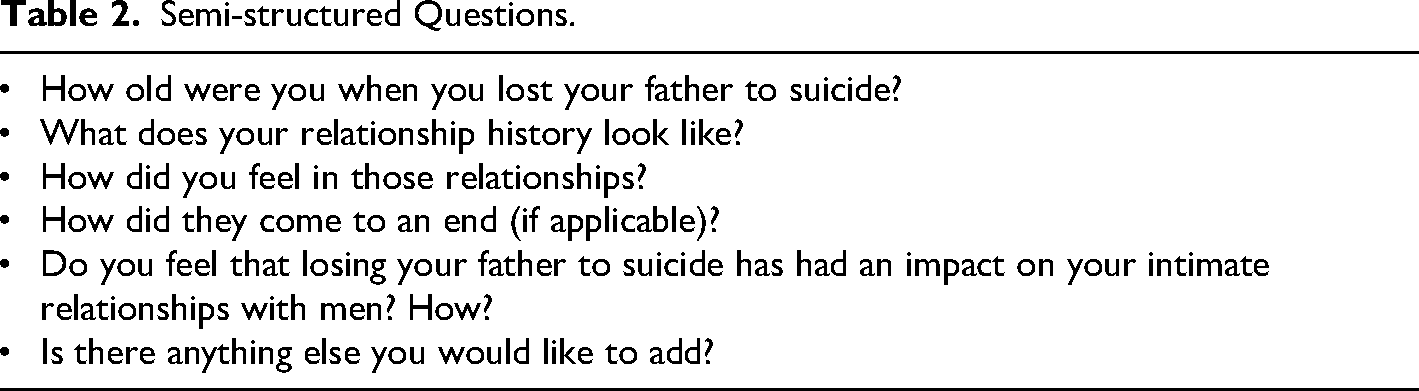
The Participant Information Sheet and Consent Form were shared with each potential participant. Four participants responded (see Table 1) and were interviewed using semi-structured questions (see Table 2).
Participant Information.

Semi-structured Questions.
The interviews were transcribed. Transcripts were analysed using interpretative phenomenological analysis (IPA) (Smith et al., 2022). This method captures the unique, phenomenological, lived experience of the participants. The method of analysis involved the researchers ordering the data into Group Experiential Themes (GET) and Personal Experiential Themes (PET) following a six-stage process. Participants’ anonymity was protected through the use of pseudonyms.
Findings
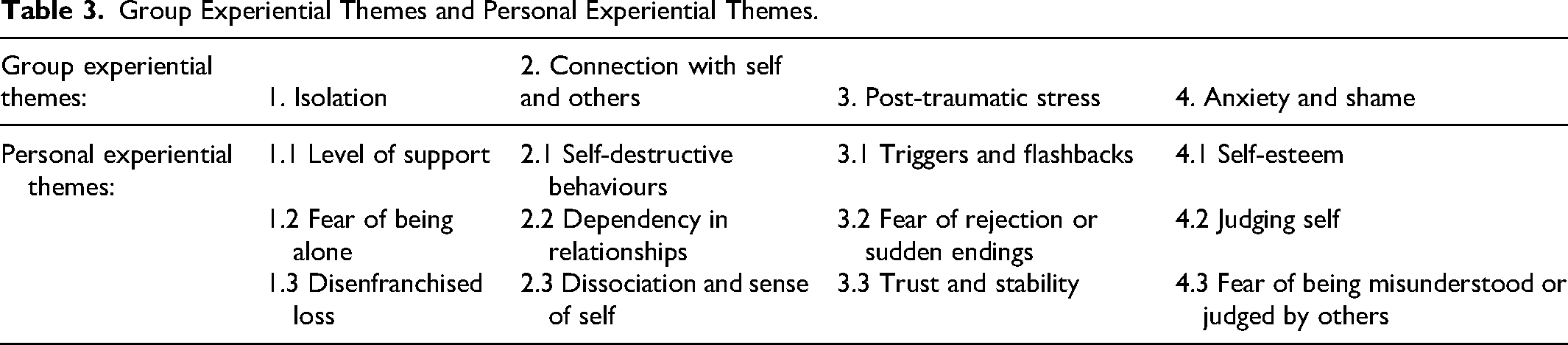
Table 3 gives an overview of the GETs and PETs that emerged from the data.
Group Experiential Themes and Personal Experiential Themes.
GET 1: Isolation
PET 1.1: Level of Support
Carys described a strong bond with her mother and stated, “I think we all had a lot of support when he died. My grandparents on both sides were there… we also had aunts and uncles on both sides who were very close and very helpful.” She described, “my stepfather and I get on very well and we really enjoy each other's company… Within a matter of months, we were back to nuclear family where we had mother, stepfather and all that” (Carys). In contrast, Aaliyah, Bethan and Della experienced an absence of support. Aaliyah and Della described a lack of emotional support, specifically from their mothers: My mum wouldn’t take care of me, like on a psychological level. (Aaliyah) I had a very, very strained relationship with my mum… I wouldn’t say that my mum was supportive. (Della) I was a daddy's girl. We were really, really close. (Bethan) My dad was the parent that I was closest to. We were really, really tight. (Della)
When asked about the amount of support available, three participants expressed a need to raise awareness and provide support for suicide loss survivors. “It's something that does need to be supported a lot more. You don’t hear really of support groups in that sense” (Bethan). No one really looked for information about it and it just led to me being on my own, which was very lonely and I really don’t believe children at any age, should be left in this place where they have to figure this out on their own because it was really painful for me… I just wish there was more support and more information about it. (Aaliyah)
All participants received therapy at some point following their bereavement. Aaliyah described being able to connect with her sense of self in therapy, “only after years, and being in therapy, I realised that whatever was happening, that it wasn’t right.” In contrast, Della stated she received a year of therapy immediately after her bereavement but noted an inability to be “engaged” in the sessions. She talked about receiving therapy after the breakdown of her marriage. Bethan was unable to connect with the group therapy that she accessed and described feeling alone in her grief, due to a lack of shared experience. Connecting with this research seemed to provide a feeling of being less alone in her experience, describing it as a “breath of fresh air to be able to talk about it, and for someone like you to actually know what I’m saying and understand what I mean” (Della).
When addressing a need for support, Bethan noted, “if girls get the help early on, they might have different ways to deal with it, and maybe that anxiety and emotion won’t be so raw because they’ve had support and methods on how to deal with the situation.”
PET 1.2: Fear of Being Alone
When reflecting on intimate relationships, Aaliyah noticed that despite feeling they were unsuitable, she remained in them because, “I was just very afraid to be alone at some level.” For Bethan, she began a relationship soon after a breakup, “I think that is solely because I didn’t like being on my own.” Aaliyah described an improved relationship with self, following a “healthy,” long-term relationship, and noted that she felt comfortable with the idea of being alone. For Bethan, and Aaliyah in former years, the idea of being single was associated with feeling alone. In contrast, Della noticed she did not feel alone when single. Della expressed that she felt most alone in her marriage when, “intimacy had completely broken down.”
PET 1.3: Disenfranchised Loss
For Bethan and Carys, disenfranchised loss was a reoccurring theme: I was taking those grades home to my dad and saying, “Look, this is what I’ve achieved” and now I don’t have that… I think it also affects things like weddings and having children and things like that… I have no idea what I will be like when it's my wedding day and he's not there. (Bethan) There are a lot of things that I’m doing that he would be really proud of, and I’m sad that he wouldn’t be able to see it… Damn, I wish he was there to see that all his efforts weren’t for nothing and I actually made it through. (Carys)
GET 2: Connection with Self and Others
PET 2.1: Self-Destructive Behaviours
Della described “self-medicating… I was drinking a lot. I was doing a lot of drugs. I was just really not in a good place.” Aaliyah noted feeling drawn to older men, “I started another relationship with another guy who was ten years older…then, after some time it was another man who was older and then again.” She ended these relationships when she identified “aggression” in her boyfriends, saying that this reminded her of her father's aggression. Carys was surprised that she was attracted to her husband who is “nice and caring and sensitive,” but felt she would be attracted to opposing personality traits. “I actually looked for someone who was not as nice and caring and sensitive.” She added, “he's more like my stepfather.” Della noticed that her marriage was at times “controlling.” “…It's taking me back to when my mum used to control me?” and she questioned, “…you have to look at yourself and think well, ‘Why am I attracted to, what is it about my energy that is attracting people like this?’”
PET 2.2: Dependency in Relationships
Three participants (Bethan, Della and Aaliyah) shared experiences of being in “toxic” or “controlling” relationships, with people who were not good for them and implied a need to be in them, to feel less alone. Aaliyah described, for many years it was just a constant thing that I was in a relationship… I knew that it's not something I needed. It was just something like a shadow in me, like something bad, something dark that wanted this. It was this bile in me… I was trying to protect myself, like having someone, at least someone by my side who would care for me and love me in a weird way, in a wicked way, but still, there would be someone.
PET 2.3: Dissociation and Sense of Self
Carys stated “I don’t attach any emotion to it” when reflecting on the aftermath of her father's death. “I don’t look back at it fondly. I wouldn’t repeat it, but I wouldn’t call it trauma. It's the same as looking back at that time I lost my phone. I don’t know if it's because I’m completely devoid of emotions.” Bethan recalled experiencing dissociation in her “toxic” relationship with her ex-boyfriend, “at the time my brain wasn’t really there and I wasn’t even really processing it. It wasn’t until we had broken up that all these memories come back and you realise what he has actually said.” She recognised she told her current boyfriend about her father's death without crying, “I blurted it all out, didn’t cry at all.” Aaliyah's sense of self “shattered” following her father's death, “It just felt like someone just hit this glass and it just shattered, and I’m just like little pieces. I’m not me, there is nothing left of me.” Della stated, “I lost a part of me when my dad died. I was just quite lost because my mum also reacted understandably quite badly to his death.” She explored her sense of self, “I’m a really kind and accepting person and I’m quite open minded, so I just go along with things.” Della discussed her sense of self through her husband's eyes, “oh sh*t, I’m married to a wife who won’t just do as she's told and is really opinionated.” She explored her changing sense of self in her marriage to avoid confrontation. “So, then I kind of really isolated myself, but then of course that's not really how I wanted to live.”
GET 3: Post-Traumatic Stress
PET 3.1: Triggers and Flashbacks
Bethan frequently discussed “triggers.” Della mentioned “flashbacks,” believing these to be a symptom of PTSD. Bethan described being caught off guard, “when friends will be like, ‘Oh I can’t be bothered with life anymore’ and I think, ‘Oh, please don’t say that, it triggers me’ and then they’ll be like, ‘What's wrong with you?’” Bethan talked about pre-empting triggers, “when I meet somebody for the first time, I’m always thinking in my head all the time like, ‘When are they going to find out what happened to me? Maybe I should tell them now,’ because if they say something that’ll trigger me off, or maybe they’ll say the question that you always get asked, ‘Tell me about your mum and dad.’” She went on to describe the relief when someone knows about her father's suicide. “You can breathe a little bit around them, because they know everything. I feel like I can be myself completely” (Bethan).
PET 3.2: Fear of Rejection or Sudden Endings
All four participants reported a greater awareness of mortality following their father's death. For Aaliyah, “it just hit me that anything can happen and anyone can do that [suicide], and I kind of realised my own mortality as well.” Carys wanted to, “establish several things. First of all, who I really loved and who I really cared about, and how important people were to me and second, establish some sort of coping mechanism in case they died.” Bethan shared a fear of the sudden death of her boyfriend, “I watched my mum lose her husband and then XXX [boyfriend] could be my husband, who my kids could watch me lose, and that's what I worry about.” Della identified a fear of experiencing sudden loss again, “Oh my God, I could not go through that again if I can avoid it, but of course, the reality is, it's not down to us, is it. It's completely out of our control.” Della highlighted how she “[stuck] around longer than I should have” in her marriage, because she feared her husband might attempt suicide. “That was really, really difficult because, to me, a depressed man takes their own life. That's my experience of a depressed man… The first man I cared about and loved, died in that way… Imagine, if something like that happens again. I could never forgive myself, even though it's got nothing to do with me really” (Della).
Both Bethan and Della felt anxious when unable to contact their partners. “…immediately my mind goes to, ‘Oh God, he's dead’, or ‘something's happened’ and then I think that's another symptom of it [PTSD]… that used to cause quite a few problems with us” (Della). Della spoke about a time when she felt her husband may have attempted suicide, “he’d been in the bathroom for a really long time and I started to get myself in an absolute panic that he’d hung himself or drowned himself and I just couldn’t shake it, and I was too scared to call his name from the bathroom for fear that he wouldn’t answer.” Bethan talked about, “not pursuing an argument or not getting triggered by the fact that he's left his phone when he's gone for a run around the block… that's a big, big thing for me. I don’t like arguments because I think they [parents] were arguing at the time. That was a big factor around losing my dad” (Bethan).
Aaliyah and Della explored their rejection of others, “I ended the relationship and then there was another guy and it was always me ending these relationships” (Aaliyah) and for Della, “am I pushing him away so that I can hurt him before he hurts me, like my dad hurt me?”
PET 3.3: Trust and Stability
Aaliyah commented on the disruption of stability when her father died, “it just ended so abruptly.” Bethan questioned her ability to trust herself when responding to hurtful comments from her ex-boyfriend, and identified stability and continuity in her current relationship, “he's been my constant since pretty much losing my dad. He [boyfriend] was there for all of that, so he knows that it touches on heartstrings.” Bethan felt a comfort in trusting her current boyfriend with her grief, but identified, “I can have trust issues within the relationship. Sometimes my partner, XXX, will go for a run and he’ll leave his phone at home and then I’m a mess until he gets home, and then I’m like, ‘Why have you not taken your phone with you?’ And it's things like that, that if I hadn’t lost my dad, that wouldn’t be happening in my relationship” (Bethan).
GET 4: Anxiety and Shame
PET 4.1: Self-Esteem
Della explained, “I do feel like my self-worth is low because of the situation I’ve been in with my parents, that is, my father's suicide and my mum just being quite horrible. My sense of self-worth and self-esteem was quite low anyhow growing up, because of the relationship that I had with my mum, and then if the one person who you think loves you more than anything has then gone and done that [suicide], I mean, it must affect me” (Della).
PET 4.2: Judging Self
Aaliyah expressed shame regarding her relationships with older men. “I believe that people can have age gaps in the relationship and it's fine. But when I’m not even eighteen years old yet…” but later spoke of an acceptance of it being her process. “It's alright that there are all sorts of experiences out there, and everyone goes through their personal hell in some way. That is all normal.” Referring to the flashbacks that she would experience on the balcony, Della explained, “it's something that I’ve always been quite ashamed of, or I don’t know if shame is the right word. Maybe just I haven’t really understood it and I didn’t want to go there within myself, so therefore I wouldn’t let him [husband] in.” Carys seemingly judged her behaviour before her father's death, “I feel almost shocked at how naive I was back then, that I hadn’t even considered that one day my father could die overnight and I could have not mentioned that I cared about him, and I was very grateful for all things he had done to me.” She expressed regret for not being able to tell her father she loved him before he died.
PET 4.3: Fear of Being Misunderstood or Judged by Others
Three participants described a fear of being judged by others. For Della, “you don’t want someone to be like ‘Oh for God's sake, that's just irrational.’” Aaliyah felt judged by others for her relationships with older men. When Bethan recalled her response to being judged, “‘Oh, please don’t say that, it triggers me’ and then they’ll be like, ‘What's wrong with you?’” Bethan experienced understanding from a friend when “triggered” by a film, but acknowledged the response may have been misunderstood and judged if she was with someone else. Bethan experienced a need for her tutor to know about her grief to avoid being misunderstood and judged.
Discussion
The data highlight the isolation that can be experienced by suicide loss survivors. Although Carys received substantial support, the majority of participants reported a lack of support following their father's death, something that is widely recognised as being the experience of suicide loss survivors (e.g., Oexle et al., 2020). Aaliyah, Bethan and Della described feeling unable to talk to others about their grief, which intensified their isolation. Carys described being disconnected from her emotions, so perhaps was not consciously aware of a need to talk. For Della, there was a sense of wanting to protect her father that contributed to a lack of self-disclosure. Berardelli et al. (2020) acknowledge that a desire to protect the family from judgement contributes to a lack of self-disclosure, and it could be an attempt to protect others from hearing the traumatic story. Three participants reported a lack of self-disclosure, so it would seem that shame, and the stigma connected to suicide, could lead to isolation. The data indicate that emotional intimacy, found in intimate relationships, eased this solitude for Aaliyah and Bethan.
Two participants shared their experience of disenfranchised losses. Bethan experienced isolation, as a result of these losses not being recognised or understood by others. She identified her boyfriend's acknowledgment of her distress, as emotional intimacy – something she proposed cannot be achieved to the same extent, through friendships. Della described feeling understood by her father, in a way that nobody else could.
The data suggest that a fear of being alone, may have reminded participants of the isolation they experienced, following their father's death. Lev-Ari and Levi-Belz (2019) state that the breakup of intimate relationships exacerbates complex grief and increases anxiety. This could explain why Aaliyah stayed in relationships as a way of avoiding being alone, why Bethan formed a relationship soon after a breakup, and why Della had a need for constant physical intimacy. Della's description of feeling trapped and lonely, when physical intimacy broke down in her marriage, could illustrate the extent to which physical intimacy was able to relieve feelings of isolation. Prager et al. (2013) argue that a lack of physical intimacy can create psychological distress. Arguably, intimate relationships can alleviate the rejection experienced by suicide loss survivors (Lukas et al., 2007). Høeg et al. (2018) corroborate that rejection can engender a sense of feeling unlovable, creating a drive to form intimate relationships. Bethan feared losing emotional intimacy, yet Della expressed a desire for physical intimacy. Bethan's propensity towards self-disclosure and Della's discomfort in self-disclosure, could be factors that affect the desire for emotional or physical intimacy. These findings therefore suggest that being uncomfortable with the idea of being alone, could create a desire for connection, in intimate relationships.
Three participants described their experiences of intimate relationships that were unfulfilling, but remained in them, to diminish solitude. Perhaps a need to have someone by their side made them more accepting of negative behaviours (Norwood, 2015). Della explained that alcohol and drugs were ways of coping with her grief, and Aaliyah noticed an attraction to aggressive, older men – personality traits that reminded her of her father. It could be argued that self-esteem is a factor in what is deemed attractive, in intimate relationships. Josselson (1996) suggests “we all secretly suspect that the reason that we do not get more from others is that we are undeserving” (p. 246). This could be particularly prevalent among suicide loss survivors, where the bereavement can affect self-esteem (Wertheimer, 2001). Although Della and Aaliyah shared an awareness of the negative impact of their intimate relationships, it took time to part with them.
Aaliyah described feeling physically stuck in adolescence, at the age when she was bereaved, perhaps explaining a propensity to seek the support that would have been provided by a caregiver, as a way of replacing the attachment that she had with her father. Aaliyah explained that therapy and a positive intimate relationship deepened self-awareness, enabling her to recognise that she could give herself the support that she needed, coming to the realisation that no intimate relationship would be able to provide the healing she was seeking. It would seem that an internal strength had developed for Aaliyah, creating empowerment, rather than a fear of being alone.
Loy and Boelk (2014) state that suicide loss survivors may be at increased risk of PTSD, something that was experienced by Bethan and Della. Della did not witness her father's death but did see his body afterwards. From what she described, it seemed likely that she had imagined what his death would have looked like. It would seem that in trying to make sense of events, she tentatively questioned if it was accidental. Bethan and Della described being closer to their fathers, rather than their mothers, highlighting the paternal support they historically received. Hibberd et al. (2010) corroborate that the relationship with the deceased has an impact on PTSD, and also suggest that a lack of support can increase the likelihood of PTSD among suicide loss survivors. Although Bethan now receives support from her boyfriend, before this relationship was formed, she, like Della, expressed an inability to talk with her family about how she felt, and therefore did not experience support.
Bethan and Della described a lack of control over their responses, and Bethan discussed a desire for greater control over her PTSD. She felt she needed to tell people about her father's suicide, as a way of reducing post-traumatic stress. Mead (2020) acknowledges the “dreaded conversation” (p. 163) that suicide loss survivors feel must take place, and proposes that they could encounter greater difficulties when dating. Bethan told her boyfriend about her suicide bereavement on their first date. It would seem that a sense of urgency for self-disclosure could be at odds with the notion, reinforced by society, that conversation on a first date should be kept light (Newman, 2016). This can create an added layer of pressure for suicide loss survivors, trying to balance social norms with their post-traumatic stress. The reaction of the potential partner, in response to what has been said, is also crucial. Whilst suicide loss survivors have no control over their past experiences, Bethan illustrates a sense of feeling different or damaged in some way, which could produce an imbalance of power, or affect self-esteem, when forming relationships (Josselson, 1996). Arguably, the fact that Bethan fears being reminded of her father's death, suggests this happens often, creating a propensity towards self-disclosure as a way of managing this.
Della expressed a lack of understanding from her husband, and Bethan feared that her boyfriend could die suddenly. Although she did not share her boyfriend's responses to her post-traumatic stress, Bethan felt this could put strain on the relationship. It would seem that a lack of understanding, and in Della's case, a judgement that her reactions were “disproportionate,” could exacerbate the isolation experienced by suicide loss survivors, and could negatively affect the ability to sustain relationships. Bethan described the comfort she feels, when her boyfriend understands her stress reactions, thus supporting the hypothesis that PTSD has the potential to create isolation, unless it is recognised and validated.
The data suggest that Bethan's experience of suicide loss affected her behaviour in her intimate relationships. She refrained from arguing, because it was reminiscent of her parents’ arguments before her father's death, suggesting there may be a fear that this contributed to his death. Choosing not to pursue arguments could be an attempt to regain control, in response to the helplessness that suicide loss survivors can experience (Leenaars et al., 2020). This behaviour could also be a way of attempting to prevent further losses, but results in her being unable to fully express herself, which may have psychological ramifications in the long-term. Whilst Bethan did not fear her boyfriend dying by suicide, as was the case for Della, she feared that accidental death could occur before they could resolve the argument. She described a close bond with her father, and now a closeness with her boyfriend, stating he is like her “therapist,” but feared losing that emotional connection through sudden death. She implied he may leave, although she did not name suicide. Her statement about leaving could be interpreted as the potential for suicide, or the relationship being terminated. Arguably, the fear of her boyfriend going missing, could stem from her father's disappearance before his death. Bethan shared this awareness of mortality and sudden endings led to “exhausting” rumination, but despite wanting the emotional support of an intimate relationship, the discomfort of this rumination led her to believe it may be easier not being in an intimate relationship, illustrating the discomfort connected to the possibility of sudden endings. Similarly, Della made a link between her father being “the first man I loved,” and her husband, a man whom she also loved, which could illustrate the presence of transference within intimate relationships.
The data show that all participants reported a greater awareness of mortality. Della and Aaliyah explicitly shared a fear of further suicide losses, yet Carys and Bethan implied a fear of accidental deaths, not necessarily suicides. It would seem that losing someone suddenly, can alter suicide loss survivors’ views of, and trust in, the world and ways of thinking, which Mead (2020) argues may be harder for non-suicide loss survivors to understand. Carys shared that death is something that her husband does not contemplate. It seems that her awareness of mortality has shaped how she acts in relationships, ensuring she communicates her appreciation, for fear of unplanned endings that could prevent her loved ones knowing how much they meant to her. Arguably, in a similar way to Bethan, Carys’ experience is reminiscent of her inability to express her gratitude towards her father, before his death. Aaliyah communicated a raised awareness of suicide loss, and its probability, but her experience was slightly different in that she became aware of her own mortality, as well as that of others. Della also acknowledged a fear of future suicides, when she refrained from ending her marriage, despite being unhappy, because she feared her husband may have taken his own life. There is a wealth of research (e.g., Andersson, 2012; Hung & Rabin, 2009; Kharay, 2011) highlighting the increased risk of suicidal ideation among suicide loss survivors, but less research has been conducted into their fear of others dying by suicide. Della linked her husband's depression with her father's depression and his suicide. Although she acknowledged others’ actions as being out of her control, she feared feeling responsible if he chose to end his life. Despite an awareness of this contradiction, these fears seemingly overpowered her ability to action her needs, illustrating how post-traumatic stress could shape behaviour in interpersonal relationships. Although Aaliyah, was aware of the possibility of suicide, this did not stop her ending relationships when she felt they were no longer serving her.
The data suggest that post-traumatic responses increased the likelihood of complicated grief (Lev-Ari & Levi-Belz, 2019), adding strain on intimate relationships, if it was not understood by significant others. Bethan did experience feeling understood and accepted by her boyfriend, yet Della did not feel comfortable in talking. Lev-Ari and Levi-Belz (2019) recognise that self-disclosure helps to reduce complicated grief. Although Della struggled to end her marriage as she feared her husband might attempt suicide, she discussed pushing him away in their relationship, and questioned whether she was rejecting him before he had the chance to reject her, linking this with her experience of being hurt by her father when he died. She felt she was rejecting herself and others which could stem from potentially feeling rejected by her father and unconsciously feeling unlovable. Della and Bethan described a propensity to assume fatality when unable to contact their partners. There is a deficit of research into this phenomenon, which could explain why this may be less understood by non-suicide loss survivors, making it difficult for them to empathise with, or understand. Arguably, this lack of understanding has the potential for suicide loss survivors to feel isolated, judged and may affect self-esteem.
Aaliyah reported accepting less than she had hoped for in intimate relationships. Haine et al. (2008) make the link between suicide loss survivors and reduced self-esteem. However, as Aaliyah did not report low self-esteem, it cannot be confirmed that this was her experience. Arguably, lowered self-esteem could be a less conscious process, in response to feelings of abandonment (Silvén Hagström, 2019), and may not always be consciously evident to suicide loss survivors. Della experienced low self-esteem. However, she explained this was the case before her father's death, and linked her low self-esteem to the relationship with her mother. Although not consciously in her awareness, she did state that her father's suicide must also have been a factor.
Judgement was a theme that was noted among all participants. This varied in terms of feeling judged by others (Aaliyah, Bethan and Della) and judging themselves (Aaliyah, Carys and Della). Carys judged herself for not being prepared for sudden death. Della was ashamed of her marital breakdown, and when referring to PTSD, she judged her reactions, and implied being judged and misunderstood by her husband. The fact that Della felt uncomfortable with self-disclosure at this point, could explain why her distress went unnoticed (Lukas & Seiden, 2007), as others were perhaps unaware of the extent of her experience. Bethan also felt judged by others, when events triggered post-traumatic stress.
Following therapy, Aaliyah was able to replace prior self-judgement in dating older men, with compassion, acknowledging she was doing her best to manage her grief. She expressed sadness when explaining that people were quick to judge her behaviour, rather than recognise it was an indication that she needed support. Young et al. (2012) propose that few suicide loss survivors seek support, yet it would seem that in Aaliyah's case, she did not realise support was needed at that time. As there is little research into the experience of adolescent suicide loss survivors, it may be harder for people to acknowledge behaviours that do not explicitly request support. This could explain why there may be a lack of compassion and understanding for suicide loss survivors’ behaviour, particularly among adolescents, which creates a propensity towards judgement. Bethan described feeling anxious that she was judged, which led to her talking about her father's suicide with a tutor, something she may not otherwise have done; but fear of being judged as emotionally fragile, led her to change her behaviour. This illustrates that judgement may exist, if suicide loss survivors’ experiences are unknown, but explaining their story can potentially be distressing for them.
Conclusion
The limitations of this research include an inability to generalise findings because of the small sample size. Nevertheless, the data provide some useful insight into the phenomena under investigation. It is impossible to know whether participants would have experienced these same difficulties in intimate relationships, if the suicide of their fathers had not taken place. As participants were adolescents when they experienced the loss, it could be argued they did not have experience of relationships before the suicide, to compare with. In recruiting participants who were heterosexual females, we attempted to reduce the variables that may have affected data. However, it would seem that even in recruiting a niche cohort of suicide loss survivors, there are still several factors at play, affecting their experiences, and possibly the data, in different ways.
Further research may prove useful to gain insight from the significant others of suicide loss survivors, as it would seem that whilst the phenomenological aspect of this research project conveys a depth of experience, there may be some unconscious, protective factors preventing suicide loss survivors from acknowledging some behaviours, as a result of their traumatic experience. Further research could ascertain whether the experience of adolescent suicide loss survivors compares or contrasts with adult suicide loss survivors, looking specifically at the impact of sense of self, how it affects their response to the suicide, and the impact on post-traumatic growth.
Although a small sample, the data indicate that the majority of participants encountered difficulties in their intimate relationships which they directly linked to their fathers’ suicide. The most common effects were related to PTSD, something that can only be ameliorated if support is received (Jordan, 2020). It would seem that the shroud of silence around suicide (Lukas et al., 2007), and societal reluctance to discuss suicide bereavement among adolescent suicide loss survivors, for fear of raking up painful feelings, results in a lack of research, recognition, validity and support. In reality, the findings of this research project suggest that suicide loss survivors are already in pain, whether it is visible or not.
In terms of developing the awareness of counsellors and helping professionals, three participants expressed a need to raise awareness and provide support for suicide loss survivors. If counsellors and helping professionals were able to signpost clients to the SoBS website, clients may be able to find a local support group. Perhaps further training on suicide loss for counsellors and helping professionals could facilitate this. Support is often signposted to parents, and it is at their discretion if this is passed on to their dependents. The data suggest that suicide loss survivors may not be aware that they need support, which results in them being unable to ask for help.
Awareness that PTSD may be linked to suicide loss is also important. Whilst there is little research that makes that link, it would seem that suicide loss survivors who experience PTSD may not acknowledge that their responses are symptoms of PTSD. Psycho-education may play a role in facilitating post-traumatic growth, and provide opportunities for suicide loss survivors to speak openly about their suicide bereavement, which is effective in reducing psychological distress.
Footnotes
Declaration of Conflicting Interests
The author(s) declared no potential conflicts of interest with respect to the research, authorship, and/or publication of this article.
Funding
The author(s) received no financial support for the research, authorship, and/or publication of this article.
