







Abstract
Interest in adjustment issues Veterans face following incarceration has grown rapidly in response to the prevalence of stress-related disorders as well as the physical, social, and occupational challenges when reintegrating into communities. While reintegration may be a positive event that includes the reunification of family, friends, and a return to civilian life, transition can also involve a wide range of difficulties and crises impacting readjustment. Veteran reintegration has been understood as a complex process influenced by different levels, such as at the individual, interactional, and socio-cultural level. This article takes a Veteran standpoint to explore how Veterans’ lived experiences are a basis to understand their transition readiness. Specifically, identity work clarifies the empirical self-constructions of Veterans’ standpoint and their everyday strategies used for post-incarceration transition efficacy.
Introduction
Veterans and non-Veterans exiting prison will encounter high rates of significant negative events, outcomes, and barriers that interfere with their long-term success. This finding does not imply incarceration is causal in all cases; those who become incarcerated have several difficulties prior to incarceration. However, it does suggest this cohort could or should trigger a deeper review by clinicians of factors that may contribute to the high rate of negative outcomes. Scholarly and public interest in the post-incarceration adjustment issues Veterans face has received attention in response to the prevalence of stress-related disorders as well as the physical, social, and occupational challenges when reintegrating to communities (Elnitsky et al., 2013; Sayer et al., 2014). While reintegration may be a positive event that includes the reunification of family, friends, and a return to civilian life (Firmin et al., 2016), it can also involve a wide range of difficulties and stressors that impact Veterans’ readjustment to various social arenas (Danish & Antonides, 2013). Roughly 27% of returning service members and Veterans will be diagnosed with post-traumatic stress disorder (PTSD; Phillips et al., 2016), 87% with chronic pain (Phillips et al., 2016), and 12% to 23% with traumatic brain injury (TBI; Church, 2009). In addition to mental and medical treatment needs, researchers have made progress in mapping post-incarcerated Veterans’ risk of homelessness and housing instability (Geller & Curtis, 2011), unemployment (Schaffer, 2015), and mortality (Binswanger et al., 2013). In all, Veteran reintegration has been understood as a complex process influenced by individual, interactional, and socio-cultural factors (Resnik et al., 2012; VA, 2013, p. 7).
Research important to this area has begun to focus on the role of Veteran identity to deepen our understanding of transition pathways (Dolan et al., 2022; Firmin et al., 2016; Gade & Wilkins, 2013; Orazem et al., 2017). Early studies identified a “crisis of identity” or “disrupted identity,” alongside Veterans’ adjustment accounts, to describe tension between military and civilian cultural expectations that left Veterans feeling out of place in civilian society (Demers, 2011; Rumann & Hamrick, 2016; Smith & True, 2014). Along with the possible problems associated with identity stresses, however, the potential for positive outcomes has been alluded to as well. Veteran identity is documented as a protective factor, wherein identification with a Veteran sense of self has been linked with positive adjustment (Firmin et al., 2016; Haranda et al., 2002).
We sought to extend this literature by exploring how post-incarcerated Veterans actively construct meaning in relation to their Veteran identity to inform their transition readiness post-incarceration. Our research focused on how post-incarcerated Veterans’ identity shapes an awareness of transition readiness, responses to significant transition events, and development of social roles important for readjustment. With more attention given to the local realities of Veterans’ lives, we developed a theoretical framework of the symbolic interactional process that constitutes Veterans’ attitudes and practices in their transition from prison. The aim was to illustrate how a close examination of Veteran identity work illuminates transitional opportunities and challenges. To this end, we conducted a qualitative study with post-incarcerated Veterans from across the United States: (a) to develop a theoretical lens that describes the formative process of Veterans’ standpoint, and (b) to use an identity work model to clarify how post-incarcerated Veterans develop transition readiness to address major life challenges, such as housing instability, social connectedness, employment, health care, among other issues.
Literature Review
Post-incarceration transition is usually defined as the period of reintegration into civilian life, which includes the process of change a Veteran goes through as their prison sentence ends (Cooper et al., 2018). The idea of readiness is often thought to indicate a state of preparedness, based on a set of orientations and strategies (Camara, 2013). Taken together, transition readiness can be viewed as the overall attainment and presentation of required competencies that generally prepare individuals to move into new social arenas (Abramson, 2012). Transition readiness is closely associated with having cultural competency in the shared values, views, and practices of a particular community, such as a workplace, family unit, or neighborhood (Abramson, 2012).
From a social-psychological viewpoint, an appreciation of post-incarcerated Veterans’ inner lives should consider how identities are formed and how they impact attitudes and behaviors. Literature from cross-cultural transition studies characterizes transition as a dynamic between self and culture (Westwood et al., 2002). Here identity is theorized as a relationship between the internal self and the roles that one enters in broader society (Hammack, 2014; Stryker & Burke, 2000). Identity represents the links between internal, psychological understandings of self with external social categories and groups (Hammack, 2014). Self-concept emerges, in part, from membership in groups and perceived shared characteristics (Tajfel & Turner, 1986).
We argue that conceptualizing Veterans’ transition from prison as identity work helps answer key empirical questions about how a Veteran standpoint is constituted and the degree to which a self-concept generates pathways for transition readiness. Identity work represents “anything people do, individually or collectively, to give meaning to themselves or others” (Schwalbe & Mason-Schrock, 1996, p. 115). Identities build from broader going concerns, such as dominant cultural and institutional discourses. Put differently, the production of selves occurs in the context of local cultures. Institutions such as the military and prison provide symbolic and material resources for a person's identity work. In the words of Holstein and Gubrium (2000), selves are constructed “in accordance with local relevancies” (p. 104). Local cultures indicate the somewhat stable ways of making meaning; they are the “big stories” found in persons’ immediate setting utilized to make sense of the world (Gubrium & Holstein, 1997). In this study, we appreciated Veterans social (interactional) experiences in the military and prison as an important site for self-production, which also offer discursive resources for Veterans’ identity work. Methodologically speaking, observing post-incarcerated Veterans’ identity work is a way to understand how they strive to rebuild familial, occupational, and other social bonds (Swidler, 1986).
Identity work also alerted us to the interplay of discourses-in-practice and discursive practice used in the constitution of the self. Discourses-in-practice are those cultural discourses socially operant that frame meaning making, since they are already locally imposed. This part of identity work relates to the institutional dimension of discourse (the nouns). Discursive practice points to the work individuals do when they integrate their biographical stories into the narratives already in play (the verb). This dynamic approach to identity helped us conceptualize Veterans’ standpoint as a process—namely, as a way in which Veterans “talk themselves into existence” (Broad et al., 2004, p. 516).
On an empirical level, we adopted Wendlandt and Rochlen's (2008) model of transition readiness to alert us to key transition crises, issues, and events. Wendlandt and Rochlen (2008) suggested a phased approach to thinking about transition that occurs along three dimensions: anticipation, adjustment, and achievement. Keeping these transition phases in mind allowed us to situate identity work in Veterans’ practical transition experience. Transition stress, for example, was linked to “unanticipated adjustment difficulties and unmet expectations” following prison (Westwood et al., 2002, pp. 221–222). However, Veterans also managed transition stress by maintaining continuity with a military identity that provided daily coping strategies. As will be discussed later, post-incarcerated Veteran stories revealed the important role of identity work in their effort to mediate crises and move toward transition readiness.
Recruitment, Data Collection, and Analysis
The overall recruitment strategy involved several methods and sites to maximize our recruitment of Veterans. (a) We identified Veterans from the Dallas Veterans Affairs (VA) Medical Center as it is the researchers’ clinical setting. We also recruited at VA sites across the United States. (b) Health Care for Reentry Veterans staff provided Veterans whom they see in prison with study contact materials for when they were released. (c) Veterans were contacted by various homeless programs. (d) Flyers were also placed in the ambulatory care clinics where Veterans frequently make first contact with personnel associated with the VA. The study was approved by the Dallas VA IRB, #1589863. All participants were provided informed consent, with a total of 54 Veterans participating in the study. Table 1 shows Veteran demographics.
Socioeconomic Characteristics.
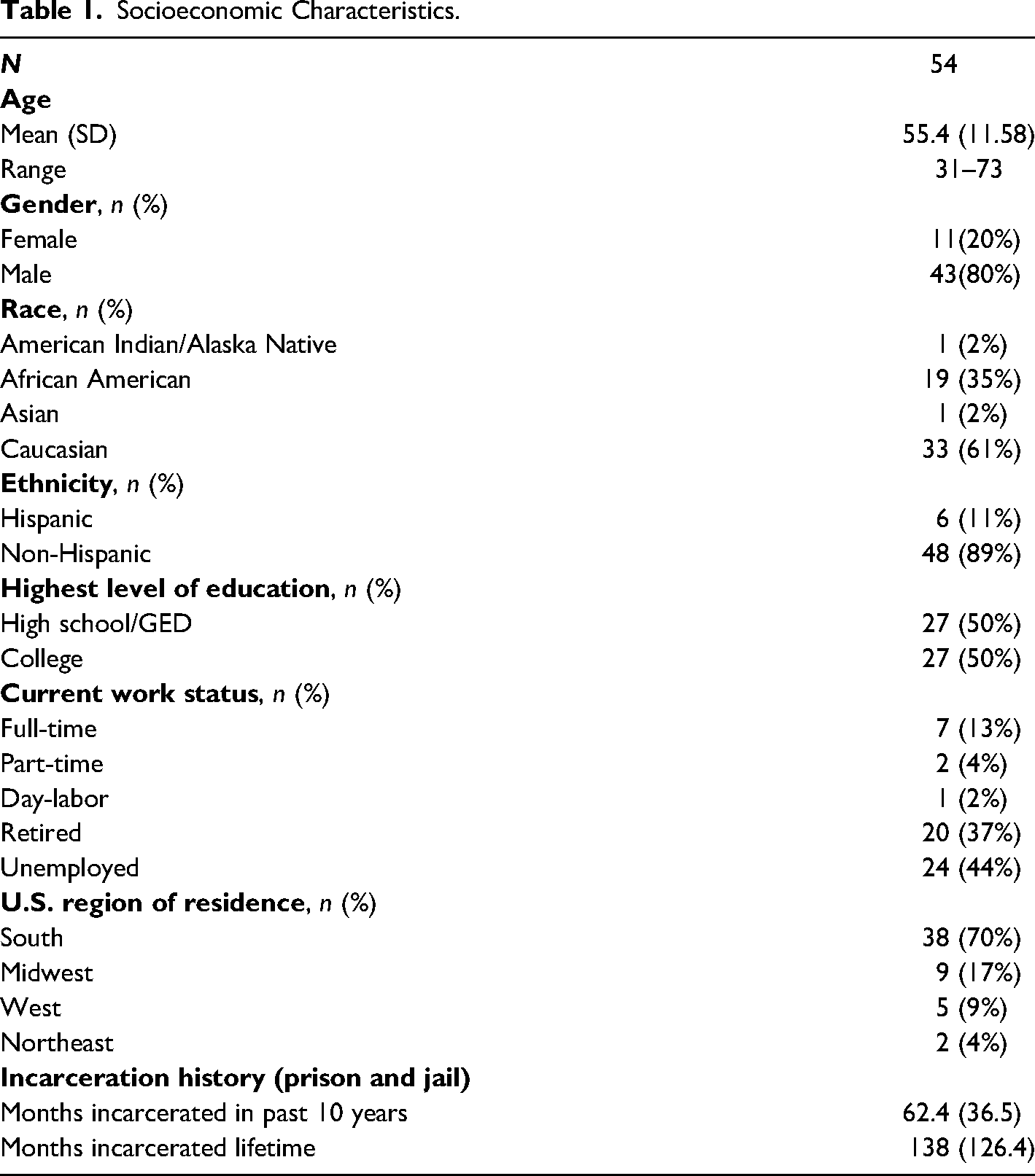
Following a grounded theory approach, sample size was determined by theoretical saturation, which is reached when no new conceptual information is discovered in the data (Morse, 1991). While our design was not based on rigid quota criteria, we sought representation across age, gender, race, ethnic, educational, occupational, regional categories, and incarceration histories. We made a concerted effort to oversample post-incarcerated women veterans, who are underrepresented in studies. The logic of the recruitment strategy was not to generalize in a rigorous way, but rather to obtain a sample sufficiently diverse in post-incarceration experiences.
Participants were encouraged to tell detailed stories that illustrated their post-incarceration histories and perceptions. Semi-structured interviews lasted approximately 90 to 120 minutes and initially focused on current transition needs (e.g., medical, housing, employment, family reunification). The interview protocol also guided Veterans to comment in more detail on key transition dimensions. Transition-specific questions asked Veterans to describe how they set short- and long-term goals after initial release, the ways they made accommodations when goals and expectations went unmet, and how they developed psychosocial and behavioral strategies for more prolonged transition success.
With respect to an analysis strategy, coding was conducted alongside data collection. Immediately after conducting each interview, the researchers prepared extensive theoretical, methodological, and personal memos (Schatzman & Strauss, 1973). After completing all the interviews and analysis, we solicited feedback from all researchers, including a sample of participants, to assess the validity of generated codes.
Interview Findings
Military-Prison Mindset as Discourse-in-Practice
Veterans focused on their time in the military and prison as important factors in their transition experience. Of interest, however, was how Veterans relied on broader institutional narratives to define themselves, frame interests, and express concerns about transitioning to civilian life. On the one hand, Veterans adopted what some refer to as a “military mindset” based on the adoption of specific values and beliefs (i.e., loyalty, duty, respect, personal courage, and strength) learned from the practical experience of training and actual combat performance (Firmin et al., 2016). In recollecting their military background, Veteran interviewees used concepts such as being “brave”, “strong”, “tough”, and “disciplined” to describe an approach to manage their transition: “It's a vet thing … basic training makes you disciplined. You have an attitude of having control over things when you get out … being tough” [please note italics added for theoretical emphasis]. Veterans carried these military mindset attributes into their life after prison.
In similar fashion, our interviewees referenced a “prison mindset” (Sreenivasan et al., 2018) as another way to characterize their post-incarceration. Here Veterans discussed having a “fight” mode mentality that built upon the idea of military toughness. Ideals learned in prison were described as functional for life after prison. For example, transitional housing was imagined having problems that mirrored prison, such as regular confrontations and theft: In prison all you have is your word and I get respect with fear. In prison I had to fight from the first day. … You’re not supposed to have weakness. And out here [civilian life] you have to show people something. … Being in transitional housing with others can lead to a fight over possessions. I’m not letting someone take advantage of me.
Dominant military and prison narratives continued to operate as part of Veterans’ attitudes and behaviors post-incarceration. One Veteran explained this component of Veteran identity work quite succinctly: “as a vet, the military holds the self to higher standards.” In the theoretical language of identity work, this mindset represents a discourse-in-practice, an institutional narrative Veterans build a sensibility, conscience, and evaluation of their transition to civilian life (Holstein & Gubrium, 2000).
A key question was how a military and prison mindset specifically interact to impact transition readiness. Literature focused on Veterans transitioning from military deployment to civilian life is instructive here. Research shows the benefits of maintaining continuity between military and civilian identities (Koenig et al., 2012). While identity theories have emphasized the importance of identity coherence, we do not seek to make an ontological claim regarding an “essential” or “unified” self. Instead, our intention with this literature is narrower. It is meant only to highlight that continuity in the self may offer individuals with the practical opportunity to carry the same social-psychological resources from one social setting to another (McAdams, 1993; Schwartz, 2001). This insight helped us further theorize Veteran identity work around the everyday narrative tools Veterans use to build goals, motivation, and social behaviors for their lives after release. More specifically, Holstein and Gubrium (2000, p. 12) noted the self is active because individuals accomplish selves by using “biographical particulars” to reinterpret dominant cultural narratives for new purposes. As mentioned earlier, Holstein and Gubrium (2000, p. 9) refer to this process as discursive practice, or how Veterans do self. The next section illustrates how continuity with military and prison selves (i.e., discourse-in-practice) was a basis to construct selves in support of post-incarceration transition readiness (i.e., discursive practice).
A Discipline Self for Transition Readiness
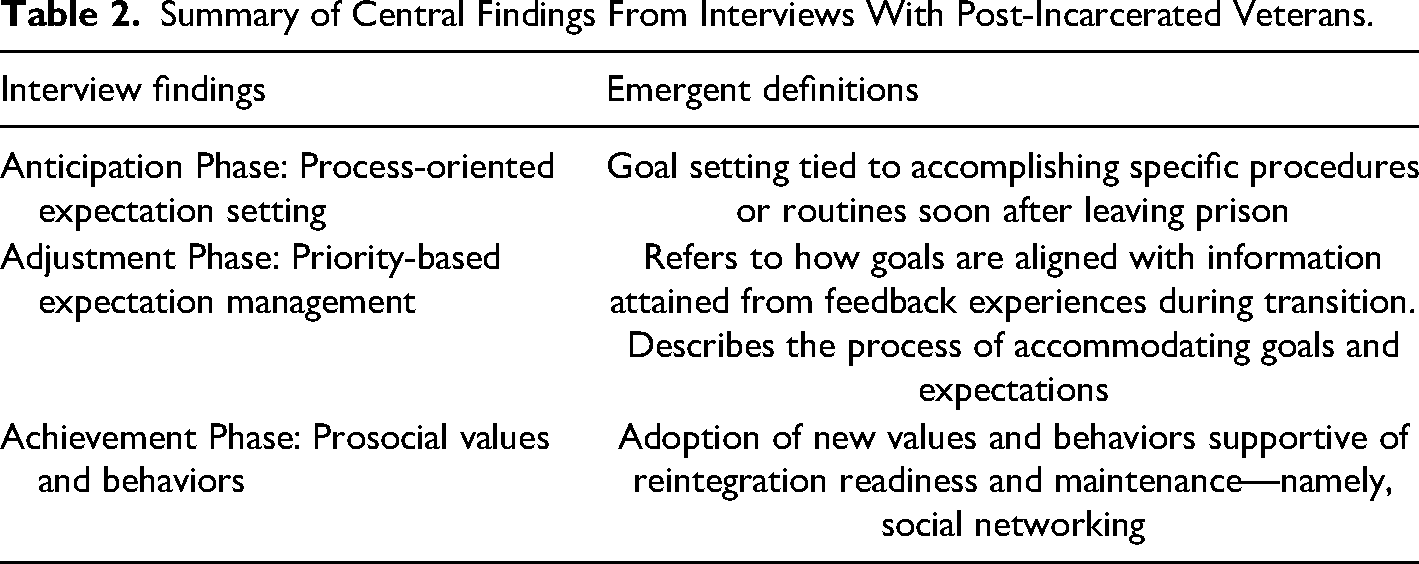
To mitigate the wide range of difficulties of readjustment (Lomsky-Feder et al., 2007), research supports a phased approach to assist Veterans over time and through key transition dimensions (Faulkner & McGaw, 1977). In this vein, we asked Veterans to explore the stages of having been recently incarcerated, exposed to reentry settings, and more fully involved in civilian life. In their stories, Veterans used past military and prison identity markers (e.g., toughness, strictness, and discipline) to narratively move through these phases of transition. Specifically, we introduce the idea of a discipline self as a construct used by Veterans to (a) establish an early process of setting expectations; (b) adjust to expectation challenges; and (c) adopt new values and behaviors to maintain social integration. Table 2 summarizes these findings.
Summary of Central Findings From Interviews With Post-Incarcerated Veterans.
Anticipation Phase: Process-Oriented Expectation Setting
Our exploration of Veteran identity work looked at the time before, or soon after, Veterans were released from prison (Wendlandt & Rochlen, 2008). The anticipatory phase focused us to collect and assess information related to Veterans’ desires after being released from prison, especially their expectations about their needs, wants, and anticipated new roles at home, the workplace, and other settings (Feldman, 1976). Important for this discussion is how identity work assists in observations of Veterans’ discursive practice—that is, their ability to redress broader military and prison mindsets to build practical pathways for transition. By centering discipline, particularly a focus on stepwise rules, Veterans reframed institutional narratives for anticipatory goal setting.
Being disciplined was described by Veterans as being process-orientated when setting transition goals. As one Veteran put it: I’m doing pretty good … because I have a badass plan. I would sit there [in prison] and I would write it over and over and over again when I was in prison. I would write down my goals and priorities and base my goals on my priorities. I have fear of going back [to prison] and doing something to be sent back. … it's still terrifying. … But it's like basic training … I had to make myself a list for like a whole nine months … like setting a goal of making appointments [referring to medical appointments]. The military prepared me for prison…. You have to follow orders in the military and the same in prison. You are told what to do, when to eat, when to sleep, when to go to the bathroom…I need to be strict outside of prison to survive. I focus on the small stuff right now. I try to take care of things that help me at the moment. Well, I have short-term goals … getting an appointment now. As far as the present world, I want the basic things … I want a house … to get off parole.
In this way, Veteran identity work included the discursive practice of reframing larger military and prison narratives to construct a discipline self, one that retains continuity with the past to chart practical goals post-incarceration.
We argue an evaluation of Veteran identity is significant as it explains the formation of Veterans’ worldview and their engagement with this constellation of meanings for the purpose of transition readiness (Suter et al., 2006). The examples above introduce the idea of discipline selves, which are a product of both institutional and personal meaning making. Based on these, and later, Veteran accounts, we define a discipline self as the management of emotive (e.g., transition “fear” and “terror”) and perceived challenges (e.g., being able to “survive outside” of prison) through a set of rules (e.g., repetitive steps or processes) reminiscent of the everyday experiences that defined Veterans’ military and prison life.
Adjustment Phase: Priority-Based Expectation Management
Along with anticipatory goal setting, another dimension to transition readiness relates to encounters Veterans have with reentry settings, such as housing, family, work, and community. This adjustment phase refers to when goals and expectations are more thoroughly tested in the “real-world”, along with the ways Veterans respond to emergent difficulties. A primary source of adjustment problems is the accommodation shock from settling into new environments (Louis, 1980; Wanous et al., 1992). Even though stress can be a normal part of the post-incarceration transition, the experience of not meeting valued goals may cause Veterans to dwell on negative thoughts about life more generally.
The examples below show the role of accommodation shocks in shaping Veterans’ awareness of unmet expectations: I didn’t know it would be this complicated. … More complicated than I thought … maintaining a normal life with a roof over my head, hot water, having a family, having a person in my life, being able to work… There are some goals that I had wanted and life knocked me back. Like for instance, when I got out of the Army, I thought first about being a police officer. But I figured, nah, I’m going to take a year off and have me some fun. That's when I made my mistakes, because then I ended up getting in trouble [going to prison]. …And it still hits me—Wait a minute, I’m out…now…and dang I can’t do it anymore.
In response, Veterans shared stories about the importance of “staying in order” to maintain their focus and motivation despite accommodation shocks from readjustment. Here again, a discipline self was adopted by Veterans to cope with a transition phase. One Veteran rhetorically asked how to maintain motivation in an adjustment period: How do you keep your priorities in order? It's all about…staying in order. You can talk about having a roof over your head all day long, but if you don’t pursue it, you know what I’m saying, –you’ll just be talking about it. And that makes a difference between a talker and a doer. …. I got out in the field. I made my appointments. I made my appointments, I set my appointments, and I knew what matters most. I knew what matters. So if things matter to you, you know what I’m saying? You’ll tell it by your actions. You know, not everybody does that. You know…Be sure to make your appointments…
Achievement Phase: Prosocial Values and Behaviors
A comprehensive view of Veteran transition readiness involves what scholars call an achievement phase, wherein Veterans move from managing accommodation shocks to regular goal maintenance. Progress in this area means Veterans not only begin to self-assess their readjustment experiences, but also adopt values and behaviors that support long-term reintegration to civilian life (Wanous et al., 1992). This final set of testimonials highlights how Veterans adopted new prosocial behaviors to support transition readiness.
Veterans recalled a sense of connectedness and shared purpose that comes from the structure of both the military and prison (Koenig et al., 2012). As one Veteran put it, “in the military and prison you have clear roles and purpose … you are part of a whole system.” By comparison, however, civilian life was described as more socially isolating, lacking the guidance stemming from the connectedness of their past experiences: The environment out here today is a very individualistic environment. The United States is more individualistic. They [individuals] depend upon and stand on themselves, right? Now, you got to say—Hey, look. What do I do and what do I know? Okay? And who can I trust? Because trust is a hard issue for people. Hey, but you know, that's the thing about prison. In prison, you learn. Okay? It's going to be there, and it's going to be there pretty much at a set timeframe, okay? Like, food. Like, shower. Everything is there for you. Your support mechanism is in place. It may be a little slow and abhorrent at times, but guess what? It's going to be there. You’ve got that. Now, when you get out of prison, guess what? That stuff no longer exists. You know why? Because the system ain’t taking care of you no more.
With these concerns in mind, Veterans’ discipline self was used to rebuild prosocial values and actions for social networking. A discipline self was expressed, in this instance, through a remembrance and reaffirmation of the strict and unbreakable vow Veterans made when joining the military: …because a Veteran, every Veteran knows that he makes the vow. That's the start of your military life. That's your vow. You’re giving your life up. … We made the sacrifice. I made a commitment. And that's what connects Vets. …
Through the telling of loyalty vow stories, Veterans revisited the serious commitment made with fellow service members. Through these biographical details we observed Veterans weaving together legacy stories of “commitment” to imagine “what connects Vets” now after incarceration. In a concrete way, our interviewees narrated new prosocial actions designed for the experience of transitional housing, which many Veterans encounter upon release from prison: … and we’re expected, in Johnny's House [transitional housing], to maintain that, what would they call—a shipmate kind of environment. You know, put away your petty differences. You guys are trying to get your act together, here. See what I mean? … you guys need to work together, to help each other out to get out. … You guys are here together, you’re here to help each other. This is what the house is.
The establishment of prosocial behaviors, as part of a discipline self, helped Veterans extend social networking skills to broader life domains as well, such as in reconnecting with family and finding employment opportunities. As one Veteran phrased it, there is a “renewing of the mind” that occurs with the retrieval of core values and experiences from Veterans’ past: You have to be aware that I served over 20 years in the military. … Initially I didn’t like the structure but … social structure helps. So, the structure part is very familiar to me. … There was no ambiguity about what am I doing, right? And so, I learned to rely on that network that you have. There you go. That's a good way … Because see, I now reconnected with friends, they gave me a little bit of work … and help paint [describing a house painting job]. I gave up on the VA and trying to find help…But we gotta continue to be consistent like we were [in the military]. We gotta keep trying and keep trying to see things to happen, see doors to be open…. Yeah. That's it. Now there's this situation of not letting defeat control you or dictate what you can’t do and what you can’t have in life. Because you don’t keep trying, you don’t keep going for it then you’re not really giving yourself the opportunity or a chance.
Veterans’ identity work opened pathways to transition achievement. Veterans discursively used a discipline self to rediscover commitment and motivation to engage with others for long-term transition success (Wanous et al., 1992). In all, Veterans told stories consistent with their past, but also fashioned a new identity—a discipline self—that encompasses strategies for transition readiness. Veterans’ meaning making was a site for identifying psychosocial resources designed for moving through transition stages. Veterans’ identity work was central to planning post-incarceration expectations, responding to accommodation shocks, and renewing prosocial interactions in reentry settings.
Discussion
Transition planning is an essential component to reentry intervention success. Transition planning for prisoners exiting correctional settings and returning to the community, however, remains one of the least frequently provided mental health services within prisons (Osher et al., 2003). Inadequate transition planning puts formerly incarcerated Veterans at risk of compromised public safety, as well as increased incidence of psychiatric symptoms, hospitalization, relapse to substance abuse, suicide, homelessness, and rearrest (Draine & Solomon, 1994). Furthermore, the gap between expectations and reality may place the returning Veteran at risk of disappointment and negative affect (Sreenivasan et al., 2018).
To effectively develop transition readiness, post-incarceration Veterans need guidance and reflection in developing a transition plan. Many Veterans exiting prison may experience difficulties in transition related decisions. Potential reasons include facing too many choices, not being exposed to enough options, and/or feeling unprepared to make decisions in several areas, including living situation, securing a job, learning to structure oneself, coping with rejection from family or in job-seeking situations (Sreenivasan et al., 2018). Recent literature has shown the value of exploring Veterans identity. The hope is to develop a more sensitized understanding of Veteran perspectives and experiences. From a Veteran standpoint the idea is for scholars and practitioners to develop Veteran-centric intervention and assessment tools to help curb problems related to transition from prison (Suter et al., 2006). Effective explorations of Veteran identity have been positively related to better person-environment fit (Di Leone et al., 2016). Post-incarcerated Veterans’ feelings, sensibilities, commitments, and actions related to their social reintegration reflect both a state of mind and negotiated “strategy of action” in relation to how they strive to rebuild familial, occupational, and other social bonds (Swidler, 1986).
We have argued that a study of Veteran identity work offers researchers unique theoretical tools to observe the empirical self-construction of a Veteran standpoint, along with practical opportunities for post-incarceration transition readiness. Our Veteran participants demonstrated their identification with dominant military and prison narratives from their past, while also actively reinterpreting these discourses into practical social action. Veterans’ identity represented constructions that are embedded in institutional narrative structures, such as strength and discipline, learned in the military and prison. At the same time, our Veterans showed a transformative capacity to renegotiate these institutional meanings and practices into transition strategies. Veteran identity work shaped the way they set expectations; responded to unmet expectations; and engaged in prosocial networking post-incarceration. From an empirical point of view, Veteran identity work “uncovers the operant language that comprises the field of possible” action Veterans chart from their standpoint (Broad et al., 2004). While our findings were not meant to be exhaustive, they do illustrate the narrative process behind the social construction of a Veteran standpoint.
Based on the numerous and severe negative factors associated with incarceration as described above, understanding the challenges and opportunities for improving transition to civic life requires a better assessment of Veterans’ inner lives. A foundation of this understanding is appreciating the “identity projects” they undertake when they transition to civilian spaces. Improving these Veterans’ adjustment and creating tailored rehabilitation programs is contingent on knowing the psychosocial development of their self-identity. We strove to answer the call by researchers and practitioners who suggest that “[i]nterventions and programs, to help ensure that Veterans successfully transition back to civilian life, should address the needs and problems Veterans themselves identify” (Orazem et al., 2017, p. 5). The qualitative approach in this study was designed to reveal the workings of a Veteran standpoint and to generate theoretical and practical insights about the social-psychological processes by which Veterans manage their identities, social relationships, and psychosocial needs after exiting prison.
Conclusion
Because of the limited studies explaining Veterans’ personal perspectives in transitioning from prison, qualitative methods can spotlight Veterans themselves and their cultural adjustment to civilian life. The goal is not only to document challenges, but also to better understand opportunities for successful transition from Veterans’ point of view. For alongside the adjustment problems with the psychosocial discontinuities encountered after prison, Veteran identity can also be a resource used to generate positive transition outcomes. Comprehending the needs of post-incarcerated Veterans through identity work can inform social services from a Veteran standpoint.
Footnotes
Declaration of Conflicting Interests
The author(s) declared no potential conflicts of interest with respect to the research, authorship, and/or publication of this article.
Funding
The author(s) disclosed receipt of the following financial support for the research, authorship, and/or publication of this article: This work was supported by MERIT review award RX003225 from the United States Department of Veterans Affairs, Office of Research and Development, Rehabilitation Research and Development Service.
