







Abstract
The editorial summarizes the evolution of virtual reality and its application in a variety of healthcare contexts to improve nursing education, research, and clinical practice. The use of digital avatars in conjunction with virtual reality systems is also discussed, along with the benefits and risks of this emerging technology.
When William Gibson published his classic science fiction novel “Neuromancer” in 1984, he described an alternate virtual reality known as the matrix, which the central character plugged into to interact with an all-powerful artificial intelligence to secure his survival (Gibson, 1984). More than 30 years later, the science of virtual reality technology is rapidly advancing, so much so that someday Gibson’s vision may materialize. Virtual reality (VR) has been defined as the use of interactive simulations created with computer hardware and software to present users with opportunities to engage in environments that appear and feel similar to real-world objects and events. (Weiss, Kizony, Feintuch, & Katz, 2006)
The origins of VR can be traced as far back as the middle of the 20th century but major breakthroughs only began to take place in the 1980s. Companies such as Atari and then VPL Research Inc., who were the first to sell VR headsets and gloves, started to develop sophisticated hardware and software that enabled three-dimensional virtual spaces to be created and explored. Today’s VR systems incorporate much more advanced, interactive computer-generated environments that can simulate a range of real-world and imaginary spaces and objects (see Figure 1).
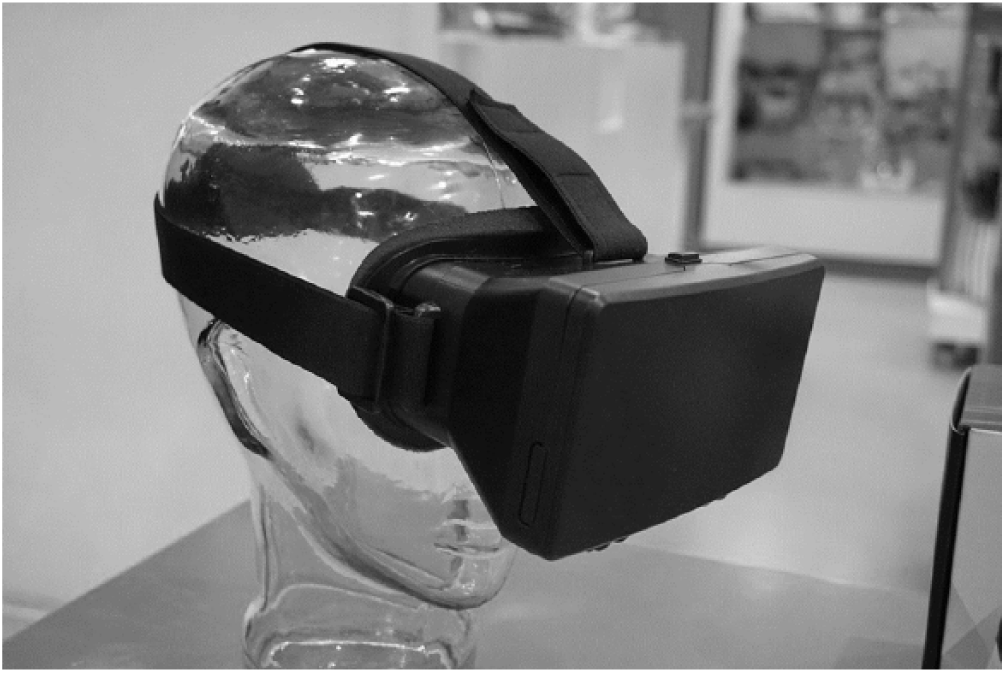
Virtual reality headset.
As virtual reality advanced, it began to be applied in health care. An overview in 1997 highlighted numerous applications which included the use of VR technology in surgical procedures, medical therapies and for preventive health (Moline, 1997), some of which appear in professional practice today. For example, an application called ImmersiveTouch translates patient’s computed tomography (CT) or magnetic resonance imaging (MRI) scans into three-dimensional virtual scans that can be manipulated by surgeons in a virtual environment to prepare for complex operations. Pilot studies of VR games for children with cancer have demonstrated that being immersed in these types of digital, therapeutic play sessions helped reduce depressive symptoms (Li, Chung, & Ho, 2011). Clinical trials of VR for pain management, eating disorders and exercise rehabilitation demonstrate the multiple applications of this novel technology (Chou, Chen, Yen, & Han, 2018). Meditation and relaxation–based virtual reality applications are also being developed to help people manage stress and anxiety. For instance, VR technology has been pioneered with patients who are undergoing wound dressing changes to reduce the pain experienced (Guo, Deng, & Yang, 2014).
Virtual reality technology includes multiple components such as head-mounted displays (HMDs) used in combination with tracking systems. The HMDs enable changing head position to be reflected in a three-dimensional visual landscape. Popular HMDs are produced by companies such as Oculus Rift, HTC Vive, Google Cardboard, and Gear VR, among others. They can be combined with VR applications for smartphones, making the technology more affordable and accessible. Joysticks and gloves can also be employed to provide haptic feedback to users, so the touch and feel of a virtual object or environment can be sensed enhancing the overall experience (Stone, 2001). Avatars, which are graphical representations of users in a virtual environment, are also popular components of virtual reality programs (see Figure 2). Avatars originated in the world of gaming and are now being used in healthcare. Recent evidence suggests that those who receive tailored guidance and advice from these types of virtual agents appear to have better physical and psychosocial outcomes, as the digital characters can be customized for cultural, social, and other user preferences (Shafii et al., 2015).

Example of a digital avatar.
Virtual reality is also being employed to improve health professionals’ education. Advanced simulations are created that allow nursing and midwifery students to explore role-play and use computer-generated interactions with patient avatars to enhance learning in a risk-free environment (Skiba, 2009). Immersive, three-dimensional worlds have been created in VR that incorporate multisensory feedback to ensure students pick up key skills and application in different healthcare contexts. For example, McCallum, Ness, and Price (2011) used a three-dimensional virtual software application called “Second Life” to explore how nursing students made clinical decisions in a virtual hospital environment. Smith and Hamilton (2015) used a combination of Autodesk Maya software and Unity, a game development platform, to help nursing students practice catheterization in a virtual space. The technology can also be used in more abstract ways, for example, by allowing students to explore human anatomy and physiology at the cellular, tissue, or bodily system level. Creating emergency situations such as road traffic accidents and natural disasters through VR enhanced simulation can also augment professional training and lead to improvements in knowledge, skills, and behaviors (Cook et al., 2011), which could help save lives.
As with all technology, some drawbacks to VR are present. Costs can be prohibitive and physical side effects like visual asthenopia and motion sickness, and possible psychological effects such as dissociation may occur (Cobb, Nichols, Ramsey, & Wilson, 1999; Nichols & Patel, 2002). Furthermore, the evidence base is still in its infancy. However, as the technology continues to develop, opportunities arise to create novel VR interventions which can be combined with other technologies such as artificial intelligence, wearable sensors, and Big Data (O’Connor, 2017). Given the possibilities of making smart, adaptive virtual environments where students, health professionals, and patients can interact with and benefit from simulated scenarios, virtual reality is a world worth exploring in healthcare. Therefore, nurses and other clinicians should work with patients and carers to ensure this emerging technology is designed, evaluated, implemented, and used appropriately.
Footnotes
Author Contributions
The sole author drafted and wrote the manuscript.
Declaration of Conflicting Interests
The author(s) declared no potential conflicts of interest with respect to the research, authorship, and/or publication of this article.
Funding
The author(s) received no financial support for the research, authorship, and/or publication of this article.
