







Abstract
According to Lazarus and Folkman’s theory, stress and coping affect an individual’s anxiety, which is an adaptive outcome. This study examined the mediation effects of stress-coping strategies on the relationship between stress and anxiety in caregivers of patients with acute stroke. A cross-sectional descriptive design was used to analyze a total of 131 caregivers caring for patients with acute stroke at a university hospital. The Caregivers Stress Scale, Ways of Coping Questionnaire, and Korean Beck Anxiety Inventory were used to quantify the participants’ responses. Our results revealed that emotion-focused coping (β = .56, p < .001) partially mediated the relationship between stress and anxiety (Z = 3.30, p < .001), suggesting its ability to exacerbate anxiety in the short term by acting as a mediator between stress and anxiety. Developing appropriate coping strategies for caregivers of patients with acute stroke is therefore critical for reducing their anxiety.
Introduction
Stroke has a global incidence and prevalence of approximately 9 and 30.7 million, respectively, while approximately 12.6 million patients with stroke suffer from moderate to severe disability according to the World Health Organization (Fisher & Norrving, 2011). In Korea, stroke remains the third leading cause of death following cancer and heart disease and ranks first in terms of mortality caused by a single disease (Kim et al., 2019). Given the unpredictable onset of stroke and associated functional deficits, such as hemiplegia and dysphagia, caring for stroke survivors is essential (Dewey et al., 2002).
In Korea, 70.7% of the family members, such as spouse and offspring, assume the role of caregivers for patients with stroke (Kim et al., 2017). Individuals naive to caregiving following the sudden development of stroke in a family member must provide immediate assistance with basic activities and fulfill unfamiliar and multiple responsibilities (King et al., 2010b). Caregivers experience emotional distress during their first month (King et al., 2010a), depression early after assuming the caregiver role (Byun et al., 2019), and anxiety and burden throughout the first 12 months (Wyller et al., 2003), placing them at high risk for developing physical and emotional problems (Byun et al., 2019).
Caregivers of patients with stroke experience significant stress within the first year poststroke (Ostwald et al., 2009). A recent study reported that the odds of anxiety increased 2.57 times for every 1-point increase in caregiving burden scale associated with caregiving stress (Denno et al., 2013). The presence of anxiety among caregivers of patients with stroke can eventually hinder the patient’s recovery and cause a decline in the caregiver’s mental health (Van den Heuvel et al., 2001).
One meta-analysis showed that 21.4% of caregivers of patients with stroke experience anxiety symptoms (Loh et al., 2017). According to Lazarus and Folkman’s stress and coping theory, anxiety among caregivers, which indicates psychological maladjustment, can be modified depending on coping (Lazarus & Folkman, 1984). Coping, when considered as a process, is an effort aimed at addressing stress that dynamically changes depending on the stress and environment (Lazarus & Folkman, 1984). It can be classified into problem-focused coping, which is an effort undertaken to manage or alter current problems, and emotion-focused coping, which is an effort undertaken to regulate stressful emotions (Lazarus & Folkman, 1984). Individuals who use problem-focused coping attempt to address a stressful situation though active confrontation and problem solving, such as seeking information, concentrating efforts on doing something about the problem, and other more active coping behaviors (Gregório et al., 2011). In contrast, individuals who use emotion-focused coping attempt to reduce or eliminate negative feelings, such as palliative reactions, avoidance, and other more passive coping behaviors (Gregório et al., 2011).
Some disagreements have existed regarding the effects of coping style on psychological outcomes. A previous study on the effects of coping on anxiety in caregivers had reported that emotion-focused coping strategies significantly predicted anxiety, whereas problem-focused coping strategies had a significant negative association with burden among caregivers of hemodialysis patients (Ghane et al., 2016). Consequently, less problem-solving strategies, categorized under problem-focused coping, have been associated with greater anxiety among caregivers of patients with stroke (King et al., 2010b).
Given the limited studies focusing on caregivers of patients with acute stroke, it is necessary to examine stress-coping strategies among caregivers to reduce their anxiety. The current study was conducted to examine the mediation effect of stress-coping on the relationship between stress and anxiety in caregivers of patients with acute stroke based on Lazarus and Folkman’s stress-coping-adaptation theory.
Methods
Design and Sample
A descriptive correlation study design was employed to examine the mediation effect of stress-coping on the relationship between stress and anxiety in caregivers of patients with acute stroke based on Lazarus and Folkman’s stress-coping-adaptation theory (Figure 1). Participants included herein were caregivers caring for patients with acute stroke at a university hospital in D city, South Korea. (a) Participants caring for patients the most among the family members (at least >8 hours) in the stroke ward and (b) those caring for the patients within 14 days of hospitalization (i.e., the standard hospital stay for patients with acute stroke) (Kiran, 2012) were included herein. The exclusion criteria of were as follows: (a) participants caring for patients with a history of stroke and (b) those caring for patients with a 24-hour professional caregiver. The sample size was calculated using the G*power 3.1 program (Faul et al., 2007), with the results indicating that a sample size of 107 was required for detecting a medium effect (f2 = 0.15) in a hierarchical multiple regression analysis with a power of 95% and a 0.05 level of significance. Ultimately, 131 participants were included for data analysis. Seven copies of the questionnaire were inappropriate for use during statistical processing due to incomplete data and were therefore excluded.
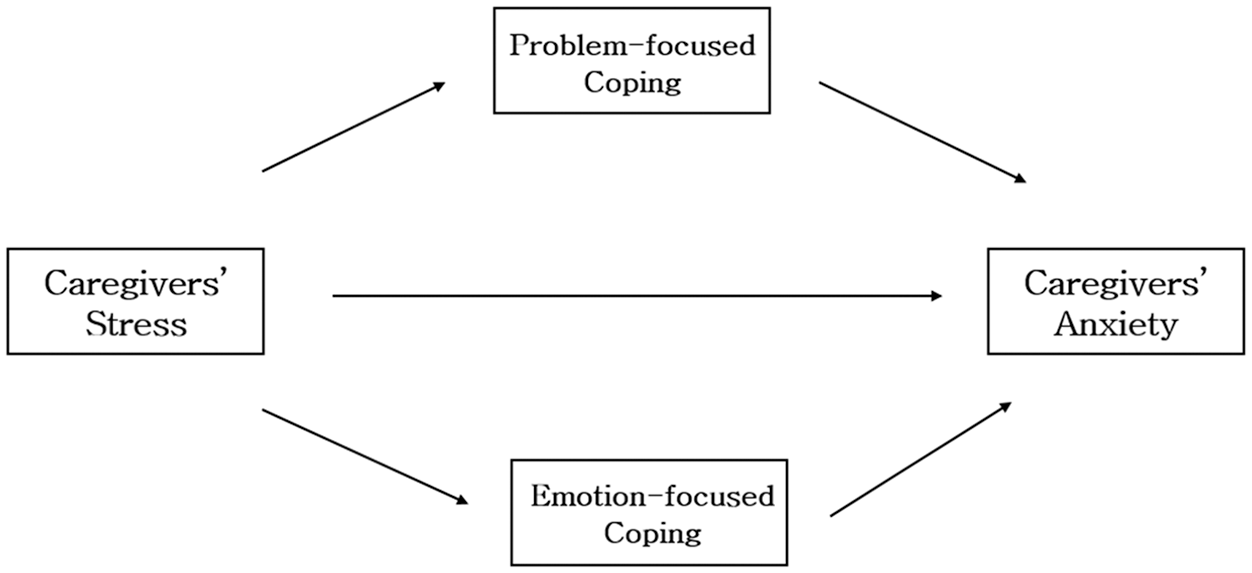
Conceptual framework of this study.
Measurements
Stress
The Stroke Patients’ Caregiver Stress Scale (SPCSS) is a 35-item scale that measures stress related to social and personal relationships and responsibilities, that related to changes in the patient’s disease state and difficulty in caring, and that related to the prognosis of a patient’s disease in Korean (Choi & So, 1993). The items are scored on a 4-point Likert scale ranging from 1 (not worried) to 4 (very worried). Total scores can range from 35 to 140, with higher scores indicating higher stress. Cronbach’s α for the SPCSS in this study was .94, with others showing a value of .92 (Choi & So, 1993).
Coping
The Ways of Coping Questionnaire (WCQ), modified and translated by Yang for caregivers (Yang, 1998), was used to measure problem- and emotion-focused coping. The WCQ consists of 30 items, with 14 items focusing on problem-focused coping and 16 items on emotion-focused coping. This questionnaire is scored on a 5-point Likert scale ranging from 1 (not at all) to 5 (always). Total scores can range from 14 to 70 for problem-focused coping and 16 to 80 for emotion-focused coping, with higher scores indicating more use of coping. Cronbach’s α for problem- and emotion-focused coping in our study was .90″ and .89″, respectively, with others showing values of .88″ (Lazarus & Folkman, 1984) and .86″ (Yang, 1998).
Anxiety
The Korean version of the Beck Anxiety Inventory (K-BAI), a 21-item scale, is scored on a 4-point Likert scale ranging from 0 (not at all) to 3 (severely). Total scores can range from 0 to 64, with higher scores indicating higher anxiety. Cronbach’s α was .94 in this study, with other showing a value of .90 (Lee et al., 2016).
Data Collection
This study was conducted according to ethical standards and was approved by Kyungpook National University Committee. Written informed consent was obtained from all participants after explaining the objective of the study. Participants were informed of the voluntary and confidential nature of the study. Questionnaire were completed by self-report and were collected in person. All surveys were conducted between August and November 2019.
Data Analysis
Collected data were analyzed using the Statistical Packages for Social Sciences, version 25 (IBM Corp, Chicago, IL, USA). The general characteristics of caregivers were analyzed and expressed as frequencies and percentages. Cronbach’s α was calculated to verify the reliability of each measurement. Pearson’s correlation test was used to examine the relationship between stress, coping, and anxiety. Hierarchical multiple regression analysis based on the model of Baron and Kenny was performed to examine the mediation effect of coping strategies on the relationship between stress and anxiety, while the Sobel test was conducted to verify the statistical significance of the mediating effect.
Results
Table 1 shows the general characteristics of caregivers and stroke patients. Among the included caregivers, 69.6% were female, with the mean age being 49.37 years. Most (50.7%) were children of the patients, 61.6% were unemployment, and 75.4% had medium level economic status as expressed by themselves. Moreover, 68.8% had no prior caring experience, while 62.3% had someone to who took turns to caring for patient with them, with a mean caring duration of 16.47 hours per day. Subjective health as reported by the caregivers was normal (45.7%). In this study, more than half (62.6%) of the stroke patients were male, with a mean age was 67.76 years. Moreover, 71.7% patients were diagnosed with infarction, with a mean hospital stay of 4.21 days. Among the included patients, 66.4% had minimal dependence on the Bathel Index, while 51.1% had minor symptoms based on National Institute of Health Stroke Scale.
General Characteristics of Subjects (N = 131).
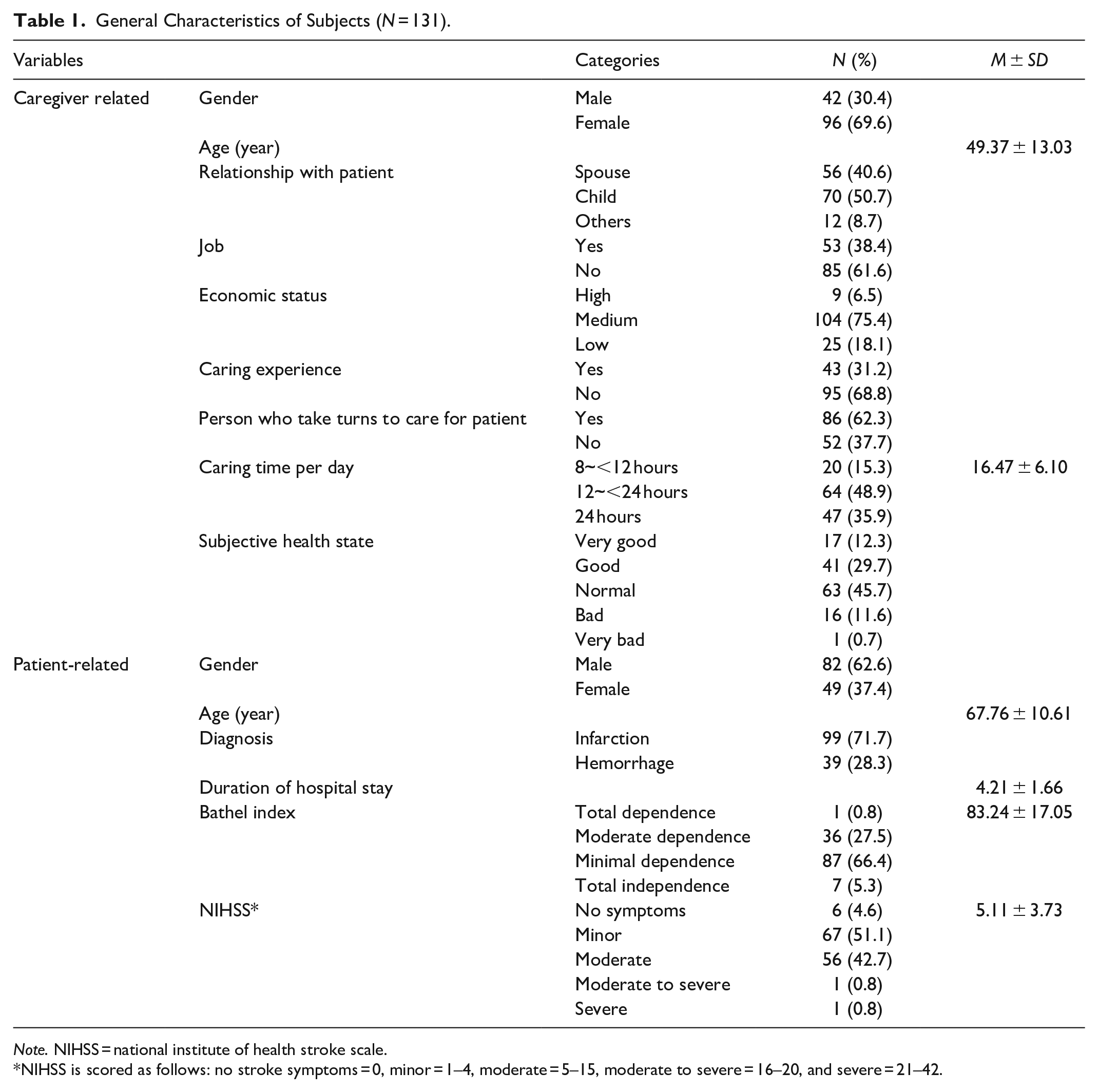
Note. NIHSS = national institute of health stroke scale.
NIHSS is scored as follows: no stroke symptoms = 0, minor = 1–4, moderate = 5–15, moderate to severe = 16–20, and severe = 21–42.
Table 2 summarizes the level of stress, problem-focused coping, emotion-focused coping, and anxiety of caregivers. The mean stress and anxiety values among caregivers were 86.47 ± 17.61 and 15.20 ± 10.26, respectively. Problem-focused coping was used more than emotion-focused coping. The relationships between stress, problem-focused coping, emotion-focused coping, and anxiety among caregivers are outlined in Table 3. Significant positive correlations were observed between stress, problem-focused coping, emotion-focused coping, and anxiety.
Level of Stress, Problem-Focused Coping (PFC), Emotion-Focused Coping (EFC), and Anxiety (N = 131).
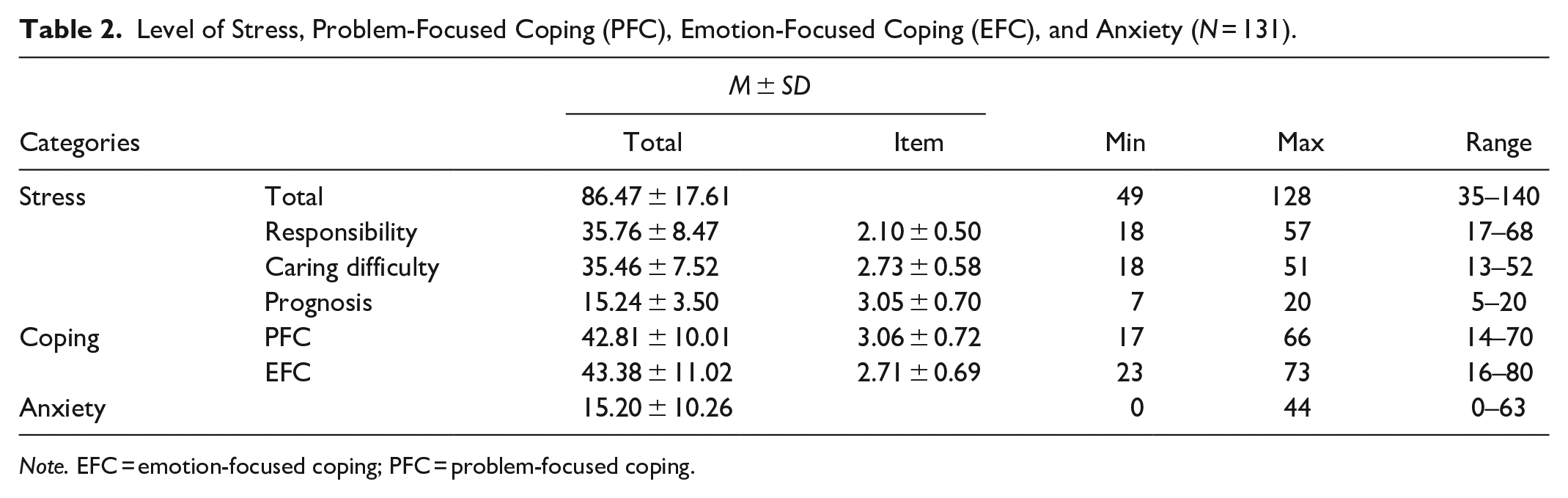
Note. EFC = emotion-focused coping; PFC = problem-focused coping.
Correlations among Study Variables (N = 131).
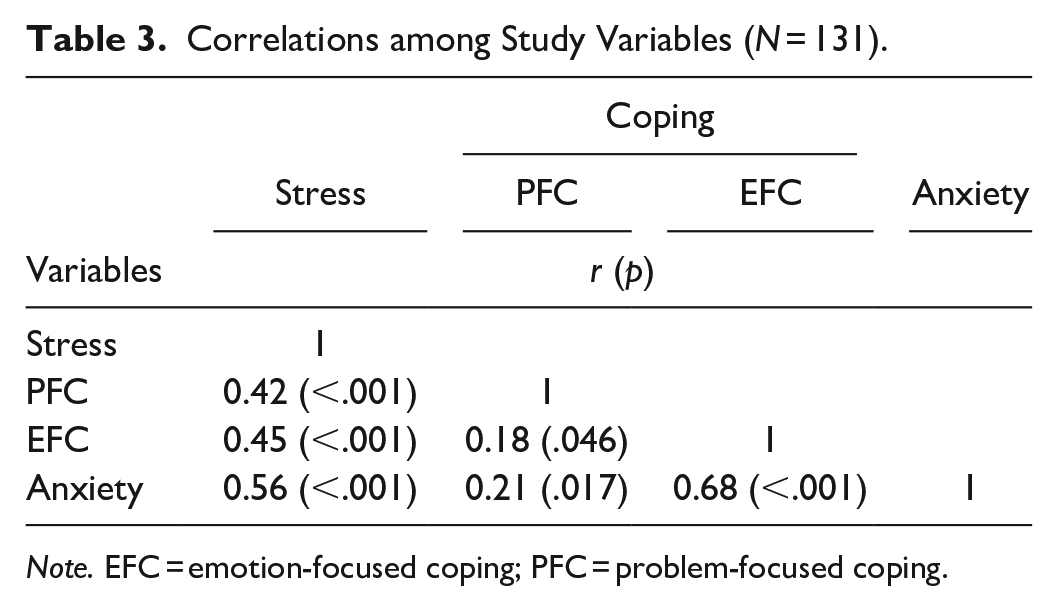
Note. EFC = emotion-focused coping; PFC = problem-focused coping.
All characteristics of caregivers and stroke patients were controlled as variables during regression analysis (Caregiver; gender, age, relationship with patient, job, economic status, caring experience, person who take turns to care for patient, caring time per day and subjective health status, Patient; gender, age, diagnosis, duration of hospital stay, Bathel index, and NIHSS). After examining the mediating effect of emotion-focused coping on the relationship between stress and anxiety, step 1 showed that stress, the independent variable, had a significant influence on emotion-focused coping (β = .41, p < .001), while step 2 showed that stress had a significant influence on anxiety (β = .54, p < .001), the dependent variable. In step 3, emotion-focused coping also showed a significant influence on anxiety (β = .56, p < .001). In step 4, the regression coefficient of step 3 (β = .31) was lower than that of step 2 (β = .54). Moreover, when adjusting for emotion-focused coping in step 3, stress was found to have a significant effect on anxiety (β = .31, p < .001). Therefore, our results showed that emotion-focused coping had a partial mediating effect on the relationship between stress and anxiety as a path model (Figure 2). The Sobel test showed statistical significance (Z = 3.30, p < .001). After examining the mediating effect of problem-focused coping on the relationship between stress and anxiety, our results showed that problem-focused coping had no significant influence on anxiety (β = −.05, p = .57) in step 3 (Figure 3).
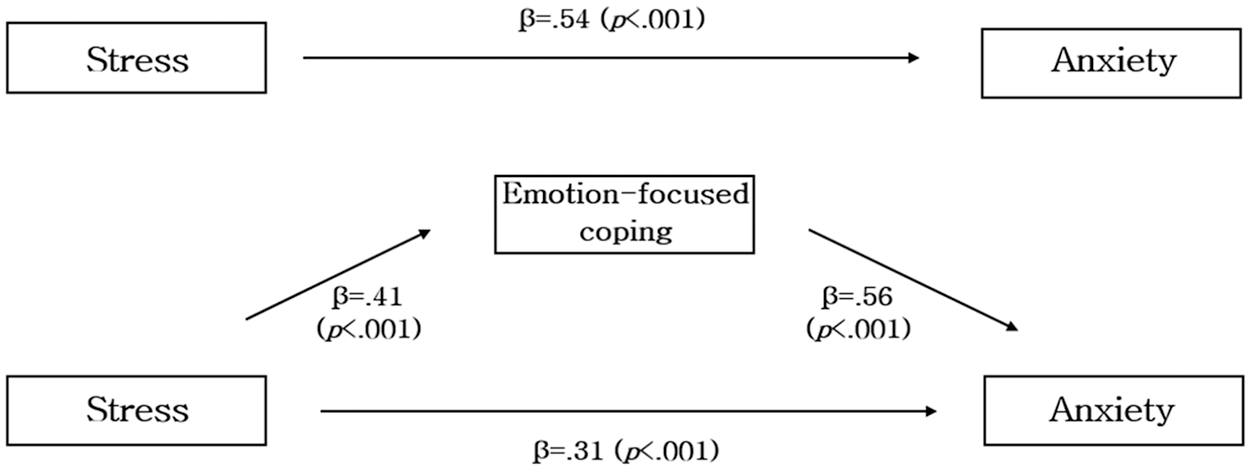
The mediation effect of emotion-focused coping on the relationship between stress and anxiety.
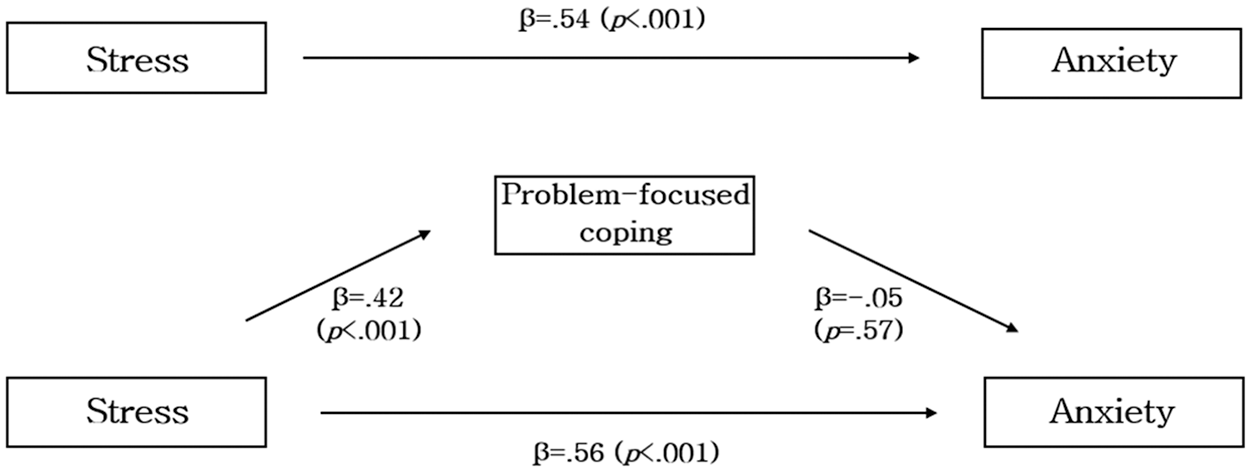
The mediation effect of problem-focused coping on the relationship between stress and anxiety.
Discussion
This study was conducted to explore the intensity of stress, coping, and anxiety among caregivers of patients with acute stroke and determine the mediation effect of coping strategies on the relationship between their stress and anxiety based on Lazarus and Folkman’s theory that the individual’s stress and coping style accordingly affect psychological adaptation.
The current study showed that caregivers had an average stress score of 86.47 points, which was more than moderate. Such scores are consistent with those presented in a study reporting that caregivers of patients with stroke experienced considerable stress within 1 year (Ostwald et al., 2009) and were substantially higher than those reported by a previous study conducted using the same stress instrument, which showed an average stress score of 57.9 points in 65 family caregivers of patients with cerebrovascular disease (Kim et al., 1998). Caregivers experience emotional burden given the sudden onset of unfamiliar roles and responsibilities during acute periods. Moreover, the current study found that the use of problem-focused coping was higher than that of emotion-focused coping. Indeed, studies have shown that problem-focused coping is used more in situations appraised as changeable (Lazarus & Folkman, 1984). Our results indicated that caregivers made an effort to actively solve their problems immediately after the onset of stroke, such as seeking information regarding the disease and treatments to improve the patient’s condition. Additionally, caregivers included herein had an average anxiety score of 15.20 points. A previous study showed that almost 43% of spouses of patients with stroke reported an anxiety score of 11 points or more (Wilz & Kalytta, 2008). Considering that the patient’s disease involves an intense shock over an unforeseeable incident and uncertain future, it seems expected that caregivers primarily feel anxious.
Our result showed that emotion-focused coping had a partial mediation effect on the relationship between stress and anxiety, indicating that emotion-focused coping can exacerbate anxiety in the short term by acting as a mediator between stress and anxiety. Caregivers who reported experiencing stress tended to use emotion-focused coping, which was related to higher anxiety. Adaptation to a stressor has been strongly associated with how people cope. As such, this study suggests that if distressed caregivers used emotion-focused coping such as avoidance and denial, it would be information regarding its possible association with greater anxiety would be considerably helpful. This is consistent with the result of a previous study in which emotion-focused coping was associated with maladaptive outcomes, such as depressive feelings in caregivers of patients with acute stroke (Qiu & Li, 2008). Emotion-focused coping activities (e.g., denial, self-blame, and avoidance) have also been shown to be associated with higher levels of anxiety in caregivers of patients with other illnesses, such as consciousness disorders (Cruzado & Elvira de la Morena, 2013) and leukemia (Demirtepe & Bozo, 2011). During the stress process, individuals using emotion-focused coping, such as denial and avoidance, may experience emotional stability at first but would be more likely to suffer from vulnerabilities to subsequent difficulties (Lazarus & Folkman, 1984). Vulnerability to anxiety in caregivers using emotion-focused coping has been considered to the eventually increased due to the increased burden of care needed when the patient’s disease state does not improve rapidly during early stroke. Therefore, findings suggest that programs aimed at reducing if not preventing the use of emotion-focused coping during stress in caregivers of patients with acute stroke will be necessary.
Alternatively, problem-focused coping had no mediation effect on the relationship between stress and anxiety. This finding is consistent with that presented in a study wherein problem-focused coping strategies, such as information seeking, had no significant influence on anxiety, whereas avoidance coping had a significant influence on anxiety in caregivers of patients awaiting solid organ transplantation (Goetzinger et al., 2012). Another study reported that problem-focused coping had no effect on psychosocial outcomes, whereas emotion-focused coping was associated with maladaptive outcomes in caregivers of patients with early-stage stroke (Gregório et al., 2011). We assume the existence of a limit to the effectiveness of problem-focused coping, which aims to deliberately modify and control stressful situations when providing care during the acute phase of stroke, despite being more frequently used. Furthermore, previous studies have shown that emotion-focused coping was strongly related to psychological problems (Braun-Lewensohn et al., 2009), whereas problem-focused coping was strongly related to well-being and health (Lewis & Frydenberg, 2002). Given that anxiety, a psychological problem, was herein considered as the dependent variable, emotion-focused coping was more strongly related to stress and anxiety than problem-focused coping.
Additionally, the results of the current study should be considered in light of the cultural differences between ethnicities. First, Asian women are thought to play a central role in elderly care among patriarchal families of ethnic background (Chan & Chui, 2011). In our study, 69.6% of the participants were female. Given that women tend to use emotion-focused coping more than men (Lazarus & Folkman, 1984), we assume that only emotion-focused coping had a significant mediation effect. Second, Asians tend to be reserved and are reluctant to express their emotions due to cultural values (Kim et al., 2005), which might be linked to avoidance, denial, and self-blame in emotion-focused coping and increased anxiety.
However, adaptive outcomes according to coping strategies are inconsistent and remain unclear. A previous study reported that the use of emotion-focused coping strategies helped reduce symptoms of anxiety among caregivers of patients with Alzheimer’s disease (Monteiro et al., 2018). Another study showed no significant relationship between anxiety and emotion-focused coping, whereas problem-focused coping was significantly associated with the reduction of anxiety among family caregivers of patients with trauma (Rahnama et al., 2017). Each coping method has several sub-systems and includes both adaptive and non-adaptive dimensions (Lazarus & Folkman, 1984). Therefore, these two coping strategies need to be understood as coping methods that have different functions depending on the situation rather than the opposite concept. Classifying various sub-systems of coping and examining their functions according to type will therefore be necessary.
The coping strategies of caregivers of patients with acute stroke have yet to be extensively studied so far. The strength of this study is that we examined the mediation effect of coping by testing Lazarus and Folkman’s stress and coping model, unlike previous studies on the relationship between stress and anxiety. Moreover, the data obtained herein can be used to guide the development of intervention programs for appropriate coping strategies.
Nonetheless, the current study has some limitations worth noting. First, given that our participants were sampled from a single facility within Korea, sampling bias might not have been avoided completely. Moreover, caregivers of patients with stroke in the intensive care unit were excluded. Therefore, further investigations on factors influencing caregivers’ anxiety, including patient disease severity, are necessary.
Clinical Implications
Caregivers of patients with acute stroke experience considerable stress and anxiety. This study revealed that caregivers’ coping behaviors can reduce anxiety despite experiencing stressful situations. Providing appropriate intervention, such as emotion-focused coping strategies, might help reduce caregivers’ anxiety.
Conclusions
Given the limited number of studies investigating the mediation effect of coping in caregivers of patients with acute stroke, the results obtained therein carry substantial value. This study revealed that emotion-focused coping had a significant mediation effect on the relationship between stress and anxiety. Thus, developing appropriate coping strategies for caregivers of patients with acute stroke is critical in reducing their anxiety.
Footnotes
Declaration of Conflicting Interests
The author(s) declared no potential conflicts of interest with respect to the research, authorship, and/or publication of this article.
Funding
The author(s) received no financial support for the research, authorship, and/or publication of this article.
