







Abstract
Purpose of the research
We propose a framework on how to implement exergames in the rehabilitation process.
Major findings
An increasing body of research is showing that exergames improve balance, motor dexterity, and cognitive functions. People suffering from stroke, Parkinson’s disease, multiple sclerosis, dementia, and many other neurological conditions may benefit from exergames. Similar to other rehabilitation strategies, playing exergames enhances neuroplasticity and facilitates functional recovery in individuals with neurological disabilities. Alongside pharmacological treatments, rehabilitation interventions, including exergames, are essential in neurological diseases to achieve functional restoration, promote independence, enhance quality of life, and prevent secondary complications.
Conclusions
Exergames are an emerging tool in the field of digital rehabilitation. They provide fun, engaging, and effective interventions for adaptive physical and cognitive training. The integration of exergames into a comprehensive neurorehabilitation program has stepped up considerably following the first COVID-19 pandemic wave that led to widespread disruptions in healthcare systems.
General considerations
The most stringent definition of exergames is a combination of whole-body physical exercises and video games.
1
Originally developed for entertainment, exergames are playable on low-cost off-the-shelf commercial devices, representing an easily accessible and sustainable tool to promote physical activity and fitness at home. Unlike fully immersive virtual reality that simulates a three-dimensional life-like multisensory experience, playing exergames is essentially a sort of non-immersive virtual experience in a smaller-scale, bi-dimensional environment projected onto home TV, computer display, or monitors. Game controls are based on interface devices, including motion controllers, balance boards, or cameras with depth sensors. Haptic or kinesthetic communications replicate the tactile sensation by applying forces, vibrations, or motions. The control of the avatar (i.e., the player’s virtual representation in the game world) by the user relies on the interaction with the game system through player motion (e.g., Kinect) and/or weight bearing (e.g., Wii balance board), thus requiring coordinated gross motor efforts. Compared to resting conditions, playing exergames significantly raises oxygen consumption, respiratory exchange ratio, heart rate, and energy expenditure (corresponding to a light to moderate physical activity).
2
Exergames also involve cognitive efforts fostering experience-driven adaptive plasticity, as active video games are centered around high-intensity repetition of task-oriented exercises, gradual escalation of task complexity, real-time feedback, salience, motivation, and reward
3
(Figure 1). Multi-domain benefits of exergames.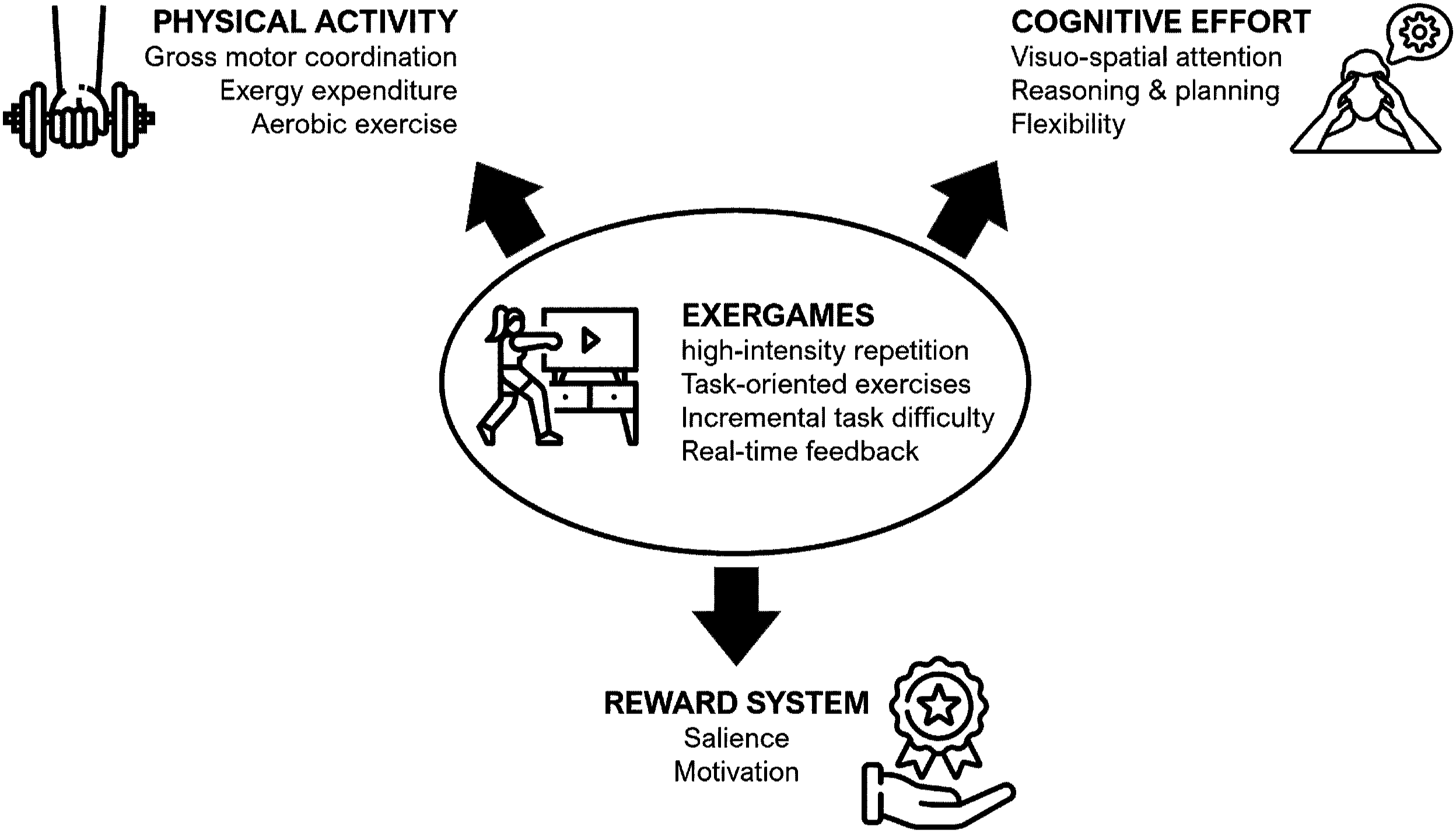
We advocate that exergames can be implemented in the rehabilitation process of a wide variety of medical conditions, ranging from counteracting a sedentary lifestyle to assisting rehabilitation in people with neurological disabilities. Despite being known for at least one decade, the potential of exergames in the neurorehabilitation setting has stepped up considerably after the first coronavirus disease 2019 (COVID-19) pandemic wave that led to widespread disruptions in healthcare systems, including rehabilitation services. 4
Neurorehabilitation targets of exergames
Neurological disabilities span a wide spectrum of disorders affecting the central and peripheral nervous systems, including (but not limited to) stroke, Alzheimer’s disease and other dementias, multiple sclerosis, Parkinson’s disease, brain tumors, and traumatic brain and spinal cord injuries. Depending on where the neurological damage takes place, a variety of signs and symptoms can occur: gait and balance problems, muscle weakness, difficulties with arm coordination, impaired manual dexterity, sensory alterations, fatigue, cognitive dysfunction, etc. In addition to pharmacological interventions, rehabilitation is essential for improving impaired functions and reducing disability. However, access to standard rehabilitation services is challenging for all individuals affected by neurological diseases due to common barriers and/or lack of facilitators. Therefore, alternative digital health interventions, including exergames, offer a more convenient, easily accessible, affordable, and cost-effective option compared to standard physiotherapy for addressing various neurological problems, mainly balance deficit, upper extremity impairment, and cognitive dysfunctions. All these situations only partially benefit from pharmacological treatments; furthermore, in the clinical setting, many prescribed medications (muscle relaxants, antidepressants, genito-urinary drugs, etc.) may actually worsen postural control and cognitive functions.
There is a moderate level of evidence supporting the use of exergames to manage balance dysfunction and prevent accidental falls in mixed neurological disabilities. 5 This evidence is based on a meta-analysis showing a medium effect size of exergames as compared to no intervention or conventional physiotherapy, with no substantial difference when exergames were delivered in both supervised and home-based settings, and regardless of being adopted an add-on intervention with standard rehabilitation programs or not.
People with neurological diseases, especially stroke survivors, suffer from motor disorders affecting both the upper limb and hand. Sensorimotor deficit of the paretic upper extremity has a detrimental impact on performance in daily living activities, resulting in loss of independence. Exergaming-based interventions have been shown to be more effective than traditional therapy 6 or at least as effective as conventional therapy or usual care 7 on upper extremity functions. Custom-written games heal better than commercial games, especially in combination with other rehabilitation instruments and assistive devices (e.g., finger tracking, robotics, and orthosis). 8
Video games have relevant effects on cognitive skills, positively influencing various aspects such as attention, memory, decision-making, spatial awareness, problem-solving, and flexibility. 9 Playing video games can foster brain plasticity, by stimulating neurogenesis, synaptic growth, strengthening of synaptic signals, white matter integrity, and functional connectivity. Accordingly, scientific data are increasingly suggesting that exergames can lead to a transfer effect, improving cognitive skills alongside motor skills in both healthy individuals and clinically impaired populations.10–12
Mechanisms of action of exergames
The putative mechanisms underlying the exergaming-related improvement go beyond the mere increase in fitness, heart rate, oxygen consumption, and energy expenditure. 11 Exergames not only promote muscle reinforcement but also foster the efficiency of executive and attentional brain networks by requiring simultaneous physical and cognitive efforts. Other hypotheses regarding their mechanisms of action involve the re-training of sensorimotor strategies aimed to restore the axial control, anticipatory and compensatory postural adjustments, and the engagement of mirror neuron system mediated by the avatar. 13 As aforementioned, playing exergames exploits adaptive plasticity, which is the inherent property of the central nervous system to structurally and functionally adjust itself in response to external stimuli, environmental changes, or injuries (Zatorre and coll. claim: “the brain is the source of behavior, but in turn, it is modified by the behaviors it produces” 14 ). Increased production of plasma brain-derived neurotrophic factor (BDNF, a molecule that serves as a neurotransmitter modulator and plays an important role in neuronal survival and growth) was found in older adults and in patients with neurological conditions undergoing a variety of physical activities, including exergames. Translational studies based on advanced imaging or neurophysiological techniques (e.g., non-conventional magnetic resonance imaging, near-infrared spectroscopy, and electroencephalogram-derived data) showed valuable structural and functional brain changes after Exergames.15–18
Side effects of exergames
Playing exergames was associated with mild to moderate adverse events, including musculoskeletal disorders (knee, leg, or back pain), unintentional falls during play, increased spasticity, and dizziness 5 ; however, there is no report of serious adverse events. The colloquial terms “Nintendinitis” or “Wiiitis” were coined to describe a specific set of symptoms, typically including muscle soreness, strains, or sprains, resulting from repetitive or excessive movements while playing exergames. Despite not being severe or life-threatening conditions, moderation, proper technique, and attention to physical well-being remain essential to avoid discomfort and intervention discontinuation. Playing exergames, in itself, is not associated with an increased risk of epilepsy or seizures. However, exposure to flicker or rolling images on TV screens or computer monitors may potentially trigger seizures in individuals with photosensitive epilepsy, and we must consider that some neurological conditions can be associated with symptomatic epilepsy. Another concern regards the possibility that exergames might foster aggressive behavior or addiction: although there is no demonstration of a causal link, special attention should be paid to children and adolescents. 19
A perspective on how to implement exergames in the neurorehabilitation process
Exergames have beneficial effects on both motor and cognitive outcomes, thus potentially representing a “pay-one-get-two” deal for people with neurological disabilities.
12
They offer a flexible and scalable solution to reach a large audience of individuals requiring a sustained, long-term intervention that can be administered at a relatively low-cost. Another relevant advantage is that all devices are equipped with a machine log that allows checking the level of adherence to the prescribed intervention. Providing feedback on performance and progress can motivate users to continue engaging with exergames. Progress tracking, achievements, and rewards for milestones achieved can contribute to adherence. However, data on long-term adherence are scarce and the application of exergames in the real world seems to be challenging without enabling long-term engagement strategies. A proposed framework for exergames (Figure 2) involves the promotion of physical activity in individuals with mild to moderate disability (e.g., adapting home-based training to fit around work and family commitments), whereas in those with more severe disability levels, one can exploit their “carry over” effect on the abilities acquired by conventional physiotherapy (e.g., in case of planned or unexpected interruption). Exergames may also encourage social integration via multiplayer mode when physical barriers preclude access to healthcare and social services. Indications of the optimal “dose,” intended as the duration of a single session, weekly frequency of sessions, and overall duration, were explored only for balance rehabilitation training, where high-frequency interventions (i.e., at least three sessions per week) were associated with larger effect size.
5
A proposed framework to implement exergames in the neurorehabilitation process of people with neurological disabilities, according to their disability level.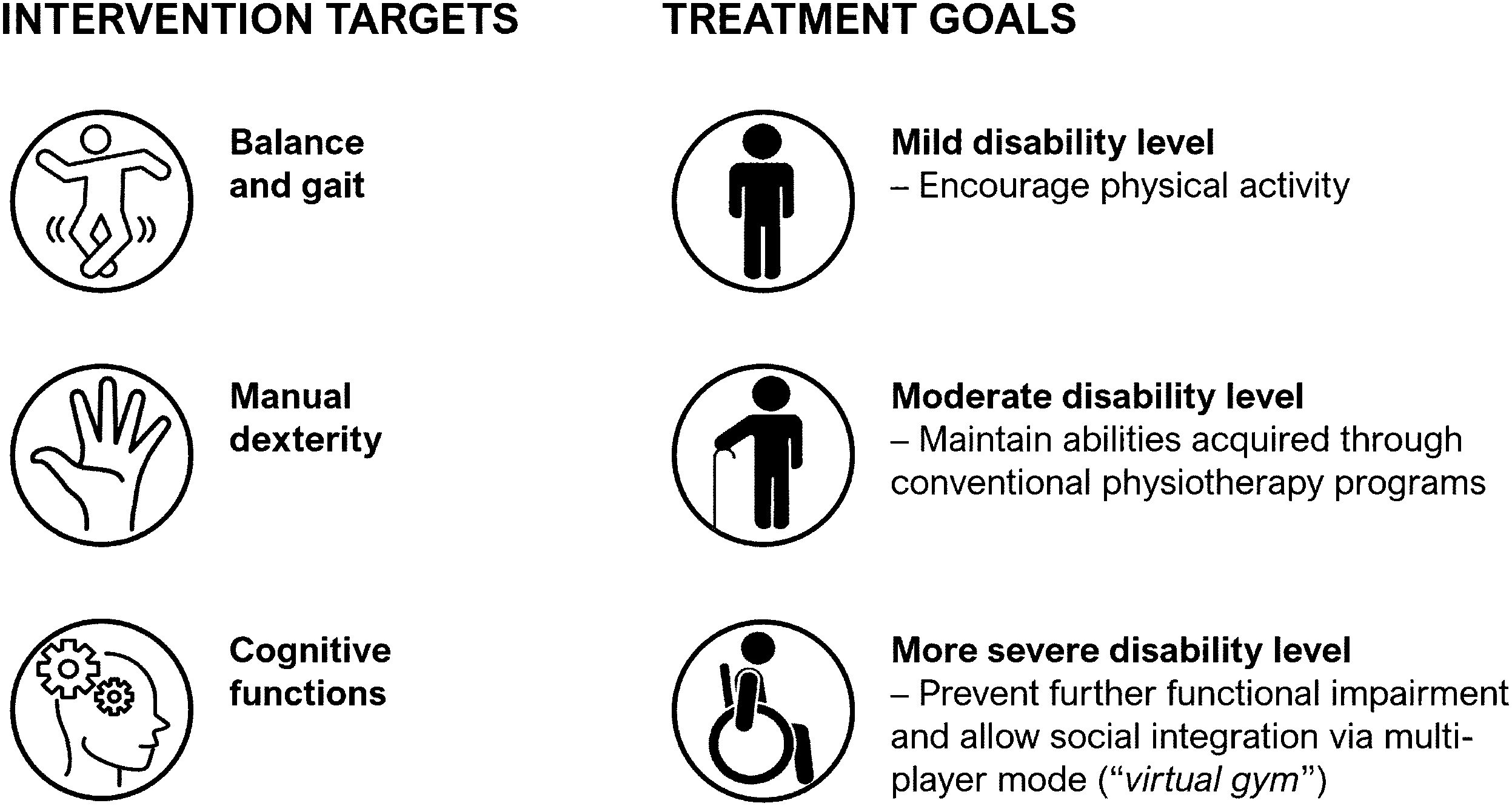
As a rehabilitation strategy, exergames have not escaped criticisms, mainly stemming from their commercial nature: while tailored treatment is commonly considered the cornerstone of physiotherapy programs, exergames offer only limited possibility, thereby representing a large-scale solution (“blockbuster”) rather than a personalized (“tailored”) intervention. Additionally, it’s important to note that certain exergames might not be sold anymore when they are found to be useful in a neurological therapy setting (e.g., the Wii balance board) since gaming devices typically have a commercial life cycle of around 5 years before being replaced with new hardware. Consequently, the development of custom-written game software and low-cost hardware alternatives have been advocated in this context. We must acknowledge that exergames, together with other digital innovations, have contributed to triggering a real “Digital Revolution” in healthcare that paves the future for new opportunities. 20
Statements and declarations
Footnotes
Acknowledgments
We thank A.L.I.Ce. (Associazione per la Lotta all’Ictus Cerebrale) and FISM (Fondazione Italiana Sclerosi Multipla) for their valuable support.
Author contributions
All authors have read and agreed to the published version of the manuscript. Conceptualization: L.P. and S.R.; writing—original draft: L.P., A.C., and S.R.; writing—review and editing: F.R.P., M.E.Q., and I.A.; supervision: F.R.P., M.E.Q., and A.C.
Conflicting interests
The authors declared no potential conflicts of interest with respect to the research, authorship, and/or publication of this article.
Funding
The authors disclosed receipt of the following financial support for the research, authorship, and/or publication of this article: This work was supported by the A.L.I.Ce. (Associazione per la Lotta all’Ictus Cerebrale) and FISM (Fondazione Italiana Sclerosi Multipla).
