







Abstract
Although numerous studies have examined the field of Socially Assistive Robots (SARs), less attention has been paid to evaluating the role of the NAO robot in enhancing the communication skills of children with autism spectrum disorder (ASD) across two distinct time periods (2013–2019 and 2020–2025), highlighting advancements in both SAR-based interventions and NAO’s technological capabilities. A systematic search was conducted across international databases, using strict inclusion and exclusion criteria, resulting in the selection of 44 relevant studies. This review synthesizes findings on the types of interventions implemented, NAO’s functional characteristics, and its effectiveness in facilitating social communication. The results indicate a positive impact on children’s communication abilities, with more recent studies (2020–2025) reporting greater improvements, possibly due to advancements in NAO’s capabilities and the refinement of intervention methodologies. To the best of our knowledge, this is the first systematic review to compare NAO-assisted interventions across two different periods, offering novel insights into the evolving role of SARs in autism therapy.
Keywords
Introduction
Socially Assistive Robots (SARs)/NAO
The history of robotics is interdisciplinary, as the branches of engineering, politics, philosophy, and learning theories intersect. 1 The word “robot” was first used in literature in a science fiction work titled Rossum’s Universal Robots. 2 In 1962, the first industrial robots used in engineering were introduced at Ford’s Canton automobile plant to increase production. 3 According to Roshidul et al., 4 there are five generations of robotics: Robots, robotic arms, walking robots, behavior-based robots, and humanoid robots. In particular, humanoid robots could also be called Socially Assistive Robots (SARs) due to their ability to simulate empathy by mimicking human movements and understand emotions when programmed. 5 Socially Assistive Robots (SARs) are robotics platforms with audio, video, and motion capabilities. 6 Robotics has been introduced in recent years in the field of education through interventions implemented in the school context. 7 More specifically, robotics is linked to the pedagogical theory of constructivism, according to which children learn through their experiences and actively participate in the creation of knowledge. 8
A significant number of studies have been implemented over the last 10 years on the utilization of SARs and specifically for the NΑΟ. In particular, the NAO robot has a small size, namely, 58 cm in height, two legs, and “rounded” characteristics. 9 Furthermore, the NAO has 25 liberty degrees, speaks 20 languages, and has low cost. 10 The NAO was designed by Soft Bank Robotics (formerly Aldebaran) in 2006, and continuous upgrades have been made. 11 In addition, it is equipped with four directional microphones and speakers for better human-user interaction. 12 The NAO robot rotates its head, creating eye contact with the user, and at the same time shows slow movements of the hands and body, significantly increasing its interactivity with the user. 13 The NAO, moreover, presents special characteristics, such as advanced communication, display of physical cues, and human face recognition. 14 These qualities are important for enhancing the interaction of the person with others, in meeting the needs of everyday life and in effective communication with those around them. 15
The use of SARs, especially the NAO, seems to improve the social and communication skills of children with special educational needs, as studies in recent years have shown. 16 The World Health Organization (WHO) reports that 10% of the world’s population has a disability, a fairly high proportion. 17 In particular, 14% of the population in the USA and at least 18% in Europe have been diagnosed with some type of disability. 18 The number of studies on the use of social robots in special education is small globally. The majority of research on the use of social robots in special education is on children with autism spectrum disorder (ASD), while there are far fewer studies on other cases. 19 The term “autism spectrum disorder” (ASD) refers to a wide range of symptoms, ranging from mild to more severe. 20 More specifically, ASD is a long-term neurodevelopmental disorder that manifests in childhood and is characterized by a lack of social interaction and repetition of an unusual range of sensorimotor behaviors. 21 The two main symptoms of ASD are limited and repetitive sensorimotor behaviors and limited social interaction. 22
Interventions using NAO
There are two literature reviews published in related literature in international journals with significant impact factor to date on the use of NAO and refer to interventions implemented in typically developing children and older people.23,24 First, a literature review by Robaczewski et al. 24 collected the interventions that have been conducted using the NAO in order to evaluate its potential as SARs. For this purpose, the researchers distinguished six categories: social interaction, emotionality, intervention, assisted teaching, mild cognitive impairment, and intellectual disability. The results showed the effectiveness of NAO in the majority of cases. Second, the literature review by Amirova et al.2 23 presents a summary of qualitative and quantitative research over the decade (2010–2020) on the potential of the NAO, the ways of communicating with children of typical and elderly individuals, its use in teaching, social skills development, and care of elderly individuals, as well as in human-robot interaction experiments in which the NAO was involved.
Despite the growing body of research on the applications of NAO in various populations, no systematic literature review has specifically examined its role in developing communication and social skills in children with special needs. Existing reviews have primarily focused on typically developing children and older adults, overlooking their impact in special education settings. Additionally, no study has comparatively analyzed interventions across different time periods to assess potential advancements in the effectiveness of NAO-based interventions. Given the increasing adoption of NAO in special education and the technological upgrades introduced in recent years, understanding how its impact has evolved over time is crucial. This review aims to bridge these gaps by systematically analyzing studies from two distinct time periods (2013–2019 and 2020–2025), providing insights into both the effectiveness of NAO-assisted interventions and their progression over time.
Study aims
According to the study, the primary aim of this systematic review is to evaluate the effectiveness of NAO-assisted interventions in fostering communication skills in children with ASD, with a focus on two distinct time periods: 2013–2019 and 2020–2025. This division is not arbitrary but based on key developments in the field. First, the integration of social robots in special education significantly expanded after 2019, leading to an increase in studies and potentially more refined intervention methodologies. 25 Additionally, from 2020 onwards, the COVID-19 pandemic accelerated interest in educational technologies, including social robots, which correlated with a rapid increase in research on their applications. 26 This thematic review aims to understand the effectiveness of the NAO social robot and not to generalize the results to other humanoid robots. More specifically, the aim is to understand whether NAO interventions are effective and to interpret when and why they are effective.
Technological advancement of the NAO robot is a crucial factor in this division. In 2019–2020, SoftBank Robotics released enhanced versions of NAO featuring improved natural language processing, greater computational power, and advanced sensory capabilities. 27 The technological advancements of NAO, particularly in natural language processing and sensory capabilities, have likely facilitated more effective interactions with children with ASD, contributing to the significantly greater improvements in communication skills reported in recent studies (2020–2025). 28 This analysis will assess whether these technological advancements and the increasing familiarity of educators and researchers with social robot-based interventions contributed to more impactful outcomes.
Specifically, the review examines the following dimensions across two distinct periods: 2013–2019 and 2020–2025: (1) What types of intervention with the NAO robot have been used to develop communication skills in children with ASD, and what is their effectiveness? (2) Which specific characteristics of the NAO (movements, sounds, and facial expressions) are most often used in interventions, and how do they affect the development of communication skills? (3) What is the role of the NAO robot in interventions to support communication in children with ASD (e.g., interlocutor, mediator, and imitator)?
Through the study of the existing literature, the review aims to identify effective interventions and best practices in the use of ΝΑΟ, as well as to highlight how ΝΑΟ is a useful tool for special education, while identifying potential gaps in the literature and suggesting directions for future research.
Materials and methods
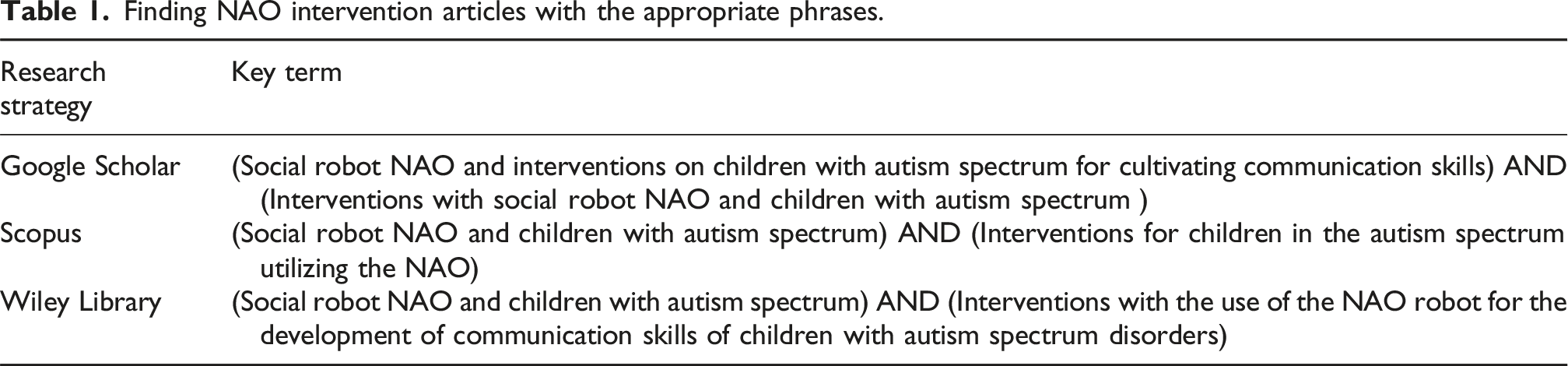
A systematic review was conducted to collect, select and comparatively analyze the effectiveness of different intervention methods using the NAO social robot to develop communication skills in children with ASD. The collection and analysis of a wide range of research articles seem to enhance the development of new theories, making the above research method a powerful approach. 29 To present a comprehensive and well-structured systematic review, the research was based on the PRISMA methodology (Preferred Reporting Items for Systematic Reviews and Meta-Analyses).30,31
Search strategy
Finding NAO intervention articles with the appropriate phrases.
Eligibility criteria
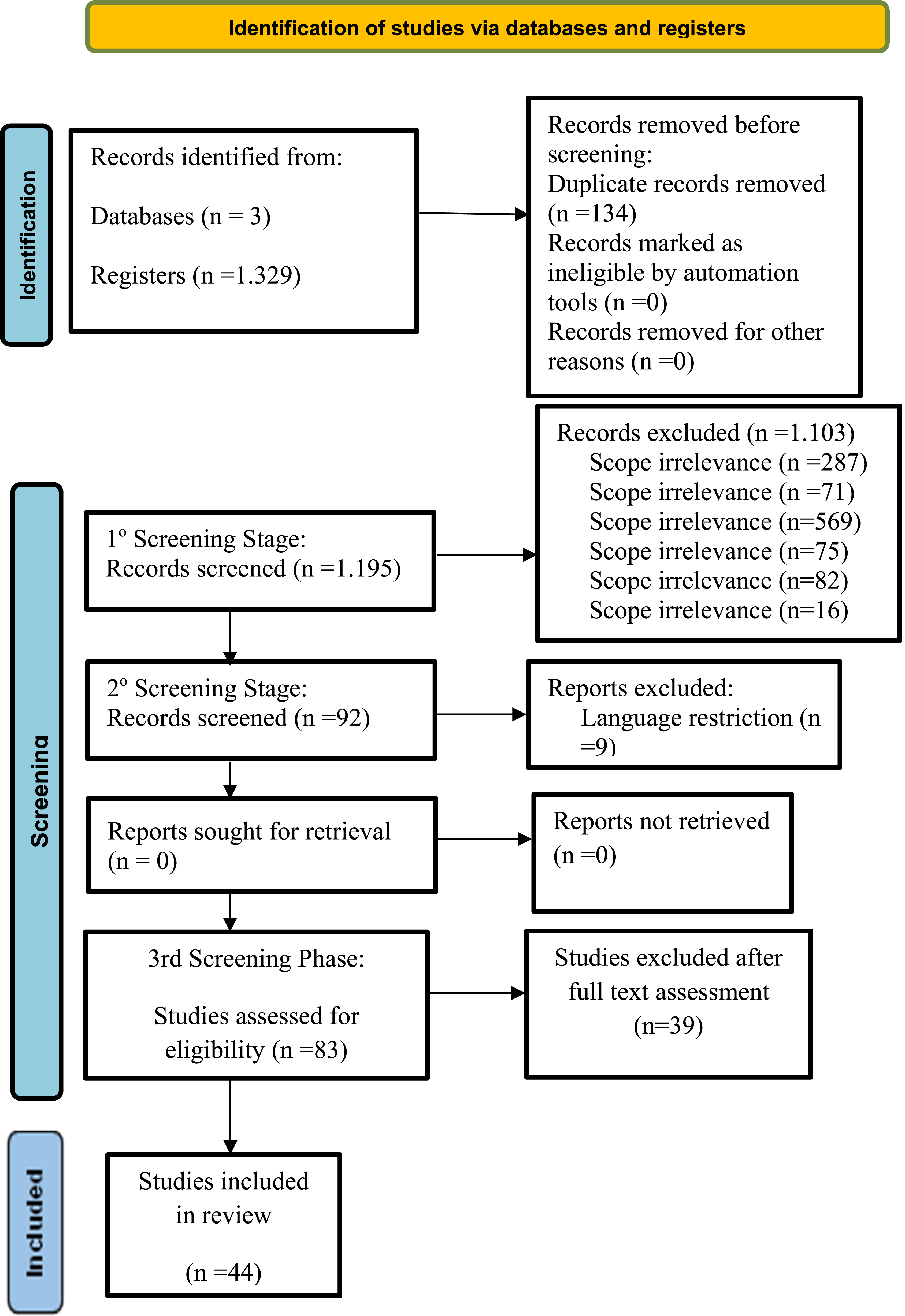
Screening of research articles with specific inclusion and exclusion criteria was the second phase of the systematic review (Figure 1). The criteria used for the exclusion of studies were as follows: (1) Research papers presented at conferences. Papers published in conference proceedings were not examined but in papers submitted to scientific journals because full peer review is provided and the research is presented with the required depth in methodology, results, and discussion, enhancing the reliability and validity of our review. (2) Books and book chapters on social robotics. (3) Research papers on the attitudes of teachers and parents towards the social robot NAO. (4) Research papers using social robot NAO to diagnose autism. (5) Research papers in which the social robot NAO is used as a tutor for teaching school lessons. (6) Systematic review of the literature on the use of social robots. PRISMA flow diagram for study selection.
Studies to be included based on criteria: (1) Studies published within a specific time frame (from 2013 to 2019 and from 2020 to 2025). (2) Studies written in English. (3) Studies in which the social robot NAO was used as a teaching assistant for children in the autism spectrum. (4) Studies on NAO social robot used to develop the communication skills of children in the autism spectrum. (5) Studies that included all levels of education (preschool, primary, and secondary education).
Study selection, data extraction, and quality assessment
The database research was conducted from January to March 2025. Initially, 1.329 articles were found in all three databases and in the two time periods searched (Figure 1). In the first stage, 134 duplicate studies were removed. In the second stage, the abstracts of the 1.195 remaining articles were examined in terms of inclusion and exclusion criteria, resulting in 92 articles for further evaluation. Following detailed screening, 1.103 studies were excluded due to the irrelevance of their scope. In particular, there were 287 systematic reviews and systematic literature reviews on the use of social robots, 71 book chapters and books on social robots and specifically the NAO robot, 569 articles presented at conferences, 75 articles on the attitudes of teachers and parents toward the social robot NAO, 82 articles where the social robot NAO was a tutor during teaching, and 16 articles used the social robot NAO to diagnose autism. At this stage, 9 papers were removed because of language restriction. In the third stage, the full texts of the 83 studies were fully examined against the inclusion and exclusion criteria. The result of the third and final stage was to produce 44 studies that were fully in line with the aim of our research.
The researchers used a predetermined form to extract and collect data. This form included information about the researchers in each study, forms of intervention, types of communication skills, role of the NAO, and specific characteristics of the NAO. Quality is ensured through objectivity in the selection of sources, the use of reliable and valid data, and the systematic and comprehensive coverage of the topic. More specifically, the initial review and selection of articles was carried out by all members of the writing team independently. Any discrepancies related to the eligibility of articles were resolved through discussion and agreement among all of us, thus ensuring that a consensus was reached. Accuracy for data extraction was ensured through cross-checking by at least three team members for each extracted item, thus minimizing the potential for errors and at the same time enhancing the reliability of the data. In addition, the method used in this narrative research was the synthesis of a systematic qualitative analysis of the findings. Finally, no meta-analysis was conducted owning to the different methodological approaches used in the research evaluated.
The methodological quality of the included studies was assessed using the CASP (Critical Appraisal Skills Programme) checklist for systematic reviews, which helps to assess the validity, reliability, and transparency of the methodology of the included studies. 32
Results
General characteristics of included studies
Studies on the utilization of the social robot NΑO in the development of communication skills of children with autism.

The types of interventions utilizing the NAO robot for the development of communication skills and their effectiveness
Across all intervention types, recent studies (2020–2025) report significantly greater improvements than earlier research (2013–2019). This is largely attributed to advancements in the capabilities of NAO robot’s and the increasing complexity of interactive tasks. One-to-one interventions using structured prompts and interactive games show notable gains in verbal and non-verbal communication, while group-based interventions foster social engagement and cooperative skills.
Since the use of Artificial Intelligence (AI) applications and, in particular, the utilization of social robots such as the social robot NAO in the field of education have been studied and recognized by many researchers,14,77–82 the use of the social robot NAO in enhancing communication skills and social interaction of children with ASD has been studied for the last 13 years and more systematically for the last 6 years. In particular, different types of interventions carried out in recent years, especially in children with ASD, have evaluated verbal communication, non-verbal communication, and social interaction of children with ASD in a series of interventions implemented in specially designed classrooms in the school setting, yielding useful findings with important implications for the use of the NAO social robot in the field of special education. 83 It is worth noting that the majority of studies (see Table 2) focus on interventions for primary school children (aged 3–12 years).
The first two types of interventions evaluated were as follows: (1) Interventions in which each child entered a specially designed room and the robot was placed opposite, with the presence of a teacher-therapist and the researcher. These interventions can be described as one-to-one interventions and symbolized as 1:1. (2) Group interventions in which two or more children entered a specially designed room and the robot was placed opposite, with the presence of a teacher-therapist and the researcher.
Two other types of interventions one-to-one that were implemented and evaluated were: (1) Interventions one-to-one (1:1) with oral questions-prompts. (2) Interventions one-to-one (1:1) with interactive games and activities.
These types of interventions were evaluated in combination to assess the communication skills of children with ASD.
One-to-one (1:1) iterventions
Interventions one-to-one (1:1) with oral questions-prompts
Studies33,36,43 for the period 2013–2019 that the interaction of the NAO with the child with ASD in the form of oral questions and prompts enhances verbal communication to a satisfactory degree in order to develop his social skills. On the other hand, studies53,62,64 for the period 2020–2025 in the same type of intervention were more effective. More specifically, the results showed that child interaction with the recent version of the NAO using questions significantly enhances oral communication, oral production and comprehension.
One-to one (1:1) iterventions with interactive games and activities
Studies34,45,46,48,49 for the period 2013–2019 showed that the interaction between the child and the social robot NAO in simple interactive games, such as Dora the Explorer, fairytale games, discovery games, card games, and free games (such as rock-paper-scissors or play catch by throwing and catching small bean bags), enhanced verbal communication and understanding of oral instructions at a satisfactory level. In contrast, studies55,57,61,71 with the same type of intervention in the period 2020–2025 seem to be more effective in relation to the results of studies carried out in the previous period. Interactive games were more complex than their counterparts in the previous period, such as music and dance games, imitation games, ball games, and card games with emotions. In particular, the results showed an enhancement in eye contact, oral language production, and comprehension to a very satisfactory level with the use of the recent version of the NAO robot.
Research35,39,41,44,47 implemented in the period 2013–2019 highlights the interaction of the social robot NAO with the child with ASD in a series of interactive activities, such as interactive activities using 3D figures to depict animals and objects, imitation activities, dance and singing activities, daily life activities (e.g., teaching the correct way to sneeze and wait their turn), and activities involving a structured story which enhanced visual contact and verbal and non-verbal communication to a satisfactory level. In addition, the results of studies52,54,56,59,60,63,65,66,68–70,72–76 in the period 2020–2025 on the same type of intervention showed enhancement of eye contact, attention ability, verbal and non-verbal communication, and oral comprehension to a very satisfactory level in relation to the corresponding studies implemented in the period 2013–2019. In particular, these studies used recent versions of the NAO and the structure of some activities was more complex, such as the rock-paper-scissors game, robot body language games, and storytelling activities.
Group-based interventions
Interventions implemented in groups using oral questions and prompts were not found in either period.
A study by Barakova et al. 37 on the interaction of the social robot NAO with children in a series of games, such as Lego-based play and discovery games, showed an enhancement in verbal communication with group members, comprehension, and production of spoken language to a very high extent. As for the period 2020–2025, the research of Mutawa et al. 67 showed that the interaction of the children’s group with the new version social robot NAO in card games with animals enhances oral communication with the group member(s), eye contact, enhances attention ability, comprehension, and oral production to a very satisfactory level in relation to the results of the previous period.
Studies carried out during the period 2013–2019 with the interaction of the NAO with a group of children in interactive skills such as cooperative activities (how to cooperate with each other and how to program a robot) and imitation activities with the aim of enhancing verbal communication and attention skills to a fairly satisfactory level.38,40 On the other hand, the studies by Qidwai et al. 50 and Marino et al. 51 in the same type of intervention showed that the interaction of the group of children with the new version of the NAO enhanced eye contact, attention ability, verbal communication, comprehension, and production of speech at a very satisfactory level compared to the previous time period.
Finally, interventions in which children are in groups and participate in interactive game-activities enhance communication skills to a more satisfactory extent than one-to-one interventions. In addition, regarding one-to-one interventions, it seems that interventions using interactive games and activities are more effective in developing the communication skills of children with ASD than interventions using oral language and prompts.
Characteristics of the NAO (tone of voice, hand, head, and body gesture movements and facial expressions) most frequently used in interventions and to what extent they influence the development of communication skills
The studies examined demonstrated certain characteristics of the social robot NAO, such as the tone of voice, movements of the hands and head, and more recently changes in facial expressions, due to the recent versions of NAO. These characteristics enhance the communication and social skills of children with ASD to a very satisfactory level and other characteristics to a satisfactory level depending on the time period we studied. However, there is an increase in communication skills in interventions which children with ASD are grouped.
Tone of voice as a communicative feature in interventions
The results of the studies by Huskens et al. 33 and Warren et al. 34 which focused on the tone of voice of the social robot NAO in interventions involving robot-initiated questions to children with ASD and their participation in interactive activities, respectively, reported improvements in verbal communication and oral comprehension to a satisfactory extent. In addition, three studies39,45,48 also focused on the tone of voice of the social robot NAO in interventions that incorporated interactive activities such as singing and dancing, as well as interactive games. These studies reported improvements in verbal communication, comprehension of spoken language, and oral instructions to a satisfactory extent. Finally, the study by Taheri et al. 46 in which the participants were divided into groups during the intervention, focused on the tone of the NAO’s voice during specially designed games. The findings indicated a marked enhancement in oral communication among group members, contributing to a notably high level of spoken language production.
In the studies by Romero-García et al. 53 and Urdanivia Alarcon et al. 59 conducted in between 2020 and 2025 and in which the new version of the NAO was used, we examined tone voice and vocal expression in conjunction with specific hand and head movements, respectively. The results of these studies showed notable enhancements in both verbal and non-verbal communication, as well as oral language production and comprehension reaching a highly satisfactory level.
Hand, head, and body movements in interventions
Three studies35,36,43 which focused on the simple head movements of the NAO during interactive activities, which involved 3D figures representing animals and objects, as well as questions posed by the robot to participants with ASD. These studies showed enhancements in eye contact and verbal and non-verbal communication to a satisfactory level. The results of four studies35,37,44,47 which focused on the NAO social robot’s head and hand movements during LEGO-based play, imitation activities, singing activities, interactive games, and storybook-based dance and singing activities, respectively, showed improvements in eye contact and verbal and non-verbal communication at a satisfactory level. Furthermore, the studies conducted by Chevalier et al. 41 and So et al. 42 focused on the simple movements of the head, hands, and body posture of the NAO in imitation activities and games. The results of these studies showed enhancements of non-verbal communication and the use of gestures to a satisfactory extent. Τhe results of the studies by Kaboski et al. 38 and Srinivasan et al. 40 in which participants engaged in groups and engaged in participatory and imitation activities, respectively, showed enhancements in non-verbal communication, verbal communication, and attention skills reaching a moderately satisfactory extent.
The results of six studies56–58,61,70,73,74 which focused on the specific head, hand, and body posture movements of the recent version of the social robot NAO used in music games, musical activities, imitation activities, card game with emotions, singing activities, ball game, and interactive body language activities, respectively, demonstrated enhancements in eye contact, non-verbal and verbal communication, and oral comprehension. In addition, four studies63,68,71,75 focused on the specific head and hand movements (excluding body posture) of the recent versions of the NAO robot conducted during interactive exercises, in social interactive exercises, in imitation activities, and in music and singing activities, respectively, demonstrated significant enhancements in significant non-verbal communication, attention skills, and eye contact at a very satisfactory level. Lastly, the study by Marino et al. 51 in which participants engaged in groups based in interactive activities focused on the specific hand movements and body posture of the recent version of the NAO robot. The results of the research showed significant enhancements in eye contact, verbal communication, comprehension, and oral communication production to a very satisfactory extent.
Facial expressions in interventions
In the period 2013–2019, no research focused on the facial expressions of the social robot NAO as the earlier versions of the robot used in these interventions did not support such capabilities.
The research by Chung 54 highlighted that the facial expressions of the recent version of the NAO robot used in interactive exercises and activities significantly enhanced eye contact, attention skills, verbal and non-verbal communication, and oral comprehension to a very satisfactory level. Similar results were observed in the studies by Korneder et al. 64 and van Straten et al. 62 in which children with ASD participated in question-and-answer activities with the NAO robot. The results demonstrated that the robot’s facial expressions enhanced verbal and non-verbal communication and oral comprehension to a very satisfactory extent.
Furthermore, eight studies52,55,60,65,66,69,72,76 utilized the recent version of the NAO in a variety of activities, including daily life activities, in complex interactive games, singing-themed activities, imitation activities, fairytale activities, activities with the theme of singing, interactive activities, and activities with applause, respectively. The results showed that the combination of the NAO’s facial expressions and specialized hand and head movements enhanced the attention skills of participating children with ASD, verbal and non-verbal communication, comprehension, and oral language production to a very satisfactory extent. Research conducted by Qidwai et al. 50 and Mutawa et al. 67 in which children with ASD participated in groups based in singing activities and card games, respectively, showed significant enhancements in attention skills, verbal and non-verbal communication, and speech production to a very satisfactory extent.
The integration of NAO’s characteristics voice tone, movement, and facial expressions has showed considerable potential in enhancing communication skills in children with ASD. While individual features contribute to progress, the combination of multiple characteristics appears to produce the most substantial enhancements, particularly in group-based interventions settings. Future research should focus on further enhancing NAO’s capabilities to optimize its contribution to social and communicative development.
The role of social robot NAO in interventions to enhance communication skills: Mediator, interlocutor, imitator, and their combinations
The research examined showed that NAO was used various roles in interventions including mediator, interlocutor, imitator, and their combination. These roles enhance verbal and non-verbal communication, eye contact, attention skills, comprehension, and oral communication. The degree of enhancement ranged from satisfactory to very satisfactory, depending on the duration and time period of each intervention.
NΑO as an interlocutor
The results of four studies33,34,36,43 in which NAO used as an interlocutor in interventions, such as questions and answers between the robot and the child, demonstrated enhancements eye contact and verbal communication to a satisfactory extent. Furthermore, in three studies39,45,48 NAO was used as an interlocutor in interventions such as interactive activities (dance, singing and daily activities), fairytale-based games and interactive games, respectively. The results showed a satisfactory level of enhancement of oral and non-verbal communication, eye contact, and comprehension of verbal instructions. On the other hand, in three studies53,62,64 utilized the recent version of NAO as an interlocutor, in question-and-answer activities with the child. The results showed significant enhancement of verbal and non-verbal communication and oral comprehension at a very satisfactory level. In addition, the results of three studies56,58,75 in which NAO was used as an interlocutor in song games, drumming and xylophone music activities, music and singing activities, and music activities, respectively, demonstrated improvement in eye contact, attention skills, verbal and non-verbal communication, and oral comprehension to a very satisfactory level.
NΑO as an imitator
In the study by Srinivasan et al., 40 the participating children were divided into groups and the NAO robot was employed as an imitator in imitation activities. The results of the research showed significant enhancements of verbal and non-verbal communication and attention skills to a fairly satisfactory extent. Furthermore, research by Kostrubiec et al. 70 and Chung et al. 72 highlight the role of NAO used as an imitator in singing activities and other interactive activities (music, dance, and math quiz), respectively. More specifically, the results showed enhancements in attention skills, verbal and non-verbal communication, comprehension, and production of spoken language at a very satisfactory level.
NΑO as an imitator and interlocutor
Τhe results of the studies by Chevalier et al. 41 and So et al. 42 in which the NAO social robot was used as an imitator and interlocutor at the same time in imitation activities and games, respectively, showed enhancement of non-verbal communication and gestures at significant satisfactory extent. In addition, three studies35,47,49 in which the NAO social robot was used in 3D interactive activities, in singing, dancing, and story-based activities and interactive games, respectively. The results of these studies showed significant enhancement of verbal and non-verbal communication, eye contact, and understanding of verbal instruction at a satisfactory level.
In addition, in three studies,65,66,74 the social robot NAO was utilized as both an interlocutor and imitator in imitation and storytelling activities, respectively. The results of the research highlight significant enhancements that eye contact, attention ability, verbal and non-verbal communication, and oral comprehension of children with ASD to a very satisfactory level. Furthermore, the results of five studies52,55,59,69,71 in which children with ASD used in interactive activities, interactive games, and interactive activities of daily living, as well as singing, storytelling, and ball games, respectively, showed significant enhancement of attention skills, verbal and non-verbal communication, comprehension, and oral language production at a very satisfactory extent.
NΑO as a mediator
Τhe research by Taheri et al. 46 involved children participating in groups, with the social robot NAO serving as a mediator in an intervention by specially designed games. The results revealed an improvement in oral communication within the group. On the other hand, in three studies60,61,68 the new version of NAO was used in activities such as songs and musical instruments, in card games with emotions and in interactive social activities, respectively. The results of the research revealed significant enhancements of eye contact, attention skills, verbal and non-verbal communication, and oral comprehension at a very satisfactory level in relation to the corresponding studies of the previous period. In addition, the study by Mutawa et al. 67 where the participants were grouped and the NAO was utilized in activities involving animal cards showed strengthening of attention skills, verbal and non-verbal communication with group members, comprehension, and oral language production at a very satisfactory extent.
NΑO as a mediator and an interlocutor
Τhe results of the studies by Barakova et al. 37 and Kaboski et al. 38 in which children participated in groups with the NAO serving as both interlocutor and mediator and the interventions involving LEGO-based play and cooperative activities, respectively, revealed an enhancement in oral communication and attention skills to a fairly satisfactory extent. In contrast, the studies by Qidwai et al. 50 and Marino et al. 51 in which children participated in group activities with NAO such as singing, dancing, and interactive activities demonstrated significant enhancement of eye contact, attention skills, verbal communication, comprehension, and oral production at a very satisfactory level. Furthermore, the results of five studies in which the NAO was used in activities such as songs and interactive activities, in games with music and dance games, in interactive activities (such as reading a fairytale), imitation games, and imitation activities, respectively, demonstrated significant enhancement of eye contact, verbal and non-verbal communication, and oral comprehension to a very satisfactory level.57,63,72,73,76
Lastly, the studies reviewed indicate that NAO’s role in interventions as an interlocutor, imitator, mediator, or in a combination of these roles significantly enhances various communication skills in children, especially those with ASD. While all roles contribute to verbal and non-verbal communication, eye contact, attention skills, and comprehension, the effectiveness varies depending on the type of intervention and the nature of the activities involved. Future research could further investigate how different combinations of NAO’s roles may optimize learning and social interaction outcomes.
Discussion
Recent advancements in NAO’s design and capabilities, along with improved pedagogical practices, are expected to significantly enhance the effectiveness of interventions focused on communication. Initially, a positive impact is suggested to result from both technological developments in robotics and the adoption of improved pedagogical approaches. New versions of the NAO (post-2020) feature significantly enhanced capabilities—such as more natural hand and head movements and facial expressions—which contribute to improved communication outcomes.50–52,54–76 In addition, modern versions of the robot offer more natural interactions with children, enhancing robot-child interaction to a significantly degree compared to older versions.51,55–57,59,61,66,70–74 These improvements facilitate for more natural and engaging interactions, thus increasing the effectiveness of the interventions.
In addition, group interventions that incorporate interactive games have been found to be more effective than individual interventions, enhancing verbal and non-verbal communication, speech production, eye contact, and concentration while children showed higher levels of engagement when interacting simultaneously with the robot and their peers.37,38,40,50,51,67 The social dynamics of group settings may amplify learning by fostering shared experiences and encouraging cooperative engagement. 84 Regarding non-verbal communication, results indicate that children show more positively when the robot combines expressive movements with facial expressions.55,60,65,66,69,72,76 Furthermore, the results of the studies indicates that body language (hand movements, head movements, and posture) is more important than the robot’s tone of voice in enhancing communication.35,36,38,40–43,56–58,61,63,68,70,71,73–75 Thus, interventions that emphasize NAO’s expressive body language appear to result in superior communication outcomes.
Moreover, the role of the NAO in the intervention (as an interlocutor, imitator, mediator, or a combination of these) significantly influences the interaction and enhances children’s engagement in the activities. More specifically, when the robot acts both as an imitator and an interlocutor, children tend to participate more and develop skills that are retained after the intervention, compared to the other roles that utilized in the other interventions, suggesting that the interactive and mimetic skills of the NAO contribute more effectively to learning than passive mediating roles.41,42,47,49,52,55,59,65,66,69,71,74 Among the various techniques applied, the most effective seem to be: interactive storytelling, imitation games, cooperative activities, musical activities, emotion-based card games, and interactive social activities.34,35,37–42,44–52,54–57,59–61,63,65–76 These interventions are hypothesized to be more effective than other activities, and they are consistent with pedagogical strategies frequently used by teachers, such as storytelling, turn-taking activities, imitation-based learning, and training of gestures and facial expressions. More specifically, interactive storytelling activities using NAO have been utilized to tell social stories aimed at helping children with ASD understand social rules.45,63,65,66
In relation to turn-taking activities, the robot guides children through activities where they have to wait their turn, thereby fostering social interaction and enhancing communication.39,52,59,68 The strategy of imitation-based learning and gesture training refers to the use of specific movements or expressions of the NAO, where children are encouraged to imitate them, thereby enhancing their verbal and non-verbal communication skills.40–42,57,73,74 Thus, it is particularly effective in developing both verbal and non-verbal communication skills. Finally, gesture and facial expression training involves NAO’s body postures and facial expressions, aiming to enhance children’s non-verbal behaviors and improve their ability to interpret the emotions of others.50,52,55,60,65,66,67,69,72,76 These interventions suggest that developments in NAO design are significantly improving communication, particularly for children with ASD. Furthermore, promoting more natural interactions through the features of the newer versions of the NAO, combined with group and interactive activities, appears to increase their engagement. In addition, the role of the NAO as a mimic and conversationalist, as well as the emphasis on body language, are considered key factors in the development of communication skills of children with ASD, with the new versions of the robot enhancing them to a significant degree.
The present review confirms that the NAO social robot is an effective tool to support communication in children with ASD. Moreover, technological advances in the design of the NAO have gradually enhanced its effectiveness. However, further empirical studies are needed to validate these hypotheses and investigate. There were also limitations in our literature review. The first limitation of the present literature review is the limited number of databases searched and the lack of meta-analysis. In addition, the three dimensions on the basis of which the review was carried out are totally subjective, which may limit their representative compared to other potential categories. More specifically, there are some studies which could have been classified into more than one category. Therefore, the reliability of these dimensions could be called into question. In addition, papers published in conference proceedings were not considered, but only papers submitted to scientific journals. More specifically, papers published in journals are provided with full peer review and the research is presented with the required depth in methodology, results, and discussion, enhancing the credibility and validity of our review. However, conference papers can potentially provide important state of the art findings. Lastly, although methodological quality was not an exclusion criterion, some studies failed to report the gender of the participants, which suggests that the results should be interpreted with caution.
Future research investigating the role of the NAO social robot for children with ASD should prioritize the exploration of group dynamic in the development of communication skills, given the very limited number of studies (Ν = 6) conducted to date. In particular, studies involving group-based interventions seem to be more effective in developing the communication skills of children with ASD compared to one-to-one interventions (1:1), highlighting the need for further investigation into the potential benefits of group interventions. In addition, future research should focus on participants with ASD over the age of 12 years, as only a small number of the studies (Ν = 3) we examined included participants in this age group. More specifically, the majority of the studies reviewed involved preschool and elementary school children and there are few literature reports on secondary school children with ASD. Finally, the duration of the interventions in relatively short (up to 3 months) making it difficult to reliably assess whether the enhancement of communication skills are temporary or long-lasting. Therefore, future research should prioritize interventions of longer duration and include follow-up assessments of children’s communication skills beyond the 3-month period.
Conclusions
Artificial intelligence (AI), particularly in the field of social robotics, has experienced rapid growth in the last 5 years, and the integration of SAR in classrooms becoming increasingly common among educators. These developments have also influenced the field of special education, where the number of studies exploring the use of SARs to develop communication and social skills continues to rise. This systematic review aims to provide a comparative analysis of studies conducted two different time periods on the use of the social robot NAO to enhance the communication skills of children with ASD. The focus on specific elements of the selected studies, such as the types of intervention, the role of the NAO, and its unique characteristics, highlights the positive impact of the social robot NAO on the communication skills of children with ASD. The contribution of this systematic review is significant, as it is both a pioneering study that has not been done before and reports a number of results that report on the contribution of the social robot NAO to the development of communication in children with ASD. In conclusion, the NAO social robot can be effectively utilized to enhance communication skills in children with (or without) ASD, provided that the intervention is conducted in specially designed spaces within the school environment.
Footnotes
Ethical considerations
The authors declared that this study did not require an ethics committee approval. This study did not include any personal information. The authors further declared that the highest ethical practices were followed during this study.
Funding
The authors received no financial support for the research, authorship, and/or publication of this article.
Declaration of conflicting interests
The authors declared no potential conflicts of interest with respect to the research, authorship, and/or publication of this article.