






Abstract
The DEEP (Disability and professional Empowerment Engaging 3D Printing) training program aimed to explore the integration of 3D printing technologies into disability care, with a focus on fostering multidisciplinary collaboration and enhancing prosocial skills among health care professionals and 3D makers. This study gathered the experiences of a total of 40 health care professionals and 3D makers who participated in the pilot program in Italy and Spain. Data were analyzed using thematic analysis. The findings indicate that the training facilitated active collaboration and deeper engagement with individuals with disabilities, promoting autonomy and participation in the co-design of the assistive devices they need. However, some participants also highlighted challenges such as financial constraints and limited accessibility to 3D printing technologies. Nuances in the experiences of Italian and Spanish participants were also identified. Overall, the findings suggest that the DEEP training had a positive impact on empowering individuals with disabilities in their care process by supporting social inclusion, autonomy, and the co-creation of solutions that truly meet users’ needs. These results highlight the potential of combining 3D printing technologies with prosocial and collaborative approaches to improve disability care practices.
Disability care frequently entails providing assistive supports or technologies to foster participation across different settings or activities, as well as to maintain or improve users’ skills and autonomy.1,2 However, identifying the specific support that an individual with disabilities might need is not an easy task; rather, it is often complex and requires personalized solutions.
A “one size fits all” approach to disability care is inadequate, as it overlooks the diverse and unique needs and priorities of individuals.3,4 For example, 19% of people with motor disabilities require a wheelchair, but their condition often also impacts their arms and/or other parts of their bodies. Beyond mobility, these individuals might need assistance with a wide range of movements, both fine and gross, to use everyday equipment and fully participate in society.5,6
There is a significant interest in and demand for customized technical aids that can facilitate certain movements or participation in specific activities. 6 Assistive technology has demonstrated substantial benefits across physical, psychological, social, and economic domains, offering numerous life-changing advantages.7,8
Innovative technologies in assistive care for individuals with disabilities are continually expanding. 3D printing is well suited to promoting independence, autonomy, and other related outcomes.
However, challenges persist due to the limited availability of specialized assistive aids, an insufficient user-centered approach, and the lack of context-appropriate product design. 9
Among the innovative technologies, 3D printing stands out, enabling the production of assistive devices or aids at a level previously unattainable.10,11
Studies suggest that 3D printing can significantly improve the health outcomes and participation of end-users.2,6,10,12 To fully unlock the potential of 3D printing in disability care, research emphasizes the need for collaborative efforts between professionals (e.g., health care professionals and 3D makers), users, and their immediate context (e.g., family and friends). 12 While technology makers play a key role in designing assistive aids, they might lack experience interacting and collaborating directly with individuals who have disabilities. 13
Consequently, their standard design models and guidelines might not adequately address the unique needs and priorities involved in disability care.14,15 This is where the involvement of health care professionals becomes crucial. These professionals, who often collaborate closely with individuals with disabilities and understand their specific challenges, can collaborate effectively with technology makers to guide both the design and implementation of assistive aids.
Importantly, involving users and their context in the process ensures that these devices are tailored to users’ specific requirements and can be effectively integrated into their daily lives.
To foster effective collaboration in 3D printing for assistive care, professionals must be equipped with the necessary training to develop a core set of competencies that go beyond mere technical expertise. These competencies encompass not only technical but also social, emotional, and ethical dimensions, which are essential for delivering holistic and person-centered care.
Core professional competencies in disability and assistive care.
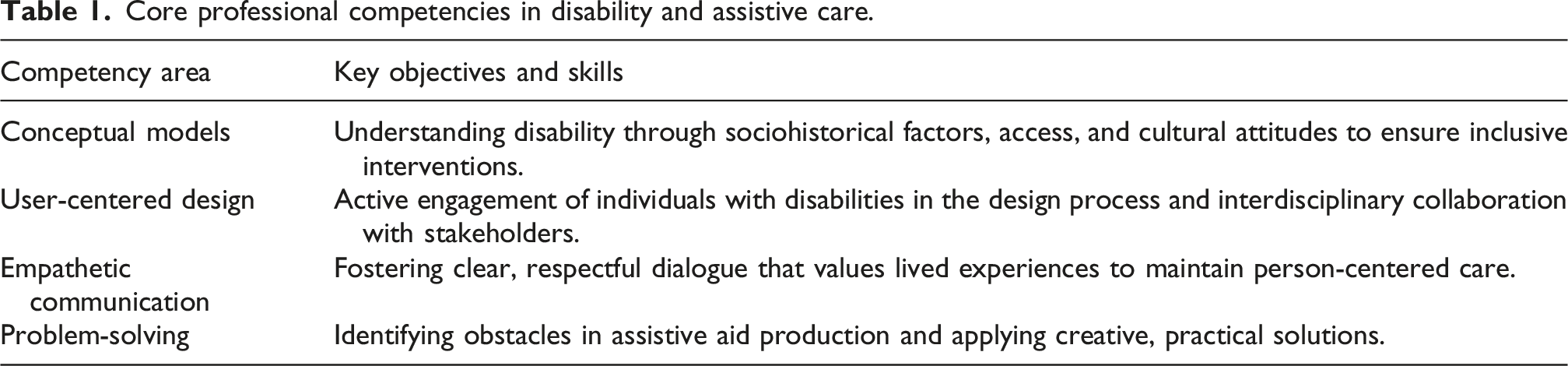
Assistive technologies and products must be user-friendly, comfortable, and aesthetically pleasing.7,18 Without these features, users might not be motivated to use the aid and could ultimately abandon it. 19
Therefore, stakeholders must collaborate across disciplines and develop skills to promote and enhance user motivation20,21 empowering individuals to actively participate in the design and use of their own aids and adhere to treatment.
Achieving this requires professionals to understand that the path from identifying needs to everyday use of the assistive device is not always straightforward. Behavioral change is often a complex process that demands tailored approaches and consistent encouragement. 22 Professionals must recognize the psychological stages users experience when adopting new technologies and foster prosocial behaviors such as empathy and cooperation. These factors are critical for building supportive relationships, overcoming barriers, and ensuring sustained user engagement throughout the process.
Engaging in a user-centered approach can be challenging; for instance, some users might not yet recognize the need for an aid to promote autonomy, while others might have concerns or misconceptions about how the aid could assist them. 21 Professionals can benefit from understanding the stages individuals go through to be ready to make changes in their lives.22,23
Reference 21, developed the Trans-Theoretical Model, which highlights how individuals progress through various stages of change: precontemplation, contemplation, preparation, action, maintenance, relapse, and a definitive way out. In the precontemplation stage, individuals are not yet considering change. During contemplation, a concern emerges, and they begin to think about change. In the preparation stage, they decide to try something new and start planning for change. The action stage involves actively participating and making changes. Maintenance focuses on sustaining these changes, while relapse signifies a setback requiring reengagement with the plan to continue progressing. Finally, the definitive way out is reached when the change is fully implemented and long-lasting.
For example, in the context of 3D printing for disability care, a user may initially be unaware of the benefits of a custom-made assistive device (precontemplation). As they learn more and consider its potential advantages (contemplation), they begin to engage with the design process (preparation). Once they start using the device (action), they gradually incorporate it into their daily routine (maintenance). If challenges arise, such as discomfort or reluctance to use the device, they may step back (relapse), requiring adjustments. Ultimately, with support and refinement, the device becomes an integral part of their life, enhancing their independence (definitive way out). Service providers who are mindful of this model can offer the appropriate support, information, and encouragement needed to facilitate successful participation, create high-quality products that truly meet users’ needs, reduce resource waste, 24 and foster the adoption and sustained use of assistive aids.
Prosocial behaviors involve voluntary actions aimed at benefiting others without expecting external rewards, focusing on the receiver’s needs, identity, and preferences.25–28 These behaviors (such as actions of positive reciprocity, care, help, empathy, solidarity, and cooperation) are essential elements in the professional relationship between service providers and individuals with disabilities. 29
In the context of disability care, prosocial behaviors foster a supportive environment, enabling meaningful engagement with individuals, and acknowledging their unique needs and circumstances throughout the whole process of designing assistive 3D aids. These behaviors can contribute significantly to the effectiveness of care, as they might establish trust and ensure the dignity and autonomy of end-users.30,31 For instance, empathy allows service providers to understand the lived experiences of users, which enables them to adapt strategies that resonate with the users’ goals and challenges. 30
For example, when a user is involved in co-designing a 3D-printed prosthetic, a service provider who exhibits prosocial behaviors like active listening and empathy may ask detailed questions about the user’s daily life, mobility challenges, and preferences. This approach allows the service provider to create a prosthetic that not only meets the functional requirements, but also aligns with the user’s comfort and lifestyle, promoting greater satisfaction and long-term use of the device.
Moreover, fostering prosocial behaviors among health care professionals and makers can have a broader impact, contributing to building more inclusive and supportive environments where users feel empowered and supported throughout the design and implementation process. When professionals engage with empathy and solidarity, they improve the quality of care and enhance the likelihood of long-term user engagement and adherence to co-designed solutions as well as assistive devices. 32
DEEP project
In line with these ideas of training and collaboration as key factors in empowering individuals with disabilities, the DEEP project (which stands for Disability and professional Empowerment Engaging 3D Printing) was developed to expand disability care beyond its traditional sectors. 29 Often, professionals from sectors such as technology, design, and even some areas of health care may lack the necessary experience to effectively interact with or provide tailored services to individuals with disabilities. To address this gap, the DEEP project fostered collaboration among institutions from five EU countries: Italy, Spain, the Czech Republic, Luxembourg, and France. 33 Participating institutions contributed their expertise and insights, enriching the project and developing a training program that introduces diverse perspectives and innovative approaches to disability care, with a particular focus on the use of 3D printing technologies.
The primary goal of the DEEP project was to introduce the socio-health sector to the potential benefits of utilizing 3D printing in disability care. Additionally, it sought to enhance the motivational and prosocial skills of target service providers. These skills are crucial for fostering meaningful engagement with individuals with disabilities, allowing them to participate actively in the co-design and production process to better address their specific needs. DEEP is committed not only to supporting the practical needs of end-users, but also to promoting social integration, autonomy, and psychological well-being.
The DEEP training program
It was developed within a European Erasmus + project: 2021-1-IT01-HKA220-VET-000034658.
It was implemented as a blended learning pathway structured into thematic modules. It was not limited to a transfer of theoretical knowledge, but rather focused on the development of practical and prosocial skills for the co-design of assistive technology. The face-to-face training was delivered through collaborative work sessions totalling 16 h of practical teaching (depending on the pilot center), complemented by the study of technical materials. The program integrated knowledge of the bio-psycho- social model, prosocial communication, and technical training in 3D printing, with the aim of fostering the autonomy of people with disabilities through personalized solutions.
The current study aimed to gather feedback from the Italian and Spanish service providers who participated in the DEEP training, focusing on their experiences and the potential impact of the training. The study’s research questions were: (a) what are the participants’ perceptions and experiences after the DEEP training, which aims to provide 3D printing supports for individuals with disabilities? and (b) are there any differences and commonalities between the experiences from the Italian and Spanish participants?
Methods
A qualitative method was employed, using the focus group technique.34,35 This approach was effective for gathering individuals’ insights on their participation in the DEEP training, as well as some practical repercussions in their context after taking the course and their collaboration with people with disabilities.
The evaluation conducted through the focus groups aimed to assess the practical impact of the program following the actual integration of 3D printing into the participants’ professional routines. Specifically, the sessions were structured to evaluate behavioral change, by identifying the participants’ progression through the stages of the Transtheoretical Model (TTM); and interprofessional communication, by analyzing the development of prosocial skills during the collaborative co-design of assistive devices. This approach ensured that the evaluation moved beyond mere technical feedback, focusing instead on the sustainable adoption of the technology and the quality of professional interactions.
Regarding the inclusion criteria, participants were eligible for the study if they possessed at least 3 years of experience in disability care or 3D printing and had furthermore completed the full DEEP training modules. In addition, the data collection process was conducted through semi-structured focus group sessions, each lasting approximately 45 min. These sessions were audio-recorded and subsequently transcribed verbatim to ensure a precise representation of the participants’ experiences.
The data were analyzed using thematic analysis, following the six-step framework proposed by Ref. 36. To ensure inter-rater reliability, two researchers independently coded the transcripts, resolving any discrepancies through consensus to maintain rigorous analytical standards.
To ensure the comparability and quality of the data collected in Spain and Italy, a unified methodological protocol was followed. This included standardized moderator training and a shared coding frame. Regular inter-country briefings were held to calibrate the thematic analysis process, ensuring that the interpretation of the “stages of change” and “prosocial communication” was consistent across both geographical contexts, despite local variations in participant discourse.
The focus group guide was explicitly designed using a top-down approach, where the predetermined Research Questions (PIs) served as the thematic framework. This ensured that the dialogue remained focused on the key dimensions of the DEEP program, such as technical barriers or empathy development, thereby securing a direct link between the theoretical framework and the empirical data collection.
Participants
A total of 40 service providers participated in the follow-up focus group, 30 from Italy and 10 from Spain. A service provider in this study is defined as an individual from a range of disciplines that collaborates in a professional manner to support individuals with a disability. Examples of service providers that participated in the study were health professionals (medical doctors, physical therapists, psychologists, speech therapists, occupational therapists) and 3D makers.
The participants work in different organizations, while their clients often range from children and adolescents to adults. Their working environments range from rehabilitation centers, non-profit organizations, private practice, hospitals, and health care settings.
Procedure
Two follow-up meetings were held involving 30 service providers who participated in the training (15 for each meeting).
Each participant described, in a dedicated space, a situation that represented a change in their own attitude and ability to motivate appropriately using the categories of the Trans-theoretical Motivational Model, toward one or more patients with disabilities. Then, the trainer proposed a follow-up question to test the degree of skill learned in relation to the motivational and prosocial models.
Data collection
DEEP program phases.
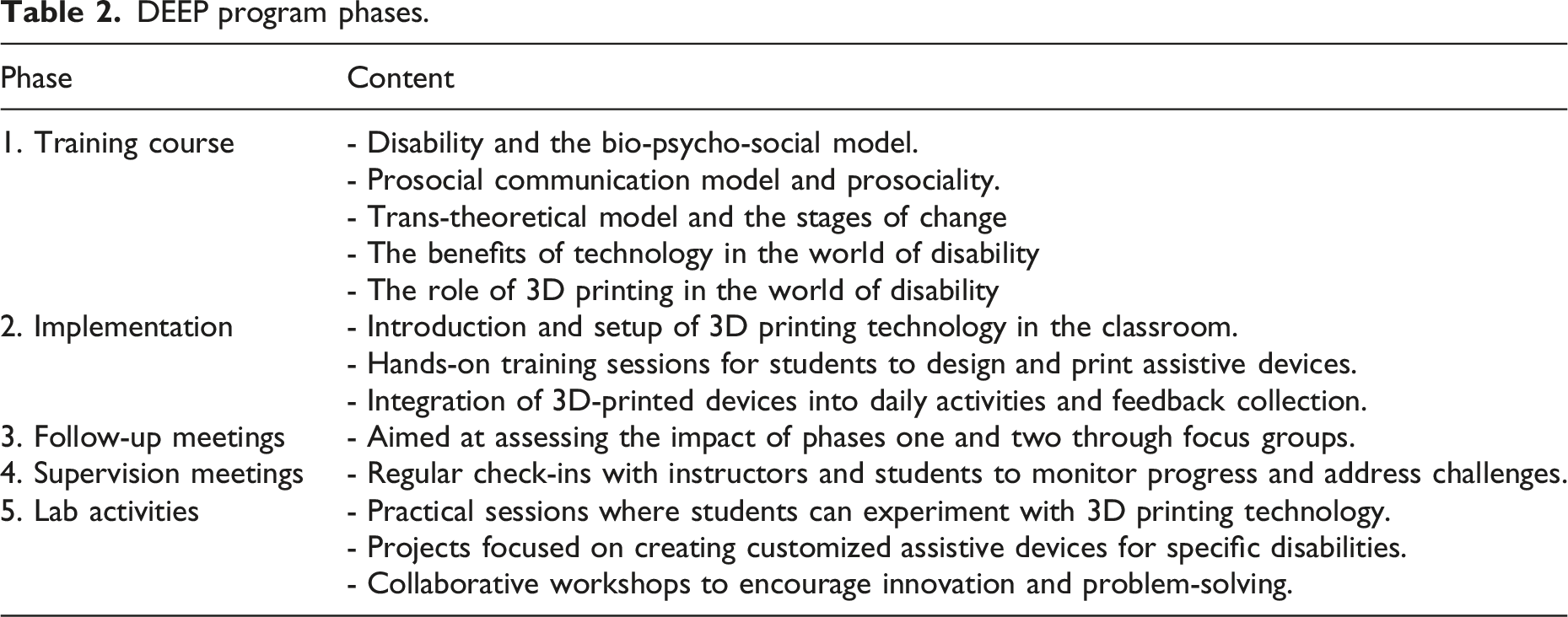
4 weeks after the end of the DEEP training, follow-up sessions in the format of a focus group took place. Sessions were guided by a trainer and a facilitator, ensuring that discussions remained open, focused, and productive while also gathering data. For each country, a total of two follow-up sessions (each lasting 3 h) were carried out with 15 participants per meeting. This setting enabled the participants to share their views, reflect on their practices, and provide feedback on the training they received.
The focus groups were guided by the following questions: [1] How has your relationship with people with disabilities improved after the DEEP training? What has changed or will change in the near future? [2] What is your current feeling about integrating 3D technology into your practice? What are the pros and cons of using the technology? [3] How do you feel about networking and co-design with others? Who would you consider suitable to be involved in your activities in the future? [4] How do you feel about your work and tasks after the training? What has changed? and [5] Is there anything you would like to add? The participants were asked to reflect on and discuss those questions. Their insights were crucial for evaluating the effectiveness of the DEEP project and identifying areas for improvement. 37
The trainer and facilitator of each focus group maintained reflective notes, including quotes, which were anonymized for use in the analysis.
Data analysis
The data collected were reviewed and analyzed by one coder per country using the thematic analysis proposed by Ref. 38. Data analysis included a systematic and iterative process of inductive coding, emphasizing immersion in the data and continuous reflection between the coders. 36 The focus was to uncover shared meanings in the participants’ perspectives, while acknowledging researcher subjectivity as a valuable tool for analyzing and interpreting the data. The data analysis resulted in four themes that are explained in the results section.
To minimize researcher bias and ensure the trustworthiness of the findings, the thematic analysis was performed by coders who did not participate in the facilitation of the DEEP training sessions. This independent coding process followed a double-blind approach to the extent possible within the research team. Discrepancies in theme identification were resolved through consensus meetings. Furthermore, the analysis adhered to the principle of negative case analysis, actively searching for and documenting participants’ frustrations, technical setbacks, and perceived limitations of 3D printing in their clinical practice, thereby ensuring a balanced representation of the data.
Results
Four major themes emerged from the data: [1] Changes in behavior and professional identity, [2] Collaborative and multidisciplinary approaches, [3] User-centered and inclusive practices, and [4] Implementation challenges. These themes are described below.
Abbreviations used: HP = healthcare professional; MK = 3D designer; User = users.
Changes in behavior and professional identity
This theme encompasses the participants’ perceptions of changes in their behavior and professional identity when interacting with people with disabilities. A participant from Spain reflected: (HP1) “It has been a very interesting experience because it has allowed us to fulfill ourselves as people and professionals.” This statement embodies this theme, highlighting the personal and professional growth that the participants experienced throughout the program. Two subthemes were identified: (a) Emotional and relational changes and (b) Professional development.
Emotional and relational changes
The DEEP program had an impact on the participants’ socio-emotional learning, improving their ability to interact with people with disabilities in an empathetic, reflective, and constructive way. The participants from both countries shared their transformation in enhancing communication, managing emotions, and fostering healthy relationships with individuals with disabilities.
The Italian participants reported identifying changes in their behavior during challenging interactions, such as users’ expressions of irritation, anger, or hostility. The participants became more aware of adopting a reflective mindset even in difficult moments, allowing them to replace negative reactions (e.g., irritation) with healthier responses (e.g., responding with a kind tone and active listening).
Similarly, the Spanish participants noticed changes in the way they interacted with their users, spending more time listening to their needs and incorporating their input. Moreover, the participants reported using empathic listening to understand the true needs and intentions of people with disabilities, which are sometimes expressed through hostile attitudes or show resistance to receive some kind of support.
Respecting their process and not giving up, one participant shared: (HP2) “I’m still trying with one of the people I serve.”
This may refer to the lack of trust that people with disabilities sometimes show toward the professionals who accompany or support them in specific situations. It may be that the person resists accepting help or advice from professionals, be it because of mistrust, pride, fear, or simply because they do not want to change their behavior. This resistance may hinder the professionals’ work and negatively affect the helping relationship, as the person is sometimes unwilling to collaborate or follow the recommendations. It would be interesting to identify the reasons behind this resistance and try to address them respectfully and empathetically to achieve greater collaboration and progress in the accompaniment process.
Professional development
The DEEP program enhanced the participants’ professional development, influencing their roles, attitudes, performance, and approaches in providing services to individuals with disabilities. The participants from both countries revealed their experiences of professional growth, increased motivation, and the adoption of novel strategies and collaborative practices in their work.
The Italian participants reported being more aware of their valuable role as professionals, recognizing the importance of a more inclusive and supportive approach to disability care. (MK2) highlighted the importance of working together (makers, designers, therapists) to achieve a holistic approach and create unique and sustainable solutions. (MK3) shared their enhanced ability to motivate and cooperate with people with disabilities, recognizing their limitations and finding alternative strategies together.
(HP7) expressed being more oriented toward the development of autonomy, social inclusion, and the prevention of any form of marginalization.
The Spanish participants described their participation in the training as enriching and aligned with their professional needs and goals. (HP4) mentioned that the training had opened up new professional areas of interest for them to explore (e.g., safety and legal regulation of 3D printing in the health care field). This emphasis underscores the broader impact of the DEEP program on opening up new professional avenues and encouraging comprehensive approaches to disability care. They recognized the need for service providers to become more involved in aspects they had not considered before.
The reported changes in behavior and professional identity noted by the participants as a result of the DEEP training facilitated stronger bonds with the individuals they serve, transformed their professional practices, and contributed to the broader goal of social inclusion.
Collaborative and multidisciplinary approaches
The DEEP program emphasized the importance of collaborative and multidisciplinary approaches in supporting individuals with disabilities. This theme captures the participants’ insights on the value of involving various professionals and users to create a comprehensive and effective support system when employing 3D technologies.
The Italian participants recognized the advantage of involving a diverse range of service providers and users, such as makers (3D printing experts), designers, therapists, individuals with disabilities, and their families. They highlighted the importance of working together to achieve a holistic approach and create unique, useful, and sustainable solutions. This multidisciplinary collaboration helped address different aspects of care, from technical solutions to emotional and social support.
Similarly, the Spanish participants appreciated the collaborative approach between users and service providers, acknowledging the benefits of adapting 3D tools to the users’ particular needs. They considered bringing together different perspectives and expertise to be crucial for developing innovative, inclusive, and practical user-centered solutions: “In a world of increasingly complex problems, collaboration between users and professionals can be essential and helpful.”
User-centered and inclusive practices
(MK5) commented that the DEEP program influenced them to practice a user-centered approach and actively offer services with social inclusion in mind and a commitment to breaking some of the barriers that users might face. This theme encompasses the importance of involving people with disabilities in the decision-making processes and designing solutions that promote autonomy, usefulness, and sustainability.
The Italian participants expressed that they became more aware of fostering a respectful environment where users’ limitations, needs, intentions, and preferences are considered. Additionally, they recognized the importance of involving not only users with disabilities but also their families in order to design unique and adapted solutions that emphasize usefulness, specificity, sustainability, and beauty, where design quality and the aesthetic component become a vehicle and value to promote social inclusion.
The Spanish participants highlighted the empowering effect of involving users in the decision-making process for the creation and design of the products they need when using 3D technologies. (MK5) noted, “It is a professional mistake to make decisions for the other person,” emphasizing the importance of promoting autonomy in the interactions with the users. Moreover, the participants commented on the importance of considering the possible needs of individuals with disabilities in advance and suggested creating protocols or adapted manuals to meet those needs, ensuring that the users understand the working process. For example, they suggested creating an adapted 3D printing manual to clearly explain all the steps involved in printing the design.
Additionally, the participants considered that DEEP training contributes to raising awareness of the social prejudices and preconceived ideas that people with disabilities still encounter. They perceived that the training contributes to building a more inclusive society by breaking down the barriers that still exist for this community. For example, users who benefit from the training said: (User 1) “This type of training helps us better understand our limitations. Personally, it has helped me to see how 3D printing can make my day- to-day life easier, and to be part of the process and to collaborate on what I need.” (User 2) “It is the first time that, in a training course, I have been allowed to give my opinion and my point of view to improve something. Normally, people without disabilities tend to think that they know what people with disabilities need. Unfortunately, this is not always the case.”
Involving users with disabilities in the 3D printer project has been crucial. Their insights ensure that the designs meet real needs, enhancing usability and accessibility. By incorporating their feedback, the project can create more effective and personalized solutions. This collaboration not only empowers users but also drives innovation, making the technology truly inclusive.
Implementation challenges
Only the Spanish participants pointed out challenges that might appear in the implementation of 3D technologies in the context of disability support. First, the participants reflected on the substantial lack of knowledge about people with disabilities, indicating a need for comprehensive and practical training opportunities to provide better services to this community. Second, the participants considered that one significant barrier is the cost of and access to 3D printers. Despite the innovative potential of this technology, the participants expressed that it remains expensive and not widely available for some service providers and users, making it difficult for many to take full advantage of its benefits. Participants noted that, despite the benefits, the time required for 3D printing remains a significant barrier.
Lastly, some participants noted the lack of opportunities to apply 3D technologies in their practice, such as psychologists. (HP 9) “As a psychologist, I see the potential, but I find it difficult to find real opportunities to apply 3D technology in my daily clinical practice; it feels like the tools aren’t yet designed for our specific field.”
In response to the second research question, the data from both cohorts reveals a high degree of consistency in the core transformative effects of the DEEP training, alongside specific divergent nuances regarding implementation and the scope of social inclusion.
The findings indicate that the DEEP training outcomes were largely consistent across both cultural and institutional contexts. Participants from both Italy and Spain experienced a paradigm shift in professional identity. Both groups transitioned from traditional, top-down service provision to a more empathetic, user-centered mindset.
Recognition of multidisciplinarity
There was a shared consensus on the necessity of a collaborative ecosystem (health professionals, makers, and users) to ensure the success of 3D printing supports.
Empowerment through inclusion
Both cohorts emphasized that involving individuals with disabilities in the design process is not just a technical requirement but a fundamental right that fosters autonomy. Despite these shared perspectives, the data suggests specific differences in how each cohort perceives the application of 3D technology.
Focus on the support network
While both countries valued inclusion, Italian participants explicitly highlighted the aesthetic quality of the products. They argued that for a 3D-printed support to be truly inclusive, it must not only be functional but also visually appealing.
Technical and structural barriers
Spanish participants were more vocal regarding implementation challenges. They were the only ones to explicitly identify structural barriers such as equipment costs, time constraints, and the lack of specific protocols or legal frameworks for 3D printing.
Emotional versus procedural adaptation
The Italian cohort focused more on the emotional management of difficult interactions with users, whereas the Spanish cohort emphasized the need for procedural tools, such as adapted manuals, to bridge the gap between technology and the user.
Despite these contextual differences, the training outcomes showed a remarkable consistency across both countries.
Discussion
The findings on the experiences of the DEEP training program suggest valuable insights into how the integration of 3D printing technologies, combined with enhanced motivational and prosocial skills, shapes the behavior and identities of health care professionals and 3D makers when interacting with individuals with disabilities, fosters collaborative approaches, and highlights the importance of user-centered and inclusive practices. A key takeaway is the critical role of collaborating closely with individuals with disabilities, ensuring that their needs and preferences are prioritized in the design and implementation of assistive devices. The data from both Italy and Spain provide a detailed perspective on how professionals experience transformation through the program, while also revealing country-specific challenges and opportunities. These findings align with the existing literature that emphasizes the need for specialized training and collaborative frameworks in the context of disability care.2,12,13
Shaping professional roles in disability care
The results show that the DEEP training brought about significant changes in how participants perceived their professional roles, with shifts reported in both emotional and relational aspects of their interactions with individuals with disabilities. Both Italian and Spanish participants highlighted the development of empathy, reflective thinking, and better communication as key outcomes of the training, reinforcing previous studies that underscore the importance of socio-emotional skills in health care settings.39–42 The training empowered professionals to adopt a more inclusive, user-centered approach, which stands in contrast to more traditional models of care.
However, differences emerged in the way the participants from each country interpreted these changes. The experiences from the Italian participants were more focused on professional responsibility specifically in terms of fostering autonomy and inclusivity for individuals with disabilities. In contrast, the Spanish participants reported that the training opened up new professional avenues, including the consideration of legal and safety aspects of 3D printing in health care, suggesting that while both groups experienced transformation, the specific outcomes varied based on their professional and unique contexts.43,44
These findings suggest that the DEEP training, with its focus on integrating 3D printing technologies into disability care, facilitated stronger bonds and deeper engagement between service providers and users. This encouraged professionals to move beyond addressing functional needs, emphasizing autonomy, participation, and dignity, which in turn contributed to promoting social inclusion.2,9,10,16
Regarding the Transtheoretical Model (TTM), the DEEP training acted as a catalyst for movement through the stages of change. Participants who initially reported skepticism or lack of awareness (precontemplation) shifted towards contemplation after the first modules. Furthermore, the collaborative co-design phase was particularly effective in moving healthcare professionals into the action stage, as evidenced by their direct involvement in creating assistive devices. For instance, the transition from “understanding the potential” to “implementing solutions” aligns with the TTM’s self-efficacy construct, where participants gained the confidence necessary to integrate 3D technology into their daily clinical practice.
Promoting disability empowerment and inclusion through prosocial behaviors and user-centered approach
Prosocial behaviors, such as empathy, cooperation, and solidarity, were consistently cited by the participants as crucial elements in their interactions with individuals with disabilities. The DEEP training placed a strong emphasis on these behaviors, which aligns with the existing literature on the importance of prosociality in health care.28,30,45 In both countries, prosocial behaviors were identified as essential for establishing trust, ensuring user autonomy, and enhancing the overall quality of care.
In particular, the concept of active listening and empathy was repeatedly highlighted by both Italian and Spanish participants as fundamental to their interactions with users during the co-design process of assistive devices. Italian participants focused on creating environments where users felt heard and respected, which aligns with broader frameworks of inclusive care.13,16 Spanish participants, on the other hand, emphasized the role of empathy in understanding the lived experiences of users, allowing them to better adapt their strategies to meet users’ challenges and goals.4,17,46
The emphasis on prosocial behaviors and a user-centered approach not only improved the immediate care provided but also contributed to the creation of more inclusive environments, where users felt empowered to actively participate in decisions related to their care. This underscores the broader impact of prosociality in fostering long-term user engagement and adherence to co-designed solutions for assistive care.3,19,20,30
Promoting team-based approaches in 3D printing for assistive technology
The participants from both Italy and Spain recognized the value of multidisciplinary collaboration in implementing 3D printing technologies for disability care. This aligns with broader research advocating inter-professional cooperation to ensure that assistive technologies are tailored to the specific needs of individuals with disabilities.3,4,7
The role of makers, health care providers, and users in the co-design process was seen as critical in ensuring that assistive devices were both functional and integrated into users’ daily lives.
While collaboration was emphasized in both countries, subtle differences in approach were observed. The Italian participants highlighted the importance of involving a diverse range of professionals, such as designers and therapists, alongside families, to co-design solutions that were not only useful but also aesthetically pleasing. This reflects a more holistic approach to disability care, where technical and emotional factors are equally considered.7,13,15,18
The Spanish participants, on the other hand, were more focused on developing clear protocols and manuals to ensure that users could easily understand and engage with 3D printing technologies. This underscored the need for having well-prepared materials to improve user comprehension and support collaboration.47,48
These variations suggest that cultural and systemic differences influence how collaboration is perceived and implemented in each country. While the DEEP training successfully fostered collaboration, further exploration into how these collaborative dynamics differ across cultural contexts would provide deeper insights into effective implementation strategies for 3D printing in disability care.
These variations provide a direct answer to the second research question regarding the differences between cohorts. Specifically, the Italian cohort prioritized a relational-aesthetic approach, where the visual dignity of the object is considered essential for social inclusion. In contrast, the Spanish cohort adopted a procedural-structural approach, focusing on technical empowerment through manuals and expressing greater concern for the economic and legal barriers of the system.
The above should not be analyzed in isolation, as it stems from deeply rooted socio-institutional contexts within each country’s maker ecosystem. In Italy, the emphasis on design aesthetics reflects a cultural heritage applied to the healthcare sector, where the healthcare system operates through regional and community-based models that prioritize personalized, local, and empathetic care over bureaucratic rigidity. Conversely, the Spanish collective’s distinct focus on procedural manuals, structural barriers, and regulations reflects the highly formalized and centralized nature of its National Health Service, where integrating clinical innovations demands compliance with strict data protection laws, safety certifications, and institutional regulations. Recognizing these differences demonstrates that applying a one-size-fits-all strategy for the future scalability and implementation of the DEEP program would be counterproductive; hence, the key to consolidating this framework lies in tailoring it to the particularities of each institution. Consequently, effectively expanding the program in Italy would require investing in service design and empathy-based guidelines that optimize the emotional connection between makers, families, and therapists. In contrast, expansion in Spain will depend on equipping professionals with formal tools to overcome structural limitations, including legal compliance templates, manufacturing protocols, and cost-benefit analysis models.
Challenges in adopting 3D printing for disability care
Despite the potential of 3D printing in disability care, the Spanish participants identified barriers that required attention. While 3D printing is often associated with relatively low production costs, 6 the participants expressed their concerns about financial constraints and the limited access to this technology in their work environments. These challenges point to the need for additional investment and support to make 3D printing more accessible for both users and service providers.
Additionally, the participants acknowledged limited opportunities to incorporate 3D technologies into their daily practices. Some highlighted the lack of infrastructure to support the integration of 3D printing in their work. This suggests that while the DEEP training was effective in raising awareness and fostering collaboration, systemic barriers still hinder the widespread adoption of these technologies in disability care. Although the participants did not specifically address the time and human resource demands involved in co-design, as highlighted by Ref. 2, these factors are important avenues for future investigation.
Limitations
A limitation of this study is the imbalance between the Italian (n = 30) and Spanish (n = 10) samples. While this disparity may affect the depth of the comparative analysis, the qualitative nature of the study allowed for a rich exploration of themes across both contexts. Future research should aim for more balanced cohorts to further explore regional nuances.
Conclusion and future directions
The results of the DEEP project highlight that the integration of 3D printing technologies in the field of disability represents a promising pathway for promoting autonomy, social participation, and quality of life for people with disabilities. The training program demonstrates that the joint training of health care professionals, occupational therapists, designers, and makers not only supports the acquisition of technical skills, but also fosters a shared understanding of the functional, emotional, and contextual needs of end-users. This interdisciplinary convergence, accompanied by the explicit promotion of prosocial behaviors, emerges as a key component in driving truly person-centered technological solutions.
Likewise, the project’s findings show that the training methodology applied offers notable flexibility and adaptability to the sociocultural contexts of the different participating countries. This versatility suggests that the DEEP model has strong potential for transferability and scalability to other geographical settings and care systems, provided that the institutional, educational, and community-specific characteristics of each region are taken into consideration. The program’s ability to adjust to local needs reinforces its usefulness as a framework for open innovation initiatives aimed at fostering inclusion.
Nevertheless, significant challenges remain that must be addressed to ensure the widespread and equitable adoption of these technologies. Among the main obstacles are the costs associated with the acquisition, maintenance, and updating of 3D printers and materials; limited access to digital fabrication spaces; the heterogeneous level of technical training among health care staff; and difficulties in translating technology into everyday clinical practice. These challenges are compounded by structural barriers related to time availability, service funding models, and the absence of standardized protocols to facilitate the integration of personalized solutions into care pathways.
Looking ahead, it is considered a research priority to further examine these limitations in order to develop sustainable strategies that enable the democratization of 3D printing in diverse health care and social care contexts. It will be essential to explore models of collaboration between public institutions, universities, digital fabrication centers, and civil society organizations that facilitate access to technical resources and promote the creation of inclusive innovation ecosystems.
Similarly, it is recommended to advance the analysis of how cultural, organizational, and regulatory differences influence technological adoption, with the aim of producing guidelines and policies that support the responsible and effective implementation of these tools.
Moreover, the role of prosocial behaviors in collaborative design processes warrants deeper study. Investigating how empathy, cooperation, and shared responsibility can be fostered within multidisciplinary teams from different cultural backgrounds will offer greater insight into the mechanisms that enable solutions that are more closely aligned with the real needs of people with disabilities. The combination of these dynamics with emerging technologies may contribute to improving outcomes in rehabilitation, support, and social participation, thereby reinforcing the principles of universal accessibility and person-centered design.
Overall, the DEEP project shows that the convergence of technological innovation, interdisciplinary training, and prosocial values constitutes a robust pathway toward a more inclusive, customizable, and autonomy-oriented model of care. Consolidating and extending this approach represents both a challenge and an opportunity to transform the way support solutions for people with disabilities are designed and implemented.49,50
Footnotes

Funding
The author received no financial support for the research, authorship, and/or publication of this article.
Declaration of conflicting interests
The author declared no potential conflicts of interest with respect to the research, authorship, and/or publication of this article.