






Abstract
Intorduction
Inclusive education requires accurate and systematic identification of students with disabilities to ensure appropriate educational support and equitable learning opportunities. However, conventional assessment instruments used in inclusive schools are often limited in flexibility, accessibility, and responsiveness to diverse disability profiles. Recent advances in educational technology have introduced new possibilities for supporting assessment and identification processes through technology-based instruments.
Methods
This study aims to regularly review the use of technology-supported assessment instruments for identifying students with disabilities in inclusive education settings. A systematic literature review was conducted following the PRISMA 2020 guidelines. Relevant articles were retrieved from Scopus, Web of Science, ERIC, and PubMed databases, covering publications from 2021 to 2025. After a rigorous screening and eligibility process based on predefined inclusion and exclusion criteria, eight peer-reviewed international studies were included in the qualitative synthesis.
Result and Discussion
The findings reveal several dominant themes, including the use of assistive technologies and mobile applications to enhance accessibility, data-driven assessment systems such as learning analytics for continuous monitoring, and interactive or immersive technologies (e.g., AR/VR) to support adaptive and personalized assessment. Overall, technology-supported instruments were found to improve the accuracy, efficiency, and inclusiveness of assessment processes, although challenges related to teacher competence, infrastructure, and system integration remain prevalent.
Conclusion
In conclusion, technology-supported assessment instruments play a strategic role in strengthening the identification and assessment of students with disabilities in inclusive education. The review highlights the need for integrated, user-friendly, and data-informed assessment systems, as well as professional development for educators, to maximize the potential of technology in inclusive assessment practices.
Keywords
Introduction
Inclusive education places accurate assessment 1 and fair 2 as the main foundation in ensuring that the learning rights of every student are fulfilled, especially students with disabilities,3,4 in an education system that is responsive to diversity.5–7 Inclusive education is an educational paradigm that emphasizes the fulfillment of the right to learn for all students, including students with disabilities,8,9 in an equal educational environment, 10 fair, 11 and non-discriminatory. 12 The implementation of inclusive education not only requires acceptance of the diversity of students, but also requires a support system that is able to accommodate diverse learning needs.13,14 One of the key components of the system is the process of accurate identification and assessment of the learning needs of students with disabilities15,16 because the assessment results form the basis for planning educational services, adjusting learning, and providing educational support that is aligned with the individual characteristics of students.17–19 At the practical level, the process of identifying and assessing students with disabilities in inclusive schools still faces various obstacles. 20
Assessment instruments used in schools are generally conventional, static, and less adaptive to the increasingly complex diversity of disability profiles.21,22 In addition, limited teacher competency in conducting specialized assessments, limited implementation time, and minimal access to expert support staff often hinder the implementation of comprehensive and sustainable assessments. These conditions have the potential to cause delays in identifying student learning needs and impact the suboptimal educational interventions provided in inclusive school environments. Developments in educational technology in recent decades have opened up new opportunities to overcome these limitations. Various technologies, such as assistive technology, mobile devices, interactive applications, data-driven systems, and immersive technologies like augmented reality (AR), have been developed23–25 and virtual reality (VR),26–28 starting to be used in the context of inclusive education.29–31
The use of technology allows for a more flexible, adaptive, and student-centered assessment process, while simultaneously supporting continuous, data-driven learning development. Several studies have reported that technology-based assessment instruments contribute positively to increasing the accessibility, accuracy, and efficiency of the process of identifying students with disabilities.32,33 Assistive technology and digital applications have been reported to help teachers identify specific learning barriers in students with sensory, physical, and cognitive disabilities. 34 Furthermore, learning analytics systems and data-driven assessment platforms enable more objective and systematic monitoring of student progress, enabling educational decision-making to be based on more accurate and sustainable information. However, research findings related to the use of technology in inclusive education assessment are still scattered and show significant variation in the types of technology, assessment functions, and contexts of application.2,35,36 Most studies focus on specific technologies or specific disability categories, thus not providing a comprehensive picture of the use of technology as a systematic instrument for the identification and assessment of students with disabilities in inclusive schools.32,33 This condition indicates the need for a literature synthesis that can comprehensively map the role of technology in the inclusive education assessment process.
This article aims to conduct a PRISMA-based systematic literature review of studies discussing the use of technology as an assessment tool in identifying students with disabilities in inclusive education. Specifically, this study aims to map the types of technology used, the assessment functions supported, the disability targets, and the educational context in which the technology is applied, thereby providing a comprehensive overview of the development of technology-based assessment instruments and their implications for the development of an integrated digital assessment instrument selection system (instrument finder).
Materials and methods
Research design
This study uses a systematic literature review approach based on the Preferred Reporting Items for Systematic Reviews and Meta-Analyses (PRISMA) 2020 guidelines. This approach was chosen to ensure that the process of searching, selecting, and synthesizing articles is carried out in a transparent, systematic, and replicable manner.
37
This review focuses on mapping the use of technology-based assessment instruments in the process of identifying students with disabilities in the context of inclusive education as a conceptual basis for developing an integrated digital assessment instrument selection system (instrument finder). The article selection process in this study is presented in detail through a PRISMA flowchart (Figure 1). PRISMA flow chart diagram.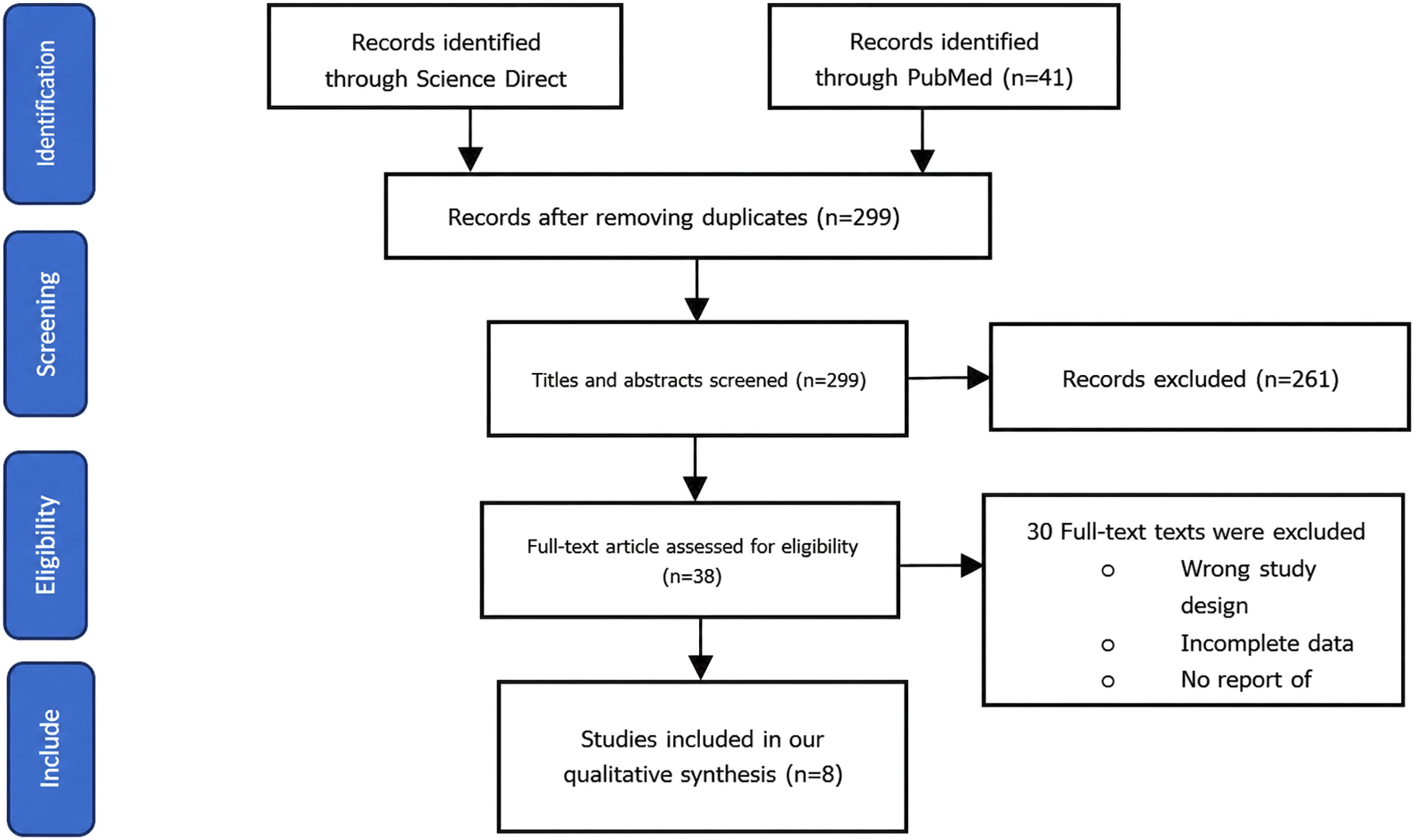
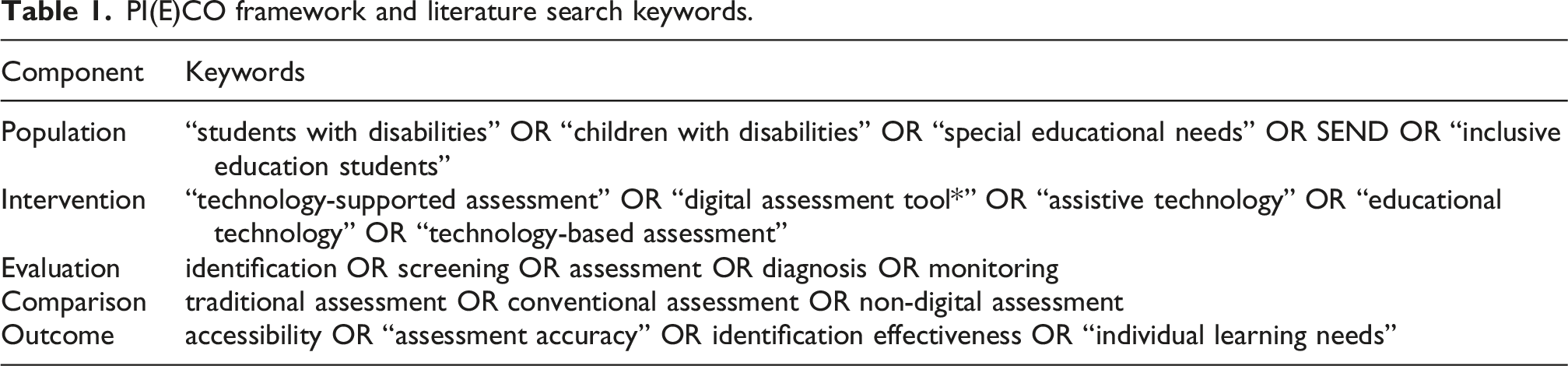
Literature search strategy
PI(E)CO framework and literature search keywords.
Inclusion and exclusion criteria
Articles obtained from the search process were selected based on predetermined inclusion and exclusion criteria. Inclusion criteria included empirical research articles discussing the use of technology as an assessment instrument or for identifying students with disabilities in the context of inclusive education, published in reputable international journals, available in full text, and written in English. Conversely, articles were excluded if they only discussed technology as a learning medium without an assessment function, focused on clinical contexts outside of education, were editorials, opinion pieces, or non-empirical reports and were duplicates of other articles.
Article selection process
The article selection process followed the PRISMA steps, which include identification, screening, eligibility, and inclusion. During the identification stage, all articles obtained from the database were compiled and duplicates were removed. The screening stage involved reviewing titles and abstracts to ensure they align with the research focus. Articles that met the initial criteria were then fully reviewed during the eligibility stage. Based on the overall selection process, eight articles were found to meet all criteria and were included in the qualitative synthesis stage.
To ensure objectivity and reduce potential selection bias, the screening and eligibility processes were conducted independently by two researchers. Each researcher reviewed the titles, abstracts, and full texts of the identified articles based on the established inclusion and exclusion criteria. The results of the independent assessments were then compared, and any discrepancies were discussed until a consensus was reached. In cases where disagreements could not be resolved through discussion, a third reviewer was consulted to provide a final decision. This procedure was implemented to enhance the transparency, reliability, and rigor of the article selection process in this systematic literature review.
Data extraction
Data from the selected articles were systematically extracted using a literature synthesis table to ensure consistency of information across studies. Extracted information included authors and year of publication, type of technology used, assessment function, target disability, educational context, and key research findings. This extraction process aimed to facilitate comparisons between articles and support structured thematic analysis.
To enhance reliability, the data extraction was conducted using a predefined template. The selected articles were reviewed and the relevant information was recorded in the extraction table to ensure accuracy and consistency of the extracted data.
Data analysis
Data analysis was conducted using a descriptive thematic analysis approach. Each article was analyzed through a coding process to identify patterns, similarities, and differences in the use of technology as an assessment instrument for inclusive education. Key themes that emerged were then grouped based on technology type, assessment function, disability target, and application context. The results of the analysis are presented in the form of a narrative synthesis, which aims to illustrate the contributions of previous studies and identify existing trends and limitations in the development of technology-based assessment instruments.
Results
These articles were then further screened through several stages, resulting in a final selection of eight articles aligned with the research theme. Table 1 presents, for each study, the study title, sample characteristics, publisher, study design, and results.
Literature review results.
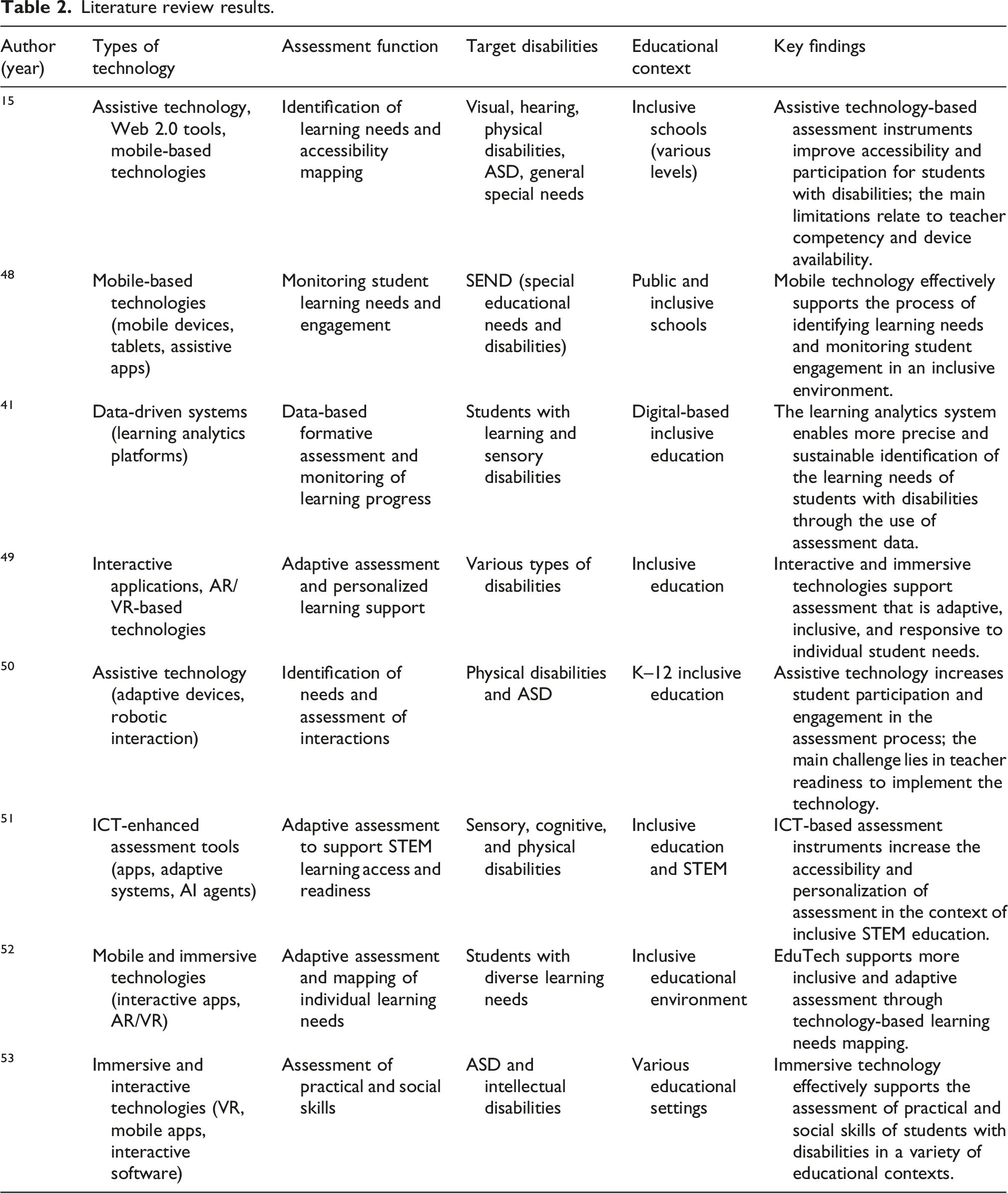
A number of studies also emphasize the role of interactive and immersive technologies, including interactive applications and augmented reality (AR) and virtual reality (VR), in supporting adaptive and personalized assessment.24,26 This technology allows students to showcase their learning abilities and responses in a more inclusive and disability-friendly assessment environment, while increasing engagement and participation during the assessment process. 38 These findings indicate that technology functions not only as a technical tool but also as a pedagogical approach that supports the principles of inclusive education. However, the effectiveness of implementing assessment technology varies across studies. The success of technology utilization is strongly influenced by the quality of instrument design, teachers’ digital readiness and competency, and institutional infrastructure and policy support. Limited teacher competency and the lack of integration of various assessment instruments into a unified system were the most frequently reported challenges. This confirms that the effectiveness of assessment technology is not solely determined by the type of technology used, but also by the implementation context and support of the education system. Overall, the results of this literature review confirm the strategic role of technology-based assessment instruments in supporting the identification and mapping of the needs of students with disabilities in inclusive education. Key impacts identified include increased assessment accessibility, accurate needs identification, personalized assessment processes, and strengthened data-driven educational decision-making. Despite differences in results across studies, the majority of evidence supports the use of technology as a critical component in strengthening assessment practices in inclusive education.
Discussion
The results of this systematic literature review confirm that the use of technology-based assessment instruments plays a strategic role in strengthening the identification and assessment of students with disabilities in inclusive educational settings. Specifically, this review aims to map the types of technology used in assessment, the assessment functions supported by these technologies, and the disability targets and educational contexts in which these technologies are applied. Consistently, the eight articles analyzed demonstrate that technology, whether in the form of assistive technology, mobile devices, interactive applications, data-driven systems, or immersive technology, can improve the accessibility, flexibility, and accuracy of assessments compared to conventional approaches. These findings align with international literature emphasizing that inclusive assessment requires instruments that are adaptive, contextual, and oriented to individual student needs.13,14 The dominant use of assistive technology and mobile devices in the reviewed studies indicates that technologies that are flexible, portable, and easily integrated into classroom practices have higher adoption rates in inclusive schools. This finding reinforces previous research suggesting that mobile devices and digital applications enable real-time, contextual, and student-centered assessments, particularly for students with sensory and physical disabilities.33,34 In this context, technology not only functions as a technical aid, but also as a pedagogical medium that bridges the limitations of traditional assessment instruments that tend to be uniform and less responsive to the diversity of student abilities.34,35
In addition to software-based digital technology, the development and validation of assessment instruments in the form of structured learning resources also plays a crucial role in supporting the quality of inclusive assessment. The article analyzed by Rahmahtrisilvia et al. (2015) confirms that assessment instruments developed systematically and validated by experts have a high level of feasibility for more accurate identification of student characteristics and learning needs. These findings indicate that assessment quality is determined not only by the digital platform used, but also by the clarity of the construct, the appropriateness of the indicators, and the instrument’s reliability in representing student learning profiles. This reinforces the review’s findings that the integration of assessment technology must be accompanied by the development of instruments that are valid, reliable, and aligned with the goals of inclusive assessment (Rahmahtrisilvia et al., 2024).39,40
In line with this approach, research (Rahmahtrisilvia et al., 2024). A study on Mauro’s Popup Book based on voice recognition showed that the integration of interactive media based on audio-visual and voice recognition can improve learning responses and engagement of students with Autism Spectrum Disorder (ASD). Furthermore, the findings of this review emphasize the important role of data-driven systems, such as learning analytics, in supporting formative assessment and ongoing monitoring of student progress. These results align with research,1,41 which demonstrates that learning analytics enables educators to identify learning patterns, cognitive barriers, and support needs more precisely through longitudinal data. In the context of inclusive education, this data-driven approach is crucial because it can reduce subjectivity in assessment and strengthen evidence-based educational decision-making. In line with this data-driven approach, research 42 demonstrated that the use of neurophysiological technologies such as quantitative electroencephalography (QEEG) in students with autism spectrum disorder (ASD) can provide objective information regarding changes in cognitive function and behavioral regulation longitudinally. These findings indicate that sensory and physiological-based assessment technologies have the potential to complement conventional digital assessments with more in-depth objective data, thereby enhancing the accuracy of identifying the learning needs of students with disabilities. This technological integration broadens the scope of inclusive assessment, from one based primarily on observation and learning performance to a multidimensional assessment that considers cognitive, behavioral, and neurophysiological aspects in an integrated manner.
The development of interactive and immersive technologies, such as augmented reality (AR) and virtual reality (VR), also shows significant potential for enriching inclusive assessment approaches. The findings in this review are consistent with research findings Borna et al. (2024); Montoya Rodríguez et al. (2023)38,43 as well as Bryant & Hemsley (2024) 25 which states that immersive environments allow students to demonstrate their competencies in more authentic and less stressful situations. For students with autism spectrum disorder (ASD) or intellectual disabilities, immersive experience-based assessments have been shown to better capture aspects of social, communication, and problem-solving skills that are often not optimally measured through conventional written tests.44,45 In line with these findings, other research emphasizes the importance of validity and clarity of the conceptual framework in the development of assessment instruments. A validation study of a learning style assessment reference book showed that systematically designed instruments based on students’ learning characteristics can improve the accuracy of identifying learning profiles and support teachers in adapting assessment strategies more objectively. These findings reinforce the view that the quality of inclusive assessment is determined not only by the use of technology, but also by the reliability of the instrument and the suitability of the assessment framework to the individual needs of students. This approach is consistent with literature that emphasizes the importance of integrating technology, instrument validity, and Universal Design for Learning (UDL) principles in inclusive education assessment practices. 46
However, the results of this review also revealed that the effectiveness of technology-based assessment instruments is heavily influenced by the implementation context. The main challenges consistently reported, both in the reviewed articles and in external literature, are teachers’ limited digital competencies and the lack of systemic support at the school and education policy levels. Several studies have shown that without ongoing professional training, teachers tend to use technology in a limited way and not integrated with assessment objectives. 35 This confirms that the success of technology-based assessments is not solely determined by technological sophistication, but also by the readiness of human resources and a supportive educational ecosystem. The variation in findings across studies also suggests that technology-based assessment instruments will have optimal impact if designed in alignment with Universal Design for Learning (UDL) principles. Previous literature emphasizes that inclusive assessments must provide a variety of representation, expression, and engagement methods so that students can demonstrate their competencies equitably.4,47 The findings of this review reinforce this view by showing that technologies designed without considering UDL principles risk reproducing exclusion in new forms, even when using digital platforms.
Despite the valuable insights generated by this review, several limitations should be acknowledged when interpreting the findings. First, the number of studies included in the synthesis was relatively limited, as only eight articles met the inclusion criteria after the PRISMA screening process. This limited number reflects the still-emerging nature of research focusing specifically on technology-supported assessment instruments for identifying students with disabilities in inclusive education. Second, the reviewed studies varied considerably in terms of research design, technological tools, disability categories, and educational contexts, which may limit the generalizability of the conclusions. Third, most of the included studies focused on specific technologies or particular disability groups, rather than examining integrated assessment systems across diverse educational settings. These limitations suggest that the findings of this review should be interpreted as an overview of current trends rather than a definitive evaluation of the effectiveness of specific technologies. Future research should therefore expand the scope of empirical studies, include more diverse educational contexts, and examine the long-term implementation and impact of integrated technology-based assessment systems in inclusive education.
In this context, the need for an integrated assessment system becomes increasingly relevant. Several international studies highlight the importance of digital assessment platforms that can connect students’ disability profiles, learning objectives, and assessment instrument choices within a single, systematic framework.14,29 In line with these findings, the results of this review indicate a gap in research and practice related to the lack of integration of various technology-based assessment instruments into a comprehensive selection system. This reinforces the urgency of developing an integrated digital assessment instrument selection system (instrument finder) that can support teachers in selecting and adapting assessment instruments according to the characteristics of students’ disabilities and learning needs.
Conclusion
This systematic literature review confirms that technology-based assessment instruments play an increasingly important role in supporting the identification and assessment of students with disabilities in inclusive educational settings. Based on a synthesis of eight international scientific articles, it was found that the use of technology, whether in the form of assistive technology, mobile devices, interactive applications, data-driven systems, or immersive technology, provides advantages over conventional assessment instruments, particularly in terms of accessibility, flexibility, accuracy, and responsiveness to the diverse profiles of students with disabilities. The results of this review indicate that technology-based assessment instruments function not only as technical aids but have evolved into strategic components of inclusive assessment practices. By supporting continuous monitoring, adaptive assessment, and data-driven decision-making, technology enables a more student-centered assessment approach that aligns with the principles of inclusive education. However, this review also revealed significant challenges, particularly related to limited teacher digital competency, infrastructure availability, and the lack of integration of various assessment instruments into a single, unified system.
Practical implications
From an educational practice perspective, these findings emphasize the importance of adopting technology-based assessment instruments that are integrated, easy to use, and relevant to the context of inclusive schools. Teachers and other educators need ongoing training focused on selecting, using, and interpreting technology-based assessment results. Furthermore, the use of assessment technology should be positioned as part of the overall school assessment system, rather than as a standalone application, so that assessment results can directly support learning planning and educational interventions for students with disabilities.
Implications for education policy and systems
At the policy level, the results of this review indicate the need for stronger institutional and regulatory support for the implementation of technology-based assessments in inclusive education. Education policies need to explicitly accommodate the use of digital assessment instruments as part of an inclusive education evaluation system, including the provision of infrastructure, implementation guidelines, and mechanisms for evaluating instrument quality. Adequate policy support is key to ensuring the sustainability and equitable access to assessment technology across various school contexts.
Implications for further research
Based on the results of this study, further research should be directed at testing the validity, reliability, and long-term effectiveness of technology-based assessment instruments in the context of inclusive education. Furthermore, research is needed to develop and test integrated assessment systems that can assist teachers in selecting assessment instruments appropriate to students’ individual characteristics and needs. This research direction is crucial for bridging the gap between the potential of technology and the actual needs of assessment practices in inclusive schools.
Footnotes
Acknowledgments
We would like to thank the Master’s Program in Special Education at the Faculty of Education, Universitas Negeri Padang, for its full support in carrying out this research, as well as all those involved in the preparation of this article.
ORCID iDs

Ethical considerations
The study was approved by the Ethical Review Committee for Institute for Research and Community Service Universitas Negeri Padang.
Funding
The authors received no financial support for the research, authorship, and/or publication of this article.
Declaration of conflicting interests
The authors declared no potential conflicts of interest with respect to the research, authorship, and/or publication of this article.