







Abstract
Objective:
Long-term outcomes of patients born with a cleft lip and palate (CLP) are scarcely investigated. Yet, this patient group is of particular interest, as they can provide a valuable retrospective view upon their treatment experiences and psychological adjustment. Qualitative accounts may be especially useful in understanding the patient journey.
Design:
The present study set out to evaluate quality of life and satisfaction with treatment in adult patients previously treated for CLP at the Wilhelmina Children’s Hospital. Semistructured interviews were performed.
Patients:
A total of 22 patients aged 17 to 35 years (mean: 25 years) were interviewed about their experiences of growing up with CLP and of the treatment they received. Interviews were audio-recorded and factors thought to influence psychological adjustment were identified.
Results:
Four main themes were identified: background factors, support systems, treatment factors, and coping/internal factors. Each theme was described with illustrative quotes.
Conclusion:
This study underlines that psychological adjustment can fluctuate over time and greatly differs between individuals, even during adulthood. Psychological support should therefore be available beyond the finalization of the treatment course. Furthermore, the majority of participants stated they had wanted more psychological support as a child to facilitate resilience and to help them cope with challenges.
Introduction
Cleft lip and palate (CLP) is the most prevalent congenital craniofacial diagnosis worldwide (World Health Organization 2012). Treatment is multidisciplinary and involves numerous surgical interventions, hospital stays, and regular follow-up consultations throughout the patient’s youth. As well as the ongoing burden of care, CLP brings along many additional challenges which can impact upon the psychological well-being of both the patient and their family members (Hunt et al., 2005; Collett and Speltz, 2007; Stock and Feragen, 2016). Understanding of CLP among the general public is poor and judgments about the patient’s personality and abilities might be influenced by appearance and first impressions (Pausch et al., 2016). Both the burden of care and challenging social experiences might therefore influence patients’ self-esteem and overall quality of life.
In recent years, there has been an increasing focus on psychological support within cleft care, and it is now firmly integrated in the cleft treatment protocol in many centers. Concurrently, there has been an increase in the number of studies investigating factors that may influence the psychological well-being of this patient group (Stock and Feragen, 2016). Unfortunately, the great heterogeneity in study designs, questionnaires, methods, and reported outcomes makes comparisons between findings complicated. Qualitative studies have the potential to shed light on these conflicting findings, yet remain relatively rare in the field of craniofacial conditions. This is in spite of the clear recommendation that qualitative methods should be integrated as part of the standard toolbox of inquiry (Nelson and Hons, 2009). Fewer still are the number of qualitative studies exploring long-term outcomes in adult patients who have fully completed their treatment course (Hunt et al., 2006; Stock et al., 2015). This group is of particular interest, as they can provide a valuable retrospective view of their treatment experiences, the challenges they have encountered, and their overall psychological adjustment.
Between 2008 and 2017, The Wilhelmina Children’s Hospital carried out a long-term follow-up study of adult patients treated by delayed hard palate closure (9-12 months). As well as surgical outcomes and speech (Kappen et al., 2017a; Kappen et al., 2017b), the team set out to evaluate psychological adjustment among these adult patients, in order to provide a more holistic and patient-centered view of the treatment protocol at that time. Subsequently, the aim of the present study was to evaluate patient satisfaction and quality of life in adults previously treated for unilateral or bilateral CLP by 2-stage palate closure by performing semistructured interviews. Building on previous research in this area (Stock et al., 2016), the goal was to explore “external” and “internal” factors which might influence psychological well-being and patient satisfaction, from the perspective of adult patients.
Methods
Design
This study carried out one-on-one semistructured qualitative interviews with adults who were born with unilateral or bilateral CLP and who were treated at the Wilhelmina Children’s Hospital in Utrecht, the Netherlands. Interviews were either conducted in person or over the telephone.
Setting
The Wilhelmina Children’s Hospital is one of the largest tertiary centers (out of 12) in the Netherlands providing regional multidisciplinary cleft care from prenatal diagnosis until the age of 18. Patients are routinely followed up at set time points throughout their treatment course by each specialist of the cleft team, which includes a psychologist. In addition, psychological parental support is provided after the prenatal diagnosis and throughout the treatment course of their child.
Procedure
Ethical approval was obtained from the ethical committee at the University Medical Center in Utrecht, the Netherlands. Patients with CLP who attended their final routine follow-up at the center between 2008 and 2017 were invited to participate in the study by the cleft team. Eligible patients were initially informed about the study via an invitation letter. Unfortunately, this letter received a low response rate (<10%), and therefore, patients were subsequently approached by telephone by their treating surgeon. In total, 59 patients were asked to participate by telephone. Patients who showed an interest were given detailed information regarding the purpose and procedure of the present study by 1 of the 2 interviewers (H.V. and I.K.). Thirty patients were not interested in participation, 7 patients were initially interested but later decided not to participate or could not be reached. Patients who were willing to participate (n = 22) were asked to provide their written informed consent. A one-on-one interview was subsequently scheduled at the outpatient clinic (n = 5), or via the telephone (n = 17), depending on the patient’s preference.
Each patient was interviewed according to a semistructured interview format, based on the protocol used by Stock et al (2015). Topics included early memories, social experiences, satisfaction with treatment, experiences of education/work, the impact of CLP on psychological well-being, and future plans. These topics were initiated by the interviewer and subsequently discussed in an open conversation (I.K., H.V., and K.B.). Interviews lasted a maximum of 1 hour and were audio-recorded. Before each interview, patients were reminded of their right to withdraw from the interview or to refuse to answer a particular question if they were uncomfortable.
Participants
A total of 22 adult patients were interviewed. All participants were aged 17 to 35 years (mean: 25 years), were Caucasian, and were born in the Netherlands. Participants who were (partly) treated by a different cleft team were excluded from this study. At the time of the interview, all participants were either (self-) employed or engaged in education. In total, 15 patients followed or were still engaged in higher education after high school. Ten participants had a partner at the time of the interview, 3 had children. One participant had a child with a cleft and 2 participants had siblings with a cleft.
Data Analysis
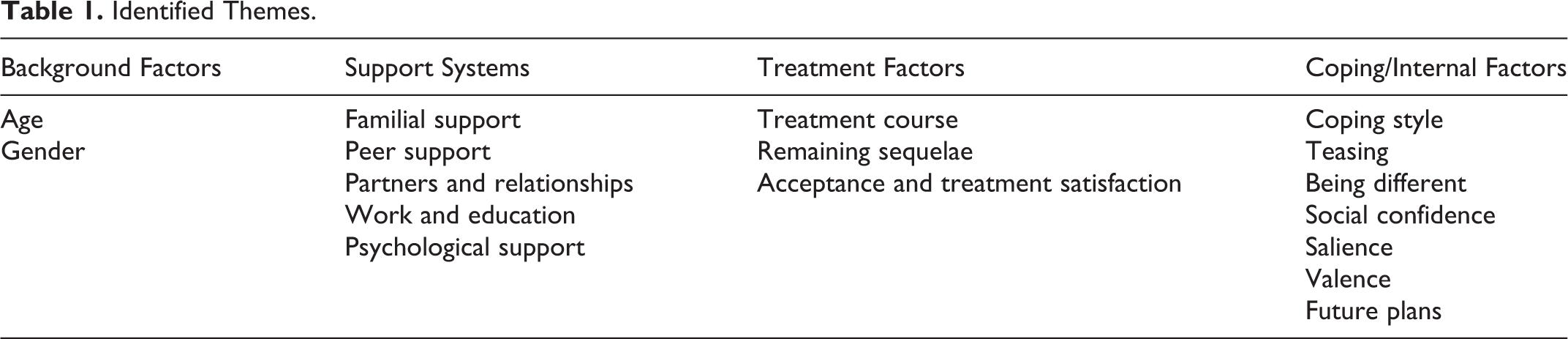
Thematic analysis was performed on the data obtained. Recordings were individually transcribed, analyzed, and subsequently discussed in a group of 3 researchers (H.V., I.K., and K.B.) in order to identify common themes and to ensure inter-rater agreement. Themes were also compared to the previous report by Stock et al (2015). To build upon this previous work, themes were divided in 4 subgroups: background factors, support systems, treatment factors, and coping/internal factors. Data remained in Dutch during the analyzation process, and illustrative quotes were eventually translated to English.
Results
Each of the 4 themes is outlined below using illustrative quotes. The themes are also summarized in Table 1.
Identified Themes.
Background Factors
Age and gender
Both men and women had experienced insecurities regarding their appearance. However, a large proportion of participants believed that the value they placed on appearance became less over time, while their level of acceptance of their appearance increased. Some valued speech outcome and intelligibility more than aesthetic outcome, especially with increasing age. I used to value appearance a great deal, but as one grows older, over 30, one starts to look at it differently and it becomes less of an issue. When I finished high school and went to higher education it suddenly seemed all OK. People acted normal, nobody teased. It was a turning point for me.
Support Systems
Familial support and family history
Nearly all participants had received significant support from their parents. Some participants openly discussed their struggles and difficulties with their parents, which they considered important for their own adjustment. Three participants sensed that one or both parents had feelings of guilt and had difficulty coping. One participant could not talk about the cleft to his/her parents at all. My grandma told me that my dad called her up crying when I was born. He had more difficulties coping than my mum. He also had an adversity towards medical procedures and never went along inside the treatment room. Personally, it was also very emotional to hear that story from my grandma. My uncle also had a cleft, but he would never talk about it. Maybe because he was from a different generation. Since my dad also had a cleft, having a cleft was not “different” for me.
Peer support
Two participants stated that being born in a village or small town had helped with their adjustment. As people often know each other in small towns, participants felt they were accepted for who they were and treated “normally” by town members. These patients also reported being attached to their hometown. Moving to a city or new town had been challenging and had a great effect on their confidence and coping at the time. I grew up in a very protected environment, a small village, where there was no teasing at all. Going to high school (in the city) was like being exposed to the big bad world. I am someone who loves to be in my own environment. Moving to a new environment and making new friends was a real challenge, partly due to my cleft.
Participants who had many social contacts reported experiencing less severe bullying or found an increased amount of support with their peers. Apart from my family, I had support from my friends, and I must say I was never short of friends.
Partners and relationships
A large proportion of the interviewed participants had experienced a period of difficulty addressing people of the opposite sex or starting relationships, mainly during their youth. Most attributed this to their character (being introvert and shy) or having low self-esteem at the time, and not directly to the cleft itself. Nearly every participant in a long-term relationship at the time of interview reported that having a relationship had contributed to them developing more self-confidence and social acceptance. She (girlfriend) really supported me and helped me to focus on my positive qualities.
Work and education
Job satisfaction contributed considerably to self-confidence and psychological well-being in many of the participants. Our company always had an important role within our family. We all worked very hard and it brought me a lot of pride. This contributed to my self-esteem.
Treatment Factors
Treatment course and hospital visits
Most participants had found the treatment course intensive. The treatment course left a big mark on my life. Even now, I am still being treated. Coming to the hospital was kind of a party. (When I was a child) I don’t remember it being as painful and I got a lot of attention. During treatment, I was never completely satisfied with the results but I always had the hope that additional procedures would make it better. After my last surgery I suddenly had to accept the result. This is the final result and it always will be. I suddenly had to get rid of my hopes that it would still become better.
Remaining sequela of the cleft
Apart from aesthetic appearance, middle ear pathology and/or hearing problems were the most frequently reported sequelae of CLP during adulthood. I still go to the ENT surgeon on a regular basis and might need additional surgery or hearing aids. I think good intelligibility is very important. I used to value appearance a great deal, but now I am older, I regard intelligible speech as more important. I am conscious about my speech. I am often a little nervous when calling strangers because it might sound different.
Treatment satisfaction and self-acceptance
In total, 55% of the adult patients (n = 12) interviewed had accepted their cleft and were satisfied with the end result of treatment. Sometimes I regard my cleft as a positive thing, it is part of me. I want to take life as it comes and would not want to change it. When I realized that the recovery of the procedure would be 8 weeks, I decided not to do it, partly because it would be such a heavy operation but also because of practical reasons such as taking time off work.
Two patients had not yet come to terms with their diagnosis and still had difficulties coping. One participant expressed feelings of anger. Both were psychologically affected at the time of interview: one was coping with depression, while the other was experiencing a mild form of generalized anxiety. Around the age of 17-18 years, I was searching for a reason and something or someone to blame. I am still trying to give it (cleft) a place in my heart.
Psychological support
Four patients had independently sought professional psychological help during or after their treatment course, and one patient was considering seeing a psychologist at the time of the interview. Two patients reported having depression and bipolar disorder that they were treated for by a psychiatrist after adolescence. A great proportion of the patients recommended that optional psychological help should be available from an early age, focusing on resiliency, dealing with bullying, and preparing patients for associated stressors. Psychological support should start at primary school. I did not have any problems at that point, yet I would have liked to be prepared for the harsh world and to deal with certain stressors.
Coping and Internal Factors
Coping style
In general, participants who identified as having adjusted positively to their cleft stated having a positive look upon life and a certain resilience against the challenges associated with CLP. They often focused on other qualities and strengths, such as work, family, or education. I try to focus on my own qualities. Everyone has negative traits, I just try to put them aside. Since my (workplace) burnout, I try to have a positive outlook on life. Before I tended to be more negative. I have really grown as a person since.
Participants often stated that remarks about appearances were made by people who were not happy themselves. When someone makes a nasty remark, it tells me more about that person than anything else.
Perceptions of teasing
Nearly half of the participants had experienced teasing or bullying during their youth. Self-esteem was affected by teasing in all cases. Teasing often started at primary school. Three participants had changed high school, partly because of teasing. Four participants reported feeling embarrassed to tell their parents or teachers that they were being teased. I was teased at the beginning of high school. I was new, different and vulnerable. At first I didn’t dare to share this with my parents, but they noticed. It ruined my first year of high school and I had to change schools/subjects because of it. I learned how to stand up for myself.
Perceptions of being “different”
Participants generally became aware of being “different” from an early age, often at the beginning of primary school and usually as a result of being teased. Some came to realize their difference later (at age 10 or above) and attributed this to the protective environment they grew up in or to the support they received from peers. Personally, I do not think I regarded myself as different, but I just started to notice that people around me sometimes regarded my cleft as odd. I am not really satisfied with my speech. I lisp. As a result, I struggled with some words during my internship at a lawyer’s office. I always regretted having to say specific words containing the /s/ sound.
Social confidence
Nearly all of the participants interviewed reported having good social confidence in adulthood. Social confidence was often lowest at primary school or high school, due to teasing, and gradually increased as participants got older. Factors such as having an enjoyable education, a satisfying job, or a romantic relationship often helped improving their overall and social confidence. Approaching new people always means getting out of your comfort zone. However, I am fine with that now. Especially for people with a cleft, I think it is very important to be amongst people as much as possible.
Three patients were conscious about their scar or having a “different” appearance when approaching new people. One participant reported having poor social skills and still felt isolated at the time of the interview (aged 30 years). I think my social skills are not as strongly developed compared to those of others.
Salience of the cleft
Salience of the cleft was often situational and more severe in particular settings, for example, when meeting new people. When I meet someone new, I value their first impression. When people meet me, they notice something different. I therefore used to be very conscious of my cleft when meeting new people in a new environment. When I started college, I had to take the train on a daily basis, often during rush hours. I met a lot of new people. At those moments, I had difficulty coping and felt less confident.
Valence of appearance
Many participants considered their appearance to play an important part in their lives. Although not always prominent, the lip scar and the appearance of the nose still affected participants’ psychological well-being at times. It (the scar) is there and I sort of accepted it. However I still have difficulties at times. I just find it ugly. I would never leave the house without make-up on.
Family planning
Almost all participants wanted to have children or already had children at the time of the interview. However, 3 indicated that they would rather not have a child with a similar condition, and 2 said they would consider abortion in the case of a genetic recurrence or would choose not to have children at all. This was mainly because they did not want to subject their child to such an intensive treatment course. I would have difficulties taking my child out if he/she would also have a cleft. I would feel guilty and responsible for it. Suppose my future daughter or son will have a cleft, I will just accept it.
Discussion
This study is one of the first to investigate long-term outcomes in patients affected by CLP using a qualitative approach and is the first study of its kind to be conducted within the Dutch treatment system. The findings build upon previous qualitative research in this area and offer new perspectives on the key factors which may influence psychological adjustment among the CLP population.
Background Factors
Similar to previous reports, increasing age seemed to be associated with an increase in acceptance and psychological adjustment. Nevertheless, great variation in adjustment existed between similar aged individuals and also within the same individual at different life stages. As implied by Stock et al (2016), a direct linear correlation between age and adjustment therefore seems to be lacking, and psychological well-being is thus an important consideration throughout the entire life span. Similarly, the data did not suggest an evident correlation between gender and adjustment. While objective factors remain important, subjective factors therefore seem to be of greater influence and should be identified and explored across different age groups.
Support Systems
The findings identified a number of support systems, including job satisfaction, romantic relationships, and support from family and peers. These factors seem to influence general psychological well-being and self-esteem within the general population also (Orth et al., 2015; Luciano and Orth, 2016).
Familial support
Having a parent with CLP was considered to have a positive influence on coping and adjustment. Among these families, the affected member often was regarded as “normal” and not treated differently from other family members. As recognized by Stock et al (2016), participants who reported being treated as “the same” as anyone else also showed better adjustment. Furthermore, previous studies have suggested that patients who report a close relationship with a family member are believed to be more resilient against challenges (Cochrane and Slade, 1999). In contrast, not being able to talk openly about their cleft or coping difficulties with (one or both) parents seemed to affect feelings of acceptance and psychological well-being in a minority of participants. Avoidance or emotion-focused coping strategies of parents have also previously been associated with a higher level of family impact (Hasanzadeh et al., 2014). Parental coping style and familial dynamics are likely to make an important contribution to the patient’s own adjustment, and it is therefore important to understand each patient’s experience within the context of their individual family system. Maladaptive coping strategies of the parents should be identified early in order to provide appropriate psychological support and to support the well-being of the family as a whole.
Teasing, friendships, and romantic relationships
Similar to the report of Stock et al (2016), a lack of understanding among the general public was mentioned. Some participants felt that a lack of knowledge or familiarity with CLP was one of the key reasons of why bystanders would stare, make remarks, or tease. Previous research has suggested that awareness of CLP among teaching staff is sometimes low (Richman, 1978; Stock et al., 2018). Providing additional information to schools should therefore be considered, with the aim of creating awareness around CLP and equipping teaching staff with the relevant knowledge to address these concerns.
Two participants reported that moving out of their trusted environment to an unknown city had been challenging and had subsequently made them feel less confident. It may therefore be beneficial to suitably prepare patients for possible stressors when embarking on periods of transition and to improve their personal resilience. Participants with a large number of close friends at school reported experiencing less appearance-related distress and exhibited higher self-esteem. Similarly, participants reported that being in a romantic relationship significantly contributed to their psychological adjustment. It has been postulated that close friendships and a higher level of social competence may protect against appearance-related distress and negative social experiences (Berger and Dalton, 2009; Feragen et al., 2009; Feragen et al., 2010). The findings of the present study appear to support this suggestion and highlight the importance of supporting young people with CLP to develop social skills and confidence.
Psychological support
A great proportion of the participants in this study also believed that clinical teams should offer psychological support from an early age in order to facilitate resilience and to prepare them for potential challenges. Even as early as the age of 10, factors including adequate emotional well-being, satisfaction with appearance, and a lower perception of being teased are important contributors to psychosocial resilience (Feragen et al., 2009). Furthermore, patients often realized that they may be seen as “different” at an early age, usually during primary school. While the focus of psychological support may be most beneficial for the parents early on, the psychological well-being of the child may already be affected at primary school age. Feragen et al (2009) already recommended standardized routine assessment throughout the life span of cleft patients, allowing for tailored psychological support. In the Netherlands, national guidelines recommending regular psychological screening are now being set up (Richtlijnendatabase, 2018).
Treatment Factors
Treatment course
The treatment course was often described by participants as intensive. However, significant anxiety associated with treatment was not reported within this group. Negative associations with admittance were often pain related. In general, participants felt well prepared for a surgical procedure, lending support to the treatment team’s current approach, including psychological care integrated in the patient’s cleft treatment, starting from prebirth until the patient’s last follow-up. Some participants reported having positive associations with hospital visits, as they felt they received extra attention or were rewarded by their parents. A child’s adjustment to hospitalization is influenced by the emotional state of the parents, as well as children’s coping strategies and parental support during and following hospital discharge (Melnyk, 2000). Some positive coping strategies include creating positive images and a feeling of security, which can be stimulated by parents and caregivers (Salmela et al., 2010). In contrast, research has suggested that parental pain catastrophizing influences the child’s postoperative memories of postsurgical pain and is possibly associated with a higher recall of emotional stress and chronic postoperative pain (Theunissen et al., 2012; Noel et al., 2015). Informing parents about positive coping strategies and ways to support their child during hospital admittance can therefore be considered. Equally, a dedicated and easily approachable person within the cleft team can help young people to have a positive experience of treatment (Feragen et al., 2017a).
Treatment satisfaction and self-acceptance
The findings of the present study suggest that satisfaction with treatment outcome and self-acceptance are 2 different entities. It appears to be possible for a participant to be accepting of his/her cleft, while still dissatisfied with the end result of treatment. Although a proportion of the participants in this study regarded their last treatment consultation to be a happy moment, some participants felt they had lost hope of a better outcome and/or would still consider having additional surgery.
A minority of patients described that the transition from the (familiar) childhood services to the (unfamiliar) adult services felt abrupt. Measures to prepare patients for this transition are therefore important. Since the findings of this and other studies were reported (Stock et al., 2015), the cleft team introduced an additional follow-up consultation for 22-year-olds carried out by the same cleft team, but taking place at the general academic hospital. In this way, patients can become familiar with the facilities and services at the general academic hospital, while still being treated by their own specialist.
Remaining sequelae
Apart from the aesthetic outcome, hearing difficulties and/or middle ear problems were the most prevalent sequelae of CLP treatment among this group of adult patients. Participants reported having consultations with their general practitioner or ENT surgeon multiple times per year. While this did not seem to significantly influence adjustment, it clearly added to the burden of care. Similarly, speech outcomes and intelligibility remained a significant concern in adulthood, which has also been recognized previously (Hunt et al., 2006). For some, good intelligibility contributed to their confidence, while others still felt conscious about their intelligibility when speaking to strangers. Nonetheless, objective intelligibility did not seem related to patients’ satisfaction with their speech, emphasizing the importance of subjective satisfaction. For example, one patient reported to be nervous when having to call strangers, while intelligibility over the phone during the interview was very good. This finding has been reported in another recent study (Feragen et al., 2017b) and demonstrates the importance of patient-reported outcomes and the need for interdisciplinary work between speech therapists, psychologists, and other members of the multidisciplinary team (Feragen et al., 2010).
Finally, at least 6 participants had received professional psychological/psychiatric help as an adult, and at least one participant was considering visiting a psychologist at the time of the interview. Reasons to seek professional help included depression, anxiety, anger, and complaints associated with psychological stress and (workplace) burnout. All 6 of these participants partly attributed these mental health challenges to having a cleft. Previous literature has suggested that the prevalence or incidence of psychiatric conditions is increased amongst patients with nonsyndromic CLP (Demir et al., 2011; Pedersen et al., 2016). A Danish cohort study showed that individuals with nonsyndromic CLP had an elevated risk of psychiatric diagnoses compared to the control population (Pedersen et al., 2016). Having a cleft therefore possibly acts as an additional stressor and imposes mental challenges, triggering psychological problems in more vulnerable or susceptible patients. Together, these findings demonstrate the ongoing multidisciplinary needs of the adult CLP population. The findings of the present study lend support to the recommendation that measures to both prevent and treat mental ill health during adulthood are necessary. Introducing a follow-up consultation and extending psychological support after the age of 18 (Stock et al., 2015) may facilitate the implementation of these measures.
Coping and Internal Factors
Coping style
Internal psychological factors (such as coping style) can influence adjustment (Cochrane and Slade, 1999; Heffer and Willoughby, 2017), which was recognized by the participants in this study. Focusing on their strengths and having a positive outlook were coping strategies that helped participants to be accepting of their situation, increase their self-esteem, and adopt a balanced valence of appearance. These findings suggest that building optimism among patients and their families may be a helpful psychological strategy in the context of cleft care.
In contrast, participants who showed traits of perfectionism and who greatly valued appearance over other characteristics seemed to struggle to adjust to their cleft and were less satisfied with aesthetic outcomes of treatment. Patients with these traits may therefore focus more on their perceived “imperfections” and rely more heavily on surgical interventions to “fix” these areas, hampering psychological adjustment. Nonacceptance or disproportionate dissatisfaction might be similar to processes involved in body dysmorphic disorder (Van den Elzen et al., 2012), for which perfectionism and esthetic sensitivity are considered to be vulnerability factors (Schieber et al., 2013). As described previously, preoccupation with facial attractiveness is not associated with the degree of severity (eg, unilateral cleft lip and palate vs bilateral cleft lip and palate) (Feragen et al., 2009), and further research is needed to investigate whether these personality traits are associated with poorer adjustment.
Teasing and social confidence
A great proportion of participants had been teased in the past. Teasing was most likely to begin at primary school, but also occurred during adolescence, which is in line with previous studies (Semb et al., 2005; Van Lierde et al., 2012). Often there was a feeling of guilt or shame associated with this teasing, preventing participants from sharing their problems with parents or teachers at school. As a consequence of teasing, many reported having withdrawn socially and to have only had a small circle of social contacts during their youth. Teasing had also occasionally impacted patients’ education, as some participants had changed schools or school subjects. The current literature remains contradictory regarding the influence of a cleft on academic performance (Stock and Feragen, 2016). However, some participants believed they had to change schools due to teasing. These findings thus underline the importance of identifying children at risk of teasing and negative social experiences.
Starting a Family
Nearly all participants had a family at the time of interview or had the desire to begin a family in the future. However, some participants expressed that they would consider not having children due to the recurrence risk or would consider abortion in the case of a cleft anomaly, mainly because of the intensive treatment course involved. One patient also thought they would feel ashamed, since others might blame her for the child’s cleft. Previous research has suggested that individuals with and isolated orofacial cleft may be less likely to have children of their own (Yttri et al., 2011). In contrast, other participants in this study stated that their previous experiences of cleft would allow them to provide better support to their children, in the case they were affected. In accordance, O’Hanlon et al (2012) found that parents with a cleft drew on their own experiences when supporting their child’s coping, while parents without CLP were mainly guided by expert opinions (O’Hanlon et al., 2012). Stock and Rumsey (2015) highlighted that adults’ decision as to whether to have their own children may be predominantly influenced by the adult’s psychological adjustment to their own experiences (Stock and Rumsey, 2015). These findings, together with the findings of the present study, emphasize once again the importance of psychological input throughout the treatment pathway, as well as the need for genetic counseling for young adults with CLP.
Study Limitations
The main limitation of the present study was that the response rate to the information letters was low. As the time between the invitation and the patients’ last follow-up visit varied from weeks to years, changes in address and/or incorrect contact details might partly contribute to this low response rate. As patients had already finalized their treatment course at the Wilhelmina Children’s Hospital, the incentive to get back into contact with the hospital might have been low. In addition, the effort required to respond to the invitation/information letter may have been too high, as most patients did agree to participate when being asked by telephone.
Only native Dutch-speaking patients were included in this study. It has previously been shown that different religious beliefs, cultural expectations, and customs might influence adjustment and bring about different challenges or struggles for the cleft patient within their community (Hughes et al., 2009, Stock et al., 2016). The valence of appearance and attitudes toward visible differences is therefore likely to vary across cultures. Physicians should be conscious of this difference when providing psychological support and interpreting our findings. Additional research is needed to identify specific challenges and to explore the variation in attitude toward CLP within different cultures.
Conclusions
This study has built on the findings of previous qualitative work and demonstrated the applicability of such findings in other European countries. Psychological adjustment among patients with CLP is a multifaceted combination of external, internal, and background factors, which are likely to fluctuate over time. This complicates research and stresses the importance of an individual approach when providing psychological care. Although the focus on psychological support has increased over the years, additional work is still needed in order to identify risk factors for suboptimal adjustment and to efficiently act upon those factors. The present study has identified a number of issues to be considered in clinical practice and to be addressed by future research. In particular, psychological support should be available throughout the patients’ life, including into adulthood as necessary, and especially during times of transition. Evidence-based early intervention to prevent difficulties surfacing later on should be further explored and implemented.
Footnotes
Authors’ Note
Ethical approval was obtained from the Medical Ethics Committee of University Medical Center of Utrecht.
Declaration of Conflicting Interests
The author(s) declared no potential conflicts of interest with respect to the research, authorship, and/or publication of this article.
Funding
The author(s) received no financial support for the research, authorship, and/or publication of this article.
