







Abstract
In this letter, the authors present archeological evidence of the presence of cleft lip and/or palate (CLP) in pre-Hispanic Mesoamerica. During years 2016 and 2017, the authors visited 5 anthropology museums in Mexico, Guatemala, and El Salvador, in search for pre-Hispanic archeological evidence of CLP, and 16 anthropomorphic figurines with evidence of CLP were identified; 9 at the Anahuacalli Museum, 6 at the National Anthropology Museum of Mexico, and 1 at the National Anthropology Museum of El Salvador. Fifteen of these ceramics originated from the shaft tombs (pre-Hispanic culture from western Mexico, Jalisco, Colima, and Nayarit; dating from 200
Mesoamerica is a culturally defined geographical area, corresponding to the central and southern parts of modern Mexico and the northern part of Central America. The term refers to the territory on which civilizations with common cultural traits flourished from the second millennium
The prevalence of CLP has been reported as high in some areas of Mesoamerica; in 2018, Corona et al. reported an overall prevalence in western Mexico as 28 per 10 000 or 1 per 358 live births. In 2015, Matute et al. reported in Guatemala a prevalence of 18.9 per 10 000 for cleft lip and 4.7 per 10 000 for cleft palate, a prevalence higher than that reported in Europe, Asia, and the United States of America. Allam et al. in 2014 reported a prevalence of 2.39 per 1000 for Latin America, the highest, compared with North America, Western Europe, Pacific Asia, and North Africa. The evidence of CLP in pre-Hispanic ceramics could suggest a potential high prevalence of CLP in the Mesoamerican pre-Hispanic population. Furthermore, this archeological evidence may provide for some reasons behind the higher prevalence of cleft lip and/or palate (CLP) in this region.
Although the study of Mesoamerican culture has been quite extensive over the last 2 centuries, there are just a few documents related to the pre-Hispanic archeological representation of CLP in Mesoamerica (Aleman & Martínez, 2017).
During years 2016 and 2017, the authors visited 5 anthropology museums in Mexico, Guatemala, and El Salvador, in search for pre-Hispanic archeological evidence of CLP (the National Anthropology Museum of Mexico, the Anahuacalli Museum in Mexico, the National Anthropology Museum of Guatemala, the Pablo Tesak Museum in El Salvador, and the National Anthropology Museum of El Salvador). The paintings, ceramics and facial bones exhibited were analyzed in search of features compatible with CLP and other craniofacial clefts. High-resolution photographs of all identified pieces were performed and examined independently with permission from all museums.
Sixteen anthropomorphic ceramics were identified with evidence of CLP. Nine were found at the Anahuacalli Museum, 6 at the National Anthropology Museum of Mexico, and 1 at the National Anthropology Museum of El Salvador. Of these ceramics, 15 originate from the shaft tombs, a pre-Hispanic culture in western Mexico (Jalisco, Colima, and Nayarit) (Al-Muheisen & Al-Bashaireh, 2012; Cabrero, 2016). One figurine originated from the Cotzumalguapa, a pre-Hispanic culture that lived in western El Salvador in the classic period (200
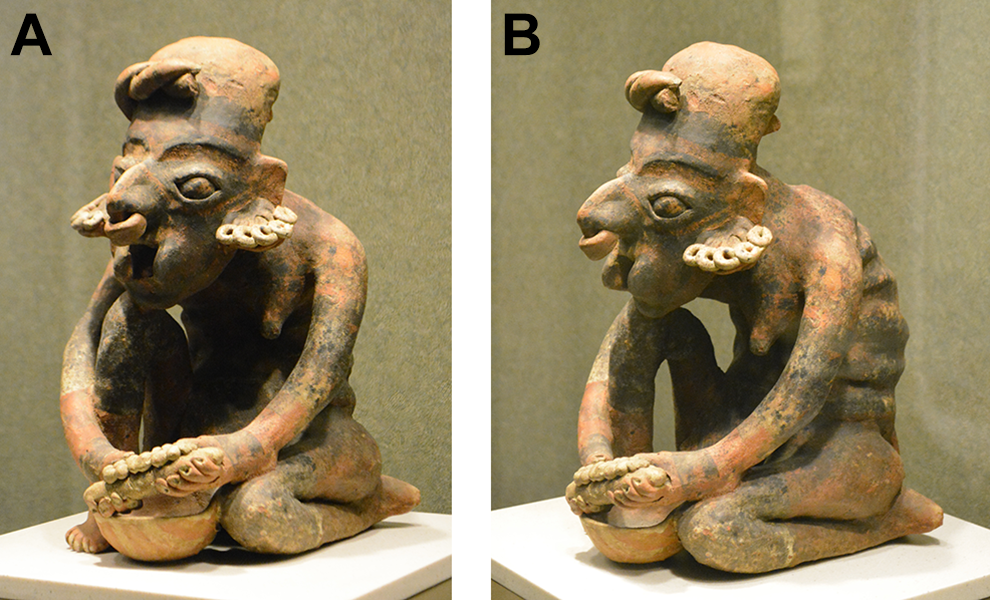
A, Anthropomorphic ceramic with a bilateral cleft lip defect, the figurine has a hat, earrings, a nose ring, body paintings, and is holding an ear of corn in her hands. B, On a lateral view, you can see signs of malnutrition, thin arms, thin legs, marked ribs, and face bones. This ceramic belongs to the classic period. Shaft tombs culture (200
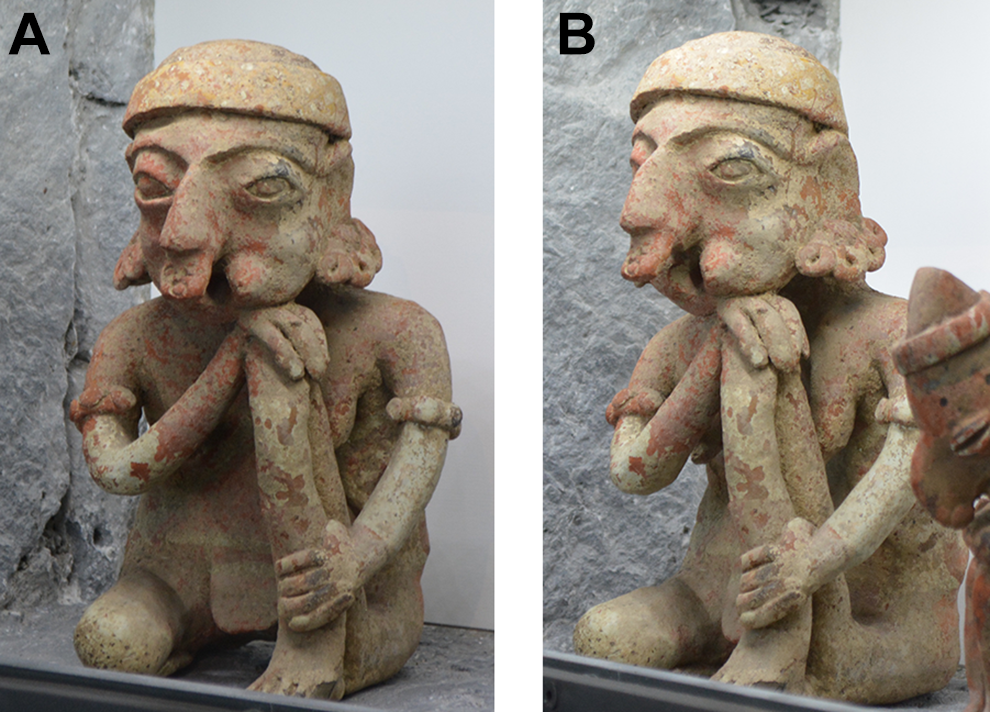
A, Anthropomorphic figurine presenting a bilateral cleft lip, it has a hat, earrings, and arms bracelets. B, Lateral view with evidence of protruding premaxilla, thin arms, and legs. This ceramic belongs to the classic period. Shaft tombs culture (200
Five of the figurines show evidence of malnutrition, of which 3 and 2 were identified as male and females, respectively. Evidence of malnutrition was documented due to the portrayal of protruding ribs and facial bones, and thin arms and legs (Figures 1B and 2B). One figurine displayed pustules all over the skin accompanied by a complete bilateral cleft lip (Figure 3). Lastly, all figurines displayed different types of corporeal decoration, such as paintings, earrings, nose rings, hats, necklaces, bracelets, and loincloths. Fifteen figurines displayed hats, 8 displayed bracelets, 9 displayed nose rings, and 12 earrings. Eight figurines displayed objects in their hands such as an ear of corn, a cocoa pod, and a drum, while 2 figurines displayed drinking from a vessel with a straw. It is difficult to precise the exact number of objects in possession of the institutions where these figurines were found; in 1957 when Diego Rivera died, he left a collection of 59 400 pre-Hispanic objects to Anahuacalli Museum (Rivera, 1965); 2000 are currently exhibited. Bautista Martínez in 2005 reports nearly 10 000 anthropomorphic figurines studied at the National Anthropology Museum of Mexico. Urrutia et al. (2019) report nearly 30 anthropomorphic figurines present at the National Anthropology Museum of El Salvador.
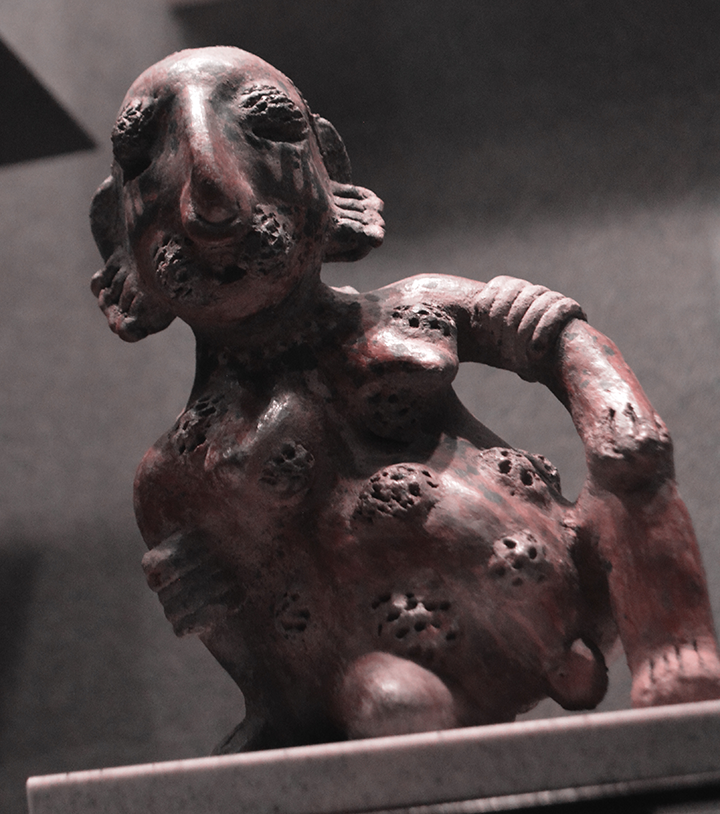
Male anthropomorphic figurine with a bilateral cleft lip. It exhibits pustules over the skin. It has a nose ring and bracelets in both arms and earrings. This ceramic belongs to the classic period. Shaft tombs culture (200
The ceramics described in this paper all belong to the classic period (200
Interestingly, all figurines studied by the authors were adorned with either hats, necklaces, bracelets, earrings, nose rings, or body paintings. Body adornments were a distinct characteristic of those members of the elite in pre-Hispanic Mesoamerica. Adornments were given, especially those related to perforation of the skin (ie, earrings, nose rings, tattoos, scarification), during special religious ceremonies, nose rings were usually associated with governors and deities. In fact, some pre-Hispanic gods had nose rings within their distinctive attributes (Vela, 2010). Similarly, to the observations made by Marius-Nunez and Wasiak (2015), it is theorized that the figures described in this document show evidence that they played a sacred role in Mesoamerican society. In pre-Hispanic culture, individuals with congenital malformations were considered to be divinely chosen for a life of priesthood as they believed to be uniquely anointed to have these physical features.
Mesoamerican pre-Hispanic cultures believed that facial clefts in children appeared secondary to solar or lunar eclipses, which were events that affected these 2 important deities. Mesoamericans believed that the sun was the source for life on earth—the origin of light and heat. Another important deity was the moon; also known as the fertility goddess, the moon was the light in the night, the protector of water, the energy for fecundity and fertility, and the protector of birth. An accidental disappearance of light secondary to eclipses was considered dangerous. A solar or lunar eclipse represented that the moon had bitten the sun or vice versa. Moreover, during an eclipse, Mesoamericans believed that the stars’ powers were diminished, thus bringing tragic consequences to the population. Pregnant women were at risk during an eclipse event. Lunar eclipses were thought to place pregnant women at risk of bearing children with facial clefts; therefore, all pregnant women were encouraged to not witness these events. Interestingly, the Chortis Mayan still to this day call infants with clefts as “bitten by the moon,” metaphorically describing that the powers of the moon were deleteriously affected by the sun (Najera, 1995). Additionally, other communities in the region continue to explain the presence of facial clefts as related to lunar activity.Castro (1995), through testimonies collected during 5 years, documented the common belief in the population of Ocuituco, Morelos, Mexico, that CLP might appear as a consequence of the exposure of a pregnant woman either to a solar eclipse or to the full moon’s light. Lastly, another common belief was that the moon had a special substance that contained a rabbit inside. The rabbit could take possession of the baby during the eclipse, and these babies would be born with a CLP, resembling a rabbit (Lopez & Perez, 2012).
There are few descriptions in the literature of archeological findings related to the evidence of CLP. In 1920, George Dorrance described an Egyptian mummy dating 2000 years
Footnotes
Acknowledgments
The authors profoundly thank the National Anthropology Museum of Mexico (Mexico City, Mexico), the Anahuacalli Museum (Mexico City, Mexico), the National Anthropology Museum of Guatemala (Guatemala City, Guatemala), the Pablo Tesak Museum (San Salvador, El Salvador), and the National Anthropology Museum of El Salvador (San Salvador, El Salvador), for keeping Mesoamerican history alive and sharing it to the world.
Declaration of Conflicting Interests
The author(s) declared no potential conflicts of interest with respect to the research, authorship, and/or publication of this article.
Funding
The author(s) received no financial support for the research, authorship, and/or publication of this article.
