







Abstract
Objective
Our goal was to compare data collected from 3- and 7-day Infant with Clefts Observation Outcomes (iCOO) diaries.
Design
Secondary data analysis of an observational longitudinal cohort study. Caregivers completed the daily iCOO for 7 days before cleft lip surgery (T0) and for 7 days after cleft lip repair (T1). We compared 3- and 7-day diaries collected at T0 and 3- and 7-day diaries collected at T1.
Setting
United States.
Participants
Primary caregivers of infants with cleft lip with and without cleft palate (N = 131) planning lip repair and enrolled in original iCOO study.
Main Outcomes Measure(s)
Mean differences and Pearson correlation coefficients.
Results
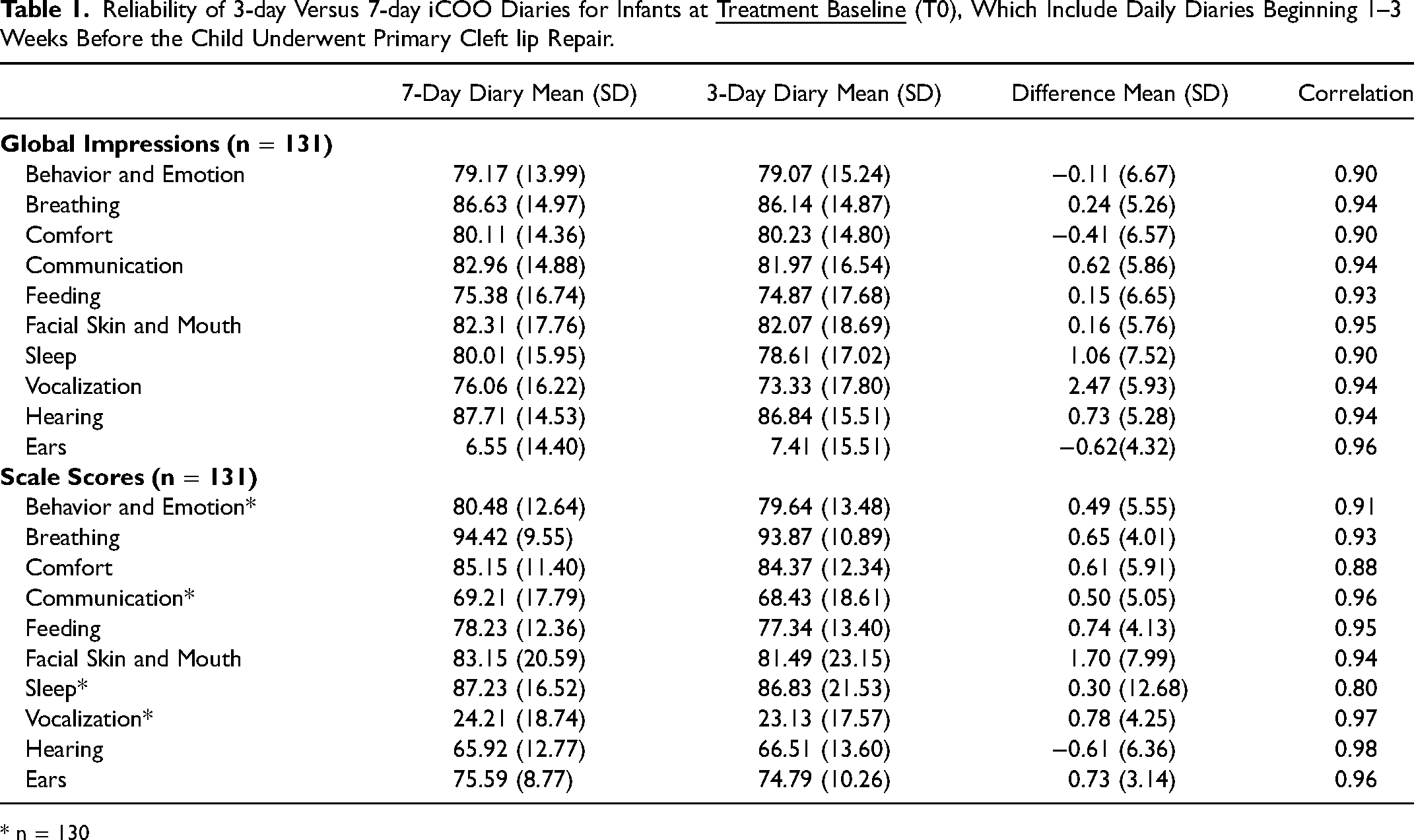
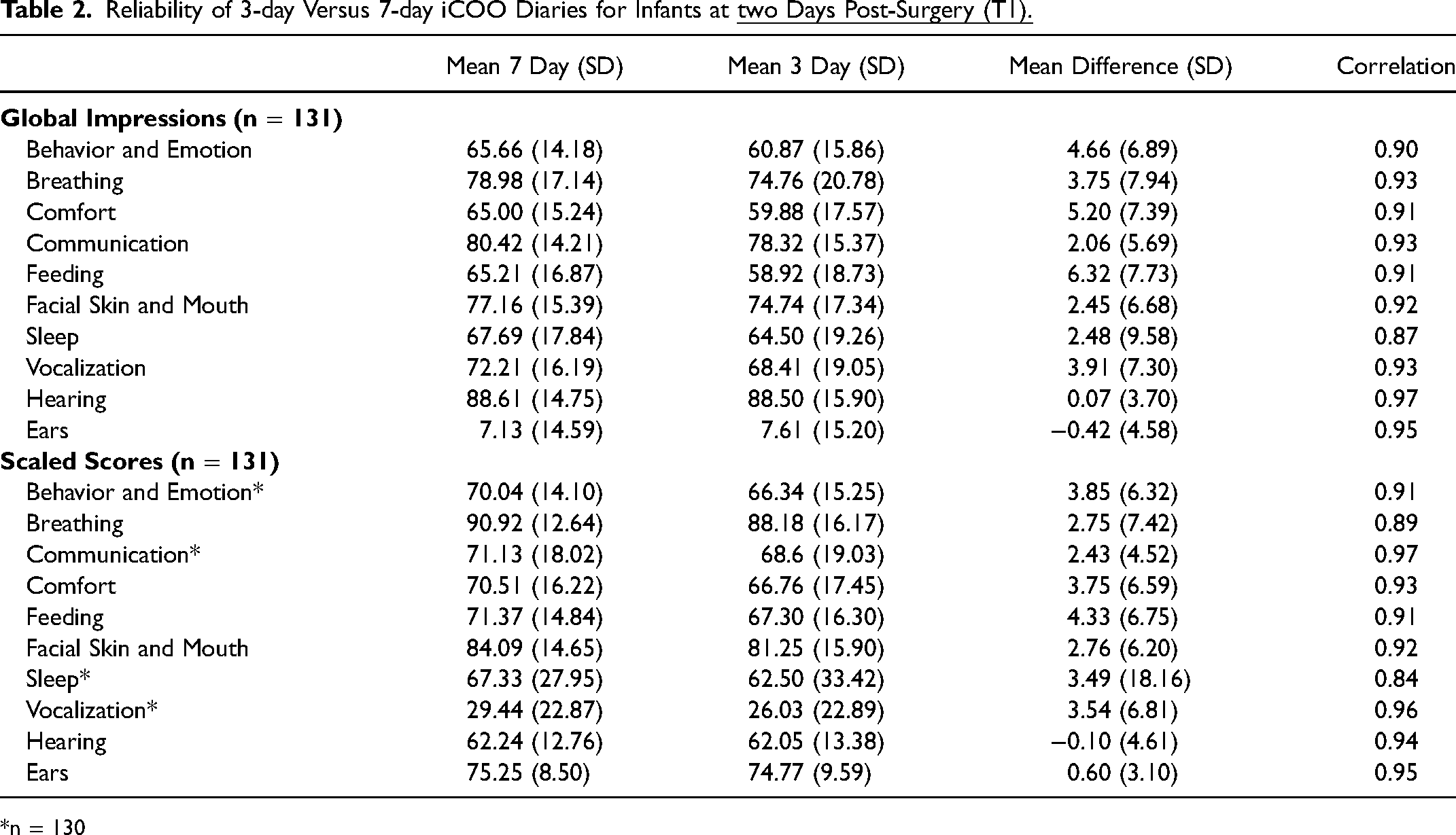
Correlation coefficients were high for global impressions (>0.90) and scaled scores (0.80–0.98). Mean differences were small across iCOO domains at T0. T1 comparisons reflected the same pattern.
Conclusions
Three-day diary data is comparable to 7-day diaries for measuring caregiver observations using iCOO across T0 and T1.
Background
Infants with clefts of the lip and/or palate often face health challenges related to the presence of the cleft and/or cleft-related treatments. Feeding difficulties can result from an infant's inability to create adequate negative intraoral pressure to extract milk while breastfeeding or using a typical bottle,1,2,3,4 breathing difficulties have been attributed to reduced nasal airflow,5,6,7 eustachian tube dysfunction is common, 8 and discomfort is associated with lip and palate surgeries. 9
An observer-reported (ObsRO) outcome is a type of clinical outcome assessment 10 that can provide meaningful data when patients, such as infants, are unable to report direct effects of their medical condition or its impact. 11 Twenty-four-hour recall with daily diaries have been successfully used to record signs and identify significant changes in patients for a variety of pediatric outcomes.12,13,14,15
Our research group developed an ObsRO that focused on caregiver perceptions of the most relevant health domains to be assessed in infants/children ranging in age from birth to 36 months with clefts of the lip with or without cleft palate (CL ± P). 9, 16 The iCOO was shown to be reliable based on evaluation of test-retest reliability for the 7-day consecutive diary. 17 Recording a daily diary can be challenging, especially for busy caregivers. In an effort to increase participation rates, we sought to evaluate methods to minimize barriers to participation in research.
In this paper, we set out to examine the comparability of caregivers (observers) collecting iCOO data for 3-days and 7-days. Our goal was to determine the extent to which data obtained from 3-day iCOO diaries compares to that collected from 7-day iCOO diaries at two time points: before and 2 days after lip surgery. A shorter iCOO would reduce the burden on caregivers, making the measure more feasible for clinical trial outcome assessment and for use in clinical care as a major goal of our analysis was to ensure higher likelihood of compliance with survey taking.
Methods
Design and Participants
We conducted a secondary analysis of a dataset obtained through the original study designed to test the reliability of the 7-day iCOO diary. 18 The original study was a multicenter observational study that included standardized caregiver observations of infant health, caregiver global impressions of function and clinical data to evaluate comprehensive health status of infants with cleft lip with or without cleft palate (CL ± P). We have previously published a detailed description of our design and evaluation of the iCOO instrument. 16 In the parent study, English or Spanish-speaking primary caregivers of 170 infants with CL ± P planning to undergo primary lip repair were enrolled. Infants were excluded if medical factors not related to the CL ± P or related treatments had a greater impact on their overall health. To be eligible for this secondary analysis, participants needed to have completed at least 2 of the first 3 days of the iCOO and 1 additional day of the possible 7 at baseline (T0). Of the original 170 participants, 131 primary caregivers were eligible for this study. The 3-day averages were based on data collected in the first 3 days, and the 7-day averages included all data collected during the week. We also collected demographic information about caregivers (eg, age, gender, education level) and their infants (eg, cleft type, age).
Caregivers were recruited between October 2017 and February 2020 from three academic craniofacial centers in the United States. Additionally, caregivers were recruited nationally in the United States from social media, including online advertisements through advocacy organizations and cleft-related Facebook groups. Caregivers had 24 h to fill out the survey for each associated date.
Measurement
In the parent study, primary caregivers were asked to complete the iCOO either through the online REDCap19,20 survey or via paper surveys at 3 time points:
Appropriate institutional review boards approved all study procedures before they were conducted. Informed consent was obtained prior to collecting study data from the participants.
Statistical Analysis
We calculated means and standard deviations (SD) of each of the 7-day iCOO diaries and the 3-days of the iCOO diaries for T0 and T1. We calculated mean differences between 3- and 7-day data at each time point by subtracting the mean 7-day from the 3-day score such that a positive number in the mean difference represented a higher score for 7 days. We also calculated correlation coefficients for the 3-day vs 7-day mean scores. We consider a correlation >0.8 to be high. Therefore, a cutoff score of correlation coefficient of 0.80 was used to determine to be a clinically relevant score and the threshold which we determined would be sufficiently reliable for administration of a 3-day diary.
Results
Among the 131 caregiver participants, the majority completed the iCOO in English (>97%) and 4 caregivers participated in Spanish. Most infants were male (n = 86, 66%). Most infants had a cleft lip and palate (n = 95, 73%) and 27% had either a unilateral or bilateral cleft of the lip without a cleft of the secondary palate. The majority of the primary caregivers were mothers (95%). Most primary caregivers reported having a bachelor's degree or higher (51%, n = 67). This sample has been well-described in prior publications.16,17
Overall, the mean differences were small across domains at baseline as well as two days post-surgery as illustrated in Tables 1 and 2. The correlation coefficients were high for Global Impressions (>0.90) and Scale Scores (range 0.80–0.98) for T0. We observed similar results across domains for the individual items comparisons with relatively low mean differences and correlation coefficients >0.63 (see Supplemental Table 1). This wider variability for individual items was anticipated given the larger number of tests; however, the results generally remained the same. As shown in Table 1 for T0 scale scores, the absolute differences in mean scores ranged from 0.30 to 1.70 on a scale of 0 to 100 which shows the similarity of the 3-day and 7-day groups. Comparisons of the T1 reflected this same pattern with correlations (>0.87) and relatively small mean differences between the 3- verses 7-day data (Table 2). Furthermore, correlation coefficients were >0.76 for all individual items for the T1 administration (see Supplemental Table 2).
Reliability of 3-day Versus 7-day iCOO Diaries for Infants at
* n = 130
Reliability of 3-day Versus 7-day iCOO Diaries for Infants at
*n = 130
Discussion
We found that the data obtained from the 3-day diaries are similar to that obtained using the 7-day diaries for measuring caregiver observations of infant health using the iCOO. In this secondary analysis, we found high correlation and small differences in the mean scores between the 7-day group and 3-day group iCOO diaries.
There are numerous barriers to participation in clinical research. Reducing diary requirements may make it more feasible for caregivers to complete the iCOO diary as required and may increase engagement of caregivers of infants with CL ± P, particularly for those who have historically been underrepresented in research.
We chose 3-day instead of a shorter period to obtain reliable data and ensure a variety of days were sampled to account for day-to-day variation in this infant population. The results of our study are consistent with similar survey studies that found 3-day data was the most similar to 7 days than when compared with averages from 1 or 2 days. 13
A major goal of our analysis was to ensure similar results with a shorter duration of survey taking. Studies from 2002 and 2014 on urinary incontinence found patients who are incontinent more often or who have been diagnosed with voiding frequency were able to complete 3-day diaries in reporting their symptoms accurately and the 3-day observations correlated highly with the 7-day observations.21,22 In a 2005 comparison of 3-day vs 7-day bladder diaries for patients with overactive bladder, it was found that both 3-day and 7-day diaries showed improvement and were equally as effective. In addition, 3-day diaries had significantly better likelihood of completion and record-keeping. 22 Similarly, in another study on urinary incontinence, patients assigned to 3-day diaries had more complete data to individual item responses across the 3 days compared to those assigned a diary for 7 days, when comparing item responses in the first 3 days. 23 This suggests that in practice a 3-day diary is likely to elicit more complete data than the 7-day iCOO and shortening the number of days needed to complete the iCOO may maintain data integrity.
Strengths of our study include very high correlations for virtually all comparisons between 3- and 7-day diaries. For caregiver responses, the caregivers had a limited time window (24 h) to fill out the daily surveys, which was a strength as it increased the likelihood that recorded observations accurately reflected the experience at/near the time of reporting thereby minimizing recall bias and misclassification. Limitations of the study include only using data for caregivers who met criteria for the 3- and 7-day data collection. Another limitation is that the 3-day iCOO was not validated in a separate sample who only completed the 3-day version.
Conclusion
We have found that the 3-day diaries have similar results as the 7-day iCOO diaries. Daily data collection of the iCOO diary for 3 days for studies of infants with CL/P will minimize burden of data collection pre- and post-intervention for caregivers and families.
Supplemental Material
sj-docx-1-cpc-10.1177_10556656231175290 - Supplemental material for Observations by Caregivers Using the Infant with Clefts Observation Outcomes Instrument (iCOO): A Comparison of Three Versus Seven-day Daily Diaries
Supplemental material, sj-docx-1-cpc-10.1177_10556656231175290 for Observations by Caregivers Using the Infant with Clefts Observation Outcomes Instrument (iCOO): A Comparison of Muhammad Rahman, Brian G. Leroux, Christy M. McKinney, Kathleen A. Kapp-Simon, Todd Edwards, Salene M. Jones, Janine M. Rosenberg, Donald Patrick, Kristen Daniels, Laura Stueckle, and Carrie L. Heike in The Cleft Palate Craniofacial Journal
Supplemental Material
sj-docx-2-cpc-10.1177_10556656231175290 - Supplemental material for Observations by Caregivers Using the Infant with Clefts Observation Outcomes Instrument (iCOO): A Comparison of Three Versus Seven-day Daily Diaries
Supplemental material, sj-docx-2-cpc-10.1177_10556656231175290 for Observations by Caregivers Using the Infant with Clefts Observation Outcomes Instrument (iCOO): A Comparison of Muhammad Rahman, Brian G. Leroux, Christy M. McKinney, Kathleen A. Kapp-Simon, Todd Edwards, Salene M. Jones, Janine M. Rosenberg, Donald Patrick, Kristen Daniels, Laura Stueckle, and Carrie L. Heike in The Cleft Palate Craniofacial Journal
Footnotes
Acknowledgements
We want to thank the families for their participation.
Declaration of Conflicting Interests
The author(s) declared no potential conflicts of interest with respect to the research, authorship, and/or publication of this article.
Funding
The author(s) disclosed receipt of the following financial support for the research, authorship, and/or publication of this article: Patient-Centered Outcomes in Infants and Young Children with Cleft Lip and Palate (R01 DE024986) and REDCap (UL1 TR002319, KL2 TR002317, and TL1 TR002318).
ORCID iDs

Supplemental Material
Supplemental material for this article is available online.
References
Supplementary Material
Please find the following supplemental material available below.
For Open Access articles published under a Creative Commons License, all supplemental material carries the same license as the article it is associated with.
For non-Open Access articles published, all supplemental material carries a non-exclusive license, and permission requests for re-use of supplemental material or any part of supplemental material shall be sent directly to the copyright owner as specified in the copyright notice associated with the article.
