







Abstract
Many scholars have attempted to make jazz relevant to an organizational audience. We seek to extend this literature by considering a more radical version of improvisation associated with the jazz musician Ornette Coleman. Inspired by an encounter between Coleman and the philosopher Jacques Derrida, we juxtapose the radical collective responsibility associated with Coleman’s Free jazz improvisation and Derridean deconstruction. We especially emphasize a phrase used by Derrida, “a certain experience of the impossible,” as an expression for a particular experience of doing management. The overall contribution of the article is to explore the possibility of responding to issues within organizations in more participative and improvisational ways, without losing an appreciation of the inherent impossibility (perhaps even absurdity) of the managerial condition.
Speaking of Free jazz, once in Paris, I [the speaker is Jacques Derrida] appeared in public with Ornette Coleman.. . . We met in a hotel. There was a big discussion and he told me he was interested in my texts, so we met. Then, he invited me to come to one of his concerts and to say anything I wanted and he would accompany me, improvising. So, I was quite scared.. . . Finally, I said yes. Although against it, I said yes. So I prepared a text, and Ornette Coleman started the concert and, as we agreed upon, at some point he called me onstage. And once onstage, I started reciting this special text that I’d written for this occasion as he accompanied me, improvising. But his fans were so unhappy with this strange man coming onstage with a written text that they started, uh, whistling? [He was eventually booed off stage].. . . it was a very painful experience. But finally it turned into a happy event because the day after, in the newspapers, everyone mentioned this as something interesting.
A Certain Experience of the Impossible
It is common, perhaps typical, for managers in their day-to-day work to experience several conflicting, yet equally legitimate, demands at the same time. In other words, they often find themselves in “no-win,” “damned if I do, damned if I don’t” situations (Hoggett, 2006, p. 186). In such circumstances, recourse to an ethical framework, code of conduct, or a more pragmatic solution proves deeply unsatisfactory, for there is no one, clear and straightforward course of action (Becker, 2004; Jacobs, 2004). Perhaps the easiest response to such a troubling situation is to pretend you are improvising and then stick to a familiar path. As we shall elaborate later, two of us have been managers in the past, and both of us have indeed stayed with the familiar many times. More challenging, however, would be to undergo what Derrida (1992a) calls “a certain experience of the impossible” (p. 328) to work through the conflicting demands. However, what might a certain experience of the impossible mean in an organizational context? What might it feel like for those involved? How might individuals and groups respond? And anyway, what is the point of attempting to work through such a discomforting experience? These are the sorts of questions our article seeks to explore. And it does so, in the main, via a reenactment—we compare a certain experience of the impossible with a radical form of collective musical improvisation: Coleman’s Free jazz 1 —inspired by the above encounter between Derrida and Coleman (Coleman & Derrida, 2004; Derrida, 2004; Lane, 2013; Malabou & Derrida, 2004).
We are not the first to make jazz relevant to an organizational audience (see especially the 1998 Special Edition of Organization Science as well as, for example, Bastien & Hostager, 1988; Hatch, 1997, 1999; Humphreys, Ucbasaran, & Lockett, 2012; Kamoche, Pina e Cuhna, & Viera Da Cunha, 2003; Lewin, 1998; Mantere, Sillince, & Hämäläinen, 2007; Moorman & Miner, 1998; Weick, 1989, 1993). Similarly, we are not the first to consider deconstruction and Derrida’s wider work in the context of management and organization studies. The implications of Derrida’s work for praxis have been developed by Laclau and Mouffe (2001) who emphasize the emancipatory potential in Derrida’s championing of “the impossibility of an ultimate fixity of meaning . . . [to allow] the flow of differences” (p. 112). As Laclau (1996) has argued, [I]f people think that God or nature have made the world as it is, they will tend to consider their fate inevitable. But if the being of the world which they inhabit is only the result of the contingent discourses and vocabularies that constitute it, they will tolerate their fate with less patience and will stand a better chance of becoming political “strong poets.” (p. 122)
Deconstruction is particularly interesting in the context of management scholarship, therefore, because it aims to produce a tension between what a text purports to claim (its intended meaning) and a double or multiple range of meanings that cannot be contained within the text’s intended meaning. This tension is what creates an experience of the impossible. Such debate has occurred in the pages of this journal (e.g., Weiss, 2007; Weitzner, 2007), as well as, of course, more widely (e.g., Boje, 1995; Cooper, 1989; Kilduff, 1993; Kilduff & Kelemen, 2001; Kilduff & Mehra, 1997; Learmonth, Lockett, & Dowd, 2012; Martin, 1990).
We seek to extend both these literatures by making a new contribution that combines the radical collective responsibility we see in Coleman’s Free jazz with the “experience of the impossible” explored by Derrida. Through this juxtaposition, there is a sense that we shall be working (or to use a more musical [indeed, perhaps a more Derridean] metaphor: playing) on the margins—the margins of Derrida’s philosophy (though, see Royle, 1998)—as well as on the margins, perhaps, of both jazz and organizations (though, see Cobussen, 2001, 2003; Rhodes, 2007; Subotnik, 1996). Nevertheless, we trust that, in the end, to play on these margins will be to do the kinds of things Derrida did—as well as to perform something new, in our own language and in our own voice (Derrida, 1996). By reflecting on the experiences two of us have had as managers, our particular contribution is to combine shared responsibility with free collective improvisation in ways that may be (we hope) both radical and ethical in organizational life (see also Cunliffe, 2002; Hansen, Barry, Boje, & Hatch, 2007). In so doing, we have tried to remain faithful to Derrida’s (1992b) work in being able to show, a future which [like Free jazz] does not allow itself to be modalised or modified into the form of the present, which allows itself neither to be fore-seen nor programmed; it is thus . . . the opening to freedom, responsibility, decision, ethics and politics [while it is] . . . also the experience of the impossible . . . the least bad definition of deconstruction. (p. 200; italics in original)
Improvisation, Coleman, and Derrida
Hatch (1999), in her article on the value of the jazz metaphor in the study of organizations, argues that improvisation “constitutes the distinguishing feature of Jazz” (p. 78). She goes on to describe a typical performance as structured around the playing of tunes which themselves are loosely structured via partial musical arrangements called heads. The head of a tune defines, at a minimum, a chord sequence, a basic melodic idea, and usually an approximate tempo . . . Improvisation centres around the head, which is usually played through “straight” (without much improvisational embellishment) at the beginning of the tune, then improvised upon, and finally returned to and played again as the ending. The head gets a tune started by suggesting a particular rhythm, harmony and melody. The tune is then built from this starting point via improvisation within which different interpretations of the initial idea are offered and new ideas and further interpretations can be explored.
This description represents the broad structural context of improvisation within a range of jazz styles variously described by critics as New Orleans, Swing, Be-Bop Hard Bop, and Modern. Furthermore, individual numbers would generally be structured in a way in which each member of the band would in turn take improvised solos while being supported by the rest of the band “comping.” 2 The musician soloing would effectively be the leader of the band—for that moment at least. 3 However, as Hatch (1999) notes, “with the advent of Free jazz, structure became so subtle as to be practically undetectable to any but the most sophisticated listener, including many traditional jazz musicians” (p. 84). Berliner (1994) explains the distinctiveness of Coleman’s Free jazz approach when compared with other forms of jazz improvisation. He argues that “Free jazz groups express concern for democratizing jazz [and] minimize or eliminate the distinctions between soloists and accompanists at times involving band members in constant simultaneous solos throughout performances” (p. 338). In other words, unlike other types of jazz, there is no one leader in the performance of Free jazz. 4
Ornette Coleman is an African American musician, who (eventually) found fame in the late 1950s and early 1960s with landmark recordings such as The Shape of Jazz to Come and the eponymously titled 1960 album Free Jazz: A Collective Improvisation. In a rare (and brief) article in the jazz magazine Downbeat, Coleman (1983) expressed his approach to music (and life) as one’s own logic made into an expression of sound to bring about the musical sensation of unison executed by a single person or with a group . . . harmony, melody, speed, rhythm, time and phrases all have equal position in the results that come from the placing and spacing of ideas. (p. 54)
Thus, Coleman’s free improvisation approach to music seeks to offer “an aesthetic (but not aestheticized) democracy like that which operates within his performing ensembles” (Murphy, 1998, p. 90). This approach offers the opportunity for a collective improvisation that enables a shared responsibility for the outcome. As Heble (2000) further explains, Coleman came along and swept away
5
the set harmonic structures and tightly knit patterns . . . which had dominated the music of his contemporaries (2000, p. 49) . . . Melody, then, [in Free jazz] is privileged over harmony to the extent that the tune itself becomes the pattern of the composition. (We might be tempted here to make an analogy with Derrida’s différance . . .) [because] Coleman’s jazz is a proliferation of meanings, a valorization of the signifier. (pp. 50-51)
Indeed, just as it may be possible, however tentatively, to link Free jazz with Derrida’s neologism différance, we might also be tempted to make a range of other analogies between the two figures themselves. For example, both have a substantial fan base (let’s use that term for each of them) across the world—just as both have also attracted deep controversies within their respective “mainstream” communities. 6 In biographical terms, too, there are similarities, some of which they discussed during their meeting prior to the gig. Both were born in 1930 within marginalized communities (Coleman grew up in an underprivileged Black family in Texas, USA; Derrida was an Algerian Jew) and, perhaps significantly in terms of their later political and ethical stances, both suffered from the effects of racial prejudice as young men. (For biographies of Derrida and Coleman, see Peeters, 2012, and Litweiler, 1992, respectively.) 7
It is equally possible, however, to see contrasts between the two figures. For example, unlike Derrida, Coleman has produced little written output.
8
Derrida’s interview with Coleman is therefore different in tone when compared, say, with the published conversations between Edward Said and Daniel Barenboim (2002). Barenboim has written on music and its relationship with wider political issues, and one gets a sense of the meeting of similar minds—conversations between two individuals who share comparable orientations toward, and understandings of, the world (see also Guimaraes-Costa, Pina e Cuhna, & Viera Da Cunha, 2009).
9
Derrida and Coleman, however, appeared to have had less in common—at least in terms of their respective temperaments and approaches to life. For example, in his interview with Derrida, Coleman emphasizes the importance of doing: “[f]or me, being an innovator doesn’t mean being more intelligent, more rich, it’s not a word, it’s an action. Since it hasn’t been done, there’s no use talking about it.” Derrida then says, “I understand that you prefer doing [faire] to speaking” (Coleman & Derrida, 2004, p. 327). One detects the same kind of contrasts in Coleman’s response to the following question from Derrida (2004): . . . last night I read an article that was in fact a conference presentation given by one of my friends, Rudolph Burger, a musician whose group is called Kat Onoma. It was constructed around your statements. In order to analyze the way in which you formulate your music, he began from your statements, of which the first was this: “For reasons I’m not sure of, I am convinced that before becoming music, music was only a word.” Do you recall having said that? OC: No. (p. 328)
We enjoy Wills’s (2006) wry aside, then, in which he suggests of their encounter, that “one can imagine . . . the serious philosopher preparing himself early in the morning . . . while the Bohemian musician gets up just in time for the meeting, presuming he can take it as it comes” (p. 36). Indeed, it is of interest to note that in the context of the others who have collaborated with Derrida (ordinarily, academics or writers with broadly similar interests and orientations), Coleman’s particular understanding of, and emphasis on, doing is unusual, indeed, almost alien. This contrast seems to have been noticed by Derrida; in a letter to Catherine Malabou, written shortly after the gig, Derrida (2004) told her that the encounter with Coleman “[w]as in Paris, [i.e. in Derrida’s home city] but no voyage will have ever taken me so far away, myself and my body and my words, onto an unknown stage, without any possible rehearsal or repetition” (Malabou & Derrida, 2004, p. 97(n)). It appears to us, then, that both figures were facing an experience of the impossible in their onstage encounter. Derrida tried to deal with it by intense preparation—he had a written text and would have preferred to rehearse; whereas Coleman risks the intrusion of a French philosopher (of all people!) into his gig but seems rather more relaxed about any outcome, negative or positive (Dayan, 2006).
Coleman, in contrast with Derrida, appears to have had little, if any, fear of embracing an experience of the impossible playing the violin and trumpet in live performance even though he lacked expertise on the instruments. In many respects, an experience of the impossible manifests differently for Coleman, energizing him and leading him to try new things. This innovation was not appreciated by other musicians such as Miles Davis who recorded his reaction in his autobiography: I don’t know what’s wrong with him. For him—a sax player—to pick up a trumpet and violin like that and just think he can play them with no kind of training is disrespectful toward all those people who play them well. And then to sit up and pontificate about them when he doesn’t know what he’s talking about is not cool, man . . . if you don’t know how to play the trumpet, it sounds terrible. People who know how to play it can play it even when it’s all stopped up. As long as you play in rhythm, even if the horn’s all fucked, as long as it fits, you can do that. You have to play a style. If you play a ballad, you play a ballad. But Ornette couldn’t do that on trumpet because he didn’t know anything about the instrument. (Davis & Troupe, 1989, p. 240)
In any event, we think that Coleman’s preferences—for doing and action (a preference that Derrida acknowledged, and with which he complied by actually appearing onstage with Coleman)—will resonate with many managers facing similarly impossible situations (Byers & Rhodes, 2004; Mintzberg, 1975). That Coleman is different from a more typical Derridean collaborator as a doer (as opposed to a writer) represents a reason in itself for suggesting that Derrida’s encounters with him may be of special significance for readers faced with the impossibilities and responsibilities involved in managing organizations. So, in the next section, we consider how doing free collective improvisation—as understood by Coleman and Derrida—might inform the way we might do management in organizations.
A Collective Improvisational Music Lesson for Free Organization and Management
Doing—making things happen—is what any kind of jazz (or organizational) performance is all about. As Hatch (1999) puts it, “[j]azz happens. It is an activity, not just an abstract category. As an activity, jazz is something to be entered into, participated in, experienced” (p. 82). In this section, therefore, we move to discuss how Coleman’s encounter with Derrida might inform how we do things (and experience things) differently in organizations—even though the experience may well be a discomforting one, as it was for Derrida. Indeed in the lyrics of his own performance with the Coleman group, Derrida (2004) started by talking of his uncertainties and fears, along with the necessity of improvisation in this context. He also emphasized what is happening: Qu’est-ce qui arrive? What’s happening? What’s going to happen, Ornette, now, right now? What’s happening to me, here, now, with Ornette Coleman? With you? Who? It is indeed necessary to improvize well . . . I knew that Ornette was going to call on me to join him tonight, he told me so when we met one afternoon last week. This chance frightens me, I have no idea what’s going to happen. It is indeed necessary to improvize, it is necessary to improvize but well, this is already a music lesson, your lesson, Ornette. (Derrida, 2004, pp. 331/2; italics in original)
Derrida’s emphasis on being unsure—even frightened—and his consequent need to improvise well is resonant of the kind of dilemmas that can similarly frighten us in their production of a certain experience of the impossible. We briefly illustrate the kind of dilemma we have in mind in an organizational context through retelling stories of our experiences in the following vignettes (Figure 1). The first comes from a time (almost 20 years ago) when, as a health care manager, Mark was asked to introduce a computer system into clinical areas; an introduction that involved changes to the way that nurses worked (see also Learmonth, 2007). The second example is Mike (from more than 20 years ago) illustrating his fear of being placed in a senior management role.
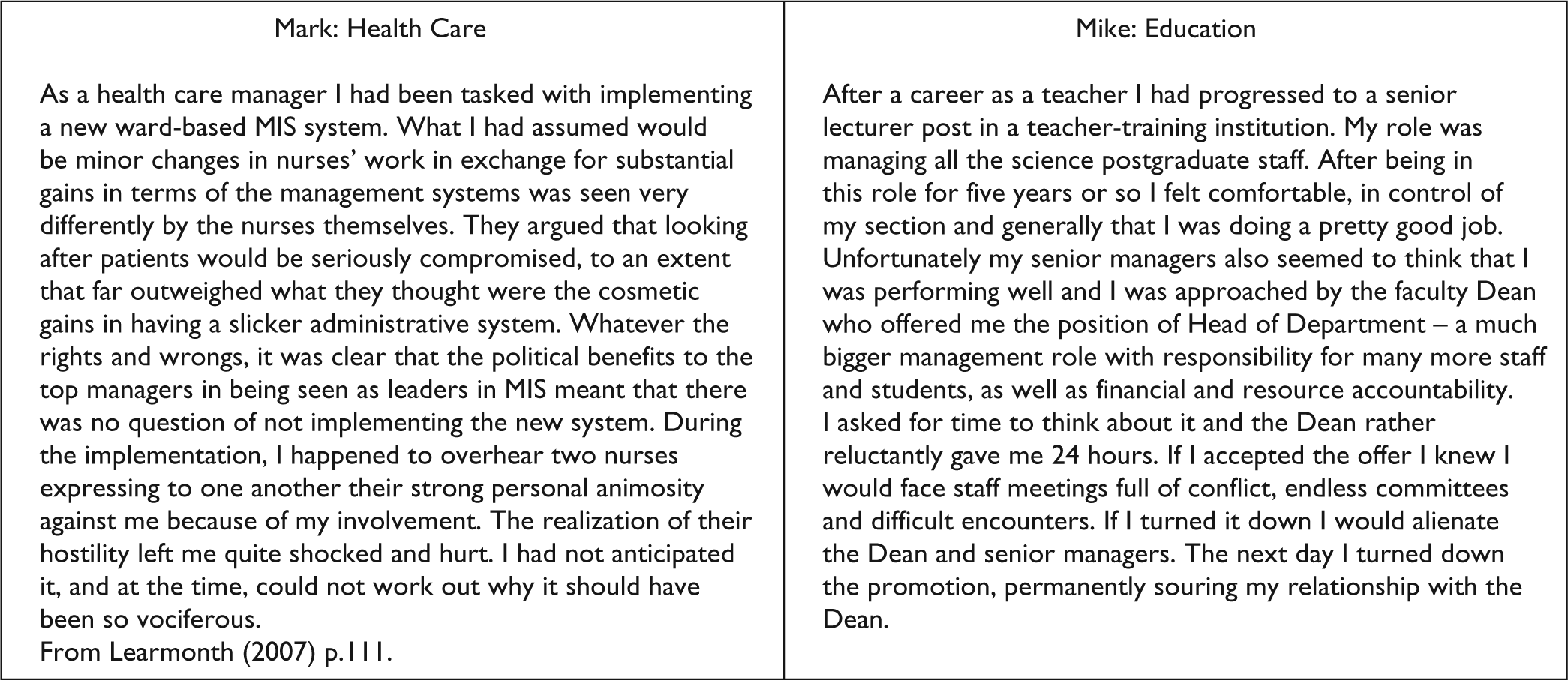
Management vignettes: Experiences of the impossible.
We think these situations—where you are damned if you do and damned if you don’t—are commonplace in organizational life. In other words, they might be seen as experiences of the impossible. However, in an effort to make sense of such experiences, we believe it may be productive to reflect on the potential for collective improvisation and shared responsibility (á la Coleman) in the face of impossibility (á la Derrida).
In this light, it now seems clear that one of the central problems with Mark’s story was that the nurses had no participation in the decision-making process. The concerns they raised had not been listened to, nor had they had any recognizable influence on the outcome. Mark was acting like a conventional jazz soloist with a pre-determined composition, imposing his will on the group with no consideration for the implications on their working lives. The nurses had seen through his act, and the resulting feeling of powerlessness had led to the level of spite and anger leveled at him. Perhaps an alternative route would be one in which the nurses could be listened to and influence the nature of the overall decision. If we continue the analogy with jazz, conventionally, what a skilled manager might have been expected to do in such a situation is to come up with a brilliant solo that brings everyone back into the groove.
However, a more radical approach—allowing everyone to improvise, at the same time, together—to which Coleman’s Free jazz approach aspires—may have been a better option in providing shared responsibility. Perhaps it would have had the potential to break down the barriers between groups and enable the nurses to have an equal and fair contribution—along with responsibility for—the overall decision. Coleman’s Free jazz is a helpful illustration of the kind of collective improvisation we believe could occur in such an environment and why it might be so valuable (but also risky) for managers encountering an “experience of the impossible.” Free improvisation suggests that an alternative action to Mark’s experience of the impossible would have been an improvised response that was collective and one that involved shared responsibility. In other words, in our example, a free improvisational jazz ethos would have suggested working with the nurses and the other people involved to explore different alternatives—where all of them would be allowed to be soloing at the same time—even when they disagreed: an experience of the impossible?
What might a free improvisational approach have meant if Mark had acted following its inspiration in this particular situation? We suggest, most fundamentally, that it would have necessarily involved getting all those in the situation together—the minimum condition of being able to jam. And if they had all improvised together in the radical way implied by Free jazz, this would suggest the encouragement of a free exchange of views. We think that such an exchange might well have felt deeply emotional—like the painful experience Derrida underwent when onstage with Coleman. Doubtless, it would have involved arguments, shouting, tears, and prompting a consideration of systems, efficiency, and other more codifiable issues (Griffin, 2012). As Hatch (1999) argues, “[t]he jazz metaphor suggests that whenever we interact, communication rests as heavily upon emotional and physical feeling as it does on the intellectual content of the messages involved” (p. 89). The shared risks of such improvisation and collaboration are vividly evoked by Mengelberg (1995, 236) who argues, Part of improvisation, of the act of improvising, playing with other people, has very much to do with survival strategy. You have, of course, all your expectations and plans destroyed the moment you play with other people. They all have their own ideas of how the musical world at that moment should be. So there are two, three, five, six composers there at the same time destroying each others’ ideas, pieces. (Mengelberg in Corbett, 1995, p. 236)
Similarly, Mike would have preferred a free improvisation approach in dealing with his own experience of the impossible. He would have been much more comfortable recruited into a “free improvisation collective.” He plays alto sax in a seven piece band and is very happy improvising as part of the collective horn section but is extremely reluctant to take solos, preferring to stay in the background comping. Just like his management dilemma, he wants to avoid the limelight, but in doing so, he disappoints other members of the band. He would be much happier, therefore with a free, collective improvisational response. It would be a response allowing for the possibility of everyone soloing together. In organizational terms, Mike was invited by the Dean to take on the role of a high-profile soloist. However, he would have preferred a collective organizational role where free improvisation was the norm—a situation where everyone was in the spotlight simultaneously. However, isn’t everyone being in the spotlight simultaneously something that is impossible, even absurd? Perhaps, but in any case, in Free jazz (or in Free organizations) there will also always be a significant element of risk involved, which is to say that improvising may well not succeed—and so there is necessarily a need to trust in the future. Not, as Derrida explains, a future which is predictable, programmed, scheduled, foreseeable. But . . .. a future, l’avenir (to come) which refers to someone who comes whose arrival is totally unexpected. For me, that is the real future. That which is totally unpredictable. (Dick & Ziering Kofman, 2005, p. 53)
So, in Mark’s example of the Management Information System, would a resolution necessarily have been found? Would the computer system have been implemented more quickly—or at all? In Mike’s example, would it have been possible to have a fully participative and Free jazz-improvising head of department role in which multiple individuals shared responsibility, accountability, and decision-making duties? Well, we just don’t know—the future would have been a future to come. The important point is that the managerially defined aspects of the problem would have not been allowed to solo over the nursing or the other lecturers’ interests. In other words, free improvisation is self-consciously an experience of the impossible, as well as a way of taking and sharing responsibility. It is not a way of finding definitive “answers”—such improvisation cannot replace uncertainty with confidence; indeed, free improvisation always has a high degree of risk and uncertainty.
Discussion
In recognition of this unpredictability, we suggest that Derrida and his concept “democracy to come” may have something to offer. It proposes a participatory space where the “experience of the impossible” is not buried or managed away, but embraced. The idea of a “democracy to come” (perhaps in a similar way to Coleman’s album The Shape of Jazz to Come) is built around the uniqueness of the notion of democracy, in that it is “the only system . . . in which, in principle, one has or one takes the right to publicly criticize everything, including the idea of democracy, its concept, its history and its name” (Derrida, 2003, p. 127). Derrida (2001) calls this criticism “auto-immunity” or the “strange behaviour where a living being [or system], in quasi-suicidal fashion, ‘itself’ works to destroy its own protection, to immunize itself against its ‘own’ immunity” (p. 94). This tendency toward constant self-critique is what makes radical forms of democracy in organizations seem so impossible (i.e., chaotic, difficult, and fragile), especially in comparison with authoritarian alternatives. However, self-critique is also what enables democracy’s improvement over time toward a betterment that would not otherwise come (“a democracy to come”).
It could be argued that in free improvisation, musicians similarly take a “quasi-suicidal” leap into the unknown with their fellow players in an improvised and democratic fashion. Inevitably, the chance and the promise that this leap opens up can just as easily end with failure as with success. And, of course, whatever happens, not everyone will like it. As one reviewer of a Coleman group recording suggests, “Collective improvisation?” Nonsense. The only semblance of collectivity lies in the fact that these eight nihilists were collected together in one studio at one time and with one common cause: to destroy the music that gave them birth. Give them top marks for the attempt. (Tynan in Walser, 1999, p. 255)
For many people in organizations, the risk of such destruction may seem too great, and so, either traditional hierarchical management will be retained or more subtle normative controls introduced. However, for other organizations (often, but not exclusively, smaller ones), the risks involved are considered lower than the potential for creativity that can be delivered through fully democratic systems. For example, organizations such as Valtech (Denmark) and Davita (the United States) both have regular town hall meetings involving staff in which they can discuss and challenge company policy. Thus, all staff take key decisions through democratic votes—votes that could directly go against the wishes of senior management. Other companies such as Nearsoft (the United States) and Semco (Brazil) allow staff to take the responsibility for hiring fellow workers through collective and participative democratic means. They integrate staff members into the hiring process, by asking them, for example, to write the job description and set the wages so that new members of the group can be found who fit with existing members and needs. Other organizations such as Taf’eel (Malaysia) give all employees full access to company accounts and salaries, and share profits equally depending on involvement in various projects. (For all of these examples of democracy in the workplace and more, see www.worldblu.com).
Indeed, it is also apparent that there are a growing number of people who are more sensitive to issues of employee power, participation, and control within the workplace (cf. Reedy & Learmonth, 2009). And many of the strongest ideas relating to autonomy and control involve the explicit introduction of democratic or participatory procedures (Griffin & Learmonth, 2014). These procedures can be used in different ways, and to varying extents, within an organization. Indeed, Pateman (1970) suggests that there are (broadly speaking) three different types of workplace participation—types that seem to us to have parallels in improvisational jazz.
First in Pateman’s list is pseudo-participation. In this mode of management, participation (allowing questions and discussion about what might be done) is used as a way of convincing workers to accept a decision that has already been made. This occurs in many organizations today where management encourages employees to provide feedback on strategy and policy documents in specially organized meetings. These are often constructed as relaxed and informal “staff consultation” events that give the impression that management is listening and responding to the concerns of its employees while manipulating and controlling outcomes (Heller, 1998). Such pseudo-participation in the world of organizations has parallels in jazz where one can sometimes observe the tyranny of a soloist who invites suggestions on what will be played but ultimately imposes his or her will on the group and does what he or she prefers (see Humphreys et al., 2012). Thus, this approach to organizational democracy (and its parallels in jazz) allows managers to achieve a semblance of freedom and collective responsibility while masking increased managerial control—although we doubt many workers are that easily fooled (Harris, Hopfl, & Clegg, 2010).
Pateman’s (1970) second type of workplace democracy involves “partial participation.” In this model, two or more parties (composed of management and employees) can influence decisions but ultimately the final “prerogative of decision making rests with the permanent supervisors, the management” (Pateman, 1970, p. 69). Again, there may be parallels in jazz. Here, just as in work organizations, partial participation might involve the lead musician genuinely listening to, and being influenced by, his or her fellow players, while retaining power over what is finally played. We might see this approach exemplified in the music of Charlie Parker, Miles Davis, Sonny Rollins, or John Coltrane. These artists were incredibly innovative and achieved their innovations, at least in part, by being able to use and respond to the ideas of their fellow musicians. However, they, like most conventional managers, retained (artistic and managerial) control of their bands.
A third type of workplace democracy identified by Pateman (1970) seeks to minimize managerial control by offering “full participation,” a “process where each individual member of a decision-making body has equal power to determine the outcome of decisions” (p. 70; cf. Barros, 2010). In this type of organization, there are no longer two opposing sides but a group of individuals who deliberate and make work-related decisions democratically. To continue the jazz parallels, we think that a fully participative workplace of this kind would most resemble Coleman’s free collective approach to improvisation where everyone is soloing together. The role of the manager in an organization where there is full participation would, perhaps, be to ensure that these procedures work and are carried out according to pre-agreed rules such as upholding norms of equality of participation and freedom of speech.
It is, however, important to note that as well as identifying three different types of participation in the workplace, Pateman (1970) identified two different levels of management where these can be applied. The lower level of management “refers broadly to those management decisions relating to control of day-to-day shop floor activity, while the higher level refers to decisions that relate to the running of the whole enterprise” (Pateman, 1970, p. 70). Thus, there may be a mix of pseudo, partial, or full participation at the higher and lower levels of management that complicates the overall position. To apply the jazz analogy, the higher-level management may refer to the style of music the group plays and the makeup of the group itself. The lower level, however, might refer to the choices made by individual members in terms of the composition that they play or improvise on. So it could be argued that Coleman allowed full participation on lower-level issues of responsibility, such as the improvisation on his musical composition, while maintaining a firm grip on the higher level. For example, his band was always referred to as the “Ornette Coleman group”; all releases have his name and face on their covers, and he seems to have control over the nature and musical direction of the group. Indeed, we wonder why Ornette Coleman uses his name to identify the band at all. Are we to believe that he is permitted to play democratically, even if he wanted to? Perhaps then, the band could be called “Free Ornette Coleman.”
In many respects, then, the example of Coleman further illustrates just how difficult (we might say impossible) it can be to be fully participative at both levels in any organization—even a jazz band. An organizational example of this difficulty is provided by Fleming and Sturdy (2011) who discuss a call center in which employees are asked to “just be themselves.” This request was made in relation to their sexual identity, the way in which they dress and various other lifestyle differences—things that might ordinarily be designed out of the workplace. They suggest that although these “fun” features of the job are presented as altruistic and liberating, they are actually used to increase normative control and distract employees from poor working conditions. In instances where informal mechanisms are used, then, what we tend to find is that there is an illusion of worker autonomy rather than anything substantive that would challenge traditional management practices (see also Costas, 2012 or King & Learmonth, 2014). Perhaps Coleman, in controlling the business side of the group, finds himself in “an experience of the impossible,” as he promotes and markets himself in various ways while trying to uphold his free improvisational ideals. 10
There appears, in other words, to be an ongoing tension between free expression and collective responsibility on the one hand and getting things done on the other. This is because the manager (or musician) is torn between a freedom to make decisions and a desire to treat their collaborators as equals in the act of creating—and perfecting something as a collective—another experience of the impossible? Interestingly, Derrida (2003) addresses this experience of the impossible in democracy by suggesting that there could be a process of “taking-in-turns” (p. 46). It is here that he also invokes the idea of a “free spinning wheel,” by suggesting that even in taking turns and curtailing our freedom of expression to get things done, we are in fact doing so of our own accord and therefore continuing to act out a certain kind of freedom (Derrida, 2003, pp. 46-47). Each of these Derridean concepts of “taking-in-turns” and the “free spinning wheel” can act as metaphors for the type of democratic improvisation we might find within Free jazz and free organizations, leading to the promise (if also the risk) of something entirely new—a system in which there is a circulation (rather than an abolition) of hierarchy, perhaps involving rotating leadership roles and individuals sharing the spotlight simultaneously. In these circumstances, it will be necessary to avoid preferential access to valued symbolic and material resources that sustain traditional hierarchy in organizations, so that these resources can be utilized by multiple individuals and groups as they engage in free exchange. This would clearly be a difficult (perhaps even an impossible?) form of organization to sustain over the long term. However, we feel it offers a potential method of experimentation that could be invoked and applied either temporarily within organizations or even more permanently within organizations that are less reliant on hierarchy and more interested in cultivating risk and creativity.
CODA
Doing something about these sorts of experiences of the impossible in a Free jazz-inspired Free organization, therefore, might achieve a shifting and an opening-up of our settled modes of thinking and feeling (Argote, 2005; Bailey, Ford, & Raelin, 2008). Free improvisation, after all, involves trying really hard not to try too hard—which is to say that it calls for us to be both active and passive (i.e., to “do” and to be open to others “doing”). Preparedness is absolutely necessary, yet it is also the case that, for it to be successful, Free jazz improvisation is a collective activity that requires that the musicians share collective responsibility for their music and be surprised by the music that emerges.
Free improvisation in organizations, then, has two necessary conditions: It can occur only if we have prepared for it, and yet it will work only if the event of the improvisation exceeds our preparations and takes us unawares. As Coleman told Derrida, What’s really shocking in improvized music is that despite its name, most musicians use a “framework” . . . as a basis for improvizing. I’ve just recorded a CD with a European musician, Joachim Kühn, and the music I wrote to play with him, that we recorded in August 1996, has two characteristics: it’s totally improvized, but at the same time it follows the laws and rules of European structure. And yet, when you hear it, it has a completely improvized feel. (Coleman & Derrida, 2004, p. 321)
As managers who have had experiences of the impossible in many situations, we commend aiming for a similar “completely improvised feel.” We hope that free improvisation, read in the light of deconstruction, might inspire a move toward what one might call Free organizations—places that have a completely improvised feel, while still following the “laws” and “rules” of conventional organizational forms.
Footnotes
Declaration of Conflicting Interests
The author(s) declared no potential conflicts of interest with respect to the research, authorship, and/or publication of this article.
Funding
The author(s) received no financial support for the research, authorship, and/or publication of this article.