







Abstract
Although scores of articles and books have been written on what constitutes good writing in academia, we’ve granted far less attention to academic writing as a daily practice. Yet it is precisely because it is so taken-for-granted that writing as a practice needs to be explored, investigated, and questioned. In this article, I reflect on academic writing as a practice through conversations on writing with researchers in the fields of management and organization studies. By reflecting on the writing processes and practices of others, I offer a lens through which researchers-as-writers can examine their own writing practices, and by so doing, expand their personal repertoires of practices and approaches for producing meaningful texts.
Introduction
As academics, writing is integral to the work that we do. Our writing journeys begin with the writing of our doctoral dissertations, and continue as we later write research articles and conferences papers, books, and funding applications. Our identities and reputations as academics are largely formed on the basis of what and how we write. Many would argue that the fate of our careers rests more on our ability to write than on our ability to teach. And yet despite this, we spend very little time thinking about how we write. Most of us have received little, if any, formal instruction in academic or other forms of writing— probably because it is generally assumed that anyone undertaking graduate studies already “knows” how to write.
For these reasons and others, writing is something that most of us just “do.” This doing might come easily if we are blessed with a natural ability to write, or it might be difficult, if we are not. Most likely, our experience lies somewhere in-between: moments when writing flows almost effortlessly punctuated by bouts of writing paralysis. Although we may be prompted to think about our writing at such times, the reality is that most of the time, we do not.
Yet it is precisely because it is so taken-for-granted that writing as a practice needs to be explored, investigated, and questioned. Doing so is important not only from a technical perspective, in terms of improving one’s ability to write well, but also from an output perspective, because of the impact that writing has on the production of knowledge: an impact that begins at the level of individual preferences and routines, the intimate and personal ways of working that specific authors develop over time that progressively build up to form the larger body of work that we interact with and contribute to when writing in our chosen field and genre (for the concept of genre, see Orlikowski & Yates, 1994). Indeed, how we write invariably affects what we write and, by association, the knowledge claims we offer to the wider world.
In this article, I reflect on academic writing as a practice through conversations on writing with (mostly) qualitative researchers in the fields of management and organization studies. By means of my observations and reflections, I seek to show that how we write is intimately interconnected with how we do research, how we theorize about the phenomena we observe, and how others are convinced by what we have to say (Golden-Biddle & Locke, 1993). This article does not pretend to be a dos and don’ts kind of article, nor does it offer any list of best writing practices. Rather, by displaying the writing processes and practices of others, it offers a lens through which researchers-as-writers can examine their own writing practices and, by so doing, expand their personal repertoires of practices and approaches for producing meaningful texts.
On the Importance of Writing Well
Scholars have long claimed that good writing underpins good science. In 1905, T. C. Allbutt (1905) was already making the claim that “slovenly habits of expression corrode the substance of thought” (p. 27). Some one hundred years later, calls for better writing in academia persist (Dane, 2011; Hoffman, 2006). Steven Pinker (2014, p. 3) wondered “why people who devote their lives to the world of ideas are so inept at conveying them.” And Helen Sword (2012), in her book Stylish Academic Writing, lamented that “there is a massive gap between what most readers consider to be good writing and what academics typically produce and publish” (p. 3).
For one, good writing is essential to good theorizing. Clarity of expression is frequently cited as a criterion of good theory (Bacharach, 1989; Whetten, 1989). Good theories are also qualified as interesting—interest is something that we stimulate, notably by how we write about something (Bartunek, Rynes, & Ireland, 2006). John Van Maanen (1995) has argued that “staking out a theoretical position is unavoidably a rhetorical act,” one that is all the more convincing depending not only on what we write, but also how we write (p. 134). And yet, within academia, the notion of style tends to be viewed with a touch of skepticism, as if concern about style undermined one’s seriousness as an academic (Sword, 2012). This is unfortunate. As Erik Dane (2011) has argued, “there is a need for academic writing that not only sounds better, but that is more memorable too” (p. 333).
Good writing is not only desirable for its own sake but it also increases one’s chances at getting published. As Murphy (1996) has argued, “No matter how good the study, a manuscript that is impossible to understand will never be published in a respectable journal” (p. 131). Indeed, poor writing is likely to have the opposite effect, limiting the potential impact of our ideas: “Lack of clear writing decreases the likelihood of positive reviewer responses to a manuscript and, more importantly, decreases an article’s potential contribution to the field itself” (Feldman, 2003, p. 1).
Calls for better writing are being made not only across academic disciplines (Sword, 2012) but also more specifically within the field of organization studies and management. In a survey conducted by former editors of the Academy of Management Journal, 48% of respondents cited good writing as a factor that makes articles interesting. How did these editors define “good” writing? In their view, good writing is well framed, builds momentum, provides good examples, is clear and engaging, and offers rich descriptions (Bartunek et al., 2006). As Mintzberg (2005) aptly argued, having ideas and insights is not enough, we also need to be able to communicate these ideas effectively if we are to be read or listened to.
Although scores of articles and books have been written on what constitutes good writing in academia (e.g., Becker, 1986; Booth, Colomb, & Williams, 2008; Huff, 1998; Jonsson, 2006; Thody, 2006; Williams, 2007), usually in the form of rules to follow for generating compelling and readable text (e.g., use or do not use first name pronouns, avoid the passive voice, alternate the length of your sentences, etc.; see Sword, 2012, for a review), we’ve granted far less attention to academic writing as a daily practice. Indeed, few of these texts offer any insight on how our writing practices (the actual “doing” of writing) contribute to shaping how and what we write. This is a missed opportunity as writing is much more than just a question of technique or style. Paying attention to the actual writing practices of others as a means of improving our own writing practice is the focus of this article.
Method of Inquiry
In seeking to better understand how academic writing is produced in practice, I chose to examine, through personal interviews, how seasoned and (mostly) qualitative researchers in the field of organization studies go about the mundane task of writing on a day-to-day basis. What do they do when engaged in this stimulating yet difficult activity called writing? What are the practices that underpin how they write and, by association, how they think? In others words, as Van Maanen (1995) has himself asked, “What might we learn if we were to explore the terra incognita of our literary practices?” (p. 135).
Inspiration
This inquiry was initially driven by curiosity and a desire to expand and improve my own writing practice, not by any conscious intention to write an academic article based on my findings. As most newly minted assistant professors, I was nervous about tenure, and given that my initial attempts at publishing were not very successful, I wondered what I might do to help turn the tables around. What was I doing wrong? Asking more accomplished scholars how they went about this complex task of writing academic papers was my response to this predicament.
I was inspired to use interviews as a method of inquiry for understanding writing processes by similar interviews conducted with accomplished authors of fiction (see the Paris Review www.theparisreview.org/interviews) and nonfiction (Boynton, 2005). My original plan was simply to meet interested researchers, question them about their writing practices, and post the edited interview transcripts online, so that others may also benefit from reading them. It was only later that I decided, on the suggestions of peers, to write about my findings in a more analytical and formalized way.
The scholars I interviewed were chosen opportunistically on the basis that (a) they had a good publication record in top journals, (b) they accepted that the interview be recorded, and (c) they agreed that an edited transcript of their interview could be posted online. On account of my existing network, all of the interviews except for two are with academics who identify themselves (primarily) as qualitative researchers. Although some might argue that writing up qualitative and quantitative research involves different processes (Bansal & Corley, 2012), I disagree. Informal conversations with peers who identify themselves primarily as quantitative researchers suggest that although their writing tends to be more formulaic than that of qualitative researchers (something that may help remove some of the stress associated with “writing up” research), their writing processes appear to be largely the same, especially at the level of analysis I’m focusing on here (on this, see also Sword, 2012). In future work, I may choose to investigate potential differences more closely, but such is beyond the scope of the present article.
All of my interviewees signed waivers allowing me to post their interview on a blog on academic writing (www.projectscrib.org) that I created with two colleagues. As a consequence, the transcripts of all the interviews cited in this study are fully accessible online. This study is thus partly inspired by the “open data” movement, as readers interested in having a look at the raw data from which the quotes in the present article are drawn can actually do so.
Conversations
I conducted my first interview in December 2010 and posted the first edited interview online in January 2013. By January 2015, there were 17 interviews posted on the blog. Interviews were semidirected and were conducted following a template that was partly inspired by the one followed by Boynton (2005). Questions touched on several aspects of the writing process and included questions on where authors got their ideas, how they wrote (physical location, time, rituals, process), and what their experience of the publishing process had been. I structured the interviews such that they tended to follow a classic narrative arc, starting with hope and excitement around the emergence of a new idea, followed by periods marked with struggles and challenges (such as the hurdles associated with the review process), and ending with the success (or failure) at publishing a piece of writing. Interviews lasted approximately 1 hr, with a few extending to 90 min and occasionally 2 hr. Some took place over more than one sitting. All of the interviews were recorded and professionally transcribed.
Once transcribed, I edited interview transcripts for length and fluidity (removal of hesitations or repetitions, for example) while nevertheless maintaining interviewees’ verbatim responses. My goal through this process was to produce a final transcript that represented “what a well-brewed conversation should sound like on the page” (which is how a New York Times journalist described the Paris Review interviews; Garner, 2010). Edited transcripts were forwarded to interviewees for approval prior to posting on the blog.
Exploration
I began my analysis in classic, grounded theory style (Charmaz, 2006; Locke, 2001), by systematically coding my cumulated interviews, looking for patterns across them until recurrent themes began to emerge. As I was doing this, I also searched the literature for studies that might have looked at what I was seeing to incorporate these insights into the analysis. Iterating back and forth in this way between the literature and the data, I was able to identify a repertoire of practices (or subpractices) that seemed to be commonly associated with writing (the physical act of composing words onto a page or screen). I then stepped back from these observations to look at the bigger picture and articulate elements that I thought helped characterize the practice of academic writing more generally.
In presenting my findings or “discoveries” as I like to call them, I decided to take a somewhat unconventional approach that involved simultaneously rather than sequentially weaving insights from my data with insights from the literature. As well, to fully “give voice” to my respondents and properly reflect the nuances of their different accounts, I deliberately chose to include many verbatim excerpts in the body of the text. And finally, in keeping with the deliberate playfulness of this piece and my desire to partly break certain stylistic barriers in academic writing, I also chose titles and subtitles for this article that allude to, but nevertheless deviate from, the standard IMRAD (Introduction, Method, Results, and Discussion) template.
Discoveries: Writing and . . . Other Stuff
Being largely personal, I expected that the writing practices I identified would vary considerably from one author to the next. This was indeed the case, but despite the variety that was visible when reading individual accounts of writing practices, patterns did emerge in my rather purposive (Patton, 2003) sampling of authors. The most striking and frequent pattern I observed linked writing to other practices. In this, it would seem that “writing” (as a general practice) emerged at the intersection of writing, in its physical sense, and other related, but essentially nonwriting activities, such as talking, reading, drawing, and thinking. It was within these interstices of writing and nonwriting that the authors I interviewed found their creative energy, and thus their capacity, to translate ideas into words that are understandable and meaningful to others. Figure 1 helps illustrate my observations in this regard.
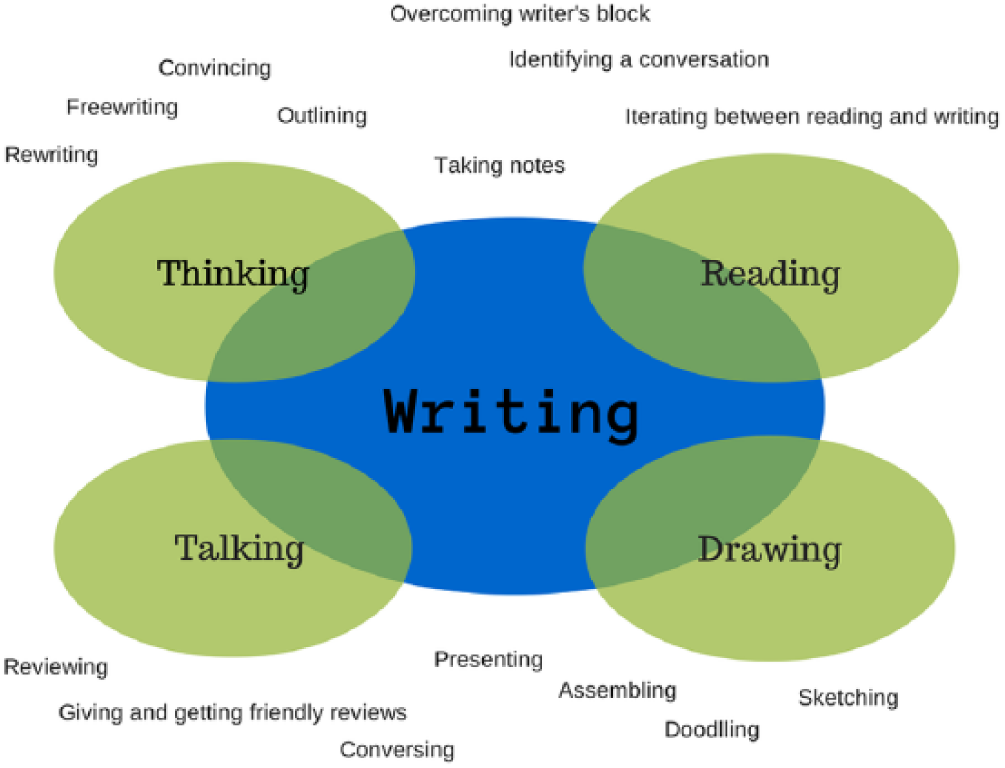
Academic writing as a process involving four other practices.
Writing and Talking
Even when the scholars I spoke with were sole author on a piece of work and they spent long periods of time writing on their own, their writing process was nevertheless deeply anchored in some form of ongoing interaction with others: If you want to have someone read you, then you can’t write for yourself . . . You have to write to a scholarly community, and you have to be a part of that conversation. You have to respect the people in that conversation or at least what they’re saying. They have to be interested in it. You have to find a way to empathize with their perspectives on the world even if you don’t agree with them because otherwise you can’t write in a way that they can understand or accept. (Tom Lawrence)
Although previous authors have noted that, at its core, academic writing is about “entering into a conversation” with peers and members of the scientific community to which one belongs, and that academic conversation is itself a form of written conversation (Golden-Biddle & Locke, 2007; Graff & Birkenstein, 2006; Huff, 1998), my analysis helped me see the extent to which this is indeed the case. On this, practically all of my respondents said that their ideas, both in terms of what they wrote and how they wrote it, were largely generated through their conversations with others. Arguably, “conversation” within the realm of academic writing is more than just a metaphor. Conversations in their many different forms were not only real but also seen as central to the knowledge production process itself: The quality of the conversation is the quality of the work. There’s a lot of the writing process that’s a lone, individual endeavor. But it’s also a social endeavor. (Karen Golden-Biddle) I think of the papers I write as being part of a conversation, right? By writing a paper you are engaging in a conversation with other scholars, they offer their ideas in their papers, I offer mine in my papers. This is a dialogue. You actually never write in isolation. (Tammar Zilber)
The types of conversations that interviewees engaged in were of three types. Informal conversations took place mostly with coauthors, peers, and students. Such conversations, usually around idea sharing, took place on an ongoing basis, either face-to-face or through various media, such as the phone, Skype, email, and so forth. Semiformal conversations usually took the form of presentations at conferences and/or invited talks or by means of friendly reviews. Such conversations served to validate to a wider audience whether a scholar’s piece of writing was likely to have appeal within their chosen scholarly community and to help her identify any unnoticed “fatal flaws” in the work offered up for consideration. Finally, conversations took a more formal turn as scholars engaged with editors and reviewers as part of the publication process.
Informal conversations: Talking with coauthors and others
As I alluded to above, the conversations underpinning scientific endeavor and the writing that goes with them can take many forms. Most informal were conversations with coauthors and peers. These were real-time conversations, where ideas for papers got fleshed out through ongoing and sustained discussions with others: As regards specific ideas, with collaborators, it usually starts off with conversations around an ongoing stream of work. . . . “What do we think are issues in that area?” . . . And working through them becomes a matter of just sitting down and talking. (Bob Hinings) Talking with others helps you articulate what you’re thinking. (Tom Lawrence)
Such conversations often took the form of a debate, something that Danny Miller viewed as a positive and necessary aspect of the academic writing process: We’d have many arguments (with coauthors) but these made our papers a lot better. (Danny Miller)
In certain situations, as Tom Lawrence relates here, lack of conversation was even seen as stifling the writing process: I spent a whole year working on this paper. And I got it to a point where I couldn’t get it any further, which is where it is now. Because I don’t have a coauthor, I don’t know what to do. I’m totally stuck. (Tom Lawrence)
Semiformal conversations: Giving and getting friendly reviews
Another form of conversation that contributed to writing involved giving and getting informal reviews from close friends and respected peers on all or part of a piece of writing. Friendly reviews were indeed a frequent way that authors’ gauged whether their ideas and arguments were likely to be well received by a given scholarly community. Friendly reviews were also viewed as an effective way of catching serious flaws in a piece of work prior to submitting it to a journal: You have go-to people to whom you can say . . . “Hey, can you just read my discussion section and make sure that it makes sense?” or “Can you look at the introduction? . . . Does it sound interesting? Does it sound like we’re on target?” (Kevin Corley) I’ve got one or two people who I’m good with that, and they’re good with me. It’s that thing I say, “Get your friends to tell you that your breath smells because you’d prefer to know that, right?” (Paula Jarzabkowski)
Although younger scholars were encouraged to get friendly reviews on their work (and there are good reasons for doing so), certain scholars pointed out the drawbacks of doing so: I don’t tend to do a lot of getting feedback from other people on papers. When I’ve done it, I’ve sometimes regretted it because . . . people have their own idiosyncratic reactions to it. . . . And that’s going to happen anyway with reviewers. They’re going to have their own idiosyncratic reactions. (Tom Lawrence) You’re supposed to do it (friendly reviews). But it’s just that I’m going to get very different comments from different people—and those can tempt you to lose focus or originality. (Danny Miller) In the end, my theory is that no matter what your friends say, even your best critics, the reviewer is going to come up with something else, right? So why bother? (Steve Barley)
As far as friendly reviews were concerned, these scholars were quite deliberate in choosing when, with whom, and how often they had such conversations, based mostly on the extent to which they felt friendly reviews could help them move their ideas and their writing forward in the direction they wanted.
Semiformal conversations: Presenting
Another way in which scholars engaged with others that was more formal than ad hoc conversations with peers or friendly reviews but less formal than submission to a journal was via presenting their work at conferences or invited talks. Scholars often and frequently present their work at various fora to receive feedback and comments from those attending. Presenting was not only a way of testing the waters as to how new ideas were likely to be received by a particular scholarly community but was also a way of generating new ideas. Here, for example, Sarah Kaplan relates how presenting helped her figure out what the framing of her paper should be: I did all this field work and started presenting these vignettes at MIT and other places and people kept saying: “Why is this cognition? Why isn’t this just people pursuing their interests?” Which is when I realized that that was part of what was going on. And so then I had to think about, “Are there other models for thinking about how cognition and interests interact?” (Sarah Kaplan)
Presentations were a way to get a view of one’s work through the eyes of interested others who are not directly involved in its development. As such, they are one step ahead of the more formal conversations that take place between authors and their reviewers once they formally engage in the publication process.
Formal conversations: Reviewing and being reviewed
As they write, academic authors converse not only with coauthors and peers, but also with journal editors and reviewers. The review process can effectively be seen as the continuation of a conversation begun earlier (between coauthors and colleagues) with new people now entering it (the editors and anonymous reviewers). The conversation between authors and reviewers is primarily a written one. Reviewers write their comments to an author (editor letter and reviewer comments), who in turn writes back (the letter to reviewers). Increasingly, this goes on repeatedly, in multiple revision rounds.
It occasionally needs reminding that at the heart of academic conversations are debates over the state of knowledge in a given field, or over how such knowledge should be advanced in future. As such, academic conversations are contentious by definition—something that is rendered particularly salient during the review process. This partly explains why almost all of the authors I interviewed said that they found the review process both challenging and frustrating. In this context, the word “argument” takes on its multiple meanings simultaneously: There are arguments in the sense of quarrel or disagreement, and there are arguments in the sense of reasoning (sets of reasons that are given to persuade someone of something). It is not surprising then that such conversations triggered powerful emotions, even among the most seasoned academics among those I interviewed: I open it right away because I know that I’m going to get pissed off and I know that it’s going to take me anywhere from 3 to 6 months to stop being pissed off so I might as well start being angry soon. (Steve Barley) It needs time to distil. You need time to get over that first emotional reaction of, “These reviewers are jerks.” Or, “Did they really read the paper?!” Then you have to decide what it is you’re going to do because all the reviewers are saying different things and they’re all asking for a new paper out of the original paper. (Bob Hinings)
This being said, several of my respondents indicated that their initial emotional response usually gave way to recognition that maybe the reviewers had a point: I still get rejections, just to make sure you understand. And I still get mad about it. And I still take it personally because this is my identity. I’m a writer, I’m a scholar and you people must all be idiots if you don’t see the wisdom in this paper. So yeah, I get rejections. It takes me a while to get over a rejection or even a “high risk” revision. I do not take them well. But then my brain immediately starts working on revising the paper, “Do they have a point? Do I have a way of addressing this?” And how am I going to revise the paper? And I’ll just put all that in and let it stew for a while. (Denny Gioia)
Still others took a more philosophical view of the process, not necessarily diminishing its emotional aspects, but acknowledging, and even embracing, the review process as part of an ongoing dialogue or discussion: No matter how “perfect” your paper is, your editor and the three people that review it are going to see things a little differently than you because it’s an interpretive process, . . . a social construction: What’s valuable and what’s not? What’s a contribution and what’s not? As an inductive researcher, you have to have this capacity . . . to recognize that more writing, more creating, more constructing is down the road. (Kevin Corley) When I’m writing, I don’t try to write the perfect paper. I try to write a good-enough paper that is interesting enough and intriguing enough for my immediate audience—a set of reviewers and an editor—that allows me to get an R&R. The paper will then evolve within a dialogue with them, a dialogue that will allow me to further develop the project. (Tammar Zilber)
For these authors, reviewer comments presented an opportunity to better explain or better argue what they were trying to say: I don’t have a big ego about rejections. If they’re unfair, it’s a little bit of a bummer. If I don’t feel like they were judging the paper based on its own merits, that they were applying criteria that are not appropriate for the paper, then I find that frustrating. But mainly I look at it and say: “Gee, this is what they didn’t understand” or “This is what I didn’t do.” (Sarah Kaplan)
These authors thought that even though the process was difficult and intensely frustrating, exchanges with reviewers ultimately led to better writing, whether such interaction led to successful publication or not: My experience has been that most of the time it (the review process) has helped improve my papers. (Davide Ravasi) Like everyone, at first, I’m quite offended by some of the remarks made by reviewers. . . . But when I think it over, I usually get what they’re saying. . . . It is a challenging conversation, not only on issues of theory, methods or data, but emotionally as well. But usually, by the end of the process, it is a productive dialogue and a satisfying one. (Tammar Zilber)
Nevertheless, it remained that certain scholars, particularly those with more experience, felt that the process wasn’t quite as constructive or developmental as it could or should be: Sometimes the revisions look impossible and editors have a code language for that. And they seem to be overusing that code language these days. Everybody seems to want to characterize revisions as high-risk, which gives them the license to reject even a good revision. (Denny Gioia) This is because most reviewers think their job is to figure out why the paper should not be published. It shouldn’t be that way and I know that if you ask editors, they’ll say, “Oh, no, no, no, we’re developmental,” but I don’t believe that’s true. (Steve Barley)
Perhaps it is important and necessary to remember that the process is indeed a conversation and that authors, while listening to and being respectful of what others have to say about their work, must not lose sight of their own voice in the process: I think one of the big challenges today is allowing authors to have their voice. We’re so driven to publish in the top journals that we’ll do anything to get in. . . . The drive to publish makes us a little over-keen to satisfy the reviewers. And I’m like, “Just a minute! This is not what I’m trying to do in this paper.” (Royston Greenwood) Part of my maturing as an academic has involved not letting reviewers do things to my paper that I don’t want. Working out what I want to say; not giving in to everything in the hopes they might let you through. Because sometimes, they won’t let you in even if you do the things they ask. And then you end up with a rejected paper that you don’t even like or believe in anymore. (Paula Jarzabkowski)
In sum, academic writing was not only the outcome of conversations between authors in a given scholarly community but it was also very much a kind of conversation in and of itself.
Reading and Writing
A second way that the scholars I interviewed developed their writing was through reading. Reading moved the academic conversations discussed above into a new medium, that of published work: When I think about a community, I think about it in terms of an intellectual community . . . that is embodied in a set of papers, books, whatever, through intellectual references and citations or whatever establishes this discursive community. (Tom Lawrence)
For these authors, reading was a key resource, one on which all academic conversations were based and that all scholars turned to when oral conversations got stumped or ran dry. When writing became blocked, several respondents indicated that reading was their way of getting unblocked: If you don’t know what to write in the discussion, just go back and reread all the pieces you cite in the theory section and see how your work is different from that. (Davide Ravasi) I’ve found that when I have writer’s block it’s often because I don’t know enough to write yet, and reading helps. So if I’m stuck, the way I usually get unstuck is to go and read something in that area, something someone else has written, something I’m trying to build on, maybe even something completely different and the ideas pop into my head. . . . To be a good writer, you have to read a lot. (Kevin Corley)
Reading and compulsively taking notes about what they read was also an effective way for some authors to “get going” on writing: The blank page is always kind of terrifying. I always outline. I start by taking notes. I read a whole bunch of stuff and I’ll start taking notes. (Sarah Kaplan)
For many of my interviewees, reading and writing were never entirely separate activities. Rather, reading and writing were done iteratively and repeatedly, one activity continuously feeding on the other: It’s never an “Ah-ha.” It’s gradual. So you’re reading, and you have an idea. You capture that idea, you read some more, and then you have another idea. I’m beginning to get a sense that this might be connected to that. Okay. Now I need to set the reading aside and get back to my writing because I’ve just figured out something important. (Kevin Corley) The other thing I might do, especially if I know what it is I want to say but just can’t get it down on paper, is I might go back to a couple of articles or a book or whatever and reread something that I know in my mind is important. (Bob Hinings)
In sum, reading can be viewed as the lubricant that keeps academic conversations (and thus academic writing) going. It forms the basis from which most academic conversations start and the end point toward which authors aspire (that one’s work be not only published but also read).
Writing and Drawing
Articulating ideas, finding relationships between concepts, or constructing convincing arguments is difficult. One way that a handful of the authors I interviewed overcame this difficulty was by drawing. For these authors, drawing, doodling, or sketching ideas in visual form was another tactic they used to sort out their thoughts and get their writing juices flowing: I tend to think in terms of boxes and arrows. At some point I’ll do that, a box and arrow diagram, and even if it doesn’t make it into the final paper, it at least helps me organize the front-end of the paper. (Bob Hinings) It could also be something visual, so writing isn’t always just text, right? It could be a picture, it could be anything. Anything that helps you engage with the data. (Martha Feldman) The very act of drawing clarifies things in my head. It’s important for me to do it, because it sharpens my thinking. (Royston Greenwood)
Drawing was seen as a way to synthesize talk and engage in visual thinking, prior to actually writing. Among coauthors, it was a way to capture collective thought, and agree on what to write: We talk and talk and talk, and then we go to a white board and we talk about—what are the kind of two boxes and an arrow that this paper is about? (Tom Lawrence)
Visual thinking was not achieved uniquely by drawing. Karen Golden-Biddle, for instance, shared with me how arranging objects in space was another way that she sorted her thoughts and ideas to better “see” them. For Karen, claims, summary notes, or pieces of data marked on cards that were then arranged and rearranged so as to construct a logical argument that could be “visualized” was another way in which drawing and visual thinking enhanced and facilitated her thinking and writing: There may be a couple of claims to knowledge that I’m trying to develop, and I’ll actually put those on the floor. I’ll write what the claim is in a big marker on some index cards and then I’ll move data around or interviews around where I think they might fit. (Karen Golden-Biddle)
Drawing to sharpen one’s thinking is not a new idea, and scholars have previously extolled the benefits of diagrams for clarifying one’s thoughts (Buckley & Waring, 2013; Few, 2012; John-Steiner, 1997; Tufte, 1983). Henry Mintzberg (2005), for example, related how he used “diagrams of all kinds to express interrelationships among concepts I am dealing with” (p. 369). The view that drawing and writing are very different and unrelated activities that call on different talents and abilities (e.g., only artists draw; Roam, 2008) might help explain why only a handful (and not more) of the authors I interviewed mentioned drawing as an activity that helped them with their writing.
Writing and Thinking
Thus far, I’ve considered academic writing as “conversation” in its many forms. Conversations highlight the relationship between writing and talking, or expressing one’s ideas out loud. I’ve also highlighted the relationship between writing and reading, and the relationship between writing and drawing. So one of my main realizations through this process was that writing is never (ever!) an activity that happens on its own. It is invariably tied up with some other activity that facilitates thinking, which in turn facilitates writing. The relationship between writing and thinking is thus perhaps the most important of all. We write what we think, but in the act of writing, we also clarify our thoughts: But the writing itself is such an important part of the process of thinking you know, it’s not that you think and then you write. You think and you start writing, which means you have to start thinking again. (Bob Hinings) Can I find an explanation that flows logically and is true to what I observed? That’s something that I’ll find out only when I write the paper. (Davide Ravasi) When you try to write it, you realize: “Well that was a really stupid idea.” When you actually write it on paper, it doesn’t make any sense and then you have to go back and start again. (Nelson Phillips)
For the authors I interviewed, writing helped clarify their thinking in various ways:
Outlining
Some authors felt that preparing outlines before developing their ideas was essential for putting order in their thoughts: I always do outlines. . . . What I try to do is develop an outline that gives me the general flow of what the paper is going to look like. Sometimes those outlines are fairly high level. Sometimes they can be quite detailed. Sometimes I write my paper literally by filling in the outline with text and then just taking out all the Roman numerals or a, b, and c’s and so on, and then bingo! you have a paper. (Steve Barley) Increasingly I outline, yes. It’ll be like, “Let’s do three paragraphs on this and some on that and, you know, there’s too many of these and that’s looking a bit too bulky, it’s disproportionate.” (Paula Jarzabkowski)
Others did not find formal outlining helpful at all: I’m not a big outliner. But I arrange. I think about the flow of ideas. I think about the construction of the argument. What’s the claim or the claims I’m making? And what evidence am I warranting those claims with? So I think of those things, but I don’t outline per se. (Karen Golden-Biddle) I do (outline) because I feel like I should, and I feel virtuous. . . . So I go through with it because I believe it’s the right thing to do, but once I’ve done it, I tend to largely stray away from it. (Jennifer Howard-Grenville)
Whether authors prepared outlines before starting to write was therefore quite personal, with some authors doing so systematically and rigorously, and others being content with a “rough outline in my head” or “a general sense of the categories I’m going to need.” The kinds of outlines they produced could be simple, and even generic (intro, lit review, method, results, discussion, and conclusion) or highly detailed, complete with subtitles, general points to make in each section, and even, for some authors, an estimate of the number of words they needed to write for any given section. Regardless of their approach, however, whether outlining or merely “arranging,” at some point in their writing process, scholars did tend to use some sort of mechanism to help them structure their thoughts.
Writing linearly or not
How authors proceeded to write once they had managed to give some initial structure to the points they were trying to make also varied considerably from one author to the next. Certain authors felt compelled to write linearly, their ability to generate text in one section dependent on having already developed the previous one. Others could jump around easily based on their mood, inspiration, or on the amount of time they had available to write at any given moment. Whether authors wrote in a linear or nonlinear fashion seemed anchored in both their personalities and thinking style, to the extent that for many among them, writing any other way was deemed unthinkable, if not impossible. For example, several authors indicated to me that they couldn’t even begin to write a paper without a title: First I write a title. This is very important. I have to have a title because it helps me focus. (Tammar Zilber) Everything starts with a title for me. It’s all very linear. . . . The idea probably first becomes conceptualized in terms of a figure of a very loose kind and then a title. And the title is often just the figure turned into a title, the impact of x on y sort of thing, colon: a study of some context. (Tom Lawrence)
Others needed to have a fully developed introduction before they could start, and it was only once they had this that they could go on thinking and writing about what it is they wanted to say: I always start at the beginning. We always start with the title and an abstract and an introduction. We know we’re not going to stick with it, but at least that way it summarizes what’s going to be in the paper. (Nelson Phillips) I start from the beginning and end at the end. (Steve Barley)
Others were more flexible, and could write up any section of a paper at any time depending on where they were at in their thinking and analysis and what inspired them on that particular day: The easiest part of the paper to start writing is the methods, right? Because as you’re collecting data, you write what you’re doing. Then I’ll write an intro that basically frames what it is I think I’m going to be writing about. Then I typically work on the findings section and discussion section. Once I have a good draft of that discussion section, I’ll go back and write the literature review around what it now needs to be, based on the discussion. Because again, doing inductive research, you can’t write your literature review beforehand. (Kevin Corley)
These varied and sometimes opposing practices helped highlight just how interconnected our writing compulsions are with how we think.
Analyzing
Another way the authors I interviewed figured out what to write was through the process of analyzing their data. Deep engagement with their data, including field notes, interview transcripts, and other documentation, and looking for fruitful and exploitable patterns or angles was a key way in which each made the “leap” (Langley, 1999) or connection between writing and meaning making: I’ve never been able to just write theory without data . . . I’m someone who sees a context or a phenomenon that is happening in the world and thinks, “This could be a really cool research project” and goes with it. (Jennifer Howard-Grenville) I never start a project with a notion of what I’m going to write about. . . . What I actually write about depends on what is in the data. What can I support a story line with? (Steve Barley) It really becomes a matter of moving back and forth between this early interpretation and the data until I manage to find a correspondence between them, between the idea and the data that supports it. (Davide Ravasi)
Freewriting
Almost all the authors I interviewed felt that writing became easier once they had managed to write a few sentences, as those handfuls of words gave them something to “mull over” and think about. Indeed, most commented on how freewriting—what Bob Hinings refers to as “stream of consciousness writing” or Paula Jarzabkowski as “blue-sky writing”—or just “getting something down on paper no matter how unclear or ridiculous” was a necessary first step toward getting on with writing “for real”: The most important thing about writing is to just start, somehow. Just write something. It could be a title. Remember, it’s temporary, it will probably change many times, but write a title, write an abstract, just to start. (Tammar Zilber) Sometimes I can sit in front of the computer for a couple of hours and end up with two sentences. The ideas are kind of all there, but it’s getting them onto the page that is a challenge. But once I’ve got those first couple of pages done, then I can go on, you know? Those first pages are really crucial, because they’re saying, “Here’s what I’m going to do.” (Bob Hinings) For the first round, you kind of just have to get words on a paper, so I do try to just chug away . . . I try to get stuff down because I’m much better once there’s at least some amount of text on paper. Then I go back and edit and rewrite section by section. (Sarah Kaplan) The first day you bugger around, and you try to copy and paste something you did before, or you take parts of your notes and you think, “Okay, maybe I’ll just copy and paste that in, and write a few things around it.” . . . Once I’ve done that, I’ve got something, and something is something. So I’m a big believer in something is better than nothing, because you can improve something. (Paula Jarzabkowski)
In a discussion on how he develops theory, Mintzberg advises aspiring scholars to “keep things messy,” especially at first as in his view, messiness enhances thinking. Early messiness seems to provide the right seedbed for eventually writing more compelling and interesting work (Mintzberg, 2005), a view shared by Mary-Jo Hatch. In an interview she gave with Ann Huff (Huff, 1998), she explains her “unorthodox” (p. 129) approach to writing in just these terms: I’m writing to figure out what I think, there’s no agenda . . . I just get thoughts, random thoughts down on paper. After some time, the pages I am producing begin to have some coherence and that is when I start writing toward a first draft. (p. 130)
Peter Elbow (1981), on his part, elaborated considerably on the benefits of freewriting, which he viewed (among other things) as a powerful generator of better ideas and a miracle cure for writer’s block.
Rewriting
The “mulling over” triggered by freewriting also helps explain why so much of the writing authors did was actually “re”-writing. For most of the writers interviewed here, rewriting was how they spent most of their time. Rewriting is the blue-sky writing that gets shaped and reshaped like clay, each iteration helping authors make sense of what they think and bringing them closer to what it is they are trying to say: I mean, if you look at me as a writer and you looked at the way I devote my time, you’d say he’s not a writer, he’s an editor. I just revise, revise, revise. (Denny Gioia) There’s the blue sky type of writing, when you start writing, and then there’s the overwriting, rewriting, and writing again. (Paula Jarzabkowski) This doesn’t mean that everything I write, I keep; I trash a lot. But at least I write. . . . For some of the papers I’ve written, I’ve produced three, four, five different visual representations of the model; three, four, five different versions of the findings. (Davide Ravasi)
As authors, we thus write and rewrite and rewrite again until our texts do what they’re supposed to do: convince.
Convincing
As with other forms of writing such as advertising or editorial journalism, academic writing is geared toward convincing others to change the way they think. As Van Maanen (1995) has argued, “Our writing is something of a performance with a persuasive aim” (p. 135). Academic writers write for a purpose, and that purpose is to convince others of some idea—some claim to knowledge that they wish to make, and that they want their peers to recognize and accept as well. For the authors I spoke with, convincing others of something reflected the very process whereby knowledge was created: My job is to sit down and work with text. And my job is to make that text compelling. Writing to me is rhetoric. (Denny Gioia) Our papers are rhetorical—it’s an honest argument intended for an audience, and we’re trying to convince that audience, right? . . . This is really important because it’s the “how” and the “what” of what we write, and these two are always interdependent. So blindness to the how, the rhetoric, is always to our disadvantage. (Karen Golden-Biddle)
The fact that some authors forget this important point may explain why reviewers are unhappy with some aspect of their work: Mostly, reviewers are saying, “Your work didn’t convince me,” not, “Your work is wrong.” (Paula Jarzabkowski) I think the spirit of dealing with reviewers is like that. These guys are trying to say something to us, because they’re not convinced by the paper. . . . How do we convince these guys who are clearly not convinced? We can’t let the hurdle of clarity get in our way on that. What is it that they’re not getting? Why are they not getting it? (Royston Greenwood)
Figuring out how to convince others about an idea also inevitably shaped how and what authors themselves thought about any topic they happened to be writing about, and thus convincing is yet another way that writing shapes our thinking.
In a frequently cited piece, Richardson (1994) argued that “Writing is also a way of “knowing”—a method, in and of itself, of discovery and analysis." Through our writing, we discover new aspects of our topic and our relationship to it: Careful and correct use of language is a powerful aid to straight thinking, for putting into words precisely what we mean necessitates getting our own minds quite clear on what we mean. It is with words that we do our reasoning, and writing is the expression of our thinking. (Beveridge, 1957, p. 91)
As Mary-Jo Hatch relates (Huff, 1998), we need to trust the writing process to help us do just that or, in the words of K. Golden-Biddle (personal communication, September 2012), “we write our way to clarity.”
A Multifaceted and Interconnected Practice
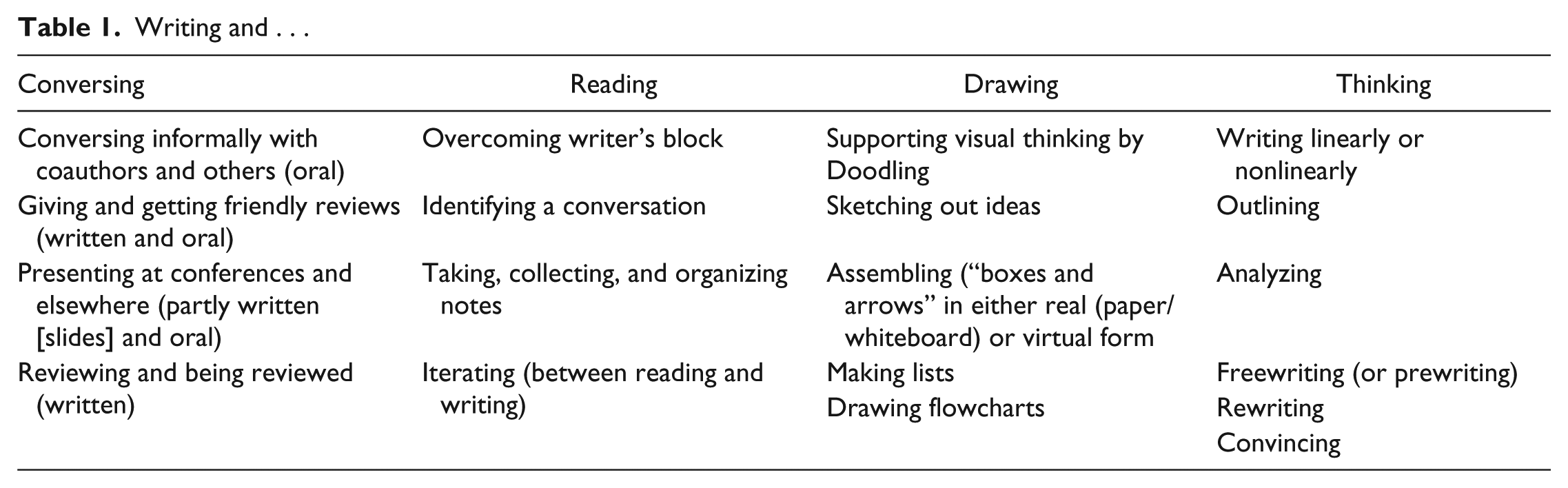
What these many observations helped reveal to me is that writing, and especially academic writing, is not a stand-alone activity. Rather, writing is a practice that is intricately bundled and intertwined with other practices, namely, talking, reading, drawing, and thinking, from which it cannot be separated (see Table 1 for a summary). Indeed, “discursive thought comes forth through physical engagement with text, material tools and memories rather than being thought ideas awaiting transcription” (Essen & Varlander, 2012, p. 408). What we write is not the result of us simply “writing down” our already fully formed thoughts onto a page. Rather, what we write is a synthesis of our interconnected conversations, drawings, readings, and thoughts that have cumulated over time and have given rise to the sequence of words that we call text and for which we claim authorship. These interconnections help illustrate how our thinking comes together through writing and how our writing shapes our thinking in a nonlinear and recursive process. Figure 1 above is my attempt at producing an image that reflects this core idea.
Writing and . . .
Academic writing can thus be viewed as a process of trying to keep its different moving parts in continuous movement. A potentially helpful analogy is to see ourselves as circus plate-spinners: If or when one of our spinning plates (the reading, writing, drawing, thinking) begins to lose momentum and wobble, we need to give it a twitch to keep it going. Such it is with writing. If it is to be taken seriously, writing is not something that you turn on and off at will, it is something that you do continuously and all the time.
Reflections: On the Dynamics of Academic Writing
Taking a step back from the actual process of getting words written down onto a page or screen helps us see additional factors that feed into and nurture our writing journeys and lives, factors that help keep the various plates of our writing practice spinning. In my conversations with authors, two such factors stood out in particular: the “nonwriting” aspects of writing, and the realization that academic writing must be viewed (and accepted) as a profoundly social activity.
Writing as Not Writing
Up until this point, my discussion has focused on actual writing as a practice. Interestingly enough, because of writing’s interconnectedness with other activities, a large part of writing is in fact not writing. It is not writing in the sense that writing feeds on nonwriting activities. If or when we cease to feed it, we run out of things to write about. What my interviews reveal is that writing needs to be continuously fed through reading and talking, drawing and thinking. When we stop feeding it with these activities, we should not be surprised if our writing suffers. As such, not writing must be seen as an integral part of writing because it is at the intersection of writing and not writing that our creative energy lies. If we want that energy to flow, we must take measures to nurture it, not only by feeding it through its related activities but also by nurturing those nonwriting activities that make it possible for us to write anything at all.
Transitioning Into Writing and Cognitive Cueing
Thus, a second dimension of “not writing” that nurtures the writing process which I picked up on involves the unrelated, and often ritualistic, activities that authors engage in and that help them “get into” writing, activities that “primed” their thoughts and eased them into a particular frame of mind such that they are able to write: I have to do another outline, or read some more stuff and take notes, and upload everything into my brain. I feel like a computer where you have to upload everything in your RAM. Once it’s in your RAM, you can write. (Sarah Kaplan) When I switch on my computer, the first thing I do is check my email . . . The second thing I do is check Facebook. And then the third thing I do is check the BBC sports page. Now are these rituals? I don’t think of them as preparing me for writing as such, it’s just the way I get into my game. (Bob Hinings) To get started I have to get in the mood of the paper, otherwise I can’t write . . . So what that means is that in the beginning, my desk has to be clean. I am very messy usually, but when I start a paper my desk has to be clean. (David Seidl)
It is essential to not view such time as wasted, but rather as integral to the writing process: For new stuff, when I’m actually starting to write something, I’ll usually try to set aside days for that. Something that I’ve never come to accept in myself, even after all these years, is that at the clean sheet stage, it takes a day to get into it. And that is actually part of the writing time. (Paula Jarzabkowski) For every hour I’m going to write, I need 2 hours when I’ll not write. (Bob Hinings)
Thus, the rituals that authors follow before writing must not be viewed as disguised forms procrastination, or the eccentric habits of the more neurotic among us. On the contrary, as Kellogg (1994) has argued in his book, The Psychology of Writing, such rituals actually work as cognitive cues that trigger certain associations in our minds and ease us into a writing mode: The abstract ideas, images, plans, tentative sentences, feelings, and other personal symbols that represent the knowledge needed to construct a text are associated with the place and time of the writing environment. These associations are strongest when the writer engages in few if any extraneous activities in the selected environment. Entering the environment serves as a retrieval cue for the relevant knowledge to enter the writer’s awareness. Once the writer’s attention turns to the ideas that pop into consciousness, the composing process flows again. Particular features of the environment may serve as specific prompts for retrieving, creating, and thinking. (p. 188)
Practiced systematically and often, such rituals are actually generative and may serve to increase our overall productivity by limiting moments of writer’s block (Boice, 1990). These nonwriting activities must not be overlooked or underestimated as it is often during these moments of not-writing that our best ideas take shape, the product of the unconscious processing that is always going on in the back of our minds (Czsikszentmihalyi & Sawyer, 1995; Leonard-Barton & Swap, 1999). As such, not writing is an essential ingredient to the creative process. More often than not, we figure out what we want to say or how we want to say it when we least expect it: I’ve learned however that if you just force yourself to get out the door, it can be quite productive. . . . And it’s not like I try to think when I run. But there is something about running that makes things click. (Jennifer Howard-Grenville) So there have been lots of times where I’ve been working on something and I’m stuck, so I’ll go for a dog walk, and in the middle my walk, the answer would come to me. And it wasn’t as if I was actively thinking about it. So having those breaks and doing something physical really helps. (Tim Pollock)
This observation points to the importance of repetition and incubation in the creative process (Glei, 2013). We need to view our writing as a practice that requires practice: a practice that we engage in deliberately and routinely, regardless of our particular mood on a particular day: What I’ve discovered is that I have to force myself to sit in front of the computer even if nothing happens. I know from experience that I need to go through purgatory before I can figure out how to put something together. I have to worry about it, I have to think about it and then it will eventually come, usually when I am not expecting it to happen. It might be when I wake up in the morning. It might be when I’m in the shower or it might be when I’m falling asleep at night. I don’t know when—something has to happen in your brain subconsciously maybe. And it’s painful to wait for that to happen, but I think that the pain is important because it probably means that you are always thinking about it at some level, either consciously or unconsciously. (Steve Barley)
Writing as a Profoundly Social Activity
Writing is often viewed as a solitary activity, and in certain contexts, such as writing fiction or poetry, perhaps it is. Although there are certainly moments when researchers feel alone with their text, it nevertheless remains that this image of writing is, particularly as regards academic writing, misleading. Despite prevailing belief, academic writing is neither a solitary nor a stand-alone activity. Rather, it is a profoundly social one. Academic writing must be viewed as a social activity because producing it requires ongoing and sustained engagement with others, whether this be in body (through real conversations with others, written, and oral) or in spirit (through reading and thinking). We tend to forget that the origins of academic journals were personal letters that scientists wrote to their peers and to which their peers responded. It was because of a desire to expand the reach of these private conversations that academic conferences and journals were created (Harmon & Gross, 2007). When scholars refer to the “literature” on a topic, what they are effectively referring to are “all the conversations that scholars have had on this topic to date.” By definition, almost any piece of academic writing, whether sole-authored or coauthored, can be said to be the product of a joint effort.
I don’t like writing alone, I think it’s the least fulfilling way to do research. For me, research is a social activity. I think you get better ideas by discussing them and challenging others with them. (Tim Pollock)
Writing Alone or Writing Together
The social side of academic writing naturally brings us to the topic of cowriting. Today, the majority of journal publications are coauthored (Acedo, Barroso, Casanueva, & Galan, 2006). This trend takes the notion of writing as a social activity to a new level. Academic writing is no longer just about joining and participating in a scholarly conversation, it is about taking part in a genuinely collective effort. It is about writing together, both in principle and in practice. Authors who have written about writing in collaboration with others have commented on the generative nature of collaborations (Alpaslan, Babb, Green, & Mitroff, 2006), such generativity occurring even when a lot, if not most, of their exchanges are not done in person, but via email and conference calls (Dutton, Bartunek, & Gersick, 1996). Meanwhile, others think that physical proximity is essential to the process (Hinings & Greenwood, 1996).
In light of this, it is interesting to note how some of my respondents took the notion of joint effort quite literally. Whereas most authors adopted the “trade-off” approach to collaboration (where drafts were continuously exchanged between authors until all were satisfied), certain authors preferred writing together, simultaneously, and side by side. These authors saw physical proximity and immediate engagement as essential for producing interesting and engaging drafts: We write together. I mean, we don’t write, write together. We tend to divide it up but having the other person there means you can talk about it, as you’re writing it. Some of it is brainstorming, lots of it is brainstorming. . . . It’s very creative, because you’re talking and finding problems, figuring out things and brainstorming as you try to write it out. (Nelson Phillips) We’ll have a conversation around writing the document as we’re writing it. I am not into doing a draft and then giving the draft to my co-author and then having them work on it. I just discovered along the way that for me joint thinking makes for a better paper. (Steve Barley) We just sat and physically wrote words together. And we had rules around if you were typing, that means another person was dictating. . . . I would be dictating, but you wouldn’t be writing what I’m dictating. You would be adapting it as you went. But . . . you couldn’t just race away, otherwise I’d be excluded from the process. But I couldn’t get mad when you changed the words, otherwise you would be excluded from the process. So it has to be literally an ongoing and collective creation of text. (Tom Lawrence)
With the advent of technologies (such as Skype or WebEx, which is what Steve Barley uses), live cowriting with coauthors is now easier than ever as it no longer requires people to be physically in the same room together to do it.
Even when drafts are traded between coauthors, there are ways in which the boundaries between who wrote what can be blurred. Martha Feldman related to me her preference for not using the “track changes” feature of word processing software when writing with coauthors: I don’t like using track changes . . . For the most part I think it tends to make you feel like I own this text and you own that text. I like to feel that we all own the text. If you make a change, and somebody else reads it and they’re fine with it, then it’s fine and it doesn’t matter who made the change or when the change was made. What matters is: “If you read this, do you like it?” (Martha Feldman)
This being said, though cowriting side by side might be something interesting to consider, and possibly try, as Denny Gioia related to me, such an approach is not for everyone: My writing is strictly private . . . I’ve had collaborators say, “Let’s sit down together and write.” “No, no, no, you don’t understand; I cannot write that way!” I cannot write in real-time, collaboratively. So I always write alone. (Denny Gioia)
So What?
If you’ve gotten this far in reading this article, you are probably asking yourself, “so what?” How does paying attention to the writing practices of others help improve my own writing? The more frank among us might admit that when we picked up this article, or when we started to read some of the interview transcripts online, we harbored a secret hope that perhaps, by digging deep into the mundane details of our favorite researchers’ writing practices, we would get at the heart of something. We would discover some magic formula that would help us write better, more, and faster; we would lift the veil on the mystery that is writing with impact, so that we could put this article down and begin a new life where every article we wrote was not only published but also widely cited. If only! We all harbor such fantasies, and there is nothing wrong with that. Hardly anyone who has accomplished anything worth remembering did so without dreaming for the impossible or the unlikely at some point. We must recognize that there are inherent limitations to any study of practices that is aimed at improving one’s own practice. As Steve Barley (2006) argued in his engaging essay, “When I Write My Masterpiece,” “Rockers and academics share another characteristic: a peculiar kind of cluelessness. Although many people can teach you to play guitar, no one can teach you to play guitar like Jerry Garcia, including Garcia himself (were he still alive)” (p. 16). Indeed, There is . . . no infallible guide to good writing, no assurance that a person who thinks clearly will be able to write clearly, no key that unlocks the door, no inflexible rule by which the young writer may shape his course. He will often find himself steering by stars that are disturbingly in motion. (Strunk & White, 1979, p. 66, as cited by Sword, 2012, p. 10)
So what is there to learn from a process such as this one?
On Being Reflexive About One’s Own Writing Practice
As social science researchers, we know that it is necessary to be reflexive about how we engage with and interpret the settings and subjects of our research and how these settings and subjects affect us as researchers (Charmaz, 2006). Reflexivity is about “finding strategies to question our own attitudes, thought processes, values, assumptions, prejudices and habitual actions” (Bolton, p. 13) both as we engage in research and as we write. Becoming reflexive about our own writing practice gives us the means of becoming more aware of the processes we follow when we seek to translate our ideas into words, either orally (through speech) or on paper (through writing). By doing so, we make it possible to identify avenues for enhancing our own writing practice.
Indeed, inherent to the word “practice” is the notion of “practicing”—a term we associate easily enough to music but tend to forget when it comes to writing. Practicing implies improvement. It involves becoming conscious of one’s practice, in a deliberate effort to improve. This in turn requires being intimately aware of and becoming sensitive to the practices of others (that of “masters,” if one stays within the musical metaphor) and being able to harness such awareness and sensitivity to one’s own practice, in an iterative and ongoing fashion (Kurtz, 2008). My point is that a researcher’s writing can benefit from “practicing” as much as a musician’s playing does.
If I turn the camera onto myself, what can I claim to have learned through these conversations with scholars about their writing practice? First and foremost, learning to view writing as an integrative practice, one that involves many activities other than just putting pen to paper (or fingers to keypad) has been liberating. Realizing that there is more to writing than just “writing” has helped me shed the pangs of guilt that tend to overcome me whenever I am not actually sitting at my computer writing. I now know that through the nurturing of the many activities that feed into my writing, I am actually “writing” a lot more than I ever realized. Second, I have come to fully embrace the recursive and serendipitous nature of writing as a practice. Although the generation of insight is not something I control, I now know that there are steps I can take to make sure that when my muse drops by, I’m able to grasp it. My creativity in writing thus feeds on my conversations and ongoing engagement with others and is honed through my routine and disciplined practice of putting my ideas and thoughts into words, every day, day in and day out, whether I “feel” like it or not. As many of the authors cited here have suggested, if I just keep at it, at some point, something will give. And third, paying attention to the practices of others has helped me expand my personal repertoire of practices in ways that I doubt I would have come up with on my own. For instance, until now writing for me has been a primarily narrative endeavor. I rarely, if ever, “thought” in diagrammatic or visual terms, certainly not in the early stages of writing up research. I now see the potential of visual thinking and have started drawing “boxes and arrows” much earlier and more often than I ever did before, and my writing and thinking has benefited from this. Now that I know about these new practices, I can use them in my own idiosyncratic ways, and by so doing, enhance both my productivity and creativity.
These however are my takeaways. Yours may, and probably will, be different. By offering up these interviews for others to engage with, I offer everyone the opportunity to become more reflexive about their own writing practice and, by so doing, generate their own list of takeaways that might help put them on a more direct path toward better and more impactful writing. As Finlay (2002) has related in her article on “outing” the researcher in qualitative research, “phenomenological philosophers such as Heidegger argued that each person will perceive the same phenomenon in a different way; each person brings to bear his or her lived experience, specific understandings, and historical background” (p. 534). As such, my personal interpretation of these interviews can at best lead only to partial learning. What is needed, rather, is to “take pause, and seek alternative paths to those seemingly indicated by our current ways of ‘going on’” (Shotter & Tsoukas, 2011, p. 322). It is by engaging directly with these accounts on one’s own terms and in one’s own particular way that a more complete learning can be achieved.
Some Closing Thoughts
In closing, let me leave you with some closing comments from interviewees that I hope will reassure you in your own practice, and remind you why it is that we do this work. First, we must all remember that academic writing is a process that takes time, even for the most seasoned among us: I mean people are surprised to hear that I’ve been doing interpretive studies that take 5 years to finish and I’ll get one publication out of it. (Denny Gioia) It’s always an evolution, right? It always takes years. (Nelson Phillips) It takes a lot of energy to go from an idea to a paper. There are miles and miles in that. (Paula Jarzabkowski) I see the writing process very much like a pregnancy. . . . It takes time. And it doesn’t help to push it. (Tammar Zilber) All ideas take forever. (Tom Lawrence)
Although we might try, and occasionally succeed at making this process go faster, there is only so much we can do. Ideas grow at their own rhythm.
Second, given that most of us are in this game for the long haul, we may as well remember to do so for things that matter to us. And that means to remember, despite the ongoing (and growing) pressures creeping up on current and aspiring academics, that we should never lose focus of why we got into this field in the first place: From the people I see and know in some of our schools, going solely for short-term results to get tenure is a corrupting influence because, firstly, you develop bad work habits and your creativity becomes rusty. And secondly you come to not like research because doing that kind of opportunistic research isn’t a lot of fun. (Danny Miller) Don’t ever let that be displaced by the goal of publishing papers and putting marks on your vita because that’s when it stops being fulfilling. It seems to me that it’s better to have fewer papers that are good then lots of papers that are mediocre. (Steve Barley) You have to go where the energy is . . . What’s the point of doing this if you’re not really interested in it? Because it’s not like you’re going to make a whole lot of money and it’s not like you can get really famous. The only reason to do this is because you’re interested in it and you think you can make some kind of a contribution to some part of the world that matters to you. (Martha Feldman)
Write well. Be well.
Footnotes
Acknowledgements
I’d like to thank Viviane Sergi for her many suggestions, comments and ongoing support throughout the writing of this article. I’d also like to thank editor Nelson Phillips for his support and encouragement, as well as all of the scholars interviewed who agreed to be part of this project.
Declaration of Conflicting Interests
The author(s) declared no potential conflicts of interest with respect to the research, authorship, and/or publication of this article.
Funding
The author(s) disclosed receipt of the following financial support for the research, authorship, and/or publication of this article: The author has received support from HEC Montreal for this research.