







Abstract
In response to the calls for more context-aware theorizing, in this essay we review the empirical research on individual knowledge sharing behavior in organizations, with a specific focus on the context in which employees share knowledge. We build on the “Who? / Where? / Why? / What?” framework to “flesh out” the contexts of the empirical studies on individual knowledge sharing published in top-level journals. Mapping the researched contexts, we indicate several biases of the literature as well as point to under-investigated spaces, suggesting theoretical dimensions, their contrasts, and new empirical settings that are missing from the major stream of knowledge sharing studies. We also find that context has been scarcely accounted for in the existing literature, discuss the reasons for it, show how accounting for context can be used to re-interpret some contradictions in existing literature, and suggest some ways to move forward.
Keywords
Introduction
Why do employees share knowledge? Why don’t they share it? Why do they share knowledge in teams and projects, across units and organizations, online and offline, through knowledge management systems and informal channels? What are they sharing and how does the sharing happen in practice? All of these and related questions have captivated the minds of numerous researchers over the past decades (see, for example, the review by Foss, Husted, & Michailova, 2010). While a large body of research has produced extensive explanations of the knowledge sharing processes, it has done so using various angles, levels of analysis, and by paying attention to various selected aspects. This has resulted in a fragmented picture of the process that calls for integration.
Knowledge sharing can be broadly defined as inter-personal interactions involving communicating as well as receiving knowledge from others, in line with the idea that human interactions “are the primary sources of knowledge transfer” (Argote & Ingram, 2000, p. 156). As has been demonstrated over the recent decades, the knowledge sharing process does not take place in a vacuum but is always embedded in the context in which it occurs (Nonaka, 1994; Orr, 1996; Wenger, 1998). However, acknowledging the embeddedness of knowledge sharing in context does little to enhance our understanding of how and why knowledge sharing systematically varies across different contexts. Indeed, as put forward by Argote (2005) in the reflections on the state of knowledge management field and its different approaches, there is a need for cumulating the findings of existing studies so that we advance our understanding of the knowledge sharing phenomenon. Following on from these arguments, in this essay we attempt to aid in the integration of the knowledge sharing literature by systematically “fleshing out” the contexts of the empirical studies on individual knowledge sharing and demonstrating how the empirical research has represented the context of knowledge sharing.
The journey toward this article was triggered by our desire to understand the discrepancies in the findings of the empirical studies explaining knowledge sharing behavior of individuals. For example, we have found the existing empirical evidence regarding the impact of the rewards of knowledge sharing behavior to be contradictory—some found a negative relationship (Bock, Zmud, Kim, & Lee, 2005; Gooderham, Minbaeva, & Pedersen, 2011), some found a positive relationship (Siemsen, Balasubramanian, & Roth, 2007), and some found no relationship at all (Cabrera, Collins, & Salgado, 2006). Several prominent contributions suggested that such discrepancies can be resolved by uncovering and explicitly incorporating contextual conditions in which the behavior is taking place into the study (e.g., Bamberger, 2008; Joshi & Roh, 2009; Michailova, 2011). Inspired by these ideas, we hoped that if we took a closer look at the contextual settings of these studies, we would be able to meaningfully interpret and integrate these controversies. However, this scrutiny brought only more confusion. We found that various studies approach the context—if they approach it at all—to such differing depths and in such different ways, that the intended clarification or integration was hardly possible. To move beyond simple acknowledgment of the importance of the context toward context-based theorizing (Bamberger, 2008), we felt that there was a need for an overarching comparative analysis of the contexts in which employees share knowledge, as well as the need for the generic analytical framework that would allow such an analysis.
To perform such analysis, in this essay, we build on the framework suggested by Johns (2006) for bringing context back into the picture, namely, by eliciting the details on “who,” “where,” “why,” and “what” of the knowledge sharing from the existing studies. Our findings provide an overview of the settings studied in the knowledge sharing research (where is knowledge shared?), reveal the details about the respondents (who shares knowledge?), organizational reasons for knowledge sharing (why is knowledge shared?), as well as the implied nature of “knowledge” in these studies (what is shared?). Second, we reveal that the empirical research generally tends to downplay context and discuss the implications of this state of affairs. Summarizing the results of our review, we put forward a number of dimensions, representing potentially impactful aspects of contexts that represent directions for future research in the spirit of building more context-based theories (Bamberger, 2008).
We provide the following contributions to the knowledge sharing literature. First, our review serves as a map of the contexts already studied in the knowledge sharing field. Several researchers have acknowledged that sensitivity to context is important to understand the knowledge management challenges in different organizations (Andreeva & Ikhilchik, 2011; Glisby & Holden, 2003; May & Stewart, 2013). However, an integrated perspective on the variety of contexts that have already been explored in the research has not been forthcoming. Our study addresses this gap. Second, we identify the tendency of downplaying context, reflect on several reasons for it, and conclude with the recommendations on how to move forward. We call for abandoning some assumptions that seem to be pervasive in the mainstream studies of knowledge sharing and suggest future research to engage with context more through both its holistic representation in individual studies, as well as more comparative research on different types and configurations of context. Finally, we also point to empirical and theoretical under-investigated spaces in the knowledge sharing studies. Together, these contributions provide a response to the calls for context-aware theorizing of organizational processes voiced by researchers in the broader management field (Bamberger, 2008; Johns, 2006; Rousseau & Fried, 2001).
The article proceeds as follows. First, we discuss how we conceptualize context (of knowledge sharing) and identify a guiding theoretical framework for our analysis. Then, we present the methodology of our study, describing our selection criteria for articles and the analysis procedure. Next we present our findings, structured according to the chosen analytical framework. Finally, we discuss our findings and their implications for future theoretical and empirical developments in research on knowledge sharing.
Multiple Faces of Context
The idea that it is important to acknowledge and recognize the context in which the phenomenon we are studying takes place is, of course, anything but new. In fact this sounds so obvious as almost being a truism. However, despite its obviousness, there are reasons not to dismiss it as too simple an observation. In fact, as evident from the multiple calls and editorials (Bamberger, 2008; Boyacigiller & Adler, 1991; Johns, 2006; Michailova, 2011; Mowday & Sutton, 1993; Rousseau & Fried, 2001), the field of management has yet to learn how to express a greater sensitivity toward contextual issues and to develop more context-informed theories. The authors exploring the attention to context effectively demonstrate how many of the current contributions have failed to do so (e.g., Joshi & Roh, 2009; Porter & McLaughlin, 2006). It has also been convincingly explained that a greater appreciation of the contextual issues can help explain inconsistencies and controversial results, such as, for example, the findings of both positive and negative relationships between constructs such as team diversity and team performance (Johns, 2006; Joshi & Roh, 2009). Another argument put forward is that more attention to context can help generate new context-contingent theories (Bamberger, 2008; May & Stewart, 2013). More explicit attention to context can generate theory that is more relevant to practice and which keeps up with the current changes in the world of work, so that we do not “lose sight of the phenomena we seek to understand” (Mowday & Sutton, 1993, p. 255). Last but not least, serious attention to context produces research that is simply more interesting and engaging for its readers and consumers (Johns, 2006).
Overall, there seems to be a consensus that unpacking the context is extremely important but has yet to be mastered by management researchers. However, once we go a step further with this simple argument, some difficulties appear. Namely, there are substantial differences in how the context is conceptualized in the literature. These differences are both ontological (what do we mean by context in general?) and operational (which specific components of context should be considered and how should they be operationalized?). For example, one of the central ontological debates on this topic is whether context should be seen as an environment external to the phenomenon under investigation (e.g., see Cappelli & Sherer, 1991; Johns, 2006; Mowday & Stowey, 1993; Rousseau & Fried, 2001) or something which is more dynamic and inseparable from the phenomenon, that both shapes and is shaped by the phenomenon (e.g., Dilley, 1999; Erickson & Schultz, 1997; Michailova, 2011). In this review, however, we do not wish to engage in this philosophical debate. For the purposes of comparative analysis, we adopt a more pragmatic approach to context, defining it as “situational opportunities and constraints that affect the occurrence and meaning of organizational behaviour as well as functional relationships between variables” (Johns, 2006, p. 386). The reason for choosing this pragmatic path is that it allowed us to be more inclusive in the review and to compare a variety of ways in which other authors represented context in empirical research. However, we believe that this choice should not necessarily limit the scope of applicability of our results, as our findings could also inform the research that takes a dynamic perspective on context.
At the operational level, previous research has put forward a large number of various context components. These components include, for example, a range of macro-level factors, such as broad social and normative environments, namely institutions, professions, industries, and national cultures, the type and sector where organizations operate (e.g., service, manufacturing, high-tech, non-profit; for example, Joshi & Roh, 2009). Other components include organizational-level characteristics, such as organizational structure, culture or climate, and organizational norms (e.g., Porter & McLaughlin, 2006). Other authors focus on what they call micro-level factors, for example, physical workplace conditions (e.g., Elsbach & Pratt, 2007) or specific occupational demography, such as gender, age, nationality, work styles (Mowday & Stowey, 1993).
The existing attempts at disentangling context components and operationalizing them demonstrate that being precise about the context is quite difficult. Our own journey of trying to integrate existing evidence on knowledge sharing contexts illustrates this problem vividly. We started off with a theoretical hunch that the literature on knowledge sharing has reported data from multiple different organizational contexts. Our initial goal was to look across these contexts to synthesize what we know and don’t know about them. We wanted to build on this further to gain a better understanding about similarities and contrasts between knowledge sharing in different organizations. Yet the task of making such comparisons turned out to be not easy. When we compiled a list of articles and looked across the contexts—we realized how variably these contexts were presented in articles. For example, we were unsure how to compare articles that went into depth about one aspect of context, such as the organizational setting, but did not provide any information on the nature of the work that informants were involved in. Multiple such issues were raised in long (and often heated) discussions between the authors of this article. What the diversity of literature showed is that authors pick their own context dimensions depending on what they deem to be important for their research. As a result, a huge volume of different contextual accounts has been accumulated, but there is not yet a systematic way to compare what components are there and how deep each of them is theorized. Hence, we do not know the state of the art on what the different context dimensions are that influence knowledge sharing.
To be able to deal with this issue, we needed a basic overarching framework that would help to uncover and systematize the contexts that are already covered in the studies. A helpful approach for such a framework was proposed by Johns (2006). He suggests that to describe the context, scholars should rely on the “journalistic practice” of reporting the who, where, why, and what of any phenomenon in question. In this article, we specify these questions as “Who shares knowledge?” “Where is the sharing taking place?” “Why is knowledge sharing taking place?” and “What knowledge is shared?” This framework turned out to be a useful device for several reasons. First, it is generic enough to take various dimensions into account. Second, it can also accommodate both micro- and macro-level factors, allowing us to be flexible in terms of the scope of contextual issues which might be influencing knowledge sharing behaviors. Third, because of this flexibility and inclusiveness, it allowed us to use it as a sensitizing device for articles to see if some aspects are missing and if some are included.
Method of the Study
Selection of Studies for the Review
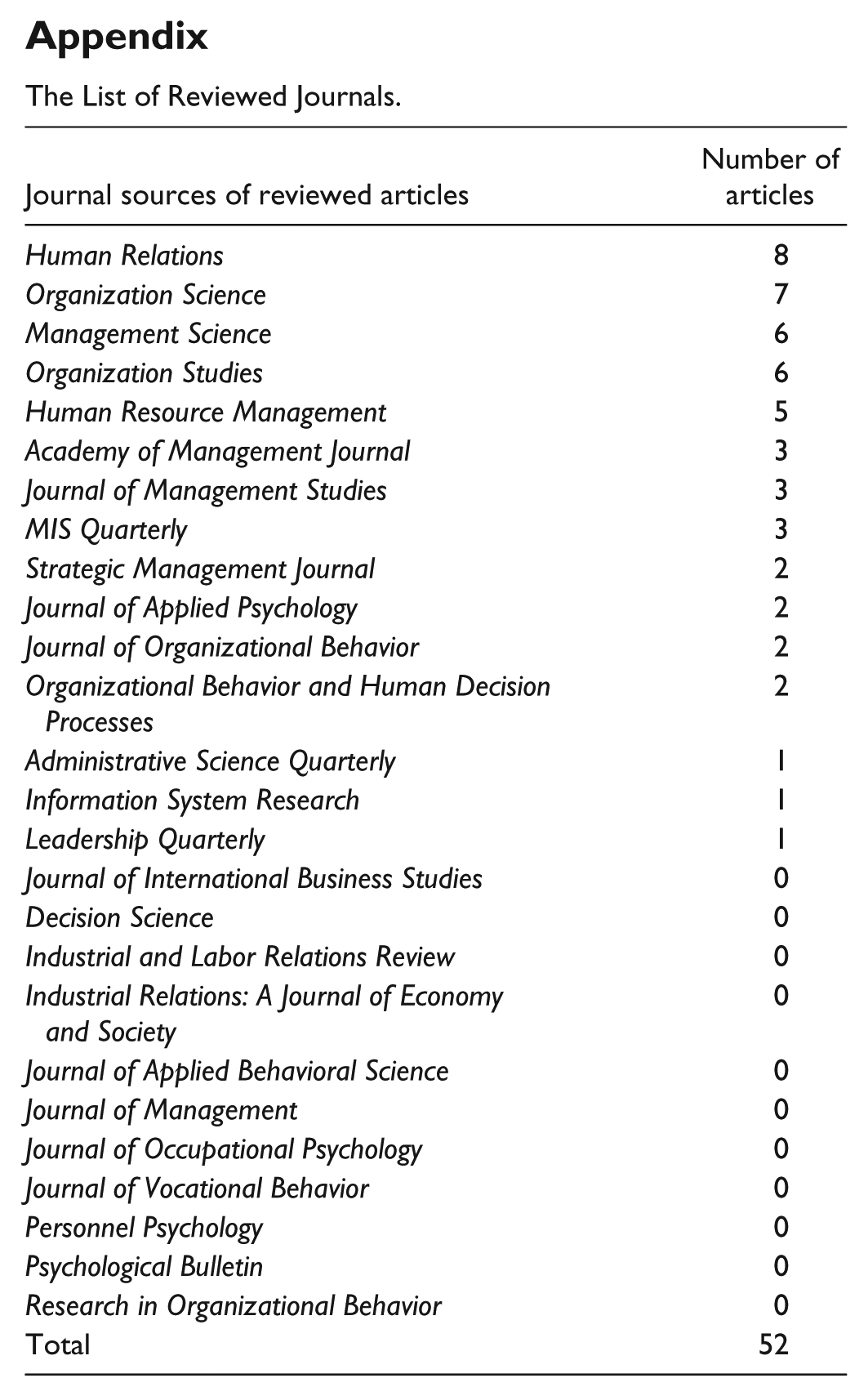
We followed a systematic search methodology suggested by others (e.g., Tranfield, Denyer, & Smart, 2003; Wolfswinkel, Furtmueller, & Wilderom, 2013). As a first step, we needed to decide which journals to include in our review. Our preliminary search, with no restrictions to the journals, demonstrated that knowledge sharing was very widely discussed over the last decades, yielding over 5,000 articles, a number beyond the capability to analyze. Therefore, we decided to limit our search to peer-reviewed journal articles appearing in top-level business and management journals described in other studies, such as Gomez-Mejia and Balkin (1992), Tahai and Meyer (1999), and Werner (2002). We also identified additional top-level journals through the Association of Business Schools (ABS) Academic Journal Quality Guide, where we selected top-level journals in the subject categories of general management, information systems, human resource management, and organization studies. Our selection criteria yielded a list of 25 journals (see the appendix). We chose to focus only on leading journals, in line with the reasoning of Locke and Golden-Biddle (1997) that top journals represent both a methodological standard of academic research and an accurate picture of state-of-the-art views on the topic, and, therefore, can be treated as a proxy for the academic scholarship in the discipline.
We used the Web of Knowledge database to conduct our search in these journals, typing in the search strings “knowledge sharing” OR “knowledge exchange” OR “knowledge transfer,” as these terms are often used interchangeably and have been utilized in previous reviews (Foss et al., 2010). These keywords were used to search the titles, abstracts, author-provided keywords, and additional keywords of the publications suggested by the editors of the Web of Knowledge database. We did not set any time limit on the publication date. Our search, performed in June-August 2013, yielded 386 articles.
We then reviewed the 386 articles to determine their relevance. It is important to note that knowledge sharing is a phenomenon that can be analyzed at different levels, namely, between different agents, for example, between organizations, their sub-units, or individuals (Argote & Ingram, 2000). To be able to compare different studies, we needed to focus on one particular level. We decided to focus on knowledge sharing between individuals, in line with the reasoning by Argote and Ingram (2000) that all types of knowledge sharing ultimately originate from the individual interactions. Therefore, we screened the initially selected articles by using two inclusion criteria: (a) the study is empirical and (b) the study focuses on the individual level of analysis, namely, individual knowledge sharing behaviors. In doing so, we excluded articles that provided purely conceptual discussions on our focal question, and articles that dealt with inter-organizational or inter-unit knowledge sharing. After reviewing the titles and abstracts of the 386 articles, we identified 52 articles as relevant.
Analysis and Coding
The first step in our analysis was to read through the articles and identify their empirical contexts. We constructed tables in which we extracted information from the articles on the elements of “who,” “where,” “why,” and “what.” Two authors first did this separately and then discussed the procedure of extractions together to check the consistency. This resulted in multiple discussions on what information to consider, what level of detail to exclude and include, what aspects were important and which were not. During these discussions, the tables were reconstructed many times because it was important to have a consistent and sufficiently detailed basis for comparison.
In the second step, we zoomed into the problem found at the first step. Namely, we realized that the articles were very uneven in how deeply they engaged with one or another element of context. We then decided that it is interesting to compare to what degree these various aspects of the context were accounted for. To allow for systematic and consistent comparison, we developed coding criteria, summarized in Table 1. We distinguished between three levels of context awareness—basic, descriptive, and analytical. Each article received four codes that corresponded to how the article covered each of the four elements of the chosen framework. The code analytical level (e.g., “who shares knowledge?”) was assigned to an element if the article not only specified the “who” (respondents or subjects of knowledge sharing) but also discussed the potential impact of these respondents’ characteristics on the findings and tried to interpret the findings in this light. An element was given the descriptive level code if the article revealed and described the element in detail, but did not discuss it in terms of its impact on knowledge sharing. In such a situation, a reader has the opportunity to analyze the presented findings independently and come up with personal potential interpretations. Finally, the basic-level code was allocated to an element if the article described the element to a minimal extent, not allowing a reader to develop further personal interpretations of the findings.
Description of the Coding Criteria.
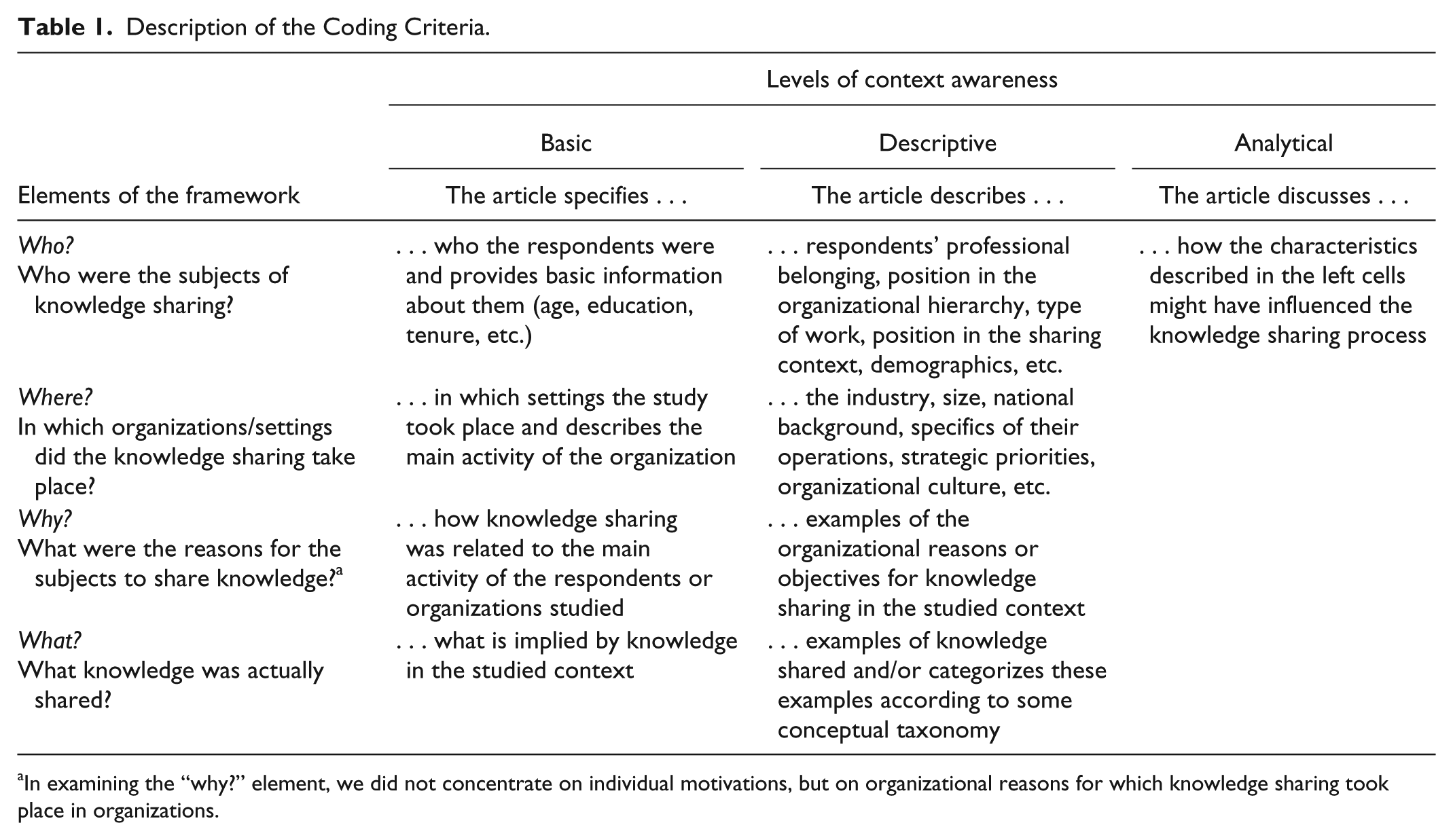
In examining the “why?” element, we did not concentrate on individual motivations, but on organizational reasons for which knowledge sharing took place in organizations.
Clearly, the elements of “who,” “where,” “why,” and “what” are to some extent inter-dependent. However, for the sake of clarity of the discussion, we treated each of the questions as being distinct.
To ensure the validity and reliability of the analysis, the coding procedure was performed in several steps as suggested in the methodological guidelines for reviews (Miles & Huberman, 1994). First, the two authors coded all of the selected articles independently by entering the suggested codes in an Excel spread sheet, along with a brief justification (sometimes including extracts from the article). Next, the two sets of codes were compared and discussed. The inter-rater agreement was 83%. At each instance of disagreement (34 codes out of total 208), the authors returned to the reviewed articles to clarify the codes and conducted in-depth discussions until an agreement was reached. The final coding was produced based on the consensus between the authors.
It is important to acknowledge that the clear-cut categorization of articles according to the proposed codes was not unproblematic due to the high diversity of the context-awareness levels of the studies. However, we believe the assigned codes still serve analytical and ultimately illustrative purposes in our systematic review, and they should be seen as indicators of the overall trend of unpacking the treatment of the context in the reviewed articles rather than as an assessment of the merit of particular studies.
The Representation of Context in Knowledge Sharing Literature
A summary of the data on empirical contexts from the selected articles is presented in Table 2. The table reveals the details about the respondents, data collection sites, organizational reasons for sharing knowledge, and type of knowledge that was supposed to be shared.
Summary of the Context Details in Reviewed Articles.
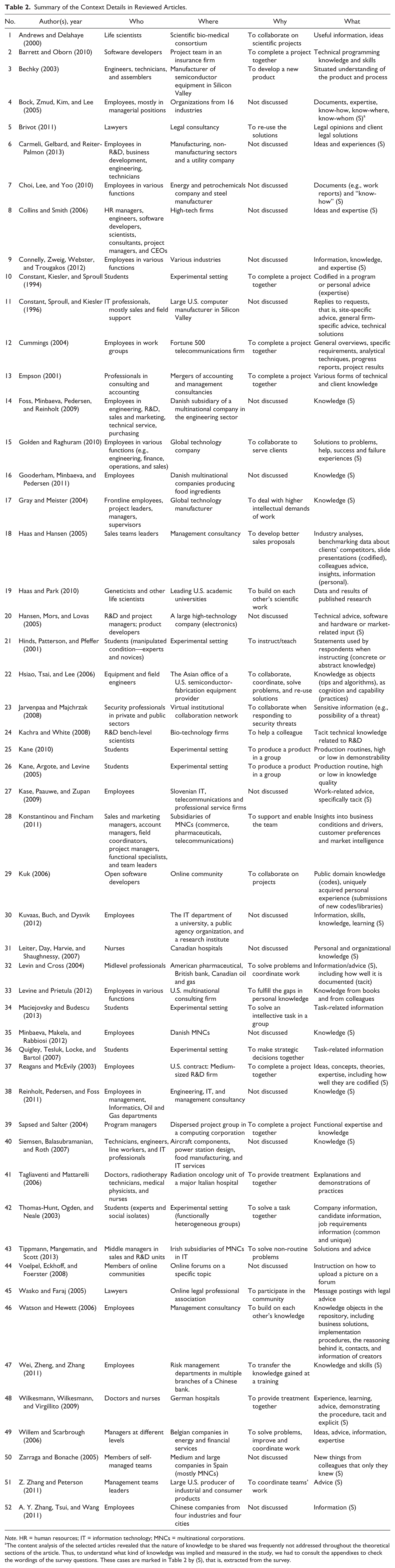
Note. HR = human resources; IT = information technology; MNCs = multinational corporations.
The content analysis of the selected articles revealed that the nature of knowledge to be shared was frequently not addressed throughout the theoretical sections of the article. Thus, to understand what kind of knowledge was implied and measured in the study, we had to consult the appendixes to check the wordings of the survey questions. These cases are marked in Table 2 by (S), that is, extracted from the survey.
The coding results are summarized in Table 3. The table visualizes to what extent the authors have provided contextual discussion and analysis. The basic level of the context inclusion is marked by ʘ, descriptive level by **, and analytical level by ***. If the article lacked information about some element and it was impossible to assign a code to it, the element is marked by—. The table also indicates whether the study was quantitative or qualitative and the number of contexts (organizations, communities, etc.) covered.
Representation of Context in Empirical Articles on Individual Knowledge Sharing.
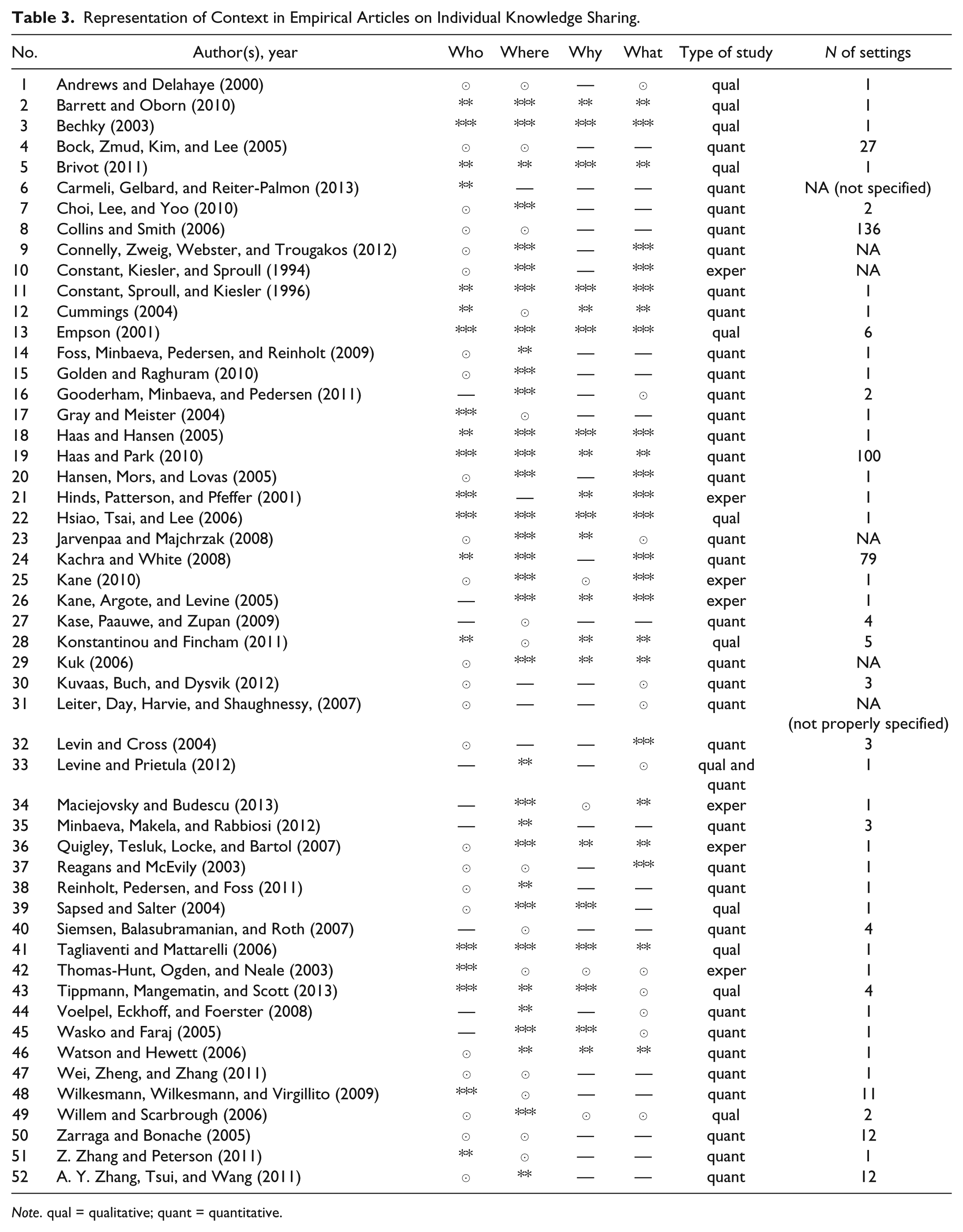
Note. qual = qualitative; quant = quantitative.
Altogether, out of the 52 reviewed articles, 33 rely on quantitative methods, 11 contain qualitative methods, seven are based on experimental data and one employs mixed-method. The table suggests that the “who” and “where” elements of context received, in general, more attention compared with the “why” and “what.” The next sections discuss our findings on each of the four elements of our framework.
Who Shares Knowledge?
The “who?” element in our framework refers to the characteristics of individuals engaging in knowledge sharing behaviors. The reviewed articles studied a variety of knowledge sharing agents, among them mid-level professionals (Levin & Cross, 2004), managers (Bock et al., 2005), members of online communities (Wasko & Faraj, 2005), knowledge workers such as engineers and scientists (Collins & Smith, 2006), accountants and consultants (Empson, 2001; Haas & Hansen, 2005; Levine & Prietula, 2012; Watson & Hewett, 2006), and line employees (Siemsen et al., 2007). In certain articles, the respondents are not specified (Gooderham et al., 2011; Kase, Paauwe, & Zupan, 2009; Minbaeva, Makela, & Rabbiosi, 2012; Reagans & McEvily, 2003), and in some cases, the subjects are described briefly, in one or two sentences only, and the potential impact of their characteristics on the findings is not discussed. For example, Collins and Smith (2006) studied “core knowledge workers” whose jobs were directly related to creating new knowledge or developing innovations, while Levin and Cross (2004) studied professionals engaged in knowledge-intensive work who relied heavily on colleagues for information to solve problems and coordinate work. We can hypothesize that the job specifics of these respondents might have an impact on the patterns of their knowledge sharing behaviors. Indeed, the first group might be more concerned with their own innovative ideas and may be subject to the “not-invented-here” syndrome. The second group might be naturally “forced” to share if the sharing is a key to completing their job (according to the job characteristics theory; Foss, Minbaeva, Pedersen, & Reinholt, 2009; Hackman & Oldham, 1975). The respondents of Cummings (2004) included members of successful teams nominated by the managers for a corporate-wide competition, and they are predominantly North American males with significant experience both in the industry and within the company. Do their knowledge sharing behaviors reflect the pattern of the experienced, well-established and self-efficacious employees, and would this pattern differ, for example, for novices or people from other cultural backgrounds?
Several articles from our sample convincingly demonstrate why it is important to specify and describe who is sharing knowledge. For example, Thomas-Hunt, Ogden, and Neale (2003) revealed, by means of an experiment, that the social and expert status of the team members (e.g., if they are perceived as social isolates or as experts in a certain area) have a significant and direct effect on their knowledge sharing behavior and the amount and type of knowledge they will share in a group. Specifically, social isolates tend to participate in knowledge sharing more actively and emphasize their knowledge contributions to bolster other members’ impressions of their usefulness, while experts tend to act as integrators, focusing on aggregating shared knowledge, but not on their own unique contributions, because experts do not feel it is necessary to contribute information which they were already aware of. From another study conducted among management consultants and accountants (Empson, 2001), we learn that knowledge sharing between employees can be influenced by the individual images and styles of work. Because of the contrasts in individuals’ self-identity and work styles—some consultants wanted to appear as “the brightest and the best” and others as “solid and polite”—employees ended up significantly resisting knowledge sharing with each other.
Existing literature allows one to hypothesize how some other sharing agent characteristics might affect his or her behavior. For example, successful and self-confident individuals might engage in knowledge sharing more actively and willingly, because they are less afraid of being evaluated or misunderstood (Husted & Michailova, 2002). At the same time, if these individuals see their knowledge as a critical component of their professional success, they might be less willing to engage in knowledge sharing in order not to lose their superiority (Cabrera & Cabrera, 2002). Individuals in managerial roles might be more active in knowledge sharing as their jobs, by their nature, imply being knowledge brokers (Davenport & Prusak, 1998; Delmestri & Walgenbach, 2005; Tippmann, Mangematin, & Scott, 2013). Although the researchers often studied either knowledge-creating professionals (scientists, new product developers) or knowledge-exploitative professionals (project managers, coordinators, and consultants reusing knowledge), the role of the orientation of the profession toward exploration or exploitation or the tensions between these (e.g., Brivot, 2011) has not been theoretically addressed. Finally, the gender of the agents involved in the knowledge sharing process might matter. For example, females might prefer inter-personal and face-to-face forms of knowledge sharing compared with computer-mediated systems (Taylor, 2004). Males might be less willing to seek knowledge from team members in situations in which their traditional gender roles may be threatened, for example, when it concerns the feedback about their performance (Miller & Karakowsky, 2005). To summarize, multiple implications could stem from “who shares knowledge” in organizations, and the specifics of the subjects of knowledge sharing are directly relevant to the behavior in question. Future research should explore how these and other possible categories of “who” might shape and influence knowledge sharing.
Where Is Knowledge Shared?
The “where” elements of our framework can include various dimensions of the setting where knowledge sharing takes place, for example, some characteristics of the organization, industry, or country (e.g., Joshi & Roh, 2009). Among the organizations studied in the reviewed articles, two different “wheres” seem to dominate. First, several studies are based on evidence from high-technology firms (Bechky, 2003; Collins & Smith, 2006; Hansen, Mors, & Lovas, 2005; Reagans & McEvily, 2003), as well as from consultancies (Empson, 2001; Haas & Hansen, 2005; Levine & Prietula, 2012; Reinholt, Pedersen, & Foss, 2011; Watson & Hewett, 2006), and the choice of these settings is typically motivated by the so-called “knowledge-intensity” of their operations. Another frequently addressed group consists of multinational corporations operating in various industries, such as food ingredients, pharmaceuticals, telecommunications, engineering, and so forth, (Foss et al., 2009; Gooderham et al., 2011; Konstantinou & Fincham, 2011; Minbaeva et al., 2012; Zarraga & Bonache, 2005) and the choice is justified by knowledge management challenges or the strategic priority of knowledge sharing in these companies (Gooderham et al., 2011; Minbaeva et al., 2012). However, most of these studies did not engage in discussing how the results from knowledge-intensive or multinational firms can be different from firms engaged in other activities.
While the “wheres” mentioned above indeed represent rich settings for the study of knowledge processes, this bias in existing research discriminates other settings that are equally relevant to the theory of knowledge sharing behavior. As any human activity is based on and involves knowledge (e.g., Tsoukas & Vladimirou, 2001) most organizations are in fact fundamentally knowledge sharing based, though they may differ in terms of the nature of knowledge shared, the type of agents who share, and the purposes of sharing. For example, Ritala, Andreeva, Kosonen, and Blomqvist (2011) discussed an example of transportation services (e.g., trains and buses) and demonstrated that they require using and integrating specialized knowledge such as routing, schedule planning, and driving. This setting is not typically seen as knowledge intensive. However, efficient sharing of knowledge between a train driver and a train maintenance team is critical for efficient and safe service delivery. Thus, knowledge sharing patterns in such contexts also deserve the attention of researchers.
To begin designing meaningful comparative studies across different “wheres” and distill what makes these “wheres” theoretically different, researchers would need to attend closely to characteristics of their settings—an exercise done rather infrequently in the sample of articles we reviewed. Among those that do (24 out of 52 reviewed articles provide an analytical treatment of “where” element), a particularly interesting case is presented in a study by Haas and Hansen (2005) in which the authors carefully delineated the studied context of a management consulting firm, and, in particular, its sales teams. For example, the authors demonstrated that the nature of the consulting industry had an impact on knowledge sharing between members of consulting teams: Tight deadlines to deliver a sales bid to the client created the significant barriers to engage in knowledge sharing, as time spent on knowledge sharing was perceived as opportunity costs that may hamper the winning of the bid. Another example of acknowledging the setting is the study by Constant, Sproull, and Kiesler (1996). Here, the authors dwelled on the fact that the firm they studied had a specific organizational culture with almost no vertical hierarchical barriers for communication and that this culture contributed to the very intensive knowledge sharing patterns they identified.
The specific features of the place where knowledge is shared is also present to some extent in the studies of online communities. Specifically, it is argued that the absence of established relationships and face-to-face interaction in an online community lead to differences between the motivational mechanisms of online individuals who share knowledge with strangers on forums and individuals in traditional organizations where employees are acquainted with colleagues and interact with each other in person (Wasko & Faraj, 2005). Wasko and Faraj (2005) provided evidence that knowledge sharing in online communities is driven more by motives of reputation building rather than by intrinsic motives, such as enjoyment of helping others. They also demonstrate that online settings may be characterized by generalized reciprocity, where one’s giving knowledge is reciprocated not by a direct recipient, but by a third party, that is, other network members. This feature makes knowledge sharing in online communities less dependent on the strength of relational capital than one would expect in face-to-face contexts.
National culture may represent another aspect of “where” that can significantly influence the patterns of knowledge sharing behaviors. For example, some studies have argued that Russian culture is characterized by a number of beliefs and norms that create hostility to knowledge sharing. These include, for example, little trust of others, negative attitude to mistakes, and the idea that knowledge is individual power and thus should not be shared unless necessary, and/or unless appropriate benefits are received (Andreeva & Ikhilchik, 2011; Michailova & Husted, 2003). Such differences might have implications for the managerial practices designed to foster knowledge sharing. In particular, Michailova and Husted (2003) suggested that in the cultures that are hostile to knowledge sharing, punishment or other “forcing” mechanisms might be a more effective managerial strategy to persuade employees to share knowledge.
Recent studies allow hypothesizing about several other aspects of “where” that might have an impact on knowledge sharing patterns. For example, consider the characteristics of fast-response organizations (e.g., aviation, police, emergency medicine), which operate under conditions of high uncertainty and where there is a pressure to make rapid decisions and “where errors can be fatal” (Faraj & Xiao, 2006, p. 1155). These settings create special conditions for knowledge sharing. For example, the pressures to take decisions quickly, coupled with perceived high risks of failure, might lead individuals to “depersonalize” their knowledge and share it more readily and openly to solve the problem (Faraj & Xiao, 2006). However, time pressure and high stakes might hinder knowledge sharing behaviors by decreasing trust between agents (e.g., Jarvenpaa & Majchrzak, 2008). In addition, we might find different routines for sharing knowledge in these settings. For example, a recent study by Houtman, Kotlarsky, and Van den Hooff (2014) revealed that fast-response organizations tend to rely on more structured and formalized protocols to share knowledge in emergency conditions, in comparison with traditional organizations, where emergencies trigger more improvised and informal practices to resolve the emergency, for example, employees utilize their personal networks to speed things up.
Next, the organizational design—the way the tasks are divided and coordinated—might create or decrease opportunities for knowledge sharing. Some intuitive dimensions of organizational design that influence knowledge sharing are the level of inter-dependence between the units and the level of centralization and formalization of rules for knowledge sharing. However, the relationships between these structural dimensions and knowledge sharing are not as straightforward as it might seem. For example, Burns, Acar, and Datta (2011) acknowledged that, in contrast to a commonly held view, some formal rules and standardized routines are actually needed to streamline knowledge sharing. Similarly, Willem and Buelens (2009) found no support for the hypotheses that less formalization and centralization lead to more knowledge sharing. They also demonstrate that in one particular context (energy company), the level of units’ inter-dependence influenced the intensity of knowledge sharing between them, but its “forced” character resulted in decreased satisfaction with its quality. Their findings coupled with expressed sensitivity to the contexts provide an excellent example of why it is important to consider how organizations are structured and coordinated to understand how knowledge sharing worked in these companies, and how employees perceived it.
Overall, even though existing studies utilize diverse samples from different nations, industries, and organizational contexts, potentially more exciting and revelatory research could be done on under-represented aspects of “where” and how knowledge sharing behavior differs across them.
Why Is Knowledge Shared?
The question of “Why is knowledge shared?” may refer to the motives of the individuals or to organizational goals. These categories are inter-connected as the pressing organizational goals may influence individual motivations. For the sake of the current review, we focus only on those aspects of “why” that relate to the reasons for sharing which have been created or already exist in organizations. This is in line with the analysis by Lam and Lambermont-Ford (2010), which focuses on how contextual conditions of organizations facilitate and interact with individual motivations.
While the studied articles usually provided at least some details about who shared knowledge and where, the situation is different with regard to the “why” question. The answer to it remains implicit in most articles—18 articles do not contain any reference to the underlying organizational reasons for employees to share knowledge.
However, a number of studies demonstrated different reasons for knowledge sharing in organizations, which can influence the patterns and intensity of knowledge sharing behavior. For example, the ethnography by Bechky (2003) described the collaborative process through which experts in different fields consult each other and share knowledge to solve operational problems in the course of developing a new product. This is quite a different story from the case of management consulting teams described by Haas and Hansen (2005), where teams with overlapping experience directly borrowed solutions from other teams to prepare new sales proposals to save time and avoid “reinventing the wheel.” In the first case, the joint interest to solve the problem led organizational members from different occupations to put efforts into knowledge sharing though it involved the uneasy process of transforming their local understandings of the problem. In the latter case, the teams were able to complete their task independently, and their choices to utilize others’ knowledge or not, were guided by the palette of factors, including the level of their expertise, the type of knowledge they needed, and the competitiveness of the task.
These cases allow for hypothesizing that the task inter-dependence between the jobs (especially the level of knowledge inter-dependence) might be the factor that determines the level and the type of knowledge sharing. First, the level of the inter-dependence matters: In the jobs that can be performed by individuals autonomously, for example, in jobs such as a teacher, a lawyer, or a doctor, knowledge sharing might be desirable from the organizational point of view but not inherent to the job itself. In contrast, the jobs that are inter-dependent may naturally involve more knowledge sharing as this is necessary to complete a job (Davenport, 2005). Second, the type of task inter-dependence—whether it is sequential or reciprocal—may have an effect (Hsiao, Tsai, & Lee, 2006; Tagliaventi & Mattarelli, 2006). Indeed, when jobs are reciprocally knowledge inter-dependent, both parties are equally interested (or pushed by the nature of their jobs) to share, while in sequential knowledge inter-dependence only one party depends on another, and this asymmetry may create tensions in knowledge sharing especially in competitive and politically driven environments.
Another conclusion emerging from the review is that current studies seem to have an overly positive view of reasons for sharing knowledge. Indeed, even when not providing much details about “Why?” the authors imply inherently “useful” sharing, referring to, for example, sharing for providing better services (e.g., Tagliaventi & Mattarelli, 2006), developing new products (e.g., Bechky), training and developing employees (e.g., Wei, Zheng, & Zhang, 2011) or integrating diverse cross-functional knowledge (e.g., Barrett & Oborn, 2010). This, in our view, reflects a bias of existing research toward an overly optimistic picture of knowledge sharing and ignores potentially more complicated reasons for sharing, for example, playing political games, striving for legitimacy, forgetting obsolete knowledge, or competing for the same resources.
Therefore, the reasons for sharing knowledge can be shaped by diverse organizational reasons and may form different patterns of knowledge sharing behavior, and more research is needed to understand these differences.
What Knowledge Is Shared?
The final aspect of our analysis concerned how studies addressed the question of “What kind of knowledge is shared?” By “what” we refer to the types or specific attributes of knowledge that might have an impact on the knowledge sharing process.
As can be seen from Table 2, many studies only marginally touched on this issue by describing how they measured the constructs in their survey. Moreover, we found that in their measures, researchers usually referred the respondents to general words such as “advice,” “software and hardware,” “solutions,” “information,” and so forth. In the studies that were more specific about “what is shared,” authors mentioned they were interested in issues such as “lessons learnt” from previous consulting projects and market analyses (Haas & Hansen, 2005), information and advice received from colleagues (Levin & Cross, 2004), technical solutions embodied in already developed software code and hardware components (Hansen et al., 2005), or messages on online forums provided as a response to somebody else’s request (Wasko & Faraj, 2005). A number of articles did not cover this issue (Kase et al., 2009; Reinholt et al., 2011; A. Y. Zhang, Tsui, & Wang, 2011). Overall, even when “what” was described, the examples or discussion on what kind of knowledge is shared were rather brief.
At the same time, a number of studies in our sample directly addressed the issue of how the kind of knowledge shared influences the process of knowledge sharing. For instance, Kane (2010) used an experimental design to show how knowledge demonstrability, which is the extent to which knowledge’s merit is easily recognizable, affects the process of knowledge transfer. Other studies included knowledge tacitness, explicitness, or codifiability in the empirical model and demonstrated that the determinants of the knowledge sharing behavior differed depending on the type of knowledge shared (Levin & Cross, 2004; Reagans & McEvily, 2003). In another illustrative example, the authors acknowledged and reflected on the nature of technical advice as a type of knowledge shared and suggested that other types of knowledge, for example, more sensitive personal advice, would lead to different sharing patterns (Constant et al., 1996).
The existing theoretical arguments (e.g., Blackler, 1995; Burns et al., 2011; Nonaka, 1994) allow for hypothesizing about some possible impacts the knowledge characteristics can have on knowledge sharing behaviors. For example, tacit knowledge involves more effort to share and thus may require more and/or different incentives to share than explicit. Sharing tacit knowledge might be less dependent on external incentives and is mainly driven by individuals’ autonomous motivation (Osterloh & Frey, 2000). In addition to this, the sharing of tacit knowledge might be more dependent on individual skills to share and may even require a specially trained intermediary agent to elicit it from its owners (Gavrilova & Andreeva, 2012). Different knowledge types in terms of depth, scope, and action (Burns et al., 2011) also play an important role in the process in terms of ease of transferring knowledge and absorbing it. Individual knowledge, compared with a collectively held one, might be more prone to fears of mistakes, external assessment of the quality of the transmitter’s knowledge, misinterpretation from the recipient’s side, and other stimuli for knowledge hoarding (e.g., Husted & Michailova, 2002) as it is closely linked to an individual’s self-esteem. Similar concerns may arise around knowledge that is highly perishable (Holsapple, 2003) or is ambiguous and complex (Reagans & McEvily, 2003). High knowledge perishability, for example, in the news or stock exchange industries, may lead to specific patterns of knowledge sharing, as individuals might perceive such knowledge as being of particularly high value to them personally, and the process would strongly depend on the sender’s willingness to immediately signal their possession of the knowledge.
Another possible dimension of knowledge that can be relevant to how it is shared in organizations is the degree of knowledge sensitivity. Jarvenpaa and Majchrzak (2008) illustrated this with the case of the security professionals sharing national security information, where knowledge sensitivity was a critical factor in deciding with whom to share and with whom not to share. When confronted with the need to share information about a possible threat, security professionals choose with whom to share knowledge based on their own personal networks rather than formal organizational structures. These decisions are highly dependent on knowledge sensitivity and hence include not only the usually described motivations for sharing (e.g., intrinsic, extrinsic), but also awareness of “what should not be shared (since others may act in a harmful way with that knowledge)” (Jarvenpaa & Majchrzak, 2008, p. 270).
Knowledge regarding individual’s performance, or knowledge about the mistakes, might also evoke peculiar sharing patterns. While individuals might be generally less willing to share this knowledge due to fears of being evaluated and losing their power and status (Husted & Michailova, 2002), some organizational settings or some groups of employees might be more susceptible to this than others—for example, males when they perceive their traditional gender role is threatened (Miller & Karakowsky, 2005) or cultures characterized by negative attitudes to mistakes (Andreeva & Ikhilchik, 2011; Michailova & Husted, 2003). To summarize, the attributes of knowledge to be shared may have a significant impact on the knowledge sharing behaviors.
Table 4 summarizes the main findings of our review and suggests some common themes in existing research as a way to bring together the individual studies and identify potential future research questions. As the articles differed a lot in how many details they reported about the contexts of their studies (e.g., see Tables 1 and 2; 28 out of 52 studies did not report on the reasons for knowledge sharing, and 12 out of 52 described their respondents as “employees”), comprehensive integration and synthesis was hardly feasible. Therefore, our summary is of an indicative nature and demonstrates recurrent empirical details and theoretical categories at different levels, rather than a full integration of everything we know about contexts from the existing studies. Our review also indicates under-investigated spaces, suggesting both theoretical dimensions and their contrasts, as well as interesting empirical contexts that are missing from the major stream of knowledge sharing studies. In the spirit of accumulating evidence, our suggestions for future research are also anchored in what previous studies have already considered, but have not yet contrasted with each other. For example, as can be read from our summary table, although the studies provide evidence on knowledge sharing among those who integrate the knowledge of others (e.g., project managers or team leaders) and those who create knowledge (e.g., R&D professionals or scientists), little research has been done to explicitly compare one group with the other.
Summary of Our Findings.
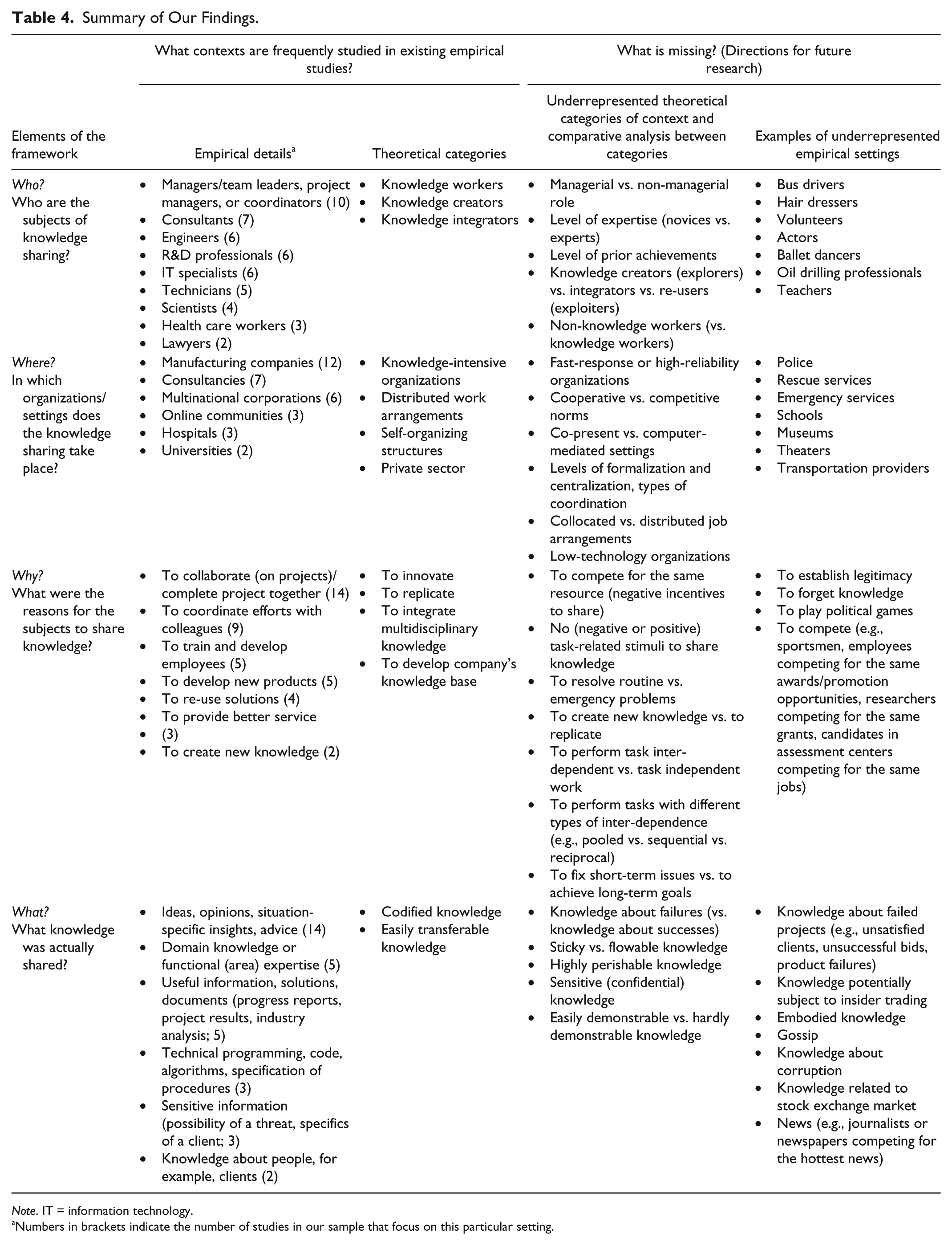
Note. IT = information technology.
Numbers in brackets indicate the number of studies in our sample that focus on this particular setting.
Discussion
We had two main aims in this essay: to “flesh out” the details of the contexts in which these studies took place and to demonstrate how the empirical research represent the context of knowledge sharing. Below, we summarize our key findings on these goals, as well as discuss their implications and suggest some ways to move forward.
First, looking across our sample of studied settings and respondents, we identified that empirical work on individual knowledge sharing was predominantly biased toward selected categories, such as knowledge-intensive firms, knowledge-creating professionals, collaborative work, tacitness or explicitness of knowledge, and positive organizational reasons to share knowledge. While such settings and categories indeed represent rich fields for the study of knowledge sharing, we argue that this approach under-represents and, may be, even under-privileges other contexts that are equally important to understand the phenomenon. On extracting empirical details from studies and theorizing on them, for example, we demonstrate that such contextual characteristics as knowledge perishability or knowledge sensitivity (e.g., Jarvenpaa & Majchrzak, 2008), knowledge inter-dependence (e.g., Tagliaventi & Mattarelli, 2006), conditions of non-collaborative work (e.g., Brivot, 2011), knowledge integration jobs (e.g., Tippmann et al., 2013), or “low-technology” organizations (e.g., Ritala et al., 2011) are under-researched but have an impact on knowledge sharing and therefore of interest to studies that wish to advance knowledge sharing (see Table 4 for an overview).
The details of the contexts that we extracted from previous studies are useful as they can also help to explain the inconsistencies among the findings of these studies and identify contextual conditions that shape different patterns of knowledge sharing behavior, thereby assisting in the integration of previous research. To illustrate, current literature offers controversial findings regarding the impact of expertise on knowledge sharing. Some studies find expertise to be positively related to the usefulness of knowledge sharing (Constant et al., 1996), whereas others find no such impact (Wasko & Faraj, 2005). Once we unpack the “who,” “where,” and “what” elements of these two studies, we see the following: In the case of Constant et al. (1996), where the influence of expertise is found to be positive, knowledge sharing took place in an online network of information technology (IT) professionals and managers who worked in the same organization. In the case of Wasko and Faraj (2005), where no influence of expertise on the usefulness of advice was found, knowledge was shared in the community of legal professionals who did not belong to the same organization. Thus, the disparity of results may be explained by the differences in the “where knowledge is shared” (within the same organization or not) and “what kind of knowledge is shared” (how easy it is to recognize the value of the knowledge, that is, high or low knowledge demonstrability). Indeed, the IT specialists in Constant et al. (1996) shared knowledge of a more technical nature, such as algorithms or code, and this knowledge was contained within one organization. We can speculate that the advice offered by those who had the expertise was more easily recognized as valuable by others—both because it was more demonstrable and because it came from known or verifiable sources. In contrast, Wasko and Faraj’s (2005) study concerns the sharing of legal knowledge that might have been more ambiguous and specific to particular legal situations (low demonstrability). Moreover, Wasko and Faraj’s (2005) study was set in the context of a legal professional online association, which meant that knowledge was shared between experts who belonged to different organizations and thus might have had incompatible experiences or been perceived as less reliable sources. These contextual details can explain why the value of knowledge offered by the members of this association was less apparent and not easily recognizable by receivers and was therefore not considered helpful.
Another controversy in the literature refers to the impact of rewards on individual knowledge sharing behavior: some studies find that they have a negative impact (Bock et al., 2005; Gooderham et al., 2011; Lin, 2007), whereas others find a positive impact (Siemsen et al., 2007). Scrutinizing the “who” and “where” (unfortunately, we do not know much about the “what” and “why”) of these studies, enables us to develop some potential explanations for these conflicting findings. Bock et al.’s. (2005) and Lin’s (2007) respondents predominantly held managerial or senior positions in their organizations. Such respondents may not value organizational rewards for sharing (especially monetary ones) because they already earn above average wages, or because they may consider knowledge sharing a natural part of their job. In contrast, the study by Siemsen et al. (2007) is based on shop floor employees for whom organizational rewards might be more relevant and valuable. The cultural aspect of “where” might also explain some of these conflicting results around extrinsic rewards and knowledge sharing. Bock et al. (2005) and Lin (2007) examined Korean and Taiwanese cultures respectively. Both cultures are collectivistic and relationship-oriented (House et al., 2004) and thus may see monetary incentives for socially promoted behavior offensive. Similar consideration may explain the findings of Gooderham et al. (2011) who examined Danish companies whose management culture is characterized by high institutional collectivism, especially on the level of practices (House et al., 2004).
With regard to our second aim, our analysis revealed a tendency of the existing literature to downplay context. We found that out of the 52 articles reviewed, seven engage in a deep discussion of the context (either three elements of our framework at the analytical level or two at the analytical level combined with two at the descriptive level). Furthermore, 31 articles in our sample provide rather basic information on more than two contextual elements and only briefly describe a handful of contextual elements. Finally, 14 studies either approach two elements analytically or handle a single contextual issue analytically and at least two more issues descriptively. Based on this, we can roughly classify seven articles as “context-aware,” 14 articles as “partially context-aware,” and 31 articles as “context-free.”
Why do we see such a trend, despite the understanding among many researchers of the importance of context? This may stem from a number of assumptions that seem to form a basis of the research on knowledge sharing. First, the identified lack of context awareness could be explained by the methodological tradition—a discussion of context is often seen to be a prerogative of an ethnography, case study, or other types of qualitative research, and our sample is heavily dominated by quantitative studies, more specifically, 40 quantitative (including seven experiments) versus 11 qualitative studies and one with mixed methodologies. Indeed, quantitative studies may have more difficulty describing and uncovering the context when they use data from multiple organizations. However, 11 quantitative studies in our sample used data from a single organization and still did not describe the organizational context in which their study took place (e.g., Choi, Lee, & Yoo, 2010; Foss et al., 2009; Reagans & McEvily, 2003; Reinholt et al., 2011). Another seven articles in our sample relied on the quantitative data from a very limited number of companies (two, three, or four), and also did not delve into their specifics. In other words, 18 quantitative studies had an opportunity to share with readers the context of their research settings and apply them to the interpretation of their findings but did not take it. Furthermore, there are a number of exemplary contributions in our sample in which authors integrate a description of the context into a quantitative research design and build a convincing and generalizable theory from their context (e.g., Constant et al., 1996; Haas & Hansen, 2005; Haas & Park, 2010). These considerations allow us to conclude that the problem of downplaying the context is not inherent to a specific methodology.
A second reason for our findings might be the assumption that factors that fall outside the research questions of a specific study should be treated as an error term and do not require additional analytical attention. While the research question understandably limits how many issues can be covered in a single article, the number of exemplary articles in our sample demonstrate that it is possible to combine a specific focus on a particular research question with a wider reflexive analysis of relevant issues that can provide additional insights and suggest alternative explanations (e.g., Constant et al., 1996; Haas & Hansen, 2005).
The third explanation might be linked to the culture of academic publishing and the expectations of editors and reviewers who press authors to pursue generalizability. However, a number of authors have recently argued that less generalist studies might be of interest not only for specific contexts but also for generic theory-building (e.g., Jack et al., 2012; May & Stewart, 2013). Finally, the reason for insufficient attention to the context might be linked to the ambiguity around the very concept of context (Michailova, 2011) and the lack of a guiding framework that could help researchers to explore it. All in all, these considerations, as well as our own experience with this review, suggest that context-based theorizing is easier said than done.
Moving Forward
How can knowledge sharing studies move forward? We propose that the first and most basic thing to do is to revisit the assumptions discussed above that push researchers toward context-free studies. Irrespective of the methodology of their study, future studies will benefit from meaningfully covered questions of “who,” “where,” “why,” and “what” when designing research projects and reporting their results. To do so, the authors can use the questions we used for coding the articles (Table 1) as guiding questions in representing the contexts of their study. In particular, researchers should explicitly specify who the actors of knowledge sharing are in their case, what the peculiarities of the organization are where these actors belong, what the reasons are for actors to share, and what kind of knowledge is shared. Rather than simply acknowledging the context by mentioning it as a limitation of the study, researchers should also engage in a reflection of how the findings might be embedded in and shaped by this particular context. In turn, journal editors and reviewers should encourage authors to demonstrate these details of the context and reflect upon them.
Good examples of articles that reveal the contexts of knowledge sharing to the fullest extent come from qualitative studies, in particular ethnographic ones (see, for example, Bechky, 2003; Tagliaventi & Mattarelli, 2006). This is hardly surprising, as ethnography by definition implies immersing into the context and then reporting it back to the readers in rich detail (Van Maanen, 1988). However, we need to move beyond the stereotype that unpacking context is the exclusive domain of ethnographic methods. In fact, one of the main points we aim to convey with our essay is that it is perfectly possible, and should be striven for, to unpack the context in the studies, irrespective of the chosen methodological approach. Haas and Park (2010) provided a good example of how to remain sensitive to the context of the study while conducting a large-N research. On exploring the problem of information withholding among life scientists, Haas and Park (2010) drew a vivid picture of the “world” in which scientists operate. In particular, they build their theory section by explaining the ambivalent nature of norms that scientists face in their work, such as placing “premium on discovery” but valuing “humility” or being passionate and objectively neutral about their research at the same time. Haas and Park (2010) also described such characteristics of scientific professions as norms of “communism” in science in the name of progress conflicting with intense career competition. They also explain how sciences’ norms are reinforced by journal requirements that oblige researchers to provide their protocols, materials, and data sets. To paint this comprehensive contextual picture, Haas and Park (2010) brought together the diverse literature sources that include press and governmental reports, insights from sociology of science, selected ethnographic studies of laboratory cultures, as well as debates and dialogues in the journals of the community they are studying (such as Nature, Science, or Journal of American Medical Association). Further on, they elaborate on the nature of their research context to make sense of the findings of their quantitative study. Future research can use this example to consider how the engagement with secondary and in particular sector-specific literature can be performed for a deeper appreciation of the knowledge sharing context.
Furthermore, as we realized when working on this essay, and as the study by Haas and Park (2010) illustrates, it is also important for future research to remain sensitive to how the dimensions of context are in fact inter-connected. Even though we discussed each of the dimensions separately, to give a deeper understanding of the knowledge sharing-in-context they should be integrated in the holistic picture. In fact, the process of our analysis showed that any attempts to disentangle the aspects of contexts, as if they were separate from the phenomenon, only served to prove the dynamic perspective point that context dimensions are intertwined with each other and are inseparable from the phenomenon in question. That is, when we examined every aspect of a context separately and analyzed it in a vacuum, we constantly stumbled upon the inherent overlaps between the who, where, why, and what. The question of “who shares knowledge” cannot be seen separately from “where it is shared.” Similarly, the reasons why people share knowledge are often closely related to their professions and organization in which they work. Finally, what kind of knowledge they share is also embedded in both the kind of work they do and where they work. For example, coming back to the example of life scientists (Haas & Park, 2010), we saw how each dimension relates to another one: Life scientists (who) are the ones who actually make up a scientific community (where) that prioritizes particular types of knowledge (what) and specific reasons to share knowledge (why; Figure 1 visualizes this inter-connectedness).
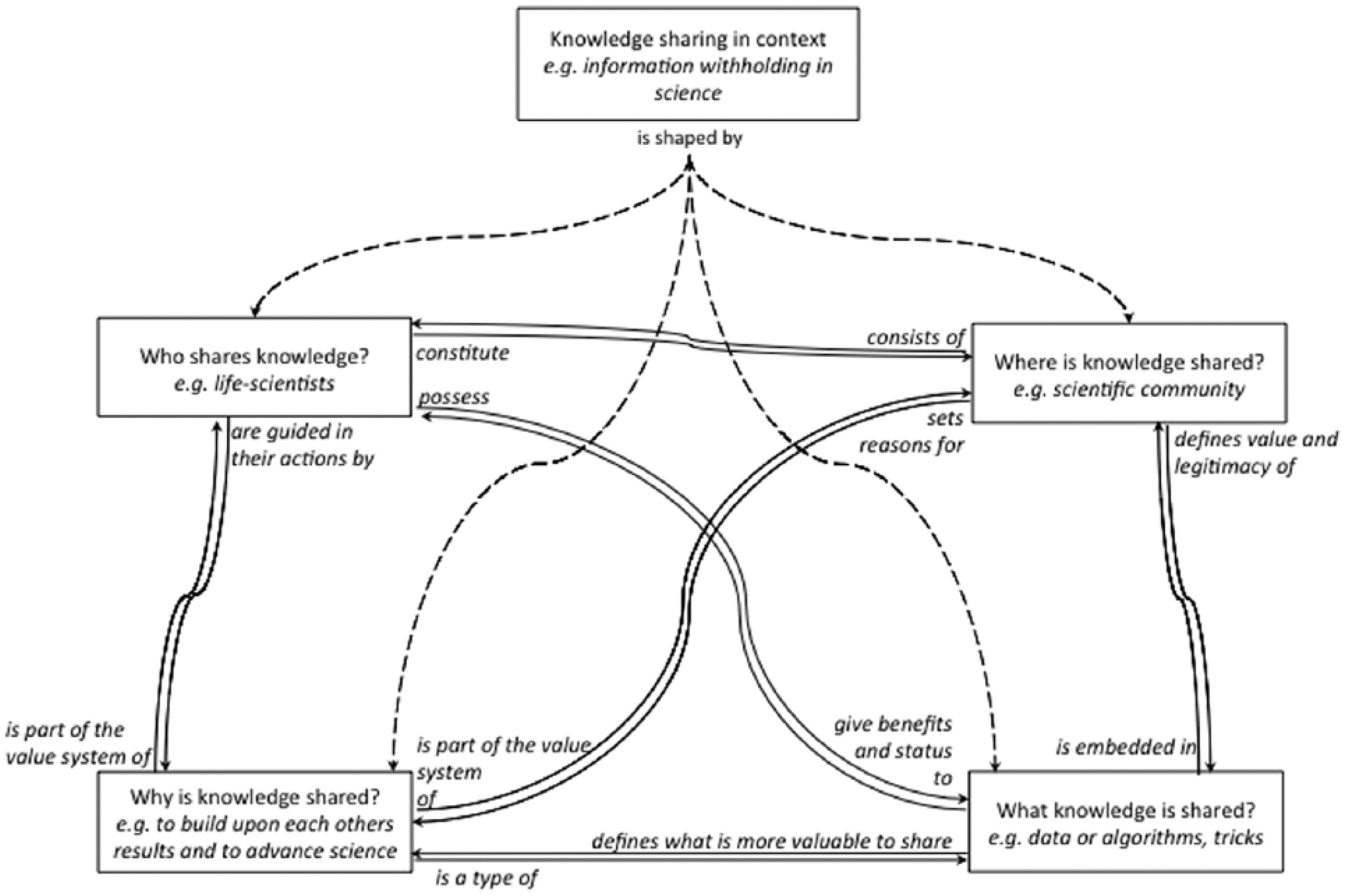
Illustrative cognitive map of connections between context dimensions.
In other words, the four “Ws” framework in essence represents a “seamless web” of contextual reality. Previous studies have seldom attended to such inter-connectedness (with the exception of ethnographies, perhaps), possibly because many of the existing recommendations on how to contextualize management research (e.g., Bamberger, 2008; Hackman, 2003; Mowday & Sutton, 1993) offer “linear” images of context, neatly divided into levels, and therefore provide representations that reduce the complexity of contexts. Such linear thinking might blind the researchers from focusing on the important links between the dimensions that can reveal new insights for knowledge sharing research.
To move forward on this, we suggest that researchers should embrace such inter-connectedness of the context dimensions by not only reporting it comprehensively in individual studies, but also, for the sake of further advancement of knowledge sharing—by exploring the effects of complex relationships. A possible way to start this can be to look for configurations of contextual elements that form stable patterns and lead to a particular pattern of knowledge sharing. To identify such configurations, qualitative comparative analyses can be utilized (e.g., Rihoux & Ragin, 2009) to examine explicitly how the dimensions of “who,” “where,” “why,” and “what” look like or play out across contexts. Qualitative comparative analysis can help identify what particular configurations of contextual elements produce similar or different outcomes in terms of knowledge sharing. Another possible direction of connecting contextual elements to each other can be to develop typologies of knowledge sharing contexts (e.g., “ideal types” of context, see, for example, Doty & Glick, 1994 as a guideline), in the spirit of the ones developed by Mintzberg (1979) in his study of organizational structures or the ones recently proposed by Mainemelis, Kark, and Epitropaki (2015) in their overview of types of contexts for creative leadership.
Finally, as our findings summarized in Table 4 demonstrate, to bring context back in, future research on knowledge sharing would also benefit from studies in the new settings that are currently under-represented. Authors can use the ideas presented in this article as a starting point. In particular, Table 4 can serve as a departure point to explore the new categories of the dimensions of the context or to compare different contexts. Tables 2 and 4 can help in the theorizing on commonalities between the settings that have been already studied.
Conclusion
Our essay contributes to knowledge sharing theory and practice in several ways. First, we provide an overview of the empirical contexts that have been covered in extant knowledge sharing research, highlighting their biases, and identifying some blank spaces as areas for future research. Second, we demonstrate that the context has been insufficiently represented in existing research, explain why this is a problem, and give some suggestions on how the situation can be remedied. Together, these contributions respond to the calls for more context-aware theorizing in knowledge sharing (May & Stewart, 2013) and general management research (Bamberger, 2008).
Our study also has some limitations as it focused on a selected number of top-level journals. Several journals focus on knowledge management issues (e.g., Management Learning, Journal of Knowledge Management, or Knowledge Management Research and Practice) and therefore naturally include many articles on knowledge sharing. We reviewed the journals with the same questions in mind and found similar trends regarding contextualization as described in this article. This essay may have omitted some context-aware publications from these journals that could serve as examples of the best practice in the treatment of context in knowledge sharing research. Nevertheless, we believe this limitation does not alter the conclusions and implications of our study.
In sum, we hope to inspire future researchers to design more context-aware studies and to engage with under-researched contextual aspects, possibly using the ideas suggested in this article. We also hope that our findings can serve as a useful footing for journal editors and reviewers, to guide authors in revealing more meaningful details of their empirical context and reflecting upon them. Finally, we hope to assist management practitioners in their decision-making regarding the application of knowledge sharing initiatives, based on a better understanding of their applicability to their organizations.
Footnotes
Appendix
The List of Reviewed Journals.
| Journal sources of reviewed articles | Number of articles |
|---|---|
| Human Relations | 8 |
| Organization Science | 7 |
| Management Science | 6 |
| Organization Studies | 6 |
| Human Resource Management | 5 |
| Academy of Management Journal | 3 |
| Journal of Management Studies | 3 |
| MIS Quarterly | 3 |
| Strategic Management Journal | 2 |
| Journal of Applied Psychology | 2 |
| Journal of Organizational Behavior | 2 |
| Organizational Behavior and Human Decision Processes | 2 |
| Administrative Science Quarterly | 1 |
| Information System Research | 1 |
| Leadership Quarterly | 1 |
| Journal of International Business Studies | 0 |
| Decision Science | 0 |
| Industrial and Labor Relations Review | 0 |
| Industrial Relations: A Journal of Economy and Society | 0 |
| Journal of Applied Behavioral Science | 0 |
| Journal of Management | 0 |
| Journal of Occupational Psychology | 0 |
| Journal of Vocational Behavior | 0 |
| Personnel Psychology | 0 |
| Psychological Bulletin | 0 |
| Research in Organizational Behavior | 0 |
| Total | 52 |
Acknowledgements
We would like to express our gratitude to the Editor-in-Chief Nelson Phillips and Journal of Management Inquiry anonymous reviewers for their constructive feedback, and to Hans Berends and Celeste Wilderom for their helpful comments on earlier versions of this manuscript.
Authors’ Note
The manuscript was accepted on 2nd October, 2015.
Declaration of Conflicting Interests
The author(s) declared no potential conflicts of interest with respect to the research, authorship, and/or publication of this article.
Funding
The author(s) received no financial support for the research, authorship, and/or publication of this article.