







Abstract
Traveling to novel destinations can give rise to a state of attention referred to here as a “traveler’s mind”—a state in which two forms of a popular concept in management and organization studies, mindfulness, occur in tandem. In this essay, written as a personal narrative, I explore the nature of a traveler’s mind, discuss the conditions under which this state of attention is most likely to arise, and consider how this state connects to and informs our understanding of related concepts of note (e.g., mindfulness and sensemaking). I also propose that a traveler’s mind can be achieved not only through travel but also on a more mundane basis and highlight practices organizations and their members can adopt to foster this state of attention. Together, the observations provided here suggest that cultivating a traveler’s mind is as much a matter of mind-set as of geography.
I was halfway across America, at the dividing line between the East of my youth and the West of my future, and maybe that’s why it happened right there and then, that strange red afternoon.
Why is travel so memorable? What is it about visiting somewhere new that galvanizes our attention and leaves deep impressions on our mind? This is the question I’ve been contemplating—the question at the core of this piece. 1
For organizations, this question is timely. Even as leaders and management researchers tout the importance of awareness and “presence” (Goldman-Schuyler, Skjei, Sanzgiri, & Koskela, 2017), scholars and social commentators are lamenting the apparent decay of attention in both the workplace and throughout society (e.g., Alter, 2017; Carr, 2014; Gazzaley & Rosen, 2016). Our attention is arguably more divided and fleeting than ever. In meetings, we write emails and check social media as colleagues share industry developments. While driving, we join conference calls and compose text messages next to semi-trucks. Unrelentingly, our minds race backward and forward in time, ruminating on yesterday’s miscalculation and envisioning tomorrow’s presentation. From an attentional standpoint, we seem to be everywhere at once and yet nowhere at all.
Except, perhaps, in the case of travel. Travel invites us to pay attention to the world around us. At times, it can even challenge us to rethink the world itself and our place within it. In this essay, I consider when and how travel gives rise to a “traveler’s mind”—a state of attention in which two different but potentially related forms of a concept of interest in the organizational and psychological sciences, mindfulness, co-occur. I suggest that much of the intrigue and memorability of travel lies in its potential to cultivate this particular state of attention. I also explore the heartening possibility that a traveler’s mind may not be restricted to life on the road. That is, I suggest that engaging fully with one’s surroundings at work and beyond is less a matter of geography or physical location than of mind-set. The rewards associated with this mind-set are rich and worth pursuing, even though achieving and maintaining a traveler’s mind on a daily basis can be an elusive accomplishment.
In pursuing these directions, I avoid pedantry. Like travel itself, papers focusing on this topic should, I believe, carry with them a touch of whimsy, even as they seek to inform. The narrative aspects of this essay are intended to play this role—and to help you connect with my observations at a personal level.
*****
The focus here is travel to novel destinations. Visiting the same resort in Mexico annually or shuttling between Los Angeles and San Francisco may prove restorative and stimulating, respectively, but such trips aren’t as likely to provoke two of the conditions associated with traveling somewhere new: confusion and curiosity.
Experiencing a new part of the world is disorienting. The eye takes in sights previously unseen. The brain seeks to account for unfamiliar sounds, words, and languages. Getting from Point A to Point B is no longer trivial. Habits of action and mind are dislodged: there isn’t an option to default to autopilot (cf. Louis & Sutton, 1991). At the extreme, such confusion produces culture shock and, with it, feelings of frustration and distress (Zhou, Jindal-Snape, Topping, & Todman, 2008). More commonly though, the confusion is a manageable by-product of the uncertainties associated with a novel context.
The confusion borne by the traveler is complemented by the curiosity travel can produce. The events one observes while traveling provoke intrigue and defy easy explanation. Questions of attribution come to the fore. Why is he wearing that outfit? Why did she make that gesture? How can everyone here stand to talk so close to each other? Observed events defy labels and categories and provide opportunity to rethink one’s assumptions. For a mind teeming with curiosity, the simplest explanation or interpretation is rarely satisfying or sufficient (Harrison, Sluss, & Ashforth, 2011).
By stoking confusion and curiosity, travels invites, and oftentimes compels, sensemaking (Weick, 1995). Sensemaking involves taking note of “discrepant cues”—events or phenomena at odds with one’s assumptions or mental models—and making meaning from these cues by bracketing and interpreting them (Maitlis & Sonenshein, 2010). Sizable bodies of research have examined sensemaking in the context of organizational change (e.g., Balogun, Bartunek, & Do, 2015; Sonenshein, 2010), crisis situations (e.g., Maitlis & Sonenshein, 2010; Weick, 1988), and professional transitions (Vough & Caza, 2017). Such research indicates that, across a wide range of situations, sensemaking proceeds “through cycles of interpretation and action” that enable people to progress from a less ordered to a more ordered environment in the wake of expectation violations (Maitlis & Christianson, 2014, p. 67). Thus, sensemaking is the process through which people take startling and seemingly amorphous phenomena and shape them into a coherent form.
Traveling to novel destinations prompts sensemaking because of the confusion and curiosity it engenders. But how is such sensemaking accomplished? This is an important question because, when traveling, people may have fewer vehicles available for sensemaking than they have in familiar settings. For example, many organizations and work groups avail themselves of collective-level practices such as “preoccupation with failure” (Weick, Sutcliffe, & Obstfeld, 1999) and “heedful interrelating” (Weick & Roberts, 1993) that direct their members’ attention toward cues associated with potential risks and opportunities and facilitate forms of discourse and behavior that foster meaning making in the face of discrepant cues. By contrast, when one is traveling, one may be more limited in terms of organizational practices and social support mechanisms for making sense of unfolding events.
Sensemaking in the context of travel likely begins with paying attention to one’s surroundings. That is, sensemaking may be initiated by adopting a “wide attentional breadth” (Dane, 2013). In actively scanning a number of events and phenomena occurring within one’s environment, one is able to discern nuances, identify potential risks, and spot unexpected delights. Focusing attention in this fashion also helps ensure that a number of unfolding events are registered and, thus, committed to memory. To illustrate, I can distinctly recall searching everywhere for the “taxi” stand after flying into the airport in Venice, Italy. As it turned out, the taxis were, in fact, water taxis and the ride from the airport to the town was entirely across the waterway. The “taxi driver” and I arrived at a dock in front of the palatial Ca’ Sagredo Hotel at dusk. The sky was braised crimson and a soft Mediterranean breeze swept through as I tried mightily to take in everything about the scene, especially the massive sculpture of hands running up the hotel’s wall, designed to highlight and decry the city’s rising water level. I remember these things well because my attention was transfixed by my surroundings. This is sensemaking in high gear.
Sensemaking in the context of travel goes beyond simply paying attention. It also involves finding ways to comprehend and grant meaning to unfamiliar sights, events, and experiences. In many cases, this may involve updating or revising one’s mental models or cognitive schemas (Weick, Sutcliffe, & Obstfeld, 2005). For such adjustments to occur, one must be willing to relax certain beliefs and assumptions and think flexibly and creatively. When I was an undergraduate student, I embarked on a university sponsored excursion to Turkey for students studying classical history. Checking in at our hotel in Istanbul, we were told that, on the day to follow, breakfast would be served on the hotel’s terrace. I went to bed that night dreaming of waffles, omelets, bacon, and hash browns. But when I eyed the buffet the next morning, I was baffled. Cucumbers? Tomatoes? Olives? Hard cheese? Surely this wasn’t breakfast, was it? Although that first breakfast in Turkey took me off guard, over the course of trip, I revised my conception of what breakfast could entail. In learning and appreciating that “lunch food” had a place at the breakfast table, the world around me began to make more sense.
In short, the psychological processes associated with making sense of novel travel destinations involve the integration of wide attentional breadth with deep and discerning information processing. Theoretically, this union is remarkable; it highlights a forum in which two variations of a concept receiving much attention in industry and society, mindfulness, occur in tandem. In other words, sensemaking in the context of travel is facilitated through the application and integration of two distinct, yet compatible, forms of mindfulness.
The first form of mindfulness is grounded in Eastern traditions and is central to several lines of investigation in contemporary psychology. Mindfulness of this form involves focusing one’s attention on events and phenomena unfolding in the present moment, thereby resisting the mind’s tendency to wander (Brown & Ryan, 2003; Brown, Ryan, & Creswell, 2007; Kabat-Zinn, 2003). Put differently, such mindfulness involves maintaining a stable hold on ongoing events and observing the effect of these events on one’s perceptions and sensations (Weick & Putnam, 2006). As such, mindfulness of this form—Eastern mindfulness—is characterized by wide attentional breadth: one attends to a wide range of events in one’s stimulus environment as well as intrapsychic phenomena, such as intuitions and emotional reactions (Dane, 2011).
Distinguishable from Eastern mindfulness, Western mindfulness involves breaking free from existing labels and categories and drawing novel distinctions (Fiol & O’Connor, 2003; Langer, 2014; Langer & Moldoveanu, 2000). For example, while employees in a given organization may be apt to view the annual performance evaluation process as an occasion for judgment and critique, in a mindful state, one might view this process through any number of other labels or categories, such as an opportunity to receive useful feedback, offer suggestions to one’s supervisor, or initiate a compensation related discussion. While mindfulness of this form, like Eastern mindfulness, is concerned with directing one’s attention toward present moment events, the focus of Western mindfulness is less on how widely one brings one’s attention to bear than on how actively and imaginatively one processes the events one encounters. The pertinent question is whether one is thinking about events in new ways versus adhering mindlessly to existing categories (see Weick & Sutcliffe, 2006).
Although the forms of mindfulness noted above are distinct, they are not incommensurate with each other (Sutcliffe, Vogus, & Dane, 2016). Indeed, it may be possible for both forms to co-occur. A state of attention characterized by both Eastern and Western mindfulness would involve focusing on present moment events via wide attentional breadth and drawing novel distinctions around those events as opposed to cataloging them through previously established interpretation schemes. As I have suggested, this state of attention, a traveler’s mind, can arise from and, in turn, facilitate people’s efforts to make sense of their surroundings when they travel to novel destinations.
Travel writer Pico Iyer (2000) maintains that we travel both to lose ourselves and find ourselves—an observation that touches on both types of mindfulness and their role in helping people make sense of novel environments: . . .travel spins us around in two ways at once. It shows us sights and values and issues we ordinarily might ignore, but it also, and more deeply, shows us all the parts of ourselves that might otherwise grow rusty. For in traveling to a truly foreign place, we inevitably travel to moods and states of mind and hidden inward passages that we’d otherwise seldom have cause to visit. . .We travel, then, in search of both self and anonymity—and in finding the one we apprehend the other.
Sights and issues we might ignore at home—the knowledge of travel—facilitate movement toward Western mindfulness. Traveling to a foreign place compels us to process new information and see the world through a novel lens. Our existing schemas are not equipped to handle such information; we must reset and make sense of how life happens in this peculiar environment. Complementing knowledge acquisition are the moods and states of mind that we “seldom have cause to visit”—the emotion of travel—which opens us to Eastern mindfulness. Travel both creates and sensitizes us to affective responses, as our mind is opened to beauty and nature, pain and suffering, marvel and achievement—responses that are often muted when we encounter them in our own grid.
*****
Several years ago, I was leading an MBA residency in Buenos Aires, Argentina. As part of the development for the trip, I had told our in-country vendor that I wanted my students to do a service project in one of the poorer areas of the city. On the fourth day of our residency, we boarded a bus and drove about 45 min to Nordelta, a beautiful gated community on the outskirts of the city (see Figure 1). After a brief tour of Nordelta, we headed across the highway to Fundación Nordelta (see Figure 2), a non-governmental organization (NGO) in the low-income barrio next to Nordelta, where we painted the community center, the child care center next to it, and the surrounding fence. In just a few hours, the fresh paint, along with some landscaping work, had completely changed this little haven for the community’s children. We had been exposed to something new—low-income houses, residents walking the streets, as well as what a community center in such a community looked like (essentially one big room). I could see it in my students’ eyes: they were seeing the world anew, especially given the contrast to the luxury village next door and the tourist area surrounding our four-star hotel.

Club Nordelta, Buenos Aires, Argentina.
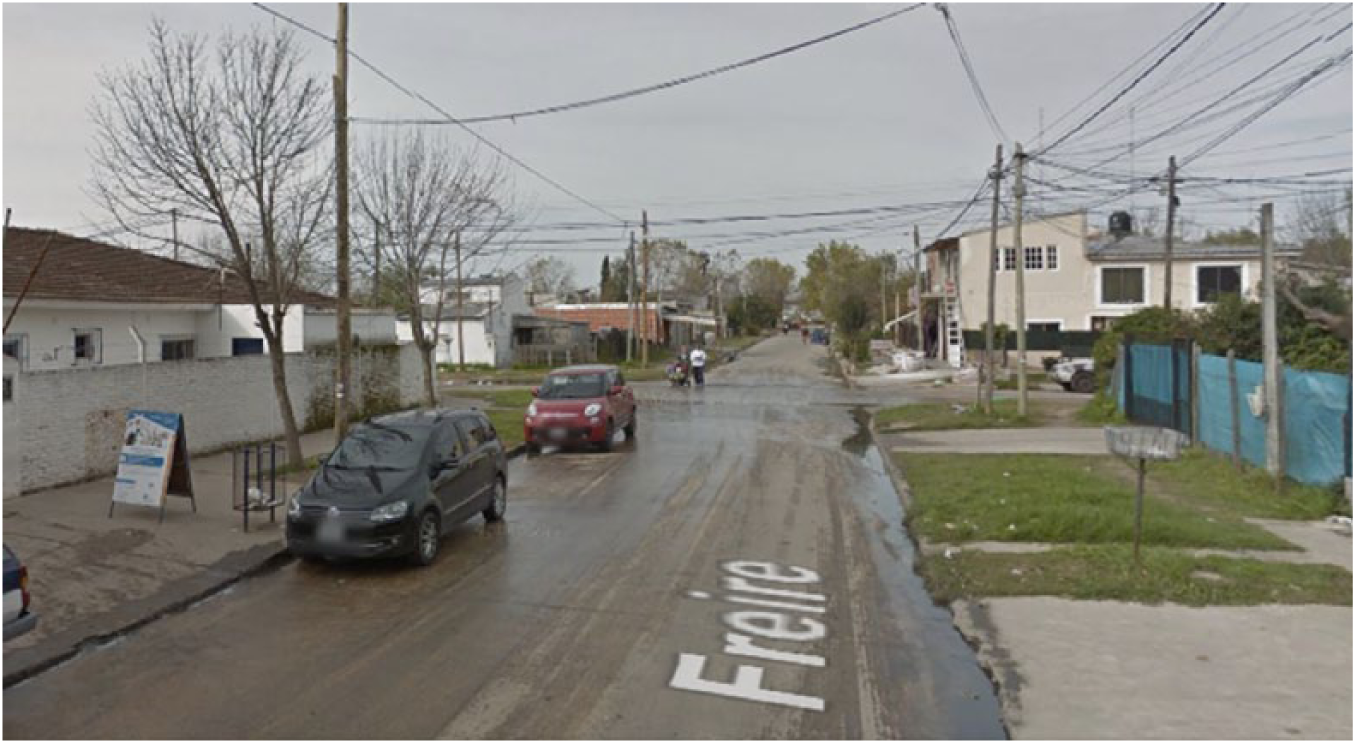
Fundación Nordelta (7 miles away).
At the end of our time at the NGO, we went into the day care center to meet the children of the community. Their clothes were ratty; their hair, disheveled. A smell of uncleanliness was pervasive. In the room were but a few books and old toys. Too many children for the teachers. A sobering, depressing sight until I realized that they loved us. Those kids couldn’t get enough hugs or pictures. They were grateful not just that we painted, but that we were there. That we valued them enough to share our time with them. We read to them in English—smiles all around even though they had no idea what we were saying.
I changed that day. Many of my students changed that day. Though I was (unsuccessfully) holding back tears, I’ll never forget the look on those kids’ faces.
*****
Traveling to a novel destination does not guarantee one will adopt a traveler’s mind. When I return from a trip to a more widely recognizable or touristy destination, I am unwaveringly asked the same question: “Ooh, you went to [insert place], what did you see?” What the inquisitor really means is, “What landmark did you see that I’ve heard of?” This inquiry is an attempt to make a connection, a platform from which to create shared meaning. You went to Paris? Let’s talk about Notre-Dame. You went to New York? Let’s talk about Times Square. You went to Prague? Let’s talk about the Jewish Quarter. And on and on and on we go. These conversations evolve, sadly, into a SparkNotes version of the Frommer’s travel guide. Knowing that I am likely to receive these questions has even, in some instances, compelled me to do my Frommer’s homework while I’m traveling so that I can sound intelligent when addressing friends and family upon my return—a task even more critical if those with whom I will share these stories have traveled to the same locales or, worse, told me where to go before my departure.
The travel industry reinforces this notion that to travel means to see the sights. If you adopt this dogma, the need for sensemaking and the opportunity for both Eastern and Western mindfulness is all but eliminated. Guidebooks, tours, hotels—they all seemingly want to show exactly the three or four things you must see in each city. Traveling becomes a checklist. Going to Rome? St. Peters? Check. Sistine Chapel? Check. Spanish Steps? Check. Colosseum? Check. On to Florence! This has multiple effects that hold the traveler’s mind at bay. The first effect is that we restrict ourselves in terms of exploration. Why examine a side street or a park or a local neighborhood if Rick Steves has not proclaimed it worthy? Travel becomes an act of hopping from one “three-star” location to another “three-star” location, as our mind is cued to ignore the rest. Second, even when we travel to these (amazing) locations, we are told what we should think, rather than making sense of things ourselves. This is described well by author Alain de Botton (2002): Where guidebooks praised a site, they pressured a visitor to match their authoritative enthusiasm, and where they were silent, pleasure or interest seemed unwarranted. Long before entering the [cathedral], I knew the official enthusiasm. . .: “The most beautiful convent in Spain. A grand staircase decorated with frescoes leads to the upper cloister gallery, where each of the chapels is more sumptuous than its predecessor.” The guidebook might have added, “and where there must be something wrong with the traveler who cannot agree.” (p. 111)
Unlike explorers, who go through a process of discovery when traveling, reliance on a guidebook makes travel almost mundane. Goethe notes his disgust at this idea: “I hate everything that merely instructs me without augmenting or directly invigorating my activity” (de Botton, 2002, p. 110). Our mind is not stretched as we are not forced to make sense of the new. The newness is reduced, as the guidebook has already told us what we should expect and what we should believe. Here’s a passage from one of my travel books on Istanbul: Hagia Sophia with its glory and magnificence has survived to the present time and is one of the greatest examples of early Byzantine architecture. In architectural terms, it is seen that it has a vast nave covered by a central dome, two side nephs with protruding apses and an interior and an exterior narthex. (Yücel, 2010, p. 24)
Reading this guidebook is akin to reading an appliance manual; it simply does not capture the full experience of visiting one of the greatest architectural feats in human history. When we anchor ourselves on the nave, the nephs, and the narthexes, we are cued to look only for these features. Why seek to create meaning with such an adept guide at the ready? The real power of visiting a place such as Hagia Sophia is to wonder how humans came together to create a space of worship that not only rivals St. Peter’s Basilica in Rome but which was built almost 10 centuries prior. It is an exercise in imagination: mentally resurrecting images of the workers and architects and financiers who had a hand in producing a structure that has stood for close to 1,500 years. It is also to consider what we can learn about our own lives and problems by visiting such a place. The reason to visit such a site is not to take note of the placement of narthexes, but rather to put our lives in context of something bigger and greater than ourselves—an appreciation that can perhaps be developed in full only through mindful thinking and reflection.
In short, traveling primarily to see sights may be misguided. To achieve and maintain a traveler’s mind is not to join a thousand other tourists on a parade through a museum, but rather to see the world afresh. Travel should be about novelty, not conformity. Conformity means we follow the masses, from large hotels to major sites to restaurants filled with tourists. Novelty takes us to local neighborhoods, exploring how people experience life on a day-to-day basis. This is exploring parks where local children are laughing and playing. It’s having a drink not with tourists from your country, but with locals in the city. One of my rules when traveling is to never eat dinner on the square, plaza, or piazza. The square is a “safe” place for tourists to eat overpriced and underwhelming food. Squares are created to be familiar and non-threatening; the mind is stretched only when squares are circumvented for less linear locales.
*****
There is yet another reason travel to novel destinations does not guarantee the emergence of a traveler’s mind. Take, for example, Pratt’s (2000) research on sensemaking among new Amway distributors faced with uncertainty. These new Amway recruits are led through a process of “dream building” about what their lives and careers could be, and then shown how a life in Amway can help them reach their goals. This process does not work for everyone. As Pratt notes, for this to be successful, the recruits must engage in motivated sensemaking; they must want to begin the search for something new. The Amway mentors facilitate this process by taking the recruits to new stores (their “foreign” place), stores they would never go otherwise. For recruits motivated to see the world anew, this likely activates both confusion and curiosity and the sensemaking processes associated with the traveler’s mind. For unmotivated recruits, sensemaking via Eastern and Western mindfulness is at best deficient or at worst abandoned.
Consider, again, my trip to Argentina with the MBA students. While the response was overwhelmingly meaningful and positive that day in Buenos Aires, some of the students were unmotivated travelers. They were reluctant—anxious to get back to the hotel, to their comfort zone. They came back wondering what the point of the exercise was. They missed it. They wouldn’t—and therefore couldn’t—see the newness around them.
We have all traveled with people who would have preferred not to have traveled at all, or who wished their traveling experience would resemble life at home. In writing about Gustave Flaubert, de Botton (2002) notes, “[Flaubert] would have liked to travel, if he could have done, stretched out on a sofa and not stirring, watching landscapes, ruins and cities pass before him like the screen of a panorama mechanically unwinding” (p. 94). Just as anchoring one’s travels in checklists is unlikely to foster a convergence of Eastern and Western mindfulness, downright resistance to travel is almost certainly antithetical to a traveler’s mind.
*****
I was on my university’s campus and a staff member was interrogating me diplomatically. I wasn’t at the business school. I was in the school of architecture—a building I hadn’t stepped foot into until that day. The staff member had spotted me peeking into one of the studios, eying the mess of blueprints and graphics and ingenuity strewn across the workstations.
“Can I help you with something?” she inquired.
Almost apologetically, I told her who I was and what I was doing there. I explained that I was a business school professor and that I had assigned my students a “paying attention” activity. I was participating in the activity as well and I’d opted to visit buildings on campus I’d never entered before. (Each participant in this activity must decide upon and pursue an attention-based strategy—for example, walking the campus with an eye toward noticing certain colors or looking for animals, such as birds or squirrels.) Thankfully, the staff member took my word for it.
“I didn’t know courses in the business school could be so fun,” she said.
I remember other things that happened as I walked into buildings on campus that day. I remember how humbling it was to stand outside a classroom and watch an instructor present mathematical techniques far more advanced than any I’d studied. I remember encountering a large case of trophies won in debate tournaments—a type of competition I didn’t even know my university participated in. I remember doing a double take as an undergraduate offered his friends a swig of “liquid courage” from his thermos before they walked into a lecture hall.
I remember the rest of that day’s class session, as we each reported what we had observed on campus. I imagine the students remember that part of the class as well. It’s not every day a professor tells his students he was called out for snooping around campus buildings or that he was privy to some preclass guzzling.
It’s not every day. That’s the point of this tale, really. On that particular day of class, I didn’t bag alligators in a bayou or swap stories with sojourners in a faraway land. I simply ventured beyond my business school and entered what was, to me, terra incognita within my own campus. It was, in short, a day different from the others. A day I remember because I was alert and attentive to my surroundings. A day in which, to some degree at least, I was a traveler.
*****
Organizations can create conditions that help their members achieve and maintain a traveler’s mind. One approach is through immersion. From the study abroad literature, we have some evidence that students show personal development, language improvement, and greater cultural competence when they spend more time abroad—benefits that can be sustained over a long period of time (Dwyer, 2004). Flaubert (1972, in de Botton, 2002, p. 85) provides a telling example of immersion: Yesterday we were at a café that is one of the best in Cairo. . .and where there were at the same time as ourselves, inside, a donkey shitting and a gentleman pissing in a corner. No one [there] finds such things odd; no one says anything.”
Want your employees to notice the world around them? Donkeys shitting inside a café seems a decent place to start.
Research also indicates that individuals who have accrued experience working in countries beyond their home nation tend to think more flexibly and generate more creative ideas (Godart, Maddux, Shipilov, & Galinsky, 2015). This points to the value of expat assignments as a means for cultivating a traveler’s mind among an organization’s members and also suggests that organizations would do well to emphasize the potential cognitive-level benefits such experiences can bear. In doing so, organizations can perhaps increase their expats’ willingness to engage deeply with local cultures, helping to minimize their resistance and strengthen their traveler’s mind.
To induce a traveler’s mind in their members, organizations can also turn to training. As de Botton (2002) notes, [To induce this mind-set] I tried to reverse the process of habituation. . .I forced myself to obey a strange sort of mental command: I was to look around me as though I had never been in this place before. And slowly, my travels began to bear fruit. Once I began to consider everything as being of potential interest, objects released latent layers of value. (p. 247)
One training technique, therefore, is to place individuals in places they have never been before or have never really noticed before, and instruct them to be intentional about being mindful. What are the smells, the sounds, the colors in this place? How was this place created? What problems might the creators of this place have faced? Who has been in this place before me? What is the inherent beauty here? How can I take this beauty and wonderment with me when I leave this place?
In addition, organizations can rely on the ingenuity of their members by encouraging and rewarding behaviors that run counter to those rooted in mindless habits and routines. Most workers and teams are saddled with a number of practices—daily commuting routes, patterns of information sharing, decision-making procedures—that are largely taken-for-granted and thus rarely challenged or re-envisioned. By devoting attention to this point, organizations could urge their members to think more directly about where, when, and how they currently perform their work and whether existing practices are suboptimal in certain ways. Such thought exercises are likely to attune members more deeply to their surroundings (enhancing Eastern mindfulness) and to activate deeper and more thoughtful processing (sparking Western mindfulness). Moreover, if practiced regularly, this line of questioning may help to instill a culture of inquiry and reflection—qualities likely to buttress multiple forms of mindfulness.
For similar reasons, organizations should not limit their interventions to lower level employees but rather should consider the importance of helping senior managers achieve and maintain a traveler’s mind as well. As research indicates, senior managers can be vulnerable to cognitive rigidity, which contributes to habituated thinking and reduced adaptability (Reger & Palmer, 1996; Tripsas & Gavetti, 2000). Likewise, cognitive rigidity may hamper the emergence of a traveler’s mind, given that rigid mental models are, by their nature, resistant to new information and novel events (Schultz & Searleman, 2002). Organizations may therefore find value in encouraging senior managers to modify their daily routines and to engage in training techniques with the aim of increasing their cognitive flexibility. Candidates for consideration in this regard include role-plays that enable executives to experiment with and develop various aspects of their identity as a leader (Kark, 2011) as well as improvisational activities that spur new patterns of thought and action and reorient one’s schemas accordingly (e.g., learning to apply the rule of “Yes, and. . .” in improvisational comedy—see Vera & Crossan, 2004).
Even without organizational support, individuals themselves can take the initiative to develop a traveler’s mind. Seeking new contexts and novel forms of meaning could be a way to engage in “cognitive job crafting” (Wrzesniewski & Dutton, 2001), a process of modifying how one thinks about the relationships among job tasks. In studying cognitive job crafting, Berg, Wrzesniewski, and Dutton (2010) asked people to consider how they have “actively changed the way [they] think about [their] work” (p. 186). The key question here is how? In other words, how can individuals begin to rethink the nature of the work they perform? Travel may be one way individuals can change the way they think about their work tasks and, in turn, engage with their work more mindfully.
*****
As suggested here, a traveler’s mind is provoked by the experience of travel but perhaps not restricted to it. This observation is not without consequence. To the degree one can achieve a combination of Eastern and Western mindfulness amid the otherwise monotonous moments of the mundane, the quality of one’s performance at work as well as one’s overall well-being might improve noticeably. Such possibilities serve notice that the line between travel and everyday life may be fuzzier than we assume. As author Henry Miller (1957) observed, “One’s destination is never a place but rather a new way of looking at things” (p. 25).
Footnotes
Declaration of Conflicting Interests
The author(s) declared no potential conflicts of interest with respect to the research, authorship, and/or publication of this article.
Funding
The author(s) received no financial support for the research, authorship, and/or publication of this article.
