







Abstract
Communities and platforms pervade all aspects of the collaborative economy. Yet, they exist in apparent tension. The collaborative economy is grounded in communities. These are typically characterized by isonomic relations, in which the singularity of members finds its distinctiveness in being woven into mutual, collective endeavor. Yet, the collaborative economy also entails digital platforms organized through largely heteronomic relations in which employees and users are configured as isolate, useful, interchangeable, and flexible “units.” As such, communities and platforms are traditionally framed as separate from, and in contradiction to, one another. There is, it seems a paradox at the heart of the collaborative economy. Yet, inspired by the work of Merleau-Ponty, we argue the expression, embodiment, and eventfulness characterizing the collaborative economy show communities and platforms being constituted by one another. We conclude that the paradox, far from being a condition of opposition and dialectical tension requiring managed resolution, is a generative organizational process.
Keywords
Introduction
Communities versus platforms: The collaborative economy seems to be constituted in two opposing organizational forms. On one hand is communities. They have long played a powerful role in the history of capitalism (Dürkheim, 1889; Hegel, 1991; Tönnies, 1887/2001; Weber, 1921/1978). The modern era, more than ever, entails their development, considered as offline or online, physical or emotional collectives. In an increasingly “collaborative” and “knowledge-based” economy, communities are considered places that create and enrich collective intelligence. In merging demand and supply; production and consumption; competition and alliance; the economic, social, and political; and group and individual; communities are redefining the mechanics of capitalism and society, as exemplified by the growth of coworker, maker, hacker, fabber, or activist defining themselves as not only alternative, critical, and responsible but also productive (Lallement, 2015). Such communities are characterized by isonomic 1 relations: They enable their members to meet, exchange with peers, and identify with “alter egos” according to trustful (Adler, Kwon, & Heckscher, 2008) and reciprocal norms that respect and value each member’s singularity, idiosyncratic qualities, contributions, and personality. Like past domestic communities, such collectives rely on a “communalization” 2 process (“Vergemeinschaftung”; Weber, 1921/1978) of social relationships, characterized by a sense of solidarity, and the affectual attachment of those involved (Weber, 1921/1978, pp. 21-22, 40-41). They are “isonomic,” in the sense that, the individual and the collective reflect each other, and the uniqueness of each individual is valorized by the community and its specific practices and processes.
On the other hand is platforms. The new era of collaborative capitalism is simultaneously marked by the emergence of platforms: Uber, Facebook, Google, Amazon Mechanical Turk, and Airbnb offer the typical examples of “platform capitalism” (Srnicek, 2016), an ultimate market-based, organizational form in which independent workers offer and rent their services. Contrary to communities’ isonomic relations, platforms are based on heteronomic 3 relations among independent, interchangeable, and flexible “units.” Platforms rely on an “aggregation” process (“Vergesellschaftung”; Weber, 1921/1978, pp. 21-22, 40-41), transforming members (e.g., independent workers) into atomized, anonymous service providers, erasing any singularity and personality, through depersonalized, emotionless, clearly detailed means-end relations and categories (likes, scores, numbers, status).
Apparently these two sides of the collaborative economy share little in common, indeed are often framed as having opposing trends and forces, with competing organizational structures (isonomy vs. heteronomy). Yet, meaningful interactions exist, certainly empirically, when, for example, “communal” and “aggregative” factors come into tension (Schulenburg, 2004; Weber, 1921/1978) as revealed in Vignette 1.
Accounts of Tensions Between the Community of Taxi Drivers and Drivers of the Uber Platform in France.
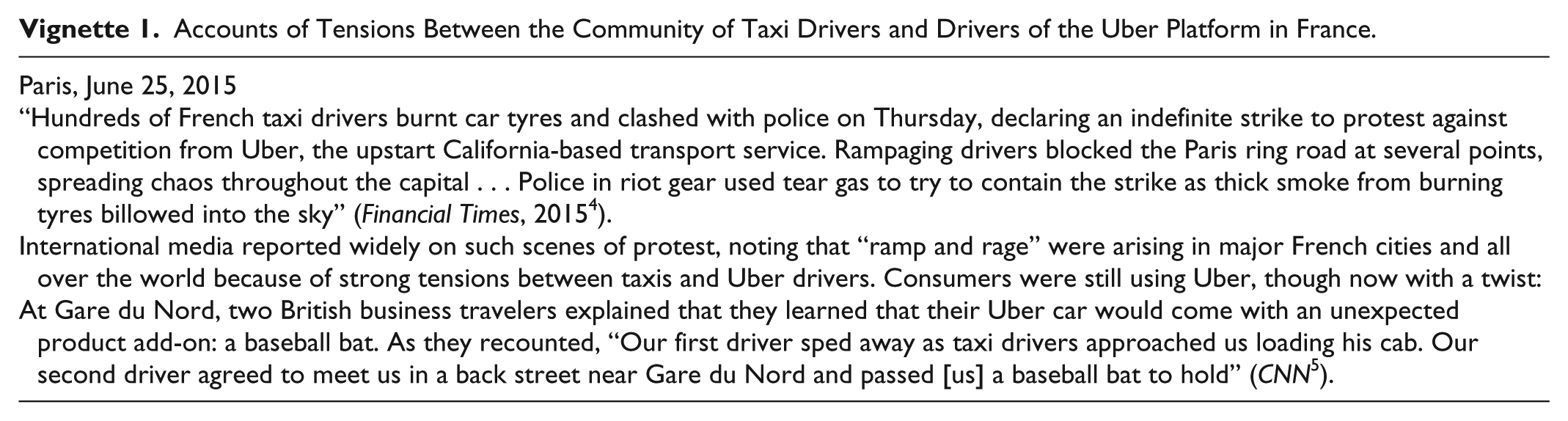
Although empirical observation suggests interrelationships, embeddedness, and cross regulations within and across communities and platforms do exist in the collaborative economy, little attention has been given to the conceptualization of such tensions between communities and platforms, and even less to their possible intersection and articulation (Acquier, Daudigeos, & Pinkse, 2017; de Vaujany, 2017). Given their empirical prevalence in the economic and social experience of many economies this is surprising, even more so considering the site of such cross over is increasingly a digital as much as physical configuration that unsettles the long-established conceptual binaries established between producers and consumers, or between community members and independent platforms service providers, in ways that surely require further investigation (Kane & Ransbotham, 2016; Lallement, 2015). Tensions, passages, mobility, and invisible articulations exist across multiple platforms, as well as vertical and horizontal intersections between platforms and communities in the collaborative economy. Platforms rely on communities and just as readily seek to manage them, and, in conscripting individuals, they meet opposition in the form of communities organized through the use and integration of rival platforms (e.g., using twitter or Facebook to create communities of objection among subscribers/members of platforms such as Tripadvisor or Airbnb). Thus, we ask: How can we conceptualize the paradoxical tensions between communities and platforms in the body of the collaborative economy and pave the way to the creation of new spaces and times for political solutions and regulation strategies?
Our essay offers three interwoven responses. We first expose and explore the tensions between communities and platforms, and advocate a closer consideration of how communities and platforms entail one another, but often through tensions and struggles. To that end, we visit recent studies of paradox to better understand the paradoxical relationship between communities and platforms. Where existing organizational theories argue paradox emerges when preexisting, separate forms (such as communities and platforms) touch uneasily, we suggest communities and platforms are constituted by their own opposite. Developing our understanding of paradox as a form of chiasm, we consider the community becomes aware of itself as constituted through the very platform against which it is set up in opposition, and the platform realizes its survival and flourishing as a function of the collaboration by which communities are constituted.
Second, we suggest the struggle between platform and community reveals an inherently emotional aspect to the collaborative economy. We, thus, argue for a less managed, more critical appreciation of such paradoxical condition of collaboration, and suggest it is emotion that marks such an economy from the more traditional arrangement of “rationally calculating” buyers and sellers, a form of economy in which the body, singular and collective, comes to the fore. The body, though, has not enjoyed prominence in management inquiry, and we turn to the phenomenological work of Maurice Merleau-Ponty to suggest one way this might be corrected, and, specifically, by which our understanding of the paradoxical relations between platforms and communities might be enriched.
Third, from a practical viewpoint, in making sense of the apparent contradictions between communities and platforms, we encourage both scholars and politicians to rethink the social regulation processes at work in modern, radically transformed capitalist economies. Our paradox-based view of the tensions between communities and platforms (that we characterize as Janus—one body and two faces turned in opposite directions) calls for a humanist focus on the phenomenal body and felt solidarities, as necessary spaces for the joint regulation of platforms and communities (de Vaujany & Mitev, 2016; Hayles, 1999; Mazis, 2016).
Isonomic Communities in the Collaborative Economy
Isonomic communities, defined as collectivities that implement practices and processes to emphasize the equal singularity of each member, play a major role in the emerging collaborative economy. Their influence in society is not new—such communities (in particular traditional, domestic, and monastic communities) have long constituted historical and sociological objects of interest, as motors of the development of society and economy (Weber, 1921/1978). Etymologically designated as a pooling of resources, or a cum munus, they were associated in the Middle Ages with religiously defined, monastic groups, analogous to a family, formed around the abbey (abba means “father” in Greek) and whose members were brothers and sisters. Such communities placed each member at similar levels, around the abbey, each member following the same rules: “the notion of hierarchy [was] erased . . . It [was] a kind of phalanstery before there was a name for it” (Fossier, 1994, p. 41). The community revealed the singularity and face of each member; the individual and the collective could not be understood without the other (de Vaujany, 2009; Pacaut, 1970, Sève, 2017). The revealing and understanding were configured emotionally, a sense of solidarity and affectual attachment (Weber, 1921/1978), so the community enabled them to perceive themselves as inseparable from the collective not because of bureaucratically stipulated roles and hierarchies, but because through collective belonging, each member realized a sense of his or her singularity by feeling and living this sense of self in the company of other selves, bonded by a sense of equality and love (Cohn, 1957/1970).
Here, a community is “a group of people who are socially interdependent, who participate together in discussion and decision making, and who share certain practices that both define the community and are nurtured by it” (Bellah, Madsen, Sullivan, Swidler, & Tipton, 1985, p. 333). According to Tönnies (1887/2001), in contrast with “society” (“Gesellschaft”), 6 each member of such a community (“Gemeinschaft”) has space to develop and fulfill personal goals but through a sense of belonging, simultaneously contributing to others’ self-realization as much as their own: “[C]ommunity does not exist by virtue of shared characteristics, but by virtue of individuals’ actions towards one another being meaningfully oriented in a way considered by Weber as affectual or emotional” (Schulenburg, 2004, p. 1476).
Community movements have long played a strong role in the development of societies, especially when the latter endure deep crises (Bell & Newby, 1971; Goode, 1957; Kieser, 1989). Monasteries, along with other communities of the Middle Ages such as guilds, were configured against the backdrop of millenarian fears about the end of the world; the 19th century and its utopian socialist communities developed in response to the furious sweep of industrialized, machine-based production.
Yet, if, historically, communities emerged as countermovements to dominant forms of capitalism, their isonomic relations and valorization of singularity have also played a critical role in the emergence of capitalist systems (Weber, 1921/1978). For example, as much as they elevated a sense of self, monastic communities were equally influential in defining and organizing processes of collective action, prefiguring the bureaucracies at the heart of emerging capitalism (de Vaujany, 2009; Kieser, 1989). Because individuals are inherently related to other individuals and bound up in “a system of all-round interdependence,” “the subsistence and welfare of the individual are interwoven with, and grounded on, the subsistence [and] welfare of all, and have actuality only in this context” (Hegel, 1991, p. 222). By acting as an individual in civil society, each person furthers the “universal” (i.e., social end). A recent rereading of Marx (1867; see Sève, 2017)
7
also highlights the isonomic characteristics of communities in the development of capitalism. Rather than an overwhelming, massifying movement, Marx defines communism as a “form of superior society whose fundamental principle is the full and free development of each individual” (Marx, 1867, Vol. 1, p. 575). Therefore, Economics, in the sense of Marx in the Capital, is the basis of all social relations, what makes us as the human beings we are; it is anthropology in its double dimension, the one of the collectivity and the one of the individuality. The Capital concerns the biography of each person as much as the economies of societies, the one being intertwined to the other one (Sève, 2017).
Today, emerging communities similarly exhibit isonomic relations and emotional attachment, and valorize each member’s individuality and singularity, as exemplified by alternative, activist communities of coworkers, makers, hackers, and fabbers (Davies, 2018; Lallement, 2015); they are driven by shared practices to accomplish some intended purpose, with an explicit objective of social belonging (Garrett, Spreitzer, & Bacevice, 2017). More than doing politics, promoting innovation, or engaging in countercultural critique, the goal of hacker- and maker-spaces members is to subscribe to a distinctive lifestyle, giving them access to a welcoming, intimate, and close-knit community (Davies, 2018). Their primary isonomic practices center around the “doing” of each member of the community and the resultant contribution to the collective good, as epitomized by the term “doocracy” (which posits that “legitimacy belongs more precisely to the one who does”; Lallement, 2015). 8 The Chilean architectural practice Elemental, for example, calls itself a “Do Tank,” and understands the task of giving form to living space as utterly collaborative: Involving users in defining the questions design is to meet, leaving finished projects “open” to allow for iterative expansion and personal modification, and using common prefabricated structural elements to establish sense of community unity. Such community emphasis and a blending of innovative technology and Do It Yourself (DIY) ethos enables not only the practice itself, but the communities with which it works, to experience a joint sense of wholeness and distinctiveness simultaneously (Oldenburg, 1989). This investment in community almost inevitably spills into a more general critique of capitalist practice. With elemental, for example, come attempts to organize social housing that allows the poor access to processes of capital accumulation typically reserved for traditional owner occupiers. More broadly, we have examples such as repair cafes fighting against planned obsolescence, as alternatives to capitalist notions of “fast innovation” or “hyper-consumption,” and the rise of corporate hacking and new forms of activism (e.g., Nuit Debout in France) constitute actual political projects. Such collaborative movements organize in ways that encourage self-awareness through collective activity. Doers, makers, hackers, and coworkers increasingly strive to defend fundamental values in society and be heard, to exert influence in democratic debates.
Other reasons also explain the growing importance of communities in modern capitalism. They fill a social void by providing a uniting frame for action (Garrett et al., 2017). The digitized transformation of organizational structures, roles, and projects has found them becoming a rapidly disassembling flow of ungovernable, algorithmic occurrence. Liquidity, quickness, multiplicity, and superficiality are the new orders (Calvino, 1985/2009). Communities are emerging in riposte to these loosening, feckless, and perhaps bloodless, forces. They address the feelings of isolation and anxiety experienced by growing numbers of workers and freelancers (Friedman, 2014). They allow for the development of emotional ties and a sense of solidarity (Weber, 1921/1978), so members may develop a collective identity while valuing their singularity and idiosyncratic qualities, as well as gaining a sense of ownership through the coconstruction of the common good, motivated by a sense of social responsibility (Garrett et al., 2017). Communities may represent an “emotional and psychological necessity” (Bohas, Fabbri, Laniray, & de Vaujany, 2018), similar to “emotional communities” (Weber, 1921/1978) that help members manage their solitude and deal with their emotional tensions collectively (Petriglieri, Ashford, & Wrzesniewski, 2019), notably with the rise of large cities as primary living and working places. 9 People with insecure jobs or in situations marked by mobility or transition often live and work in an urban, megalopolistic context, which produces a strong emotional demand for isonomic collectivity. In turn, many independent workers and teleworkers (recent strikes in France have reinforced this trend 10 ) choose to visit coworking spaces, fablabs, or hacker or maker spaces, “with the express purpose of being part of a community” (Garrett et al., 2017, p. 1). Although they do not share employment affiliation, they coconstruct a sense of community through their day-to day interactions, contributions to individual “doings,” and the mutual development of collective actions through emotional connections. The resurgence of communities constitutes a renewed type of collective emotional labor, which, in previous iterations, has produced real, positive emotions that affect general work atmospheres (see Hochschild, 1983). In the modern era, they allow people to share negative emotions (e.g., anxiety, solitude, doubts), such that they get absorbed and projected into the collective (de Vaujany, Bohas, Fabbri, & Laniray, 2016), which, in turn, may transform them into positive energy (Follett, 1940; Spinuzzi, 2012) within which each member can be immersed: Autonomy and relatedness appear complementary. Members talk, receive reassurance, and actively participate in events that give them opportunities to feel like part of the same “emotional thread” (Merleau-Ponty, 1945/2013), such that they plunge into a shared form and fate (Bohas et al., 2018).
Finally, communities favor an embodied relationality (physical or virtual); they offer specific spatiality and temporality, which make the presence of each member visible while also reinforcing the dynamic of the community. The physical gathering and assembly of bodies have demonstrative, performative, and political effects (i.e., enacting politics or rebellion, as in the case of Occupy Wall Street; Butler, 2015). Communities function in dedicated spaces (e.g., coworking spaces, incubators, accelerators, e-garages, innovation labs, makerspaces, hackerspaces, fablabs) and are embedded in a specific temporality, organized through unifying events (e.g., hackathons, hold-ups, lunches, pitches, creativity workshops, boot camps). They, thus, favor the copresence of bodies to amplify the relationality among members. In this regard, communities constitute “hyper places” (hyper-lieux; Lussault, 2017) that are intense and local, and in which new forms of political and social forms of life can be invented, in contrast with “non places” (non-lieux; Augé, 1992) that, similar to platforms, refer to global spatial uniformization, or standardization, and exemplify the paroxysm of capitalism’s depersonalization of social relationships (Weber, 1921/1978).
Platform Capitalism as an Exogenous Shock for Communities
Extending the shift from “communalization” to “aggregation” logics, from traditional and domestic communities to formal and rational bureaucracies (Weber, 1921/1978), we consider the emergence of “platform capitalism” as an exogenous shock for isonomic collectivities (i.e., community in the context of this essay), reflecting a broader transition from isonomic to heteronomic relations.
Dramatic changes in the economic, working, and technological contexts have led to a radical transformation of capitalism marked by the rise and silent revolution of “platforms” (Parker, Van Alstyne, & Choudary, 2016; Srnicek, 2016), such as Uber, Airbnb, Amazon, Apple, and PayPal. These meta-organizations (Ahrne and Brunsson, 2008) integrate vast digital platforms, combining standards, technical infrastructures, and applications to support billions of accounts and interactions (Rochet & Tirole, 2003; Weil, 2014). These businesses disrupted their markets completely when they launched, revolutionizing business practice to the point where nearly all organizations must endeavor to acknowledge and even work with them (Cusumano, 2015; Parker et al., 2016). These endeavors range from having a profile on existing platforms to creating alternatives, the tide seems unstoppable: “by 2018, more than 50 percent of large enterprises—and more than 80 percent of enterprises with advanced digital transformation strategies—will create and/or partner with industry platforms” (Accenture, 2016).
Platforms structure markets in a two-sided way (Cusumano, 2015; Rochet & Tirole, 2003). 11 They aggregate, assemble, and disassemble the activities of thousands of individuals (workers, customers, and independent entrepreneurs), who play different roles successively (Kenney & Zysman, 2016; Scholz, 2016). In contrast with isonomic communities, platforms rely on the creation and institutionalization of predefined and distinguished positions, roles, categories, functions, rules, competences, prescriptions, and hierarchies, according to impersonal and formal procedures (Weber, 1921/1978). They respond to a logic of “aggregation,” which describes a rational and functional type of social relations that is typical of the emergence of modern, capitalist organizations (Weber, 1921/1978). They create and institute data-driven and data-governed lifestyles and habits, systems of sorting that configure what we have done and will do—how we will vote, consume, and love—with the sole purpose of replicating and enhancing their own existence. Their natural business condition is one of monopoly rather than competition, the bigger their presence, the more effective and “useful” the platform.
In these new economic models, demand and supply for resources explicitly determine the price, which represents the sole source of information, and economies of scale induce monopolies over time. Digital infrastructures permit the creation of large common goods, and potentially enable a dual production and consumption process (Kane & Ransbotham, 2016) that necessarily extends economic considerations into social and political ones. Platforms, thus, can connect sellers and buyers, hosts and visitors, or service providers with service users (Parker et al., 2016). Platforms can function through social networks (Facebook, Twitter); sites that enable the exchange of content, such as pictures (Flickr.com), videos (YouTube, Dailymotion), or knowledge (Wikipedia); marketplaces (eBay); or collaborative crowdsourcing sites that solicit users to contribute funding (Kickstarter) or R&D (InnoCentive).
In this regard, platforms are generally considered as part of what Chesbrough and Appleyard (2007) call “community-driven” models. Platforms such as Google, Amazon, Facebook, Twitter, Uber, or Airbnb aggregate anonymous masses of individuals and rely on infrastructures that associate the crowd with the coproduction of services. Yet, it is community in name only. Most platforms rely on the nebulous language of the collaborative economy in which “sharing” and “social” become loose synonyms that are used carefully and subtly in branding programs whose exponents are only too aware of the advantages of appearing to be communal. If collaborative economy is based on isonomic relations, peer-to-peer logics, and the coconstruction of a “common good,” suggesting huge self-fulfilling potential for the participants (Bauwens, 2015; Cusumano, 2015), these platforms are far from collaborative. They are characterized by fragmented work, a differentiation of roles and statuses among members, impersonal relationships, and a displacement of the center of value creation to the worker. They imply a transfer of responsibilities and a shift of economic risk from the company to workers (Friedman, 2014), who get hired for “gigs” under flexible arrangements. These real-world platforms are rooted in a new form of competition among independent freelance workers to produce a service, without a clear means for them to access the service or common good that they coproduce (e.g., algorithms controlled by the company, collected data). Profound disequilibrium, instability, and precariousness result.
At odds with the isonomic practices, processes, and relations found in communities, it is precisely because they individualize, anonymize, depersonalize, and atomize people in emotionless relations that these platforms exist and perpetuate themselves. Uber drivers, for example, cannot group together on the Uber platform to identify one another, sense the presence of the others, or share emotions that might enable them to develop a community. To be successful, the platform must turn each worker away from one another; if workers identify one another and work together, the platform might even lose its potential profitability and viability (so many of them are valued on the basis of future earnings): Solidarity, or emotional or affectual attachment, is counterproductive. Extending Weber’s (1921/1978) analysis of social relations in the modern, urban, capitalist Western societies, platforms appear as the ultimate capitalist business model, infused with a bureaucratic, rationalized system in which emotions are marginalized: [B]ureaucracy develops the more perfectly, the more it is “dehumanized,” the more completely it succeeds in eliminating from official business love, hatred, and all purely personal, irrational, and emotional elements which escape calculation. This is appraised as its special virtue by capitalism. (p. 973)
As a result, contemporary economies feature massive increases in the number of self-employed workers, who contribute to the constitution of a “capitalism of assemblers” and the “liquefaction of capitalism” (Bauman, 2000/2013). Short-term, insecure jobs (e.g., urban delivery drivers, pickers) rise more rapidly and with greater prevalence than classic salaried work (Friedman, 2014), 12 in the so-called “fissured workplace” (Weil, 2014). What are the possibilities, then, for (re)activating the practices and processes that maintain isonomic relations (i.e., equality of rights) between individuals?
Communities Versus Platforms: A Paradox
Research on the collaborative economy, across disciplines, tends to frame communities and platforms as independent, disconnected, or irreconcilable dualities of the collaborative economy, forming divergent types of social relationships (Weber, 1921/1978), objectives, modes of action, spatiality, and temporality (Figure 1). On one hand, communities stem from logics of singularity and “communalization” (Weber, 1921/1978, p. 78), relying on isonomic relations, trust, solidarity, emotional attachment, and collaboration among socially interdependent members, whose authenticity, individuality, and idiosyncratic qualities are valorized and contribute to the strength of the collective. On the other hand, platforms stem from logics of atomicity and “aggregation” (Weber, 1921/1978, p. 79), relying on heteronomic relations, fragmentation, competition, among individuals who are regarded as independent, interchangeable atoms, such as competitive service providers.
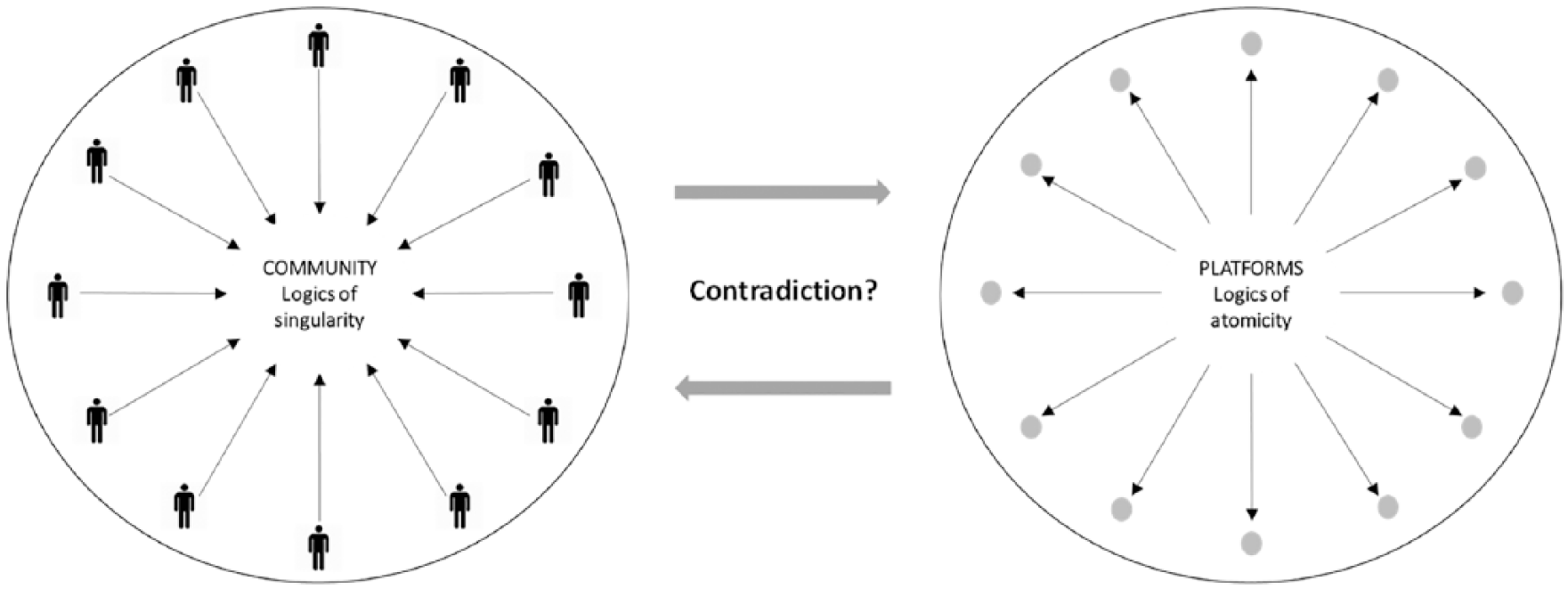
Communities and platforms as contradictory sides of the collaborative economy.
Yet, communities and platforms are not separated in practice and do not exist independently of each other. On the contrary, they rely on each other for their day-to-day functioning, such that cross regulations (within and across communities and platforms) already exist at their intersection, a connection that is most apparent within the users or customers of such platforms.
At the risk of simplification, what we might call “immersive platforms” such as Google or Facebook were designed initially to produce informational value. Through use, however, producing and communicating information cannot be disassociated from the senders and receivers and their prevailing modes of cognition, their senses, and their affective states: To broker information is also to structure meaning. Frequent users become “Google-like” or “Facebook-like,” beyond any instance of using the platform; indeed, an event of use (and by implication disuse) becomes increasingly difficult to isolate. Users are inhabited by the platform, used by it as much as using it (see Serres, 2015).
In contrast, what we might call “usage platforms” tend to be places for the encounter of offer and supply, rather than where people and ideas meet. Interactions within “use platforms” are often more explicit, punctuated activities associated with trade: a ride, or room is ordered, provided and paid for. Yet, more and more, most platforms are becoming hybrids, combining information with traded services, consumer “feedback” and rankings being a pervasive example.
This trend toward hybridity finds modern platforms achieving (or attempting to achieve) rapid economies of scale, leading to monopolistic situations (Cusumano, 2015; Parayil, 2005) in which a critical mass of “atoms” (i.e., independent, interchangeable individuals who contribute to their development) are assembled and disassembled. The bigger the platform, the more it is able to grow (Oliva, Sterman, & Giese, 2003; Srnicek, 2016). This logic of scale is based on network externalities (Cusumano, 2015) and transfer costs, which make it difficult to move users or value from one platform to another. The less users recognize and identify one another outside the platform (so their relations remain mediated by the platform), the more powerful these scaling effects. This lock in of users is realized by creating forms of inertia: seeking to control and standardize formats, integrating different platforms (e.g., auction sites and payment systems) merging ownership of different platforms, locking in users through recommender systems and status-based user profiles.
Google, for example, organizes a media ecology in which the labor of users is invisibly, seamlessly, and profitably managed through filters (recommender systems, autocomplete algorithms) that direct attention toward advertised services, and these services are secured through an auction system, in which advertisers bid for what algorithmically is considered the most appropriate space (immersion and usage merge). Google users are unaware of being entrained as content providers in such a media ecology, and unthinkingly search in ways that deepen and enrich the topology of the platform and hence Google’s (market) value (Gillespi, 2018; Ridgway, in press).
So, platforms are themselves mediating lives in community-like ways, and, in the process, dissolving the distinction between suppliers, users, and employees, meaning the community can consist of all these, and people can be classified according to one or more type at the same time. Relatedly, some platform users, especially those suppliers offering services through “usage” platforms such as Uber drivers, are beginning to federate and identify themselves through other platforms, such as Facebook, in a “dissenting” collective that constitutes a loose community. Similarly, delivery drivers for firms such as Deliveroo, Foodora, and UberEats throughout Europe came to demand better wages and conditions, identifying “collective action as the only way to get a fair deal.” 13 To that end, they encouraged members to gather into communities of riders (e.g., Collectif des coursiers, Collectif des livreurs autonomes, #deliverunion) and to organize themselves on platforms such as Telegram, Whatsapp, Twitter, and Facebook. In these examples, the special groups on platforms function as spaces for community action, invoking a clear counter to other, dominating platforms. In the global gig economy, marked by mobile work and the invisible orchestration of assembled and disassembled independent workers, communities serve a visible, integrative (and complementary) role that traditional hierarchical modes of organizing can no longer support. In turn, they largely resort to (other) digital platforms to gain visibility, legitimacy, and voice for their cause, and this, in turn, encourages those other digital platforms to sense and strive to capture the value created by these emerging communities of users.
Recognizing this insatiable urge to realize the productiveness inherent in the uptake of platforms has meant some collectives (e.g., third spaces, coworking spaces) defining themselves as “platforms” of open innovation, whereas other platforms consider themselves online communities of innovation—revealing the struggles each encounters with the other are also potentially enriching, oscillating between being neutral mediums and proactive facilitators (Gillespie, 2018). So rather than opposing communities with platforms, isonomic with heteronomic relations, there is almost a necessary complementarity between them, though in relation to an appreciation of the collaborative economy it remains utterly a paradoxical one (see table 1). Facebook, for example, is alive to the network effect nature of its business growth (gaining value means gaining users), so that, in addition to technical features, the company obsesses over creating the best community. Yet, to create such a community requires an expertise in persuasive technology that alters and nudges behavior in ethically problematic ways: for example, Facebook helping to organize voter suppression tactics paid for by Republicans in 2016 U.S. Presidential campaign, or facilitating Buddhist extremist Facebook groups in Myanmar. More ordinarily, the platform risks encouraging a community without cooperation, without discourse, without the possibility for critical relief, a community characterized by, in the words of a former Facebook executive Chamath Palihapitiya (2017), “short-term, dopamine driven feedback loops.”
Synthetic view of community-platform tensions.
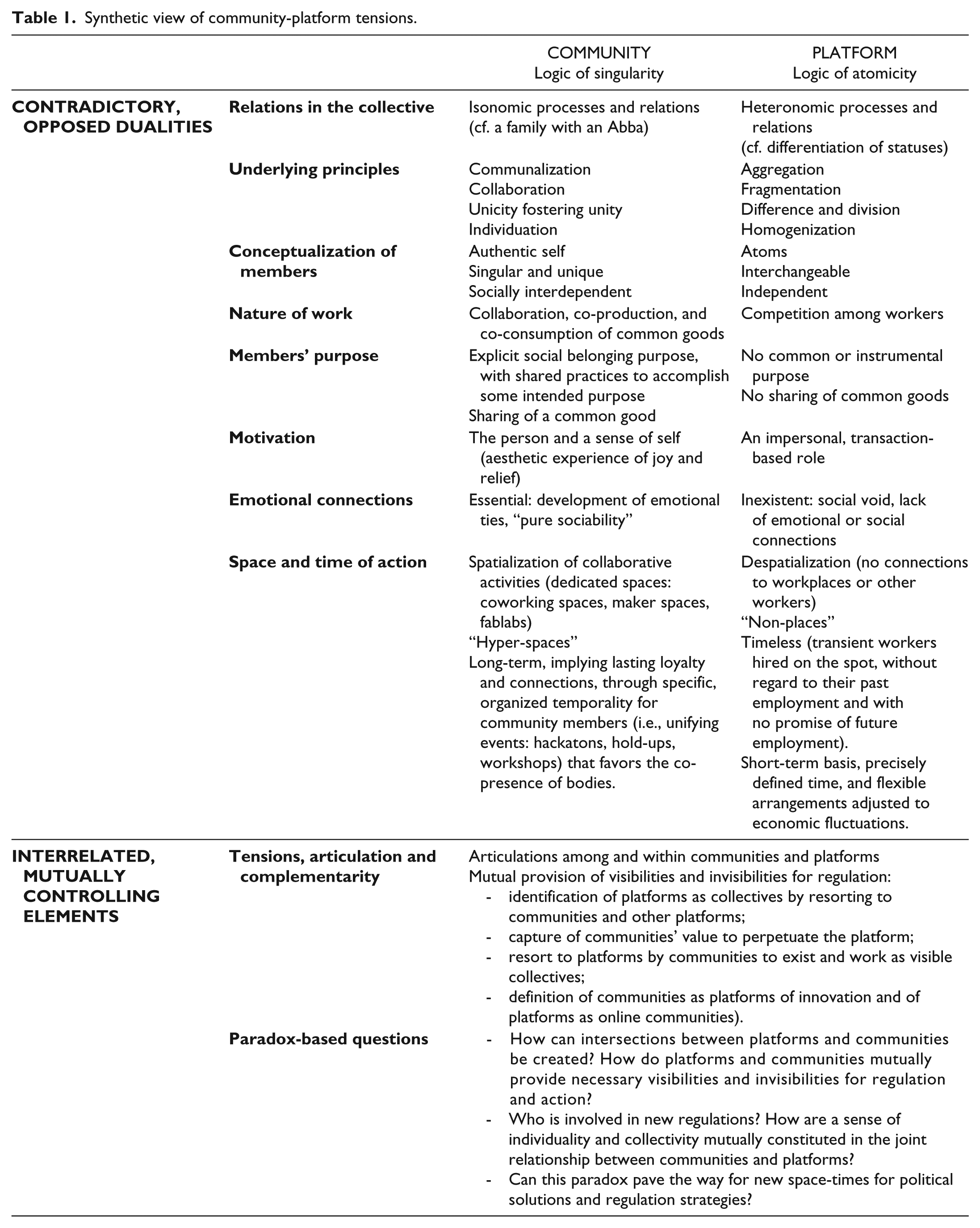
To conceptually apprehend these apparently contradictory developments of platforms and communities, we might turn to paradox theory. For Smith and Lewis (2011), paradoxes are “contradictory yet interrelated elements (dualities) that exist simultaneously . . ., seem logical when considered in isolation, but irrational, inconsistent, and absurd when juxtaposed” (p. 387). A paradoxical perspective, thus, can depict tensions between contradictory but reasonable considerations (see Smith et al., 2017), such as Facebook’s desire to create the best community because of its income-generating possibilities. There appears to be something irreconcilable between a flourishing collective and an adept use of technology to script behavior in accord with profit-maximizing outcomes. Rather than eradicate such contradictions, however, Facebook and others seem to relish them, indeed find them a source of innovation and renewal. Platforms and communities might be said to be in a state of persistent contradiction and interdependence (Schad, Lewis, Raisch, & Smith, 2016). The heteronomic and isonomic relations not only coexist but do so productively: They rile and agitate one another into heightened state of presence, and do so with a persistence, suggesting the paradox almost constitutes their organizational form.
As platforms expand and monopolize a market, communities appear from within the platform as well as without, to then resist and potentially regulate the platform from within and without, often using other platforms. This resistance can be not only oppositional outright but also supportive. So, for example, we find the Uber drivers of London campaigning in 2017 for better employment terms using grassroot community building while also lobbying the city’s transport authorities to overturn their revoking of Uber’s license. This appears strange because the authorities had revoked the license precisely because of the baleful effects of Uber’s alleged unreasonable contractual practices. Were the drivers lobbying for self-incurred exploitation? No, they knew the problems all too well, yet felt there were ways to organize the platform differently, and that could be responsible for helping do that. Alive to these multiple pressures to reform, Uber itself, rather than getting bogged down in such taxi wars, aims to reach beyond being a taxi service, indeed to become an organization delivering the world’s transport needs, public and private alike, an aspiration that, in turn, provokes community responses from all manner of potentially implicated peoples, also using (being used by) platforms (such as Facebook) to unify and articulate a sense of community response from what would otherwise be a disparate group of multiple interests, and so it unfolds and refolds.
There is, it appears, a continuous, perpetual, reciprocal regulation and reinvention of communities by platforms and of platforms by communities. They are coconstituting organizational forms of action, spatiality and temporality, and investments in physical, economic, social, and political space that are as complementarity as they are hostile. Communities and platforms are not irreducible opposites; they are fundamental dualities of the collaborative economy that can and do learn from each other, albeit, at times, reluctantly and under duress, and unwittingly.
As the Uber or Facebook examples attest, this productive forming is not amenable to the overview of management; indeed given its overwhelmingly digitized and, hence, ungoverned nature, the forming is ipso facto beyond management, if by management we mean handling, deciding, and directing in Fayolian sense (Fayol, 1916). It has its own paradoxical form that belie, somewhat, Smith and Lewis’ (2011) claim that “underlying tensions are not only normal but, if harnessed, can be beneficial and powerful” (p. 395). Powerful and beneficial maybe, but only for some set of interests or other. But harnessed (controlled)? Well hardly ever. It is more a process of open dialectic, without a narrowing or settling synthesis. It is more a process of organizational (re)forming. So from within a platform a community might appear, but as an irritant, meaning the platform attempts to immunize itself, by first apprehending a sense of itself as set against the community, but, only ever from within. In Niklas Luhmann’s (1995a and b, 2000) terms, to gain a sense of itself in its environment, an organization reaches outside of itself but can only ever make such an attempt through reentry into itself; what is beyond is only ever apprehended from within (Lauritzen, 2017). It is less a mutually constituting case of A because B (where the interdependence is between mutually exclusive opposites) than it is A because not A. This conveys how, empirically, it is impossible to isolate where a platform stops and community starts, the distinction is impossible to sustain, and when thought through the distinction continually reenters itself. Specifically, the distinction between community and platform is being reentered into each organizational form, a community-based apprehension of the community–platform distinction, and a platform-based apprehension, each forming their own unresolvable but potentially productive indeterminacy. Thus is set in train an entwinement of forms in which each configures the form of the other in its own terms. They provoke each other into mutual self-awareness without ever becoming the other, it is an interdependency that relies on a fundamental separation, to recur to Facebook’s attempt to create the “best” community. How can it decide the nature of a good community in itself as distinct from a good community that yields an income stream for the platform? It cannot, for, right away, such a question reinserts the distinction between community and platform into commercial reasoning, forcing the organization to configure new ways of thinking.” Facebook executives can only think through the distinction from within their own organizational form, grounded in commercial reasoning.
This puts into somewhat critical perspective those aspects of the paradox literature that maintain paradox emerges when preexisting, separate elements (such as platforms and communities) come together, and what was once reasonable (a discrete platform and discrete community) become not only antagonistic but also, potentially, a source of innovative potential that might find both organizational forms living in a fertile, if tense, struggle. For much of the literature on paradox, the job of management is absorb these tensions (what Chia & Holt, 2009, liken to a strategic embodiment of John Keat’s “negative capability”) to then organize conditions in which each form (platform or community) sustains and enhances the other, for example, where a platform can learn from a community how to better broach its social responsibility and, hence, better secure its long-term license to act, in the way, for example, Sharma and Bansal (2017) identified paradoxical relationships between charities and businesses in India. This argument has the virtue of accommodating a reasonable and consensual condition, touching even on that platitudinous and thoughtless moniker “win-win.”
Yet, the platforms and communities of the collaborative economy exist in paradoxical relations that cannot be dissolved or reconciled. They are not either/or as they are not separate prior to their being braided. A platform is in some way a community whose membership is twisted into isolation. And, a community is performed on platforms, increasingly so with digitized technology, and is nothing beyond the mediated performance. Nor are they both/and, for a community often resists the heteronomic logic of a platform and a platform as a business fails if governed by the isonomic logic of a community. Understood in Luhmann’s terms as a form of organizational reentry, however, helps conceptually because, here, the community becomes aware of itself as constituted through the very platform against which it apprehends itself as “other,” and the platform realizes its commercial survival and flourishing as a function of the collaboration by which communities (unmanaged, undirected, and, in the language of Coase (1937, 1991) without the cost of open contracts) are constituted. The platform serves the isonomic interests of the community, and the community the heteronomic interests of the platform, and in making users aware of this, each becomes constituted by its own “other.” This is not a case of opposites encountering one another and seeking compromise, or reconciliation, or alignment, but rather of an organizational form knowing itself in relation to its being aware of its constitution as a distinction (Holt & Zundel, 2016). Its distinction arises in a pulling away that is also a pulling toward because what it is different from (the other) is only understood from within what it is.
Such a condition resists being reduced to a known and managed organizational condition. We might indeed understand this paradoxical condition as a felt one (a “felt solidarity,” see Mazis, 2016). So as much as we have a rational organization of the collaborative economy (clearly investment decisions are made, mergers happen, markets are created), it is also a sensed (felt) and affective (feelings of excitement, frustration, awe, surprise) one. Extant theory and empirical work in organization and management studies have paid little attention to these aesthetic phenomena a fortiori in the body of the collaborative economy (de Vaujany, Dandoy, Grandazzi, & Faure, 2019). We, thus, turn to the phenomenological work of Maurice Merleau-Ponty to enrich our understanding of these sensory, emotionally anchored, paradoxical relations between communities and platforms.
Merleau-Ponty and Paradox
Merleau-Ponty (1945/2013) proposes a phenomenological understanding of social structures and activities grounded in perceptual and bodily awareness. He questions the easy use of binary conceptual structures (mind and body, the objective and subjective world, labor and capital, individual and community, sensation and experience). These binaries, he argues, are not where experience begins, but where it is abstracted and then concealed, leaving us with the illusion of a world composed of neatly opposed pairings. In phenomenological spirit, he takes us back to the things themselves—to experience of being there, or belonging—a condition, he says, which is always constituted and perceived through embodied activities and practices, and emotionally anchored in our sensate body, set amid a collective body, and without clear boundaries between them. We always experience things indirectly, and sensibly. Even basic feelings such as pain can only be apprehended because it already belongs to things, to a head that is aching, or to a bodily death drawing close. Although pain exists as something in language, in experience, it is woven into a tapestry of things whose form is already constituted in preexisting, collectively acquired patterns of thought, feeling, and action, and that are reactivated moment by moment in loops of visibility and invisibility.
In all this flux, what holds meaning together: How does anything appear as a thing? Answer is as follows: Through the body, for it is the body that is the opening of experience, and experience with all its tensions and balances is the immanent grounding of our awareness of things (not their grammatical form). Neither body nor world can be understood without the other: A body emerges because we are already perceptually leaning toward a world, which, in turn, is only available through bodily mediation (Carman, 2004). The body is the site of “me” and the world, and in its endless attempts at orientation toward the world, a fit is being struggled for from which endeavor (reaching into the world for refuge or prospects), a background for perception, emerges. What appears phenomenologically is organized through the acquired dispositional style of our body intertwining with the world through events, a relation Merleau-Ponty called chiasm. Events are realized through bodies’ endless struggle for poise, appearing from which come impressions not just of things, but of normative conditions of good or bad, right or wrong. Phenomenology studies the experience of this struggle for poise within event and how these events are aligned with language (Gély, 2000), without presuming neat structures or teleological end.
Merleau-Ponty (1964) uses this phenomenological approach to appreciating social and political continuities and discontinuities. He stresses that, although in language, these tend to be apprehended as oppositional struggles hinting at possible (rational) resolution, in experience, they are far less definitive or controlled: Exceptions, dissolutions, and accidents abound. Rather than attempt to manage this social and political chiasm through definitive knowledge of what “is” and “could be” the case, phenomenology attempts to give voice to our inevitable mutual connectedness and felt solidarity, which is always also incomplete (de Vaujany & Aroles, 2019; Kuepers, 2014; Mazis, 2016). The collectivity becomes aware of itself in some way, without ever attaining an outsider’s or bird’s eye view, or ever presuming some form of dialectical progress toward emancipation, or of its being a singular unit. The questions of emancipation and belonging with which these social and political communities are a realization of the chiasm, which is always paradoxical.
Here, Merleau-Ponty is borrowing ideas from Antoine de Saint-Exupéry (e.g., from Pilote de Guerre) about the importance of depth and felt solidarities, a connection Mazis (2016) summarizes thus: [O]one can feel empty and hollow pursuing ethical action for the sake of an abstraction called “humanity,” unless it is based on a more immediate felt connection with humanity through its concrete presence in one’s life . . . If there is a depth of perception that encompasses the nexus of relations that are the lining of each percept, then to be immersed in the myriad acts of humanity of friendship, kindness, love, beauty, discovery, creativity, and so on, that have spanned the long history of human beings on this planet in uncountable instances of community, gives us another sense of humanity as inexhaustible and of an unfathomable depth. (p. 319)
Interestingly for our paradox-based analysis of communities and platforms in the collaborative economy, Merleau-Ponty kept stressing the presence of chiasm in human experience of the world. This feeling of shared enmeshments, collective gestures, and common mediations, of being part of the same face and texture of the world, but without smoothing sense of settled identity, emerges in collective experiences, in particular, those involving the presence of others and otherness. So many social and political problems emerge because, being unwilling to absorb the chiasm, we seek recourse to abstracting language and the identification of things, commitments, agendas, and purposes that such language makes possible.
In an extended dialogue with Jean Paul Sartre concerning the nature of an individual’s political commitment, Merleau-Ponty (1945/2013) was critical of Sartre’s insistence on choosing a side and committing (Mazis, 2016). For Merleau-Ponty, all situations are inherently ambiguous and contingent, and appear often only dimly as we lurch this way then that, without firm ground. There is no such thing as subject (sole or collective body) freely choosing to re-act to a distinct array of historically embedded events: Everything is entangled. What matters most for Merleau-Ponty is “the instauration of the event and not first and primarily the instauration of the subject in the event” (Gély, 2000, p. 355). This loosening of the idea of a subject (whether individual or collective) within the field of events finds there the emergence of habit and the possibility of transformative difference, given habit is always (potentially) being exposed to otherness, a condition echoed by Alain Badiou (1993) who suggests “the subject who is in the flow of an event experiences a de-possession, the event opening the horizon to a set of possibilities not at all expected by the subject” (quoted in Gély, 2000, p. 355).
Beyond embodiment, the problem is also temporal. To act politically, Merleau-Ponty argues, is to realize possibility by actively thinking about fate, to apprehend the knotted nature of events by refusing the extremes of thoughtless engagement (the knave’s entirely reactive and adaptive action with no freedom) and detached thought (the cynic’s freedom with no action). Neither knave nor cynic, to act in good faith is to accept already existing patterns and styles of mediated dis/concord, which present constraints by which any future spills out, and which cannot be cleared away by ideas and visions for a future. For Goehr (2004), this entails what Merleau-Ponty comes to call the good ambiguity of distant engagement, where active management of events yields to an open, irresolvable dialectic in which the incomplete and porous vie with the finished and adamantine, but always and only as connecting fragments, whose encounters as thesis and antithesis are freed from the progressive shackles of synthesis. The platform engineer or manager or community political activist seeking the certainty of aims and warrants, and desiring to act under their duress, ignores what Merleau-Ponty has called “the background of non-sense against which every universal undertaking is silhouetted and by which it is threatened with failure” (quoted in Goehr, 2004, p. 343). Otherness is always present. In his final (unfinished) book, The Visible and the Invisible, Merleau-Ponty, thus, stresses, our experience is this upturn which settles us well far from “us,” in others, in things . . . in ourselves and otherness, at the point when, through a kind of chiasma, we become the others and we become the world. (p. 212)
Collaborative Economy as Janus Faced
Our brief foray in phenomenology helps orient our consideration of how to approach and analyze the presence and interaction of platforms and communities in the collaborative economy. With Merleau-Ponty, the process of reentry, one that Luhmann leaves abstracted as a second-order system condition of organizational maintenance, becomes an empirical one, one of felt, bodily entwinement with the world, or chiasm. Communities and platforms are simultaneously both before and after one another, both here and there, separated and touching, in mutual loss and gain, visible to one another or invisible. This “chiasmic paradox” (Prendeville, 1999) becomes something like this: Each becoming oriented toward the emergence of possibility in the other (other ways of being) must make simultaneous two moves that “cannot take place at the same time” (Gély, 2000, p. 361). As Merleau-Ponty (1964) explicates, Position, negation, negation of negation: this side, the other, the other of the other. What do I bring to the problem of the other? This: that the same be the other of the other, and identity differences of differences, this 1) does not realize an overcoming, a dialectic in the Hegelian sense, 2) takes place on site, through encroachment, depth, spatiality. (p. 361)
The expression and its corresponding event are embodiments of the paradox, which reconcile, in practice, possibilities that are a priori impossible, or “incompossibilities” (Gély, 2000, p. 363; Merleau-Ponty, 1955).
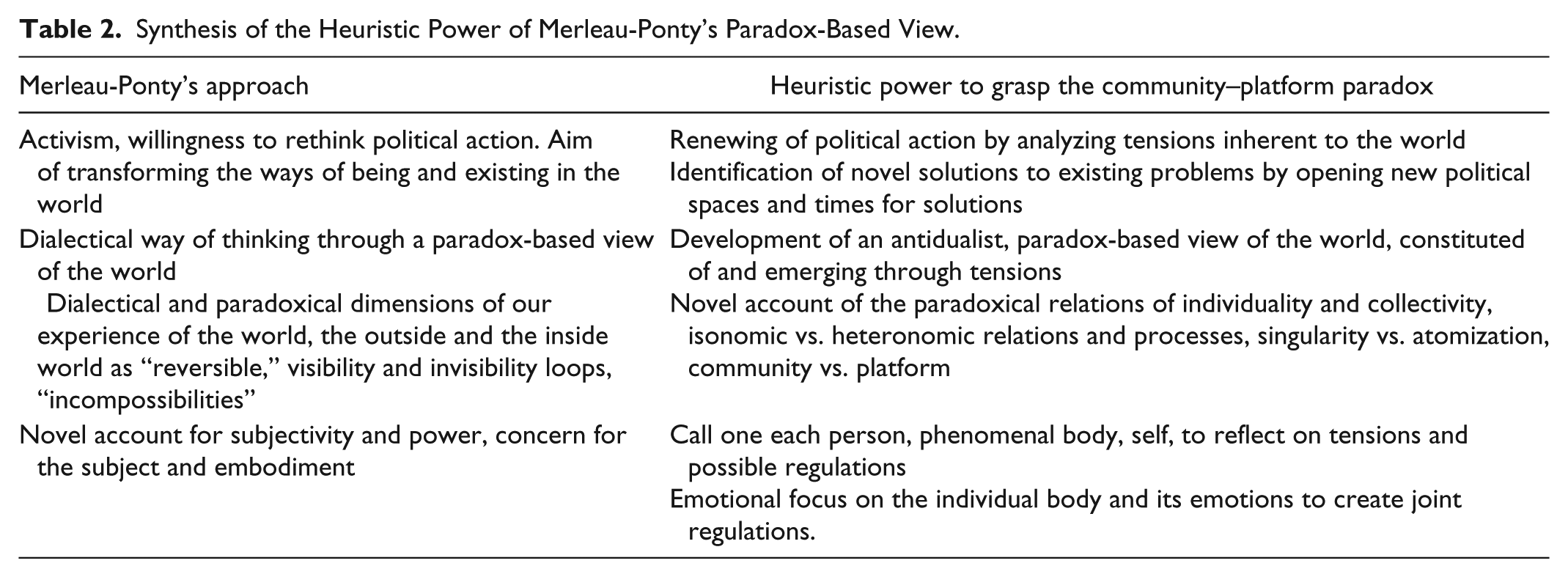
Both research study and forms of political engagement that are held open to ambiguity, and doubt creates a space of junction between the two (incompossible) forms (communities and platforms), a new space of integration. In addition to proposing new concepts and theorizations to grasp the inherent paradoxes of the world, using Merleau-Ponty suggests new spaces and times for solutions and calls on us—each phenomenal body—to self-reflect on possible junctions between communities and platforms (Table 2).
Synthesis of the Heuristic Power of Merleau-Ponty’s Paradox-Based View.
Communities and platforms become two faces of the collaborative economy, faces that are held in paradoxical and necessary union. The collaborative economy is Janus faced. One of the earliest of Roman deities, sometimes referred to as the “God of Gods,” Janus was the custodian of the universe, invoked in liturgies as the god of beginnings and endings, presiding over every entrance and departure.
Janus looks both ways: A single body holding a porter’s staff and set of keys and a double-faced head (Janus bifrons), oriented in opposite directions (Figure 2). He symbolizes the introductory god, the gatekeeper, the doorman (Ianituos), and the “passer” enabling passages and transitions always toward elsewhere. In ancient Rome, many jani (i.e., ceremonial gateways and bridges), usually freestanding structures, served as symbolic, auspicious entrances or exits that facilitated passage during important events, such as harvests, plantings, marriages, birth, funerals, or war. 14 As the God of passages, gates, and doors, as well as choices, representations of Janus—especially later, during the Renaissance—came to represent practical wisdom achieved in the “passage” between two distinct realities, the gap of good ambiguity, or what we have conceptualized as an embodied chiasmic paradox.

The Roman deity Janus, represented by Murray (1988, p. 120).
For us, Janus neatly conceptualizes the paradox in the body of the collaborative economy. The “other” is everywhere (de la Soudière, 2000), and it is an “other” that is felt in passing, bodies in motion adjusting, and which, in this adjustment, can elicit self-reflection and the construction of a sense of availability to the other, in turn also producing a change in the self. The passage is a “space-between,” where “separation is a condition to belonging, and belonging a form of separation” (Sibony, 1991, p. 334).
The Janus metaphor helps form a phenomenological understanding of the community–platform paradox by making us aware of its being a felt condition of passage whose contradictions demand and yet resist orientation, and one which is always open to new passages and passers. Following Merleau-Ponty, we ask how can “passages” between communities and platforms emerge? Who are the “new passers” in the collaborative economy? To what extent are “passages” a politics, embedded in action and collective reflection?
Creating a Politics of Collaborative Economy
Our paradox-based view regard communities and platforms as mutually interdependent spaces of collective action that might create between them new passages, or cross regulations, and whose constraints and inventiveness are configured through what is already there and toward which all bodies (individual or collective) must orient themselves (see Figure 3). When they are conceptualized as the Janus faces of the collaborative economy, communities and platforms emerge as recursive elements in entwined loops of visibility and invisibility, potentially productive but without any prospect of reconciliation.
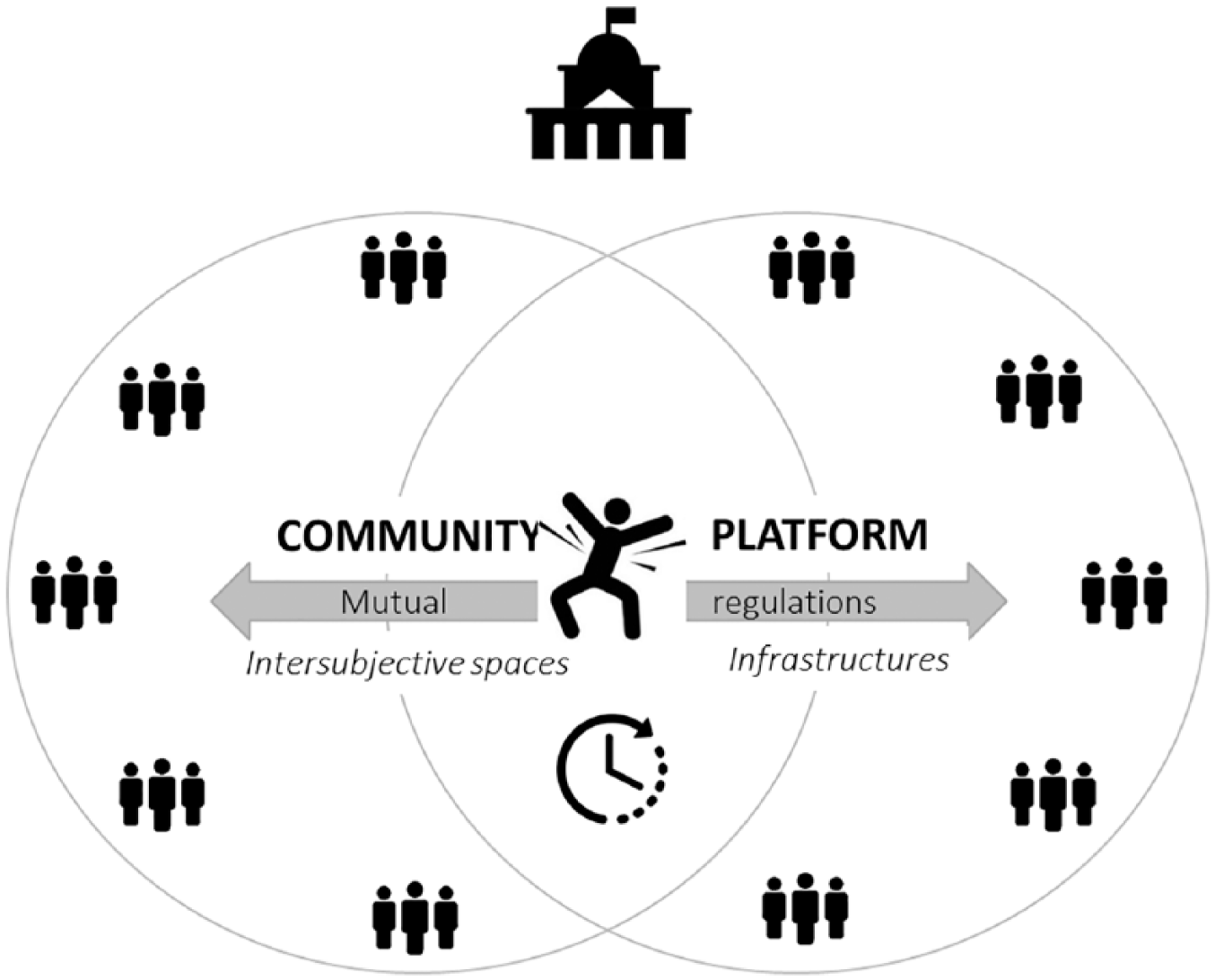
A phenomenological approach of regulation in the collaborative economy.
In phenomenological terms, platforms are “infrastructures” (closely related to “praxis”), inseparable from “superstructures” (Godelier et al., 1978; Merleau-Ponty, 1955). These infrastructures constitute collective activity and tend increasingly toward the digital, combining standards, networks, waves, and new work practices (e.g., mobility, telework, collaborative entrepreneurship). Uber and Facebook are grounding examples because they crystallize the global and communicative nature of the practices and sense-making processes toward which countless human bodies bend. They function through the creation and expansion of heteronomic relations: Bodies held in separated mass of scripted, predictable, and rent-creating arrangements. Through the mediation of digital technology, these relations are increasingly self-organized: There is no overt management—the stipulation of who communicates (works) together, and who will remain separate, is organized through efficiency-hunting algorithms.
Yet, communities abound at every turn. They often configure the isonomic beginnings of platforms, and their ending, as the originating spirit, in giving way to heteronomic orders, lingers and gains new life in feelings of nostalgia and disappointment among those who feel heteronomy as a loss. This is no simple opposition, not least because the platform itself is very often the setting for emerging experiences of otherness. The communities themselves are constituted in performance, and this engagement can then become commitment, yet only insofar as the community then loses its capacity to respond to the inevitable paradox of its being constituted through platforms (increasingly through digitized media) whose presence refuses any prolonged settlement to such commitments.
To attain and sustain the good ambiguity of a Janus condition is, observes Merleau-Ponty, to create spaces allowing “otherness” to remain (difference is not exiled by commitment). Through the structuring of good ambiguity, platforms, as infrastructures, and communities, as political spaces without definitive outlines, 15 can mutually and recursively provide visibilities and invisibilities for action. For example, platforms have many advantages as they can free the energies of workers—breaking down rigid organizations and internal labor markets and opening up differences of perspective; however, they also require different regulation; they tend to create a social problem that demands a method to expand individual autonomy while still providing security and a sense of collective responsibility (Friedman, 2014); platforms’ members, thus, need visibility to exist and act as a collective. To that end, communities could give passage to regulations on platforms (through prices, services, or norms), because they provide a collective structure and support to disturb the platform’s heteronomic relations (Friedman, 2014). For example, finding no justifiable reason for a U.S. company to manage the daily rides of citizens in an Asian city, Seoul’s local government banned Uber, not to protect taxi drivers or deter innovation but rather to push local actors to devise new solutions and regulations. According to the Seoul City Council, 16 “Uber is charging customers while avoiding the regulatory process, which creates unfair competition for taxi drivers.” It promoted local communities of users, who developed more local applications and citizen-based platforms, which stimulated the local economy while also ensuring fairly shared value. 17
In turn, communities offer spaces of collective action in platform capitalism but often lack structuring processes, thus creating a high risk of “cloistering” in a collective—therefore, platforms can function as regulation apparatuses that structure and perpetuate logics of communities, such that they can avoid the trap of dogmatic insularity characteristic of closed communities of commitment such as religions (Adler et al., 2008). To help the community exist and help members recognize one another, these collective mechanisms of the platform have to give visibility to the singular presence and action of each member, while enabling invisible coordination across the collective. For this passage, performative apparatuses must enable, in an articulated manner, the visibilities that are indispensable to the collective action and the possibility for reflexivity through doubt (good ambiguity). Infrastructures provided by platforms support the framing of collective action, beyond an instrumental, managerial logic.
Indeed perhaps here, there is a role for entrepreneurial ventures constituting themselves as a communicative and accountable organization alternating between economic and social values. For example, individuals gathering to create data cooperatives, so rather than just commercial platforms, they would be collectivist platforms, based on a collaborative spirit, in which each user would be an owner or co-owner of personal data and the profit they generate (Bauwens, 2015). The “Wikispeed car,” or Goteo, a Spanish platform of participative finance oriented toward the production of common goods, are such examples—in the same vein, young French social entrepreneurs have grouped together to mutualize their activity, as illustrated by coworking spaces such as La Coroutine or at Mutualab, in an emerging dynamics of collaborative culture, which appears as an answer to individualism and the fragmentation inherent to postmodernity.
There is also a role for governments here, to move from a top-down approach (considering citizens as consumers) to a more collaborative approach (the government being a partner facilitating social, collective, and individual autonomy), as exemplified by the Bologna regulation (i.e., regulation for the care and regeneration of urban commons). In this regard, the experience of Audrey Tang offers a striking inspiration: This Taiwanese civic hacker and digital minister in charge of social enterprise revitalized global open source communities and contributes to “Taiwan’s g0v” (“gov-zero”), a vibrant community that seeks to create tools for civil society, to “fork the government,” and to enable people to exert their civic rights by making political decisions, as an outcome of a deliberative democracy.
Conclusion
In summary, then, the actions of the platform (standardizing, indexing, classifying, categorizing) and the action of communities (undertake, singularize, position) constitute in/compatible possibilities in the process of embodiment, supporting a shared temporality and space of practices from which events of collaboration become possible. In the course of these actions, users gain embodiment (e.g., driver, renter), thereby distinguishing the self in the practical category (ride providers, consumers of rental spaces), but only insofar as the body finds sufficient poise in bending toward prevailing conditions with a constancy and concord that befits what is presently there. Here, anybody is a crossing over and intertwining (chiasm) combining immediate perceptual and affective of self and other with more abstracting and invisible meanings (procedures, codes, values). In this sense, platforms offer precious regulation apparatuses for communities that do not need active, conscious direction. For example, regulating hackers’ communities often requires platforms, which tend to be missing from the communities themselves. Independent, citizen-based platforms can create new spaces for socialization, transparency, and visibility. Thus, platforms and communities provide virtual and physical spaces of action, which enable passages across them; they offer necessarily mutual visibilities and invisibilities for regulation. Such spaces for action constitute the “new bridges” of the collaborative economy, which operate invisibly, so that they can offer greater visibility to their other, matching face.
Platforms can keep track of past actions (for both individuals and the collective) and project actions into well-articulated space. They open the path to such traces and continuous reflexivity on the ongoing collective action. Communities instead support the ability to feel engaged and live intensely (e.g., the efforts to “slow time” in the emerging trends devoted to work–life balance, or in attempting to disconnect from social media). Communities constitute an interesting place, or a point of passage, to determine a relevant time for action. This perspective invites novel perspectives in the collaborative economy, perhaps by developing new fora or agora that can incite members, Janus like, to inspect the past, live the present, and look at the future simultaneously, or to inhabit spaces anew (reconfiguring old institutional spaces such as disused hospitals, or the tool sheds of heavy industry, or domestic bedrooms).
Our approach also leads us to question the possibility for new bodies becoming involved in this politics of the collaborative economy, those whose passing consolidates and opens the mutual constitution of communities and platforms. For example, in a big data context, the loop from communities to platforms represents a critical process, due to its potential impacts and threats for the democratic process. Platforms can only provide an effective regulation apparatus for communities if they engage in strong competition, or are punctured by bouts of reflexive doubt, or are forced into regulatory constraints. In this regard, platforms might be forcibly divided, or legally challenged, to curtail their reach and so allocate economies of scale in different ways while also limiting transfer costs for participants, and all of this without the possibility of settled equilibrium. The paradox being that these constraints and frustrations are in some way self-willed, they are taken into the platform as provocations from communities with which they share a mutually constituting condition, but never through the same identities or commitments.
Understanding the relationship of platforms and communities in the collaborative economy as such a paradoxical condition (and we accept that, to date, it has not been approached thus) offers up interesting ways of understanding what, empirically, is already manifest: the mutual constituting of one by the other, without either resolving into the other. We have suggested how each might productively provoke and sustain the other, and also how other organizational forms—governmental regulations, entrepreneurial ventures—might contribute to what Merleau-Ponty (1953) calls good ambiguity: keeping the paradoxical condition sufficiently open for platforms and communities to become the Janus face of collaboration.
We must end, though, on a word of caution, or doubt, issued to ourselves. The term community touches on what Giorgio Agamben (1993/2007) apprehends as a condition of ease (commodious), one which etymologically identifies a space of being alongside or being besides, a space of the neighbor into which one can slip and by which a common sense is realized without its being anything other than an unnamed scene for the expression of singularity. In this, there is much that resonates with Merleau-Ponty’s paradoxical condition of political engagement. Agamben then goes on to suggest such a community of ease is constituted not by being defined as something (a political party with a dogma say, a congregation with a hymnal, or a club with a crest and colors) but, rather, an open condition of belonging, without determinate content or edges. Being without edges, however, does not mean it is simply existing, as might a group of people with a common physical attribute be said to exist in some kind of raw union. Rather, a community of belonging is defined by a process of passage moving from a raw state of people simply finding themselves together toward an experience of belonging defined by the quality of living well; it is a passage toward a living in which, politically, people live with others whose community has a just form, which is both a physiological/material quality (a certain number is ideal where all can acknowledge one another) and political quality (all belong by virtue of their possessing the logos, or language, in whose words they are able to separate the bare from the just life; Agamben, 2017).
It is this transformative and generative passage toward logos that is under threat from how we configured communities and platforms here. Perhaps we have been too naïve in treating platforms, notably in their digitized condition, as being configured through embodied paradox. What defines felt solidarities in communities of belonging is the felt power of being beings able to configure the demands of living in affirmative and negative arrays: Bodies accede to this, but shy from and refuse that. Often communities arise in riposte to conditions that deaden or dampen this experience of refusal, and digital platforms are perhaps peerless as an organizational form that orders activity and thought in such a way as to deny the possibility for refusal. The heteronormative logic of platforms achieve this denial by stripping us of logos by taking what lives and is alive (bodily grounded) and transforming it into pure representation (the human becomes a role/unit, their movement a measured pulse, their time a managed rhythm), and to do so completely. The digitized platform has as its structural (not managerial) aim a complete mediation of social relations through its own image, whereby all lives are to become a product of a mediation, which is so totalizing that what is manipulated is not just the production of things, but the very communication, perception, and memory by which any production makes sense. In thrall to this force, their communities are entirely affirmative ones, and they have edges simply by the fact that nothing outside counts (Agamben, 1993/2007). Merleau-Ponty’s early phenomenology argued that if we attend to experience, we would notice how it is always something bodily configured in situations in which language and values always lag somehow (Merleau-Ponty’s later works will make the relationship between pre-reflexivity and language more chiasmatic). Yet, the mediations of digitized platforms organize in such a way that everything is always and only a spectacle (produced to be looked upon and found wanting in the light of what could, in the future, be even more productive). In such spaces, all we have by way of belonging is its already conceptualized sensation: “like” or “not-like,” “go here,” “go there.” These are not passages, but means-end orderings against which the community becomes an attempt, a struggle in refusal animated by a passage toward logos, a life of relations to others each of whom is not a type or classification (belonging as a member of this or that representation—avatar, handle, employee role, friend, recommendation, rating), but simply as a singularity finding its voice (Agamben, 2017).
Footnotes
Declaration of Conflicting Interests
The author(s) declared no potential conflicts of interest with respect to the research, authorship, and/or publication of this article.
Funding
The author(s) received no financial support for the research, authorship, and/or publication of this article.
