







Abstract
Research in cultural entrepreneurship has shown how entrepreneurs gain legitimacy through entrepreneurial storytelling. Entrepreneurs are seen as strategic cultural operators who draw on cultural resources to gain support from audiences. There have been calls to move beyond consensual views of culture to examine the diverse cultural resources actors mobilize. We conduct a qualitative study of an entrepreneurial program and ask: How do tensions across cultural resources shape entrepreneurial storytelling? Drawing on the ventriloquial approach, we trace how varied concerns—what actors value and are attached to—are voiced, negotiated, and contested. Our findings demonstrate the ways in which entrepreneurial storytelling is shaped by tensions between competing cultural resources, such as market expectations and scientific rigor. These tensions influence entrepreneurial decisions, including choices about business models, target markets, and engagement with stakeholders. Our study highlights the tension-driven dynamics and moral dimension embedded in the deployment of cultural resources in entrepreneurial storytelling.
Keywords
Introduction
Entrepreneurial storytelling is critical for the development of early-phase entrepreneurial ideas (e.g., Bartel & Garud, 2009; Garud & Giuliani, 2013; Wry et al., 2011). It allows entrepreneurs to communicate their new venture's identity claims in a way that resonates with demands within an industry or institutional field (Lounsbury & Glynn, 2001, 2019). Entrepreneurial storytelling has been connected to the idea that stories make new ventures understandable, gain access to resources, demonstrate compliance with institutional norms, and generate feelings of acceptance and excitement among stakeholders (e.g., Fisher et al., 2021; Garud et al., 2014; O’Connor, 2004; Zott & Huy, 2007). It reveals entrepreneurs’ narrative techniques used to communicate to audiences their ventures’ identities, values, and visions, as well as shape future expectations and establish legitimacy (Garud et al., 2014).
Cultural entrepreneurship has been defined as “the process of storytelling that mediates between extant stocks of entrepreneurial resources and subsequent capital acquisition and wealth creation,” allowing entrepreneurs to convince their audiences, such as potential investors and consumers (Lounsbury & Glynn, 2001, p. 545). Entrepreneurs are expected to develop cultural competence—the ability to recognize cultural resources in the entrepreneurial domain and to skillfully deploy them in storytelling (Lounsbury & Glynn, 2001; Lounsbury & Glynn, 2019; Navis & Glynn, 2010; Überbacher et al., 2015). Cultural resonance is said to occur when entrepreneurs imbue their stories with cultural meanings that are similar to or overlap with the values and beliefs of their audiences (Lounsbury & Glynn, 2019; Soublière & Lockwood, 2022). In this line of research, culture is perceived under the form of resources—stories, frames, values, categories, practices, and symbols—that constitute a cultural toolkit that actors draw upon (e.g., Giorgi et al., 2015; Lounsbury & Glynn, 2019; Swidler, 1986; Überbacher et al., 2015).
Scholars have questioned mainstream conceptualizations of cultural resources with regard to the assumption that they are understood in a similar way among all actors within a domain (Gehman & Soublière, 2017; Giorgi et al., 2015; Soublière & Lockwood, 2022). There is an interest to understand the many faces of culture—the plurality of meaning in values, norms, stories, and categories—which requires perceiving culture as a “code of many colors” (Gehman & Soublière, 2017; Giorgi et al., 2015, p. 2; Lounsbury et al., 2019). Soublière and Lockwood (2022) proposed that entrepreneurial actors and audiences may have distinct cultural repertoires, suggesting that entrepreneurs develop strategies for bridging cultural gaps with their audiences. More broadly, scholars have highlighted the need to better understand the nature of cultural resources, the processes through which they are put to use, and entrepreneurs’ efforts to achieve cultural resonance with their audiences (Giorgi et al., 2015; Glynn & Lounsbury, 2022; Soublière & Lockwood, 2022). This indicates that existing research has not fully acknowledged actors’ diverse backgrounds, which are significant for understanding processes and experiences associated with becoming an entrepreneur. These prior backgrounds relate to tensions actors may experience when adopting an entrepreneurial character and attempting to use the entrepreneurial cultural repertoire.
Entrepreneurial programs for academic scientists exemplify contexts where normative entrepreneurial cultural resources are not intuitive and taken-for-granted, potentially affecting entrepreneurial storytelling. In such programs, scientists are provided with education and mentoring from business experts (e.g., Greven et al., 2024; Patzelt & Shepherd, 2009). Business experts aim to enhance entrepreneurs’ cultural competence and inject correct cultural resources into their storytelling, for example as part of entrepreneurial pitches, in a way that would be difficult for the new entrepreneurs to achieve on their own. By interacting with business experts, academic entrepreneurs acquire knowledge about how to act as storytellers and pitch their discoveries to audiences such as potential investors.
Yet, deploying entrepreneurial cultural resources in storytelling in this way can conflict with the traditional academic values and ideals, which remain strong in universities (e.g., Hewitt-Dundas et al., 2019; Lam & Campos, 2015). The productization and marketization of scientific discoveries calls for new forms of value creation—business models, proof-of-concepts, and calculations of profits and costs—that are unfamiliar to scientists and clash with academic norms (Mäkinen & Sapir, 2023). Academic entrepreneurs, especially those who continue to work within universities, are faced with multiple institutional logics, for example academic, market, and care logics (e.g., Brantnell & Baraldi, 2020; Clarysse et al., 2023; Fini & Toschi, 2016). These entrepreneurs need to find ways to manage the competing logics in a manner that aligns with their values and morals. For these reasons, we see entrepreneurial programs as a rich context for analyzing entrepreneurial storytelling as a communicative practice involving actors with varying understandings about cultural resources. Such a context allows us to ask the following research question: How do tensions across cultural resources shape entrepreneurial storytelling?
We draw on a qualitative study of an entrepreneurial program and the ventriloquial approach to examine tensions across different repertoires of cultural resources in entrepreneurial storytelling (e.g., Cooren, 2010; 2012; Fairhurst & Putnam, 2024). This approach allows us to trace how varied concerns—what business experts and academic entrepreneurs value and what they are attached to—are voiced, negotiated, and contested, exposing competing values (Cooren, 2010; Cooren & Sandler, 2014; Nathues et al., 2021). The ventriloquial lens thus reveals how divergent concerns compete and orient entrepreneurial storytelling. Consequently, we first draw on interview data to identify and compare the expectations, principles, and values that matter to business experts and entrepreneurs. These become figures that are ventriloquized in discussions, revealing how actors position themselves as animated or constrained by different values, ideologies, and norms (Cooren et al., 2013). For example, the ventriloquial approach illuminates how entrepreneurs, as part of their storytelling, speak in the name of and with the authority of institutional structures, such as science or the market. However, when figures clash, they become sources of tension (Cooren et al., 2013; Fairhurst & Putnam, 2024). Therefore, we analyze how tensions surface in discussions between business experts and academic entrepreneurs as they negotiate entrepreneurial pitches and debate what constitutes effective storytelling.
Our study makes contributions to entrepreneurial storytelling, cultural entrepreneurship, and academic entrepreneurship as well as advances research at the boundaries of these research areas. First, we contribute to research that problematizes the consensual and taken-for-granted nature of entrepreneurial cultural resources (e.g., Gehman & Soublière, 2017; Giorgi et al., 2015; Soublière & Lockwood, 2022) by empirically demonstrating the tension-driven dynamics between different cultural repertoires and their ability to shape entrepreneurial storytelling and trajectories. By examining how business experts and entrepreneurs mobilize and negotiate competing cultural repertoires, such as market expectations and scientific rigor, we show that entrepreneurial storytelling unfolds through low and high tensional interplays that affect decisions on, for example, business models, target markets, and engagement with stakeholders. Second, we contribute to current understandings about cultural resources in entrepreneurial storytelling by shedding light on the moral dimension inherent in cultural repertoires and entrepreneurial activities (e.g., Anderson & Smith, 2007; Clarke & Holt, 2010). We show how academic entrepreneurs navigate towards the entrepreneurial domain balancing tensions between familiar and foreign values and moralities, which has implications for how they engage in entrepreneurial storytelling. We conclude by discussing the potential for synergy between cultural entrepreneurship and academic entrepreneurship research in terms of advancing understandings about the multiplicity and fluidity of culture. Likewise, we see synergy between academic entrepreneurship and the ventriloquial approach in detailing competing values, logics, and tensions across them.
Theoretical Background
Entrepreneurial Storytelling
Entrepreneurial storytelling has been traditionally concerned with how entrepreneurs create “accounts that legitimate individual entrepreneurs to networks of investors, competitors, and visionaries, who make resource decisions and take strategic actions based upon what the stories mean to them” (Lounsbury & Glynn, 2001, p. 545). It has been associated with increased legitimacy, which allows new ventures to develop and survive (e.g., Bartel & Garud, 2009; Garud & Giuliani, 2013; Lounsbury & Glynn, 2001; 2019; Wry et al., 2011). Entrepreneurial storytelling is thus recognized as a practice that allows entrepreneurs to gain support for and convince audiences about the potential of their new products, services, technologies, and business models (e.g., Garud et al., 2014; Lounsbury & Glynn, 2001). It is seen as a strategy for conceptualizing the new venture in a way that is understandable and legitimate, thereby mitigating the liability of newness (Lounsbury & Glynn, 2001; Navis & Glynn, 2010).
Empirical research on entrepreneurial storytelling has focused on various narrative forms, both written and oral, as well as episodic and ongoing (Soublière & Lockwood, 2022). Scholars have analyzed for instance business plans, annual reports, promotional materials, and websites (e.g., Becker-Blease & Sohl, 2015; Chen et al., 2009). Aligning closely with its interest in audiences and legitimacy seeking, researchers have analyzed entrepreneurial pitches and presentations to business angels and venture capitalists (e.g., Chapple et al., 2022; Clarke et al., 2019; Smith & Viceisza, 2018). Entrepreneurial storytelling has even been discovered in material artifacts like product packaging (Garud et al., 2014; Lounsbury & Glynn, 2001; O’Connor, 2004).
More recently, the focus has shifted from discrete communications—such as live pitches or business plans—to considering entrepreneurial storytelling as an ongoing communicative practice that engages different actors and audiences. Chapple et al. (2022) highlighted the importance of analyzing storytelling evolving in the interactions between entrepreneurs and varied audiences, not only investors, over the course of entrepreneurial processes. Teague et al. (2020) in turn criticized extant empirical research on entrepreneurial pitching for assuming that it is primarily a marketing instrument, where the main purpose is to attract investment. Such a view ignores the relational and processual nature of the practice. Teague et al. (2020) revealed that entrepreneurial pitching is a rich, nuanced, and varied practice, and that audiences, and how they engage with what they see and hear, impact entrepreneurial storytelling. In more practical terms, the authors concluded that “entrepreneurs should view the pitch as a communication practice that maintains relational ties and support over time” (Teague et al., 2020, p. 347). Such observations highlight entrepreneurial storytelling as an evolving communicative practice that emerges in the interactions between entrepreneurs and other actors (see Cooren et al., 2024). Entrepreneurial storytelling is situated, relational, and trajectory-shaping communicative endeavor through which entrepreneurial actions are negotiated and enacted.
Tensions in the Deployment of Cultural Resources in Entrepreneurial Storytelling
Research in cultural entrepreneurship has advanced our understanding of entrepreneurial storytelling by analyzing how entrepreneurs deploy cultural resources in their entrepreneurial narratives (Lounsbury & Glynn, 2001; 2019; O’Connor, 2004; Soublière & Lockwood, 2022; Überbacher et al., 2015). Culture is perceived as a rich repertoire of elements that entrepreneurs draw upon to gain approval and support from their stakeholders (Garud et al., 2014; Lounsbury & Glynn, 2001; 2019; Snihur et al., 2022; Soublière & Lockwood, 2022). Cultural resources, or cultural toolkits, are understood as broad discourses, concepts, symbols, and institutional myths (Swidler, 1986), including stories, frames, categories, rituals, and practices (Giorgi et al., 2015), which are specific to a cultural context.
There have been calls to advance our understanding of cultural resources and how they are used in entrepreneurial processes (e.g., Giorgi et al., 2015; Glynn & Lounsbury, 2022; Soublière & Lockwood, 2022). Scholars have suggested that entrepreneurial cultural resources have been perceived in a consensual and unproblematic way and that it is therefore timely to embrace the many faces of culture (Gehman & Soublière, 2017; Giorgi et al., 2015; Lounsbury et al., 2019). This involves acknowledging that there are many cultural repertoires that can be used to justify and legitimate value creation and that cultural repertoires are fluid rather than stable (Gehman & Soublière, 2017). Such observations allow us to move away from portraying entrepreneurs as skilled cultural operators, as strategic actors, who are “capable from the outset to purposefully use ‘cultural resources’ in order to motivate resource-holding audiences to support their new ventures” (Überbacher et al., 2015, p. 925).
This draws attention to the importance of problematizing the notion of cultural competence, which is understood as entrepreneurs developing the ability to deploy cultural resources correctly in their entrepreneurial storytelling (Lounsbury & Glynn, 2001, 2019; Überbacher et al., 2015). By considering the multiplicity of cultural resources, we can analyze the ways in which actors’ prior experiences, circumstances, and motivations relate to their efforts to adjust and extend their existing cultural competencies (Rindova et al., 2010). Überbacher et al. (2015, p. 947) urged future research to explore whether and how entrepreneurs develop “locally appropriate cultural competencies” when moving from one cultural context to another, and what happens if they have low motivation to modify their cultural skills. The more ingrained prior backgrounds and experiences are, the more conflicting the process of getting into an entrepreneurial character and deploying certain cultural resources and values in entrepreneurial storytelling is likely to be.
Early-phase support organizations, like entrepreneurial programs and pitch development platforms, provide mentoring, coaching, and pitch training for new entrepreneurs (e.g., Clark, 2008; Daly & Davy, 2016; Rothaermel et al., 2007), so that they are exposed to entrepreneurial cultural resources and become “skilled cultural operators” in their storytelling (Lounsbury & Glynn, 2001; 2019; Überbacher et al., 2015). Academic entrepreneurship research reveals that transforming one's values, ways of thinking, and, relatedly, cultural competence, is not an immediate, smooth process, even with the help of early-phase support organizations. Academic science and entrepreneurship continue to exist in two domains with their own cultures, values, and ideals (e.g., Hewitt-Dundas et al., 2019; Lam & Campos, 2015; Mäkinen & Sapir, 2023). Commercialization of science challenges academic scientists’ core values and transforms understandings about standards of success, work practices, and identities (e.g., Mäkinen & Esko, 2023; Meek & Wood, 2016; Owen-Smith & Powell, 2001).
In entrepreneurial universities, the relationships between scientists and universities are being “defined and negotiated through intellectual property, profit, and ownership,” which causes tensions between scientific values and entrepreneurial forms of valuation (Mäkinen & Sapir, 2023, p. 194). Brantnell and Baraldi (2020) studied academic entrepreneurship in the context of medical innovation, where entrepreneurs dealt with academic, market, and care logics, highlighting the complex relationship between institutional logics and entrepreneur behavior. While these logics could coexist, there was potential for conflict as market logic could contradict academic and care logics. When tensions run high, actors may perceive cultural resources that align with the market logic as “morally tainted,” assessing them as going against, even threatening, principles that are important to them (Dalpiaz & Cavotta, 2021). Tensions between cultural resources are thus likely to be concerned with morals and ethics, and emerge in entrepreneurial storytelling, especially within the realm of academic entrepreneurship.
Analyzing Tensions Across Cultural Resources Using the Ventriloquial Perspective
To delve deeper into how tensions across cultural resources can shape entrepreneurial storytelling, we draw on the ventriloquial perspective (Cooren, 2012). This approach illustrates how people, considered metaphorically as ventriloquists, mobilize ideational, experiential, evaluative, and emotional actants, called figures, that materialize in communications and social interactions (Cooren, 2010; Cooren & Sandler, 2014; Fairhurst & Putnam, 2024). The word “figure” is sometimes used by ventriloquists to refer to their dummies, which are made to speak through these artists. Through a ventriloquial lens, “we see that communicating is always about implicitly or explicitly staging various beings that are supposed to express themselves in a given situation” (Nathues et al., 2021, p. 1460). This means that through implicit and explicit ventriloquations, people ventriloquize a variety of things (e.g., objects, feelings, visions, values, or principles) by staging them as participants in interaction and ascribing them agency (Brummans & Cooren, 2011; Cooren, 2012; Nathues et al., 2021).
Whenever people communicate with each other, many things manage to express themselves through what they say, which means that various things materialize in discussions. For instance, when an administrative employee turns down a client's request by saying, “I’m sorry sir, I cannot give you this information as it is against our regulation,” ventriloquizing a regulation means that this employee becomes the means by which this document is not only expressing itself but also materializing in this situation. By materializing, we mean that this regulation makes itself present through what this employee is saying on its behalf (Cooren, 2018, 2020). And if it materializes in this situation, it is also because it matters to the employee at that point, as it is a way to justify her refusal to give the information the client is asking for.
This reflection on materializing leads us to acknowledge that what matters to people tends to materialize in their interventions (Bencherki et al., 2021). Mattering means that whatever matters or counts to people usually materializes in what they say, that is, they become figures that interlocutors ventriloquize in their discussions. Matters of concern refer to something that people are interested in and/or concerned about to the extent that when they feel it is threatened, they will want to protect it. The phenomenon of mattering suggests that if something (whether a value, a principle, a person, or an object) matters to someone, this mattering conveys a certain attachment that can express itself not only in the form of affection, care, or love, but also in the form of constraints, restraints, or ties (Bencherki et al., 2021). For instance, identifying matters of concern in an interview or discussion amounts to detecting what appears to animate, enthuse, or motivate what people say. This means that while people act as ventriloquists who make things speak, they can also be seen as dummies because it is these things’ existence and importance that also compel them to speak the way they do (Nathues et al., 2021).
The ventriloquial perspective has been shown to be a suitable approach for analyzing tensions (Fairhurst & Putnam, 2024), which has been demonstrated in multiple empirical studies (e.g., Long, 2016; Long et al., 2018; Wilhoit & Kisselburgh, 2019). This is because what counts or matters to someone can appear incompatible to what counts or matters to someone else. These tensions may present themselves as paradoxes, contradictions, or situational ironies, which can be felt and experienced (Cooren et al., 2013; Fairhurst & Putnam, 2024). In such instances, certain ideas, principles, and actions manifest themselves in discussions and in the positions that people take, which then clash with each other, generating tensions and feelings of discomfort (Cooren et al., 2013; Fairhurst et al., 2002). In their study on Doctors Without Borders, Cooren et al. (2013) analyzed tensions that emerged when one clinic was established close to patients, which the United Nations saw as a security threat. In this case, tensions were centered on the figures of “proximity” and “security.”
In our empirical setting, rigor and accuracy are supposed to be values that matter to scientists, which means that these values/figures will tend to express themselves in what they say. These values dictate that scientists be not only strict in the design of their research, but also careful in what they are allowed to claim about their results. In contrast, adaptability and simplicity, as classic entrepreneurial values, might require that entrepreneurs “cut corners” or simplify value propositions to be as reactive and convincing as possible, a course of action that may appear, at first sight, incompatible with what scientific rigor and accuracy dictate. In this example, two figures that matter to scientists, i.e., rigor and accuracy, appear in tension with two figures that matter to entrepreneurs, i.e., adaptability and simplicity.
By adopting the ventriloquial lens to understand entrepreneurial storytelling, we advance knowledge on the diversity of cultural repertoires and their tension-ridden dynamics in entrepreneurial storytelling. We respond to calls to pay attention to the role of cultural resources in entrepreneurial processes and take seriously the notion that culture is a “code of many colors” (Gehman & Soublière, 2017; Giorgi et al., 2015, p. 2; Glynn & Lounsbury, 2022; Lounsbury et al., 2019; Soublière & Lockwood, 2022). The ventriloquial approach allows us to expand research on cultural resources in entrepreneurial storytelling by providing us with tools to detect different cultural repertoires and tensional interplays across them as well as analyze how cultural resources are mobilized in communicative practice.
Research Method and Data
Research Setting
We conducted a qualitative study of an entrepreneurial program located in Finland. The program was directed at academic entrepreneurs, and it sought to promote the development and commercialization of their discoveries in the fields of medicine, life science, and technology. Program participants were provided with educational opportunities and mentoring from business experts. They had the opportunity to take part in activities and develop their ideas and commercialization efforts for a couple of years. During this time, participants attended educational events, practiced entrepreneurial pitching, and attended conferences and startup events. Our data collection was focused on projects selected to the program between 2018 and 2020.
Data Collection
We conducted semi-structured interviews with the program's experts, who managed the program and mentored the participants, and the program participants, who were early-stage academic entrepreneurs. We interviewed six members of the program's management and business experts (of which two were interviewed twice) and 38 program participants (of which 22 were interviewed twice and six were interviewed three times). Taken together, our data consist of 74 semi-structured interviews with two groups of actors, which are broadly defined as business experts and emerging academic entrepreneurs. The interview protocol for the management and business experts included questions about the program's aims and activities, perceived challenges for commercialization, how to address them, and what entrepreneurial success required. When interviewing the academic entrepreneurs, our interview protocol included questions on the types of discoveries and their development towards commercialization, the scientist's aspirations, motivations, and experiences, as well as significant moments during their entrepreneurial journeys. The interviews lasted between 45 and 90 min and they were transcribed by a professional transcription service.
We also attended the program's pedagogical webinars where the participants learned about a variety of entrepreneurial topics such as business models, design thinking, team building, market analysis, and regulation. Because the program included participants across the country, all its events were organized online. Importantly for the present study, the first author participated in 19 mentoring sessions (in total, 44 hr). It was these communicative events and the discussions between the business experts and the academic entrepreneurs that piqued our interest in studying the tensions in the deployment of cultural resources and how those shaped entrepreneurial storytelling. In each of these sessions, entrepreneurial teams pitched their projects and engaged in entrepreneurial storytelling, discussing their ideas with the business experts. Our observations focused on the exchanges between the entrepreneurs and the business experts after the presentations.
While these data sources allowed us to develop a rich understanding of the empirical setting (Creswell, 2013), our study has limitations in capturing how entrepreneurial trajectories evolved in response to specific feedback from business experts. Moreover, the program accepted several projects each year, which meant that the community continuously changed and evolved as new projects started and old projects graduated. After leaving the program, many projects and, in some cases, companies updated their websites, providing us with some information about their later stages.
Data Analysis
Our analysis developed through different but often overlapping phases through which we first identified business experts’ and academic entrepreneurs’ concerns using the interview data and then analyzed how the identified concerns created tensions in entrepreneurial storytelling in the mentoring sessions. We began the analytical process by using inductive thematic analysis to identify and interpret general patterns in the data (Charmaz, 2006). When we were organizing the data in this way, we began to consider the ventriloquial approach as a suitable analytical grounding for our findings. We were reviewing research that investigated tensions in communicative practice and came across literature focusing on this perspective (e.g., Cooren et al., 2013; Fairhurst & Putnam, 2024). As most of our data were derived from semi-structured interviews, we sought methodological guidance from prior studies that have relied on interview data, the ventriloquial approach, and the notions of tensions, tensional interplays, and resistance (e.g., Long, 2016; Long et al., 2018; Wilhoit & Kisselburgh, 2019). We also sought inspiration from the methodological framework for ventriloquial analyses that provides a step-by-step guideline (Nathues et al., 2021).
Phase 1: We began by analyzing the interview data with the business experts and the academic entrepreneurs. We read all the transcripts identifying recurring themes in the interviews (Charmaz, 2006). The themes among the business experts related to their understandings about how to achieve success in entrepreneurship, how academic entrepreneurs should behave, develop, and present their innovations, and how the program could help and mentor the participants. In turn, the interviews with the academic entrepreneurs revealed their experiences concerning their entrepreneurial journeys, efforts to develop their projects, and understandings about how the program sought to guide them. These general themes revealed how the program promoted academic entrepreneurship and what they perceived as important in entrepreneurial processes, including in entrepreneurial storytelling. Interviews with the academic entrepreneurs demonstrated how they assessed the program's entrepreneurial objectives.
Phase 2: We then analyzed the interview quotes under the specific themes more closely with an eye for figures invoked by the interviewees as they spoke about entrepreneurial storytelling. Figures in the ventriloqual act have been defined as “anything that happens to count in a given situation, that is, anything that is or becomes the object of preoccupations, interests, and expectations on the participant's part” (Bergeron & Cooren, 2012, p. 121). The ventriloquial analytical questions helped us recognize both explicit and implicit expressions of figures (Nathues et al., 2021, p. 1462). For identifying explicit invocations, a useful question is, what is a person invoking with what they are saying? For identifying implicit invocations, one can ask, what voice(s) can be recognized in what a person is saying?
Within the interview quotes identified during the first analytical phase, we recognized the different kinds of preoccupations, interests, and expectations that the interviewees invoked explicitly or implicitly in their accounts. In this first round of identifying figures, we kept an open mind and considered many preoccupations, interests, and expectations that reappeared in the interviewees’ accounts. Among the business experts, figures were concerned with market, market analysis, identifying a problem and a solution, value creation, competition, regulatory demands, investors, and stakeholders. Among the academic entrepreneurs, figures were concerned with what was perceived as an ideal pitch, value creation, validation, scientific evidence, scientific rigor, and the startup world.
Phase 3: Next, the identified figures were further analyzed by grouping and relating them (Nathues et al., 2021). We sought to develop broader, more abstract terms for describing the groups of figures and no longer group them separately for different actors. We labeled the groups as follows: Market, Regulation, Simplicity in the Entrepreneurial Story, Scientific Rigor, and Start-Up Culture. These broader sets of figures appeared in the accounts of both business experts and academic entrepreneurs, but there was variation in how explicitly they were invoked, the extent to which they mattered to different speakers, and what kind of potential for tension could be detected.
For example, a business expert invoked the market explicitly in an interview saying: “John [a mentor] often says that in Finland, health is a right and, in the US, it is a business. You need to understand the logic.” In turn, an entrepreneur invoked the market more implicitly, responding the following after being asked about market opportunity: “I hope that it [innovation] will make people less sick and dying less. No numbers.” The figure of simplicity in the entrepreneurial story could be detected when a business expert said, They [scientists] understand the science, but it is very clear that when they enter the program, they will give a pitch, and the pitch is an academic pitch. If you are to go to a company or an investor with that, they would not understand it.
In turn, an entrepreneur invoked simplicity in the entrepreneurial story critically by saying: “It [pitch] is so superficial […] the meaning of a pitch is just to raise some interest in a short amount of time and stay in people's minds.” Depending on who the speaker was, a group of figures, such as market or simplicity in the entrepreneurial story, could be presented as something one should or should not be preoccupied with, and oftentimes the two were contrasted. Table 1 provides further data examples from the interviews regarding the groups of figures that business experts and entrepreneurs invoked.
Groups of Figures: Data Examples from Interviews.
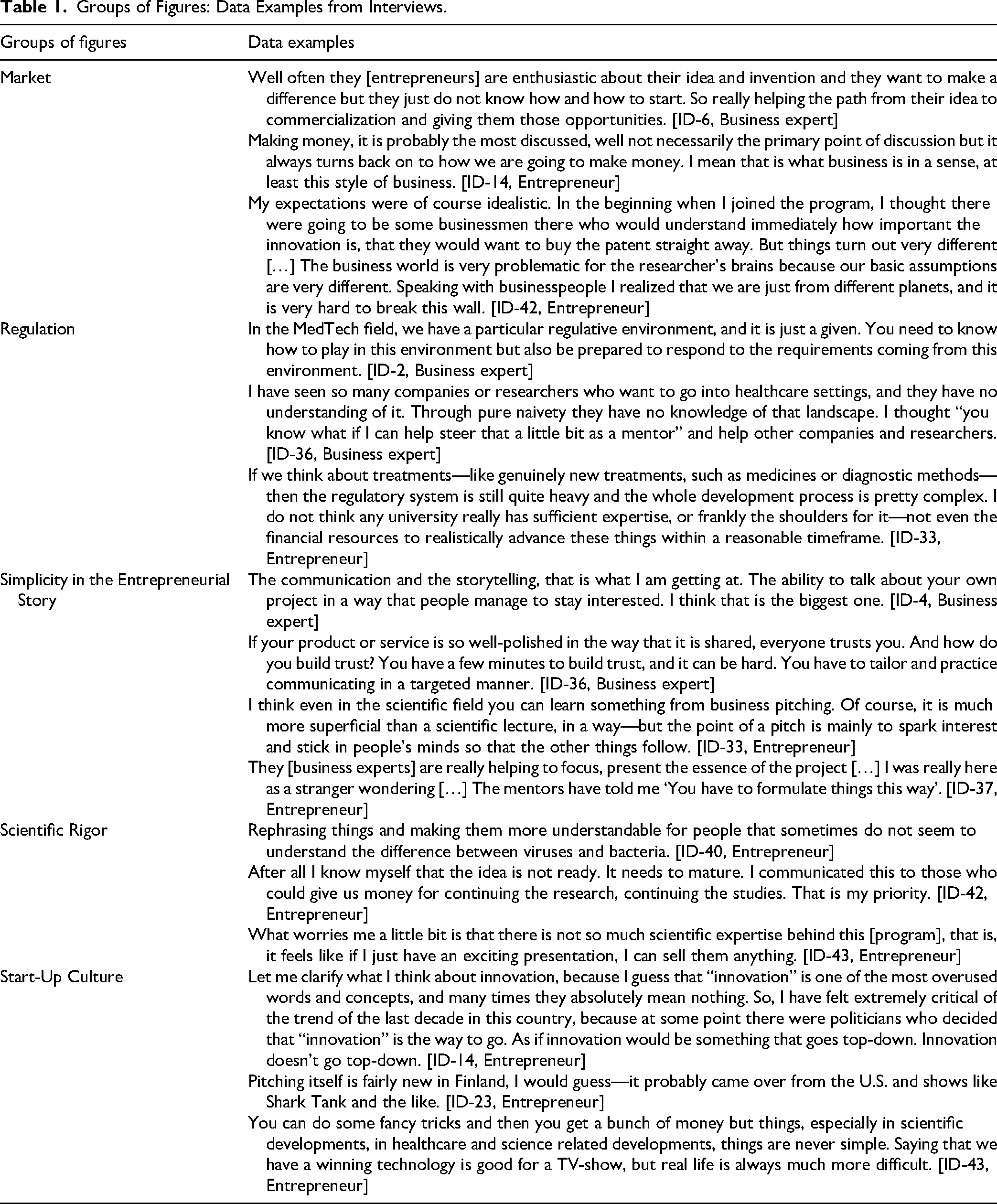
Phase 4: As discussed above, the identified sets of figures demonstrated potential for tensional interplays (Cooren et al., 2013). This refers to how different figures were mobilized implicitly or explicitly to foreground certain matters while backgrounding others (Bergeron & Cooren, 2012). We analyzed mentoring sessions and zoomed in on the exchanges that took place after the presentations, as these moments revealed tensional interplays. We considered how, in these discussions, in which the pitch was evaluated, the different actors invoked the figures to make a point about entrepreneurial storytelling and what it should entail. We also reflected on how business experts sought to guide the entrepreneurs and how the entrepreneurs responded to the feedback.
Over time, we were able to detect variation in the level of tension across interactions and discussions, allowing us to develop a rough categorization of low and high tensional interplays. Table 2 shows data examples on both types with a description of their main focus and content. In low tensional interplays, it was common that the presentations were prepared according to entrepreneurial norms and that entrepreneurs deployed entrepreneurial cultural resources in their responses and were generally appreciative of the mentors’ feedback. In high tensional interplays, the presentations typically followed scientific norms, and entrepreneurs were critical of the feedback they got or did not show interest in pursuing the start-up.
Tensional Interplays: Data Examples from Mentoring Sessions.
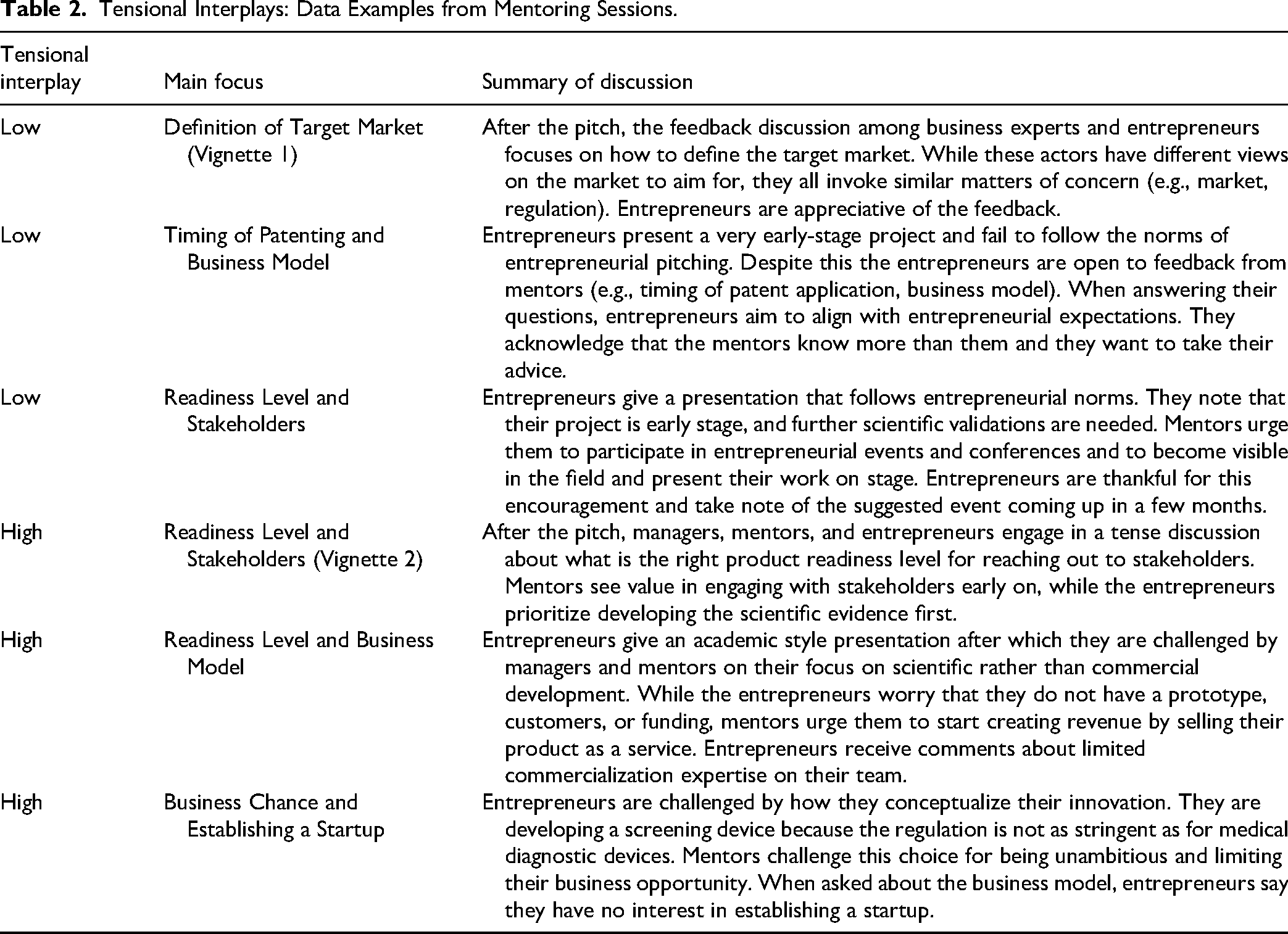
For the final empirical section, we have selected illustrative vignettes (in Table 2 identified as Vignette 1 and 2) to elaborate on entrepreneurial storytelling as a communicative practice by which cultural resources and tensions across them get ventriloquized. While by observing we could capture the main dialogic moves and types of questions in this communicative practice, it was not possible to create full accounts of actual conversations.
A Ventriloquial Analysis of Cultural Resources in Entrepreneurial Storytelling
The ventriloquial approach allows us to trace what business experts and academic entrepreneurs value and what they are attached to and then examine how their different concerns guide entrepreneurial storytelling, sometimes leading to clashes and contestations (Cooren, 2010; Cooren & Sandler, 2014; Nathues et al., 2021). Specifically, the ventriloquial analysis revealed the following concerns that were presented as mattering in entrepreneurial storytelling: Market, Regulation, Simplicity in the Entrepreneurial Story, Scientific Rigor, and Start-Up Culture. In the first section, we present what is expressed as mattering, or not, in entrepreneurial storytelling using our interview data. In the second section, we demonstrate how business experts and academic entrepreneurs invoked these concerns in their feedback discussions after entrepreneurial pitches. The analytical sections highlight how emerging entrepreneurs strive to speak on behalf of institutional structures—such as entrepreneurship and market—that embody values and moralities foreign to their own. This sense of foreignness lies at the heart of the tensional interplays that unfold between business experts and entrepreneurs and that divert entrepreneurial storytelling to unexpected trajectories.
What Matters in Entrepreneurial Storytelling
In the business experts’ accounts, market, regulation, and simplicity in the entrepreneurial story materialized both explicitly and implicitly as key concerns as these experts explained what they expected to see in entrepreneurial pitches and what their mentoring practices emphasized. As explained below by a member of the management team: What is the ecosystem that makes those stories possible and what is the mechanism and the key functions that we need to have to make the success stories happen? One key factor is obviously the mechanism of value creation, so are we able to produce something that has value and meaning. Science is not the point here; the point is to generate a solution to a concrete problem or a need. You also need to understand the market environment, so you know what to target and aim at. Second, in the MedTech field, we have a particular regulative environment, and it is just a given. You need to know how to play in this environment, but also be prepared to respond to the requirements coming from this environment. [ID-2]
More implicitly, the manager invokes simplicity in the entrepreneurial story by saying, “Science is not the point here; the point is to generate a solution to a concrete problem or a need.” Simplicity is ventriloquized as requiring that the entrepreneurial story communicates how it creates something that addresses an existing problem and has potential for value creation. This sentence reveals a key tensional interplay between what matters to business experts and academic entrepreneurs. In this quote, science is positioned as mattering less in entrepreneurial storytelling than the market environment, regulation, and simplicity in the way the story is presented.
Another business expert invoked market and regulation but slightly more implicitly by speaking in the name of investors: Scientists are always excited about their science but ultimately investors do not care about that, what they care about is to multiply their investment. They want their investment to grow all the time. […] Cool science does not always mean it has any commercial value. That is why we do a market analysis to understand and mitigate risks. To initiate a dialogue with regulators, those who are the payers, to see what they think about your products. Failure to measure competition leads to failure of new products. [ID-3]
The academic entrepreneurs, in turn, were learning an entrepreneurial repertoire to be used in storytelling. This involved adopting a new set of concerns (e.g., market, regulation, simplicity in the entrepreneurial story), while downplaying other, more familiar concerns (e.g., scientific rigor). We have learned to present the need, the problem, and the solution, and how we have developed the solution, our approach, and the competition […] When presenting the project to an investor or someone who is some general audience, we keep it simple. We never go into so much science. [ID-16] I have pitched it several times and they [mentors] keep pointing out that I am trying to squeeze too much information into my presentation and need to delete some of the scientific parts. “Imagine presenting this to a toilet company, they will not understand a word about the science part. You need to be adding euros and dollars and markets instead.” [ID-22]
The tensional interplays between scientific rigor, the market, and simplicity in the entrepreneurial story were, in many accounts, associated with values that were foreign to academic entrepreneurs. The entrepreneurs expressed concerns that an entrepreneurial story could be constructed by generating excitement for the discovery instead of showing real scientific evidence behind the innovation. They referred to “start-up world” and “businessman,” criticizing what they associated with the start-up culture. I would say that there is a lot of nonsense in this start-up world […] things that are not so relevant. People having to present their project to be bigger than they are or tell a story about all the things they know and will do when things are still so unclear and underdeveloped. I know myself that the innovation is not ready. [ID-40] You are told that to be able to become successful, a businessman, you need to be able to sell your idea from the beginning before it is fully developed. You need to extract the most useful information out of your research and then, wrap it into a package that can be sold. That is quite different from the way of behaving that I am used to. [ID-42]
In this section, we demonstrated business experts’ and academic entrepreneurs’ varying concerns relating to the market, regulation, simplicity in the entrepreneurial story, scientific rigor, and start-up culture. Tensional interplays were detected between market and scientific rigor, affecting entrepreneurial storytelling which to the entrepreneurs appeared to emphasize simplicity and lack of scientific detail as well as making projects look bigger, better, and more developed than they were. Such objectives in entrepreneurial storytelling were seen as contradicting values central to the scientific domain.
How Tensions Across Cultural Resources Shape Entrepreneurial Storytelling
Next, we show how the conflicting concerns were mobilized by the different actors in mentoring sessions shaping entrepreneurial storytelling. When engaging in entrepreneurial storytelling and aiming to speak and think in the name of market and value creation, entrepreneurs negotiated tensions between competing values and moralities. Some were able to adopt a new entrepreneurial worldview and role by balancing competing concerns, while others struggled to draw on cultural resources, values, and moralities embodied by the entrepreneurial domain. These instances reveal low and high tensional interplays that affect key decisions in entrepreneurial storytelling, diverting entrepreneurial trajectories to various and often unexpected directions.
Tensional Interplay Around the Definition of Target Market.
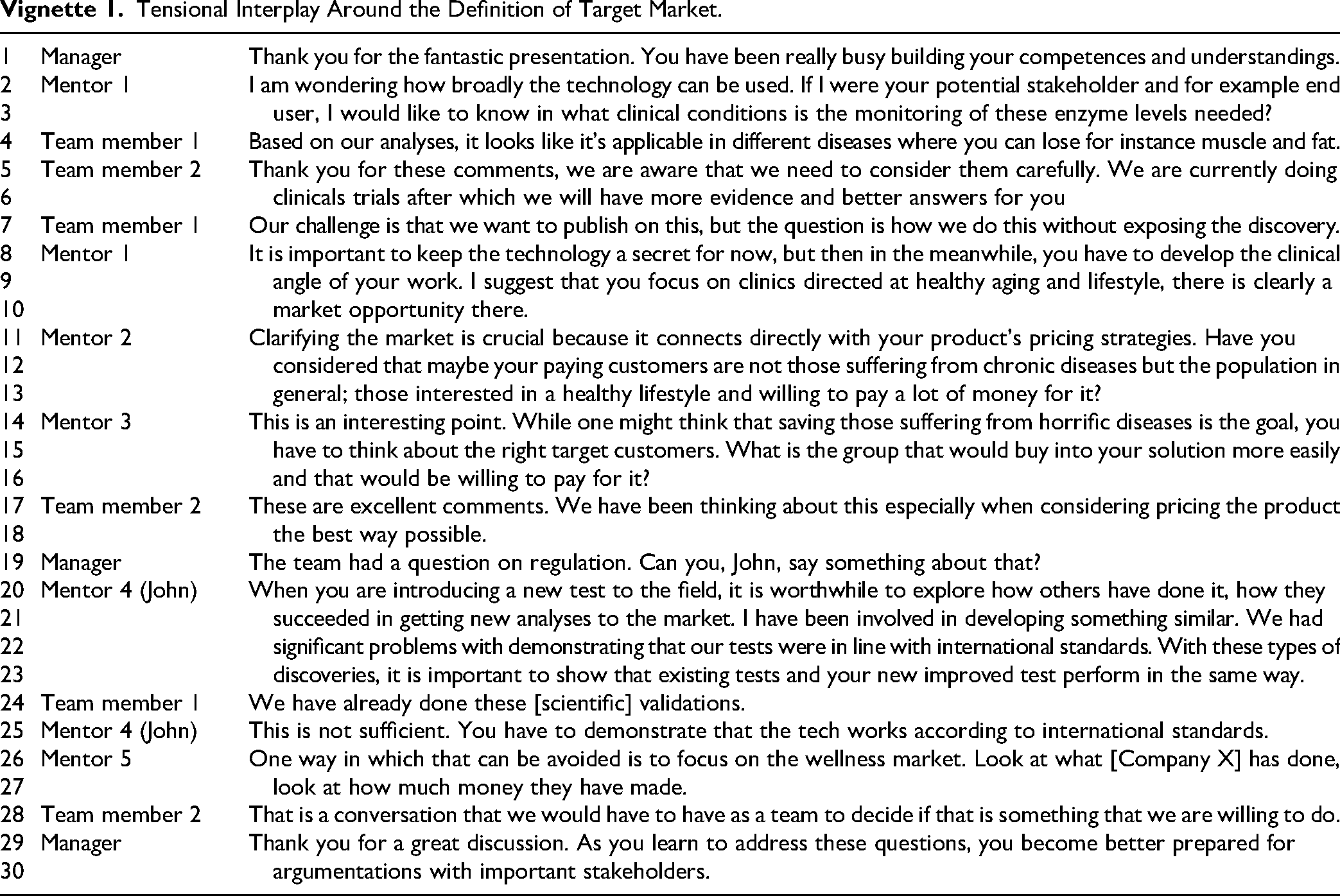
The team's pitch included many of those elements that were shown to matter for business experts in entrepreneurial storytelling. The presentation was not too focused on scientific content and included relevant business concepts (e.g., value proposition and market analysis) demonstrating that the entrepreneurs recognized how to present their work to a business-minded audience. A program manager opens the feedback discussion, congratulating the team for their presentation and progress. The figure of the market expresses itself through Mentor 1's questions, concerned with specifying the market and the uniqueness of the solution. The mentor ventriloquizes the figure of potential stakeholders and users of the technology by framing his questions in the following way, “If I were your potential stakeholder and for example end user, I would like to know…” (lines 2 and 3). By speaking in their name and in the name of their concerns, the mentor argues what should be seen as consequential when clarifying the business idea.
The two academic entrepreneurs (Team member 1 and Team member 2) try to address these concerns by reassuring Mentor 1 that analyses and clinical trials are in process (lines 4–6), but also by recognizing the importance of the business experts’ preoccupations (“Thank you for these comments. We are aware that we need to consider them carefully”) and the necessity to pursue these validations to be able to address them appropriately (lines 5 and 6). We see the entrepreneurs showing real effort to demonstrate that they recognize the business experts’ concerns and preoccupations and that they also matter to them.
Mentors 1, 2, and 3 all appear to speak in the name of the market, raising comments and questions about the entrepreneurs’ “market opportunity” (line 10), “product's pricing strategies” (line 11), and “the right target customers” (line 15) to ensure that the team has identified the right market for their product and a customer group that is most likely to pay and contribute to value creation (lines 8–16). Again, the entrepreneur (Team member 2) shows preoccupation with the business experts’ concerns with the market, saying, “These are excellent comments. We have been thinking about this especially when considering pricing the product the best way possible” (lines 17 and 18).
It is worth noting how, after ventriloquizing the market explicitly as a figure, Mentor 2 asks the team “Have you considered that maybe your paying customers are not those suffering from chronic diseases but the population in general; those interested in a healthy lifestyle and willing to pay a lot of money for it?” (lines 11–13). This question brings up the objective of maximizing value creation by targeting the broader population interested in a healthy lifestyle instead of only those suffering from certain diseases. The team members do not give a direct answer and there are signs of differences in opinion. Later in the discussion, Mentor 5 similarly invokes a specific successful company that could be an example for how these entrepreneurs should consider their product, market, and target group (lines 26 and 27). Their comment refers to the “wellness market” (line 26), which is quite different from targeting the product to those suffering from chronic diseases. At this point, Team member 2 notes that “That is a conversation that we would have to have as a team to decide if that is something that we are willing to do” (line 28). Here, values other than those of the market are implicitly invoked and the question about the right target market appears to have a moral undertone.
As for Mentor 4, he, together with one of the managers, brings up regulation by emphasizing the importance of developing the product in accordance with international standards (lines 20–23). They ventriloquize figures such as the market, other successful start-up companies, and their expertise and experience, highlighting why it is worthwhile to listen to this advice. Team member 1 answers the comment by referring to scientific validations they have done but in doing so, fails to incorporate the right resources in his answer (line 24). Mentor 4 corrects Team member 1 by reminding them that international standards are not the same as scientific validations (“This is not sufficient. You have to demonstrate that the tech works according to international standards” (line 25)). International standards are thus explicitly ventriloquized as dictating specific actions that the entrepreneurs need to carry out.
Tensional Interplay Around Readiness Level and Engaging with Stakeholders.
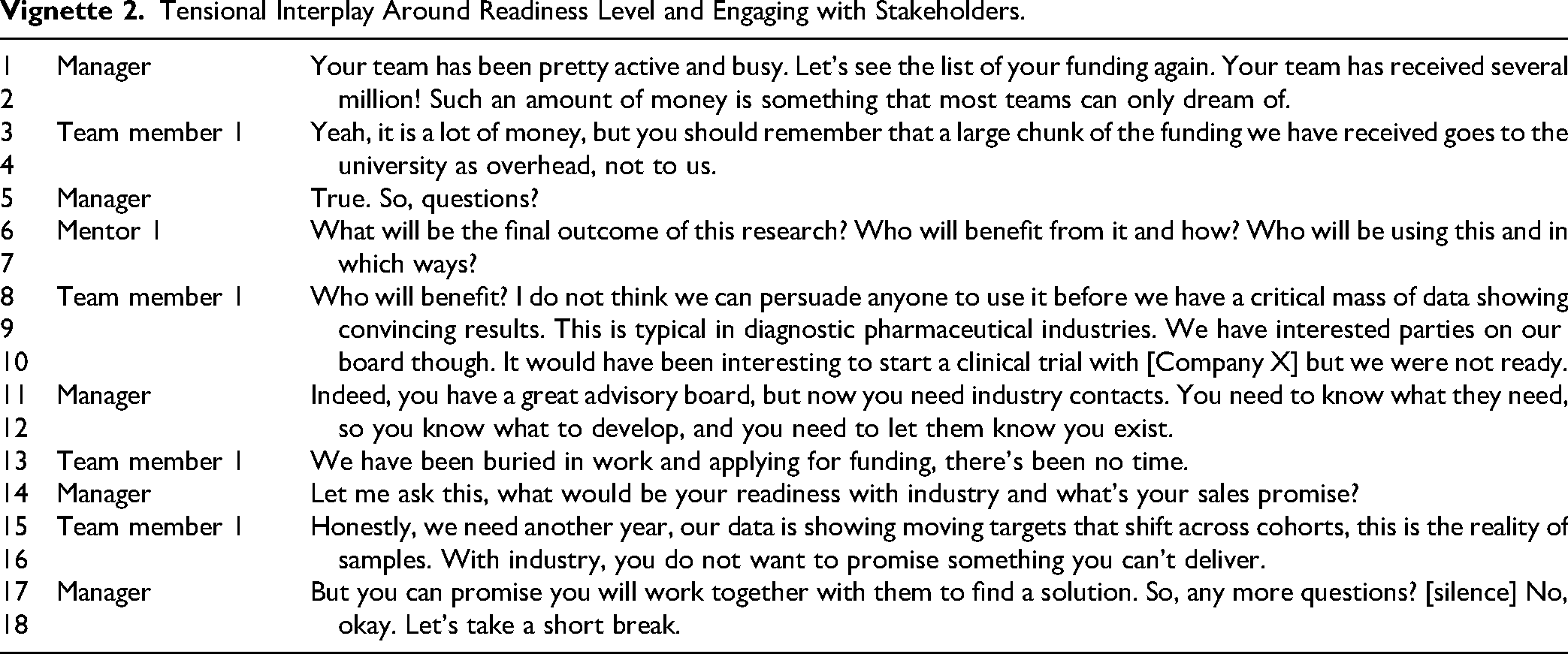
Vignette 2 presents a feedback discussion after an entrepreneurial pitch that was informative in terms of scientific work and progress but did not include those business concepts that the business experts deemed important. We see the program manager opening the discussion by emphasizing the team's success in receiving research funding and hinting that this amount of money would be a beneficial starting point for any entrepreneurial team (lines 1 and 2). The entrepreneur then cautions against this notion by reminding the manager that they do not get to use all that money (lines 3 and 4). There appears to be a tension between how the entrepreneurial and the scientific domains generally work, that is, receiving research funding and financial support from investors are different types of resources.
This is followed by Mentor 1, who implicitly invokes the market by asking a series of questions that highlight the lack of a clear value proposition in the presentation: “What will be the final outcome of this research? Who will benefit of it and how? Who will be using this and in which ways?” (lines 6 and 7). Mentor 1 reiterates concerns that should matter and count, thereby implying that the team has failed to pay attention to things that need to be included in the pitch and their business conceptualization. Team member 1 responds to these concerns by invoking scientific rigor and referring to the project's readiness level and scientific evidence (“I do not think we can persuade anyone to use it before we have a critical mass of data showing convincing results” (lines 8 and 9)) as well as their knowledge of how the field of diagnostic pharmaceutics typically works (line 9). By doing so, she challenges Mentor 1's questions by ventriloquizing other concerns and values than those associated with the market. For this entrepreneur, scientific evidence and rigor are values deserving attention, while Mentor 1 invites her to pay attention to other aspects of their entrepreneurial project, which she fails or refuses to do at this point. Rather, the entrepreneur points out that they have interested parties on their advisory board, to show that despite her incapacity to respond to Mentor 1's concerns, some industries are interested in their project even if her team is not ready to start a clinical trial (lines 9–10).
This is followed by a manager acknowledging Team member 1's point about the advisory board (line 11) while reaffirming the importance of establishing contacts with the industry “to know what they need, so you know what to develop, and you need to let them know you exist” (lines 11 and 12). The manager ventriloquizes the industry by making them say that their needs have to be acknowledged by the entrepreneur if she wants to succeed. This comment justifies Mentor 1's three questions, that is, to reaffirm the importance of the concerns relating to a clear value proposition.
In response, the team member invokes her lack of time to justify their incapacity to get in touch with the industry, to which the manager responds by asking her to speak in terms of innovation readiness and promise (line 14) rather than in terms of what they can deliver right now. Thus, the manager appears to implicitly invite the team member to think, speak, and act like an entrepreneur: it's not what you can deliver now, rather it is what you can imagine delivering in the future. The team member again resists this invitation by pointing out that they need one more year before making this kind of promise (lines 15 and 16). Moreover, she ventriloquizes a principle that allows her to explicitly state why she does not want to engage with the industry until she has the evidence to back up the innovation (“With industry, you don’t want to promise something you can’t deliver” (line 16)).
Consequently, the manager tries to convince the team member by implying that the promise can just be that they want to work with the industry to advance their project collaboratively (line 17). These exchanges demonstrate the tensional interplay between market/start-up culture on the one side and scientific rigor on the other side. The business experts see value in engaging with stakeholders early on, while the entrepreneur prioritizes developing the scientific evidence first.
Taken together, these two vignettes showcased the business experts’ efforts to inject their own concerns into the entrepreneurial stories as well as the entrepreneurs’ efforts to deploy these concerns, or refuse to deploy them, in their storytelling. The matters of concern revealed what these actors have come to value, believe, and expect, and, as such, showed the mobilization of different cultural repertoires and their associated values in their interactions centered around entrepreneurial storytelling.
The tensions between cultural repertoires focused on key entrepreneurial decisions and appeared to set entrepreneurial stories to diverse trajectories. As we saw in vignette one, instead of determining their target group in line with market and profit maximization, these entrepreneurs considered other values in how they sought to generate impact, thus diverting their entrepreneurial story from a normative trajectory. In an interview conducted towards the end of our data collection, the main scientist (Team member 1) recounted how the team had succeeded in founding a company that provided laboratory services and analytical kits for central laboratories. Their focus was not on the wellness market, as some mentors in vignette one recommended. Still, the scientist continued to experience some moral tensions concerning the financial objectives, saying in an interview: To be able to use a laboratory service, you need to have this monetary component. That people are buying it [the service] in exchange of money and then I work to make it available to them. This is the only way I can accept the money component. I’m a scientist. That's why we have commercial experts on the team who have a different mindset, complementing mine. [ID-37]
The scientist accepted that her work, the service, was made available to those who needed it in exchange for money, but her focus was on the science, not on how to make profit. Moreover, after founding the company and hiring people in different roles, the scientific and commercial aspects could be more detached, and the scientist could focus on science and more easily balance the competing concerns and values in her work.
As we saw in vignette two, the entrepreneurs assessed their product's readiness level using different standards than the business experts and postponed interactions with stakeholders. Promoting an innovation to stakeholders before all validations were completed felt morally questionable to the entrepreneurs, although this is perceived as a common activity in the entrepreneurial domain. Concerning this project, the entrepreneur continued to feel conflicted about the pressure to interact with stakeholders early on, and, over time, she distanced herself from the program. Currently, there is no company, only a website, which states that the team is looking into partnering with pharmaceutical companies and diagnostic service providers to develop their application.
Discussion
The article explored entrepreneurial storytelling as a communicative practice that involves multiple actors and by which varied cultural resources get ventriloquized. We asked: How do tensions across cultural resources shape entrepreneurial storytelling? We first identified matters of concern that were associated with distinct cultural repertoires, demonstrating how differently the business experts and the emerging academic entrepreneurs perceived what entrepreneurial storytelling should ideally entail. Second, we analyzed mentoring sessions to show how distinct cultural resources were mobilized in interactions resulting in tensional interplays—often with a moral dimension—which affected the content of entrepreneurial stories and trajectories. Through these findings, we make contributions to research on entrepreneurial storytelling, cultural entrepreneurship, and academic entrepreneurship, as well as recognize synergy across the research areas worth exploring further in future research.
Tensional Interplays Across Cultural Resources and Entrepreneurial Storytelling
Our findings on distinct cultural repertoires and tensional interplays across cultural resources answer calls to problematize the “somewhat consensual and unproblematic view of culture” in entrepreneurial storytelling (Gehman & Soublière, 2017, p. 67). It has been largely assumed that entrepreneurs assemble cultural resources into various symbolic actions followed by audiences who use compatible elements to evaluate these efforts (Soublière & Lockwood, 2022). Instead, entrepreneurial storytelling should be seen as a nuanced, relational, and processual practice, in which both entrepreneurs and their audiences shape entrepreneurial storytelling (Teague et al., 2020).
By analyzing entrepreneurial storytelling using the ventriloquial lens (e.g., Cooren, 2012; Cooren et al., 2013), our first contribution is to empirically demonstrate the tension-driven dynamics between different cultural repertoires that have the power to influence entrepreneurial trajectories. The notion of mattering and figures that were ventriloquized allowed us to first identify the matters of concerns of the different domains and their cultural repertoires and then analyze where there was potential for tensional interplays. Our approach aligns with recent efforts in cultural entrepreneurship research to separate different actors’ cultural repertoires (i.e., what they have come to value, believe, and expect) and see how these repertoires are mobilized in actions, assessments, and utterances (see Lounsbury & Glynn, 2019; Soublière & Lockwood, 2022). Our findings showed tensions between the concerns of market and scientific rigor, which had implications for entrepreneurial storytelling. Specifically, while the business experts saw value in emphasizing simplicity in the entrepreneurial story and through this approach, communicating to stakeholders and investors the value of the innovation, entrepreneurs tended to interpret this as showing limited scientific evidence and making projects look bigger, better, and more developed than they were.
The ventriloquial approach allowed us to further analyze tensional interplays—both low and high—between competing figures or concerns in our observational data (Cooren et al., 2013; Fairhurst et al., 2002; Fairhurst & Putnam, 2024). In low tensional interplays, entrepreneurs drew on required entrepreneurial cultural resources in their pitches, or at the very least aimed to speak and think in the name of the market, when responding to comments and questions, thus embodying the concerns and values of the entrepreneurial domain. In high tensional interplays, the pitches tended to focus on scientific content, and the entrepreneurs struggled to invoke entrepreneurial concerns such as engaging with stakeholders early on and developing business conceptualizations that maximized value creation. In low tensional interplays, the potential for tension was diffused when entrepreneurs adopted an entrepreneurial worldview, played the correct role, and revised their storytelling to match entrepreneurial expectations. In high tensional interplays, however, tensions were not resolved as entrepreneurs continued to show alignment with the scientific domain, making their storytelling unfit from the perspective of entrepreneurial expectations.
These findings challenge the common assumption that entrepreneurial storytelling is about revising narratives so that they align with audience expectations. Instead, our findings revealed instances in which storytelling diverged from the advice of the business experts. Tensional interplays across cultural resources redirected entrepreneurial storytelling in ways that departed from normative entrepreneurial understandings. In our analysis (see Table 2), key issues central to entrepreneurial trajectories repeatedly resurfaced during the mentoring sessions, as business experts and entrepreneurs expressed competing concerns and values.
One issue was concerned with how to conceptualize the business model and target market. Instead of identifying a target market that made the most profit, entrepreneurs sometimes saw value in creating an innovation that could help those suffering from a chronic illness, without emphasizing its commercial potential. Another issue related to readiness level and the timing of engaging with potential stakeholders. Whereas the business experts thought it was valuable to contact stakeholders early on, entrepreneurs prioritized achieving scientific validation on their own terms and standards first. These differences in worldviews and decision making relate to a moral dimension in entrepreneurial storytelling, which we will discuss next.
Entrepreneurial Storytelling, Cultural Resources, and the Moral Dimension
The ventriloquial approach and its notion of tensional interplays can reveal what different actors are deeply attached to (Cooren et al., 2013; Fairhurst et al., 2002). This suggests that when a business expert or an academic scientist speaks and thinks in the name of their institutional domain, they embody a sense of morality inherent to that domain. Our second contribution thus advances current understandings of how cultural resources are deployed in entrepreneurial storytelling by foregrounding their moral dimension. This is a significant direction for research, as prior work has largely assumed that entrepreneurs engage in storytelling to establish cultural resonance with audiences, increase the legitimacy of their innovation, and secure financial viability and profitability (Lounsbury & Glynn, 2001; Lounsbury & Glynn, 2019; Überbacher et al., 2015). Contributing to the research that questions such assumptions, our findings revealed that while many entrepreneurs learned to recognize normative entrepreneurial cultural resources, embodying a foreign morality associated with the entrepreneurial domain made entrepreneurial storytelling challenging.
Specifically, the incompatibility between the business experts’ concerns, such as market and simplicity in the entrepreneurial story, and the academic entrepreneurs’ concerns, such as scientific rigor, resulted in moral reflections. For some, the normative entrepreneurial cultural resources in storytelling appeared “morally tainted” (Dalpiaz & Cavotta, 2021) and associated with the negative sides of the start-up culture and the notion of “fake it until you make it” (see Wood et al., 2022). These academic entrepreneurs felt they had to “present their project to be bigger than they are” and “sell [their] idea from the beginning before it is fully developed,” as one of our interviewees observed. The entrepreneurial story was thus about “an exciting presentation” that allows one to “sell them anything.”
This finding on experienced moral conflicts in the deployment of entrepreneurial cultural resources in storytelling challenges notions about entrepreneurs and their drive for success by any means (e.g., Lounsbury & Glynn, 2001; Lounsbury & Glynn, 2019). Entrepreneurs are not only animated by economic growth; instead, their goals may incorporate “a moral dimension or the importance of ‘doing the right thing’” (Clarke & Holt, 2010, p. 80). While this perspective is more commonly associated with social and sustainable entrepreneurs, who are represented as being motivated by creating social impact through their ventures, it is important to consider the moral dimension also among the more commercially oriented entrepreneurs (e.g., Clark et al., 2018; Hägg et al., 2024; Kimmitt & Muñoz, 2018). In fact, the “fake it until you make it” and the “drive for success by any means” mentality can hinder entrepreneurial success if it is related to deception. As Garud et al. (2023) observed, the early-stage storytelling frames that entrepreneurs develop can create such expectations in entrepreneurial efforts that they lead to deception later in the entrepreneurial journey.
Therefore, the deployment of entrepreneurial cultural resources in storytelling can in some instances relate to the loss of legitimacy. From this perspective, the behavior of the academic entrepreneurs we studied—the ways in which they criticized and refused to deploy certain entrepreneurial cultural resources—seems understandable and justified. We urge future cultural entrepreneurship research to explore in different entrepreneurial contexts how the moral dimension affects the deployment of cultural resources in entrepreneurial storytelling. Future research should also assess the overall entrepreneurial process from the perspective of the moral dimension to explore what happens to those entrepreneurs and innovations that continue to stray away from normative understandings about entrepreneurial trajectories due to experienced moral conflict (see Hägg et al., 2024).
Academic Entrepreneurship, Cultural Resources, and the Ventriloquial Approach
Finally, we recognize potential for synergy between academic entrepreneurship, cultural entrepreneurship, and the ventriloquial approach. First, it has been observed that there are unexplored opportunities to extend work on cultural entrepreneurship and cultural resources to new areas, such as social entrepreneurship and sustainable and responsible innovation (Gehman & Soublière, 2017). As these scholars pointed out, these unexplored areas “are clearly culturally located, and yet, surprisingly have yet to be studied through a cultural lens” (Gehman & Soublière, 2017, pp. 67–68). We argue that academic entrepreneurship is another research area that could help cultural entrepreneurship further embrace the multiplicity and fluidity of culture. As prior research has shown, academic entrepreneurship is ripe with tensions concerned with different actors’ competing values and logics (e.g., Brantnell & Baraldi, 2020; Hewitt-Dundas et al., 2019; Lam & Campos, 2015), making it a worthy research context for studying the dynamics across varying cultural repertoires.
Second, although the values and logics connected to academic entrepreneurship have been analyzed using different conceptualizations, such as institutional logics (e.g., Brantnell & Baraldi, 2020; Clarysse et al., 2023; Fini & Toschi, 2016), we are not aware of any empirical studies that utilize the ventriloquial approach. We see this as a missed research opportunity. Extant analyses on academic entrepreneurship typically highlight the tension between academic and market logics. Some studies include more specific distinctions, such as the domains of academia, entrepreneurship, and medicine (Mäkinen & Esko, 2023), or academic, market, and care logics (Brantnell & Baraldi, 2020). However, we believe that the ventriloquial approach could enable more detailed analyses of competing cultural repertoires and their elements, using notions such as mattering, figures, and tensional interplays (e.g., Bergeron & Cooren, 2012; Cooren et al., 2013). The ventriloquial approach can advance nuanced understandings about what academic entrepreneurs value, are attached to, and how these values, positions, and moralities guide their actions.
Footnotes
Acknowledgments
We would like to express our gratitude to three anonymous reviewers for their insightful and constructive feedback throughout the review process. Their thoughtful suggestions and comments were instrumental in strengthening the manuscript. We gratefully acknowledge Terhi Esko for her assistance in data collection.

Funding
The authors disclosed receipt of the following financial support for the research, authorship, and/or publication of this article: This research was supported by the Foundation for Economic Education (Liikesivistysrahasto).
Declaration of Conflicting Interests
The authors declared no potential conflicts of interest with respect to the research, authorship, and/or publication of this article.