







Abstract
This paper aims to advance our understanding of the intricacies of how copreneurial couples navigate their work–family interface when boundaries are blurred. While there are many studies of work-life balance and of managing family businesses, studies of the work–family interface in micro-businesses are relatively rare. Our contribution lies in extending work–family interface theories within a copreneurial context by offering a new theoretical lens, the phenomenological notion of togetherness, which we elaborate as a relational attunement and emotional sharing that involves an implicit sense of care and consideration. We do so by drawing on a study of couples who own small copreneurial leisure and tourism businesses in Greece, to elaborate how they navigate the day-to-day challenges of balancing work and family life. We elucidate their lived experience by drawing on a rarely used methodology in the field—Interpretative Phenomenological Analysis.
Keywords
Introduction
For couples who live and work together, drawing a line between professional responsibilities and family life can be challenging. In copreneurial businesses, where couples share life goals, are committed to the responsibility of running a business, and may even live on the premises, work–family boundaries can be deeply intertwined and life partner support is critical (Barnett & Barnett, 1988; Fletcher, 2024). Prior research has examined the business impact of how copreneurs organize their roles or manage tasks (El Shoubaki et al., 2022; Hirigoyen & Villeger, 2017; Machek et al., 2016), and the copreneurial literature often focuses on “work–home boundaries, relational dynamics, resources, and the division of labor” (Woolley & Pozner, 2025, p. 99). Less is known about how they experientially navigate the work–family boundary in their daily lives.
Within copreneurial businesses, especially home-based ones like those in the tourism sector, the boundaries between work and family can be permeable, blurred physically, symbolically, and temporally (Cederholm & Åkerström, 2016; Fitzgerald & Muske, 2002). While this blurring can afford flexibility, for example, having no set hours means one partner can stay home with the children (Galloway et al., 2022; Helmle et al., 2014), tensions may arise around unanticipated issues and long working hours which can impact emotional and social well-being (Lee et al., 2024; Rodrigues & Franco, 2022). In their review of the literature, El Shoubaki et al. (2022, p. 128) note that few studies explore how couples “construct boundaries and moderate tensions,” and that findings tend to focus on traditional organizational strategies such as creating goals, rules about available times/hours, and formal boundary markers such as signs, locked doors and fences (Butler & Modaff, 2012). Even fewer studies explore how couples navigate their work–family interface on a daily basis (Sun et al., 2020). We contribute to ongoing discussions in copreneurial research by foregrounding the lived experience of copreneurial couples to offer insights into how they navigate the challenges of their work–family interface in their unique relationship.
The question we explore is: How do copreneurial couples running businesses (less than five employees) within the Greek leisure and tourism industry navigate the challenges of balancing the daily demands of work and family in everyday life? This question is important because how couples deal with their work–family interface impacts not only the resilience and sustainability of their business, but also, importantly, the quality of their family life and their sense of well-being. To offer an alternative way of understanding the work–family interface, we adopt an inductive phenomenological methodology, which allows insights to emerge from couples’ personal lived experiences and stays close to their own interpretations, language, and meanings. As such, we do not begin with a predetermined theoretical framework, identify antecedents and consequences, factors, generalized strategies or behaviors.
Our contribution is both theoretical and methodological. We extend current theories of work–family life and copreneurship by offering the phenomenological notion of togetherness as a new lens through which to understand how copreneurial couples navigate their work-family interface. This calls attention to how couples experience balancing the demands of family and work through feelings of togetherness—a relational sensitivity in which they are attuned to each other through an emotional bond and sense of caring for each other. Togetherness is implicated in feelings that family and business life are not separate but mutually entwined and embedded within both work and family relationships. Our methodological contribution lies in bringing a rarely used methodology to this field, Interpretative Phenomenological Analysis (IPA) to illustrate the fine-grained daily challenges and the often-hidden interplay of the practical, relational, and emotional aspects of trying to balance work and family life. IPA does not begin with a theory, nor develop constructs or generalizations, but emphasizes what it means to be a human being embedded in this situation by elucidating how research participants give meaning to their lived experience. Elucidation aims to unfold something we take for granted and in doing so opens up “rich and multi-layered possibilities” (Williams, 2018, p. 50) and insights that may resonate with others. The notion of togetherness emerged abductively as we searched for a way of explaining interviewees comments conceptually without losing their humanness (Cunliffe, 2022; Smith et al., 2022).
The paper is structured as follows. We begin by examining the literature around balancing work–family life and then explore key themes that relate specifically to the work–family interface in copreneurial businesses. We then describe the methodology, followed by our interpretation of the interviewees’ comments which are interspersed with some theoretical observations. Finally, we elaborate the notion of togetherness and its relevance to our understanding of the lived experience of copreneurial couples.
Literature Review: The Work–Family Interface in Family and Copreneurial Businesses
We begin by offering an overview of how family business literature addresses the challenges of balancing work–family life, followed by a discussion of the additional challenges faced by copreneurs and how they navigate these challenges. We conclude by outlining three key areas of future research identified in the literature that we address in this study.
The Work–Family Interface in Family Businesses
There is a growing body of work around the tensions and strategies involved in balancing work obligations with personal life. Within the literature, various terms are employed, including work-life balance, work-life flexibility, work–family conflict (WFC), work–family balance, and work–family interface (see Gatrell et al., 2013, for a comprehensive overview). While balancing work-life demands applies to employees in most types of organizations, it can become significantly more complicated in family firms due to the complexity of managing different goals, interests, and roles of family members as owner, partner, employee, spouse, etc., (Bettinelli et al., 2022). Early work addressed the impact of WFC on business success (Foley & Powell, 1997; Greenhaus & Beutell, 1985), before expanding to explore how conflict and stress arising from incompatible demands of work and family roles challenge participation in both domains (Akinbode et al., 2018; Hilbrecht & Lero, 2014; Peregrino-Dartey, 2018). Within the literature, studies of work–family balance have identified tensions around goal congruence, workload issues, decision making and task allocation (Danes, 2006; Danes et al., 2009; Leung et al., 2020; Ratten & Jones, 2020). These tensions can be exacerbated in family businesses where the high emotional attachment between family members can lead to relationship conflicts that are difficult to resolve (Qiu & Freel, 2020).
De Massis et al. (2023) emphasize that family businesses are particularly emotion-dense environments because of the family's strong identification with the firm and its future. Family members can provide emotional support for strategic decisions and sustaining entrepreneurial motivation and resilience (Edelman et al., 2016). Cogan et al. (2022) differentiate between social support (e.g., providing attention and empathy) and instrumental support (using household resources). However, family member emotions can also complicate the management of family businesses through self-interest and rivalry (Bettinelli et al., 2022; De Massis et al., 2023). The emotional climate of a family business is therefore critical to business success (Brundin & Plate, 2024) and as we will show, even more critical to negotiating challenges in copreneurial businesses.
Work–Family Challenges in Copreneurial Businesses
While key factors influencing the work–family interface are similar to those in family businesses, copreneurs may face additional challenges, especially when they live on or near their work premises and are the sole managers or workers. In this context, work is not necessarily defined nor paid in conventional terms and work activities and family life may be fluid and overlapping (Helmle et al., 2014; Leung et al., 2020; Neubaum & Payne, 2021). Copreneurs often see their business not just as an occupation but as a way of life with no clear physical and temporal boundaries. Consequently, stressful events in one domain can directly impact the other, increasing complexity and tension (Danes & Lee, 2004; Fitzgerald & Muske, 2002).
Gender differences constitute a significant theme within the family business literature and the tensions relating to gender related issues take on a sharper focus within the copreneurial literature. Women are often framed as invisible business partners, with their roles demoted or confined to gendered work practices and to household and child-rearing activities, while their male counterparts are viewed as largely unencumbered by routine domestic concerns (Jurik et al., 2019; Sun et al., 2020). For example, women juggle multiple roles relating to household, childcare and business activities more than men. Studies indicate that when roles and responsibilities are shared more equitably between copreneurial partners, a multifaceted form of value (economic, social, emotional, and technical) can emerge (Deacon et al., 2014; Hirigoyen & Villeger, 2017; Machek et al., 2016).
Beyond the sharing of roles and responsibilities, spousal support is identified as a key factor in managing work–family tensions. However, this is often perceived as the female partner supporting their spouse through gatekeeping activities such as taking phone calls and organizing information (Dreyer & Busch, 2021; Helmle et al., 2014; McDonald et al., 2017). When defined and enacted more broadly as emotional support and empathy, spousal support can be beneficial in reducing stress, sustaining marital quality, and indirectly supporting business performance (Peregrino-Dartey, 2018). Tolentino et al.'s (2022) survey and factor analysis of Australian copreneurs, found that cognitive empathy, the ability to “mentalize and understand another person's emotional state” (p. 3) influences psychological well-being and role performance in positive ways. Interestingly, while female cognitive empathy increased their male partners wellbeing they found no evidence of the reverse. In a recent review of the copreneurial literature, Mahanti et al. (2025) identify a need for further research addressing how copreneurs deal with work-life balance and also the nature of copreneurial relationships, which is the focus of our paper.
Navigation Strategies
Literature on navigating the work–family interface has highlighted several strategies, including shared goals, aligned values, mutual spousal support, and fostering emotional well-being (Helmle et al., 2011; Helmle et al., 2014; Leung et al., 2020). A key ongoing debate is the classical dilemma of whether integrating work and family or segmenting them produces better outcomes. Segmentation means creating physical, symbolic and mental boundaries between work and family as a coping mechanism to reduce conflicts (Franco & Piceti, 2020; Sun et al., 2020). Integration involves blending work and home life so they complement each other. Within family and copreneurial businesses, this issue is more complicated because they involve individual, family and contextual factors (Michael-Tsabari et al., 2020). Dreyer and Busch (2021), for example, found copreneurs actively crafted segmentation strategies such as jointly establishing clear rules about when business talk is permitted, relying on one's spouse to help maintain boundaries, and creating designated recovery phases involving leisure activities together. They concluded that spending quality time with one's partner outside of work significantly improved perceptions of work-life balance. This finding aligns with Li et al.'s (2013) study of US bed-and-breakfast innkeepers, which highlighted that managing and maintaining strong borders between work and home life is crucial because a high degree of integration may lead to a loss of control over one's personal life.
Beyond segmentation, the literature also focuses on family adaptive strategies. These are approaches families take to cope with structural, social, and economic barriers while attempting to maintain or enhance their economic viability and well-being (Moen & Wethington, 1992, p. 234). Lee et al. (2017) investigated the adaptive strategies of minority female small business owners, identifying actions such as reallocating tasks between family and business, interweaving family and work duties, and employing volunteer or hired help. They found that external demands often prompt owners to reallocate family resources toward business tasks and intertwine family and business activities—for example, completing household tasks during work hours or vice versa. This concept is closely tied to Qiu and Freel's (2020) notion of vacillation, defined as oscillating between family and business demands by reallocating resources—such as deferring household chores for business needs or vice versa. They also underscore how unique family characteristics affect the adoption of these adjustment strategies, indicating a need for research exploring diverse family business forms.
Key Issues Identified in the Literature
We suggest that three main issues emerge in the copreneurial literature in terms of expanding studies around the work–family interface. First, a need for fine-grained qualitative experiential studies that go beyond identifying abstracted factors, variables, mechanisms, and dynamics, to explore how copreneurial couples anticipate, experience, and actively manage the work–family interface in their day-to-day relationship (Fletcher & Adiguna, 2020; Lee et al., 2024), specifically how couples perceive and co-construct boundaries (El Shoubaki et al., 2022, pp. 129–130). Similarly, Fletcher (2024) argues that we need a deeper understanding of how copreneurs negotiate responsibilities and challenges in their relationship, which means elaborating what this feels and looks like in their everyday lived experience.
Secondly, copreneurial research is mainly conducted in the US, followed by the UK, the Czech Republic, South Africa, and New Zealand (El Shoubaki et al., 2022). Therefore, more studies are needed addressing how the family–work interface manifests across different cultures, life experiences and life stage (Franco & Piceti, 2020; Michael-Tsabari et al., 2020; Wielsma & Brunninge, 2019) .
Third, in their systematic literature review, Michael-Tsabari et al. (2020) concluded that much of the existing literature relies heavily on established theories and conceptual models such as fundamental interpersonal relationship orientation theory (e.g., Hedberg & Danes, 2012; McDonald et al., 2017), work-life conflict (WLC) theories (e.g., Helmle et al., 2014), leadership and identity theories (e.g., Wielsma & Brunninge, 2019), and resource-based theories like conservation of resource theory and the work–home resources model (e.g., Dreyer & Busch, 2021, 2024; ten Brummelhuis & Bakker, 2012). They, along with El Shoubaki et al. (2022), call for more diverse and innovative ways of theorizing to shed light on the intricacies of navigating the copreneurial work–family interface.
Our study contributes to addressing these three key issues by undertaking a phenomenological investigation, which we then theorize abductively, of how copreneurial couples in the Greek tourism industry experience and navigate the challenges and tensions of their family and work lives interface on a daily basis.
Methodology
Research Context
This study investigates and explores copreneurs in the leisure and tourism industry in Crete, Greece. Despite calls for contextualization and comparative research (Jurik et al., 2019), few studies exist on the relationship between copreneurship and tourism. This is remarkable, given that small and medium-sized family firms dominate the industry (Peters & Kallmuenzer, 2018). Crete was chosen due to it being the largest Greek island and an established tourist destination for the past few decades. The number of inbound visits in Crete totaled over 5.35 million in 2024 (Deputy Regional Governor for Tourism). In Greece, 8 out of 10 businesses are family-owned, approximately 70% are microenterprises providing 45% of the total number of jobs and producing approximately 12% of the GDP of the Greek economy.
Phenomenology
Decades of research on work-life balance in Organization and Management Studies often leans towards quantitative and positivist qualitative approaches, employing surveys, scales, and looking for causal factors, antecedents, and predictors (Beigi & Shirmohammadi, 2017). Positivist research is also influential in entrepreneurship and family business studies (El Shoubaki et al., 2022; Fletcher & Adiguna, 2020; Pittaway et al., 2018). Non-mainstream qualitative methodologies can extend this work by exploring the experiential complexities of managing work–family life, and phenomenological approaches, particularly, can humanize issues by staying close to how people interpret and make sense of their lives (Rajasinghe et al., 2021; Rydzik et al., 2017). We suggest phenomenologically inspired research is therefore of value in shedding insight into the interplay of work–family life in copreneurial businesses where the relationship between partners is critical to personal, family, and business well-being.
Phenomenology's ontology and epistemology is subjectivist, focusing on how human beings experience and give meaning to their world through rich descriptions of their lived experience. The phenomenological researcher's focus “is on the meaning of the situation as it is given in the participant's experience” (Finlay, 2014, p. 123). A phenomenological methodology therefore offers a way of addressing Mahanti et al.'s (2025) call to look at the relationships of couples because it offers more contextually relevant and resonant forms of knowledge by drawing attention to practical ways of coping with uniquely experienced living exigencies (Helin, 2015). It is also a more human form of theorizing that emphasizes the importance of “relationships between people—in understanding and making meaning about our world in moments of sociality and moral being.” (Cunliffe, 2022, p. 12, italics in original). As such, phenomenology does not aim to generalize or propose theories, for these are abstractions of lived experience, but to offer a contemplative understanding (Heidegger, [1927]1962) that elucidates experience (Glendinning, 2007) through insights that resonate and provoke reflection on taken-for-granted practices and ways of being. In doing so, phenomenological methodologies can make a significant contribution to our understanding of the complexities of being a copreneurial couple (Leitch et al., 2010) and dealing with the exigences of family/work life.
Phenomenological research addresses a central question, “What does it feel like to be me?” that is, first person experience which stays as close as possible to the interpretations and words of participants, to the felt sense of everyday actions and the meanings they attach to their experiences. In other words, it does not begin with a theory (i.e., not a priori theorizing) but is inductive, requiring researchers to be sensitive to the seemingly mundane details of everyday lived experience by “opening up the pores to the feelings and sensations that emerge for both our participants and ourselves” (Tomkins & Eatough, 2013, p. 267). Exploring how people give meaning to their experience affords an appreciation of the situated, relational and lived experience of copreneurship. This can help researchers “understand the complexities of entrepreneurial relationships, consciousness, how individuals evolve as entrepreneurs, the unique issues they encounter, the actions and interactions, ups and downs and transformation of their identity” (Rajasinghe et al., 2021, p. 869). Interviews were conducted at the copreneurs place of work or home to give a better sense of the cultural landscape (Neergaard & Leitch, 2015) and what family and work life looks and feels like.
Research Design and Method
This paper is based on a larger study conducted by Sophie over 12 months to investigate the experiences and challenges of managing a copreneurial business. She lives in Crete but does not work in the tourism business. The sample was purposive, consisting of seven couples active in the tourism industry. A small number of interviews is common to IPA (Smith et al., 2022) because a key element is idiography—achieving “an in-depth and detailed understanding of each research participant or case” (Gill, 2014, p. 36). The particularities and details of peoples’ experience in specific events are more important than abstract concepts. Jurik et al. (2019) found that copreneurial studies frequently interview only one partner or both partners together, which may obscure the contributions of each partner and individual perspectives. Both partners were therefore interviewed separately (one husband later declined an interview) in order to understand their personal experience of work and family life. Interviews were conducted in either English or Greek, depending on the interviewee's preference (See Appendix 1 for interviewee profiles). Sophie knew one partner in two couples and the remaining couples were suggested by snowball sampling. All the couples had children, varying in age from 4 to 31 years. Interviews lasted between 30 and 90 min.
Data was obtained through open interviews and followed IPA principles, comprising of open questions beginning with “how” or “what” to facilitate more meaningful conversations (see Appendix 2). This allowed interviewees to speak fluidly about issues important to them (Hamilton et al., 2017). Questions moved between asking participants to describe their experience and then comment upon or evaluate the experience. In this way, the interviewer can explore more deeply the meanings people give to their lives (Carradus, 2014; Cope, 2011).
Nizza et al. (2021) identify four key quality indicators in IPA: Constructing a compelling, unfolding narrative; developing a vigorous experiential and/or existential account; close analytic reading of participants’ words; and attending to similarities and differences across the interviews. To remain faithful to these criteria, Sophie engaged in a close analytic reading through the iterative process of listening and reading, re-listening and re-reading each interview, making initial exploratory notes which stayed close to what was meaningful to participants. For example, one participant described in detail what he ate for breakfast, which initially may seem to be irrelevant, but was important because he was proud that he farmed his own land, had his own livestock, and that the taverna customers were able to eat the same organic and free-range food that his family ate. Understanding an interviewee's lived world helps a researcher make sense and develop an experiential account (Nizza et al., 2021) that resonates with others. Sophie then identified experiential themes within each participant's experience, and organized them in a Table (see Appendix 3 for an example). The next stage in the IPA interpretive process involves looking for recurrent themes across the interviews—themes present in at least a third to half of the transcripts—then grouping these into six overarching themes, each highlighting similarities across the interviews.
This paper draws on an overarching theme, We Are In It Together, within which are four recurrent sub-themes that elucidate the intricacies of trying to manage work–family life: Ongoing respectful communication across work/life boundaries; Shared purpose and mutual understanding; Consideration for one another, and Being in it together. Implicated within each sub-theme lies the notion of togetherness. The idea of togetherness emerged abductively as we noted that interviewees mentioned the term or used phrases in which togetherness was implicated, and then looked for ways to explain this. As a form of reasoning or theorizing, abduction is not about taking a fact and trying to “jam it into a category or to rationalize it in terms of your favorite idea” (Abbott, 2004, p. 244), but to look for possible explanations (Locke et al., 2008). We therefore searched the phenomenological literature for a way of explaining and elucidating what togetherness means and came across the work of Gerder Walther, which we elaborate in the Discussion section. We now move on to discuss and illustrate how these recurrent themes are embedded in the daily lives of copreneurs.
Navigating the Challenges of Work–Family Life: Together
A key issue plays through our findings: The ongoing and relational nature of navigating the challenges of marriage, life, family, and owning a business. This can be seen as each copreneur expresses how they deal with work–family demands in ways that are entwined in the nature of their relationship with each other. We now elaborate each theme.
Theme 1: Ongoing Respectful Communication Across Work–Family Boundaries
In micro-copreneurial businesses, where the business may also be home, where physical boundaries do not exist, and where business and household responsibilities often overlap, unique challenges of balancing work and family life emerge. Interviewees spoke of how ongoing discussions about business and family issues across work/family spaces were key in creating a sense of togetherness that spilled across these spaces and helped them navigate the demands of their daily work and personal lives.
For example, for Debbie and Alex (Couple 3) who own a bar and shop, discussions about the business may begin in the house, be paused, reevaluated, and discussed again at the bar before being brought back to the house:
For some couples, it is not a problem if work discussions take place at home. One father (Petros, Couple 2) said he preferred to talk about the business in front of his children because:
However, there are differences. Eleni and her husband (Couple 6) had been married for over 30 years, each previously had their own career and started their business less than a year before the interview. In this early stage, they found the overlap between business and family life uncomfortable and an intrusion:
Copreneurs also spoke about the need for respectful discussions—especially when disagreements occur. In this context of work–family boundaries, this is not easy, as Sarah (Couple 2) observed:
Indeed, couples who have been working together for many years saw respectful communication across work/life spaces as an integral part of both family and work life because it helped develop a tacit understanding of issues, so that decisions seem to “make themselves” (Emma, Couple 5) and become mundane—an accepted and unquestioned part of everyday interaction. Consequently, partners make joint decisions and take action with the understanding and support of the other, embodying feelings of togetherness and “we-ness.” This also helped them routinize work and problem-solving, which connects to the second theme because communication helps in creating a shared purpose.
The importance of communication in negotiating boundaries and balancing work–home demands has been acknowledged (Danes & Lee, 2004; Kreiner et al., 2009). While Helmle et al. (2014) found that communication had both positive and negative effects on the work-life balance of copreneurs, both alleviating and increasing conflict, they do not elaborate what those communication processes involve. The novel aspect of this theme lies in the importance of respecting one another when dealing with work–family challenges and goals that may clash—and in illustrating what respectful communication encompasses. As Debbie and Sarah say, normal family life involves anger and shouting, and WLC studies identify many reasons why this occurs. Ways of dealing with this conflict through segmentation and adaptive strategies relate mainly to tasks and activities. We suggest that our interviewees understanding of respect as an ethical, responsive, and communicative relationship resonates with Ricoeur (1992), who believes that respect is ethical in the sense of respecting others, viewing other people as irreplaceable and caring about them. This can be seen in comments such as Maria's “we have conversations so that we can be hugging,” Petros's “everyone has a say,” and Debbie's that everything is discussed.
Theme 2: Shared Purpose and Mutual Understanding
All the copreneurs discussed the importance of creating a shared purpose that transcends the work–family boundary, and involves a mutual understanding of the business, their goals, and how they make work-related decisions. Both Debbie and Alex (Couple 3) explained that they had to deal with challenges arising from the Greek financial crisis, which resulted in shutting the lower part of the bar. Both were now focused on expanding the bar in a way that they considered acceptable:
Elena and Akis (Couple 4) own an apartment complex, which both try to make a space that they themselves would enjoy when on holiday. This space reflects their shared purpose and mutual understanding of what is needed:
The comments made by copreneurs also indicate that mutual understanding and a shared purpose also means being sensitive to each other's differences, as Maria and Adonis (Couple 5) who own a bar and restaurant note. Maria helps manage her husband's stress:
However, a shared purpose and hopes for the future are not always straightforward, especially when the future is uncertain and generations do not share expectations:
The excerpts above highlight that on a daily basis, enacting a shared purpose can be both straightforward and complex, based on agreement and difference. This builds on existing literature by highlighting that the relationship between couples is key to enacting a shared purpose because it involves a mutual understanding of how their similarities and differences work together. While one may suggest this is part of couples’ adjustment or adaptive strategies (Moen & Wethington, 1992) , we suggest the copreneurs comments illustrate that it is more: They highlight the importance of being sensitive and responsive to each other when creating and enacting a shared purpose and when difficulties arise, which brings us to the next theme.
Theme 3: Consideration for One Another
Building on the first two themes, we suggest that implicit in the personal relationship of the copreneurs is a consideration for each other. Consideration for one another goes beyond dialogue and joint decision-making to a deeper and more empathetic understanding and concern for each other's needs at home and work. It is interwoven with the first theme—respect—but goes beyond respect to embody “benevolent spontaneity” (Ricoeur, 1992, p. 190), a relationship of solicitude involving feelings of care for the other. This was emphasized particularly by the female copreneurs, for example, Maria (Couple 5) has four children and her husband Adonis has insomnia and sleeps as little as two hours a night:
But while identified as an important issue, mutual consideration was not always present, and this led to anxiety across home and work life for some. The female copreneurs, who were all mothers, spoke of the stress of taking care of the family and the house as well as the business. Sarah (Couple 2) has four young children and admitted the extent of her anxiety:
However, this does not always translate so easily when cultural differences are present. Traditionally, in Greece, husbands work while wives stay at home. Debbie (English, Couple 3) finds that the majority of household tasks have fallen to her and draws upon her husband's culture as an explanation for his behavior:
When the kids were small his role was to take them out of my hair and he's really good at that, so that I could get a break.
Theme 4: Managing the Work–Family Interface Means Being in it Together
The three themes above illustrate that when work and family life are entwined, the nature of the relationship between copreneurial partners is critical to the success of the business and to a harmonious family life. Ongoing and respectful dialogue, a shared purpose, consideration and care for each other are key, but a thread running through each of these and which stands out as significant is a sense of being in it together. This was expressed in different ways by the copreneurs. When asked “what is the most rewarding aspect of being in business with his wife?”, Petros (Couple 2) answered:
As previous excerpts also show, this feeling of being in it together is expressed in many ways, and we suggest that it is more than just a physical presence, it is relational—a shared emotional sensitivity to each other and a feeling of connectedness that lies across work–family boundaries. As Maria (Couple 5) noted, this is about talking, planning and making decisions together in a comfortable setting:
These acts may be seen as mundane from the outside, but they are deliberate and practical activities that are ways of expressing and emphasizing that the couple are together in both business and personal life. For example, eating together.
To summarize, our interviews show that where physical and relational boundaries are blurred between home and work, a mutually supportive relationship that extends across those boundaries is key to navigating the work–family interface and achieving a balance between work, life, and family. Underlying each theme is the importance of paying attention to each other, and each couple has developed their own ways of navigating their work-life interface: What aspects to segregate (e.g., not taking business disagreements home) and what to integrate (e.g., discussing business in front of the children). This involves an implicit sense of care and consideration, of being sensitive and responsive to each other that is expressed in their unique relationship. However, theme four, Being in it Together, suggests particularly that in the copreneurs’ shared experience of managing a business and living together, they have developed a sense of togetherness, an emotional bond or a relational attunement that goes beyond working as a team or as business partners. This sense of togetherness intertwines each couple's personal and work lives in ways that are unique to their relationship and their circumstances.
We now move on to elaborate the notion of togetherness and how it is implicated in managing the work–family interface. In doing so, we offer a theoretical lens that presents an alternative way of understanding how copreneurial couples navigate their work–family interface—one that brings to the surface the emotional sensitivity that allows each couple to function effectively as both life partners and business co-owners.
Discussion: The Importance of Togetherness in Navigating Work and Family Life
The importance of feeling that “we are in it together” played through each of the interviews in implicit and explicit ways. Togetherness is a distinctly phenomenological concern because phenomenologists are interested in a social ontology of subjectivity and intersubjectivity: What it means to be in the world as a person, and what it means to be with others in a community (e.g., Heidegger [1962]2007). We therefore searched the phenomenological literature for ways of explaining the copreneurs’ experiences and came across the work of phenomenological philosopher Gerda Walther (1923) where the notion of togetherness initially found form. She argued that social relationships within communities and families emerge through an “inner joining” or a feeling of belonging together, which involves a knowing-of-each-other (p. 20). She does not reduce this to factors or mechanisms, nor does she see it as a form of cognition, but as a wave—a feeling—that flows through us and allows us to grow together (p. 34). This wave can be experienced as feelings of love between family members who have a shared or “common life” (p. 66). Indeed, Walther argues that an emotional bond is key to feelings of togetherness.
Later phenomenologists also explored this notion of “we-experience” or intersubjectivity, including Paul Ricoeur who provoked us to think about who I am, who I am in-relation-with-others, and how this impacts ourselves and our lives. He argued: The selfhood of oneself implies otherness to such an intimate degree that one cannot be thought of without the other (Ricoeur, 1992, p. 3)
Zahavi (2021), a phenomenologist, argues that although “we-experience” is sometimes conflated with empathy, they are different because empathy is an “I” experience in that I might understand your feeling but not share it. Empathy is therefore directed towards the other person. He elaborates by saying that we-experience involves some form of emotional sharing or an emotional bond that we experience from within—just as the copreneurs experience togetherness within their living, everyday relationship in both pre-reflective and reflective ways (Schutz, 1967). A we-experience is implicated in the copreneurs’ talk in the form of a deep emotional sensitivity and practical interconnectedness which recognizes the fundamental importance of love and support for each other. Unlike many work relationships which are instrumental, even in small to medium family businesses, for copreneurial couples there is an emotional bond that crosses the boundaries of work and home: They work in the business (together), discussions about the business take place when and where needed (together), and balancing work–family life involves an ongoing mutual understanding of each other's needs and of the business.
We suggest that from this phenomenological perspective, togetherness can be seen as a form of relational attunement and emotional sharing—a fundamental intersubjective ontological we-experience of belonging together through an “inner connectedness” (Walther, 1923, p. 33), which copreneurs expressed as they talked about our business, our family, our home, and each other. Relational attunement encompasses an emotional sense of togetherness that emerges when I understand myself as not alone but entwined with you and I feel an experience is ours. This is embedded in the couple's deep reliance and sensitivity to each other's needs, emotions and to the well-being of each other and their relationship.
Relational attunement played out in very practical ways as couples figured out their business/family lives together in their “living social relationship” (Schutz, 1967, p. 162), for example, opening a bottle of wine, talking and making plans. The copreneurs were also attuned to how their individual differences complement each other, help them navigate their work–family challenges, and enrich their partnership, for example, Adonis seeing himself as the car and Maria as the driver. Relational attunement also involves a knowing-of-each-other as seen in Maria's comments about doing things without asking, Akis's comment about he and his wife's “practical minds,” and Debbie's comment about decisions not being like a decision … all indicate a mutual understanding embedded in their everyday and ongoing relationship. This is critical as business and family life grow over time and the challenges of navigating the work–family interface may become more acute.
Relational attunement is therefore different to empathy, which in the literature is often constructed as an inner mental state, a psychological construct or a cognitive process (e.g., Tolentino et al., 2022). Relational attunement encompasses emotional sharing and a “we” sensitivity that is not deliberate or planned, but a spontaneous pre-cognitive and sometimes visceral experience (Merleau-Ponty, 1962; Zahavi, 2021; Zahavi & Rochat, 2015) and knowing-of-each-other as, for example, Maria sensing when she needs to become the “persona” in the bar to help relax her tired husband. Copreneurs were attuned to—and felt—each other's thoughts, emotions, fears, and stress about their business and family life, and discussed them continually to shape a common understanding of everyday goings-on in business and family life. In this context, relational attunement and emotional sensitivity are embedded in their intersubjective relationship as an emotional bond or feeling of togetherness. Thus, relational attunement is embedded in the relationship of each copreneurial couple because, as Zahavi and Salice (2016, p. 519) note, “When an experience is shared, each partner is not only conscious of the other's experiencing, but identifies with and incorporates the other's perspective.”
We suggest that togetherness goes beyond empathy for another, to feelings of being in it (work and family) together, which embraces an attunement to their relationship and an emotional sharing that involves feelings of care for each other at home and work, despite differences. For copreneurial couples where boundaries between family and business are often blurred physically, symbolically and temporally, relational attunement is critical to both domains. We therefore supplement existing work on the family–work interface by proposing that togetherness, from a phenomenological perspective, emphasizes a living relationship between people—a way of being that we have noted encompasses solicitude and feelings of care for each other that represents a deep sense of “we-ness.” It is about the experience of what it means to be together in both emotional and in practical ways.
Conclusion
Fletcher (2024, p. 82) observes that more research is needed on the emotional stresses and strains of copreneurial life. We present a new perspective on navigating the work–family interface that humanizes how copreneurs navigate the challenges of family and business life together in their everyday relationship with each other, that is, what this means and feels like in daily practical acts of intentionality, consideration, and respect.
We Bring Two Contributions
Togetherness as Relational Attunement and Emotional Sharing: Togetherness offers a different theoretical lens that enhances our understanding of how copreneurial couples experience and navigate the challenges of work–family life every day in practical ways of relating and being together as a couple. As such, it offers a fresh viewpoint by prioritizing the lived human, relational, and emotional facets of the work–family interface. Togetherness as relational attunement and emotional sharing involves a mutual sensitivity and a concern and care for each other, for family, and business that is expressed in practical, sometimes habitual and small ways. This differs from theories of spousal support, which define support as “the amount of instrumental aid, emotional concern, and informational and/or appraisal functions” (Helmle et al., 2014, p. 116). It also differs from theories of empathy because it is embedded in a knowing-of-each-other or inner connectedness. While studies note that relationships in couple businesses are important (Cruz & Hamilton, 2019; El Shoubaki et al., 2022), when relationships are studied they are often conceptualized in terms of relational factors, capabilities, family dynamics, or familial resources (e.g., Franco & Piceti, 2020; McGrath & O’Toole, 2018). Our study explains what it feels like to be a copreneur and to relate with one's partner to address these challenges in everyday life.
Phenomenology doesn’t develop theory in the conventional sense, but asks us to reflect on our and others’ experience. By prioritizing lived experience, the notion of togetherness encourages future studies to delve deeper into the subjective realities, feelings, and relational sensitivities of copreneurs, rather than solely on external behaviors or outcomes. This can lead to richer, more nuanced understandings of the work–family interface. Additional insights could be generated, and work–family balance theories extended, by studies of the lived experience of copreneurs in different business and cultural contexts, and interviews conducted with both couples together could shed light on how they jointly navigate relational issues. In five of the seven couples in our study, partners came from different cultural backgrounds, and an interesting area of research could explore the potential impact of cultural differences on navigating the work–family interface. Finally, a further avenue of research could be a longitudinal study of copreneurs to explore how they navigate their work–family interface over time. Longitudinal studies could extend our understanding of how the work–family interface changes as families grow and age, and address potential generational challenges as children do, or do not, become involved in the business.
Because phenomenology generates insights that resonate and provoke others to reflect on how the issues might relate to their life, there are practical implications for couples, consultants and coaches who can adapt or develop their own ways of navigating the challenges they face. Our findings suggest that copreneurs can benefit from reflecting on practical ways of addressing the demands of their business while simultaneously fulfilling their individual and familial needs. This involves recognizing the significance of paying attention to their relationship, cultivating mutual sensitivity, and understanding how their unique qualities and their similarities and differences can complement each other and enhance their partnership. Consultants and coaches can also develop strategies to help couples cultivate a mutual sensitivity and understanding how their unique qualities can enhance their partnership: Offering ideas to help them find their own practical ways of navigating the blurred boundaries of work and family life, for example, by reaching agreement on what can be discussed where and when and carving time to be together as a family.
Methodological: In-depth phenomenological studies of family businesses are rare, despite ongoing calls for broader interpretive phenomenological studies such as ours (Cope, 2011; Rajasinghe et al., 2021). Our second contribution is therefore methodological in illustrating how IPA can contribute to our understanding of embodied and experiential meanings (Finlay, 2009) that copreneurs give to their lives. IPA is idiographic and inductive and can be criticized for not offering generalized, theoretical abstractions provided by other methodologies. Instead, a phenomenological approach responds to Kanov's (2021) call to humanize our research and suggest that future research adopts this methodology to capture the “aliveness” of life (p. 85): Phenomenology's rich descriptions expand knowledge through resonance, which can generate reflection in relation to our own and others’ circumstances, and potentially meaningful action in our own lives. As Van Maanen (1990, p. 13) observed, phenomenology is an “evocative speaking, a primal telling, wherein we aim to involve the voice in an original singing of the world”—a means of theorizing the complexities of life more humanly (Cunliffe, 2022).
Footnotes

Funding
The authors received no financial support for the research, authorship, and/or publication of this article.
Declaration of Conflicting Interests
The authors declared no potential conflicts of interest with respect to the research, authorship, and/or publication of this article.
Appendix
Example of Interpretative Phenomenological Analysis (IPA) Transcript
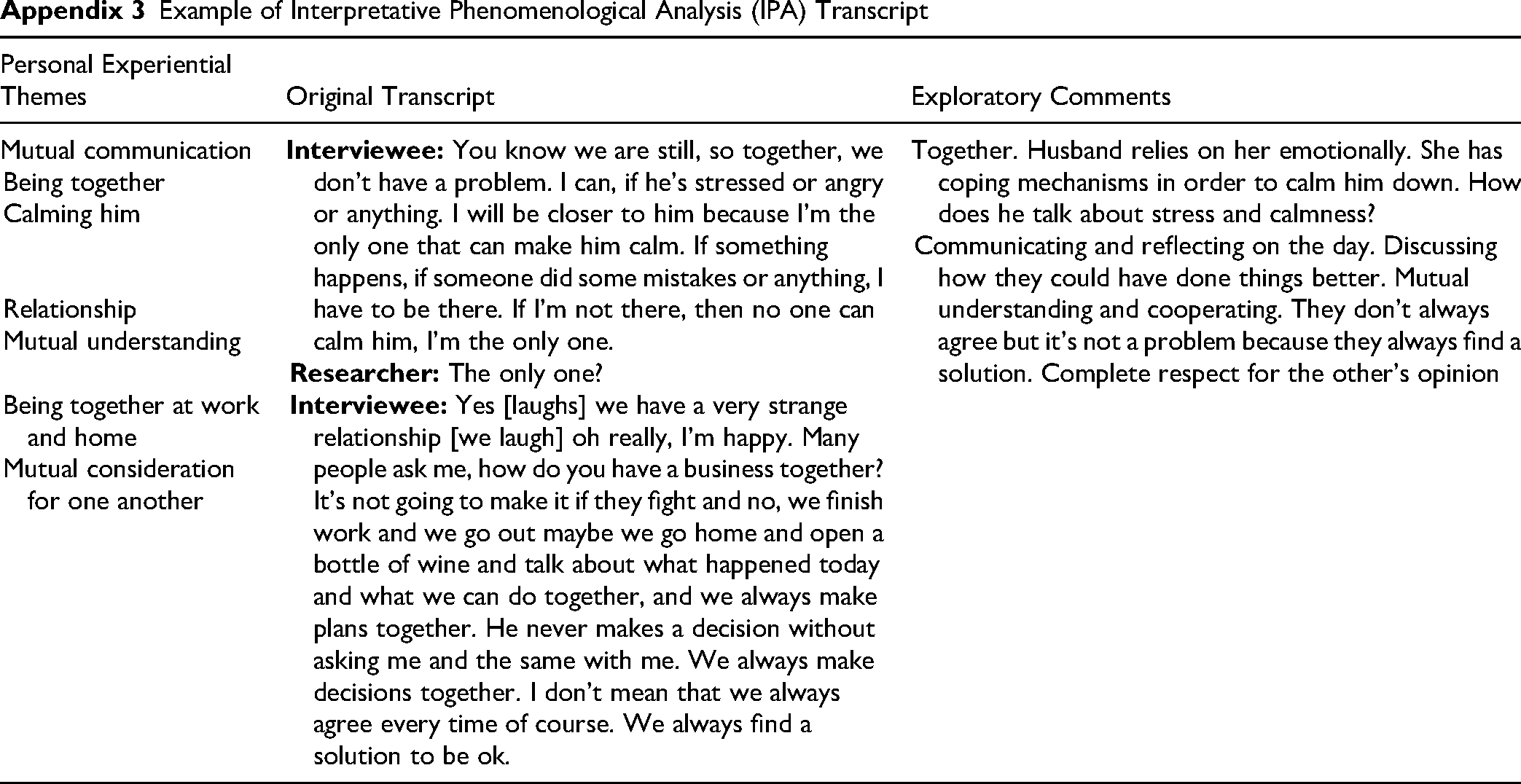
| Personal Experiential Themes | Original Transcript | Exploratory Comments |
|---|---|---|
| Mutual communication Being together Calming him Relationship Mutual understanding Being together at work and home Mutual consideration for one another |
Together. Husband relies on her emotionally. She has coping mechanisms in order to calm him down. How does he talk about stress and calmness? Communicating and reflecting on the day. Discussing how they could have done things better. Mutual understanding and cooperating. They don’t always agree but it's not a problem because they always find a solution. Complete respect for the other's opinion |