







Abstract
This study explores how corporate Project Management Offices (PMO) in project-based organizations navigate diverse transformation paths toward organizational agility. While agile transformation is often treated as a linear process guided by maturity models or prescriptive frameworks, our research challenges this assumption by applying the lens of equifinality—the idea that similar outcomes can be reached through multiple, context-sensitive pathways. Drawing on 11 in-depth case studies across diverse sectors, we identify four distinct PMO configurations that reflect varying levels of agility and project governance maturity. These configurations—Debutant, Traditional, Agile Supporter, and Agile Leader—illustrate how PMO functions not merely as passive structures, but as dynamic mediators of change. Our findings show that agile transformation unfolds through multiple trajectories shaped by structural constraints and cultural readiness. We argue that understanding PMO evolution through equifinality reframes agility as a contingent achievement—driven not by a singular target state, but by alignment between context, capability, and purpose.
Keywords
Increasingly, organizations are under pressure to adapt with agility and responsiveness to fast-changing environments (Bechtel et al., 2021; Mamédio et al., 2024; Thiry & Deguire, 2007; Hobday, 2000). The capability to innovate rapidly, implement new work methods, and develop sustainable and ethical products and services is now a key competitive concern (Geissdoerfer et al., 2018). This imperative is further amplified by the transformative impact of digitalization and AI on organizational structures and processes (Brock & Von Wangenheim, 2019), and by the growing recognition of learning capacity as a strategic asset (Eltigani et al., 2019).
Over the past two decades, this context of accelerating change has been accompanied by a widespread projectification of work (Artto et al., 2011; Thiry & Deguire, 2007), with Project-Based Organizations (PBOs) becoming more prominent. As a result, Project Management Offices (PMOs) have emerged as key actors across industries, including in sectors historically unfamiliar with project practices (Miterev et al., 2017; Prouska & Kapsali, 2021). These units are increasingly central to how organizations plan, govern, and implement strategic change.
Agile transformation has gained momentum as a strategic response to these pressures, especially for PBOs, which rely heavily on structured delivery models. A growing body of literature and frameworks promotes agility as a way to improve coordination, speed, and flexibility (Annosi et al., 2022; Carroll et al., 2023; Hoda et al., 2018; Goncalves et al., 2020). However, evidence of successful and sustained agile transformation across entire organizations remains limited, and most studies focus on isolated cases or IT-specific settings. Transformation journeys are often slow, resource-intensive, and fraught with ambiguity, highlighting a persistent gap between aspiration and execution (Dikert et al., 2016; Simard & Aubry, 2025).
When examined from an operational perspective, several issues remain unresolved. The meaning of agility as an organizational outcome, the indicators by which it can be observed or assessed, and the comparability of transformation trajectories across diverse contexts all continue to pose significant challenges. The literature indicates that, although the vision of agile transformation is widely shared, the pathways taken—and even the eventual outcomes—often diverge considerably across organizations (Carroll et al., 2023). These divergences merit closer examination as phenomena.
In this paper, we focus on the Project Management Office (PMO) as a strategic lens through which to analyze agile transformation in project-based organizations. Due to its formalized structure, cross-functional visibility, and mandate to coordinate strategic and operational activities, the PMO can be considered a semi-autonomous subunit within the broader organizational system, what some scholars refer to as a “meta-organizational actor” (Aubry et al., 2007, 2010). PMOs occupy a central but underexamined role in mediating organizational change: they are often tasked with translating strategy into delivery, standardizing project practices, managing portfolios, and coordinating major change initiatives (Aubry et al., 2010; Crawford, 2006; Desouza & Evaristo, 2006; Ferreira da Silva & José Rosamilha, 2025; Hurt & Thomas, 2009). As such, the PMO provides a valuable analytical vantage point for observing how agile principles are interpreted, adapted, or resisted across the organization (Aubry & Simard, 2023; Brunet et al., 2024; Simard & Aubry, 2025). Its position at the intersection of governance, operations, and strategy allows us to trace transformation dynamics that are both systemically embedded and operationally visible (Aubry et al., 2008; Crawford, 2006).
As prior studies have noted, scaling agile practices remains a persistent challenge (Carroll et al., 2023; Conboy & Carroll, 2019; Tallon et al., 2019). While many frameworks promise replicable paths to enterprise agility, relatively little is known about the variety of ways organizations actually adapt these methods, or the roles internal actors like the PMO play in shaping such adaptation (Patrucco et al., 2022).
Existing literature often centers on high-profile exemplars—Spotify, ING, or Netflix—relying on generalized narratives of success that may obscure the diversity of organizational experience. Comparative studies of transformation trajectories remain rare, especially those that move beyond IT departments or look at meso-level structures like the PMO. Even when organizations aim for similar end states, their transformation paths—and the roles their PMOs play in them—can differ sharply. Understanding these differences is crucial for developing a more context-sensitive theory of agility at scale.
To address this gap, we examine 11 large PBOs undergoing agile transformation. Each is analyzed through the lens of its corporate PMO to identify how agility is pursued, experienced, and configured. We argue that PMOs—often overlooked or seen as incompatible with agility—are in fact central mediators of transformation. Their trajectories reveal not a singular path, but multiple, viable configurations shaped by organizational context, maturity, and strategic priorities. By applying the lens of equifinality, we show that effective agility arises not from a universal blueprint but from context-sensitive adaptation, of which the PMO is both a driver and a reflection.
This paper explores how corporate PMOs evolve within transitions toward greater organizational agility, including—but not limited to—scaled frameworks. Agile transitions are often approached through maturity models or prescriptive roadmaps. In contrast, we adopt equifinality as a theoretical lens—the idea that similar outcomes may be reached via different paths. This perspective reframes variation not as deviation but as a meaningful expression of organizational adaptation. Rather than seeking a best practice, we focus on fit-for-purpose trajectories.
Guided by this lens, we ask: What configurations of corporate PMO transformation paths, in project-based organizations, emerge through the transition toward agility?
Theoretical Background
Agility in Project-Based Organizations
Agile principles have been spreading since the creation of the agile manifesto (Bechtel et al., 2021) to be integrated not only in software projects but, increasingly, and with varying degrees of success, more widely as a set of principles that facilitate dealing with and accepting changes in projects.
In agile project management, there is usually a strong emphasis on team empowerment for quick decision-making rather than formal channels of escalation (Highsmith, 2009; Patrucco et al., 2022). This difference is significant as it means that successfully shifting to agile project management often hinges on a preparatory culture shift, both from management and from the project team. For agile project management to be successful, management is required to give a higher level of autonomy to their team and the team is expected to find their own paths to a solution rather than relying on strong direction and guidance on how to achieve their goals. In this way, agile project management practices differ significantly from classic project management methodologies that PBOs are more accustomed to using and which are based on predictive project management processes.
Very few studies have looked at agility from an organizational point of view (Sharma et al., 2022; Spagnoletti et al., 2021). Those that have been undertaken generally focus on providing managerial recommendations to help practitioners with the agile transition. A summary of the most well-known and used agile frameworks for large-scale agile development was provided by Dingsøyr et al. (2019). The authors identified the characteristics of the frameworks and for each one, the most suitable organizational context. The frameworks are: Agile portfolio management, Disciplined agile delivery, The Kanban method, Large-scale scrum (LeSS), Nexus, and the scaled agile framework (SAFe). Although each framework incorporates pre-defined routines and is supported by specific tools, empirical evidence on the adoption, use, effectiveness, and challenges of these frameworks is still in its infancy (Carroll et al., 2023; Conboy & Carroll, 2019).
This shift is particularly consequential for project-based organizations, which have traditionally relied on structured, predictive delivery methods and established governance mechanisms to manage complexity across multiple projects. One of the organizational structures most directly implicated in managing this shift—yet often underexplored in the context of agility—is the corporate Project Management Office (PMO).
The Corporate PMO as a Lens on Organizational Agility
Introducing agile management practices in organizations has initiated a debate about the transition from classic plan-driven practices to a more agile way of doing projects (Bechtel et al., 2021; Boehm & Turner, 2003; Cram & Marabelli, 2018; Dikert et al., 2016; Sharma et al., 2022; Sidky et al., 2007; Šmite et al., 2023). One of the perspectives present in the literature also studies how contemporary firms rely on information systems to enhance organizational agility (Zhou et al., 2018; Küpers et al., 2013). A recognized challenge in this transition is how to balance the two approaches to take advantage of their respective strengths and, at the same time, compensate for their weaknesses (Boehm & Turner, 2003; Spagnoletti et al., 2021). To date, little research exists on how organizations can effectively scale agile practices within a PBO. Sidky et al. (2007) proposed a structured approach with four stages steering the trajectory of adopting agile practices and with it a measurement index representing the readiness of the organization, its ability to change, and where and how to start the transition. Qumer and Henderson-Sellers (2008) proposed an alternative framework of six levels named “agile adoption and improvement model,” which was later developed and extended (Cao et al., 2009; Sureshchandra & Shrinivasavadhani, 2008).
The nature and connectedness of governance at different levels of the organization have also been studied, leading to several theories that advance our understanding (Geraldi et al., 2022; Müller et al., 2019). Although there are similar goals, governance in agile project management is executed differently than governance in traditional project management (Luna et al., 2014; Meier & Kock, 2021). One key element of realizing the benefits of agility at scale is to find a balance between agility and stability. The backbone of that “stability” is, according to Aghina, De Smet, Murarka, et al. (2015a) and Aghina, De Smet, and Weerda (2015b), the development of an agile governance framework such as the Scaled Agile Framework (SAFe) (Ebert & Paasivaara, 2017; Eilers et al., 2022).
To further examine the journey of change that large organizations undergo in a transition to agile, it is to recall the purpose of such a change and to consider the existing mechanisms that fulfill the role of strategy execution and transformation in an organization. Structural change often accompanies a transition to agile but other factors are important in deciding to make such a transition. The reasons and triggers for moving to an agile orientation currently lack solid theoretical underpinnings; however, it represents a strategic decision. As such, scholars of strategy can help us to understand the relevant mechanisms at work. For example, Neilson et al. (2008) identify several predeterminants of successful strategy execution: clarifying decision rights, designing information flows, aligning motivators, and making changes to structure. In their experience, many organizations move too quickly to structural change, reaping only short-term benefits and foregoing the expected long-term gains. This theory has merit for our research study because shifting from a predominantly predictive organization to one with an embedded agile mindset can be perceived as a structural change in the organization, leaving the door open for many pitfalls if not undertaken with the associated predeterminant building blocks espoused.
To better understand how PMOs navigate this shift, it is essential to consider the underlying organizational conditions that shape their evolution—particularly their maturity and affinity for agile principles.
PMO Maturity and Agile Affinity
The PMO is a common organizational structure in a PBO that has evolved in form and function over the years. Many PBOs have invested internal resources to establish a strategic PMO as an organizational mechanism to facilitate effective multi-layer governance in a multi-project environment to deliver intended organizational benefits and strategic value from the projects undertaken (Too & Weaver, 2014). Although their importance has been debated with scholars arguing for and against their necessity, the persistence and growth of PMO in many industries suggest that they will continue to be popular for many years to come (Albrecht and Spang, 2016).
The trajectory of a corporate PMO is evolutionary and representative of the significant strategic moments in a company (Aubry and Hobbs, 2011; Black et al., 2009; Cooke-Davies et al., 2009; De Souza and Gomes, 2015). The evolution of the mandate of a PMO over time generally reflects the project management process maturity in the company. Few models in the literature have studied how to best adapt the PMO's value proposition to the project management process maturity level of the organization (Ko & Kim, 2019). Jack Duggal (2011) argues that because of the dynamic, complex environment, a PMO must adapt and become what he refers to as a “next generation” PMO. By this, he means that the PMO needs to move from a change management to a change leadership mindset and evolve from delivery of projects to benefits realization and a business value mindset. Konrad-Maerk et al. (2022) support these statements and further suggest that shared leadership skills from transformational to agile, encompassing empowerment, trust, openness, coaching, mindfulness, and empathy, are the important future leadership competencies that represent the desiderata needed to achieve sustainable results in today's uncertain climate. As PMOs evolve in response to environmental uncertainty and shifting strategic priorities, it becomes essential to understand how these shifts enable or constrain different pathways toward organizational agility.
From Agile Adoption to Organizational Agility
As a “keeper of the process,” Sliger (2007) states that the PMO must be expected to adapt. A transition of work processes from predictive to agile requires adaptation at every level of the organization. Based on a report from Tengshe and Noble (2007), the transition from a traditional-oriented PMO to an agile-oriented PMO can follow a top-down approach, starting from the executive level to support the portfolio and agile project teams. They propose that the “agile” PMO should bring in services such as agile training and capture appropriate metrics across portfolio and project teams.
Adopting agile practices at the level of an organization requires a period of transition that creates structural tensions (Gerster et al., 2019). To manage these tensions, project governance intrinsically becomes a key success factor by balancing the transition journey in terms of finding the right trajectory to follow and identifying the most appropriate end game for the organization. Until now, no generalizable research has focused on the various project governance considerations to be made when adopting an agile context at scale, i.e., beyond a very limited part of the organization (Lappi et al., 2018). A recommendation method allowing the identification of patterns of project management practices (agile—hybrid or waterfall) using an agility indicator is proposed by Bianchi et al. (2021). More recently, Carroll et al. (2023) have developed a complete study of the transition from the transformation to the normalization of large-scale agility.
Based on our analysis of the extant literature, there is a lack of agreement on the efficacy of the PMO as the appropriate governance mechanism to impart an agile mindset and expertise throughout an organization. Traditionally, the PMO has been the gatekeeper of predictive project management methods (Aubry et al., 2008, 2011). In the journey to agile, PBOs are having to consider whether their existing PMO is able to shift their mindset sufficiently to develop the expertise, will, and governance mechanisms to support the organization if it seeks to adopt a scaled agile structure (Nerur et al., 2005; Pinto & Ribeiro, 2018; Power, 2011).
Some scholars even ask the question whether the PMO has any role in agile project management (Pinto & Ribeiro, 2018; Power, 2011). Others have recommended the total transformation of a PMO to a novel structure called an agile office (Power, 2011) or an agile coordination office (ACO) (Pinto & Ribeiro, 2018) to better adapt to agility requirements. Then again, some researchers consider that the PMO role should be limited to one of only facilitating an agile transformation and that once agility is in place, it should step out of the way (Mitchell, 2017).
These contrasting perspectives reflect broader uncertainty in the literature about what agile transformation looks like in practice—and whether a single model can capture the diversity of organizational journeys. To interpret this complexity, we turn to the systems theory concept of equifinality.
Reframing Agile Transition Through Equifinality
Agile transformation in organizations is often presented as a response to increasing complexity, uncertainty, and the need for responsiveness in dynamic environments (Denning, 2018; Highsmith, 2009). In practice, however, the shift toward agility—especially at scale—is rarely uniform. Organizations vary significantly in their structure, culture, leadership, and strategic priorities, all of which influence the nature and outcome of transformation efforts (Cicmil et al., 2006; Kotter, 1996).
Corporate PMOs, in particular, play a complex role in this process. Situated at the intersection of strategic oversight and operational delivery, they act both as enablers and as subjects of agile transformation. Their involvement varies significantly across organizations—ranging from active architects of change to units that are restructured or even marginalized. This diversity highlights the need to better understand and conceptualize the variety of PMO transformation trajectories that unfold within project-based organizations (Simard & Aubry, 2025).
To explore this, we draw on the systems theory concept of equifinality (Bertalanffy, 1968; Kapsali, 2013), which posits that open systems can reach the same end state via multiple paths. This idea has been applied in organizational research to highlight how structurally different organizations may perform equally well if their internal elements align coherently with environmental demands (Gresov & Drazin, 1997; Katz & Kahn, 1978). Equifinality invites us to shift focus from idealized maturity models or linear change programs to more flexible, context-responsive processes of organizational adaptation (Venaik and Midgley, 2019).
In the context of agile transformation, equifinality helps us reframe the journey not as a standard roadmap, but as a set of divergent trajectories shaped by local conditions and strategic choices. It allows us to understand why some PMOs evolve into lightweight agile enablers while others take on an expanded coordinating role—or resist agility altogether. Rather than searching for a “best” PMO model, this perspective legitimizes variation and emphasizes alignment between structure, context, and purpose.
This theoretical framing underpins our empirical analysis of 11 project-based organizations navigating the move toward agility. We identify four distinct PMO configurations and examine the conditions and challenges associated with each. Equifinality provides the conceptual grounding to interpret these configurations not as deviations from a standard model, but as alternative expressions of agile transformation shaped by organizational complexity.
Methodology: A Multiple Case Study
We conducted a qualitative multiple-case study to explore how corporate PMOs in project-based organizations (PBOs) navigate transitions toward organizational agility. This approach aligns with our aim to understand emergent, context-dependent transformation trajectories and is consistent with calls for theory-building from qualitative inquiry (Eisenhardt, 1989; Yin, 1981). A multiple-case design enables analytical replication, providing variation in PMO maturity, organizational setting, and agile configurations. Each case was treated as an opportunity for either confirming or challenging emergent insights, following the logic of theoretical sampling and cross-case comparison (Eisenhardt, 1991; Glaser & Strauss, 1967).
Our epistemological stance draws on critical realism, recognizing that organizational change processes are shaped by underlying structures, actor interpretations, and contextual contingencies (Van de Ven, 2007). This aligns with our theoretical commitment to equifinality, which emphasizes the legitimacy of diverse transformation pathways.
Case Selection and Sampling Strategy
This study is based on a multiple-case design (Yin, 1981, 1984) intended to explore variation in PMO trajectories during organizational transitions toward agility. Case study research is well suited to questions of organizational process and variation (Eisenhardt, 1989; Langley, 1999). Following recommendations for theoretical sampling (Eisenhardt & Graebner, 2007), we selected cases based on their potential to provide insight into different pathways of agile transformation within project-based organizations.
Cases were selected based on three primary criteria:
The organization must operate as a PBO with a formal corporate PMO—i.e., project management is central to its core activities. The PMO must have existed for a minimum of 3 years, indicating sustained investment in project governance and sufficient maturity to have undergone meaningful strategic evolution. The organization must be engaged in an enterprise-level agile transformation—not limited to isolated teams or departments.
We sampled for maximum variation in industry, organizational size, agile maturity, and PMO evolution stage. Our aim was not to compare sectors per se but to explore a wide range of structural, cultural, and strategic contexts for PMO adaptation. The 11 organizations in our sample include both public and private entities across consulting, finance, retail, government, and technology sectors. Some had well-established PMOs; others had recently formalized the function as part of their agile transformation. This configurational diversity provided a rich foundation for theory development using the lens of equifinality.
While not all sampled organizations conform strictly to textbook definitions of project-based organizations (PBOs), each operated substantial project portfolios and maintained formal PMO structures. In line with recent scholarship on the hybridization of organizational forms (Miterev et al., 2017; Prouska & Kapsali, 2021), we include organizations that exhibit project-dominant logic in structure, governance, or delivery practices.
To capture a broad range of agile transition experiences, we deliberately sought sectoral and organizational diversity—including public institutions, global corporations, and mid-sized firms at varied levels of agile readiness. While the primary unit of analysis was the corporate PMO, some organizations had nested PMO structures or evolving mandates, which added analytical richness. Table 1 provides an overview of each case, including sector, PMO configuration, interviewee roles, number and duration of interviews, and the scope of agile transition. This snapshot helps to foreground the configurational variation that underpins our theoretical framing.
Organizational Profiles and Interviewee Information.
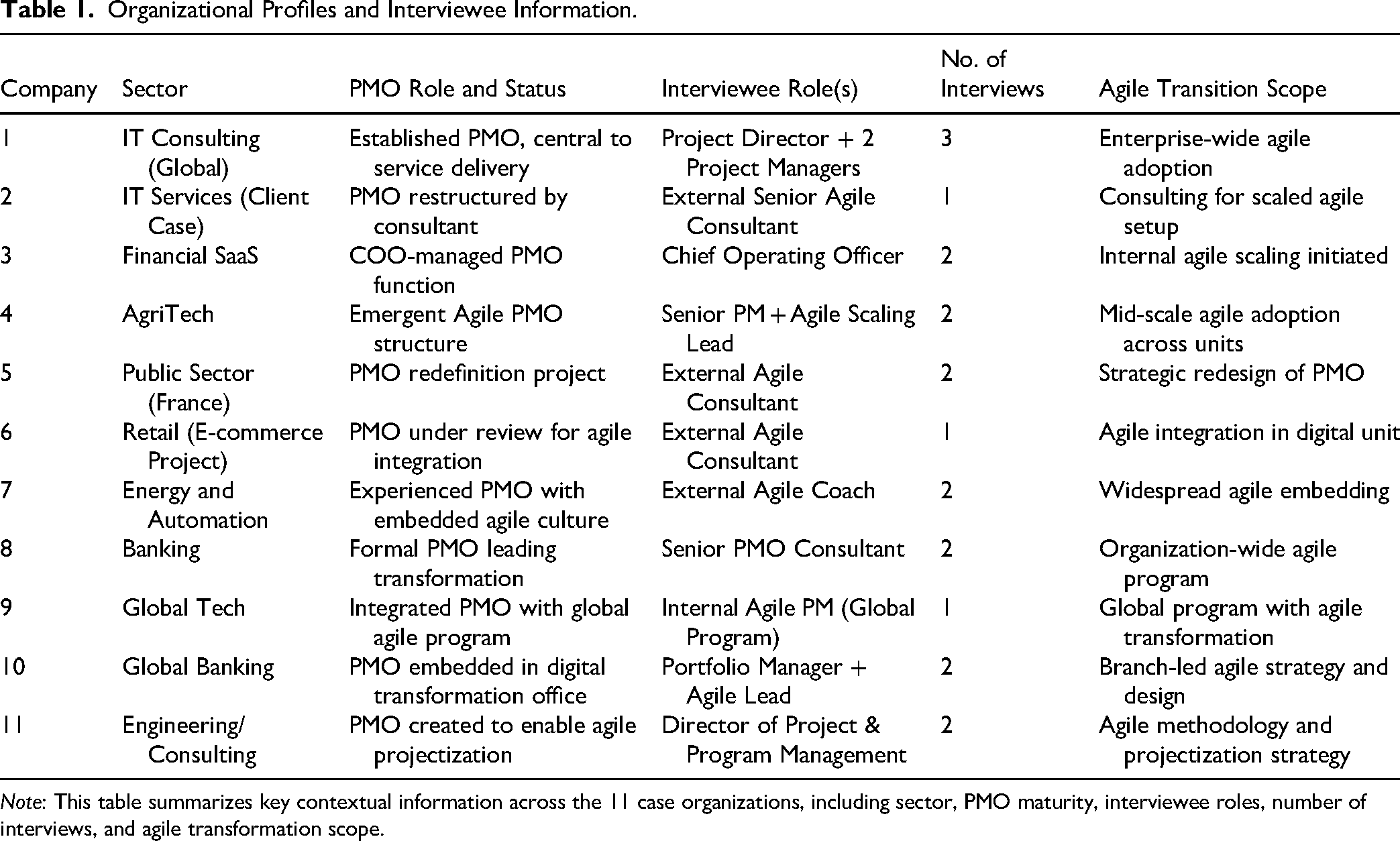
Note: This table summarizes key contextual information across the 11 case organizations, including sector, PMO maturity, interviewee roles, number of interviews, and agile transformation scope.
We adopted a purposive sampling strategy aimed at capturing diverse PMO trajectories rather than pursuing statistical representativeness. Our goal was to document variation across three temporal points: the organization's initial state, its current transformation status, and its envisioned future state. This design enabled us to trace how shared agility ambitions translated into distinct organizational pathways. While we prioritized configurational diversity across cases (rather than seeking classic theoretical saturation across the entire sample), we ensured thematic saturation within each case by continuing interviews until sufficient depth was achieved to reconstruct the PMO's transformation journey. This approach was supported by collaborative review and memoing among the research team (Glaser & Strauss, 1967), aligning with best practices in qualitative inquiry (Sutton & Callahan, 1987).
Data Collection
Primary data were collected through 20 semi-structured interviews with PMO directors, senior project managers, agile coaches, and external consultants. Interviews lasted 60–180 min and were conducted between March 2022 and September 2023. Several participants were interviewed more than once over a span of months, allowing for temporal depth and iterative follow-up. All interviews were conducted primarily in French, with a smaller number in English where international stakeholders were involved. To ensure consistency and accuracy, translations were reviewed by bilingual team members (native speakers of both languages), with particular attention paid to preserving project management terminology and contextual nuance.
All interviewees were selected for their deep experience with organizational agility and their strategic or operational role in the PMO. Particular attention was paid to ensuring that interviewees could articulate both their organization's current state and its transformation history—providing access to what we refer to as “organizational memory.” Participants were informed of the study's purpose and consented to audio recording and transcription.
We also gathered secondary data as organizational documents, including internal reports, PMO charters, executive briefings, and transformation roadmaps, selected for their direct relevance to the research questions and their capacity to illuminate organizational practices. These documents were confidential and reviewed collaboratively with interviewees during data collection sessions, which enhanced contextual understanding and helped validate key themes. Documents were used primarily for triangulation and were not coded separately unless they contained rich narrative or strategy-related content.
Documents were not coded line-by-line, but relevant excerpts were thematically cataloged to support both within- and cross-case comparison. When interviewees referenced specific tools, policies, or governance frameworks, we sought corroboration in these materials. This helped deepen our understanding of PMO roles and transformation logics, particularly where narratives pointed to strategic alignment or institutional memory.
Data Analysis and Cross-Case Comparison
We followed a three-step analytic process inspired by Miles and Huberman (1994): data condensation, data display, and drawing/verifying conclusions. Interview transcripts and documents were coded using both deductive codes (e.g., based on Hobbs and Aubry's (2005) five PMO functions) and emergent themes that surfaced during iterative reading.
Our analysis covered three time horizons: (a) pre-agile context, (b) transition period, and (c) projected future state. Within-case narratives were constructed for each organization, followed by cross-case comparison to identify patterns in PMO configurations, transformation strategies, and challenges encountered. We paid close attention to variation across contexts (public/private sector, internal/external actors, scale of operations) to support configurational interpretation.
Coding was conducted using a combination of manual thematic analysis and computer-assisted organization of data (Excel and Word). NVivo or similar software was not used, but a structured coding template based on a priori themes—such as PMO roles, agile adoption, transformation challenges, and governance maturity—guided the process. Emerging sub-themes were incorporated iteratively through memoing and collaborative discussion among the researchers. Coding occurred in two phases: first, within individual cases to develop rich narrative profiles, and then across cases to generate comparative insights and derive the four PMO configurations. This dual approach enabled us to preserve contextual richness while allowing pattern recognition across diverse organizational settings. Figure 1 illustrates the coding process, from data sources to theme development and final configuration outcomes.
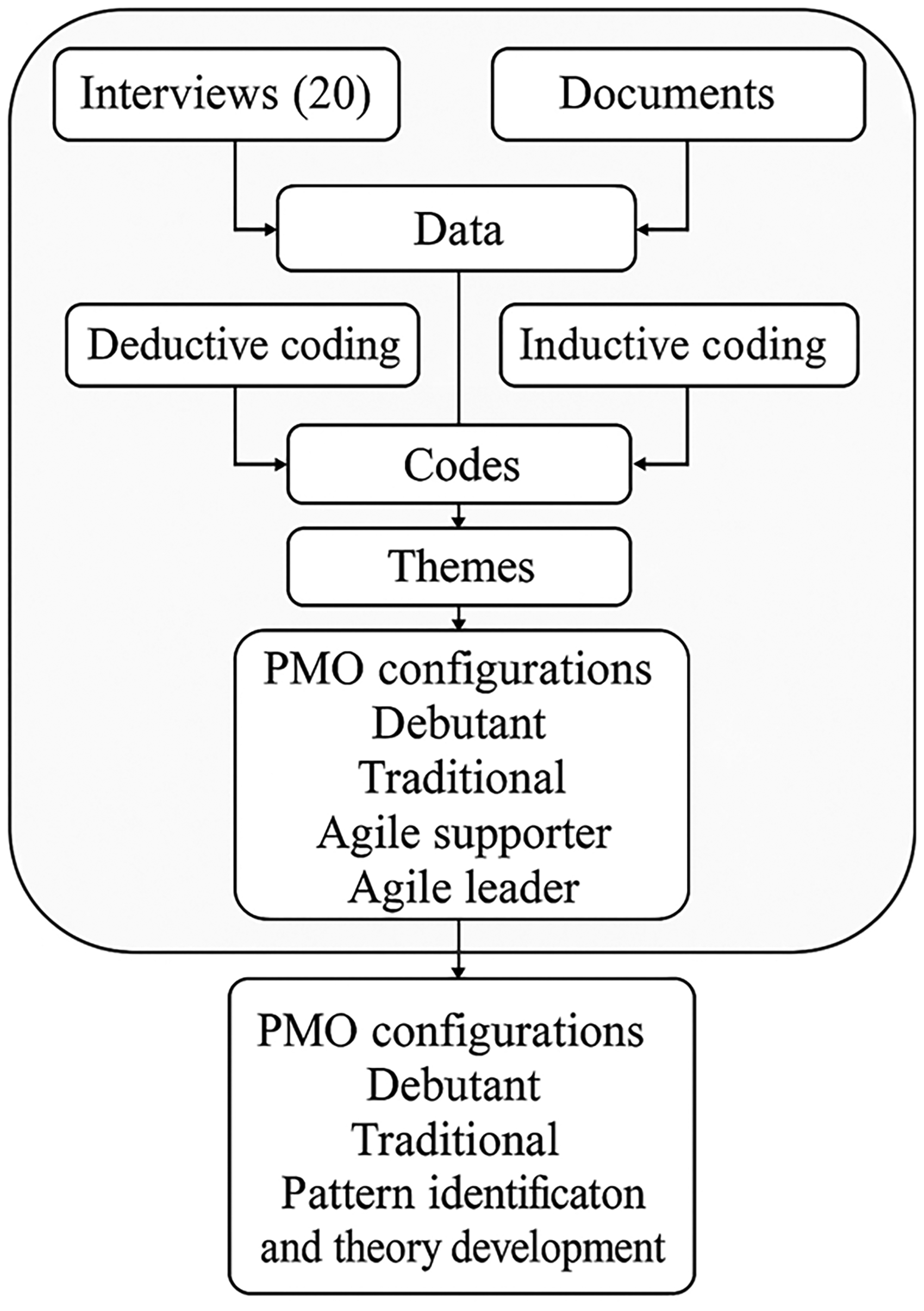
Data analysis process: from raw data to cross-case analysis and theory development.
To enhance rigor, the research team engaged in multiple rounds of data triangulation and peer debriefing, challenging each other's interpretations and returning to the data where necessary. This process ensured consistency across cases and validity of the identified configurations.
Scope and Limitation of the Methodology
Our goal was not to capture the entire organizational transition but to trace the evolution of the PMO as a window into wider agile transformation dynamics. We acknowledge that this focus narrows our scope, but it allows for a deep, theoretically grounded analysis of a key organizational actor often overlooked in agile research.
Some of the organizations in our study, while not “pure” PBOs by traditional definitions, operate substantial project portfolios and maintain formal PMOs with enterprise-wide responsibilities. This reflects the growing hybridization of organizational forms in practice and supports our inclusion criteria. Nonetheless, future research could apply tighter PBO classification thresholds.
Findings
Challenges Faced by the PMO During Agile Transformation
Across the 11 organizations studied, interviewees described a variety of tensions that shaped their journey toward greater organizational agility. While each context was unique, several recurrent challenges emerged, shedding light on the difficult recalibration that many PMOs must undertake when operating in agile environments.
The transition challenges we identified were derived through cross-case comparison of coded narratives. After constructing within-case memos, the research team conducted iterative clustering of codes—such as “scope ambiguity,” “trust deficit,” “PMO value shift,” and “cultural friction”—into higher-order themes. These themes were then traced back to the original data to confirm grounding in participant language. Summary tables (e.g., Table 2) and quote extracts served as anchors to ensure consistency between empirical material and analytical claims.
PMO Narratives Across 11 Organizations. Case profiles with embedded interview quotes illustrating key challenges and agile practices.
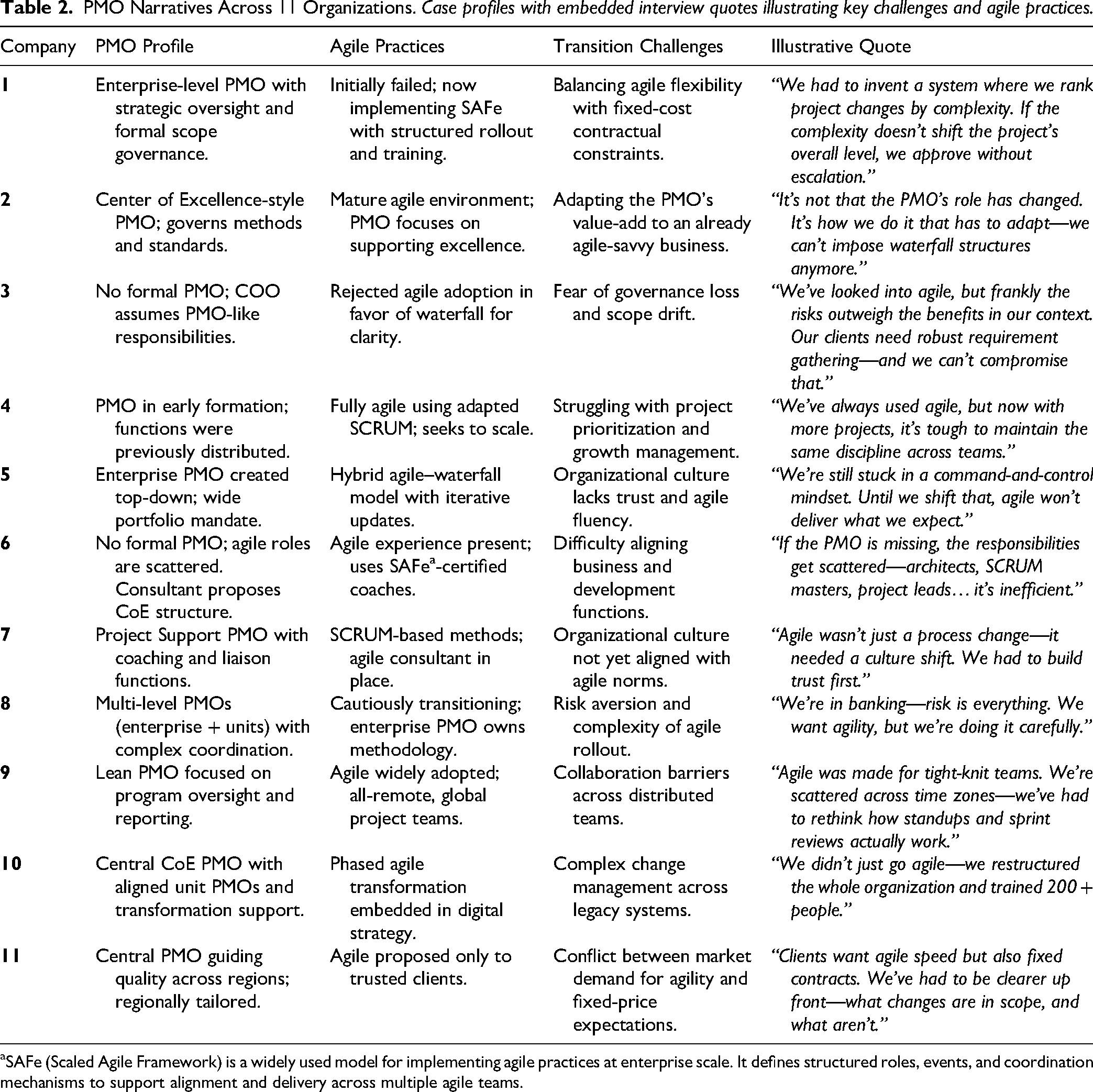
SAFe (Scaled Agile Framework) is a widely used model for implementing agile practices at enterprise scale. It defines structured roles, events, and coordination mechanisms to support alignment and delivery across multiple agile teams.
One of the most commonly cited difficulties relates to scope and cost management under agile conditions. For PMOs accustomed to predictive project planning, the more fluid and iterative nature of agile work processes introduced uncertainties that were difficult to reconcile with fixed-price contracts or strict compliance regimes. Interviewees in companies with external clients or tight regulatory environments noted how agile approaches complicated contractual commitments. In Company 1, for instance, project leads developed a complexity-ranking system to help predefine acceptable levels of change without escalating every modification to senior decision-makers. Others, such as Company 3, opted out of agile altogether, concluding that the benefits did not outweigh the perceived risks. “The risks brought by agile aren’t worth the potential benefits,” the interviewee stated, reflecting a broader skepticism rooted in early negative experiences with agile.
Beyond operational hurdles, several organizations raised questions around their readiness—both technical and cultural—to undertake a large-scale agile transformation. While some had prior exposure to agile practices in pockets of the organization, others struggled to mobilize internal belief in its value. For Company 8, the issue was not a lack of tools or expertise, but hesitation at the executive level about whether agile could be adopted “without taking on unnecessary risk.” Similarly, Company 3's earlier attempt at agile had ended in costly overruns, making stakeholders wary of revisiting that path.
As organizations began to engage with agile approaches more seriously, many found that the role of the PMO itself came under scrutiny. Traditional responsibilities such as scope definition, progress monitoring, and governance no longer aligned neatly with agile practices focused on autonomy, flexibility, and team-led decision-making. In Company 2, the interviewee argued that “the role doesn’t inherently change, but the approach must,” emphasizing that PMOs still had a place—but would need to reframe their value proposition. Company 5, which had already established a mature PMO, acknowledged that moving beyond waterfall required “less emphasis on upfront scope definition” and a stronger focus on coaching and facilitating adaptive learning loops.
This redefinition of the PMO's mandate was often contingent on deeper organizational capabilities. Agile transformation requires teams that are not only technically skilled but also able to operate with high levels of trust, initiative, and cross-functional collaboration. In Companies 9 and 10, the presence of these capabilities helped enable more ambitious transitions. However, even in well-resourced organizations, agility was frequently constrained by gaps in leadership or culture. Company 5, for example, cited a lack of “mutual trust, strong listening skills and mastery of agile methods” as key inhibitors to its progress—suggesting that maturity in tools and processes alone is not sufficient.
Cultural alignment emerged as a critical enabler—or blocker—of transformation. Several interviewees underscored the importance of psychological safety and openness to feedback. In Company 7, the PMO was positioned as a cultural mediator, helping to bridge the gap between business units unfamiliar with agile and project teams tasked with delivering in new ways. “Company culture has to be conducive to open collaboration prior to changing processes and methodologies,” the interviewee noted, reinforcing the idea that transformation is as much about values as it is about methods.
Finally, PMOs were often challenged to translate agile ambitions into coherent, strategically aligned transformation efforts. This required navigating organizational complexity and adapting agile frameworks to fit the unique structures of their environments. In Company 10, this meant not only leading agile initiatives but embedding them within a broader digital transformation strategy, with dedicated training programs and a 3-year change roadmap. In Company 8, the presence of multiple interacting PMOs made coordination more difficult, requiring careful articulation of roles and responsibilities to avoid duplication and drift.
Together, these challenges illustrate the layered complexity of agile transitions in project-based organizations. They also reinforce the relevance of the equifinality lens: despite shared goals around agility, organizations face distinct constraints and pursue different routes—each shaped by their PMO's structure, culture, history, and leadership dynamics.
To enhance transparency and strengthen the traceability of our analysis, Appendix Table A1 provides a detailed overview of the qualitative coding process. The table summarizes how recurring first-order codes identified across interviews were progressively grouped into higher-order themes, which subsequently informed the development of our analytical dimensions. In addition, the table includes illustrative participant quotes that exemplify the underlying meanings and experiences captured by each theme. These quotations not only provide empirical grounding for the interpretation of the data but also highlight the core tensions and contextual nuances that shaped PMOs’ trajectories toward organizational agility. As such, Appendix Table A1 serves both to demonstrate the rigor of the coding process and to support the contextualization of the challenges discussed in the first part of the results.
PMO Profile Configurations in Agile Transformation
The diversity of challenges faced by the PMOs in our study reflects the broader complexity of transitioning toward organizational agility. To interpret this variation, we identified four distinct configurations of PMO roles that emerged across the 11 cases, each situated along two key dimensions: their affinity for agile project management approaches, and their overall maturity in project governance and leadership (cf. Appendix Table A2).
This configurational approach is grounded in the concept of equifinality. Rather than presuming a single optimal path, we recognize that different PMOs—based on their internal resources, strategic positioning, and organizational culture—can play different roles in facilitating (or resisting) agile transformation. Some act as change leaders, others as supporters, while some remain anchored in traditional practices. These positions are not fixed. In several cases, PMOs evolved significantly over time, shifting from one role to another as the organization adapted to new demands.
Figure 2 presents a two-by-two matrix that summarizes the four PMO configurations identified in our research. The horizontal axis represents the degree of project management maturity (Gartner, 2012), incorporating elements such as structural governance, decision-making authority, and strategic alignment. The vertical axis reflects the PMO's affinity with agile project management approaches, based on the tools, methods, and mindsets adopted. The resulting quadrants—Debutant PMO, Traditional/Predictive PMO, Agile Supporter PMO, and Agile Leader PMO—represent ideal types observed across the data.
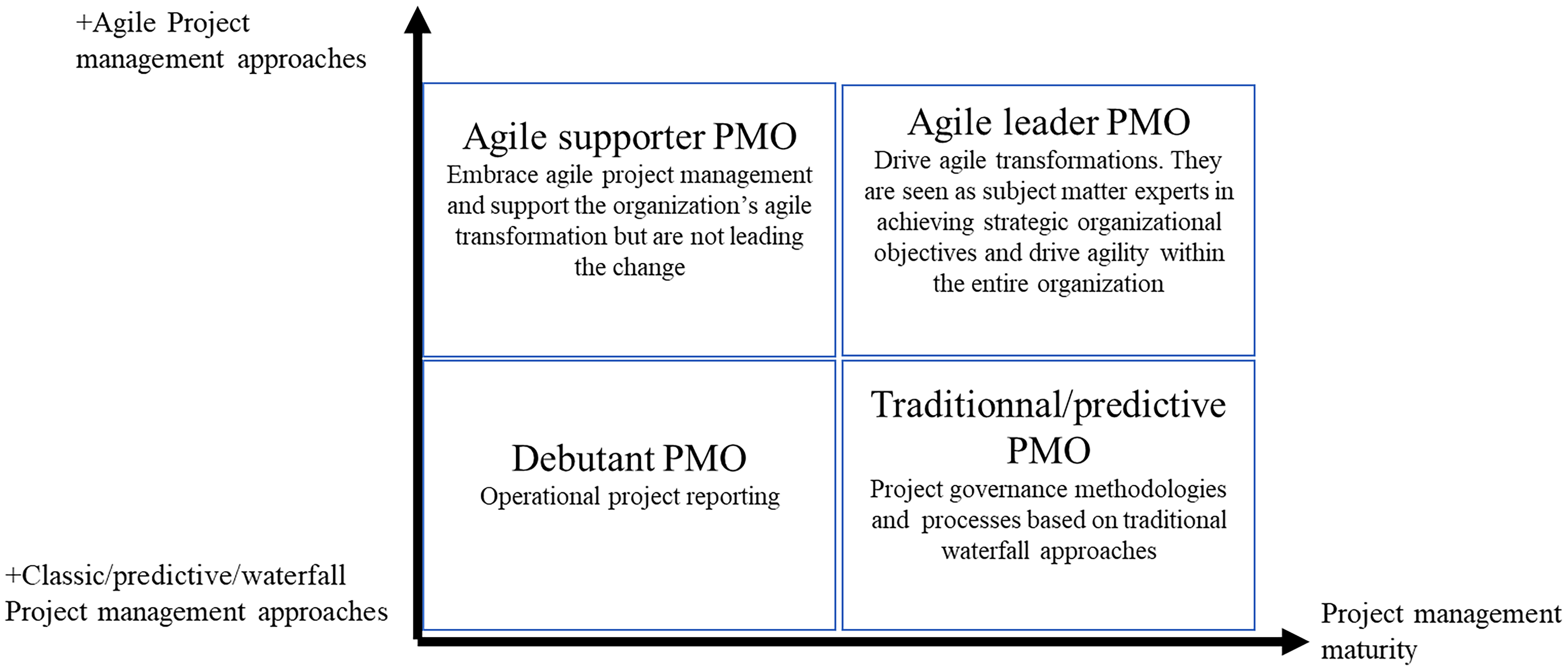
PMO configurations in organizational agile transformation. This two-by-two matrix maps four ideal PMO configurations based on their agile affinity and governance maturity. It provides a diagnostic tool for analyzing how PMOs support or lead organizational agility.
While these configurations are analytically distinct, they are not mutually exclusive or static. Several PMOs in our sample evolved over time, combining elements from multiple quadrants or moving from one position to another. For example, an organization may begin with a traditional PMO and, through investment in training and leadership alignment, develop into an agile supporter or leader PMO. This reinforces our core theoretical argument: there is no single trajectory to success. Instead, PMOs adopt different roles depending on their starting point, organizational context, and strategic priorities.
Figure 2 thus provides not only a descriptive framework but also a diagnostic tool for organizations seeking to understand and navigate their own agile journeys. In the following section, we use this model to analyze how PMOs in the 11 case organizations moved between configurations over time.
To illuminate how corporate PMOs navigate agility-oriented transformations, we synthesized the case narratives into a comparative overview (Table 2). Each row presents a snapshot of the PMO's structural role, its adoption of agile practices, the principal challenge it faces during transition, and a quote from the interview that captures the essence of its experience. These quotes were selected through close reading and coding, representing recurring tensions or strategic dilemmas voiced across multiple cases. This table does not simply describe organizational context—it exemplifies how practitioner accounts informed the derivation of key themes and PMO configurations. Consistent with the lens of equifinality, these diverse expressions of agility are not treated as deviations from a standard model, but as context-specific pathways shaped by organizational logic and constraints.
Comparative Case Analysis: PMO Journeys Toward Organizational Agility
Building on the four PMO configurations identified, we now examine how the 11 organizations in our study followed different paths toward context-specific forms of agility. Figure 3 maps each case's trajectory within the configuration matrix, offering a comparative perspective on the evolution of the PMO's role in agile transformation. The movement between configurations reflects diverse starting points, strategies, and organizational constraints—illustrating how PMOs evolve in response to internal and external pressures.
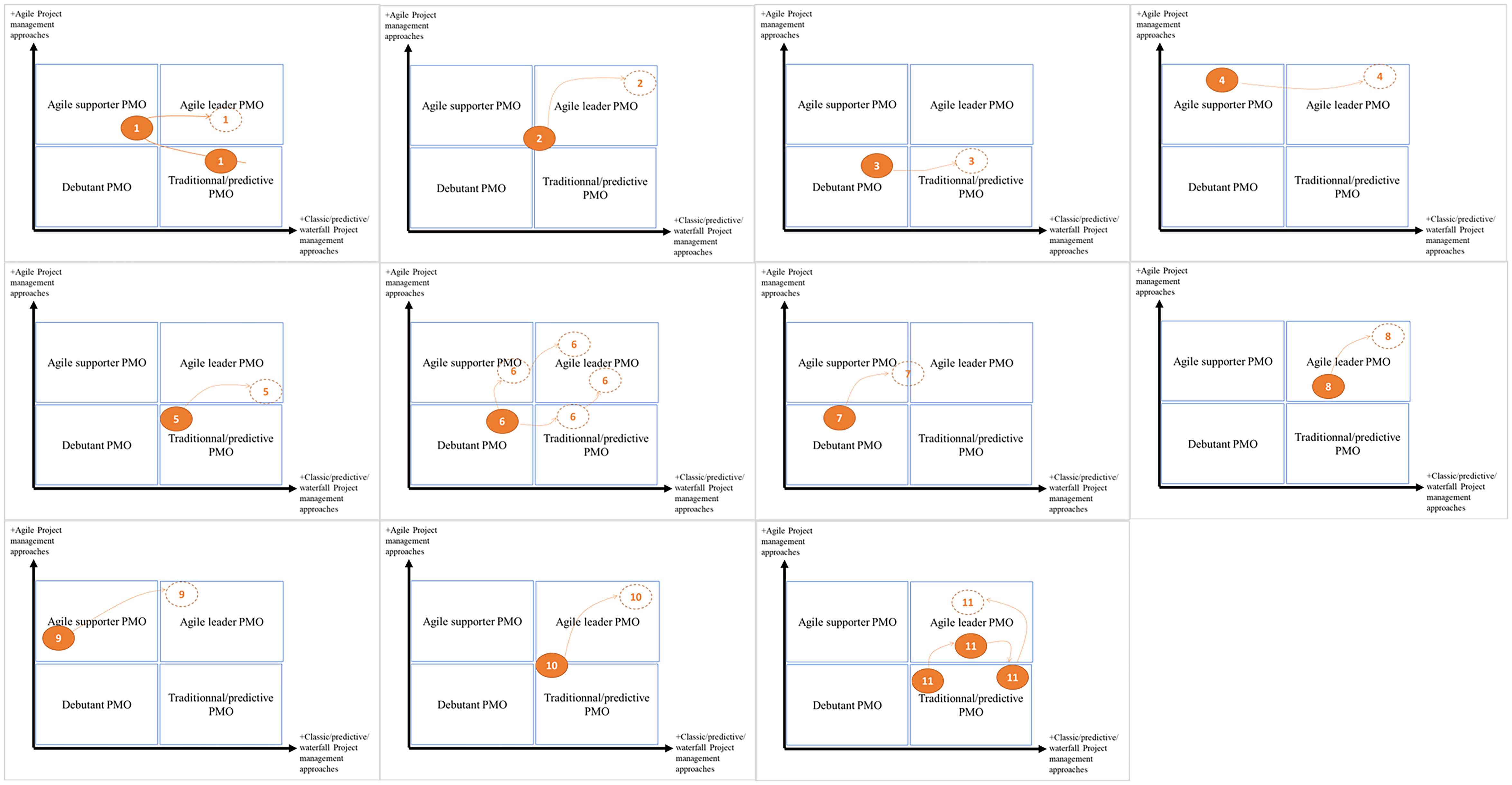
Diverse PMO transformation trajectories toward context-specific agility across 11 case organizations. This visual summary shows how each case evolved through different PMO configurations over time, illustrating context-dependent pathways toward agility and reinforcing the paper's equifinality lens.
What becomes immediately clear from this analysis is that no single pathway dominates. Instead, we observe a variety of trajectories—vertical, horizontal, and diagonal—that reflect different organizational logics. Some PMOs began in a more traditional or predictive orientation and evolved toward agile leadership (e.g., Companies 1 and 10). Others remained in supporting roles or faced resistance that slowed or stalled their transformation (e.g., Companies 5 and 8). Still others, like Company 3, opted not to pursue agile at all after early negative experiences. This variation reinforces the equifinality principle at the heart of our study: similar outcomes—in this case, effective agile contribution—can be achieved through different paths, depending on context.
In several cases, movement between configurations aligned with an increase in project management maturity and stronger alignment between PMO activities and corporate strategy. Companies 1 and 2, for instance, achieved an Agile Leader PMO configuration after developing strong governance processes and embedding agile roles and practices throughout the organization. Their journeys were characterized by clear executive sponsorship, strategic vision, and a deliberate capability-building process.
Company 10 followed a similar upward trajectory, combining agile implementation with broader digital transformation efforts and structured change management. Yet even in these more linear paths, challenges remained. Company 5, despite having an enterprise-level PMO and executive support, struggled to progress due to cultural obstacles, including “lack of mutual trust, strong listening skills, and mastery of agile methods.” This underscores that maturity in structure alone is insufficient; behavioral and cultural factors play a central role in enabling agility.
In contrast, some organizations followed more horizontal or lateral transitions. Company 6, for example, expanded the PMO's influence across departments without substantially increasing its formal authority or strategic role—developing what we term an Agile Supporter PMO. Similarly, Company 7's PMO, while heavily involved in project coaching and framework support, lacked the executive proximity to shape high-level decisions, limiting its ability to become a true transformation driver.
Company 8 presents a more complex picture. With multiple interacting PMOs, each at varying levels of maturity and agile alignment, its journey reflects the layered reality of large matrixed organizations. While the enterprise PMO demonstrated agile leadership qualities, the unit-level PMOs remained largely in support roles. This case illustrates that transformation can be unevenly distributed, with different parts of the organization operating at different stages.
Notably, only a few organizations in our study pursued what might be described as a “diagonal evolution”—increasing both agile affinity and maturity simultaneously. Companies 9 and 11 are illustrative here, as they developed new structures, practices, and cultural expectations in tandem. These transformations were enabled by iterative experimentation, adaptive learning, and strategic recalibration based on feedback loops.
Taken together, these cases point to three dominant patterns of PMO evolution in the context of agility-oriented transformation:
These trajectories offer practical insight for organizations considering or currently undergoing agile transformation. They suggest that success depends less on conforming to a predefined model than on achieving internal alignment between agile practices, governance maturity, and strategic goals. PMOs are not merely passive participants in this process—they are active agents whose configuration and evolution shape, and are shaped by, the wider transformation agenda.
These insights were not abstracted from framework application alone, but grounded in the lived accounts of PMO leaders and agile practitioners across diverse organizational settings. By closely linking coded narratives to our theoretical lens, we offer a grounded explanation of how agility unfolds through PMO configurations.
In this way, Figure 3 becomes not only a map of past journeys but a tool for navigating future ones. By situating their current configuration and comparing it to the journeys of others, PMOs and their parent organizations can better anticipate the challenges and opportunities ahead.
To clarify the analytical pathway, Appendix Table A1 presents the full data structure, showing how first-order codes and representative quotes were clustered into second-order themes and eventually synthesized into the four PMO transformation trajectories. Appendix Table A2 then maps how individual PMOs were positioned along the axes of governance maturity and agile affinity, based on these thematic clusters. Together, these two tables establish the empirical foundation for interpreting each PMO's journey through the configurational space and ensure that the identified configurations are grounded in both data and theory.
Discussion
Our study set out to explore how corporate PMOs in project-based organizations navigate the transition toward scaled agility. Drawing on the principle of equifinality, we examined how similar transformation ambitions can unfold through distinct yet viable trajectories, shaped by each organization's maturity, cultural context, and strategic imperatives. Importantly, our study does not seek to advance a full process theory of organizational transformation. Rather, it contributes to understanding the configurational patterns through which transformation toward organizational agility manifests in project-based organizations. The analysis highlights the plurality of transformation pathways and the contingent interplay of structural and contextual factors that shape these pathways—rather than focusing on the fine-grained temporal sequencing of change events. Within this configurational perspective, we identify four distinct PMO configurations—Debutant, Traditional, Agile Supporter, and Agile Leader—each representing a coherent and adaptive response to local organizational demands. These configurations reflect the diversity of roles and positions that PMOs can assume, depending on their leadership alignment, structural embeddedness, and level of governance maturity. By articulating these alternative configurations, the study contributes to a comparative and contingent understanding of PMO transformation, illuminating how multiple legitimate routes toward organizational agility coexist within the broader landscape of project-based organizations.
The theory of equifinality enables us to reframe these findings. It shifts the analytical lens away from maturity models and best practice roadmaps, and toward a more nuanced understanding of transformation as configuration. From this perspective, agility is not a fixed destination—nor is scaled agility necessarily the goal for all PMOs—but rather a situated outcome achieved through an interplay of enabling conditions, institutional pressures, and internal choices. Each PMO configuration can therefore be viewed as one of several viable expressions of an agile evolution, aligned with organizational context rather than universal benchmarks.
This theoretical stance also helps make sense of the five recurring challenges identified in our cross-case analysis. These challenges—ranging from governance tensions to value alignment and leadership discontinuity—are not simply barriers to be overcome but shaping forces that influence each organization's route and rhythm of transformation. In this way, our study extends the conversation about agile adoption by emphasizing the plurality and legitimacy of diverse transformation paths, and by highlighting the active role of PMOs in interpreting and negotiating that complexity. These results indirectly align with the findings of recent studies by Simard and Aubry (2025) regarding the tensions and paradoxes generated by agile transformation within organizations. The PMO emerges as a central subunit particularly affected by these tensions, serving as a focal point where competing logics and practices intersect. This research contributes to the literature on agile transformation and PMO evolution in several ways. First, we extend understandings of agility in project-based organizations by showing that agile scaling is not a linear journey but an emergent and contingent process. Unlike prior research that focuses on maturity models or binary classifications of “agile” versus “not agile,” our findings offer a configurational view of PMOs as evolving structures navigating competing demands (Dikert et al., 2016; Lappi et al., 2018).
Second, by mobilizing the concept of equifinality, we respond to recent calls in organizational theory to better account for plurality and contingency in transformation processes (Gresov & Drazin, 1997; Riis et al., 2019). Our analysis shows how similar organizational aspirations—such as increased responsiveness, innovation, and autonomy—can produce different PMO forms depending on internal and external conditions (Pemsel & Wiewiora, 2013). Equifinality thus proves useful not just as a descriptive tool, but as a conceptual frame for theorizing dynamic alignment in organizational change.
Third, we contribute to debates about the role of the PMO by moving beyond static typologies. While earlier studies (e.g., Dai & Wells, 2004; Hobbs & Aubry, 2005) categorize PMOs based on structure and function, our study traces transitional movement—capturing how PMOs morph in response to their environment and the demands of agile transformation. This dynamic perspective repositions PMOs as active agents of organizational sensemaking, not merely administrative or controlling bodies.
While many of the organizations in our study expressed ambitions to move toward scaled agile frameworks, our findings do not suggest that this is the only—or even the most desirable—end state. In fact, our configurational analysis highlights how different PMOs strategically interpret and enact agility in ways that align with their organizational context. For some, this involved embedding agile practices within specific project domains; for others, it meant supporting enterprise-wide transformation.
From an equifinality perspective, success is not defined by reaching a predefined agile maturity level or fully implementing a framework like SAFe, but by achieving alignment between internal capabilities, project goals, and external demands. This opens space for hybrid, contextual, or even conservative approaches to agility to be seen as legitimate and effective, particularly in organizations where stability, compliance, or scale impose additional constraints.
We therefore caution against treating scaled agility as a universal goal. Instead, we advocate for an approach that emphasizes fit-for-purpose transformation, where agility is one of several possible means to deliver strategic and project success. Furthermore, our study aligns with the literature, which primarily highlights the active role of the PMO in driving strategic innovation and digital transformation within organizations (Artto et al., 2011; Simard & Aubry, 2025). Although these studies adopt an intra-organizational perspective, our findings converge on the importance of contextualizing transformation processes. The transition toward agility cannot be regarded as an end in itself; rather, our comparative analysis reveals a strong complementarity between organizational maturity, mastery of agile approaches, and the broader organizational context. Together, these factors shape the PMO's transformation trajectory, which, in turn, mirrors the evolution of the parent organization.
While PMOs can be enablers of agility, our findings also highlight the risks of misalignment—between mandate, culture, and strategic intent. Our study offers several insights for PMO leaders, transformation teams, and organizational designers navigating agility-oriented change. The core implication is that there is no single best practice or universal roadmap to achieving organizational agility. Instead, transformation efforts must be calibrated to the organization's current configuration—its structure, maturity, cultural dynamics, and strategic priorities. This insight is supported by the comparative PMO trajectories visualized in Figure 3, which show how different configurations align with distinct transformation strategies. The diversity of PMO trajectories observed in this research supports a fit-for-purpose approach, where success depends on internal coherence and contextual alignment rather than conformance to prescriptive models.
Practically, the PMO configuration matrix (Figure 2) can serve as a diagnostic tool. PMO leaders may use it to assess their current role and aspirations in relation to agile maturity and governance capabilities. For example, an Agile Supporter PMO may seek to expand its influence by investing in coaching capabilities or securing closer alignment with executive decision-makers. Conversely, a Traditional PMO facing cultural resistance to agility may need to rethink not only its methods but also how it communicates value to stakeholders. The matrix encourages reflection: not “how agile are we?” but “what kind of agility fits our context, and what role should the PMO play in that?”
Organizations should also recognize that challenges such as scope instability, role ambiguity, or governance tensions are not universal hurdles to be simply “overcome.” Rather, they are contextual factors that shape the form and pace of transformation. Our findings show that successful PMOs often adapt their mandate, processes, and cultural positioning instead of trying to impose predefined frameworks. Some become incubators of experimentation; others serve as orchestrators of scaled initiatives. This is also consistent with recent findings reported by Brunet et al. (2024).
We also highlight the importance of sequencing. Organizations that attempt to leap into large-scale agile implementation without first strengthening governance maturity, leadership alignment, or cultural readiness are more likely to encounter resistance or failure. By mapping their current configuration and identifying realistic transition pathways—vertical, horizontal, or diagonal—they can design more deliberate and sustainable change programs. Rather than defaulting to frameworks such as SAFe or LeSS, PMOs should clarify their strategic purpose within the organization's agility-oriented transformation and evolve their role accordingly.
These findings not only deepen our theoretical understanding of PMO evolution but also provide a grounded basis for reflection, planning, and adaptation in practice. In the concluding section, we reflect on the broader implications of our work and suggest directions for future inquiry.
Limitations and Opportunities for Future Research
This study is based on 11 case studies drawn from a diverse set of sectors, including financial services, public administration, and retail. While each organization operated with a substantial project portfolio and a formally designated PMO, not all conform neatly to classic definitions of project-based organizations (PBOs). This raises important boundary considerations. Future research could further explore how organizational structure—particularly in hybrid or matrixed environments—influences the applicability and evolution of PMO roles during agile transformation.
Methodologically, our analysis relies primarily on retrospective interviews and documentary materials. While this approach enabled access to rich narratives and reflective insight, it is also susceptible to recall bias and post-hoc rationalization. Future studies might employ real-time, longitudinal, or ethnographic methods to observe transformation processes as they unfold, capturing the emergent dynamics of change and the tensions that arise in situ.
Finally, while this study centered on the PMO as a focal unit of analysis, agile transformation is inherently multi-level. The trajectories we observed were shaped not only by PMO structures and leadership but also by middle managers, delivery teams, and external consultants. Future work could unpack these interdependencies to better understand how influence, authority, and learning diffuse across organizational layers. This could offer a more granular perspective on how different actors co-construct the pathways—and obstacles—of agility-oriented transformation.
It is also worth noting that while all organizations in our study maintained formal PMOs and substantial project portfolios, some reflected hybrid structures rather than textbook PBOs. This variation is consistent with our equifinality framing and reflects the diversity of real-world project governance contexts.
This study explored how corporate PMOs in project-based organizations navigate the transition toward greater agility. Drawing on 11 diverse case studies and guided by the concept of equifinality, we identified four distinct PMO configurations—each representing a viable, context-sensitive response to the challenges of agile transformation. Rather than unfolding through a singular roadmap, transformation in our cases emerged as a process of organizational reconfiguration shaped by maturity, leadership, structural dynamics, and evolving interpretations of agility.
The equifinality lens helped us recast this diversity as meaningful rather than deviant. PMOs did not all move in the same direction, nor did they assume uniform roles. Some led the transformation, others supported it, and still others remained rooted in traditional practices. These trajectories reflect ongoing negotiations between control and autonomy, standardization and adaptation. Our analysis positions the PMO not as a relic of pre-agile bureaucracy, but as a site of strategic sensemaking and organizational learning.
Crucially, we caution against treating scaled agility as an inevitable or ideal endpoint. In many organizations, hybrid models or selectively agile practices may offer better alignment with operational realities and strategic goals. Success, in this view, lies not in conforming to a framework but in crafting a fit-for-purpose path to agility.
Future research might further investigate how PMOs shape and are shaped by different transformation logics, particularly in highly regulated or operationally complex sectors. Longitudinal and multi-level approaches would deepen our understanding of how PMO configurations evolve over time and interact with broader organizational dynamics. Such insights can help organizations navigate the uncertainties of agile transformation with greater awareness, flexibility, and strategic intent. Comparative tools like Figure 2 offer a practical foundation for mapping, reflecting on, and recalibrating their own transformation journeys.
Footnotes

Author's Note
Robert Wisnewski is also affiliated with SKEMA Business School, Université Côte d'Azur, France.
Funding
The authors received no financial support for the research, authorship, and/or publication of this article.
Declaration of Conflicting Interests
The authors declared no potential conflicts of interest with respect to the research, authorship, and/or publication of this article.
Appendix Table A1. From Codes to Themes: Illustrative Patterns Across Cases.
Note: Quotes below are paraphrased for clarity and illustrative purposes. They summarize sentiments expressed by participants across multiple interviews rather than verbatim excerpts.
Appendix Table A1 outlines the qualitative coding process, showing how recurring codes were consolidated into higher-order themes that informed the analytical dimensions. It also includes illustrative participant quotes that ground the analysis empirically and reveal the contextual tensions shaping PMOs’ trajectories toward organizational agility. The table thus demonstrates the rigor of the coding process and supports the contextualization of the challenges discussed in the results.