







Abstract
Organized crime has incommensurable impact on economies and societies, yet criminal organizations and careers have very scarcely been studied in management literature. To do so, we elaborate on the concept of status, arguing that career success in organizational crime is based on the acquisition of prestige, which connects three levels of action and sources of prestige: individual, organizational, and social. We find that in organized crime, status is empirically based on the unequal capacity to scare others. Such a capacity must be to some extent legitimate because criminal organizations do well only when embedded in local social structures. Criminal careers consist of three steps. The first is to establish oneself in the criminal world, before consolidating their status through control over their territory. Finally, criminals manage to make durable their status by investing in the legal economy. This study contributes to research on organized crime, status, and stigmatization
Introduction
Organization studies have examined illegal and stigmatized activities such as corruption (Frei & Muethel, 2017) and slavery (Crane et al., 2022). However, despite their tremendous impact on society, few studies have addressed organized crime (Calamunci, 2022; Cappellaro et al., 2020; Catino, 2015; Cincimino et al., 2024; Enderwick, 2019; Ferrante et al., 2021; Meyer et al., 2019; Vaccaro, 2012; Vaccaro & Palazzo, 2015). Criminal careers have attracted even less attention from researchers. Nevertheless, the scale of the markets in which organized crime operates is colossal, estimated to be in the billions of euros, with commensurate economic, political, and social impact (Barnes, 2017; Catino, 2019; Mallon & Fainshmidt, 2020). One might assume that careers in organized crime consist of the most ruthless, unscrupulous pursuit of the highest profit by whichever means possible. Indeed, what sets criminal organizations apart from legal businesses is their illegal activity and their ability to exert influence over their environment over a long time (Paoli, 2002). Interestingly, a close study of criminal careers shows that they are subject to stringent organizational rules within organizations that may be defined according to the terms of management research; that is, they coordinate the actions of numerous criminals over the long term (Vaccaro & Palazzo, 2015). This reality is a far cry from theories of “boundaryless” or “protean” careers (Arthur, 1994; Hall, 1996), where, as numerous critical studies have underlined (Inkson et al., 2012; Rodrigues & Guest, 2010), organizational structures fade out of the picture.
Two models have dominated the study of criminal careers in the social sciences. The first sees criminal organizations as bureaucracies in the Weberian sense (Cressey, 1969). In this light, criminals progress through a series of new positions within an organization. The second model describes criminals as entrepreneurs leading short-term projects (Cincimino et al., 2024; Venkatesh, 1997). However, both theories fail to fully account for the structure of criminal careers, which are highly flexible and deeply rooted in hierarchical social structures. We offer a third and novel view of criminal careers, which we call the status career. Following Barley (1989, p. 49), careers can be seen as “a stream of more or less identifiable positions, offices, statuses, and situations that served as landmarks for gauging a person's movement through the social milieu.” Yet what enables actors to move through this stream of events? We argue that status allows criminals to move up the career ladder; in other words, career progression corresponds to an increase in status.
Inspired by Weber, status is understood as the variable amount of prestige an actor holds in the eyes of audiences (Ertug et al., 2016) that structures groups and organizations (Blader & Yu, 2017). Economic sociology has further theorized status as a signal because stakeholders facing uncertainty use prestige as an indicator of quality (Piazza & Castellucci, 2014; Podolny, 1993). Drawing on Ridgeway's (2019) theorization of status as a cultural schema, we argue that actors use criminals’ position and affiliations as a signal of “quality,” that is, the criminals’ capacity to control a territory, its resources, and businesses over their competitors and thus the need to defer to and obey them. Throughout their careers, criminals’ status is based on the fear they can instill in different audiences: those within their (highly hierarchical) organization, among their victims, and those in their broader social environment. The fear they inspire shapes the behaviors of others. We show that criminals’ careers progress as they rise in status, which allows them to control a larger territory and set of activities, including the legal economy, where they bias fair competition and resources (Champeyrache, 2018; Ferrante et al., 2021). Criminal careers begin when criminals enter the underworld through social ties and violence. Criminals later establish themselves by controlling a territory, which requires establishing an organization along strict rules. Finally, criminals reach the status of ineluctable and pivotal actors in their economic and social environments. We propose a theory of criminal careers based on the idea that criminals’ status connects microlevel relations and macrolevel structures. We develop two arguments. First, society operates as a “third party” in status judgements because actors use it to evaluate others. Ridgeway (2019) calls these status beliefs—perceptions that link one group difference (gender, social milieu, position) with differences in general worthiness—and proposes that status inequalities depend on the (evolving, though stable) hierarchy between social groups (Simpson et al., 2012). Second, careers unfold in society. We show that criminals rising in status reach what Bourdieu (1998) calls the field of power, the social arena where dominants from various fields, namely, those of the economic field (corporate leaders) and those of the political field (politicians) (Rossier & Lunding, 2025). Indeed, successful criminals establish themselves as major players in the legal economy, as well as influential actors on the political scene. Building on Bourdieu (1998), we integrate the three components of social hierarchies classically inspired by Weber (1978) of status, class, and power to illuminate how they interact and make notables of criminals through specific processes (exploitation of clan social ties, investments in the legal economy, redistribution of resources, and collusion with economic and political elites). Our first focus is on status, because in criminal careers, status denotes the capacity to instill fear: it fuels the interaction between class and power.
We apply the concept of the status career to Corsican organized crime, reconstructing the careers of criminals in three major organizations. In contrast to Italian, North American, Russian, Chinese, Japanese, and South American organized crime (Allum et al., 2019; Firestone, 1993; Hill, 2003; Medel & Thoumi, 2014), Corsican organized crime has received little attention in the social sciences. However, it exerts tremendous influence over the island's society and economy, as well as that of France as a whole (Constanty, 2017). Criminal organizations in Corsica possess the same features as those in other countries: hierarchy, secrecy, control of a defined territory, extortion, operation through legal and illegal businesses, and powerful socialization processes (Catino, 2019; Paoli, 2002).
This article begins by examining criminal careers and the concepts of status and status careers. It then presents our data on Corsican criminal networks before moving into an analysis of careers within them. The discussion section focuses on what management scholarship can learn from the status career concept as it applies to criminal organizations. The article concludes with the main contributions and limitations of this study.
Theory
Status
Societies are socially stratified (Askin et al., 2015). Weber (1978) explains social stratification through three core concepts: status, class, and power. Status is the degree of “social honor,” esteem, or prestige granted by others to an individual or an organization within a hierarchy or status order (Sauder et al., 2012). It is a form of inequality based on normative social judgments (Bitektine, 2011), where one or more actors enjoy increased social standing over others (Bowers & Prato, 2018). Status brings significant rewards, access, and control of material and symbolic resources (Magee & Galinsky, 2008); opportunities to partner with high-status partners (Benjamin & Podolny, 1999); and disproportionate credit for the contributions of high-status individuals (Merton, 1968). It has thus a profound influence on the behavior of individuals, who act to enhance their status (Raz et al., 2021). Actors base their decisions on status because it is perceived as a signal of quality and performance when the former is uncertain (Piazza & Castellucci, 2014; Podolny, 1993). Actors thus look for information about others’ status that can be gleaned from signals of prestige and quality such as awards (Wade et al., 2006), collaboration with high-status partners (Podolny, 2005), and even from individual attributes such as family, education, and occupation, which influence peoples’ perceptions of others, as Weber had already suggested (Barbalet, 1980).
Though we focus on status to analyze careers, we need to bring class and power into the analysis as Weber already pointed out. Their relations have thus fed substantial research and theoretical elaboration. Scholars have discussed disentangling status from class (Bihagen & Lambert, 2018), a distinction Weber explored, arguing that because status can provide certain social groups with economic monopoly positions, social status “may partly or even wholly determine class, without however, being identical to it” (Weber, 1964, p. 428). Social origins and family wealth associated with social class strongly contribute to status (Ridgeway, 2019); economic capital opens access to material resources (Barbalet, 1980), as well as the means to display status through conspicuous consumption (Veblen, 1899). Bourdieu sought to overcome Weber's distinction, arguing that status is somehow the symbolic aspect of class (Rossier & Lunding, 2025). Social class is the central concept in Bourdieu's theory, referring to a position in the social structure characterized by material and symbolic domination processes (Bourdieu, 1984, 1998; Bourdieu & Wacquant, 1993). However, it is possible to distinguish class from status, at least analytically: class corresponds to an individual's position in the social structure formed by the social relations of economic life, whereas status corresponds to the structure of relations of the perceived, and to some degree, accepted superiority, equality, and inferiority among individuals (Chan & Goldthorpe, 2007). This analytical distinction is helpful to understand how status and class can interact; for instance, poets make little money, are marginalized in the economic arena—including the publishing industry—but can achieve high prestige and status (Dubois, 2018; Gitlin, 1981). Bourdieu further theorized the relation between class and status through the concept of field of power, wherein the dominants in their respective fields (e.g., ministers in the political field and corporate leaders in the economic field) struggle (but also make alliances) to define the main societal power (Bourdieu & Wacquant, 1993; Rossier & Lunding, 2025). A typical case for Bourdieu is that of former high-ranked officials (especially Ecole Nationale d’Administration graduates) holding top management positions in large companies (Bourdieu, 1998).
The third Weberian concept of stratification, power, is also related to status. In management studies, the relationship between status and power has been investigated more often than that between status and class (e.g., Clegg, 2023; Magee & Galinsky, 2008). At its most general, “power” means the capacity to affect outcomes and, more specifically, in the context of social relations, it means the capacity to affect significant social outcomes, whether positively or negatively (Lukes, 1974). However, such definitions have been criticized for ignoring that power, like status, is a relational concept, as people “possess power only in so far as they are relationally constituted as doing so” (Clegg, 2002, p. 257). Thus, power, like status and class, is embedded in networks of social relations. A useful distinction is that between episodic and systemic power (Fleming & Spicer, 2014), episodic power captures deliberate efforts to coerce and manipulate others; systemic power captures how taken-for-granted knowledge and social structures shape the way actors see the world and act (Clegg et al., 2006). Status is a social judgment involving both a hierarchy and subjectification processes (particularly deference, see Bitektine, 2011) grants high-status actors power; in turn, power consolidates positions of status as it entails the subjectification of domination (Bourdieu, 1984, 1991). This explains that Bourdieu chose to term “the field of power” the arena where dominants from various fields struggle to impose their domination at the societal level.
We argue that the important trends of management research on status (e.g., Bitektine, 2011; Borkenhagen & Martin, 2018), while inspired by Weber, tend to leave aside a core Weberian argument about status, namely, its linkage to social class and social stratification, thus becoming domination (Weber, 2014). We contend that status connects the individual to the organizational and the social. For instance, Borkenhagen and Martin (2018) analyzed the careers of chefs through the interaction of organizational status (the prestige of the restaurant and thus, its chef) and occupational status (the individual's rank in the restaurant); they noted that the overall status of a restaurant can make a second-rank position more prestigious than a first-rank one. However, the link to the broader social context still needs to be theoretically incorporated into the concept of status. Drawing on Ridgeway's theoretical account of status as a cultural schema (Ridgeway, 2019), we argue that we should look for a theory that links rather than distinguishes the components of status. Even so, the status of individuals (or organizations) is inscribed in beliefs about the relative worth of social groups (e.g., gender, occupation, credentials, family, and organizational memberships), which operate as categories shaping judgments (Bitektine, 2011). Status thus connects at micro and macro levels. These status beliefs can endorse multiple memberships: a female independent lawyer from a third-tier university will cumulate disadvantages vis-à-vis a male Ivy League-graduated partner in a large law firm, who will be perceived as more valuable. Therefore, people will choose him over her or accept paying him more (Karpik, 1999). Status hierarchies thus develop within the broader social framework, which acts as a “third-party” in interpersonal relations. Status inequalities depend on the (evolving, but quite stable) hierarchy between social groups (Simpson et al., 2012). Of prime interest for this study is how occupations and professional positions powerfully rank individuals in modern societies (Hénaut et al., 2023). These inequalities are re-enacted, reproduced in everyday interactions, as well as at the institutional level: when a female employee defers to her male manager, it reinforces the status hierarchy between men and women and manager and employee.
We argue that status, as we have elucidated it here, heavily shapes careers and that evolving upwards in one's career corresponds to rising in status. This is especially true in settings where performance is uncertain and the social recognition of performance is decisive (Alvesson & Kärreman, 2016). It is the case for organized crime: due to secrecy, that is, the “formal and informal social processes of intentional concealment of information from actors by actors in organizations” (Costas & Grey, 2014, p. 1423), performance is difficult to assess and criminals’ success depends on their connection to their social environment and acknowledgment of their social position (Paoli, 2002).
Status in Organized Crime
In the words of Ames (1981, p. 144), “Gangsters are very concerned with ‘face’ … and a gangster's power is directly related to his prestige.” As one boss (cited by Ames) phrased it, “Face is more powerful than money.” Mafiosi's titles underscore the importance of status: they call themselves “men of honor” in Italy and “wise guys” in the United States. In the following passage, Joseph Pistone, the Federal Bureau of Investigation agent best known for his undercover work in the Mafia under the name Donnie Brasco, recalls how prestige structures careers in criminal organizations. A mafioso told him: Donnie, you don’t understand nothing sometimes. In the first place, Lilo don’t sit down with anybody except captains or above-bosses. He don’t sit down with soldiers or below, like me and you … You can’t even talk to this guy. You got to go through somebody higher, somebody that can talk to him. (Pistone & Woodley, 1989, p. 150)
At a collective level, the diffusion of status beliefs within an organization commands obedience based on respect and fear (Ridgeway & Balkwell, 1997). Status is far more complex than a mere title in an organizational chart, as the bureaucratic model implies, and is more socialized than in the entrepreneurial model.
In organized crime, traditional work contracts do not exist. Instead, members operate under a contract of status, as Weber puts it. Whereas a traditional work contract is connected to a function, a contract of status is connected to a person (Cockayne, 2016). It implies a complete change in that person's status and way of life, including their personal and family life (Weber, 1978, p. 672). Status-based belonging is a guarantee that members will follow the rules and remain loyal to the organization throughout their lives. “Our entire system of cooperation and connections depended on trust,” explains Joseph Bonanno, the boss of one of New York's five major Mafia families (cited in Catino, 2015, p. 538). Indeed, the fact that bosses often belong to the same social milieu reinforces trust through shared rules (Catino, 2015); status thus interacts with a key determinant of social class. Status is especially important in organized crime because criminal organizations must be informal. Illegality and secrecy prohibit any written record of activities: no contracts, no organizational chart, no “official” titles, no accountability, thus no “official” career path. Decisions more than in the legal economy are made on perceptions. Even when they invest in the legal economy, criminals still rely on informal procedures such as double payment systems (cash), strawmen, and oral contracts (Paoli, 2004). This organized informality makes it difficult outside the organization to know who does what, and who owns what, which is precisely what criminals look for.
Bonanno's observation seems paradoxical in light of traditional notions about criminals’ nonrespect of norms. How do criminal organizations manage stratification (social domination) and cohesion in settings that are informal because illegal? Criminal organizations are in fact “imaginary brotherhoods” (Paoli, 2003) rooted in a territory (Chinese triads, Japanese Yakuzas, Italian and American Mafias, South American drug cartels). Even if the hierarchy is not as institutionalized as in the bureaucratic model, the distribution of power is just as sharp between bosses and nonbosses. Bosses are responsible for the overall strategy that engages the organization as a whole, encompassing alliances, territories, organizational rules regarding the use of violence or secrecy, and procedures for money laundering and recruitment; in this way, criminal organizations are strongly stratified (Catino, 2019). Economic decisions can then be decentralized with little coordination apart from agreement among bosses (Allum et al., 2019). The organization rests on the deference of the members to their bosses in the imaginary brotherhood that protects them (Hill, 2003). Trust and feelings of safety are strong motives for obedience (Van Baarle et al., 2022). Without status-based social regulation from the boss, the use of violence would be unwarranted, incidental, and have no lasting effect.
The need for external prestige among criminals might seem paradoxical at first, but it is very real. The illegal and sometimes violent business of organized crime can be carried out only if the criminal organization is at least partly accepted and viewed as legitimate within its sociocultural setting. The organization must act within the bounds of a given political, social, and economic environment (Paoli, 2002). These bounds work to the organization's advantage in many ways. The goal of bosses is to control a territory. Their power is illustrated by a core activity of organized crime, extortion (Battisti et al., 2018; Vaccaro, 2012), in which the victims must at the same time fear and trust the criminals who “offer” them protection. More broadly, criminals do not engage in only illegal activities. The most successful ones invest in the legal economy given their financial power and social prominence. In addition, public perception of criminals as clan chiefs and respected figures confers significant status in certain settings, helping organized crime flourish in regions where distrust of legal authorities is high and clan ties are strong, such as in southern Italy (Calderoni, 2014). That criminals are identified as belonging to an imaginary brotherhood and membership and opportunities are predetermined by social belonging are two sides of the same coin. Al Capone and indeed all of America's Mafia bosses were born into families of Italian origin (Cockayne, 2016).
Criminals’ prestige is paradoxical: what exactly they and their organizations do is largely unknown, but their prestige within their social milieu allows them to engage in legally sanctioned activities, often even in politics (Briquet, 2007). Their external connections may extend all the way to the most established institutions (Radaelli et al., 2019). Status is the connector. It frames the hierarchical structure of the organization; it shapes relations among criminals and peers from other criminal organizations as territory conflicts are always managed by high-status criminals; and it shapes relations between criminals and the noncriminal world. Because the status of an individual may vary depending on the audience (Ertug et al., 2016), bosses must ensure that their connections work well. Career navigation depends on status acquisition in relation to these different audiences, as well as to the ability to use status to operate in different social networks inside and outside the organization.
Rising in Status
How then may status be acquired? Understanding both the successes and failures (as we will see later with the case of La Brise) of criminals and criminal organizations requires reconstructing status acquisition, as this is how criminals get resources and establish themselves. Criminals succeed because they inspire fear within their organization and in their broader environment, as this is how their status operates. They instill fear in their subordinates, who may be punished and even killed if they do not respect the organization's rules. Criminals also instill fear in their victims, which is why the latter obey and pay. This capability is embodied in criminal personae such as Al Capone (Papachristos & Smith, 2013). The greater the fear a criminal inspires, the greater their status inside and outside the organization. Fear is a management tool. Like status, fear is a perception based on expectations of potential losses (even of life). As political philosophers such as Hobbes have long argued, fear operates only if it is, to some extent, accepted. It is based on threat, which the old Greek myth of the sword of Damocles illustrates well: the sword can hit whenever the tyrant decides; it is neither negotiable nor predictable because it depends on how the tyrant might react, namely, what the tyrant can do. The same is true for criminals, each of whom must inspire fear both within and without the organization. We thus argue that in organized crime, status is expressed in the fear that criminals inspire in others. Fear commands deference and obedience in the daily relationships extended through the diffusion of status beliefs (e.g., the status of a boss); such processes affect organizational life far beyond the case of criminal organizations (Hodson & Roscigno, 2004; Jackall, 1988).
To increase status, criminals must therefore demonstrate that they should be feared. This can entail violence; however, violence is costly and risky as it can attract the attention of the police. Criminals may instead establish themselves in a specific territory through their influence and personal connections. The fear that criminals wield serves specific purposes, such as ensuring social order and managing resources (Catino, 2019).
Criminals are not only feared, but they are also to some extent legitimized and respected (Carnevale, 2018). First, because they obey the traditions and social structures where they (the criminals) are established; second, because they often belong to well-known families; and third, because they distribute resources across their territory. The latter contributes to a “Robin Hood effect”—wherein criminal organizations are perceived as robbing the rich to give to the poor—personified in the clan chief (Gambetta, 1993). Criminals are able to allocate resources such as money, jobs, or assistance. These earn them power and bolster their legitimacy in the eyes of their local communities where they hold top positions in the social structure (Paoli, 2002). For instance, Mafiosi attend masses, often playing leading roles in processions, projecting an image of respectability; in Sicily, the Mafia benefits from significant social legitimacy, which in turn casts doubt on antimafia organizations (Vaccaro, 2012, p. 29). Their influence extends beyond image alone. Indeed, many community members are literally indebted to them. Here, status is acquired through social capital that brings material and symbolic resources (Adler & Kwon, 2002). This suggests that status, class, and power interact: ruling a territory, criminals enjoy prestige, and belong to the upper echelons of their society; they are able to influence and inspire obeisance in their organization, but also more broadly in their local economic and political environments, where it is even often said that criminals “make” elections (Paoli, 2002). This suggests that they belong to the field of power (Bourdieu, 1998), that is, the network of dominants coming from various fields (economic, political, and, thus, organized crime) who struggle to impose their power at the societal level. We now analyze careers in organized crime using the case of Corsican criminal organizations to empirically investigate status careers. We start by introducing the Corsican context and our methodology, always a tricky question when dealing with organized crime.
Methodology
The Case of Corsica
Corsica's geography is key to understanding its organized crime. Mountainous and sparsely populated, the island is far from France and close to Italy (see the map Figure 1). It has little in the way of industry, and before the recent growth of tourism, most of its income came from a not-yet-modernized agricultural economy, making Corsica highly dependent on France. The island has been a part of France since 1796, but it enjoys a special legal status guaranteeing it a certain degree of autonomy. The relationship is colored by mistrust, as well as a feeling of abandonment: France is perceived as distant, both geographically and symbolically (Fabiani, 2018). The first effect of this distance has been to foster patronage and cronyism. Against Corsica's history of clanship and feudalism, in which chiefs are supported by their networks of vassals, the illegal capture of funds from the mainland can appear locally as a form of reparation for wrongs done to the islanders. This atmosphere of criminality has never been curbed by the state. These complicated relations with mainland France have catalyzed nationalist movements that have spilled over into high-level organized crime, and the collection of revolutionary taxes has become a form of extortion. The laundering of these funds has encouraged diversification into legal activities and fostered the emergence of personal fortunes, causing the personal and the political to become ever more closely interlinked. The same is true of business and organized crime. This interlinking is a key feature of Corsican society and its reputation in mainland France (Constanty, 2017). Initially, Corsican crime organizations conducted their business mostly off the island, consisting of loose groupings able to pull together rapidly as needs arose. This changed in the early 1980s, when a significant proportion of criminal activities relocated to the island and organizations became more strongly structured (Follorou & Nouzille, 2004).
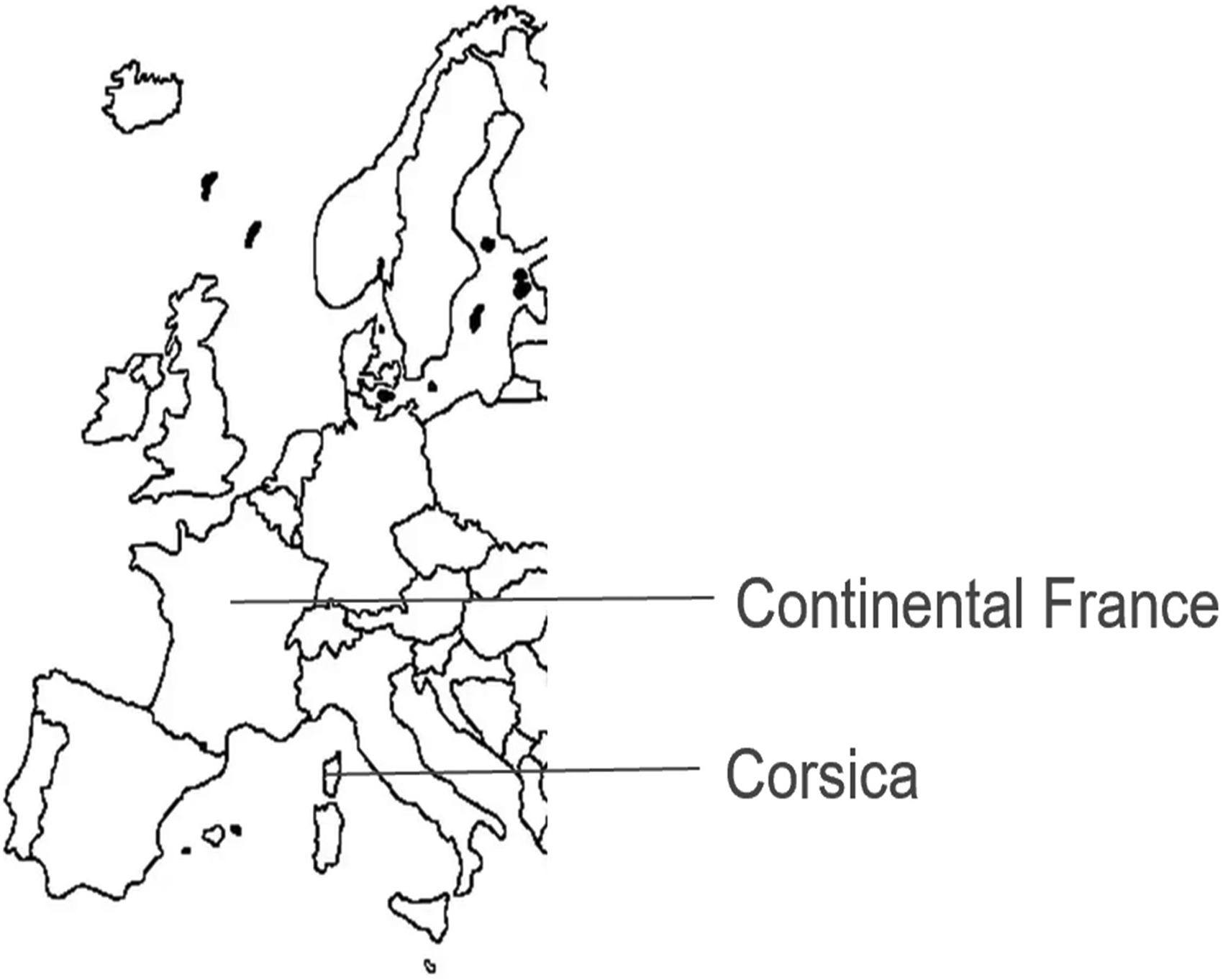
Map of Corsica and France.
Data and Methodology
Primary sources of information are hard to come by in the study of criminal organizations. Economic consequences, potential reprisals, and legal prosecution make criminals reluctant to speak about their work, if ever they could be reached; communication is almost exclusively oral, leaving researchers without access to archival sources (Catino, 2015). Researchers must therefore base their work largely on judicial resources and secondary data (Savona et al., 2017). Still, such sources alone are insufficient: since bosses rarely come into contact with the justice system, legal documents give only a partial view of criminal organizations (Follorou & Nouzille, 2004). We took an original approach to this topic, based on variety of sources, including books and articles from investigative journalists (e.g., Constanty, 2017; Follorou, 2022; Follorou & Nouzille, 2004), reports from French institutions (Ministry of Justice, Ministry of the Interior, which supervises the police and secret services, and the French Parliament). Some of these reports are confidential and not publicly available.
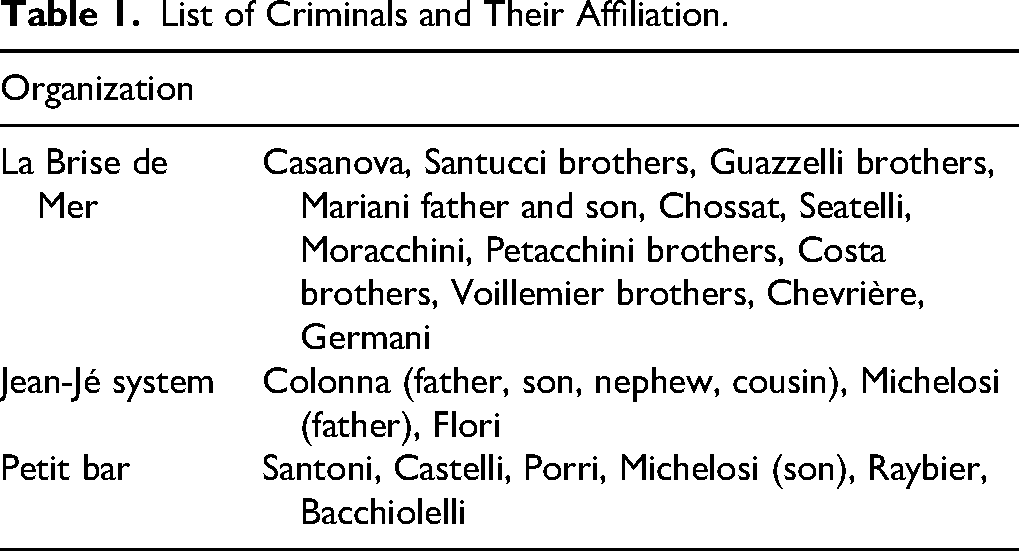
Based on these sources, we found that three criminal organizations have dominated Corsica over the past four decades: La Brise de Mer and its (claimed) successor Jean-Luc Germani, Jean-Jé Colonna (the godfather's name), and le Petit Bar, led by Jacques Santoni. We identified 31 important criminals belonging to these organizations, often from the same families (see the list, Table 1, and the map in Figure 2). Once we had identified this network of individual criminals, we located 77 legal cases that we added to our data. Finally, we conducted 24 interviews with Corsican crime actors and specialists (not criminals): eight judges, two police officers, six national specialized journalists, seven local reporters, and one lawyer.
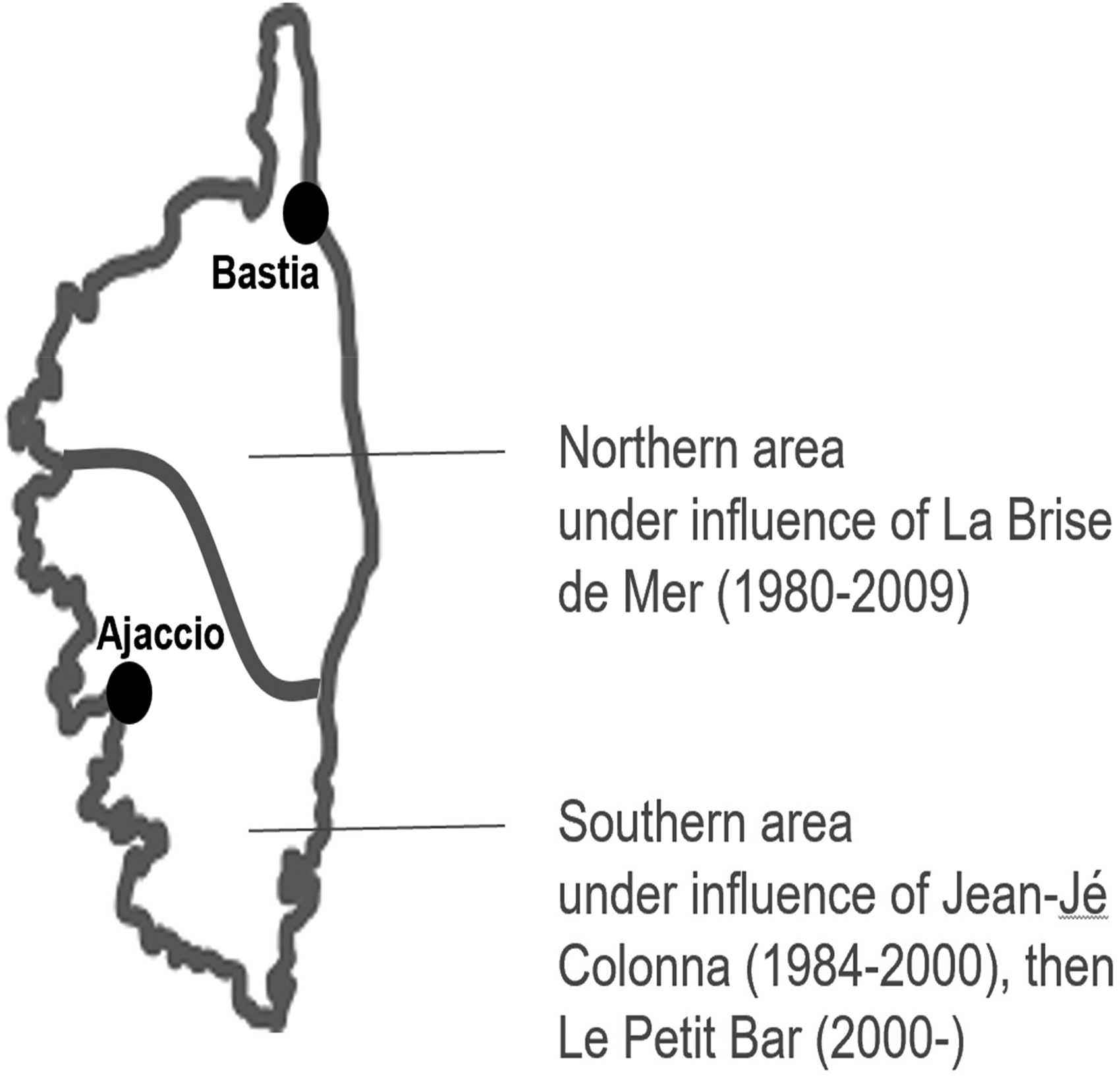
Map of Corsica and criminal organizations.
List of Criminals and Their Affiliation.
Such a diversity of sources is an asset, but it requires a rigorous methodology. We used a thematic approach because it provides a deeper understanding of a phenomenon by the people experiencing it (Shah & Corley, 2006). Such an approach is based on coding qualitative material. We coded our material in three steps: from the raw material (first order) to emerging themes (second order) to conceptual categories (third order) (Goyal et al., 2024; Theel & Sydow, 2024). First, the two authors read the data separately to reconstruct the criminals’ trajectories by emphasizing their main steps, associated events, and quotations before cross-checking the coding tables they had manually elaborated. At this step, we worked on each organization separately to identify the key categories describing criminals’ trajectories. In the second step, we identified recurrent themes by comparing criminals’ trajectories across organizations. The third round consisted of conceptualizing the data. We then went back across the data to refine our conceptualization. Table 2 summarizes this process, displaying the most striking events backed by quotations, the most prominent themes we identified, and our conceptualization. Figure 3 provides a timeline displaying the main events in Corsican organized crime from the 1980s to the 2020s.
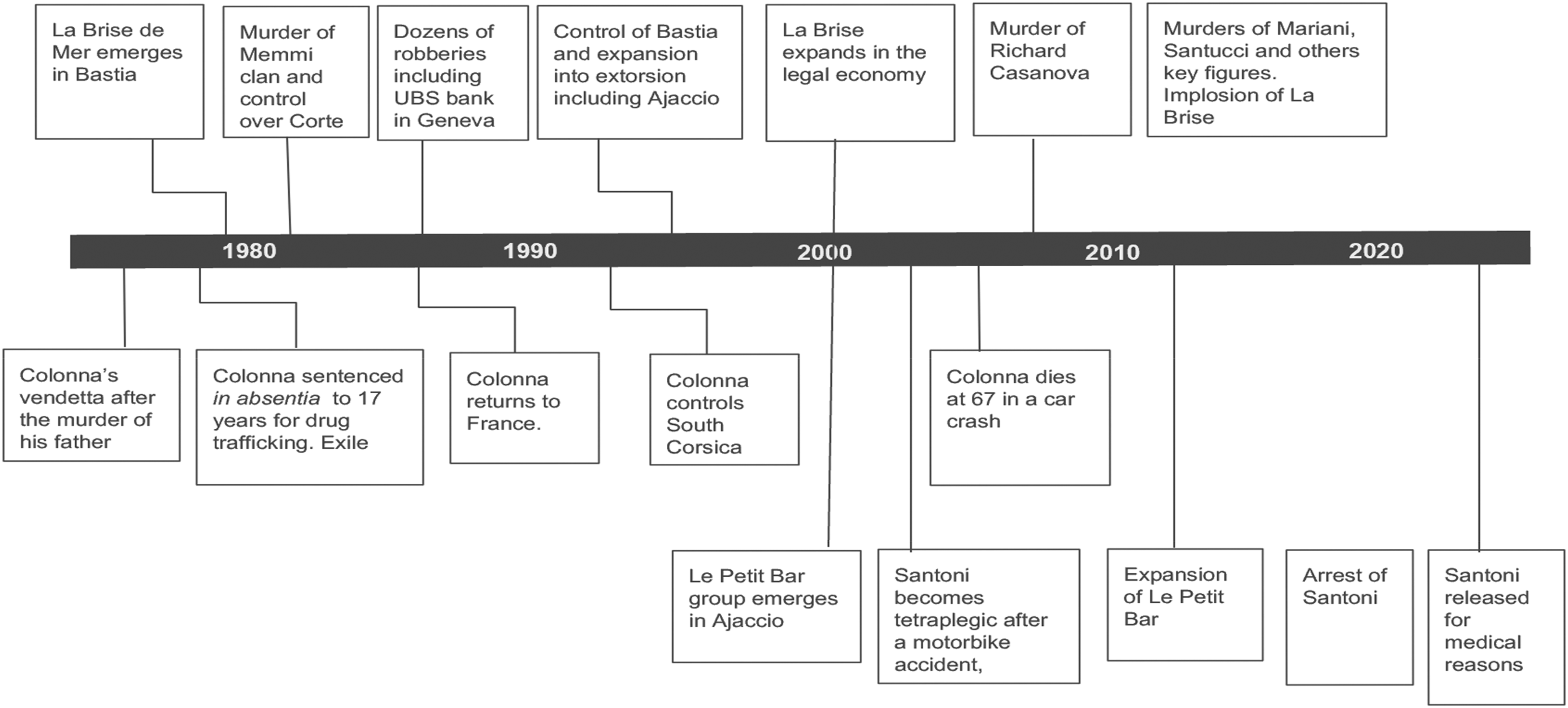
Timeline of Corsican organized crime.
Data and Theoretical Elaboration.

Our empirical setting raises important (including security) ethical issues. We have thus decided to cite sources only mentioning their professions (journalist, police officer, judge, etc.), regardless of the source (interviews, journalist investigations, or confidential reports), to avoid any possibility of identifying any source and/or informant. Judges and police officers hold their position for a limited period of time before moving on to another position in a new court or police station. Some of our respondents were stationed in Corsica when we interviewed them, while others had been there earlier in their career. It is therefore impossible to identify our respondents.
Table 2 details our qualitative material and theoretical elaboration of criminal careers in Corsica, which we discuss in the next sections.
Careers in Corsican Criminal Networks: Status and Promotion
The careers of Corsican criminals, far from being random, follow clear steps structured by their status. They move up when their status increases and broadens across audiences. Criminals need first to acquire material and immaterial (status) resources. They do so in two related ways: they exploit their social connections (legacy) and they use violence.
Developing a Criminal Career: Consolidating Status
Power and Territorial Control
The bosses of La Brise were able to take control over one of the largest Corsican cities, Ajaccio, by eliminating all rival organizations and organizing lasting criminal activity, especially extortion. Their status increased and extended beyond the underworld as they controlled a larger territory. In fact, La Brise and Colonna shared the island, the former controlling the north, the latter, the south.
The best indicator that a criminal has become established is the measure of their ability to extort, which means controlling a territory. Extortion works only if victims know whom they must pay for their “protection” and recognize the extorters as the dominant power in their territory. The following story demonstrates the power of status in extortion. It is told by Mickaël “Mika” Ettori, Santoni's employee from Le Petit Bar (succeeding La Brise as the extortion power in Ajaccio). Ettori recounts visiting a restaurant owner who had resisted paying his extortion fee: I told him, “You wanted to play—now I’m gonna go see Jacques [Santoni]. Your fate is in his hands.” I said, “Dumè, you know you lost”; meaning, on the day I say, if the money isn’t there, I’m coming back, and the restaurant is mine, and everything you put in is lost. “You know that, Dumè.” He says, “I know, Mika.” I say, “but you, you don’t think you’re going to get off like that, that I take the restaurant and you just walk away? If you owe me money, I take everything from you, sweetheart—your house, your sister, the office. It’ll be hell for you and your entire family, I’m letting you know”. (police record)
The criminal's status is a convincing motivator, even beyond the capacity to exert violence. In 2003, a motorcycle accident made Santoni tetraplegic and thus unable to exert physical violence himself. His status was such that he did not even need to exert violence. The fear he inspired in both his victims and employees was enough. His status was even strengthened by his disability, as it provided cover from the police, making him an example of resistance against the metropole.
At this stage, the bosses had become managers of a whole team, including gunmen, collectors, couriers, and accountants. Bosses choose collaborators who will become indebted to them, hiring, for instance, accountants and jurists who have had issues with the law. The fact that La Brise de Mer remained the dominant extortion power in the northern part of the island for 20 years makes sense only in light of the protection it could offer its victims from the other criminal organizations. The extortion bosses promised protection and were deemed capable of providing it.
Inspiring Fear
When Germani took over the Cercle Wagram casino by force, “it was his reputation that convinced his interlocutors not to resist” (judge). Being a boss means being able to inspire more fear in others—whether rivals, employees, or victims—than others can inspire in them. Criminals’ status has to become known by the whole of the society they wish to influence: everyone must know who they are. The more prestigious the organization, the more prestigious the criminal. After a criminal court pronounced him not guilty for lack of evidence, Alexandre Chevrière returned to the village of his birth and a volley of celebratory gunfire welcomed him home: “it was his ties to La Brise de Mer that made his reputation” (journalist). Chevrière was not a boss, and he did not enjoy the same status as Mariani or Casanova, but he did benefit from the status of La Brise in Corsican society. Individual status is thus connected to organizational status. Mariani, a La Brise boss, claimed in court that “La Brise de Mer is a myth.” A lawyer, picking apart the case against his client, called these assessments “the stuff of legend, a reputation.” Myth is an interesting word to choose for a real organization, feeding conversation and speculation. Rather than refuting reality, such terms affirm the social order and demonstrate the speaker's own status. His son Jacques, himself a criminal, later said that “my reputation should not condemn me; my name is not a franchise,” when, in fact, that is precisely what it is.
At this step, judges, police officers, journalists, and Corsican laypeople alike are aware of the respective ranks of organizations and the individuals within them. Recalling when La Brise bosses Pierre-Marie Santucci, Francis Mariani, and Maurice Costa were arrested (by chance) and held in the Borgo prison, the judge noted, “Francis Mariani had a superior attitude. They all looked at me condescendingly.” Mariani's status made him feel untouchable. Even in prison, La Brise's bosses would continue to rely on their status. They regulated social relations among prisoners and benefitted from special privileges, eating lobsters, and drinking champagne. They eventually escaped in broad daylight without firing a single shot, walking out the main door with the several hundred euros allocated by the government at the time to newly released prisoners. A series of mishaps, including a falsified order from the presiding judge of the Ajaccio court, was enough to convince the prison director to let them walk. Their escape reinforced their status throughout the island as personalities who could get the better of the national government in a few clever turns.
Group Organization
To control and develop their activities, criminals need an organization. They face the same challenges (logistics, finance, and management) as other developing organizations, but organized crime imposes heavy organizational constraints to maintain cohesion (there are no legal work contracts) and secrecy to prevent police investigations. Corsican criminal organizations follow two organizational models: the solitary clan chief (Colonna, Le Petit Bar) and the board of equal-status associates with complementary skills (La Brise). These models have different implications, but also much in common. Both are highly hierarchical (with different statuses from bosses to soldiers) but flexible. Indeed, they rely on circles (several interviewees used this word). Colonna's lieutenant and La Brise's associates could organize their own businesses (e.g., drug trafficking, gambling, or prostitution), provided they respected the organization's rules. The lieutenants must pay the boss for his protection; La Brise's organization rested on sharing money equally. The most strategic decisions (use of violence, territory regulation, and diplomacy) need the boss's approval and, in the case of La Brise, the unanimous decision of all the associates. This made possible the long coexistence of La Brise and Colonna, who controlled their affiliates. We thus understand why Colonna's lieutenant deplored the visit of La Brise on Colonna's turf without Colonna's having been warned (see Table 2). Consolidating status means extending it to new audiences (e.g., victims of extortion and, more broadly, the island society), developing one's organization, and inspiring fear.
Entering the Criminal Career: Acquiring Status
Legacy
Legacy—which we call the familia effect—is a first route by which the Corsican criminals whom we studied successfully launched their career. All were strongly embedded in the island's social fabric, and contrary to popular belief, they often came from established, well-known families with ties to the underworld and/or the economic and political elites of the island. Table 2 illustrates these ties. Remarkably, Corsican bosses had dealings with people involved in organized crime but also with high-status actors of the island before launching their own businesses: Colonna was involved very early on in drug trafficking, La Brise's members met in a bar owned by a criminal involved in prostitution, among other things, and Germani was Casanova's (one of the bosses of La Brise) brother-in-law. Santoni—whose parents had no ties to the underworld—is an exception. Even so, he benefitted from the support of one of Colonna's lieutenants and from specific circumstances: Colonna died in a car crash, and La Brise imploded in a civil war, killing almost all its leaders. As one journalist noted about Santoni, “the future belongs to the blood heirs, which he is not.”
The criminals had already inherited a privileged status that framed how others perceived them in the context of the island's status beliefs. They relied on these networks, which also provided them with material resources. Casanova, the son of a prominent family, was taken under the wing of Tomi, a wealthy businessman involved in multiple criminal operations who invested in international gambling in France, South America, and Africa. Tomi provided illegal funding to the political campaign of Charles Pasqua (who came from a Corsican family and served as French Interior Minister, member of the French Assemblée Nationale, and senator) in exchange for a permit to operate a casino. Tomi's brother was a police officer and a member of the board of the Syndicat de la Police, the national police officer's union. Status can also be transmitted by association: “He made it thanks to his ties to Richard Casanova [his brother-in-law],” recalled a police officer, speaking of Germani.
The first strategy to gain status when entering a criminal career is thus to use the status inherited from one's clan and personal ties that make sense only when considering island beliefs. Such connections ensure the individual is perceived as reliable despite having engaged in illegal activities.
Violence
The second strategy to gain status is violence. Because they need to be feared, criminals use violence much more often during the first steps of their career than later. Colonna's life was marked by violence early on: upon entering organized crime, he spent 10 years carrying a vendetta to avenge the murder of his father and an attack on his uncle. Added to his family's economic and social capital, the vendetta consolidated his status, demonstrating that he was highly effective in his deadly intent, driven by honour, and deeply rooted in Corsican society—a man to be feared. With this capital of fear, along with the money from his past criminal actions, Colonna would put together his own organization. He also had the support of an established criminal, Pierrot Flori, and the help of well-placed institutional connections such as Cuttoli, a local delegate of the majority political party and the president of the Chamber of Commerce.
Violence can be used to signal to other Corsican criminal organizations and social entities that a new power was emerging in the Corsican underworld. La Brise formed around a group of young criminals who met in a bar. They became specialists of hold-ups and soon decided to attack Louis Memmi, the godfather of Corte, a smaller town in the mountains. Then Memmi made a mistake. He caught two members of La Brise and humiliated them but did not kill them; they escaped and went on to murder more than 20 persons, including Memmi himself. The La Brise bosses took control over Memmi's businesses. Memmi's former partners and clientele immediately understood the message. This event upset the broader community in Corsica: a new power in the underworld had dared to attack a well-known godfather on his own ground and succeeded, gaining material and immaterial resources.
Violence is used to visibly display the threat an organization represents, as well as its command of human and logistical resources. In its early rash of committing some 80 robberies over 3 years, La Brise orchestrated the famous robbery of the main Geneva branch of the Swiss bank UBS, carrying it off without firing a single shot, despite Swiss banks’ reputation for impeccable security. The success of the robbery depended on highly effective procedures: infiltration, disguise, and tight organization based on pairs working together continuously, while the rest of the team changed regularly to keep investigators off the scent. This arrangement shows the existence of both flexibility and a clear hierarchy.
This same efficiency in preparing and executing complex operations was used 2 years later when La Brise commandeered a helicopter and intercepted an Air Inter plane on the runway, stealing seven million francs from its hold. These exploits made Casanova, their mastermind, “the glory of the underworld” (police officer). Following this event, La Brise had significant financial resources at their disposal and projected a general fear of the effectiveness and violence of its “notorious team” (judge). The violence of La Brise was embodied most famously by Mariani, who murdered around 50 people. But violence is not enough to sustain a powerful organization. It is its ability to organize fear over the long term that is pivotal. The first steps of a criminal career must inspire fear and respect: after numerous such murders and robberies, La Brise began to be perceived as a new “island power” (journalist). However, criminals use violence with caution because it is complex to organize and can needlessly garner police attention.
Fulfilling Status: Becoming a Person of Note
The Legal Economy and Money Laundering
The final phase is to attain the status of the ineluctable actors of the island's (legal) economy and social and political life. The first step in doing so is for criminals to implant themselves in the legal economy to gain influence and, of course, to launder money. La Brise had “served as a bank to all of Corsica” (police officer). The bosses identified struggling businesses or farms that were waiting for European funding and needed bridging loans. They also provided loans where banks would not or where such loans came with too many conditions. Loans from bosses are easy enough to obtain, but for the borrowers, they represent a commitment that will remain outstanding for the rest of their lives. The loans are granted like equity by a straw man and, if not repaid, the lender takes over the company. Criminals may also impose that owners supply themselves through companies they control, so that the latter sometimes so indebt themselves that they lose control of their business. Criminals can finance and purchase a whole series of businesses using these tactics. La Brise “set up shop in the local economy by buying it up” (judge). Having failed to buy an Opel dealership because the brand was suspicious of the funding's provenance, La Brise simply turned to another major German brand and took it over instead. “Shall I draw you a diagram?” a judge quipped.
This system functions only “as long as they [the organization] have the means to collect the money, to scare people, to intimidate” (police officer). Their status enables them to control their businesses, and it is highly effective, the officer added, because the money, “which will never be found,” is “laundered and relaundered.” To facilitate laundering, criminals tend to operate in sectors where payment is mostly in cash, such as in bars, restaurants, nightclubs, tobacco shops, coin-operated laundromats, and gas stations. They also operate where public and private overlap—where they can more easily assert their status—such as in construction and waste management. This requires trusted straw men for their business operations, leading them to position their employees in the legal economy. These jobs help make criminal organization durable, giving it social cover, as well as regular income. Even then, the hierarchy is clear. The bosses organize the fraud and the employees execute it, as when creating fake labor contracts and invoices. Often, payments are made partially in cash, which is then laundered. Double accounts are kept for payroll and invoices, making laundering simple for those engaged in it yet difficult for the police to catch. Bosses prefer businesses with low-skilled workers so that dubious employment practices, such as under-the-table work or double pay, are easy to put into place to launder money. In this way, bosses become major backers of the legal economy and of private business owners.
Local Establishment
Criminals must establish themselves not only in the underworld and the legal economy, but also in society, which they do in two related ways: they redistribute their wealth to maintain and enlarge their clientele; and they influence its politics.
Bosses become benefactors in their communities, returning to the role of clan chief through the Robin Hood effect. They may distribute money, provide jobs, or ensure that building permits or grants are approved. They also invest in highly visible businesses that boost their prestige as contributors to the community, such as charities and football clubs, which are prestigious, although not legally profitable. They develop connections with a wide array of people: they have “friends everywhere” (judge). Corsica is one of the poorer regions of France, and it is highly dependent on public subsidies. This opens the door to nepotism: as for business owners, criminals offer an alternative to get resources such as grants and jobs that neither the State nor the legal economy will provide.
Criminals are thus able to finance and mobilize large numbers of people during political campaigns. They use their influence to make people vote for a given candidate and even participate in campaign organization. They attract politicians and often have family or personal ties to political leaders. According to a local reporter (and as is recurrent in the local press), criminal organizations “make” elections. Their influence on the island's economy, social life, and politics is self-reinforcing: a large clientele makes them more attractive for politicians, while their social and economic ties to politicians help them serve their clientele. They are then able to play on these connections to manage their businesses as the following example illustrates. A young tax inspector, arriving for a routine audit at L’Apocalypse, a nightclub owned by La Brise, recalled being offered a drink by an employee. Since accepting it would be an expression of allegiance and therefore a betrayal of her professional ethics, she refused. When she did so, another employee of La Brise pulled out a revolver and gestured at her to drink. When the glass touched her lips, she sealed the deal. Her initial refusal and subsequent acceptance were reported to the boss, who then exerted his influence in the local administration to have her transferred out of Corsica.
To be considered prominent in Corsican society, criminals display a taste (and their status) for expensive products. Highly visible manifestations of their status range from palatial luxury villas perched in the Corsican mountains, with hidden exits and helicopter pads, to thousand-euro tips left in luxury hotels. Francis Mariani, an amateur race-car driver, was known for his Porsches, and Casanova, for his beautifully tailored suits. Criminals are so well-known there that their wives “can go shopping in luxury boutiques without ever opening their wallets” (journalist): the name alone is enough. It is at this point that criminals become “godfathers,” as they are known in Corsica and beyond.
The status of criminals in organized crime is paradoxical: they are feared and plunder the island's resources, but they are also respected as they pretend to serve the community and successfully contest metropolitan power on an island governed locally by separatists. Their prestige has even extended beyond Corsica, its godfathers being the subject of numerous articles and the source of perceptions of the island on the French continent. A police officer sums up criminals’ careers, acknowledging that at this last step, they are essentially beyond the reach of the police: If we don’t manage to put them [Le Petit Bar] out of business in the next 2 years, it's all over. They are changing scale. The barons of Le Petit Bar hardly do anything themselves. Now, they delegate. They manage their businesses like La Brise de Mer before.
Discussion
This study makes at least three major contributions to the literature: on the status career; on status, class, and power; and on dominance and domination. It shows first that criminals’ careers progress as their status rises, corresponding to the status career. Achieving status in their career changes criminals’ position in the social structure. Successful criminals, far from being interlopers, are part of the upper class, commanding resources key to other actors, including businesspeople and politicians. They become notables, businesspeople at the center of their local economic and political networks. In this sense, they belong to what Bourdieu terms the field of power (Bourdieu, 1998). Recent research has argued that if, in the 1950s, economic capital and “political” capital (the inclusion in the organizational network of institutional power, that is, the political elites) combined together, they now oppose each other (Rossier & Lunding, 2025). We show, on the contrary, that they can still combine and reinforce each other. Our findings rather confirm Bourdieu's view that class, status, and power are related through processes specific to a given activity (and thus field). In the case of organized crime, these processes include their use of social capital, their investment in the island economy and society, to increase resources that in turn generate power (Pfeffer & Salancik, 1978) and redistribute material and immaterial resources (money, jobs, and connections). Through these processes, many people become indebted to criminals in a lifelong status contract (Weber, 1978), allowing criminals to influence people's behavior, even in the political arena. They influence elections, for example, and obtain public subsidies and contracts for those they “help” while their political connections help them obtain very profitable public contracts, especially in the security, building, and waste management industries (Paoli, 2004). Criminals combine episodic power, as we saw with Dumè's episode, with systemic power (Lawrence et al., 2012); the two are related, because criminals hold a specific position in social and economic networks from which they can coerce others. It is even suspected that Casanova, one of La Brise's bosses, conducted confidential missions of prime importance for the French state, especially in Africa, which means he would have had connections at the highest level of the national political elites. Casanova also at least partly owned the most luxurious resort in Corsica (Murtoli), which welcome high-status politicians (including former president Sarkozy), businesspeople, and cinema stars. The resort has privatized one of the choicest parts of the island's coastline, an act normally prohibited by French law. High-status individuals thus navigate across fields because prestige can convert into money and power and vice versa (Bourdieu, 1996; Dick & Nadin, 2011; Dowd & Pinheiro, 2013). They do so through specific processes that need to be identified, as we have done in this study of criminals. However, the first steps of a criminal's career consist of making others aware that one is now “in the game” and to be feared. As we saw in the examples of La Brise, Colonna, and le Petit Bar, status comes first.
Upon achieving status, criminals step into the field of power in a manner comparable to other professions. For instance, writers having achieved high status in the literary field to then develop connections in the field of power (Sapiro, 2023). We suggest that this is true for all careers based on status acquisition, including artists (Dubois, 2022), athletes (Ertug & Castellucci, 2013), academics (Alvesson & Kärreman, 2016), and, more largely, those holding specific and sought-after expertise (Abbott, 1988). Still, within this process, prestige comes first: it is because Chateaubriand and Hugo were recognized as major writers of their time that they later held important political positions (Durand, 2005). The same can be said of Bourdieu himself, who latterly became influential in French politics while holding the most prestigious academic position in France at the Collège de France, as he himself recounted (Bourdieu, 2004). Our study thus contributes to returning status, class, and power to the foreground of careers and organization studies more broadly (Carter et al., 2024), showing to what extent careers, far from being only individual trajectories, are embedded in social structures.
Such a progression in status is based on status beliefs, that is, the perceptions others have of criminals based on their actions, but also on their organizational and social affiliations. It is precisely because others think that criminals are powerful that the former defer to and obey the latter, enabling such criminals to exert their power over a territory. Indeed, once no longer feared, criminals lose control (and often their life). This happened to the long invulnerable La Brise group, which imploded because of the break-up of the pact between the associates, thus ending the “imaginary brotherhood.” Not only did some members kill their former partners, but up-and-coming criminals such as Santoni came to realize they had an opportunity to take control over La Brise's territory and businesses. In a few years, almost all the La Brise bosses died. Status is therefore not a fixed attribute, but rather the result of constant negotiation (Bitektine & Haack, 2015). Actors need to re-enact their status constantly to feed and maintain status beliefs (Ridgeway, 2019). This is why criminals attend so much to manifesting their status: others (from rivals to victims) must constantly feel the sword of Damocles dangling over their head. While criminals’ status is highly personal, it is also organizational, with a clear distinction between bosses and executants, and it is social, as it corresponds to a position in society that evolves as criminals’ careers progress. These connections enable them to exert their domination over the (stratified) local society.
Our study, rather than distinguishing between components of status (Borkenhagen & Martin, 2018), presents it as a multilevel construct linking the individual, the organizational, and the social. Status is built and made manifest in daily interactions (e.g., extortion, corruption of a politician, conspicuous consumption) (Aranda et al., 2023). Our study contributes to the research on status and, more specifically, to the “dark side of status” (Sharkey, 2018), showing that it may not only incentivize misbehavior (Raz et al., 2021), it can also attract others, even in cases of overt, publicized misbehavior. Our study contradicts the intuitive idea that when organizations and/or misbehave, their prestige necessarily decreases, they are penalized, and they no longer attract partners (King & Carberry, 2018). Indeed, criminals remain (paradoxically) legitimate in Corsica, where Casanova, for instance, the probably most brilliant of the La Brise bosses, still enjoys prestige. Their involvement with organized crime did not prevent certain politicians from being re-elected. Another example is Alain Orsoni, a central independentist leader, former president of the French Premier League football club in Bastia, despite its well-known connections to organized crime. He was murdered in January 2026, in ways typical of Corsican criminal organizations, supposedly by le Petit Bar affiliates. Our study suggests that all people do not assess organizations and leaders only, or even firstly, along ethical lines. The penetration of organized crime in Corsican society drives a large range of people (including businesses) to cooperate and even support them for at least three reasons. They may expect rewards; their perception is rooted in the island's specific history and sociology that we presented earlier; they may fear direct or indirect sanctions if misbehaving leaders maintain their positions, which is likely to happen. The case of Corsican organized crime illuminates how these sets of interacting factors may allow organizations and leaders to maintain their legitimacy in spite of their public misbehavior.
Finally, our last contribution pertains to status, domination, and dominance. Organizational psychology scholars have distinguished between dominance—based on fear—and status—based on merit and prestige—as two pathways to the top (Cheng et al., 2013; Kakkar et al., 2020; Maner, 2017). At first glance, dominance might well describe the case of organized crime. However, such a distinction is artificial, as status always implies domination (Weber, 2014). Counter-intuitively, we have shown that criminals’ position and success interweave the capacity to intimidate others with legitimacy, inspiring respect (Rudolph et al., 2021). Bourdieu (2016), following Weber, insisted that a prime characteristic of domination is its acceptance by the dominated; there has been resistance against organized crime (Vaccaro & Palazzo, 2015), including in Corsica, but it has been too sparse to really threaten organizations deeply rooted in the local environment.
Limitations, Implications, and Future Avenues for Research
Our study has several limitations, notably in relation to our empirical setting. Criminal organizations are obviously specific (Catino, 2015), requiring caution before generalizing to “normal” organizations. Status may be especially important in criminal organizations because “performance” is difficult to assess due to secrecy and informality. In this sense, criminal organizations are an extreme case. However, as scholars have long argued, extreme cases may shed light on what happens more broadly in society (Becker, 1963) and attract attention to the power of status in shaping careers in other fields.
We would like to focus on two avenues for reach opened by our study. The first is on status. We showed that criminals having achieved high status then enter the social networks of what Bourdieu (1998) termed the field of power. As we suggest, this is likely the case for high-status professionals in other fields such as the arts and academia (Bourdieu, 2004; Sapiro, 2024). Future research might explore if this is so for other activities, especially for managers and corporate leaders, as our results contradict the argument (Rossier & Lunding, 2025) that “political” and economic capital diverge. This issue is crucial for understanding the distribution of power in society. Second, we find that fear plays a key role in organized crime careers and management. Future research could extend this insight to legal organizations, as fear plays a role in management more broadly (Hafsi & Baba, 2023) via mechanisms on which organizational psychologists focus, such as fear of sanction, exclusion, or loss of prestige (Connelly & McAbee, 2024; Pustovit et al., 2024). Further studies could investigate to what extent managers’ prestige is accompanied (and not opposed) by mechanisms of intimidation or implicit threat. Indeed, prestige can be used to silence dissent or impose compliance (Sharkey, 2018) without blurring the boundaries between deference and admiration. Future studies might look at how charismatic leaders simultaneously provoke admiration and fear and how this duality contributes to durable status.
Our analysis of status careers in organized crime also opens avenues for managerial practice. Status is not merely an accompaniment to career progression but, in many fields, functions as its very fuel: careers advance when actors gain prestige in the eyes of relevant audiences. Recent empirical reviews of managerial careers highlight the centrality of prestige as a driver of career development (Maas & Endemann, 2025). What varies across organizational settings are the modalities through which status is acquired. In some contexts, these modalities are opaque or informal—based on personal ties, trust, or fear—making them invisible to conventional human resources (HR) practices. Studies exploring socially responsible HR management show that prestige plays a significant mediating role in employee retention and performance, underscoring how prestige outside formal systems can affect outcomes (Anthonysamy et al., 2025). In small and middle-sized enterprises (SMEs), for example, status is often determined by the proximity to the owner-manager and their prestige in local networks. Although less explicitly studied in SMEs, the concept of organizational prestige and symbolic recognition can be critical in small firms where formal mechanisms have less reach (Patie, 2024). In professional occupations, status develops through symbolic markers (e.g., affiliations and credentials) rather than through transparent performance criteria (Abbott, 1988). Mapping studies of occupational prestige confirm the power of symbolic markers and societal perceptions in status attribution across occupations (Newlands & Lutz, 2024). In emerging economies, status rests on prestige and social ties, which act as substitutes for formal contracts. Longitudinal research shows how occupational prestige trajectories evolve in the absence of strong formal structures, especially in modernizing contexts (Nennstiel & Becker, 2025). The challenge for managers and HR professionals is that such forms of status frequently escape traditional career management systems, leaving organizations exposed to arbitrary, inequitable, or even coercive patterns of advancement. Our findings therefore invite managers to critically identify which forms of status should be recognized as morally and economically legitimate, and to integrate them into transparent career systems. Reviews of managerial career literature urge integrating prestige into formal frameworks to ensure legitimacy and fairness (Anthonysamy et al., 2025; Maas & Endemann, 2025). This may involve valuing prestige when it aligns with organizational goals or ensuring that symbolic recognition rewards cooperation rather than intimidation.
Conclusion
Our study builds on the concept of status careers to show that Corsican criminals’ careers progress as they rise in status, to finally become part of the dominant networks of the island. It then becomes very difficult for the police to reach them and thus fight organized crime. Authorities then target the criminals’ economic activities as businesspeople (fraud, corruption, and money laundering) rather than blood crimes. Status is key: several leading Corsican politicians won elections despite their known ties to organized crime (Follorou, 2022), illustrating the persistence of the paradoxical legitimacy we emphasized and the necessity to (also) fight the (paradoxical) legitimacy of organized crime. Our study illuminates the status-based functioning of the field of power. Political and economic elites are, as Bourdieu argued (1998), closely intertwined because political decisions affect businesses, and reciprocally; this is what makes criminals unreachable when they have achieved high status. A second key theoretical insight of our paper is about fear. We show how fear operates, and this extends beyond the case of organized crime (Ashkanasy & Nicholson, 2003). This insight is all the more important because misbehavior does not always blur legitimacy, prevent support from, nor lead to sanctions from other stakeholders. This last point is very important to Corsica, at a time when the French President recently declared that he would be open to the island's autonomy (but not independence), which would give more power to local elites who, as we showed, are (sometimes significantly) compromised with organized crime.
Footnotes

Ethical Considerations
Our research adheres to the highest ethical standards, prioritizing the protection of participants’ rights, safety, and confidentiality. All data were anonymized, securely stored, and used solely by the two researchers. We fully informed respondents about the objectives of the study. Their participation was voluntary, with the possibility of withdrawing from the study at any time. We designed our study to contribute to an essential topic while minimizing risks to both respondents and researchers. Given our empirical setting, we took further dispositions to preserve anonymity that we detail in the methodology section.
Funding
The authors received no financial support for the research, authorship, and/or publication of this article.
Declaration of Conflicting Interests
The authors declared no potential conflicts of interest with respect to the research, authorship, and/or publication of this article.