







Abstract
Political conversations are increasingly shaping organizational life, yet management research lacks a unified construct for understanding this phenomenon. We introduce workplace political discourse (WPD): episodic interpersonal communication in organizational settings that explicitly references partisan identities, political actors, or contested public policies. We delineate WPD's conceptual boundaries, distinguish it from six adjacent constructs, and specify three dimensions—behavioral, relational, and content—along which episodes vary. We propose a process model identifying five pathways through which WPD generates organizational consequences: four dysfunctional pathways (identity threat, resource depletion, self-censorship, and grim expectations) and one conditional constructive pathway that operates when communicative action and enabling conditions are present. Emerging evidence suggests that employees self-select into political discussions often with politically similar coworkers, meaning costs fall disproportionately on political minorities who suppress rather than express. We conclude with a research agenda targeting macro-to-micro translation, pathway differentiation, constructive versus dysfunctional conditions, and construct measurement.
Keywords
Workplaces have become unavoidable sites of political exposure. Nearly half of U.S. workers report discussing political issues with coworkers monthly, with higher rates among on-site employees and in conservative-leaning industries (Hedrick & Saad, 2024). Political viewpoint differences rank among the most frequently cited contributors to workplace incivility, with salience rising sharply during the 2024 election cycle (SHRM, 2024). These indicators converge on a practical reality: political talk—whether initiated deliberately or encountered ambiently—now reliably enters the workday.
We call this phenomenon workplace political discourse (WPD). Existing work shows that political ideology and dissimilarity shape workplace experiences (He et al., 2019; Henderson & Jeong, 2022; Swigart et al., 2020), but discourse itself remains underspecified and conflated with adjacent phenomena. By distinguishing WPD from adjacent constructs, specifying its behavioral, relational, and content dimensions, and tracing the pathways through which it reshapes organizational life, we clarify when political talk corrodes cooperation, when it builds understanding, and which organizational conditions determine which pathway dominates. Political talk now recurs across workplaces, yet management scholarship has left its effects at the individual, interpersonal, and organizational levels underspecified— an omission this framework addresses—opening questions about how macro politics becomes workplace talk, when that talk corrodes cooperation rather than building it, and how to measure it
Why Now?
Qualitative shifts in political identity make WPD especially urgent now. Affective polarization—emotional animosity toward political outgroups rooted in identity rather than policy disagreement—has intensified over the past two decades (Iyengar et al., 2019). Finkel et al. (2020) characterize this trend as “political sectarianism,” in which othering, aversion, and moralization render partisan animosity increasingly persistent and resistant to resolution.
Organizational flashpoints underscore these stakes. Basecamp announced in 2021 that “societal and political discussions” would no longer be permitted on the company’s Basecamp account; within days, roughly one-third of the company’s 57 employees had announced plans to accept buyouts (Fried, 2021; Lyons, 2021). Coinbase similarly adopted a mission-focused posture discouraging internal debate over causes, political candidates, and activism unrelated to work; after the company offered employees an exit option, about 5% of employees, or 60 people, accepted the package (Armstrong, 2020; Kokalitcheva, 2020). Together, these episodes illustrate a governance dilemma: attempts to restrict political talk can provoke backlash and exit, while unstructured political talk can threaten collaboration and trust.
This dilemma matters because workplaces remain among the few settings that bring people into recurring interdependence with non-chosen others. Compared with families, neighborhoods, and voluntary associations, workplaces expose people to cross-cutting political views far more frequently (Mutz, 2002; Mutz & Mondak, 2006). That exposure makes political identities visible—and consequential. Thompson (2021, 2022) documented how such visibility activates discriminatory treatment in the workplace. We extend this line of inquiry by focusing on discourse as the specific behavioral mechanism through which political identities produce organizational consequences.
Defining Workplace Political Discourse
WPD is episodic interpersonal communication in organizational settings that explicitly references partisan identities, political actors, or contested public policies in ways that express, signal, or negotiate political positions. Four boundary conditions sharpen this definition.
First, WPD is interpersonal and involves spoken or written exchanges between organizational members. Second, WPD is explicitly political, referencing partisan identities, political actors, or contested public policies, and thus distinct from “organizational politics” concerning internal influence tactics (Drory & Vigoda-Gadot, 2010; Ferris et al., 2019). Third, WPD is work-contextualized, occurring within roles and relationships where power asymmetries, performance interdependence, and exit constraints shape consequences. Fourth, WPD is behavioral and episodic—discourse events measurable through event sampling, communication traces, or vignettes. This definition synthesizes prior work on cross-cutting political discourse (Mutz & Mondak, 2006), event-level political conversations (Kim et al., 2022), and ambient political exposure at work (Rosen et al., 2024).
Dimensional Structure
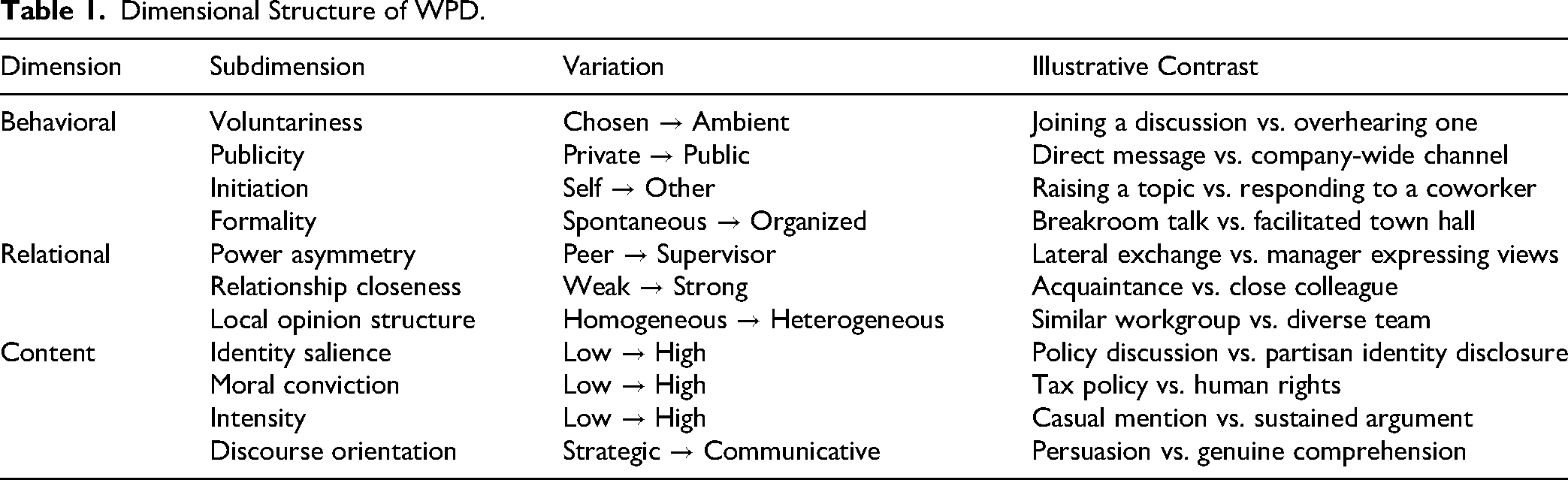
WPD episodes vary along three dimensions that jointly shape their organizational consequences (see Table 1). The behavioral dimension captures voluntariness (chosen participation vs. ambient exposure), publicity (private vs. public channels), initiation (self- vs. other-initiated), and formality (spontaneous vs. organized); it distinguishes WPD from stable trait constructs like political identity dissimilarity. The relational dimension captures power asymmetry (peer vs. supervisor), relationship closeness, and local opinion structure (homogeneous vs. heterogeneous); experimental evidence confirms that expected disagreement, relationship strength, and power dynamics each independently shape willingness to express political views (Carlson & Settle, 2023). The content dimension captures identity salience, moral conviction (Skitka, 2010), and intensity. It also includes discourse orientation—the subdimension that most directly governs which pathways a WPD episode activates.
Discourse orientation draws on Habermas’s (1984) distinction between strategic action and communicative action. In communicative action, “the actions of the agents involved are coordinated not through egocentric calculations of success but through acts of reaching understanding” (Habermas, 1984, p. 286; see also Johnson, 1991). Strategic action, by contrast, is oriented to success, where actors follow “rules of rational choice” and assess “the efficacy of influencing the decisions of a rational opponent” (Habermas, 1984, p. 285). Strategic WPD thus aims to persuade or position the speaker's views as dominant; communicative WPD aims to genuinely comprehend another's perspective.
These dimensional combinations generate distinct risk profiles: the same political statement produces different consequences when delivered by a supervisor versus a peer, encountered voluntarily versus ambiently, or moralized versus policy-focused. Discourse orientation can be assessed through self-reported discussion goals, behavioral coding of speech acts, or discourse quality indices developed for deliberative research (Niemeyer et al., 2024; Steenbergen et al., 2003).
Dimensional Structure of WPD.
Differentiating WPD From Adjacent Constructs
Establishing WPD's novelty requires distinguishing it from six adjacent constructs (see Table 2).
Conceptual Boundaries of WPD and Adjacent Constructs.
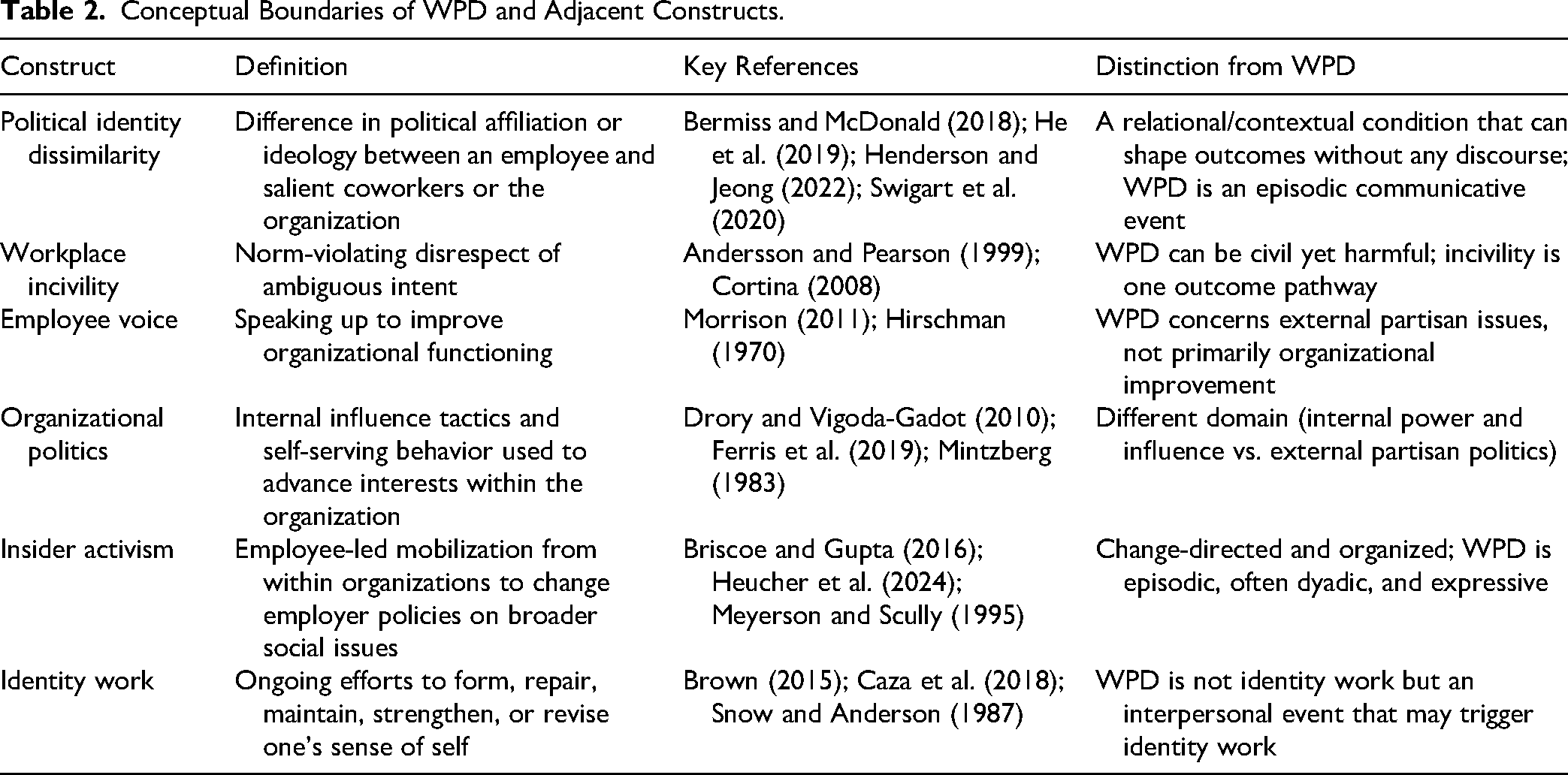
Political identity dissimilarity refers to differences in political affiliation or ideology between employees and salient coworkers or organizations (Bermiss & McDonald, 2018; He et al., 2019; Henderson & Jeong, 2022). WPD serves as the behavioral activation channel through which those identities become salient in interpersonal interaction. Crucially, dissimilarity is neither necessary nor sufficient for WPD: WPD occurs in homogeneous environments (co-partisan talk that amplifies moralization and norm pressure), and dissimilarity generates consequences without discourse through non-discursive pathways such as taste-based statistical discrimination (Thompson, 2026).
Workplace incivility involves norm-violating disrespect of ambiguous intent (Andersson & Pearson, 1999; Cortina, 2008). WPD can trigger incivility—selective incivility is one possible manifestation of the identity-threat pathway—but political discourse can also be civil yet harmful. Overhearing political conversations impedes goal progress even absent mistreatment (Rosen et al., 2024). Incivility is thus one possible outcome of WPD, not its defining feature.
Employee voice concerns communication intended to improve organizational functioning (Morrison, 2011). WPD differs because its focal intent is typically identity expression or political positioning rather than organizational improvement—a distinction that matters because responses appropriate for voice, such as encouraging upward communication, may prove counterproductive for WPD.
Organizational politics concerns influence tactics and self-serving behavior deployed to advance interests within organizational authority structures (Drory & Vigoda-Gadot, 2010; Ferris et al., 2019). WPD differs because it references external partisan content—parties, candidates, contested public policies—rather than internal power dynamics.
Insider activism involves employee-led mobilization to change employer policies on broader social issues (Briscoe & Gupta, 2016; Heucher et al., 2024). WPD differs in three respects: it is episodic and often dyadic rather than organized and campaign-like; it is frequently expressive rather than directed at organizational change; and it centers political talk rather than sustained mobilization.
Identity work denotes ongoing efforts to form, repair, maintain, or revise one's sense of self (Brown, 2015; Caza et al., 2018). WPD is not identity work; rather, it is an episodic interpersonal event that may trigger identity work as a downstream consequence. Because identity threat is a key antecedent of identity work (Caza et al., 2018), cross-partisan WPD may disrupt employees’ sense of self and prompt identity-related responses.
A Process Model of Workplace Political Discourse
Figure 1 presents a process model linking environmental triggers to WPD episodes and their consequences. We offer this model not as a comprehensive theory but as a conceptual infrastructure demonstrating the consequentiality and fertility of WPD as a construct (Pek & Sonpar, 2025). By mapping four dysfunctional and one conditional constructive pathway, we identify the most productive targets for empirical investigation. WPD's dimensional structure—behavioral, relational, and content—shapes which pathways activate in any given episode.
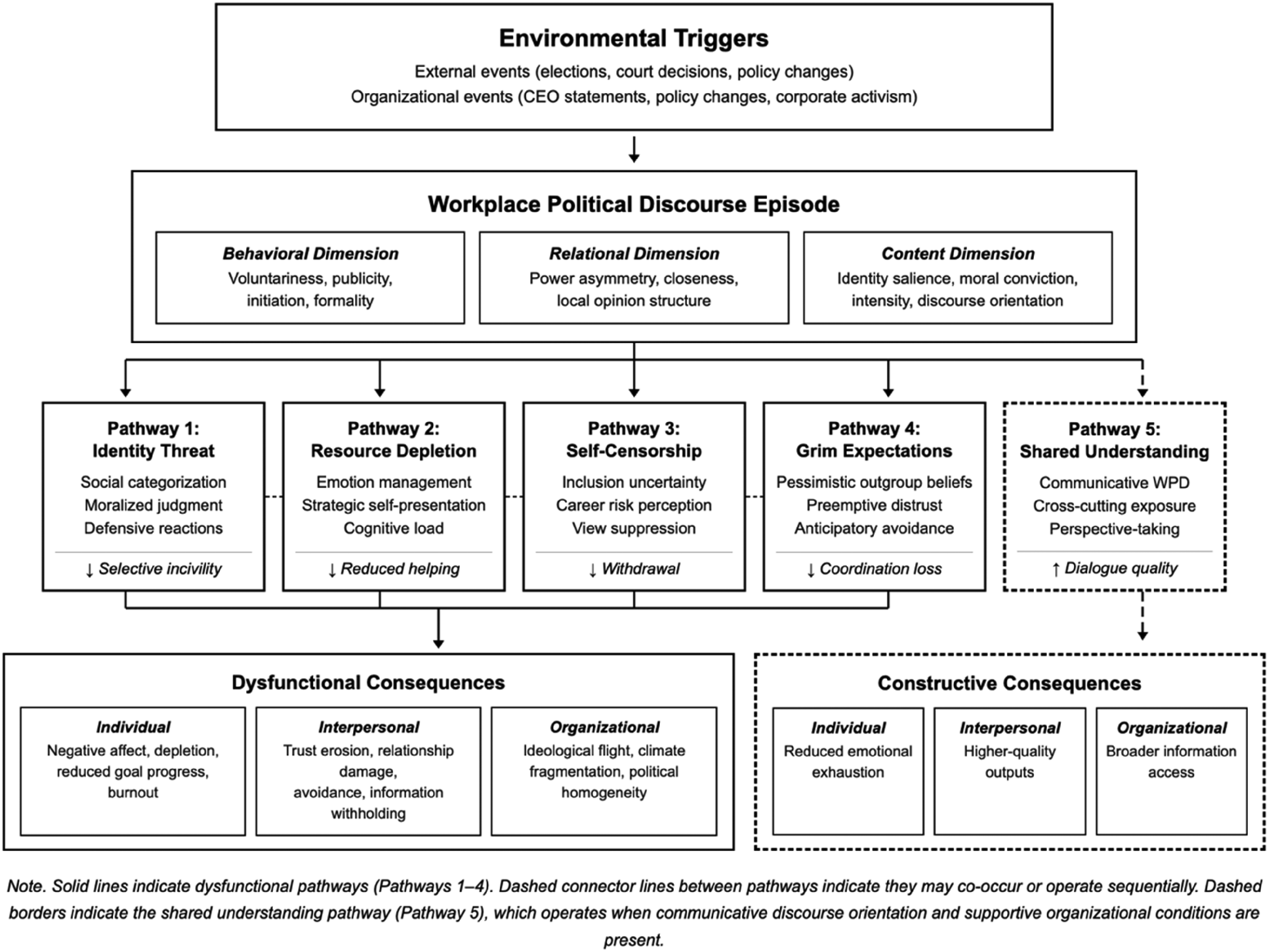
Process model of workplace political discourse.
External events (elections, court decisions, policy changes) and organizational events (CEO political statements, corporate activism) often trigger WPD episodes, though episodes also arise ambiently when workplace conversations drift toward contested public issues. The consequences of any given episode depend on its dimensional properties, channeling through the following pathways.
Pathway 1: Identity threat. Social identity theory predicts that salient political identities activate categorization and intergroup threat (Tajfel & Turner, 1979). Employees experiencing moralized political issues may perceive challenges to their moral character (Skitka, 2010), which intensifies defensiveness and reduces tolerance. In WPD contexts, identity threat can yield overt incivility but also produces subtler costs—avoidance, diminished information sharing, and interpretive suspicion—without any explicit norm violation.
Pathway 2: Resource depletion. Political talk demands emotion management and strategic self-presentation. Conservation of resources theory predicts that such repeated cognitive and emotional demands generate strain and withdrawal (Hobfoll, 1989). Empirical evidence supports this mechanism: employees report higher depletion after political talk, which in turn predicts reduced helping behavior and increased withdrawal (Kim et al., 2022). Notably, WPD depletes resources even when employees are not direct participants— (this might be a better phrasing:— ambient political conversations can produce negative affect and impede goal progress under passive exposure alone (Rosen et al., 2024).
Pathway 3: Self-censorship. Employees who hold minority political views, feel politically ambivalent, or value privacy face uncertainty about social inclusion and career risk when political talk arises. Many resolve this uncertainty through self-censorship—suppressing authentic views to avoid conflict—at a cost to belonging and well-being (Sinclair et al., 2024). Thompson (2021, 2022) argues that political identity can function as a concealable stigma whose disclosure through political discussion activates discriminatory responses. Experimental evidence reinforces this pattern: individuals demand significantly more compensation to discuss politics with out-partisans than with co-partisans (Settle & Carlson, 2019). Beyond overt conflict, people also avoid political discussion with dissimilar others altogether (Carlson & Settle, 2022). In workplaces, Kuhn et al. (2026) find that employees discussing emotionally charged political news tend to select politically similar conversation partners. This pattern suggests that the apparent affective benefits of coworker political discussion may be unevenly distributed: employees who hold minority political views may have fewer safe partners and may therefore bear greater costs of silence. Kuhn et al. (2026).
Pathway 4: Grim expectations. The final dysfunctional pathway operates not through experienced conflict but through its anticipation. Dimant (2024) demonstrates that polarization reduces cooperation toward political outgroup members largely because people hold pessimistic expectations about outgroup cooperativeness—what he terms “grim expectations.” These expectations need not be accurate; research on second-order political beliefs reveals misperception of others’ political positions (Carlson & Hill, 2022), suggesting that employees may act on distorted inferences about coworkers’ views. In workplaces, once employees infer colleagues’ political identities—through explicit talk or subtle cues—they may preemptively reduce cooperation, information sharing, or trust, even absent any direct conflict. Thompson (2026) identifies a complementary mechanism: as demographic-partisan sorting intensifies, observable attributes—race, education, geography—increasingly predict political affiliation (Mason, 2018), enabling taste-based statistical discrimination even without identity disclosure. Together, grim expectations and taste-based animus can poison collaboration even when political discourse itself is rare, because coworkers need not hear each other's views to form partisan inferences that reshape behavior.
These pathways are not mutually exclusive: a single episode may activate multiple pathways simultaneously, and dimensional properties shape which pathways dominate. High moral conviction content primarily engages identity threat; power-asymmetric contexts disproportionately activate self-censorship; ambient exposure primarily drives resource depletion. A purely dysfunctional account, however, would be incomplete.
Pathway 5: Shared understanding. When organizational conditions for genuine dialogue are present, communicative WPD can yield constructive outcomes. Research on cross-cutting political networks shows that exposure to dissimilar views increases awareness of oppositional rationales and fosters political tolerance, though often at the cost of participatory engagement (Mutz, 2002). (Hedrick & Saad, 2024; Kuhn et al., 2026; Shi et al., 2019. In organizational contexts, emerging evidence suggests that coworker discussion of emotionally charged political news may improve affective well-being under some conditions (Kuhn et al., 2026), while Gallup survey evidence indicates that some employees report feeling included or closer to coworkers through political discussions even as others report discomfort or unfair treatment (Hedrick & Saad, 2024). Related evidence on politically balanced teams or crowds suggests that ideological diversity can improve output quality when strong norms govern collaboration (Shi et al., 2019). Yet these benefits remain highly conditional: such discussions often occur between politically similar coworkers, suggesting self-selection rather than robust cross-partisan deliberation. Communicative WPD, therefore, requires psychological safety, equal-status interaction, and governance that limits domination and moral shaming (Edmondson, 1999). When these conditions align, WPD can foster perspective-taking and cross-partisan understanding that other organizational mechanisms cannot readily provide.
Across these pathways, consequences cascade through multiple levels of analysis. At the individual level, WPD predicts negative affect, depletion, and reduced goal progress, especially under ambient exposure and high moralization (Rosen et al., 2024). Kuhn et al. (2026) found that perceived political dissimilarity predicted higher emotional exhaustion following the 2024 U.S. presidential election, even absent overt conflict. At the interpersonal level, WPD damages trust and relationship quality through incivility, avoidance, and suspicion. At the organizational level, WPD can catalyze ideological flight, contributing to political homogeneity (Bermiss & McDonald, 2018). These multilevel consequences underscore both the urgency of studying WPD and the breadth of the research agenda we now propose.
Research Agenda
The process model yields four research questions that target the most productive lines of inquiry: macro-to-micro translation, pathway differentiation, constructive versus dysfunctional conditions, and construct measurement. RQ1: When do macro-political events translate into workplace WPD episodes, and what organizational factors govern this translation?
Elections, court decisions, and policy events create predictable shocks, yet organizations vary widely in whether those shocks become internal discourse episodes. Researchers should identify the organizational moderators governing this translation—communication architecture, leadership signals, norms around nonwork identity expression, and local political balance—using quasi-experimental designs around election periods and event-system theory (Morgeson et al., 2015). Communication trace data can reveal how political content diffuses through networks after external events. Comparative cases of organizations facing the same political event under different governance regimes would clarify when macro politics becomes WPD. RQ2: Through which pathway does WPD generate consequences—and when do consequences accelerate?
Researchers should not assume that pathways co-occur uniformly. Studies should test whether pathways operate sequentially, conditionally, or multiplicatively and should identify dose-response thresholds—the exposure parameters (frequency, duration, moralization intensity) beyond which harm accelerates. A dose-response framing is warranted because allostatic load theory predicts that repeated stressors produce cumulative physiological wear that progressively dysregulates stress response systems (Ganster & Rosen, 2013; McEwen, 1998), and meta-analytic evidence reveals stronger stressor–strain relationships at the between-person than within-person level (Pindek et al., 2019). Together, these findings suggest that occasional WPD episodes and sustained WPD climates produce different harm trajectories.
Moralization intensity may serve as a critical threshold moderator. Highly moralized political attitudes generate intolerance and resistance to compromise that exceed ordinary disagreement (Skitka et al., 2021). The model therefore yields specific predictions: high moral conviction content should primarily activate Pathway 1; supervisor-initiated WPD under power asymmetry should disproportionately activate Pathway 3; and ambient exposure should primarily activate Pathway 2. Event-contingent experience sampling and multilevel growth models can test these within-person harm trajectories (Gabriel et al., 2019). RQ3: Under what organizational conditions do constructive versus dysfunctional WPD pathways dominate, and what mechanisms explain the balance?
Because the constructive pathway operates conditionally (Pathway 5), researchers can move beyond asking whether constructive outcomes are possible toward specifying the mechanisms that govern pathway selection. Three levels of enabling conditions warrant investigation. Macro-organizational communication architecture—structured forums versus ambient political talk—may determine whether episodes activate Pathway 5 or default to Pathways 1–4. At the meso-level, leaders who model communicative rather than strategic orientations shape subordinates’ discourse norms. At the micro-level, individual differences in perspective-taking capacity and moral conviction may moderate whether employees shift to communicative engagement. Emerging evidence suggests that topic selection critically moderates these outcomes: cross-partisan conversations reduce affective polarization when they center on common ground rather than direct disagreement (Santoro & Broockman, 2022). Field experiments comparing ambient versus facilitated dialogue, longitudinal studies of discourse governance, and comparative case studies across political climates can address this question. Importantly, researchers must account for selective sharing (Kuhn et al., 2026): observed “constructive” outcomes may reflect safe same-partisan exchanges rather than genuine cross-cutting deliberation, requiring designs that capture the political composition of discourse dyads. RQ4: How can WPD be reliably measured across its dimensional structure, and what methodological approaches best capture its episodic nature?
Testing the process model requires valid WPD measures. Instruments must capture behavioral, relational, and content dimensions, especially discourse orientation. Existing measures offer starting points (Kim et al., 2022; Rosen et al., 2024), but no single instrument captures the full dimensional structure. Communication traces can assess behavioral and content features at scale; diary methods can track episodes over time; and vignettes can isolate causal effects of specific dimensional properties. Multi-method triangulation will prove essential for construct validation and for maintaining WPD's distinctiveness from adjacent constructs.
Conclusion
WPD is increasingly common and consequential, yet it remains under-theorized as a focal construct in organizational research. By defining WPD, distinguishing it from six adjacent constructs, and mapping five pathways through which it generates organizational consequences, we provide conceptual infrastructure for systematic study. Our research agenda targets macro-to-micro translation, pathway differentiation, constructive conditions, and measurement. The payoff is both theoretical—integrating identity, communication, stress, and cooperation under polarization—and practical. Rather than debating whether politics belongs at work, researchers and managers can now ask sharper questions: when does discourse become harmful, when might it become constructive, and what organizational conditions tip the balance?
Footnotes

Funding
The author received no financial support for the research, authorship, and/or publication of this article.
Declaration of Conflicting Interests
The author declared no potential conflicts of interest with respect to the research, authorship, and/or publication of this article.