







Abstract
Despite efforts to redress racial grievances, American’s most progressive institutional sector, higher education, suffers racial incidents with disturbing frequency. We hypothesize that one explanation lies in the bureaucratization of higher education. Various trends have led to what Benjamin Ginsberg calls “the fall of the faculty” and “the all-administrative university.” We hypothesize that insulated from students and responsive to national employment markets, administrators adopt policies promoting the short-term appearance of successful integration, and driven by ideology. Faculty, in contrast, may focus on long-term student well-being, acknowledging policy tradeoffs. Using the North American Academic Survey Study (n = 1,643 faculty and 808 administrators), we construct statistical models of attitudes toward race-based undergraduate admissions and faculty hiring. Contrary to predictions, both faculty and administrators offer nuanced support for affirmative action acknowledging potential tradeoffs. Further, ideology better explains faculty than administrator support. Implications are discussed.
Recent racial unrest on various American colleges and university campuses, reflecting a long history of racial injustice (e.g., Dawson, 1994; Myrdal, 2008), can be interpreted in various ways. Some on the social justice left see incidents at the University of Missouri (Eligon, 2015), Evergreen State College (Sumter, 2017) and elsewhere as long delayed efforts to achieve social justice first on campus and then in American society. Since higher education allows somewhat safe spaces protected from the white privilege 1 dominant elsewhere, within academia racially conscious students and faculty feel free to express concerns in ways effectively prohibited elsewhere. Such interpretations accord with a lone line of research regarding the role of power and powerlessness (e.g., Gaventa, 1980), particularly as regards race (DiAngelo, 2016). In sharp contrast, academic conservatives and particularly Straussians (e.g., Balch, 2009; Wood, 2009) perceive racial incidents at certain campuses as limiting free speech to enforce norms of “political correctness” (Eligon, 2015). Conservatives are joined by many on the center (Whittington, 2018) and left, including Lukianoff and Haidt (2018) and Lukianoff (2014). Conservatives also see campus racial conflict as reflecting an elite developed erosion of American identity, now replaced by various contending subnational identities championed by the New Left (see works within Chua, 2018; Maranto et al., 2009; Rothman et al., 2016). Further, dating back to at least Sowell’s (1972) discussions of racial politics at Cornell in the 1960s and in particular the “guns on campus” crisis in 1969, conservatives have argued that leftists incite racial conflict in part from ideological zealotry, but also for advancement within academia since administrators coopt activists with paid positions and even whole departments. Recently Chatelain (2017), has made similar charges of conservative activists.
We do see these interpretations as limited and insufficiently anchored in theories of bureaucracy and intergroup conflict. The right and left each fail to recognize how higher education leadership could simultaneously patronize and marginalize minorities, particularly African Americans, by subordinating educational and class mobility goals to administrative and political goals. Allegedly to advance diversity, American higher education has long employed differential admissions standards (Sander & Taylor, 2012; Sowell, 1972), minority affairs offices (Wood, 2009), and in the case of elite colleges and universities, speech codes (Lukianoff, 2014; Reeves & Halikias, 2017; Whittington, 2018), none of which are found at elite British universities (Warikoo, 2016). Yet only 2.9% (105 of 3,600) of traditionally white colleges and universities were led by African Americans as of 2006 (Chenoweth, 2007). Seemingly, American higher education welcomes African Americans in certain posts to demonstrate to outside funders that institutions are not racist, but does not welcome them into real leadership positions. Since at least the 1960s African American faculty have complained of marginalization, placement in token rather than important faculty and administrative positions, claims which have come from the right as well as the left (Carter, 1991; Maranto, 2016; Sowell, 1972).
We hypothesize that this contradiction reflects what Ginsburg (2011) calls the rise of the “all administrative university.” Administrators may view promoting diversity as encompassing a set of political practices aimed at satisfying external constituencies and markets through public relations (Lukianoff, 2014; Lukianoff & Haidt, 2018). In contrast, as street level bureaucrats (Lipsky, 1980) higher education faculty will be more apt to focus on whether diversity policies help or harm individual students, thus balancing institutional public relations with competing goals including the long-term academic success of students, who faculty actually know and serve. Faculty would thus be less apt to admit students unlikely to succeed academically, and more likely to work with individual students to foster success (Frisby & O’Donohue, 2018; Professor, 2012; Sander & Taylor, 2012; Sowell, 1972).
Here, we hypothesize about higher education and diversity, and use a large national survey of higher education faculty and administrators to test whether our theory fits patterns of how professors and (generally more powerful) administrators view affirmative action, and whether those views are driven by ideology. We find that faculty are more politically progressive than administrators; relative to administrators, their support for affirmative action is better predicted by ideology and perceptions of national racism than by more pragmatic factors, contradicting our predictions. Implications and directions for future research are discussed.
The Rise of the All-Administrative University
As early as President Eisenhower’s military industrial complex speech (Ledbetter, 2011), observers have raised concerns that external funding has shifted higher education missions from serving undergraduates to revenue maximizing research, and administrative compliance supporting that research, and to satisfy ever growing public regulations affecting any institution taking public funding. This has led to an ever-thicker higher education administrative class (Brennan & Magness, 2019; Ginsburg, 2011; Greene, 2010). Further, perhaps ironically, the neoliberal reforms of higher education linking funding with measured results have led colleges and universities, including private institutions, to focus more on prestige seeking behaviors raising official rankings, as indeed some university presidents (e.g., Trachtenberg, 2012) and journalists (Washington Monthly editors, 2013) lament, and to enhance public relations functions such as college athletics (Levine, 2014). Recruitment and retention maximization to enhance rankings have led colleges and universities to reduce traditional academic requirements, instead emphasizing “soft skills.” These trends combine to empower university administrators at the expense of professors who have greater dedication to teaching academic content, leading to what Ginsburg (2011) calls “the fall of the faculty” and, regarding governance, “the all-administrative university.” As Ginsberg and others (e.g., Greene, 2010; Levine, 2011) show, administrators and support staff have increased in number far more rapidly than professors, and now outnumber and often out-earn professors. Further, faculty growth has come disproportionately among adjunct and renewable contract rather than tenured or tenure track posts, generally undermining the ability of faculty to challenge large and well-compensated administrative staff (Cross & Goldenberg, 2009; Smith, 2015). Indeed Brennan and Magness (2019) speculate that administrators prefer adjunct faculty since they are more compliant, and subject to downsizing before administrators.
This evolution suggests that to better understand higher education, we need to employ the literature on hierarchy in complex organizations. All organizations have missions, which they use to attract resources and measure success (Downs, 1967; Perrow, 1979; Wilson, 1989). Until relatively recently, most college and university administrators at the dean, provost, and even chancellor level continued to teach and/or do research, so they had direct knowledge of students and student life. Anecdotal evidence suggests that such teaching administrators have faded in number, in part as leadership salaries have risen far more rapidly than those of faculty, undermining the economic logic of having (highly paid) administrators fill classroom positions when their talents might bring more value elsewhere. Further, as noted above, administrative staff have expanded (Brennan & Magness, 2019; Ginsburg, 2011; Levine, 2011). In combination these changes have increased the social and organizational distance between administrative leaders and faculty, reducing the informal exchange of information across hierarchical levels. When leaders lack direct knowledge of organizational work, they compensate with “distortion proof” data such as statistics (Downs, 1967; Knott & Miller, 1987). Unfortunately, as a significant literature indicates, the more measures matter, the greater the efforts of subordinates to manipulate them (Campbell, 1979). Further, social distance from street level bureaucrats like professors can lead administrative leaders to impose their own cognitive heuristics on complex realities, “seeing like a state” as Scott (1998) put it, rather than compromising a range of values and interests, as the U.S. Constitution and political traditions suggest (Ostrom, 1974).
In addition to these fundamentally information-related challenges, we must consider administrative incentives. When high-level administrators periodically returned to faculty, they had incentives to attend to the long-term health of their institutions, protecting reputations inside the organization rather than nationally. Those on permanent administrative tracks, making far higher incomes than as faculty, might instead face incentives to appear attractive to prospective external employers, as Teodoro (2011) finds in his seminal work on police and water administrators. This accords with findings regarding urban school superintendents. As Hess (1999) shows, since improvement in large, complex educational bureaucracies takes years and offer uncertain prospects for success, superintendents have incentives to announce and burnish flashy initiatives to pad their records, and then move on to better jobs before those reforms are implemented and leaders might face accountability for failure. This mirrors the broader critiques of generalist political appointees, that they have incentives for the short-term appearance of success rather than long-term improvement in organizational outcomes (Lewis, 2008; Maranto, 2005; Maranto & Wolf, 2013). Some argue that regarding higher education, administrative leaders have fought for short-term resource acquisition or additional prestige at the expense of long-term academic success (Ginsburg, 2011). For example, it might be easier to increase student retention rates by easing requirements rather than improving instruction.
Both anecdotes (e.g., Armstrong & Hamilton, 2013; Professor, 2012; Zimmerman, 2016) and data (Arum & Roksa, 2011; Brennan & Magness, 2019) suggest that full time students study far fewer hours than in the 1960s, and in most majors at most universities, learn relatively little content and few skills even while earning degrees. This has long-term costs to students (Arum & Roksa, 2014). We argue that these long-term impacts reflect the rise of the all-administrative university. Though both professors and administrators are typically mixed motive officials (Downs, 1967), professors are likely more motivated by student academic success, in part since they know students and work with them on a regular basis. Because administrators focus on more immediate public relations enhancing budget maximizing and prestige (and hence their own prospects for advancement), they are more likely than faculty to embrace short-term policies regarding race (and everything else) rather than those which might facilitate long-term student success.
Regarding diversity, this means that universities have resourced offices, dorms, and even majors meant to attract and segregate African Americans while failing to integrate white fraternities and sororities. Higher education administrators similarly eschew efforts to build African American academic achievement so that African Americans can compete on an equal basis with whites and Asians in like fields of study. In effect, diversity policies increase the number of collegiate African American since success is measured by the numbers of minority students, but segregate rather than integrate those students in higher education, failing to assure minority academic success and leaving institutions of white privilege such as Greek letter organizations unchanged; reforming the latter could offend alumni (Maranto, 2016). Similarly, universities may appoint African American administrators to “token” positions with public presence, but lacking institutional power. As noted above, only 2.9% (105 of 3,600) of traditionally white colleges and universities were led by African Americans as of 2006 (Chenoweth, 2007), less than a third the percentage of African American Army officers. As Moskos and Butler (1996) find, African American and white soldiers in the U.S. Army are more likely over the course of their service to have cross-racial friendships and eschew stereotyping while in their limited study students are less likely to do so after four years of college. Diversity policies in American higher education might also compare unfavorably with those in much of corporate America (Golembiewski, 1995). We argue that this reflects higher education administrative practices typing racial diversity issues as part of public relations rather than as a more complex array of issues properly addressed over the long term within rather than apart from the traditional academic missions of higher education, and best addressed by policies tending to integrate students on equal terms rather than segregate them.
This suggests that mainstream higher education administration lacks comfort with African Americans in positions of power rather than in subordinate or largely orthogonal, symbolic posts. Further, efforts to report statistical descriptive representation have led some universities to practice differential admissions practices which have seemingly decreased African American college retention rates, a matter empirically explored since the 1960s, but largely avoided rather than addressed by higher education administrators. Seemingly, administrators fail to acknowledge potential tradeoffs, seeking numerical gains producing short-term symbolic benefits, which over the long term may weaken African American academic performance and increase alienation (Sander & Taylor, 2012; Sowell, 1972). In The Still Divided Academy, Rothman et al. (2011) provide some of the first side-by-side assessments of perceptions of affirmative action comparing students, faculty and college administrators. One of the more interesting findings from their research was that faculty and administrators hold diverse views on questions of preferential or compensatory treatment.
According to the NAAS study (Rothman et al., see Table 1), 57% of faculty and 50% of administrators chose “agree” or “agree with reservations” that “No one should be given special preference in jobs or college admissions on the basis of their gender or race.” The question is asked in a way that might erode support for differential treatment by referring to “special preferences” rather than general support for “affirmative action.” Not surprisingly, Rothman et al. find significant differences in support for affirmative action by race and by field, with the arts and social sciences showing the strongest commitment to special admissions and hiring practices. Notably, when a similar question prompted respondents to consider the possibility that different standards lead to “relaxed” standards, support remains unchanged. When asked to evaluate the statement “More minority group undergraduates should be admitted here even if it means relaxing normal academic standards of admission” 58% of faculty and 54% of administrators chose “agree” or “agree with reservations.” Support for special treatment in hiring faculty is considerably weaker than for college admissions. Regarding the statement “The normal academic requirements should be relaxed in appointing members of minority groups to the faculty here” only 19% of faculty and 16% of administrators chose “agree” or “agree with reservations.”
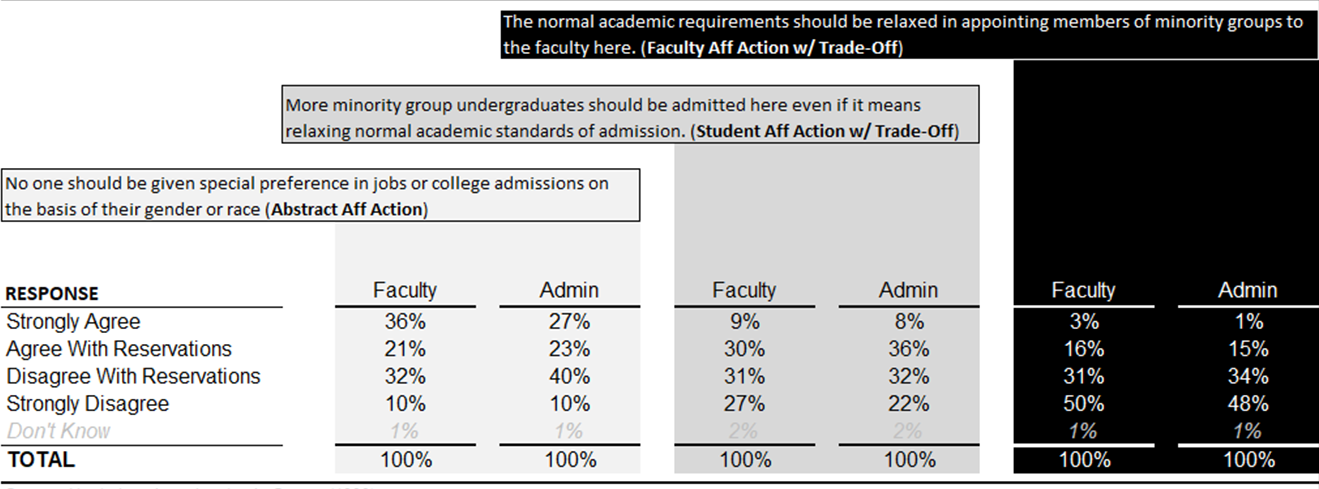
Support for Affirmative Action Among Faculty and Administrators
When asked to consider the probable impact of special treatment, Rothman et al. (2011) noted more significant differences between faculty and college administrators (Table 2). When asked “What impact, if any, do you think special admissions policies for minority students have on academic standards?” 39% of faculty and 29% of administrators said it would lead to “a little lower standards” or “much lower standards.” Concerning faculty hires, 36% of faculty and 24% of administrators said it would lead to “a little lower standards” or “much lower standards.” While faculty and administrators assess the effects of affirmative action somewhat differently, again their overall perception of its consequences are largely the same.
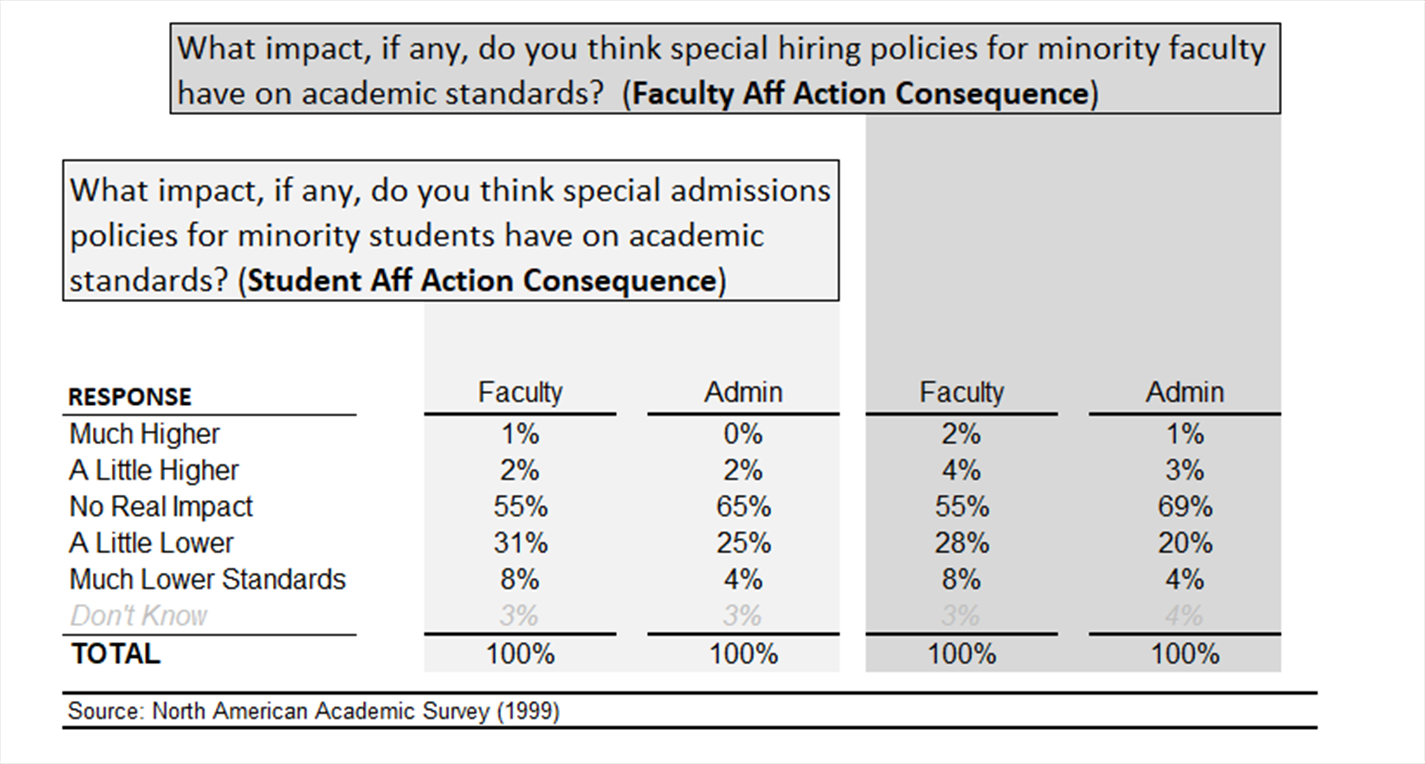
Consequences of Special Admissions and Hiring Policies
Hypothesis
Similar levels of faculty and administrators support for affirmative action do not preclude the possibility that they reach these conclusions in different ways. Given their different roles and experiences in academia, faculty see firsthand the consequences (good and bad) of preferential treatment. Even if they exhibit similar levels of support for affirmative action, those experiences should influence how they weigh the costs and benefits of affirmative action policies. We hypothesize that as a consequence of their day-to-day contact with students, faculty support for special treatment would be shaped primarily by pragmatic assessments of policy costs and benefits. Largely removed from the classroom, administrators would evaluate affirmative action more in terms of abstract considerations like personal ideology and views of national racism, rather than conditions on their campus.
Naturally, the null hypothesis suggests that administrators to a greater degree than faculty assess affirmative action policies based on pragmatic within institution tradeoffs rather than ideological or national considerations. If our reasoning is correct, then among faculty, most explained variance comes from academic, personal or campus variables. Among administrators, most explained variance would relate to ideology or perceptions of racism generally. If this hypothesis is correct, faculty and administrators examine race-based admissions policies based on fundamentally different factors, even if there is considerable overlap in support for affirmative action.
Methods
We test our theory by constructing a series of OLS regression models using data from the 1999 North American Academic Survey Study. The NAAS study, commissioned by Stanley Rothman, Everett Ladd, and Seymour Martin Lipset, is the only comprehensive examination of the competing views of the university’s primary stakeholders, utilizing a large-scale national representative sample of students, faculty and college administrators (Rothman et al., 2011). The study was run by the Angus Reid Group (now the Ipsos-Reid Group) between March 4, 1999 and May 3, 1999. The study included respondents from both American and Canadian institutions. The analysis is limited to faculty and administrators from American colleges and universities. Institutions of higher education were chosen by random sampling procedures from a list of four-year colleges and universities. Accordingly, community colleges were not included in the sample. Individual faculty members were also chosen at random, based on lists of faculty at each institution, proportionate to the size of the institution. Faculty respondents included full time faculty who were teaching during the 1999 spring semester. Administrators were chosen at random from a list of college presidents, provosts, academic vice presidents, senior academic officers, and academic deans. The Angus Reid Group reported a 72% response rate for faculty and a 70% response rate for college administrators. The complete NAAS survey includes 1,645 faculty, and 807 administrators.
Dependent Variables
The statistical models of respondent attitudes toward granting compensatory treatment in admissions and hiring are based on estimates of five independent variables. The first three dependent variables, assessing support for affirmative action, are provided in the frequency distribution in Table 1. The final two dependent variables, assessing the probable impact of affirmative action, are provided in the frequency distribution in Table 2.
Table 3 summarizes our theoretical expectations for the five regression models provided later in Tables 4 and 5. The sign of the coefficients are listed as negative, positive or they are left blank were, from a purely theoretical perspective, we do not expect them to achieve statistical significance.
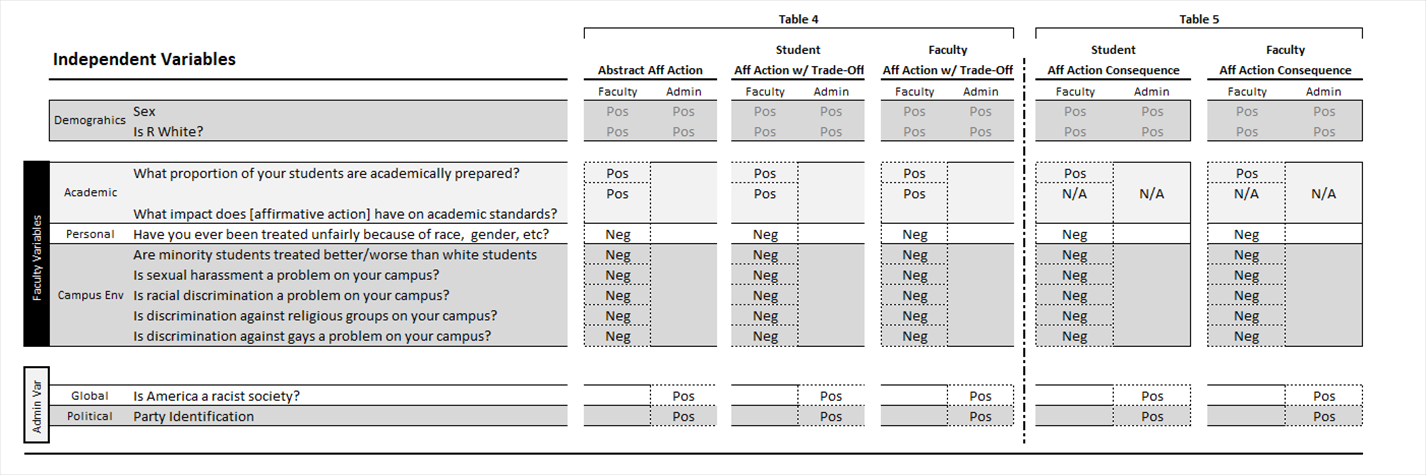
Summary of Expectations for Regression Models—Direction of Standardized Betas
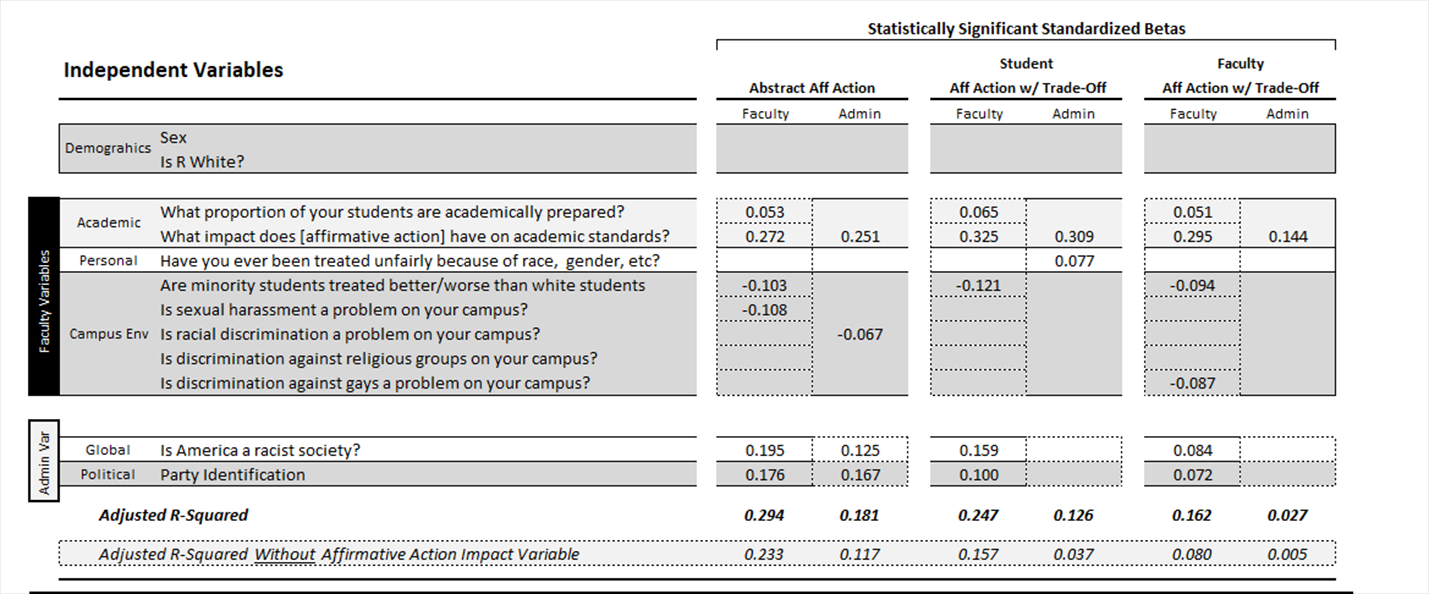
Regression Summaries Predicting Support for Special Admissions/Hiring
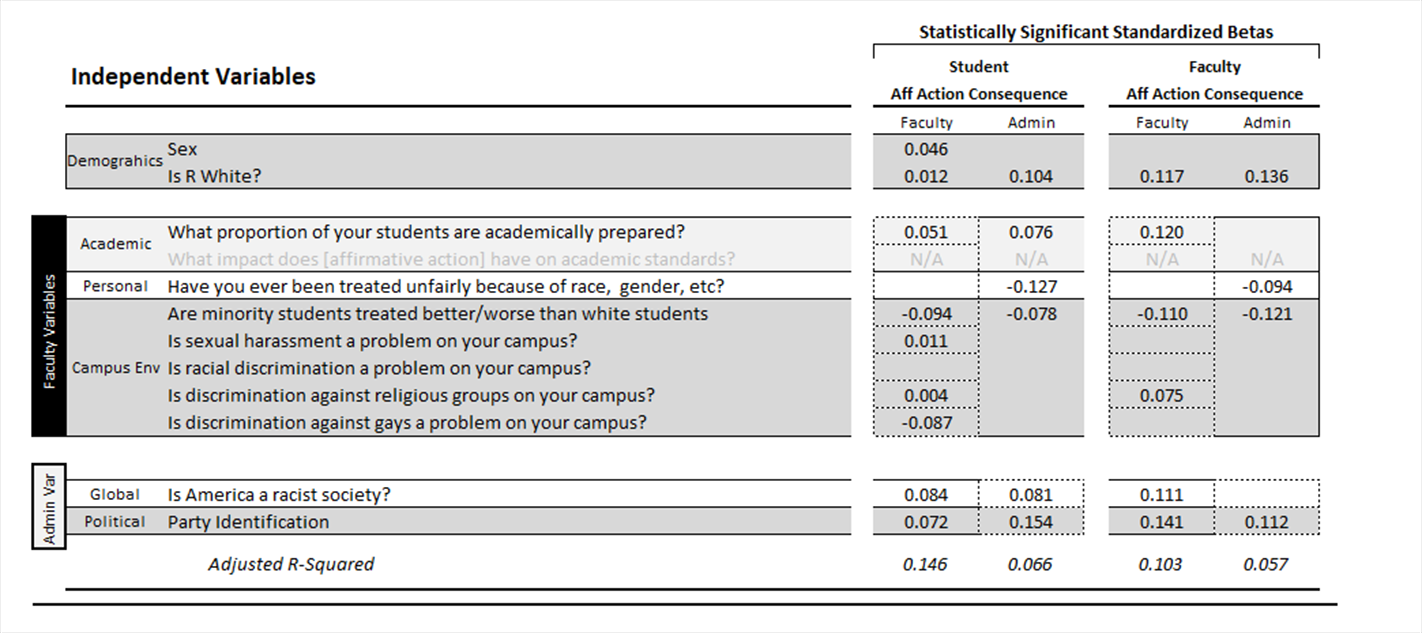
Regression Summaries Predicting Consequences of Special Admissions/Hiring
Demographics
Each of the five models include two demographic variables: sex and race (is the respondent white). If (controlling for other factors) demographics predict support for affirmative action we expect that nonwhites and women will tend to support granting minorities “special treatment” or minimize the negative consequences of affirmative action. This would result in positive correlations for both the sex and race variables.
Faculty Predictors (Academics, Personal Mistreatment and Campus Environment)
Theorizing that faculty views of affirmative action are primarily shaped by more immediate assessments of the academic environment, we highlighted eight measures of academics, personal experience and perceptions of the campus environment labeled on the far left column as “Faculty Variables.” Respondent views of academics are measured with two variables: Assessments of academic preparedness, and the perceived impact that special treatment has on standards. Those who believe their students are academically prepared will tend to support affirmative action (Table 4) and they will tend to minimize the impact of affirmative action on academic standards (Table 5). Those who believe that affirmative action has minimal impact on standards will tend to support affirmative action 2 (Table 4). We presume that faculty who have personally been the victims of unfair treatment because of race or gender will be more likely to support affirmative action (Table 4), and minimize its impact on quality (Table 5). The five measures of the campus environment include one assessment of whether the respondent feels that minority students are treated better or worse than white students, as well as four measures of inequity, including sexual harassment, racial discrimination, religious discrimination, and GLBT discrimination. Those who feel that minority students are treated worse on college campuses, or those who feel a particular group is the victim of mistreatment should be more supportive of affirmative action (Table 4), and minimize the negative impact of preferential treatment (Table 5).
Administrative Predictors: Ideology and National Racism
Theorizing that administrative views of affirmative action are primarily shaped by more abstract assessments of discrimination, we highlighted two measures of race labeled on the far left column as “Admin Var.” or administration variables. We expect administration respondent views of national racism and their partisan disposition to strongly influence their support for affirmative action (Table 4) and influence their perceived impact of preferential treatment on standards (Table 5). Ideally, the model should include an ideology (liberal/conservative) self-identification rather than party ID. The NAAS survey administered by the Angus Reid Group made a methodological error when administering the ideological self-placement question. Prior to asking the ideology question, they included a screening question (“Do you think of yourself as Left or Right”) that unintentionally screened most of the respondents from self-identifying as liberals or conservatives. As a workaround, Rothman et al. used an imperfect proxy for ideology, Party Identification, which we use in this analysis.
It is important not to take the theoretical expectations provided in Table 3 too literally. To say that faculty views of affirmative action tend to be rooted in practical measures of students’ and experiences does not preclude administrators from also considering factors like student preparedness or personal experience. Similarly, faculty are presumably cognizant of national racism, and politics. When a faculty member becomes an administrator, presumably they do not instantly lose sight of the potential academic drawbacks to special preferences, or the plight of mistreated women on college campuses. Rather, over time, issues like student preparedness would become less salient, as administrative role theory (Downs, 1967; Follett, 1926) suggests. Accordingly, administrators’ views might very well link to our “Faculty Variables.” Faculty views might correlate with “Admin Variables.” If our hypothesis works, with respect to administrators, most explanatory power of the model would reside in the “Admin Variables.”
Results
Table 4 shows the results of six regressions modeling support for affirmative action, including the question labeled “Abstract Affirmative Action 3 ” (“No one should be given special preference in jobs or college admissions on the basis of their gender or race”) and the two affirmative action questions related to student admissions and faculty hiring. Again, the affirmative action questions labeled “Aff Action w/ Trade-Off” presumes that the practice of giving special treatment may require “relaxing” normal standards.
The results in Table 4 show the regression standardized beta coefficients, but only where the results are statistically significant with 95% confidence using a two-tailed test. This standardization permits a rough assessment of the importance of each variable relative to others provided in the model.
Consistent with the theory, despite their overall similarities in support for affirmative action, there are potentially important differences between how faculty and administrators tie affirmative action to academics, campus climate and personal experience. Nevertheless, while the two groups draw conclusions about affirmative action differently, the pattern in the regression coefficients in several ways contradicts our theoretical expectations.
Consistent with our expectations, the faculty are more sensitive to both academic considerations and assessments of the campus environment. Each of the beta coefficients runs consistent with our theory. Faculty are, perhaps not surprisingly, more sensitive to academic preparedness as it relates to the desirability of affirmative action. They tend to link campus climate to affirmative action more often than do administrators.
We expected that, for faculty, personal instances of mistreatment would play a significant role in their support for affirmative action. However, the variable is never statistically significant for faculty. Interestingly, in one model, related to special treatment for students, the variable is significant for administrators. The coefficient runs counter to our theory. Strangely enough, administrators who report unfair treatment based on race, gender or other issues are less likely to support special treatment in admissions.
Somewhat counter to our expectations, the perceived impact of affirmative action is by far the most important predictor in all of the six models. In other words, both faculty and administrators are sensitive to the trade-offs between offering special treatment in admissions and hiring. With respect to administrators, this one variable accounts for between a third and three quarters of all the explained variance. As it pertains to administrators’ affirmative action and faculty hiring, it is the only statistically significant variable in the model. The adjusted R2 for the faculty affirmative action model drops from 2.5% to effectively zero when the affirmative action impact variable is omitted from the model. Not only are administrators sensitive to the question of how special treatment may affect academic standards, in many tests it is also the only factor linked to their assessment of the policy.
Finally, counter to our expectations, the more ideological and thus less pragmatic matters, which we expected to dominate the administrators’ assessments of affirmative action in admissions and faculty hiring, played only a limited role. In fact, assessments of racism in America and their political views are only statistically significant predictors in modeling the “abstract” statement about affirmative action. Completely contrary to theory, faculty perspectives on giving preferential treatment were consistently related to their views on national racism and their political affiliation. Unlike the administrative respondents, this holds true for all three measures of support for affirmative action in Table 4.
Table 5 models the impact of special admissions and hiring practices. Respondents could answer the question by indicating that affirmative action would raise, lower, or have no impact on standards (Table 2). The results in Table 5 are nearly identical to those used in Table 4, except that, as the “impact of affirmative action” variable is no longer in independent variable.
Unlike the model of affirmative action, two of the demographic variables are statistically significant. White respondents are more likely to say that special admissions and hiring practices lead to lower standards. With respect to college admissions, white faculty are more likely to conclude that special treatments lowers standards.
As with the previous set of regression models, Table 5 provides further evidence faculty and administrators assess affirmative action differently. Again, the results run counter to our hypotheses that faculty assess special admissions and hiring practices predominately on the basis of academics, personal experience and the campus environment.
Concerns about academic preparedness are a statistically significant predictor of faculty tendencies to conclude that special admissions and hiring practices lead to lower standards. At least with respect to college admission, administrator views are also influenced by concerns about academic preparedness. These concerns correlate with beliefs that special treatment leads to lower standards.
As with Table 5, faculty experiences with unfair treatment do not correlate with a belief that special treatment hurts standards. Surprisingly, college administrators who have been treated unfairly are more likely to state that special treatment leads to lower standards. While this is certainly counter-intuitive, it is possible that individuals who have personal experience with mistreatment might well be more willing to acknowledge that it might relax standards. Experience may make their judgements more nuanced (Lukianoff & Haidt, 2018). Regardless, we expected this would influence faculty judgments more than that of administrators.
The results of the models in both Tables 4 and 5 demonstrate that, while in the aggregate faculty and administrators tend to draw similar conclusions about the value and consequences of affirmative action, they come to these conclusions in different ways. The differences we observed were far more complicated than we anticipated.
Discussion and Conclusion: Affirmative Action Is Complicated
To date, very little quantitative research has explored how university faculty and administrators view affirmative action. As Rothman et al. (2011) reported, in the aggregate, faculty and administrators hold very similar views of offering compensatory treatment to underrepresented groups both in terms of admissions and hiring. While they downplay the overall impacts of the policies, both groups tend to acknowledge possible impacts on standards.
We were correct in assuming that, despite the similarities in their aggregate views, faculty and administrators seemingly justify beliefs in very different ways. When compared to administrators, faculty are indeed more sensitive to the potential impact the policy may have on student preparedness. Their view of campus climate is more closely related to their support for affirmative action. We completely misjudged how concerns about maintaining standards dominate the views of both faculty and administrators. However, we incorrectly predicted that views of national racism, and politics would strongly influence administrators. While administrative views on racism and politics were tied to some models of affirmative action, these were in fact far more important factors in how faculty judged both the desirability and effectiveness of preferential treatment.
One of the chief lessons learned from the analysis of the NAAS dataset is that with respect to understanding support for affirmative action, faculty are much more predictable. The OLS regression model could account for a quarter of the variation in the faculty views on special admissions policies for students. The same model could only account for 13% of the variation for administrators. Regression models of support for special hiring practices for faculty explained 16% of variance among faculty respondents, with only 2% for administrative respondents, possibly since administrators are less invested in faculty hiring. A similar pattern emerges in Table 5 when we attempt to model the consequences of affirmative action. Faculty are simply more predictable than administrators, and more ideological.
Perhaps the most surprising result is that ideology is what makes faculty more predictable. Whereas we originally speculated that faculty were, in essence, more pragmatic about affirmative action given their day-to-day interactions with students, we find the opposite. The so called “Admin Variables” were in fact the second best predictors of support for affirmative action. However, these ideological measures of politics and perceptions of racism were consistently strong predictors for faculty respondents, and only intermittently significant for administrators. Interestingly, these findings fit with work on large bureaucracies in various democracies including the U.S. indicating that to reach and retain high-level career positions, officials must moderate their views, adapting to the changing demands of political accountability (Aberbach et al., 1981; Maranto, 1993). Seemingly, in this way universities resemble public bureaucracies generally.
While the best predictor of support for affirmative action is its perceived impact on academic standards, in this faculty resemble administrators. It is only their response to abstract “Admin Variables” that make faculty more predictable. Far from being more pragmatic about affirmative action, it would appear that faculty tend to be driven by views of politics and racism more than their administrative counterparts. In short, data suggest that faculty on all sides of affirmative action-related issues can be and often think of themselves as idealists. In contrast, it is administrators who must consider ideological and political tradeoffs, and thus in some sense dream drabber, or at least more pragmatic and less theoretical dreams.
This pragmatism may offer hope. In higher education, diversity policies and practices have often provided de facto segregated “safe spaces” for minorities (Frisby & O’Donohue, 2018; Lukianoff, 2014), employed differential admission and hiring practices (Sander & Taylor, 2012; Sowell, 1972), or developed extensive and highly detailed racial etiquettes regulating language and behavior in order to avoid offense; diversity administrators now routinely make six figures salaries developing and disseminating such policies and practices (DiAngelo, 2016; Saul, 2016). Yet psychological theory (Haidt, 2012; Kinder & Kam, 2009) and actual organizational practice in businesses (Alhejji et al., 2016; Bregman, 2012) and in higher education (Levine, 2005) suggest that such approaches harden rather than soften the boundaries between social groups, decreasing rather than increasing integration and intergroup understanding. Instead, applying lessons from the military and other organizations, more productive means of managing diversity would encourage informal intergroup interactions in contexts in which shared identities and common challenges such as academic or athletic competition foster cross-racial friendships and trust, enabling sensitive conversations regarding race. Notably, considerable evidence indicates that military service reduces stereotyping and increases interracial understanding; some evidence indicates that college attendance does the opposite (Maranto, 2016; Moskos & Butler, 1996). Lukianoff and Haidt (2018) and the works within Frisby and O’Donohue (2018) describe the disadvantages of certain existing diversity practices in higher education, and model how practices employing more contact and engagement could increase interracial and inter-ideological understanding. We believe such approaches offer hope for overcoming what Myrdal long ago described as an American dilemma.
Footnotes
Authors’ note
The views expressed are those of the authors and do not reflect the official policy or position of the Department of the Army, Department of Defense or the U.S. Government.
Declaration of Conflicting Interests
The author(s) declared no potential conflicts of interest with respect to the research, authorship, and/or publication of this article.
Funding
The author(s) received no financial support for the research, authorship, and/or publication of this article.

Notes
Author Biographies