







Abstract
This study was conducted to examine which metaphors teachers attribute to educational reforms. This research adopted a phenomenological design, in which the data were collected through metaphors. The findings indicated that teachers have negative beliefs about educational reforms. Also, the findings showed that teachers have traditional beliefs about educational reforms, rather than contemporary ones. Although teachers believed that educational reforms are a need for the education system, they perceived reform acts negatively, approaching them from a more traditional perspective.
Introduction
Research on educational reforms has a long tradition, which has been widely discussed in the literature, with its causes and consequences (Hargreaves, 2005). As postmodern era is characterized by change (Fullan, 2007), educational reforms have become a fact of life for education systems all around the world (Priestley, 2011). Since all education systems are being bombarded by change (Fullan, 2007), educational reform acts have become inevitable (Blase & Björk, 2010) to respond to the changing economic, demographic, political, and social imperatives (Darling-Hammond, 2010). Thus, in many countries education systems are now expected to keep up with the change, and implement reforms to meet the needs of the 21st century world (Thomas & Beauchamp, 2011).
While educational reform is defined as deliberate policy and strategy attempts to change the system as a whole (Fullan, 2009), it aims at improving the educational system to make it keep up with constant diversification in society and knowledge base (Thomas & Beauchamp, 2011). Reforms involve renewal of the education system (Datnow, 2002), yet they may not always lead to improvement of the system, when imposed by the government (Day & Smethem, 2009), resulting in resistance amongst teachers working in schools (Bishop & Mulford, 1999). Usually, educational reforms are imposed through a top-down approach on teachers, without taking their views into account (Fullan, 2006), despite them being required to modify their behavior patterns and even their value systems (Fullan, 2007). Whenever teachers are viewed solely as implementers, educational reforms may become unsuccessful (Zhao et al., 2010). Educational reforms without considering teachers may result in negative consequences (Hargreaves, 2004), meaning a waste of resources, and at worst, do more harm than good (Fullan, 2007). Hence, teachers are acknowledged to play a crucial role in the success of educational reforms (Luttenberg et al., 2013) and they are considered as change agents (Fullan, 1993a), who focus on the improvement of the education system.
Teachers, as change agents, play a significant role in the implementation of educational reforms (Hargreaves & Fullan, 2000). Success of those reforms depends on how teachers perceive and adopt that kind of reform specifically (Ungar, 2016). How teachers perceive the main goal of educational reforms is important (Shirley, 2010) because it influences their motivation to change their own professional practice and achieve the goals of the reform (Kalin et al., 2007). Teachers resist educational reforms when the rhetoric of change does not match with the reality of their everyday classroom practices (Schmidt & Datnow, 2005). So, it appears that teacher beliefs are crucial in the transformation of education systems through educational reforms (Fullan, 2007). Without teachers having positive beliefs, educational reforms seem hard to be implemented. However, educational reform acts rarely address the beliefs of change for teachers (van Veen & Lasky, 2005). Therefore, understanding beliefs is important to gain insight into teachers’ thoughts and feelings about educational reforms. Teacher beliefs may serve as feedback to better understand how they conceptualize their basic views about educational reforms. Taking into account teachers’ beliefs about educational reforms can make authorities implement reforms in the education system successfully. So, the purpose of the present research was to reveal teachers’ beliefs about educational reforms using their metaphorical appraisal. Having the Turkish sociocultural context as background, the research had the following questions:
What metaphors do teachers use to describe educational reforms?
What conceptual categories can be derived from the metaphors teachers produce?
Theoretical Framework
Teacher Beliefs
Over the past two decades, there has been a growing interest in understanding teacher beliefs (Fang, 1996). Research literature has revealed that teachers’ classroom behaviors are shaped by a set of theoretical framework, which is belief driven (Chan & Elliott, 2004). Teacher beliefs constitute teachers’ conceptions, proposals, and hypotheses about issues related to education (Woolley et al., 2004), and they have a considerable influence on teachers’ classroom practices (Pajares, 1992).
Beliefs form part of the process of understanding how teachers shape their work, which is important in gaining insights into teaching practices and decisions in the classroom (Kagan, 1992). Teacher beliefs can be rooted in a series of stages in which the individual first goes through as students, then as preservice and in-service teachers (Bolhuis & Voeten, 2004). These beliefs form the identity of the individual as a teacher (Pinnegar et al., 2011), deriving from personal experience, previous schooling, and formal knowledge (Mahlios et al., 2010). Teacher beliefs can become more firm and deeply rooted over time (Murphy & Mason, 2006); however, they can be changed with practice and experience (Mahlios et al., 2010).
Research literature reports two belief orientations for teachers: traditional versus constructivist beliefs (Chan & Elliott, 2004). Studies on teacher beliefs are generally classified as either seeing teaching as knowledge transmission or teaching as facilitating students’ construction of knowledge (Lim & Chai, 2008). Teachers holding traditional beliefs are inclined to organize teaching
Use of Metaphors in Examining Teacher Beliefs
Research on teacher beliefs points to a shift toward qualitative methodology in understanding how teachers make sense of the classroom. Although there are exemplary methods for capturing teacher beliefs such as interviews, observations, written reflections, and questionnaires (Soysal & Radmard, 2018), metaphors have also been started to be used in gaining insights into teachers’ ways of thinking (Seferoğlu et al., 2009). They are used as a way of understanding the professional development of teachers and improving the education system (Zhao et al., 2010).
According to Lakoff and Johnson (2003), our thoughts, actions, and experiences are mostly unconscious outcomes of our conceptual system, which is mainly metaphorical. Metaphors express one entity in terms of another one (Lakoff & Johnson, 2003), and they are the windows of how people conceptualize the world and reality around them (Seferoğlu et al., 2009). Metaphors reflect to explaining phenomenon (de Guerrero & Villamil, 2002) by using other thinking or imagining systems with similar aspects to the given phenomenon or case (Lakoff & Johnson, 2003).
The process of selecting metaphors gives us an idea of the hidden aspects of language, emphasizing some of the selected characteristics of a whole phenomenon (Inbar, 1991). According to Inbar (1991), the metaphorical approach emphasizes the view that language choice is not accidental and represents more than the surface meaning of the concepts. Metaphor elicitation as a methodology, therefore, considers the value of the metaphorical language in revealing the subconscious beliefs and attitudes underlying consciously hold opinions (Seferoğlu et al., 2009).
Metaphorical expressions are not only reflectors of subconscious values, but also directly or indirectly affect teachers’ classroom performance (McGrath, 2006). These expressions can provide ample actual information about teachers’ classroom decisions and actions (Yob, 2003). Metaphors can also be used to reveal teacher beliefs that cannot be derived from the verbal implications of a spoken language (Moser, 2000). Metaphors, thus, can be a powerful manifestation of how teachers will make decisions and act in their future classroom settings (Leavy et al., 2007). The use of metaphors may be an ideal starting point from which teachers can reflect on reform initiatives and changes in the education system (Mahlios et al., 2010), since they reflect how teachers perceive situations and processes and can clarify some of the gaps between policy makers and practitioners (Inbar, 1991).
Present Research
Research on teacher beliefs reflects a shift toward qualitative methodology (Seferoğlu et al., 2009), while attempting to understand how teachers make sense of educational reforms. Since metaphors serve as a powerful tool to reflect teachers’ beliefs (Mahlios et al., 2010), they can be used to conceptualize their perceptions about educational reforms. Despite the studies about teachers’ beliefs regarding teaching, learning, and schooling being quite vast in scope (Inbar, 1996; Martı́nez et al., 2001, 2005; Saban et al., 2007), the research on their beliefs about educational reforms remains very limited (Ungar, 2016). Although recent research has revealed numerous metaphors about teachers’ beliefs about educational reforms (Ungar, 2016), alternative metaphors may provide us with fresh lenses through which we are capable of seeing the phenomenon from a different perspective (Saban et al., 2007). As metaphors “represent a part, but not the whole, of the phenomenon they describe” (Weade & Ernst, 1990, p. 133), they may serve us better understand how teachers conceptualize their most basic views about educational reforms.
Methodology
Research Design
This research adopted a phenomenological design (Moustakas, 1994), which is a widely used design in qualitative studies (Patton, 2002). A phenomenological study describes the common meaning for several individuals of their lived experiences of a concept or a phenomenon (Creswell, 2013). This type of study seeks “understanding about the essence and the underlying structure of the phenomenon” (Merriam & Tisdell, 2016, p. 24). The goal of phenomenological research is “describing the phenomenon from the person’s perspective with as few preconceived notions or influence from the researcher as possible” (Schreiber & Asner-Self, 2011, p. 199).
Participants
Teachers (n = 162) working in six public high schools in the province of Nigde, Turkey, who were identified by means of purposive sampling method (Fraenkel & Wallen, 2009), were participated voluntarily in the research. The aim of adopting purposive sampling method was to capture teachers’ beliefs that experienced educational reform acts over the past 15 years. The teachers came from high schools with different academic and sociocultural backgrounds. Of the participating teachers, 75 (49.30%) of them were males and 87 (53.70%) of them were females. Ninety-two (56.80%) teachers reported 15 to 20 years of occupational experience, whereas 70 (43.20%) teachers declared having an occupational experience up to 21 years. Their age ranged from 36 to 58 years, with an average of 22 years.
Data Instruments
In educational research, metaphors, which have long been used as a heuristic to raise awareness of theoretical assumptions, challenge established beliefs, and encourage change in the classroom (de Guerrero & Villamil, 2002), are “an important instrument of analysis aimed at understanding the role of the teacher” (Oxford et al., 1998, p. 45), and they represent what people’s beliefs are, and how they feel toward a topic (Leary, 1994). Related research has used a variety of techniques, such as stories, in-depth interviews, and classroom observations to provide rich metaphor-laden data coverage (Oxford & Green, 1996; Oxford et al., 1991). According to Pajares (1992), teachers’ beliefs should be inferred from their verbal expressions, instead of relying only on questionnaire data. So, in the present research, teachers’ beliefs about educational reforms were evaluated by means of an in-depth semistructured interview process (Bogdan & Biklen, 2003).
In order to gather data, an interview protocol was created (Creswell, 2013), based on the relevant literature. The protocol consisted of five open-ended questions that enable teachers to look at the process of educational reforms and address the changes that education reforms summon for them as teachers. The interview protocol, which was systematically devised across two stages, was designed to elicit teachers’ responses in-depth on how they find educational reforms. In the first stage, the researcher gathered data from five teachers as a pilot study to improve the validity and reliability of the study (Maxwell, 2013). These teachers provided anonymous answers to the open-ended questions regarding educational reforms. Based on their suggestions, the wording of some questions was refined. In the second stage, the interview questions were piloted with another group of five teachers for the second time, asking to check whether the devised questions were understood well or not. Based on the teachers’ responses, the researcher made the necessary changes in the questions after the pilot study, and made them ready for the implementation.
Data Collection
Prior to collecting the data, necessary permission was received from the Ministry of National Education (MONE), considering the ethical issues (Berg & Lune, 2011). The data of the research were collected from volunteering teachers working in different public high schools over a period of 3 months through semistructured interviews. The interviews were carried out after school times because of the teachers’ working schedules. During interviews, the teachers were asked about their metaphorical images regarding educational reforms, and each interview lasted approximately for 25 min. The explanations of the teachers were tape-recorded and then typed after completing the interviews which resulted in a 48-page document. Although the interviews with the teachers were conducted in Turkish, all the data were translated from Turkish into English by the researcher.
Data Analysis
This research used a content analysis through metaphor analysis (Miles et al., 2013). Metaphor analysis, which was carried out in line with content analysis, involves “collecting examples of linguistic metaphors generalising from them to the conceptual metaphors” they exemplify, and using the results to suggest understanding or thought patterns which construct or constrain people’s beliefs or actions (Cameron & Low, 1999, p. 88).
Analysis of the metaphors proceeded in a manner consistent with a naturalistic inquiry approach (Lincoln et al., 1985). Data analysis included open coding, which “generates categories and defines their properties (the characteristics or attributes of a category or phenomenon) and dimensions” (Strauss & Corbin, 1990, p. 69), through examination of all aspects of the teachers’ responses on each of the metaphor.
During the analysis phase, first, the interviews of the teachers were tape-recorded and transcribed verbatim, then each transcript was analyzed in sentences reflecting single metaphors. Thus, the collection of the metaphors served as a stimulus to develop the conceptual categories (Silverman, 2010). After that, the researcher coded the data, creating new codes and conceptual categories and subcategories, and integrating codes where relevant until the coding was complete (Cohen et al., 2018). Finally, the researcher grouped the codes into categories, giving the categories a title, based on criteria that the researcher decided. The researcher categorized the metaphors, drawing on evidence to support each conceptual category in the research.
Findings
As a result of the interviews conducted, the teachers produced a number of metaphors about educational reforms, which were conceptualized under two main categories: (1) the belief direction and (2) the belief orientation. The main and subconceptual categories in terms of educational reforms were shown below.
The Belief Direction
The teachers who participated in the research claimed positive, negative, and ambivalent metaphors about educational reforms. The teachers produced a total of 128 metaphors, in which 32 of them were positive, 86 of them were negative, and 10 of them were ambivalent metaphors. The major ones were presented in Table 1.
Belief Direction of Educational Reforms.
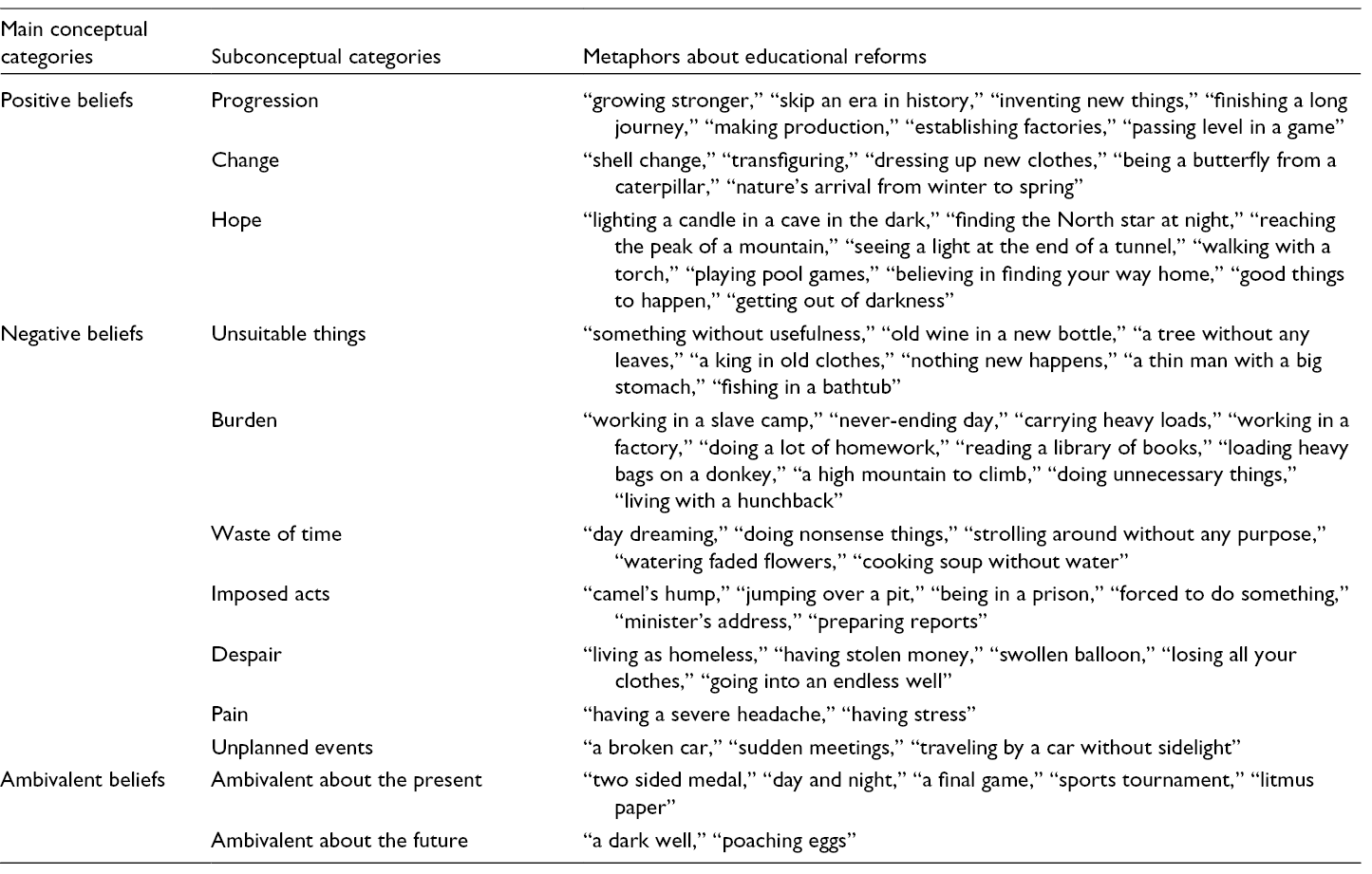
In the positive beliefs category, the teachers expressed hope about educational reforms that resembled “lighting a candle in a cave in the dark.” Even though initially the teachers found themselves in the darkness of a cave, they “walked with a torch” thoroughly and came to “believe in finding [their] way home.” The teachers, with time, also believed in “good things to happen” and “get out of the darkness.” After they “walked with a torch in the darkness,” they saw “a light at the end of [the] tunnel.” This seemed to them like “nature’s arrival from winter to spring,” which made them feel “skip an era in history.” In the end, they “finished [this] long journey,” which eventually made them “grow stronger.”
In the negative beliefs category, the teachers perceived educational reforms as unsuitable events, considering them as “old wine in a new bottle.” After a while, they found themselves “forced to do something,” imposed by the “minister” as if they were doing “unnecessary things,” which seemed to “watering faded flowers.” The teachers, as imposed by the “minister,” read “a library of books” and did “a lot of homework,” feeling like “working in a factory”, to repair “[the] broken car.” Eventually, they had “a severe headache” with the feeling of “having stolen money.”
Lastly, teachers expressed ambivalent metaphors in terms of seeing both benefits and flaws coexisting at the present, not sure which will overcome the other, and how the story will end in the future. There are teachers who were waiting to see the impact of the reforms to shape a positive or negative opinion, like “a two sided medal”—considering that educational reforms have an open-ended structure. Teachers perceived themselves as if in a “sports tournament,” in which it was hard to predict the winner of the “final game.”
The Belief Orientation
The teachers who participated in the research claimed traditional and contemporary metaphors about educational reforms. The teachers produced metaphors about educational reforms either in the direction of traditional and contemporary ways. Altogether, the teachers produced totally 128 metaphors, in which 88 of them were traditional and 40 of them were contemporary metaphors about educational reforms. The major ones were presented in Table 2.
Belief Orientation of Educational Reforms.
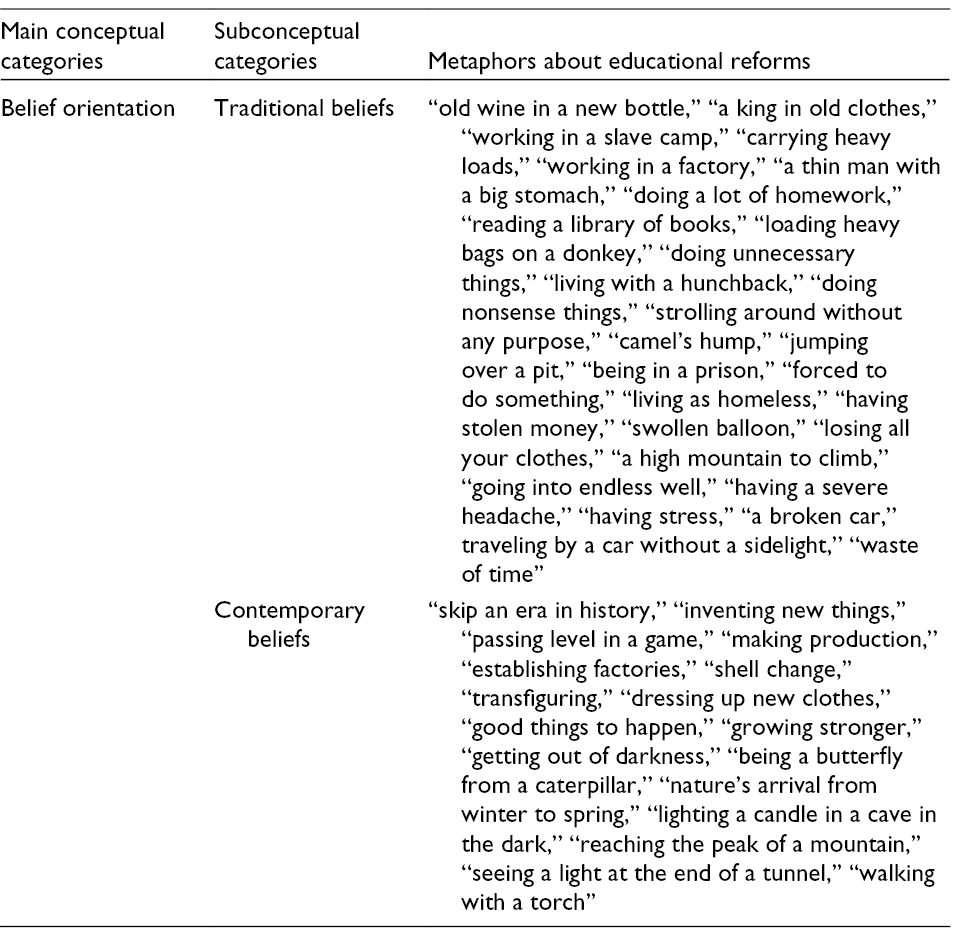
In the traditional beliefs category, teachers produced conservative metaphors, revealing that educational reforms do express negative meanings. The teachers considered educational reforms as “old wine in new bottle,” claiming that those reforms are “the same” compared to the old one bringing no new things in nature. In this category, the teachers generated metaphors about educational reforms resisting to change, which they felt themselves “working in a factory” as if they were “carrying heavy loads.” The teachers considered educational reforms as “camel’s hump,” “a high mountain to climb,” and “endless well,” symbolizing them with traditional beliefs. In the traditional sense, the teachers felt that the reforms are like “doing nonsense things,” just like “strolling around without any purpose.” At the end of the reforms, the teachers had “a severe headache,” as if they “forced to do something,” “working in a slave camp.”
In terms of the contemporary beliefs category, teachers generated progressivist metaphors, revealing that educational reforms do express positive meanings. The teachers considered educational reforms as “getting out of darkness,” symbolizing them with “skip an era in history.” In this conceptual category, the teachers produced metaphors which are open to change, hoping “good things to happen” to “get out of [the] darkness.” Also, the teachers perceived educational reforms as “shell change” to be “a butterfly from a caterpillar” to “grow stronger” in the end of this change process.
Discussion
The purpose of this research was to examine teachers’ beliefs about educational reforms through metaphor analysis. The findings of the research revealed a majority of negative beliefs about educational reforms. The findings indicated that teachers attribute negative metaphors on educational reforms, considering that they bring new workloads to them but no change. This finding could mean that teachers tend to consider educational reforms as unnecessary actions, rather than actions bringing innovation and curing. Based on the finding, it can be implied that teachers see themselves as passive implementers of educational reforms. Indeed, the research has shown that teachers do not feel like change agents (Priestley, 2011), which is a very important component for a successful educational reform act (Fullan, 1993b). Failure of teachers to see themselves in this way may adversely influence educational reforms. Teachers can directly affect the results of change due to their strategic role (Fullan, 2007) so that their negative beliefs about educational reforms can serve as a barrier to the success of those reforms implemented. It is considered that teachers are the primary reason for the failure of reforms, especially in traditional reform acts where change is imposed by decision-makers on teachers (van Driel et al., 2001). Thus, when teacher beliefs and reforms do not match (Bailey, 2000), it may lead to resistance to change, which in turn influences the success of educational reforms (Fullan, 1993b). Research supports the notion that teachers are important change agents for educational reforms, and their beliefs are the pioneer of the change process (Mansour, 2009). Change impulses are at best used as long as they fit or can be adapted to the beliefs of teachers (Terhart, 2013). Most of the past educational reform initiatives, however, have overlooked the role of teacher beliefs (Tobin et al., 1994), which are the strongest predictor of their implementation in the classroom (Czerniak & Lumpe, 1996), resulting in a high rate of failure of educational innovations (Fullan, 2006). The major cause of failure of many educational reforms was the negligence in failing to take into account teachers’ beliefs (Handal & Herrington, 2003).
The research also revealed that teachers have traditional beliefs, claiming that teachers have conservative viewpoints about educational reforms. This finding indicated that teachers are in a position of resisting change in education, suggesting educational reforms are a huge burden and despair rather than something useful. The teachers in the research were seen to be forced to change through educational reforms, rather than being the change agents of these reforms. According to Davis (2003), some teachers consider educational reforms as an opportunity to achieve their goals, while others think that it challenges their long-standing beliefs. From a conservative point of view, which is fundamentally supportive of adherence to established institutions and processes, together with a deep respect for law and order (O’Neill, 1990), teachers do not favor educational reforms while they advocate for the continuation of the old order. Teachers also believed that educational reforms are imposed on them, implying that these reforms are in a top-down fashion. Thus, this implied that teachers feel subjected to external control to cope with the educational reforms (Ungar, 2016). Generally, such reforms are implemented from a top-down approach, and are carried out without consulting teachers, even though they require teachers’ behavior patterns and even their values are changed (Fullan, 2006). Educational reforms, when imposed by external powers such as the government, may not lead to renewal of the education system but can also increase the resistance amongst those who implement them (Day & Smethem, 2009). So this confirms the notion that teachers have been systematically positioned as barriers to the change (Ball, 1990), identifying the negative effects of educational reforms on most teachers (Fullan, 2007; Hargreaves, 1997; Mahony & Hextall, 2000). Teachers, in most countries around the world, are experiencing educational reforms imposed by the government (Day & Smethem, 2009), resulting in undermining their autonomy and professional and personal identities (Day, 2002). From this perspective, teacher beliefs appear to be one of the most powerful factors influencing the way the practice takes place and teachers’ responses to externally initiated educational reforms (Priestley, 2011).
There is a growing body of literature, which has revealed that metaphors can be used with teachers as a cognitive device (Mahlios et al., 2010) to understand educational reforms. The present study combined the use of metaphors in educational research with the innovation through educational reforms. The use of metaphors is very important in times of educational reform as they offer more meanings than regular verbal expressions (Ungar, 2016). Metaphors that an individual chooses to define a topic may affect his or her beliefs about a phenomenon (Massengill et al., 2005), which can serve as a good tool to elicit teachers’ positions on educational reform acts (Priestley, 2011). Therefore, metaphor elicitation may serve as an efficient device for helping individuals dealing with educational policies to bring about conceptual changes in teachers’ beliefs about current educational reforms (Pinnegar et al., 2011). When teachers’ beliefs about educational reforms are embodied with their own words, educational administrators and policymakers can detect problems clearly, and provide appropriate solutions in order to make reform initiatives successful.
Implications
The findings of the research are promising since they indicate successful educational reforms can be implemented by considering teacher beliefs. This study emphasizes the importance of considering teacher beliefs about educational reforms. Understanding exactly how teacher beliefs influence educational reforms is critical to being able to implement such reforms at the local or state level. Since teacher beliefs determine the direction and orientation of education reforms, education reforms without regarding beliefs can result in failure. The role of the teacher is very important in the process of implementing educational reforms. The fact that the teacher is seen as a change agent rather than a passive practitioner is one of the most important steps to be taken during the implementation of educational reforms. It is not possible for a teacher who does not feel that (s)he belongs to the education reform to own the reform and to successfully implement it. Therefore, taking the opinions of teachers, removing their reservations, and making them actively involved in the reform process are very important for the success of educational reforms.
Although research and experience show that teacher beliefs are very effective in educational practices, teacher beliefs are mostly ignored in educational reforms. Many developing countries have implemented a number of educational reforms over the years to make the education system work better and become quality, but these reform efforts are largely unsuccessful. Educational reforms are not a simple action that a few authorities can plan and implement around a desk. Educational reforms are much more complex and multidimensional than simply replacing or replacing parts of the education system. Although the educational reforms have a complex and multidimensional structure, it makes it necessary to consider the beliefs of teachers who are the implementers of them. In this respect, it can be suggested that teacher beliefs have an influence on the way education reforms are handled and implemented.
Conclusions
The findings of the research imply two conclusions. First, educational reforms are influenced by the belief direction of teachers. In the research, teachers produced positive, negative, and ambivalent metaphors about educational reforms; however, the findings revealed a majority of negative beliefs about educational reforms. This finding suggested that teachers have negative perceptions about educational reforms. Second, educational reforms are also influenced by the belief orientation of teachers. Teachers produced metaphors about educational reforms either in the direction of traditional and contemporary ways. However, it was found that teachers tend to have traditional belief about educational reforms, rather than the contemporary one. This finding suggested that teachers are in a position of resisting change in education, suggesting educational reforms are unnecessary.
Footnotes
Declaration of Conflicting Interests
The author(s) declared no potential conflicts of interest with respect to the research, authorship, and/or publication of this article.
Funding
The author(s) received no financial support for the research, authorship, and/or publication of this article.

Author Biography