







Abstract
International commitment is to address all forms of imbalanced and discriminatory situations experienced within the education system. While students of secondary provision in many developed countries enjoy the liberty of choosing their desired subjects from different areas (i.e., science, business, and arts), students in some developing counterparts are restricted to consider one cluster. With a policy support, students of the science cluster can procure higher education (HE) in any area, while students from other clusters are restricted to study HE in their respective area only. By virtue of this policy, the limited scope of HE and jobs in the areas of business and arts is being occupied by science graduates because of one-way traffic that favors science cluster. This has a grave impact on the HE and job market, which is the central focus of this research. We failed to find such studies conducted in the context of a developing nation. Considering this, the article is the first of its kind. Given the differentiated nature of research questions, multiple techniques were used to collect the data. However, this research bears the norms of qualitative method. Findings confirm that having been denied access to HE, secondary graduates especially from the business cluster, dropped out without furthering their education. This has deteriorated the quality of HE and job performance—more precisely, it has deprived students of the business and arts clusters. This research suggests a revision of the prevailing policy to address these constraints.
Keywords
Introduction
Criteria of education and their schemata have a historical base (Alam, 2009). Interpretation of social events is guided and constrained by the prevailing rationality which, itself, reflects the dominant constellation of power (Chilisa et al., 2017). Education, being the most powerful weapon should kill all insects preventing development (Chabbot, 2013). While education primarily produces skilled manpower to support economic development, it also removes the inequality experienced within the social settings to ensure social development (Chabbot, 2013). Unfortunately, the educational setting in some countries itself experiences many forms of inequality that hinder national development (Pacis & VanWynsberghe, 2020). Considered as both a “public and private good,” education receives the largest volume of formal and informal budgets to ensure equity (Shestakova et al., 2017).
Education could probably be seen as pioneer innovation of humans which distinguishes them from other living organisms (Alam, et al., 2020a). Analogies that exist within the creation/nature were the fundamental root for today’s innovation (Pacis & VanWynsberghe, 2020). Philosophical underpinning helped to identify these analogies; therefore, it is considered as the “mother of educational program,” which has provided diversity today (Alam, et al., 2020b). Philanthropists and intellectual elites heavily sacrificed to popularize education, which was an invisible product (Shestakova et al., 2017). The areas of arts and social science are the origins of education (Chilisa et al., 2017). While mathematics is one of the oldest subjects, other science subjects are relatively new (Alam, et al., 2020b). Various areas of science have provided better visibility to understand the role of education in development. Therefore, education becomes a more visible product these days (Alam et al., 2020c). Adherents argue that science made education a successful and popular product (Yerrick & Ridgeway, 2017). On the other hand, opponents advocate that science used the platform originated by the “arts,” 1 but unfortunately it was not acknowledged (Alam et al., 2020c). Science education may provide economic development; however, it could be the constraints to social development; especially for developing nations, where “ruling elites suck the cream” (Alam, et al., 2020a; Pacis & VanWynsberghe, 2020). While many studies found—education generally plays a positive role, as some empirical studies showed—the rate of return in education is negative (Pritchett, 2001). Although the discussion about the role of education generates heat, none denies that purpose of education is holistic (Ali, 2017). This motivates both the “partners for development” and governments to invest in education.
Developing countries are struggling to popularize education by reducing gender disparity and ensuring social participation (Alam, 2009). Thus, international mandate 2 is to address these fundamental constraints (Verger et al., 2018). Education in developing countries is subject of a number of interventions. According to Ainscow and Miles (2008), the goals of these interventions are the following: to achieve gender balance, in particularly at the primary and secondary provisions, and to make education widely available. This has dramatically increased the number of secondary graduates who would eventually compete for the limited scope of HE and jobs (Alam, et al., 2014; Polat, 2011).
Primary education fundamentally produces responsible citizens, while secondary education supplies the manpower required for low-level skilled jobs and produces competent graduates to access HE (Shestakova et al., 2017). Alam, et al. (2020b) noted that students of secondary provision in many developed countries enjoy freedom to choose their desired subjects from different areas (i.e., science, business, and arts). This helps secondary graduates to have an open-ended journey for study and work life (Ali, 2017). Alam, et al. (2020b) noted that students in many developing countries are unfortunately forced to choose one of the three clusters (science, business, and arts). In such climate, policy supports the students from the science cluster to procure HE in any area. However, students from other clusters (business, arts) are restricted to continue HE in their respective area only. Indubitably, the scope of HE is very narrow, but university qualification is the fundamental prerequisite to obtain a job in developing countries (Alam, 2019). Consequently, it is not surprising to find that secondary graduates from the science cluster in the developing world occupy most of the places available in HE and in jobs.
Research Context, Problem and Questions
History of the Clustering System in Bangladesh
“Muslim Madrasa education” was the first widely-known education system in the Bengal region. British Education was introduced during the “Colonial Era.” Initially, “arts” was the prime concentration for both British and “Madrasah” education in order to produce leaders (Alam, 2009). The British system gradually incorporated the areas of commerce 3 and science to produce a skilled work force. Science education was initially neglected because the ruling elites 4 were reluctant to be the working force (Alam et al., 2020c). In order to make science education popular within secondary provision, the clustering system was introduced (Alam, 2009). Students of science cluster were incentivised by “cash.” Consequently, less-able students who had dropped out from the arts and commerce clusters studied science (Bude, 1983). The purpose of this cluster system was to support the survival of the science stream. In fact, science education increased the income of its graduates, who became part of the “middle-class society” (Bude, 1983). This eventually led science education to be popular. Although local science graduates increased during “colonial era,” the British rulers and their local associates were arts graduates (Alam et al., 2020c). During the “colonial era,” graduates from the arts cluster could further HE in any areas, but other graduates were restricted to their own fields. This was seen as discrimination during “colonial era.” Upon the end of the colonial regime, local science graduates started occupying both professional and leadership positions and they thereafter changed the policy for HE and jobs without revising the clustering system. This change supported secondary graduates from the science cluster to access HE in any area and to obtain the job in any field. Amended initiative adds further problems instead of addressing the “discriminatory atmosphere created by the British chastisement” (Alam et al., 2020c). These days, the science cluster is not only a popular area of study but also a weapon to deprive the underprivileged and under-representative groups in education.
Current Clustering
Pupils begin primary education (a five-year program) at the age of six. Students at the age of eleven may continue to junior secondary provision. 5 After completing junior secondary at the age of fourteen, students can join the “Secondary School Certificate (SSC) program.” Clustering starts from grade IX. Grades IX and X is a combined program, labeled as SSC. Upon successfully completion of SSC, graduates can enroll into the Higher Secondary Certificate (HSC) provision, which is a two-year program. SSC graduates from the science cluster can study HSC in three areas. Options for business graduates are both business and arts while the arts graduates are restricted to one. The same rules are also applicable for HSC graduates to continue tertiary education. Tertiary or post-secondary education in Bangladesh begins at the age of eighteen. Graduates from science can access postgraduation in any subject, while business and arts graduates are restricted to their own fields. The scope of science graduates to procure HE in their own fields is larger than the scope available for business and arts graduates. Despite more scopes, while science graduates fail to admit in their desired subjects, they then attempt to occupy the seats in business mainly (Alam, 2009). Due to a favorable admission test and scoring system for science graduates, secondary graduates from business and arts areas are unable to access HE (Parvin et al., 2011). This develops a discriminatory atmosphere within HE and job market (Alam, et al., 2020a). Moreover, education becomes delinked with the job market.
The minimum dropout age (MDA) differs from country to country. Forhad and Alam (2020) noted that MDA should be linked with the minimum age for entrance in the job market. Most countries allow their graduates to return to the education system at any stage of their life (Forhad & Alam, 2020). Therefore, secondary graduates who are employed or halted studying after the MDA can return to the system. Unfortunately, no MDA is setup in Bangladesh and students who leave the education at any point are not allowed to re-enter the system (Alam, et al., 2020a). 6
Paradigm Transformation in HE
Newman (1952) defended that the “sole” purpose of universities to produce “elite leaders” to run a country. Polytechnics, before their transformation into universities, focused on producing professionals. The universities which were established to produce “elite leaders” were labeled as “man as man delivery” (Friedman, 2018). Owning the concept of “an as an delivery,” Dhaka University (DU) was established during the colonial regime in 1921. DU concentrated on creating leaders to run the state; therefore, the focus of DU was to offer liberal Arts and Social Science programs. Alam (2019) noted that “man as man delivery” is the “root form” of university which is known as “Conventional University” in Bangladesh. In addition to DU, two more “Conventional Universities,” namely Rajshahi University and Chittagong University, were established, respectively, in 1953 and 1966. These “Conventional Universities” mainly offered liberal arts and social science programs and produced elite leaders to run the state. Affiliated colleges under these universities located around the country produced semi-elites. In order to respond to the market needs, “Conventional Universities” and their affiliates have lately started offering science programs, which become major parts (Parvin et al., 2011).
During the “colonial era,” science education was limited to semi-polytechnique (Alam, 2019). Owning to the concept of “Land Grants Delivery,” East Pakistan University of Agriculture was established during the Pakistani regime (in 1961) by transforming a vocational institute imparting agricultural programs (Alam, et al., 2020b). The Bangladesh University of Agriculture was renamed in 1971. 7 Affiliated agriculture colleges around the country used to produce semi-agriculturist. Responding to the concept of “Machine Grants Delivery,” 8 East Pakistan University of Engineering and Technology was established in 1962 by transforming a vocational institute (Alam, et al., 2020b). It was renamed Bangladesh University of Engineering and Technology (BUET). BUET produced elite professionals and its affiliates located around the state produced semi-elites. HE in the area of medical science started before the British Regime (Alam, et al., 2014). Affiliated medical colleges under three “Conventional Universities” provided medical education. Lately, one medical university has been established; therefore, all the medical colleges have become the affiliates of this university instead of three “Conventional Universities.”
After independence, the first university named Islamic University 9 was established in 1985. Two public universities namely Bangladesh Open University (BOU) and Bangladesh National University (NUB) were established in 1990. Before NUB’s operation, conventional affiliated colleges were guided by the three “Conventional Universities.” However, some of the larger conventional affiliated colleges transformed into universities and the rest are working as the affiliates of NUB. These days, NUB also grants affiliation to the specialized colleges working in the area of science and technology. Although BOU is a university, its activity is rather limited to offering some certificate programs for the school/college leavers. Affiliated engineering and agriculture colleges have become universities by the virtue of an ordinance (Alam, 2019).
The private sector started in 1992 with two universities. Most of the private universities offer market-driven programs. To respond to the concept of “Technology Grants Delivery,” the establishment of Science and Technology University has started since early 2000s. Currently, 107 private universities share 23% enrolment and 45 public universities along with their affiliates cover the rest. Of these 45 public universities, three are conventional universities, two are Islamic Universities, two are affiliating universities, 10 and the rest are specialized universities (Alam, 2019). “Conventional Universities” are larger in size and offer both science and social science as well as liberal arts programs. Secondary graduates from the science cluster can study any program that a conventional university offers. Counterparts from arts and business are restricted to their own fields. Specialized universities 11 and in their affiliates are exclusive to science graduates.
Comparative Significance and Research Questions
Alam (2019) noted that although literature is lacking on the clustering education system, many British colonial countries 12 follow this. Countries within the Indian subcontinent that share nearly 26% of total secondary education enrolment of the globe; rigidly follow the clustering system (UNESCO, 2016). Not only countries within the Indian subcontinent but also many others experience similar challenges as described earlier. Therefore, research in this area using Bangladesh as a case would uncover some meaningful insights. The aim of this research is to analyze the impact of clustering system in secondary provision on HE and job market. The following research questions are outlined:
What is the scenario of clustering system in secondary provision?
How does a favoring cluster system impact the HE and job market?
How can a substantial system be developed to address the constraints?
This article aims to answer the above research questions at the findings and discussion section before the conclusion. The following writings chalk out a conceptual framework before explaining the research design.
Conceptual Framework and the Scope of This Study
Education is one of the fundamental tools for economic and social development (Shestakova et al., 2017). Education enriches individuals’ understanding to explore their potentials with increased productivity (Aleixo et al., 2016). This attribute improves the quality of living standards and leads to enhance social welfares to individuals in particular and the society in general (Chan & Robert, 2007). Additionally, education can play a crucial role in improving income distribution in the society (de Vuijst et al., 2017).
The education system in a country is mainly demarcated into three main provisions namely primary, secondary, and tertiary (Thomas, 2018). The core aim of primary education is to inject the “citizenship skills,” while secondary provision caters mass-workforce needed. This also supplies competent graduates to tertiary provision to prepare them as skilled and hi-tech professionals and intellectuals (Cortese, 2003). A further aim of tertiary education is to produce innovators (Alam, 2008). While the collective efforts of primary and secondary provisions are to ensure competent graduates for HE, the later provides well-timed course curricula, teachers, knowledge, and pedagogical skills for earlier provisions (de Vuijst, et al., 2017). Consequently, all the provisions collectively maintain a “production cycle” to deliver skills and knowledge (Birdsall et al., 2005).
Two major pathways of research are considered to examine the role of education on national development. Firstly, scholars working for primary provision examine the role of primary education on social development in order to check whether the purpose of primary education is achieved or not (Connolly, 2002). On the other hand, counterparts working in the area of secondary and tertiary provisions often examine the roles that the secondary and tertiary provisions play to ensure economic development (Lin, 2004). By combining the results of the two groups, the role of education in national development is determined (Alam, et al., 2020a; Francoise et al., 1997).
Mapping of skills with an accurate projection of the demand and supply sides is a complex issue (Neumark et al., 2013). Despite a more systematic industrial growth in developed countries, an accurate projection of required skills is also impossible. However, some countries have managed to reduce the gap between demand and supply sides of skills using better projection, (Gropello et al., 2011). A well-prepared education system designates its programs substantially drawing a balance between the requirements of different trades and sectors and ensuring a proper proportion of graduates for different levels and subjects/areas (Alam, et al., 2020a). This also supports to make a punctual link between secondary education to tertiary education and tertiary education to job market (Gropello et al., 2011). Researches in developed countries examine this efficacy, but this is impossible in the context of developing countries like Bangladesh due to lack of data and information (Darvas & Palmer, 2014). Despite absence of data, many researchers are interested in finding the connection between secondary and tertiary provisions and their salient links with job market to ensure economic development (Chan & Robert, 2007). With a delink of degrees from jobs, the tertiary education in many countries fails to produce job-ready graduates. (Cunningham & Villaseñor, 2014). Under such situation, graduates who have done well in primary and secondary education are treated as socially privileged and they eventually perform well in the jobs regardless of the trade and sector (Acemoglu et al., 2011). This hampers the design of substantial education programs and their quality assurance (Cunningham & Villaseñor, 2014). Consequently, all provisions (primary to secondary) experience a high volume of disjoint and this impacts the graduates’ job performance. As suggested by Börner et al. (2018), “a ratio analysis” can inform about the disjointed atmosphere among different provisions and can identify its impact on the job market. This also helps to draw a substantial mechanism that can link among different provisions and job market (Cusack et al., 2006). Following the ratio analysis model prescribed by Börner et al. (2018), this research aims to draw a decent mechanism which would address the unfairness, ensure ethics, and provide salient links between different provisions of education and job market. Thus, education would play a more constructive role in national development.
Research Design
Primarily, a qualitative method was used; we adopted a number of tools to value a concept of triangulation. Given the nature of the research questions, an individualistic approach to selecting tools was considered. While the first two research questions were answered mainly through the secondary data of Bangladesh Bureau of Educational Information and Statistics (BANBIES) and University Grants Commission (UGC), the others needed more in-depth information which was to be collected through interviews. We conducted semistructured interviews with employees, graduates, staff, and management from the organizations sampled. A comprehensive documentary review was undertaken for the materials from the relevant institutions. The study focused on the above data.
Data Collection and Analysis
Graduates from the science discipline can occupy the placements that are ideally occupied by business graduates. Hence to understand the impact of clustering on job market, we collected the education background of the employees working in the sectors and trades which should theoretically be occupied by business graduates. Employees of banking sector were sampled because this sector and its trades are primarily for business graduates. Banking sector includes both a central regulatory body and public and private banks as well as multi-national companies. We fundamentally considered Central Bank and two banks from each provision (i.e., public, private, and MNC). One of the banks is the most successful while the other are less. 13 We only considered the employees who were employed in 2018. 14 We analyzed the ratio of new employees that each organization shares. Gender issue might influence the education background; therefore, gender balance viva proportionate ratio analysis was taken into consideration. Moreover, diversification of location was considered to value the triangulation of data. Hence, as suggested by Alam, et al. (2020a), we considered 750 15 as total sample from seven organizations following a ratio model. 16 The CVs of these 750 employees were collected from the respective Human Resource Division for analyzing their education background. The departments (i.e., Engineering, IT) that especially require science graduates were excluded from this survey.
The document review also provided us with an excellent opportunity to preview the overall scenario and prepare the semistructured interviews for an in-depth understanding. The objectivity of the study was achieved with a triangulation of samples. Ensuring an equal equation from each cluster, 17 45 students, 33 employees, and 21 academics were randomly selected. Three employers 18 from each provision 19 were interviewed. As suggested by Bell (2010), we conducted trial interviews with the colleagues—a step which guided us to realize the need for asking further questions based on respondents’ answers in the final interviews. Therefore, the interviews with the respondents were semistructured. The interviews were segmented into four phases. While the first phase included students and employees, the final phases covered key legislators and employers. This sequence guided us to ask the relevant questions on a phase-to-phase basis. Since legislators are the key designers of strategies, they were interviewed last to discuss the relevant issues from the other phases. A second session of interviews was conducted with a few respondents to cross-check.
A briefing on the purpose, focus, and confidentiality of the research was made before the interviews. Each interview lasted 35 to 45 min, in contrast to legislators’ interviews, which lasted around an hour. We asked several indirect questions, and the respondents’ answers led us to ask further questions. We asked if they could tell us more which was not prompted but was relevant to the research. This question prompted the respondents to disclose additional useful information. The exact sequence of the interview questions was altered on an ad hoc basis to maintain a friendly discussion. Our discussion ended with a healthy rapport by thanking all the participants for their constructive, positive, and critical feedback with an assurance of information security and confidentiality. We sought their permission to record the interviews, and most of them agreed, leading us to record, transcribe, and listen to the consenting participants’ interviews for our analysis. As researchers from educational management, we have taken care with all our cultural baggage and ability to be entirely objective in our data collection by being aware of possible positional power issues that might arise from power differences.
Limitations
Secondary data from BANBIES and UGC have their own limitations. Criticisms can be made of the collection process and analysis as well as presentation. However, they are the approved sources for education data and information. By law, both the public and private agencies are obliged to consider their data if any policy and legislative frameworks in education are to be implemented. Since this article aims to complement the ongoing policy dialog, we use the data from BANBIES and UGC as the primary focus. Due to unavailability of some nation-wide data at BANBIES and UGC, we used representative data collected through personal communication to articulate some important issues. This project is qualitative and faces the limitation that findings are limited to Bangladesh. They can, however, be a pathway for other developing nations for further research.
Findings and Discussion
Before analyzing the impact of the clustering system on HE and job market, a mapping of the generic scenario is needed. Firstly, we picturize the clustering situation at the SSC level, identifying its influence on HSC. Secondly, we identify the influence of clustering in the secondary provision on undergraduate level. Subsequently, we check how clustering system at earlier levels affects the postgraduate provision. Final section ends by identifying the impact of clustering system on job market and on overall efficiency of education.
Mapping of Clustering Education in Secondary Provision
Figure 1 shows the distribution of SSC graduates from three clusters namely arts, business, and science, and the cluster distribution of the HSC enrolments. Approximately 40% of the SSC graduates are from the humanities cluster (panel A). These graduates are expected to procure HSC admitting to the same cluster. Surprisingly, it is found that approximately 60% of enrolment in HSC are in arts cluster. Hence, some would probably argue that higher rate of dropout for other clusters might be the reason. Data further confirms that dropout in humanities cluster is more than others. Thus, we investigated the reasons that have increased the enrolment in humanities cluster at HSC. Since SSC graduates from the science and business clusters can enroll in humanities, the total number of students enrolled in the humanities cluster may increase, which is evident from Panel B of Figure 1. For example, the percentage of enrolment in the humanities cluster is approximately 50% in past years.
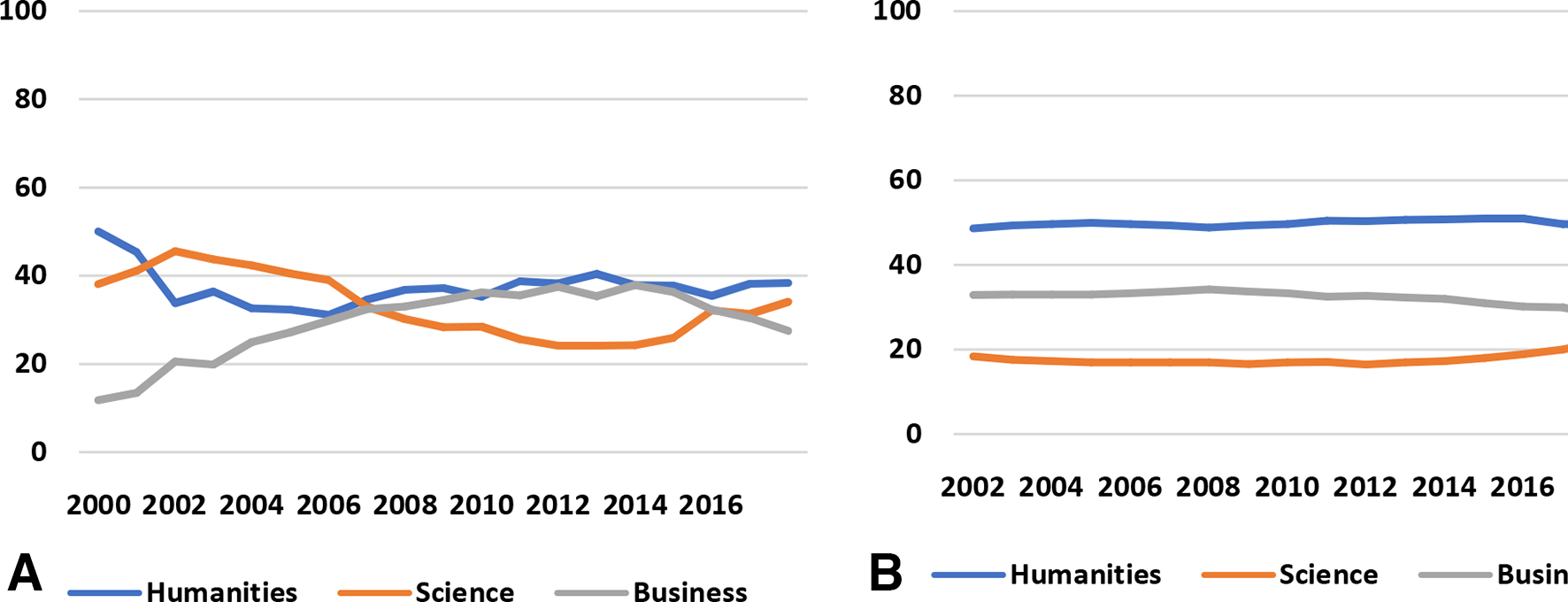
Clustering in the secondary level. Panel A: Distribution of students passed in SSC (%). Panel B: Distribution of students appeared in HSC (%). Source: Compiled from the BANBEIS Reports. *Students passed in 1999 is expected to be appeared into the HSC in 2001, therefore panel B starts from 2001.
Panel A of Figure 1 also shows that approximately 30% of the SSC graduates are from the science cluster, but only 20% of the total enrolment in HSC level is shared by science cluster. Immediate reaction to the above finding may support that a significant number of SSC graduates from the science cluster did not continue education. But the data confirm that the science cluster experiences the lowest rate of dropout. Therefore, we further inquired to discern the grassroot reasons for the low enrolment in the science cluster at HSC. Since SSC graduates from the science cluster can enroll into the clusters of humanities and business, graduates from the science cluster may enroll into other clusters at the HSC. In contrast, SSC graduates from humanities and business clusters are prohibited to access the science cluster at the HSC. Furthermore, an interviewee noted “admission tests to access HSC education in humanities and business clusters are favorable to graduates from the science cluster since only the performance on Mathematics and English is checked.” In other words, enrolling into the humanities cluster at the HSC level from business and science clusters is a one-way traffic, not the other way around.
Panel A also shows that SSC graduates from the business cluster have increased since 1999, and this rate is almost stagnant at 32%. Panel B further shows that business cluster shares approximately 32% of the total enrolment at the HSC. Hence, some may claim that no dropout situations exist within the business cluster. Data show that business cluster experiences the second highest dropout rate. Thus, the enrolment of SSC graduates from the science cluster into the business cluster of HSC contributed to this 32%.
Given the data of secondary provision, it can be noted that students of the science cluster are privileged enough to enjoy more liberty and to occupy the intakes of humanities and business clusters by depriving the rights of other counterparts. The favorable policy and admission tests have created this unfair circumstance.
Impacts of Clustering in the HSC on First Degree
Figure 2 scribbles the proportion of HSC graduates in three clusters and candidates appearing for under graduation. The distribution of science-related subjects in under-graduation is diverse. Conventional universities offer programs in science, arts and humanities, and business through units A, B, and C, respectively. In addition, they also offer programs in social science and professional courses 20 via units D and E, respectively. Specialized universities offer science-based professional programs in various disciplines (i.e., agricultural, medicine, and engineering).
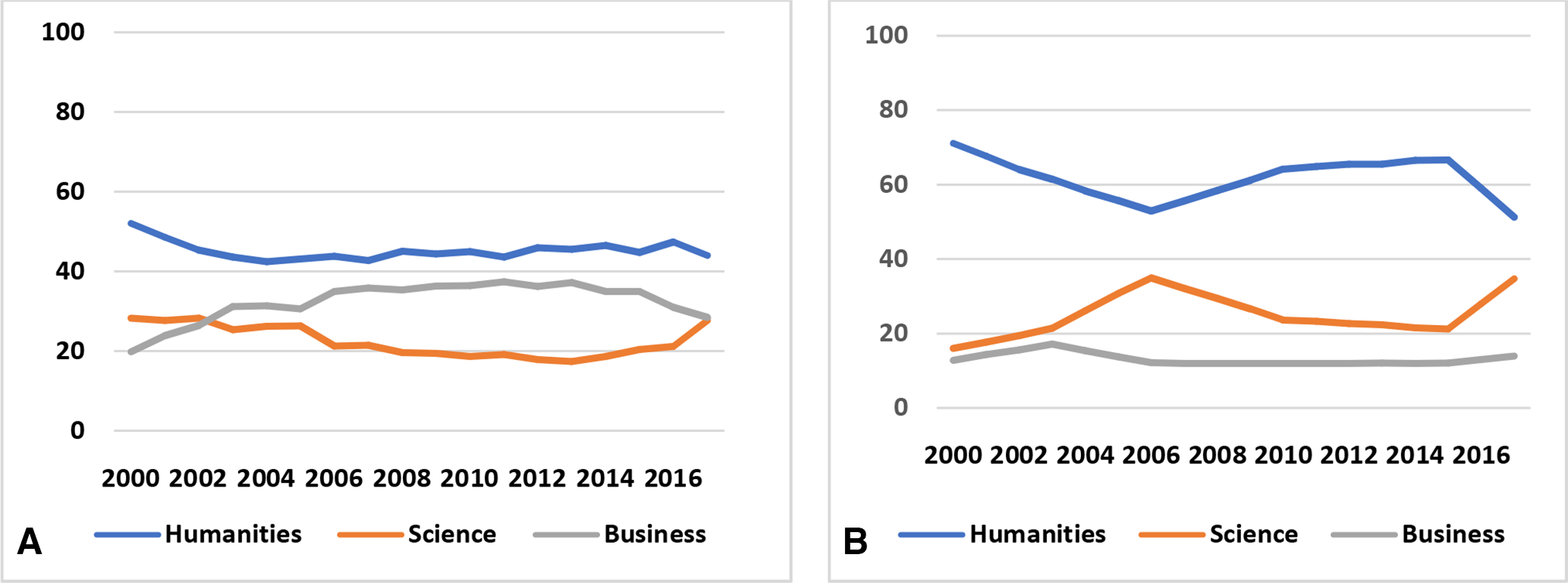
HSC graduates and enrolment in Bachelor Program. Panel A: Students passed in HSC (%). Panel B: Students enrolled into undergraduate Programs (%). Source: Compiled from the BANBEIS and UGC Archives. *Students passed HSC in 2000 is expected to be enrolled into the Bachelor Program in the same year of 2000.
Panel B of Figure 2 shows the number of candidates that appeared for undergraduate programs from the three clusters in different conventional universities. The reason of considering only conventional universities is because they were primarily established as liberal arts universities before they branched out to other areas. These days, they offer various subjects clustering into humanities, business, and science. We did not consider the specialized universities working for science, technology, medicine, and agriculture because they were established to prioritize the science cluster. Thus, providing access to science graduates by these specialized universities cannot be treated as discrimination caused by the institutes themselves. It is rather a greater discrimination developed by the policy.
Panel A shows the cluster distribution of HSC graduates who are the procurers of undergraduate programs. Approximately 43% of the HSC graduates are from the humanities cluster, which is the first largest group, followed by business and science clusters. Naturally, it is expected that the same trends should be maintained in the undergraduate program. But panel B shows that the science cluster shares the second largest enrolments at undergraduate level, while business cluster stands for third position instead of second. HSC graduates from both science and business clusters can enroll into business cluster of undergraduate programs while HSC graduates from business cluster cannot enroll into science. It was thus anticipated an increase on business cluster instead of a decline. We now examine the reasons of decline of business cluster at undergraduate level.
Worth to note an observation of an academic by the virtue of policy, the enrolment capacity in the business cluster at undergraduate level is forced to be lowest in any conventional university. To illustrate this, we use data collected through personal communication from DU which is the premier and known to be pioneer conventional university in Bangladesh. Undergraduate enrolment capacity in 2018 of DU allocated 23%, 39%, and 38%, respectively, for business, humanities, and science clusters (Figure 3). The proportion given to business cluster is too small to accommodate the HSC graduates from business cluster. But surprisingly within the small allocation for business cluster, approximately 46% of enrolment at undergraduate program are occupied by HSC graduates from science cluster, while for humanities, this figure is 54%. This confirms that very negligence number of HSC graduates from business and humanities clusters access HE, while their intakes are occupied by science counterpart. This ratio is even worse for business cluster of the National University (the largest university in terms of intake capacity for undergraduate programs).
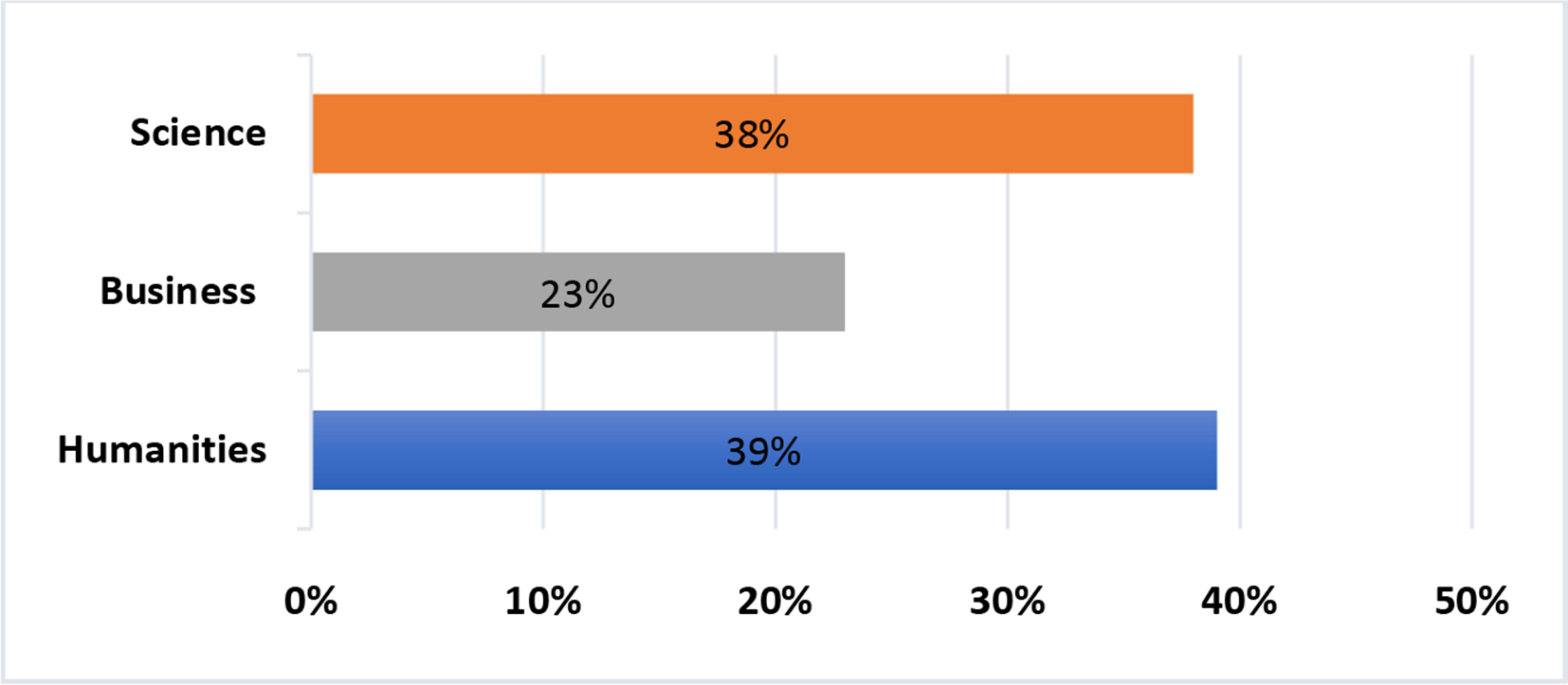
Distribution of intake capacity in Dhaka University, 2018. Source: complied from the data collected from the Dhaka University via personal communication.
Specialized universities in the areas of agriculture, engineering and medicine provide exclusive access to HSC graduates from science cluster. A few science specialized universities offer small number of humanities and business-related programs. Under such situation, HSC graduates from business cluster either stop the education or try to access HE in the field of arts, provided they can get an access facing an unfavorable admission test. Data shows that, overall, 37% of the enrolments of humanities cluster at undergraduate program in Bangladesh are also occupied by HSC graduates from science cluster. The statistics of DU is graver that represents approximately 54% of enrolments of humanities/social science cluster are occupied by the HSC graduates from science cluster. One of the Deputy Registrars at DU informed the science-friendly admission test of Dhaka University provides greater scopes and privileges to HSC graduates from science cluster to access higher education not only in science cluster but also in others. 100% of our sampled interviewees (students) opted that admission test questions for both humanities and social science subjects are prepared mainly basing on the basic concepts of science.
Enrolment to undergraduate programs at the conventional universities is highly dominated by HSC graduates from science cluster, let alone the specialized universities in science. Many secondary graduates from business and arts clusters are forcefully dropped out and they are missing greatly from HE. Hence, the questions are: if secondary graduates from business and arts clusters are not provided scope to HE, why does the system need to offer business and arts programs at secondary level? If the graduates from science cluster can always easily move to other clusters, what is the substance and specialty of business and arts clusters? Is it a fair practice to occupy other graduates’ places? Under such circumstances, some students especially nonruling elites may study business or arts to have secondary certificate since secondary provision is free. But lack of seriousness within the learning atmosphere would seriously dismay the education quality. It may also be argued that spending four years to study business or arts cluster of secondary education is contemptible, since many HSC graduates from science cluster are studying business or arts clusters at tertiary provision, while HSC graduates from business and arts clusters cannot use their knowledge for HE and jobs. Now we will examine the impact of clustering in undergraduate program on postgraduate program and job market.
Impacts of Clustering in First Degree on Postgraduation and Job Market
Figure 4 shows the number of graduates completed first degrees in different clusters and their enrolments into postgraduation. Graduates from arts cluster are higher, while business cluster shares the lowest proportion (anel A). Panel B confirms proportion of students studying humanities cluster at postgraduate level is the highest which is approximately 60%; and being the lowest, science cluster shares approximately 12%. However, graduates with undergraduate qualification in the area of business is about 20%, and their enrolment ratio at postgraduate level is approximately 30%. This is simply because graduates having undergraduate qualification in the area of science have enrolled into business area of postgraduate level.
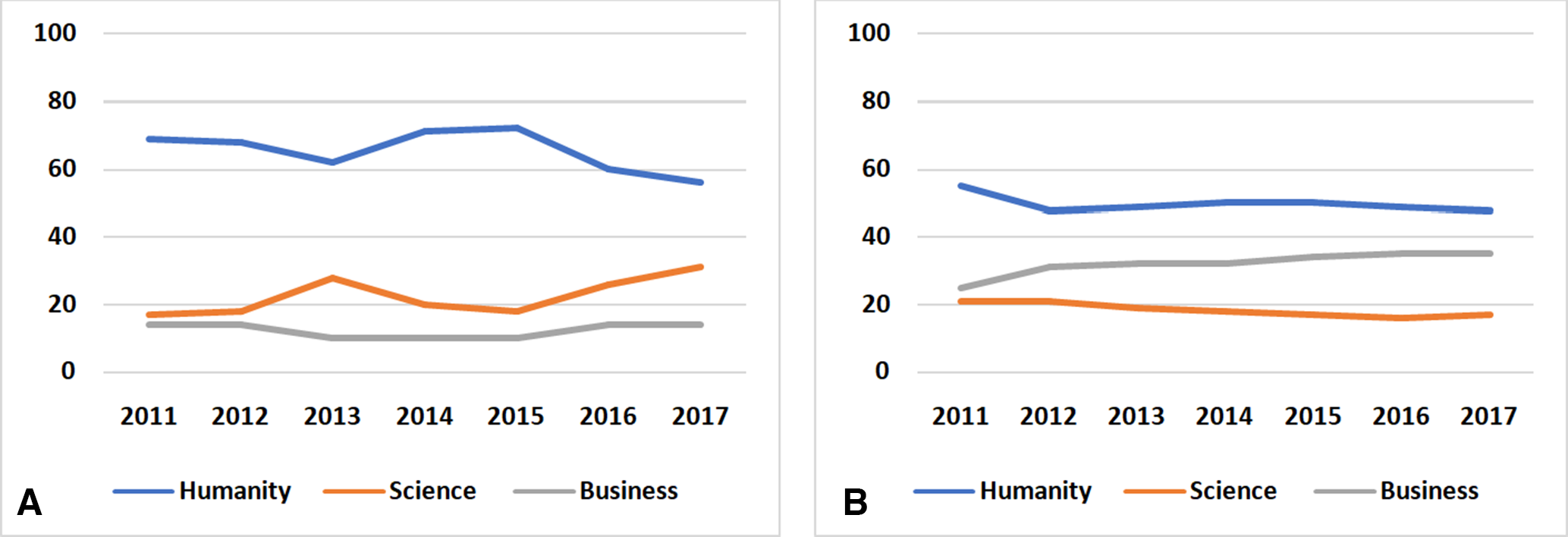
Distribution of graduates with first degree and enrolments into postgraduation. Panel A: Students passed undergraduate programs (%). Panel B: Students enrolled into master’s Programs (%). Source: Compiled from the BANBEIS and UGC Archives.
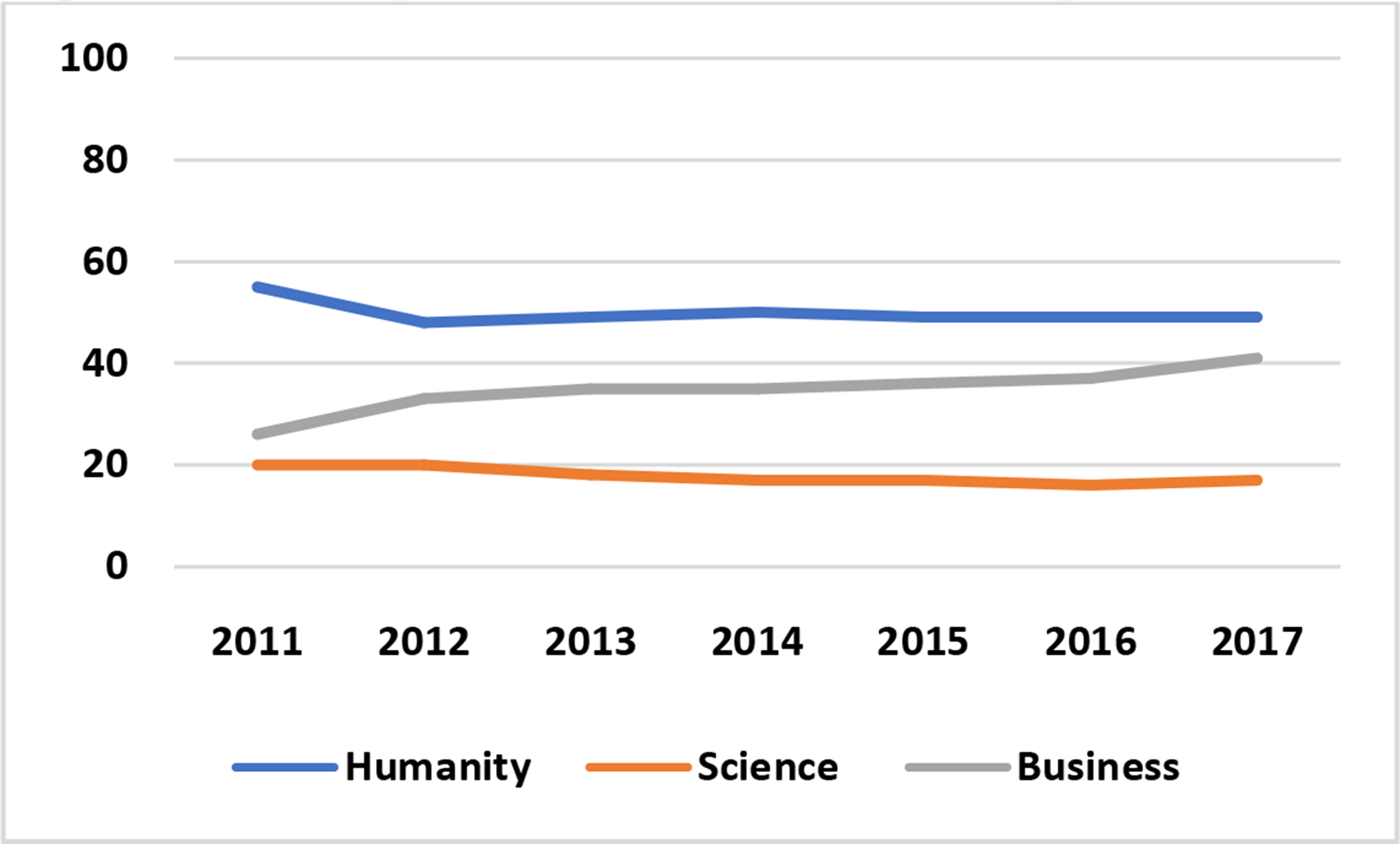
In response to a “diploma disease of MBA” many graduates from science cluster are studying MBA as a result graduates from business cluster are denied accessing MBA. Those who are enrolling MBA programs from science cluster are successfully completing the program (Figure 5). This generates a question, how can students from science successfully complete MBA while they don’t have basic knowledge in business area? In this regard, it is worth of noting a comment of an academic:
Passing distribution in Masters Programs. Source: Compiled from the BANBEIS and UGC Archives.
“In the MBA class, I hardly find BBA graduates, although these days, business graduates have only one option to study Master which is MBA. Most of the MBA students are engineers. Admission test for MBA programs mainly judges the knowledge in Mathematics and English. Therefore, graduates from science cluster are the major portion for MBA intakes. These graduates do not have solid basic for business; so, our MBA program doesn’t dig into advanced level knowledge. Rather, we only provide knowledge at a surface level.”
Making a forced dropped out of HSC business graduates, counterpart from science became the busuness graduates at undergradate level and finally, these business graduates are kicked off by science graduates at postgraduation level and who are primarily occpying the jobs at business area. To examine the influence of clustering in education on the job markets, we collected the infomation on educational bankground of 750 executives working in the banks since they are the prime areas for business graduates to be invloved. Figure 6 shows that approximately 55% of executives in this sector are the science graduates with an undergraduate qualification. Approximately 39% of executives working with these organizations 21 have first degree in business (Figure 6). Of which, 35% and 65% have, respectively, studied business and science cluster at secondary provision (Figure 7).
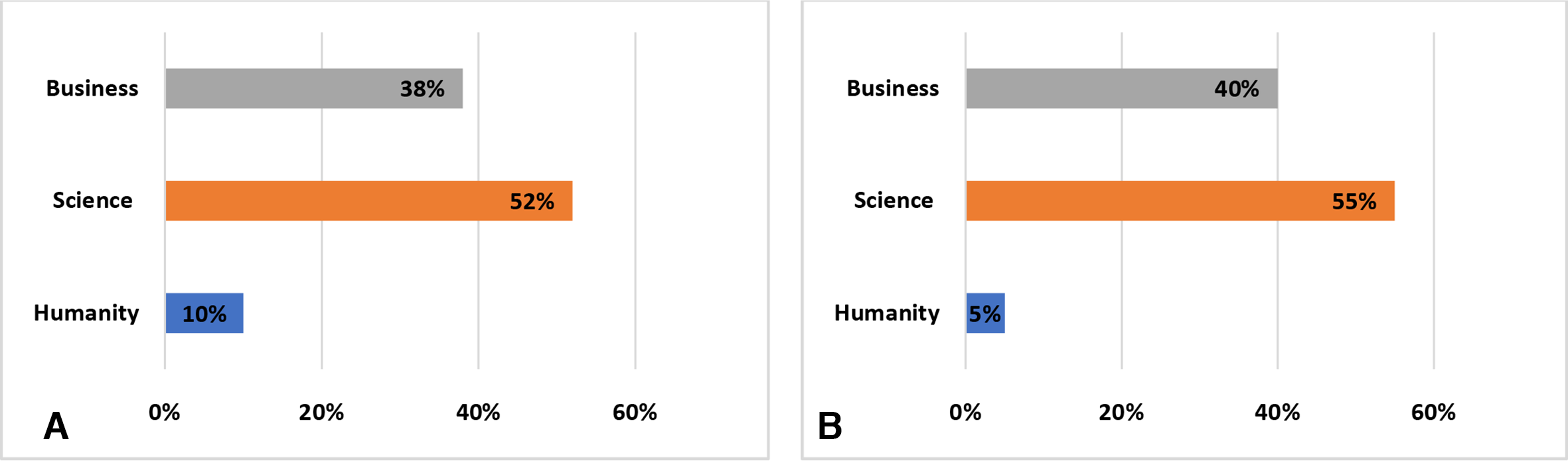
Backgrounds at First Degree of Executives working in Financial Sector. Panel A: Distribution of the executives in banking sector. Panel B: Distribution of the executives in MNCs. Source: Data collected through interviews.
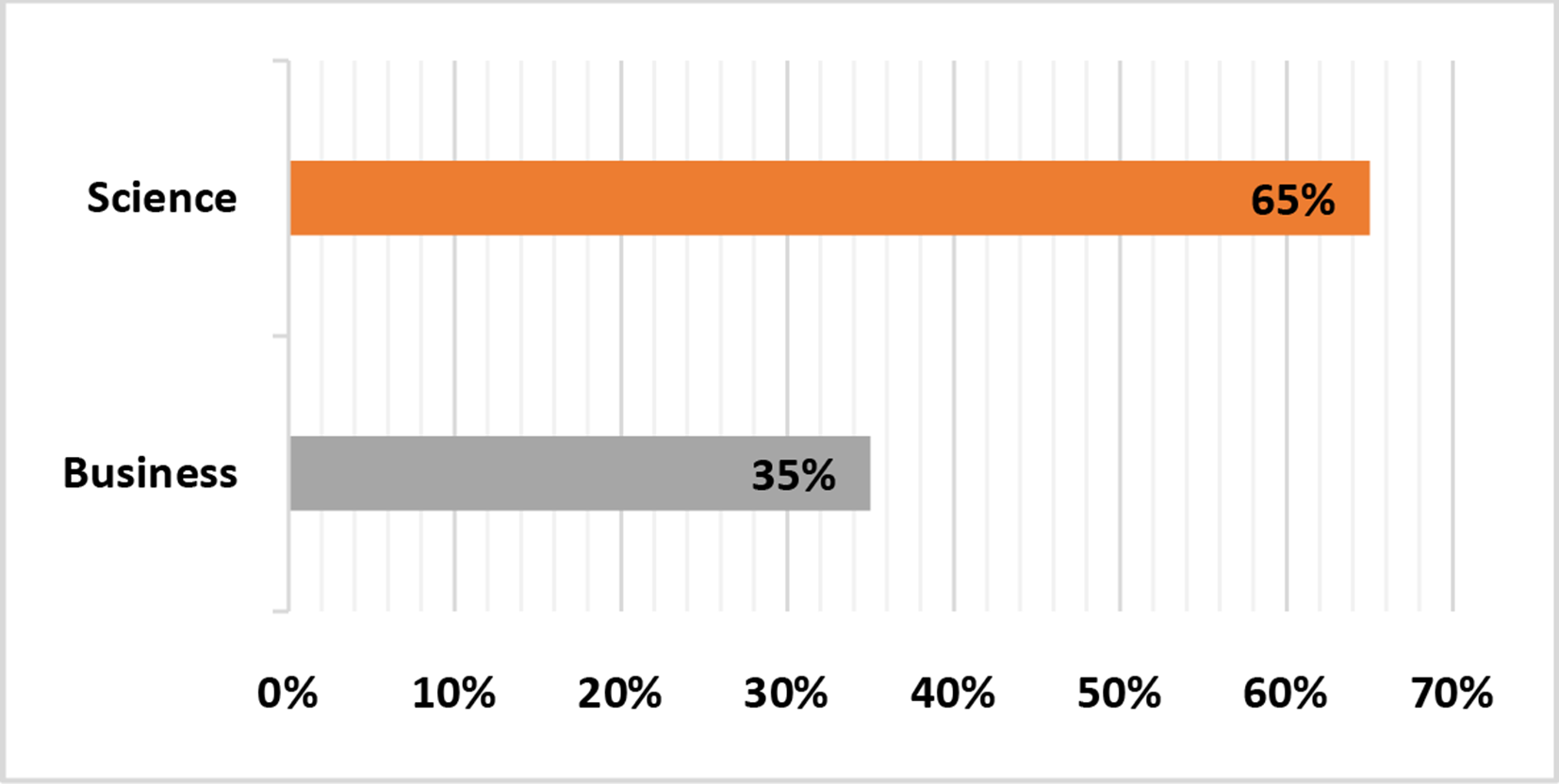
Secondary education cluster for executives (completed first degree in business) working in Financial Sector. Source: Data collected through interviews.
Science-friendly recruitment tests have mainly developed this sitution. Managing Director of a commercial bank infomred us that approximately 70% questions for a recuirtment test are from science domain. Hence, questions may be asked: whether the graduates from the science domain are really prepared to take the challenges involved in the business professional careers; or the job in business sector do not essentially needs any specialized skills; or business education fails to inject necessary skills needed for the jobs thus employers are not keen to employ business graduates. As a result, they take the responsibilities of trained the employees via doing the job. None of the reasons is acceptable because funds are allocated to business education. It is simply misuse of education budgets. Approximately 80% of our sampled academics opted that they often compromise with the curricula, teaching methodologies, and students’ evaluations in order to support the science graduates studying MBA program. Hence an academic observes:
“MBA program both in public and private universities is the money-making machine which provides direct cash incentives to the academics involved. Science graduates having richer backgrounds are more willing to pay, it is thus they are given higher preferences.”
Comments of a CEO of an MNC highlights the situation:
“None of education is really aligned with the job requirement as the supply side of graduates never collaborates with us and we are not seen as an important stakeholder within the process of education product. Graduates having first degree from business cluster impart the core tasks. But they suffer from an inferior complexity since they consider science graduate as superior. Hence, science graduates take extra advances to be the leaders by chalk out the mistakes.”
Conclusion
Conceptual framework has identified that secondary provision should produce semi-skilled workforce and supply competent graduates to tertiary education for producing high-skilled professionals and intellectuals by mapping the needs of job market (Aleixo et al., 2016; Cortese, 2003; de Vuijst et al., 2017). Unfortunately, an unplanned and prejudiced clustering system which begins at secondary provision made the entire education system dysfunctional. This also greatly discriminates the graduates of business and arts clusters. Finally, this biased clustering system made the education disjointed from the world of work.
Clustering system in secondary provision forces the more able students to consider science cluster as this provides a wider scope by giving a chance to occupy other clusters while a science graduate can foresee darker prospects in science. This has infringed the rights of graduates from other clusters and the fund allocated for other clusters are useless. This has created an unhealthy situation in education system. It is thus an emerge of change so that students can choose their desired subjects to study in secondary provision that may include subjects from different clusters. In the case of admitting to HE, subjects studied at secondary provision can be used as prerequisite. In the event of lacking a specialized prerequisite to enroll in HE due to sudden change of mind or goal, candidates should be given a scope to retake the necessary prerequisites. This will eventually provide more freedom of choice for graduates which would ultimately help them to discover their real potentials and talents throughout the journey in education life. Addressing discrimination from education will construct a sense of fairness within the society; supporting both economic and social developments.
Footnotes
Acknowledgements
The author acknowledges the supports received from Ms. Morsheda Parvin (Faculty of Educational Studies, University Putra Malaysia) and Dr. Md. Abdur Rahman Forhad (Dhaka University of Engineering and Technology, Gazipur, Banglasdesh)
Declaration of Conflicting Interests
The author(s) declared no potential conflicts of interest with respect to the research, authorship, and/or publication of this article.
Funding
The author(s) received no financial support for the research, authorship, and/or publication of this article.

Notes
Author Biography