







Abstract
The changing global scenario throws a big responsibility to higher education institutes to prepare future ready students. The curriculum is the most important input, which can play a vital role in the overall development of students. Present work identifies the need for curriculum change in the 21st century and presents a responsible approach to curriculum development at the Bachelor’s level. The dynamics of curriculum design have been discussed from an international perspective with a more integrated and collaborative approach. Different dimensions of the curriculum have been identified and mapped to the needs of various stakeholders from both the academia and industry perspective. An integrated process framework has been presented for the development of the curriculum taking care of the major stakeholders. The proposed framework will support the academic institutions and their stakeholders to identify the gaps and offer a curriculum-based solution towards student development, in a more responsible manner.
Introduction
In recent years, global society is facing multiple challenges towards development. These may be classified as societal issues (employability, ethics, global warming, and pollution), economic issues (financial crisis, recession, and funding problems) and personal issues of the people (health, attitude, happiness, spirituality, and motivation). Sustainable solutions for all these problems are much needed at this hour. For this, we need to focus on education which emphasizes on transformative role in transmitting knowledge, innovation, creative problem solution, happiness, and social justice (Peña Miguel et al., 2020). A skill-based curriculum can be helpful in providing efficient and sustainable solutions for these global problems and can help in policy making (Singh & Kumar, 2022). It tends to increase the level of entrepreneurial activities which provide efficient solutions for poverty, socio-economic issues, and sustainable development (Subagyo et al., 2020). The curriculum of a course is the sole weapon by which the students can be prepared to tackle the requirements of the future (Bhardwaj & Kumar, 2022). A curriculum is a collection of knowledge that is translated by following the administrative and academic standards and regulations, textbooks, instruction methodologies and the practice of teaching—learning in classrooms (Benn & Rusinko, 2011). It can contribute a lot to the development and change in society as well as to individuals. However, the designing and development of the curriculum is a complex process, which needs meticulous planning as several aspects of teaching–learning needs to be considered. This process becomes more rigorous, when it comes to higher education as the graduates from these institutions are job aspirants just after they complete their degree. With the ongoing push towards the global standards and accreditations, the curriculum is expected to be outcome-based, with proper mapping of the program outcomes and course outcomes. The importance of a curriculum further increases with the kind the course in which the student gets enrolled. The curriculum is revised considering the competencies of the students and making them future ready (Graignic et al., 2013). A structured curriculum helps in the following ways:
The students enrolled in a course are not limited to classroom teaching, but get an opportunity for self-learning and self-discovery following the topics, references, and pedagogy mentioned in the curriculum. A predefined curriculum help in preparing a structured schedule of teaching with proper time management. Structured Curriculum allows the teachers to work with the proven pedagogy and plan their class as per the student needs. A lot of curricular and extracurricular activities may be planned for the students to support the curriculum. The activities help the students to develop better physical and mental health, a sense of social responsibility and working with the groups (Krause & Bird, 2019).
Need for Curriculum Change and Development
The curriculum must be designed, which is globally acceptable and serves the growing needs of the industry (Buyurgan & Kiassat, 2017). The transformation from an agricultural society to an industrial society, with advancements in IT-based innovative industry is most important for learners to upskill them to keep themselves competitive. Industry 4.0 is reshaping our economic, social, and technical environments, which is throwing a lot of challenges to academia. Industry 4.0 refers to the intelligent networking of machines and processes for better organizational and process control in the industry. This new industrial revolution has a high dependence on information and communication technology. The latest disruptive innovative technologies like AI, Analytics, IoT, Quantum Mechanics, and Robotics are growing in demand in the Industry 4.0 scenario, and people are looking forward to academia to fulfill their skill requirements. Thus, there is an urgent need to revamp the educational system with the objective to bridge this gap. There will be a transition in industry demand as highly-skilled jobs will be created. This has generated an urgent need for Education 4.0, which will respond to the learning need generated by the wave of Industry 4.0 and identify the capabilities and creativeness among the learners. It has become a challenge for educationists to design outcome-based programs (Hussin, 2018). In Education 4.0, the teaching–learning practices need to be transformed to meet the future needs of industry and learners. Disruptive technologies like artificial intelligence, robotics, machine learning, etc., have the huge potential to completely change the ways of working both in industry and in academia. Similarly, digital learning platforms create a new dimension in the approaches to teaching–learning and can replace the traditional teaching practices adopted by the universities (Becker et al., 2017).
Both technical and interpersonal skills need to be imparted into the workforce to make them industry-ready. Skills like ICT usage, creative problem solving, creativity and innovation, adaptive thinking, social and emotional intelligence, and analytical and communication skills are very much expected from the new-generation students. To make our students match the needs of the industry, a skill-based curriculum needs to be developed with a combination of traditional subjects with futuristic needs. We also need to ensure that best teaching practices must be adopted to address the need of the fast-changing world around us (D’Souza et al., 2018). Thus, there is an urgent need to transform the curriculum and adopt new practices to make the students future ready. The current requirement demands an elite higher education system in India, which in recent years has limited itself to providing traditional and behavioral knowledge for improving social equity. It is important to anticipate the future needs and opportunities of the stakeholders (Liao et al., 2017). The institutes of higher education should respond to the current needs and contribute to the success of the students. Due to the changing needs of the diverse stakeholders including students, the traditional institutions need to design an effective curriculum with innovation (Andrade, 2018). The foremost reasons that demand the curriculum update can be the following:
Changing Needs of the Students and Society
Learning is a lifelong process for human beings. However, the learning needs are different for the different age groups. For example, today's teenagers have a high dependency on mobile phones and social media (Oblinger & Oblinger, 2005). These young members of the Information Technology society have been referred to as Net-Geners, millennials, Generation Y, echo boomers or digital natives. These new-generation students are having very high digital literacy and multitasking capabilities. Learners of this age have a high dependency on the Internet, Social Networking, and sophisticated all-pervasive devices (Kumar & Nanda, 2022). They have high interests in both consuming and producing digital information, more demand for personalized virtual learning, seeking recognition from others, and demanding instant and frequent feedback. Collaboration and convenience have come up as the two most important components of learning by the millennials (Sharma & Kumar, 2017). Correspondingly, the curriculum must be able to integrate them as part of delivery pedagogy. Collaborative learning empowers the students and teachers, who are physically isolated from each other and allows them to communicate via online chats, online discussions, or lectures (Kumar & Sharma, 2016). Social Networking Sites are being used as a platform for collaborative and peer-learning (Kumar & Nanda, 2019a, 2020). Kumar and Nanda (2019a) have described an interesting model for integrating social media at all different levels in the higher education life-cycle.
Contrary to the rich technical skills of the millennials, Karakas et al. (2015) have highlighted that the students of 21st century face problems with concentration, engagement, and socialization. They have suggested the integration of reflective, creative, and collaborative learning aspects in the curriculum. With the growing concerns of society, integration of ethics has also become important (Kumar & Nanda, 2019b). Correspondingly, ethics are being included as a compulsory course in a number of higher education curricula. The world is facing unprecedented challenges in terms of scale and complexity among the growing needs of Globalization and decreasing political stability. The graduates of higher education are expected to be capable of taking up these challenges by way of their professional, scientific, and professional skills. Seow et al. (2019) have presented the need for the integration of skills to adapt a volatile, uncertain, complex and ambiguous (VUCA) work environment for the young graduates.
Bridging the Industry Academia Gap
Academia has always served as a feeder to the industry and correspondingly, the industry has very high expectations from academia. The industry is always in need of updated and learned professionals, who can directly be employed and put on operations but the fresh students without any experience and exposure to the industry face the skill gap which needs to be filled up. However, a number of researchers have talked about the industry-academia gap. An Indian perspective has been presented by Malik and Venkatraman (2017). Even a 2018 report titled “Reskilling and Indian Workforce,” has presented the fact that a number of industries in India face an acute shortage of talent and these include IT, finance, e-commerce, retail, manufacturing, pharmaceuticals, media, and entertainment industry. Taking note of this, the Government of India has come up with a Future Skills PRIME (Programme for Reskilling Upskilling of IT Manpower for Employability) program in collaboration with Nasscom in December 2019 (LiveMint, 2019). The training modules of top IT companies will be available on the platform. Büth et al. (2017) have discussed the massive demand for complementary training for engineering graduates in India indicates a mismatch between academic education and industry requirements. Many other studies have also identified the gap between academia and industry and recommended a change in curriculum to bridge this gap.
A number of steps may be required by the academic institutions to bridge the skill gap and ensure the employability of the graduating students. The academic institutions require skilling and reskilling initiatives in collaboration with industry for improving the education system. An efficient skilling ecosystem is required to develop the capability of students in specific sectors. The online platforms can also be used to leverage the required skills among the students (Shams & Thrassou, 2019). However, this needs to be integrated as part of the curriculum. The curriculum taught in the classroom should give the present industrial scenario and tend to bridge the skill gap between student and industry needs. This issue can be solved by continuous monitoring and evaluation of the designed curriculum. It is desirable to assess the performance of both the students and the curriculum in a very continuous fashion.
Technological Advances
Technology advancement is a continuous phenomenon and it has direct implications on the curriculum. With the technological advances in all different disciplines, both the pedagogies and content need to be updated. For example, a number of laboratory tests, which were carried out by hand have been transferred to automated machines and kits causing less hazard and safety concerns. With the integration of information technology, a lot of laboratory experiments have been changed to simulation-based and students can even do it from the comfort of their homes. For example, cloud computing-based online infrastructure provides a lot of opportunities for students to perform sophisticated computing experiments (Kumar & Sharma, 2017). Similarly, a lot of analysis works, which used to be done with complex mathematical calculations, have now got replaced with software. Similarly, a lot of engineering drawings, which used to be drawn with pencils and scales have now got replaced with Computer-Aided Designs (CAD). All these changes have a direct impact on the curriculum, which needs to be updated continuously to integrate these technologies and flush out the outdated ones.
With the emergence of new technologies, desired skill sets have been changed for the jobs in disciplines of BFSI, manufacturing, automotive, and IT sectors. Correspondingly, the curriculum has also been updated for the disciplines. Mcknight et al. (2016) have argued that the successful digital conversion of classrooms and society is not just determined by the technology, but instead how the technology enables the teaching and learning process. Technology integration in the curriculum follows a chain effect as it gets transferred to the students, industries and finally society.
Emergence of New Disciplines
The idea of a focused and specific approach is the fundamental concept of an academic discipline. A particular academic discipline defines the boundaries of concern, which are important to it. It outlines the process of defining and elaborating that what is to be studied and what is the approach to be followed. Correspondingly, different academic disciplines follow different pedagogies and research methodologies. Most importantly, the disciplines create boundaries and differentiation among the specializations being offered. Due to the continuous production of new knowledge in different fields, the need for its preservation and transfer was also inevitable. For example, data science has emerged as a new academic discipline in the area of management and a number of institutes have started offering courses in the area of data science, including certificate courses, diploma courses, and master-level programs, etc. Similarly, with the advent of renewable sources of energy, the need for renewable energy education at all levels has been globally recognized. Correspondingly, a number of academic programs have been initiated across the world in this area.
Analyses of higher education and knowledge have proposed a variety of explanations for how such disciplines emerge. For instance, the emergence of new or newly popular career fields can result in the expansion of knowledge and the creation of new disciplines through market pressures (Becher & Trowler, 1989), as might social needs for knowledge that cannot be easily addressed within the existing knowledge taxonomies (Klein, 1990). Frickel and Gross have attempted to overcome this shortcoming through their notion of Scientific/Intellectual Movements (Frickel & Gross, 2005). Whereas, a framework for the emergence of new disciplines as a knowledge-focused social movement has been presented by Arthur (2009).
Accreditation of the Course
Accreditation of the program is equally important as developing an effective updated curriculum. This is seen as a process of quality assurance that ensures the academic institutions or some specifically designed programs meet a strict set of services and the required operational standards in the interests of students, potential employers, and other stakeholders (Alaskar et al., 2019). Accreditation of the institutions or the programs is done through assessment by the autonomous agencies, which are recognized by Government entities or regulators like the Department of Higher Education or Ministry of Human Resource and Development, etc. The accreditation becomes more important for professional and technical courses as it sets quality standards for all the programs or educational institutions which further helps to develop the confidence among the students, employers, and other stakeholders and provides access to state funding. In the Indian context, the two most important accreditation agencies are the National Board of Accreditation (NBA) and the National Assessment and Accreditation Council (NAAC). However, a lot of institutions are focusing on Global accreditations. Most prevalent of them include the Association to Advance Collegiate Schools of Business (AACSB), Association of MBAs (AMBA), European Quality Improvement System (EQUIS), Middle States Association of Schools and Colleges (MSA), Accrediting Commission for Community and Junior Colleges (WASC-ACCJC), Western Association of Schools and Colleges, Accrediting Commission for Senior Colleges and Universities (WASC-ACSCU) (Gratch-Lindauer, 2002).
The curriculum remains the most important focus for the accreditation agencies. They not only look for the curriculum but also the process of its design and its implementation. Corresponding to the needs and guidelines of the accreditation agencies, many higher education institutions are adopting the outcome-based curriculum, which demands defining the course-specific and program-specific outcomes from the curriculum. Along with this, the integration of constant feedback from the students and employers also becomes a point of concern. This in turn requires a constant update of the curriculum through a well-structured methodology.
Focus of Curriculum Design
An effective curriculum is designed after making the need analysis with an objective to achieve specific academic purposes. An analysis to determine the expectations of the industries and the deficiencies in the present curriculum with the difficulties to provide the required set of skills to the industries is made. This analysis helps to conclude the wishes, necessities, and preferences of the industries. A purposeful curriculum is required to improve the capabilities of the students and make them employable and industry ready which makes them able to face real-world problems. One of the ways to redesign an efficient curriculum is through industry integration (Hedgcock & Lee, 2017). The higher education institutes need to work on the holistic and transformative approaches to adopting the strategy of education for sustainable development. These strategies should address adopting the approaches of the education for sustainable development and making the teaching–learning environment a manner for the transition of the pedagogical practices from instructional to transformative pedagogical dimension. By adopting this approach, the students can be more participatory in the teaching practices and can work for self-directed learning in a collaborative manner. With these practices, the students feel empowered and act responsibly, without affecting the insights of social and economic aspects for sustainable development in the future (Manwaring et al., 2020). The purpose of redesigning the curriculum has been shown in Figure 1.
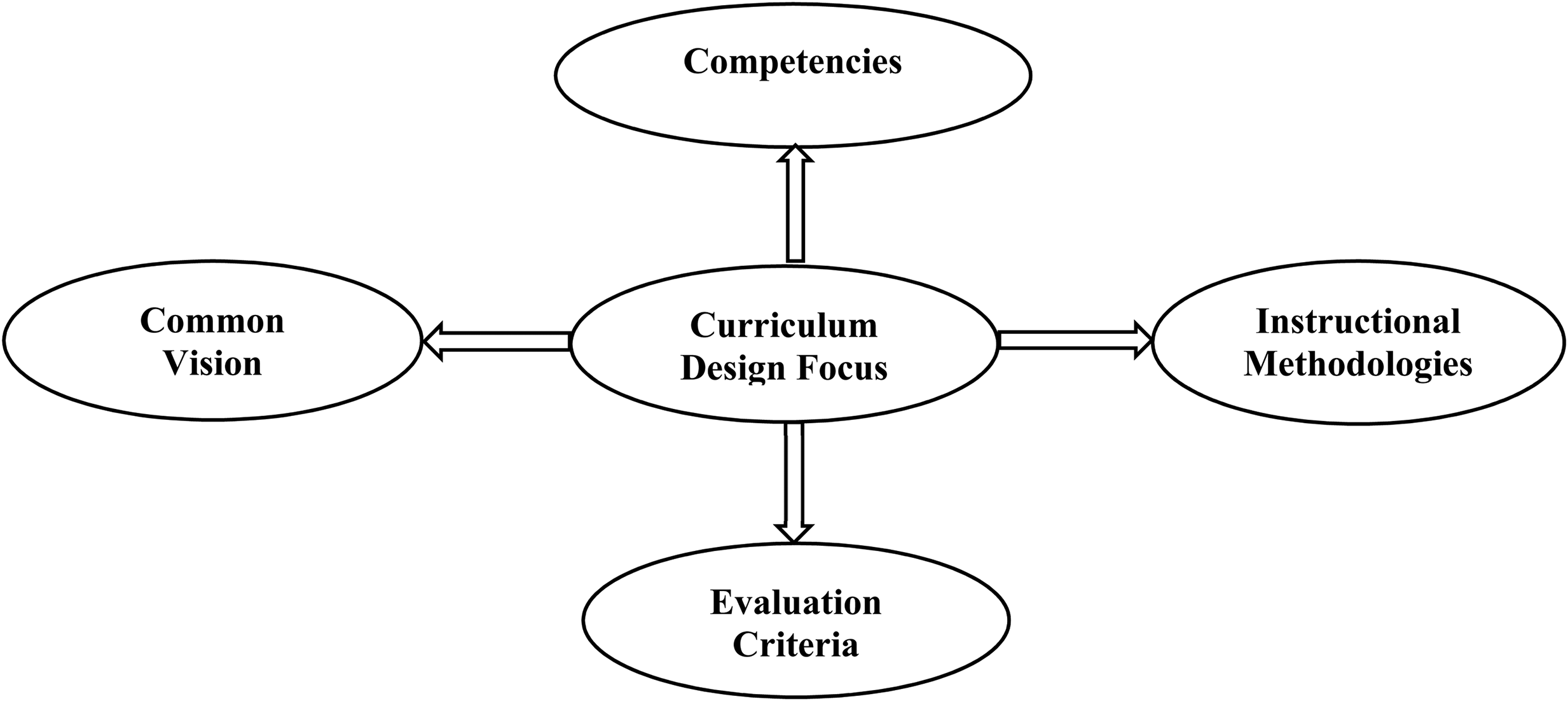
Curriculum development focus.
The institutes of higher education should come up with policies for continuous and dynamic educational reforms. The implementation of an effective curriculum in higher education would help the country to grow in the right direction, on both macro and micro levels. The process of curriculum design is a time-consuming process which actually requires a lot of dedication and patience (Jadhav & Mahadeokar, 2019). The purpose of curriculum redesign includes the following aspects:
Developing a Common Vision
The very first purpose of designing the curriculum is to build a common vision among all the stakeholders of the higher education institutions. The vision of every higher education institute should be clear with a comprehensive set of objectives. The vision of the institutes should be kept in mind while designing the curriculum for different courses. This common vision also helps to identify the potential, modes of industry, and academia integration (Bruce & Schoenfeld, 2006). Some universities may have specific objectives like (a) historical and cultural researches, (b) uplifting some underprivileged areas, (c) focusing on some specific skills, etc. Still, the universities should consider at least some common minimum framework to integrate the multidisciplinary approach to achieve the 21st Century Skills, Sustainable Development Goals, and elements of the 4th industrial revolution. At the first point in redesigning the effective curriculum, the institute’s needs, common goals, and standards are considered to design the curriculum and select the core instructional methodologies (Hay & Hodgkinson, 2006).
Identification of Competencies
A competency-based curriculum intends to identify the competencies which are expected from a student passing out the course. The competencies should cover the course outcomes with the inclusion of subject knowledge, attitude, soft skills, and decision making. The set of competencies which are expected from the passing-out students must be translated into specific course objectives, which helps the teachers identify them as a common framework for teaching and assessing the students (Singh & Gupta, 2020). In the need analysis, skills and abilities which the companies find attractive among the professional and technical graduates, are identified. The major skills that need to be inculcated in the curriculum are verbal and written communication skills, inter-personal skills, creative problem solving, quantitative and analytical skills, entrepreneurial skills, work ethics, adaptability towards change and ability to lead the team with innovative ideas (Ard et al., 2019). The readiness of the students is assessed by the performance outcomes, which can be directly related to measuring the competency of the students. The curriculum should be learner-centered and should have the ability to develop the students to bridge the competency gap between industry requirements and academia. The success of the curriculum implementation majorly depends upon the proper identification of the skill set required and its mapping. The proper implementation is possible only with specific instructional and evaluation methodologies. The curriculum can be designed in a standardized or individualized manner depending upon the requirements of the students and its successful implementation can be analyzed by the performance of the students (Chyung et al., 2006).
Defining the Instructional Methodologies
Instructional methodologies focus on adopting proven and new ways of teaching–learning methods. Instructional methodologies may be personalized or standardized depending upon the capabilities of the students and individuals, however, the common standards need to be defined as part of the curriculum. It is necessary to explore how the University-level students can learn in a better way by adopting the new and necessary instructional methodologies. This in turn also reflects the purpose of redesigning the new curriculum. Another factor which needs to be taken care is organizing and integrating the study material. This helps to decide the broad structure of the curriculum like the length of the course, structuring of both mandatory and elective courses in the curriculum and the contact hours to be given to the course (Huang et al., 2017). The instructional methodologies establish a sequence in the progression of the course. It also allows the educators to exercise some flexibility and encourage them towards experimentation with innovative teaching activities. It promotes the integration of the curriculum at various levels and adopt the interdisciplinary approach of teaching at the University level.
A mix-and-match of technology and classroom teaching need to be adopted to meet the requirements of the students and make them understand (Nwokeji et al., 2019). The professional and technical courses cannot be covered from a single textbook and require a broad range of supplementary materials, especially in the form of ICT-based study material. These insights are extremely helpful in the curriculum development efforts of educators. Considerations related to instructional design need to be highlighted essentially (Narayana & Rao, 2020). These considerations may provide useful frameworks for educators who are looking for opportunities to minimize the resistance of the students and maximize their engagement. For example, case study-based teaching helps the students in creative problem solving and makes the teaching approach more innovative. The practical-based teaching not only makes the curriculum more interesting rather more observations are gathered from practical teaching. Commonly used instructional methods include (Kozakowski, 2019; Nyer, 2019):
Classroom lectures Group teaching with small groups of learners and demonstration in practical classes Online platforms for massive online learning (MOOCs) Flipped classroom where learners are asked to read the study material before the class Work-based learning, where students learn through real-time experience Problem-based learning, where students learn through solving the problems Blended learning having a mix of traditional classroom with online learning.
Identifying Evaluation Criteria
Every curriculum is designed to achieve specific goals of teaching–learning. Every course is also associated with learning outcomes which the students are expected to achieve once the course is completed. The process of redesigning the curriculum cannot be completed till the methods of evaluation in the redesigned curriculum are formulated. Traditionally, the written examination at the end of the course has been the most accepted evaluation methodology. However, the continuous assessment became a practice over a period of time. Higher-order thinking skills and practical implementation became the most important components in evaluation with a lot of people considering Bloom's taxonomy as an important model to map the educational learning (Mahmud et al., 2019). Also, with the large-scale proliferation of the internet, e-assessments started becoming an important component. The new methodology of evaluation like peer assessment also became important. In today's rapidly changing environment, technology, and science programs get updated quickly and a state-of-the-art course needs to be designed fulfilling the present-day requirements (Mintz & Tal, 2018). With the evolution of new technologies, a new set of skills are required and job seekers need all such skills in terms of technology, interpersonal, communication and innovation. A well-defined approach is required to assess both the students and the curriculum so that the effectiveness of the curriculum can be judged and can be updated accordingly (Filho et al., 2018).
Framework for the Curriculum Design
Designing an effective curriculum for a course requires a lot of patience and dedication and this becomes more tedious, when it is for the course in an affiliating public university. In this case, a large number of affiliated colleges just follow the curriculum supplied by the University. Colleges do have the flexibility to change the curriculum at their own level. Hence, a very careful and responsible process is required. Further, the curriculum design, specifically for professional and industry-oriented courses like Management Studies/Business Administration/Information Technology/Engineering, etc., need extra effort as it requires to bridge up the skill gap, which is developed with the continuously changing disruptive technologies. Most of the students enrolled in these professional and technical courses need to be taught with the latest requirements of the industry as these students are looking for jobs just after the completion of their degree. Correspondingly, a process framework has been proposed in Figure 2, consisting of the four modules to cover the different aspects of curriculum design.
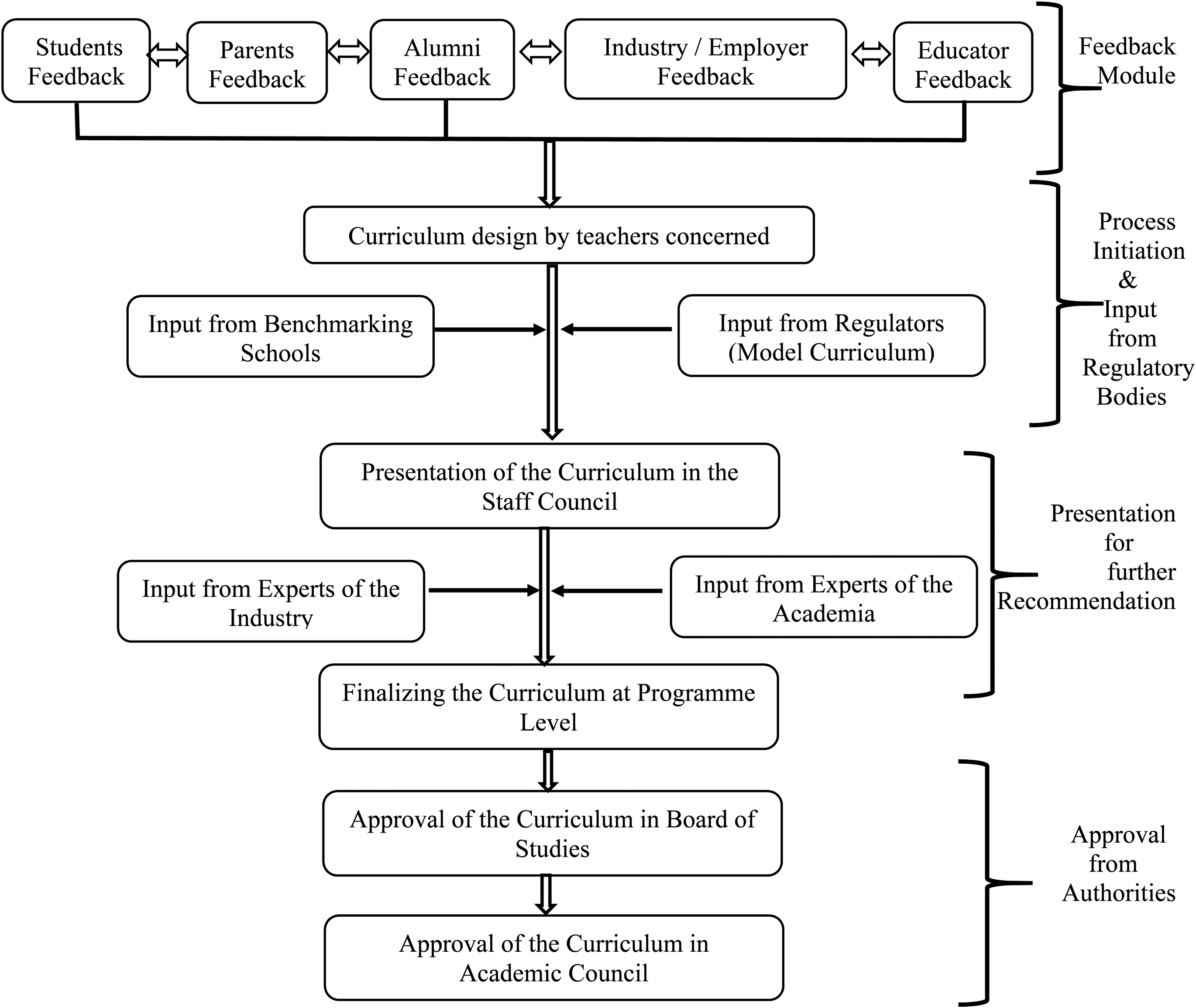
Process framework for curriculum design.
Module I—Feedback
The first module of designing a curriculum should be focused on getting the feedback of various stakeholders of the course on the existing or proposed curriculum. The purpose of collecting the feedback is to identify the gaps between the expectations of different stakeholders and what academia offers. This gap broadens when the curriculum of professional and technical courses is not updated periodically as per the updated requirements. The feedback from all the stakeholders including academic and industry experts also helps to identify the latest instructional methodologies that should be used to make the students understand the content. These methodologies may be standardized or personalized which depends upon the capabilities of the students and making the curriculum more impactful and understandable for the present and coming set of students. Secondly, the feedback related to the mechanism of assessment, monitoring, and reporting need to be analyzed. So it is important to provide all stakeholders with a common platform to collect the necessary feedback. This feedback should be analyzed to develop an effective strategy, which tends to improve the skills of the students and help them to achieve their future goals. The different stakeholders to be considered include the:
Students
The feedback from the students helps to enhance the quality of the curriculum and focus on improving teaching–learning practices. It helps to monitor the learning experiences of the students for both academic and interpersonal development. This feedback is collected through assessment forms, staff–student meetings, and other class activities. This feedback helps in identifying the followings:
Capabilities of the students Allocation of the credits and evaluation strategies Identifying the needs of the students Assessing the performance and ways to improve it Planning and understanding the learning outcomes of the course Employability focused curriculum.
Parents
The involvement of parents is a part of the social integration of the academic institutes and collaboration with the community. It also develops an effective inter-linkage which also promotes the learnings and performance of the students. Parent's feedback make the work easier for the educators by getting essential information on:
Social and emotional attitude of the students Holistic development of students through curricular and co-curricular activities Expectation of the parents from the course Level of satisfaction from the outcome of the course.
Alumni
The alumni feedback is a continuous assessment tool which provides important and valuable information for evaluating the academic programs. The feedback is used to improve the quality of curriculum and teaching practices in the institutes. The feedback obtained from alumni provide inputs on the following:
Quality of education they received during the academic program Course fulfilling their expectations Relevance of the curriculum and present industry requirements Effectiveness of curriculum on entrepreneurship development.
Industry
This feedback helps to identify the changing industrial scenario to match the course outcome with the needs of the employer. It also provides valuable information on the skill gap which needs to be bridged making the students job ready. The technology keeps on changing so it is really important to collect feedback from the stakeholders on regular basis. It makes the curriculum development a dynamic and continuous practice which has to be repeated periodically. The benefit of evaluation methodologies is to collect the present and upcoming requirements of the industry so that the curriculum can be revised accordingly. Evaluation of the course content can be made after collecting the feedback from industry and academic experts and period evaluation and improvement of course curriculum become an ongoing process.
It provides information on the following:
Relevance of the curriculum for employability Effectiveness of curriculum in developing innovative and critical thinking Effective of the curriculum in developing soft skills and team culture Initiatives required to bridge the gap between industry and academia.
Educators
Teachers’ feedback is the most important part of this module which provides relevant information on student involvement and learning strategies. The educators work directly with the students, hence their role and feedback become an integral part of the whole process of curriculum development. The teacher's feedback provides the information on:
Content and deliverables Instructional pedagogies Programs’ outcomes of the curriculum Flexibility of the academic program Present needs of students Need of review of the syllabus Balance of theory and practical aspects Availability of study material.
Module II—Process Initiation and Input from Regulatory
The feedback collected from the stakeholders is analyzed and integrated to initiate the process of preparing a draft curriculum. Generally, a teacher involved in teaching a course should be directly involved in preparing this draft. It is utmost important for the teacher to correctly assess the current needs of various stakeholders and then consider the input from the regulatory agencies. Most of the countries have Government regulatory bodies (Like UGC and AICTE in India) looking after the different aspects of higher education and sometimes these agencies also suggest a model curriculum. This model curriculum provides a roadmap and helps to identify the latest topics that should be covered to make the curriculum more effective. Another important process to be adopted is to consider the curriculum of the course at a Benchmark institute. Benchmarking can be very helpful, if the program from successful institutes is considered. When we consider the curriculum developed for a successful program, it is assumed that the curriculum has already come-through a rigorous process and considered all different requirements. However, such a curriculum must be seen from the perspective of the local needs of the students and industry and most importantly the input levels. They also need to be mapped to the vision and focus of the particular institute as mentioned in earlier sections. The requirement of accreditation and ranking agencies must also be considered at this step, if the institute follows any accreditation agencies or plans to go for this in near future.
Module III—Presentation for Further Recommendations
In this module, the curriculum is presented before the staff council and the Board of Studies of a particular department offering the subject. The Board of Studies consists of experts in the field including the outside experts from the top schools and the experts from industry. The draft curriculum from Module—II is presented before the experts with the objective to get more precise recommendations and suggestions which need to be inculcated in the curriculum to make it more effective. This body is expected to be very well aware of the factors that should be taken care while making all necessary changes in the current curriculum. The staff councils recommend the changes, keeping the following things in the mind:
New Skill-Set desired by the industry Quality of the Students joining the course Availability of the resources Instructional methodologies to be used Availability of technical know-how.
Most importantly, the curriculum is seen from the perspective of a program rather than the individual subject. Hence, the mapping of course outcomes with the program outcomes, integration with the other courses as well as with the pre-requite needs to be done at this stage. This is the stage where the curriculum comes in mostly the final shape. Now the curriculum should be ready to be presented before the authorities/academic council for their perusal and approval.
Module IV—Approvals from the University Authorities
This is the final module of the process, the final curriculum is presented before the university authorities. The academic council or academic senate is the higher authority in a university to look after the academic matters. The curriculum can be implemented only after getting their formal approval. These academic bodies have representative members from the affiliated colleges, professors, experts from different disciplines and the academic administrators of the University. They generally see the curriculum from a broader perspective of the present and future academic environment as well as the overall academic vision. Student employability trends, institutional strengths, and futuristic developments are considered by these academic authorities. Specific inputs regarding the inclusion of some specific contexts, evaluation schemes, or teaching pedagogies are given during the meeting. The council members deliberate upon the proposed curriculum and generally approve the draft with some or no modifications. Once approved by the council, the draft gets notified and becomes the curriculum to be followed.
Conclusion
The curriculum is the most important aspect, where the higher education institutions should work to offer an integrated solution to the needs of the society, industry, students, faculty, and parents. The curriculum should be multidimensional in nature and should cover all the practices of modern industry, with a holistic approach towards teaching–learning. Inputs from the various stakeholders must be taken and given due consideration in the design of curriculum in higher education institutes. Considering the ongoing technological change, the industry expectations must be kept at high priority to bridge the industry-academia gap. Correspondingly, the industry leaders should also be continuously involved in the curriculum revision process. The proposed framework helps in understanding the detailed process of curriculum design at the university level with the need and implications of each step. The framework can certainly be used by higher education institutions to develop a responsible, outcome-based, and future-oriented curriculum.
Footnotes
Declaration of Conflicting Interests
The authors declared no potential conflicts of interest with respect to the research, authorship, and/or publication of this article.
Funding
The authors received no financial support for the research, authorship, and/or publication of this article.
