







Abstract
The objectives of the study were to assess risky behaviors among students. A total of 52 female and 48 male graduating class students were selected by using comprehensive sampling. Independent sample t-test and chi-square were used. The study revealed that unsafe sexual practice was found to a large extent. However, substance usage and suicide attempts were found to be lower among regular college trainees. Risky behaviors such as unsafe sexual practices, suicide attempts, and sleep deprivation are more dominantly seen in females while substance usage was more dominantly seen in males. Therefore, training and advice should be given by reproductive health experts and psychologists.
Introduction
Many students are currently enrolled in colleges and universities since they are assumed to be important settings in reducing health risk behaviors and shaping the overall personalities of citizens. Nevertheless, when we see students in colleges and universities actually, they are vulnerable to risky behaviors. Considering this, there is increased attention regarding college students’ health risk behaviors (O’Neill, 2007).
Data from the 1995 National College health risk behaviors survey indicates that many college students engage in undesirable behaviors that place them at risk for developing serious health problems. Moreover, the literature reviewed indicated the major risky behaviors such as risky sexual practices, suicide attempts, substance (smoke cigarette and over alcohol) usage, sleep deprivation, and unhealthy dietary behavior (Davis & Debarros, 2006 cited in O’Neill, 2007).
Suicide can be defined as an intentional and self-inflicted death. According to the World Health Organization (WHO) (2014), suicide is a growing public health problem all over the world; one million people worldwide die of suicide every year (mean mortality rate: 16 per 100,000), that is, one death in every 40 s. This figure was estimated to be increased to 1.53 million deaths in the year 2020, one death every 20 s and one suicide attempt every 1–2 s.
Developmental stages of students by themselves can be a factor for the exposure to risky behaviors, especially adolescence and young adulthood periods are very crucial (Mortier et al., 2017). Suicide is the leading cause of death among college and university students and it accounts for 19% of all deaths (Zhai et al., 2015).
A higher prevalence of suicide ideation has been reported among 47.5% of Botswana (Korb & Plattner, 2014) and 32.3% of South African medical university students (Van Niekerk et al., 2012). However, there have been no reports on the prevalence of suicidal behavior among university students in Ethiopia in depth.
Risky sexual behavior is a behavior that increases the susceptibility of an individual to problems related to sexuality and reproductive health. They include having sex earlier, having multiple sexual partners, having sex under the influence of alcohol or drugs, and unprotected sexual behaviors. Unsafe sexual practices among younger ages are increasing alarmingly in the world. In 2011, WHO reported that unsafe sex as the second among the 10 top causes of all diseases (Harvey and Beckman, 1996). In many countries of the world, the majority of young age people are sexually active before age of 20 and premarital sex is common among 15–19-year-old (WHO, 2002).
Substance use has become one of the rising major public health problems worldwide. Alcohol, Khat, and cigarette are commonly available and used substances in Ethiopia. Khat originated from Hararghe, Ethiopia, with the gradual expansion to the different corners of the country and other nations of the world. Worldwide in 2010, nearly 47% of men and 12% of women smoke cigarette. Today, more than any other time people smoke cigarette. According to WHO, more than 4 million people die in a year because of tobacco (Lamina, 2009; Zarika, 2006).
Sleep deprivation is a problem for young adult college students. It is linked to decreased physical health, mental health, and academic performance. Sleep deprivation among students is not well researched in the Ethiopian context. Students are exposed to new stimuli every day which can influence their sleeping. Academic demands like the need to get good grade, noise from television, video games and using of mobile cell phones and computers, social demands, experimentation with alcohol, drugs, and sex, and workload of students are accountable for sleep deprivations among college students (American Academy of Sleep Medicine, 2022).
Statement of the Problem
College life is a time of great transition where one leaves a time of social interdependence from parental rules and a lifestyle that holds great familiarity. It is through this new freedom that college students feel invincible which could cause a dare-all approach to risky behaviors. Unfortunately, Freshman College students do not consider the high consequences related to the risk (miss) behavior (Goodman, 2004 cited in O’Neill, 2007).
Unsafe sexual behaviors are behaviors that include having two or more sexual partners, inconsistent condom use with new partners, and having sex with commercial sex workers. Those behaviors could lead to unwanted health consequences, such as unwanted pregnancy, sexually transmitted diseases, and psychological trauma. Students had more sexual practices than noncollege students. They have multiple sex partners, use drugs and alcohol prior to sexual activity, and report a lower incidence of condom use and communications regarding safe sexual practices. Moreover, female students were significantly more likely than male students to report sexual experiences; students aged ≥25 years were significantly more likely than students aged 18–24 years to report this behavior (Youth Risk Behavior Surveillance, 1995).
According to the study conducted by Desalegn and Netsanet (2019) in Ethiopia showed that 71 (40.3%) of samples had multiple lifetime partners and 18 males had sex with commercial sex workers. Four of five respondents (81.9%) had ever used a condom. Two-thirds of them used condoms at first or last sex and always with a new partner.
Similarly, the study done by Awoke et al. (2017) indicated that a significant number of students have risky sexual behaviors. Of the total respondents, 60% of students reported having ever had sexual activity; among these 86 (83.5%) and 112 (64.4%) reported having inconsistent condom use and multiple sexual partners, respectively. The interests of samples themselves, their exposure to peer pressure, and alcohol utilization are contributing factors to the risky sexual behavior of the students.
According to the research work of Berihun et al. (2018), the prevalence rate of suicidal ideation was 19.9% among university students in Ethiopia. Mental distress, family history of mental illness, low social support, financial distress, chewing Khat, and alcohol use were also significantly associated with suicidal ideation. But there was no evidence of associations between suicidal ideation and gender, age, and year of study.
Depression and other mental disorders (e.g., anxiety, adjustment disorder, and schizophrenia) substance use, family history of suicide or psychiatric illness, low social support, sexual violence, loss of family or close friends, and conflict are some risk factors for suicidal ideation among university students (Qin et al., 2002).
Research done in Ethiopia at Mettu University indicated that suicide among university students was found to be higher than other problems and one in four reported suicidal behavior (suicidal ideation, plan, and attempt; Zakir et al., 2019).
Adequate sleep is a biological necessity, not a luxury, for the normal functioning of humans. Good mental and physical health depends on the maintenance of adequate sleep. For most students, the college environment is full of new living and social experiences, new freedom from parental supervision, and new academic demands. Adequate sleep is often neglected. Researchers have noted a positive correlation between lack of sleep and decreased physical health, mental health, and academic performance. Lack of sleep has also been linked to an increase in psychosocial stress and the use of drugs and alcohol (American Academy of Sleep Medicine, 2022).
Substance use is a universal problem for youngsters which affect health, social, economic, cognitive, and humanity in general. Currently, people start using substances at a young age than before, usually when joining college (Solomon, 2018). University students constitute a high-risk group for engaging in risky behaviors, such as smoking, heavy alcohol drinking, and illicit substance use (Wangeri et al., 2012). Several factors contribute to the initiation of substance use by college students. Peer influence, newly gained freedom, stress, and environmental factors predispose them to substance use and other risky behaviors (Jessor et al., 2006). Although there is no nationally comprehensive and representative study involving students at the college and university level in Ethiopia, there are few studies that report the prevalence of risky behaviors. The problem is believed to be on the rise, and it has become a source of concern for various stakeholders, especially due to its adverse impact on students’ education and well-being, as well as the future of the country.
The impact of risky behavior is multiple and multidimensional. They influence the youngsters who engage with them and those who live and work with them. While some of the impacts would be evident in the immediate aftermath of the risky behavior; others may lie low to expressions even in the adult life of those engaged in them (Kumar & Seleshi, 2010).
The researcher did not see a previously done investigation about the explained facts, particularly at the college level in Ethiopia. This situation is the major issue that initiated me to conduct research entitled substance use, sleep deprivation, unsafe sex, and suicide attempt among Finote Selam College of Teachers’ Education students. Thus, this study is designed to answer the following research questions:
To what extent do students reveal unhealthy behavior? Which risky behavior is the most dominant among students? Are there significant sex differences in the prevalence of risky behaviors among students?
Methods
The general objective of this study was to assess the prevalence of substance use, sleep deprivation, unsafe sex, and suicide attempt among Finote Selam College of Teachers’ Education students. The design of the study was descriptive research that aims to investigate the present status of risky behaviors (suicide attempts, substance abuse, unsafe sexual behavior, and sleep deprivation) in the study area. This study was conducted in Finote Selam College of Teachers’ Education, Amhara National Regional State. Finote Selam is the capital city of the West Gojjam Zone of the Amhara region. Finote Selam is located 387 km away from Addis Ababa and 176 km from Bahir Dar Center of Amhara National Regional State.
In the college, there are 112 graduating students and all of them were taken as a sample for the study by comprehensive sampling techniques. Of 112 students, 7 were dropout from schooling because of Covid-19-associated reasons, and 5 questioners of the respondents were rejected because of their inappropriate way of scoring the questionnaire. Thus, data obtained from a total of 100 students (52 female and 48 male) were fully analyzed and interpreted. Only graduating students were selected purposively because of their better stay in the college.
Both open-ended and close-ended questionnaires were employed as a data-gathering instrument. A questionnaire was developed by the researcher by considering previously conducted research and literature review. Their reliability was checked by using the Cronbach alpha method and vague and unnecessary items were improved and removed to ensure the consistency of this research work. Finally, it was administered to research participants.
Questions that were administered to participants who are related to each variable were randomly distributed to get relevant information, and during the analysis, each question was grouped into the major variable. The questionnaire contained both positively and negatively stated items and each was randomly distributed to reduce the effects of response bias and after the data were collected negative items were scored by taking their direct opposite response. The questionnaire had two sections. The first section comprised of objectives, purpose, and background information of respondents. The second part included a set of items that can measure the effects of studying variables. And before the pilot study, a questionnaire was distributed to senior experts, colleagues, and English teachers for critics as well as to gather relevant and pertinent information. By taking into account all important information and comments from different bodies, a questionnaire was made ready for the pilot test. A pilot test was conducted at Injibara Teachers’ Training College using 40 students from graduating class.
After the preparation of the final data-gathering instruments, letters of cooperation were written and submitted to deans and department heads. After gaining acceptance, orientation about the purpose of the study was given to all participants and assistant data collectors. It was also instructed on how to give response to a questionnaire. They were also told the confidentiality of the data they would give. A close follow-up was also made for the immediate return of the questionnaires. To increase the quality of the respondents’ responses and rate of return, times convenient for the respondents were arranged.
Both quantitative and qualitative methods were utilized to analyze and interpret the data. Data reduction, data display, and conclusion drawing were done in relation to the application of qualitative methods which were intended to use for data gathered by words.
Descriptive statistics such as mean, range, standard deviation, variance, independent sample t-test, and chi-square test have been utilized. The above-mentioned statistical analyses have been computed by Statistical Package for Social Science (SPSS) Version 20.
Result
As observed in Table 1, the calculated chi-square test value (83.541) is greater than the table value (7.3778) at an alpha level of 0.05 and 2 degrees of freedom which revealed the presence of a statistically significant difference in the number of individuals included in each category. A total of 75% of college students are at the lower extent of attempting suicide. Thus, suicide is not that considerable problem.
Expected (E) and Observed (O) Frequencies of Student Respondents at Various Levels of Suicide Attempts.
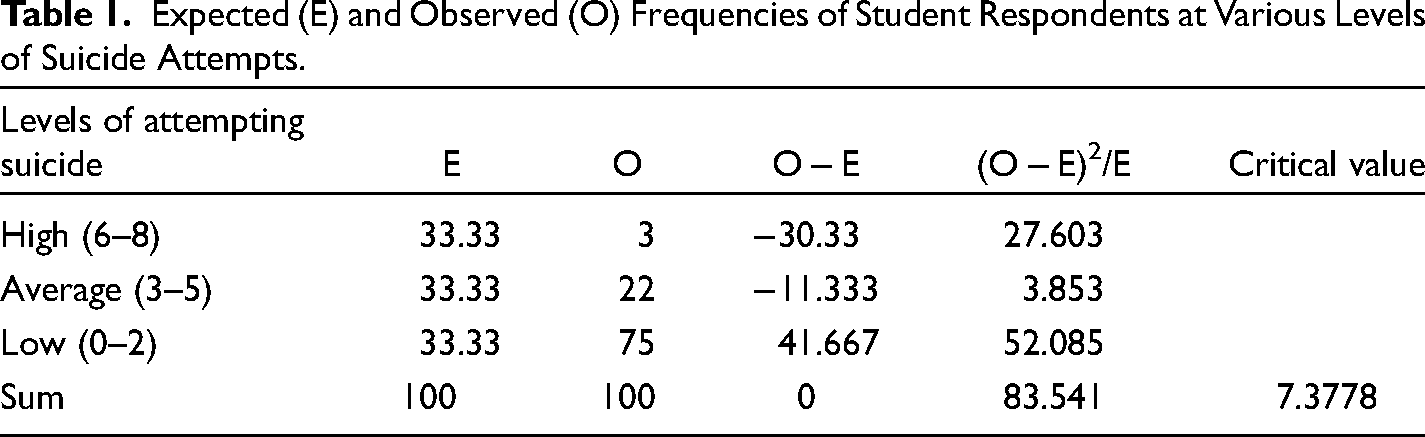
Table 2 shows that the obtained value of the chi-square test (54.3) is by far greater than the table value (7.378) at an alpha level of 0.05 and 2 degrees of freedom. This indicates that there is a significant difference in the number of students in each category. The observed frequency in the category of high unsafe sexual practices (62%) is significantly higher than those in the categories of average (36%) and lower (2%) extents of unsafe sexual practices. Thus, it can be concluded that unsafe sexual practices are the major problem of college students which needs great attention from the college communities as well as other concerned bodies.
Expected (E) and Observed (O) Frequencies of Student Respondents at Various Degrees of Unsafe Sexual Practices.
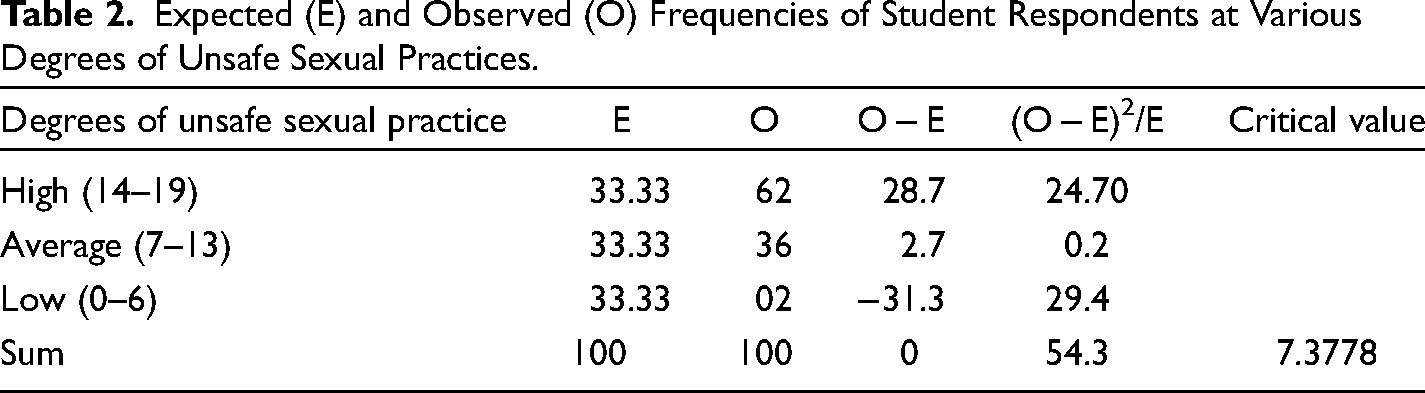
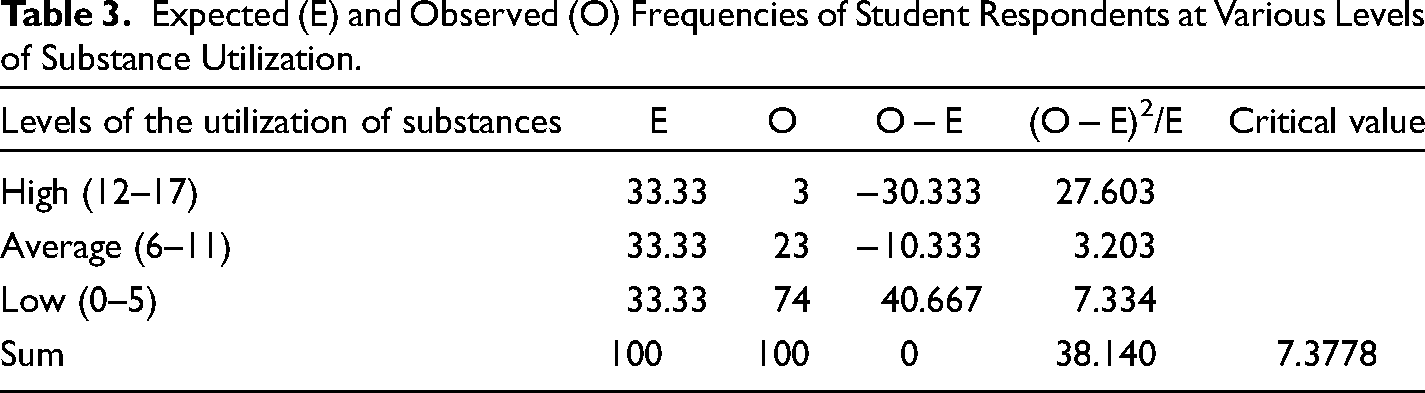
Table 3 indicates that the calculated value of the chi-square test for the extent of substance usage (38.140) is greater than the critical or table value (7.3778) at 0.05 alpha level and 2 degrees of freedom. This reveals that there are statistically significant differences in the number of students who are included in each category. Generally, this analysis shows that a larger proportion of students (74%) is concentrated at the lower extent of substance usage. Therefore, substance utilization is not a problem for many college students in this study.
Expected (E) and Observed (O) Frequencies of Student Respondents at Various Levels of Substance Utilization.
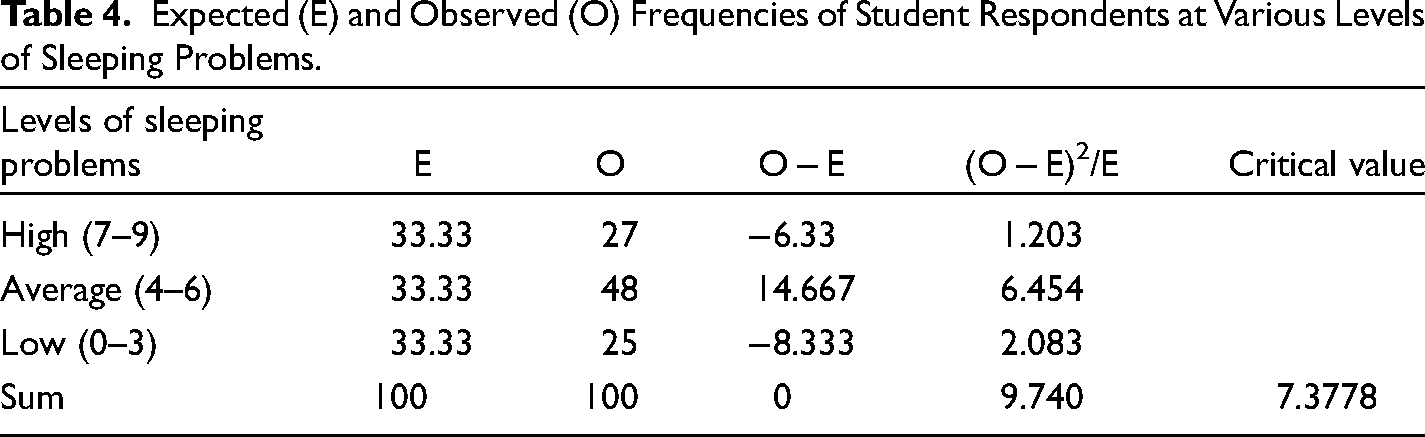
As it had been revealed that a large proportion of respondents (48%) were in the average category (Table 4). The chi-square test indicated that there were significant differences since the calculated value (9.740) was greater than the table value (7.3778) at an alpha level of 0.05 and 2 degrees of freedom. Therefore, sleep-related problems are available to the average extent among college students.
Expected (E) and Observed (O) Frequencies of Student Respondents at Various Levels of Sleeping Problems.
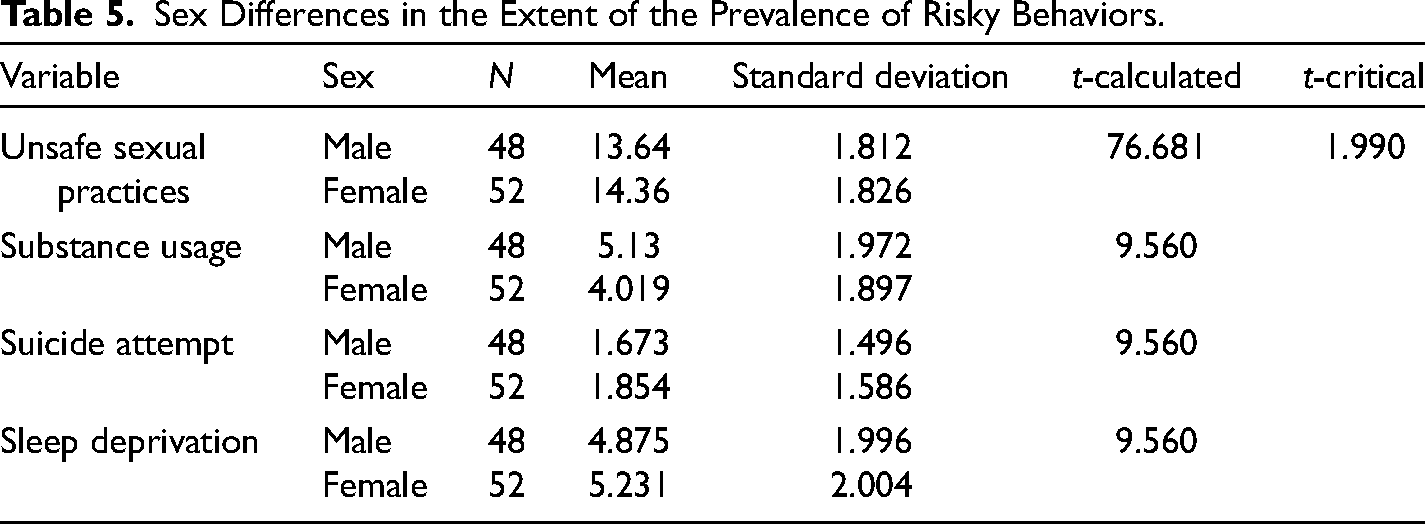
The t-test results in Table 5 revealed that the differences in the mean score of unsafe sexual practices for males (13.64) and females (14.36, t = 76.681), substance usage for males (5.13) and females (4.019, t = 9560), suicide attempts for males (1.67) and females (1.854, t = 9.560), sleep deprivation for males (4.875) and females (5.231, t = 9.560) were statistically significant at 2 degrees of freedom, an alpha level of 0.05 and a critical value of 1.990.
Sex Differences in the Extent of the Prevalence of Risky Behaviors.
Discussion
To what extent do students reveal unhealthy behavior?
Suicide Attempts
The chi-square shows that majority of college students are concentrated in the category of the lower extent of attempting suicide. Therefore, suicide is not that much considerable problem in the study area. Nevertheless, this finding is not supported by the researched facts that say depending on their age level, sex, and ethnicity many college students are characterized by having suicidal thoughts and attempts (Youth Risk Behavior Surveillance, 1995). In contrast to this finding, research done by Desjarlra and Kleinmaan (1995) confirmed that suicide is the third major cause of youngster and adolescent mortality. Inconsistent with the findings of this research, globally, suicide is a serious problem for youth of today it has been reported to be accounted as the third leading cause of death among young people 10–34 years of age (Centers for Disease Control and Prevention, 2012).
On the other hand, this result is also consistent with the work of Frances et al. (2020), which revealed the prevalence of suicidal attempts among the participants was 6.3%. The finding of this result is fairly reliable with a study of college nursing students on suicide in Ghana (Quarshie et al., 2019) as well as secondary school students (Baiden et al., 2019). On the other hand, in 2008, Hjelmeland and colleagues reported that only 4% of Ghanaian college students compared to 7% of Ugandans and 8% of Norwegians conveyed that they might consider suicide under some circumstances (Frances et al., 2020). A study conducted at Metu University Ethiopia indicated that 4.4% of the respondents were attempting suicide which is nearly similar to this research finding (Zakir et al., 2019). Suicide is not as such frequently observed among the participants of this study, this might be because of religious and cultural influences in the area.
Unsafe Sexual Practices
Unsafe sexual practices are common among college students to a great extent and hence need great attention from the college communities as well as other concerned bodies. This finding is consistent with the findings of Lewis and Mallow (1997), Flannery and Ellingson (2003), Eschbacher (2002) cited in O’Neill (2007). They proposed that college students experience more sexual behaviors than noncollege students. They have multiple sexual partners, use drugs, and alcohol prior to sexual activity, and report a lower incidence of condom use and communication regarding safer sexual practices. The reason is due to the number of misconceptions put forth by students. Approximately, two-thirds of high school graduates come to college with established sexual histories and are exposed to sexually transmitted diseases.
In line with this research, several studies have revealed that young adults in Sub-Saharan African countries including Ethiopia also tend to be engaged in having multiple sexual partners and unprotected sexual intercourse, and university and college students are in the youth age group (15–24 years) and are highly exposed to unsafe sexual practices such as unprotected sexual intercourse and having had sex with multiple partners (Olaitan, 2009; Shiferaw et al., 2014; Tura et al., 2012; UNICEF, 2006). On the other hand, a cross-sectional study conducted among Mekele University students indicated that unsafe sexual practice was significantly high which is consistent with this research finding (Kebede et al., 2020).
Substance Usage
The chi-square test reveals that there are statistically significant differences in the number of students who are included under each category. It shows that larger proportions of students are concentrated at a lower extent of substance usage (alcohol and cigarette). Thus substance utilization is not a problem for many college students although there are some students who have the habit of drinking local beer. However, this finding is in contrast with the views of Wechsler, Dowdall, Davenport, Moeykens, and Castillo, 1994 cited in O’Neill (2007) who suggested that binge drinking (consumption of four or more drinks in a row) and smoking cigarettes are common among college students than their peers of the same age who do not attend college as well as the impact of this behavior easily provides repercussions on around campuses.
Unlike the results of this research work, university and college students constitute a high-risk group for engaging in risky behaviors, such as smoking, heavy alcohol drinking, and illicit substance use. In Ethiopia, the substances most commonly misused are alcohol, Khat, and tobacco. Cannabis is becoming more common in urban areas, and at-risk populations such as street children engage in inhalant use, including benzene and glue sniffing (Fekadu et al., 2007; Poscia et al., 2015; Wangeri et al., 2012; Warren et al., 2006).
Inconsistent with this finding, research done in Ethiopian higher learning institutions students reported high levels of substance use, especially alcohol, tobacco, and Khat, and adverse impacts on students’ academic performance were observed (Solomon, 2018).
Sleep Deprivation
Another important variable manipulated in this study was the degree of the prevalence of sleep-related problems among the students. The chi-square test result indicated that a larger proportion of respondents was in the average category. The presence of differences in the number of respondents in each category was significant since the calculated value of the chi-square test was its table value. Hence sleep-related problems are found to an average extent among study participants. This finding is supported by Edens (2006), Amilton and McGee (2006), and Dahl (1999) cited in O’Neill (2007). To the views of these scholars, there are a number of factors that can negatively influence the health and academic conditions of college students. Of these common contributors to the poor health and academic achievement on college campuses, sleep deprivation ranks as one of the top three impediments as the others are stress and cold sore throat. Other obstacles that seem to correlate with students who are sleep deprived are other illnesses, alcohol and drug use, depression, sexual assaults, and problematic relationships. Insufficient sleep may contribute to negative emotions and the inability to control emotionally driven behaviors.
2. Which risky behavior is the most dominant among students?
Forty-seven percent of students agreed that unhealthy sexual practices are the most repeatedly seen problems that need more attention. Next to this, as supported by 23% of the students, sleep deprivation is the second considerable problem. However, substance usage (drinking more alcohol and smoking cigarettes) and suicide attempts have not been found to be considerable problems.
Except the findings that describe that substance usage (drinking more alcohol and smoking cigarettes) and suicide attempts have not been found to be considerable problems in this college, the other proven facts in this research have supporters. For instance, youth risk behavior surveillance 1995 stated that many college students engage in behaviors that place them at risk for serious health problems. Risky sexual practices, substance usage (over alcohol drinking and smoking cigarette), suicide attempts, sleep deprivation, and unhealthy dietary situations are some of the known risky behaviors among college students.
Students were engaging in unsafe sexual practice for a variety of reasons, including amusement, ignorance, trusting their partners, for business, lack of access to condoms, knowledge of their partners’ health statuses, unconsciousness, lack of privacy to purchase condoms, and even a lack of concern for HIV and other sexual transmitted infections (STIs). Kebede and his colleagues in 2020 found that unsafe sexual practice was significantly high (44%) among Mekele University students which is reliable to the findings of this study. Despite the fact that the participants from Bahir Dar were private college students and those from Gondar were high school students, the size was greater when compared to other research of a similar nature carried out in Sri Lanka, Western Ethiopia, Jimma, and Bahir Dar (Alamrew et al., 2013; Negeri, 2014; Tura et al., 2012). It was, however, less when compared to research from Debre Tabor University, Bahir Dar University, and Aksum University in Nigeria (Imaledo et al., 2012; Mulu et al., 2014).
3. Are there significant sex differences in the prevalence of risky
behaviors among students?
Another important issue that was desired to be understood by the researcher was the presence of differences in the extent of the prevalence of risky behaviors as a function of sex. The results of this study revealed that there are significant sex differences in the extent of availability of the intended risky behaviors. Unsafe sexual practices, suicide attempts, and sleep deprivation are more dominantly seen in females while substance usage is dominantly seen in males. This research outcome is consistent with the findings of Resnick. Accordingly, sex is the major source of variation in the prevalence of health risk behaviors in colleges. Girls were significantly more likely than their male age mates to report the history and experience of risky behaviors (Resnick and Blum, 2011).
There are previously done research studies that had similar findings and proposed that there are gender differences in the extent of availability of risky behaviors. A greater portion of males than females have had sexual experience; however, females were at greater risk for a history of sexual abuse. Similarly, research studies indicated the presence of gender differences in the prevalence of risky behaviors such as incorrect perception of body image, inappropriate dieting, substance use, and suicide attempts (Troiden, 1988; Remafedi et al., 1991 cited in Resnick & Blum, 2011 and Vanphanom et al., 2011).
In this study, attempting suicide was more frequently observed among females than males. In this respect, research done by Kreitman (1983) also supported and indicated that more men than women kill themselves, but more women than men attempt suicide.
Conclusion
Unsafe sexual practices were found to be higher while sleep-related problems were found to be seen moderately. However, to a lower extent among students, substance usage and suicide attempts were found. Unsafe sexual practices are the most repeatedly seen problem followed by sleep deprivation in the college. Nevertheless, substance usage (drinking more alcohol and smoking cigarette) and suicide attempts have not been found to be considerable problems.
Sex differences were observed in the extent of the availability of risky behaviors. Risky behaviors like unsafe sexual practices, suicide attempts, and sleep deprivation are more dominantly seen in females while others like substance usage are more dominantly seen in males.
Recommendations
College instructors, expertise, principals, the region’s educational office expertise, and the local community should give higher emphasis and help the students to reduce the intensity of risky behaviors.
Special attention should be given to girls by college instructors, experts, principals and the region’s educational office expertise, and the local community so that they can be aware of the effects of risky behaviors.
Psycho-Educational Interventions
Students will gain awareness about the impacts of risky behaviors on their behavior and mental health. College counselors and leaders should get and provide adequate and timely information about risky behaviors for students. College leaders, mental health experts, psychiatrists, and educational expertise near the college will obtain data that will enable them to take different actions and provide training. It can provide information for different social workers, governmental and nongovernmental organizations working in the area. It can also be a springboard for further researchers in the study area.
Footnotes
Declaration of Conflicting Interests
The author declared no potential conflicts of interest with respect to the research, authorship, and/or publication of this article.
Funding
The author received no financial support for the research, authorship, and/or publication of this article
