







Abstract
This study aimed to explore gender equality in language textbooks in Georgian schools. The content analysis method was used to answer the research questions, and a theoretical framework was developed based on Porreca's Analytical Framework (1984). The research revealed that men remain more visible in textbooks. Social roles, activities, and professions are gender-biased, and the books contribute to the development of gender stereotypes. The study identified five different approaches that school textbook authors adopt toward gender equality: (1) superficial, (2) artificial, (3) additive, (4) deliberate ignorance, and (5) attitudinal nondeliberate gender mainstreaming approach.
Introduction
Schools, school curricula, and textbooks are essential to construct students’ knowledge and forms of thinking, as well as students’ values, attitudes, and behaviors (Bandura, 1977, 2001; Lee, 2016). Accordingly, school textbooks have become an important topic in educational research as they can develop students’ sensitivity toward differences and different sources of cultural identity, including gender identity (Tabatadze, 2015a; Tabatadze et al., 2020).
Gender equality is a critical topic for many states in the world, including both – developed and developing countries. The OECD report “Closing the Gender Gap: Act Now” (2012) underscores that “Girls today outperform boys in some areas of education… But… women continue to earn less than men, are less likely to make it to the top of the career ladder, and are more likely to spend their final years in poverty (p. 13). Even in OECD countries, gender inequality is problematic in a school setting. In OECD countries, schools’ textbooks do not fully promote gender equality and sensitivity (Blumberg, 2007). A harsher situation is observed in non-OECD Eastern and Central European, former Soviet Union countries (Magno & Silova, 2007) as well as in developing countries worldwide (see literature review below).
Georgia, a post-Soviet country, is no exception regarding problems and challenges of gender equality in the educational system. Even though girls’ access to education is positively solved in the Georgian context, the educational content remains challenging. Girls’ access to preschool, general, vocational, and higher education is not limited in Georgia, and they are less likely to drop out of school (Gorgadze, 2015; Tabatadze, 2015a). Further, girls outperform boys in various international educational assessments (PIRLS, PISA, TIMSS); However, the challenge to develop gender-balanced and sensitive content of school teaching materials for boys and girls in public schools is still a crucial issue to consider. It should also be noted that gender equality in access to education is sometimes a problem if it is used for gender indoctrination. As Longwe (1998) pointed out, school is where students learn power relations, power control, and gender inequality. “Women with more schooling are more indoctrinated. They have been schooled to believe in the value of schooling. They have been schooled to progress within the existing system, and not to change it. They have been schooled to believe that women get ahead by being schooled, and that women are less advanced than men because of lack of schooling. Women's empowerment involves, as a prerequisite, that women throw away this false ideological baggage” (p.26).
Accordingly, it is essential that knowledge and attitudes are developed based on the content of existing teaching materials for women's empowerment.
Georgian legislature reflects the issue of gender equality in education. The law on gender equality, as well as specific educational laws such as: “Law on General Education,” “National Goals of General Education of Georgia,” National Curriculum of Georgia 2018–2024”, “The School Textbook Approval Rule”, “Teachers Professional Standard” and “Teachers Profession Regulation Rule”, are important legislative acts for regulating gender issues in the educational system. The textbook approval rule underlines the importance of gender balancing and develops additional instruments to ensure gender equality in school textbooks. Specifically, the involvement of representatives of Public Defenders in the textbook approval rule was formalized. The representative of the Public Defender's Office assesses the drafts of school textbooks in terms of multiculturalism, diversity, discrimination, and equality (Chanturia & Kadagidze, 2020).
This study analyzed gender sensitivity in language textbooks developed in the framework of the third generation National Curriculum of Georgia. The study had the following research questions: To what extent women and men are represented equally in school textbooks? How are women and men represented in activities and professions? To what extent do textbooks contribute to reproducing stereotypes among students? What approaches do textbook authors use to develop gender equality and sensitivity in students?
Literature Review
Literature on gender analyses of school textbooks presents important results and findings in different directions, specifically: Visibility in school textbooks and the ratio of males and females; Gender stereotyping in social roles, activities, and occupations; Discourses on gender power relations and power control in society.
Gender visibility in school textbooks and the ratio of males and females is an important research direction. Many studies have been conducted from the beginning of the twentieth century until today in the developing and developed world. Hellinger (1980) conducted a study of English language textbooks in Germany and found that “English language textbooks used in German schools (ELTG) convey the image of a patriarchal society, which not only contributes nothing towards the realization of equal rights for women and men studies on English language books used in schools in Germany” (p. 267). Koster (2020) systematically analyzed gender representation in texts and illustrations in 15 Dutch as Second Language school textbooks of the last 50 years. The results revealed that females are not underrepresented in dialogs and pictures but are backgrounded through male primacy. Porreca (1984) developed a gender analytical framework and conducted a study of gender representation in US schools’ language textbooks and showed that quantitatively, women were represented less in educational materials. Ndura (2004) studied ESL textbooks in the Western US and identified three significant forms of bias by examining six textbooks that included stereotyping, invisibility, and unreality. Similarly, a school textbook analysis in Japan revealed similar patterns in the gender representation of men and women (Lee, 2016, 2011; Lee, 2018a). Furthermore, in Australian textbooks, the gender balance is not achieved fully, although there is significant gender sensitivity (Lee & Collins, 2008, 2010). Greek school textbooks also show quantitative and qualitative inequality (Karintzaidis et al., 2016). Gender-unbalanced English as a foreign language is taught in Indonesian public schools (Albana, 2017). Studies of language textbook gender analyses conducted in Iran also revealed the same pattern (Amini & Birjandi, 2012; Hall, 2014). Islam and Asadullah (2018) conducted a comparative study of English language textbooks in Indonesia, Malaysia, Pakistan, and Bangladesh. The results of their cross-country study showed that the women representation was in “… Malaysia and Indonesia (44.4% and 44.1%, respectively) while this share is only 24.4% and 37.3% in Pakistani and Bangladeshi textbooks respectively” (p. 1).
Identification of gender stereotyping in social roles, activities, and occupations is another important direction in school textbook research. Several studies have confirmed the challenges in school language textbooks in this context. The challenges are presented in early as well as in new research studies on nearly all continents. Davies (1995) conducted a literature review of studies of school language textbooks in Asia, Africa, the Caribbean, and Australia. The literature was reviewed from 1970th, and the analysis showed that all school textbooks were inclined to foster gender stereotypes in school students. Other research during the same period revealed the same tendencies as well. Macaulay and Brice (1997) found that school textbooks have not changed over the last 25 years, and most of them stereotype both genders routinely. Further, Hartman and Judd (1978) found that ESL textbooks often presented women in stereotypical roles and assigned stereotypical emotional reactions to them. The authors analyzed English, Mathematics, and French textbooks and found that they were male-dominated and men's occupations were invariably more prestigious than women's. UNESCO conducted a study on gender equality and gender stereotyping in school textbooks in seven countries: China, France, Kuwait, Norway, Peru, the Ukrainian Soviet Socialist Republic, and Zambia (Michel, 1986). The books in nearly all countries characterize females as having little initiative, while males always have authority, initiative, and creativity. Women are presented primarily in domestic settings and are weak and dependent, while men display strength, power, and independence. The studies conducted in the twenty-first century show some improvements in terms of gender equality in school textbooks; however, the challenges persist. Gouvias and Alexopoulos (2018) conducted a content analysis of Greek-language textbooks for primary grades and concluded that gender stereotypes existed throughout the full range of these books. Similarly, Falah and Saed (2017) examined gender equality and gender stereotypes in Hebrew schools’ textbooks and found that they include “… many gender stereotypes which represent the weak, inferior role of women in society… perpetuate the long-standing position of male, who poses a higher, most important and dominant status” (p. 251). Lee and Collins (2010) compared Australian and Hong Kong language textbooks and concluded that they promote male primacy.
Male primacy and power construction emerge from a literature review of existing studies. School textbooks can construct gender biases as well as different discourses on gender power relations and power control in society. Quantitative analyses, in many cases, are insufficient to catch those discourse constructions, and accordingly, textbook studies that used predominantly qualitative data illuminated the way school textbooks construct gender (Namatende-Sakwa, 2018). Critical Discourse Analysis (CDA) was used to understand those discourses produced by school textbooks and concerns about power and control in society (Canale, 2021; Fairclough, 2013; Rahimi & Sahragard, 2007). Feminist researchers contributed to these studies and, based on CDA, developed Feminist Critical Discourse Analysis (FCDA), which studies the issues of power and ideology through the lens of gender (Lazar, 2005). Much research has been conducted in different countries using FCDA. These research studies revealed that masculine power emerged in text discourses (|Ahmad & Shah, 2019; Curaming & Curaming, 2020; Kostas, 2014, 2021; Ji & Reiss, 2022; Lee, 2018b; Lee, 2019; Namatende-Sakwa, 2018; Sunderland, 2000, 2004; Sunderland et al., 2000; Sunderland et al., 2002).
Situating the Study: School Textbook Analytical Studies in Georgia
Reforming the Soviet educational system and introducing the new National Curriculum in schools became part of the political agenda in Georgia beginning in 2004 (Tabatadze et al., 2020). The National Curriculum and school textbook reform were implemented in three waves (Tabatadze, 2015b). In 2004–2007, the first generation of the National Curriculum and school textbooks were developed, piloted, and introduced in Georgian public and private schools (Tabatadze, 2015a, 2021; Tabatadze & Gorgadze, 2018). The second generation of the National Curriculum was adopted in 2011 and implemented in schools in 2011–2016, and finally, the third wave of curricular reform began in 2016. The textbooks for primary grades (1–6) were developed in 2018, and those for Basic Education (Grades 7–9) began to be developed in 2019–2021 (Tabatadze et al., 2020; Tabatadze & Gorgadze, 2022).
Several important gender research studies of school textbooks have been conducted in Georgia. Textbooks were analyzed at different times, starting from the analyses of textbooks developed before 2005, i.e., before the educational reform (Magno & Silova, 2007). Further, Georgian scholars analyzed the textbooks developed during the first and second generations of the National Curriculum (Chanturia & Kadagidze, 2020; Gorgadze, 2015, 2016; Khomeriki et al., 2012; Tabatadze et al., 2013).
The literature review of the existing school textbook analyses demonstrates the gap in the current research. Although gender analyses of school textbooks have been conducted multiple times in Georgia, this particular paper is still important for the field, specifically because: (1) This study analyzed school textbooks developed under the third-generation National Curriculum, which has not been undertaken previously; (2) the study analyzed textbooks of the primary as well as the basic education level, while previous research has focused on either one or the other; (3) previous studies have not focused on changing the status quo because they were conducted either at a time when the textbooks were no longer in use or when their deficiencies could not be addressed or revised; (4) analyses of the textbooks were not intended to develop the theoretical and scientific field, while this study is intended to create a theoretical framework for the analysis of textbooks as well as theoretical educational approaches for authors or policymakers’ use. This study is designed to advance the scientific field as well as improve educational practices in the classroom. Further, there is a significant gap in the scientific literature with respect to the analysis of methodological approaches that authors employ in school textbooks to develop students’ gender sensitivity. This study was designed to bridge this existing gap.
Methodology
This study is part of a larger project that analyzed 16 textbooks, five of which are language textbooks: Two are textbooks of Georgian as a second language (GSL), two are of Georgian as a native language (GNL), and one is of Russian as a foreign language (RFL). This study used the content analysis method to answer the research questions, Porreca's Analytical Framework (1984) was used to develop a theoretical basis for our study's analysis. Porreca (1984) conducted research on foreign language textbooks and used an analytical framework in her study to perform a gender analysis based on the following components: Gender visibility in texts and illustrations, gender primacy, gendered activities and professions, masculine generic constructions, neutral nouns, specific nouns, and adjectives. We did not use the components of gender-neutral and gender-specific nouns and adjectives in our analysis, as the specifics of the Georgian language did not allow this. Instead, these components were combined into a stereotype production and reproduction component, and the textbooks were analyzed using this model. Accordingly, we used an adapted version of Porreca's framework in this study.
Results
This section presents the research results based on the analytical framework developed. Each aspect of the framework is described separately with specific examples and evidences.
Visibility and Gender Representation in Texts and Illustrations
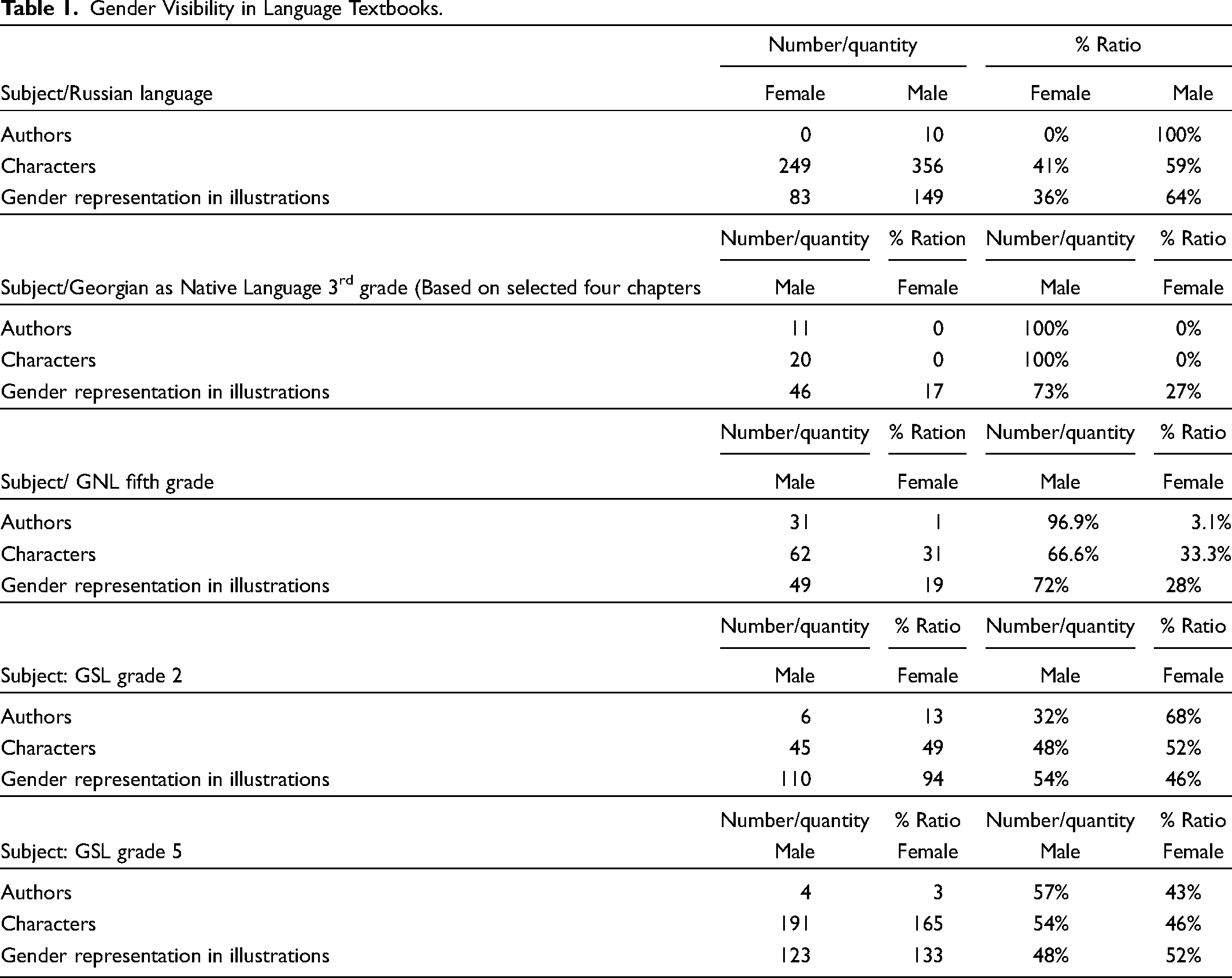
The efforts of GSL textbook authors to quantitatively balance gender representation are clearly seen during the analysis. The gender balance is represented in a variety of texts, exercises, and images. Both males and females are included in some of the episodes. There are also couples made up of a boy and a girl and groups of people with a balanced number of males and females. The GSL textbook for third graders has 46% of female and 54% of male representation in illustrations. The GSL textbook for fifth graders is even more balanced; there are 49 female characters and 44 male characters. Thirteen female and six male writers author the texts included in the textbook. Obviously, GSL textbooks maintain a gender-balanced approach quantitatively, and women's representation is even higher than men's.
In the RFL textbooks, a different pattern emerges. Male authors of the texts and the number of male characters and their appearance in illustrations outnumber female authors, despite the authors’ efforts to achieve a balanced numeric representation. The male /female ratio in RFL textbooks is 60/40 on average.
The most disproportional representation of males and females was observed in GNL textbook for third graders. The authors of this study chose four of the ten chapters in this textbook at random for analysis and discovered no females in any of them. Females are represented in the GNL textbook for fifth graders on unequal terms. Women are presented as characters in 31 cases, while men are presented in 62 cases. The textbook included only one female author with two poems, while 31 male authors were presented with their texts, novels, or poems. Unproportional representation is depicted in the illustrations. There are only 19 illustrations that include females and 49 images with males. Table 1 presents detailed information about visibility and gender representation in language textbooks.
Gender Visibility in Language Textbooks.
Masculine Primacy and Dominance in Textbooks
No women as the main character are represented in the four chapters of the textbook of GNL for third graders. Men are given preference and are associated with wisdom, courage, wealth, care for nature and the environment, and the preservation and development of that wealth. Values such as respect, kindness, diligence, prudence, and devotion to the oppressed in the texts are attributed to men. A specific example of male primacy is expressed well in Vazha-Pshavela's poem “What does it really mean to be a boy which is a type of manifesto of what a really good boy should be. The textbook authors provide an assignment for the students at the end of the poem: “Imagine and write a story about a father and son based on the poem's plot and illustration. The story should show what father and son do and how their actions relate to the poem's content. Do not forget to describe the characters in your story.” The plot of the poem is about a boy who stands for justice and protection of the oppressed. This important poem and its values are important for all students, not boys alone, yet this assignment suggests that these values are exclusive to boys. Unfortunately, the authors considered that only males are ready to fight for justice and protect those who are oppressed. The second problematic gender-specific episode in the textbook is related to women. In Sulkhan-Saba Orbeliani's “Friendship of a bear and a peasant,” a woman is the main character's wife and plays the role of the antihero. She hurts her husband's friend, the bear, with her unkind attitude, which becomes a harsh pain for the bear. In the text, the husband's primacy and dominance and the wife's subordinate position are revealed clearly in the episode in which the woman is forced to kiss the bear she dislikes. The concepts of subordination and male primacy are illustrated well in the question after the text: “What did the man want to express when [he] forced his wife to kiss the bear”? In answer to this question, students are expected to emphasize the man's generosity and the value of loyalty to his friend. It is possible to use this text for the purpose it was created; however, the authors could have avoided exacerbating the gender issues seen in this text with a biased assignment.
The GSL textbooks have some shortcomings as well. In the second-grade book, the primacy of males is not observed often and obviously. As the book is intended for second graders, only short texts are presented to develop the language skills of students for whom Georgian is not a native language. Nevertheless, some gaps are evident in the context of male primacy. The characters in the text “Household” are a mother, father, grandfather, and two children (boy and girl). The text describes what each family member does at home. The roles of husband and wife are presented stereotypically; while the husband is watching TV, the wife is cleaning the house. Similarly, there is a text, “What I look like”, which presents two heroes, Ali (boy) and Anna (girl). Ali has brown hair and loves to read, and while Anna also has brown hair, she loves to read and sew. Thus, both characters love to read, but Anna simultaneously loves to sew, an activity that is ascribed stereotypically to females. An interesting illustration in the same context is an illustration about gathering crops. Children pick fruit from a fruit tree. The boys are at the top of the tree picking fruit, while the girls are simply trying to pick the fruit from the ground, which also highlights the boys’ superiority in climbing a tree and obtaining fresher fruit. In contrast, the girls are satisfied with only the easily available fruit.
Although the authors try their best to balance the texts quantitatively, the GSL fifth-grade textbook also exhibits male primacy. For example, in one instance in which grandparents are talking to their grandchild, Grandpa is portrayed as a wise problem-solver. In contrast, Grandma is portrayed as a housekeeper with an apron who executes the grandfathers’ intelligent decisions. Similarly, in the holiday-related texts, the grandfather walks in the woods doing chores and helping his grandchildren build a playhouse while the grandmother prepares dinner for the children.
Gender Representation in Occupations and Activities
The GSL textbook for second graders includes texts and illustrations with gender-biased professions and activities. For example, there is a female teacher presented at the beginning of the book. This teacher is the book's main character; accordingly, the reader/students constantly encounter a female teacher in the book. The text “Conversation” is illustrated with a picture of a woman (the mother of a friend of the main character) who is shown as a housewife. These pictures tell students that mothers are usually at home and are primarily housewives and housekeepers. Similarly, the text “Anna's family” shows a picture of Anna's mother wearing a housewife's apron, which underlines that women's primary activity is housekeeping, and the apron is part of a female's identity.
In general, the book presents women's activities such as sewing, making the Georgian cookie, “Churchkhela”, reading a book, talking on the phone, and cleaning the house. The females are also depicted by their professions: shop assistants and teachers (reiterated in many cases). Men's activities are as follows: Watching TV and walking with dogs. The male in the text is a doctor by profession. The activities and professions presented show the female as a housewife who is focused only on family affairs.
Gender representation in activities and occupations is also biased in the fifth-grade GSL textbook. The textbook contains a particular chapter on professions, the distribution of which is gender-unbalanced and reflects pre-defined gendered professions. Men's occupations are as follows: Airplane pilots; policemen; bus drivers; engineers, and house builders. The positive aspect of the book is the portrayal of a male waiter who breaks the gender stereotype of the traditional waitress as a female professional. In other parts of the book, the male is presented as a taxi driver, doctor, policeman, attraction supervisor, driver, popcorn seller, and ticket controller. The women's professions listed in the textbook are as follows: teachers, pediatricians, receptionists in a hospital, cashiers, housewives, and librarians. Consequently, gender bias is obvious in the activities in the textbook. The textbook presents Ilia Chavchavadze's “Nikoloz Gostashabishvili. New Year's Story.” According to the story, the mother melts honey in the fireplace. The text is accompanied by an illustration in which females are spinning and doing work while a male smokes a cigar and a boy eats cookies.
Although the authors of the RFL textbook try to maintain numerical gender balance in the textbooks, gender bias is still obvious in activities and occupations. For example, the fourth chapter presents boys’ and girls’ belongings. The boys’ belongings include a ball; car; roller; bicycle, and bricks to make constructions, while the girls’ belongings include a handbag, key, phone, wallet, lipstick, and a small mirror.
Males are represented primarily in the GNL textbook. They are portrayed in the role of wealthy merchants, peasants, wise men, hard-working men, rich people, lazy children, and loyal and committed friends. The female representation is limited to two cases, in which the woman is represented as a wife and mother. The second case is more interesting. The woman is the wife of a hard-working man and the mother of a lazy son. According to the text, the husband is hard-working and takes care of the family's well-being for his entire life. The husband tries to improve his lazy son and gives him different tasks to accomplish, while the mother helps the son deceive the father rather than accomplish his task.
Producing and Reproducing Stereotypes
The second-grade GSL textbook includes interesting episodes that reinforce and reproduce gender stereotypes. The dialog between Ali and Anna is presented to teach the students how to use the lesson timetable. The conversation is about students’ favorite school days. According to the text, Anna loves music lessons, and accordingly, Monday and Thursday are her favorite days, as she has music classes on those days. In contrast, Ali loves every day because mathematics and Georgian are his favorite subjects; these subjects are taught every school day. This distribution of favorite subjects between girls and boys reinforces stereotypes about boys’ mathematical talents.
Several episodes in the fifth-grade GSL textbook contribute to the reproduction of gender stereotypes. In particular, the textbook contains holiday-related texts, according to which the grandmother prepares food for the grandchildren while the grandfather walks in the forest where he plans to build a house for the children. A second example portrays a mother as a housewife and a father employed as a taxi driver. This episode also contributes to reinforcing gender stereotypes between women and men in the family. The third example is the text about Rezo that reinforces the same stereotype. Rezo is a little boy who helps his mother. The question in the text is “How does he help his mother?” and the text provides answers to this question: Sometimes he brings bread from the market, sometimes he gets sugar.” Rezo, as his mother's helper in supplying food for the family, also emphasizes the stereotype that the man brings the food while the woman prepares it.
Further, another episode deepens the stereotypes about the roles of males and females in the family. The text is about a mother who takes her child to the doctor. The child is suffering from abdominal pain and needs an immediate check from a doctor. This episode reinforces the stereotype that mothers are responsible for their children's health and, in general, for taking care of them. Another episode describes girl's birthday, according to which the mother sets the table while the father gets home from work later and brings her a puppy as a birthday present, fulfilling the girl's wish. Similarly, Nodar Dumbadze's poem “Letter to Manana” is presented, according to which Dad is a person who can afford to buy gifts for his children. A text about Santa Claus supports this stereotype further. According to this text, Natasha, a little girl, wrote a letter to Santa Claus. Her father took the note, pretending that he was going to send it to Santa. In reality, he went to the shop and bought a bicycle from the list of gifts Natasha asked Santa Claus to bring to her. The text is followed by the question: “Who is Natasha's Santa Claus?” to highlight further that the father is the person who brings gifts to the children. These episodes, separately and collectively, reinforce stereotypes about women's and men's roles in the family.
The RFL textbook attempts not to produce gender stereotypes; however, it has some shortcomings. Lesson eleven is about a family. In the illustration of the family, the females are wearing an apron and either doing the laundry or cleaning the house with a mop and scrubber. On the other hand, the males are either reading the newspaper, working on their computer, or drinking or eating. Similar role distributions facilitate the reproduction of gender-stereotypical family roles in students.
Discussion and Conclusions
The research findings have practical implications as well as scientific significance. Considering these findings and the application of these issues will improve classroom practices. At the same time, the research offers room for further studies focusing on constructing gender knowledge in textbooks. The research results can be used as a theoretical framework for future research studies on approaches to gender education.
The research revealed that males still remain more visible in school textbooks. Social roles, activities, and professions in school textbooks continue to be gender-biased, and the books promote the development of gender stereotypes in school students. Further, the books do not provide the opportunity to discuss the issues of gender equality and social justice in Georgian society.
The research identified differences in the reflection of gender equality in textbooks by subjects. Quantitatively, GSL textbooks attempt to maintain the gender balance in texts, illustrations, and textbook authors. The RFL textbook also makes similar attempts, but males prevail over females. On the other hand, the GNL textbooks do not reflect gender equality even quantitatively, and the imbalance between males and females is very evident.
The research identified essential approaches school textbook authors use to reflect gender aspects in school textbooks and develop students’ gender sensitivity. The research has shown that formal legislative regulations have not led to qualitative and substantive changes. Although policy and legislation reflect positive legal procedures for gender equality, it is not achieved fully in practice. Reflecting gender equality only in formal and declaratory provisions provides only illusory results. This is clear in light of the legislative changes that have taken place in Georgia, including the Public Defender's involvement in approving school textbooks, yet the results achieved are only formal and superficial. Accordingly, this approach can be classified as a superficial approach to gender equality.
Authors of school textbooks try to balance the gender aspects in texts and illustrations quantitatively, which falls under gender socialization theory in the educational context (Thompson, 2003), which implies “push for gender-neutral curricula and teaching under the assumption that by ensuring equality in treatment, there would be equality in educational outcomes (Rafalow, 2013, p. 313). However, as Porreca (1984) indicated, “Simple ratios reveal only quantities and cannot reveal the way in which males and females are presented” (p. 713). Balancing gender quantitatively neither allows students to develop gender sensitivity nor does it make them critical thinkers. Consequently, we can call the attempt to balance gender quantitatively only an artificial gender equality approach.
The study revealed that school textbook authors think that teaching language is the books’ sole function and gender equality issues should not necessarily be reflected there. The reflection of gender issues, even on a superficial and formal level, is considered separately from the subject content and not as an integral element of it. Accordingly, such an approach can be called an additive approach to gender equality. Language textbooks play an essential role in the development of gender sensitivity. Hence, when school textbooks’ authors adopt only an additive approach to gender education, it reinforces male dominance. Language is a reflection of political, social, economic, and cultural attitudes about society and can emphasize the idea of male superiority and female inferiority (Amini & Birjandi, 2012). As Bourdieu (1991) stated, language is seen in the policy domain as a symbolic characteristic of power. Accordingly, rather than using the additive approach to gender equality in school textbooks, it is vital to transform the curriculum and teaching materials. Doing so can promote gender equality and gender sensitivity when teaching languages to the students.
The study showed that the reviewed textbooks do not provide opportunities for discussion of gender equality and gender sensitivity issues, even though these books play an essential role in shaping attitudes and social images (Kobia, 2009). School textbooks are necessary to develop and transmit cultural values (Mkuchu, 2004) and develop positive and negative images of different sources of cultural identity (Tabatadze et al., 2013). School textbook authors do not use this power properly. Although there are texts in the books based on which it is possible to set an appropriate goal in this direction, their authors avoid raising these issues. Developing of gender sensitivity in students and teaching the problems of gender equality are not the goal of these books. Consequently, it is evident that except for superficial, artificial, and additive approaches to gender equality, the authors use a deliberate ignorance approach to gender equality.
The analyses of the textbooks above also showed that masculine primacy, social gender roles, and the production and reproduction of gender stereotypes remain significant problems in school textbooks. It is obvious that this is not a deliberate attempt on the part of their authors, as they attempt to balance gender quantitatively. However, the result is that the authors reflect and express their attitudes toward these issues unconsciously. The authors’ attitudes are reflected naturally in the textbooks’ content and practices, contributing to the production and reproduction of existing stereotypes. This process can be referred to as attitudinal nondeliberate gender mainstreaming.
The school textbook analysis showed that the liberal approach to gender socialization in education and approaches deriving from the Soviet legacy simultaneously function in the Georgian educational context and synthesize the pedagogical methods used by the authors of these school textbooks. Liberal approaches to gender socialization in Georgian education are reflected in general education legislation and the national curriculum. Consequently, As already mentioned, the production of this liberal educational policy has led to the existence of superficial, artificial, and additive approaches in terms of equal treatment of girls and boys in school textbooks. On the other hand, the post-Soviet heritage explains the application of attitudinal nondeliberate gender mainstreaming and the deliberate ignorance approach to gender equality in designing school textbooks.. As Shchurko (2018) underlines, “Soviet legacy, coincides with global processes and neo-liberalization, producing new ways and forms of social stratification based on gender and sexuality” (p.446; Shchurko, 2018). The majority of the authors of school textbooks were part of the Soviet educational space. In this system, discussing gender equality issues were taboo (Temkina & Zdravomyslova, 2003). The educational policy aimed to exclude women from political, cultural, and material participation (DeYoung & Constantine, 2009; Durrani et al., 2022). Accordingly, school textbook authors try to treat males and females equally quantitatively, but they are not able to overcome their own socialized perceptions about the gender aspects in education. As Zajda (2007) points out “nostalgia for the past is the new concern for teaching the concepts of participatory democracy, active citizenship, human rights, and social justice, never experienced by the ex-Soviet citizens (p.304). The Soviet legacy and usage of these two approaches by school textbook authors do not create the environment to develop knowledge towards gender equality.
To summarize, our study revealed that school textbook authors’ approaches to gender education are diverse and shaped by complex factors. The liberal approach to gender education plays an important role in the formation of policy at the state level. It influences the content of school textbooks in terms of gender representations, adding gender-related issues in educational materials as well as in the reflection of gender equality as an important direction of educational policy and legislature. Concurrently, the Soviet legacy also influences the authors’ approaches to gender education practices translated into male primacy, biased roles in school textbooks, and the production and reproduction of gender stereotypes through school textbooks. The classification of the authors’ approaches provides an opportunity to rethink the approaches to teaching gender equality in practical terms.
Footnotes
Acknowledgments
This publication is prepared in the framework of the “EU 4 Gender Equality: Together against gender stereotypes and gender-based violence” program, funded by the European Union, implemented jointly by UN Women and UNFPA. This research was prepared with the financial support of the European Union. Its contents are the sole responsibility of the authors and do not necessarily reflect the views of the European Union, UN Women and UNFPA.
Declaration of Conflicting Interests
The author(s) declared no potential conflicts of interest with respect to the research, authorship, and/or publication of this article.
Funding
The author(s) disclosed receipt of the following financial support for the research, authorship, and/or publication of this article: This work was supported by the European Union, United Nations Fund for Population Activities, UN Women.
