







Abstract
Group schools are increasingly emerging as a school-running model that balances and improves school quality. The integrated model can promote the connection within the group school, and is an ideal way to promote the improvement of the school's moral education effect. The research adopts qualitative research, collects data information such as documents through observation method and interview method, and conducts data processing through text analysis method. The study selected four representative affiliated schools in the H Education Group, observed their open classes and teaching and research; meanwhile, conducted open talk with a total of eight front-line teachers in four schools to understand the current status of the integration of moral education in the group school. The study found that the integration of moral education in group schools mainly involves three main bodies, namely universities, member schools and local teaching and research offices. The interaction of the three main bodies forms three elements: content, resources, and culture. Group schools should strive to form a unique school-based moral education curriculum, and at the same time build a long-term interoperable teaching and research platform, and generate a harmonious and diverse group culture, thereby achieving integration.
Keywords
Introduction
The research on moral education in the world is enduring and the theme is changing with the change of the times. In China, the theme of moral education has undergone several changes since the reform and opening up. From the 1970s to the 1980s, the exploration of the professionalism of Chinese moral education theory and the absorption of excellent moral education research results in the West were carried out simultaneously. In the 21st century, the theoretical research related to the reform of moral education curriculum has emerged, and the discussion on “building morality and cultivating people” has gradually become the focus (Qi et al., 2018). The integration of moral education is put forward in the research of “moral education and human cultivation,” the ultimate purpose is to improve the effectiveness of school moral education and achieve the fundamental task of moral education and human cultivation.
The effectiveness of school moral education is related to the cultivation of students and future talents. It has become an indisputable fact that the effectiveness of school moral education in China is low, which is mainly reflected in fragmentation and systematic conflicts. First of all, there is obvious fragmentation in the theory of moral education. Although great progress has been made in the study of the basic concepts of moral education in China since the reform and opening up, how to establish the connection and form the joint force of these theoretical models is still the theme that the future moral education construction needs to face (Ye & Tan, 2020). Second, in addition to the theoretical risk of fragmentation, China has not yet formed an overall system of moral education goals and curriculum content. In the late 1980s, California put forward the famous “history-social science curriculum” model (also known as K-12 model) (California State Board of Education, 1998). In 1994, the National Council of Social Sciences (NCSS) clearly put forward the general goals of K-12 social sciences curriculum in the book “Social Science Curriculum Standards: Expectations for Excellence”" (NCSS, 1994). The current moral education goals in China are still obviously dispersed. In the moral education goal system of universities and primary and secondary schools, the curriculum goals and teaching goals have not been connected with the national education goals and personnel training goals. Without systematic objectives, it is natural that effective and cohesive curriculum content cannot be formed in practice. Longitudinally, the course content between each learning section is not smooth, and there are great differences in the course content, structure and concept of different students. From a horizontal perspective, the relationship between different moral education sections is not clear, which leads to the inability to effectively connect the contents. However, moral education has systematic needs, which is determined by the essence of moral education. Moral education is a value-guiding activity that promotes the independent construction of individual morality. Marx believed that education is to “promote the free and comprehensive development of every individual” (People's Publishing House, 2009), and in order to achieve this goal, moral education needs to become a systematic and holistic work, so as to promote the cultivation of “all-round man.” Therefore, “integration of moral education,” as a way to effectively improve the effect of school moral education, has gradually entered the field of view of researchers and become a research hotspot and focus of the current topic of moral education.
It is not difficult to see that the integration of moral education requires a systematic and holistic approach, which requires the integration of all grades and learning segments. However, in general schools, only a single learning segment is included, and few can involve multiple learning segments such as university, middle school, primary school and even preschool education. Group schools can meet this condition. Group schools run by “collectivization,” which is essentially a mode of running schools and a form of educational organization. It generally refers to the cooperative relationship with scale effect formed by two or more schools under the guidance of the concept of running schools together and under certain contract constraints (Zhang, 2017). From the perspective of management, the group school takes one or several famous schools as the core, realizes the integrated management of multiple schools within or across regions, and realizes the overall development of all schools in the group by formulating common educational objectives and optimizing the allocation of educational resources (Fan & Tian, 2017).
In the 1960s and 1970s, in some areas where private education was more developed, the trend of education collectivization had already appeared. These countries and regions began to appear as network, chain of large educational organizations. At this time, the number of education groups is not large, and the scope is limited to a certain country and region. Entered 90 times, education group got bigger development again. The newly emerged education group presents new characteristics: first, public schools also appear as the trend of education collectivization; second, the scope of expansion, the development of transnational education group and overseas education market; third, start to finance education through capital market; and fourth, centering on education and training to carry out multi-industry operations, so that the education group continues to expand. Apollo Education Group in the United States, COC Education Group in Brazil, and Yinghuamei Consulting Holdings in Singapore are all typical education groups (Dong, 2002). China's education group appeared in the early 1990s. In recent years, it has developed rapidly and became a new organizational mode of education development and management. At present, there are three main types of education groups: private education groups belonging to the nature of private education, vocational education groups composed of enterprises and vocational colleges, and basic education groups composed of several primary and secondary schools (Yu, 2008). From the development history of education groups at home and abroad, education groups not only play the industrial attributes of education, but also reflect the success of enterprise organization form; marketization and diversification are the development trend of education group; public schools can break through the traditional teaching mechanism by learning from the operation mode of education groups, so as to improve the efficiency of running schools and maintain competitive advantages. At the same time, as a means to promote the balanced development of regional education, group school has gradually become a popular new form of educational organization.
In essence, group schools emphasize the cooperative relationship between schools, and university-school cooperation is one of the important cooperative modes (namely U-S mode). Gree et al., through a review of 59 sources, reported that the Australian government advocates school–school partnerships to support the theory-practice divide for pre-service teacher development. School–school cooperation is beneficial to both schools and universities. Universities can get high-quality initial teacher education programs, and schools can get more professional learning opportunities and higher-quality school courses. Successful school-to-school partnerships require shared goals, long-term developed people relationships, and abundant resources, where resources are the foundation and shared vision and people relationships are the focus (Green et al., 2020). Mitchell, Hayes, and Mills focus on the interaction between teachers and teacher educators and the promotion of professional learning through an analysis of two Australian cases, suggesting that such learning extends beyond some of the boundaries of secondary school and university (Mitchell et al., 2010). In Sweden, this focus on collaboration between people is called the Cross-School Teachers’ Organization (CSTT). Katarina Cederlund's research shows that CSTT can provide different perspectives to promote professional issues and practice development, and complement the work and learning of local teams through collaborative sharing and reflection (Cederlund, 2018). In China, although group schools are on the rise, there are still practical difficulties. From the perspective of the group, front-line teachers think that the communication within the group is limited, some activities are mere formalities, and the group does not give a strong sense of support (Editorial Board of this journal, 2021). From the regional point of view, the interschool differences within the group schools are large, there are many problems in resource allocation, the cultural integration of each school is difficult, and the management mode is too repetitive or difficult to adapt to each other (Huang & Cai, 2021; Xia, 2021).
Group school internal integration systematic integration demand exactly the process of moral education, but at present, little attention on the study of integration of moral education in China to group the school a new school-running mode, therefore on the basis of existing research, this study will focus on group school how to realize the integration of moral education, advancing the actual effect of school moral education.
Aims of the Study and Research Questions
At present, some group schools are trying to promote the integration of moral education through theme-based and project-based teaching activities. For example, based on the effective management mechanism, Nanmo Education Group in Shanghai promotes the connection between middle and high schools through the joint completion of teaching design by middle and high school teachers, and the same class by middle and high school teachers (Lu, 2021). Shanghai experimental school education group from “horizontal integration” to “vertical integration” two angles build a high school at the beginning of the small group integrated activity curriculum of moral education, moral education through design activities total goal and the segmented target, establish shared resource platform and interactive platform, for the group to achieve integration of moral education practice experience of Fan and Dai (2021).
This study aims to explore how to realize the integration of moral education in the new teaching field of group schools. Different from the existing forms, this study will start from the teaching and research platform (TRP) of H Group school, observe the interaction of multiple levels within the group, and summarize the mode of moral education integration of the group school. The following research questions will guide the conduct of this study:
What is the main way of moral education integration in the group school? How does the TRP work? Does this approach promote the integration of moral education and enhance the effect of school moral education?
Integration of Moral Education
In China, moral education courses are called “ideological and political courses” and “morality and rule of law.” In foreign countries, for example, they are called civic education in Britain, social science in the United States, citizenship and moral education in Singapore, and different names in Japan according to different age groups. The citizenship education courses in these countries show the following characteristics: they all set up special and independent citizenship education courses, which are the overall planning of the curriculum group; both have core spirit or values as training objectives. In addition to the formal courses, hidden courses, students’ extracurricular activities and life experiences also fall within the scope of civic education (Wang, 2006). Although the concept of “integration” is not used, it has formed rich experience of moral education integration, which is mainly reflected in the vertical integration of curriculum objectives, curriculum content, teaching materials and teaching methods, as well as the horizontal collaborative education of multi-angle and multifield activities and communities.
In contrast, the integration process of moral education in China is still in the initial stage. At present, the existing research results of moral education integration mainly focus on concept interpretation, content analysis, status quo, and problem analysis. There is no clear stipulation about the connotation of the integration of moral education, and some scholars try to define the concept for it. According to Wen Tiantian and Chen Dawen, the integration of moral education refers to “designing courses according to the laws of students’ physical and mental development within the education system, giving full play to the joint forces between different subjects such as moral education courses and moral education work, scientifically implementing moral education, and finally achieving the optimal effect of integration” (Wen & Chen, 2021). Han Zhen (2021) believes that moral education can be divided into broad sense and narrow sense, and “moral education integration” is the broad sense of moral education, moral education channels and carriers have a broad space, and ideological and political education is the main channel of moral education, so the very important task of moral education integration is to do a good job in the integration of ideological and political courses. In this article, the integration of moral education means that in the education system, the moral education courses and subject courses are effectively connected vertically, and the schools, families, and society are coordinated and consistent horizontally, so as to form a joint force of education.
The research on the integration of group schools is also fruitful. Many Western countries are increasingly concerned about the principle of school cooperation for improvement, so in recent years, the education system has invested a lot of resources to improve school cooperation methods. In the United Kingdom, various initiatives are already under way, such as the Federation program; in the United States, charter-school management organizations are beginning to emerge, as are many other school networks (such as trade school unions); the trend is also evident in Europe (Chapman & Muijs, 2013). The most important one is to focus on the form of “cross-school cooperation” or “partnership.” The core problem lies in: how to improve and promote the development of professional learning through collaboration, with emphasis on teachers’ professional learning and school development. This has led to an in-depth exploration of different theories and models, such as how school leadership promotes school effectiveness, and how collaborative and shared leadership models can promote mutual learning among teachers (the most typical one is teacher professional learning community).
However, China's research is more practical, focusing on the status quo, difficulties, and improvement strategies of group school integration. Many scholars have put forward suggestions based on the practical experience of regional education groups, which can be divided into three types: culture, resources, and management. From the perspective of culture, scholars believe that the integration of group schools can be promoted by constructing cultural identity and building group brand. For example, Beijing Changping No. 1 Middle School Education Group forms a common vision of group development by listening to the common opinions of teachers and students, and then enhances the sense of identity and participates in group governance through propaganda and daily teaching infiltration (Pan, 2021). By formulating the group constitution and development plan, Guangzhou Liwan Education Group integrates the group culture with the school-based culture of its members, promotes the generation of group culture, and achieves the cultural symbiosis of “harmony but difference” (Li et al., 2021). From the management level, many scholars have suggested to establish a perfect governance system to achieve overall development. Based on the investigation and analysis of group schools in Jiangsu Province, Yu Mingya pointed out that the innovation of organizational structure should be taken as the key link to improve the running of the group. For the single legal person education group, the two-level organizational structure of combining group and campus can be constructed, while the flat organizational structure can be adopted for the multilegal person education group (Yu, 2020). In terms of resources, most scholars emphasize the need to promote the flow, co-construction and sharing of resources. The improvement of the management system will facilitate the communication of teachers within the group, such as the mechanism of teacher rotation and joint teaching and research. In addition to the improvement of the management system, hardware facilities (such as smart classrooms, studios and other special rooms) and information platforms can be established to promote the sharing of equipment, teachers, teaching, and course resources.
The integration of moral education in group schools is based on the integration of group schools. The construction of the integration of moral education can be divided into three main points: the construction of integrated content, the construction of integrated teaching and research mechanism and the cultivation of integrated teachers. From the perspective of content, course connection is the key point, which includes the content connection of learning period and interdisciplinary content connection. At the level of teaching and research, group teaching and research has become the focus of scholars, and the establishment of teaching and research community is an important way. The teaching and research of the group has the dual attributes of regional and school-based. It should take the main school as the core and break through “school-based” to “regional” based on the common teaching concept (Jin, 2021). The group school can establish a group teaching and research center to guide the teaching and research work of member schools, form a regular and long-term communication mechanism within the group, and build a top-down top-level design vertically. It can also build a form of horizontal collaboration to carry out multidimensional and diversified group teaching and research through expert lectures, thematic teaching and research, exhibition class observation and other activities. At the same time, they should make full use of wisdom education and carry out new teaching and research methods such as network teaching and research and long-distance teaching and research. In the aspect of teacher training, in addition to promoting teacher communication and interaction from the management system and collective teaching research, it is also necessary to strengthen teacher training. In group schools, teachers’ awareness of education can be cultivated through collective learning, demonstration and guidance, and cross-learning and interdisciplinary integrated training can be carried out to optimize the professional growth path for young teachers. In addition, it is necessary to establish a perfect assessment and evaluation incentive mechanism.
Methodology
H Education Group is led by H, a key normal university in China, and established in Shanghai with the support of its affiliated schools. It has taken the initiative to give full play to the characteristics and advantages of H school's education discipline and made positive contributions to the development of basic education. This study chooses four representative member schools of H Education Group as cases to explore how to realize the integration of moral education in H education group schools (as shown in Table 1).
Case Overview.
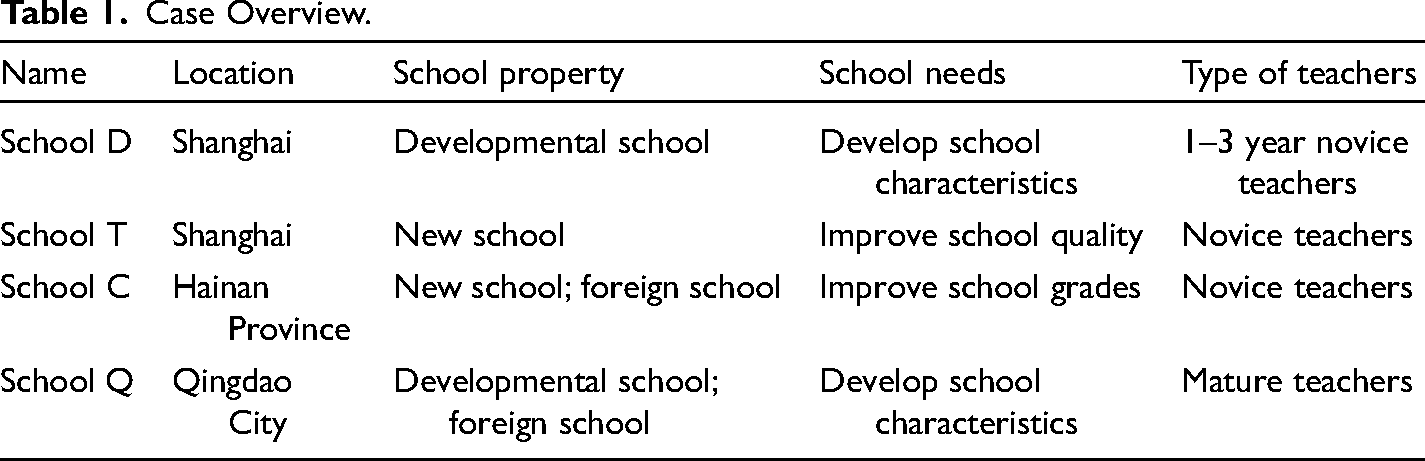
Member school D, located in Shanghai, is an ordinary developing member school. It hopes to continue to develop its own teaching characteristics. The school features “financial education,” and its teachers are new developmental teachers with 1 to 3 years of teaching experience.
The member school T is located in Shanghai and is a newly established school (it has been running for less than two years). The teachers of the school are eager to participate in the activities. Some teachers are from the group school and some are new teachers.
The member school C is located in Hainan, a foreign school (which means that it is not in the same administrative region as the core school H), and it is also a newly established school. It is expected to quickly improve the school quality through the support of the group. Most of the teachers in the school are novice teachers who have just graduated.
The member school Q is located in Qingdao and belongs to an out-of-town school. The school expects to continue to develop its own characteristics. The school features “smart classroom,” the principal is dispatched by the group school, and the teachers are mostly mature teachers.
The research adopted the same data collection method for the four cases, and collected more in-depth information through participation in the whole process of tracking and observation of the activity, as well as open conversations with teachers during the activity. From the beginning of 2020 to the end of 2021, the researcher participated in observing all activities in the four cases, including discussion activities during the preparation of the activities and public display activities. Through multiple activity observation and participation, the repeated action organization pattern of group schools was determined. School information, local education conditions and teacher generative materials (including revised instructional designs, open class teaching cases, PowerPoint presentations and teacher reflections) were available online or face-to-face. At the same time, the researcher observed the eight open classes provided in the four cases and participated in the after-class discussion. Therefore, the researcher investigated the organizational form and effectiveness of the integration mode of moral education in group schools.
During the whole process of data collection and analysis, all participants were informed of the purpose of the study and participated voluntarily. The anonymity of the participants’ information and the information they provide was guaranteed.
Teaching and Research Platform: The Main Way of Moral Education Integration
By collecting news, documents and other information from the official website and Wechat official account of H Education Group, the research found that the most representative integration way of H Education Group is the teaching and research cooperation platform—“H School Basic Education discipline teaching and research Alliance.” H Education Group was founded in 2017, based on the expansion of affiliated school, provincial difference, the imbalance of the development between new and old schools of the actual situation, in continuous operation, expert advisory guidance and discipline characteristic project support, on the basis of this, cooperative, professional for the affiliated school research platform was established. At the beginning of its establishment in 2018, the platform included subject experts from universities in nine disciplines, practice mentors such as front-line special teachers and teaching and research staff, as well as teachers of various disciplines from more than 40 affiliated schools across China. In 2020, with the development of the group school, the platform was expanded to 13 disciplines and 19 teaching and research groups, and the teaching and research groups of each discipline began to match the most appropriate practice experts according to the needs of different topics and the specific needs of affiliated schools. The daily activities of the TRP are undertaken by the expert organizations of various disciplines of H University. The expert committee and secretariat are set up to manage, summarize, and reflect on the activities. The summary exchange meeting of the teaching and research alliance of the discipline is held at the end of each year.
Since its establishment, the platform has carried out 154 activities, and the frequency of activities has been increasing year by year since 2019, including 105 offline and hybrid activities and 49 online activities. Each discipline basically guarantees the frequency of four activities a year. The scope of the platform has expanded from Shanghai to many provinces and cities in China, from only 15 affiliated schools hosting activities in 2019 to 35 member schools hosting activities in 2021, and the number of activities outside Shanghai exceeds that of member schools in Shanghai. Subject experts within the group have given key support to the newly established schools within 2 years, the member schools with the development needs of subject characteristics, and the external affiliated schools with the needs of middle school and college entrance examination. The active participation of nonlocal schools shows their recognition of the platform. By inviting local teaching and research staff and local schools for exchange and discussion, it not only promotes the radiation of high-quality educational resources, but also activates local resources, so as to create a good educational ecological environment.
Since the establishment of the platform of discipline alliance, remarkable results have been achieved. Within the group, the teaching quality of the newly established school has been greatly improved, becoming the forefront of local schools, and the gap between member schools has been narrowed but not homogenized. In terms of region, with the large-scale development of discipline alliance, nearly 100 affiliated schools and local schools in nine provinces and cities have participated in the activities. While integrating the discipline resources of colleges and universities, they have also combined with local teaching and research forces, which has enhanced the driving ability of affiliated schools to the development of regional basic education. In terms of teacher training, after 2 to 3 years of various activities and exercises, subject teachers in the affiliated school have significantly improved their abilities and achieved excellent results in various competitions and projects. In terms of resource flow, excellent principals and famous teachers in the group infiltrate into different member schools for management, which promotes the integration of ideas and culture with the group. At the same time, a teaching and research community has been formed between the university and its affiliated schools. On the one hand, on the basis of strengthening teaching guidance, the university promotes the formation of a self-circulation system of teachers’ scientific research ability and teaching quality in the affiliated schools. On the other hand, the affiliated school provides a large number of real and vivid lesson examples and practical cases for university experts, and even serves as the practice base for undergraduate and postgraduate courses, which in turn promotes the in-depth research of basic education in universities and the transformation of research results.
Teaching and Research Platform: Cooperation and Interaction Under the Mode of Group Teaching and Research Community
As the main way of integration of H Education Group, the TRP is also the main carrier of the integration of moral education. Through this platform, universities, member schools, local schools, and local teaching and research offices have formed a triangle-three-dimensional cycle integration mode. University experts, teachers from member schools and local teaching and research officers (TROs) have also formed a relatively stable professional learning community for teachers, as shown in Figure 1. This pattern will be analyzed in detail with a typical case.
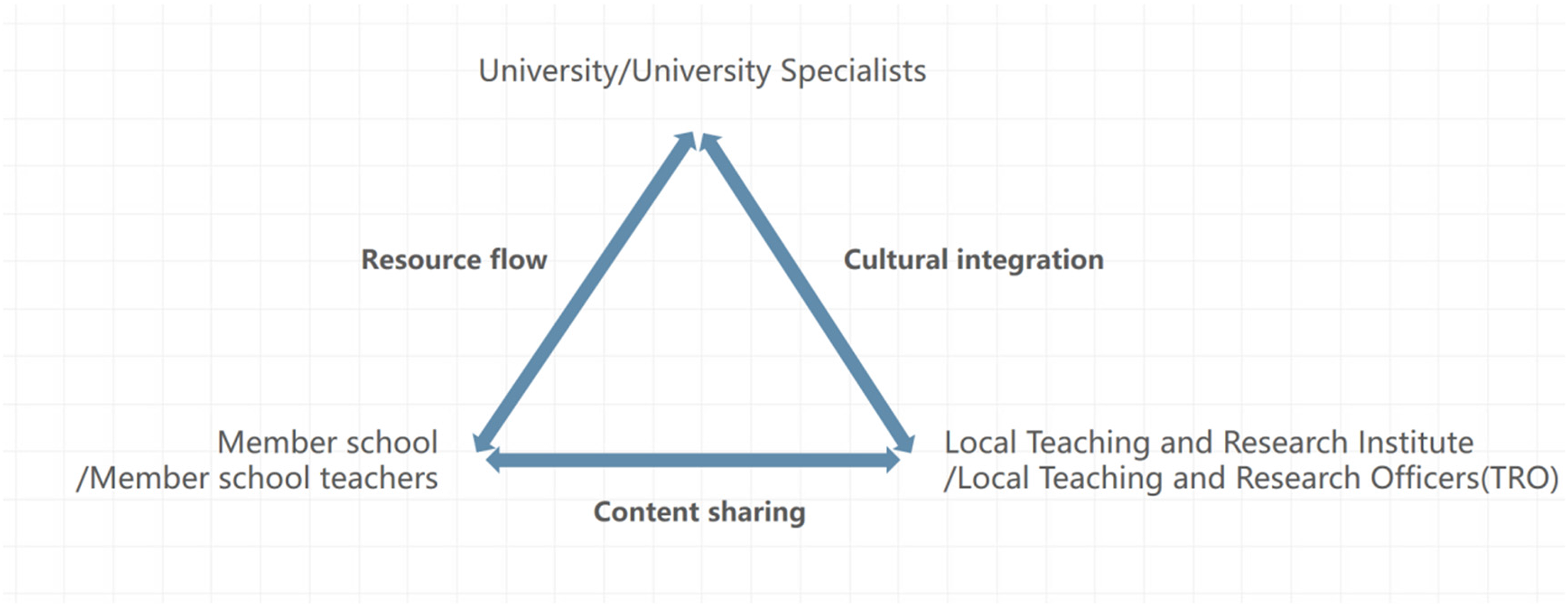
Interaction mode of the three main bodies.
Before starting the analysis, it is necessary to explain the character of local teaching and research staff, which involves the traditional three-level teaching and research model in China. China's teaching and research system matches the educational administration system. At the beginning of the founding of New China, in order to ensure the quality and standard of teaching in primary and secondary schools, teaching and research institutions were established under the educational administration at the provincial, municipal and district levels, and the guidance and management of teaching was entrusted to these teaching and research institutions (Cong, 2011). Since then, educational research institutions have been exercising the function of guiding the operation of primary and secondary education (Huang, 2011). In the 21st century, with the curriculum reform of basic education, the three-level teaching and research institutions are also facing the requirements of transformation and development, and a variety of new forms, such as school-based teaching and research, regional teaching and research, network teaching and research, have emerged (Wang & Hu, 2019). In the new curriculum system, the teaching and research institutions assume the key role of connecting the previous and the next: on the one hand, the teaching and research institutions accept the commission of the local education director to promote the local curriculum reform. On the other hand, teaching and research institutions should provide guidance and support for schools to implement national and local curriculum policies, such as providing schools with resources needed for curriculum reform, carrying out teacher training, and guiding schools to carry out teaching activities in accordance with new concepts (Cui, 2009). There is also a tradition of teacher professional learning community in China, in the form of teaching and research groups in schools. The teaching and research team of the school promotes the teaching quality of teachers by carrying out a variety of learning activities such as collective discussion activities and open classes, which is also the basic link of China's multilevel teaching and research system. Among them, the teaching and research staff are generally selected from the front-line teachers with excellent performance in subject teaching.
As a normal and large-scale interaction and collaboration mode within the group, the TRP mainly goes through three steps: (1) Theme determination—the three main subjects in this stage may be involved, the theme will be either decided by the university's own development needs, or stipulated by local teaching and research offices according to the latest requirements, or provided by universities according to current affairs and research trends. (2) Activity preparation—in this stage, the front-line teachers of the university become the main body of the activity. The front-line teachers design teaching cases according to the theme, discuss with university experts or local TRO, and repeatedly modify the teaching cases and try teaching. (3) Activity display—after the public class display by teachers, the practice tutor, university experts and local TRO will make comments and give suggestions for revision. In addition, there will be expert lectures or special reports in line with the theme.
Therefore, in the TRP activities of H Education Group, it is not difficult to find the triangular cooperative and interactive relationship between university experts, front-line teachers and local teaching and research officers. For example, the theme teaching and research activity “Integrating unit resources and Focusing on subject elements to Implement Core literacy” held in member school D was stipulated by the local teaching and research institution (namely the district-level teaching and Research office) according to the hot teaching topics at that time, and the teachers in ideological and political group of school D carried out teaching design according to this theme and school characteristics. In the process of design, the front-line teachers not only participated in the school's collective teaching and research, but also discussed and modified with the local TRO. On the basis of the former two, university experts were invited to visit D school to observe the trial teaching activities. After the trial teaching, university experts and local TRO gave modification suggestions again, and teachers determined the final version of teaching design according to the opinions. Then, on the day of the activity, teachers gave a teaching demonstration, experts, practice mentors, and TRO made comments according to the on-site situation. The practice mentors did not participate in the previous session, so they could give real and targeted suggestions without the influence of pre-test effect. Finally, the local TRO made a special report titled “Focusing on the Core literacy of Disciplines to Improve the quality of classroom teaching—Grasping and handling the teaching content of textbooks,” sharing the problems of current classroom teaching, cause analysis and how to improve the teaching quality and realize teaching transformation for front-line teachers.
In the process of this activity, the interaction of the three main bodies naturally forms a stable triangle: there is content sharing between member schools and local teaching and research offices. Teaching and research institutions smoothly transmit new ideas and requirements to schools while performing their functions of guiding teaching business, and school teachers carry out activities according to the new requirements. Resource flow between member schools and universities: the solid teaching theoretical basis of university experts can provide good guidance for front-line teachers, urge them to internalize the corresponding theoretical knowledge in the process of preparing activities, so as to improve the teaching ability of front-line teachers. At the same time, university experts can also collect real cases through activities, understand the real situation of front-line practice, and provide a practical basis for the in-depth and promotion of research. University experts and local TROs can promote cultural integration. University experts should comprehensively consider the overall situation of the local, and local TROs can reflect the local uniqueness in their activities.
There are three elements that come out of the interaction: content, resources, and culture. On the basis of the interaction of the three main bodies, the three elements also need and can realize the interaction: in the interaction between content and culture, member schools should expand their own characteristics on the basis of common ideas, or combine with local cultural background; when resources interact with culture, university experts should consider the local culture or the school's own characteristics when giving guidance, and put forward targeted and tailored opinions. In the interaction between content and resources, member schools can radiate the discipline resources of the group universities to the local regions through school-based content to realize the driving effect on the development of regional basic education, as shown in Figure 2.
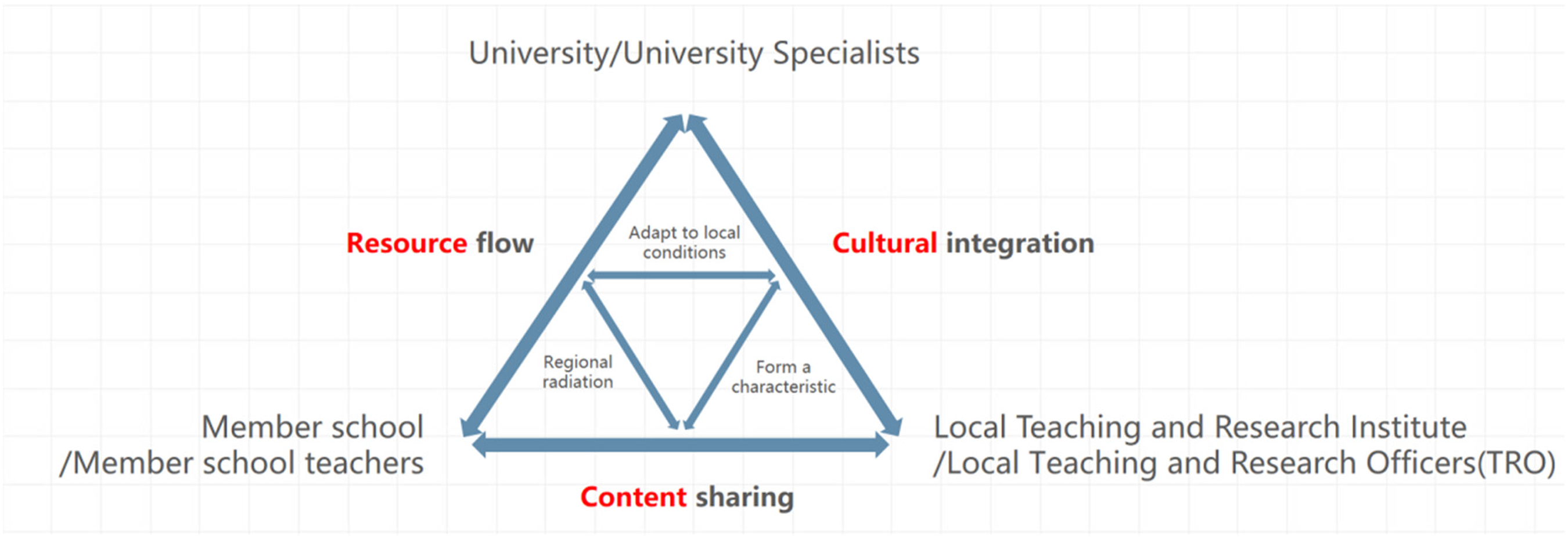
Interactive model of moral education integration.
Discussion and Analysis
Teacher professional learning community is a shared leadership model based on collaboration, in which the source of leadership is extended to the teaching and research group leader, director, experts, mentors, and other personnel. Through the cooperation between community subjects, mutual learning is realized in an organized form, which promotes the professional learning of teachers and the development of the school. In H Education Group, the cooperation mode of Group Teaching and Research Community is formed through the TRP.
In this triangulated integration mode, the attributes of member schools will have an active impact on cooperation and interaction, and the interaction effect will change accordingly. For example, if a member school is a nonlocal school, the flow of resources will be limited by regional space, and cultural integration will be more important. The suggestions provided by university experts must be in line with the local education situation, and should not go beyond or lag behind. If the member school is newly established, content sharing with the local teaching and research office will be dominant. Because China is still in the exam-oriented education background, the new school priority is usually how to improve the quality of school education and school teachers, pay more attention to the teaching of the entrance examination for secondary school or college related topics, so local research institutions to provide a bigger help for the new school, at the same time, demand for resources flow is relatively obvious, need to provide a certain support group on the teachers’ training school. However, when the nonlocal attributes co-exist with the newly built attributes, the impact of the new attributes is more obvious, that is, the demand for content comes first. In these two cases, front-line teachers may be in a vulnerable position in the interaction. Teachers will become timid because of inappropriate psychological positioning, and dare not put forward opinions or accept them completely. At the same time, the development of schools is easy to become limited or homogenized, focusing on improving the school level and ignoring the creation of their own characteristics, which will affect the effect of the integration of group schools. And when the members of the school is a high-quality school, members of the proofreading of the university and local radiation effect will be greatly enhanced, for local colleges and universities and provide an excellent vivid practice case, but at the same time, school teachers in the flows of resources will certain negative influence on group school integration, it is also because inappropriate psychological orientation of superiority or more concerns.
At the same time, this integration mode is mainly applicable to the group schools under the U-S model, while for the group schools under the S-S model, the universities in the main body will no longer be applicable, but may become three main bodies: famous schools, ordinary schools, and local schools. However, since the case of this study comes from the education group under the U-S model, there is no in-depth study on the S-S model of group schools, and a comparative case study between the U-S and the S-S models can be carried out later.
Conclusion
Taking four cases in a group school as examples, this study discusses how to realize the integration of moral education in U-S model group school. Although these four cases all follow similar integration patterns, there are still subtle differences in integration patterns among member schools with different attributes, which can be attributed to different concepts and needs caused by different attributes.
This study adds to the existing literature by proposing a triangulated model of integration, through which we can understand the process of moral education integration in U-S model group schools. By combining the teaching and research community model of the group, this article dynamically analyzes the interaction between different member schools and the group schools, and explains that the main reasons for the influence are the inappropriate psychological positioning of teachers and the limitations of school needs.
The integration model proposed in this study has three important implications for the integration of Chinese group schools: first, the group school itself has the integration demand, which coincides with the path of the integration of moral education. The group school needs to establish a smooth mechanism and platform to guarantee the cooperation and interaction between the school and the school, and between the school and the region. Such mechanism can be an effective management mechanism or TRP. Second, the integration of moral education in group schools has three main elements, namely content, culture, and resources, which can realize a virtuous circle through the TRP. The mechanism or platform established by the group school must ensure the smooth interaction of these three elements, so as to achieve integration and promote the effectiveness of school moral education. Third, while the group schools are integrated, they should realize “commonality to individuality” and “sharing to co-creation,” maintain the diversity and uniqueness of the group, and promote the relationship between member schools, famous schools, and universities from “helping and being helped” to “co-building,” so as to realize collaborative evolution.
Footnotes
Declaration of Conflicting Interests
The authors declared no potential conflicts of interest with respect to the research, authorship, and/or publication of this article.
Funding
The authors received no financial support for the research, authorship, and/or publication of this article.
