







Abstract
Humanism is a perspective which centers upon human interests and values. It asks learners what they want to be and how they want to be. Recently there have been dominant traditional and technological perspectives to education and this situation causes some problems because these perspectives service to society's expectations, not learners’ expectations. Humanistic curriculum might be a kind of antidote for technological and traditional perspectives. These perspectives mostly focus on cognitive development while humanistic perspective focuses on affective development. The aim of this study is to evaluate humanistic perspective and curriculum within the “Accepted” movie because the students are asked what they want to learn and how they want to learn in the movie. The methodology of this research is a case study within qualitative approach. The data are collected by discourse analysis. At the end of the study, three themes are defined in the movie: Materialistic expectations and disappointments; humanistic curriculum development; traditional curriculum vs humanistic curriculum. There is no pure humanistic curriculum so far therefore it is not known yet the outputs of it in the real world. New educational programmes based on humanistic curriculum might be developed and applied. There might be new studies to combine traditional curriculum and humanistic curriculum.
Keywords
Introduction
Introduce the Problem
Someone knocked on my office door while working as a research assistant at the School of Science of the university in 2009. He looked like a student; however, I knew that he was not one of our students at the department. He was a bit shy and hesitated to come into the office. He had a seat and started to tell his story: He was a polytechnic student and had found my name on the university's website. He planned to sit for another university exam for the next year and wanted to have a ‘bachelor’ degree related to biology or biology education. He especially wanted to learn course details of the biology education curriculum. The interesting side of the story was his parents’ approach. He said that he had to sit for another university exam because his parents had bachelor's degrees and they were embarrassed of their son's polytechnic education. The parents had a four-year education although their son had just a two-year education. They forced him to have a bachelor's degree. He was quite upset when he told his story. I explained him the course details of the department and encouraged him not to feel like an ‘idiot’ just because being a polytechnic student. Ialso asked him what he wanted to do in this life, and he was not very sure because his parents’ pressure was quite high.
When he left my office, I felt myself very miserable because I could not help him properly. I could understand him very well because I experienced the similar feelings and pressure in my life. Nobody in my life asked me what I wanted to be or to do. Everybody wanted me to study, to pass the exams with the highest score, to be better than others and to earn money. This is my story however it is not new to see this kind of emotional and intellectual pressure in human life. Graubard (1972) and Holt (2005) warn educators/politicians about how coercion and regimentation inhibit emotional and intellectual developments. This inhibition is done by the large classes, the teacher who has absolute power to administer a state-directed curriculum to rigidly defined age groups, the emphasis on discipline and obedience, the constant invidious evaluation and the motivation by competition, the ability tracking (Graubard, 1972; Holt, 2005). I had the same issues during my education life. Now I am a researcher, hold a PhD degree and have been working for 18 years but I am not happy because this is not the life I wanted to live. Probably most of the people in Turkey have similar feelings and experiences.
There is a national university entrance exam which has multiple choices in Turkey and students go to a university or polytechnic according to their correct answers. If you have more correct answers, you can have a four-year faculty education. If you have less correct answers, you can have a two-year polytechnic education. People -especially parents- underestimate polytechnic education because it is thought that faculty students are more “intelligent” than polytechnic students. However, this perspective is quite wrong because there is no guarantee that if you have a bachelor's degree you can set up your life easily or earn more money. For example, there are many people who work in information technology sector but most of them are self-taught rather than having a university education (Okur-Berberoglu, 2022b).
I had an educational programme development course within my PhD education. The humanistic perspective was quite interesting for me because it addressed my feeling and experiences that I explained above. I had some questions in my mind since then: Was it possible to design a humanistic curriculum? Could someone have asked me what I wanted? How might my personality and dreams have been if I had humanistic education? Could I have discovered all my talents or abilities? How could it have been to collaborate rather than compete? When I had these questions in my mind, I watched a movie on TV. Its name was “Accepted”, and I felt that I was not alone because this movie was based on a humanistic curriculum. The aim of this study, therefore, is to evaluate humanistic perspective and curriculum within the “Accepted” movie.
Literature Review
According to the humanistic perspective, human is not a simple product that becomes from genes. The interaction of human with inner and outer world is very complicated. Human is very interrogative for himself; tries to interpret own feeling and emotion and learn who we are. Spontaneity, self-determination, self-actualization, self- direction, becoming independent and responsible are very important. Human reacts with himself, others and his environment at the same time and tries to understand himself, others, and his environment by some activities such as yoga, psychotherapy, and self- analysis. In this way human may develop empathy. (Okur-Berberoglu, 2022b; Pooladgar & Bazmi, 2021; Ringness, 1975; Singh et al., 2020). Humanism is a perspective which centers upon human interests and values and its theoretical roots come from Maslow, Rogers, Perls, Berne, Rousseau (Pratt, 1987; Smilie, 2012) therefore humanistic curriculum provides a way of life centered upon them and asks learners what they want to be and how they want to be. (Goodlad, 1967).
Humanistic curriculum is also student-centered and focuses on affective domains such as values, attitudes, inner feeling (Chen, 2021; Kruger, 1973). In terms of education, there are a variety of individual outputs because of individual differences, backgrounds, and experiences. (Mielkov et al., 2021; Okur-Berberoglu, 2022b; Ringness, 1975) American education system has been criticized in terms of having these individual outputs since 1970s (Esler & Armstrong, 1973; Holt, 2005; Kruger, 1973; Pratt, 1987; Smilie, 2012; Walter, 2009). I, as a researcher, especially consider American literature because the movie is an American production and critizise the American education system.
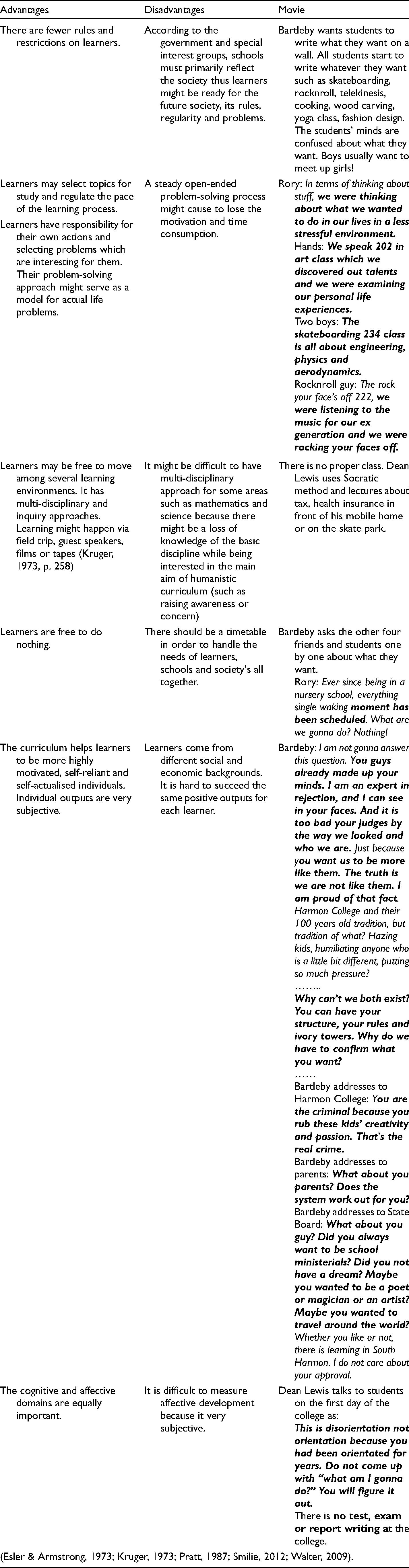
There are dominant traditional and technological perspectives to education in American society and some problems at American education system such as understanding self, the lack of emphatic sense of others or specialization without integration. Humanistic curriculum might be a kind of antidote for technological and traditional perspectives. These perspectives mostly focus on cognitive development while humanistic perspective focuses on affective development. Both sides have own advantages and disadvantages (Esler & Armstrong, 1973; Kruger, 1973; Pratt, 1987; Smilie, 2012; Walter, 2009) (Appendix 1).
Martin and Briggs (1986; in Bichelmeyer et al., 2009) and Jung (2009) characterize the affective domain as a huge area inclusive of ego, motivation, concern, attitude, value, self-respect, ethics, self-control, curiosity, creativity, mental health, dependence, individual development, group dynamics and dreams. Ozcelik (2010) expresses that it takes a long time to determine development of all these concepts in the affective domain. It is still not known how to achieve aims of the affective domain because we do not exactly know the features and development of the affective domain in terms of educational program development (Reis & Roth, 2009; Ringness, 1975). There are two theoretical studies which can be evaluated in terms of the affective domain: “The Humanistic Program” (McNeil, 1996) and “Enhancement of Affective Outputs” which is an emotional intelligence perspective on affective learning (Bichelmeyer et al., 2009). The cognitive and affective domains can be seen as two different areas but the famous neurologist Antonio Damasio (1994, in Bichelmeyer et al., 2009) who studies patients with brain damage says that emotion is essential for logical thinking. Learning can be succeeded development of both areas (Ringness, 1975). If people have various features in affective domain (Crompton & Sellar, 1981; Martin & Briggs, 1986; in Bichelmeyer et al., 2009; Ringness, 1975), then various and rich learning environments should be designed in order to develop them.
Education-either cognitive or affective —should be holistic and each discipline should be integrated to each other (Okur-Berberoglu, 2022a; 2022b). A strong self-concept grows when individual determines what and how of teaching should be (Barnet, 1978; Smilie, 2012). Unfortunately, money is a huge pressure on education and side-effects of this financial pressure on education have been discussed for the last nine decades (Freire, 2005; Holt, 2005; Horkheimer & Adorno, 2002; Illich, 1971; Izetbegovich, 1984; Macfarlane, 2002; MacCulloch, 2009; Marcuse, 1964). Curriculum decision has been made by taxpayers or budget controllers and rich people who have better education. Curriculum has excessive bureaucratization, rigidity, and traditional value orientation (Rubin, 1974). Rubin (1974) asks which educational perspective is better for learners, traditional structure, or humanistic unstructuredness. Esler and Armstrong (1973) suggest that the best way might be a combination of traditional structure and humanistic unstructuredness.
As can be seen above, there are many theoretical papers related to humanistic curriculum however experimental studies are very limited according to the literature. The literature is mostly based on curriculum evaluation. Aikenhead (2003) evaluates Canada's science curriculum in terms of humanistic philosophy. Scanlon (2006) discusses how humanistic philosophy and curriculum might be used in psychiatric nurse education in her article and she suggests using eclectic approach while developing nursing education programme. It has not been seen yet a curriculum which is based on pure humanistic perspective and philosophy however there is a movie, “Accepted.”
“Accepted” Movie (2006)
“Accepted” is an American comedy movie which was directed by Steve Pink in 2006. It is about a story of Bartleby Gaines and his friends (Sherman, Hands, Rory, and Glen) who are fresh graduate high school students and were rejected from any college they have applied. Therefore, he and his friends decide to create a fake college in an abandoned psychiatric hospital; South Harmon Institute of Technology (SHIT). However, many students who had been rejected from every other university have already paid the tuition to enter the college because of the fake website of the college was open to public (Bostick et al., 2006).
I first watched this movie on TV by a chance in 2011. I had a course related to humanistic programme development in 2010 and thought that this movie was very coherent with the humanistic philosophy. I was writing my thesis and ignored the movie and its philosophical roots. When I decided to write a paper related to this movie, I realized that it was popular between researchers.
According to the literature, Puspita (2017) analyzes the movie in terms of humor reflection while Meriem (2016) evaluates the movie in terms of the development of critical thinking skills of tertiary students. Readman (2016) assesses the movie in terms of radical pedagogy and criticism of higher education. Rullyanti and Devita (2017) analyze the swearwords in the movie by the speech act theory. Carter (2017) compares the traditional and progressive education programmes within the movie and suggestes the other researchers analyse the movie from different educational perspectives. In response to Carter's suggestion, I evaluate the movie in terms of humanistic perspective.
Method
The methodology of this research is a case study within qualitative approach. The data are collected by discourse analysis. Researcher plays an important role as the research designer, data collector, analyst, data interpreter, and reporter of the research finding in qualitative research. Researchers also try to be subjective as much as possible. There is no conflict of interest within this study. However, it should not be forgotten that I, as a researcher, had the similar negative experiences in my life therefore my personal background might affect the data evaluation (Atkins & Duckworth, 2019; Atkins & Wallace, 2012; Lichtman, 2013).
Case Study
Case study is a very popular method in educational research because it provides to explore a variety of contexts and situations within a research question or theory. Case study also helps investigate connections, patterns, and reflecting bigger picture on the detail of small-scale research. This small-scale research might be conducted with an individual, a couple of people as well as institutions such as schools, universities. Researchers, therefore, should be careful while evaluating data and not make generalized claims based on a specific case because case study gives researchers rich information about the case, not generalized claims. (Atkins & Wallace, 2012; Lichtman, 2013) “Accepted” movie is, therefore, analyzed as a case study and evaluated how the scenario is coherent with the humanistic philosophy.
Discourse Analysis
Discourse analysis is a technique to analyze of text content in terms of syntax and semantics (Lichtman, 2013) and helps understand what a text or a word means in a context within small-scale research. Sometimes people are advised to include certain words in their expressions and these words dislocate the meaning from context or their original sense. These kinds of words might be used in politics documents, video, or media/ advertisement texts. (Atkins & Wallace, 2012; Lichtman, 2013) Discourse analysis is also related to literacy. Adults/children might be literate or illiterate, but the evaluation of the words or visuals might change according to social norms, values, beliefs, and behaviors (Atkins & Duckworth, 2019; Potter, 2005).
Data Collection and Analysis
Firstly, I read the literature reviews about humanistic curriculum and made a table for the main point of humanistic curriculum. There were two rows on the table. One side was for the literature while the other side presented the movie sentences (Appendix 1).
Secondly, I watched and transcribed the script. I also thought my personal background and what annoyed me while being in the mainstream education. I made bold some lines in which I believed they reflected the humanistic philosophy and defined the themes (Appendix 1).
Thirdly, two academicians independently checked my table in order to have reliable and coherent data analysis (Creswell, 2005). One of them has PhD degree in media studies, the other has PhD degree in education. They agreed on my themes.
Results and Discussion
There are three themes in the movie: Materialistic expectations and disappointments; humanistic curriculum development; traditional curriculum vs humanistic curriculum.
Materialistic Expectations and Disappointments
The first half an hour of the movie is based on materialistic expectations of the society and people's disappointments. Bartleby's dad, Dean Lewis of SHIT and a student with ADD (attention deficit disorder) explain very well society's expectations.
Dad says on the the 6th second: “Society has rules. In the first rule is you are gonna go to college. If you have a successful life you go to college. If you want to be somebody you go to college. If you want to fit in you go to college.”
Dean Lewis is Sherman's uncle who pretends to be the dean of SHIT. When he was young, he also used to be an academician in Harmon College. Uncle Lewis resigned from the college after for a while because of not liking its education style. He starts to work at the food court of a mall. Dean Lewis explains SHIT's philosophy as “A lot of people say that college is the time when young man and women expand the way they look at the world. When they open their minds to new ideas and experiences, and they begin that long journey from the innocence of youth to responsibilities of the adulthood. ……..
We throw a lot of fancy words in front of these kids in order to attract them going to school in the believe that they are gonna have the better life.
And we all know that all we are doing is breeding a whole new generation buyers and sellers.
……..
There is only one reason the kids wanna go to school which is to get a good job with a good starting salary.”
After 27th second of the movie, lots of kids, who had not been accepted by any college, start to come to the South Harmon. They find the college from its fake website. For example, a boy with ADD says his mom used to cry because she thinks he would never be a fully functioned society member. These kids look like excluded from the society. The same student says on the 35th second “When I got accepted here was the first time my parents were proud of me.” (All students applauded him.)
Goodlad (1967, p.91–92) refers to the same expectations in his paper. He emphasizes that parents expect formal education to help children go to the most prestigious colleges. The formal education should present easier access to money and power. People cannot choose/ find any interest without coercion therefore society decides what should be done to be happy and successful.
Humanistic Curriculum Development
Bartleby has empathy and the same experiences with the ADD boy. He says on the 36th second: “I know how it is like to be rejected. They say you are not good enough; you did not enough play tennis, study hard enough for your score, you are not gonna make it.” Bartleby starts to show leadership skills and tries to understand how a curriculum should be. He goes to the principal office of the Harmon College. The lady at the office says, “We offer highly structured time-tested curriculum, carefully designed to stimulate young mind.”
Bartleby sneaks into a classroom. Everywhere seems like very extravagant and boring. The students either fall asleep because of being bored in the class or are extremely nervous because of the exams. Bartleby runs into his sweetheart from high school in the garden. She says that she is interested in photography, but she has been told that she has not met the requirements.
Bartleby has a conversation with Dean Lewis on the 44th second: Dean Lewis: American education is in the shredded. People forget the most important rule, College is a service industry. All these kids paid here for an experience.
Barnby: What kind of experience?
Dean Lewis: I don’t know. I am not mind reader.
Bartleby: Maybe I should just ask them.
Dean Lewis: Welcome to the conversation.
Bartleby asks the other four friends and students one by one about what they want. Rory: Ever since being in a nursery school, every single waking moment has been scheduled. What are we gonna do? Nothing!
Bartleby wants them to write what they want on a wall. All students start to write whatever they want such as skateboarding, rocknroll, telekinesis, cooking, wood carving, yoga class, fashion design.
There is no proper class. For example, Dean Lewis uses Socratic method and lectures about tax, health insurance in front of his motor home or on the skate park. There are not tests, exams or report writing at the college.
The Harmon College boys are also very mean to Sherman who has been Bartleby's friend since kindergarten. He is so upset because he wants to be accepted by the other boys but there is a clique there (the 51st second).
Rubin (1974) says that good education is constrained by a set curriculum, preplanned lessons, and discretionary standards. Bassett (1972) emphasizes that school should be appetizing, satisfying, and happy making, a congenial place rather than being grim, joyless, and unrewarding place. We should accept students as a present human being not a future citizen or an output. There should be a wide variety of learning situations without imposed goals and requirements. We should help learners be themselves (Bassett, 1972; Rubin, 1974).
Traditional Curriculum vs Humanistic Curriculum
The comparison of traditional and humanistic curriculums starts after the 66th second. Dean Richard Van Horne of Harmon College exposes that “SHIT is not accredited and nor an educational institution” to parents. All parents are upset because they understand that SHIT is a fake college.
Sherman applies to Ohio State Board for the accreditation. Rory sends an invitation to all SHIT students and parents. Sherman sits with his friends even though he is a formal student at Harmon College.
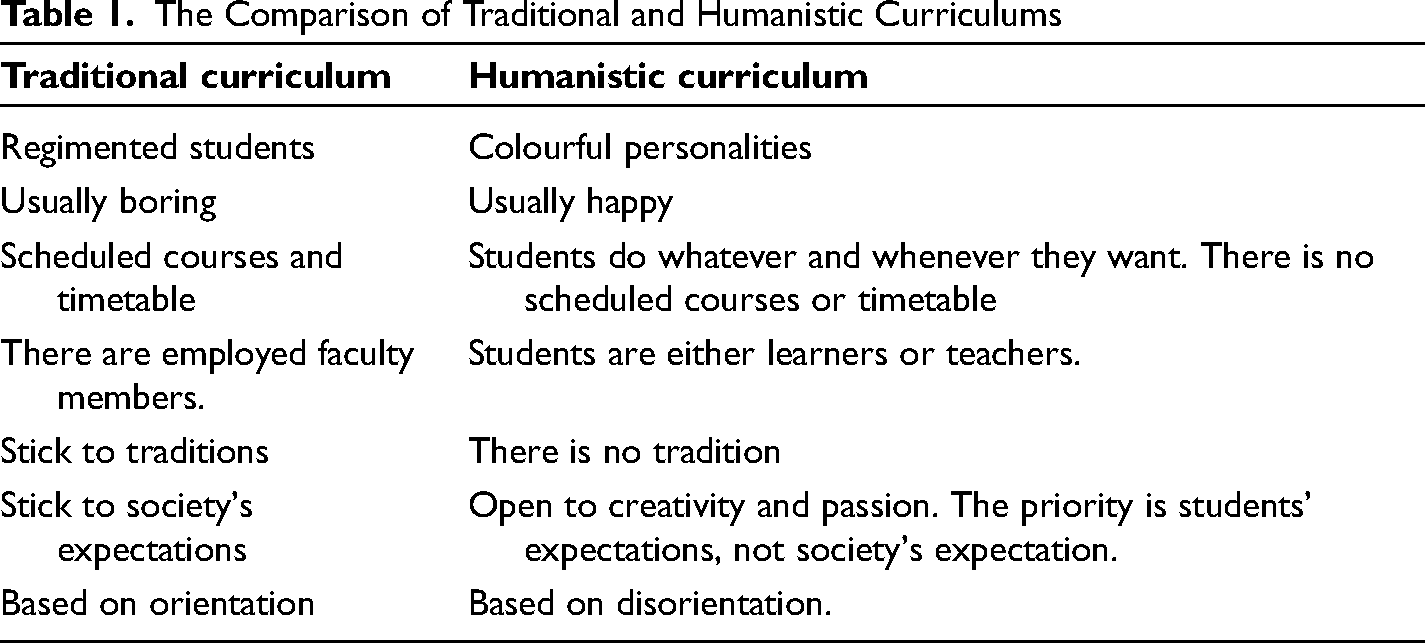
The SHIT side of the court is very colourful, full of casually dressed people. The Harmon College side of the court is full of regimented people. Ohio State Board Educational Meeting and Bartleby's plead start after the 77th second.
Board Chairman: In order to become accredited a school must need three requirements: You must have
- A facility, - A curriculum, - A faculty. Please state your case. A facility: SHIT does not have a formal athletic facility, library, or health center.
A curriculum: Coursebook, comprehensive list your available classes etc.
Kids brings the board to show their curriculum and it has been written “What do you want to learn?” on the wall.
Board Chairman: I fail to see any merit or scholastic value in anything listed on that board.
Rory: In terms of thinking about stuff, we were thinking about what we wanted to do in our lives in a less stressful environment.
Hands: We speak in 202 Art Class which we discovered out talents and we were examining our personal life experiences.
Two boys: The 234 Skateboarding class is all about engineering, physics, and aerodynamics.
Rocknroll guy: The rock your face's off 222, we were listening to the music for our ex generation and we were rocking your faces off.
Chairman: Do you have a faculty?
Bartleby: Yes sir.
Glan: Faculty stand! (All SHIT students stand up)
Chairman: What is this?
Bartleby: These are our students and teachers. They try to show that the students are also a faculty at SHIT.
….
Chairman: Have you employed a faculty or not for 300 students?
Bartleby: I am not gonna answer this question. You guys already made up your minds. I am an expert in rejection, and I can see in your faces. And it is too bad your judges by the way we looked and who we are. Just because you want us to be more like them. The truth is we are not like them. I am proud of that fact.
Harmon College and their 100 years old tradition, but tradition of what? Hazing kids, humiliating anyone who is a little bit different, putting so much pressure?
……..
Why can’t we both exist? You can have your structure, your rules, and ivory towers. Why do we have to confirm what you want?
……
Bartleby addresses Harmon College: You are the criminal because you rub these kids’ creativity and passion. That's the real crime.
Bartleby addresses parents: What about you parents? Does the system work out for you?
Bartleby addresses to State Board: What about you guy? Did you always want to be school ministerials? Did you not have a dream? Maybe you wanted to be a poet or magician or an artist? Maybe you wanted to travel around the world? Whether you like or not, there is learning in South Harmon. I do not care about your approval.
Chairman: Your methodology is questionable at best. However, the true purpose of education is to stimulate the creativity and the passions of the student body. In that regard you have certainly succeeded. This board does not reject innovation, but it must be watched carefully therefore SHIT will be granted one-year probationary period in which to continue its experimental programmes. You will be so quickly judge us by the way we looked.
……
Chairman: Mr. Barns I wanted to play jazz trombone!
Bartleby and his friends start to set up a new college according to the education policy after the 87th second. Dean Lewis is a lecturer there, too and talks to students on the first day of the college:
This is disorientation not orientation because you had been orientated for years. Do not come up with “what am I gonna do?” You will figure it out.
The Comparison of Traditional and Humanistic Curriculums
Discussion
Materialistic Expectations and Disappointments
There are many expectations of the society, and we must accept these norms if we want to live happily ever after. The expectations are obvious: If people want to have a successful, better and happy life, a good job with good salary and to be a fully functioned society member, they must go to a college (Goodlad, 1967). Otherwise there will be disappointments as can be seen at the ADD student's example or my student's experiences (the introduction). If the students can go to a faculty or a collage their parents will be proud of them.
The reality is that the society does not trust people to choose any interest without coercion therefore the society sets up its own rules to have money and power (Goodlad, 1967). However I am not quite sure whether the traditional education gives society's expectations or not. Dean Lewis sums up this situation as “what we are doing is breeding a whole new generation buyers and sellers.” Buying and selling is related to money, power, and capitalist philosophy.
Capitalism gives us technology, comfortable life but it takes happiness from us because we, all, are one dimensional people now. Unfortunately, we all think according to Fordism and Taylorism philosophies and our minds process linear (Okur-Berberoglu, 2022b). The society has started to regiment people's mind since the industrial revolution and now we all look like each other even our thinking styles, dreams, life targets, skills and abilities (Graubard, 1967; Jung, 2009; Marcuse, 1964). We are more unhappy than past -like SHIT students- and have more psychological/mental problems. If we are unhappy, we buy more even we do not need. If we have psychological/mental problems, then again, we buy medicines or drugs to solve our problems and unhappiness as Dean Lewis summed up (Izetbegovich, 1984). Unfortunately politicians and educators concentrate on cognitive development of our minds, not affective development (Jung, 2009) because cognitive development is related to money. There are many teaching models to improve cognitive skills but there are only two models for affective development (Bichelmeyer et al., 2009; McNeil, 1996).
Affective domain is related to personal development, creativity, passion, our life satisfaction, and these developments might not bring money to the society (Bassett, 1972; Ringness, 1975). Whereas cognitive development is related to science, technology, society's development, and politics (Chen, 2021; Okur-Berberoglu, 2022b). Politicians want one dimensional human for economic development therefore educators develop teaching models to produce one dimensional human. We are not robots, but our minds work like a robot, and we service to unjust politics and economic systems. These systems are unjust because if you are rich, you have a better education, better jobs and salaries and more powerful careers or vice versa like SHIT students. I am on the other side of the system and could not get better education because of my financial status. Unfortunately, I name myself as an educated mummy because this capitalist system has embalmed my mind and body. I do not know how to rescue myself from these unjust systems that divide my mind as cognitive and affective (Freire, 2005; Holt, 2005; Horkheimer & Adorno, 2002; Illich, 1971; Izetbegovich, 1984; Macfarlane, 2002; Marcuse, 1964). We need cognitive and affective developments together for logical thinking according to Antonio Damasio (1994, in Bichelmeyer et al., 2009). Might humanistic curriculum have been a solution for this injustice social environment and helped cooperate cognitive and affective areas of our minds?
Humanistic Curriculum Development
“Accepted” movie is very remarkable in terms of asking students what they want which is the main issue of humanistic curriculum (Esler & Armstrong, 1973; Kruger, 1973; Pratt, 1987; Smilie, 2012; Walter, 2009). The reality is nobody asks us what we, learners, want from this life or education system. We must satisfy our parents, politicians, and society's needs. However, this is not democracy. One of the main points of democracy is to be able to live according to our wills, to have education whichever we want (Macfarlane, 2002; Plato, 2019). However, the pressures of politicians and religions on education have been quite high for centuries (Izetbegovich, 1984; MacCulloch, 2009; Macfarlane, 2002). It is possible to see some characteristics of humanistic curriculum in Ancient Greek (Plato, 2019). When the religion was institutionalized and the industrialization changed the economy, education has started to service to power, money, politics, and religion. Human effect on education has disappeared (Freire, 2005; Horkheimer & Adorno, 2002; Illich, 1971; Izetbegovich, 1984; MacCulloch, 2009; Macfarlane, 2002; Marcuse, 1964; Readman, 2016). Now it is a sign of status to belong to a college, to put their hat or jackets on like Harmon College students.
However, inner status is important as well in order to have strong self-concept, creativity, passion and actualize himself. Otherwise, people cannot have inner happiness. (Barnet, 1978; Bassett, 1972; Jung, 2009; Kruger, 1973; Singh et al., 2020; Smilie, 2012). We should allow learners to be themselves without seeing them an educational/economic output or a future citizen (Bassett, 1972). For example, Singh et al. (2020) study on medical education and they emphasize that traditional medical education causes psychological effect on students such as burnout, mental-health issues, and suicides. It is obvious that these medical students do not have inner happiness therefore Singh et al. (2020) suggest using humanistic perspective in the medical training. “Accepted” movie allows SHIT students to be themselves however we really do not know yet how a real humanistic curriculum works properly in the real world. According to the movie, the school environment is full of fun, but real world is quite different. I could not see yet an educational programme which based on 100% humanistic philosophy. Is it possible to apply a pure humanistic curriculum? This question should be studied, or the producers of the movie might create “Accepted 2” to show what has happened after the board meeting.
Traditional Curriculum vs Humanistic Curriculum
According to the literature humanistic curriculum and traditional curriculum have own advantages and disadvantages in terms of educational, financial, social, and personal outputs (App 1 & Table 1). We know many positive and negative sides of traditional curriculum because we live in this educational process, however, we should know which perspective is better for learners (Rubin, 1974). Learner's perspective and psychology have also become more important after the COVID lockdowns according to Mielkov et al. (2021). Mielkov et al. (2021) discuss that locdowns, online educations and sudden changes in the educational settings cause ambiguity and stress on students. They suggest that humanistic curriculum might be used to handle this stress and ambiguity. Pooladgar and Bazmi (2021) mention that traditional medical education cause lack of empathy on doctors therefore they are not able think of treatment processes in terms of patients. They suggest using humanistic perspective in order to change doctors’ perspective. Jung (2009) says that first we should understand ourselves and after that we are able to understand the others. It is hard to understand ourselves and essence. There is a gap between self and soul (Jung, 2009). I think this gap gets bigger and deeper due to the traditional and technological education. Researchers emphasize that education should be holistic, support cognitive and affective dimensions together (Barnet, 1978; Ringness, 1975; Smilie, 2012). Esler and Armstrong (1973) also suggest that the best way might be to combine traditional and humanistic curriculums. Bartleby also addresses the same point in the movie and wants humanistic and traditional curriculums to exist together.
Recently the concept of education has been changing because of the technological development. For example, online or multimedia education is very common recently (Mielkov et al., 2021). The new economic system also wants “soft learners” therefore people may be educated/trained according to system's needs during their professional lives (Mielkov et al., 2021; Meriem, 2016; Okur-Berberoglu, 2022b). This situation also refers to “lifelong learning.” If people hate classic learning environment how it is possible to integrate them to new/online learning environments. People should also be aware of their skills, talents and needs to have online learning. This awareness might be given by humanistic curriculum. If we think about to combine traditional and humanistic curriculums, we should also consider whether it is possible to combine online education and humanistic curriculum or not (Okur-Berberoglu, 2022b).
Conclusuion
Humanistic curriculum is an interesting subject for researchers and has been discussed at the theoretical level (Aikenhead, 2003; Scanlon, 2006). There are experimental studies related to affective development of learners in the literature (Okur, 2012; Okur-Berberoglu et al., 2013a, 2013b; Okur-Berberoglu, 2017, 2021, 2022a). However, there are not enough experimental studies related to pure humanistic curriculum therefore researchers and universities should start to focus on experimental studies. “Accepted” movie shows the starting point of experimental studies however we do not see the outputs of the curriculum. In the real life, it is possible to observe the long-term effects of educational programmes (Okur-Berberoglu, 2020; Ozcelik, 2010) therefore researchers should follow up learners periodically.
“Accepted” movie also refers to radical pedagogy (Readman, 2016) and progressivism (Carter, 2017). It is possible to evaluate this movie from different perspectives and other movies might also be evaluated in terms of humanistic perspective. In a conclusion, humanistic curriculum development is crucial for personal development. There are many unhappy people outside because of societies or parents’ expectations. This is not related to earning money, this is related to self-actualization and being happy. Otherwise, what is the meaning of this life?
Footnotes
Declaration of Conflicting Interests
The author(s) declared no potential conflicts of interest with respect to the research, authorship, and/or publication of this article.
Funding
The author(s) received no financial support for the research, authorship, and/or publication of this article.

Author Biography
Appendix 1. The characteristics of humanistic curriculum in the movie
| Advantages | Disadvantages | Movie |
|---|---|---|
| There are fewer rules and restrictions on learners. | According to the government and special interest groups, schools must primarily reflect the society thus learners might be ready for the future society, its rules, regularity and problems. | Bartleby wants students to write what they want on a wall. All students start to write whatever they want such as skateboarding, rocknroll, telekinesis, cooking, wood carving, yoga class, fashion design. The students’ minds are confused about what they want. Boys usually want to meet up girls! |
| Learners may select topics for study and regulate the pace of the learning process. | A steady open-ended problem-solving process might cause to lose the motivation and time consumption. | Rory: In terms of thinking about stuff, Hands: Two boys: Rocknroll guy: The rock your face's off 222, |
| Learners have responsibility for their own actions and selecting problems which are interesting for them. Their problem-solving approach might serve as a model for actual life problems. | ||
| Learners may be free to move among several learning environments. It has multi-disciplinary and inquiry approaches. Learning might happen via field trip, guest speakers, films or tapes (Kruger, 1973, p. 258) | It might be difficult to have multi-disciplinary approach for some areas such as mathematics and science because there might be a loss of knowledge of the basic discipline while being interested in the main aim of humanistic curriculum (such as raising awareness or concern) | There is no proper class. Dean Lewis uses Socratic method and lectures about tax, health insurance in front of his mobile home or on the skate park. |
| Learners are free to do nothing. | There should be a timetable in order to handle the needs of learners, schools and society's all together. | Bartleby asks the other four friends and students one by one about what they want. Rory: Ever since being in a nursery school, everything single waking |
| The curriculum helps learners to be more highly motivated, self-reliant and self-actualised individuals. Individual outputs are very subjective. | Learners come from different social and economic backgrounds. It is hard to succeed the same positive outputs for each learner. | Bartleby: I am not gonna answer this question. Y Harmon College and their 100 years old tradition, but tradition of what? Hazing kids, humiliating anyone who is a little bit different, putting so much pressure? …….. …… Bartleby addresses to Harmon College: Y Bartleby addresses to parents: Bartleby addresses to State Board: |
| The cognitive and affective domains are equally important. | It is difficult to measure affective development because it very subjective. | Dean Lewis talks to students on the first day of the college as: T There is |
| (Esler & Armstrong, 1973; Kruger, 1973; Pratt, 1987; Smilie, 2012; Walter, 2009). | ||