







Abstract
This study investigates the possibilities of an English-oriented reform in Moroccan universities as far as the development of an English-dominated proficiency is manifest in translation classes. Two-hundred seventy-six students were surveyed to determine their attitudes and achievements in translating from and into English. The paper claims that this pursuit has been vulnerable to the premises of postcolonial pedagogy and language policies adopted in/by the Moroccan higher education system since 1960s. It concludes that the insufficiency of reading rates, limitedness of writing skills, and the postcolonial linguistic compulsions emanating from the French/English connection hinder faster education reform achievability in Morocco.
Introduction
Conceiving of translation as a “cross-linguistic process” (House, 2009) whereby different languages are carefully used to mediate specific meanings and insights from a source authorship to a target readership, this study seeks to present a clearer conceptualization and carry out a systematic and critical analysis of the pedagogical, institutional, and ideological features and dimensions characterizing the teaching and learning/practicing of interlingual translation in a Moroccan multilingual university setting from a multilingual perspective. This interest in investigating the complex relationship connecting foreign language proficiency, teaching/learning translation, and multilingualism is primarily motivated by a personal experience of teaching translation to Moroccan university students and examining them in it over a period of 11 years. A concrete conviction has gradually formed to contend that translation is arguably instrumental in developing not only one's language mastery but also their intellectual growth and academic excellence. Translation has expanded and is expanding more than ever before in every corner of today's life following the unprecedented globalizing worlds of business, politics, education, and science especially with and amid this contemporary unceasing worldwide ICT big bang.
The incremental need for translation in most sectors of contemporary human life has increased its academic and scientific salience especially with the unremitting spread of such politically and ideologically loaded/motivated epithets as multilingualism and multiculturalism. In the two last decades talk and research have continued to proliferate in fields of Cultural Studies and Applied Linguistics about notions like “intercultural intelligence” (Lustig and Koester, 2010), the “intercultural communicative competence” (Byram et al., 2001), and the consequent emergence of the need for the cultivation of “cultural quotient” (CQ) in today's youth worldwide (Spitezberg and Changnon, 2009; Livremore, 2010). This is but to cite a few examples reflective of the importance of the cross-linguistic and cross-cultural aspects characterizing tertiary education in most parts of the world, especially in contexts encouraging multilingual and multicultural education settings and policies. For instance, the Department of English Studies at Ibn Tofail University, the locus of the case study investigated by this work, offers a course called “Advanced Multilingual Translation” majorly based on the deep belief in its instrumentality in equipping students with a practical multilingual proficiency.
One accordingly may suggest that it has become incumbent to include translation and interpreting in their integral relation to multilingual proficiency among the top priorities of the so-called 21st century soft skills especially in emerging nation-states like Morocco. However, this inclusion should not regenerate the linguistic status-quo in contemporary Morocco, which is still predominated by a French hegemonism—mostly as an institutionalism, ideologism, and elitism. A large faithfulness to Arabic and Amazigh as the two constitutionally national languages in both of their standard and dialectical varieties—amid an increasingly expanding conviction in the unavoidability of English for scientific, technical, and business purposes—remains quite conspicuous notwithstanding. At least partially, this state of the art of the current multilingual ecosystem in Morocco can be claimed to have caused much of the theory and practice problems now identified as major challenges faced by translation students. This study therefore attempts to suggest adequate solutions for improving these students’ multilingual proficiency through learning and training in translation. The average Moroccan student, whose mother tongue, for example, is Moroccan dialectal Arabic, Darija, usually finds it quite difficult to produce an accurate rendering of Arabic source texts (STs) into French or English target texts (TTs) and the other way round quite probably because they might have failed to achieve the required multilingual proficiency ostensibly partially due to the linguistic status-quo succinctly described above. The methodology section details these claims and probabilities into clear-cut hypotheses and research questions.
Review of the Literature
Plethora of work has been done in terms of delineating as “conscious and systematic relation” of L1/foreign language acquisition to L2/second language acquisition “via translation” (Mona Baker, 2008, 2001–2008, p. 119). For instance, Julian House (2009) pointed to the achievability of foreign language proficiency through systematic practice of translation as a “cognitive communicative strategy in the context of bilingual pedagogy” (p. 68). She argues that “The common educational tenet of linking new knowledge with what learners already know can be interpreted in the context of foreign language learning as involving a bilingualization process in the L1 and translation play an active part” (p. 68). Therefore, “translation needs to be reconceptualized as a helpful instrument, contributing to communicative competence in the foreign language, to linguistic-cultural awareness, and to cognitive and conscious learning as well as cross-cultural understanding” (House, 2009, p. 68). Besides using translation to “achieve the objective of linguistic accuracy to illustrate and explain grammatical rules, drill certain items, and contrast uncontextualized linguistic items, translation … can be used to make learners reflect on differences and similarities in the formal features of L1 and L2 language systems as well as the contextual and cultural meanings of original and translated texts” (House, 2009, p. 69).
Accordingly, many seminal studies have approached and endorsed the instrumentality of Functional Theories of Translation in boosting EFLers’ (English as a Foreign Language Learners) bilingual and multilingual proficiencies. For example, Skopos Theory, since it focuses on such elemental factors as “purpose of translated text,” “TT Producer,” and “TT Recipient,” it, once operationalized in contextual consciousness of most translation theories, can foster the cross-linguistic patterning of both source language (SL) and target language (TL) (Vermeer, 1989). As a term, Skopos is used to refer to the purpose of a translated text, taken to be “the primary concern in the purpose-oriented view of translation” (House, 2009). Making the translation “relevant” to the recipients is therefore given primacy although this process involves the upgrading of the translated text in line with a focus on target culture norms denies the integrity of the original text. Target culture norms are crucial because it is in the target cultural environment that the translation will have to achieve its purpose. Consequently, the role of the original text and its linguistic make-up are “diminished.” At the same time, “the position of the translator, who is in fact often referred to as ‘co-author’, is given more status and esteem, as he or she is seen as holding the key to fulfilling the all-important purpose of functional relevance” (House, 2009). Yet the original text is not to be completely reduced to an “offer of information,” where the linguistic forms and meanings “lose importance”; rather, these forms and patterns are to be given enough care so that bilingual patterning can be reinforced.
Besides, there is Translatorial Action Model of Translation proposed by Holz-Manttari and it takes concepts from communication theory and aims to produce a model and guidelines useful in a wide variety of professional translation situations. It views translation as “purpose-driven, outcome-oriented human interaction” and focuses on the process of translation as “message-transmitter compounds” involving intercultural transfer (Manttari, 1984 cited in Vermeer (1989/2004)). “It is not about translating words, sentences or texts but is in every case about guiding the intended co-operation over cultural barriers enabling functionally oriented communication” (Manttari, 1984). Business, where bilingualism as well as multilingualism is of high demand, is a field where Translatorial Action is very useful. This translation theory can therefore be seen, from a ST perspective, as an “interlingual translation” and as a “communicative process” that involves a series of roles and players are as follows:
• The initiator: the company or individual who needs the translation.
The commissioner: the individual who contacts the translator. The ST producer: the individual within the company who writes the ST, not necessarily involved in the TT production. The TT producer: the translator(s) and the translation agency or department. The TT user: the person who uses the TT, for example, as teaching material. The TT receiver: the final user of the TT, students in a TT user's class (Manttari, 1984).
Translatorial Action focuses very much on producing a TT that is “functionally communicative,” that is, the form and genre of the TT “must be guided by what is functionally suitable in the TT culture, rather than by merely copying the ST profile” (Munday, 2001). Moreover, what is functionally suitable is to be “determined by the translator, who is the expert in translatorial action and whose role is to make sure that the intercultural transfer takes place satisfactorily” (Manttari in Munday, 2001, p. 87). The value of Manttarri's work on translation resides in the placing of the TT (especially professional nonliterary translation) “within its sociocultural context, including the interplay between the translator and the initiating institution” (Manttari in Munday, 2001). Therefore, Translatorial Action can be seen as “relevant for all types of translation and can provide guidelines for every decision to be taken by the translator” (Manttari, 1984). Yet, Manttari's work is said to have failed to consider cultural differences in more detail.
As a point to be highlighted here is that functionality “is the most important criterion for a translator,” but this should not mean to give the translator “complete license.” There should be a relationship between the ST and the TT determined by purpose or Skopos, that is, “functionality plus loyalty principle” (Nord, 1997 in Munday, 2001).
Similarly, Mary Snell-Hornby's “integrated approach” is another overarching approach that reviews and attempts to integrate a wide variety of different linguistic concepts into translation. It stems from a predominantly German theoretical background and borrows the notion of “prototypes” to categorize the text types. Broadly, a prototype is an original type, form, or instance serving as a basis or standard for later stages. This integrated approach incorporates cultural history, literary studies, socio-cultural and area studies, and the study of the relevant specialized subjects for legal, economic, medical, and scientific translation, and hence its instrumentality in reinforcing bilingual and/or multilingual proficiency.
Overall, since 1980s through 2000s onwards, translation can be said to have experienced a revival, a reconsideration of the role of translation in SLA despite earlier rejection based on traditional assumption of the inefficiency of the grammar-translation method (Baker, 2008, p. 117–119). “One of the virtues of translation as an exercise is that the learner, being constrained by the original text, is denied resort to avoidance strategies and obliged to confront areas of the L2 system which s/he may find difficult” (Baker, 2008, p. 119). Translation “can focus attention upon subtle differences between L1 and L2 and discourage the naïve view that every expression has an exact equivalent” (Baker, 2008, p. 119). Renaissance of translation in teaching and learning foreign languages and even in improving one's mother tongue (L1) has thus become more of a fact since 2000s.
As far as transfer between languages is concerned, it, L1 transfer, is a psychological process whereby learners rely on the L1 system to construct the L2 system (Ellis, 1994). This reliance means that the learner unconsciously assumes that the L2 is like the L1, and thus the mechanisms responsible for language acquisition use the L1 as the starting point. Inter-language (IL) research shows that learners do not simply transfer all patterns from L1 to L2, and that there are changes over time as learners know more about L2, and, therefore, do not recognize similarities between L1 and L2 as before (Ellis, 1994). In SLA, there are two kinds of transfer. First, there is “positive transfer,” which is meant to facilitate learning. Second, there is “negative transfer” also known as “interference,” which usually leads to errors (Ellis, 1994).
As for the patterns and strategies of the Moroccan version of institutional(ized) multilingualism, this work tries to investigate the extent of the educational operability of translation teaching/learning in either perpetuating/consolidating or deconstructing the multilingual hierarchies common in Moroccan higher education in both pedagogy and administration. Arabic, French, and now English are the three key languages, in addition to the different Moroccan dialects, that constitute the polyglossic, interlingual, intercultural, and intercommunicational hierarchical structures of Moroccan multilingualism. Since students are usually the main vehicles by dint of which these structures are set, developed, and maintained, a systematic combination of qualitative (conceptual/theoretical background) and empirical quantitative analysis of the data elicited from the survey is deployed to assess their perceptions and attitudes towards the translation/multilingualism connection in the Moroccan university.
Rudimentarily, specialists delineate three basic but dominant factors, which are arguably functional in the determination of most of the multilingual ecosystems in today's world.
The increasing inter-national mobility and subsequent migratory movements, The worldwide hegemonic role of English as the world's lingua franca, and The Western colonial/imperial experience and its neocolonial/postcolonial aftermath with all the involved state and non-state forces (Jessner, 2006).
Having at least partially caused the two first factors especially if referred to the British and French imperial enterprises and their subsequent contribution to the imposition of the so-called New World Order largely triggered by the aftermath of the First and Second World Wars, the third one is claimed here to have played and still be playing a considerable role in the structural manifestation of the current reality of multilingualism in Moroccan higher education.
Regardless of any political or ideological interpretations, much of the existing literature has highlighted different benefits that multilingualism is claimed to exert in education. For instance, Kemp (2007) thinks that achieving multilingual proficiency can mean having a high order ability/skill to effectively use more than two or three languages for different social, cultural, and economic reasons. Multilinguals, as therefore contended by Galambos and Goldin-Meadow (1990), have a “stronger awareness and a sharper perception of language,” and enjoy more efficient interlinguistic diversity, high code-switching capacity, high code mixing quality, inter alia. They are also claimed to have greater cognitive flexibility, better problem solving, and higher-order thinking skills (Hakuta, 1986). Asides linguistic knowledge, multilinguals are thought to enjoy a multi-competency especially in terms of professional employability (Cook, 2008).
In the light of these linguistic and extralinguistic advantages of multilingualism and from an experiential perspective, the scientific preoccupations of this study stem from an 11-year teaching and practicing of multilingualism and translation studies with Moroccan and foreign undergraduate and graduate university students, switching between different languages especially while teaching translation and supervising research. For example, observing and correcting students’ oral and written responses while translating different texts in class, English-Arabic-English and English-French-English have been of considerable utility in exploring and evaluating the students’ improvement of their bilingual and multilingual proficiencies. Translation exercises in offline massive classes and online home assignments have been evaluated in order to assess their multilingual competence and performance by means of focusing on their handling of the lexical, grammatical, structural, formal, semantic, and cultural aspects in both SL and TL, especially as far as complex notions like equivalence and cultural filtering are concerned. Having said this, this paper attempts to demonstrate that translation can be pedagogically useful in decreasing transfer effects on SLA/L2 and subsequently increasing bilingual and multilingual proficiencies of Moroccan university students while being aware of manifest or latent, deliberate or undeliberate institutional or ideological implications. To carry out this attempt, the motivations, objectives, hypotheses, research questions, research methods, and data collection and analysis processes underpinning this study are hereinafter bulleted in the Research Methodology section.
Research Methodology
In the light of what has been advanced thus far, this study is specially motivated by an academic experience of teaching translation to Moroccan and foreign university students and examining them in it over a period of 11 years and a subsequent practical conviction that translation is arguably instrumental in the development of not only language mastery but also intellectual maturity, knowledge expansion, and academic excellence. It equally finds encouragement in the ever-increasing need for translation more than ever before in every corner of today's life following the unprecedented globalizing worlds of business, politics, education, science, and technology especially with and amid this unceasing ICT explosion worldwide. The clear defining of major theoretical and practical difficulties/challenges most students face while doing translation and/or developing their bilingual and multilingual proficiencies and the development of adequate solutions for these problems do also propel this study. Accordingly, this latter primarily aims to investigate the relationship between teaching/learning translation and multilingualism in order to measure students’ academic linguistic and cognitive achievability amid pedagogy programs and language policies that are ostensibly set to be functional for a deliberately institutionalized multilingual higher education system. It therefore seeks to determine the real attitudes of the students towards translation and its functionality in improving their multilingual competency, and to contribute to the establishment of a less-ideologized and more learning-centered multilingual education environment where translation courses are not decentered.
Research Hypotheses
The average Moroccan university student finds it difficult to provide consistently grammatical, meaningful, and natural translations of Arabic STs into English or French TTs partially due to the formal, structural, lexical, and semantic differences between these languages.
The average Moroccan university student can improve their multilingual proficiency if they can properly understand and appropriately account for such lexically, structurally, and culturally different languages as Arabic, English, and French are.
Pedagogic translation minimizes the negative effects of transfer via a process of translatorial bilingualization and/or multilingualization.
Multilingual proficiency has been vulnerable to the premises and traits of postcolonial pedagogy politics and language policies/ideologies that have shaped the Moroccan higher education system since the country's independence from the French Protectorate in 1956.
Research Questions
How difficult is it for the Moroccan university student to provide grammatically and semantically meaningful natural translations of STs from Arabic into English or French TTs and vice versa?
Can the Moroccan university student improve their multilingual proficiency once taught the appropriate linguistic and cultural features needed to translate from Arabic into English or French and vice versa?
Can pedagogic translation minimize the negative effects of transfer via a process of translatorial bilingualization or multilingualization?
Has multilingual proficiency been subjected to the pedagogy politics and language policies adopted in postcolonial Moroccan?
Research Design
This study is basically founded on an appropriate combination of philosophical approaches to scientific research in arts and humanities, as schematized in Figure 1.
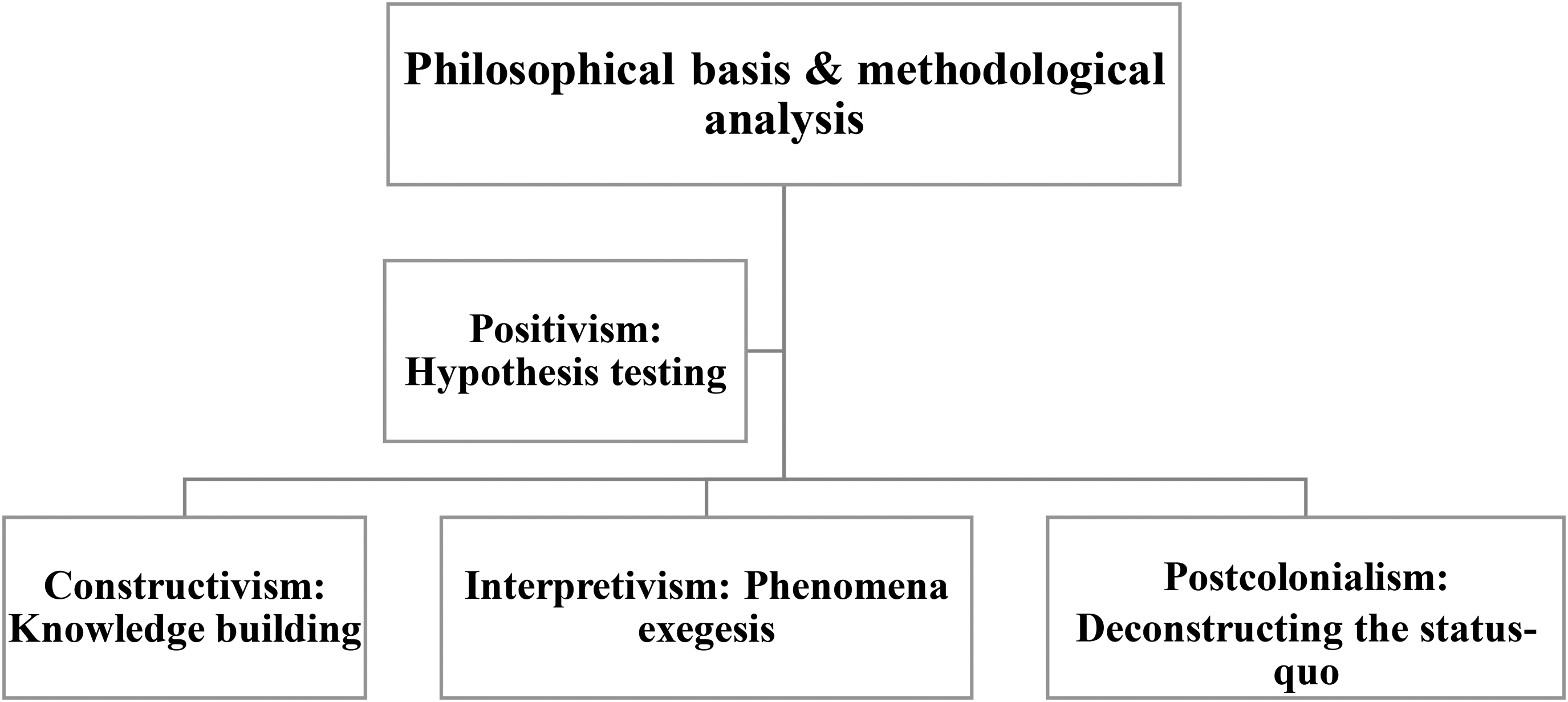
Representing the research methodology and its philosophical foundations.
As demonstrated in Figure 1, positivism, constructivism, and interpretivism are resorted to in order to help in the analysis of the statistical data obtained from the survey. Basically, positivism is about subjecting human society to fixed laws, determining behavior, and arguing, “knowledge and truth exist insofar as they can be proved” (Wisker, 2008). It remains useful despite the post-positivist criticisms in carrying out tenable quantitative data analysis especially in terms of testing hypotheses, covering large samples, eliciting highly specific and precise data, obtaining high reliability, and generalizing from sample to population. Constructivism, on the other hand, contends that knowledge and meaning are constructed from experience and relationships between things, people, and events. As for interpretivism, it suggests that the human mind is to be used to interpret experience, phenomena, and events out there in the social world, and construct meanings thereof. Postcolonialism, too, which is traditionally operationalizable in deconstructing power relations as manifest in politics, culture, or language encounters, is used to help in interpreting the postcolonial condition of modern higher education in formerly colonized countries like Morocco. The four isms synoptically advanced here have an interdisciplinary intersecting analytical nature and hence useful as a research methodology in this work.
More specifically, the study uses a methodic combination of quantitative and qualitative analyses of the data obtained from the field survey with a view to investigating the functionality of pedagogic translation in maximizing Moroccan students’ multilingual proficiency away from any institutionalized ideological distractions.
Subjects
As stated in the Introduction section, this study did survey 276 Moroccan students, graduate and undergraduate, randomly sampled from the Department of English Studies, Ibn Tofail University. More than 98% of them are aged between 19 and 30 years old; the rest range between 30 and 55. Yet, neither age nor gender was researched as a variable on and for its own. The study focused on studentship in its generality without any specific age, sex, or gender categorizations since the point of gravity is chosen this time to lie at issues of teaching/learning pedagogic translation and multilingual proficiency beyond any age or gender differences. Language wise, all of the surveyed students speak Darija, standard Arabic, English, and French, and many of them also speak Amazigh and some, coming from North of Morocco, speak Spanish. Here again the surveyed population was not sampled according to specific language categories since all the Moroccan students enrolled in the Department of English Studies speak Arabic, English, and French, which are the languages of instruction in Moroccan universities. Future studies may consider these variables of age, sex, gender, and language in order to cover new research grounds.
Instruments
Field data collection process consisted of an online questionnaire carried out via Google Forms. This latter collected and presented the 276 responses. The obtained statistics, enlisted herein below, are quantitatively described and qualitatively interpreted based on the analytical methodology presented in the Research Design section.
Findings and Discussion
The findings of this study are hereinafter presented, commented, interpreted, and discussed as based on the data elicited from the survey participants all with a view to responding to the hypotheses and the research questions under investigation in conformity with the research methodology introduced above.
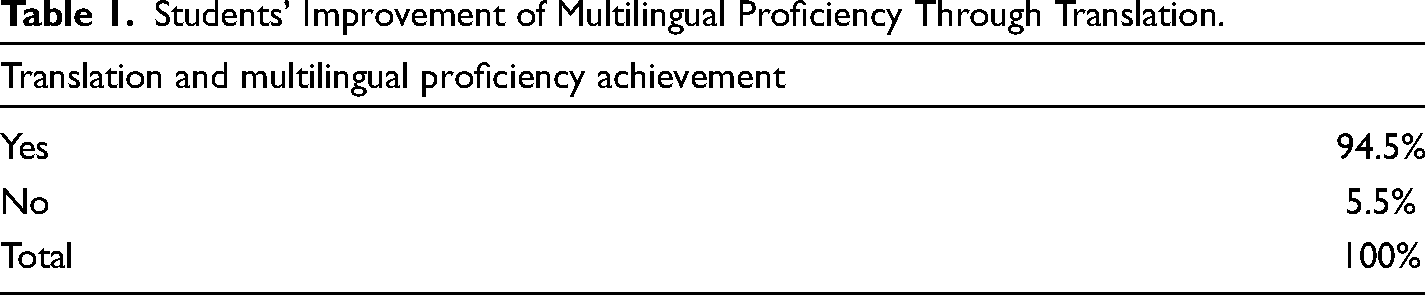
To start with and in an immediate response to whether translation classes, if taken seriously, improve the students’ bilingual and multilingual proficiencies, 94.5% of the respondents affirmed this possibility, while only 5.5% did not, as demonstrated in Table 1.
Students’ Improvement of Multilingual Proficiency Through Translation.
Accordingly, 77.1% of the surveyed population asserted that translation could improve their English writing skills as based on their day-to-day learning experience, while about 23% thought otherwise, as demonstrated in Table 2.
Students’ Improvement of Multilingual Writing Skills Through Translation.
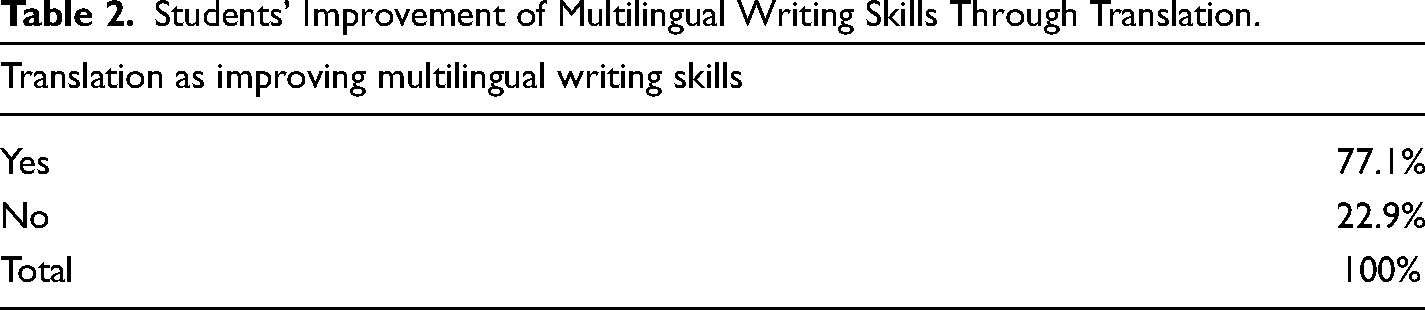
It is clear thus that the largest majority of students endorse the use and/or operationalization of translation in the boosting of their multilingual competency especially in terms of writing skills upgrading. This endorsement reflects the scholarly belief in the instrumentality of translation course in developing language mastery, bilingually as multilingually (House, 2009). Likewise, 73.3% of the respondents affirmed that their Arabic writing skills have improved thanks to taking Translation Arabic-English/French-Arabic classes, as clearly showcased in Table 3.
Students’ Improvement of Their Arabic Writing Skills Through Translation.
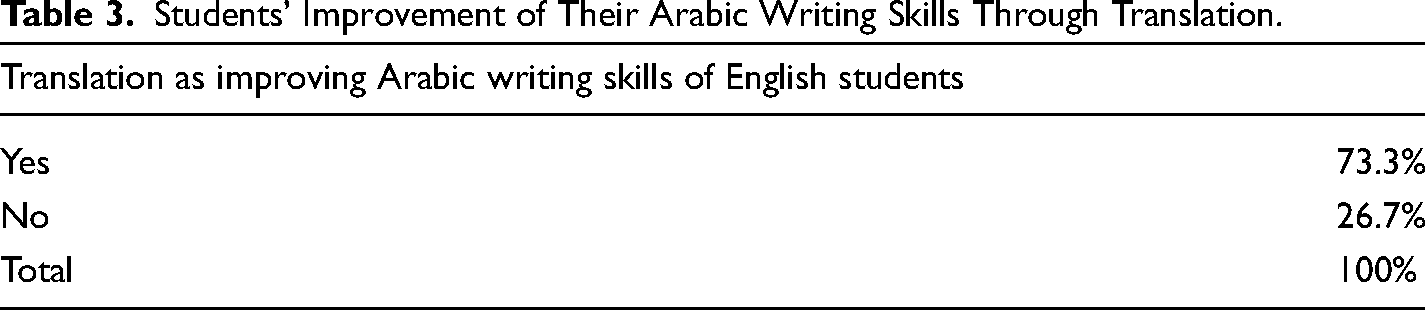
Here again in Table 3 it is demonstrated that most students of English Language and Literature agree that regular attendance and commitment to Translation Arabic-English/French-Arabic classes help them ameliorate the mechanics of writing in these languages especially as regards the business, legal, political, journalistic, religious, and literary registers studied in class.
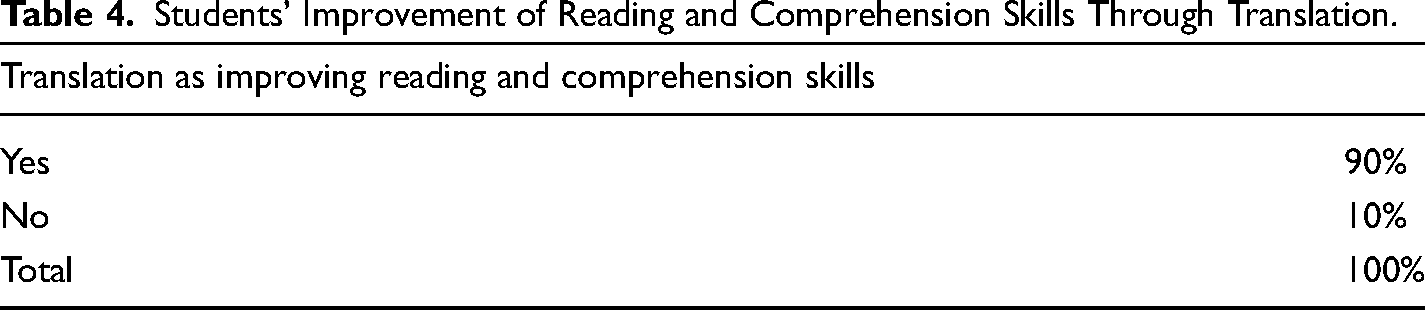
Asides writing skills, 90% of the surveyed population, as shown in Table 4, believes that regular translation of Arabic, English, and French texts has enhanced their bilingual and multilingual reading and comprehension skills. Only 10%, quite insignificant as a percentage, deny this belief most probably due to their low class attendance, low practice of translation, and their underestimation of the functionality of translation in enhancing their linguistic, cognitive, intellectual, and scholarly competences. Unfortunately, it is worth noting here that many students have a low consideration for translation; they hardly give it any importance. They practice translation but one time in a whole semester when they cannot avoid sitting for it in the finals in a doping hope to get a pass. Out of experience, one can safely affirm that this irresponsible category of students most often, if not always, fail in the translation exams and consequently fail to earn good mean marks and more importantly they fall short of achieving a considerable degree of multilingual proficiency.
Students’ Improvement of Reading and Comprehension Skills Through Translation.
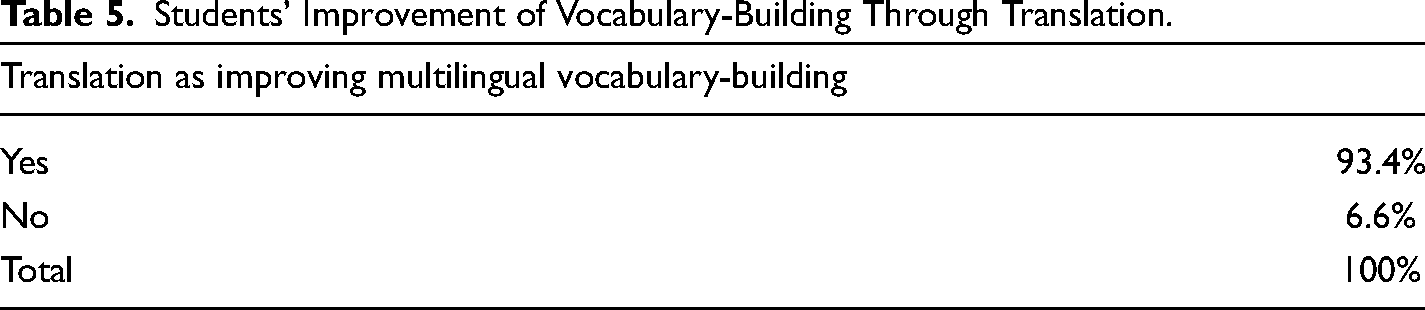
Very similarly, 93.4% of the sampled population affirmed that close attention to and serious work on translating Arabic STs into English and French and the other way round help them significantly in building and expanding their bilingual and multilingual vocabularies. Only 6.6% of the surveyed students nullify this affirmation ostensibly for inattentiveness and non-seriousness, as demonstrated in Table 5.
Students’ Improvement of Vocabulary-Building Through Translation.
It is thus clear that the students who are conscious of the undeniable role multilingual translation can play in developing their multilingual lexical competence and performance thanks to regular and systematic learning and practicing of pedagogic translation. A deeper and larger integration of translation in learning and teaching foreign languages is therefore of more importance, especially if the most difficult areas faced by students while translating are systematically resolved, as showcased in Table 6.
Students’ Treatment of Difficulties of Translation.
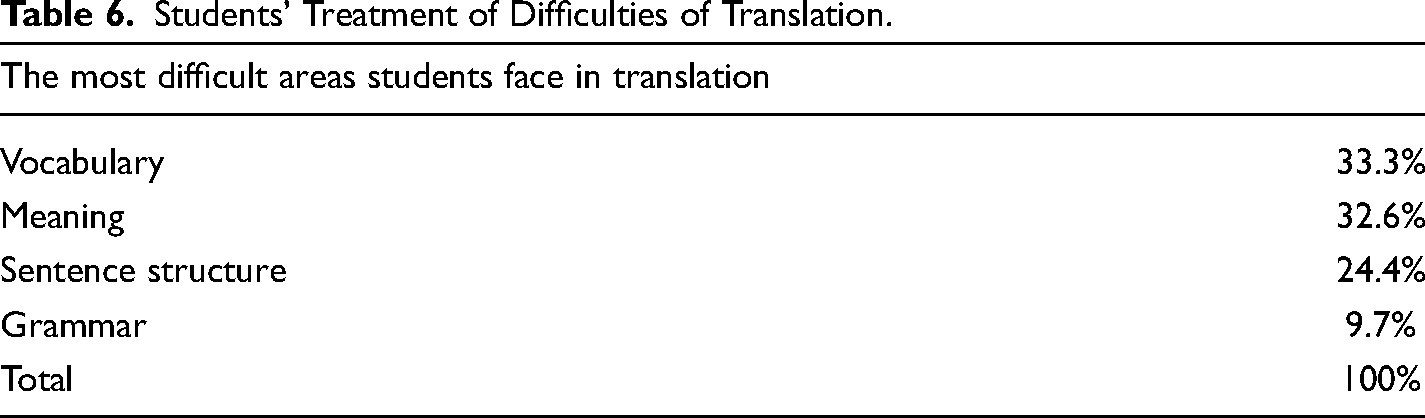
It seems clear that finding the most fitting equivalents for the lexical, semantic, structural, and grammatical/syntactic elements of both SL and TL represents major translation difficulties for students, as demonstrated by their percentage order from highest to lowest in Table 6. Once these problems are specified and adequately solved, the students can improve their translation skills and enhance their multilingual proficiency, especially if the real causes are determined and proportioned, as detailed in Figure 2.
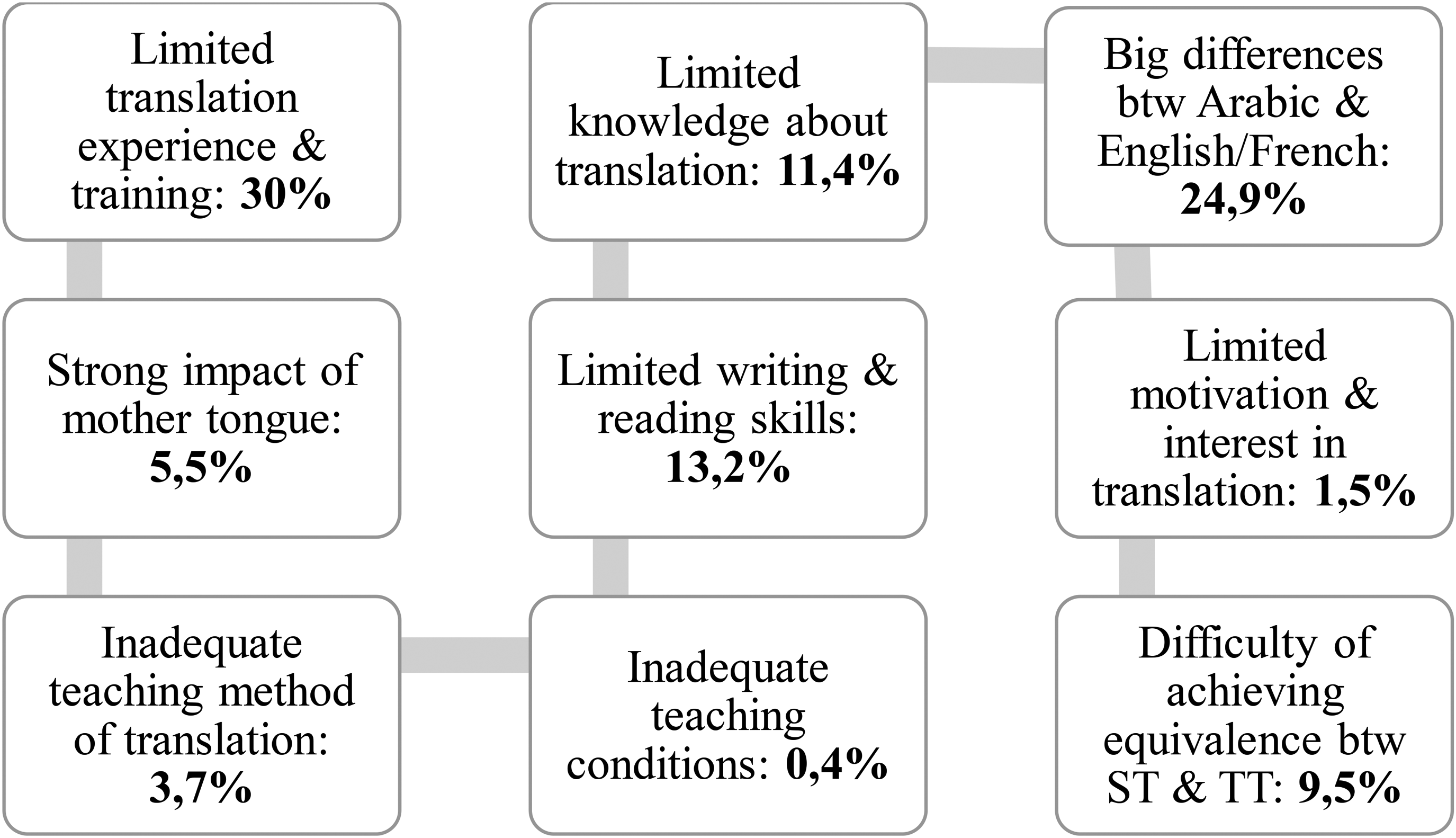
Proportioning the major causes behind the translation difficulties faced by students.
Limited translation experience/training (30%), big differences between Arabic, English, and French (24.9%), low writing and reading skills (13.2%), and difficulty in achieving equivalence between STs and TTs, inter alia, are some of the major causes that the surveyed population think are behind the most difficult problems they face when the y translate from Arabic into English or French and vice versa. This means that if these causes/problems are solved by dint of rigorous systematic and critical studying and practicing of pedagogic translation, the students can ensure a meaningful achievement of bilingual and/or multilingual proficiency. Figure 3 clearly demonstrates the areas that the students have to focus on in order to increase their chances of earning high multi-linguistic competence and performance scores.
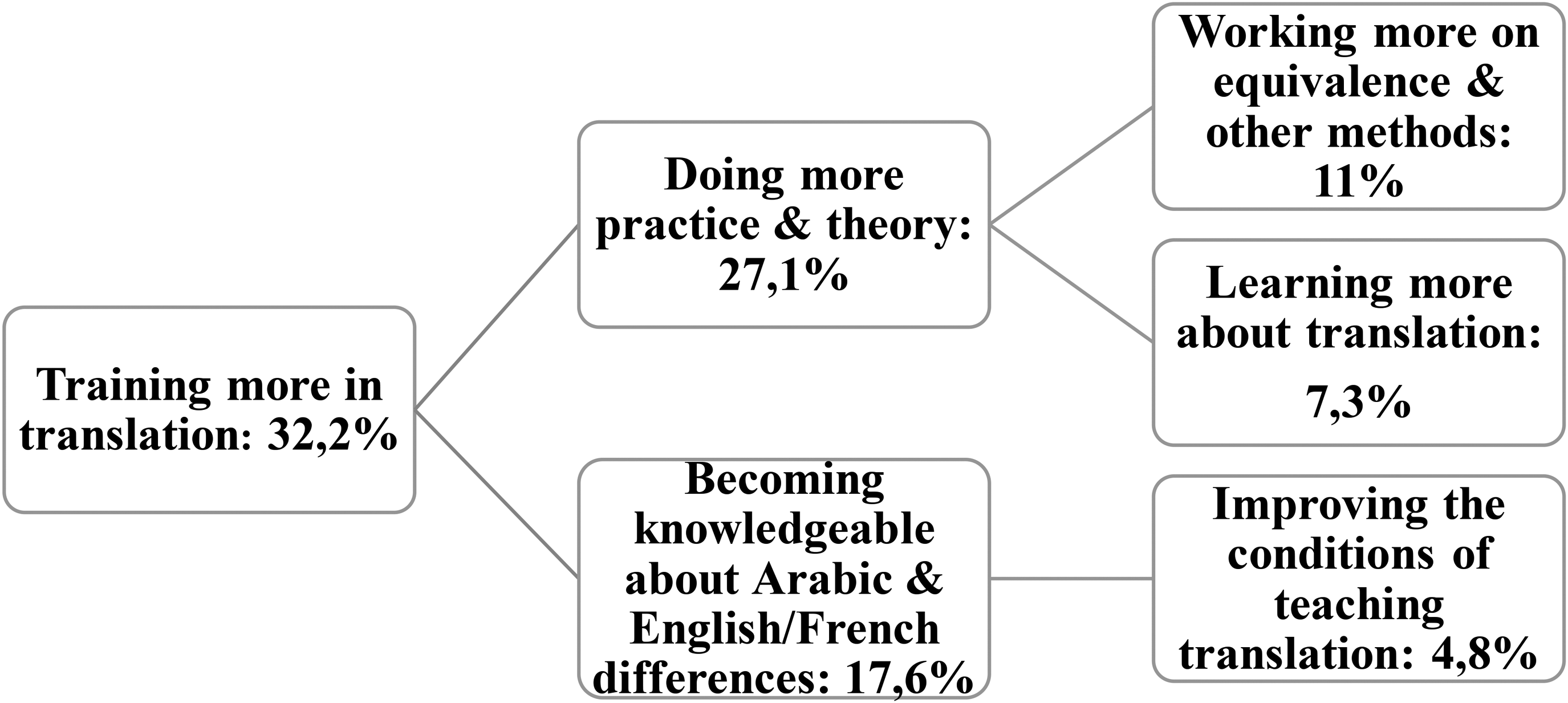
Proportioning the major solutions to the translation difficulties faced by students.
Thus, some the most functionally adequate solutions for the hardest translation problems are concretely demonstrated and proportioned in Figure 3. A total of 32.2% of the students confirmed their dire need for more training on/in translation should they wish to accede to high levels of academic achievability in translation studies and language mastery. Quite similarly, 27.1% of the surveyed population affirmed that developing more scientific knowledge about translation theory and doing much more practice would ensure this accession. A total of 17.6% of them, likewise, highlighted that becoming more knowledgeable about the nature and extension of the grammatical, lexical, semantic, and structural differences between Arabic, English, and French would help reach unfailing interlinguistic efficiency. A smaller segment (11%) of the sampled students eventually asserted that working more on appropriate applications of equivalence along other methods of translation is a sine qua non felicity condition in this respect.
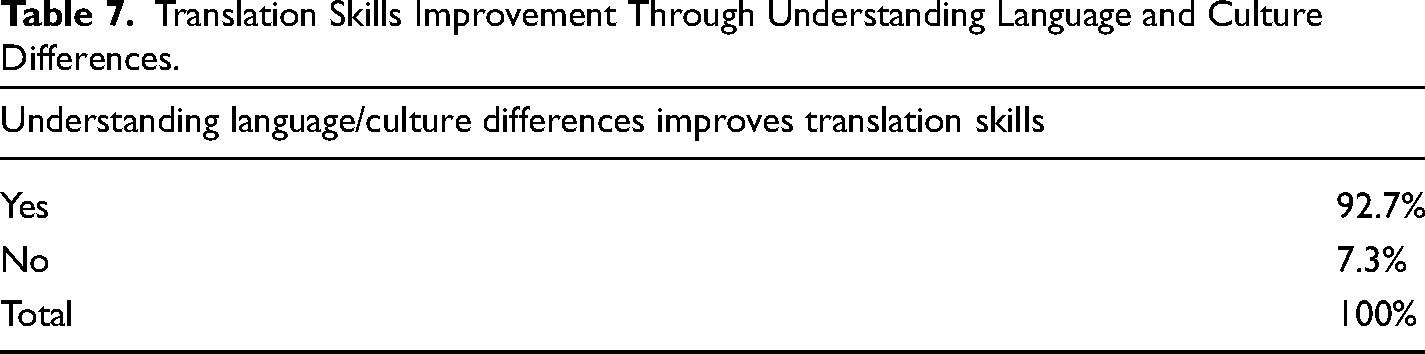
These numerical values find more advocacy in 92.7% of the survey respondents who maintained, as showcased in Table 7, that a deeper understanding of the linguistic and cultural differences between Arabic, English, and French will surely improve their translation skills and by implication upgrade their multilingual proficiency.
Translation Skills Improvement Through Understanding Language and Culture Differences.
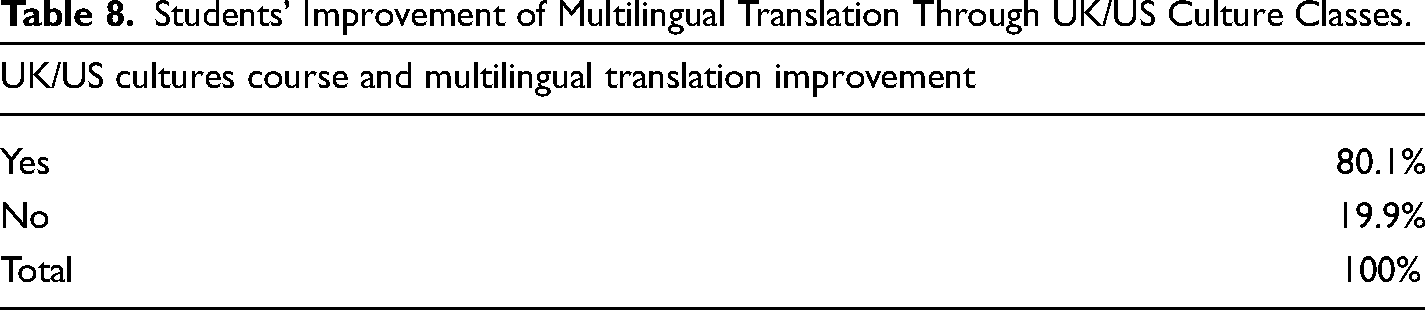
This is why 80.1% of the questionnaire participants affirmed that the UK/US Culture course as well as all other courses offered on the BA program in Moroccan universities are useful in boosting their translating skills and hence in their bilingual and multilingual proficiencies, as demonstrated in Table 8.
Students’ Improvement of Multilingual Translation Through UK/US Culture Classes.
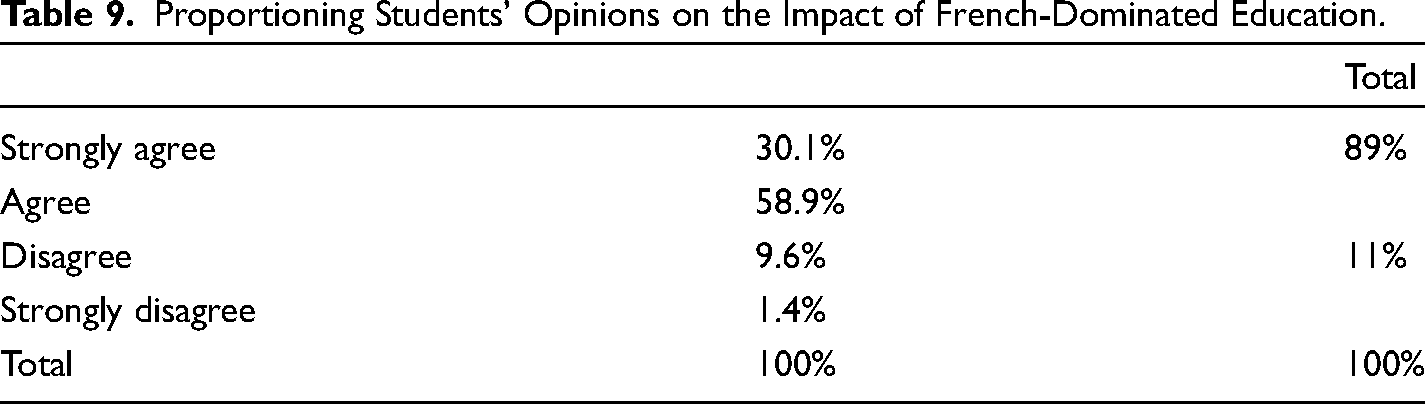
Nevertheless, in juxtaposition with this students’ preference of what is English (UK or US) there emerges a sense of renunciation of the French dominance effects on the achievement of academic excellence in Moroccan higher education. A total of 89% of the survey informants agreed that a French-dominated modern education system still perpetuates French language and culture in most Moroccan universities despite its decreasing usability compared to the increasing unavoidability of English worldwide, as clearly demonstrated in Table 9.
Proportioning Students’ Opinions on the Impact of French-Dominated Education.
The sense of rejection of French is widespread among students and Moroccans at a large scale because of two reasons. The first one refers to the French colonization of Morocco (1912–1956) with all its aggressive, destructive, and exploitative nefarious colonial politics that has left deep pernicious scars in the minds and hearts of Moroccans. The second one concerns the worldwide fact that French language is not the world's lingua franca as English is; French is now restricted to France and 14 former African colonies and few other places like in Belgium and Canada. Moroccans especially youth can no more wait to see English officially adopted as the first foreign language in Moroccan primary, secondary, and tertiary education purely for scientific, technological, and business reasons.
From a postcolonial perspective, the nefariousness of the French colonial past and the enforced-ness of its neocolonial institutionalized hegemonism in language, culture, politics, economics, education, and administration despite the minimality of gains supposed to be reaped in these fields continue to irrigate and cultivate feelings of antagonism and attitudes of rejection. If one speaks teaching delivery and learning gain, most Moroccan students strongly believe in the pragmaticity and lucrativeness of adopting English and discarding French in Moroccan higher education during this 21st century. This nationwide public but unofficial position and positionality push students to focus on developing their bilingual proficiency (Arabic and English) more than a multilingual proficiency that includes a French that insists on perpetuating its ideologized and ideologizing status in complete oblivion to Moroccans’ real feelings and aspirations. Despite its geopolitical shrinking and worldwide linguistic weakling, France continues to impose its language and culture policies in Morocco in hope to protect its interests and keep its power relations alive and influential in there. This continuity, running counter to Moroccans’ preferences and future development/empowerment, fires back and instigates more antagonistic national feelings, which eventually negatively affects the learning appetites and gains since the language of instruction (French) is being felt as imposed more than volitionally strategically chosen. These anti-French and pro-English sentiments/attitudes are well demonstrated and justified in the following tables.
The greatest majority of the target sample expressed their belief that the patterns of French language and culture continue to be maintained in Moroccan universities, which can therefore be said to be restricting the diversity of institutional multilingualism in the sense that other languages especially Arabic and English somewhat retreat in use in comparison with French. This retreat allows for questioning the tenability of the thesis of the multilingual education system in Morocco since French continues to be allowed to predominate while Arabic and English seem to be somewhat subordinated.
When asked how beneficial a French-permeated education system is in ensuring a faster and sustainable development in Moroccan higher education, 73.9% of the surveyed interactants asserted, as showcased in Table 10, that such a system slows down more than speeds up progress.
French-Dominated Education as Slowing Down Progress.
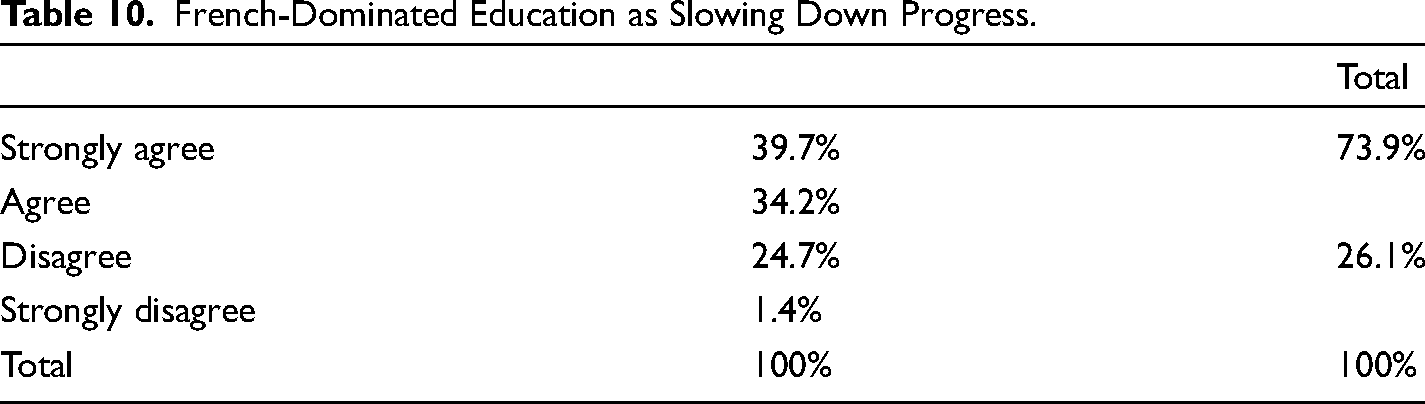
Similarly, 72.6% of the surveyed sample thought that French dominance helps in the blocking of the betterment of the higher education system in Morocco, while 27.4% of them opposes this thought, as clearly shown in Table 11. This opposition, though not very insignificant, should not mean a widespread popularity of French language among Morocco university students, as demonstrated in Tables 4 and 5.
Students’ Attitude Towards French Dominance as Blocking the Progress of Higher Education.
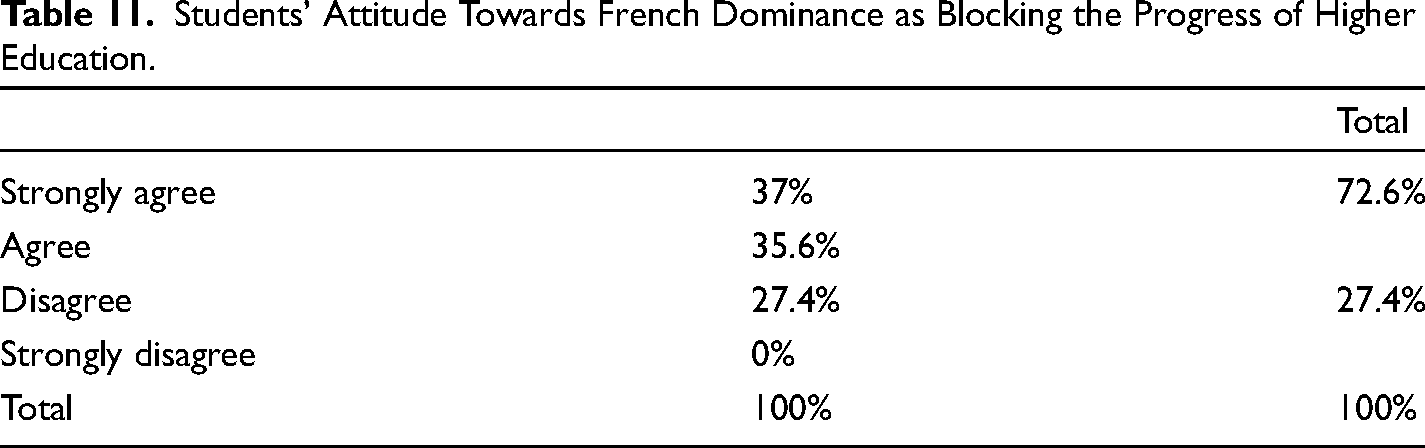
Moreover, 74.7% of the students agreed that French dominance has negative effects on their professional life after graduation, whereas 25.3% disagreed, as clearly justified in Table 12. Employability emerges here as another significant and existential variable that poses a real threat to graduates’ professional careers since most jobs, private or public, require a good mastery of French that most Moroccan students do not have.
Proportioning Negative Effects of French on Students’ Professional Life After Graduation.
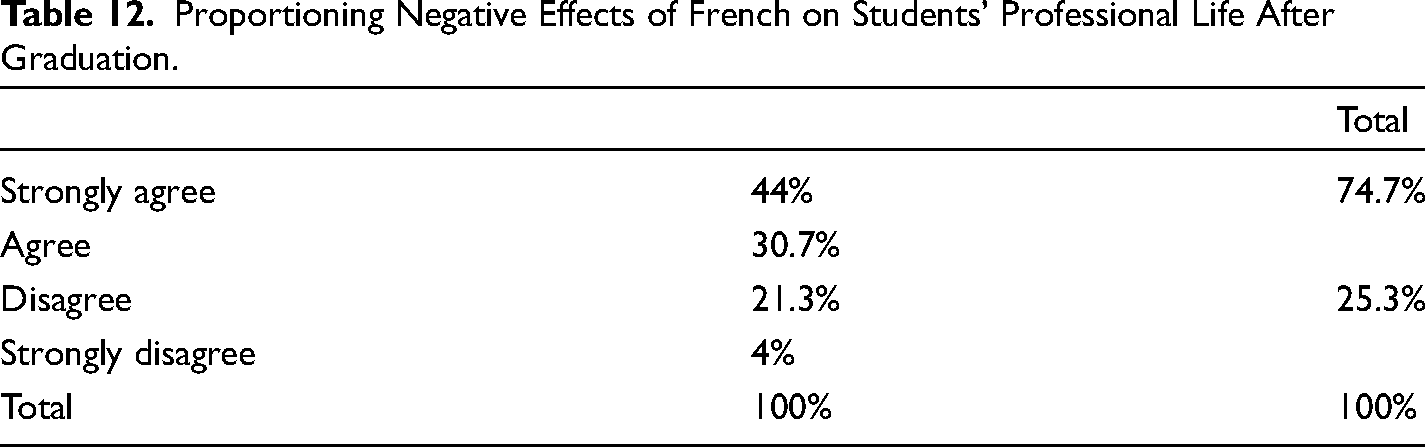
This large majority of the students (74.7%) who sees in French dominance a hindrance to their careers after graduation bespeaks some of their concern both for the future and the subsequent low confidence towards the usability and functionality of the current French-loaded institutional multilingualism in Moroccan universities. Students, belonging to most if not all departments except that of French Studies, seem to display a deep awareness of the need for a more English-oriented multilingual higher education system, as it is going to be demonstrated below through the statistics elicited from the field survey.
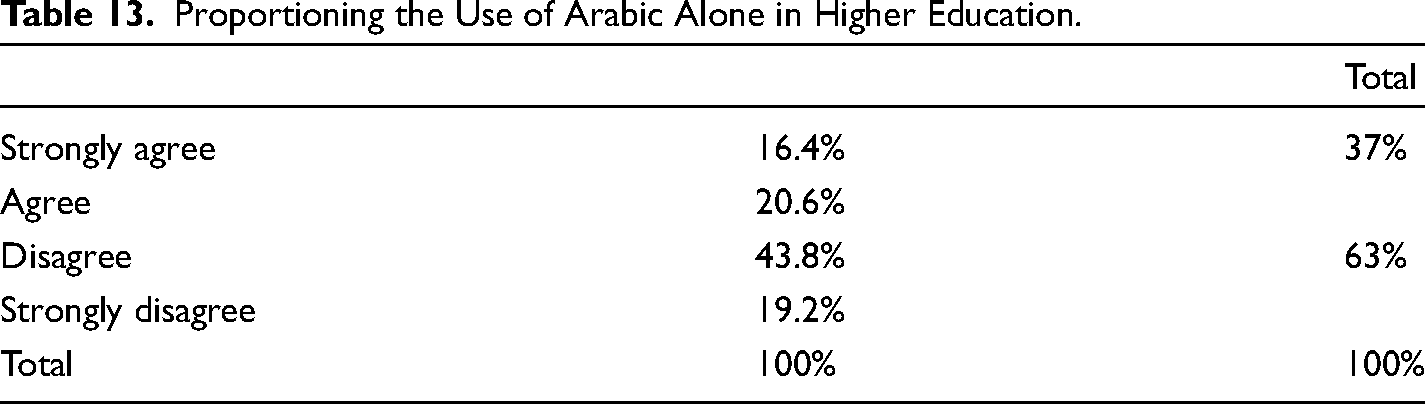
Quite unexpectedly, while 63% of the surveyed students disagreed with the possibility of pursuing university studies in Standard Arabic (the constitutionally official national language of Morocco) alone, 37% expressed their approval, as stated in Table 13. This significant attitude towards modern standard Arabic unravels the students’ familiarity with and acceptance of the integration/use of foreign languages in the Moroccan higher education system, but not any foreign language.
Proportioning the Use of Arabic Alone in Higher Education.
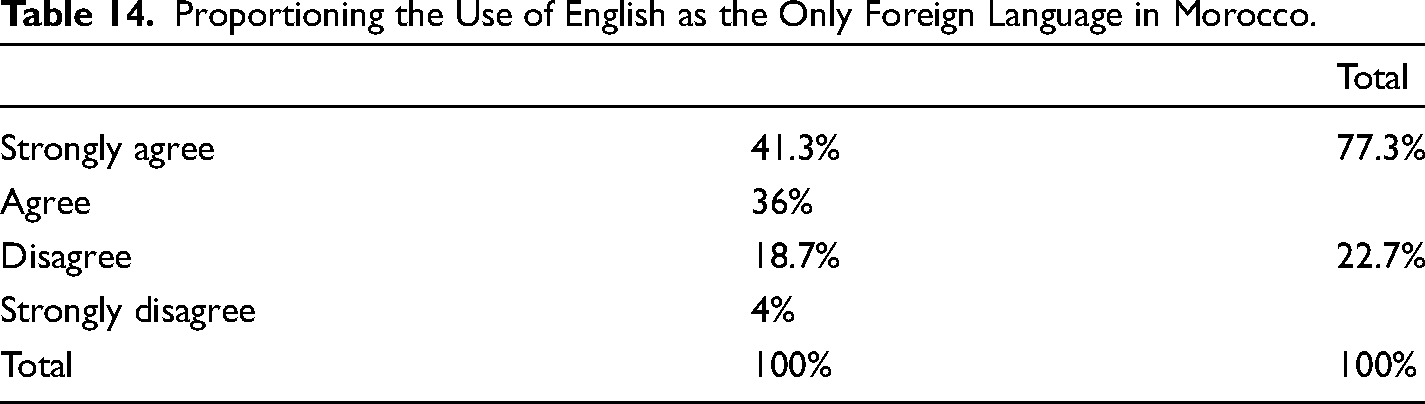
But when the same sampled population was asked as to whether or not to accept using English as the only foreign language for technological and scientific purposes in Moroccan higher education, 77.3% agreed with this proposition, whereas 22.7% disagreed, as given in Table 14.
Proportioning the Use of English as the Only Foreign Language in Morocco.
Being aware of the indisputability of English global supremacy in the realms of science and knowledge at all levels and in all forms, the surveyed students preferred this language to be adopted in higher education all along with Arabic. Accordingly, Table 15 showcases that 93.3% of the surveyed students stated that they would prefer English to unseat French in Morocco in general and in higher education in particular, while only 6.7% of them opposed the unseating idea.
Adopting English Instead of French.

In response to a specific question, 73.3% of the inquiry informants expressed their wish to have the online space reserved for them on the university homepage designed and content-loaded in Arabic and English, as demonstrated in Table 16. They see in this Arabic-English bilingual combination a means to ensure an internationally standardized online learning experience. And although the current online contents and services are provided in Arabic and French, only 2.7% of the respondents opted for the combination of these two languages, 2.7% for French alone, and 5.3% for Arabic alone. What is striking here is that only 16% of the surveyed students wished to see English as the only language in use online. Yet, this percentage remains far larger than the percentages of French alone (2.7%) and Arabic alone (5.3). These low percentages should not mean the rejection of multilingualism in daily life as in education.
Proportioning Language Preferences in Online Learning Services.

Actually, when it comes to daily communication with foreign students pursuing their studies in Moroccan universities, Table 17 shows that 71% of Moroccan students prefer to communicate to their overseas peers in English and French, while only 29% opt for standard Arabic and Darija. These numerical values are a clear-cut evidence for the deeply rooted multilingual tolerance and overture of Moroccan students towards their foreign counterparts. Therefore, Moroccan university students can be said to enjoy a high sense of intercultural competence and interlinguistic performance without which no genuine multilingual communicational identity can be formed.
Proportioning Languages Preferred in Communication With Foreigners.

Table 18 below testifies to the tenability of the argument that Moroccan university students have a historically inherited intrinsic extroversion towards others even more reinforced by a postcolonial condition of being has smoothly amalgamated genuine ingredients of multiculturalism and multilingualism.
Measuring Foreign Languages Threat to Students’ National Pride/Identity.
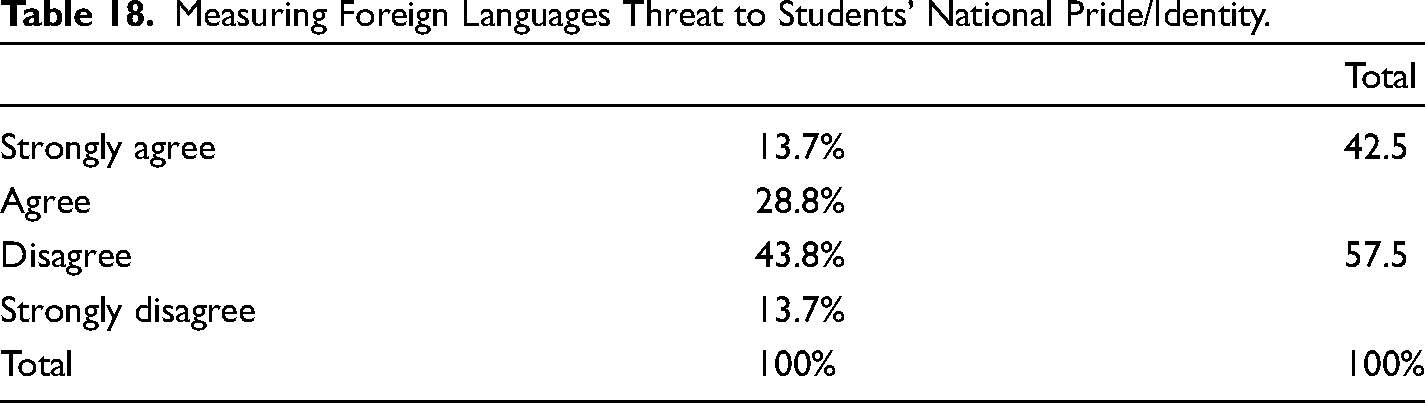
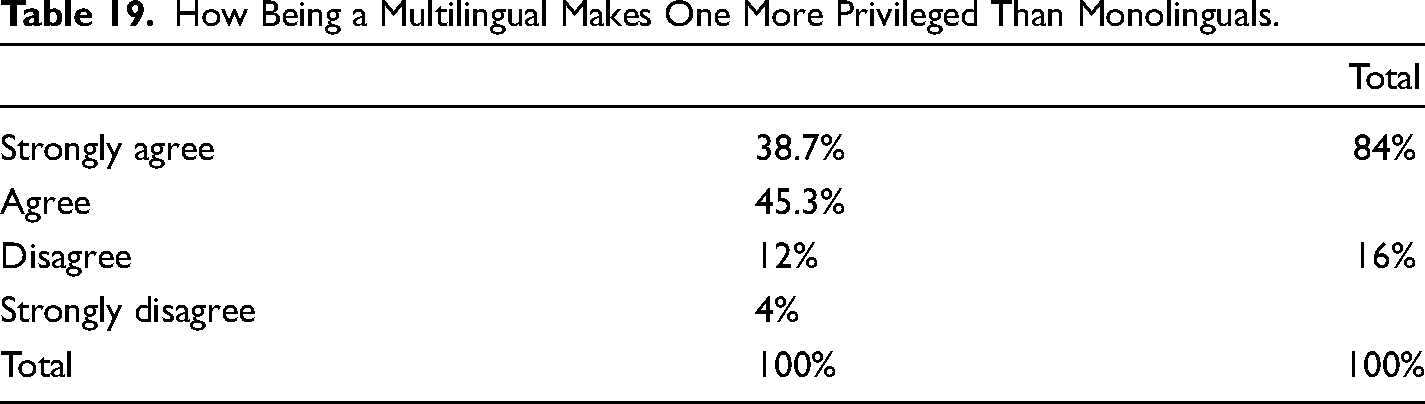
So, although 42.5% of the respondents may appear to think of the integration of foreign languages as a threat to the solidity of their national pride/identity, the majority (57.5%) does not see in using these languages a sense of linguistic imperialism but an acceptable multilingual system of communication and being. In addition, it is this very majority which believes in investing more efforts in teaching and learning translation in order to reinforce chances of achieving high levels of bilingual and multilingual proficiencies, as clearly demonstrated in Tables 1–7. That sense of postcolonial condition of multilingualism, rooted in and sustained by Moroccan higher education system (Ennaji, 2005), finds more evidence in the fact that 84% of the target population in Table 19 sees multilinguals as distinguished and privileged than monolinguals. One might here deduce again that Moroccan university students have developed a communicative identity revelatory of traits traceable in the psychological and socio-cultural fabric of the postcolonial ontology, as conceptualized in Bhabha's (1994) notions of “ambivalence” and “liminality” whereby this leading postcolonial theorist he examines the former colonizer's legitimizing linguistic, cultural, political, and ideological hegemonies.
How Being a Multilingual Makes One More Privileged Than Monolinguals.
Besides, the feeling of multilingual privileged-ness in students can be traced to their consciousness and familiarity with the global role of foreign languages in the carving of their social, financial, occupational, and intellectual positions home and abroad. Put differently, the students seem to display a pragmatic perception, belief in a kind of “lucrative multilingualism” especially amid the mushrooming of online global communication and education programs and platforms, and the subsequent cognitive growth sensed in their university experience as well as in their life at large. Positivist statistics in Tables 20–22 endorse these constructivist interpretations.
Proportioning Foreign Languages’ Role in Improving Cognition and Study Skills.

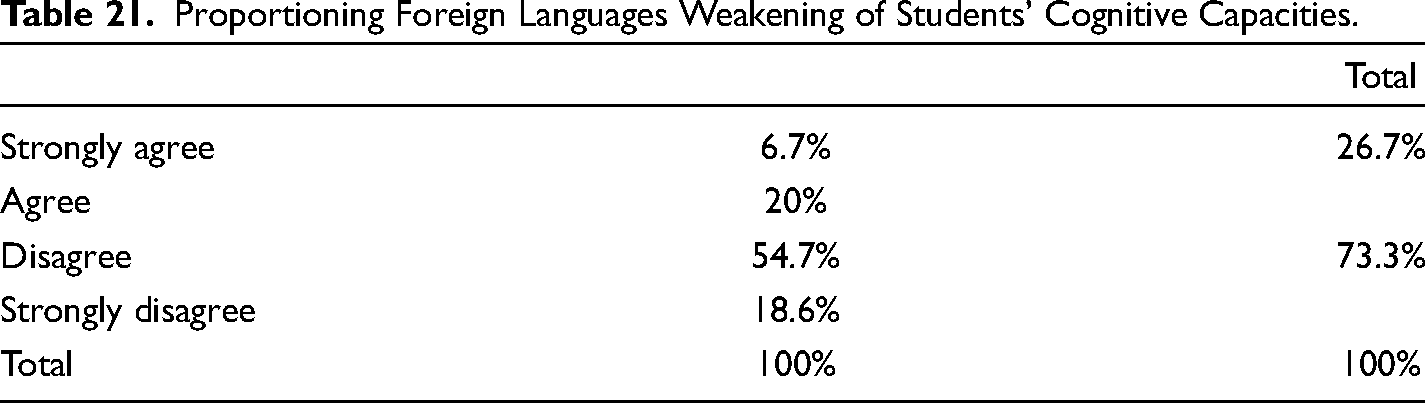
Proportioning Foreign Languages Weakening of Students’ Cognitive Capacities.
Translation as Improving Multilingual Cognitive Capacities.
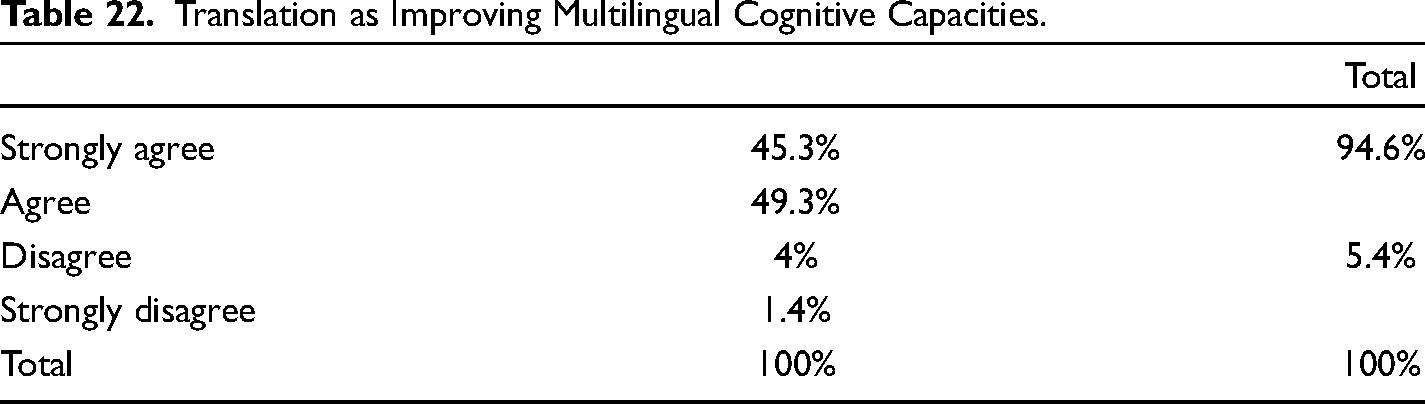
Table 20, for instance, highlights the importance Moroccan university students give to the role of foreign languages in improving their multilingual cognitive capacities and study and research skills especially by means of courses like Translation Studies, as demonstrated above.
In that, 90.7% of the sampled respondents agreed that foreign languages especially English play a vital and pivotal role in the progress of their studentship and the assurance of their intellectual/scholarly self-development. Only 9.3% of them chose to think otherwise for unspecified reasons. This minority percentage no matter how remains too low to be taken in serious consideration.
In the same vein of argumentation, 73.3% of the survey informants, in Table 21, rejects the thesis that too much use of foreign languages weakens students’ cognitive capacities, especially when courses like Advanced Multilingual Translation Studies are taught without any undesirable hegemonistically imposed foreign language agendas, as clearly justified in Table 22.
In sum, both Tables 21 and 22 prove that Moroccan university students, especially those with a high command of academic English, welcome a higher education system that adopts and adapts to a lucrative multilingualism that university can operationalize in unison with well-contextualized pedagogical programs of which multilingual translation is representative example.
Conclusions
Based on the Findings and Discussion section, it can be concluded that the first hypothesis, which claims that students face considerable difficulties while trying to provide consistent naturally flowing translations of Arabic STs into English or French TTs and vice versa, is significantly supported. As clearly demonstrated in Table 6, while 33.3% of the surveyed population see in vocabulary a major lexical difficulty, 32.6% of them think that correct deciphering of intended meanings and crossing them over to the TL represent a semantic hurdle. In addition, 24.4% of the questionnaire informants expressed their awareness of the strenuous efforts they must make to surmount problems of sentence structuring when moving from English or French to Arabic or the other way round. And 9.6% of the survey respondents highlighted their need to upskill their capabilities in handling the grammatical/syntactical differences between the languages under study and knowing how to correctly solve them thereof. From an interpretivist perspective, these interlingual translation inefficiencies regarding aspects of grammar, meaning, structure, inter alia, bespeak the students’ development of a concrete awareness of the areas in need for their learning attention and endeavor should they ever aspire to achieve adequate multilingual proficiency away from any discouraging foreign language policies.
As for the second hypothesis, which bases the achievement of multilingual or bilingual proficiency on an effective understanding of the linguistic and cultural differences encountered when translating, it is equally largely supported since 94.5% of the target population in Table 1 affirmed that this process of translation could improve their bilingual and multilingual competencies. Similarly, while 77.1% of the respondents asserted in Table 2 that translation could improve bilingual and multilingual writing skills, 73.3% of them in Table 3 thought that it could make their Arabic composition better. In addition, 90% of the informants in Table 4 highlighted that practicing translation could boost their bilingual and trilingual reading and comprehension abilities, and 93.4% of them in Table 5 agreed that it could significantly help in bilingual and multilingual vocabulary-building. Interpretively, the second hypothesis has therefore become an empirical testament to the unfailing instrumentality of translation in the pedagogy of languages once again if students and teachers are seriously engaged but beyond any undesirable ideological or political interests permeating any foreign language agendas.
The third hypothesis, predicting that pedagogic translation minimizes the negative effects of transfer via a process of translatorial bilingualization or multilingualization, is also largely supported since the greatest majority of the surveyed population confirmed that bilingual and multilingual writing, reading and comprehension, and vocabulary-building skills are upgradable through studying and practicing translation. Similarly, 92.7% of the questionnaire participants affirmed in Table 7 that transfer negative effects can be minimized when interlingual and intercultural differences are adequately accounted for by means of effective applications of equivalence as well as other translation methods and theories like Skopos and Translatorial Action introduced in the Review of the Literature section. In other words, if translation as methods, theories, and practices is taught/learnt systematically, critically, and analytically within a framework of well-designed pedagogical programs, efficient academic bilingualization and/or multilingualization of students becomes achievable away from any negative effects of such language acquisition phenomena as transfer.
The fourth hypothesis in its turn finds significant support in much of the data presented in Tables 9–22 which in their totality testify to the vulnerability of multilingualism to postcolonial education politics and foreign language agendas adopted in Morocco since its independence from the French Protectorate in 1956. A total of 89% of the surveyed students in Table 9 agreed that the institutionally imposed dominance of French perpetuates the multilingual status-quo in Moroccan higher education. A total of 73.9% of them, as shown in Table 10, stated that this dominance continues to slacken if not to obstruct a larger integration of English—the world's lingua franca—in education, science, technology, and business and consequently wane Morocco's pace of progress. A meaningful multilingualism cannot be complete without this larger integration in today's Morocco since 77.3% of the questionnaire participants in Table 14 wanted English to be used as the only foreign language for technological and scientific purposes. A total of 74.7% of them in Table 12 even more believed that French can engender undesirable effects on their professional life after graduation, while 93.3% of the same sample asked for replacing French with English for a faster and surer development in Morocco. From an interpretivist postcolonial perspective, these empirical calls issued by young Moroccan academicians reflect the need for a healthier and fairer multilingual setting where students will not feel coerced into accepting a foreign language that disserves more than serves their present academic learning experience and future professional careers. A total of 84% of these students in Table 19 believed that achieving a contemporary lucrative multilingual proficiency makes them feel more privileged than monolinguals. A total of 94.6% of them asserted that this privileging proficiency is very much attainable through a multilingual pedagogic translation course where foreign languages will be programed for academic and professional gains not for historical pre-set political and ideological agendas.
Footnotes
Declaration of Conflicting Interests
The author declared no potential conflicts of interest with respect to the research, authorship, and/or publication of this article.
Funding
The author received no financial support for the research, authorship, and/or publication of this article.
