







Abstract
The Covid-19 pandemic caused the California State University system to shift completely to online learning in March 2020. Before the end of the spring 2020 semester the CSU system announced that Fall 2020, and then Spring 2021 courses would be delivered online. During the summer of 2020 online training courses are available to all Faculty and instructors to prepare for online delivery. The courses were developed by curriculum designers and delivered by volunteer faculty with both expertise and comfort in online instruction. At one of the schools in the CSU system 800 instructors signed up to take the course. The purpose of this paper is to understand how faculty implemented teaching practices online after participating in the training provided by the participant university in the summer of 2020. Using the Universal Design for Learning framework for analysis; survey results, teaching strategies, and recommendations are included.
Keywords
The pandemic caused schools globally to consider a rapid shift to completely online learning in March 2020. Before the end of the spring 2020 semester the California State University (CSU) system announced that Fall 2020 courses would also be delivered online. According the California State University Fact Book (2022), 23 campuses and seven off-campus centers, over 480,000 students, 53,000 faculty and staff, and stretching over 800 miles, make the CSU is the largest university system in the United States.
During the summer of 2020 the participating university made online training courses available to all Faculty and instructors to prepare for online delivery in Fall 2020. The training courses were developed by the curriculum designers and delivered by volunteer faculty who possessed both expertise and comfort in online instruction, and were taken by over 800 faculty at the participating CSU. Each faculty who completed the course was given a stipend, as were the volunteer faculty instructors.
This was a major effort and expense in time, money, and other resources. As well as an amazing opportunity to provide training on teaching pedagogy to a large portion of the faculty. The purpose of this paper is to understand how faculty implemented teaching practices online after participating in the summer 2020 training provided by the participant university. Using the Universal Design for Learning (UDL) framework for analysis, a survey was offered to all faculty who took the Summer 2020 training. The survey asked how instructors planned for, and provided student engagement, representation of content, and student action and expression to demonstrate knowledge of the assigned content.
The nature of the diversity of students in the CSU system, and at the participating university in particular, calls for an expanded view of online teaching at the university level. The student population at the participating university is generally 65% first generation, 65% English as a second language, and 60% Pell Grant eligible. The student body is diverse, and not typical for success in post-secondary university settings in 2020.
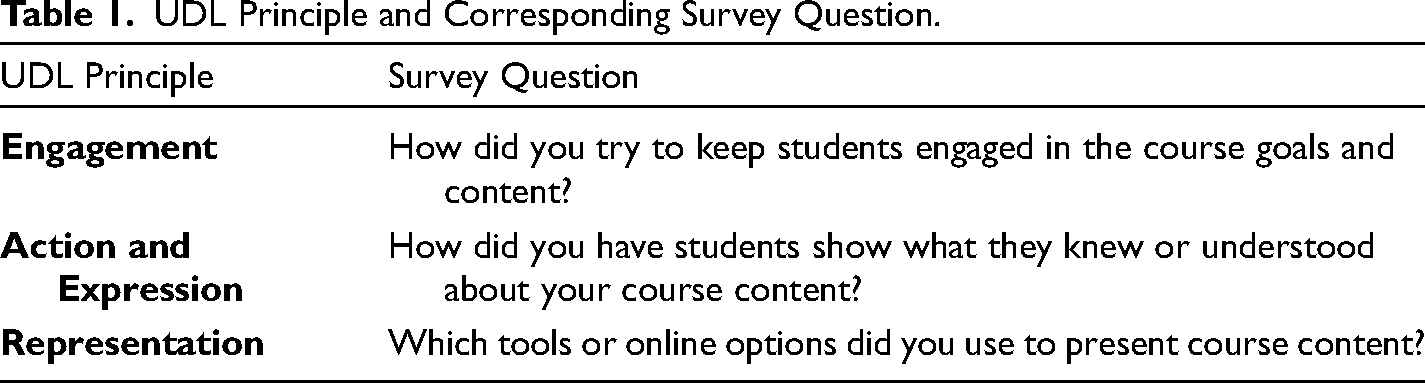
The central questions guiding this paper are twofold. The first is to open a window into some of the teaching that happened during the immediate and yearlong shift to fully online course delivery for the university faculty and instructors. What did online learning look like at the University during the time of COVID? The second question is to assess if the online environment lent itself to some of the teaching principles and methods identified as productive to student success as outlined in the framework for Universal Design for Learning. Were instructors using multiple means of engaging students? Were instructors providing multiple means of representation of the content to students? Were instructors providing multiple means, or multiple options, for students to show their learning? See Figure 1 and Table 1 below.
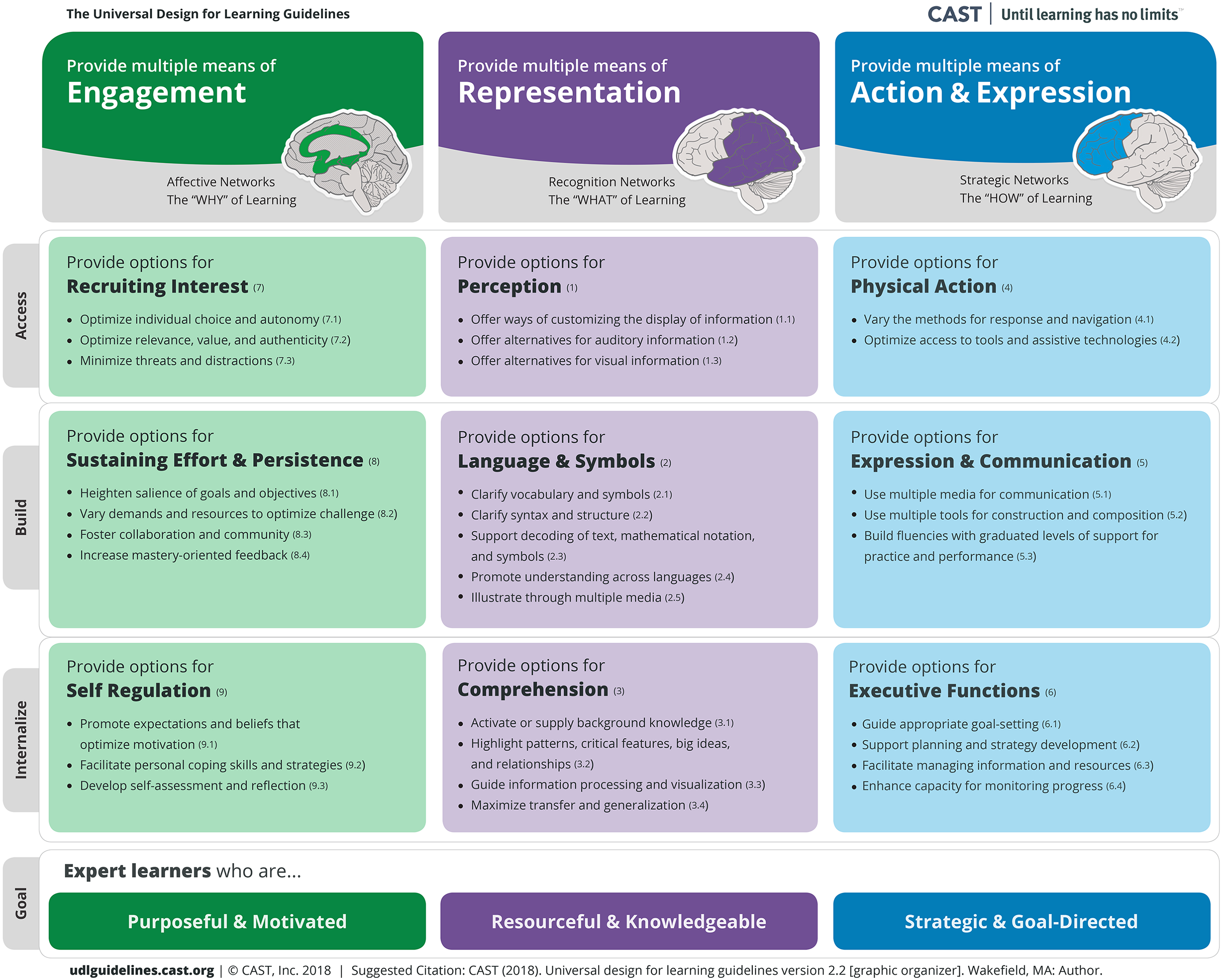
Universal Design for Learning Guidelines.
UDL Principle and Corresponding Survey Question.
Literature Review
Universal Design for Learning as an Agent of Change
It is critical for universities to shift to meet the needs of a variety of students. This includes race, social class, ethnicity, cognitive differences, gender, families, and more. Universities should embrace these changes and take steps toward believing that diversity makes us stronger. It is imperative to create pathways for all students to be successful, and to provide rigorous content is important then we must take that step. Harnessing the power of UDL in digital courses is a platform for building that step; for raising people up, expanding opportunity, and creating an environment for divergent thinking. The use of UDL principles to respond to diverse learner needs and preferences in online, digital, or e-learning has been recommended as a learning theory for design and implementation in these environments (Al-Azawei et al., 2017).
The neuroscience of learning continues to demonstrate the complex and infinitely unique ways human brains understand content, connect to new learning ideas, and demonstrate their new learning. Understanding and acknowledging student diversity is a great opportunity to examine how teaching occurs within post-secondary classrooms. Add onto this opportunity the vast growth of online learning spaces before the changes of the pandemic, and an explosion in teaching innovation is on the horizon. More research is occurring in online education from K-12 through post-secondary. Where theoretical articles were almost the only type published, a small number of data-based articles and studies are now published (Arnesen et al., 2019).
Ron Mace, an architect, coined the term Universal Design in the early 1980's (Bremer et al., 2002). He saw a new focus in designed spaces that could be used by all of the people who might want to be in the space. Universal design is the design of products and environments to be usable by all people, to the greatest extent possible, without the need for adaptation or specialized design – Ron Mace (Bremer et al., 2002).
Spaces can be designed for people who are wheelchair mobile, have vision or hearing impairments, are impacted by cognitive challenges, and many other variations within the human experience. While initially this may sound like a tremendous lift, instead this encourages using creativity and skilled design practices and thinking. Some examples that are often expected currently include crosswalks with words, images, and auditory signals, bumps on sidewalks to denote when the street begins, and curb cuts. While these design features may initially have been for people with disabilities, they also allow strollers, carts, baggage and bicycles to access areas with more safety and efficiency. Another example is closed captioning, initially developed for those with hearing impairments. now help all people in public spaces. Common features on smartphones or digital home assistants, the idea of designing without options becomes somewhat unthinkable: Just ask Siri, Alexa, or Google. And most recently ChatGPT.
Universal Design for Learning (UDL) asks educational designers to shift this idea from architecture to education (CAST, 2019). How do all educational environments, including online and digital spaces, become available to every human learner? It can be helpful to conceptualize this shift by looking at the goals, variability, and context. For example, the goals of the educational event, course, lesson, etc. should be defined and revisited to make sure educators are looking at the student's mastery of a complex issue, such as cultural competence, and not only grading on the conventions of an essay.
Variability refers to the variations in how humans learn and process information. Neuroscience continues to demonstrate that the human brain learns differently from one person to another. One example is illustrated by the differences in humans who have attentional challenges. Currently one in 15 children, and one in 40 adults are diagnosed with attention deficit hyperactivity disorder (ADHD) (Intramural Research Program, 2016). And according to the United States Department of Education, Office of Civil Rights (2016), not all people with ADHD are eligible for Special Education Services during their schooling. This means that while these students still cope with neurodiverse challenges that can impact their working with new content, they are not eligible for specific services from schools or universities. The incidence of ADHD diagnosis in the 23–29-year-old and 30–49-year-old female populations nearly doubled from 2020 to 2022 (Russell et al., (2023). With more adults being identified experiencing ADHD and other neurodiverse conditions, universities want to be aware that students continue to be diverse in their learning needs.
Context in an educational frame refers to the content or curricula, the delivery of the content, and the assessment process. The arrangement of online versus face-to-face courses highlights another example of context. Within the digital world this context can be quite varied. A learning management system like Canvas or Blackboard is the context as well as social media platforms like Facebook, Twitter, or Pinterest. YouTube can be a context or place where learning takes place as well as digital games. Context also includes the subject matter and the content of curricula. Co-occurring with all of these systems is the preferences of students to learn and perform better in one context versus another. For example, learners may learn best about the effects of laws in post-colonial countries by playing a digital game in groups, while they may understand the history of the country by reading first person accounts and discussing this in a closed Facebook group. Context is rich, varied, and unique to the specific goals of learning (Burgstahler & Cory, 2013; Coy et al., 2014).
The study of UDL as a lens through which to organize and deliver content, create curricula, and assess student learning needs to consider goals, variability, and context promotes learning experiences in online courses. Courses and learning experiences can be designed with the learner in mind to foster more dynamic practices.
Forced Change
The changes created by the Covid19 pandemic are interesting using the lens of Kezar's theories of change (2013). Instead of change agents continuing the current pace of working toward quality teaching in the online and digital environments, faculty and instructors were forced to teach online first, and think about quality second. This radical change began in March 2020 as the university systems went totally online. Due to the serious threat of the Covid 19 pandemic, crisis teaching resulted. The idea that teaching in the traditional face-to-face modality was now dangerous was a difficult one to absorb.
Responding to dramatic change tests how institutions understand the change while at the same time experiencing it. While the changes as a result of Covid 19 are most often viewed as a reaction, the building blocks for the move from face-to-face teaching to online had already been set in motion. The Theories of Change as outlined by Kezar is a helpful platform to contemplate and understand the journey the participating university undertook during sudden online teaching as a result of Covid19. The six main theories of change as explored by Kezar (2013) provide different ways of thinking about “why change occurs, how it occurs, what are the outcomes of change, types of change … (and) and strategies” for making change (p.22).
Using Kezar's (2016) six main theories to look at the implementation of rapid change with the participating university is illuminating.
Scientific management: Changes planned at the organizational level, in this case at the university level. Change as a result of the pandemic came mostly through the “top” down. From the office of the President, to Faculty Affairs, to the Center for Faculty Excellence and imposed on faculty and students. Can it be understood how this change was planned and implemented with scientific management in the context of sudden events? Evolutionary: Externally imposed changes and pressures, as well as unplanned change. Emphasizing a more systems view of change and enterprise-level examinations of organizations as part of a much broader ecosystem. Kezar (2013) states that “many studies have demonstrated that leadership can make a difference particularly in managing external forces” (p. 54). Introducing the concept of evolutionary change with the appearance of a new virus on the global stage, imposed by the pandemic, may help frame how leadership responds. Political: “Political theories of change identify change as being a natural part of human interaction, occurring as different interests and agendas are negotiated.” The political forces in the university must have been impacted by the different interests of health, science, the business of school, and the act of teaching and learning are reverberating still. Social Cognition: “A primary assumption of this school of thought is that change can be best understood and enacted through individuals and their thought processes.” (p. 54). As the role of university teachers and faculty members, was forced to change when the switch to online teaching was imposed, it seems likely that this change was perceived differently by each individual member. The concept of what they thought of themselves and their roles as university teachers could have been completely disrupted. Cultural: The cultural school of thought suggests that change occurs naturally as a response to alterations in the human environment; cultures are always changing. (Kazar, 2011). The mindset of change from face to face, or what was considered traditional teaching, has imploded with the move to online only. A long-time administrator in the field of education with extensive experience in both fully online education and fully face-to-face education explained this shift well observing that teachers who relied heavily on their personality for connections with students were struggling more than teachers who relied on other methods of connection, content or concepts for example, in the online world (K. Hirschmann, personal communication, January 2021). Institutional and Neo-institutional: “Institutional theory examines how higher education as a social institution might change in different ways from other types of organizations.” This part of the theory is of interest in this context: “One of the ongoing debates in the literature is whether internal organizational features and conditions or external conditions such as state funding or accreditation standards have a greater impact on change.” (p. 56). The online teaching training examined here did have a funding focus, as the university paid every person doing training $1,500 each.
While no one theory outlines the changes in classroom assessment that is currently occurring due to the abrupt change from face-to-face, or hybrid, to fully online teaching, two are situated to be frameworks that fit. The first, Kazar's Evolutionary Theories, because “In terms of type of change, these theories speak mostly to externally imposed changes and pressures, as well as unplanned change (p.51). The pandemic is an unplanned change that was not anticipated.
The shift for faculty to be able to both teach online and to use more educational pedagogy in their own disciplines has been a focus at the participating university for several years. The academic department on campus was created to support faculty in using evidence-based teaching pedagogies as well as accessible technologies, and new technologies housed the infrastructure to create content for faculty to learn from. Their work has been steady. While the pandemic was an external environmental change, the work before has been cultural. Kezar states that, “Cultural theories stem from anthropology and organizational studies and demonstrate a connection between mindsets and the environment/organization” (p. 57).
Changing faculty and instructor ideas and actions around methods of teaching in the University setting is as fascinating as it can be frustrating, “…major change involves core modifications that are unlikely to occur without alterations to fundamental beliefs (p. 57).” This also leads to an additional overarching question. Will the transformational thinking of going online forced by the pandemic lead to pedagogical improvements?
Faculty instructors had the opportunity to take part in three-week courses to learn to teach in online environments during the summer of 2020. This was a direct response to classes going online mid-March and forecasted to stay online throughout the upcoming academic year. The goal of the developed survey was to understand how faculty thought about designing and running courses to engage students in learning, understand how students were learning content, and represent content information.
UDL in Post-Secondary Settings
It can be said that UDL is a relatively new educational focus (Meyer & Rose, 2005). There is still ongoing debate on how to conceptualize what UDL should look like in practice (King-Sears, 2009). While definitions for UDL exist within the literature (Rose et al., 2005; Meyer & Rose, 2005) and United States federal educational guidelines, including the Higher Education Act of 2008 (U.S. Department of Education, 2008), and Every Student Succeeds Act (U.S. Department of Education, 2012), the focus continues by researchers to illustrate what educational actions constitute UDL with teachers and students (Hitchcock et al., 2002). UDL in action, and the data needed to confirm positive educational benefits for a variety of students, is promising (Katz & Sokal, 2016), and yet to define the framework in action is an ongoing quest.
An early study of UDL in Higher Education conducted in a course at Harvard taught by David Rose is a self-study titled Universal Design for learning in postsecondary education: Reflections on principles and their application (Rose et al., 2006). The word “reflections” in the title points toward the prime focus of designing learning within the newer context of online courses and programs. Rose et al. made several small changes at first to increase student engagement while keeping the course goals the same. One was to have students share class notes taken during lectures with the entire class. This change let to some substantial barrier breakers. One, students who needed special note takers did not need this accommodation anymore since note distribution became part of everyone's experiences. Another barrier removed was the reduce anxiety for students to understand their own thinking. With everyone eventually sharing their notes, students could see the variety of ways each learner decided what was significant.
Success in Online
Exposure to online learning takes place before students enter postsecondary settings, even pre-pandemic. While online opportunities were increasing for younger students, the reasons for high school students accessing online courses are interesting. None of these areas allow for the view that online learning is an integral part of all student's high school experiences. Online experiences were seen as additional, or special for some, not all, students. Picciano et al., (2012) found the results of a survey with high school and school district administrators choosing options for the importance of online options in the following areas:
Provide courses that otherwise were not available (79%). Permit students who failed a course to take it again – credit recovery (73%). Provide additional Advanced Placement Courses (61%). Provide for the needs of specific students (60%).
A systematic review of online learning in higher education by Broadbent and Poon (2015) looked at self-regulated learning strategies (SLR) used by students. Online students are perceived to need more self-directed learning strategies to achieve more independence (Serdyukov & Hill, 2013). The regulatory process that encompasses those skills is referred to as self-regulated learning (Zimmerman, 2008).
The meta-analysis by Broadbent and Poon found that SLR strategies of “time management, metacognition, critical thinking, and effort regulation were found to have significant positive correlations with academic success in online settings” (p. 13).
Rao (2021 identified some common barriers to learning for many students in higher education learning environments, specifically excessive reliance on text and ambiguity around expectations. While these common barriers were focused on face-to-face learning experiences, the toll of these barriers in online environments is compounded. Many course designers, faculty and instructors, use a heavy reliance on text to deliver content to students. Another consideration around text, is that students are expected to read and make meaning out of text using digital content. These instructions and content often do not have support for student learning in the digital context. While they may have been taught to gain content knowledge in the past by physically writing notes and meaning making on texts, or using a process of sticky notes to support learning, most students have not been taught how to do that with a digital document. In addition, students may be expected to lean heavily into their own abilities with written text by the requirements of turning in assignments in essay form, or contributing to discussion boards with text.
Engagement in online learning is important and UDL can help. Within the framework of UDL there are principles, guidelines, and checkpoints (Image 1). While they are not meant to be a checklist, or a prescriptive way of teaching, there is much to be learned while conceptualizing online environments where students need to be engaged and self-directed. One of the three primary principles of UDL is to provide multiple options for engagement when designing the learning environment (CAST, 2019). University faculty can be intensely motivated to create experiences for their students. Faculty are experts in their subject matter and want their students to be engaged and involved in the content they are presenting. This is especially evident in higher education faculty who have worked for years to master content, and in most cases are intensely passionate about their subject matter.
How can this passion translate into a deeper learning experience for students in online courses? Let's look briefly again at UDL at the guidelines under engagement for a clearer vision of what to provided students. The guidelines read: recruiting interest, or sparking excitement and curiosity for learning. Add in the subject matter being offered and faculty have a better idea of where to go. For example, an instructor may think: “I want to engage my students to be interested in social justice by providing a way for them to be excited and curious about the civil rights movement in South Africa after apartheid. Catalano (2014) had success using the UDL framework to create a distance course on library research for students with learning disabilities. This study leaned on accessibility of selecting software and tools, and provided content in varied formats.
Barriers Created by the Immediate Switch to Online: Recognize and Act
Barriers to education have often been felt by students who have learning disabilities. UDL has been used to overcome those barriers in the past (Katz & Sokal, 2016). Depending on where a person is on the digital spectrum the barriers in online learning will be identified differently. If an educational designer, in this case a university faculty, is a digital native then the barriers may seem lower. If a faculty course designer is confused between the differences in social media platforms, the barriers are going to be related to the digital environment and the technology itself. This of course also applies to the students. So, we will begin with faculty and student engagement by looking at recruiting interest, sustaining effort and persistence, and self-regulation from the student point of view. These guidelines are under the UDL principle of engagement.
There are potential Barriers to online University Courses:
Complicated or complex concepts can be a barrier to learning in themselves. Especially if students do not have a rich amount of background knowledge, or access to supporting information Learners do not seem to understand why instructor is making certain course choices Students lose track of resources Students are confused as to how to get help, or lose track of tasks Instructor becomes bored reading the same assignments Students demonstrate lack of effort or persistence in course Assignments students turn in do not demonstrate deep understanding of concept Students appear to lack motivation Learner does not read with deep comprehension using digital documents Students do not understand how to gage their own progress, get overwhelmed and stop engaging in the course
Survey
The survey objectives are to create understanding, or a “window” into how faculty and instructors are teaching online during the forced online stance of the university during the pandemic. The evidence collected is survey data from faculty teaching during the pandemic. The survey was administered to all of the faculty who completed one of the online teaching modules. There was a total of 40 faculty responders. The survey data is compared to the framework of UDL as a way to compare teaching that is complementary to the UDL framework.
The following section analyzes the survey data by question. Each question represents one principle of the UDL framework. Each question is organized by the guidelines within each UDL principle.
The answers to survey questions were then organized into the UDL checkpoints to further view instructor thinking into the UDL framework.
Survey Question: How Did You Try to Keep Students Engaged in the Course Goals and Content?
The survey results explained how instructors guided course development during this time. Instructors used a variety of content deliver modes. They used recorded lectures, “videos and readings from high quality internet source organizations”, discussions with other students in the course as well as themselves, and any interactive ways to keep Zoom sessions interesting for students. One instructor specifically highlighted: “doing Zoom sessions and being joyful”. Instructors worried that two-hour videos of themselves would be boring. Instructors leaned into working on ways to keep students interested in both the content, and the act of attending school in the suddenly remote and isolating world.
“I implemented opportunities for collaborations on several assignments, I have recorded video announcements or gave feedback to students via video response, used Break Out Rooms, You Tube videos, podcasts, and 50% the class meetings asked students to participate in physical activity to keep interest while learning course material”
Many faculty expressed working on using the full variety of the online learning management system available to them. It could be that taking the training available allowed instructors to understand how to use more of the tools than they had in the past. However, explaining the variety of tools they used to answer the survey question points to an understanding that learners who have a variety of opportunities to engage in the work are more likely to stay engaged, and to learn.
One survey answer signaled even deeper ideas of student engagement: “I tried to keep students engaged in the course goals by reimagining the content to better align with the students’ backgrounds and cultures.” Another answer went beyond the use of the variety of learning management system features: “By providing challenging tasks. the tasks that if a student did not study or practice the materials honestly, they could not complete them successfully.”
Another way to keep students engaged enacted by professors was to institute a gamification aspect to the course. Use of game theory, as described by Jane McGonigal (2011), can assist with sustaining effort. One way is to provide tasks that are high in creative load, and lower in cognitive load. For example, ask students questions around motivation and production. An example is to have students share who in their family or friend group supports their hard work at school. Or, have students identify the biggest time killers they encounter while doing assignments. This encourages students to be metacognitive about their own thinking and study habits, and gives them the support of seeing that other students also experience barriers, and overcome these barriers. A fun task, that has a purpose of supporting their study habits, does double duty.
Failure is a very powerful concept that all courses can benefit from. If instructors do not build in opportunities for failure, and eventual success, students are less likely to take chances with learning and thinking. One system used is the encouragement to fail forward. A website dedicated to this for business innovation and success is https://failforward.org/#home.
When is an assignment done? If the assignment meets all of the goals, then the assignment is complete. If the assignment is lacking, then it is not complete and needs more work or revision. Structuring revision time into an assignment, in addition to clear rubrics, supports the overall goal of mastering content, and takes the focus off of failing during the first or second attempt. This may be a radically different way of approaching assignments than some instructors may be used to. However, if the goal of the professor and the course is to have students master content, concepts, and complex ideas it may be worth rethinking outside the usual paradigms of time and only one swing at the apple.
Within the survey instructors explained specific techniques used. One professor explained their process as follows: “I emphasize emotional wellbeing and do check-ins on what is on my students’ mind during Zoom meetings. I work with my students to decide how we restructure and declutter the course to make it work for the more online and make it work for my students’ changed work and life situation (care giving responsibilities, essential worker responsibilities, technology available to work from their sheltering location). I do team writing and editing, collaborative content creation, and peer instruction on Google slides (asynchronously and synchronously). I do reflections on Google Docs.”
Survey Question: How Did You Have Students Show What They Knew or Understood About Your Course Content?
Now we look closely at how students can show what they understand and ask questions they still have while working through an online course. Being engaged in online environments is critical and instructors need continued ideas and training in UDL to elevate and keep consistent engagement (Al-Azawei et al., 2017). The UDL principle of action and expression can be used as a lens to examine online course development by asking the survey question: How did you have students show what they knew or understood about your course content?
Interestingly none of the responses on the survey addressed accessible tools or assistive technology. The learning management system used, Canvas, had the potential to use many assistive technologies. This lack of specifically addressing accessibility does not mean that the instructors did not use them. The absence of address may mean that the survey question asked did not elicit those responses.
Survey respondents tended to use the large variety of tools available in the LMS to access the knowledge students had gained. One example response demonstrated the specificity instructors were using while acknowledging that the learning environment was completely online: “online coding activities, virtual labs, online quizzes, online tests.” Another respondent was even more specific: “My students have a variety of ways of presenting their knowledge including (a) google drive during class while I monitor student responses in real time, (b) small group discussion, (c) photographs to represent thoughts, (d) multimodal texts (e) student choice (e.g., collage, painting, audio recording.” Below are some examples instructors can ask to help guide their course development:
What is an assignment I can assign that is not an essay? Can I give students optional assignments? What would a rubric look like that was only based on content knowledge? Could I have a curiosity mindset by asking “what if” on student assignments? Is there a benefit to students by offering nontraditional assignments?
Executive Functions include goal setting, support for student's own planning and strategy development within the course content, managing information and resources, and students monitoring their own progress. Below are some examples instructors can ask to help guide their course development:
Assuming at some point all of my students will have a time during the course where their executive function is compromised, how can I make sure assignment expectations are in more than one place and modality? Is it possible to dedicate a small portion of the course to self-care? Can I demonstrate a successful strategy for working through problems connected to this content? Can I highlight someone in the field who has overcome adversity?
Survey Question: How Did You Have Students Show What They Knew or Understood About Your Course Content?”
Instructors’ answers demonstrated an understanding that students may struggle with executive functions. For example, one response “very detailed and clear assignments” signals that students during this time would need support. Another instructor talked about low stake quizzes, and group homework assignments. One instructor quantified their efforts: “Exams are multiple choice, except one critical thinking question that is worth 30% of the grade, and in this way, I am making sure they understood the material correctly. it takes me more time to grade, but I like showing students’ responses.”
How can I consider the vast differences in student background knowledge when presenting information? How can I try to account for student's biases? Do I need to understand my own biases? What are the most important concept students need to walk away with from this course? What are the top ten concepts’ students need to walk away with from this course? How can the content knowledge in this course support other courses students may take? In five years, what concepts should students still use? If students want more information, where will they get it?
Last Survey Question: Which Online Tools or Online Options Did You Use to Present Course Content?
The responses covered the wide variety of tools within the LMS that the university used as well as many online sites and software resources not specifically covered within the LMS. For example, some of the additional tools in addition to the offerings built into Canvas were Jamboard, Flip grid, google shared drive, Padlet, and Nearpod and online textbooks.
The answers supplied in this survey highlight a problem with the survey question. The question was intended to elicit responses that would reflect why the instructors choose different options, not just the different options they choose. The question should have been worded differently. However, the wide variety of choices to deliver content does illustrate that instructors had an understanding that more than one way of delivering information i.e., lecture, was appropriate, if not necessary, in the online delivery model.
The Change from “Traditional” University Teaching to the “New-Normal”
David Rose, one of the academics instrumental in developing the UDL framework, has said that change can be measured by the extent to which it is a disruption (Rose, 2015). Online post-secondary courses and learning environments are certainly a disruption in the landscape of universities and colleges.
At its core UDL is a social justice movement. Universal design is intended for every learner. The potential for success for every learner is the north star of this design intent. This is a change from education where it was expected that professors would only give out a certain number of A's, B's, and C's. Where university courses were designed to weed out a certain number of learners. Where success was limited to a few. This is a disruptive concept.
Part of UDL addresses the responsibility of the educational environment to build expert learners (CAST, 2019). It is an ongoing puzzle to look at how much responsibility colleges and universities need to undertake particular work. Many people teaching in post-secondary institutions believe that students get to college in part because they are expert learners. The reality is, this is not true. The proliferation of programs aimed to shore up student's skills is a testament to this.
Another way to conceptualize this is to understand that the self-regulation skills that got students to college may not be the skills that allow for success once arrived. Especially if universities are hoping to create independent thinkers that can work through complex subject matter. “Doing the reading” is a very small part of success in the post-secondary setting. Understanding when, where, and how to do the reading, and how to apply this reading, and how to read when students don’t know how to talk to professors during office hours because they are first generation to college, is not a skill many students have without support.
Building in these key skills and strategies to post-secondary courses, especially online courses, is a way to build success. This success will give the student more of a chance to earn that A in every course, it will also give the student a better base for success in college and university life. We want our students to earn that A, because we want every voice in the room to be heard.
Recommendations
As the lockdown restrictions for the pandemic have dissipated, the challenges of addressing the needs of a wide variety of students at the university level have not. And the challenges of online delivery for courses have created even more challenges simple because there are more people who want to have high quality online education. Both students and instructors are struggling with how much to be online, how much to be face to face, and who gets to decide modality for each specific course. The participating university in this survey has struggled with these questions as well. Policies about remote work and schooling change with each academic year.
More importantly as to what the policies are regarding who is online, and who is not, is the question of high quality and effective learning and teaching environments. More work needs to continue in several areas. One, is to continue to provide training for the use of online teaching, and the other is to measure the outcomes of student achievement.
Footnotes
Declaration of Conflicting Interests
The author declared no potential conflicts of interest with respect to the research, authorship, and/or publication of this article.
Funding
The author received no financial support for the research, authorship, and/or publication of this article.
