







Abstract
As education for sustainable development learning outcomes are gaining traction in education, an integrated curriculum model that recognizes Indigenous cultural practices is imperative to align global development indicators with higher education curriculum. The study adopted a purposive sampling approach targeting 11 university students sharing their experiences on sustainability and core competencies. NVivo Version 10 was used for the narrative data coding and analysis with findings showing students’ ambivalence toward their curriculum outcomes and twenty-first-century skills development. In conclusion, as students exhibited high awareness about competency-based learning, curriculum developers in higher education institutions must be intentional about pedagogical approaches and sustainability targets.
Keywords
Introduction
Despite several curriculum reforms in the third world, education stakeholders continue to equate academic performance to students’ regurgitation of information in lieu of dialogic and competency outcomes that prepare students for sustainable livelihoods in the knowledge economy. Besides, higher education structures in many developing countries appear to primarily focus on students’ academic outcomes that are incapable of supporting sustainability learning outcomes espoused in the education for sustainable development (ESD) curriculum. Successive national curriculum frameworks have not been able to achieve students’ learning goals as employers continue to lament about poor graduate employability skills (Ananga & Anapey, 2016; McCown, 2015). Often, such reforms appear delinked from integrated curriculum philosophy underpinned by cross-cutting, sustainable development goals (SDGs), authentic learning outcomes, real-world scenario building, and creative pedagogical practices. Language as a medium of instruction has constantly dominated curriculum reforms in Africa where countries have to deal with ambivalence of colonial legacy (MacBeath, 2010), which reinforces regurgitation of facts at the expense of students’ deep learning and skills development.
While celebrating educational reforms in across the African continent, schools are appear to be struggling with a dominant textbook education and graduates’ inability to relate content standards to career interests. While curriculum reforms are recognizing the power of technology to transform students’ achievements, students appear to be learning ‘with’ technology in lieu of learning ‘about’ technology; thereby hampering competitive digital integration for meaningful learning. Equally, recruitment agencies are skeptical about the quality of graduates’ deep learning and the perpetuation of inferior intellectualism on innocent adolescents at the neglect of their twenty-first-century skills such as critical thinking, entrepreneurship, creativity, and real-world problem solving (Kvilhaugsvik, 2021). Instructively, higher education reforms alone might not be the solution to students’ competency woes but, renewed approaches that harnesses multifaceted curriculum interests in an integrated fashion are eminent to synchronize diverse curriculum interests into measurable students’ achievements and sustainability skills. Besides, an integrated model could encourage insightful debate on education quality for higher education in the Global South in partnership with education stakeholders.
Today, global development partners in collaboration with education ministries, civil society groups, and learning scientists are focusing on curriculum integration process to support deep learning goals across the life span (Khan & Law, 2015; Ornstein & Hunkins, 2018). One such intervention championed by UNESCO sought to incorporate ESD targets and Indigenous education through sustainable education reforms in member countries (Dautremont-Smith, 2017; Sterling, 2014). In the context of the SDGs, ESD focuses on transformative forces for adolescent empowerment, protecting the environment, while focusing on global harmony of students’ skills, attitudes, and resilience for environmental protection (Schreiber & Siege, 2016, p. 23). Indeed, the transformative impact of ESD has ignited curriculum attention globally with UNESCO's advocacy to prioritize sustainability education. Such interests are partially influenced by the changing nature of employment markets and the need to develop competencies including transdisciplinary knowledge, ethics, and critical thinking for sub-Saharan African graduates (McCown, 2015); as some postulated that tomorrow's potential entrepreneurs are today's students (Atef & Al-Balushi, 2015). Similarly, the promotion of innovative pedagogies likely to impact competency-based learning outcomes (Chatpinyakoop et al., 2022; Frimpong, 2016); alongside a demand for global citizens who will protect the planet earth in sustainable ways is gaining traction with ESD learning domains in higher education (Calder, 2016; Laurie et al., 2016; Osokina, 2022). In addition, several education cross-cutting themes such as changing students’ demographics, globalization, international trade, and climate change are influencing sustainable curriculum goals (Osokina, 2022), Indigenous cultural values and risk aversion (Fekih Zguir et al., 2022), integration of learner experiences into learning outcomes (Wang et al., 2019), and sustainable skills development (Osokina, 2022) are engaging learning scientists’ attention.
Despite its broad appeal and developmental learning outcomes, curriculum experts are skeptical about competency-based and ESD's impact on higher education pedagogy in developing countries that are facing dwindling financing for access expansion, education quality, congested curriculum hampering students’ twenty-first-century competency development (de la Harpe & Thomas, 2009; Holdsworth & Thomas, 2015). Obviously, a multistakeholder approach and synthesis is eminent for higher education institutions to address varied curriculum ideologies which are not focusing on connecting theory-to-practice for learners, as digital algorithmic skills are far from many students. Today's students are also dealing with artificial intelligence (AI) nuances as technological innovations continue to disrupt educational processes. As the global community is witnessing a catalytic impact of digital innovations on education systems globally, the UN member countries in collaboration with relevant agencies, academic institutions, civil society, and the private sector have also offered guidance and recommendations on how best to harness AI technologies for achieving the Education 2030 Agenda (UNESCO, 2019). Hence, higher educational institutions are in constant conversations about amalgamation of different curriculum philosophies that account for students’ competencies in the digital age. Indeed, teachers focus on connecting content standards to real-world scenarios and simulation are essential for deep learning and dialogic outcomes. Indeed, multiple curriculum recommendations tend to leave many institutions on a rhetoric path with minimal actionable plans to achieve global education outcomes. Therefore, evidence-based decision making based on ESD targets is yet to outline an integrative sustainable curriculum model that explores competency-based education (CBE), curriculum philosophy, cross-cutting issues, and Indigenous learning domains within the UN Education 2030 Agenda for countries in the Global South. Therefore, the study explored university students’ sustainability and competency-based learning outcomes for an integrative curriculum modeling and the achievement of SDGs. The outcomes will guide education regulatory bodies to support faculty professional development based on ESD curricula targets. While the model will help curriculum stakeholders to examine internal and external curriculum factors likely to impact ESD learning philosophy with country-specific needs, it will serve as a resource model for teachers to apply cross-cutting themes such as globalization, climate change, sustainability targets, global peace, and resilience into the twenty-first-century higher education curriculum. The study addressed the following research questions:
(1) What are students’ curriculum experiences on (a) education for sustainable development and (b) competency-based learning outcomes? (2) Are there existing gaps in the higher education curriculum outcomes?
Literature Review
The process of adopting a comprehensive curriculum that addresses learners’ core competencies in the wake of global hegemonies can be daunting for many newly recruited and experienced faculty members who need continuous education and revision of curriculum philosophy guiding their intellectual works. While political views of curriculum reforms continue to receive prominence in developing countries like Ghana (MacBeath, 2010), the UN Education Agenda 2030 and ESD frameworks equally provide impetus for curriculum restructuring for higher education institutions. Indeed, collaborative roles in curriculum design processes of planning, implementation, and evaluation have been recognized in the higher education literature (Shams, 2019). Similarly, a response to whether students are benefiting from higher education through the development of their twenty-first-century skills will inform integrative curriculum discourse among learning scientists who want to examine ecological validity and pedagogical awareness faculty members and administrators today. Enormous responsibility is placed on faculty members to achieve curriculum targets that answer employability questions through courseware development that addresses scalable reforms, strategic vision, and mission at the national and global levels (Khan & Law, 2015). Imperatively, theory of change guides curriculum reforms at different educational levels hence, the review explores emerging sustainability themes and the demands for students’ core competencies needed for the twenty-first century. Contextual factors such as political history, environment, indigeneity, and culture are relevant to curriculum discourse. Hence, Africa's education worldview and its impact on sustainability learning outcomes for Global South nations are examined.
Education for Sustainable Development
ESD as a framework for influencing curriculum development globally has gained prominence in 1992 after the Rio de Janeiro Conference (de la Harpe & Thomas, 2009). ESD has been defined as gaining knowledge of current events in a multidisciplinary, intercultural awareness, evaluative, and systematic inquiry for understanding the development complexities globally (Holdsworth & Thomas, 2015). The goals of ESD include supporting students to acquire basic competencies for a sustainable private and professional life, social participation, and awareness of shared responsibility from a global view (Schreiber & Siege, 2016). Unpredictability in global economic, social, health, and changing demographics are some contexts for higher education institutions’ renewal and delivering responsible education for a sustainable tomorrow (Sterling, 2014). According to Schreiber and Siege, seven basic assumptions underpinned ESD: (a) global change, (b) sustainable development, (c) awareness of natural resources, (d) cultural identity, (e) global governance, (f) focus on SDGs, and (g) gender equity and social inclusion. In addition, significant drivers of ESD include skill shortages, lack of faculty competencies in emerging areas, persistent traditional economy, and perceived threats to employability (Desha & Hargroves, 2014). Within the larger SDGs 2030, ESD is guided by 5-Ps (people, planet, prosperity, peace, and partnership) that have been integrated into ESD.
While ESD is gaining recognition among political and civil society stakeholders, Dautremont-Smith (2017) expressed pessimism about integrating the ESD goals into the higher education curriculum with most faculty members lacking the integration incentive. Learning scientists ought to be purposeful in reengineering higher educational curriculum required to prepare students to evaluate development indicators affecting biodiversity and humanity in the achievement of ESD targets by 2030. Education stakeholders must examine current higher education outcomes in the context of the kaleidoscopic global health, human rights, ecological, and economic instabilities.
Refreshingly, Calder (2016) proposed four learning domains—transdisciplinary knowledge, systemic understanding, environmental skills and sustainability, and ethical standards for the ESD learning framework that should guide discussion about contemporary, integrated, and responsive curriculum philosophy for modern higher education. Development partners’ attention on resource utilization, environmental protection, and harmonious production is redefining pedagogy for global citizenship education based on ESD targets. Laurie et al. (2016) reported that the teaching methodology associated with ESD is likely to support students’ critical thinking, quality questioning skills, and active school participation. Therefore, teachers have immense roles in building the skills and knowledge of students to integrate their content standards into ESD concepts and targets. However, empirical studies on integration would present important frameworks for higher education faculty members and administrators. For instance, on achieving holistic instruction incorporating ESD content, basic education teachers reported a stressful judgment on sustainability ideals in conflict with Qatar's cultural values (Fekih Zguir et al., 2022). With teachers’ risk aversion during practical-based pedagogies, a significant association between outdoor play and natural learning environments with sustainability has also been observed recently (Wyver, 2022). For effective integration of ESD policy alignment into Indigenous, social, economic, and environmental contexts for learners, Laurie et al. (2016) advocated professional development in creative pedagogies which elicit learners’ core competencies based on ESD philosophy for higher education teachers and administrators (Cornelia et al., 2013). Individually, teachers have been encouraged to design learning outcomes to tap into learners’ experiences and environmental sustainability targets (Wang et al., 2019). On the premise of academic freedom, program accreditation, and lecturer autonomy, suggestions to incorporate ESD policy goals in higher education ought to be weighed carefully as academic fields such as business, social science, and physics in higher education institutions can be accused of focusing on the knowledge domain instead of affective learning outcomes due to value-free and autonomy in curriculum delivery without attention to planetary earth. Hence, Desha and Hargroves (2014) have recommended academic program accreditation, existing program modification, and connecting curriculum with industry needs as some drivers of change for global sustainability skills acquisition. Consequently, the study proposed an integrated curriculum framework that addresses multiple interests in deep learning and dialogic outcomes for higher education students globally.
Competency-Based Curriculum Imperatives
Currently, curriculum reforms in many developing countries are integrating global developmental indicators such as sustainability, digital divide, gender equity and social inclusion, reproductive and global health into their national curriculum frameworks. Ghana's Education Sector Plan 2030 (National Council for Curriculum and Assessment [NaCCA], 2018) and Sierra Leonean Free Quality School Education Curriculum (Ministry of Basic and Senior Secondary Education [MBSSE], 2020) are examples of countries that have integrated sustainability agenda into their curriculum frameworks at the pre-tertiary levels. Integration of sustainable targets into higher education can be nebulous due to autonomous nature of curriculum philosophy and decisions about ESD frameworks could be entirely subject for many young faculty members. Hence, as a guide to integration, the constituent of ESD target ought to be established.
In addition, significant drivers of ESD include skill shortages, lack of faculty competencies in emerging areas, persistent traditional economy, and perceived threats to employability (Desha & Hargroves, 2014). Within the larger SDGs 2030, ESD is guided by the 5 Ps (people, planet, prosperity, peace, and partnership) that have been integrated into ESD. In summary, Calder (2016) also proposed four overarching ESD learning domains—transdisciplinary knowledge, systemic understanding, environmental skills and sustainability, and ethical standards. Despite such elaborate frameworks outlining ESD target and gaining recognition among political and civil society stakeholders, pessimism about its operationalization into the higher education curriculum has been attributed to lack of incentive from some faculty members (Dautremont-Smith, 2017). Hence, critical thinking is required to support higher education curriculum implementation with attention on ESD themes; else, many students would not benefit from broader evaluative knowledge on issues affecting biodiversity and humanity's resilience and sustainability within national curriculum ideals. Also, curriculum experts must examine current higher education learning outcomes within the context of the kaleidoscopic global health, human rights, ecology, and economic instabilities.
As global partners’ attention on resource utilization, environmental protection, and harmonious production, pedagogy for global citizenship education is redefining curriculum conversations in many countries (NaCCA, 2018; Schreiber & Siege, 2016). Creative instructional processes have also been advocated for attaining ESD targets to advance students’ critical thinking, quality questioning skills, and active participation in environmental issues (Laurie et al., 2016). Therefore, teachers have an immense role in building the skills and knowledge of students to integrate the school curriculum into ESD concepts and goals. Importantly, studies on ESD curriculum integration present divergent cultural and pedagogical views during implementation for teachers and the environment. For instance, on achieving holistic instruction incorporating ESD content, basic education teachers reported a stressful judgment on sustainability ideals and Qatar's cultural values (Fekih Zguir et al., 2022). Similarly, practical-based lessons have witnessed teachers’ risk aversion to outdoor play and natural learning environments requiring ecological lessons (Wyver, 2022).
Hence, prescriptions about effective integration of ESD targets have been advocated for curriculum experts to consider learners’ Indigenous, social, economic, and environmental contexts (Laurie et al., 2016); professional development for teachers and school administrators on creative pedagogy to deliver ESD targets (Cornelia et al., 2013). Educational institutions have also been urged to design curricula that tap into learners’ environmental and cultural experiences (Wang et al., 2019), while focusing on education cross-cutting themes such as academic freedom, program accreditation, and lecturer autonomy for higher education learning outcomes. Academic fields such as business, social science, and physics in higher education institutions have been accused of focusing on the knowledge domain instead of affective learning outcomes due to value-free and autonomy in curriculum design without attention to planetary earth can be concerning for sustainability goals. Therefore, recommendations for academic program accreditation, existing program modification, and connecting curriculum to industrial needs (Desha & Hargroves, 2014) are as some drivers of change for global sustainability skills development for Africa's Indigenous people and scholars.
African Curriculum and ESD
Context is important in advancing curriculum knowledge for Africa. This segment shares some critical views on the role of Africa's Indigenous curriculum and the achievement of SDGs for the Global South. Such discourse aims at aligning global educational goals with the environmental knowledge of local peoples in agreement with Paulo Freire's (1993) recommendation that quality education must address the environmental and cultural needs of citizens as political, cultural, economic, social, and technological innovations greatly influence education in different societies. While comparative education discourse is relevant for internationalization of education and global competency sharing, Eurocentric voices on schooling should be informed by Freire's support for social constructionism. The developmental view of education focuses on training offspring for effective exploitation of natural environments (Boyd & King, 1995), and improving social, economic, political, and personal lives (Gwanfobge, 2011). Gwanfobge's views on the exploitation of natural resources are in consonant with the sustainability curriculum outcomes proposed by Calder (2016). Therefore, attempt to view sustainability targets from Western curriculum proposition might suffer stealth birth in many Africa's higher institutions. Instead, advocacy for an integrated curriculum philosophy that explores competency-based learning and sustainability ought to be situated within the African value system of education outcomes for higher education institutions.
What then is the African Indigenous education? Pan-Africanists have described education as an epitome of freedom, social change, and growth originating from Africa's cultural heritage (Dei, 2012). However, historical antecedents such as colonization characterized by feudal struggles, slavery, and socio-political emancipation had significantly altered Africa's social and educational structures. The African worldview has been highlighted from a triad perspective: (a) the unscripted curriculum, (b) delivered by different teachers ranging from family elders to siblings, and (c) evaluation criteria of learning guided by ethnic and socially acceptable behaviors (Nsamenang, 2005). Critics believe that an imposition of Western education on colonized states tends to separate African scholars from their ancestral heritage (Dei, 2012; Nyamnjoh, 2012). With elaboration, Dei submits also submits: …my colonial education in Ghana taught me less about my own communities than other distant places, which made it difficult to relate education to my lived experiences. Cultural community knowledge was not affirmed in my education, and it has taken many years of struggle to shed the Eurocentric gaze and interpretations that have been ingrained in my thinking. (p. 103)
Such critical theorizations about disconnected knowledges for third world countries are jaundiced on relating theory to practice where teachers lack the ability to translate content standards to real-world simulation for learners; and “caged” innocent students into only what textbooks offered over the years. Dei (2012) and Nyamnjoh's (2012) lamentation should offer intellectual agitation for an integrated curriculum for African higher education system. These critical views on Africa's education provide curriculum experts with an important lens for examining progressive learning by identifying the “false” or “fragmented” consciousness (Eagleton, 1991). Mainly, critical theory has been described as “prescriptive and normative that conveys discordant perspectives on issues ranging from democracy, politics, literature, economics, development, and psychology” (Fay, 1987; Morrison, 1995a). While critical theories have contributed to understanding our social and cultural behaviors, the current attempts to locate the gaps in the educational curriculum, sustainability, and competency-based learning outcomes aligns with ESD curriculum targets. Learning scientists ought to align the four learning outcomes by Calder (2016)—critical thinking, transdisciplinary knowledge, sustainability skills, and ethical standards into Indigenous cultures and contexts.
Indeed, culture is a powerful lens for deconstructing the African worldview and a source of knowledge, identity, and growth; but an ambivalence about the hybridity of postcolonial views and emphasizing resistance to colonialism is a mimicry of the colonizers (Bhabha, 1994); and the tendency of victimization from colonial masters’ literature, discourse, and culture in a subtle way (Sherry, 2008). Sherry also inferred that colonization does not only denote unilateral power dynamics, domination, and resource struggle, but also displacement, distortion, and dislocation of the colonized psyche. Africa's educational views aptly question the imposition of educational systems that challenge the ecological validation of knowledge for diverse societies (Asante, 1995); signposts that must be watched in ESD curriculum reforms for colonized states. Besides, modern curriculum thinking must question relationships, cultural control, resource allocation, self-identity, power play, spirituality, and the subtle emergence of dominance through schooling regimes in the colonized prisms (Adzahlie-Mensah, 2013). Foucault (1980) positions the formal classroom as an obedience-seeking environment over a counter and resistant form of knowledge acquisition. In line with the thinking of Foucault (1980), some Africanists today continue to challenge the value of education as not meeting the demands of industry and society (Abu, 2012; Darkwa & Adu-Gyamfi, 2015; Hardi, 2012; IMANI Ghana, 2013; McCown, 2015). Such lamentations demonstrate the impact of relationships, dominance, power, and Indigenous knowledge as copyrighted knowledge to be accepted and developed for the African academe. Curriculum debates must support the integration of functional competencies within culture, political history, and environmental sustainability for Global South states.
Evidently, age-old Africa's curriculum philosophy remains relevant for prioritizing and re-designing a contextually grounded educational ideology that can construct an African cultural identity within an integrative ESD curriculum model today. History has rather impoverished the African continent which is home to several rich natural resources, hence, the need to redirect learning and cultural thinking which improves the lives of marginalized and Indigenous people (Simmons & Dei, 2012) is still relevant to ESD targets. ESD learning outcomes appear to offer a contemporary approach to sustainable societies through quality and functional education systems. In the views of Nyamnjoh (2012, p. 4), education in the African context reflects “cultural violence, self-hate, and mimicry.” Africa's role in the Global community must be reconstructed with a functional global curriculum that recognizes its unique values and diversity based on transdisciplinary knowledge, environmental subsistence, critical thinking and problem solving, and ethical considerations during decision making. Arguably, Africa's philosophy of education remains pivotal in the achievement of the 17 SDGs hence, ESD curriculum advocates must recognize Africa's Indigenous and global challenges for a holistic curriculum reform. Therefore, Africanist's views on education informed the study's proposition that Indigenous curriculum has a transformative role in the achievement of sustainable learning outcomes for Global South nations while nibbling gaps in higher education students’ twenty-first-century skills are central to integrated curriculum model adoption.
Methods
Research Design and Participants
This study employed the participatory rural appraisal (PRA) approach developed by Chambers (1994) and widely used in the fields of anthropology and agriculture. With a semi-circular sitting arrangement during focus group discussions, this approach offers researchers opportunities to elicit responses on related themes including change analysis, consensus building, and validation by community members. The structure of PRA involves discussants establishing eye contacts while observing group members’ non-verbal cues made it a preferred narrative data-gathering method for the exploration of students’ curriculum experiences in this study. Since professional teachers provide curriculum leadership, evaluating their students’ views on ESD and CBE learning outcomes from a teacher university offered valuable empirical data on the achievement of global sustainability targets. Hence, 11 final-year students were purposively sampled after being informed about their voluntary participation in the study. Six (55%) of the participants had human resource; 45% financial accounting career interests. In addition, the participants’ ages ranged between 23 and 29 years, with 27% (n = 3) females; 73% (n = 8) males. The majority (82%, n = 9) of the participants were 4-year Bachelor of Business Administration (BBA) degree students, while 18% (n = 3) were 2-year Post-Diploma students.
Instrumentation and Administration
Interview protocols covering ESD and CBE outcomes were constructed to measure business students’ curriculum experiences and learning gaps in focus group discussions. Two overarching questions were explored: What are business education students’ curriculum experiences on (a) ESD, and (b) competency-based learning outcomes guided the interview sessions with follow-up questions on business education curriculum gaps, and demographics (career intentions, age, and gender) were explored. Interviews were conducted in a classroom setting in a semi-circular arrangement with flexibility for interaction between the interviewer and participants (as recommended by Chambers, 1994). First, participants were informed about the purpose of the study, rights to participate and withdrawal at any stage of an interview; with protection confidentiality, and anonymity clauses emphasized. All participants took turns to introduce themselves for the commencement and consented to participate in discussions which lasted 45 min in each session. Interview sessions were recorded with a digital voice recorder and transcribed for coding and analysis.
Data Analysis Approach
Thematic approaches guided the data coding and analysis in this study using NVivo™ software Version 10 for parents and child nodes; as proposed by Creswell (2011, p. 244). According to Creswell, qualitative researchers should adopt lean coding practices, where few codes are assigned in a manuscript. The codes grouped narratives into interrelated nodes based on axial coding techniques with saturation reached. Anecdotes from the participants were used to support the emergent themes on ESD and competency-based learning targets; pseudo-names, gendered perspectives, and participants’ academic experiences supported thick descriptions of the findings in this study.
Results and Discussion
Student's Curriculum Experiences
The study explored business education students’ curriculum experiences in focus group interviews. Thematic analysis techniques revealed mixed curriculum outcomes from six emergent themes. Figure 1 shows students’ lack of “practical education” (inability to relate theory to practice), which received the least (n = 9) commentaries in word counts from students in this study. On the contrary, suggestions (way forward) for reviewing business education curricula had dominated (n = 1142) students’ attention. Students were also concerned with their curriculum confidence (n = 340), lack of formative assessment (n = 265) practices that deprived them of participation in curriculum evaluation, inadequate soft skills (n = 683) required for the world of work, and traditional pen-and-paper based assessment (n = 168) instead of real-world problem-solving; mainly formed participants’ curriculum experiences in this study. In sum, the emergent themes denote business students’ desires for twenty-first-century competencies (inventive thinking, communication, digital age literacy, and lifelong learning) required for the knowledge economy.
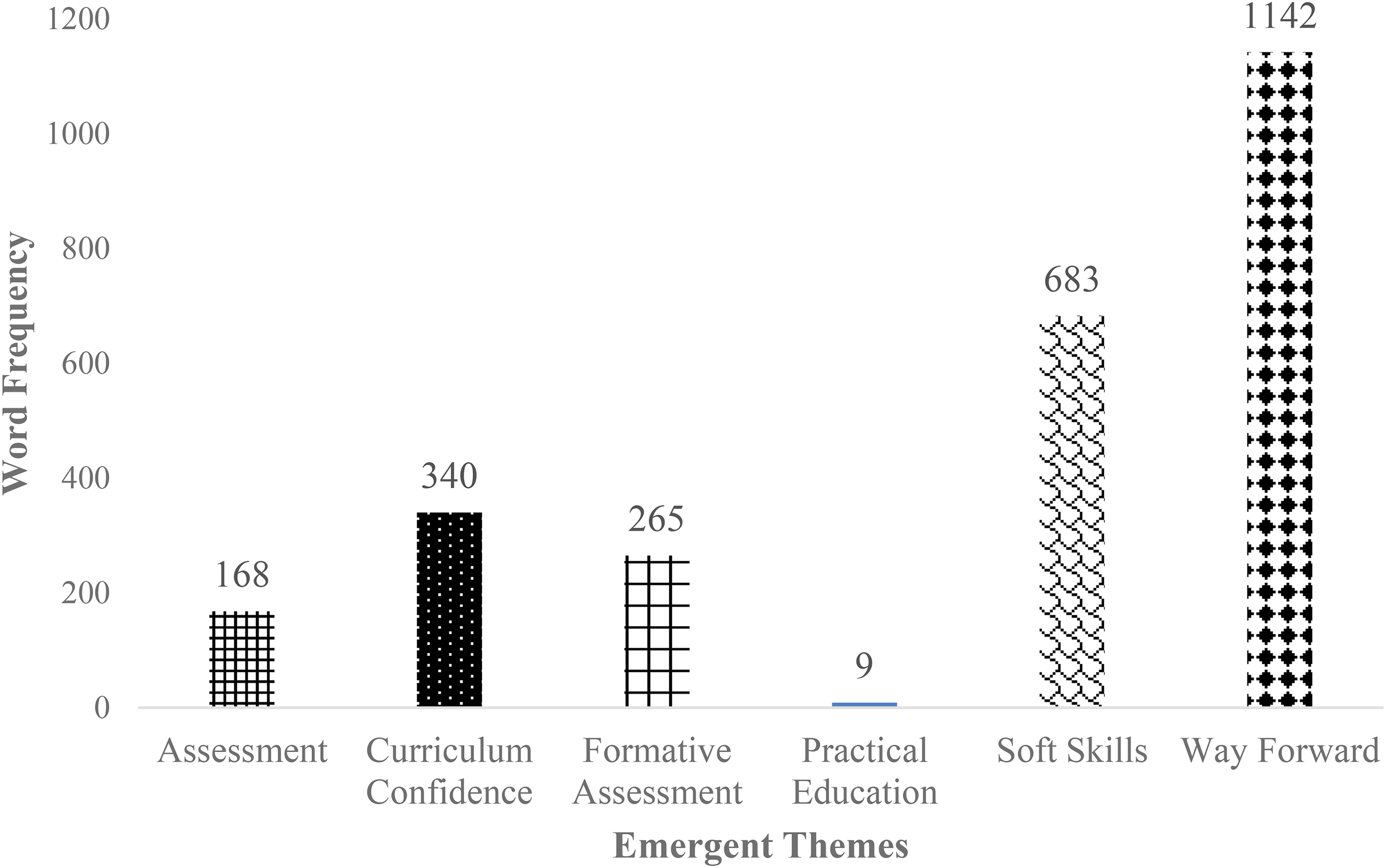
Business education curriculum competencies.
Under soft skills needed for twenty-first-century skills, students identified communication and leadership abilities, self-confidence, collaboration, and networking themes. The findings aligned with Knight and Yorke's (2004) recommendation for competency learning outcomes such as initiative, independence, grit, oration, attention to detail, time management, adaptability, responsibility, and scientific thinking. Indeed, the demand for competency-based learning outcomes is a denouncement of “banking” concept of Paulo Freire’s (1993) classical piece on critical consciousness of educational learning outcomes. A female student in the accounting department elected to the position of “Auditor” [for student union] shared a leadership experience: What I can say is [that] some of [amongst several soft skills acquired], let me say from my perspective, my leadership skills have [been] developed though I had that courage from my senior high school as a girls’ prefect, university education has given[me] more ability to communicate and talk to people. (Abi)
On interpersonal relationships, public speaking, and self-confidence skills acquired from the business education school, Abi also stated, “…when I got here [university] with a little interaction I had, I was able to communicate with my Lecturers, Head of the Department, [and] able to manage social relationships on different platforms [fora].”
Communication is an important university skill where lecturers introduce students to presentations working on group assignments, portfolios, and research papers. Confidence and communication skills were dominant experiences from students’ discussions with Felix, a Post-Diploma Accounting student who narrates, “sometimes that alone [class presentation] boosts your morale. You know [sic] you can stand before people and speak [communicate] irrespective of fears, you will be able to sail through [stage fright management].” Like Abi, Kwame served as a Financial Secretary for a local church to acquire relevant leadership competencies; and stated, “I couldn’t have done these [leadership roles] because I see things [differently now] and I have learned many skills through meetings, organising events, and church activities. All these had imparted my growth significantly and I can now advice [counsel] families and friends.” Felix also mentioned networking skills from his university curriculum. He reported, “As for me, it's knowing people [networking]” and added, “…It is [networking that] pushed me in my previous work, coupled with internship experiences from a tax [revenue collection] agency where I met big [prominent] people, which gave me confidence as well.”
Summarizing students’ views on competencies, Razak, a human resource management student, and a student leader affirmed, “Yes, yes, yes [emphasised]. That one [benefits of education] we [students] cannot run away from it. Because the word education is broad. That all faculty members are trained. I think there are a lot of things we wouldn’t have access to if we hadn’t come here [university]. Apart from the classroom tuition alone, if you put the tuition aside, the socialization, the rapport, we met people, and we‘ve created opportunities [networking].”
Curriculum Gaps
On the achievement of twenty-first-century skills, students extensively identified potential curriculum gaps inherent in the business education programs in this study. While students have acknowledged the importance of digital literacy and lifelong learning for the knowledge economy, they were concerned about their employability status after university graduation with a male human resource student's (Sam) recommendation to intensify practical lessons (linking theory to practice) in the business education curriculum. Sam puts it, “IT [information technology] should be widely used in all business education courses. Because, if you want practical learning, then teachers should use IT tools in every course. Because without IT knowledge, we cannot compete for employment today.” Students’ lamentation about their curriculum limitation on digital skills feeds into narratives about the inheritance of postcolonial school structures, which is problematic for quality education for many Global South nations (Adzahlie-Mensah, 2013; Dei, 2012; Nyamnjoh, 2012). Hence, the evaluation of students’ voices on competency gaps should inform teachers’ professional development and academic program accreditation focusing on an integrated modeling of contemporary topics such as climate change and sustainability, resilience, ethical standards, and technology.
The need for creative pedagogy to address students’ achievements in the twenty-first century has been featured in students’ curriculum evaluation (Cornelia et al., 2013). Educational technologists have coined the term, technology integration literacy to denote students’ ability to effectively apply digital media in meeting curriculum learning goals (Shelly et al., 2012). Oblinger (2012) acknowledged the key roles of computers in the marketplace today, but curriculum integration with digital tools remains a challenge for graduate employability in sub-Saharan Africa (McCown, 2015). In this study, students demonstrated low confidence in integration literacy, “I will talk about IT. The IT should be the main instructional medium connecting student curriculum to real-world problem-solving.” As higher education institutions continue to invest in information and communication technology policies and increase access, faculty members’ technology professional content knowledge will meet students’ demand for technology integration literacy.
Students also recommended lifelong learning opportunities as important graduate competency for the twenty-first-century university curriculum. Rita, a human resource management student noted, “When we are outside, we need [to] learn again. Maybe we can also develop ourselves further by learning new things after university [emphasis], but learning should be more practical instead of theories and memorization.” Graduates’ proficiency in handheld devices, instant messaging, data analytics, and social media skills to connect friends, families, and subject matter experts around the world will be relevant for curriculum reforms.
The need for creative pedagogy to address students’ achievements in the twenty-first century (Cornelia et al., 2013; Oblinger, 2012; Shelly et al., 2012) must transcend rhetoric. Faculty members’ curriculum knowledge will also be vital for students’ technology literacy, aligning learning outcomes with pedagogy, and subject-specific digital integration is a challenge for higher education. For instance, COVID-19 had exposed many universities’ incapacity to readily migrate instructions online. Therefore, management should be intentional about strategic funding of digital infrastructure and technology pedagogical training for improved graduate employability.
ESD Learning Outcomes
In a follow-up question, has a university education offered you additional skills including sustainability? While students acknowledged reading about SDGs from their business curriculum and case studies, they were unable to indicate how they could apply them to their future careers and community development. Rita, a human resource management student observed, “we have read about it in our management textbooks and heard our faculty members using sustainability terms, but we are not sure about how it [ESD] works, relates to our learning and its application to our lives.” The study concluded that business students’ curriculum experiences in ESD learning outcomes were low.
ESD learning outcomes proposed by Calder (2016) include transdisciplinary knowledge, systemic understanding, environmental skills and sustainability, and ethical standards. Though students could not readily recall topics on ethics and transdisciplinary knowledge, critical thinking is part of the university's curriculum development across the African education terrain (MBSSE, 2020; NaCCA, 2018). Also, ethics might reflect in several business courses (as core or electives) required for graduation such as quantitative techniques, African studies, language and study skills, marketing, accounting, finance, and human resource management). However, students’ inability to share experiences on sustainability might reflect a lack of emphasis on cross-cutting themes. Sustainability researchers have suggested the introduction of stand-alone courses on sustainability (Holdsworth & Thomas, 2015). Such propositions ought to factor overwhelming credit hours required for graduation in many higher education institutions, lack of capacity in sustainability, internationalization of higher education, and accreditation mandates for country education regulatory bodies.
Despite the sovereignty of nations, race, diversity, sea, air travel, hyperconnectivity, and geopolitics, globalization has brought nations and individuals together to share common resources. Such interactions are impacting global health and the environment with a call for intentionality to educate students on sustainability (Osokina, 2022). These imperatives and technological innovations justify a demand for teachers’ ESD goals attainment and integration of competency-based learning activities into overall curriculum framework instead of adding new subjects on ESD to the already burdened school curriculum (Schreiber & Siege, 2016).
Integrated Curriculum Model
The narrative data informed an integrated model for deep learning and restructuring of extant higher institution curriculum focusing on global development indicators and learning theories. Cognitive and developmental theorists (e.g., Jean Piaget, Ben Bloom, and Lev Vygotsky) have historically informed educational measurement and evaluation (Ornstein & Hunkins, 2018). As these theorists remain relevant to learning outcomes, learning scientists and global education stakeholders continue to influence curriculum development for the Global South. Such influences are emphasizing students’ learning outcomes to cover abilities and knowledge in competencies and sustainability. Daily demands on a teacher to maintain discipline and achieve curriculum targets can blight ESD curriculum realization without and integrated modeling of extant curriculum philosophies from Indigenous, national, and development partners. Besides, global development indicators that are oblivious of contextual factors have resulted in project failures in many developing countries today. The adoption of external policies and their failures have been extensively documented as characterizing social imaginaries, charisma, performative, and mimicry (Ames, 2019). Guided by findings on competency-based curriculum with minimal knowledge about ESD goals, Figure 2 presents an integrative sustainability curriculum in tandem with a nation's curriculum philosophy.
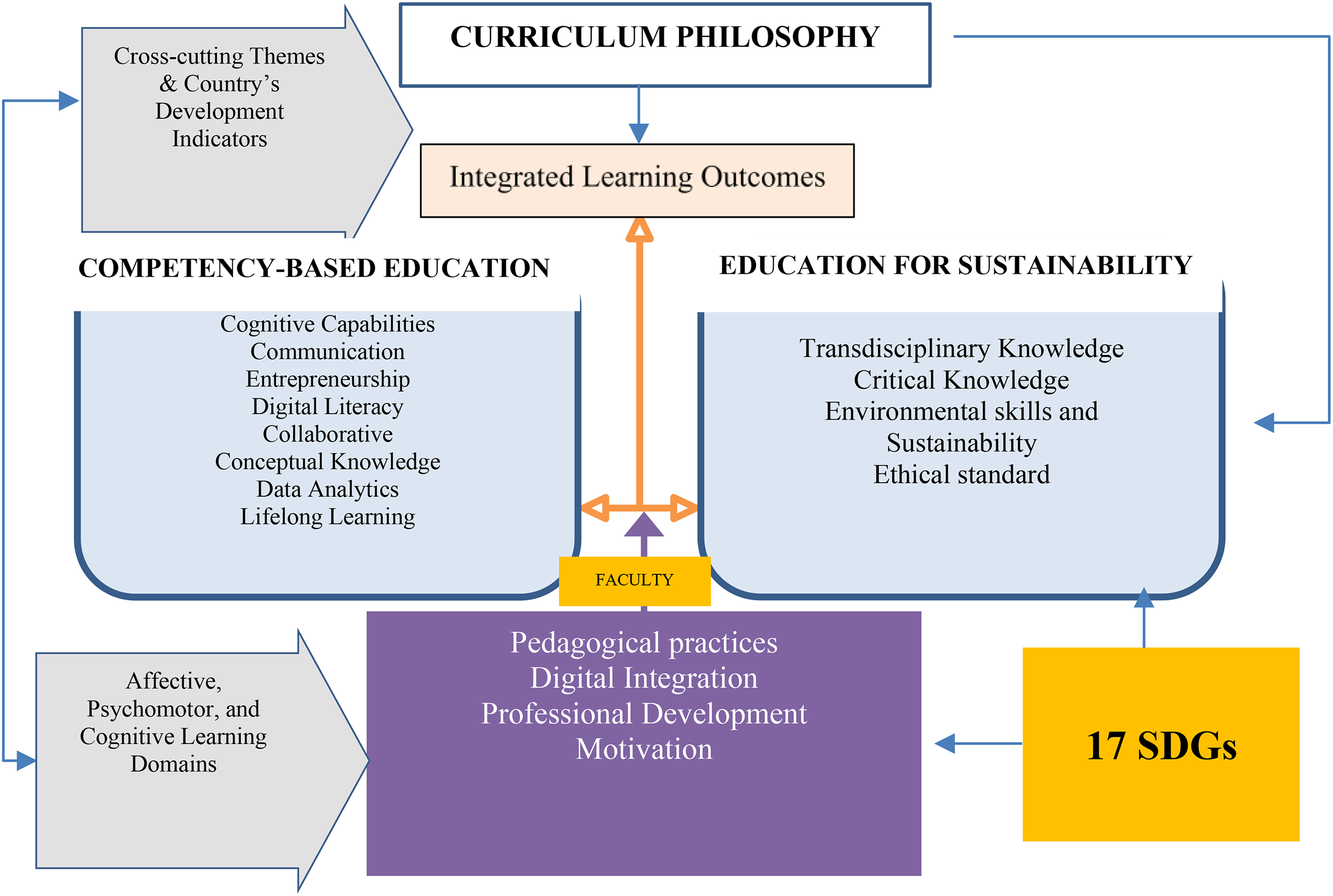
Integrative sustainability curriculum model adapted from Calder's (2016) ESD target domains.
Cross-cutting themes including national development indicators, climate change, gender equity and social inclusion, culture, digital innovations, global health, entrepreneurship, and youth demographics are at the apogee of the integrative model. The cross-cutting issues informing curriculum innovations are intricately linked with learning domains, which are informed by Bloom's taxonomy (affective, psychomotor, and cognitive) and pedagogical practices that will guide students; core competencies education (CBE) and ESD targets. Above all, Figure 2 accounted for Indigenous practices in support of sustainability education outcomes within the 17 SDGs.
Originally, Calder's (2016) four ESD learning domains focused on students’ transdisciplinary knowledge from different academic fields, cognitive science (critical thinking), climate and environment appreciation, and ethical practices, but silent on exemplars from cross-cutting themes. Faculty members’ ability to relate content standards to examples such as marginalization, inclusion, differentiation, gender, sexuality, conflict and peace, global citizenship, technological innovations, entrepreneurship, resilience and global health, and Indigenous culture are implied in ESD targets. Practically, achievements of learning outcomes must stem from the existing curriculum framework for a country. In addition, teachers’ classroom exemplars should take cognizance of the 17 SDGs, the school environment, the country's development indicators, and emerging cross-cutting issues.
Conclusion and Recommendations
Based on thematic analysis, the study explored 11 business education students’ curriculum experiences from the interpretivism data generated from a PRA. However, the findings showed students’ ambivalence about their competencies developed from the business education curriculum. Also, marginal knowledge about sustainability domains was reported in this study. As the participants recognized the importance of twenty-first-century skills (soft skills), they demonstrated low curriculum confidence in connecting theory to practice (practical education). Business education students showed contrition for lack of formative assessment practices informing competency-based curriculum outcomes. For instance, students identified gaps in authentic assessment practices, including learning opportunities, assessment for teaching and learning, and limited opportunities for project-based learning. However, results showed gloating accounts of leadership, communication, collaboration, and networking skills from the interview data.
The study concluded that business education curriculum delivery in the study area was overwhelmingly influenced by lack of competency-based learning outcomes with a lack of faculty intentionality about ESD learning domains in the business education curriculum. Though an important theme influencing the global development agenda, it appears that a developing country like Ghana is yet to mainstream ESD themes into its higher education curriculum implementation. Higher education learning outcomes ought to deliberately incorporate transdisciplinary knowledge, systemic understanding, environmental skills and sustainability, and ethical standards into curriculum philosophy; else these learning domains will remain rhetoric in the Global South. To surmise, students’ ability to connect their content standards to real-world problem solving involving environmental skills will complement their digital algorithms skills. Therefore, learning scientists ought to support ESD targets integration into curriculum models which account for diversity of community, formal and informal education programs. Otherwise, the study curriculum reforms could be unproductive as students’ core competencies would continue to be subsumed in curriculum debates for higher education institutions in the Global South.
Recommendations
Indeed, the development of a full-fledged ESD curriculum will remain a herculean task for many autonomous universities already administering accredited programs, but the adoption of an integrative sustainability curriculum will empower faculty members to educate the next generation of learners for the realization of the 17 SDGs and twenty-first-century skills development needed for the knowledge economy. The study also recommends professional faculty development support targeting curriculum philosophy, pedagogical and authentic assessment practices, cross-cutting issues, and environmental sustainability through digital and real-world scenario simulation based on learner diagnostics and career profiles. However, further research on higher education curricula will be relevant for understanding teachers’ preparedness to merge existing accredited programs with ESD learning outcomes using large-scale survey approaches rather than narrative data could expand the discourse on integrated curriculum frameworks for higher education.
Footnotes
Declaration of Conflicting Interests
The author(s) declared no potential conflicts of interest with respect to the research, authorship, and/or publication of this article.
Funding
The author(s) received no financial support for the research, authorship, and/or publication of this article.
