







Abstract
This paper introduces the Comprehensive Structural Equality Framework to promote equality, diversity, and inclusion in educational institutions by addressing systemic inequalities and aligning with global standards, including the UN Sustainable Development Goals. Built on a detailed literature review and theories like Critical Race Theory, Social Justice Theory, and Intersectionality, the framework is analyzed for its potential impact across educational contexts. Findings show that integrating these theories forms a strong base for combating systemic biases and fostering inclusivity. The paper, while conceptual, highlights challenges like adaptability and calls for future empirical validation to assess effectiveness.
Keywords
Introduction
Context and Background
In today's interconnected world, educational institutions are essential in molding the thoughts and prospects of individuals who come from diverse backgrounds. Beyond academic instruction, these institutions are responsible for fostering environments that promote equality, diversity, and inclusion (EDI). While often perceived as neutral spaces offering equal opportunities, Structural Inequality Theory highlights how educational institutions can perpetuate social inequalities through entrenched systems and practices. Bourdieu (1986) argues that social and cultural capital are unevenly distributed, leading to disparities in educational outcomes. As educational settings become more diverse, the need for comprehensive EDI frameworks is increasingly urgent. According to University College Dublin's Equality, Diversity and Inclusion Policy (University College Dublin, 2018), a strong commitment to EDI, backed by strategic vision, yields numerous advantages for universities like attracting, retaining, and developing both students and employees, which in turn enhances performance, fosters a sense of dedication, engagement, and well-being, and ultimately drives the pursuit of excellence.
EDI is not just aspirational but essential for a just educational system. Equality guarantees that everyone has equal access to opportunities, whereas diversity acknowledges and values the unique differences among individuals. Inclusion creates environments where everyone feels valued and can contribute fully. Enhancing EDI offers significant benefits. It brings a renewed emphasis on the wellbeing of both scholars and students within universities and academic institutions. By improving EDI, these institutions can promote a greater sense of togetherness and belonging for everyone involved, which is likely to enhance both commitment and performance (Buitendijk et al., 2019).
Ignoring EDI can lead to systemic biases, resulting in significant barriers for marginalized groups perpetuating cycles of inequality. Institutions that fail to prioritize EDI risk alienating parts of their community, leading to disengagement, lower performance, and higher dropout rates. Conversely, those who embrace EDI are better equipped to create supportive learning environments, fostering critical thinking and preparing students for a multicultural world. Therefore, developing and implementing robust EDI frameworks is crucial for creating truly inclusive educational spaces.
Problem Statement
Despite the recognized importance of EDI, there remains a significant gap in the consistent application of EDI principles across educational institutions. While some have developed inclusive policies, many lack a coherent, comprehensive framework, leading to fragmented and reactive efforts. Structural Inequality Theory posits that systemic disparities are embedded in institutional structures, not just individual biases. For instance, as Wilson (1978) notes, institutional practices continue perpetuating inequalities even as overt discrimination declines.
The absence of a standardized EDI framework results in inconsistent approaches, where inclusivity efforts often fail to address deeper systemic issues. This inconsistency hinders progress, making it difficult to measure the effectiveness of EDI initiatives and hold institutions accountable. As a result, certain groups continue to face barriers to full participation, affecting the overall educational experience.
This paper addresses the need for a comprehensive, standardized EDI framework that can be adopted by educational institutions to ensure consistent and effective promotion of EDI. The goal is to provide tools that create inclusive environments, supporting the success of all individuals.
Objective and Scope
The paper's primary objective is to propose a comprehensive conceptual framework for promoting EDI in educational institutions. Recognizing inconsistencies in current practices, it seeks to provide a unified approach adaptable to various educational contexts, ensuring equal opportunities for all.
This conceptual paper aims to develop and express ideas and theories, rather than presenting empirical research. It explores existing literature, philosophies, and theoretical perspectives related to EDI, leading to a robust framework for implementation in educational institutions. The scope includes critically examining current EDI practices and philosophical underpinnings.
While the paper does not offer empirical validation, it lays the groundwork for future research and practical application. The framework presented serves as a foundational model for further testing, refinement, and customization based on institutional needs. The aim is to contribute to the discourse on inclusivity in education and provide actionable insights for educational leaders and policymakers.
Thesis Statement
This paper hypothesizes that implementing a comprehensive EDI framework tailored to the unique dynamics of educational institutions can significantly enhance inclusivity, foster equal opportunities, and ensure compliance with diversity standards. This framework aims to create a more cohesive and effective approach to promoting EDI across educational environments by addressing systemic barriers and inconsistencies.
Literature Review
The literature review for the Comprehensive Structural Equality Framework (CSEF) focuses on existing theories, models, and some of the initiatives taken by educational institutions related to EDI in educational institutions. This review highlights the foundational theories guiding the framework's development, identifies gaps in current initiatives, and discusses how integrating Structural Inequality Theory and other theoretical perspectives can offer new insights.
Theoretical Foundations of CSEF
Critical Race Theory
Critical Race Theory (CRT), as articulated by Delgado and Stefancic (2017), offers a powerful framework for understanding how race and racism intersect with other forms of social stratification. Although rooted in the context of racism in United States, CRT's relevance extends globally, addressing systemic discrimination across various dimensions, including caste, gender, religion, and ethnicity. The critical race approach offers the significant benefit of providing a more profound understanding of the root causes of racial and ethnic inequality, along with practical tools to address and advance solutions (Buitendijk et al., 2019). CRT highlights the significance of including a variety of perspectives to challenge and dismantle inequalities in education. By highlighting how laws and policies perpetuate social disparities, CRT serves as a vital theoretical perspective for developing inclusive frameworks that address these broader forms of discrimination.
Intersectionality
Intersectionality, introduced by Crenshaw (1991), explores how various social identities, such as race, gender, and class combine to form distinct experiences of both oppression and privilege. Crenshaw's concept has been pivotal in understanding the multifaceted nature of discrimination and ensuring that EDI frameworks address the complexities of intersecting identities (Crenshaw, as cited in Luscombe, 2020). This approach has significantly shaped how we understand and address the overlapping forms of inequality that individuals face.
Transformative Learning Theory
As proposed by Mezirow (1997), Transformative Learning Theory focuses on how individuals make meaning of their experiences through critical reflection and discourse. This theory is relevant for EDI frameworks as it emphasizes the importance of transformative learning processes in challenging existing biases and fostering inclusive practices.
Structural Inequality Theory
Structural Inequality Theory, as developed by Bourdieu (1986), examines how social structures perpetuate inequality through various forms of capital (economic, social, and cultural). Bourdieu's framework is useful for understanding how educational institutions can reproduce systemic inequalities and how structural changes are necessary to address these issues.
EDI Initiatives Being Undertaken by Educational Institutions Globally
Educational institutions worldwide are increasingly recognizing the importance of EDI and are implementing various frameworks and initiatives to foster inclusive environments. Below is a representational analysis of some key institutions and their EDI efforts, followed by an examination of the identified gaps and how the CSEF can bridge these gaps.
Oxford University's Equality and Diversity Unit is dedicated to nurturing an inclusive culture that appreciates diversity across the institution. The unit provides advisory services on various EDI issues, excluding those specifically related to disabled students, who are supported by a separate Disability Advisory Service. The unit also oversees the University's Harassment Advisory Service and collaborates with advisory groups such as the BME Staff Advisory Group and the LGBT + Advisory Group, ensuring broad representation in EDI efforts (University of Oxford, 2024).
Edge Hill University's EDI unit focuses on promoting equality and diversity throughout the institution by developing policies, raising awareness, and providing support services. The unit is vital in guaranteeing compliance with legal requirements and advancing the university's commitment to EDI in all aspects of campus life (Edge Hill University, 2024).
Harvard University's Office for Equity, Diversity, Inclusion, and Belonging (OEDIB) strives to create an inclusive community that embraces diversity in all forms. The office promotes “inclusive excellence” by ensuring that individuals from various backgrounds, cultures, races, identities, and life experiences are fully embraced and respected (Harvard University, 2024). Ashoka University Ashoka University has implemented a robust Inclusion, Diversity, and Belonging (IDB) framework, as outlined in their 2023–2024 report. The university's approach emphasizes diversity across dimensions such as gender, socio-economic background, and regional representation, making sure that every community member feels valued and supported in their academic and personal growth (Ashoka University, 2024).
The American Psychological Association (APA) has developed an EDI framework that provides a comprehensive model for embedding EDI principles within academic and professional settings. The framework prioritizes equity, diversity, and inclusion, offering a valuable template that educational institutions can adapt to create more inclusive environments (APA, 2024).
The NGIFEIE framework aligns with India's National Education Policy 2020 to promote equity and inclusivity across the Indian education system. It provides a roadmap for creating inclusive learning environments in various educational settings, with guidelines for stakeholders such as teachers, administrators, and communities to ensure that all students, particularly those from Socio-Economically Disadvantaged Groups, have access to equitable learning opportunities (Ministry of Education, 2024).
Identified Gaps in EDI Initiatives
While these institutions and frameworks have made significant strides in promoting EDI, several gaps remain:
Alignment With UN Sustainable Development Goals
The Sustainable Development Goals (SDGs) set by the United Nations (UN) in 2015, and endorsed by 193 nations, aim to eradicate poverty, protect the environment, and foster prosperity by 2030 (United Nations, n.d.). These goals emphasize the importance of social welfare as a crucial aspect of sustainability. There is a strong link between goals focused on reducing inequalities and achieving gender equality, and the broader objective of providing quality education for all, which in turn supports the creation of decent work opportunities. Additionally, education plays a crucial role in promoting health and encouraging civic and cultural engagement (European University Association, 2018).
The proposed EDI framework for educational institutions correlates with various United Nations SDGs, especially those aimed at guaranteeing inclusive and equitable quality education and fostering lifelong learning opportunities for everyone. The alignment with the SDGs underscores the framework's relevance and commitment to global development objectives. This section explores how the framework supports specific SDGs and contributes to their achievement.
SDG 4: Quality Education
Goal 4 seeks to provide fair and accessible education for everyone and facilitate lifelong learning opportunities for all. The CSEF directly supports this goal through its focus on:
SDG 5: Gender Equality
Goal 5 focuses on achieving equality between men and women and strengthening the position of women and girls. The CSEF contributes to this goal through:
SDG 10: Reduced Inequalities
Goal 10 seeks to decrease disparities both within and between nations. The CSEF supports this goal by:
SDG 16: Peace, Justice, and Strong Institutions
Goal 16 seeks to foster peaceful and inclusive communities for sustainable growth, ensure justice is accessible to everyone, and develop effective, accountable, and inclusive institutions. The CSEF aligns with this goal by:
Contribution to Broader SDG Agenda
The EDI framework not only supports the specific SDGs mentioned above but also contributes to the broader SDG agenda by fostering a culture of inclusion, equality, and justice within educational institutions. By aligning with these global goals, the framework demonstrates its commitment to advancing sustainable development and creating positive social change.
Methodology
The CSEF was meticulously created through a thorough examination of existing literature and a synthesis of theoretical perspectives. The framework draws on foundational theories such as Structural Inequality Theory (Bourdieu, 1986), CRT (Delgado & Stefancic, 2017), Intersectionality (Crenshaw, 1991), and Transformative Learning Theory (Mezirow, 1997). These theories were chosen for their relevance in addressing complex and multifaceted issues of EDI within educational institutions.
To ensure that the CSEF addresses the identified gaps in existing EDI initiatives globally, the methodology involved a representational analysis of EDI initiatives from leading educational institutions, such as those at Oxford University, Edge Hill University, Harvard University, Ashoka University, the American Psychological Association (APA), and the National Guidelines and Implementation Framework on Equitable and Inclusive Education (NGIFEIE) 2021–2030 by the Government of India. The analysis concentrated on pinpointing the strengths and limitations of these initiatives, which informed the refinement of the CSEF.
Given constraints on resources and time, scenario testing of the CSEF was not conducted at this stage. Instead, the framework remains a theoretical model outlining key principles and components for fostering EDI in educational settings.
Future iterations of the CSEF will include scenario testing and expert consultations. Scenario testing will involve applying the framework to various hypothetical or real-world educational contexts to evaluate its practical impact and effectiveness. Meanwhile, expert consultations will provide critical feedback and insights to further enhance the robustness and relevance of the framework. These steps will ensure that the CSEF evolves into a comprehensive tool capable of addressing the complex challenges of equity, diversity, and inclusion in educational institutions globally.
Conceptual Framework
Framework Overview
Built on the theoretical perspectives of CRT, Intersectionality, Transformative Learning Theory and Structural Inequality Theory, the CSEF is designed to bridge gaps identified in existing EDI initiatives by integrating three foundational principles:
Key Components of the CSEF
Library as a Central EDI Resource:
Application of the CSEF in Educational Institutions
The CSEF is meant to be flexible and applicable to various educational contexts institutions, including schools, colleges, and universities. Its flexible structure allows for customization to meet the unique needs, challenges, and objectives of each institution, ensuring that EDI principles are embedded in every aspect of institutional life. Regardless of their size or type, educational institutions encounter similar challenges in implementing EDI principles, with success largely depending on the support and commitment from decision-makers and the active participation of all stakeholders (GALE, 2022).

UN SDGs Supported by CSEF.
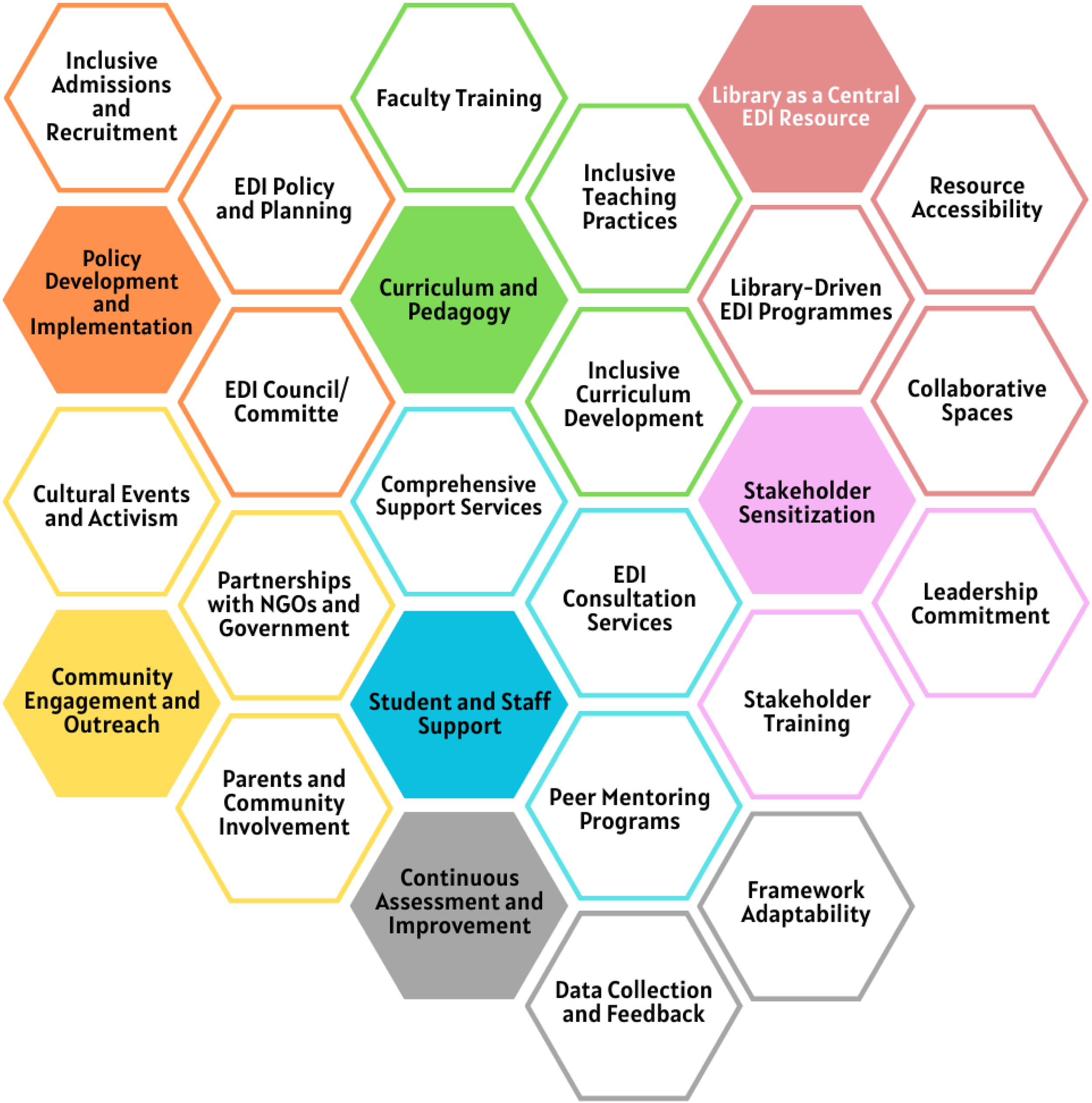
Key Components of CSEF.
In primary and secondary schools, the CSEF framework can be applied to create an inclusive environment that reflects the diverse backgrounds of students. Schools can incorporate multicultural literature into reading lists, offer training for teachers on culturally responsive pedagogy, and establish peer mentoring programs to support students from underrepresented groups. Additionally, schools can engage parents and local communities in EDI initiatives, fostering a sense of shared responsibility for creating inclusive environments.
2.
As per Sanger and Gleason (2020), if higher education institutions fail to incorporate the diverse perspectives and their learners more thoughtfully then their classrooms risk inadequately preparing their graduates for success in an increasingly interconnected global world. At the college level, the CSEF framework can guide the development of comprehensive student support services, such as diversity offices, mental health counselling, and academic advising tailored to the needs of minority students. Colleges can also implement EDI-focused professional development programs for faculty and staff, ensuring they are equipped to support diverse student populations. Additionally, colleges can use the framework to create inclusive campus policies, including those related to housing, student organizations, and campus safety.
3.
Higher education institutions have frequently faced criticism for not adequately representing the diversity of the broader society, leading to the privileging of certain groups while marginalizing others (Zhao et al., 2024). As observed by Professor Michael Murphy, former European University Association (EUA) President, in a rapidly evolving world where awareness of various dimensions of diversity—such as cultural, gender, and sexual orientation—is increasing, universities cannot afford to be exclusive. With the core values of openness and tolerance, universities need to embrace and celebrate diversity, ensuring that inclusivity is at the heart of our educational mission (European University Association, 2019). Universities, with their larger and more complex structures, can apply the CSEF framework to integrate EDI principles across all facets of institutional life. This might include revising tenure and promotion criteria to recognize contributions to EDI, establishing research centers focused on diversity issues, and offering scholarships to students from underrepresented groups. Universities can also leverage their position within the broader community to lead EDI-related research, advocacy, and policy development, extending the impact of their initiatives beyond the campus.
Case Study Example of Application of CSEF in Universities
A university adopting the CSEF framework could begin by conducting a comprehensive assessment of its current EDI practices, identifying gaps, and areas for improvement. The university might then establish a task force to develop a strategic EDI plan, incorporating input from students, faculty, staff, and community stakeholders. Over the next few years, the university can form an EDI Council to implement various components of the framework (Figure 2), such as revising curricula to include diverse perspectives, offering training programs for faculty on inclusive teaching practices, and launching outreach initiatives to engage with local communities. The university would regularly assess the impact of these initiatives by the EDI Council, adjusting as needed to ensure continuous progress toward its EDI goals.
By applying the CSEF framework, educational institutions can create environments that are not only diverse and inclusive but also dynamic and responsive to the needs of all members of their communities. This approach ensures that EDI is not treated as a secondary concern but as a central element of the institution's mission and operations.
Discussion
Critical Analysis
The CSEF presented in this paper is a comprehensive attempt to integrate various theoretical perspectives into a practical approach for enhancing EDI within educational institutions. By incorporating Structural Inequality Theory, CRT, Intersectionality, and Social Justice Theory, the framework addresses the systemic barriers that perpetuate inequalities. The framework emphasizes the central role of libraries in promoting EDI, positioning them as pivotal in providing equitable access to resources and knowledge. However, the application of these theories in diverse educational settings presents both opportunities and challenges. While the framework is conceptually sound, its practical implementation may vary significantly across different institutions, depending on their unique contexts, resources, and commitment to EDI.
Strengths
One of the key strengths of the CSEF lies in its holistic approach. The framework does not treat EDI as a standalone initiative but integrates it into the core functions of educational institutions, from policy development to community engagement. The emphasis on libraries as central to the EDI mission further strengthens the framework by ensuring that knowledge dissemination and access are inclusive. The adaptability of the framework allows it to be tailored to address the specific needs of various types of educational institutions, whether they are schools, colleges, or universities. Additionally, the inclusion of stakeholder sensitization, continuous assessment, and the strategic use of libraries ensures that the framework remains dynamic and responsive to changing circumstances.
The framework's focus on content creation, community engagement, and advocacy provides a comprehensive strategy for addressing the diverse challenges related to EDI in education. By targeting the structural aspects of inequality, the CSEF encourages institutions to move beyond surface-level interventions and address the deeper, systemic issues that contribute to exclusion and discrimination.
Limitations
Despite its strengths, the CSEF has certain limitations. First, the framework remains largely theoretical and lacks empirical validation. While it is grounded in well-established theories, the absence of real-world application data means its effectiveness in diverse educational settings remains untested. Additionally, the framework's success heavily depends on institutional commitment and the availability of resources. Institutions with limited financial or human resources may struggle to implement the framework effectively.
Another limitation is the potential resistance from stakeholders who may not fully understand or support EDI initiatives. Without strong leadership and clear communication, efforts to implement the framework could face significant challenges. Moreover, the framework's reliance on continuous assessment may be difficult to sustain over time, particularly in institutions where EDI is not a priority.
Possible Challenges
Implementing the CSEF in educational institutions may encounter several challenges. Resistance to change remains a significant obstacle, particularly from those who benefit from the status quo. Additionally, the framework requires a high level of coordination and collaboration among various stakeholders, which may be difficult to achieve in institutions with entrenched hierarchies or siloed departments.
Furthermore, the varying levels of awareness and understanding of EDI principles among faculty, staff, and students can hinder the framework's implementation. Ensuring that all stakeholders receive proper training and informed about the importance of EDI is essential but may be resource intensive.
Comparative Discussion
When compared to other EDI frameworks, the CSEF distinguishes itself through its integration of multiple theoretical perspectives and its emphasis on structural inequality. Unlike models that focus primarily on individual behavior or cultural competence, the CSEF addresses the institutional structures and policies that perpetuate inequality. The inclusion of libraries as central to the EDI strategy makes the framework more comprehensive and potentially more effective in creating lasting change.
However, the CSEF also shares some common challenges with other frameworks, such as the difficulty of measuring progress and ensuring consistent application across different contexts. While other models may offer more prescriptive solutions, the CSEF's adaptability allows for a more nuanced approach, which can serve as both a strength and a limitation depending on the institutional context.
Philosophical Reflections
The development of the CSEF is deeply rooted in philosophical reflections on the nature of EDI. Drawing on theories such as CRT and Social Justice Theory, the framework challenges the notion of educational institutions as neutral spaces and instead posits them as active agents in either perpetuating or dismantling social inequalities. The emphasis on structural inequality and the central role of libraries reflects a broader philosophical commitment to social justice and the belief that true inclusion can only be achieved by addressing the root causes of inequality.
This philosophical approach raises important questions about the role of education in society and the responsibilities of educational institutions. By framing EDI as a structural issue rather than an individual one, the CSEF encourages a shift in focus from merely accommodating diversity to actively promoting equality and justice.
Practical Dimensions
In practical terms, the CSEF provides a roadmap for educational institutions to develop and implement EDI initiatives that are both comprehensive and contextually relevant. The framework's focus on policy development, curriculum design, and community engagement, along with the strategic role of libraries, offers practical guidance for institutions looking to enhance their inclusivity. The emphasis on continuous assessment ensures that EDI efforts are not static but evolve in response to changing needs and challenges. Moreover, gaining a deeper understanding of the workforce and implementing well-informed EDI initiatives can significantly contribute to fostering an inclusive culture within organizations and across the broader industry (Thinking Ahead Institute, 2023).
However, the practical implementation of the CSEF will require significant resources, including time, funding, and expertise. Institutions will need to invest in training, data collection, and community outreach to fully realize the framework's potential. Additionally, the framework's success will depend on the willingness of all stakeholders to engage in the process and commit to long-term change.
Ethical Dimensions
The ethical implications of the CSEF are profound. At its core, the framework is concerned with promoting justice and equality in educational settings. By addressing systemic inequalities and emphasizing the role of libraries in promoting access to knowledge, the CSEF seeks to create environments where all individuals have the chance to thrive, irrespective of their background. This aligns with ethical principles of fairness, respect for diversity, and the moral obligation of educational institutions to serve the needs of all students.
Despite its benefits, the CSEF has ethical implications. Ensuring that all voices are heard, and that the framework is applied in a way that respects the dignity and autonomy of all stakeholders is crucial. Additionally, institutions must be mindful of the potential for unintended consequences, such as the marginalization of certain groups or the reinforcement of existing power dynamics. Careful consideration of these ethical dimensions will be essential to the successful implementation of the CSEF.
Conclusion
The CSEF presented in this paper offers a holistic and multifaceted strategy for advancing EDI within educational institutions. By integrating theoretical perspectives such as CRT, Intersectionality, etc., the CSEF addresses the systemic barriers that often hinder true inclusivity. Additionally, the framework emphasizes the pivotal role of libraries in advancing EDI, recognizing them as central to equitable knowledge access and resource dissemination. The CSEF calls for educational institutions to move beyond surface-level EDI initiatives and adopt a comprehensive strategy that includes policy development, curriculum design, stakeholder engagement, and continuous assessment, all while leveraging the strategic role of libraries.
The adaptability of the CSEF allows it to be tailored to the unique contexts of different educational institutions, making it a flexible resource for fostering inclusive environments. Its focus on structural change, rather than merely addressing individual behaviors, positions it as a critical framework for institutions committed to long-term, sustainable EDI efforts.
However, the successful implementation of the CSEF will require strong commitment from institutional leaders, adequate resources, and a readiness to participate in continuous reflection and adaptation. The framework's effectiveness will ultimately depend on the dedication of educational institutions to embed EDI principles into every aspect of their operations, culture, and particularly, their library systems.
Future Directions
As the revised CSEF is a conceptual framework, future research and practical application will be essential to refine and validate its effectiveness. Several avenues for future exploration and development are recommended:
By pursuing these future directions, the CSEF can be further developed and refined, ensuring it continues to be a relevant and effective resource for advancing EDI in education. The goal is to create educational settings where everyone, regardless of their background, has the opportunity to thrive and contribute to a more just and equitable society.
Footnotes

Funding
The author received no financial support for the research, authorship, and/or publication of this article.
Declaration of Conflicting Interests
The author declared no potential conflicts of interest with respect to the research, authorship, and/or publication of this article.