







Abstract
This article investigates translation teaching practices and translation modules in the English departments of Moroccan universities. A quantitative approach, involving a structured questionnaire with closed-ended, semiclosed-ended, and Likert scale questions, is used to collect quantitative data. The collected data are analyzed statistically using SPSS and presented. Findings reveal a general positive attitude towards translation modules and positive perceptions of skill development through translation classes. However, several issues are revealed, such as the negative attitude toward time allocated to translation classes, the teaching atmosphere, and current assessment methods. The findings also reveal significant differences in attitudes toward translation and perceptions of skill development through translation classes based on various factors such as time spent practicing translation outside of the classroom, attendance, and whether students are considering a career in translation or not. Similarly, students’ preferences for text types are influenced by their consideration of translation as a career.
Introduction
The world has become interconnected and globalized; hence, the growing vital need for translation. Media is growing at a very high rate because communication channels are increasing rapidly while knowledge and technological advancements are accumulating at an alarming pace, so translation is essential to navigate the complex environment of modern life (Stitou, 2011). Morocco has a long history of multilingualism and multiculturalism, which has been amplified due to colonization and globalization. De jure, the country recognizes standard Arabic and standard Amazigh as national languages. De facto, French has historically held a significant role as a colonial language and continues to be widely used in various domains, including higher education (Ennaji, 2005).
Morocco is considered one of the most active Arab countries in the field of translation, alongside Lebanon, Syria, and Egypt (Taib, 2021). The country's culturally rich and diverse linguistic context, coupled with its globalization efforts and openness to the world create a crucial need for translation. Alim (2017) categorized the history of translation in Morocco into three distinct periods: the precolonization period, the colonization period (1912–1956), and the postcolonization period. In 1989, the first cohort graduated from the King Fahd School of Translation in Tangier with a professional diploma in translation. According to a report by Fondation du Roi Abdul-Aziz Al Saoud pour les Etudes Islamiques et les Sciences Humaines (2022), translated texts made up 5% of published texts in Morocco in 2022. Seventy-five percent of the translated text had Arabic as the target language, 40% had French as the source language, and 19% had English as the source language. 78% of the texts were translated by Moroccan translators, while the rest were translated by translators from various Arab nationalities.
Morocco's higher education system comprises public, private, and semipublic institutions. However, public higher education institutions remain the primary providers of higher education in the country (Assad & Ait Si Mhamed, 2019). Limited-access institutions require formal selection procedures and entrance exams for enrollment. Therefore, enrollment in these institutions is limited. Enrollment in open-access institutions only requires a high school degree (baccalaureate). As a result, these public institutions are heavily attended. During the 2022–2023 school year, open-access institutions accounted for 85.9% of the total number of students in public universities (L’Enseignement Supérieur En Chiffres 2022_2023, n.d.).
Translation courses are offered at the department of English studies at all 12 public access universities. They are offered in 13 faculties of letters and humanities, two faculties of languages, arts, and humanities, one faculty of languages, letters, and arts, and 12 polydisciplinary faculties. Translation courses are also offered in various limited-access institutions, private institutions, and nonprofit institutions such as King Fahd School of Translation and the Euro-Mediterranean University of Fez (Statistiques Universitaires-Enseignement Supérieur Universitaire Public 2022–2023, n.d.).
A bachelor's degree in English studies at a public university in Morocco spans six semesters. The initial four semesters offer modules that are designated as the Common Core. They are shared across all public universities in Morocco. Later, students are given the option to choose a study stream (track). Usually, the choice is between the linguistics track and the literature track; however, some universities offer different tracks. The modules offered in the fifth and sixth modules differ from one university to another (El Boubekri, 2023). Tables 1 and 2 outline translation modules offered at different universities.
Translation Courses Offered in Moroccan Universities at the Undergraduate Level.
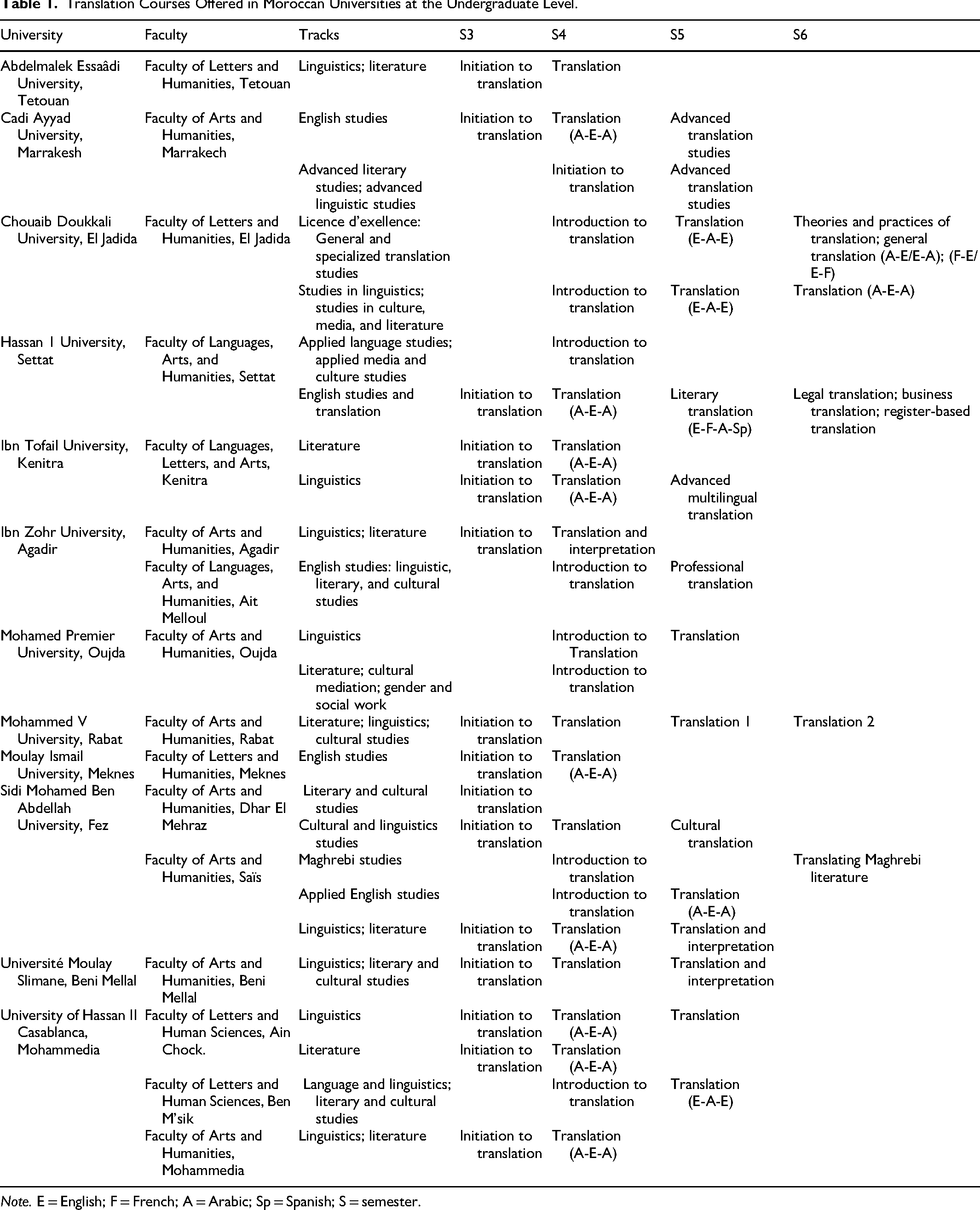
Note. E = English; F = French; A = Arabic; Sp = Spanish; S = semester.
Translation Courses Offered in Moroccan Universities at the Graduate Level.
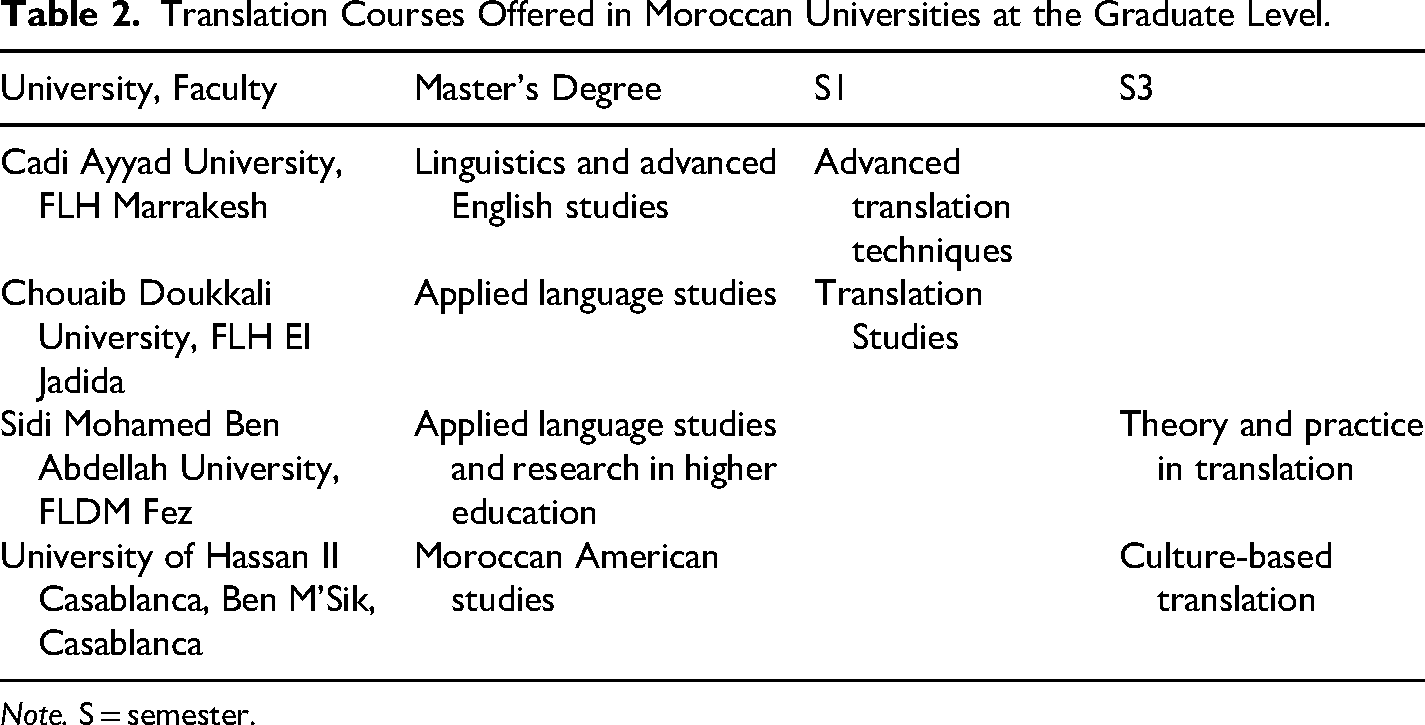
Note. S = semester.
The objectives of translation modules vary across different universities and different semesters. For instance, the Initiation to Translation module offered by most universities primarily aims to enhance language proficiency and introduce students to the metalanguage of translation. The Translation and Interpretation module, on the other hand, places a stronger emphasis on developing a specialization in translation. Moreover, it delves deeper into specific translation strategies for different genres. Translation classes mainly consist of practical exercises centered on the translation of different texts, followed by teacher-led discussions about students’ translations (El Boubekri, 2023).
As mentioned above, the majority of translation teaching done in Morocco takes place at the Department of English Studies. According to Hubert (2016), teaching translation at departments of foreign languages at the higher education level creates a problem that stems from the disparity in students’ language proficiency. However, he believes that a low level of speaking proficiency might not hinder the translation course's aims and objectives. El Boubekri (2023) advocates for a few changes in the teaching of translation within undergraduate translation courses at the department of English in Moroccan universities. He contends that in order for translation teaching to have a successful future, several key changes must be implemented, such as placing more focus on theoretical aspects and on learners’ social needs and shifting to goal-oriented methodologies and product-oriented approaches. He argues that these changes will better prepare students for specialized translation degrees and address discrepancies between course design and market demands.
Students often underestimate the complexity and significance of translation and perceive it as a simple task of finding word-for-word equivalents between languages. This reductionist view overlooks the interdisciplinary nature of translation and its connections to other fields of study. Limited class time and large class sizes at the undergraduate level make it difficult for teachers to provide individual attention and address student errors effectively. The current group work method relies on student interest and participation, which is often lacking, leading to ineffective group work. Moreover, the behavior of the unmotivated majority can be contagious and negatively affect the learning environment for the minority of students who are interested in translation (Gharafi, 2020).
Yermolovich (2015) argues that traditional translation textbooks that use text samples with glossaries and comments should be replaced with ones that adopt a semantic-situational approach. In the Moroccan department of English studies, textbooks are not widely used in translation classes. Thus, the teachers are forced to put in extra effort to provide students with the appropriate teaching materials for each level (Gharafi, 2020). Often, when textbooks are provided, they are given as further reading outside the classroom. Classroom time remains dominated by teacher-led translation practice. The lack of emphasis on the textbooks, when provided, leads to them being neglected by most students.
Hurtado Albir and Pavani (2018) found that multidimensional assessment is more comprehensive than single-dimensional because it gathers more data about the students. However, it found no major differences in terms of the final grade of students between both. Traditionally, summative exams have been used with the main aim of giving students a grade based on their ability to produce a correct translation based on an arbitrary correlation between the number of errors and a given grade. However, there has been a shift from the traditional analytical error-based approach to more holistic approaches that use constructive feedback to inform students. Thus, the focus has shifted from translation errors to decision-making processes (Campbell & Hale, 2003; Gouadec, 1981, 1989, 2003; Kussmaul, 1995; Pym, 1993; Veiga Díaz & García González, 2016). In the same vein, a study conducted by Griche (2024) found that Moroccan students at the English department believe that MCQ exams cannot properly evaluate their competence in certain subjects chief among them is translation.
Another study conducted by Ennam (2023) investigated the potential for English-oriented reform in Moroccan universities to develop English proficiency through translation classes. The study focused on 276 graduate and undergraduate students at Ibn Tofail University in Morocco and found that a substantial majority of respondents acknowledge that translation courses play a crucial role in enhancing bilingual proficiency. Moreover, most participants affirm that translation modules contribute to improvements in their English and Arabic writing abilities, reading comprehension skills, and vocabulary building.
In order to understand translation teaching practices in Moroccan universities at the undergraduate and graduate levels, gauge students’ attitudes towards translation modules and perspectives on language skill development through these modules and identify common difficulties and problems that students face in translation practice inside and outside the classroom, the article aims to answer the following research questions:
How are translation teaching practices structured across different Moroccan universities? How do Moroccan students at the department of English studies perceive translation modules and their effectiveness in developing their skills? What are the main challenges faced by students in translation modules?
Methodology
The study employs quantitative methodology, which involves collecting and analyzing numerical data using surveys and scales. It is descriptive in nature and adopts a cross-sectional design that collects data from the sample at a single point in time without influencing any variables, providing a snapshot into students’ attitudes and perspectives at that point in time.
Participants
The present study aims to draw conclusions about the theoretical knowledge and practical skills of undergraduate and graduate students at the department of English studies in Moroccan universities who have taken translation classes. While the researcher wasn't able to obtain up-to-date data about the exact number of students enrolled in English departments nationwide, a government report indicated that 239,020 students were enrolled in the faculty of humanities in the academic year 2022–2023. To reach this population, the study employs both convenience and snowball sampling, which are different non-probability sampling methods. Convenience sampling involves selecting respondents based on availability and accessibility, including volunteer sampling where participants self-select based on interest and availability (Mellinger & Hanson, 2017).
This method was employed to ensure that a large enough number of participants were involved. Snowball sampling, or network sampling, was also leveraged to reach individuals who share common traits by recruiting initial participants from the researcher's network, who then refer additional participants from within their own social networks. This method is particularly useful for accessing hard-to-reach populations and was used to ensure the inclusion of participants from different universities to increase the reliability of generalizations (Bryman, 2016; Creswell & Creswell, 2018; Dörnyei, 2012; Field, 2013). This resulted in a total sample size of N = 161.
Instrumentation
The questionnaire was designed for the purpose of this study with the research questions and objectives in mind, aiming to gather insights into students’ experiences with and attitudes towards translation modules. It comprises three different sections. The first section gleans information about various aspects of translation teaching and learning experiences through closed-ended, semiclosed, and multiple-choice questions. The second section is a one-directional 5-point categorical Likert scale consisting of seven statements to measure participants’ perceptions of how translation modules impact language skills development, such as vocabulary and reading comprehension, as well as the impact of cultural modules. The last part has a two-directional five-point categorical scale with three negative and four positive statements to assess attitudes toward variables like class time, assessment methods, and text choice, as well as overall attitudes toward translation.
Before distribution, the questionnaire was shared with an expert in the field of translation teaching with decades of experience teaching translation in higher education in order to ensure validity. Then, the questionnaire was piloted among nine graduate students from six different universities to ensure questions were worded properly and to corroborate that it addressed the research questions. This process led to one question and one statement being rephrased, one redundant question being removed, and the reorganization of several questions to enhance the flow of the process.
Data Collection
In order to collect the required data, an online self-administered questionnaire on Google Forms was used. The questionnaire was sent to the researchers’ social network, which included graduate and undergraduate students in various universities throughout the country. The form was open for 1 week and it contained an informed consent statement that respondents agreed to before starting. Respondents were also asked to send the questionnaire to anyone in their network that fits the description of the sample, leveraging existing social networks to create a snowball effect as the sample grows. The respondents answered a variety of question types, including closed questions with binary data, multiple-answer questions, and Likert scales where they chose responses to denote their perception or attitude ranging from negative to positive.
Data Analysis
After collecting the data, the researcher started the process of cleaning and coding it before importing it to the statistical analysis software SPSS. The variables and values were identified and set, and the statements of the scales were scored according to their positive or negative nature. The scores of the answer of each participant were summed up to provide an overall score, and two reliability analyses were conducted to assess the internal reliability of the scales. Descriptive analysis was used to analyze the collected data, with frequencies used for categorical data to provide percentages and descriptives for numerical data to provide means and medians. Moreover, several statistical tests were used to explore relationships between variables, including independent sample t-tests to compare means of two groups, one-way ANOVA for independent variables with more than two groups, and chi-square tests of independence to explore associations between categorical variables.
Results and Discussion
Practice-Based Approach
The distribution of respondents’ answers reveals a significant emphasis on practice. When asked if they felt that their translation classes focus more on practice or theory, Out of N = 161 respondents, n = 137 (85.1%) reported that their classes focus more on practice. Only n = 7 respondents (4.3%) indicated that their classes emphasize theory, while n = 17 respondents (10.6%) stated that their classes balance both practice and theory equally. This suggests that a majority of translation classes adopt a practice-oriented approach to translation teaching which is in line with (Elmaghnougi, 2021).
Translation Practice Habits
When it comes to practicing translation outside the classroom, the responses indicate varying levels of engagement. A majority of respondents, n = 88 out of N = 161 (54.7%), reported that they do not practice translation at home at all. A significant portion of respondents, n = 58 (36.0%), practice for 1–2 hr per week. A smaller group of respondents, n = 12 (7.5%), dedicate 3–6 hr per week to practice, and only n = 3 respondents (1.9%) practice for more than 6 hr per week. This distribution suggests that while a substantial number of students are not engaging in home practice, a notable percentage still allocate some time weekly to develop their translation skills outside of class.
Language Pairs
The responses regarding the language pairs used in translation classrooms show a clear predominance of both Arabic to English and English to Arabic translation. The vast majority of respondents, n = 150 (93.2%), indicated that both Arabic to English and English to Arabic translations are used in their classes. A small number of respondents, n = 5 each (3.1%), reported focusing exclusively on either Arabic to English or English to Arabic translation. Only one respondent (0.6%) reported translating from French to English and from English to French.
Arabic to English and English to Arabic translations predominate translation classrooms in the English department in Morocco. This could possibly justify some negative attitude toward translation expressed by certain students who probably joined the English department because of their interest in the English language and they are disinterested in other languages with students perceiving English as a medium of instruction to be the way forward Razkane et al. (2025). Recognition of the importance of translation is a crucial step towards improving translation teaching and translation prospects in Morocco. The Arabic–English language pair raises another serious issue for international students who are not proficient in Arabic, and who are currently enrolled in the Department of English studies.
Text Types
Respondents were asked to specify what types of texts they prefer to work on more often in translation classes. They were allowed to choose more than one type of text and add other types or add their own comments. These included: literary texts, scientific and academic texts, technical texts, legal texts, journalistic texts, and business texts. These types of text necessitate different skill sets and knowledge. The majority of students, n = 132 (82%) reported that their most preferred type of texts to work on are scientific and academic texts. In 30% of cases, students expressed a preference for literary texts. Technical texts were chosen by n = 33 students, making up 20% of cases where technical texts were preferred. Similarly, legal texts were chosen n = 32 times, representing nearly 20% of cases where students expressed interest for the translation curriculum to include more legal texts. Around 37.9% of students wish to work on more journalistic texts in their classes, showing a significant interest in current affairs. Business texts were selected in 22% of the cases (n = 35).
Given that students could select multiple types, the results indicate that on average, each student chose two types of texts or more. This distribution suggests a strong preference for academic-related content among students, with scientific/academic texts being the most popular. There is also notable interest in journalistic and literary texts, while technical and legal texts, though less preferred, still attract a significant portion of students. One student commented, saying, “There should be more variety of texts,” while another said that classes should include more historical and geographical texts. Additionally, one student expressed frustration with how classes focus too much on literary texts saying, “The over focus on literary texts, and neglecting texts from other domains such as politics, journalism, documentaries, films.” This indicates the need for a varied curriculum in translation classes to accommodate these diverse preferences. Students’ text preferences uncovers a major distinction between students considering translation as a career who prefer to work on a variety of literary, business, and technical texts among others, and students who are not considering translation as a career who prefer to work on more scientific, and academic texts.
Translation Classroom Problems
The questionnaire also asked students to identify problems they face in translation classes. The most frequently cited problem is the teaching atmosphere, which was mentioned n = 130 times. This indicates that 80.7% of students feel the teaching environment is problematic, suggesting that many students are dissatisfied with the current classroom conditions such as overcrowding, and lack of seriousness displayed by a subset of students. Teaching methodology is another significant concern, n = 55. Approximately 34.2% of students identified this as an issue, indicating that the way translation is taught may not meet their learning needs or expectations. Arabic proficiency is also considered a notable problem, with n = 72 mentions, of this issue. This indicates that 44.7% of students struggle with their Arabic language skills in the context of translation, which ultimately hinders their overall performance in translation classes.
English proficiency, although less frequently mentioned, is still a concern for some students. It was identified as a problem n = 15 times by 9.3% of students who find their English language skills to be inadequate for translation tasks, which could affect their ability to effectively translate texts. Additionally, one student reported difficulties related to the feedback they get from teachers, saying, “Feedback from teachers is not clear and inconsistent.” Another student expanded on difficulties related to teaching atmosphere by saying, “Classrooms are crowded, and some students don't take translation seriously.”
Translation Difficulties
Students were also asked to identify difficulties they face when translating texts, and their responses highlight several key challenges. A major difficulty that students reported facing was Arabic vocabulary. A significant portion of students n = 100 (63%), reported difficulties with Arabic vocabulary. On the other hand, only n = 19 (12%) students reported that English vocabulary poses a challenge for them. The two biggest challenges highlighted by the students are the difficulty in conveying the correct meaning during translation, and difficulties constructing grammatically correct and coherent sentences in the target language. The former issue was mentioned n = 113 times by 71% of students, while the latter was reported as an issue n = 117 times by 74% of students. This reveals that students struggle with both conveying the meaning of the source text and with shifting between two different proper sentence structures in the source and target language. Additionally, 31% of students n = 50 indicate that a lack of knowledge in translation theory poses a problem. This suggests a need for more theoretical instruction to support practical translation skills, as understanding translation theory can provide a stronger foundation for effective translation practices.
Translation Skill Development
A reliability analysis was conducted on Part II of the questionnaire, which aims to measure students’ perceived skill development in translation modules. The results of the reliability analysis indicate a very high level of internal consistency, with a Cronbach's alpha coefficient of α = .948. According to George and Mallery (2003), a Cronbach's alpha coefficient above .9 is considered excellent. Therefore, the obtained Alpha value indicates that the items used in this section of the questionnaire have excellent reliability and consistently measure perceived skill development in translation.
The total score of the skill development scale was compiled and analyzed revealing a mean score of M = 28.94 and a median score of Mdn = 31.00. This suggests that on average, students perceive translation classes as a valuable tool for developing language skills. The median being slightly higher than the mean indicates that more than half of the respondents scored above the average, implying a positive skew in responses. The standard deviation of 6.60 indicates a moderate level of variability in the scores, suggesting that while most students have similar perceptions, there are some differences in perception of translation classes as a tool for language skill development.
The findings from the perceived skill development scale indicate that students generally perceive the translation modules as a highly effective way to enhance various language skills, such as vocabulary, reading comprehension, and writing skills in both Arabic and English. The modules are particularly perceived to have a greater impact on Arabic, more specifically on Arabic vocabulary and reading comprehension. Additionally, cultural modules are also seen as valuable in improving translation skills. Despite a few low scores, the majority of the sample have a positive perception of the role translation modules play in developing their multilingual proficiency. These findings are on par with a study conducted by Ennam (2023), who found that 94.5% of students believe translation classes can improve their bilingual and multilingual proficiencies.
Attitude Toward Translation Classes and Translation as a Career
Another reliability analysis was separately conducted for Part III of the questionnaire, which was constructed with the aim of measuring students’ attitudes toward translation modules. Since Part II and Part III are intended to capture different aspects of the translation teaching experience, the reliability of each set must be independently verified to ensure that the items within each part are cohesively measuring their intended construct. Combining these items into a single reliability analysis would conflate these distinct domains, potentially obscuring meaningful interpretations of the data and weakening construct validity (DeVellis, 2017).
The results of the reliability analysis indicate a moderate level of internal consistency, with a Cronbach's alpha coefficient of α = .675. According to Nunnally and Bernstein (1994), a Cronbach's alpha coefficient above .7 is considered acceptable for psychological constructs, while coefficients between .6 and .7 may be acceptable. Therefore, the obtained Alpha value of .675 suggests that the items in Part III are moderately reliable and adequate for the purposes of the study.
The findings from the satisfaction with translation modules scale indicate that while there is high satisfaction with the chosen texts and overall benefit of the translation modules, there are some concerns regarding the adequacy of time allocated weekly to the modules, and the effectiveness of the assessment methods used at the end of the semester. Ed-dali (2025) found that the majority of students expressed positive attitude when given 50% more time to complete translation tasks. While the core content and objectives of the translation modules are well-received, time limitations and evaluative aspects require attention to enhance the overall learning experience. Addressing these issues could lead to even higher levels of student satisfaction and more engagement in translation studies. Similarly to the skill development scale, the overall score of the second was compiled and analyzed revealing a mean score of M = 22.35 (SD = 4.85), and a median score of Mdn = 24.00.
When it comes to career prospects n = 46 students (28%) indicated that they are considering a career in translation, while n = 115 students (71%) indicated that they are not considering this career path. These findings suggest that a significant majority of students do not see translation as a prospective career, indicating relatively low interest in pursuing translation as a profession among the English studies majors. This low interest can be justified by lack of specialized training, insufficient alignment with job market needs, inadequate exposure to practical translation scenarios, and lack of a goal-oriented curriculum, which can diminish students’ interest and confidence in pursuing translation professionally (El Boubekri, 2023). Moreover, the fact that translation courses are primarily geared toward enhancing general language proficiency rather than developing specialized translation skills might contribute to students’ reluctance to see translation as a viable career path (Gharafi, 2020).
Several statistical tests revealed a handful of correlations that help explore possible relationships between some of the variables in the present study. An independent sample t-test revealed that there is a significant difference in the attitude scores for males (M = 21.28, SD = 5.99) and females (M = 23.39, SD = 3.12); t (116.45) = -2.79, p = .006. This indicates that female students had significantly higher positive attitude scores toward translation compared to male students. Similarly, a chi-square test of independence revealed a significant relationship between gender and considerations of translation as a career as Females are more likely than males to consider translation as a career. χ2\chi^2χ2 (1, N = 161) = 13.61, p < .001.
An independent sample t-test uncovered a significant difference in the scores in the skill development scale for students who attend translation classes (M = 30.20, SD = 5.07) and those who do not attend (M = 22.67, SD = 9.38); t(29.13) = 4.06, p < .001. Students who attend translation classes believe that these classes develop their language and translation skills more than students who do not attend. In the same vein, the test uncovered another significant difference in the scores of translation modules attitude scale for students who attend (M = 23.35, SD = 3.74) and those who do not attend (M = 17.41, SD = 6.55); t(29.51) = 4.57, p < .001. Revealing that students who attended had significantly higher positive attitude toward translation modules in comparison with students who do not attend.
A one-way ANOVA revealed a statistically significant difference in mean scores of attitudes toward translation modules scale between at least two groups, F (3, 157) = 3.335, p = .021. A Post-hoc Tukey HSD test revealed a significant difference in the mean scores of attitudes toward the translation modules scale between students who practice more than 6 hr per week and those who don't practice at all (p = .025). Students who practiced more than 6 hr per week scored higher in terms of their attitude toward translation compared to those who didn't practice at all.
The results of an independent sample t-test indicate a statistically significant difference in Students’ attitudes toward translation modules between students considering translation as a career and those who are not. Students considering translation as a career (M = 23.39, SD = 3.33) had significantly more positive attitudes toward translation modules compared to those not considering it as a career (M = 21.94, SD = 5.30), t (129.80) = 2.08, p = .039.
A crosstabulation analysis revealed that among students considering translation as a career, n = 37 (75.5%) want more Literary Texts, n = 27 (81.8%) prefer Technical Texts, n = 28 (87.5%) favor Legal Texts, and n = 28 (80.0%) choose Business Texts. In contrast, only n = 12 (24.5%), n = 6 (18.2%), n = 4 (12.5%), and n = 7 (20.0%) of students not considering a translation career prefer the aforementioned text types respectively. Conversely, n = 106 (80.3%) of students not considering translation as a career prefer scientific or academic texts, compared to n = 26 (19.7%) who are considering a career in translation. Similarly, n = 41 (67.2%) of students not considering translation prefer journalistic Texts, while only n = 20 (32.8%) of students considering a translation career prefer these texts.
The crosstabulation shows that students considering translation as a career prefer to work on texts related to their future profession. They generally prefer to work on a wider variety of text compared with students who are not considering translation as a career. They also show a higher preference for literary, technical, legal, and business texts. Students not considering translation as a career generally prefer scientific, academic or journalistic texts more. This reveals distinct preferences for text types between students considering a career in translation and those who are not.
Conclusion
The present article sheds light on the status quo of translation in Morocco and the need for effective translation teaching practices. The literature review and the result of the study confirm the need for comprehensive and specialized translation curricula in Moroccan universities. Currently, the available translation modules are constrained by limited time, inadequate teaching atmosphere, and ineffective assessment methods. Concerns are raised by students about, methodology, Arabic proficiency, vocabulary challenges, grammatical constructions, and a lack of theoretical knowledge of translation. Additionally, a substantial number of students are not practicing at all outside the classroom. This hinders the development of professional translation skills among students.
Establishing a dedicated translation department could essentially provide students considering translation as a career with highly specialized professional and practical translation training. A dedicated translation department would nurture a new generation of skilled translators who can meet the demands of the country's job market. A dedicated translation department would enable the English department to form graduates with versatile linguistic capabilities, who bridge language barriers to facilitate the exchange of ideas and research findings across diverse linguistic communities. Consequently, they will eventually contribute to and benefit from the global body of scientific knowledge in multiple languages. This could potentially accomplish the exceptionally intricate objective of churning out skilled multilingual academic researchers and skilled professional translators.
Ensuring high attendance and active participation in translation classes should be a priority as students who attend develop multilingual proficiency more than those who don’t, and they also have an overall more positive attitude toward translation. This could be achieved by employing strategies addressing some classroom issues that students face in translation modules. Additionally, offering a variety of text types and translation contexts can cater to the diverse interests and needs of students and better prepare them for different translation careers. This approach could also help in maintaining student interest and motivation. Assessment methods used in translation modules should be reconsidered with students’ future prospects in mind. Alternative assessment methods such as portfolio assessment, performance-based tasks, or wiki-based peer-assessment should be explored.
Limitations of the Study
The voluntary nature of the instruments employed creates some issues of validity of self-reported data since students who dońt have positive attitudes toward translation would probably not take the time to answer the questionnaire. Additionally, the study's cross-sectional design does not allow the researcher to examine the changes in students’ attitudes over time or the identification of any causal relationships since the data were collected at a single point in time. The researcher's ambitions to outline the translation teaching offer in all Moroccan public universities led to a widening of the scope of the study to a national level. However, various extraneous factors could have affected the studentś attitudes across different universities. Additionally, the responses that were collected for the present research we unevenly distributed among different universities. Thus, the uneven distribution of participants across different universities could have introduced bias.
Recommendations for Future Research
The present research was very broad in order to describe the status quo and outline translation teaching practices in the country that future researchers could benefit from. Future research could be narrower and more targeted to focus on and better understand specific variables. The higher positive attitudes and career considerations among female students suggest a gender dynamic that could be further explored to ensure equitable encouragement and support for all students. Longitudinal studies of students’ progress and career outcomes could provide a better understanding of the long-term impact of different curricula, and translation teaching methods in the Moroccan context. Similarly, more focused research into the impact of incorporating a broader range of text types should provide deeper insight.
Footnotes

Ethical Approval and Informed Consent Statements
At the beginning of the questionnaire, respondents were presented with a brief disclosure statement outlining the purpose of the research. The statement assured participants that their responses would remain completely anonymous and confidential and by clicking “Next” and completing the questionnaire, they are providing their informed consent to take part in the study. Participation in the study was entirely voluntary, and respondents were informed that they could opt out at any time without any consequences.
Funding
The author received no financial support for the research, authorship, and/or publication of this article.
Declaration of Conflicting Interest
The authors declared no potential conflicts of interest with respect to the research, authorship, and/or publication of this article.