







Abstract
The study examines approaches to modernizing the administrative and legal support of general secondary education in Ukraine. It analyzes the national legal framework, defines the roles of central and local authorities and educational institutions, and highlights the importance of their coordinated interaction. Particular attention is given to inclusive education and challenges related to digitalization and distance learning. The study identifies key problems, including inefficient resource allocation, unequal access to educational resources, and insufficient regulation of digital technologies. To address these issues, the author proposes modernization measures such as electronic registers, quality monitoring, teacher professional development, strengthened international cooperation, and the integration of artificial intelligence into education management.
Introduction
Secondary education is an important social institution that prepares students for choosing a profession and for lifelong self-development (Lukina, 2020). General secondary education provides basic competencies that will be used in further education, professional activities and real-life situations. Ensuring the quality of secondary education is important for preparing a competitive generation that will become a catalyst for change in the country in the future. Management of educational activities has a direct impact on their quality, effectiveness and further development (Danylenko & Larina, 2022). Therefore, new approaches to administrative and legal support of secondary education are required.
The importance of education in the modern world has been extensively studied. Behrens (2023) explored the peculiarities of education management, while Timidi and Okuro (2024) examined the role of education in the formation of a democratic community. Education serves as a means of creating a developed and competitive society, which will influence both the state and its industries in the future. Moreover, general secondary education equips students with the competencies necessary for their future life, making it crucial to regularly improve its quality. In light of the ongoing global changes, there is a pressing need to identify new approaches to education management. As Khadka (2021) points out, the administration of educational activities relies heavily on the regulatory framework, which serves as the foundation for all actions and transformations within the education sector. Thus, changes in education management must begin with shifts in education policy, as Raza and Chua (2022) argue, because education policy directly impacts the overall quality of education. This underlines the necessity of analyzing existing approaches to administrative and legal support.
Bortnyk and Khristynchenko (2021) concluded that the quality of education is directly linked to the effectiveness of administrative and legal support, which governs educational standards, the activities of students and teachers, the material and technical support of educational institutions, and monitoring. Effective education management at all stages improves students’ learning outcomes, prepares them for university, and helps build a future community capable of addressing global challenges. This, in turn, enhances the competitiveness of the state and fosters active international cooperation. According to the authors, administrative and legal support of secondary education is a complex, interconnected process involving authorized bodies at all levels. As Tunio et al. (2022) suggest, administrative and legal support is a crucial element in the management of education, ensuring compliance with legal acts, safeguarding the right to education, and promoting equality in its delivery. This system allows for effective management of resources within educational institutions, facilitates the implementation of educational policy, assesses the quality of educational activities, and drives improvement efforts (Albornoz et al., 2023).
However, this interaction can be hindered by ineffective communication between these bodies, uneven distribution of resources, and a lack of legal regulation regarding their interaction. Kuzmenko and Chorna (2022) analyzed the regulatory framework of educational activities, highlighting the inefficiencies that arise from outdated legal norms. Danylenko and Larina (2022) explored the relationship between the administration of educational institutions and the effectiveness of policy implementation, noting the lack of a coordinated strategy across governing bodies. These studies highlight the pressing need for a comprehensive overhaul of the education management system, emphasizing the importance of modernization and the adoption of innovative approaches to address these challenges.
By the end of 2024, Ukraine needs to change the system of administrative and legal support for education, as well as democratize the educational process and increase the competitiveness of Ukrainian specialists in the international labor market. According to recommendations from Aimang and Haluti (2024), there is also a need to digitalize the system of administrative and legal support for education and educational activities in general. These recommendations align with the broader trend of modernization and globalization in education, as well as the need for flexible professionals who can adapt to ongoing social changes and challenges. New educational models must also meet the interests of the state and contribute to national security, which is particularly crucial during the period of martial law. This requires a thorough review and modernization of existing education management models, ensuring they align with public demand and address the identified problems.
Panpet and Keanla (2024) analyzed the principles of administration in educational institutions, identifying how their application, or lack thereof, affects the overall effectiveness of management. These studies highlight critical issues in educational management, such as inefficiency in existing mechanisms, a shortage of teaching staff, lack of transparency in monitoring and management, and the scarcity of resources issues that are particularly relevant to the challenges faced by the Ukrainian education system. The identified problems underscore the need for the modernization of education management and the search for innovative approaches to administrative and legal support to enhance the efficiency of the system. Specifically, the integration of advanced technologies, such as artificial intelligence, is suggested as a solution to improve administrative processes and address the barriers noted in these studies.
The purpose of the study: to provide approaches to updating the system of administrative and legal support of secondary education. The objectives of the study are to analyze the role of the Ministry of Education and Science of Ukraine, local executive authorities and the administration of educational institutions in education management and compare them; and to identify the means of education management and their features.
Materials and Methods
In the first stage of the study, an analysis of regulatory and legal educational documents was carried out the analysis of the Constitution of Ukraine (1996); Law of Ukraine No. 2145-VIII “On Education” (2017); Law of Ukraine No. 463-IX “On Complete General Secondary Education” (2020); Resolution of the Cabinet of Ministers of Ukraine No. 957–2021-p “On Approval of the Procedure for Organizing Inclusive Education in General Secondary Education Institutions” (2021). The analysis of these documents was used to obtain data on educational standards in Ukraine. The synthesis of data obtained from the listed regulatory documents was used to assess the state of secondary education management in Ukraine and the peculiarities of its administrative and legal support and helped to identify the main problems and shortcomings that exist in the administrative and legal support of general secondary education in Ukraine.
These documents were selected based on their relevance to the current framework governing education in Ukraine, their impact on administrative and legal support in the education sector, and their direct influence on secondary education management. The Constitution of Ukraine provides the foundational legal basis for education rights, while the Laws on Education and General Secondary Education are central to shaping educational policies and reforms. The Resolution on Inclusive Education was included due to its growing significance in the integration of inclusive practices into the educational framework. The analysis of these documents helped to obtain critical data on educational standards in Ukraine, assess the state of secondary education management, and identify key challenges within the system of administrative and legal support. The synthesis of data from these documents revealed the main issues impacting the management and development of education activities and provided a basis for developing strategies for their improvement.
In the first stage, the study also analyzed the concepts of “administrative and legal support” and “general secondary education,” which was necessary for a deeper disclosure of the research problem within the framework of the study. The author described the system of administrative and legal support, based on which its role in the functioning of the educational sphere was revealed. The study analyzed the relationship between the quality of administrative and legal support and the effectiveness and development of educational activities. The author analyzed the system of administrative and legal support in Ukraine and synthesized the main problems that may affect the quality of management of educational activities and prospects for its development. The study described such educational management bodies as the Ministry of Education and Science of Ukraine, local executive authorities and administration of educational institutions. A comparative analysis of these bodies was conducted, which was used to assess their functions and role in administrative and legal support. The comparative analysis was carried out according to the following criteria: the main functions of educational authorities, their role, and the results of their influence on the educational process. This was used to determine the degree of interaction between educational management bodies in the implementation of administrative and legal support and to assess which of the management bodies has the greatest impact on the educational process and its quality. An analysis of international experience in administrative and legal support of education was conducted. The experience of such countries as Austria, Great Britain, Denmark, Finland, Germany, the Netherlands, New Zealand, Norway, the United Kingdom, and the United States of America is analyzed. The analysis of the education management process in the above countries was substantial as these countries have developed education systems and their experience is useful for the modernization of the education sector in Ukraine. The models of education management in these countries were analyzed, in particular: early and late models, as well as input and output models. The means of administrative and legal support of general secondary education in Ukraine are revealed. Based on the information obtained, the principles of administrative and legal support of secondary education were identified and analyzed. The synthesis of the results of this analysis was used to determine the main strategies and models of administrative and legal support of education.
The second stage of the study proposed approaches to modernizing the administrative and legal support of secondary education in Ukraine. A comparative analysis of the proposed approaches was conducted, based on such criteria as the number of resources required for implementation, expected efficiency, and flexibility. The study analyzed innovative technologies that can improve the process of administrative and legal support, including artificial intelligence, and identified their advantages. The study also provided recommendations for the implementation of the proposed approaches in education management, formed general conclusions of the study, and identified prospects for future research (Figure 1).
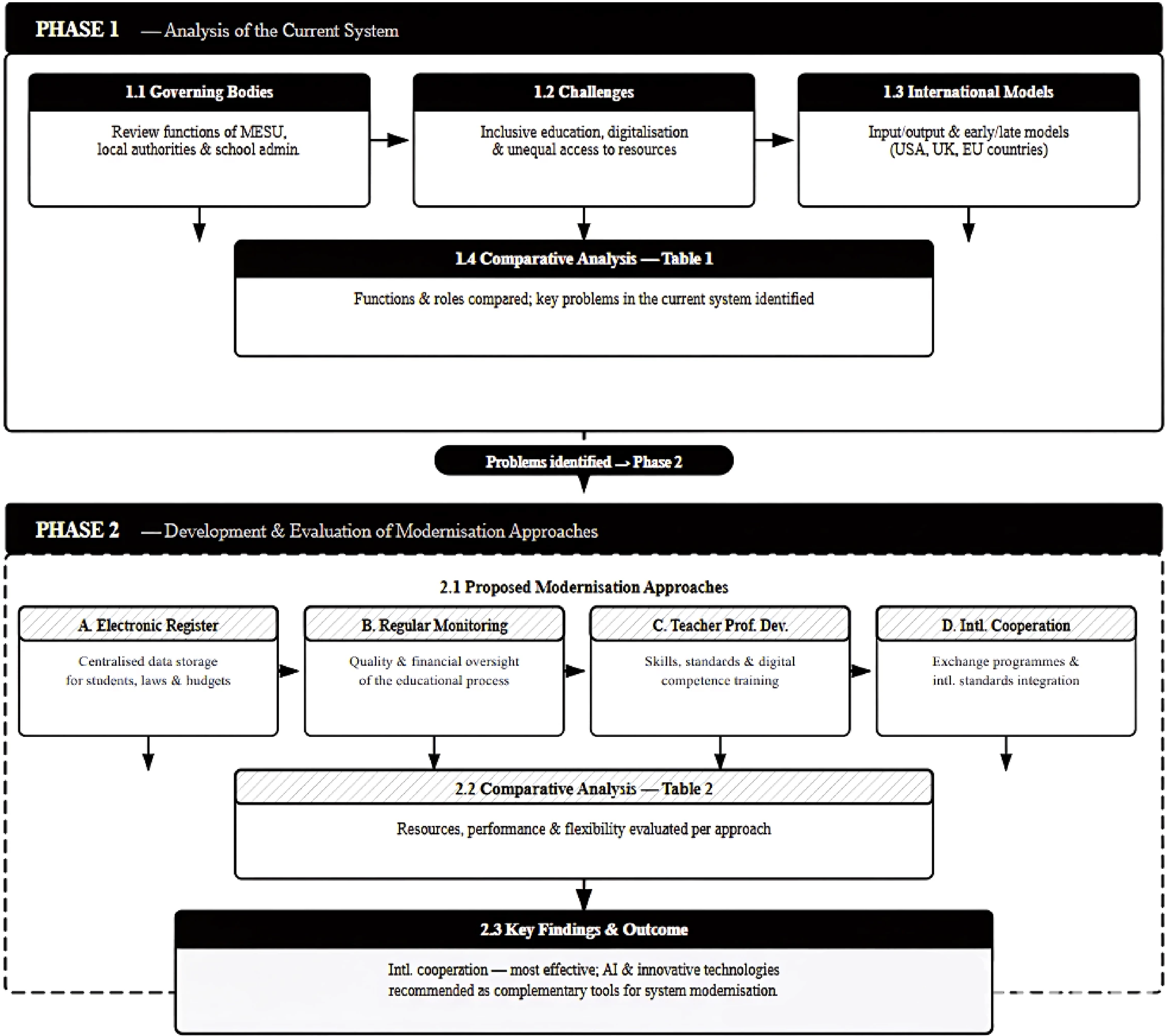
Two-phase design.
Results
The purpose of this study was to explore the current state of administrative and legal support in secondary education in Ukraine and to propose modern approaches for its enhancement. Specifically, the study aimed to assess the existing regulatory framework, identify key challenges within the system, and suggest strategies for modernization to improve the quality of education. The results presented below reflect the findings of the analysis of key legal documents, comparative studies on international best practices, and the proposed methods for enhancing administrative and legal support in secondary education.
Education management, monitoring and verification of its compliance with legal acts are provided by governing bodies: The Ministry of Education and Science of Ukraine (MESU) (Ministry of Education…, 2026), local executive authorities, and the administration of the educational institution. The MES of Ukraine is the supreme governing body of education, which ensures the implementation of policy in the education sector. The MES of Ukraine provides regulatory and legal support for education, develops strategies for its development, approves the content of documents on education, develops monitoring procedures, forms and distributes state funding for the education sector, licenses and accredits educational activities, controls the compliance of educational institutions with licensing conditions and provides regulatory and legal support for innovative activities in education (Law of Ukraine…, 2017). The MES of Ukraine sends its instructions and proposals to local executive authorities, which include regional state administrations, district state administrations, and inspection bodies. The functions of local executive authorities include the implementation of decisions made by the MES of Ukraine, monitoring compliance with legal norms in educational institutions at the local level, and development and implementation of educational plans, programs, and strategies.
The policy of local executive authorities is implemented by the subjects of educational activity—educational institutions, which are represented by their administration, which includes the director, deputies, head teachers, secretary, and accountant. Sometimes, the administration of an educational institution may also be represented by a pedagogical council, which includes teachers in addition to the director and respective deputies. The educational entity independently makes decisions on the management of the educational process based on regulatory and other educational documents. The administration is responsible for compliance with educational standards and influences the development and provision of education within its institution. In its activities, the administration of an educational institution relies on the principles of morality, transparency, participation, principles of responsibility and values, as well as legal norms (Panpet & Keanla, 2024).
Morality requires fair and equitable education management based on moral and ethical norms (Panpet & Keanla, 2024). The right to education and democratic education require this. Open administrative and legal support for education and management data are the foundation of transparency. This will show students, teachers, and parents how the administration spends financial earnings and provides resources. Participation involves students, teachers, parents, and non-governmental groups in educational institution administration decisions. This principle can be implemented through pedagogical councils, parent meetings, anonymous polls, etc. The idea of responsibility requires an educational institution's administration to be accountable to teachers, students, parents, higher education authorities, and the law for its judgments. The principle of values preserves core human values in management, including the right to education for all. The last principle, legal rules, follows all the others. The administration of an educational institution should follow laws and rules throughout the educational process.
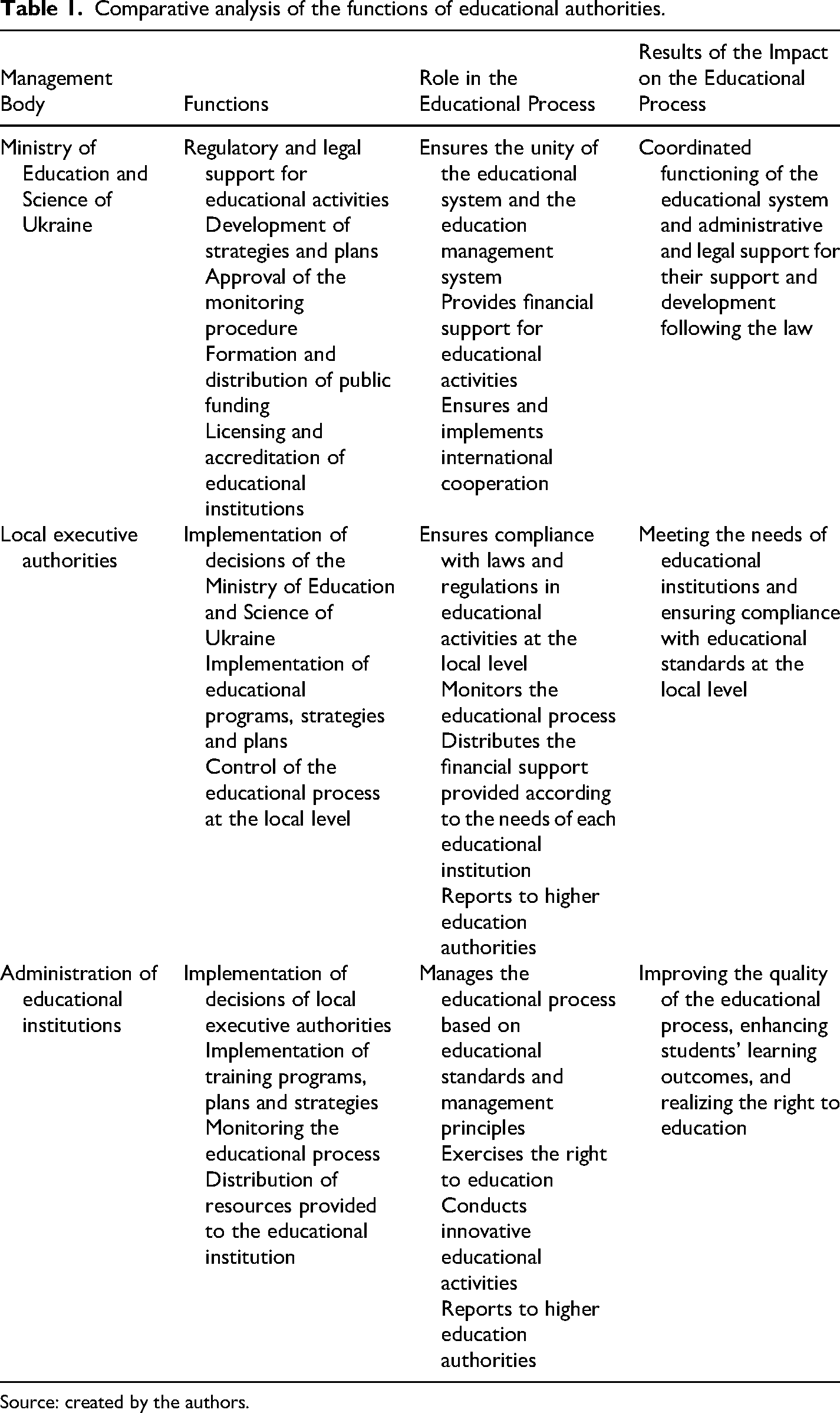
By building its activities on these principles, the administration of an educational institution can more effectively manage educational activities, ensure their quality and effectiveness, and adhere to the principles of democracy and equality. To reveal the functions of each of the governing bodies and determine their effectiveness in the administrative and legal support of general secondary education, it was advisable to conduct a comparative analysis (Table 1).
Comparative analysis of the functions of educational authorities.
Source: created by the authors.
The comparison demonstrated that each educational authority has its role and functions, without which educational activities cannot be effective. Thus, only coordinated interaction of all educational authorities can affect the effectiveness of administrative and legal support and improve the quality of education and competitiveness of Ukrainian educational institutions and specialists in the international labor market.
Only educational institution administrations can check quality and fully understand the educational process, its pros and cons. Although the MES of Ukraine and local executive authorities get statistical data on educational institutions, they cannot constantly oversee each school's educational process. This gives the administration more control over an educational institution than the MESU and local executive authority. The administration of an educational institution can develop tools and methods of education management relevant for a particular subject, advanced training of pedagogical staff who need it and in those areas that are most relevant, the ability to respond quickly to changes in society and the educational process, and more efficient financial support distribution. The Ukrainian administrative and legal support system has unique issues that may impair its quality. Inclusive education, digitization, and distant learning may influence administrative and legal support of the educational process.
Inclusive education is a system of educational services based on the involvement and inclusion of all participants in the educational process (Law of Ukraine…, 2017). Inclusive education provides for students with special educational needs to acquire knowledge and skills in an educational institution, alongside their normative peers. Education authorities are responsible for the implementation of inclusive education through financial, personnel, logistical and methodological support (Resolution of the Cabinet…, 2021). Although inclusive education is actively implemented in the modern educational process, there are problems with its administrative and legal support. There is a need to expand the regulatory framework, which is particularly due to distance learning. It also requires educational authorities to ensure equal access to the educational process in any form. Inclusive education also requires changes in educational standards (including changes in methods and approaches to the learning process) and more in-depth monitoring.
The digitalization of educational activities also requires changes in approaches to administrative and legal support Akhmedova et al. (2021). Thus, it is advisable to develop regulations that will fully regulate the use of innovations in the educational process, including cybersecurity and the implementation of distance learning. In addition, there is a problem of uneven access to modern learning resources: not all secondary education institutions are equipped with modern information and computer technologies, and educational institutions in rural areas may not have access to digital opportunities at all. There is also a problem with the readiness of the school administration, teaching staff and students to use innovative technologies (Butt et al., 2024). Thus, the main problems that exist in the system of administrative and legal support of general secondary education in Ukraine are an outdated legal framework that does not regulate the digitalization of the educational process, inefficient allocation of resources (including financial), and unequal access to education. This requires new approaches to the implementation of administrative and legal support.
Ukraine manages education using regulatory, organizational, managerial, financial, economic, informational, pedagogical, and supervisory means (Lukina, 2020). Legislation supporting educational institutions’ operation and growth is part of education management. Educational planning, personnel management, and curriculum organization are organizational and managerial. Secondary education is managed financially and economically through national and local financing to improve service. Info means use modern technology like online platforms, electronic databases, and other communication methods, including distant education. Teacher training strategies are pedagogical. Control and supervisory tools include monitoring the educational process, including compliance with educational, regulatory, and legal standards, teaching staff certification, student learning assessment, and inspections (Danylenko & Larina, 2022).
Administrative and legal support of secondary education in Ukraine also has certain features that derive from the above-mentioned means of education management. The following features can be distinguished: regulatory and legal nature, organizational, control and supervisory component, institutional component, targeted impact on education, financial regulation, information transparency, flexibility and adaptability, as well as protection of the rights and interests of students and teachers (Serkova, 2019).
Regulatory and legal nature as a feature of education management is based on the fact that the educational process has a legislative basis, which includes laws, and provisions of international and national regulations. In Ukraine, this feature of general secondary education governance is manifested in the use of the Law of Ukraine No. 2145-VIII “On Education” (2017) and the Law of Ukraine No. 463-IX “On Complete General Secondary Education” (2020), which are used to guide and coordinate this sector. Organizationally, as a feature of education management, is aimed at coordinating the processes taking place in the education sector, including setting quality standards, organizing curricula, planning the educational process and allocating resources. The control and supervision component, as a feature of education governance, is the ability of education authorities to monitor the educational process to ensure compliance with standards.
The control and supervision component of education governance includes accreditation, certification, and licensing of educational institutions. Institutional support is based on the interaction of governing bodies (ministries, local authorities, inspection bodies), with functions such as registration, licensing, and quality monitoring. Targeted influence aims to achieve educational goals, such as ensuring equal access to education, improving teacher qualifications, and promoting educational innovations. Financial regulation focuses on funding for infrastructure and technological advancements. Information transparency, supported by electronic reporting systems, ensures open access to educational data. Flexibility and adaptability allow education to respond to social, technological, and labor market changes. Additionally, the protection of students’ and teachers’ rights ensures equal access and social protection. Studying international approaches, such as input/output and early/late management models, can inform improvements in administrative and legal support for education (Lennert da Silva, 2021).
Early and late administrative and legal assistance for schooling are also classified. Early models in the US, UK, and NZ manage education based on performance and society-public sector interaction (Timidi & Okuro, 2024). For instance, administrative and legal assistance changes depending on educational process results, and society (e.g., parents of students) can freely access monitoring results, regulations, and other documents and make comments. Denmark, Norway, Germany, Austria, and the Netherlands use public administration-driven education management processes (Vaintraub, 2024). Based on education management in Ukraine, the US, and Europe, new approaches to administrative and legal support of secondary education in Ukraine have been developed to address the issues identified. Maintaining an electronic register, monitoring the educational process, advanced teacher training, and boosting international educational collaboration are suggested to modernize secondary education's administrative and legal support.
Administrative and legal assistance includes dealing with a lot of data to report, send statistical data to higher education authorities, and monitor the educational process. An electronic register that stores all educational institution data can modernize administrative and legal support. Data registration records all events and aids education management (Ojo & Ayoko, 2024). For instance, an electronic register should contain all student personal and academic information. This can be used to count students, organize them by characteristics, and choose methods and approaches based on student needs. Such a record can also monitor educational conformity with standards and regulatory requirements. A register of educational laws may be helpful. This register would record education law modifications, rules, decrees, and other educational documents. This will allow them to obtain regulatory materials, follow them, and learn about educational legislation developments. A school budget book with financial inflows and expenditures is also crucial. Financial reports will be available to parents and the school administration, thus this information is essential. The budget book can show financial revenues and expenditures during an audit or inspection, increasing transparency.
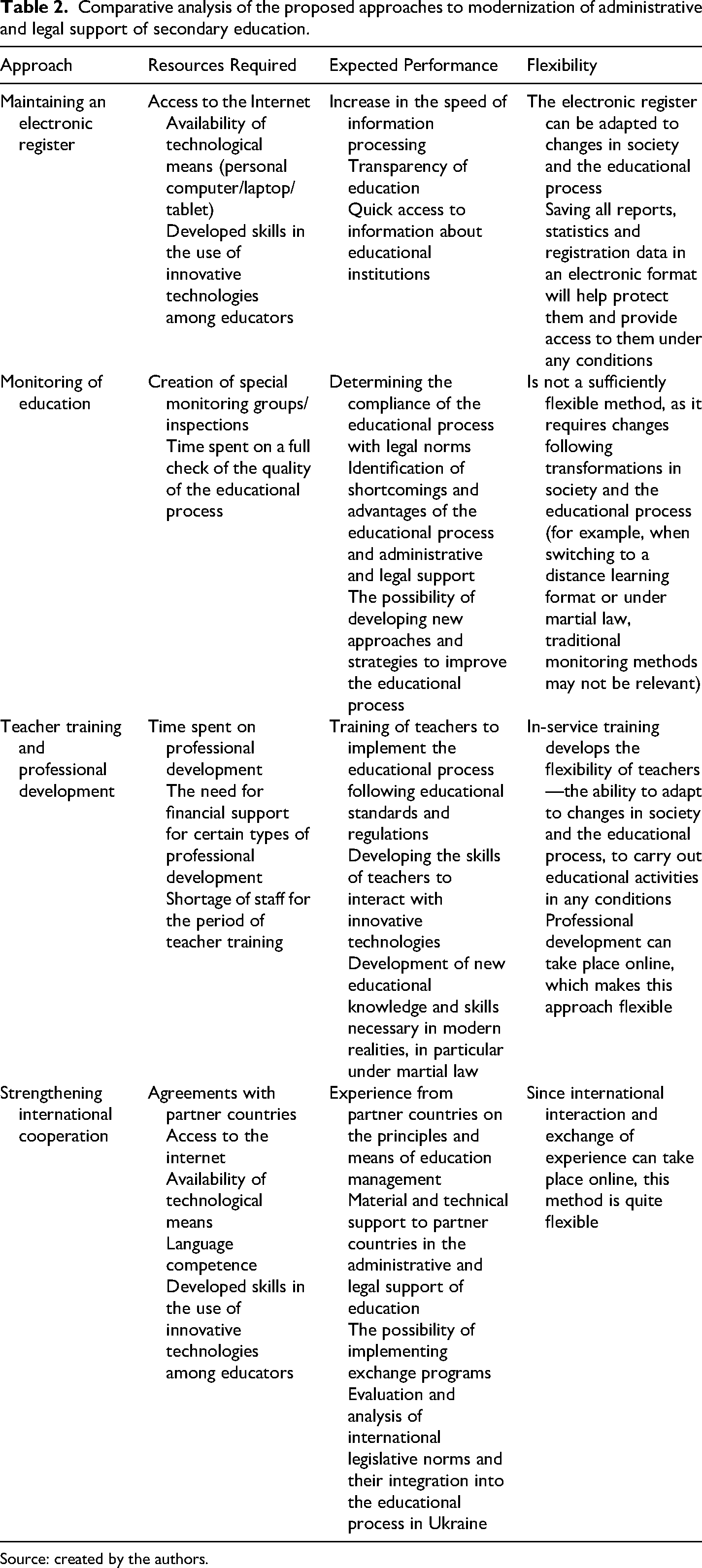
It is equally necessary to improve international cooperation in the administrative and legal support of secondary education. International cooperation can improve the management of education in partner countries and integrate international standards into Ukrainian educational activities. Cooperation with international partners in the education sector may also become the basis for financial or resource support. In addition, it is possible to implement exchange programs in which the administration of Ukrainian schools and representatives of other educational authorities can gain experience in the administrative and legal support of secondary education in educational institutions of partner countries. It is advisable to compare the proposed approaches to modernizing the administrative and legal support of secondary education and determine which of them will be the most effective and less resource-intensive (Table 2).
Comparative analysis of the proposed approaches to modernization of administrative and legal support of secondary education.
Source: created by the authors.
The comparison research showed that all recommended alternatives can modernize the administrative and legal support system, but their effectiveness differs. An electronic register is adaptable and requires fewer resources, but its efficiency is lower than the other proposed alternatives. Monitoring the educational process can be successful and uses few resources, but its flexibility is limited by changes in the educational process, which necessitate new quality control methods. In-service teacher training is flexible and effective but resource-intensive. International cooperation may be the best way to modernize administrative and legal support. This method uses fewer resources because innovative technologies via the Internet make international cooperation possible, flexible, and adaptable to social changes. Its expected effectiveness outweighs its costs.
Innovative technologies like artificial intelligence can modernize secondary school administrative and legal support. Innovative systems like AI can help education management. It can analyze and store educational data (reports, statistics, regulatory papers) and provide data attributes. AI systems can assess pedagogical monitoring data and develop education management strategies. AI can automate applicant processing, curriculum creation, class scheduling, and more for educational institutions. AI can automate student-parent and public interaction. This system can be used to construct chatbots that answer frequently asked questions, display statistical and reporting data, and accept feedback from parents and other stakeholders. AI also decreases high-volume data processing errors. It effectively modernizes secondary education administrative and legal assistance.
Thus, administrative and legal support—a collection of legal norms, procedures, and approaches to educational activity management—ensures educational standards and the right to education. The administrative and legal support system affects school quality and student learning outcomes, which will impact their future education and public sector careers. The Ministry of Education and Science, local administrative authority, and educational institution management govern education in Ukraine. The interaction of all these groups ensures education management's efficacy, but school administration can make the most substantial changes. Educational institutions’ administrations know their demands, idiosyncrasies, staffing, and resources. Educational institution administration follows morality, transparency, involvement, accountability, ideals, and legal norms. Ukraine manages education using regulatory, organizational, managerial, financial, economic, informational, pedagogical, and supervisory means. However, administrative and legal support in Ukraine has revealed inadequate resource allocation and uneven access, as well as a lack of legal oversight of digital technology use in education. Since education and state competitiveness depend on it, the administrative and legal support structure must be modernized. The author advocates maintaining an electronic register, monitoring the educational process, professional development of instructors, and developing international cooperation as novel administrative and legal support methods. Comparative analysis shows that the recommended solutions can support secondary education administratively and legally. International cooperation is the best way to modernize the education management system, and novel technologies like artificial intelligence can help create administrative and legal support.
Discussion
Administrative and legal support is a part of education management, which includes a set of legal norms, methods and approaches that ensure compliance with educational standards and the right of everyone to education. The effectiveness of educational activities directly depends on its administrative and legal support, which requires regular review of approaches to education management. Analyzing the administrative and legal support, Sung (2024) concluded that the issue of education management in the modern world has not been analyzed sufficiently, which confirms the study's relevance. The researcher noted that the methods of administrative and legal support should be flexible to easily adapt to changes in society and to the requirements of educational activities, which correlates with the results of this study. In addition, the results of the study by Sung confirmed that an effective governance process should be regularly monitored to determine its quality, and flexibility, and identify areas for improvement. This is especially relevant in educational activities, as regular monitoring of the quality of administrative and legal support for education can guarantee its transparency, rationality and efficiency.
Administrative and legal support in education was covered by Yang and Ni (2018), who studied the management of education in China, and Ashari (2024), who studied changes in the educational process through effective management. The educational sphere is a system in which management, evaluation, and international interaction take place. Ashari noted that administrative and legal support is important in the development of education, as it involves its planning, financial and resource management, regular monitoring, and expansion of staffing, which was also revealed in this study and confirms the results obtained in it.
This study has covered the role and functions of such educational management bodies as the Ministry of Education and Science, local executive authorities, and the administration of educational institutions. The comparative analysis demonstrated that although the interaction of all governing bodies is most effective in administrative and legal support, the administration of educational institutions has certain advantages in this process. Panpet and Keanla (2024), studying the use of good governance principles by the administration of educational institutions, also noted that the administration has certain advantages in the process of administrative and legal support of educational activities. Thus, the administration of an educational institution is responsible for developing a strategy for its educational institution based on regulatory documents, promoting the implementation of new methods and approaches, and the use of innovations in educational activities, which correlates with the results of this study. Only the comprehensive interaction of all educational management bodies can improve the educational process, but it is the administration of an educational institution that, within its legal capabilities, can most effectively implement the management policy.
The legal boundaries of educational governance were studied by Ryan (2002), and Gerencsér and Balla (2024). The scientists noted that the process of education management is determined by the laws of the state, as well as regulatory documents. However, Ryan noted that although the process of administrative and legal support of education should be based on legislation and official documentation, it should be so adaptive that each educational institution can make decisions about its activities independently. This confirms the results obtained in this study. Gerencsér and Balla (2024) concluded that administrative and legal support should be based on regulations, as this is the only way to realize the right to education for all groups of society, to make it more accessible, modern and effective. However, scholars have noted that there are serious shortcomings in the legal framework of education management that can affect the educational process and the competitiveness of the state (Danylenko & Larina, 2022).
Problems in the administrative and legal support of educational activities were revealed by Wang (2024), who noted that the existing methods of education management are not relevant and flexible, which corresponds to the results obtained in this study. Flexibility in education management is important due to dynamic changes in society, which determines the need to find new, more innovative and adaptive methods of administrative and legal support for secondary education. Furthermore, administrative and legal support for inclusive education is an urgent problem in the modern educational process. The issue of inclusive education in administrative and legal support was covered by Törmänen and Wicki (2020), who analyzed the management of inclusive education in Europe, and by Kovbas and Lys (2021), who studied the educational rights of persons with special needs. The researchers concluded that the implementation of inclusive education requires a revision of the regulatory framework and the search for new approaches to education management, which correlates with the results of this study. Törmänen and Wicki noted that the implementation of inclusive education requires the professional development of teachers, the development of new educational systems and resources, and changes in policy and legislation to ensure fair access to education for all groups of students. Kovbas and Lys, in their study of inclusive education in Ukraine, noted that the state must take all possible measures to realize the right to education for all groups of students. This involves finding new approaches to education management.
To find approaches to the administrative and legal support of education, this paper analyzed strategies and models of education governance, which was also covered in the works of Sulaiman and Ghadas (2021), who studied academic governance strategies, Ahmed et al. (2023), who studied models of corporate governance of education. Sulaiman and Ghadas revealed the experience of Malaysia, where educational institutions are divided into general, research, specialized and technical. Accordingly, the administrative and legal support differs from the type of institution, which allows for achieving specific educational goals and making learning outcomes more effective. Such a model of education management, where all educational institutions are subject to state laws, but each has its separate documentation, rules and obligations, allows the educational process to be conducted in line with globalization, modernization and digitalization. It also allows to meet the needs of the national and international labor market, which contributes to the development of state-owned industries. This aspect was not sufficiently covered in this study. Ahmed et al. (2023), in turn, identified the main principles of education management: comprehensive interaction of all governing bodies and participants in the educational process; creation of flexible educational legislation that will meet the needs of each educational institution and the labor market in general; optimization of the selection system for educational management bodies, which correlates with the results obtained in this study. Based on the problems existing in the process of education management and administrative and legal support strategies, the following approaches to modernizing this system were proposed: maintaining an electronic register, monitoring, professional development of teachers, and strengthening international cooperation.
Registry keeping as a method of modernizing administrative and legal support was revealed by Ojo and Ayoko (2024). According to the researchers, maintaining such a register is a method of secure storage of educational information for its further use, as well as a method of monitoring the activities of an educational institution, which correlates with the results of this study. This proves the effectiveness of the electronic register in the administrative and legal support of secondary education and demonstrates its necessity for more transparent, rational management of education. The in-service training of teachers was covered by Vaintraub (2024), who studied the professional development of teachers under martial law. In a constantly changing world, teachers need to have additional skills, such as the ability to provide psychological support to other participants in the educational process, the ability to use innovative technologies, the ability to organize inclusive education, and the ability to cooperate with local administrations, law enforcement agencies, and the armed forces of Ukraine. This will not only ensure the quality of educational activities under martial law but also increase the efficiency of its management, which makes the professional development of teachers important in this regard.
Among the insufficiently disclosed approaches to the modernization of the administrative and legal support system are licensing and accreditation, which were studied by Reznichenko (2020). According to the researcher, currently, in Ukraine, there is low autonomy in educational institutions, students’ skills do not meet the requirements, and financial support is unsatisfactory. This requires the use of such instruments of administrative support for education as licensing and accreditation. This study also identified the importance of using innovative approaches, including artificial intelligence, to the administrative and legal support process. Innovative methods of education management in Ukraine were studied by Akhmedova et al. (2021) et al., who noted that modern educational legislation needs to be changed, in particular, due to the impact of digitalization on all state processes, which was also identified in this study. This necessitates the need to gain international experience in education management using innovations.
International experience in using innovative approaches to education management was revealed by Al-Busmait et al. (2024), who analyzed the impact of e-governance in educational institutions, Li and Zhang (2024), who studied the solution of administrative and legal problems of education in the digital age, as well as Butt et al. (2024), who studied the success model of e-governance in education. The researchers noted that in the modern management of the educational process, digital technologies are not used effectively enough due to a lack of resources, a lack of necessary skills among teachers, and fear of information confidentiality. However, Li and Zhang noted that innovative technologies can now be the main tool in improving the efficiency of education management. This also requires the development of new legislation on the use of innovative technologies in educational activities, including sections on cybersecurity and data protection, which correlates with the results of this study. The use of AI in education management was studied by Siminto et al. (2023), Huang (2024), and Naldi et al. (2024). The researchers note that AI is an effective technology that is actively used in the management of the educational process. In the system of administrative and legal support, artificial intelligence can be used to develop plans and strategies, analyze educational data, allocate financial resources, personalize curricula, and assess student learning outcomes, which correlates with the results obtained in this study. This proves its high efficiency in the process of administrative and legal support and the need to use it to modernize this system.
International cooperation as a method of improving the management of educational activities was analyzed by Rachynskyi (2022), who studied international standards for the management of educational institutions in European countries and the role of this experience in the Ukrainian education sector. The researcher noted that international cooperation is important for the development of the education sector, and Ukraine, as a country seeking to meet European standards, should interact with partner countries and integrate their experience in education management, which was also identified in this study.
Thus, administrative and legal support is part of the management of the educational process, which is responsible for compliance with educational standards and ensures the right to education for everyone. However, in the modern world, where dynamic processes of globalization and modernization are taking place, there is a need for new approaches to administrative and legal support of education. The methods proposed in this study of electronic data registry, monitoring of the educational process, professional development of teachers, and strengthening of international cooperation were found to be effective. The effectiveness of using artificial intelligence in the process of secondary education management has also been proven. Among the methods of modernization of administrative and legal support that are not sufficiently disclosed in this study, the researchers propose regular licensing and accreditation of educational institutions. By building the administrative and legal support of secondary education on modern strategies, innovative methods and the principles of integrated interaction, optimization of legislation, and compliance with educational standards identified in this study, it is possible to form an educational system that will educate future specialists capable of positively influencing the development of the state and its industries.
Conclusions
This paper analyzes the administrative and legal support of general secondary education in Ukraine. Administrative and legal support is a part of education management that affects compliance with educational standards and the right to education for all groups of students. The management of the educational process has a direct impact on its quality, learning outcomes and the competitiveness of the educational institution and its graduates, who may become catalysts for change in the country in the future.
The role of the Ministry of Education and Science of Ukraine, local executive authorities and administration of educational institutions in the management of general secondary education is revealed. The effectiveness of administrative and legal support is realized through the interaction of all educational management bodies, but the administration of an educational institution has certain advantages in this process. The administration of an educational institution has detailed information about the activities of its educational entity, the problems existing within it and the prospects for its development, and, as a result, at this level, educational management can be most effective. In its activities, the administration of an educational institution is based on the principles of morality, transparency, participation, principles of responsibility and values, as well as on legal norms.
In Ukraine, the management of educational activities includes regulatory, organizational, managerial, financial, economic, informational, pedagogical and supervisory means. Based on these means, the author identifies the features of secondary education management, in particular: regulatory and legal nature, organizational, control and supervisory component, institutional component, targeted impact on education, financial regulation, information transparency, flexibility and adaptability, ensuring the rights and interests of students and teachers. These means of managing the educational process and the features of this management are the basis of administrative and legal support.
The introduction of inclusive education is regulated within the framework of education management, but at this stage, there is unequal access to learning opportunities for students with special educational needs, including materials and resources, due to the transition to distance learning. Another problem that may affect the quality of education management is digitalization, which is not sufficiently regulated by legal acts. The study determined that the problems in the administrative and legal support of general secondary education are inefficient allocation of resources, uneven access to educational resources, and lack of legal regulation of the digitalization of the educational process. To solve these problems, the author proposes such methods as regular monitoring of the educational process, advanced training of teachers, and development of international cooperation. It is determined that the most effective approach to the administrative and legal support of the educational process may be to strengthen international cooperation, which will help to integrate the experience of partner countries into the educational process of Ukraine. The use of innovative technologies, in particular AI, in the process of administrative and legal support of education is proposed. AI can be used to collect, analyze, and process data, store it, as well as to automate some management processes and create chatbots.
A limitation of this study could include the lack of practical testing of the proposed methods. The results can be improved by conducting a survey and interviews among the management of educational institutions, teaching staff and students. Prospects for further research include an analysis of the possibilities of using artificial intelligence in the administrative and legal support of education, as well as an empirical study of the effectiveness of the described models, strategies and proposed approaches for modernizing administrative and legal support.
Footnotes

Funding
The authors received no financial support for the research, authorship, and/or publication of this article.
Declaration of Conflicting Interests
The authors declared no potential conflicts of interest with respect to the research, authorship, and/or publication of this article.
Data Availability Statement
The data that support the findings of this study are available on request from the corresponding author.