







Abstract
Using case study methodology, this study explores how a Northern Virginia school district navigated a library book challenge in 2007/2008. Although this challenged occurred almost 17 years ago, And Tango Makes Three continues to be one of the most challenged books in the United States. This case study offers empirical evidence that trust between a superintendent and a school board can mitigate the codified policy regarding book challenges, especially if the board perceives budget negotiations as higher priority. There are implications for the democratic nature of school board decision-making, specifically when books are challenged for LGBTQIA+ characters.
Tango was the very first penguin in the zoo to have two daddies. (And Tango Makes Three)
Introduction
Public schools are the forum in which the public values of the district community and the private values of a family collide. School boards are the governance body tasked with mediating these collisions while also upholding the legal dimensions of public education. This study delves into the complicated and shifting dynamics that exist between educational actors such as the school board and superintendent and the ways in which district policy and constitutional law can serves as a factor of influence during a contentious community conflict.
Over the history of public schooling in the United States of America (US), school boards are often the governance body thrust into the culture wars (Driver, 2018; Laats, 2015; Petrzela, 2015; Ross, 1994). School library book challenges 1 offer an opportunity to investigate how school boards respond to culture war issues. One culture war issue that school boards mediate is the inclusion of materials with Lesbian, Gay, Bisexual, Transgender, Queer, Intersex, Asexual plus (LGBTQIA+) characters. Opponents of LGBTQIA+ library books argue that the family should be empowered to curate if, when, and how students are exposed to nonheteronormative characters and topics (Hunter, 1991). Proponents of LGBTQIA+ library books claim that children require access to diverse characters to develop empathy and see themselves represented in literature (Cahill et al., 2021). When a library book is challenged on the grounds of LGBTQIA+ characters, both sides of the culture war often mobilize to lobby the school board for a favorable outcome. In addition to navigating the demands of various groups, school boards are required to uphold the legal aspects of book challenges—namely the protection of student's free speech and expression rights.
Central to this study is a 2007 challenge of the book And Tango Makes Three, which is one of the most commonly challenged book in the US (American Library Association, 2013). And Tango Make Three is written for elementary aged students, whose young age often intensifies the conflict between the wishes of the family to protect the innocence of the child and the necessity of schools to create an inclusive environment. This case study is an early example of how a school board responded to a book challenge on the grounds of LGBTQIA+ characters. To date this is the first empirical study of the ways a school board responded to a challenge of a library book on the grounds of homosexual characters. Despite the studied challenge occurred nearly 2 decades ago; the reason for the challenge continues to come before school boards (America, 2024; American Library Association, 2023; Harris, 2024; Peifer, 2023). This study offers insight into an important function of school boards: mediating competing demands of constituent groups while maintain the legal standards of the situation. In essence this case study enters the often black box 2 of school district decision-making to distill how factors of leadership and policy shaped the book challenges process, factors of influence, and the outcome.
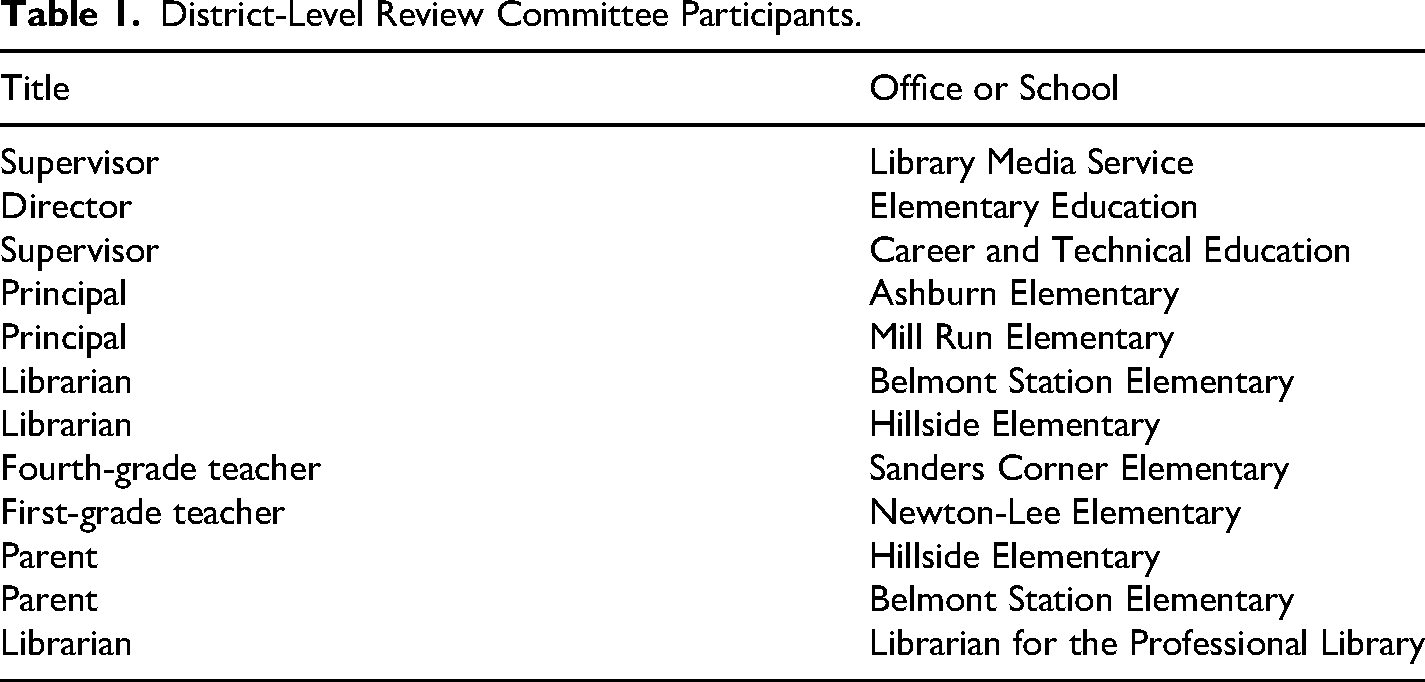
District-Level Review Committee Participants.
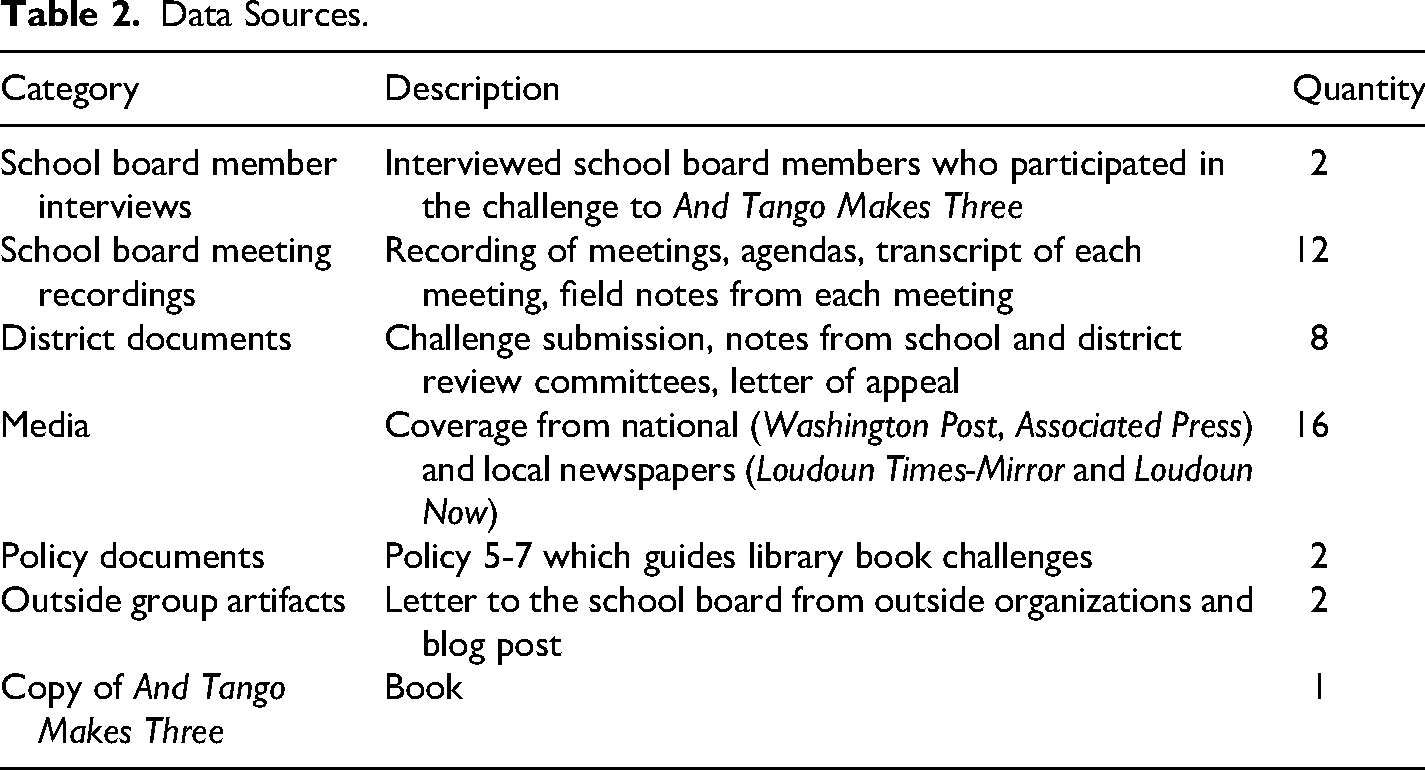
Data Sources.
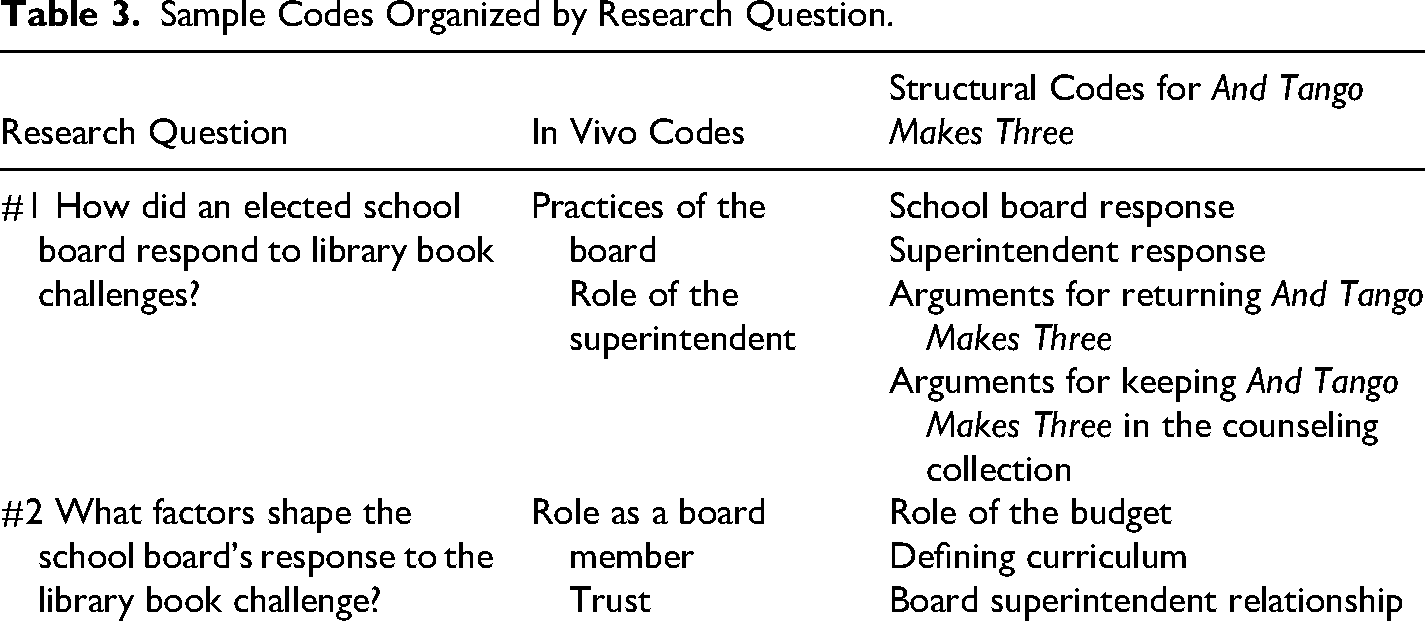
Sample Codes Organized by Research Question.
Review of Literature
School District Governance
In the US, there is not a federal right to education (Driver, 2018; Robinson, 2019). The federal government has a limited role in making decisions about the daily operations of public school districts (Davies, 2007). Instead, each state is responsible for sustaining a system of public education (Bridgeforth & White, 2025). Each state empowers local school boards to make decisions on the daily operations of schools (Maeroff, 2010).
Decisions about school districts stem from the tradition of local control (Greene, 1992; Scribner, 2016). As schools can serve as an extension of the hopes and values of the local community, local control empowers governance bodies such as school boards to make decisions that reflect the concerns, hopes, and needs of their neighbors about the public school district (Laats, 2015; McGirr, 2015). School boards are the governance body most responsible for public education. School districts and school boards can variety greatly in their size, composition, policies, practices, and public values based on the community governed (Hess, 2002; Land, 2002). These boards have the propensity to shift to reflect changes in cultural issues and community demographics given the close relationship between school board members and their connection to the communities they serve and live. School board members in the US are largely elected in small local elections marked by low turnout (National School Board Association, 2018). The prerequisites for board membership are enumerated by the state but often are limited to residency requirements and age (Bridgeforth & White, 2025). Therefore, board members are usually not required to have extensive training in school law, public budgeting, or even mediating community conflict.
School board set the high level policy and budget landscape for each district but usually work closely with a superintendent. The superintendent is hired and evaluated by the school board. Their role is to operationalize the strategic priorities of the board into day to day tasks. At times, the superintendent and school board can experience a variety of working relationships ranging from easy-going and collaborative to overtly vindicative power struggles (Mountford, 2004).
School Boards as an Arena for Community Conflict
Scholars debate the degree to which school boards are democratic forums. Iannaccone and Lutz (1994/2006) have argued that school boards are democratic bodies that respond to frustrations and complaints from constituents. Conversely, Kogan (2022) argues that school boards are a “historical artifact” (p. 10) unable to impact the core mission of schools: increasing academic achievement (p. 10).
Iannaccone, Lutz, and Kogan note that school board meetings can be places for the community to voice their concerns about the school system. Book challenges can be an issue that member of the community voice their opinion during school board meetings (Callahan & Miller, 2021). School board members are the governance actors tasked with balancing views of the community, existing district policy and constitutional related to library book challenges (Knox, 2015; Pipkin & Lent, 2002). For every book challenge, the decision-making process, specifically the factors that influence the outcome, can significantly affect the types of materials students can access in their school's library.
In his seminal work on culture wars, Hunter (1991) notes that schools are often the site of culture war conflict since children leave the privacy of their home and family and attend a public institution alongside children from other families. As a result, schools become the place where members of the community attempt to shape the public values of the school system. Culture war issues are rarely solved; instead, they continue to flare up when members or groups of community members worry their side will lose the authority to determine the public values of the community (Hartman, 2019; Hunter, 1991; Zimmerman, 2022). The types of library books available for students to explore in space such as the school library can serve to communicate in part the bounds of pluralistic living. As students grow and develop, literacy and culture scholars argue that students must have access to books that both align with their identity markers and that are very different so that students can build empathy and cultural understanding (Cahill et al., 2021).
Library Books and Student Rights
In addition to balancing the demands of constituents, school boards are also tasked with maintaining the rights of public school students including students’ speech and expression rights. In 1981, high school senior Steven Pico sued his school district, Island Trees School District No. 26, after members of the school board physically removed some books from the junior and high school libraries. Pico claimed his First Amendment right to speech and expression codified via the decision in Tinker v. Des Moines Independent Community School District, 393 U.S. 503 (1969) had been violated. Eventually Island Trees School District No. 26 v. Pico, 457 U.S. 853 (1982) reached the Supreme Court, but resulted in a plurality decision since no one opinion garnered a majority. Justice William Brennan authored the plurality opinion which counseled school board members to avoid removing library books for political or partisan reasons (Pico, 1982). Although Brennan's plurality opinion is not binding law, it has been used in lower level court decisions to extend the connection between the speech and expression rights of public school students and library book removals (see Campbell v. St. Tammany Parish School Board (1995); ACLU of Florida v. Miami-Dade County, 2009). Library book challenges require school board members and superintendents to balance the speech and expression rights of public school students alongside district policy and the demands of the community (Callahan & Miller, 2024).
Research Questions
Two research questions guided this empirical study of school board decision-making during a library book challenge:
How did an elected school board respond to a library book challenge? What factors shaped the school board's response to a library book
challenge?
Study Design
Case study methods design capture bounded phenomena of study in the specific context such as school and district settings (Merriam, 1998; Yin, 2014). This study uses “thick description” (Merriam, 1998) which offers a detailed account of the context, processes, and interactions related to the phenomenon of interest. Yin (2014) notes that case study methodology is suited to help scholars understand decision-making processes, such as the focus of this study. For this case study, the unit of analysis is the school board as the district policy indicated the board would act as a unit in determining the books placement (Loudoun County Public Schools, 2008). By adopting case study methodology this study focuses on the interaction between the school board, the superintendent, and the district policy to identify the process used and the factors of influence that shaped the boards’ response following a challenge to And Tango Makes Three.
Theoretical Framework
Library book challenges occur in school systems that are embedded in communities. Both the behavior of actors and the structure of the decision-making arena that occupy unique political arenas. This study adopts Mazzoni's (1991) “arena model” as the theoretical framework. This framework aligns with the research questions and the study context as it examines both the structure elements of the political system and the behavior of actors involved in the decision-making process, rather than a framework that privileges only the structural or behavioral elements of the decision-making arena.
Mazzoni's (1991) arena model provides a set of political analysis categories by which to array the data and identify patterns based on each research question. The categories are (a) actors, (b) goals, (c) resources, (d) motivations, (e) strategies, (f) settings, (g) interactions and (h) outcomes. Mazzoni's (1991) political analysis categories offer an approach to unpack the inner workings of the decision-making process, to understand the degrees to which it conforms to an arena or elite council model of school board decision-making (Iannaccone & Lutz, 1994), and to identify if and how factors such as the district policy, culture war related arguments, and/or law served as sources of influence during the book challenge. In essence, the political analysis categories offer a way to examine and illuminate decision-making processes often deemed a black box in which it is not clear how the systems of the decision-making arena and actors shape the outcome of a decision-making process.
Analysis
Qualitative research methods can be powerful tools for exploring contextually specific phenomena, but the strength of findings comes from the chains of evidence that can be constructed from the data set. In this section, I explain the process used to investigate the school board's response and factors of influence.
Data Sources
In Table 1, I list the categories of data that were used to construct this case study. Internal documents such as review committee notes and emails were obtained by submitting a Freedom of Information Act request. Given the diversity of data sources, I began the analysis process by reading the data set in full and then using the data to construct a complete timeline of the challenge. Having access to external sources such as newspaper coverage as well as internal sources district emails and interview data, offered a unique opportunity to craft a comprehensive timeline of the event. I also began writing analytic memos regarding questions and connections between the event, the community, and the school district's policy on library book challenges.
Coding Process
I coded the following types/categories of data: transcripts from school board member interviews, transcripts from school board meetings and special appeals hearing meeting, district Policy 5-7, Submitted Book Challenge Form, letters of appeal, review committee meeting documentation, district emails, and newspaper coverage of the challenge.
I selected an open coding approach since I could not identify empirical work on the school board decision-making during library book challenges other than this study (Table 2). I began with the in vivo coding approach (Saldaña, 2021). One of the strengths of in vivo coding is that it “adheres to the ‘verbatim principle’, using terms and concepts drawn from the words of the participants themselves” (Saldaña, 2021), which was crucial for capturing the ways in which school board members described their internal process surrounding the decision-making challenge. At the end of the first round of coding, I found that adopting the in vivo approach helped me to understand three important elements: (a) how school board members approached their role, (b) the arguments the community made regarding requests to return or remove And Tango Makes Three, and (c) the relationship between the superintendent and the school board. Although each of these elements was helpful, I felt I needed a different coding approach in the second round to offer insight specific to the dynamics of decision-making. For the second round of coding, I opted to use “structural coding” (Saldaña, 2021) based on both the conceptual framework and noticings from the first round of coding. In using both in vivo and structural coding, the analysis process described the role of actors and the features of a political system in a decision-making process.
During the coding process, I continued to memo about the process and emerging answers according to each research questions.
The Book Challenge
National Landscape of Library Book Challenges
The library book challenge studied began in fall of 2007 and concluded in the spring of 2008. In both 2007 and 2008, And Tango Makes Three was the most challenged book in the United States (American Library Association, 2013). According to the ALA, LGBTQIA+ characters continues to be the leading reason for book challenges in the US (American Library Association, 2023).
And Tango Makes Three tells the story of two fictional penguins, Roy and Silo, who work together to hatch an abandoned penguin egg in the Central Park Zoo (Richardson et al., 2005). Challengers of the book claim that Roy and Silo forming a family unit introduce elementary aged students to LGBTQIA+ partners. Although the penguins are not described as homosexual in the text nor is sexual identity discussed; challengers cite the following reasons for requesting the book’s removal: the book presents a conflict between their religious ideals and acceptance of homosexuality, the family, not the school, is responsible for introducing complicated topics to young students, and elementary students should not be exposed to materials that discuss sexuality and gender.
School District Context
The school district in this case study offers a unique cultural and political space to study school board decision-making. The book challenge occurred in Northern Virginia, specifically a region that has developed over the last 30 years from a rural community to a suburban community. At the time of the book challenge, the school district was located in the wealthiest county in the US, with a median household income of $107,207 (Department of Economic Development, 2008). With the growth of the defense industry and technology-adjacent businesses in the area, the population of the county quickly increased. Another change to the area was the extension of public transportation systems such as the Washington Metropolitan Area Transit Authority, thereby connecting Washington DC to the suburban area via a network of buses and subway stations. With these changes, the ideological leanings of the county also changed. For example, the county moved from electing all conservative politicians to increasingly electing liberal politicians as well. According to New York Times reporter Kate Philips (2008) the change in the county was responsible in part for the state of Virginia moving from a predictable Republican state to a battleground state, especially during the 2008 presidential election. As a result, the school district grew rapidly to accommodate the influx of new community members (Philips, 2008). Yet building additional schools was a challenge, especially during 2008, as the US navigated a large-scale financial recession that impacted municipal budgets, including school district capital and real estate funds. During this time of expansion and financial unpredictability, school board members weighed decisions such as purchasing land, building schools, and changing feeder patterns. The demographic shift and ideological shifts across the school district increased the propensity for the school board meetings to be a site of culture war related conflict over the public values of the school district (Hartman, 2019; Hunter, 1991).
Challenging to And Tango Makes Three
The challenge of And Tango Makes Three began when a first-grade teaching assistant (challenger) visited the school library to identify possible books for an upcoming unit on Arctic animals. Given the penguins on the cover, the teacher's aide examined And Tango Makes Three. As prescribed in the District Policy 5-7 (Policy 5-7) (Loundoun County Public Schools, 2008) on book challenges, the teaching assistant completed a challenge form and offered their rationale for requesting the book be removed from the library collection. They stated concerns that “…a student reading this book would be confused and would get the idea that homosexuality is a lifestyle that is supported by all”. Policy 5-7 offered parents—not employees—the opportunity challenge library books and instructional materials. The challenger was a parent of a district student but submitted the challenge form at their place of employment, which did not align with the district policy on library book challenges.
School-Level Review
In accordance with Policy 5-7, the elementary school principal convened a school-level review committee to consider the challenge to And Tango Makes Three. Directed by the principal the school-level review committee included a parent, a teacher, and the school librarian. According to district documents, members of the school-level review committee voted unanimously to retain And Tango Makes Three in the elementary school library collection. Following the school-level review, the principal responded to the challenger with a letter explaining the decision of the school-level review committee as required by Policy 5-7.
District-Level Review
Book challengers have the option to appeal the school-level decision. The challenger disagreed with the school-level review committee's decision and requested a district-level review committee. Following Policy 5-7, the district's Supervisor of Library Media Services directed the district-level review committee, in accordance with the policy on library book challenges (Table 3). The district-level review committee is not a standing committee; instead, it is organized each time a library book is challenged. According to notes from the committee's meeting, members of the review committee did not unanimously agree on the fate of And Tango Makes Three in elementary school libraries. In the final vote, the majority (nine members) of committee members voted to retain the book. One committee member abstained from the vote, and two committee members voted to remove the book from the elementary school library collections. The Supervisor of Library Media Services communicated to the challenger that the district review committee decided that And Tango Makes Three would be retained in the school library.
Superintendent Intervention
The challenger again did not agree with the decision of the district-level review committee and exercised the final appeal option listed in Policy 5-7 to seek a decision from the school board on the fate of And Tango Makes Three. In a move that was not prescribed by the Policy 5-7, the superintendent unilaterally removed And Tango Makes Three from the general collection of all 16 elementary schools in the district and placed the books in a professional collection for the use by guidance counselors and school professionals. By removing the book from the general library collections, students lost access the book unless a school professional deemed the book necessary as a guidance tool. This decision was not in alignment with Policy 5-7, which indicated that the challenge decision would pertain only to the school where the challenge originated and did not stipulate the opportunity for the superintendent to reverse the district level review decisions.
Conclusion of the Challenge
Following the actions of the superintendent, members of the community exercised the opportunity to address the school board by voicing their reactions to the removal of And Tango Makes Three from elementary school libraries. Community members used the public comment portion of school board meetings to share their support or disagreement with the book's removal. In an unusual move that disrupted the normal flow of the school board meetings, the superintendent requested permission from the school board to read a prepared statement prior to public comment during the February 26, 2008 school board meeting (Lcps-Tv, 2025). In this statement, the superintendent offered his rationale for removing And Tango Makes Three. Central to the decision was the “open question” of homosexuality as an issue for the family to best address in alignment with their value system (Lcps-Tv, 2025).
Despite public interest, the book challenge was largely mediated outside of the school board arena. The school board never took formal action on And Tango Makes Three. Instead, the superintendent reversed his decision and directed the books be replaced in school libraries. In a statement given to the local newspaper, the superintendent noted that their decision to remove the book in all the elementary schools was outside the purview of Policy 5-7 (Chandler, 2008). Although the superintendent's decision to remove the books without action from the school board was not in alignment with Policy 5-7, the school board neither publicly engaged in a decision-making process nor reprimand the superintendent. Following the And Tango Makes Three challenge, the school board vice chair began the process of reviewing all school district policies, including the library book challenge policy.
Findings
Research Question #1: Response of the School Board
The first research question asked: How did an elected school board respond to a library book challenge? Below I describe the limited role of the board and explain how the school board did not occupy the position as the primary decision-maker, despite the language in Policy 5-7.
Limited Role of the School Board
In an interview, one school board member noted that the board “took no formal action” during the And Tango Makes Three challenge. Instead, the decision hinged on the actions of the superintendent. Over the 3-month challenge process, members of the school board only addressed the conflict during one meeting, following a prepared statement from the superintendent (Lcps-Tv, 2025). Board members commented on the book challenge and fate of And Tango Makes Three during board member reports. Their responses fell into three camps: (a) frustration that the public was not focused on the budget cycle; (b) frustration with the county's Board of Supervisors, specifically one member who reprimanded the board for not retaining And Tango Makes Three; or (c) agreement that parents should have the opportunity to make decisions about the type of material their child engages with, including library books. By the time the board shared their thoughts, the superintendent had already removed And Tango Makes Three from general circulation in school libraries; therefore, the board's decision to share comments instead of acting had little impact on the power of the superintendent and their decision-making process. In interviews with the two school board members, both board members recalled their high trust in the superintendent even during this challenge. The superintendent had a long history in and with the district, since they had attended the public schools as a student, returned as a teacher, and then moved up through a variety of district leadership positions. The school board did not publicly direct the superintendent to reverse the removal of the book. In interviews, school board members also did not offer recall making private requests for the superintendent to reverse course. Therefore, the school board responded to the book challenges outside of the prescribed process prescribed in the district policy.
Research Question #2: Factors that Shaped School Board Response
The second research question asked: What factors shaped the school board's response to a library book challenge? One of the more unexpected findings of this study was the limited role of the school board in the decision-making process. In this section, I offer factors that shaped the decision-making process and explain in part the limited role of the school board despite their formalized role in the district policy as the final decision-maker.
Role of Policy
Although board member named district policy as a source of guidance during both school board meetings and in interviews, the degree to which the Policy 5-7 shaped the decision-making process at the school board level was minimal. For district policy to serve as a factor of influence, actors must operationalize the policy directives and act accordingly. Policy 5-7 was available to the board, district staff, and the public, but actors acted in ways not predicted by the policy. Instead, a more private process took place, largely closed off from the public decision-making process, in which the superintendent made decisions in isolation based on their understanding of the situation, ideas about the role of the family, and appropriateness of the book. Although the superintendent had a long history of service and commitment to the district, the superintendent is not democratically elected.
Policy Interpretation as a Source of Confusion
During the February 26, 2008 school board meeting, one of the school board members expressed confusion about the way the superintendent interpreted Policy 5-7 compared to how the school board member understood the policy. Whereas the superintendent noted his actions were not in alignment in the policy, the school board member did not understand how the superintendent had arrived at that interpretation. During the meeting the board member said, “I also want to say that I don't understand … [superintendent's] … statement because I don't see anything in five-seven that says that the decision has only to do with the school where it was challenged” (Lcps-Tv, 2025). If a book had “hidden messages and you hold it backwards and it's something obscene or something crazy like that,” he continued, then the removal would need to be district-wide; otherwise, it would take up too much time as each school navigated an individual challenge.
Unfortunately, the difference in interpretation was never clarified during the public portion of the school board meeting. Although the school district had a school board attorney, they were not asked to provide formal interpretation of the policy, nor did they independently volunteer to clarify the open question of interpretation left by the actions of the superintendent and the questions of the school board. Without a clear interpretation of the policy, specifically the number of schools a specific challenge would cover, the likelihood of the Policy 5-7 serving as a significant source of influence remained low.
Public Participation in School Board Meetings
Although school board members shared in interviews that public comment is rarely an effective space to influence school board members, community members against the removal of And Tango Makes Three successfully leveraged the space to communicate their position. Of the eight individuals who provided public comment, five spoke in favor of returning the book to the general library collections. One of the most impactful comments in favor of returning the book, came from an elementary school student. The student's public comment argued in favor of returning And Tango Makes Three to elementary school libraries and was the only public comment that garnered a direct response from a school board member. School board members in this district usually adhered to an informal policy of not directly addressing public comment speakers. In addition to the public comments offered at the meeting, members of the community attended the February 26, 2008 meeting dressed in black and white (in support of the penguins) to communicate their disagreement with the removal of the book from elementary school collections. During an interview, a school board member recalled that vocal majority of the community advocated in favoring of retaining the book in elementary school libraries. In the challenge of And Tango Makes Three, public participation was a mechanism of influence.
Internal Processes That Decreased the Opportunity for Board Influence
School boards have been critiqued as performative spaces in which members make decision in private meetings without input from the public (Kenney, 2020). The board's use of the parliamentary procedure left little opportunity for unstructured discussions between school board members about how or if to respond to the challenge of And Tango Makes Three during the public meetings. As a result, it was unclear if the full democratic possibility of the school board was exercised over the course of the book challenge. Yet a board member did respond to the will of the community by revising the district policy on library book challenges to increase the clarity of the process and decrease the power of the superintendent during library book challenges. 3
Based on a review of the district documents, interview data, and school board meetings, the school board had limited opportunities to intervene over the course of the challenge due to a lack of notification and involvement. Nonelected district staff, including the superintendent, handled the challenge internally. Once the district review committee's conclusion did not align with the superintendent's position, the political will and skill of the superintendent served as a factor of influence regarding the fate of And Tango Makes Three. Two school board members, in interviews, could not recall being updated about the controversy until the superintendent decided to address the community at a school board meeting. In essence the board's formal involvement began after the books had been removed from elementary school libraries. In preparation for the superintendent's statement during the board meeting, members were also offered a copy of the book And Tango Makes Three for review, although nearly 8 months had passed since the beginning of the challenge process.
Prioritizing Pennies Over the Penguins
Given the 2008 financial recession, cost of land in the district, and the rate at which the district's population was growing, school board members noted in interview data and school board meetings they were primarily focused on the district budget. In this district, the school board did not have budgetary control. Instead, the county's board of supervisors determined the budget, and the school board oversaw the spending of allotted funds. During the challenge to And Tango Makes Three, the board of supervisors proposed a school budget that was around twenty million dollars less than the budget allocation requested by the school board. Over the course of the book challenges, school board members suggested members of the community should focus on the school district budget book instead of And Tango Makes Three. One board member shared the following about the budget and the book challenge controversy: In all of this, Mr. Chairman, I have been surprised that this other book, the … County proposed 2009 physical plan has not gotten near the attention that it deserves. The penguins have been a distraction to the proposed … County physical plan, which would reduce our operating budget request, which we made to the Board of Supervisors, for a local tax revenue of $585.5 million by $23 million. (February 26, 2008 School Board Meeting)
To further complicate the tension between the focus on the budget cycle and the book challenge, a member of the county board of supervisors spoke during a public comment portion of a school board meeting. The board of supervisors members chastised the board for allowing the removal of And Tango Makes Three from elementary school libraries: “The decision to remove a book was erroneous. It was a mistake. … [superintendent] … you got it wrong. You got it wrong by pulling the book and you got it wrong by overruling a body that you should have been able to trust to make the decision without your personal attention.” Later in his comment he reminded the school board of the power of the board of supervisors and the budget process: I'm well aware that there's a budget process in front of us and people are starting to ask me, “If we can't get beyond this thing, how many more times will one of us have to come down here to defend the freedom of expression? How many more times will we see a senior administrator take time out of his day and handle a problem that should have been left to somebody down below? And how many more dollars will you ask for to buy books that not all our children get to read? (February 26, 2008 School Board Meeting) I will say I'm not really heartened at the threat of being bullied on our budget by this book issue, though. I thought that was inappropriate. I think it's not the way to go. I think you need to separate the issues and have a rational civil discussion about that. In fact, I really think the biggest threat is not, as Mr. Geurin pointed out, this book or the superintendent's decision or whatever. But I do think it is … I have the same thing he does, because I carry it around, and I'm just befuddled that we are starting $23 million in the hole without a single word being said by the supervisors. All they have to do is say, “We're approving this.” And they haven't cut anything themselves, but they've approved a $23 million cut in our budget. They've approved a pretty big whack in our CIP…. (February 26, 2008 School Board Meeting)
During this exchange, the board was forced to focus on And Tango Makes Three due to the power of the speaker. The school board was still focused on the budget and merely addressed the speaker due to a potential threat on the district's budget. In making these statements, the school board signaled that their focus was on the budget negotiations. The board's public conflict with the member of the board of supervisors highlights the number of competing factors school boards must attend to simultaneously. It also highlights the potential power of other governmental actors to become involved in school board matters.
Students’ Speech and Expression Rights
Over the course of the book challenge, students were often discussed in interviews and in public comment data. Yet the speech and expression rights of public school students were not a factor of influence during the book challenge. Following the Supreme Court of the United States’ (SCOTUS) decision in Tinker v. Des Moines Independent Community School District (1969) , public school students do not relinquish their speech and expression rights during the instructional day. Furthermore, the SCOTUS codified in Island Trees School District v. Pico (1982) that library book removals—if they were removed for political or partisan motivations—could constitute a violation of public school students’ rights established via the Tinker (1969) ruling. When asked about the speech and expression of student's rights during interviews with the school board members, they did not recall students’ speech and expression rights as a factor of influence.
Implications for School Board Governance and Decision-Making
This study illustrates how one school district navigated a culture war motived book challenge. Central to the challenge in And Tango Makes Three is a question of inclusion regarding LGBTQIA+ characters and diverse family units. Hunter (1991) notes that definitions of family are frequently central to culture war-related conflict. In his prepared statement, the superintendent used similar descriptive language as Hunter (1991) regarding the impossible situation in resolving the challenge of And Tango Makes Three (Lcps-Tv, 2025). As Hunter (1991) and Zimmerman (2022) note, culture war conflicts are never fully settled. The case of And Tango Make Three was not the first (nor the last) challenge the district experienced regarding the permissible values of the school district. For instance, as mentioned by board of supervisor's member and the board chair during a meeting, about 4 years before the And Tango Makes Three challenge, the board faced a challenge to the school play (theater) policy on similar grounds. Some scholars consider culture war conflicts unsolvable because opposing sides come to the issue with contradictory worldviews (Hunter, 1991; Zimmerman, 2022). As a result, school board members in districts with changing demographics and ideological composition are likely to encounter challenges to books. This study suggests two implications for school board decision making following culture war conflict.
First creating space for community deliberation could be a helpful factor in navigating library book challenges. During the And Tango Makes Three challenge, school board members urged members of the public to engage with those on opposite sides. Asen (2015) following the study of school board decision-making in three districts, offers deliberation as a “relational practice” (p. 145) in which members of the public and their school board representatives engage with each other to build a shared sense of trust that includes elements of “flexibility, forthrightness, engagement, and heedfulness” (p. 146), which are necessary for deliberation. By creating the conditions for deliberation, the intention of the school board members to have members of the community explore and understand the variety of values held by members of the community regarding elementary students’ access to And Tango Makes Three could have offered the community an opportunity to avoid the often-predicted impasse of culture war-related conflict.
Second school board members must be aware of legal implications involved in book challenges (Callahan & Archer, 2025). Culture war related conflicts often include issues of religious liberty, free speech, free expression, and view point discrimination all of which have legal standards associated with them (Burns, 2001; Callahan, 2024; Hunter, 1991). Given the limited prerequisites of school board members, board members may not be fully aware of the complex legal landscape of library book challenges (Callahan & Archer, 2025). Seeking support from legal professionals could be a helpful to ensure appropriate attention is paid by board members to student's rights when applicable.
Significance of This Study
Significance for District Governance
Central to this case study was the process used to determine if a book that included a family led by same-sex penguins should be accessible to elementary aged students. Although Policy 5-7 indicated that the school board would be the final decision maker regarding challenged library books, a nonelected individual, the superintendent, made the decision about the type of materials available to public school students in the school system. This study offers insight into the conditions in which district policy may be supplanted by certain actors.
This case study also highlights the ways in which public comment can be a tool for voicing disagreement with the decision of a superintendent. When members of the public became aware of the superintendent's action, they leveraged the public comment period of the school board meeting to communicate their frustration to both the superintendent and the school board. In subsequent school board meetings, the placement of And Tango Makes Three remained off the official agenda, but the superintendent did return the book to elementary school library collections and in an interview with a local paper admitted the decision to remove the book was not in accordance with the district policy (Chandler, 2008).
Theoretical Contribution of the Study
The first theoretical contribution of the study is the comparison between this study to Lutz and Gresson's (1980) work regarding the relationship(s) between the public, superintendent, and the school board. In this case study, the superintendent and school board operated as a largely elite board 4 in which the level of trust between the school board and the superintendent empowered the superintendent to make decisions that contrasted with the district policy and a subset of the school district community.
The public displeasure with the actions of superintendent came through via the public comment section of the board meeting. In this case, the action of the board did not change, but the stance of the superintendent shifted to align more closely with most school community members’ comments at the school board meeting. It is not clear how or if Lutz and Gresson's (1980) elite/arena model would explain the position of the school board to secede power to the superintendent. Over the course of the conflict the relative alliances between the school board, superintendent, and public were not consistent. Instead, the superintendent responded to the public's voice while the school board remained largely outside of the decision-making process. As such, this study complicates the theory on school boards as political councils (Lutz & Gresson, 1980) and calls for additional refinements that include ways the public can apply pressure to change a policy decision.
Mazzoni's (1991) arena model has been infrequently applied to school board decision-making scenarios (Callahan, 2024). In applying the arena model, the political analysis categories offered an approach to arraying the data to illuminate the complicated relationship between district policy, district superintendent and the school board. The application of actor category helped to illuminate how the school board's level of trust in the superintendent served as a resource that decreased the decision-making power of a school board. The application of Mazzoni's resources category illuminated the political tension between the board of supervisors and the school board. Additionally, this case study illustrates the way that the district policy did not ultimately predict the decision-making dynamic and power of the school board during the challenge process. Instead, the power of the superintendent better predicted who would make the decision and how the decision to remove and ultimately return the book to the library differed from the district policy.
Limitations
Although case studies can offer deep insight into the political decision-making process, their findings are rarely generalizable. This case study offers insights into one book challenge; therefore, the findings are specific to the 2008 challenge of And Tango Makes Three in the specific school district studied.
One of the surprising twists that occurred over the course of this project was understanding the positional authority and trust the superintendent maintained during the challenge to And Tango Makes Three. As the study progressed, I made two attempts to contact the superintendent in the hopes of capturing their recollections in addition to the interviews collected from school board members. Unfortunately, a mutual connection reported that the superintendent was not interested in participating in this study. As a result, I was unable to include their recollections and rationale to the data used in this study.
Finally, there was a significant amount of time between the book challenge and the interviews of the involved school board members. As a result, there may have been slight memory recall issues. To the extent possible all interview data was triangulated with district communications, school board meeting recordings, and newspaper reporting on the events.
Conclusion
The 2008 challenge of And Tango Makes Three in a Northern Virginia school district illustrates the decision-making dynamics related to a library book challenge. This case study offers empirical evidence that trust between a superintendent and a school board can mitigate the codified policy regarding book challenges, especially if the board perceives other issues, such as budget negotiations, as the priority issue. Therefore, specific policy actors can co-opt decision-making dynamics and skirt the involvement of the elected school board members. Book challenges continue to be important decisions for school boards to navigate, so this study offers insight into the conditions by which school board members and district policy might not be the most important factors of influence on the ultimate decision. Given that the role of superintendents does not include a responsibility to represent the will of the community in the same way members of an elected school board are expected to occupy, future studies will need to examine how frequently superintendents instead of school board members make decisions about the removal or retention of school library books, such actions could have implications related to the democratic functions of elected school boards.
Footnotes
Acknowledgment
Thank you to Dr. Karen Feagin and Dr. Joel Miller for insightful and generous comments on earlier drafts of this article.

Ethical Approval
This study was approved by the IRB at the University of Maryland, College Park. Informed consent was both verbal and written.
Funding
The author received no financial support for the research, authorship, and/or publication of this article.
Declaration of Conflicting Interest
I do not have any conflicting interest to disclose.
Notes
Author Biographies
Appendix A: Policy 5-7