







Abstract
This study aimed to investigate the impact of the government subsidies on low-cost private schools in Sindh, Pakistan, under the Public-Private Partnerships (PPPs) policy design. The study was guided by research questions on how, in what way, and for whom low-cost Foundation-Assisted Schools (FASs) under PPPs policy design improve access, quality, and equity. The Realist Evaluation theoretical framework and the qualitative study design approach were employed. The data included policy documents, 25 semistructured interviews, and focus group discussions with the FAS stakeholders. This study's findings indicate that FASs under PPPs in education have some advantages over government-run schools, specifically in governance. However, the broader impact of PPP reforms in education through the low-cost schools model still does not result in increased access, quality, and equity to meet the rising demand for education in Pakistan. The implication of this study for policymakers and future researchers is to design more contextually framed model PPPs in education that work for local needs.
Keywords
Introduction
Public-private partnerships (PPPs) in education emerged as a significant global education reform Strategy, gaining importance in several low-income countries, including Pakistan, as a means to achieve Sustainable Development Goal 4 (Aslam et al., 2017; Verger, 2012). There are different manifestations and designs of PPPs in different regions, based on their countries’ policies, the emerging role of international actors, and the context (Patrinos et al., 2009; Verger et al., 2020). In the Sindh province of Pakistan, two main types of PPP schooling models are being implemented. The first involves subsidies to low-cost private schools (LCPSs) commonly referred to as Foundation-Assisted Schools (FAS). The second model entails contracting government schools to private organizations under the name of Education Management Organizations (EMOs) (Rind & Shah, 2022). The study, however, exclusively focuses on the former FAS model and its implications.
Sindh is the second-largest province in Pakistan, with 24% of the total population and only a 57% literacy rate. Further, it has a vast disparity in urban-to-rural population distribution and uneven results in male-to-female education (Rind & Malik, 2024; Government of Sindh, School Education and Literacy Department [SELD, 2020]; Pakistan Institute of Education [PIE], 2025). To address these challenges, the government of Sindh is also increasingly contracting with the private sector to add more PPP schools to its system (SELD, 2017). In 2013, the Government of Sindh passed the Sindh Education Act, which further intensified the need to bring innovative solutions to address the issue of out-of-school children through partnering with the private sector. These partnerships are also viewed as an efficient way to achieve the target of ensuring access to quality education for all (Rind & Shah, 2022; SELD, 2017). In addition, international donor agencies, including the United States Agency for International Development (USAID), the World Bank, and the Asian Development Bank, have actively supported the PPP initiatives (Barrera-Osorio et al., 2022; LaRocque & Sipahimalani-Rao, 2019; SELD, 2017). Over the past decade, about 2644 foundation schools have been contracted under the PPP mode, which comprises about 959,139 students’ enrollment. This number continues to grow as the government expresses commitment to open more schools under PPPs mode (LaRocque & Sipahimalani-Rao, 2019; Government of Sindh Education Foundation [SEF], 2026).
The government and donor organizations are advocating the establishment of PPPs as a best practice to achieve educational goals, particularly related to student achievement and access to education. However, most existing research and discussions about PPPs through the LCPSs design and their impact on access, student learning, and equity are mixed globally (Crawfurd et al., 2023; Languille & Ron Balsera, 2025; Verger et al., 2020). The PPPs in education under the LCPS model show the potential to bring more students to schools. Akmal et al. (2022) support this argument by presenting evidence from Pakistan and Uganda. They noted that students’ enrollment increased under the LCPS's PPP design but showed no impact on learning. The PPPs schools, including LCPS, are impacting mixed or negatively on the equity because of their market-based design and prioritizing efficiency over equity (Verger et al., 2020). Ansari (2021) indicated that in the context of Punjab, Pakistan, FAS schools impact the neighboring public schools in terms of their enrollment, as private school operators appeal to parents to pull their kids from government schools to enroll in FAS PPP schools.
Study Aim and the Contribution
The PPP policy design and its evaluation matter because of their differential impact on education based on region/context and the regulatory mechanism (Crawfurd et al., 2023; Verger et al., 2020). Existing literature on PPPs in education still revolves around the policy debate of public versus private and best practices promoted by the global policy actors of the global North (Heyneman & Stern, 2014; Languille & Ron Balsera, 2025; Verger, 2012). To fully understand the Subsidy model of PPPs from the context of Sindh requires contextual evidence and discussion to unpack the nuanced outcomes. The aim and contribution of this study are to add contextual evidence and policy discussion related to foundation-assisted PPP schools. It will further inform how the subsidy models of PPPs are viewed by the various stakeholders and inform policymakers and researchers of their subtle understanding of access, quality, and equity. The Realist Evaluation (RE; Pawson & Tilley, 1997), the theoretical framework is applied in this study, which allowed for an evaluation of these PPP reforms based on contextually designed objectives. The study will address the following research questions:
To what extent and how do FAS PPPs under the LCPS framework contribute to enhancing access to quality education in marginalized areas in the Sindh Province of Pakistan? To what extent and in what ways do PPPs in education address the issue of equity (as related to gender, income, context [rural, urban], and academic inequality) in education?
The outline of this study is structured based on the purpose of explaining the findings and discussion related to the FAS PPPs under the LCPS mechanism. As we proceed, the next section discusses the relevant literature of LCPS designs in general, with particular focus on Sindh, Pakistan. The third section discusses the RE framework, followed by a section dedicated to study design. The subsequent section presents the study findings, followed by their discussions and the conclusion.
The Emergence of Government Subsidies to LCPSs Under the PPP Arrangement
The design and features of subsidized schools are much more akin to those of private schools in terms of their private provision and low regulations compared to government schools and other PPPs (i.e., EMOs) schools (Barrera-Osorio et al., 2022; Rind & Shah, 2022; Verger et al., 2020). Generally, low-cost schools charging low fees from lower-middle-income families of developing countries (Andrabi et al., 2008; Tooley, 2013) are globally promoted as local educational entrepreneurship. Ball (2007) also termed it as “Edu-preneurship,” where individuals can earn income by providing education.
Despite the Commitment to SDGs-4, low-income countries still face the challenges of poor spending by the government, coupled with low education assistance (Archer & Muntasim, 2020). Furthermore, less availability of public schools from the supply side, and more parents’ demand, have caused the emergence of LCPSs (Härmä, 2021; Hazoor, 2025; Heyneman & Stern, 2014). In Pakistan, Andrabi and his colleagues’ (2008) and later Bizenjo's (2020) study show that the demand is increasing for low-cost/low-fee private schools, because parents are willing to spend a good amount of their income on quality education for their children. Meanwhile, there is a negative perception of bureaucratic inefficiencies and red-tapism in government services like public education, and private schools are claimed to provide lower teacher absenteeism and more individualized attention (Heyneman & Stern, 2014; LaRocque & Sipahimalani-Rao, 2019).
On the contrary, skeptics of privatization and school choice, including a subsidized model of PPPs (see Härmä, 2021; Srivastava, 2016), have raised serious concerns about their implications for equity and social cohesion. Moreover, these schools frequently hire untrained teachers in disadvantaged areas, so their quality of teaching is in doubt (Afridi, 2018). Simultaneously, the World Bank and other donors are also now changing their positions from unconditional support of the private sector to a focus on learning attainment (Andrabi et al., 2020; World Bank, 2018).
Foundation-Assisted School PPPs in Pakistan
Pakistan adopted the use of private education through PPPs by developing a policy to mobilize resources to reduce educational and structural inequality through collaboration, as mentioned in its National Educational Policy 2009 (Government of Pakistan, 2009). The same spirit followed at the provincial level, the Punjab and Sindh provinces invested heavily with the support of the World Bank and Foreign Commonwealth & Development Office and launched the world's largest low-cost PPP school under the name of FAS (Afridi, 2018). The FAS PPPs’ focus in Sindh is also to reduce the inequality of the rural–urban divide and the number of out-of-school children (Barrera-Osorio et al., 2022; SELD, 2017).
The Sindh Education Foundation (SEF), a quasi-governmental organization of the Sindh Government, was mandated to give a subsidy to a LCPS named FAS, representing a flagship model of PPPs in Sindh. The SEF provides an education Subsidy under the PPP contract to private partners. The average subsidy of FASs 1,000 Pakistani Rupees (equal to 4 USD) per student is given to the private provider, including individuals and local organizations. The school partners receive subsidies determined by the number of enrolled children, in addition to certain services of teachers’ training and learning materials (Rind, 2022). The World Bank and other donors support these schools by giving funds and technical support due to the perceived efficacy of low-fee private schools and their low-cost model (Barrera-Osorio et al., 202).
Theoretical Frameworks: RE
The RE approach employed in this study was introduced by Pawson and Tilley (1997). It is appropriate when researchers are required to investigate the impact of contextually complex policies, programs, and interventions. The education reform through PPPs policies is considered more complex because of their differential impact (Crawfurd et al., 2023; Verger et al., 2020). The RE best works to unpack these policies contextually, that is, in Sindh province of Pakistan.
Westhorp (2014) defines RE as a species of theory-driven evaluation rooted in realist philosophy. It does not ask “What works” or “does this program work?” but asks instead, “how and why does this work… for whom in what respect?” (p. 4). Pawson and Tilley (1997) similarly argue that public policies, programs, or interventions aimed at social improvement are complex and work differently in different contexts. Consequently, these policies need to be unpacked and tested in context to discover how/why certain programs work or how/why they fail.
Conventionally, the impact of public policies/programs has been evaluated through randomized controlled trials intended to measure causes and effects linearly (e.g., Barrera-Osorio et al., 2022). By contrast, an RE study generates findings based on the contextually designed theory of change (e.g., Termes et al., 2015). The central discussion around PPPs in education works differently in different contexts (see Barrera-Osorio et al., 2022; Crawfurd et al., 2023; Verger et al., 2020). In other words, a policy implemented in one context may not work (or may need to be considerably adjusted) in another context (Westhorp, 2014). In this study, the RE framework helps to explain how and under what conditions these FAS PPPs work/do not work to ensure equitable access to quality education in the marginalized area of Sindh, Pakistan.
In RE, there is always interaction between context (C) and Mechanism (M), which generates outcome (O), also called CMO configuration (Wong et al., 2016). To unpack and explain CMO configuration, researchers first need to build the theory of change. The RE treats theory of change as a set of policies or reform interventions that need to be tested in the field (Marchal et al., 2012). The two theoretical concepts employed in this study for the development of a theory of change in the PPP model. These concepts are Choice Theory and New Public Management (NPM), and both approaches are widely used in PPPs in education to generate competition efficiency and accountability (Ben-Porath & Johanek, 2019; Lapuente & Van de Walle, 2020). The Choice Theory is commonly framed as a method of increasing school accountability that gives more power to parents, which is intended to create more educational quality and equity, and reduce dropouts (Aslam et al., 2017; Ben-Porath & Johanek, 2019). Similarly, the NPM concept (see Lapuente & Van de Walle, 2020; LaRocque & Sipahimalani-Rao, 2019) asserts that decentralization and separating financial and operational provisions can improve the performance of schools by hiring quality teachers efficiently from the market.
Using RE in the above concepts helps to address the problem of choice and NPM by defining what choice is, and through what mechanism NPM is being applied in PPPs, which needs to be fully unpacked contextually. The collected data enable testing and later reporting about the PPP impact, the process of its’ implementation, and the specific aspect of the program/policy context that impacts the outcome. The PPPs’ theory of change in Sindh, based on Choice theory and NPM, has been elaborated in Figure 1.
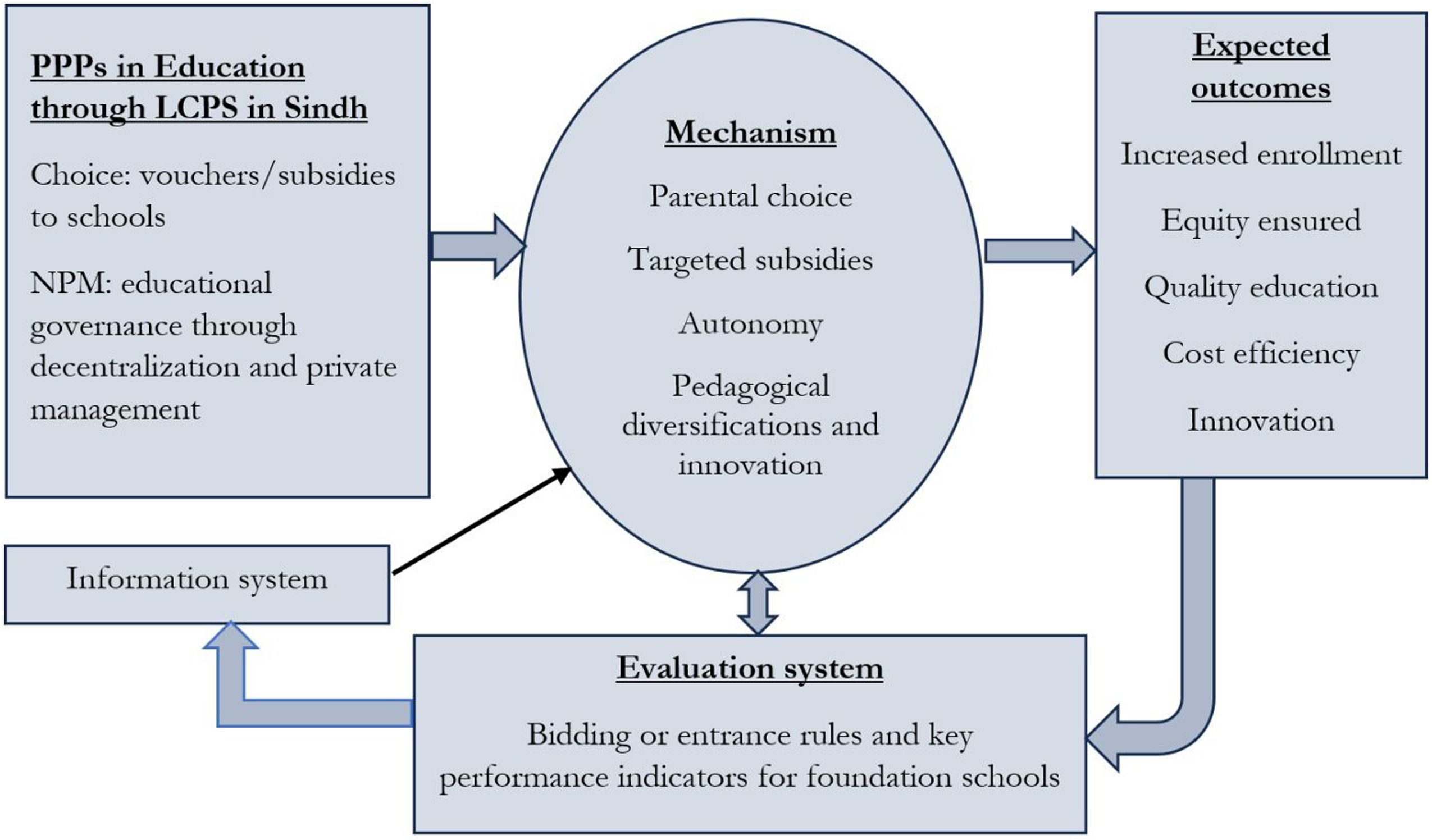
Public-Private Partnerships (PPPs) theory of change in Sindh based on Choice Theory and New Public Management (NPM).
The next step is to design the study and test the abovementioned concepts using CMO analysis (Marchal et al., 2012).
Study Design
The study design is based on a qualitative case study approach guided by RE (Westhorp, 2014). The study seeks to go beyond cause and effect and to better explain why and how observed effects emerge in a particular context through what mechanism (Wong et al., 2016). In this context, the data include document review, interviews, and focus group discussions (FGDs). The reviewed documents and participants’ details are given in Table 1.
Details of Techniques and Fieldwork of the Research Project.
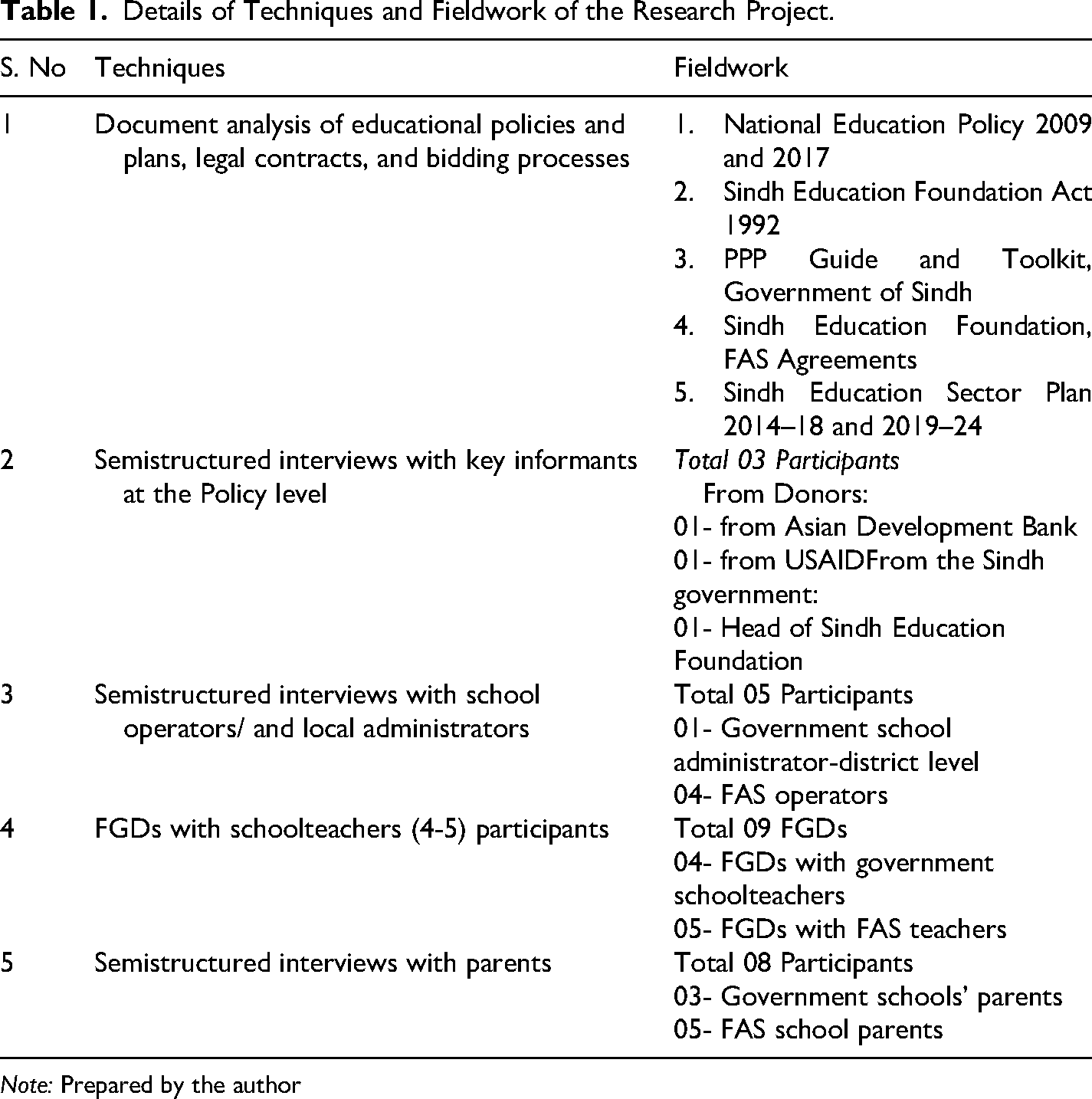
Note: Prepared by the author
Selection and Sampling of the Data
The selection and review/analysis of documents were purposeful to get policy information about the PPP, generally and specifically, the FASs. Later, to analyze based on the RE approach, how PPPs are designed through the LCPS framework to fit contextually. The rationale for selecting a document such as the National Education Policy 2009 helps to understand the policy shift toward private schools and PPPs in education. In addition, the SEF Act, PPPs Guides and Tool Kit, PPPs agreements and contracts, and SEF official data help in explaining PPP policies, contextual operations, and regulations, and give additional information on the mechanism to enhance access to quality education in Sindh.
In addition to documents, the responses were gathered from 25 semistructured interviews and FGDs with the PPP stakeholders through virtual and in-person methods. These include PPP policy developers, school operators/managers, teachers, and parents. The selection and sampling of the participants were based on purpose, representation, and heterogeneity, guided by a RE framework to get divergent contextual information. The selected district for the schools field was Khairpur Mirs, which is one of the largest districts of Sindh, with the highest number of LCPSs under the PPPs framework; however, PPP policy experts, government official representatives, and donors were selected from the entire country, and also abroad, based on their availability.
In the participants’ recruitment process, I used an open call on social media (such as Facebook, LinkedIn, and WhatsApp) to select schools, contact key policymakers by phone and email, and also through recommendations from informed people. Later, participants filtered and selected purposefully diverse and heterogeneous (based on expertise, school types, region, and gender) information and avoiding redundancy. At the school level, interviewees include school administrators, teachers, and parents. In addition, I have also included nearby government schools in an interview to make a good comparative analysis. The interviews were conducted in English and Local Languages (Urdu and Sindhi) and lasted an average of 45 min and were later translated and transcribed in English. For ethical considerations related to human beings, IRB approval is received before conducting interviews and FGDs, and participants’ names are used as pseudonyms.
Coding and Data Analysis
In RE, the development of the theory of change helps in data analysis based on the CMO configuration. The CMO configuring tool establishes the relationship between input and output in a particular context (Marchal et al., 2012). In this study, I coded documents and interview transcripts inductively and later deductively according to CMO configurations. Such as any policy or aspect of PPPs design coded as context, meanwhile, parents’ school selection, school funding, teacher matters, and pedagogy are coded as a Mechanism. In the same vein, students’ access/enrollment, quality, and equity are coded as outcomes. Later, I generated a thematic analysis of the findings to discuss the PPP initiatives’ descriptive objectives, observed outcomes, context, and mechanisms presented in the following section. The study's trustworthiness was ensured through the triangulation of various data sets, such as document reviews, interviews, and FGDs from the various stakeholders.
Foundation-Assisted School PPPs in Sindh and Contextual Challenges
The RE framework in this study supported viewing the impact of FAS PPPs based on the Context–Mechanism–Outcome Configuration. Therefore, this findings section is divided into three major themes to better explain the PPPs reform. The first theme discusses the context of the FAS PPPs in Sindh, and the second one discusses the governance mechanisms of the PPP to generate outcomes of access, quality, and equity in the third theme. To assess the contextual relevance of the FAS PPPs, we gathered data from sources such as key document reviews and interviews with the key stakeholders. The government of Sindh's rationale for PPPs in education is to leverage the private sector managerial efficiency (based on the NPM approach), resources, and support to access, quality, and innovation in education. The head of SEF stated: Education is a very big portfolio, and there is a huge number of out-of-school kids in primary and secondary level—the government yet not ready to meet. So, the government needs a helping hand to manage … we require the private sector for three purposes only—to bring in the innovation in management, to bring in the innovation in the quality, to share the burden of overall in this portfolio with the government.
PPPs models in Sindh are largely supported/sponsored by donors such as the World Bank, Asian Development Bank, USAID (in EMOs), and others. The best practices or homogeneous policies of donors often face difficulties at the implementation level. The donors’ views are not fully aligned with the government's view of PPPs. From donors’ perspectives, LCPS was broader (and less technical support) and grounded in choice theory and NPM: We defined PPP as I worked with much broader PPP things, like contracting schools, charter schools, voucher programs, and private management of public schools. To the limit, you can consider anything PPP. [Such as] some entity donates a computer to a School can also be called PPP. I don’t want to deal with these things.
The contextual fit and outcomes of FAS PPPs are still in a challenging phase. The education funding of Pakistan still relies on external cash inflows and donor agencies. That reliance pushes for divergent forms of PPP schools, also causing difficulty for the government to explain the efficacy in generating the outcomes.
Foundation-Assisted School PPPs Contracts and Contextual Implications
Document reviews of FAS show that LCPSs’ contracts and agreements are very flexible and allow various individuals or organizations to establish schools easily. This strategy was adopted to open large numbers of schools at low cost to bring more kids into schools. These loosely defined contracts and regulations also add contextual challenges to ensure transparency, quality, and sustainability in the schools. Based on the interview, school partners also reported that due to a lack of clarity in policy, challenges regarding transparency emerge; for instance, profit is prohibited in FASs; however, there is no clearly mentioned management cost for the partner. So, they retain all of the residual money after expenses as a management cost. Further, these contracts also do not incentivize hard-working and innovative partners. The per-child subsidy is the same for all partners, and the school budget is also decided at the SEF head office. Contextually, this approach also contradicts the NPM approach of decentralization and innovation.
Despite the claims by the government to mobilize private sector resources through PPPs, the FAS agreements/contracts do not delineate any resource mobilization condition from the private partner, nor do it show any risk sharing strategy. The main criteria of the school award are the partners who can bring more kids to schools and the private schools that charge low fees. The implications of this strategy come with less-qualified partners and having less educational experience. Moreover, teachers and government school administrators reported that the increasing FAS PPPs make a school like a business entity to generate business activity, including profit and employment.
The only criterion for increased funding is that increasing the number of children causes several disadvantaged areas and struggling schools to receive low funding and ultimately be closed. These choices and the NPM approach of market impact schools contextually. As one partner reported: There should be supporting visits, not policing and funding for the number of children's enrollment. Due to their inflexible criteria, if any death/festival happens, students’ attendance will be low, and[coincidentally] they visit on the same day, [resultantly] causing a reduction in funding.
Teachers’ Related Policies in FAS PPPs
One of the primary reasons for the LCPS's emergence and its efficiency is that it predominantly hires local teachers at a low cost through a quick process. This pattern is also criticized for the hiring of untrained and low-quality teachers. Locally, high schools attract unemployed youth to these schools to get some experience and money. As FAS teachers reported through FGDS: “We get experience [for other jobs] near home and easily go to school and get together with officials, which reduces transport costs.” It can be deduced that this PPP model compromises on the quality of teachers, based on the desire to provide education at a low cost.
Supply-Demand Mechanism: Parental Choice and School Subsidies
In Sindh and Pakistan, the growth of the PPP model through LCPS is more aligned with the demand. As the demand for access to education increased, the government desired to add more schools to the system from the supply side. The application of school choice by the parents is also contextual beyond the rationality of the quality. Like many developing countries, in Sindh, Pakistan, school choice is largely influenced by two main factors: the availability of nearby schools and cost (affordability). The evidence collected in this study showed that rationale choice of school by parents was not based on the quality. This is the result of several underlying factors: less informed parents, transport costs, security issues for girls, and the school operator's influence. Many parents in the village prefer nearby schools regardless of type and design because they reduce their costs and give children, especially girls, a better sense of safety and security. As one parent said, “Our priority is the nearby schools [for] almost all. But some well-educated parents choose quality education depending on their affordability.” In addition to distance, parents make school choices based on their expectations of future earnings. In this regard, parents prefer boys to choose better schools and send girls to nearby schools. As one parent noted, “We choose boys for better quality based on paying [fees]. It is a social norm. Girls can’t earn [money] normally [due to cultural constraints].”
School promotion and advertisement also affect the decision to choose schools in a low-income context. The PPP Schools tout features of private schools and apply new managerial approaches (e.g., NPM) to attract parents’ attention. However, many PPP schools run like private schools, which may cause some selectivity, such as choosing only brighter students. Other than tuition-free, schools also have hidden the cost of school bags, uniforms, stationery, branding, etc., making it very difficult for some parents to enroll their kids.
The motivation to run schools largely comes from the supply side, that is, the incentives/rewards (in the form of a subsidy) that are provided by the government. In the case of FAS, young, educated entrepreneurs who are jobless and want to contribute (and who, in return, get good experience and money) are attracted to run private schools. As FAS operator(s) responded: “It is not purely community service. If you are giving time and effort for anything, you definitely plan to get some reward for your services, like social entrepreneurship.” It has been reported and can also be deduced that, in PPP schools, equity is compromised over cost and efficiency. Private partners are choosier, in that they prefer to run schools that are located in advantaged areas and where they get fewer challenges.
Foundation-Assisted School Governance Mechanism: Autonomy, Competition, and Accountability
Applying the RE framework and NPM theory concepts in the context of Sindh, I evaluated the FAS governance mechanism. The evidence from the PPP and stakeholders suggests that the poor governance of public schools in Sindh gives a comparative advantage over PPP schools. As donors reported that “You know in [government's schools] there is bad governance in school… One of the difficulties is hiring the staff and paying them what you need to be qualified staff, etc.” Further, government schools are highly bureaucratized and less adaptable to being rationalized based on the availability of teachers and students. As teachers in FGDs reported, “In some (government) schools, one can find a large number of kids but very few teachers; on the other hand, in a different school, one might find 12 teachers but fewer than 100 kids.”
Government rigid policies also offer a poor mechanism to hire teachers locally and in a timely manner. These drawbacks give comparative advantages to the PPP schools. These schools are more autonomous in hiring teachers and allocation of the budget based on the needs. The above reports and analysis provide a good critique of government schools of their inefficiency and centralization of power. On the other side, through the PPP mode, they apply the concept of NPM. The NPM mechanism—based on decentralization, school accountability, and incentive-based performance—is claimed to yield better output.
The school administrative process has a direct effect on the children and parents. In most PPP schools, the administrative process, including student admission and their record keeping, and hiring of teachers, is easy and meets parents’ expectations. In PPP, it is said policymakers are immune from legal and political constraints and focus more on outcomes compared to the public sector. In Sindh, government schools have a uniform teachers’ recruitment policy. It is centrally administered through an open advertisement. However, in the PPP model, this structure is entirely different; they hire locally based on their needs.
Despite some advantages, the FAS PPP model is also not a clear and transparent process in teachers’ matters. In FAS PPP documents, there is no specific guideline for teachers’ recruitment. The lack of framework and mechanism also raises questions about ensuring teachers’ commitment and proper regulation in the private sector, as per labor laws. Even many teachers who work in PPP schools get less than minimum wage and cannot get a salary on a monthly basis.
Accountability Mechanism of FAS PPPs
Compared to government schools in Sindh, privately managed schools have a better perception of accountability because of the external monitoring and output approach. As reported by the donors and policy experts, government schoolteachers and officials get away with accountability. These are hired based on the recommendations of the influential, and many are their close relatives. However, PPP Policymakers believe that these schools are accountable to parents because most of these schools are working in underprivileged areas where, without parental and community support, it would not be possible to operate, as their subsidy is linked to the students’ enrollment.
The majority of parents have a better perceived value of quality education in private setups, as they reported that kids perform better in private school setups. Compared to public schools, they frequently visit private or PPP schools. Despite this, there is no formal mechanism, and parents are not empowered enough to keep the school administration accountable. As parents shared: We visit here [school] and meet [with school administration] as compared to government schools. But normally, we don’t complain. If we pay fees, then we can complain. In a free school, parents have no value [meaning power to make them accountable]
It is a belief among stakeholders that there is better performance evaluation of employees in a private setup compared to the government sector. The government sector largely relies on “Annual Confidential Report.” This is commonly referred to as a formality and can easily be manipulated and corrupted. This practice has led to several government schoolteachers, “ghosts” as they take salaries but are not available in schools. Policy experts reported they have political backing, and the government constraints on firing teachers who do not perform. In such a backdrop, PPPs have the advantage in these areas. The PPPs have the potential to hire the best teachers and pay as desired to get the desired outcome.
Despite issues in the government set-up, most of the FAS operators reported that the FAS schools’ mechanisms, monitoring, and evaluation are also problematic. They believe monitoring should be facilitative and supportive, as the current monitoring is based on testing students’ scores. These evaluations are measuring the quality narrowly; if the school fails to present good test scores they will suffer financially. Ultimately makes school hard to survive.
Competition, Differentiation, and Innovations
Drawing on the choice theory and NPM, the PPP supporters argue that the government schools lack innovation because of their homogenous practices. They generate a strong argument for the support of PPPs in education, as they apply an NPM approach in education, which reduces overcentralization and bureaucratic hurdles, and paves the way for improving pedagogical innovation and financing different units easily. Diversification and differentiation in schools are expected to create an environment of competition and innovation, not only in pedagogy but also in resource mobilization. As reported by the SEF officials: The innovation is not limited to educational pedagogy and teaching but also motivates the private sector to participate in education. The unique innovation was to involve and engage partners in rural areas. You know, a private partner is only interested in urban areas. Taking them into rural areas was a gigantic task, so the education foundation created the opportunity for them.
Despite the government claims and other stakeholders’ views, this study is unable to find any innovative educational practices in PPPs that remarkably differentiate them from government schools in terms of quality. However, the LCPS model of FAS PPP has some flexibility to follow Oxford (elite private school) syllabi. But many teachers found it hard to teach contextually as they are less qualified and trained. The understanding of competition among schools is being taken narrowly (test-based), without looking at the adequacy of equal opportunity and its social cost.
Another critical aspect of PPPs regarding innovation is that education is being handed over to noneducational people (a diversification aspect of the NPM), and they only bring cosmetic changes rather than structural ones. Many teachers reported that innovation will be possible through opening more science and computer labs, libraries, and supporting resources in teaching; the low-cost PPP model fails to offer these costly resources.
Outcome of FAS PPPs: Access, Quality, and Efficiency in Education
The objective of this broader theme is to explain the outcome of educational goals achieved through subsidizing LCPS schools in the context of Sindh, based on the CMO configuration Access to education.
The main rationale for FAS PPPs in education, as delineated in the document PPP Guides and Tool Kit (SELD, 2017), is to expand schooling in marginalized areas and improve educational outcomes. It is hoped that the current LCPS mode of PPPs takes an innovative approach to open thousands of schools in the areas where large numbers of kids are out of school. Further, PPPs help in ensuring teachers and infrastructure, which is difficult to achieve through the government system.
As one of the donors reported: The most basic way to get around proper input[having] schools that are fit for the purpose. A large proportion of Sindh schools are single classrooms. Schools that do not have many secondary schools are too few. Over 90% of schools are primary schools in Sindh. In certain areas, there are no secondary schools at all, particularly those that educate girls. (FAS) PPPs generally can help you to build increased access.
Number of Institutes and Student Enrollment at FAS.
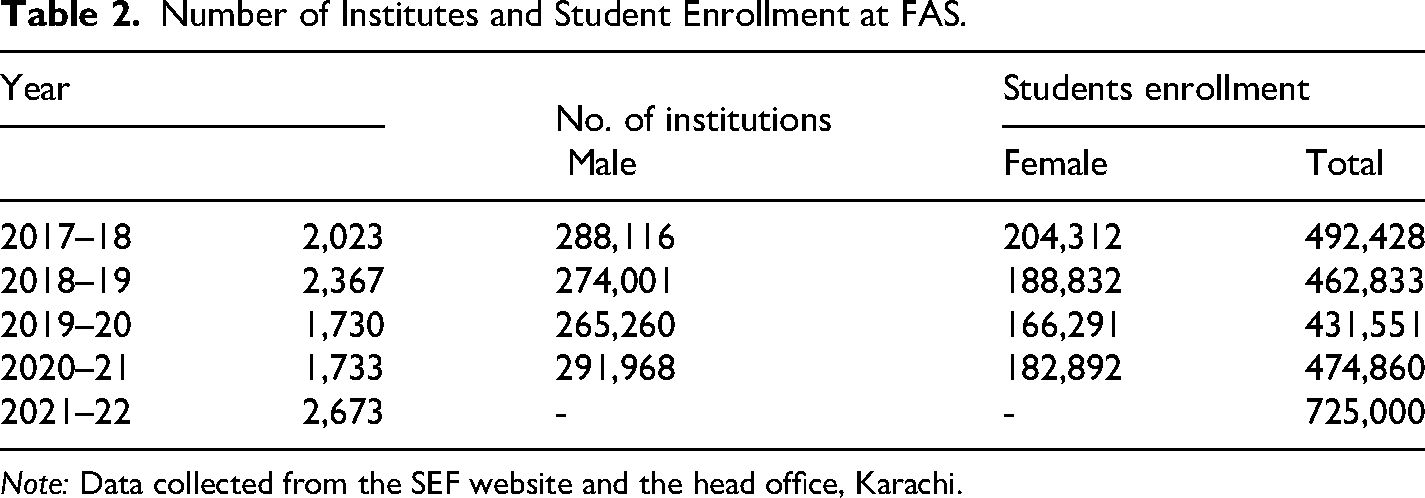
Note: Data collected from the SEF website and the head office, Karachi.
Initially, the SEF target was intended to reduce out-of-school children by requiring applications for opening schools only in certain rural areas. However, currently, the FAS model is also penetrating urban areas and areas near government schools. This pattern is being criticized, as it is creating duplication of enrollment. It has been reported that the same kids are enrolled in nearby government schools and PPP schools, and this can increase the greed of operators to target more easily available students, which can cause trouble for the government schools in terms of funding. As parents and teachers mentioned: “These Schools should be in villages, because cities have [already government] schools and teachers.”
Despite SEF's commendable efforts, the participants reported that the PPP model has no special mechanism or design for increasing enrollment in conflict and disaster-affected areas. In Sindh, within villages, some villages are better than others. Some people feel more secure and are interested in sending their kids to school. However, in the tribal area of Sindh, people are still apathetic toward education. Special provisions and targeted incentives can bring in these people. Another challenge that government schools failed to address is retaining kids. Though the PPP model also fails to address those kids who drop out of school because of their poor academic base, poverty, and child labor.
Educational Equity Through FAS PPPs
In Pakistan, education distribution is quite uneven. Due to the social structure and economic disparity of urban versus rural areas, the rural areas are persistently marginalized. In addition, gender disparity has historically disadvantaged girls. However, FAS PPP was aimed at reducing this disparity by targeting more disadvantages by applying decentralization and autonomy approach of the NPM. Based on my interviews and FGDs with parents and teachers, I found that FAS PPP schools are relatively more attractive to girls’ enrollment because parents feel more secure in sending their girls, as they have more female teachers and schools are near to their homes.
The educational equity debate is now beyond the students’ enrollment in schools (Rind & Malik, 2024). It emphasizes developing functioning and capability for all segments of society. Due to the nature of the PPP through the LCPS model being more market-centric, it incentivizes school operators to select more able-bodied students. They responded that they all believe in equity, but they felt the system would not support having students with different needs because schools do not have specialized staff or support materials. The existing design of PPPs also incentivizes school operators to choose to take typically abled and advantaged kids through screening mechanisms that perform better in tests, and to open schools in advantaged areas. Another example of inequality and segregation confirmed in FAS PPP is that parents also take students from government schools and send them to PPP schools. This may lead to bright students being moved from government schools to PPP schools. This phenomenon is also known as “white flight” due to the oversupply of PPP schools (UNESCO, 2021).
Another concerning point is that the FAS model is also penetrating urban areas and areas near government schools. This pattern is being criticized, as it is creating duplication of enrollment. It has been reported that the same kids are enrolled in nearby government schools and PPP schools, and this can increase the greed of operators to target more easily available students, which can cause trouble for the government schools in terms of funding.
Quality of Education in FAS PPPs
Though FAS PPPs schools offer some level of better-quality perception due to accountability, it has also created a substantial difference in quality (based on different school types). Grounded in choice and NPM, the reason for this difference is that some organizations and individuals have comparative advantages in operating schools. However, it also takes the blame for less inclusiveness and more competition, and standardized assessment. Educational standards and assessments are also complex and are not properly disseminated and understood among the stakeholders (i.e., teachers, parents, and administrators). School operators showed their concern about the current pattern of gauging quality education. The curriculum of some FAS (as mentioned in the contract) is based on the Oxford curriculum; many teachers feel they are unable to teach these courses well. Teachers at various schools have reported that the curriculum should be similar in all schools in order to reduce the superiority of some PPP schools based on the perception of English medium schools.
Contrary to gauging quality through tests, many parents feel the moral and ethical dimension of education is being lost day by day, as education is becoming more of a business and being offered economic value. We need good teachers who give moral value and better learning. School can play a role in kids’ [moral] development… Quality education is a good environment, good teachers, and parent support…. Teachers [should] teach moral values. Also, help in changing rural poverty.
Cost Efficiency
Educational financing in Pakistan and Sindh is quite inefficient and unfair. In the government sector, generally, school financing is based on the number of students or special grants/funds approved through political patronage. There is an argument from policymakers in the public sector where money is being wasted that could be better utilized through PPPs to increase access. As the SEF head argued: Per child expenditure of public schools is 3,000 to 3,500 PKR [Pakistan Rupees] per month, and SEF is paying 1,000 or 900 PKR per month…See a government teacher who has been paid 80,000 or 100,000 PKR per month. What is his output? And the same SEF teacher is being paid 10,000 or 15,000; then see their [better] output.
Discussion and Conclusion
This study aimed to evaluate the FAS PPPs schools under the low-cost mechanism and their implications for access, quality, and equity. The study employed the RE framework and added the concepts of Choice theory and NPM in developing the theory of change. The CMO configurations help to generate and assess the outcomes of access quality, equity, and efficiency through the mechanism of decentralized governance, per-child subsidy, and accountability in the context of Sindh.
The study findings show that, due to its low-cost mechanism, the FAS PPPs model has some advantages in reaching out to a large number of kids. However, these rising enrollments are also not homogeneous. The PPPs schools perform better in more urban or semiurban areas where they can enroll large numbers of kids easily. In several places in Pakistan, these schools also compete and take kids from the neighboring government schools, as noted by Ansari (2021).
In Sindh, large numbers of LCPS schools are established based on the enormous demand for schooling, which enables the government to justify subsidizing private schools. It was argued that the government subsidy, based on parents’ demand, increased access, and empowered more parents in the context of Sindh (Barrera-Osorio et al., 2022). The implications of the PPPs model on parents’ choice (application of choice theory) need to be viewed contextually, as many parents in this study reported that their school choice is beyond the quality and school effectiveness. It includes proximities, extra cost, available information, and partners’ influence. This conforms to the existing literature that school choices in disadvantaged contexts are based on rationality (Ben-Porath & Johanek, 2019). Compared to government schools, parents of students in many PPP schools incur costs through school uniforms, school bags, notebooks, celebrations of different days, trips, and extra schoolbooks (Srivastava, 2016) have also been confirmed in this study. This study further showed that the application of a choice option does not yield clearly better overall academic results in Sindh.
The additional findings of the study show that the FAS PPPs model increased decentralization, which empowered school administrators, providing them with resources to hire teachers and plan their professional development activities. However, the NPM approach created several contextual challenges, as some schools got a large share of funding, and others remained disadvantaged because of poor administration. Decentralization in education may benefit some schools, but as per UNESCO (2017), decentralization has resulted in underfunded rural schools in Pakistan.
Further competition and innovation are associated with the PPPs model, and it will also increase the quality of PPP and public schools (LaRocque & Sipahimalani-Rao, 2019); however, the findings of this study reported that quality is only gauged through testing and inclusion of the English medium school's curriculum. Due to low-cost PPP schools in rural Sindh and the availability of low-qualified teachers, the quality of education has been reduced in marginalized areas. Many scholars (see Heyneman & Stern, 2014; Steiner-Khamsi & Draxler, 2018) also doubt that testing, the main quality gauge in FAS aspects of quality dimensions, is pushed by international and development partners.
Another contested aspect is that PPPs portray the superiority of the private sector and depict the government as failing to fulfill its responsibilities, along with wasting public tax money. This approach has far-reaching implications for educational financing and equity (Languille & Ron Balsera, 2025). Further, this approach may lead to abandoning government responsibilities and increased encroachment on the government school system.
In conclusion, PPPs in education have some advantages in providing better governance and ensuring accountability in education in Sindh, Pakistan, and in attracting donor funding. However, their impact on increasing access to equitable quality education is still less promising and divergent. Furthermore, increased preferment of PPP schools at policy level increases apathy toward the public sector schools, as public schools provide a comparatively more equitable education (Verger et al., 2020).
The study scope of this study is the Sindh province of Pakistan, and findings are based on the RE approach, which can be more relevant and limited to a similar context, not globally. Further, the implications of this study indicate that the Government of Pakistan, especially the Sindh Government's ambitions to expand PPP models, should be carefully assessed in terms of their implications for quality education, equity, and sustainability. A more targeted model of PPPs, need-based funding, and incentives for disadvantaged areas can help to enroll out-of-school children from poor backgrounds. Further, policymakers should consider a clear, transparent, and indigenous-designed model of PPPs for sustainable solutions. It also invites future researchers to explore and explain the impact of PPP policy design based on contextually constructed evidence.
Footnotes
Acknowledgments
This paper has been extracted from the author's Ph.D. dissertation, and the author acknowledges the guidance and support of my dissertation chair, Dr. Joel Malin, Associate Professor at Miami University.

Ethical Considerations
The ethical approval of this study was obtained from the IRB. Participants’ interviews were voluntary, and their identities were kept anonymous.
Use of AI
No generative AI tools were used in idea generation, analysis, or interpretation of data in this manuscript. All aspects of the work are the original effort of the authors. AI was only used as a support for editing.
Funding
The author received no financial support for the research, authorship, and/or publication of this article.
Declaration of Conflicting Interests
The author declared no potential conflicts of interest with respect to the research, authorship, and/or publication of this article.