







Abstract
The growing preference for private schooling in India has intensified concerns regarding educational inequality and declining trust in public education. Drawing on Pierre Bourdieu's concept of cultural capital, this qualitative study explored why parents prefer private schooling despite free education. Interviews with ten parents across India revealed that parental preference was shaped by concerns regarding educational quality, disparity, unequal opportunities, and preparedness within public schooling systems. Parents’ choice was linked with anxieties regarding children's mobility and competitiveness. The study proposes the notion of “defensive school choice,” suggesting that parental migration toward private schooling reflected educational insecurity rather than unrestricted preference.
Introduction
Over the past two decades, India has witnessed a rapid expansion of private schooling despite the continued availability of free public education through government schools. Recent national data indicate a steady decline in government school enrolment alongside increasing migration toward private schools across both rural and urban India (ASER Centre, 2023; Ministry of Education, 2025). Similar patterns have emerged across many Global South societies where educational privatization has expanded alongside neoliberal reforms, market-driven schooling, and intensifying competition for educational advantage (Ngabiyanto & Atmojo, 2026; UNESCO, 2024). Although private schools are frequently associated with English communication, institutional discipline, technological exposure, and broader educational opportunities, the rapid growth of privatized schooling has simultaneously generated serious concerns regarding educational inequality, commercialization of learning, social fragmentation, and unequal access to future opportunities (Kaur & Sharma, 2025). International scholarship increasingly warns that excessive dependence on private schooling may gradually weaken the democratic and equalizing role historically associated with public education systems, particularly within economically unequal societies (Green, 2024; Huber et al., 2019).
These concerns are particularly significant in India because of the country's highly diverse and decentralized school education structure comprising regional state boards, Central Board of Secondary Education (CBSE), Council for the Indian School Certificate Examinations (CISCE), and private international schools, each differing in curricular orientation, language environment, pedagogical practices, and institutional exposure (Ministry of Education, 2020). School education in India is jointly governed by the central and state governments; however, the majority of schools are managed by state governments, and their quality, infrastructure, and institutional resources often vary considerably across states depending on broader socio-economic conditions. In contrast, centrally affiliated schools remain comparatively limited in number. As a result, privately managed schools affiliated with central boards, particularly CBSE, have expanded rapidly across both urban and semi-urban India in response to rising middle-class aspirations for nationally integrated and future-oriented education. Although such diversity reflects India's multilingual and multicultural character, it has simultaneously contributed to disparities in communicative competence, technological exposure, mainstream educational integration, and access to socially valued opportunities (Kundu & Bej, 2020). Increasingly, concerns are being raised that unequal schooling systems may create fragmented educational realities where children experience markedly different forms of exposure, confidence-building, competitive preparedness, and future opportunity structures from early childhood itself. Such disparities possess important implications not only for educational mobility but also for social cohesion, equal citizenship, and democratic access to opportunity within rapidly changing societies.
Recent educational trends further indicate the growing scale of this transformation. Private schools now educate a substantial proportion of school-going children, with enrolment continuing to rise across several states (Press Information Bureau, 2025). Over the past five years, India has also witnessed a decline in the number of government schools alongside continued expansion of private unaided schooling (Ministry of Education, 2025; Times of India, 2026). Between 2021 and 2025, private school enrollment in India increased sharply from 31.1% to 38.8%, while the share of students in government schools declined from nearly 74% to 69% nationwide (Choudhury et al., 2025). These developments increasingly point toward declining parental trust in common public education and the normalization of market-oriented educational competition. In many developing contexts, schooling is therefore becoming not only an educational issue but also a source of parental anxiety, social comparison, and fear regarding children's future mobility and social belonging (Hart, 2018; Huber et al., 2019). Despite the growing significance of these transformations, existing Indian research has largely focused on enrolment trends, affordability, and academic outcomes, while relatively limited qualitative research has explored how parents themselves interpret the shift toward private schooling within broader contexts of inequality, educational insecurity, and fragmented opportunity structures.
Against this backdrop, the present study critically explores why parents choose private schools over public and regional board schools in India. Specifically, the study investigates how concerns regarding curricular disparity, educational quality, communicative English, mainstream educational competition, and future preparedness shape parental educational decision-making. Through qualitative interviews with ten parents whose children are enrolled in private schools, the study further examines whether private schooling is experienced as a voluntary educational preference or as a structurally conditioned response to unequal educational opportunities. The study is guided by the following research questions:
Why do parents prefer private schools even when free public schools are available in India? How do concerns about educational quality, future jobs, social status, and children's future success influence parents’ school choices? Do parents freely choose private schools, or do unequal educational opportunities push them toward private schooling?
Literature Review
Educational Privatization as a Global Transformation
The rapid expansion of private schooling has become one of the most significant transformations within contemporary education systems globally, particularly across Global South societies. Influenced by neoliberal reforms, market-oriented governance, and discourses of parental choice, education is increasingly being repositioned from a democratic public good toward a competitive educational marketplace (Balan, 2023; Ngabiyanto & Atmojo, 2026). Across many developing countries, growing urbanization, middle-class aspiration, and concerns regarding employability and educational mobility have accelerated parental migration toward private schooling systems (Gu, 2024; Zancajo, 2025). International scholarship further suggests that private schools are frequently perceived as providing stronger English communication, institutional discipline, technological exposure, and competitive educational environments compared to public schooling systems (Green, 2024). Consequently, school choice increasingly reflects broader social transformations linked with aspiration, market competition, and the changing social meaning of education within globalized societies.
Educational Privatization, Inequality, and Social Fragmentation
Despite the growing expansion of private schooling, international scholarship increasingly raises concerns regarding its implications for educational equity and democratic citizenship. Researchers argue that excessive dependence on privatized schooling may intensify educational inequality by linking access to high-quality educational opportunities with economic capacity rather than social justice (Huber et al., 2019; Rodríguez-Pose & Vidal-Bover, 2024). Market-oriented educational systems may further contribute to early social segregation by creating unequal educational environments differentiated through language exposure, institutional prestige, communication culture, and access to socially valued competencies (Carrasco et al., 2021; Green, 2024). In economically unequal societies, such fragmentation risks weakening the equalizing and integrative role historically associated with public education systems (Otero et al., 2021). International literature additionally suggests that privatization increasingly transforms schooling into a site of social comparison, competitive positioning, and symbolic distinction, where educational institutions become markers of status, aspiration, and future mobility rather than spaces of collective democratic development (Ngabiyanto & Atmojo, 2026; Hart, 2018).
India as a Critical Context of Educational Fragmentation
These concerns become particularly significant within India because of the country's highly diverse and stratified schooling structure comprising regional state boards, CBSE, CISCE, private English-medium schools, and international schools, each differing in curricular orientation, language environment, pedagogical culture, and institutional exposure. Although such diversity reflects India's multilingual and multicultural character, recent educational trends increasingly indicate widening disparities in communicative competence, technological exposure, mainstream educational integration, and competitive preparedness across schooling systems (Choudhury et al., 2025; Kundu & Bej, 2020; Meena, 2025). National data further indicate continuing growth of private school enrolment alongside a gradual decline in government school participation across several states (ASER Centre, 2023; Ministry of Education, 2025). Existing Indian studies suggest that many parents increasingly associate private schooling with English communication, institutional accountability, confidence-building, and improved future opportunities (Kingdon, 2020; Kundu & Bej, 2020; Meena, 2025). At the same time, scholars have expressed concern that fragmented schooling systems may gradually normalize unequal educational futures where access to socially valued educational opportunities becomes unevenly distributed across socio-economic groups (Kumar & Choudhury, 2021).
Educational Anxiety, Aspiration, and Parental School Choice
Contemporary scholarship increasingly suggests that parental educational decision-making is shaped not only by academic considerations but also by broader emotional and social anxieties. In highly competitive societies, schooling increasingly functions as a perceived pathway toward economic security, social legitimacy, and future mobility (Hart, 2018; Reay, 2017). Parents often experience fear that children studying in weaker or less competitive educational environments may become excluded from mainstream educational and professional opportunities later in life. Consequently, educational choice increasingly becomes intertwined with concerns regarding communicative competence, institutional credibility, social positioning, and fears of children being disadvantaged within highly competitive social environments (Carrasco et al., 2021; Green, 2024). Such anxieties appear particularly visible within Global South societies experiencing rapid privatization, expanding middle-class aspiration, and unstable labour-market environments (Ngabiyanto & Atmojo, 2026). Educational choice therefore increasingly reflects not merely preference for specific schools but also parental attempts to navigate uncertainty, insecurity, and unequal opportunity structures within rapidly changing societies.
Social Meaning of Schooling
The present study is conceptually informed by Pierre Bourdieu's theory of cultural capital, which explains how educational institutions reproduce social inequalities by legitimizing particular linguistic, behavioural, and institutional competencies associated with dominant social groups (Bourdieu, 1986). According to Bourdieu, schools do not merely transmit academic knowledge but also reward socially valued forms of communication, confidence, behaviour, and institutional familiarity. Children possessing such forms of cultural capital are therefore more likely to experience educational success and social legitimacy. Within contemporary educational markets, private schooling increasingly becomes associated with communicative English, institutional discipline, technological adaptability, and confidence-oriented learning environments, all of which are perceived as important for future mobility and mainstream participation (Kundu & Bej, 2025; Green, 2024; Rodríguez-Pose & Vidal-Bover, 2024). Educational choice may therefore be understood not only as preference for academic quality but also as parental investment in socially valued competencies linked with symbolic recognition and future opportunity structures.
Research Gap and the Contribution of the Present Study
Despite growing international concern regarding educational privatization, inequality, and fragmented schooling systems, existing Indian scholarship has largely concentrated on enrolment patterns, affordability, policy reforms, and comparative learning outcomes (Kaur & Sharma, 2025; Kingdon, 2020; Kumar & Choudhury, 2021). While such studies have generated important evidence regarding the expansion of private schooling, relatively limited qualitative research has critically examined how parents themselves interpret this shift within broader contexts of curricular disparity, educational insecurity, social anxiety, and unequal future opportunities. In particular, insufficient attention has been paid to how parents perceive regional board schooling in relation to mainstream national educational competition, communicative competence, and future-oriented mobility structures within contemporary India. Existing literature has also inadequately explored whether parental movement toward private schooling reflects genuine educational preference or a structurally conditioned response to fragmented and unequal schooling systems. Furthermore, limited research has examined how educational privatization reshapes the social meaning of schooling itself, transforming education from a shared public institution into a site of competitive positioning, aspirational anxiety, and differentiated opportunity. Against this backdrop, the present study contributes to existing scholarship by qualitatively examining how parents from different regions of India interpret private schooling within the wider context of educational privatization, curricular inequality, aspiration, and competitive insecurity. By foregrounding parental narratives, the study offers a nuanced Global South perspective on how fragmented educational systems may shape contemporary experiences of school choice, educational mobility, and social inequality.
Methods
Research Design
This study adopted an exploratory qualitative research design to investigate parents’ perspectives on choosing private schools over public schooling in India. The study specifically explored how concerns regarding educational quality, communicative English, employability preparedness, institutional discipline, confidence-building, social mobility, and future competitiveness shape parental educational decision-making. A qualitative approach was considered appropriate because the study sought to understand the lived experiences, anxieties, aspirations, and subjective meanings underlying school choice within contemporary India. Rather than measuring attitudes numerically, the study aimed to capture the deeper social and emotional dimensions associated with parental preference for private schooling. The interpretivist qualitative framework therefore enabled rich and context-sensitive exploration of how parents perceive educational opportunity, inequality, and future preparedness within increasingly competitive schooling environments. The study was conceptually informed by Pierre Bourdieu's theory of cultural capital, which provided an interpretive lens for understanding parental narratives concerning communication, educational prestige, and future mobility.
Sampling Strategy and Participants
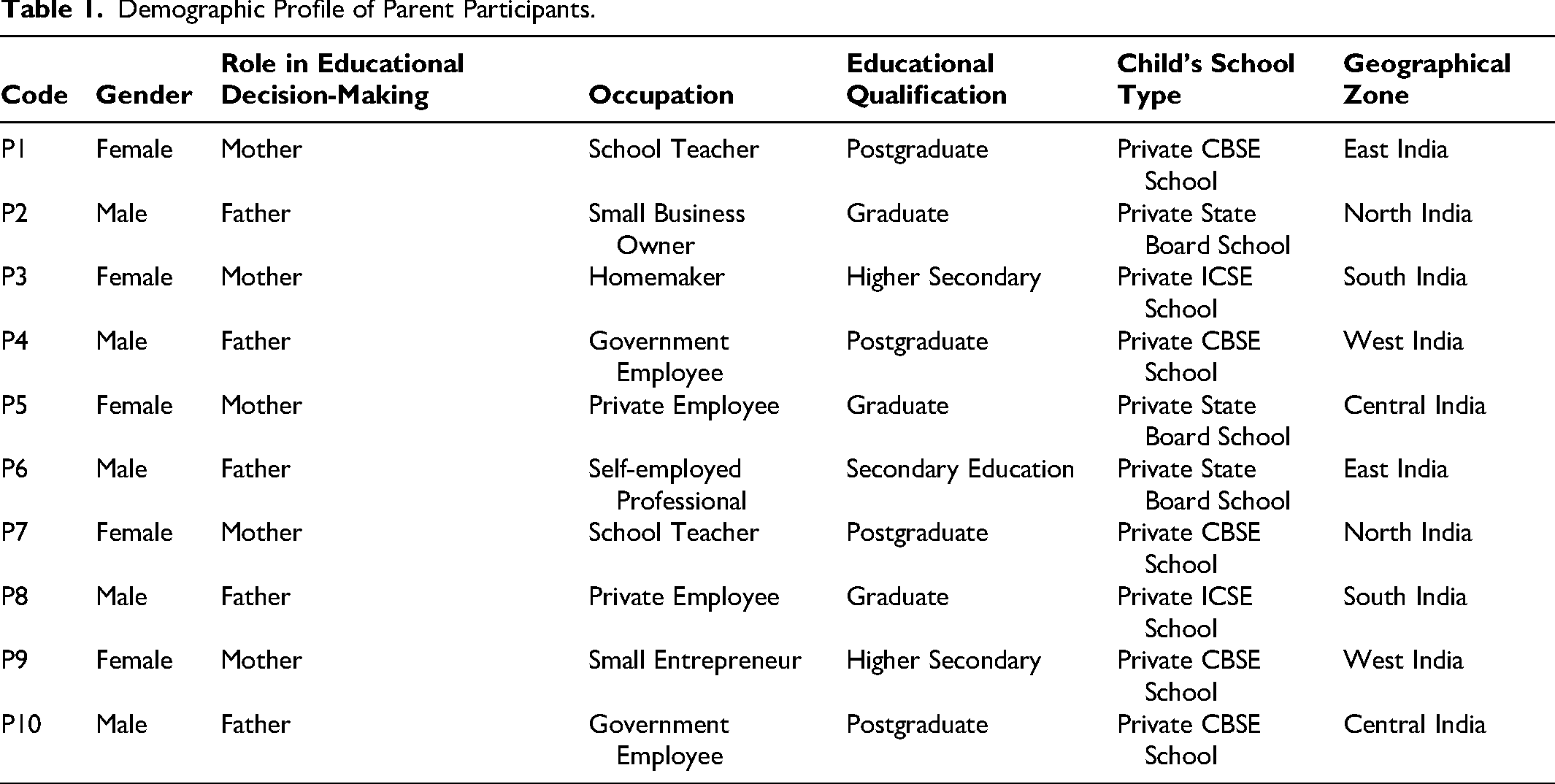
A purposive sampling strategy was employed to recruit information-rich participants capable of providing reflective and experience-based insights into parental preference for private schooling in India. The study included ten parents (also guardians) who were the primary educational decision-makers within their families and whose children were enrolled in private elementary schools (Classes I–VIII). Participants were selected from five geographical zones of India—North, South, East, West, and Central India—to obtain broader variation in socio-cultural and educational experiences rather than statistical representativeness. Two participants were selected from each zone. All participants had consciously chosen private schooling for their children despite the availability of free public education within their localities. The study intentionally focused on parents who had already chosen private schooling in order to explore the reasoning, anxieties, and perceived educational considerations underlying such decisions rather than to compare private- and public-school parents.
The sample included mothers, fathers, and guardians from varied socio-economic and occupational backgrounds, including teachers, private employees, small business owners, self-employed professionals, and government staff (Table 1). Educational qualifications ranged from secondary education to postgraduate degrees, enabling the inclusion of both middle-class and first-generation learner families. Participants were selected based on three criteria: (1) they must have enrolled their children (at least one child) in private schools at the elementary level, (2) they must be actively involved in educational decision-making within the household, and (3) they should be willing to engage in detailed reflective discussions concerning educational quality, curricular preference, future preparedness, and school choice.
Demographic Profile of Parent Participants.
Although the sample size was relatively small, qualitative inquiry prioritizes depth, contextual understanding, and richness of interpretation over statistical generalization. The cross-regional composition of participants enabled exploration of recurring parental concerns across diverse educational and socio-cultural settings. Data collection continued until sufficient thematic recurrence and analytical depth were reached, with later interviews producing substantial repetition of core concerns. Participants were assigned pseudonymous identification codes ranging from P1 to P10 to ensure anonymity and confidentiality.
Data Collection
Data were collected over a three-month period between September and November 2025 through semi-structured online interviews conducted using Google Meet and Zoom platforms. Online interviewing was considered appropriate because participants were geographically dispersed across different regions of India, making face-to-face interaction logistically difficult. Prior to the interviews, participants were contacted through email and telephone and were informed in detail about the objectives of the study, confidentiality measures, voluntary participation, and their right to withdraw from the study at any stage without consequences. Written informed consent was obtained electronically before the interviews commenced.
Each interview lasted approximately 45–60 min and was conducted primarily in English, Hindi, or Bengali according to participant comfort in order to encourage natural interaction and emotional openness. The semi-structured format enabled flexibility for participants to elaborate upon personal experiences, educational anxieties, aspirations, and school-related decision-making processes. During the interviews, the researchers primarily adopted a facilitative and non-judgmental role by encouraging reflective narration, asking probing follow-up questions, seeking clarification where necessary, and ensuring that participants could express their views freely without interruption or researcher imposition. Several interviews gradually evolved into reflective conversations where parents discussed not only schooling preferences but also fears regarding children's future mobility, employability, competitive pressures, and unequal educational opportunities. Field notes were also maintained during and immediately after interviews to document contextual observations, emotional expressions, pauses, and emerging analytical reflections that were not fully captured through audio recordings alone.
The interview schedule (given below) was developed based on the objectives of the study, existing literature on educational privatization and school choice, and Pierre Bourdieu's concept of cultural capital. Questions focused on parental perceptions regarding educational quality, communicative English, curricular disparity, confidence-building, institutional prestige, discipline, future preparedness, and reasons for preferring private schools over public schools. The interview protocol was pilot-tested with two parents outside the final sample to improve clarity, sequencing, and contextual appropriateness of the questions.
With participants’ informed consent, all interviews were audio-recorded and later transcribed verbatim. Interviews conducted in Hindi and Bengali were translated into English primarily by the first author, who is fluent in all three languages, while the co-authors independently reviewed selected translated transcripts to ensure linguistic consistency and contextual accuracy. To standardize translations and preserve semantic equivalence across languages, the researchers followed a meaning-based translation approach emphasizing conceptual rather than literal translation. Particular attention was paid to preserving culturally embedded expressions, emotional nuances, and context-specific meanings during transcription and translation. In addition, selected translated excerpts underwent back-translation procedures following Creswell and Poth (2018), where portions of the English transcripts were translated back into the original language and cross-checked for consistency of meaning. Any discrepancies identified during this process were discussed collaboratively among the researchers until interpretive agreement was achieved.
To further strengthen credibility and trustworthiness, member checking was conducted by sharing summarized interpretations and emerging thematic understandings with selected participants to verify whether the interpretations accurately reflected their experiences and perspectives. Participants largely confirmed the authenticity of the interpretations, and minor clarifications suggested during this process were incorporated into the final analysis.
Interview Schedule
Why did you choose a private school for your child instead of a public/government school?
What differences do you perceive between private and public schools in terms of educational quality?
How important was English communication in influencing your school choice decision?
What role do discipline, confidence-building, and personality development play in your preference for private schooling?
Do you believe private schools better prepare children for future careers and competitive examinations? Why?
What concerns do you have regarding public or regional board schools?
To what extent do technological exposure and digital learning facilities influence your educational decisions?
Have financial pressures or sacrifices emerged because of private schooling? If yes, how?
Do you think private schooling provides social or status-related advantages within society?
In your opinion, is choosing private schooling a genuine preference or a necessary response to unequal educational opportunities? Why?
Data Analysis
The collected data were analysed using thematic analysis following Braun and Clarke's (2006) reflexive six-stage framework: (1) familiarization with the data, (2) generation of initial codes, (3) searching for themes, (4) reviewing themes, (5) defining and naming themes, and (6) report writing. Initially, all interview transcripts were read repeatedly to achieve deep immersion within participants’ narratives, emotional expressions, and educational experiences. During this stage, reflexive notes, preliminary interpretations, and recurring patterns were documented to identify dominant concerns relating to school choice, educational inequality, future insecurity, and parental aspirations.
The analysis was conducted manually rather than through qualitative software because of the relatively small sample size and the study's emphasis on interpretive depth, contextual sensitivity, and close engagement with participants’ narratives. Manual analysis enabled the researchers to repeatedly revisit transcripts, compare emotional nuances across interviews, and capture context-specific meanings that may have been overlooked through mechanical coding procedures alone. Field notes, reflective memos, and translated transcripts were continuously reviewed alongside interview recordings throughout the analytical process.
Open coding was initially conducted line-by-line to identify meaningful segments related to educational quality, curricular disparity, communicative English, institutional confidence, peer-learning environment, employability anxiety, social mobility, financial sacrifice, educational insecurity, and parental dissatisfaction with public schooling systems. At the initial stage, the coding process generated a large number of descriptive and overlapping codes such as “fear of falling behind,” “lack of exposure,” “English disadvantage,” “competitive pressure,” “future insecurity,” “discipline,” “curriculum gap,” and “loss of trust in government schools.” These preliminary codes were subsequently compared across transcripts, merged where conceptually similar, and progressively refined into broader interpretive categories through repeated analytical discussion among the researchers.
A hybrid coding strategy combining inductive and deductive analysis was employed. While several themes emerged organically from participants’ narratives, the analysis was also theoretically informed by Pierre Bourdieu's concept of cultural capital and broader debates surrounding educational privatization, inequality, and school choice. For example, participant narratives concerning communicative English, institutional prestige, confidence-building, and mainstream educational integration were later interpreted through the lens of cultural and symbolic capital. Similarly, repeated expressions of fear, insecurity, and educational pressure gradually contributed to the interpretive development of the concept of “defensive school choice.”
Particular attention was given not only to explicit responses but also to the social meanings, emotional anxieties, and structural concerns underlying parental educational decisions. Themes were reviewed repeatedly against the complete dataset to ensure that they accurately reflected participants’ narratives rather than isolated quotations or researcher assumptions. The evolving thematic structure was also continuously cross-checked with the study's research questions to ensure conceptual alignment between the findings and the core objectives of the study. For instance, themes relating to dissatisfaction with public schooling addressed the first research question concerning factors influencing parental preference, while themes relating to educational anxiety and defensive school choice directly addressed questions concerning future insecurity and structurally conditioned educational choice.
To strengthen analytical credibility, coding decisions and thematic interpretations were discussed collaboratively among the researchers at multiple stages of analysis. Areas of disagreement or conceptual ambiguity were revisited through repeated transcript review until interpretive consensus was achieved. The final analysis generated four major themes relating to perceived limitations of public and regional schooling, private schooling as a symbolic and cultural advantage, educational anxiety and competitive insecurity, and structurally conditioned school choice and unequal educational futures.
Trustworthiness and Ethical Considerations
To strengthen trustworthiness and reduce researcher bias, coding decisions and thematic interpretations were repeatedly cross-checked through collaborative discussion, reflexive review, and repeated comparison with the original interview transcripts to ensure that themes emerged from participants’ narratives rather than researchers’ assumptions. Multiple qualitative validation strategies, including member checking, peer debriefing, reflexive note-taking, and maintenance of an audit trail, were employed to enhance credibility and methodological transparency. The study prioritized interpretive depth rather than statistical generalization, and detailed participant narratives were used to improve transferability. Ethical integrity was maintained throughout the study. Written informed consent was obtained prior to interviews, participants were assured of confidentiality and their right to withdraw at any stage, and pseudonymous codes were used to protect identities. Interview data and transcripts were securely stored in password-protected files accessible only to the researchers.
Findings
Theme 1: Perceived Limitations of Public and Regional Schooling
Perceived Disconnect Between Regional Board Curricula and Mainstream Educational Competition
One of the strongest concerns expressed by parents was dissatisfaction with regional board curricula, which many participants perceived as insufficiently aligned with mainstream national educational competition and contemporary educational demands. Parents frequently argued that children studying under several regional board systems often face disadvantages in national-level examinations, communicative English, and broader academic integration compared to students from CBSE, CISCE, and private English-medium schools. Participants feared that such curricular differences may gradually create unequal academic preparedness and restrict access to nationally valued educational opportunities. One parent explained, “I feel children from many regional board schools struggle later because mainstream competition in India mostly follows different standards and expectations” (P5), while another participant remarked, “By the time state board students understand the level of national competition, many private school students from CBSE boards are already ahead” (P7). Several parents additionally perceived regional curricula as excessively localized and insufficiently connected with contemporary educational expectations increasingly associated with higher education and professional advancement. Noticeably, some participants enrolled their children in private state board schools only because no CBSE-affiliated school was available nearby. One participant stated, “I strongly want a CBSE school in my locality, but I do not think that is possible right now” (P2). Some participants further emphasized the need for greater curricular uniformity across school systems. As one parent remarked, “I believe one country should have a more common curriculum. Why should children be taught very different educational standards that may eventually place them at unequal levels of preparedness and opportunity?” (P1). Importantly, participants did not reject regional identity or local language learning itself; rather, they expressed concern regarding unequal curricular exposure and competitive preparedness across school systems.
Weak Academic Quality and Declining Institutional Trust
Participants also expressed declining confidence in the academic quality and institutional effectiveness of public schooling systems. Many parents perceived that government schools increasingly emphasize syllabus completion, formal promotion, and procedural compliance rather than conceptual understanding and individualized academic support. Public schools were frequently associated with overcrowded classrooms, inconsistent monitoring, and reduced accountability toward learning outcomes. One parent stated, “I see children being promoted every year, but many still cannot explain basic concepts properly” (P4), while another participant remarked, “I feel government schools earlier had much more respect, but now parents fear children are not receiving strong educational foundations there” (P8). Several parents further believed that classroom learning within public schools remained excessively examination-oriented and insufficiently connected with analytical understanding and practical application. A participant observed, “I feel teachers complete the syllabus, but very little attention is given to whether children are actually understanding” (P1), whereas another parent explained, “I worry that schools now focus more on formalities than long-term learning” (P9). Such perceptions significantly shaped parental attraction toward private schooling environments perceived as academically more accountable and educationally supportive.
Limited Holistic Development and Peer-Learning Environments
Participants additionally expressed concern regarding limited peer-learning environments and inadequate opportunities for holistic development within many public schools. Several parents believed that the school environment significantly shapes children's learning motivation, behavioural habits, and educational aspirations. Participants frequently associated private schools with academically focused peer groups, stronger classroom discipline, and greater encouragement toward extracurricular participation and collaborative learning. One parent remarked, “I notice that most academically strong students from our locality go to private schools, while government schools are increasingly left with students who often struggle academically or lack learning motivation. I feel admitting my child there would mean placing them in a difficult learning environment with limited academic competition” (P3), while another participant observed, “I feel my child will not get academically competitive friends in the classroom if I send them to a government school” (P6). Parents also emphasized the importance of debates, projects, sports, and co-curricular activities in shaping personality development and classroom participation. A participant explained, “I have a public school in my locality, yet I still prefer the private school located 10 kilometers away because there is no scope for sports or other co-curricular activities in that school—not even a playground or a sports teacher” (P10). Another parent stated, “I feel private schools encourage children to participate actively and develop confidence through different activities” (P2). These narratives suggest that participants increasingly valued educational environments promoting broader developmental experiences beyond examination performance alone.
Theme 2: Private Schooling as Symbolic and Cultural Advantage
English Communication as Symbolic Capital
English communication emerged as one of the most influential symbolic advantages associated with private schooling. Participants consistently associated communicative English with confidence, social legitimacy, and access to mainstream educational and professional environments. Many parents perceived English fluency not merely as a language skill but as an important form of cultural and symbolic capital shaping children's future positioning within competitive social structures. One parent remarked, “I feel today English is not just a language; it decides confidence and future opportunities” (P1), while another participant stated, “I notice children from private schools speak confidently everywhere, while many public-school students hesitate even in simple conversations” (P9). Several parents feared that children lacking communicative English may gradually experience exclusion within national educational and employment environments. A participant observed, “I have seen even talented students feel inferior later if they cannot communicate fluently in English” (P4), whereas another parent explained, “I believe regional language gives identity, but English gives access” (P5). Importantly, participants did not reject regional languages or cultural rootedness; rather, they emphasized the importance of multilingual competence enabling children to remain culturally grounded while also participating confidently within broader institutional and professional contexts.
Exposure to Modern Educational Culture
Another major attraction associated with private schooling was exposure to what participants described as “modern” educational culture. Parents frequently linked private schools with digital learning, interactive pedagogy, presentations, creativity-oriented activities, and communication-focused classroom environments. Many participants believed that such educational cultures provide children with forms of adaptability, institutional confidence, and social exposure increasingly valued within contemporary educational and professional spaces. One parent remarked, “I believe education today is not only about textbooks; children must learn technology, communication, and presentation skills from early childhood” (P3), while another participant observed, “I feel private schools expose children to modern ways of learning which help them become more adaptable” (P8). Several parents additionally associated private schooling with broader institutional exposure through workshops, competitions, and activity-based programmes. A participant explained, “I think children should grow with the changing world, otherwise they may struggle later” (P6), whereas another parent noted, “I saw during the COVID pandemic that many government schools remained closed, but private schools quickly developed online learning systems which they still continue today” (P1). Participants therefore perceived private schooling not merely as an institutional difference but as access to socially valued educational cultures associated with visibility, adaptability, and symbolic advantage.
Theme 3: Educational Anxiety and Competitive Insecurity
Fear of Exclusion and Falling Behind
A dominant emotional concern expressed by parents was the fear that children studying in less competitive educational environments may gradually become excluded from future educational and professional opportunities. Participants repeatedly described contemporary education as intensely competitive, where differences in exposure, institutional environment, and communication ability may significantly shape long-term mobility. One parent remarked, “I feel competition has increased everywhere, and parents fear children may not be able to catch up later” (P4), while another participant stated, “I constantly worry whether my child is getting enough exposure because students are now compared nationally” (P7). Several parents also expressed anxiety that delayed development of confidence and communication ability may create lasting disadvantages. A participant observed, “I feel if children hesitate in speaking from early childhood, it affects them later” (P2), whereas another parent explained, “I believe once children fall behind in communication and exposure, recovery becomes difficult” (P9). These narratives indicate that school choice was strongly influenced by anticipatory fears regarding educational exclusion and reduced future competitiveness.
Schooling as a Long-Term Survival Strategy
Participants frequently described education as a long-term survival strategy within increasingly uncertain economic and professional environments. Many parents perceived schooling as directly connected with future employability, economic security, and social stability. Private schooling was therefore viewed as an investment intended to reduce future vulnerability and uncertainty. One participant remarked, “I feel today education is connected with survival; parents cannot take risks with children's future” (P5), while another parent stated, “I believe if children do not receive quality education now, they may struggle throughout life” (P1). Several parents emphasized that contemporary labour markets increasingly reward adaptability, institutional exposure, and communication ability rather than examination scores alone. A participant observed, “I think parents now look beyond jobs; they want children to survive confidently in changing environments” (P8), whereas another participant explained, “I feel education has become the main security system for middle-class families” (P3). These findings suggest that parental educational decisions were deeply intertwined with broader anxieties regarding economic insecurity and uncertain future opportunity structures.
Intergenerational Aspirations and Mobility
Another important dimension emerging from parental narratives was the aspiration to secure broader opportunities for children than parents themselves had experienced. Several participants reflected upon their own educational limitations, lack of institutional exposure, and communication barriers encountered during earlier stages of life. Consequently, many parents viewed private schooling as a pathway toward upward mobility and expanded future possibilities for the next generation. One parent remarked, “I want my child to reach places where I could not reach” (P10), while another participant explained, “I see my child's education as the biggest hope for improving my family's future” (P6). Participants frequently associated private schooling with stronger educational networks, confidence-building opportunities, and enhanced professional possibilities. A participant observed, “I struggled because I lacked guidance and exposure, so now I want my child to grow differently” (P4), whereas another parent stated, “I feel education is now the main pathway for changing family status and future life chances” (P7). These narratives reveal how school choice was strongly shaped by intergenerational aspirations for advancement, recognition, and social mobility.
Financial Sacrifice and Educational Pressure
Despite recognizing the significant economic burden associated with private schooling, many participants described educational expenditure as an unavoidable necessity for securing their children's future opportunities. Parents repeatedly spoke about reducing household expenses, taking additional work, and prioritizing school-related costs over other family needs in order to provide what they perceived as better educational environments. One participant explained, “I adjust many other household needs because my child's education is the biggest investment for our future” (P9), while another parent stated, “I am ready to suffer financially if it helps secure my child's future” (P3). Several participants also described emotional stress associated with sustaining tuition fees, transportation expenses, private coaching, and extracurricular costs over long periods. One parent remarked, “I feel private education creates constant financial pressure, but I cannot compromise with my child's future” (P6), whereas another participant observed, “I see even lower-middle-class families stretching beyond their financial limits for their children's education” (P10). These findings indicate that parental preference for private schooling was frequently accompanied by considerable economic sacrifice and emotional strain linked with aspirations for future mobility and security.
Theme 4: Structurally Conditioned School Choice and Unequal Educational Futures
Declining Faith in Common Public Education
A significant pattern emerging from parental narratives was declining trust in public education as a common and equitable pathway for children's future development. Participants repeatedly expressed concern that public schooling systems no longer provide the same level of educational confidence and opportunity that earlier generations associated with government schools. One parent remarked, “I feel government schools were trusted by everyone earlier, but now many parents feel uncertain about children's future there” (P8), while another participant explained, “I no longer believe all schools provide equal opportunities” (P3). A participant further observed, “I feel the gap between different school systems has become so visible that families constantly compare where children are studying” (P6). These narratives suggest that migration toward private schooling was shaped not only by attraction toward private institutions but also by weakening trust in public education as a socially shared and equalizing space.
Private Schooling as a “Necessary” Rather Than Ideal Choice
Interestingly, several participants did not describe private schooling as a completely voluntary or ideal preference. Rather, many parents portrayed it as a necessary response to perceived educational inequalities and fragmented opportunity structures. Participants repeatedly acknowledged the emotional and financial burden associated with private education but simultaneously expressed fear regarding the consequences of remaining within less competitive schooling systems. One parent remarked, “I feel parents are not choosing private schools happily; many feel they do not have another safe option” (P5), while another participant explained, “I see families struggling financially, but they still choose private schools because they fear children may suffer later otherwise” (P10). Importantly, several parents clarified that their dissatisfaction was not necessarily with public education itself, but with disparities in curriculum orientation, exposure, and national-level competitiveness. One parent remarked, “I believe if government schools in our area followed the CBSE curriculum with proper English exposure, many parents would happily send children there again” (P7), whereas another participant explained, “I still emotionally trust public schools, but I want my child to receive the same opportunities available in private CBSE schools” (P4). These findings indicate that school choice among participants was often shaped less by unrestricted preference and more by structurally conditioned insecurity regarding unequal educational opportunities.
Unequal Educational Worlds
Participants additionally perceived that different school systems increasingly create unequal educational and social worlds for children. Several parents argued that students studying in private English-medium schools and those studying in regional-language public schools often experience very different forms of institutional exposure, classroom culture, confidence-building, and opportunity from early childhood itself. One parent observed, “I feel children studying in different school systems almost grow up in different educational realities” (P7), while another participant remarked, “I see some children learning confidence, communication, and technology from early childhood, while others struggle to access these later” (P1). A participant further explained, “I feel the schooling system itself creates different levels of exposure and preparedness among children from the beginning” (P9). These narratives suggest that participants increasingly perceived schooling as a stratified system connected with unequal access to socially valued opportunities, institutional confidence, and future mobility.
Market-Oriented Schooling and Educational Branding
Several participants also described schooling as increasingly shaped by market-oriented competition, where institutional reputation, English-medium identity, and symbolic prestige strongly influence educational decision-making. Parents frequently compared schools in terms of brand value, visibility, and social recognition. One participant explained, “I feel parents now compare schools almost like people compare brands” (P4), while another parent stated, “I think education is slowly becoming something that depends on how much families can spend” (P8). A participant further observed, “I notice people often judge children and families based on which school they attend” (P5), whereas another parent remarked, “I feel private schools have become symbols of status and future success for many families” (P2). These narratives suggest that educational choice was increasingly shaped not only by academic concerns but also by market-driven competition, symbolic positioning, and unequal access to socially valued educational identities within contemporary Indian society.
Discussion
Escaping Perceived Educational Disadvantage: Parental Distrust and Unequal Schooling
The findings of the present study suggest that parental preference for private schooling in India was shaped not merely by attraction toward private institutions but also by growing dissatisfaction with perceived inequalities within public and regional schooling systems. Participants repeatedly expressed concern regarding curricular disparity, uneven educational quality, limited extracurricular opportunities, weak institutional accountability, and insufficient alignment between several regional board systems and mainstream national educational competition. In particular, many parents feared that children studying within less competitive or less nationally integrated school systems may gradually experience disadvantages in communication, confidence, institutional exposure, and future educational mobility. These findings support earlier Indian research indicating that parental movement toward private schooling is increasingly associated with concerns regarding educational quality, English communication, and future opportunity structures (Kaur & Sharma, 2025; Kingdon, 2020; Kumar & Choudhury, 2021).
Importantly, participants did not reject regional identity, multilingualism, or public education itself; rather, they expressed concern regarding unequal access to nationally valued educational opportunities across different schooling systems. Several parents explicitly stated that they would willingly consider government schools if comparable curricular exposure, communicative environments, extracurricular opportunities, and nationally recognized educational pathways were available. This finding is particularly significant within the Indian context, where educational fragmentation across multiple school boards and uneven institutional resources may contribute to perceptions of unequal preparedness and opportunity (Kundu & Bej, 2020; Choudhury et al., 2025; Meena, 2025). The findings therefore suggest that parental migration toward private schooling may partly reflect attempts to avoid perceived educational disadvantage within increasingly competitive and stratified educational environments.
These findings resonate with broader international scholarship suggesting that educational privatization in many Global South societies is often shaped by declining trust in common public education systems and expanding perceptions of unequal educational futures (Green, 2024; Ngabiyanto & Atmojo, 2026). Participants repeatedly described different schooling systems as creating unequal educational “worlds,” where children experience varying forms of institutional exposure, communication culture, confidence-building, and peer-learning environments from early childhood itself. Such narratives indicate that educational inequality increasingly extends beyond material resources to include unequal access to symbolic, linguistic, and institutional forms of advantage.
Defensive School Choice, Educational Anxiety, and Future Insecurity
Another important contribution emerging from the findings concerns the emotional and defensive dimensions underlying parental educational decision-making. Participants frequently described school choice as shaped by anxiety, uncertainty, fear of exclusion, and concern regarding children's long-term mobility rather than simple institutional preference alone. Many parents perceived education as closely connected with future employability, economic security, institutional legitimacy, and social participation. Concerns regarding children “falling behind” academically, socially, or professionally appeared consistently across narratives. Such findings align with international literature suggesting that educational choice within market-oriented systems is increasingly shaped by parental insecurity and anticipatory fear regarding future exclusion (Carrasco et al., 2021; Green, 2024; Rodríguez-Pose & Vidal-Bover, 2024).
Drawing on these findings, the present study proposes the notion of “defensive school choice” as an interpretive analytical lens. Within this framework, parents appeared to choose private schools not necessarily because they perceived them as ideal institutions, but because they feared the possible consequences of remaining within schooling systems perceived as less competitive, less trusted, or institutionally marginalized. Educational decision-making therefore emerged less as unrestricted consumer freedom and more as a defensive response to perceived unequal opportunity structures. Importantly, participants repeatedly acknowledged the financial and emotional burden associated with private schooling, yet simultaneously viewed such sacrifices as necessary for protecting children's future prospects.
At the same time, the study does not suggest that all parents uniformly viewed private schools as educationally superior in objective terms. Rather, the findings indicate that parental decisions were strongly shaped by perceptions regarding institutional trust, future preparedness, and socially valued competencies. The proposed notion of “defensive school choice” should therefore be interpreted cautiously as an analytical pattern emerging from a relatively small qualitative sample rather than as a universally generalizable model.
Private Schooling, Cultural Capital, and Symbolic Advantage
The findings additionally suggest that private schooling increasingly functions as a perceived pathway toward acquiring socially valued forms of cultural and symbolic capital. Drawing on Bourdieu's concept of cultural capital, participants repeatedly associated private schooling with communicative English, institutional confidence, digital exposure, interactive learning culture, and broader access to mainstream educational environments. Importantly, these characteristics were perceived not merely as academic advantages but as socially recognized competencies capable of shaping children's future participation within competitive educational and professional spaces.
Parents particularly associated communicative English with confidence, legitimacy, employability, and access to nationally valued educational environments. Such findings support earlier studies suggesting that educational markets increasingly reward linguistic competence, institutional exposure, and socially valued behavioural dispositions associated with middle-class educational aspirations (Gu, 2024; Ngabiyanto & Atmojo, 2026; Zancajo, 2025). However, the present findings further indicate that parental aspirations themselves appeared shaped by broader societal valuation of English-medium and nationally affiliated schooling within contemporary India. Participants frequently perceived private schools—especially CBSE-affiliated and English-medium institutions—as better aligned with mainstream educational competition and future opportunity structures. Importantly, the study does not claim that such perceptions necessarily reflect objective educational superiority. Rather, the findings highlight how parental interpretations of institutional prestige, communication culture, and educational exposure increasingly influence school choice within stratified educational environments.
Market-Oriented Schooling and Implications for Indian Society
The findings further reveal how schooling within contemporary India is increasingly interpreted through market-oriented frameworks of competition, investment, and symbolic positioning. Participants frequently described school selection as a high-stakes decision shaped by institutional reputation, English-medium identity, and perceived future returns. Several parents explicitly compared schools to branded commodities associated with prestige, visibility, and future mobility. These findings support broader international concerns that educational privatization may gradually transform schooling from a socially shared public institution into a differentiated educational marketplace shaped by economic capacity and symbolic status (Balan, 2023; Ngabiyanto & Atmojo, 2026).
Importantly, the present findings raise broader concerns regarding the long-term implications of increasingly fragmented schooling systems within socially unequal societies such as India. When children grow within sharply differentiated educational environments characterized by unequal curricular exposure, communication culture, institutional confidence, and symbolic prestige, schooling itself may gradually contribute to forms of social segmentation and unequal mobility. Participants repeatedly expressed concern that different school systems increasingly create unequal educational trajectories from early childhood onward. Although the present study does not claim direct causal relationships between private schooling and social division, the findings nevertheless indicate that expanding educational fragmentation may contribute to perceptions of unequal opportunity and differentiated futures among families.
At the same time, the findings should not be interpreted as evidence that public schools lack educational value or that all private schools necessarily provide superior learning outcomes. Rather, the study highlights how parental perceptions regarding institutional trust, mainstream competitiveness, communication culture, and future preparedness increasingly shape educational decision-making within contemporary India.
Overall, the findings suggest that parental preference for private schooling reflects broader tensions between aspiration, insecurity, inequality, and fragmented educational opportunity structures within rapidly changing societies.
Policy Implications and Recommendations
The findings of the present study indicate the importance of strengthening public schooling systems in ways that may reduce growing parental distrust and perceived educational fragmentation. Importantly, participants did not demand the disappearance of regional identity or multilingual education; rather, they emphasized the need for more equitable curricular quality, communicative competence, institutional exposure, and future-oriented learning opportunities across different school systems. Policymakers may therefore consider greater alignment between regional board curricula and nationally valued educational competencies while preserving local linguistic and cultural contexts.
Participants repeatedly associated private schooling with communicative English, extracurricular participation, technological exposure, institutional discipline, and confidence-building opportunities. Strengthening these dimensions within public schools through improved teacher support, activity-based learning, sports infrastructure, digital learning opportunities, and co-curricular engagement may help reduce perceived disparities between government and private institutions. Several parents also emphasized the importance of peer-learning environments, classroom participation, and broader educational exposure beyond examination-oriented learning. Public-school reforms may therefore need to focus not only on academic performance but also on communicative, social, and experiential dimensions of schooling.
The findings additionally suggest the importance of strengthening institutional trust in public education through improved classroom accountability, infrastructure, teacher engagement, and community confidence-building measures. Participants repeatedly expressed willingness to consider public schools if comparable curricular exposure and future-oriented opportunities were available. Such findings indicate that improving perceived educational quality and institutional confidence within public schooling systems may help reduce educational migration driven by insecurity and perceived competitive disadvantage.
At a broader societal level, the findings raise important concerns regarding the possible consequences of increasingly fragmented schooling systems within unequal societies. When educational opportunities become strongly differentiated by institutional prestige, language environment, curricular exposure, and economic affordability, families may increasingly perceive schooling as connected with unequal future mobility. Strengthening equitable and socially trusted public education systems may therefore remain important not only for improving educational access but also for promoting greater social cohesion and reducing perceptions of structurally unequal educational futures within contemporary India.
Limitations
The present study should be interpreted in light of several limitations. First, the study was based on a small qualitative sample of ten parents, which limits the generalizability of the findings across the highly diverse educational landscape of India. Although participants were selected from different geographical zones, the findings primarily reflect subjective parental perceptions rather than nationally representative educational realities. Second, all participants were parents whose children were enrolled in private schools. Consequently, the study does not capture the perspectives of parents who continue to prefer public schooling or those unable to access private education due to financial constraints. Third, the findings are based on self-reported narratives, which may be influenced by personal experiences, aspirations, anxieties, and social perceptions regarding school prestige and educational success. Fourth, the study focused primarily on parental interpretations of educational quality and future preparedness rather than direct comparison of measurable academic outcomes between public and private schools. Therefore, the findings should not be interpreted as objective evidence that private schools universally provide superior educational quality. Finally, the proposed interpretation of “defensive school choice” emerges from qualitative thematic analysis within the present sample and requires further empirical validation across broader educational and socio-economic contexts.
Conclusion
The present study suggests that parental preference for private schooling in India reflects broader tensions surrounding educational inequality, institutional trust, future mobility, and fragmented schooling opportunities within contemporary society. Participants frequently associated private schooling with communicative English, institutional confidence, curricular relevance, broader educational exposure, and perceived alignment with mainstream national educational competition. Drawing on Pierre Bourdieu's concept of cultural capital, the findings indicate that many parents increasingly perceive private schooling as a pathway toward acquiring socially valued linguistic, symbolic, and institutional competencies associated with future educational and professional participation. At the same time, the study reveals that parental educational decision-making was often shaped less by unrestricted preference and more by educational anxiety, declining trust in public schooling, and fears regarding unequal future opportunities. The notion of “defensive school choice” emerging from the findings suggests that several parents viewed private schooling as a protective response to perceived curricular disparity, competitive disadvantage, and fragmented educational futures rather than simply as an ideal educational preference. Importantly, participants did not reject regional identity, multilingualism, or public education itself; rather, they repeatedly emphasized the need for more equitable and socially trusted public schooling systems capable of combining cultural rootedness with future-oriented educational opportunities. Overall, the study highlights the importance of strengthening equitable public education systems that may reduce perceptions of unequal educational opportunity and educational insecurity within India and other Global South societies experiencing rapid educational privatization and intensifying social competition.
Footnotes
Acknowledgments
The authors would like to sincerely thank all the parents who participated in this study and shared their valuable experiences, reflections, and perspectives regarding school choice and educational aspirations in contemporary India. The authors are also grateful to the individuals and educational contacts who facilitated participant communication and supported the online interview process across different regions of India. Their cooperation and openness greatly contributed to the successful completion of the study.

Funding
The authors received no financial support for the research, authorship, and/or publication of this article.
Informed Consent
Informed consent was obtained from all participants prior to data collection. Participants were informed regarding the purpose of the study, voluntary nature of participation, confidentiality of responses, and their right to withdraw from the study at any stage.
Declaration of Conflicting Interests
The authors declared no potential conflicts of interest with respect to the research, authorship, and/or publication of this article.
Data Availability
The datasets generated and/or analyzed during the current study are available from the corresponding author upon reasonable request.