






Abstract
This article deals with the objective prediction of damage localization and failure in dynamics within the framework of local constitutive model. A main limitation of such model with respect to failure prediction is that the results can be mesh dependent. In order to overcome this problem, spatial localization limiters have been proposed and widely studied. In this article some limitations of rate-dependent model with respect to localization are discussed. These limitations have given rise to the proposal of bounded rate constitutive model. The approach is illustrated in two cases: – the simulation of failure and perforation of laminated composite structures, – the prediction of failure of metallic structures in finite strain.
Introduction
Numerical simulations are widely used in industry in order to ensure the capability of a structure to support a given load, the later being some time quite complex like in the case of bird strikes. If the possible failure scenario needs to be analyzed precisely, a refined modeling should be used allowing to predict the failure in a robust manner. In today industrial environment, due to the lack of robustness of failure model, important numerical parameters such as the mesh density, are fixed in order to calibrate the model with respect to some reference test. Industry involved in such calculation are more and more aware of the problem and seek for adapted solutions. This fundamental problem has been studied since more of thirty years now and is well understood and analyzed. Non-local model is the most widespread approach to overcome the lack of consistency of material model with respect to failure. A huge literature has been devoted to non-local model as non-local integral approaches, explicit and implicit gradient model or Cosserat models (Bazant, 1976; De Borst, 1991; Lasry and Belytschko, 1988; Pijaudier-Cabot and Bazant, 1987). The aim of this article is not to discuss those numerous works. This has already been done notably in Bazant and Jirasek (2002) for integral approaches and in Besson (2006) for various aspect of damage formulation in this context. Many improvements have been made since the middle of the eighties and non-local approaches are now well-mastered from the mathematical and numerical point of view. Moreover, a large body of theories is under development to relate internal length scales and associated boundary conditions to the underlying physics at small scale (see e.g. Abu Al-Rub and Voyiadjis, 2006; Ricci and Bruenig, 2007). The development of non-local approaches in an industrial context is nevertheless seldom, a counter example can be found in Lorentz and Andrieux (2003). The main reason is probably the fact that non-locality implies many and non-obvious code developments, identification practices is also an issue.
That is why we have seek for another possibility to overcome the difficulty, starting from earlier works on rate-dependent models. Needleman was possibly the first to discuss how, in statics, the use of viscosity can help to conserve the elliptic property of the incremental equilibrium equations and thus should eliminate pathological mesh-sensitivity (Needleman, 1988). Several models have been proposed in order to control localization by viscosity, particularly for ductile materials with negative hardening (Sluys and De Borst, 1992). Nevertheless, it has been observed that the crack growth behavior predicted by simulations based on a viscoplastic version of the Gurson–Tvergaard–Needleman (GTN) model is, in general, clearly mesh sensitive (Needleman and Tvergaard, 1994). Other experimentations have led to deceptive results as shown for example in the work Comi and Perego (1997). More recently an extension of the Johnson–Cook model to include damage has been carefully studied in Flatten (2008) and Flatten et al. (2007). Here again, it is shown and explained that pathological mesh dependency is not prevented even though the model is a rate-dependent one. This seems in conflicts with theoretical studies showing that the use of viscosity allows, in dynamic, the problem to remain hyperbolic. In some cases, it is shown in Benallal (2008) for the time discretized problem, that the difficulty could be a pure numerical one, a critical type step much lower than the one generally used in simulation being needed to achieved sensible results.
Having encountered the same type of difficulties we have proposed in Allix and Deü (1997) and developed in Allix et al. (2003) the concept of bounded damage rate model. A physical interpretation of the model is that a continuous damage variable results from the averaging of the effect of micro flaws. Each flaws having a finite propagation velocity ‘any’ averaging process should give rise to a bounded rate of damage. This idea is to be related with the concept of incubation time introduced in some failure criteria for dynamic loading (Curran et al., 1987). In the numerical experimentation performed with bounded rate damage model no spurious mesh dependency was observed. This article concerns the explanation of this property and presents some developments of the bounded rate approach. In Desmorat et al. (2010) a comparison between non-local and bounded rate damage model to deal with localization in concrete can be found.
These first studies were conducted within the infinitesimal strain theory in the case where localization and instability were induced by damage only. The introduction of the maximal damage rate intervenes only during the localization phase during which the damage rate may become close to its maximal value. If the material exhibits more classical viscous effects, they should to be incorporated in addition. In this context Suffis and Combescure have develop, for the model proposed in Allix and Deü (1997), an original and efficient way to derive an estimation of the characteristic length associated with the bounded rate model (Suffis et al., 2003). This approach based, on a closed-form solution constructed from an approximation of the damage evolution law, gives in the case of shock much better results than those associated with a perturbation analysis as developed in Sluys and De Borst (1992) for softening solids and applied in Allix et al. (2003) for the bounded rate damage model. In Guimard et al. (2009) experiments on mode II dynamic delamination have allowed the identification of the model for interlaminar interfacial damages. In a recent work in cooperation with DGA Gramat a proposal has been made to extend the approach for the objective prediction of failure and erosion in the case of high velocity impact on laminated plate. In order to describe the failure process of some metallic material (Suffis and Combescure, 2003) have proposed a bounded rate version of the damage model of Lemaître in the case of infinitesimal strains. We have applied this bounded rate damage model in the context of finite strain for the prediction of the deterioration of metallic parts subjected to bird impact (Airbus-France cooperation) but spurious mesh dependency was still observed (Court, 2006). The problem was analyzed as due to the fact that finite plasticity and damage induce two sources of instability but only one is controlled by the use of a bounded rate damage model.
A detailed description of the physics of ductile failure in the case of an Aluminium can be found in Ghahremaninezhad and Ravi-Chandar (2012). The appearance of localized necking gives rise to the initiation and coalescence of micro-voids and microcracks up to the formation of a macro-crack. The onset of localized necking and damage can be predicted as in Chow et al. (2007). Nevertheless, if one wish to predict the final state of the structure, a model which allows to mimic the whole deterioration process has to be proposed. In the framework of bounded rate approach, a finite strain model where the damage variable is a function of an equivalent plastic strain whose rate is bounded and governs the damage evolution is proposed. It prevents from mesh dependency while leading to standard code developments. For dynamic tests leading to quite different failure scenarios, 2D simulations have been compared with test results both on the prediction of the damage state of the structure and on the time to failure. It is to be noted that, in Jacques et al. (2012), a constitutive model for porous solids that accounts for dynamic effects due to void growth has been proposed. The incorporation of micro-inertia effects has proved to play an important role during the localization process by impeding void growth. Simulations based on the proposed modeling exhibit much less mesh sensitivity than those based on the visco-plastic GTN model. The bounded rate plastic model coupled with damage, even if ‘macroscopic’, shares many aspects with this model. A full comparison of the two approaches is therefore considered as a perspective for the modeling of ductile failure in dynamics.
Failure as a dynamic process: Phenomena and simulation by a local rate independent model
Remarks about the dynamic process of localization and failure
A tensile test illustrated in Figure 1 was performed with a constant prescribed axial velocity velocity at the edges of the specimen of 5 mm mn. The failure induces vibrations of the load cell. This explains the aspect of the force versus time response presented Figure 1. The whole test lasts about 100 s while the localization process leading to failure, characterized as starting at the peak load, is very brief and lasts only 100 µs. Even brief the failure process is thus not instantaneous. This characteristic is interpreted as a consequence of the physics on smaller scales: ‘Under dynamic loads which cause the flaws to nucleate and grow at maximum rates, the characteristic time for coalescence in metals is typically of the order of 10−6 s’ (Curran et al., 1987).
Example of a quasi-static test leading to dynamic failure.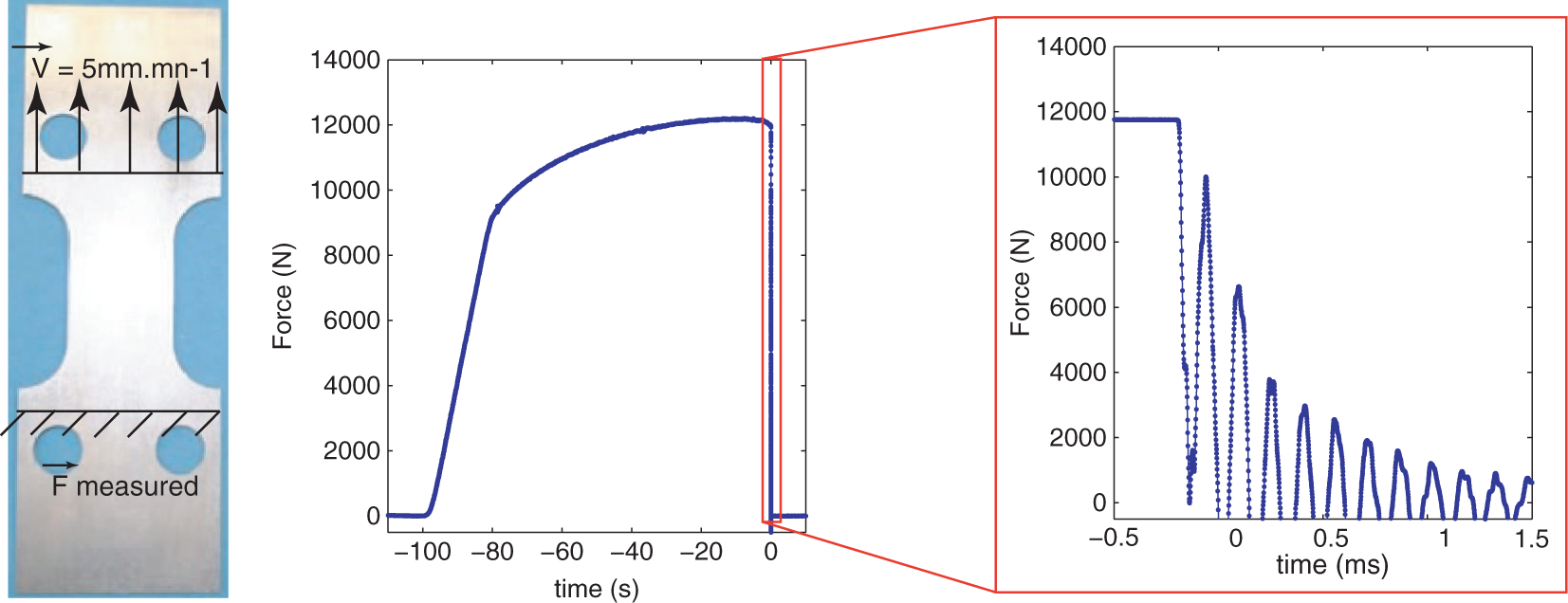
A rate independent objective extension to finite strain of the model of Lemaître
We consider a material objective extension to finite strain of the rate independent model of Lemaître (1985). The objective law which is defined makes use of the Jaumann rate. In this model, a damage variable governed by an equivalent plastic strain is introduced to account for the deterioration of the material when localization happens, such as localized necking giving then rise to intense plasticity. The objective Jaumann
Remarks about the dynamic process of spurious numerical localization and failure
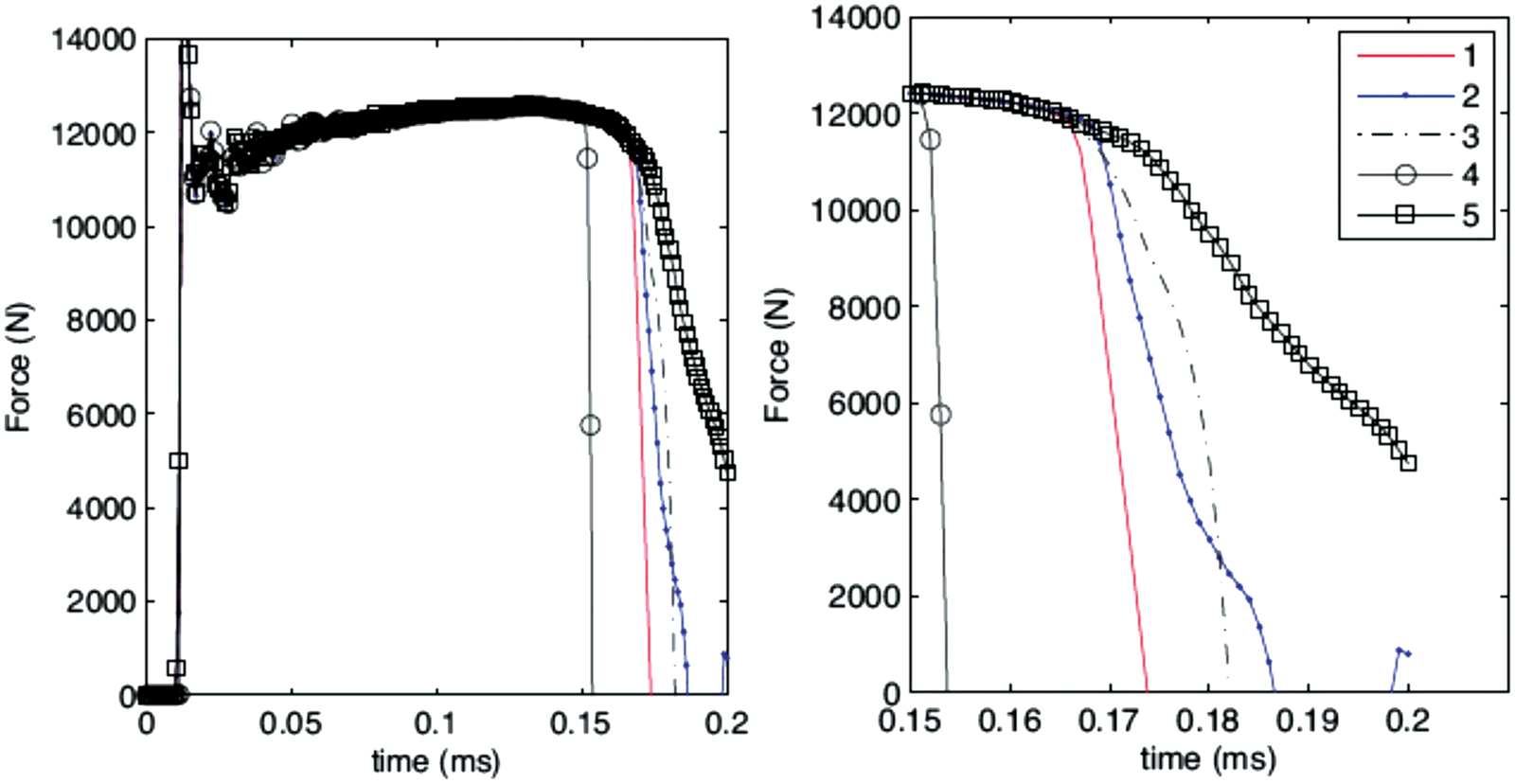
Let us consider the simulation of the previous test by means of the model presented in section ‘Remarks about the dynamic process of localization and failure’. The localization of the fully damaged area within one band of element is observed for the five meshes used. The dependance of the band orientation to the mesh orientation is also observed. The results shown in Figure 2 are classical and would have the same characteristics whatever the local rate independent model used to describe ductile failure. This has motivated the development of a bounded rate extension of the model which is described in section ‘Extension to metallic material: The bounded rate plastic exhaustion model’. Figure 3 describes the history of the numerical response with respect to the mesh size. A spurious temporal localization happens, the finer the mesh the shorter the duration of the localization process. Therefore the simulation does not allow to reproduce the process of deterioration which, as presented in Figure 1, lasts for some 100 µs.
Spurious localization: Effect of the mesh size and of the mesh orientation. Spurious localization: Time dependance of the response with respect to the mesh size.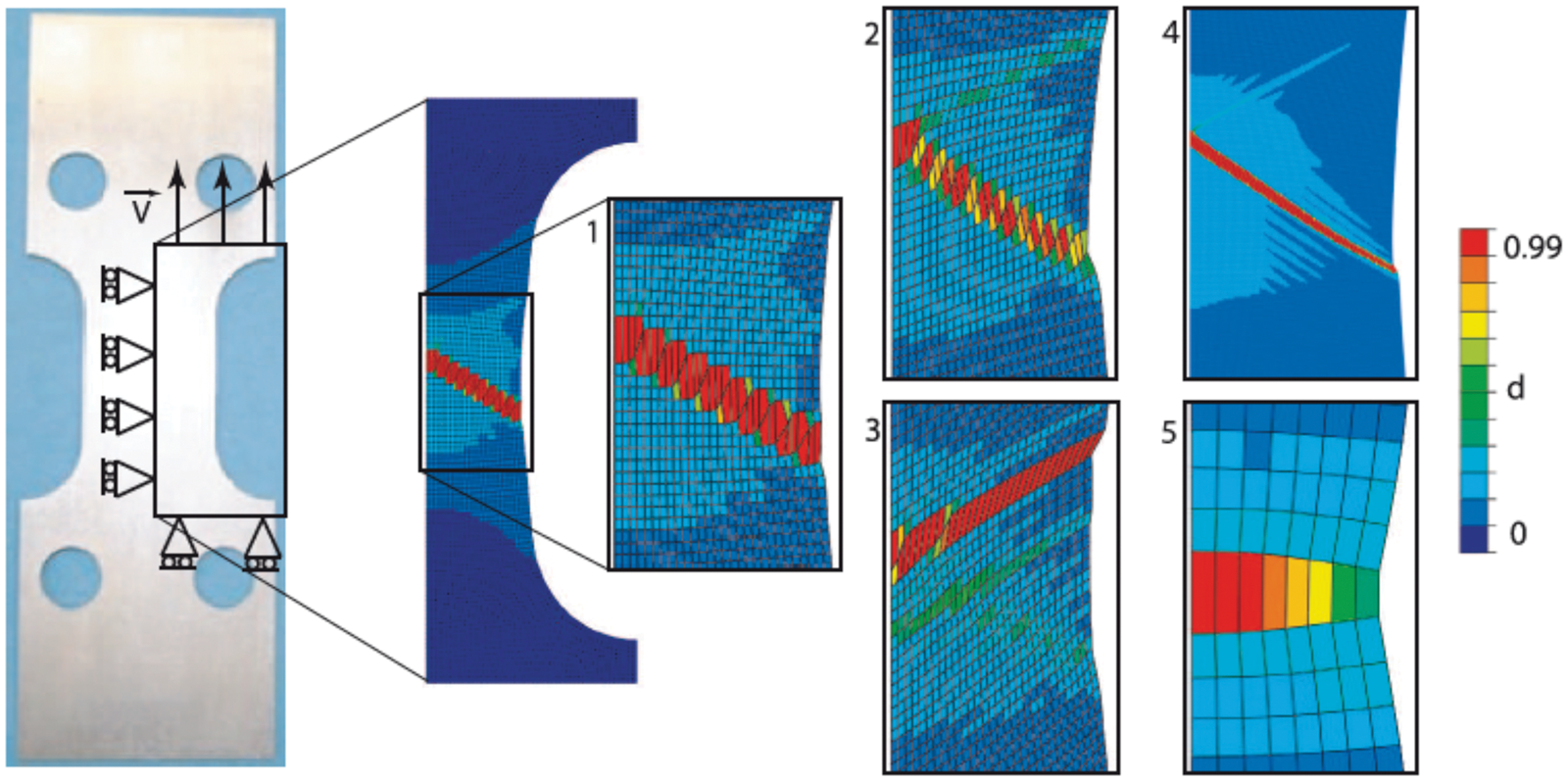
Rate-dependent model and localization: Expectations and facts
Expectations
The basic arguments on the regularization effect of rate-dependent model can be shown on the simple example of a 1D rate-dependent damage model in the infinitesimal case. The model is described by the following relations, namely the equilibrium equation and the constitutive relations
Example of a modified Jonhson–Cook model
We present here an example coming from the work of Svendsen and Flatten (2007, 2008). The model which is used corresponds to an extension of the Johnson–Cook model (1983) in order to take damage into account. A multiplicative elasto-plastic decomposition of the gradient of the transformation 𝔽 is used allowing to define the elastic logarithmic strain 𝕍
e
as follows
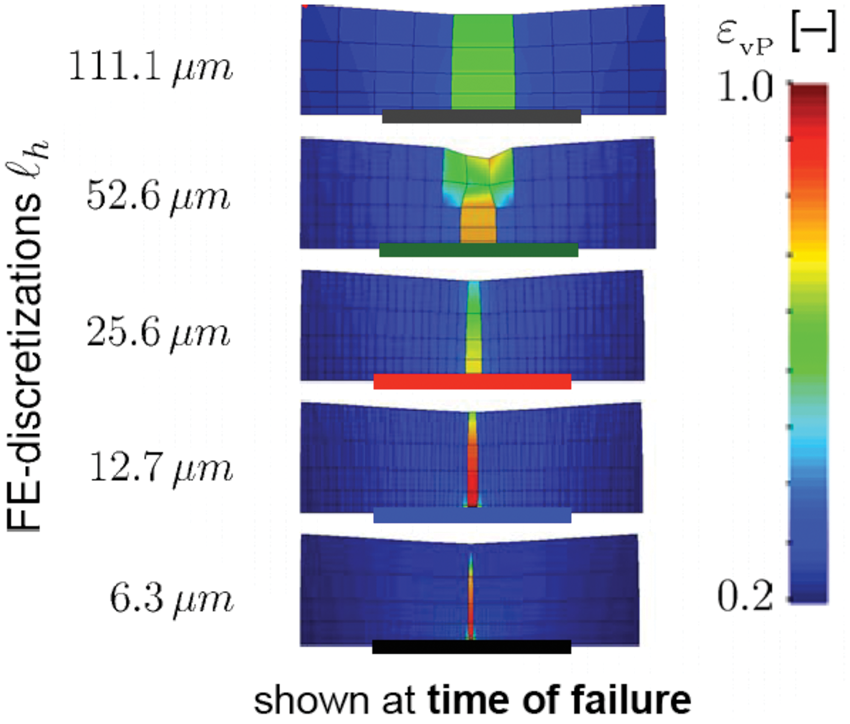
Illustration of the modified Johnson–Cook model. Modified Johnson–Cook model: Spurious localization.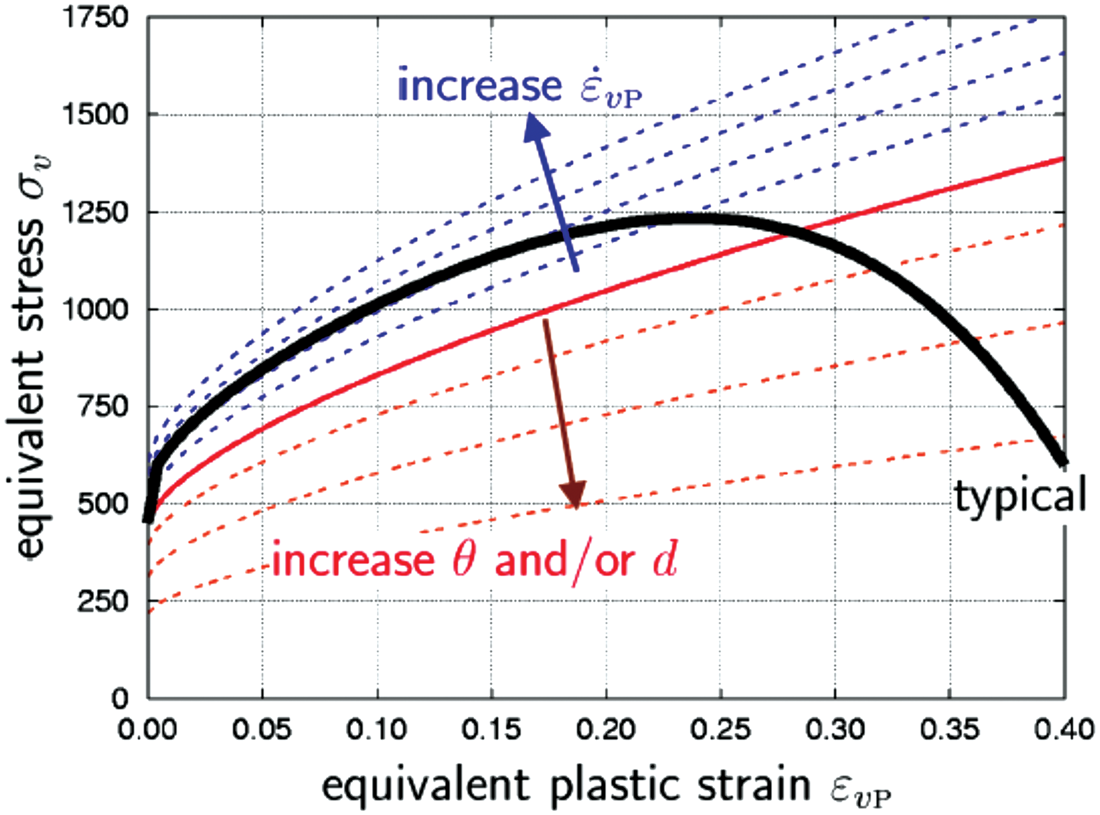
Bounded rate models
Status of the equation in the case of rate-dependent model
Let us consider the case of a simple 1D rate-dependent model introduced subsection ‘Expectations’. The fact that the higher derivatives state the status of the equation results from the property that the higher order terms dominate the solution for short wavelengths, this is true only if the remaining term (see equation (27))
The bounded rate damage model for laminated composite
This approach has first being used in the context of the meso-modeling of continuous long fiber laminates whose framework is detailed in Ladevèze et al. (2000) and whose 3D extension devoted at first for low-velocity impact is presented in Guinard et al. (2000). We only recall the relevant aspects of the model for the purpose of this article. The model is defined by means of two meso-constituents:
a single layer, which is assumed to be homogeneous throughout its thickness, orthotropic and damageable; an interface, which is a mechanical surface connecting two adjacent layers and which depends on the relative orientation of their fibers and whose deterioration is modeled by means of a damage variable to mimic delamination (Allix and Blanchard, 2006).
The meso scale is the one of a thickness of the ply. On this scale, the main damage mechanisms inside the ply (matrix microcracking, fiber/matrix debonding and fiber breakage) appear nearly uniform throughout the thickness of each meso-constituent. A given damage variable is associated with each mechanisms and is assumed to be homogeneous throughout the thickness of each ply. We conjecture that, due to the smallness of the mesoscale (one-tenth of a millimeter), this description remains valid even for high loading rates. The previous bounded rate model is then used for all the damage variable. Two characteristic time are introduced, one for all the damage variable associated with the degradation of the matrix, another one for the deterioration of the fiber. In the absence of measurements we set those parameters to values leading to characteristic length of the order of the thickness of the ply. For example the characteristic time chosen for the transverse and shear damages τ
c
corresponds to the time needed for a wave to travel all over the thickness of the ply which leads to: τ
c
= 10−7.
Example of simulation
The constitutive damage meso-model was implemented into an explicit finite element code. The material is a SiC/MAS-L laminate. The example presented (Figure 6) concerns the 3D computation of a tension test on a holed [±22.5]
s
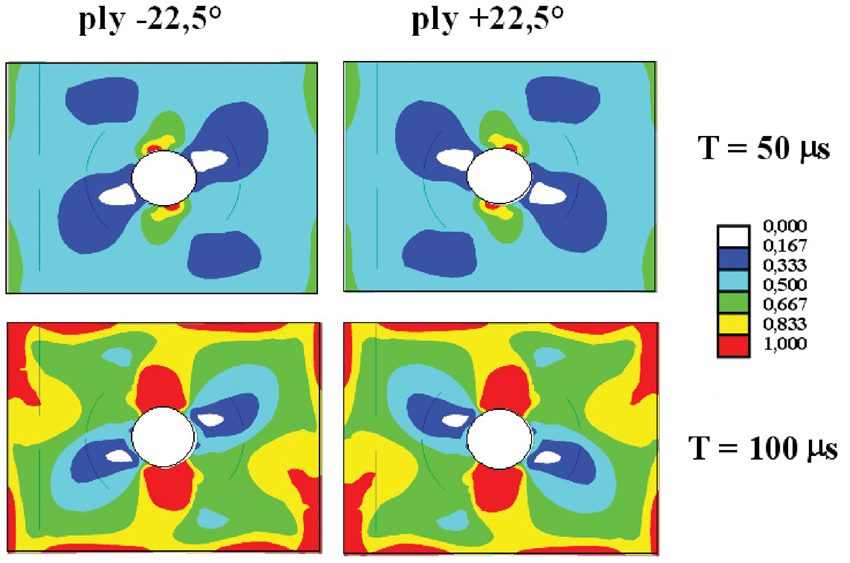
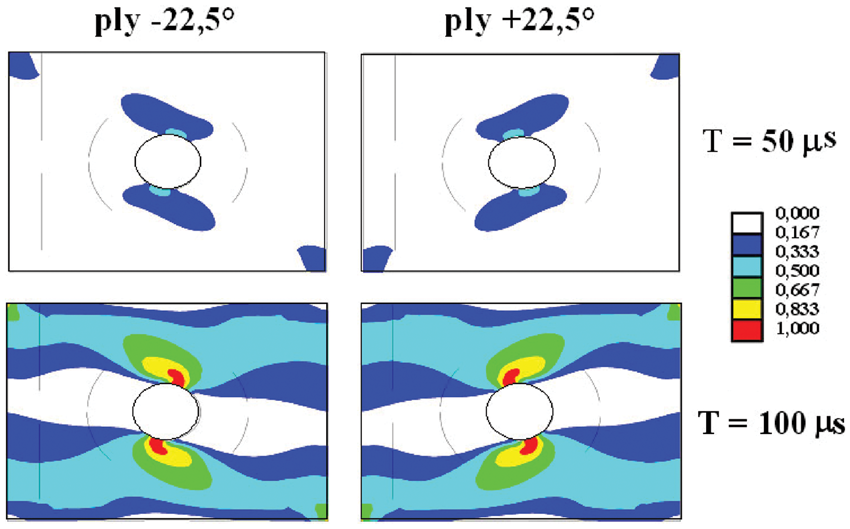
plate. A velocity is prescribed on the two opposite edges of the specimen. After an initial ramp, the velocity was set to a constant value V0 = 5 ms. The final time (T = 100 µs) corresponds to a total extension of about 1 mm. As expected no spurious numerical localization is encountered, as can be seen in Figure 7 for the extension of the matrix damage mechanisms in the plate and Figure 8 for the extension of the area where the fiber is broken. In both cases the element size is much smaller than the size of the fully damaged area.
Holed laminate [±22.5]
s
subjected to dynamic tension loading. Extension of the matrix damage mechanisms in a holed [±22.5]
s
plate. Extension of the fiber deterioration in a holed [±22.5]
s
plate.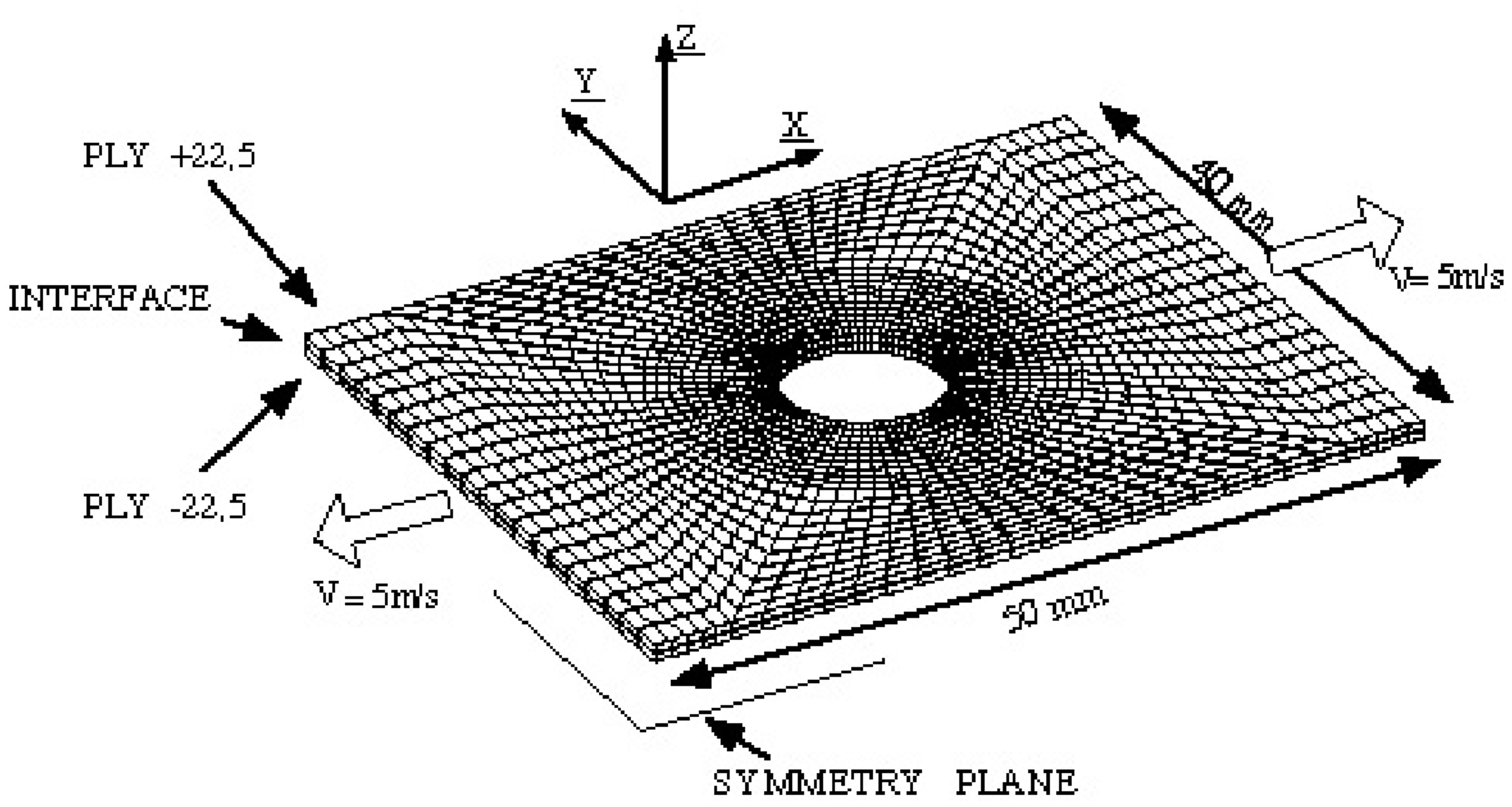
A mesh independent bounded rate erosion criteria for laminates
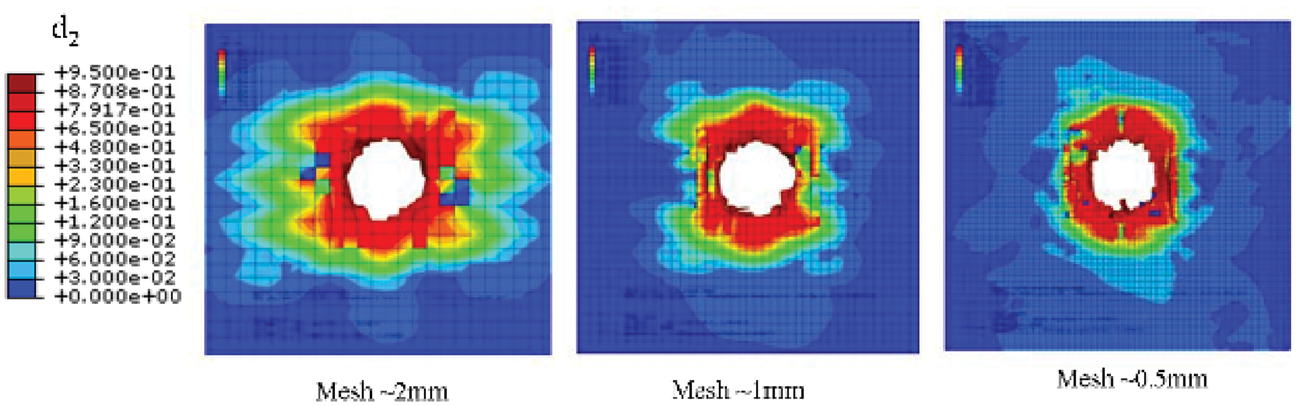
At the occasion of a cooperation with CEG Gramat the model presented in Allix (2001) has been extended to deal with ballistic impact leading to perforation. The model was implemented in Abaqus explicit and at first a classical erosion criteria based on a limit strain in the fiber direction was tested. In Figure 9 it can be seen that for three size of finite element namely (1 mm, 0.5 mm and 0.1 mm) the grey area which corresponds to the eroded elements is totally dependent of the mesh size. In order to solve this problem a bounded rate extension of the maximum fiber strain criteria, which leads to erode an element when the damage variable d
f
associated with the fiber failure equal 1 has been introduced. The results were far more better but parasitical numerical effects occurred when the erosion criteria was reached. This was attributed to the remaining stored energy of the eroded elements. Therefore the model has been modified in order to ensure the fact that when fibers are broken the material if fully destroyed and then sustains no internal energy. This leads to the expression (41) for the strain energy of the material. In this expression subscript 1 refers to the fiber direction, 2 refers to the transverse direction in the plane of the laminates and 3 refers to the normal direction, d denotes the damage variable associated with the microcracking of the matrix and d′ the one associated with the the deterioration of the fiber matrix interface. In the following expression Pathological erosion pattern for a maximum fiber strain criteria. Eroded pattern (white area) as function of the mesh size for the improved erosion model.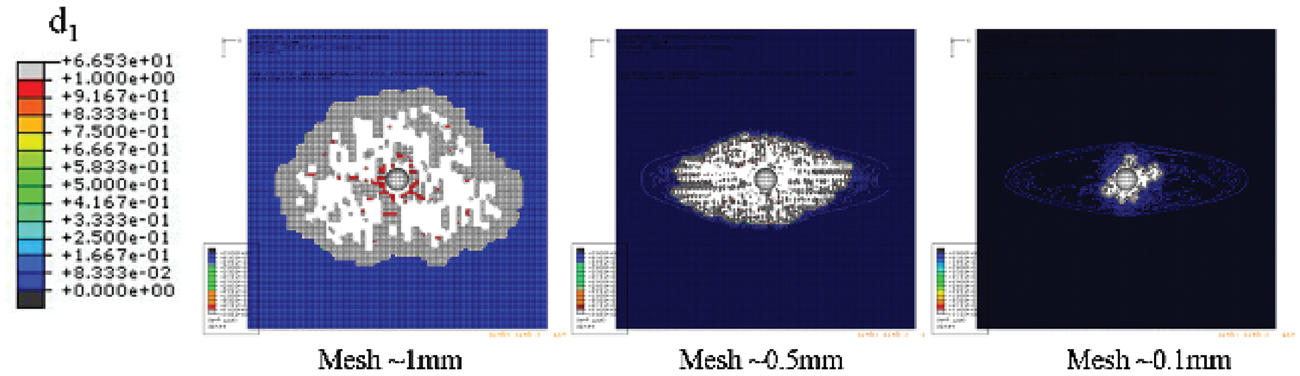
Application to ballistic impacts
The model was fully identified from static test and then applied to quite a lot of situations allowing to compare the numerical model to experiments. The value τ
c
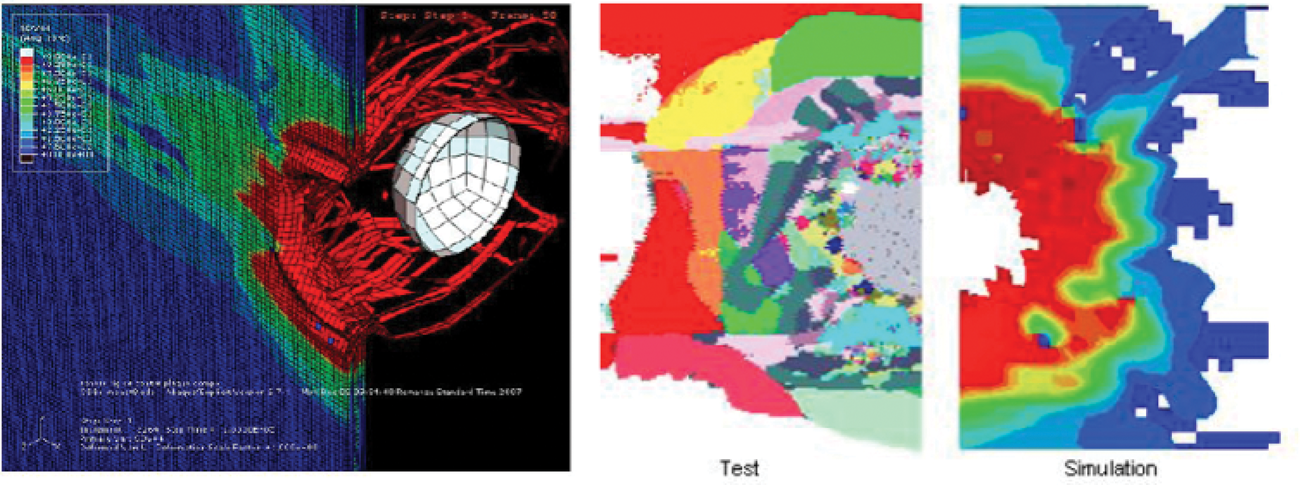
= 10−7 s was used for all the test. A typical situation analyzed is the one of the impact of tungsten-ball projectile with mass ranging from 10 to 100 g for impact velocities ranging from 1000 to 3500 m/s on different carbon/epoxy plates of 16 plies measuring about 500 mm × 400 mm for a thickness of 3 mm. For those tests, sensible sizes of simulated eroded area compared to experimental ones were obtained (Figure 11). An example of comparison between simulation and test in the case of an impact at 1030 m/s on a [04, +454, −454, 904] is provided in Figure 12. It was not possible to adopt the same range of color between the result of the ultrasonic examination of the specimen and the computed one. The grey (experimental) and white (simulated) areas of perforation fits well. This is also the case for the fully damaged matrix area delimited by the pink color for the experimental view and by the red color for the simulated view.
Simulation and comparison with experiments of the size of the eroded area. Simulation and comparison with experiments: case of an impact at 1030 m/s on a [04, +454, −454, 904].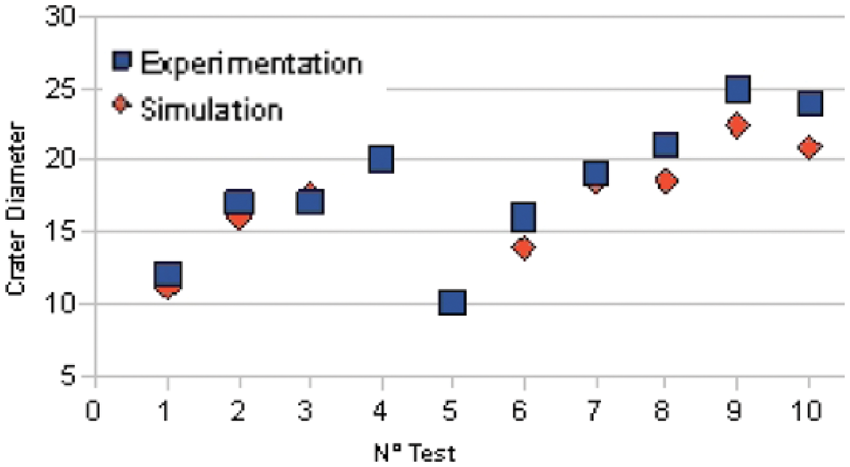
Extension to metallic material: The bounded rate plastic exhaustion model
In Suffis and Combescure (2003) a bounded rate damage version of the Lemaître model (Lemaître, 1985) in the case of infinitesimal strain has been proposed. The corresponding damage evolution is the following
Numerical results
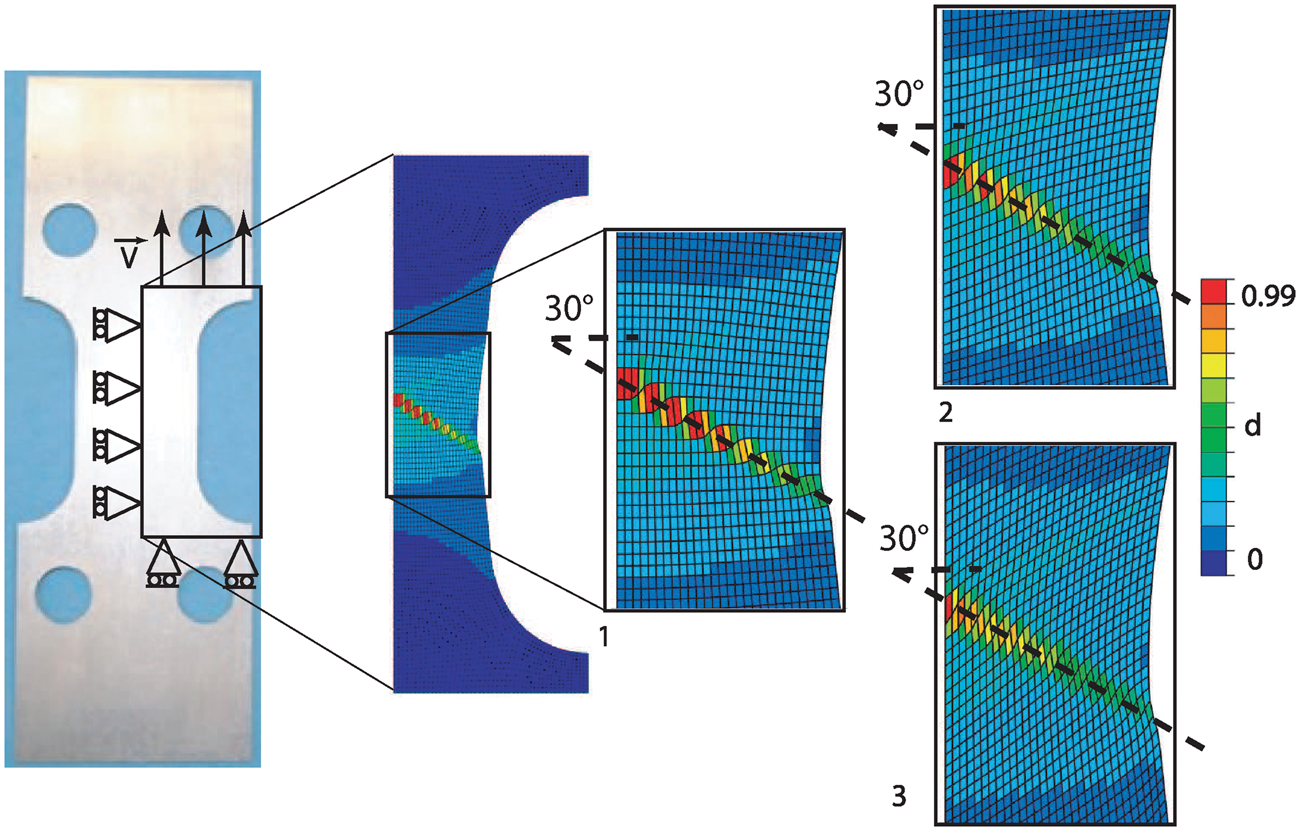
The object of this part is to verify that spurious numerical phenomenon are prevented because all the phenomenon that govern the localization, namely the localized necking and the subsequent damage accumulation leading to failure, are controlled by the limitation of the rate of the equivalent plastic strain. This can be verified by checking the status of the governing equation but the derivation is tedious and not reported here. The simulations were performed using CPS4R elements, and the focus of the study was on the influence of the mesh size and mesh orientation. The prescribed velocity of 48 ms was chosen so that the process zone would not be too small and could be described using reasonable element sizes. In all computations the elements were eroded when the damage variable value exceeded 0.99. Figure 13 illustrates the fact that with this model the crack's final configuration and characteristics (size, orientation, velocity) do not suffer from pathological mesh dependency. It can be seen in Figure 14 that the crack's final configuration and characteristics (size, orientation, velocity) are also independent of the orientation of the elements. The results of Figure 14 have to be compared to those obtained by means of the rate independent version of the model presented in section ‘Remarks about the dynamic process of localization and failure’ (Figure 2), which were clearly mesh dependent.
Numerical results for different mesh sizes. Bounded rate model: Prediction with different mesh orientation.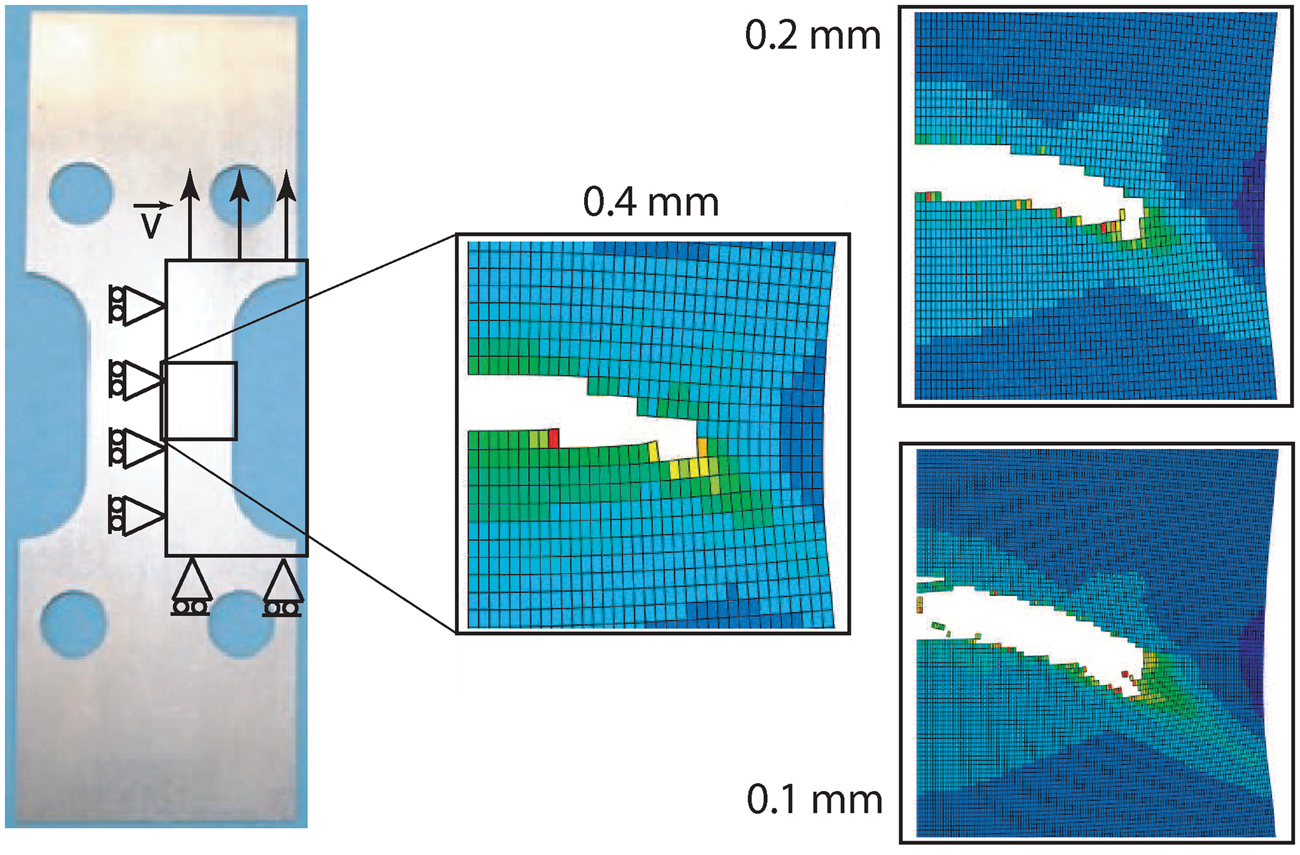
Identification
In the case of infinitesimal strain different estimations of the localization length can be found in the literature depending on the hypothesis made on the nature of loading preceding localization (Allix et al., 2003; Suffis et al., 2003). A perturbation type of analysis has been performed in the case of the bounded rate plastic exhaustion model (Court, 2006). It is not reported here because in the case of aluminum and for the dynamic experiments performed at the ONERA center in Lille the measurements of the size of the localization area were not available. Therefore the identification has been made simply by a direct comparison between simulation and test as described below. Test samples of Aluminum 2024-T3 were solicited dynamically in tension up to failure (v = 0.75 ms). In order to analyze the failure process precisely, the samples were prepared for digital image correlation and the tests were filmed with a high-speed camera. An initial guess was made for the two parameters τ
c
and a with a quite high value of a 10 in order to ensure τ
c
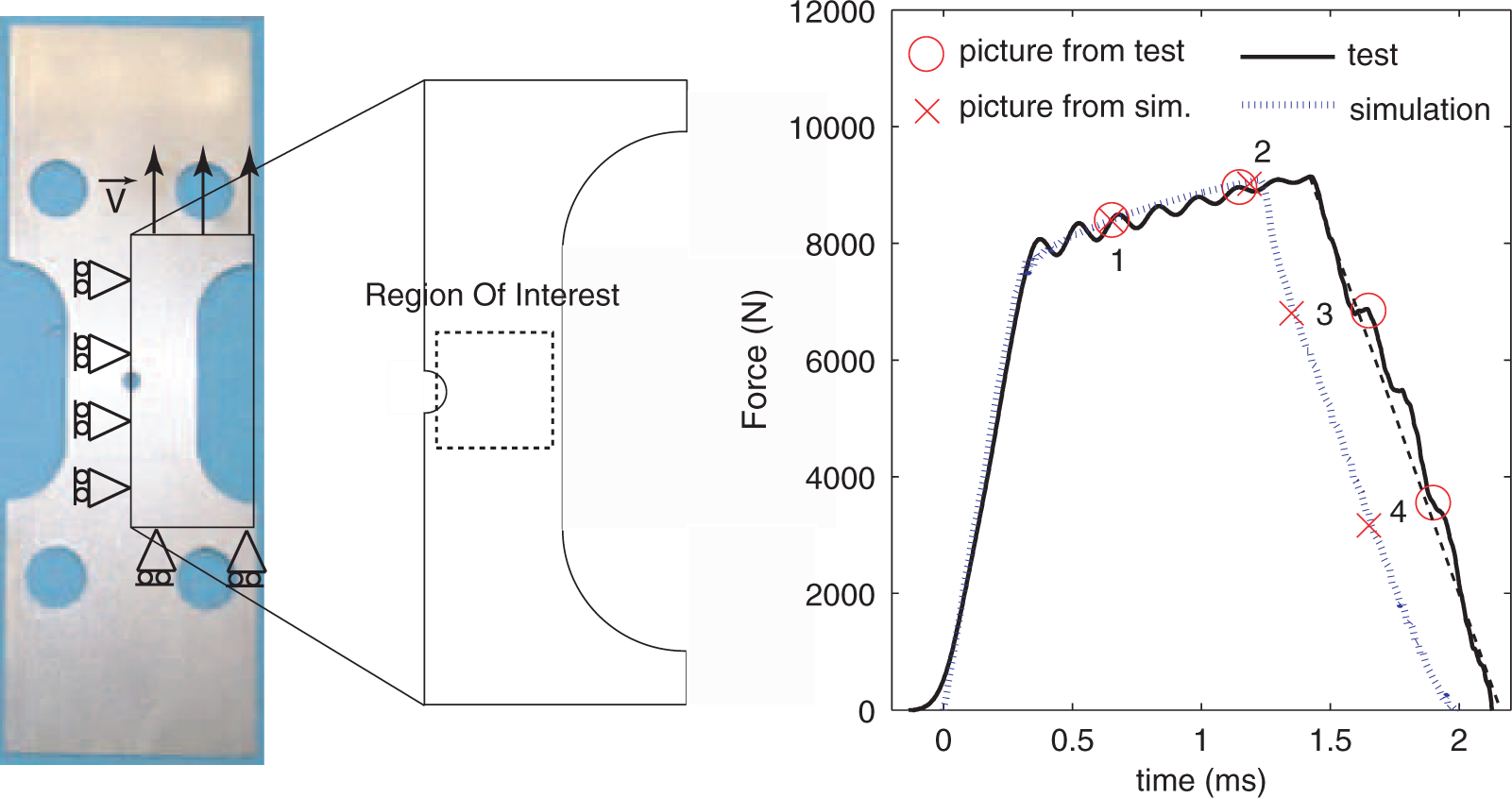
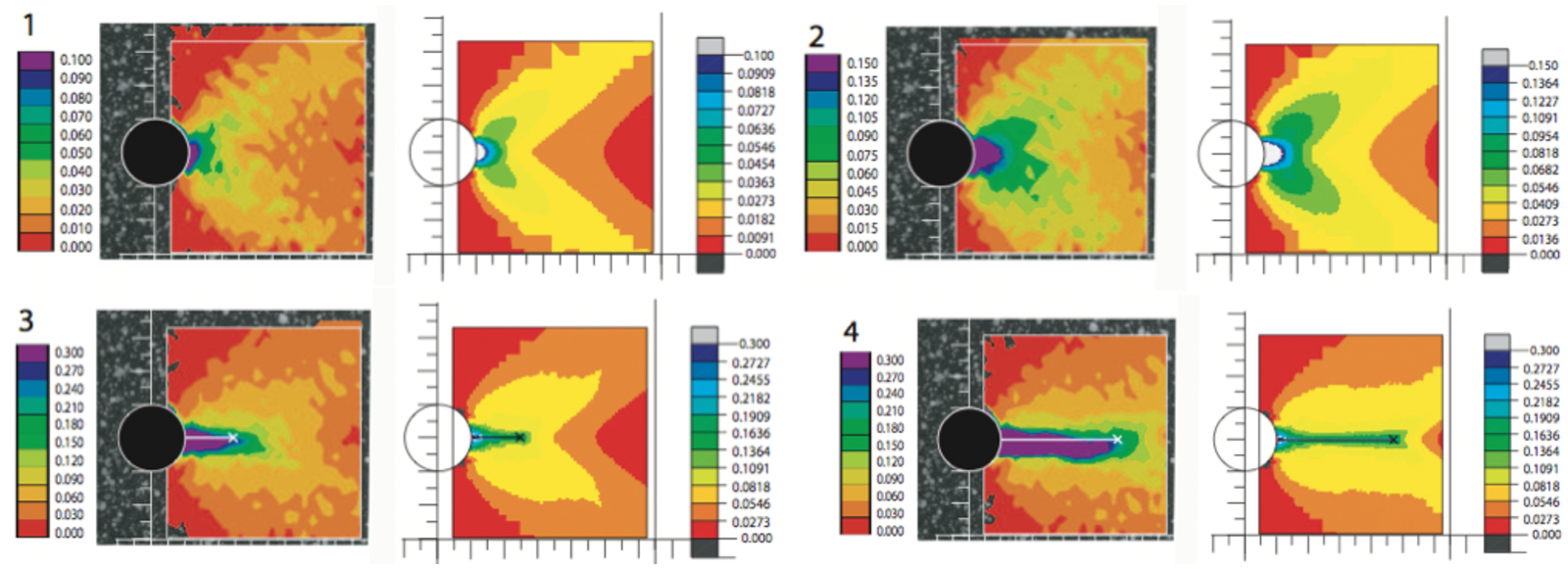
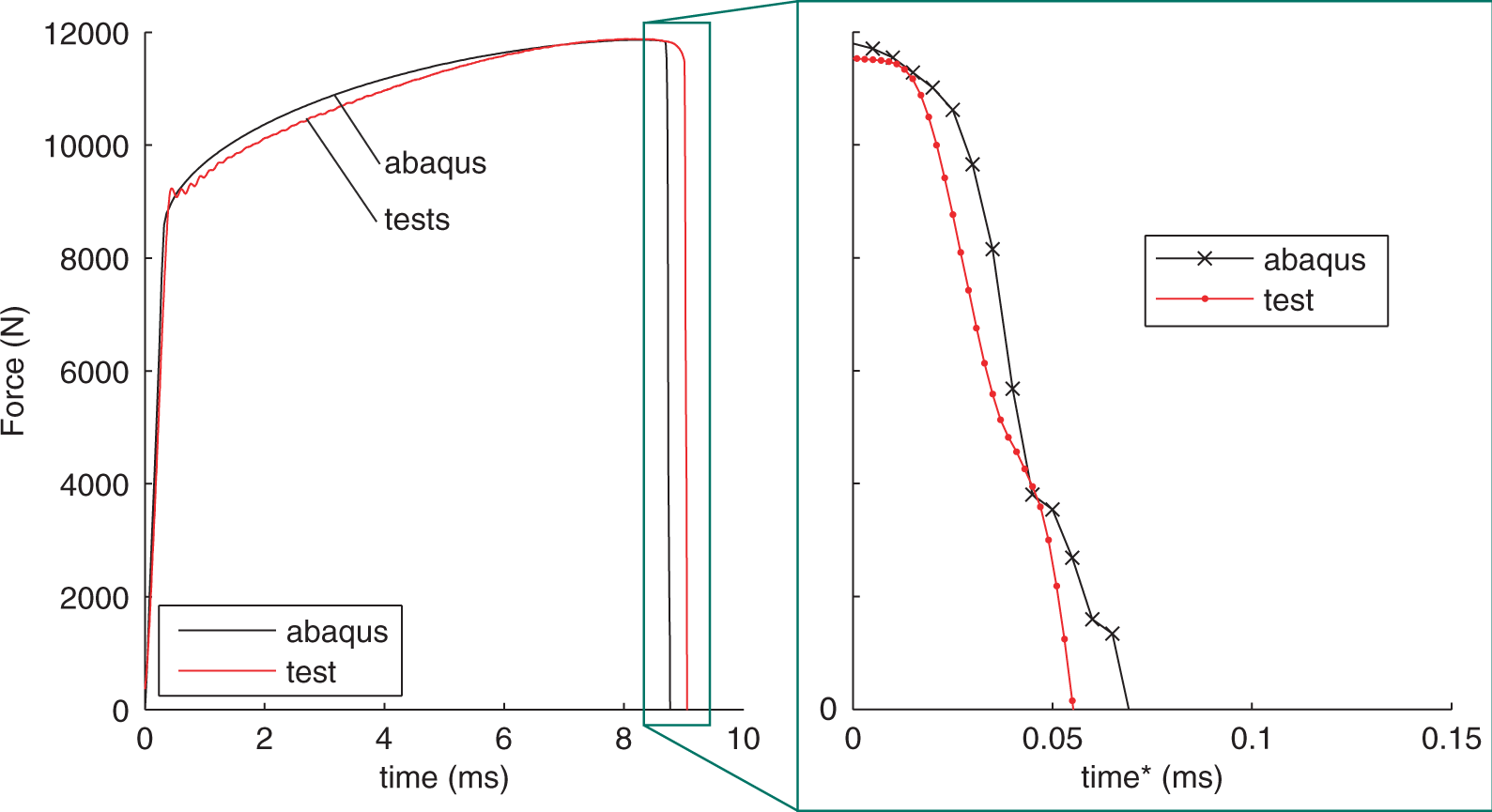
to be the main influent parameter was used. Then a few number of simulations where perform in the case of a dynamic tension test on a holed specimens. The simulations were performed with ABAQUS and the test results were again analyzed with the digital image correlation program CORRELI Q4 (Besnard et al., 2006). Figure 15 shows the force versus time curves F(t) and indicates the four points where the simulations and tests were compared. The parameters τ
c
= 75 µs and a = 12, are fitted ‘by hand’ on this test from the experimental characteristic process zone size and experimental crack's velocity. In Figure 16, results of the simulations and tests are compared at the beginning of hardening (1), just before the crack's initiation (2) and during the crack's propagation (3-4). It is difficult to measure strain values near the crack's tip because the size of the process zone is too small compared to the resolution of the camera, but overall the strain field, crack's velocity and extensions obtained numerically and experimentally are close.
The holed specimen and the F(t) curve. Comparison of tests vs. simulations – ɛ
yy
.
Predictive simulations
The parameters of the material model, which are related to the failure process were identified using test results on holed specimens. The results presented in Figures 17 and 18 show that the crack's orientation and structural failure time given by the tests and the simulations are very similar. It is to be noted that, with the same set of parameters, the prediction of the failure process duration of the specimens with and without holes are quite different: 0.06 ms for specimens without holes and 0.6 ms for specimens with holes and that they are in agreement with the experimental measurements.
Comparison between the simulated and experimental crack orientations. Prediction of the global response and of the duration of the failure process.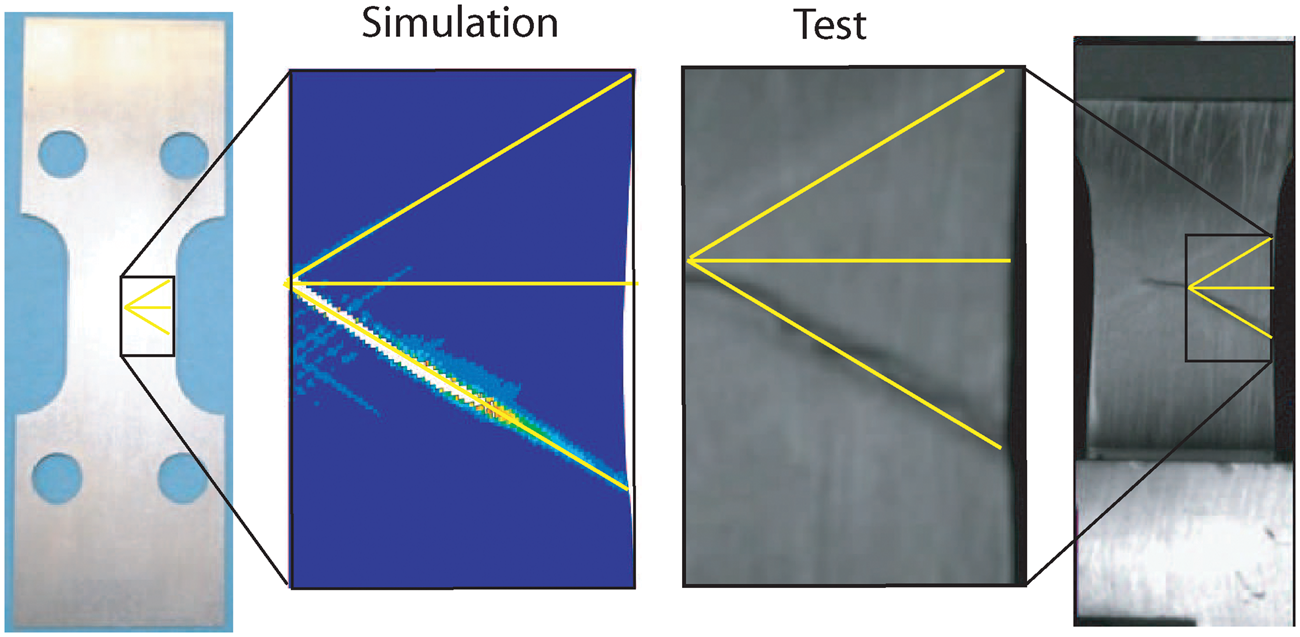
Conclusion
This article proposes a reflexion on some possible limitations of classical rate-dependent model with respect to localization and failure. To overcome those limitations, the key aspect of the proposed approach is to determine the set of internal variable, which governs localization and failure and then to bound the rate of those variables. This approach as been illustrated in two cases: damage and erosion of laminated composite, failure due to extensive plasticity for ductile metallic material. An issue, if one wish to conduct realistic simulations, is that a typical value for the maximum rate is the microsecond. This leads to make use of a lot of time step and one is also conducted to use very refined meshes. Therefore for the simulation of large structures adapted multi-scale numerical strategy both in space and time should be developed.
Moreover, the concept has still to be developed for more complex thermo-mechanical models. Even if motivated by the underlying physics of localization, the proposed bounded rate models are purely macroscopic. Therefore an explicit derivation of those models based on the underlying micro phenomena, in line with the work of Jacques et al. (2012), remains to be done.
Footnotes
Funding
This research was supported by Airbus industry for the study of metallic parts and by EADS and CEG Gramat (DGA) for the study of composites.