







Abstract
We describe virtually all known analytical models for predicting protective properties of concrete shields against normal high-speed impact by rigid projectiles. Presented formulas can be directly used in practical calculations. Particular emphasis is given to widely used one-stage and two-stage models which are systemized in a hierarchical classification system using a unified approach. One-stage models employ the same formula along the whole trajectory of a projectile for calculating a force exerted on a penetrating projectile by a shield. In the case of two-stage models, a resistance force at the first stage of penetration is a linear function of the instantaneous depth of penetration while at the second stage of penetration normal stresses at every location on projectile-shield contact surface are polynomial function of normal velocity component. Conditions of continuity of the resistance force and velocity of a projectile are invoked in the transition point between these two sub-models. A wide variety of models can be devised by using different sub-models at each stage of penetration.
Introduction
In a broad class of approximate engineering models we can distinguish between two major sub-classes: empirical (semi-empirical, phenomenological) models and analytical models.
The terms “empirical model” is used for relations between impact velocity and depth of penetration (DOP) for a semi-infinite shield and ballistic limit velocity (BLV) and thickness of a finite thickness shield which have been obtained by statistical analysis of the experimental results and are not based on the physical laws (excluding, probably, approaches based on dimensional analysis and similitude).
Analytical models can be physically substantiated although usually their justification requires a large number of assumptions. We consider mainly relatively simple engineering models which are characterized by the following features: either they determine the relations between “integral characteristics” of penetration in the explicit form (in algebraic form or including quadratures) or they describe local interaction between a shield and a projectile in the points of projectile–shield contact surface that yields such relations. The latter approach provides an opportunity to describe also a process of penetration.
Most of the analytical engineering models are based completely or partially on cavity expansion approximation whereby determining forces acting on penetrating striker is reduced to calculating stresses required for expansion of cavity in the material of the shield. Important beneficial feature of this approach is that it involves determining parameters of penetrator–shield interaction model which depend upon the mechanical properties of the shield. Comprehensive description of cavity expansion approach with relevant references can be found in the monograph by Ben-Dor et al. (2006a).
Engineering models for calculating penetration into concrete shields are described in the dedicated surveys by Adeli and Amin (1985), Ben-Dor et al. (2005), Brown (1986), Corbett et al. (1996), Daudeville and Malécot (2011), Kennedy (1976), Li et al. (2005), Murthy et al. (2010), Rahman et al. (2010), Teland (1998), Williams (1994), Zaidi et al. (2010), monographs by Bangash (2009), Bangash and Bangash (2006), Ben-Dor et al. (2006a), Bulson (1997), Latif el al. (2012b), Szuladziński (2010), and also in the report published by the United States Department of Energy, DOE (2006). These surveys include mainly empirical models while much less emphasis (if at all) is given to a few well known analytical models.
The main goal of the present study is to fill this gap. We describe and classify virtually all known analytical models. Particular attention has been given to two-stage models which are widely used for describing penetration into concrete shields. Presented formulas can be directly used for practical calculations of penetration.
Semi-infinite shields
Systematization of models
Two-stage models are widely often used to describe penetration into semi-infinite concrete shields whereby the first stage (cratering) is realized for
In order to systematize models describing penetration into semi-finite concrete shields, it is convenient to denote them as
The main developments in the field of two-stage models are summarized in the following (more detailed description of these models and their analysis are given in corresponding Section). Originally, Forrestal et al. (1994) suggested a 1&2 model that includes the “resistance parameter” determined from experiments while Frew et al. (1998) suggested formula for calculating this parameter as a function of unconfined compressive strength of the concrete. Later, Forrestal et al. (2003) returned to their original approach for determining this parameter.
Whereas these models were developed for the ogive-shaped projectiles, Ben-Dor et al. (2003) and Chen and Li (2002) used generalized formulas for arbitrary bodies of revolution, including projectiles with flat bluntness when calculating the resistance force at the second stage of penetration. Forrestal and Tzou (1997) proposed instead of a
However, these generalizations were proposed only for a sub-model describing the second stage of penetration, while a one-term sub-model, that assumes sharp impactors, was used at the first stage. In order to overcome this shortcoming Lixin et al. (2000) and Teland and Sjøl (2004) suggested
The bibliography on one-stage models is less abundant, and they are analyzed in corresponding section. Hereafter these models are denoted as
On the basis of the model proposed by Forrestal et al. (1994), Frew et al. (1998) and Sjøl and Teland (2001, 2003) suggested a three-term model (see also Gebbeken et al., 2009).
Some models for semi-infinite shields and shields having a finite thickness were suggested by Seifoori and Liaghat (2011) and Shiqiao et al. (2004, 2006, 2009).
Hereafter description of models is based on the “from general-to-specific” concept. Reference to a particular publication does not imply that authors of this publication formulated the model exactly in the same form as presented in this review. Very often in the original study the model is presented in a simplified form (e.g. for ogival nose projectiles or neglecting friction) while generalization of the model is straightforward.
Two-stage models
General 2&3 model
The general 2&3 model is characterized by the following expression for the instantaneous resistance force, D (Ben-Dor et al., 2009):
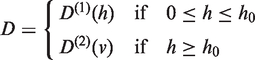



c is constant that is determined below. At the second stage of penetration the model is described as
Notations.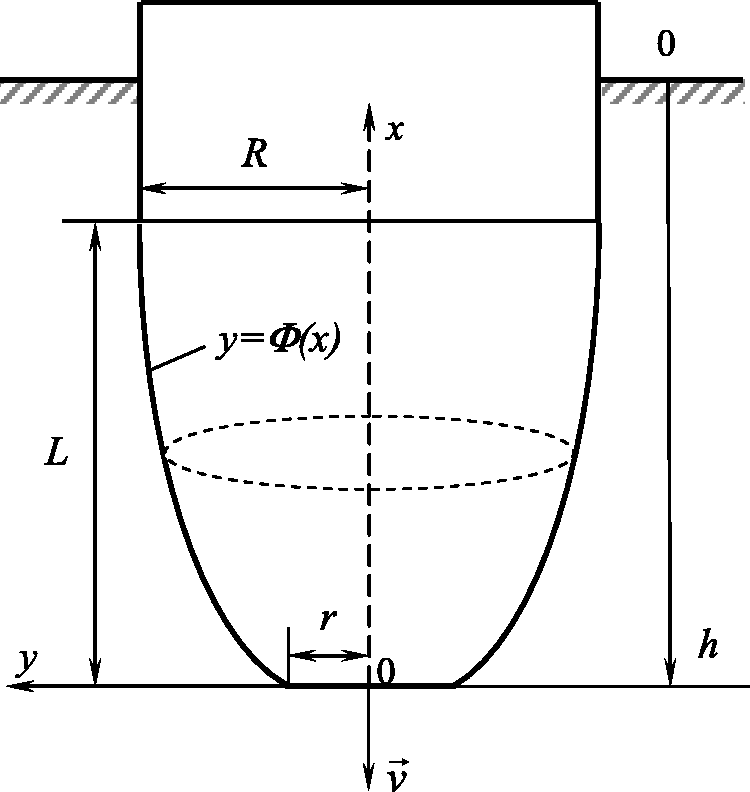

Consequently, at the second stage of penetration, a three-term model is used. At the first stage, linear dependence between the resistance force
Solutions of the second Newton’s law equation taking into account the initial condition




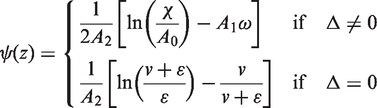
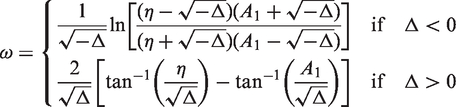

In the special case of 2&3 model proposed by Ben-Dor et al. (2009),
1&2, 1&3 and 2&2 models are considered below as particular cases of the general 2&3 model.
1&2 models: General case
The general 2&3 model is reduced to a 1&2 model by setting
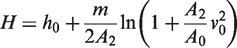


Equation (15) implies that
1&2 models: Sandia particular models
The above model recovers the model proposed by Forrestal et al. (1994) for non-truncated ogive-nosed impactors if




These equations allow us to determine s as a function of H and

The latter equation is suggested for calculating values of s using experimental data for H . It is recommended to use the average value of s for predicting the DOP.
Several modifications of the model by Forrestal et al. (1994) are proposed. Frew et al. (1998) suggested using the following relationship for s:


Li and Chen (2002, 2003) used formula
Forrestal et al. (2003), Frew et al. (2000) (for limestone shield) and Frew et al. (2006) returned to the approach suggested by Forrestal et al. (1994) and preferred interpreting the resistance parameter
Teland and Sjøl (2000) studied the boundary effects in penetration, namely, effects associated with finite size of a shield in the direction normal to the direction of penetration, and introduced a correcting parameter into the model of Forrestal et al. (1994) that was supposed to take into account these effects. Although they did not succeed to derive a formula for the correction coefficient, they found that boundary effects can be neglected in most cases if the ratio of shield diameter to projectile diameter is larger than 15.
Apart from the analysis conducted by the authors of this review, some additional evaluations of Sandia 1&2 models based on the experimental data were performed by Forrestal et al. (1996), Frew et al. (1998), Tham (2006) and Vahedi et al. (2008).
Gomez and Shukla (2001) extended the 1&2 model of Forrestal et al. (1994)(, 1996) and Frew et al. (1998) to multiple impacts introducing an empirical coefficient that is a function of the number of impacts. On the basis of the same 1&2 model, Choudhury et al. (2002), Siddiqui et al. (2002) and Siddiqui et al. (2009) derived expressions for the DOP for a buried shield and applied sensitivity analysis to study the influence of various random variables on projectile reliability and shield safety.
1&2 models: Case of small impact velocities
If
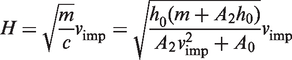
1&2 models: Other versions
Li and Chen (2003) (see also Li and Chen 2002) found that the generalized model of Forrestal et al. (1994) and Frew et al. (1998) allows to determine the dimensionless DOP as a function of two dimensionless parameters.
In a more general case of 1&2 model, it is convenient to introduce similar dimensionless parameters as follows:

Then equations (13) and (23) recover the same relationships:


In the limiting case,
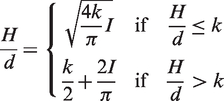
Apart from the analysis performed by Li and Chen (2003), comparison of this model with results of experiments was conducted also by Shiu et al. (2008). Latif et al. (2012a, 2012b) slightly improved the model by Li and Chen (2003), by introducing, in particular, additional frictional factor for ogive-nose projectiles.
In the case when the second stage of penetration is not realized (the basic model by Forrestal et al., 1994 and Frew et al., 1998), similar dimensionless variables were suggested and accuracy of the dimensionless formula for the DOP was studied by Sjøl et al. (2002), Sjøl and Teland (2000) and Teland and Sjøl (2000) (see also Teland and Sjøl, 2004).
Note that using the following dimensionless variables,
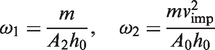
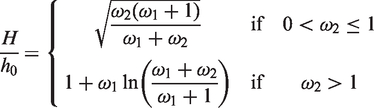
1&1 model
For relatively small impact velocities, Forrestal et al. (2003) used the 1&1 model

Substituting

Formula for the DOP is obtained by passing to the limit
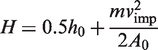
1&3 models
Models of this type can be obtained from the general 2&3 model setting
For this model, equations (8) and (7) can be rewritten as follows:
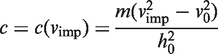


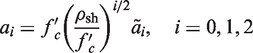

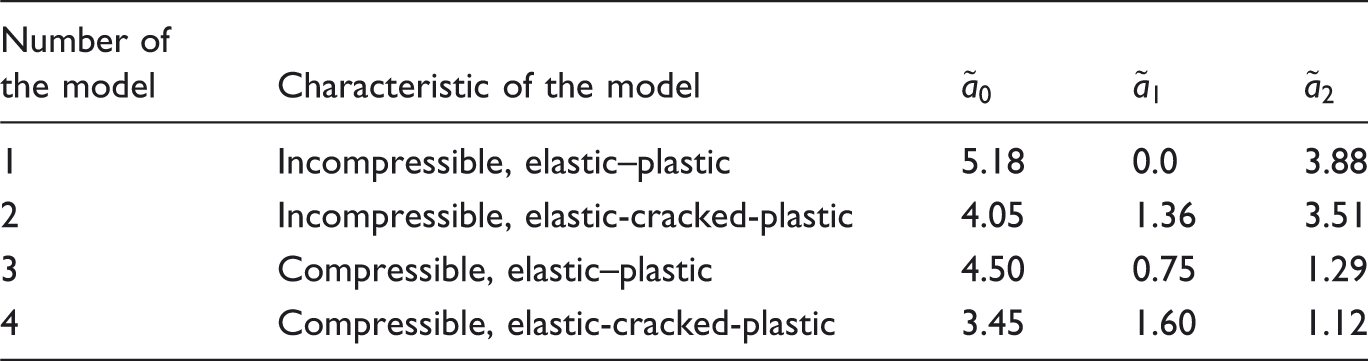
Coefficients for different models of shield material (Forrestal and Tzou, 1997).
2&2 models: Version 1
Consider the 2&2 model as a particular case of the general 2&3 model for which 


The DOP in this case is determined by equation (13).
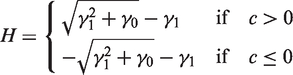
Ben-Dor et al. (2010) took notice to the fact that this model allows positive and negative values of the parameter c . Analysis shows that
Teland and Sjøl (2004) suggested that 
We are not aware about the experiments which allow evaluating accuracy of the linear approximation of the function
If 
2&2 models: Version 2
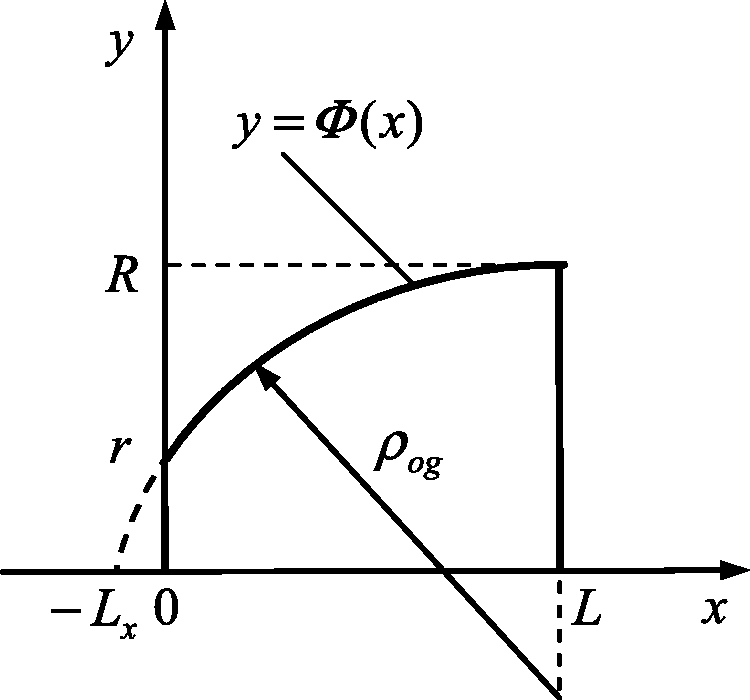
Lixin et al. (2000) suggested a model for truncated ogive-nosed impactors. They assumed that the resistance force is determined by equation (1) where
Shape of projectile: illustration to the model by Lixin et al. (2000).


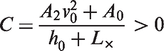
Solution of the second Newton’s law equation taking into account initial condition 

One-stage models
Luk and Forrestal (1987) proposed spherical cavity expansion model for the material described with a locked hydrostat and constant shear strength. This model is a 0&2 model that is determined by equation (5) with 
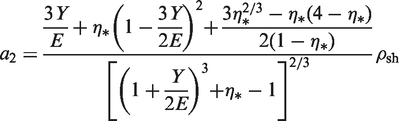
Y is the yield stress, E is Young’s modulus,
DOP can be calculated using equation (13) where
Luk and Forrestal (1989) modified the expression for the DOP in Luk and Forrestal (1987) by taking into account friction, and showed that a proper choice of friction coefficient improves agreement between experimental results and theoretical predictions. However, taking into account a current level of understanding of the mechanism of interaction of projectiles with concrete shields, this friction coefficient can be considered only as a fudge factor for improving predictions of the model.
Xu et al. (1997) suggested 0&2 elastic-cracked spherical cavity expansion model. Chen and Li (2002) did not consider the first stage of penetration (cratering) and applied 
Function 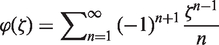
If 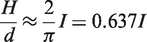
Rosenberg and Dekel (2010) proposed a 0&1 model that is based on the assumption that projectile moves inside a shield with constant deceleration, a. Since 

Equation (56) is recommended for calculating the DOP, where 
It is assumed that
Wen (2002) suggested the model in which normal stress on projectile surface that is in contact with concrete shield is a linear function of the impact velocity.
Teland (2001) proposed a 0&2 model to predrilled shields penetrated by ogive-nose projectile. In this case, the DOP of ogive-nose projectile is calculated using equation (13) where


d0 is hole diameter, and coefficients a0 and a2 are determined by the model of Forrestal et al. (1994, 1996).
He et al. (2011) proposed a spherical cavity expansion penetration model to predict penetration and perforation of concrete shields by ogive-nose projectiles. Shear dilatancy as well as compressibility of material in comminuted region are considered by introducing a dilatant–kinematic relation. Solution of cavity expansion problem allows determining coefficients of approximation in equation (5) were and applying it directly for penetration modeling.
Sun and Yuan (2012) adapted the model suggested by Yankelevsky and Adin (1980) for the case of penetration into concrete.
Shields having finite thickness
As a rule, analytical models describing penetration and perforation of finite thickness shields employ various modifications and generalizations of the model suggested by Forrestal et al. (1994).
Li and Tong (2003) (see also Chen et al., 2004, Li et al., 2006, 2005) assume that perforation occurs after plug formation, and projectile motion prior plug formation is described, as in the case of semi-infinite shields, by 1&2 model of Forrestal et al. (1994), Frew et al. (1998) and Li and Chen (2003). A modification of this model was suggested by Dai et al. (2005). Chen et al. (2007, 2008) used similar approach to reinforced concrete shield. Ben-Dor et al. (2010) suggested a model that is the combination of the models proposed by Li and Tong (2003) and Teland and Sjøl (2004) and is applicable for projectiles with a flat bluntness.
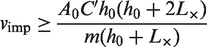
Taking into account small correction described in Li et al. (2005) the model by Li and Tong (2003) in the simplified version yields the following formulas for the BLV, 



The above discussed three-phase model suggested by Sjøl and Teland (2001, 2003) for semi-infinite shields can be modified for shields having a finite thickness. He et al. (2011) also suggested using their model not only for semi-infinite shield but also for shields having a finite thickness.
It must be noted that deriving explicit formulas for calculating BLV as a function of the shield thickness, taking into account a possibility of plug formation, is a very hard problem that requires making serious simplifying assumptions. According to the definition in the “Introduction” section such models cannot be classified as engineering models, and they are not considered here comprehensively.
Concluding remarks
In this study, we presented more or less comprehensively all widely used analytical models which were suggested for describing high-speed penetration into concrete shields.
The performed analysis showed that most models can be considered as one-stage and two-stage models. One-stage models employ the same formula along the whole trajectory of a projectile for calculating a force exerted on a penetrating projectile by a shield. In the case of two-stage models, a resistance force at the first stage of penetration is a linear function of the instantaneous DOP while at the second stage of penetration normal stresses at every location on projectile-shield contact surface are polynomial function of normal velocity component. Conditions of continuity of the resistance force and velocity of a projectile are invoked in the transition point between these two sub-models. A wide variety of models can be devised by using different sub-models at each stage of penetration.
The adopted unified approach allowed systemizing all models in a hierarchical classification system (see Figure 3).
Systematized references on p&q models.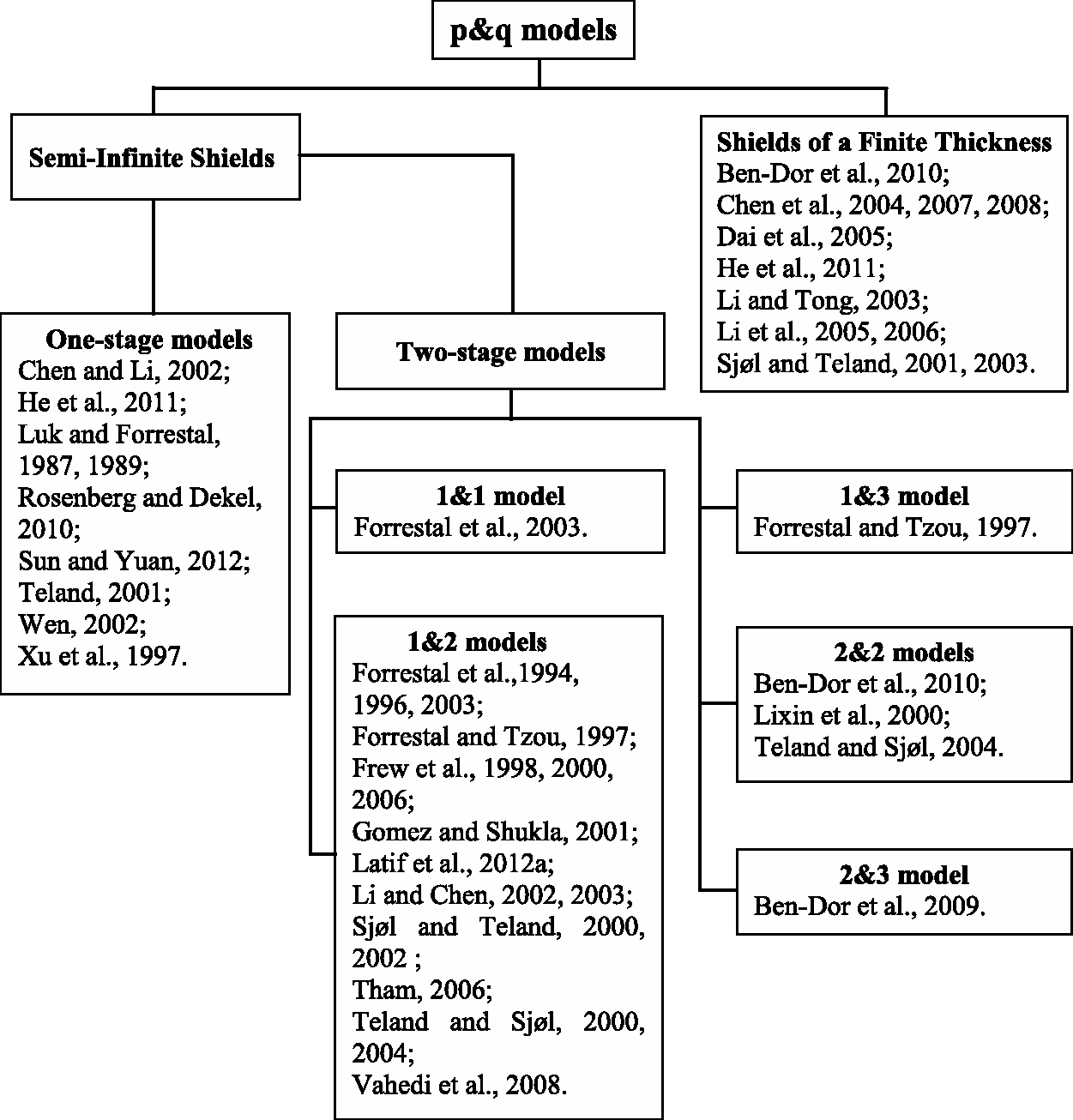
In descriptions of the models, we usually included arguments in favor of the particular model which are based on theoretical considerations, experimental results or “exact” calculations. Nevertheless, it must be emphasized that these arguments or comparisons with other models have only illustrative character.
Clearly, we realize the importance and urgency of theoretical and experimental investigations for the purpose of comparing performance of various analytical models and refining the ranges of their validity. However, we believe that this is a separate and very challenging problem that will be a subject of future research. The present survey is a necessary step in this direction, and we conceive that it is of interest in its own right.