







Abstract
This work deals with the development of a new approach to a high-cycle fatigue lifetime prediction, which is made in the stochastic framework and allows taking into account the natural degradation (aging) of material properties. Degradation of properties has been modeled as a process of the reduction of fatigue (endurance) limit. Kinetics of damage accumulation is introduced in the context of the effective stress concept. Mathematical expectation, correlation function and the continuum damage parameter variance have been obtained as functions of time. Analysis of the influence of natural aging process on statistical parameters of damage accumulation as well as on the lifetime has been carried out.
Introduction
The reliability analysis for most engineering structures is performed on the basis of static and dynamic stress–strain states, which are realized in the nominal operating conditions. Strength safety factors commonly applied when designing also provide a high level of reliability of mechanical engineering systems in these operating modes. In this regard, the lifetime of such systems is determined by their work not in the nominal but in the dangerous modes, i.e. stress peaks and outbreaks at the start and the end of their use, or during any other drastic changes in the operating conditions. Naturally, the lifetime depends on the transient states incidence, which is determined by the usage conditions, and therefore can be changed during the operation so that the loading frequency gains random values for these systems.
Taking into account the relatively low transient modes incidence and availability of strength safety factors, the lifetime of such engineering designs becomes comparable with the period of the natural degradation processes initiation in materials, i.e. aging. In structural mechanics (Jakubczak et al., 1995; Melhem and Swartz, 1993; Stacey et al., 2008; Valliappan and Chee, 2009), for example, the problem of reliability of long-term use of bridges can be mentioned (there are more than 200,000 steel bridges in the USA and more than 20,000 in Japan with over 50 years of service life (Jakubczak et al., 1995; Melhem and Swartz, 1993). The same was observed in the operation of the British offshore platforms, where hundreds of units had been used for more than 25 years (Jakubczak et al., 1995; Stacey et al., 2008). In addition, concrete structures are well-known to change their mechanical properties and fatigue resistance with time (Valliappan and Chee, 2009). Other examples can be found in mechanical engineering (Nesterenko, 1997; Renowicz et al., 2006; Vodka and Trubayev, 2013). Thus, several incidents of the bolted connections failures in hydroturbine-driven wheels (Vodka and Trubayev, 2013) were detected in Ukraine; they were caused by the high-cyclic fatigue after 30-year exploitation in spite of high safety factors for fatigue and strength. The same problem occurs in the pipelines of power plants (Renowicz et al., 2006). In the work (Renowicz et al., 2006), it is shown that the microstructure of the material has been changed during operation, which led to the decrease of the fatigue and crack resistance. Similar problems arise when predicting the lifetime of old structures for both civil and military aircraft (Nesterenko, 1997; Schijve, 2003). The problem of the elastomer materials operation, where aging becomes significant even after several years of use should also be mentioned (Baldwin et al., 2007; Mott and Roland, 2001). All these systems should be observed taking into account the processes of natural aging.
Degradation influences mechanical properties and especially strength characteristics of a material due to irreversible microstructural changes in the materials as well as physical and chemical ones. These processes are studied experimentally. Information on the changes of characteristics is very limited, and the obtained data have considerable differences. This determines the probabilistic approaches when degradation of the mechanical properties of the materials is being modeled.
Thus, the problem is to develop models and approaches to the reliability analysis and predicting a lifetime of an engineering design in the stochastic framework taking into account the material degradation and the random time variation of the load frequency.
Problem statement
This paper deals with the lifetime prediction of the engineering designs under high-cycle fatigue. The lifetime is determined by the non-localized damage accumulation rate. Models of the fatigue damage accumulation are offered in numerous surveys (Fatemi and Yang, 1998; Schijve, 2003; Yang and Fatemi, 1998). This paper utilizes the approach of continuum damage mechanics (Lemaitre and Desmorat, 2005; Murakami, 2012). So, we assume that cyclic loading leads to accumulation of damage (D) which is introduced within the framework of Rabotnov–Kachanov theory (Kachanov, 1986; Lemaitre and Desmorat, 2005; Lvov and Movavgar, 2012; Murakami, 2012) in the following way
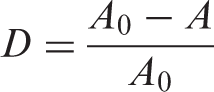

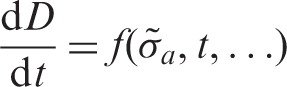
The process of damage accumulation is described by the kinetic equation
It was assumed that the stress amplitudes were presented as effective stresses within the framework of the theory of continuum damage mechanics (Lemaitre and Desmorat, 2005; Lvov and Movavgar, 2012; Murakami, 2012)
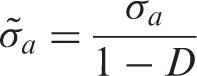
The presented relation limits the damage parameter to 0 ≤ D ≤ 1.
Let kinetics of the damage accumulation process be according to power law (Ayoub et al., 2011; Gorash et al., 2012; Kachanov, 1986; Lemaitre and Desmorat, 2005; Lvov and Movavgar, 2012; Murakami, 2012; Plumtree and Lemaitre, 1981; Valliappan and Chee, 2009)


At the time of failure (fracture) Tr damage is equal to unity (by its definition, see equations (1) and (5)), so
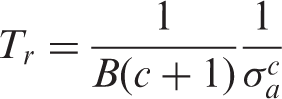
However, for such a simple case of loading fatigue the process should satisfy the Wöhler (S–N) curve (Manson, 2006; Schijve, 2009)

The time before failure in the simple fatigue test (with fixed load cycle parameters) is found from the (S–N) curve
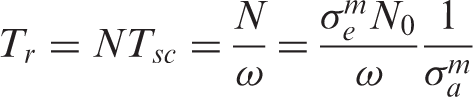

According to equations (5) and (10), the process of damage accumulation can be described by the following equation

The model of accumulation of fatigue damage is similar to the one described in Valliappan and Chee (2009), Lvov and Movavgar (2012), Plumtree and Lemaitre (1981), Ayoub et al. (2011), Gorash et al. (2012) and might be considered as its specific case for isotropic damage, which is generated due to the high-cycle fatigue i.e. without plastic strains.
The model described in the present work will be used for studying the fatigue mechanical systems which are analyzed in the dangerous modes. It is assumed that these modes are well-known, and the system response to them is studied. For example, these are the modes of start, stop (power-on or -off), etc. So, the fatigue is accumulated due to the cycling of these most-loaded modes that have known and fixed stress amplitudes but are variable in time frequency of their occurrence. As it was mentioned in the introduction, the lifetime of such systems is comparable with the time of natural aging of the materials. The natural aging of the material affects their mechanical properties, fatigue resistance in particular (Botvina et al., 2010; Kowalewski et al., 2013; Petrova et al., 2011; Zaletelj et al., 2013). The easiest way to take into account the degradation of the properties due to natural aging is modeling it as the process of the fatigue (endurance) stress limit reduction (Zhovdak and Tarasova, 2007). Thus, the kinetics of damage accumulation for the analyzed class of problems in this paper is described by equation (11), where the right-hand side depends on two time processes: frequency of the dangerous modes occurrence and the process of the endurance stress limit reduction. It should also be mentioned that the real operation of the engineering designs, which can be considered as the mechanical systems investigated in the paper, leads to randomness of the dangerous modes occurrence; similarly, the process of the natural material aging has some uncertainty due to dependence of this process on a large number of various secondary factors. So, equation (11) can be presented in the following way

In the paper, ω(t) and σe(t) are assumed to be statistically uncorrelated random functions of time. Thus, the aging process does not influence the frequency of occurrence of the dangerous modes directly and vice versa. Our point here is that occurrence of the dangerous modes during all the lifetime of the system is determined only by the operational conditions. On the other hand, the natural aging in the current paper is described as an individual self-contained process of physical and chemical transformations in a material that are not caused by the mechanical load. Mechanical loading applied to a system leads to accumulation of the continuum damage, which reduces material stiffness (Lemaitre and Desmorat, 2005; Murakami, 2012) without influencing the strength characteristics. The natural aging, on the contrary, directly affects the strength characteristics, especially the fatigue strength, as it was experimentally proven by other authors (Botvina et al., 2010; Kowalewski et al., 2013; Petrova et al., 2011). The theory presented in the paper is also limited in its application to the isothermal mechanical systems operating in the ambient temperature. In addition, it should be noted that these processes have different time scales.
Characteristics of loading
This paper deals with the designs which were under the influence of cyclic loads with a fixed level of deterministic amplitude and random frequency varying in time. We assume that the frequency of these modes is a stationary random process, i.e. the probabilistic characteristics of the process do not depend on the starting time and can be determined on the basis of the design (or its prototype) operation. The expectation, the variance, and the correlation functions of the frequency are known. An example of such data is shown in Figure 1.
Statistics of the starts and stops of hydro-turbines of the Dnipro cascade (Ukraine) (according to data given in Vodka and Trubayev (2013)).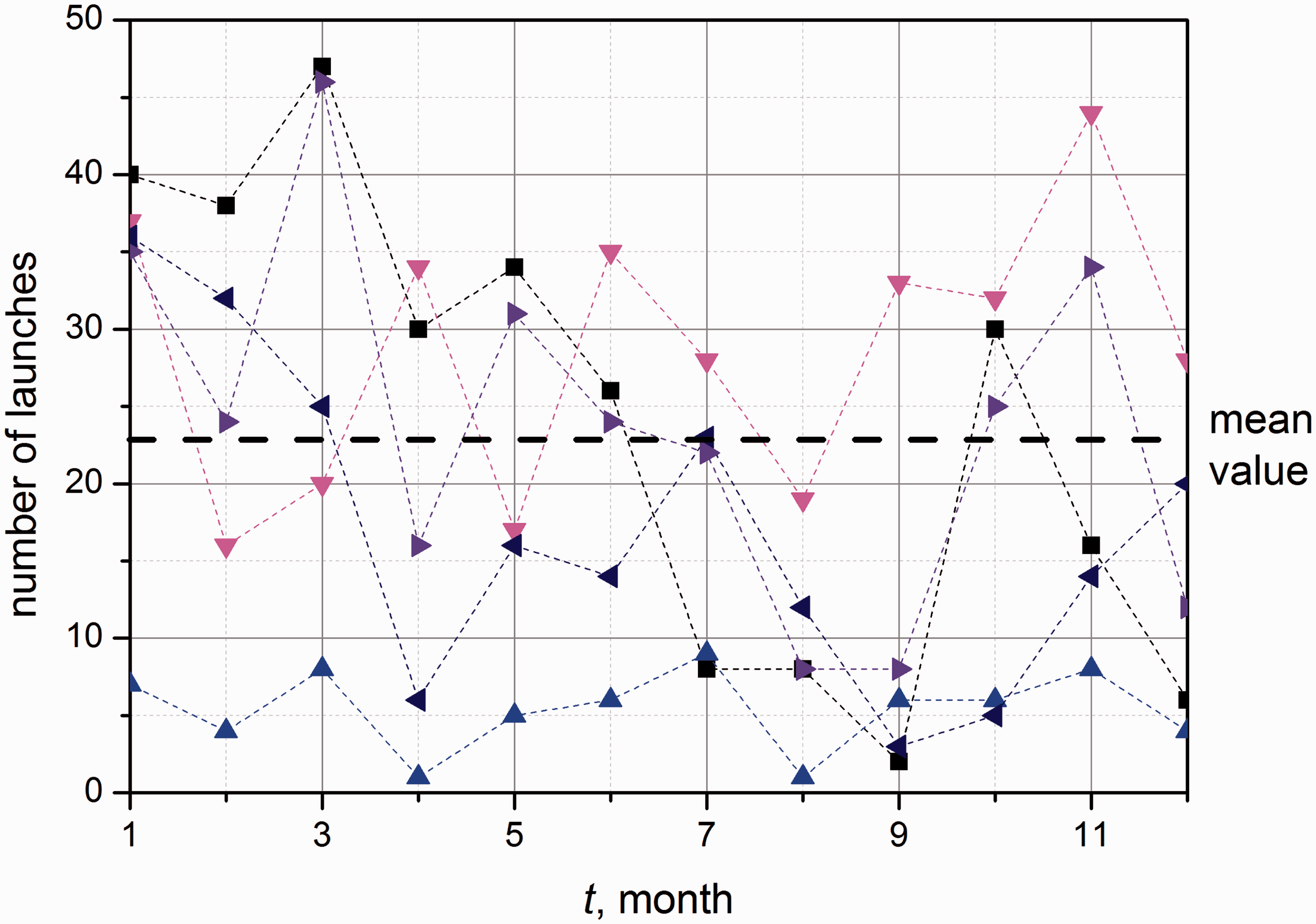
Determination of the valid frequency characteristics requires a large number of statistical data, which often leads to considerable difficulties. Therefore, in practice it is reasonable to postulate a priori a form of the correlation function (Kω), and to define its parameters only.
In this paper, the approximation by the exponential law is used (Dunn, 2005; Sveshnikov, 1968). The parameters of the approximation are variance (Var[ω]) and intensity (λω) of the incidence of the dangerous modes

Such a correlation function has a physical sense: occurrence of the dangerous modes can be set as statistically independent after some period of time. Until that time, the incidence of the dangerous modes in adjacent periods shows signs of their influence on each other. The operation of hydroturbines in the Dnipro cascade (Ukraine) presupposes plenty of secondary factors (e.g. weather around the country and in neighboring lands), which results in unique conditions from month to month according to the expert judgment. So, a representative period of time can be set as 1 month. Sometimes, stricter dependences in operation of such system can be found, like season interactions.
So, the correlation function in the exponential form shows that the frequency of occurrence of the dangerous modes is almost the same in equal periods of time; however, this trend fades with time, and the velocity of this process is determined by the correlation function intensity parameter. The intensity parameter is determined on the basis of the correlation time, i.e. the period of time necessary for the expected statistical influence of frequency of a dangerous mode within time t1 on the frequency of this mode within time t2 to vanish. So, the correlation time (τωk) is a system memory about its exploitation that can be calculated using the following equation (Kowalewski et al., 2013; Zhovdak and Tarasova, 2007)

The intensity of the frequency of a dangerous mode occurrence is determined as λω = 1/τωk taking into consideration the accepted form of the correlation function.
So, according to the presented example of the expert judgment about the hydroturbines in the Dnipro cascade operation conditions, the correlation time for the frequency of occurrence of the dangerous modes can be set to 1, 3, 6, or 12 months.
Modeling degradation as gradual reduction of fatigue endurance
Experimental study of the natural aging processes of different materials is described in a number of works (Ayoub et al., 2011; Botvina et al., 2010; Baldwin et al., 2007; Mott and Roland, 2001; Gorash et al., 2012; Petrova et al., 2011). The works (Botvina et al., 2010; Kowalewski et al., 2013; Petrova et al., 2011; Zaletelj et al., 2013) deal with the study of aging of metals and alloys. In this case, it is established that the natural aging of a metal has little effect on its static strength and elastic characteristics, but it significantly changes the long-term strength (fatigue resistance). Thus, it was found in Petrova et al. (2011) for 45 steel (EN steel name is C45) that natural aging of the material over 50 years results in only a 5% change of the static strength properties, but simultaneously reduces the fatigue limit by 44%. It is also argued in the article that the fields of dispersion of the experimental data for non-aged and aged specimens do not overlap. A more detailed analysis of the samples allowed the authors to identify the fundamental structural changes in the processes of nucleation of fatigue micro- and macro-cracks in the material. Similar results were obtained in Botvina et al. (2010) for 20 steel (EN steel name is 2C22) – thus, it was determined that the aging for 15 years reduces the fatigue limit by 38%.
On summarizing the data from the literature on the degradation processes in this article, we suggest considering the process of reducing the limit of fatigue as a hyperbolic dependence of the form

The approximation parameter p determines the character of the fatigue limit decrease. The value of the parameter p which equals to 1 is used for polymer materials and p = 2 is relevant for metals. A typical curve (p = 2), which describes the degradation of the fatigue limit is shown in Figure 2. The results presented in Botvina et al. (2010) are used there as input data.
Approximation function ϕ(t) that describes the fatigue limit decreasing due to natural aging (approximation is built for 45 steel according to data given in Petrova et al. (2011)).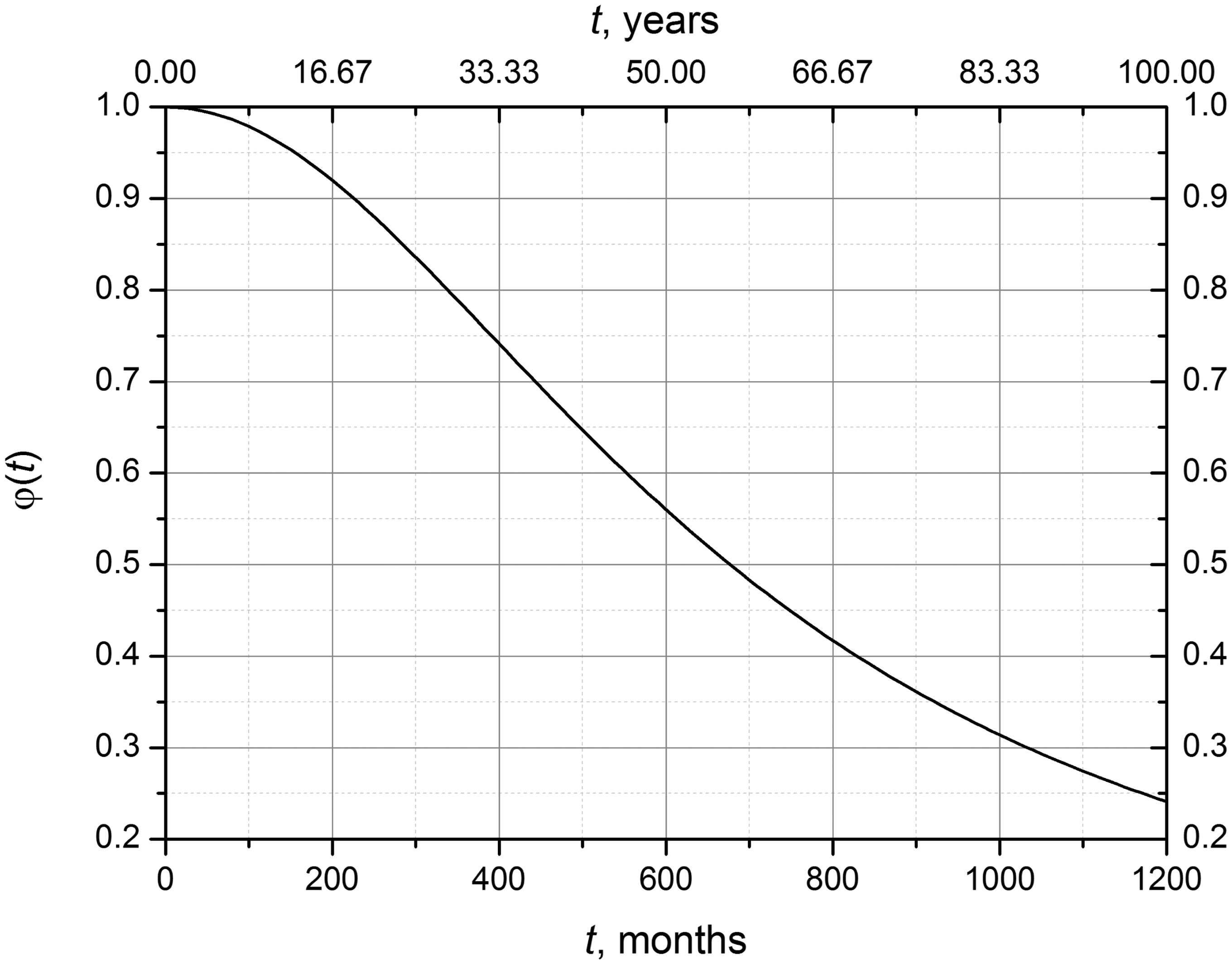
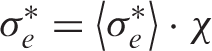
Obviously, this uncertainty persists or even increases during the aging process of the material. Therefore, we assume that the fatigue limit is the product of the function ϕ(t) normalized to a unit and the value of the fatigue limit at the initial time (σe*), which will be set as a random variable.
In the literatures, statistical data of fatigue tests are often described by the log-normal and Weibull probability distributions (Hanaki et al., 2010; Zheng et al., 1995). Weibull distribution is more general, but its parameters have a non-physical sense. So, in this current paper the log-normal probability density function is used for the description of the endurance limit uncertainty

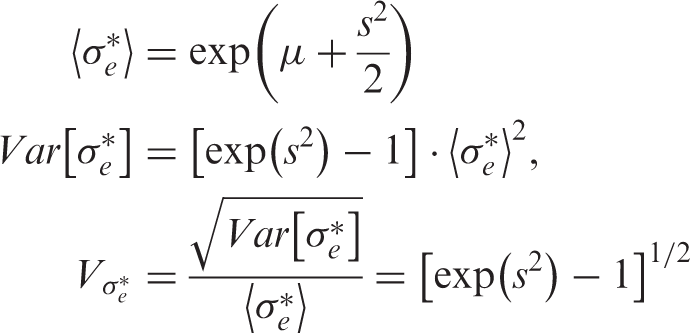
Thus, the variation of the fatigue limit is a random non-stationary process. Its one-dimensional probability density function can be obtained from the linear transformation (15) of the random variable σ*e and has the form

It is useful to normalize the fatigue limit by its mean value. Let us introduce a change of variables

The probability characteristics of the damage accumulation process
It is impossible to accurately determine and predict the fatigue lifetime of the long-term operation of engineering designs due to uncertainty of the aging material fatigue strength and the randomness of load (frequency of dangerous modes occurrence). Consequently, the probability approach should be used instead. The key point of the approach is to establish the probability of a non-failure operation of the mechanical system as a function of time or to determine the probability distribution of the fatigue lifetime.
Identification of the non-failure operation probability (often called the reliability function) can be determined as a probability of double inequality with a relation to the damage parameter, i.e. as a probability with a damage parameter that is positive and less than unity (Larin, 2011; Pham, 2003; Rathod et al., 2011; Zhovdak and Tarasova, 2007)

Such a probability will be a function of time due to the dependence of the damage parameter on time, so it can be calculated via the probability density function (PDF) of the damage (Larin, 2011; Rathod et al., 2011) in the following way
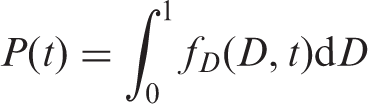
A PDF of a lifetime q(t) can be set as a derivative of the probability of failure Q(t). The failure and non-failure are complementary events, so the probability of failure is obtained from the reliability function in a simple way that gives a possibility to identify a PDF, the mean value of lifetime 〈Tr〉 and its variance (Var[Tr]) (Larin, 2011; Pham, 2003; Rathod et al., 2011; Zhovdak and Tarasova, 2007)
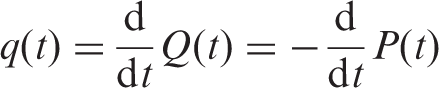

So, the solution of the fatigue lifetime estimation of the engineering designs problem, which has uncertainty in the load and in the natural aging endurance strength can be reduced to the problem of identification of a PDF of the fatigue damage, which is a process described by the kinetic equation (12). Due to the non-linearity of the equation (12) determination of a PDF of the fatigue damage accumulation process at each moment of time is a difficult mathematic problem. However, it is possible to linearize the equation (12) by introducing a change of a variable. It can be presented in quadrature

The integral in the left part of the equation (25) can be easily calculated. We can consider U(t) to be a new function which is equal to

Under the notations (26) one can obtain

The mean value of the function U(t) is easily obtained from the averaging procedure taking into account the hypothesis of the statistical independence of the loading and the degradation processes

The correlation function of U(t) is expressed through the second initial moment

Using the integral representation of the function U(t) (27) and the hypothesis of independence of the loading and degradation processes, one obtains the following expressions

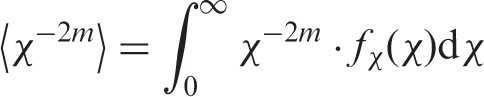
The second initial moment of a random frequency is expressed in terms of its correlation function and its squared mean value, which is a constant due to the assumption of stationarity of processes


The variance of the function U(t) is calculated from its correlation function

So, the first-order probability parameters (the mean value and variance) of the function U can be obtained from equations (28), (33) and (34). The PDF of the process U can be set as a normal Gaussian distribution due to meeting the conditions of the central limit theorem (Rathod et al., 2011), starting from a certain period of time. Thus, the integral representation of the process U(t), offered by equation (27) shows that the process U at each moment of time is a superposition of the other random variables presented by the load and aging processes. So, if we consider the period of time to be similar to the lifetime of the design, then it can be argued that the process U is the sum of a large number of uncorrelated terms with limited values of statistical moments. Then, the probability density function of U(t) has the form of a normal Gaussian distribution with the characteristics (28) and (34).
Using the relation between the process U(t) and the damage (26), the probability density function of the damage can be written in the form of equation (36) due to equation (35) (Durrett, 2004)
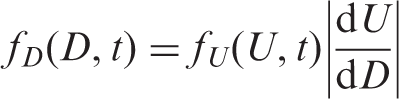

Then the mean and variance of damage can be determined by equations (37)

The spread of the damage parameter values can be defined as a confidence interval with a set level of the confident probability α

Performing test calculations
A series of test calculations has been carried out based on the proposed approach to the determination of the probability parameters of the fatigue damage accumulation with the natural degradation of the material properties. For such tests a real engineering example is used.
There have been several failures of bolted and pin joints while running the hydroturbines at the Dnipro cascade in the Ukraine; however, their nominal life-time is not over. The metallographic appraisal has shown that the type of the crack surface corresponds to the high cycle fatigue nature. However, these faults were observed after a long-term operation, so their fatigue analysis can be carried out within the framework of the theory presented in the current paper. The operation of the hydroturbine at the Dnipro cascade accounts for the randomness of the transient modes (the realizations of their starts and stops are shown in Figure 1). The average frequency of transient modes occurrence (see Figure 1) is 〈ω〉 = 23 month−1 and its variance is 159 month−2 (Vodka and Trubayev, 2013). The time before correlation of frequency (τk) has been set to 1 month which means a month-to-month statistical independence of turbines operation (such an assumption is not obvious and is based on experts’ opinion; however, in the paper, the analysis of bolted joints reliability has been carried out for different values of the loading frequency correlation time).
The stress amplitude σ a has been determined by the detailed finite element (FE) analysis of the deformed state of the bolt joint under the operation load and for the two different levels of technological tightening (nominal and over-tighten). The description of FE analysis can be found in Vodka and Trubayev (2013). The levels of stress amplitudes are 64.4 MPa and 128.8 MPa. The material of the bolt is steel (C45). The Woehler curve parameters are set according to the manufacturing company recommendations (endurance limit σ e = 21.6 MPa obtained on the N0 = 107 number of stress cycles, m = 4).
The results of the calculations are shown in Figures 3 and 4. Figure 3 shows graphs of the damage accumulation process expectation and its confidence interval with and without regard to the process of degradation. As it can be seen from the figure, during the first 100 months the processes of the damage accumulation are almost same (the effect of the degradation is insignificant). But with time passing the process of material degradation accelerates damage accumulation.
〈D(t)〉 and its confidence interval at stress cycle amplitude σ
a
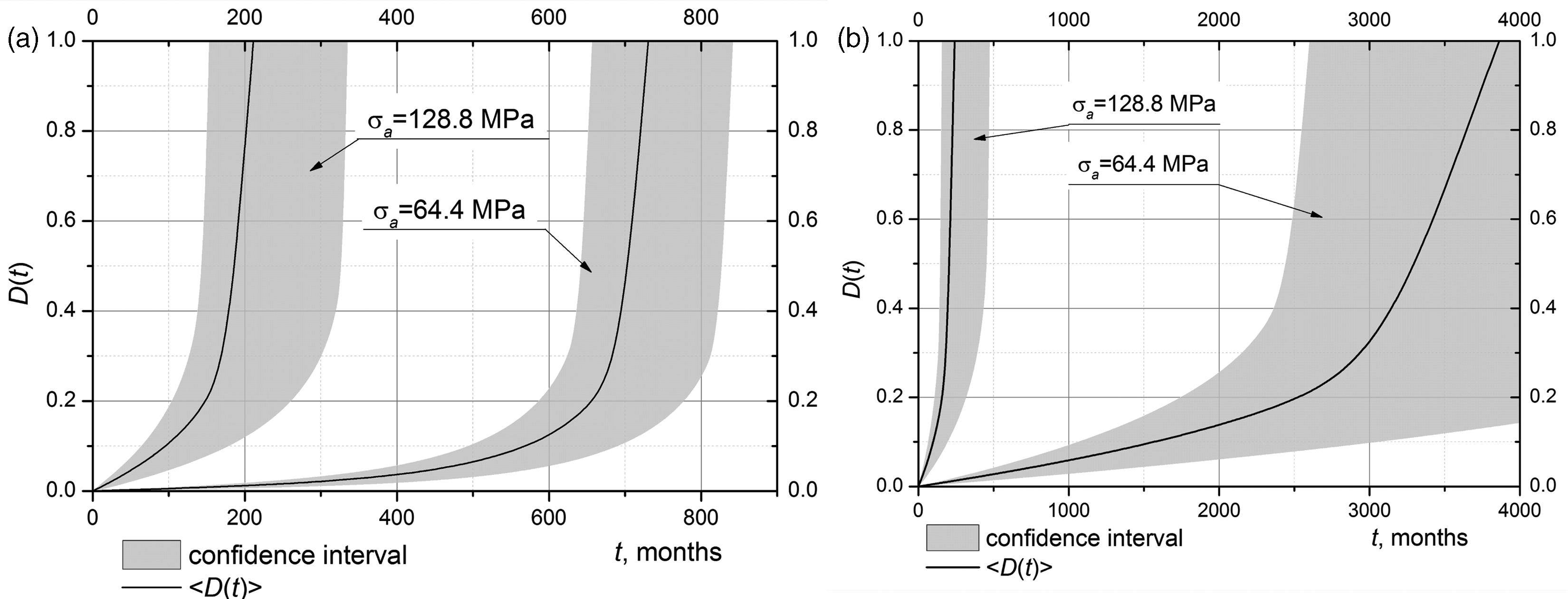
= 128.8 MPa. 〈D(t)〉 process and its confidence interval at different amplitudes of the stress cycle: (a) taking into account the degradation and (b) without degradation.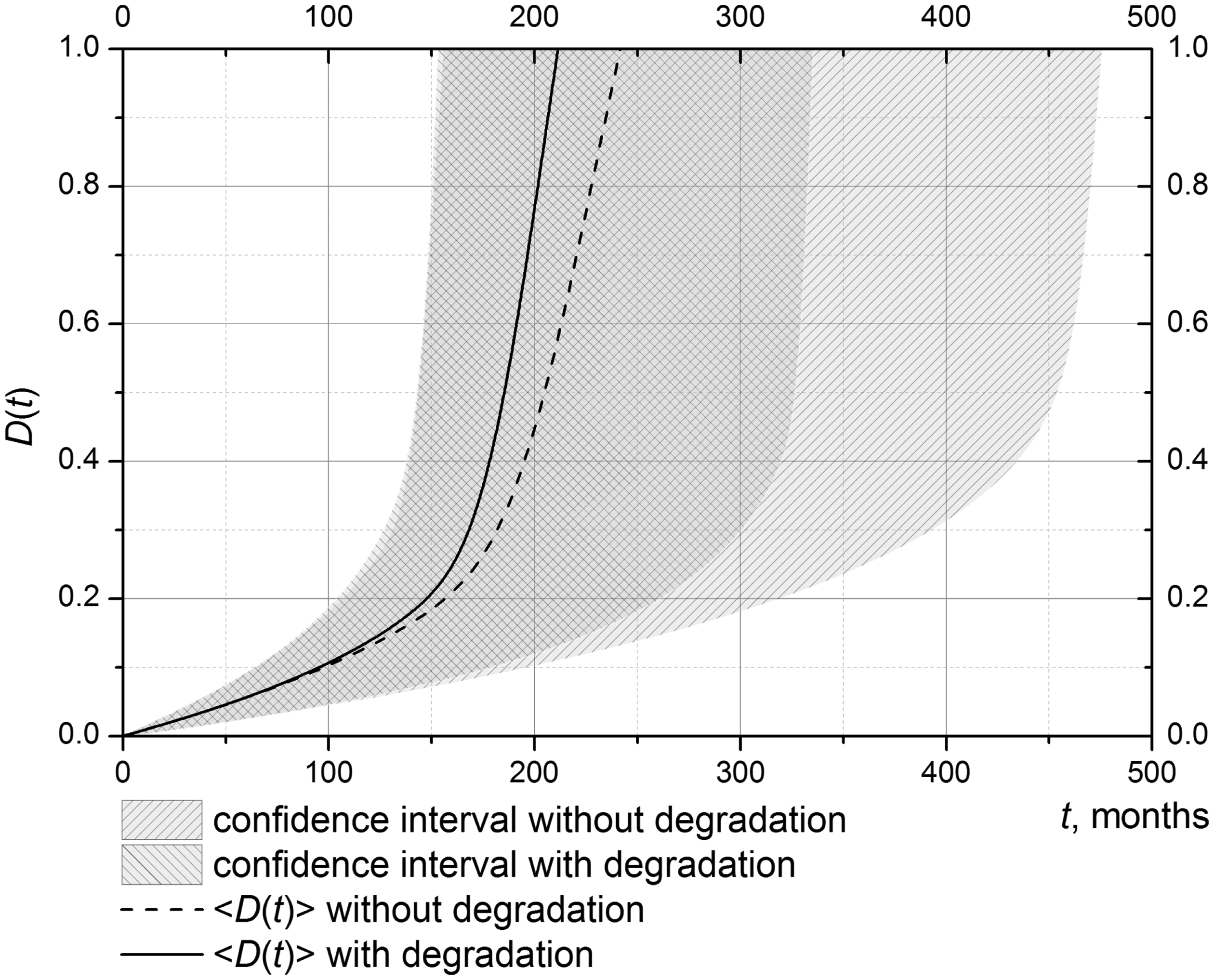
It should also be noted that the degradation does not affect the guaranteed lifetime but significantly reduces the uncertainty associated with the maximum lifetime. The mean lifetime is decreased by 12% and the maximum lifetime – by 30% due to the degradation process. At the same time, the fatigue (endurance) limit before the failure was decreased by just 8.8%.
Figure 4 shows plots of the damage accumulation and its confidence interval at two levels of the stress amplitude of the cycle. The graph, which is presented by Figure 4(b) has been truncated. The truncation has been introduced to increase the readability of the graph. However, the cut part is of no practical importance.
For these stress rates the probability density of failure q(t) and the reliability function P(t) (Figures 5 and 6) have been obtained.
P(t) and q(t) for different amplitudes of the stress cycle obtained without taking into account the degradation process. P(t) and q(t) for different amplitudes of the stress cycle obtained taking into account the degradation process.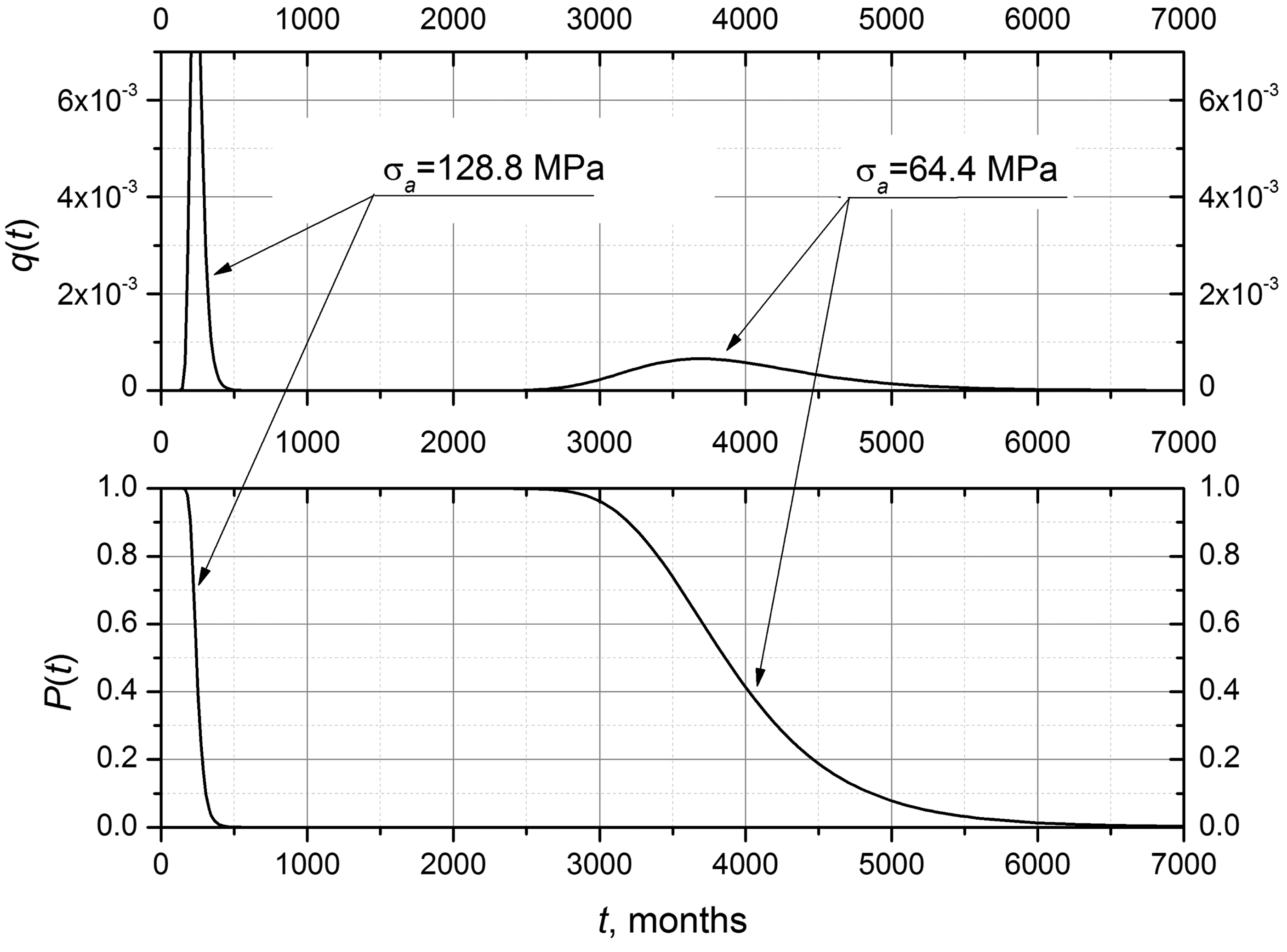
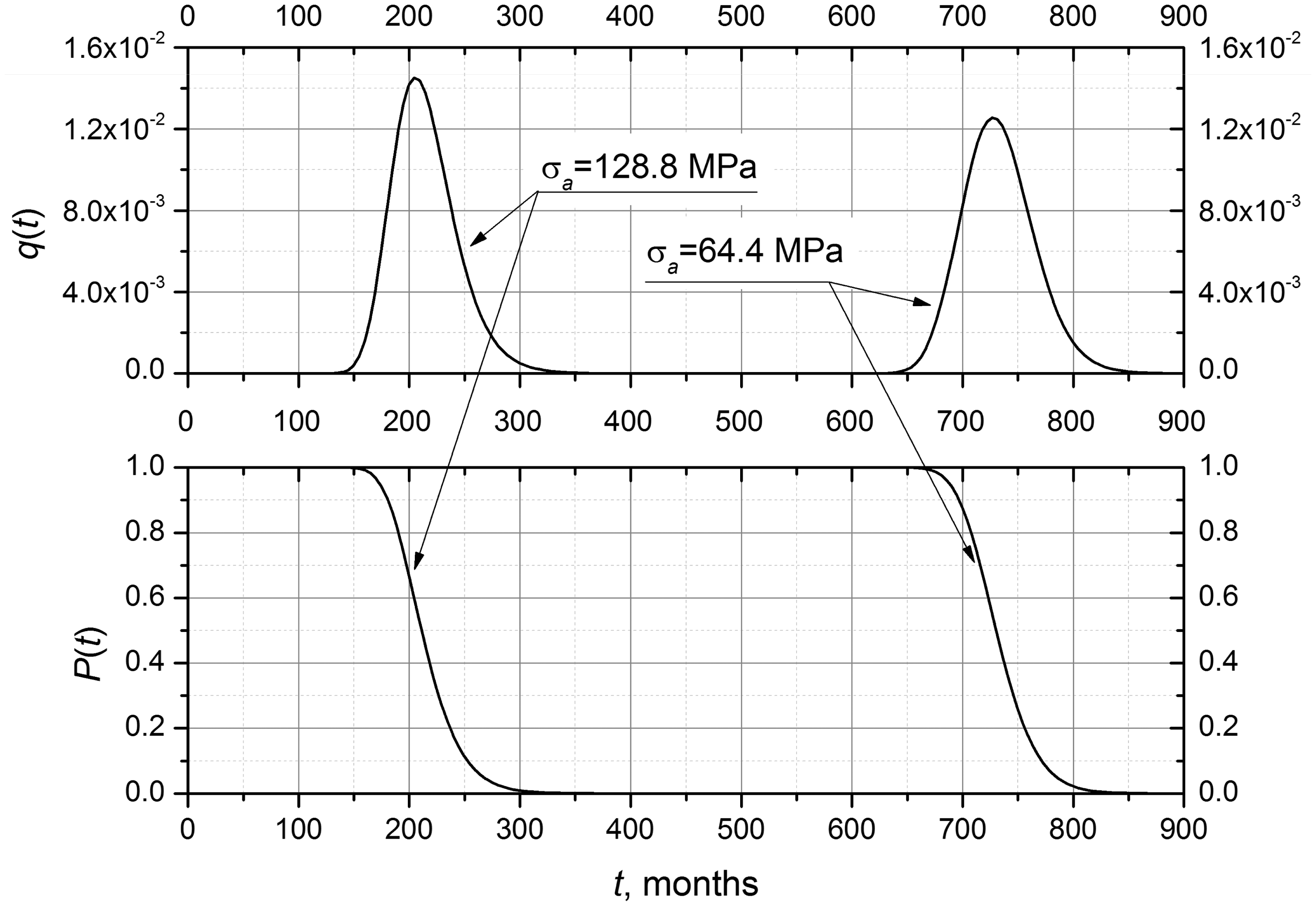
The estimate of the structure lifetime obtained without considering material aging provides considerably higher values of the fatigue lifetime for both cases of bolts tightening (pre-compression). These results lead to erroneous conclusions that fatigue failures are not important for the bolts reliability. Thus, practical engineers made these joints as pre-compressed as possible to avoid the possibility of the emergency bolting disclosure. However, results obtained taking into account the aging processes (Figure 6) show that over-compressed bolts have the lifetime comparable with the typical inter-repair (inter-inspection) term of hydroturbine operation. Therefore, the bolts connections with higher levels of technological pre-compression become unreliable. Consequently, fatigue reliability recommends making bolts connections with smallest tightening, but this leads to the reduction of their reliability under criteria of emergency bolting disclosure. The solution of this contradiction provides reasonable recommendations for the level of technological pre-compression of the hydroturbines bolting.
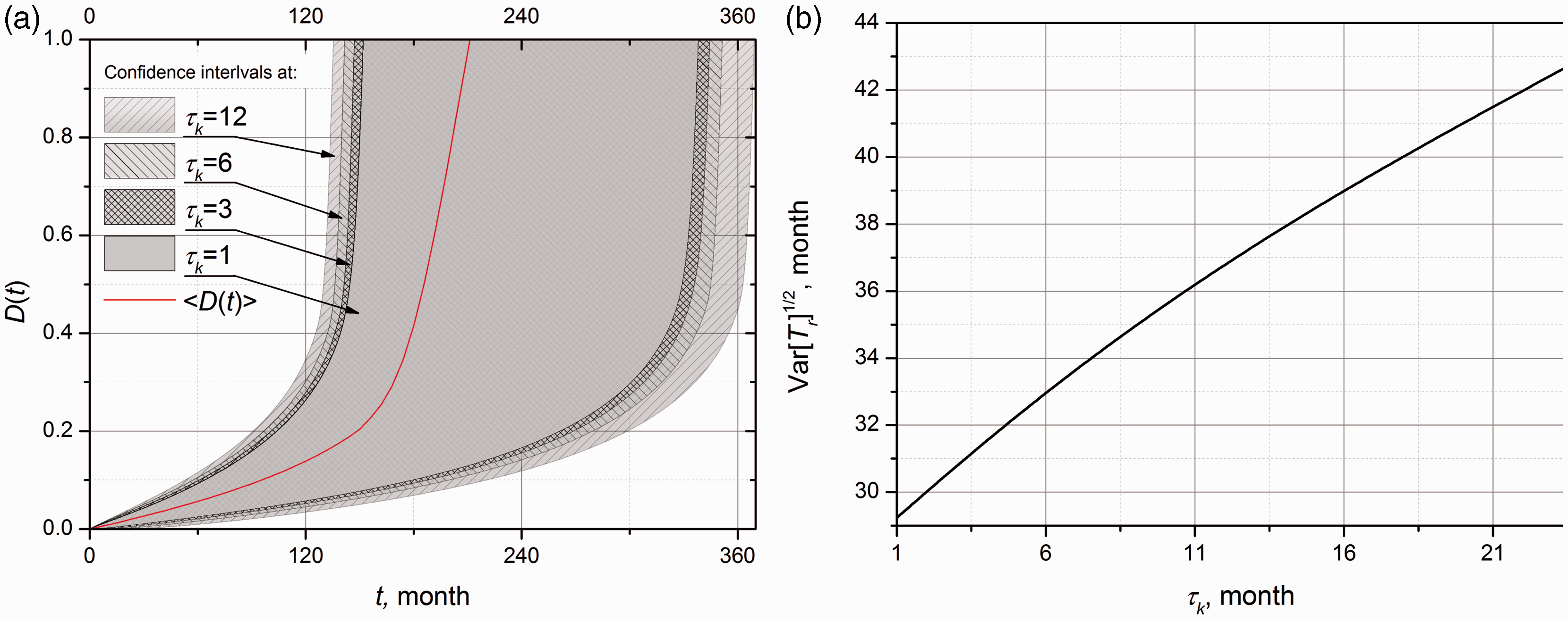
Similarly, q(t) and P(t) for several correlation times (τk) of the function ω(t) have been studied (Figure 7). The results show that life-time mean value is independent on the changing of this parameter. This numerical calculation shows that confidence interval increases with an increase in the correlation time (Figure 8). Figure 8 also shows 〈D(t)〉 and its confidence interval depending on τk.
P(t) and q(t) for different τk: (a) probability density of failure and (b) reliability function. Confidence interval of the damage (a) and standard deviation and (b) of the lifetime for different τk.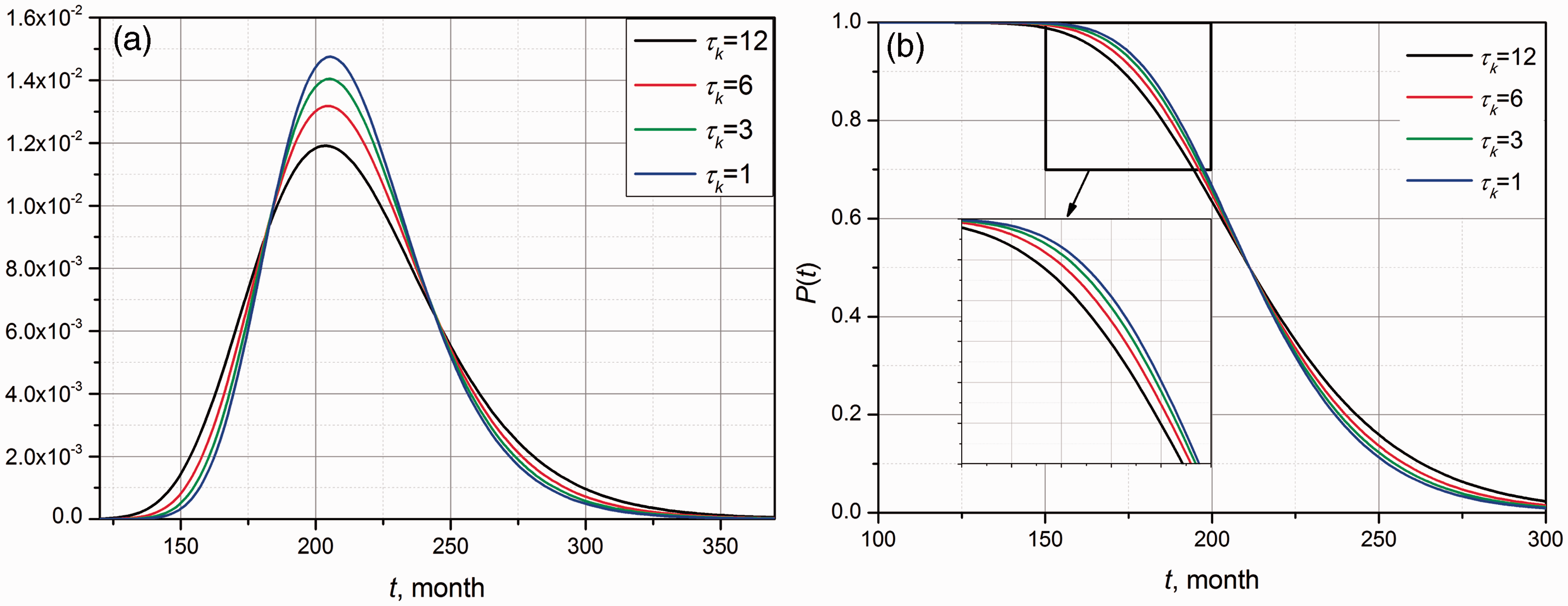
Conclusions
In this paper, a new approach has been proposed for predicting the lifetime under the high-cycle fatigue, which is made in the stochastic way and allows taking into account the natural degradation of the material properties. Solutions to the equations determining the mathematical expectation and the variance of the correlation function of the damage accumulation function have been obtained. The proposed approach allows analyzing the reliability and life prediction of structures designed for a long-term service, the damage accumulation occurring under the realization of the randomly appearing dangerous modes.
Footnotes
Conflict of interest
None declared.
Funding
This research received no specific grant from any funding agency in the public, commercial, or not-for-profit sectors.