







Abstract
One of the most challenging problems which arises in continuum damage mechanics is the selection of variables to describe the internal damage. Many theories have been proposed and various types of damage variables ranging from scalar to vector to tensor quantities have been used. In this paper we consider anisotropic damage and the most general form for damage by using a fourth-order tensor for the damage variables. We demonstrate how experimentally measured quantities can be related to the internal tensorial damage variables. We apply this analysis to experiments of an initially isotropic solid becoming transverse isotropic under triaxial or uniaxial stress loading.
Introduction
This paper is an extension of the seminal work by Cauvin and Testa (1999a, 1999b) where we consider the general case of anisotropic damage and relate the internal damage variables to experimentally measured damaged elastic moduli. An ongoing problem in continuum damage mechanics is the choice of the representation of the internal damage variables. There exists no general agreement on the choice of such variables (Lemaitre et al., 2000; Voyiadjis et al., 2015). Many damage variables have been proposed in the past ranging from scalar (see, e.g. Lemaitre, 1996; Zhu and Tang, 2004) to tensorial (Chaboche, 1993; Chen and Chow, 1995; Murakami, 1988). Although these models are based on a sound physical background, they lack vigorous mathematical justification and mechanical consistency (Voyiadjis et al., 2015).
Damage processes are generally anisotropic and exhibit preferential directions (He and Curnier, 1995; Voyiadjis et al., 2015). The internal change of a material generally depends on the direction of applied stress or strain, and hence is an essentially anisotropic phenomenon (Murakami, 2012). Different theories have been developed for the modelling of anisotropic 3D damage. We follow the approach of Cauvin and Testa (1999a, 1999b) and consider the most general case to represent anisotropic damage using a fourth-order damage tensor. Often simplifications are made to avoid using fourth-order damage tensors as they are not as easy to characterize physically when compared with a second-rank damage tensor or single scalar damage variable. However, we consider the full anisotropy using a fourth-rank tensor for damage in this paper.
A challenge in developing anisotropic damage models is the ability to identify the directionality of the introduced damage and characterize the full response of all the independent material elastic moduli with damage. It has also been difficult to perform experimental measurements which test the predictions of proposed anisotropic damage models. In this work we address these challenges and quantify the relationship between a general fourth-order damage tensor representing the internal damage variables to macroscopic, observable and empirically measured damaged elastic moduli using ultrasonic measurements. This analysis could help validate and advance anisotropic continuum damage models by using these relationships between measured damaged elastic moduli and the internal damage tensor.
Several micromechanical approaches have also been employed to model the progressive degradation of anisotropic and isotropic materials, including effective medium theory (Guéguen and Kachanov, 2011; Sayers and Kachanov, 1995) and microplane models (Bažant, 1984; Bažant and Caner, 2005; Caner and Bažant, 2013; Yang and Leng, 2014). Fabric tensors have also been related to the damage tensor in the work of Voyiadjis and Kattan (2006, 2009). Mallet et al. (2013, 2014) investigated the variation in the ultrasonic elastic wave velocities for an initially isotropic glass sample undergoing thermal cracking to become transverse isotropic. Mallet et al. (2013) showed using effective medium theory and the non-interaction approximation (Sayers and Kachanov, 1995) how elastic wave velocity measurements can be used to infer crack densities. These crack densities were then used to quantify the damaged material stiffness and compliance tensor for thermally cracked glass. Closed form results for damage-induced anisotropy in anisotropic materials are available for 2D problems using micromechanical approaches (Guéguen and Kachanov, 2011). For 3D damage it is much more difficult; however, Sarout and Guéguen (2008) also showed an exact solution for a transverse isotropic rock containing cracks that run parallel to the plane of isotropy.
In this paper we also use ultrasonic measurements to quantify the 3D anisotropic damage tensor in a similar way to these micromechanical approaches. However, we relate the ultrasonic measurements to the general internal fourth-rank tensorial damage variables defined using continuum damage mechanics. We present an alternative phenomenological approach based on ultrasonic elastic wave velocity measurements and continuum damage mechanics. Instead of modelling the various damage mechanisms at the microscale level, we represent the damage indirectly by modelling the average material degradation for an initially isotropic model undergoing damage-induced anisotropy.
Ultrasonic techniques provide fast and non-destructive methods for reliable measurement of elastic properties and their change with damage (Marguéres and Meraghni, 2013). Elastic properties can be determined by static measurements of stress and strain or by dynamic methods such as ultrasonic measurements of the seismic wave velocities (Paterson and Wong, 2005). Ultrasonic methods have been very popular in non-destructive testing and characterization of materials and monitoring progressive damage of rocks. Ultrasonic techniques have been employed by several researchers (see, e.g. Audoin and Baste, 1994; Castellano et al., 2017; Hufenbach et al., 2006) to identify purely phenomenological models of anisotropic damage for composite materials. Our approach extends these models to equate the phenomenological models of experimentally measured stiffness reduction during loading given by ultrasound measurements to general fourth-order anisotropic damage tensorial models given by continuum damage mechanics. Furthermore, our damage tensor is not restricted to be supersymmetric as in the work by Audoin and Baste (1994). Cauvin and Testa (1999a) showed that only a symmetric (minor symmetries only) fourth-order damage tensor is needed to preserve the supersymmetric properties of the damaged stiffness tensor. This paper provides a relationship between the internal damage variables used in general continuum damage mechanics models and the empirically observed reduction in elastic wave speeds. This analysis can help test the predictions of general continuum damage models.
Experimental studies of ultrasound wave anisotropy during mechanical loading include those of Dodds et al. (2007), Eslami et al. (2010), Fortin et al. (2005), King et al. (1995), Sarout et al. (2007), Sayers et al. (1990) and Scott et al. (1993). Several studies have shown how an initially isotropic solid can become progressively anisotropic during uniaxial loading due to microcracking damage. With uniaxial or triaxial compressive loading it is expected that microcracking parallel to the axial stress can occur and this preferential cracking results in transverse isotropy for the solid. In this paper we consider the experiments of King et al. (1995) and Scott et al. (1993) who performed ultrasonic testing of an initially isotropic sandstone specimen undergoing triaxial loading. The evolution of the elastic wave velocities with damage showed that the triaxial loading resulted in a change in the material symmetry to become transverse isotropic. The stress-induced anisotropy from triaxial loading induced transverse isotropic damage with the material symmetry axis in the same direction as the maximum principal stress. We use these experimental results to show how macroscopic, observable evolution of the elastic wave velocities can be used to parameterize damage models given by continuum damage mechanics.
This paper provides a quantitative relationship between the macroscopic, empirically observed damaged elastic moduli and the internal damage variables defined using continuum damage mechanics. We derive this relationship for an initially isotropic solid undergoing damage to become transverse isotropic under triaxial or uniaxial loading. We show how ultrasonic measurements of seismic wave velocities can be used to determine the evolution of the fourth-order anisotropic damage tensor characterizing this internal damage.
Fourth-order damage tensor to characterize the internal damage
The constitutive equations and the evolution equations of damage mechanics can be derived using effective state variables such as stress, strain or energy, together with the hypotheses of mechanical equivalence between the damaged and the fictitious undamaged material (Murakami, 2012). In this paper we follow the approach of Cauvin and Testa (1999a) and use the principle of strain equivalence to derive the fourth-order damage tensor. In their pioneering work Cauvin and Testa (1999a) showed using the principle of strain equivalence that in general only a fourth-order tensor is needed to describe a material undergoing damage. They also showed that the actual number of independent damage parameters in such a tensor is related to the material and damage symmetry. Cauvin and Testa (1999a) and Jarić et al. (2012) showed that the general supersymmetry requirements for the damaged elastic stiffness tensor


Stress-induced anisotropy in initially isotropic media
We first consider the general case of true triaxial loading of an initially isotropic solid. The lowest symmetry that should result from this stress-induced anisotropy is orthotropic with the same material symmetry axes as the principal stress directions. This result can be deduced from Curie’s principle which states that for any physical phenomenon, the observable effects are at least as symmetric as their causes (Rasolofosaon, 1998).
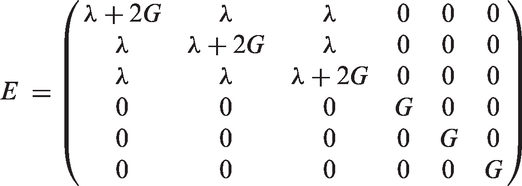
The stiffness tensor for the initially isotropic material in Voigt notation is
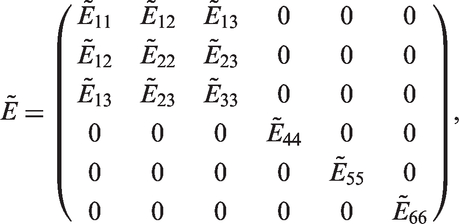
When deriving the stiffness tensor for the damaged material
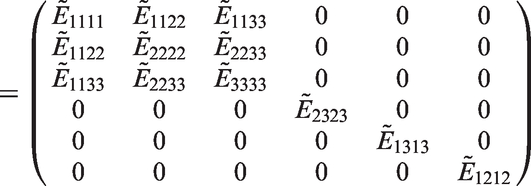
Here we are using Voigt notation where each pair of indices (ij and kl) is replaced by a single index:
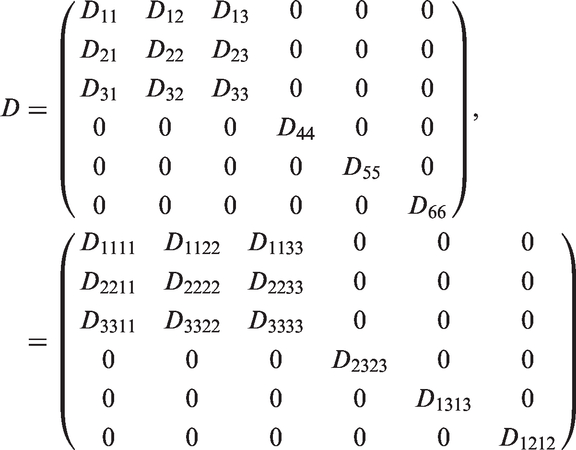
We can still write D in Voigt notation as D possesses the minor symmetries:
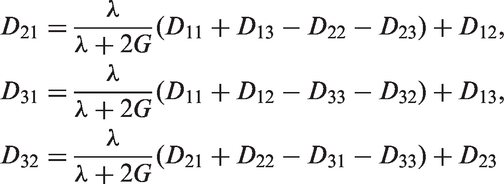
Using equation (2) the only non-zero damaged stiffness tensor variables for orthotropic damage in the definition above for

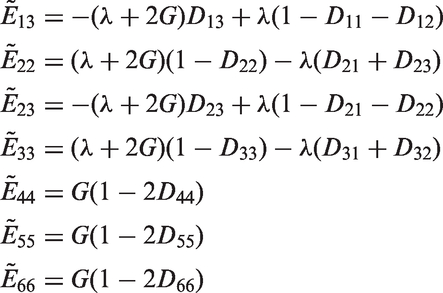
Here we are using the principal stress axes as the material symmetry axes and have assumed that the damage is orthotropic for the general case of true triaxial loading of an isotropic solid.
Rasolofosaon (1998) showed that when isotropic elastic media are truly triaxially stressed, they constitute a special subset of orthorhombic media called ellipsoidal media. This condition holds when the components of the stress deviator are small compared to the elastic wave moduli. The nine independent elastic stiffness tensor variables of an ellipsoidal material (

If we use these three ellipticity conditions then we only need to find six independent damaged elastic moduli from experimental measurements. We can apply the ellipticity conditions to the experiments of King et al. (1995) and Scott et al. (1993) as the stress deviator (MPa) is small in magnitude compared to the elastic wave moduli (GPa). However, in general the empirical damage variables
Ultrasonic measurements
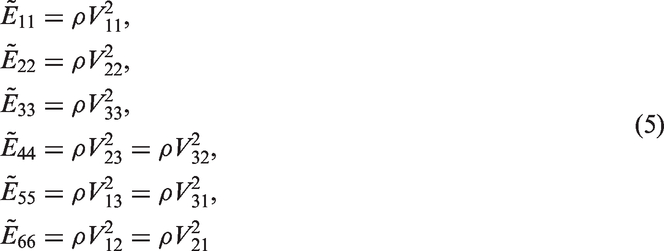
Measurements of the ultrasonic velocities during damage can reveal the progression of damage. Once the ultrasonic velocities are measured the coefficients of the damaged elastic stiffness tensor can be calculated from the well-known Christoffel’s equations for elastic wave propagation (Eslami et al., 2010)
In the next section we consider the case of uniaxial or triaxial loading of an isotropic solid and the resulting change in the material symmetry from isotropic to transverse isotropic due to the loading. We quantify the relationship between the fourth-order internal damage tensor variables and the macroscopic, experimentally observed changes in elastic wave speeds from ultrasonic measurements in the following subsections. In the last section we model the experimental results of King et al. (1995) and Scott et al. (1993) and relate the internal damage variables to the ultrasonic measurements of an initially isotropic dry sandstone under triaxial loading.
Stress-induced transverse isotropy from uniaxial or triaxial loading
We consider an initially isotropic solid undergoing uniaxial or triaxial loading. When an initially isotropic medium is subjected to vertical uniaxial loading, the resulting symmetry is transverse isotropy with a vertical symmetry axis (Johnson and Rasolofosaon, 1996). Similarly if an initially isotropic medium is subjected to triaxial loading with constant confining pressure then the resulting symmetry is transverse isotropy with the material symmetry axis in the same direction as the maximum compressive principal stress direction.
Both King et al. (1995) and Scott et al. (1993) applied triaxial loading to sandstone specimens. They increased the maximum compressive principal stress (σ3) while the confining stress (
Relating empirical damage parameters to ultrasonic measurements
In this section we define the empirical damage tensor,
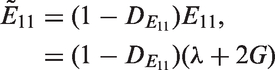
Using equation (3)


In equation (6) we assume that the density of the sandstone remains constant during triaxial loading since the densities were not reported in King et al. (1995) or Scott et al. (1993). This is an assumption only and damage will not just cause a reduction in the seismic velocities but mechanical degradation in other areas such as strength, density and rheology (Yang et al., 2010). Even in the elastic regime the density of a solid can change with applied stress depending on the value of Poisson’s ratio. A more accurate calculation of the stiffness reduction during the experiments would be to include the change in the density as well as the change in the elastic wave velocities with damage in equation (6).
By applying a similar derivation as shown for
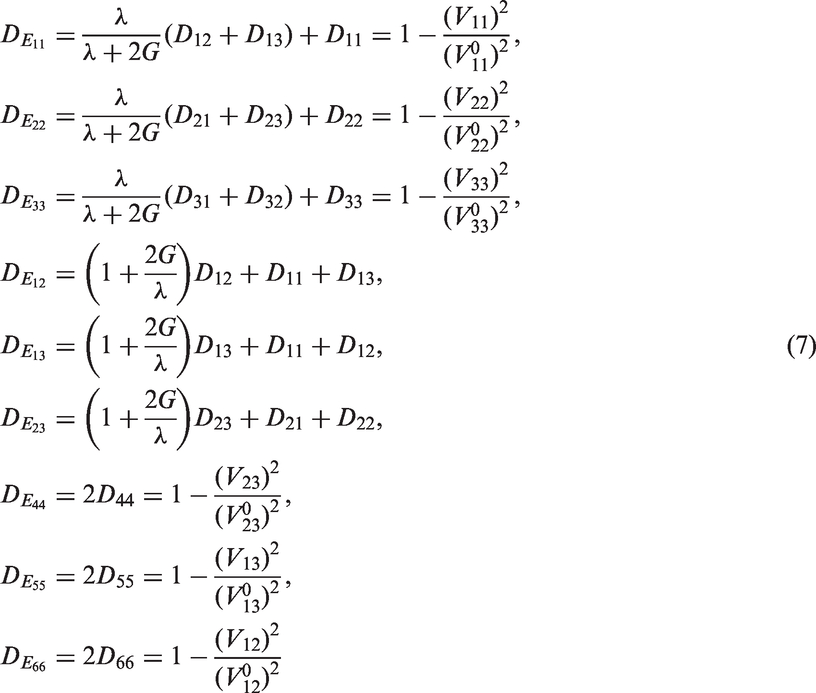
Quantifying the relationship between the internal fourth-rank damage tensor and the empirical damage parameters given by ultrasonic measurements
In this section we present the analytical derivation of the internal fourth-rank damage tensor (D) in terms of the empirically measured empirical damage parameters (DE). To do this we have to invert equation (7) and ensure that the supersymmetry condition for the damaged stiffness tensor is met in equation (1).
However, we can make further simplifications before inverting equation (7). From symmetry considerations we can assume that the triaxial loading experiments of King et al. (1995) and Scott et al. (1993) induced transverse isotropy in the initially isotropic sandstone specimens with the axis of the principal load as the symmetry axis. This is expected from Curie’s principle which states that for any physical phenomenon, the observable effects are at least as symmetric as their causes (Rasolofosaon, 1998). Thus, from the experiments and Curie’s principle we know that transverse isotropy is expected with
Both experiments of King et al. (1995) and Scott et al. (1993) also showed that
Using these simplifications arising from the symmetry of the loading and the ellipticity conditions in equation (4) the damaged stiffness tensor in Voigt notation becomes
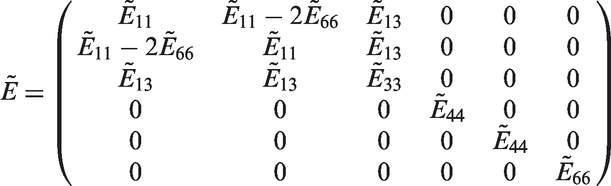
To relate the internal fourth-rank damage variables (Dij) to the empirical damage variables (
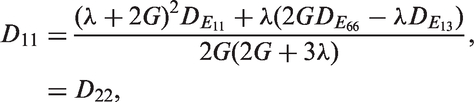
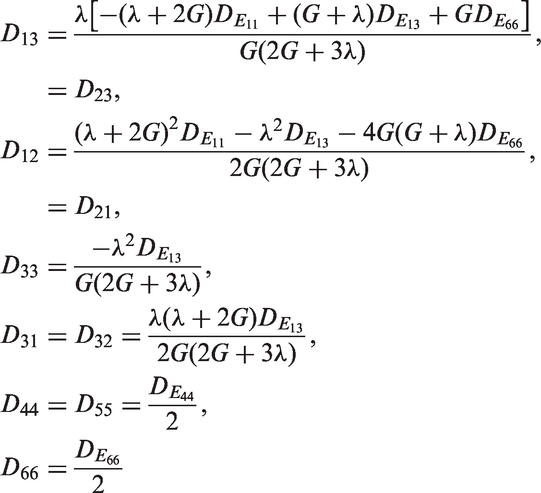
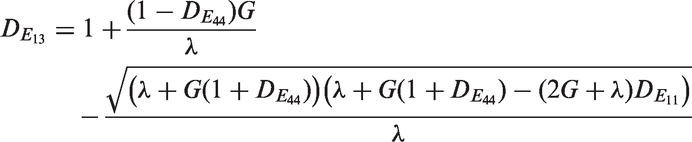
The fourth-order damage tensor for an initially isotropic solid under uniaxial or triaxial loading to become transverse isotropic in Voigt notation is
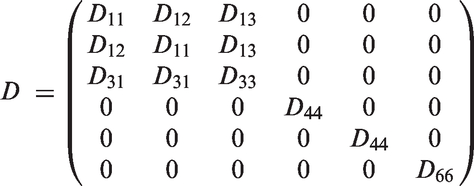
Damage-induced anisotropy in sandstone specimens under triaxial loading
In Figure 1(a) the damage variables are plotted for the experimental results of Scott et al. (1993) at different confining pressures. The damage is evaluated in this plot at the point of yielding or fracture. However in Figure 1(b) the damage variables are plotted for the experimental results of King et al. (1995) at a confining pressure of 10 MPa and principal axial stress of 70 MPa. These damage variables are evaluated before yielding or fracture occurs and hence the damage variables are lower in magnitude than the results of Scott et al. (1993). We assumed values of (a) The internal tensorial damage variables for different confining pressures at the point of yielding for ductile behaviour (138 MPa) or shear brittle failure (20 and 60 MPa) for the experimental results of Scott et al. (1993). (b) The internal tensorial damage variables for a confining pressure of 10 MPa and principal axial stress of 70 MPa for the experimental results of King et al. (1995).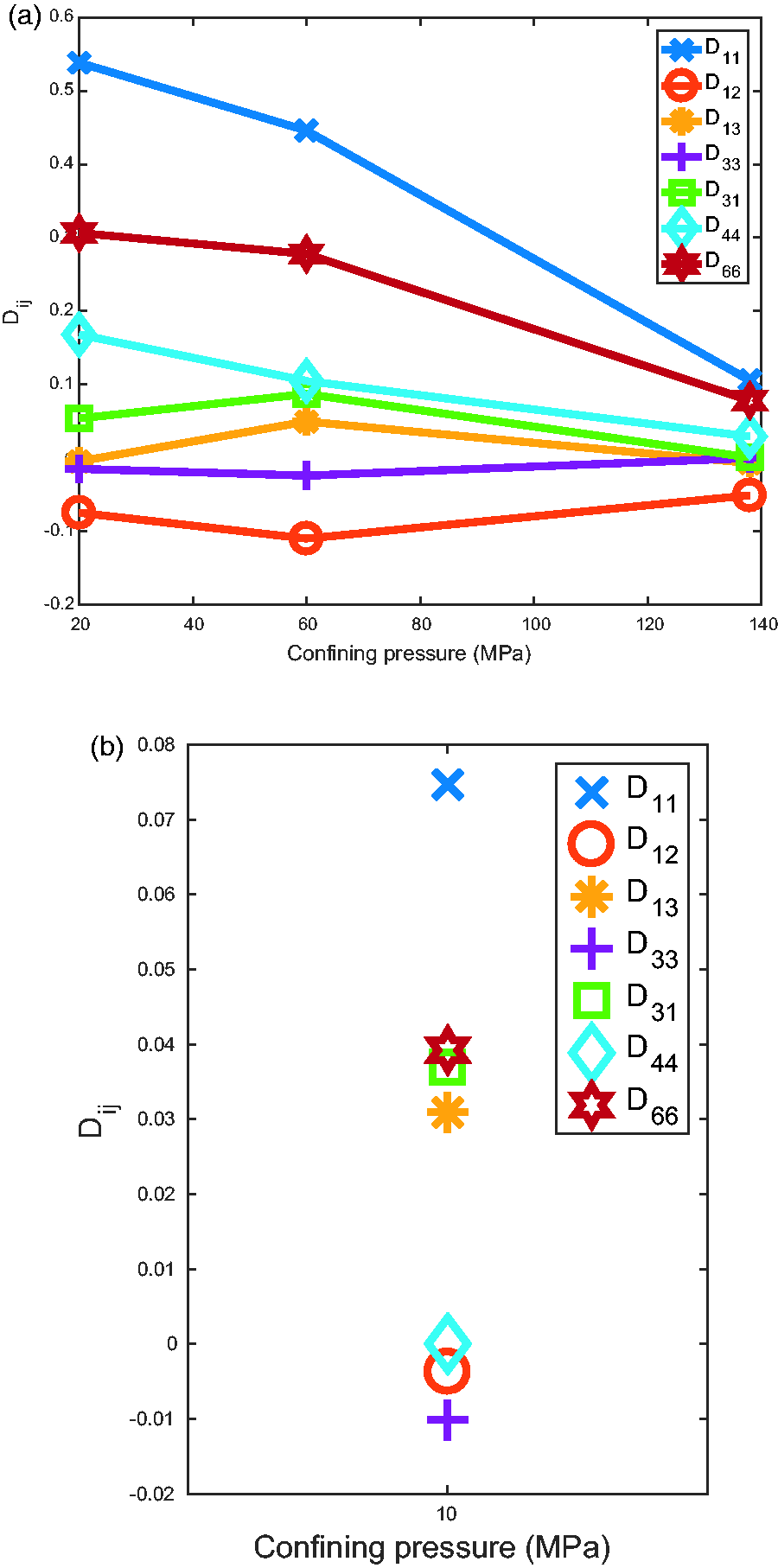
Figure 1 plots the internal damage variables for the experiments of Scott et al. (1993) in (a) and King et al. (1995) in (b). We show for these experiments that the damage tensor is not diagonal when we use the principal stress axes as the model axes. Thus, we can see that when considering transverse isotropic damage that the off-diagonal elements of the damage tensor Dij where
The internal damage variables with the largest magnitude are
Cauvin and Testa (1999a, 1999b) related the change of well-known elastic parameters, such as the bulk modulus, Young’s modulus and Poisson’s ratio with damage, to the internal damage tensor for the case of an initially isotropic solid undergoing damage to remain isotropic. We extend this approach to consider initially isotropic solids undergoing damage to become transverse isotropic. We employ different empirical measures of damage to Cauvin and Testa (1999a, 1999b). Cauvin and Testa (1999a, 1999b) related the internal fourth-order damage tensor variables to the change in isotropic elastic moduli and Poisson’s ratio with damage. Because we are considering the evolution of anisotropic damage we use a more convenient empirical measure of damage which is the experimentally measured stiffness reduction using ultrasonic investigations. We chose this measure of damage as ultrasonic investigations are widely used in many anisotropic materials such as composites and provide a convenient experimental tool to measure the evolution of the full stiffness tensor. The evolution of the full stiffness tensor is required to model anisotropic damage evolution.
Conclusions and future work
While this paper has not considered evolution of the damage tensor based on irreversible thermodynamics it provides an alternative route to building a phenomenological model of damage evolution. It also provides a method of comparing and validating the damage evolution predicted by continuum damage mechanics and irreversible thermodynamics with the physical evolution of the anisotropic damage measured using ultrasonic techniques. This work can help develop phenomenological continuum damage models of anisotropic damage evolution. We show that common assumptions about the form of the anisotropic damage tensor based on physical considerations, such as assuming the damage tensor will only have non-zero principal values along the principal applied stress directions, may be invalid.
Footnotes
Declaration of conflicting interests
The author(s) declared no potential conflicts of interest with respect to the research, authorship, and/or publication of this article.
Funding
The author(s) disclosed receipt of the following financial support for the research, authorship, and/or publication of this article: This research is supported by the Australian Research Council Discovery Early Career Researcher Award DE140404398.