







Abstract
A detailed analysis has been performed for the prediction of long-term creep behaviour of tempered martensitic Grade 91 steel at 873 K using the microstructure-based creep damage mechanics approach. Necessary modifications have been made into the original kinetic creep law proposed by Dyson and McLean in order to account for the influence of microstructural damages arising from the coarsening of M23C6 and conversion of useful MX precipitates into deleterious Z-phase on creep behaviour of the steel. An exponential rate relationship has been introduced for the evolution of number density of MX precipitates with time. It has been shown that the developed model adequately predicts the experimental long-term creep strain–time as well as creep rate-time data. The role of Z-phase on long-term creep behaviour of Grade 91 steel has also been discussed.
Introduction
Grade 91 steel is an important structural material for steam generator applications in thermal and nuclear power plants (Mannan et al., 2003). The steel has been developed by the addition of strong nitride/carbide forming elements such as vanadium and niobium along with the controlled addition of nitrogen in the plain 9Cr–1Mo or P9 steel. The creep strength of the steel is derived from (i) solute strengthening due to the presence of molybdenum (Mo) in matrix, (ii) dislocation strengthening arising from the initial high dislocation density in the order of 1 × 10¹⁴ m−2, (iii) boundary hardening from fine lath/subgrains and (iv) precipitation strengthening from finely distributed M23C6 and MX type (niobium/vanadium carbide/carbonitride) precipitates (Maruyama et al., 2001). It has been reported that the creep strength of the steel breaks down in the long-term creep regime due to microstructure evolution which includes preferential recovery along prior austenite grain boundaries (Kimura et al., 2000) originating from the conversion of finely distributed useful MX precipitates and consequent formation and growth of complex nitride Z-phase, i.e. Cr(V,Nb)N precipitates (Danielsen and Hald, 2006). Z-phase grows very rapidly at the expense of MX precipitates (Cipolla et al., 2010; Danielsen and Hald, 2006; Kimura et al., 2000; Sawada et al., 2011). It has also been reported that recovery of subgrains caused by coarsening of M23C6 precipitates leads to observed breakdown in the long-term regime (Chen et al., 2011). All the above-reported results strongly indicated that variations in microstructural variables influence the creep behaviour of Grade 91 steel and these variables need to be incorporated into the kinetic rate relationships for the development of constitutive models.
In general, understanding and modelling of creep behaviour of 9% Cr steels are important for safe life design and remnant life assessment of components operating at high temperatures (Pandey et al., 2019). The continual improvement in understanding of underlying microstructure variables in 9% Cr steels has led to the development of new constitutive models or modification in existing models. Applicability of constitutive relationships associated with the single or multiple state variables towards the description of creep behaviour of tempered martensitic steels can be found elsewhere (Biglari and Nikbin, 2017; Christopher and Choudhary, 2018; Christopher et al., 2012; Dyson and McLean, 1998; Eisenträger et al., 2017; Hore and Ghosh, 2011; Liu and Pons, 2018; McLean and Dyson, 2000; Murchú et al., 2017; Naumenko et al., 2011a, 2011b; Oruganti et al., 2011; Semba et al., 2008; Wang et al., 2016; Yin and Faulkner, 2006). Most of the creep models were based on the works of Dyson and McLean (1998) and McLean and Dyson (2000). Firstly, Ashby and Dyson (1984) proposed phenomenological relationships to quantify the influence of microstructural variables on creep resistance of metals and alloys. Later, Dyson and McLean (1998) introduced the improved model based on the evolution of various internal-state variables into the continuum creep damage mechanics formulations. The successful implementation of Dyson–McLean approach has been demonstrated for describing the creep behaviour of nickel-based alloys and tempered martensitic steels. Coakley et al. (2011) developed the quasi-bimodal model by the modification of the creep law proposed by Dyson–McLean in order to understand the influence of different gamma prime (γ′) precipitate distributions on creep behaviour of nickel-based super alloys. Zhu et al. (2012) improved the Dyson–McLean creep rate model to account for the influence of chemical composition and variations in precipitate size, geometry and spacing on the creep behaviour of superalloys.
Applicability of Dyson–McLean approach (Dyson and McLean, 1998; McLean and Dyson, 2000) has been demonstrated for 2.25Cr–1Mo steel for wide range of stress and temperature (Hore and Ghosh, 2011). The optimised constants obtained for 2.25Cr–1Mo steel were used to estimate the material constant set for 9% Cr steels in order to prove the effectiveness of the approach for the prediction of creep behaviour of similar class of materials (Hore and Ghosh, 2011). However, in the above study, the kinetics of subgrain coarsening and its influence on kinematic back stress has not been considered. Semba et al. (2008) introduced the new relationships which account for the evolution of subgrain coarsening and its contribution to kinematic back stress during creep deformation. Applicability of Semba–Dyson–McLean model (Semba et al., 2008) has been demonstrated for the description of creep behaviour of P9 steel for different applied stress levels at 873 K in two different heat treatment conditions (Christopher and Choudhary, 2018). Since major contribution of precipitation strengthening arises from finely distributed M23C6 precipitates, the coarsening of M23C6 alone has been considered for the creep modelling of P9 steel (Christopher and Choudhary, 2018). In common, either original Dyson–McLean or Semba–Dyson–McLean models do not account for the influence of individual precipitates on creep behaviour of 9% Cr steels. Although Murchú et al. (2017) developed the model in the framework of Dyson–McLean approach for understanding the influence of individual precipitates such as MX and M23C6 on creep behaviour of P91 steel, the study did not include the evolution of kinematic back stress arising from the subgrain coarsening accompanied with the decrease in dislocation density and dominant microstructural damage arising from the conversion of useful MX precipitates into Z-phase during creep deformation. In view of the above, a generalised relationship accounting for the variations in number density of precipitates with time caused by the coarsening of M23C6 and conversion of MX into Z-phase has been developed in this study. Further, the developed relationship is incorporated into the kinetic law proposed by Dyson and Mclean (1998) to describe the long-term creep behaviour of Grade 91 steel at 873 K. The evolution of kinematic back stress arising from the subgrain coarsening accompanied with the decrease in dislocation density proposed by Semba et al. (2008) is also incorporated into the present analysis.
Microstructure-based approach for tempered martensitic 9% Cr steels
The kinetic creep law in Dyson–McLean approach is expressed as (Dyson and McLean, 1998)







In terms of Dd, the rate of Hmax can be written as

In equation (1), the normalising stress σ0 is given as






Alternatively, constant load (P) condition is mathematically defined as



Integration of equation (17) with the appropriate boundary conditions can be represented as


Differentiation of equation (19) with time resulted in

The differential equations (3), (5), (6), (8), (11) and (13) have been coupled to the kinetic creep law (equation (1)) for the description of short-term creep behaviour of 9% Cr steels (Christopher et al., 2012). For simulating creep curves under constant load conditions, the numerical integration of coupled differential equations has to be performed under the appropriate constraint given by equation (20).
Further modification in model for simulating long-term creep behaviour
The normalising stress σ0 related to dislocation–particle interaction in equation (1) accounts for the broad variations in inter-particle spacing with strain/time and it does not account for the influence of individual precipitates in both short and long-term creep regimes. It is known that microstructural degradation in 9–12% Cr steels occurs not only by coarsening of primary precipitates but also by the formation and growth of secondary precipitates such as Laves phase (Fe2Mo) and Z-phase (Cr(V,Nb)N). Based on the optimised material data obtained on short-term creep data, an effort to predict long-term creep behaviour failed mainly because of non-inclusion of the effects of individual precipitates in Grade 91 steel (Christopher et al., 2012). In order to account for the influence of individual precipitates on creep damage behaviour of materials, σ0 can be evaluated as described below. According to Ashby (1968), the Orowan stress is obtained as





The damage parameter

In equations (24) and (25),
Model for the prediction of long-term creep behaviour of Grade 91 steel at 873 K
By incorporating redefined σ0 (i.e. equation (24)) into creep rate law in equation (1), the long-term creep behaviour of Grade 91 steel can be predicted. In order to prove the applicability of the modified model, it becomes necessary for finding the relationship for the evolution of number density of MX with time. So, it is highly recommended to perform the long-term interrupted tests for quantitative estimation of the evolution of number density of MX with time. The experimental creep data along with evolution of dislocation density as well as MX with strain/time has been available for MGC heat of Grade 91 steel for the stress level of 70 MPa at 873 K (Kimura et al., 2009, 2012; Sawada et al., 2011). In the present analysis, the creep data obtained for MGC heat of Grade 91 steel have been used to examine the prediction of long-term creep behaviour of the steel.
For Grade 91 steel, the volume fraction M23C6 is considered to be fixed as a constant at 873 K. The number density of M23C6 for its fixed volume fraction is defined as


Rate constant


The generalised form of σ0 for Grade 91 steel can be expressed as
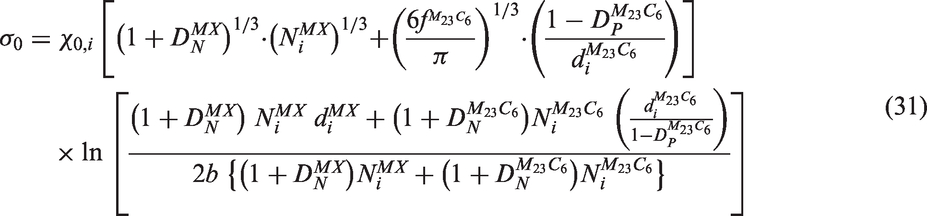
The final set of coupled differential equations to describe the kinetics of creep strain, kinematic back stress, maximum achievable kinematic back stress, damage caused by dislocation substructure coarsening, M23C6 coarsening, solute depletion and cavitation, variations in number density of MX and applied stress are given as
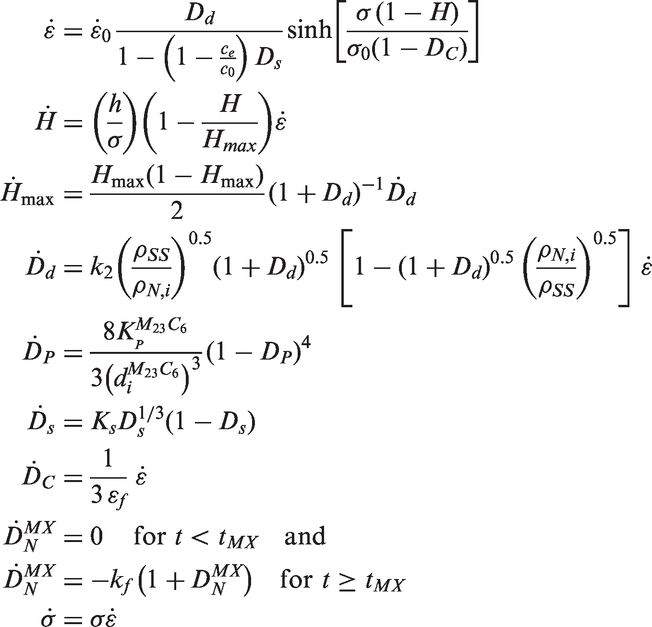
Two additional evolution relationships such as cavitation damage and the variations in number density of MX with time have been incorporated in equation (32) compared to previous investigation on modelling creep behaviour of P9 steel (Christopher and Choudhary, 2018). Cavitation damage was not included in the kinetic creep law for describing the creep behaviour of P9 steel due to its higher creep ductility along with the absence of grain boundary cavities during creep deformation (Christopher and Choudhary, 2018; Choudhary, 2013). Contrary to this, the distribution of micro-voids and their evolution during creep were reported for Grade 91 steel (Kobayashi et al., 2014). This necessitates the incorporation of cavitation damage in the present formulations. Since precipitation strengthening is from the presence of finely distributed MX and M23C6 in Grade 91 steel, the variations in number density of MX along with the coarsening kinetics of M23C6 have also been introduced in the present model. It is obvious that MX precipitates do not appear in P9 steel due to the absence of V, Nb and N in its chemical composition.
A schematic representation of the evolution of creep strain (ɛ) and different internal variables such as H, Hmax, Dd, Dp, Ds and DC with time has been shown in Figure 1. Kinematic back stress (H) increases with increasing strain/time and it approaches towards maximum value Hmax at higher creep strains. Since the damage due to the evolution of dislocation density (Dd) decreases with increasing strain, the maximum achievable kinematic back stress (Hmax) also decreases with strain/time. Continual increase in damage parameter (Dp) related to coarsening of precipitates has been observed. Similar to Dp, continual increase in damage due to solute depletion (Ds) with time is noticed. Ds approaches maximum value as the solute concentration reaches to the equilibrium value in matrix. A marginal increase in cavitation damage with time up to secondary creep stage followed by a rapid increase in values at tertiary stage has been noticed. The variation in number density of MX with time remains constant initially till the time tMX and a rapid decrease in number density of MX is noticed at longer durations. The evolution of stress with time is also included in Figure 1. The variations in stress with time displayed a marginal increase in values till the onset of tertiary creep followed by a rapid increase in values at tertiary stage.
Schematic representation of the evolution of creep strain (ɛ), different damage parameters and stress with time (t).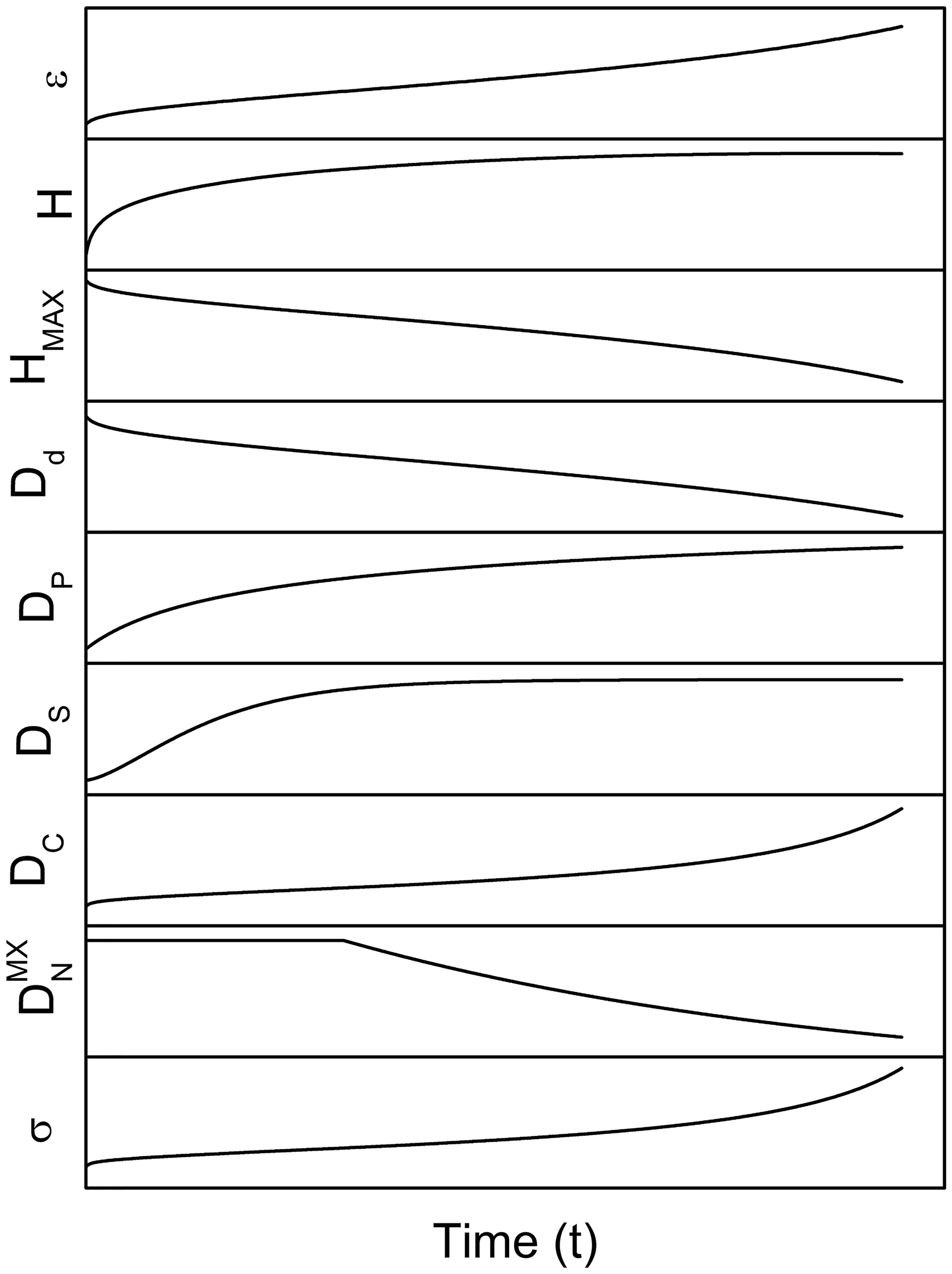
Material constants associated with the developed model
For the numerical simulation of creep curves, seven unknown material constant set, i.e. { Variations of (a) dislocation density with strain fitted by Kocks–Mecking–Estrin relationship, i.e. equation (33) and (b) normalised number density of MX with time described by exponential function, i.e. equation (29). Experimental data are extracted from Sawada et al. (2011). Material constants with fixed values for numerical integration.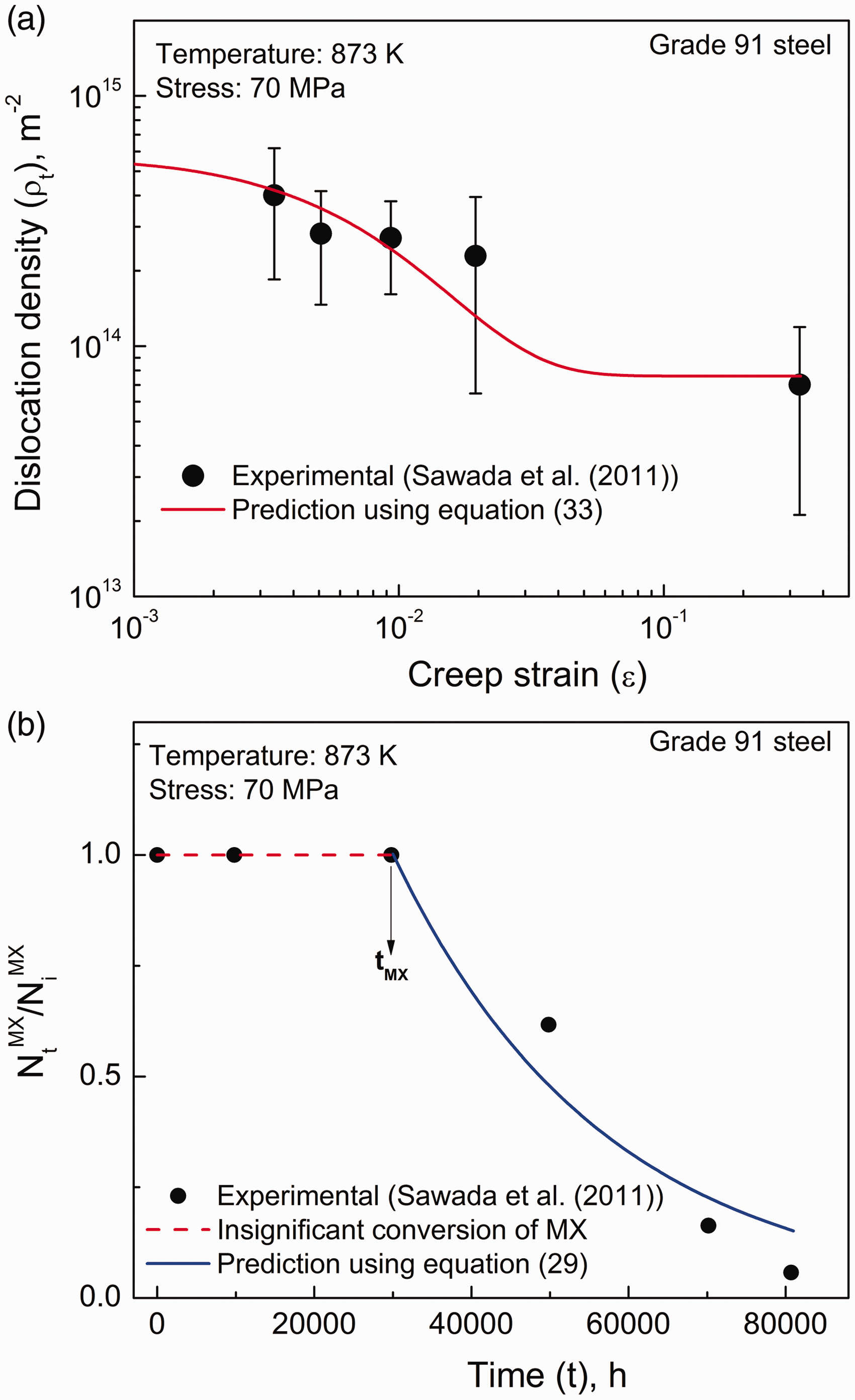


For optimisation, the initial guess values of

Values of optimised material constants obtained for Grade 91 steel as well as P9 steel (Christopher and Choudhary, 2018) in the framework of Dyson–McLean approach.
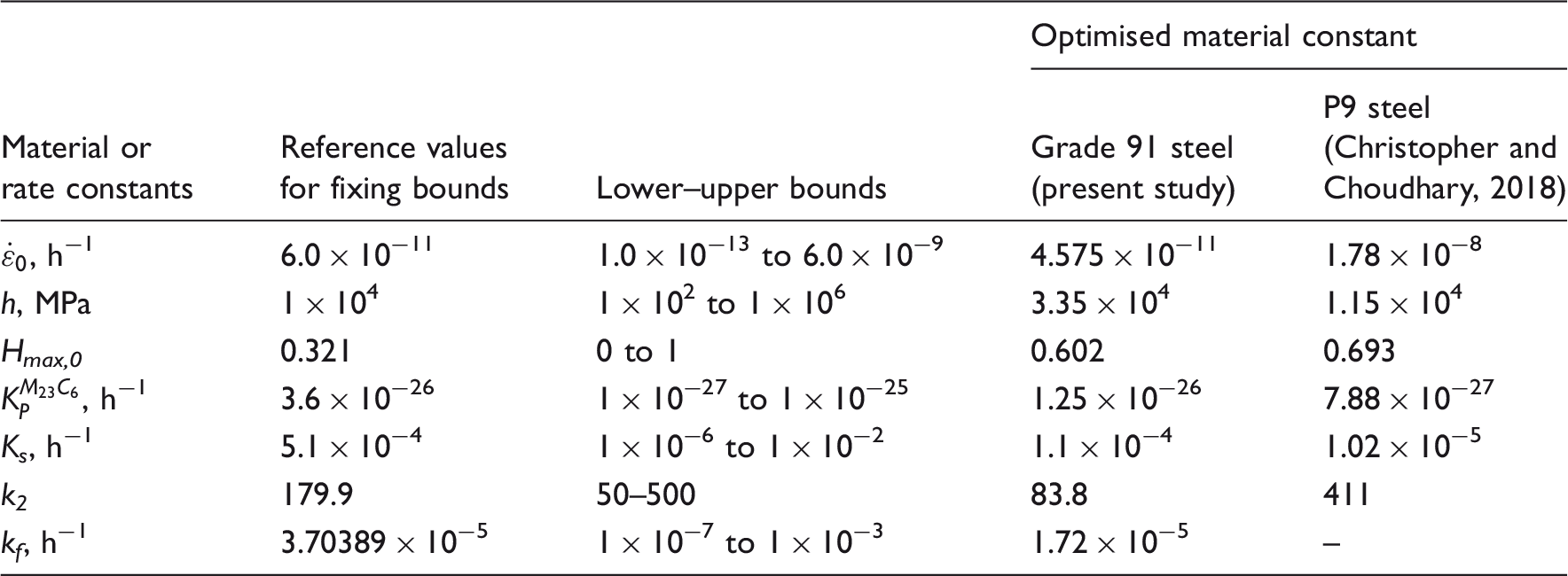
The comments related to the comparison between optimised data set obtained for Grade 91 steel in the present study and for P9 steel in quenched and tempered condition (Christopher and Choudhary, 2018) are noteworthy. For Grade 91 steel, two orders of magnitude lower in characteristic strain rate (
Applicability of the developed model
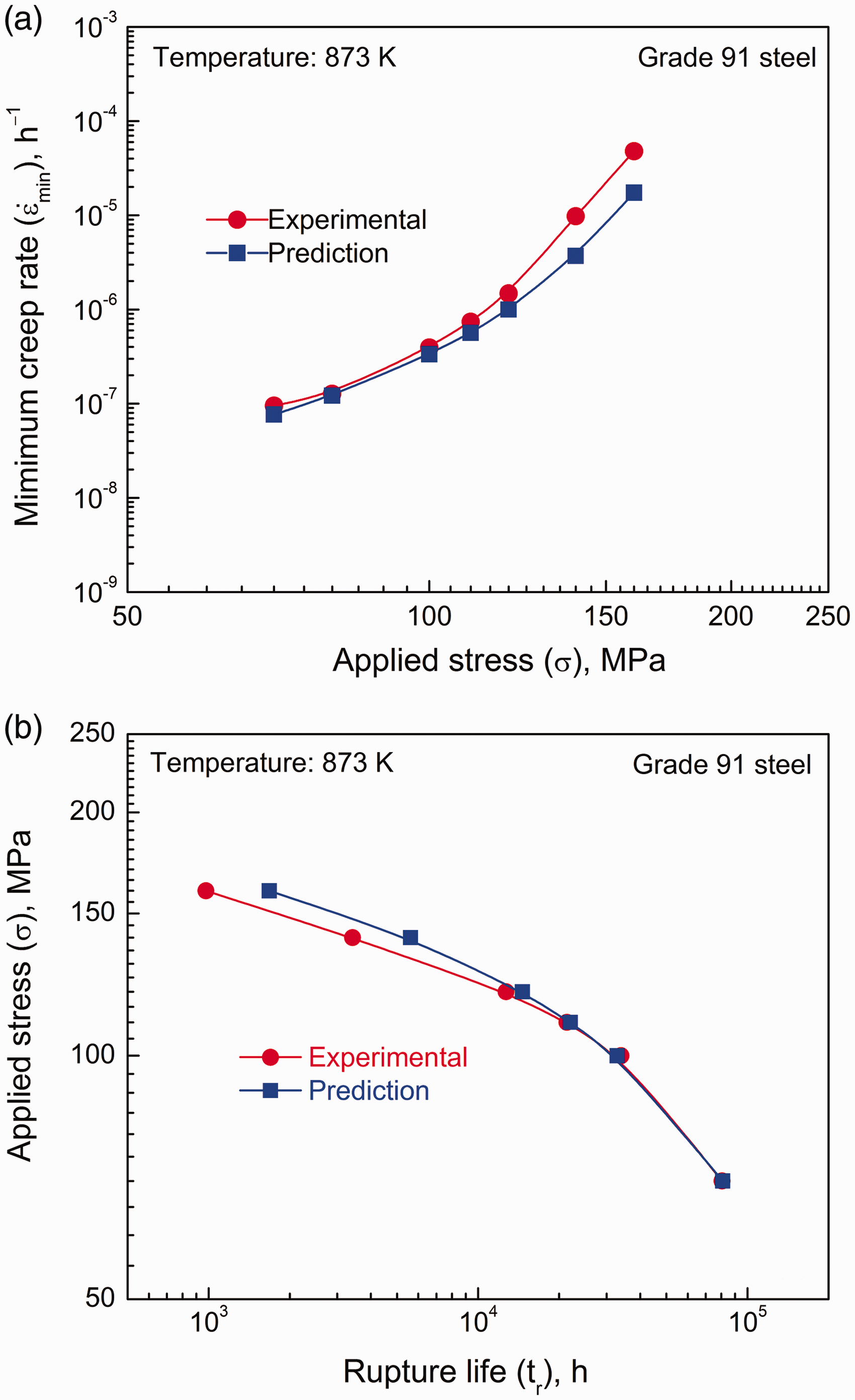
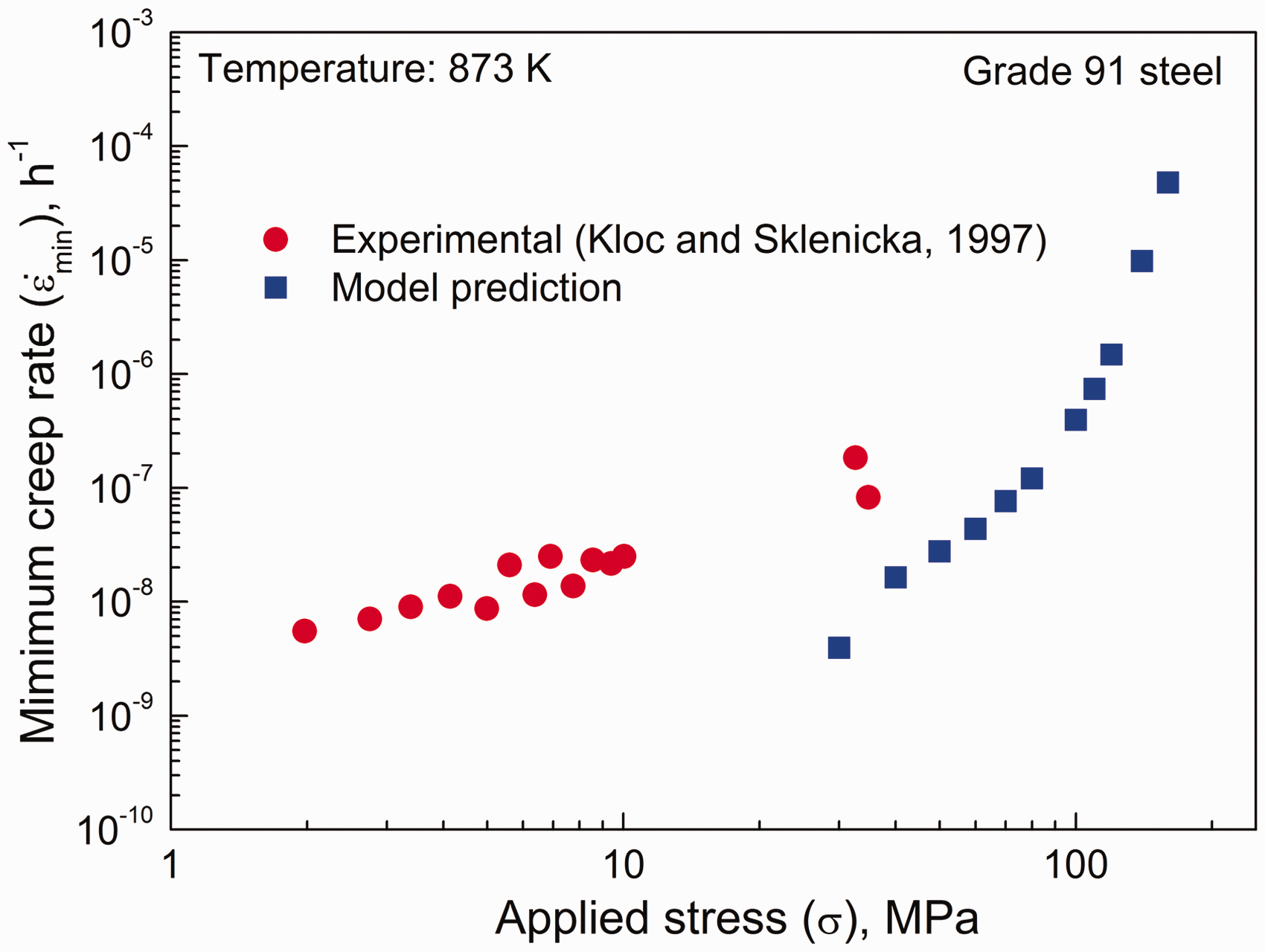
The creep strain–time curves are computed using the developed model for the two different initial stress levels of 70 and 100 MPa as shown in Figure 3(a). The central difference formula has been used for obtaining creep rate vs. time curves from the calculated creep strain–time data. The predicted and experimental creep strain rate–time curves are shown in Figure 3(b) for 70 and 100 MPa. In the present analysis, based on the optimised material constants obtained for 70 and 100 MPa, the prediction of creep data has been performed for inside the identification range at 80 MPa and outside the range for different stress levels of 110–160 MPa. It can be seen that predicted creep curves follow closely experimental data in transient, secondary and tertiary creep stages for the low stress levels in the range 70–120 MPa (Figure 3(a) and (b)). Considerable difference between predicted and experimental creep data at high stress levels of 140 and 160 MPa has been noticed. Similarly, better agreement between experimental and predicted minimum creep rates and rupture lifetimes has been noticed for the stresses of 70–120 MPa than at high stress conditions as shown in Figure 4. It is expected for 9% Cr steels that the change in creep mechanisms from general climb at low stress regime to local climb at high stress regime could be the reason for the observed difference between experimental and prediction data at high stresses above 120 MPa (Masuyama, 2007; Zhao et al., 2018). However, the obtained creep lifetimes at high stresses fall within the scatter by considering factor of 2 in creep life extrapolations (Srinivasan et al., 2012). The present formulation does not deal with the influence of individual internal interfaces such as prior austenitic grain, packet, block, sub-block and lath boundaries (Dronhofer et al., 2003) on the creep deformation and damage behaviour of tempered martensitic steels. Since the evolution of these internal interfaces could differ with respect to applied stress, the concept of kinematic back stress must be treated in terms of kinetics of individual internal interfaces for different applied stress levels. In addition, the strain rate dependence of rate constant (k2) associated with the evolution of dislocation density (Estrin and Mecking, 1984) must be incorporated into Dyson–McLean approach to improve the predictability across different stress levels. One of the major limitations of Dyson and McLean model is inapplicability at extremely low applied stresses where diffusional creep dominates. Since the origin of Dyson and McLean model is based on coupled glide/climb with dislocation-hard phase interaction mechanisms, it cannot predict the minimum creep rate vs. applied stress data obtained for diffusional creep regime (Kloc and Sklenička, 1997) as shown in Figure 5.
Comparison between predicted and experimental (a) creep strain–time and (b) creep rate–time data for different stress levels at 873 K. Experimental data for 70, 80 and 100–160 MPa are extracted from Sawada et al. (2011), Kimura et al. (2012) and Kimura et al. (2009), respectively. Comparison of predicted and experimental data for (a) minimum creep rate vs. applied stress and (b) applied stress vs. rupture life at 873 K for grade 91 steel. Experimental data for 70, 80 and 100–160 MPa are extracted from Sawada et al. (2011), Kimura et al. (2012) and Kimura et al. (2009), respectively. The variations in predicted minimum creep rate with the applied stress at 873 K for Grade 91 steel. Experimental data obtained for very low stress levels depicting diffusion creep regime (Kloc and Sklenička, 1997) are superimposed.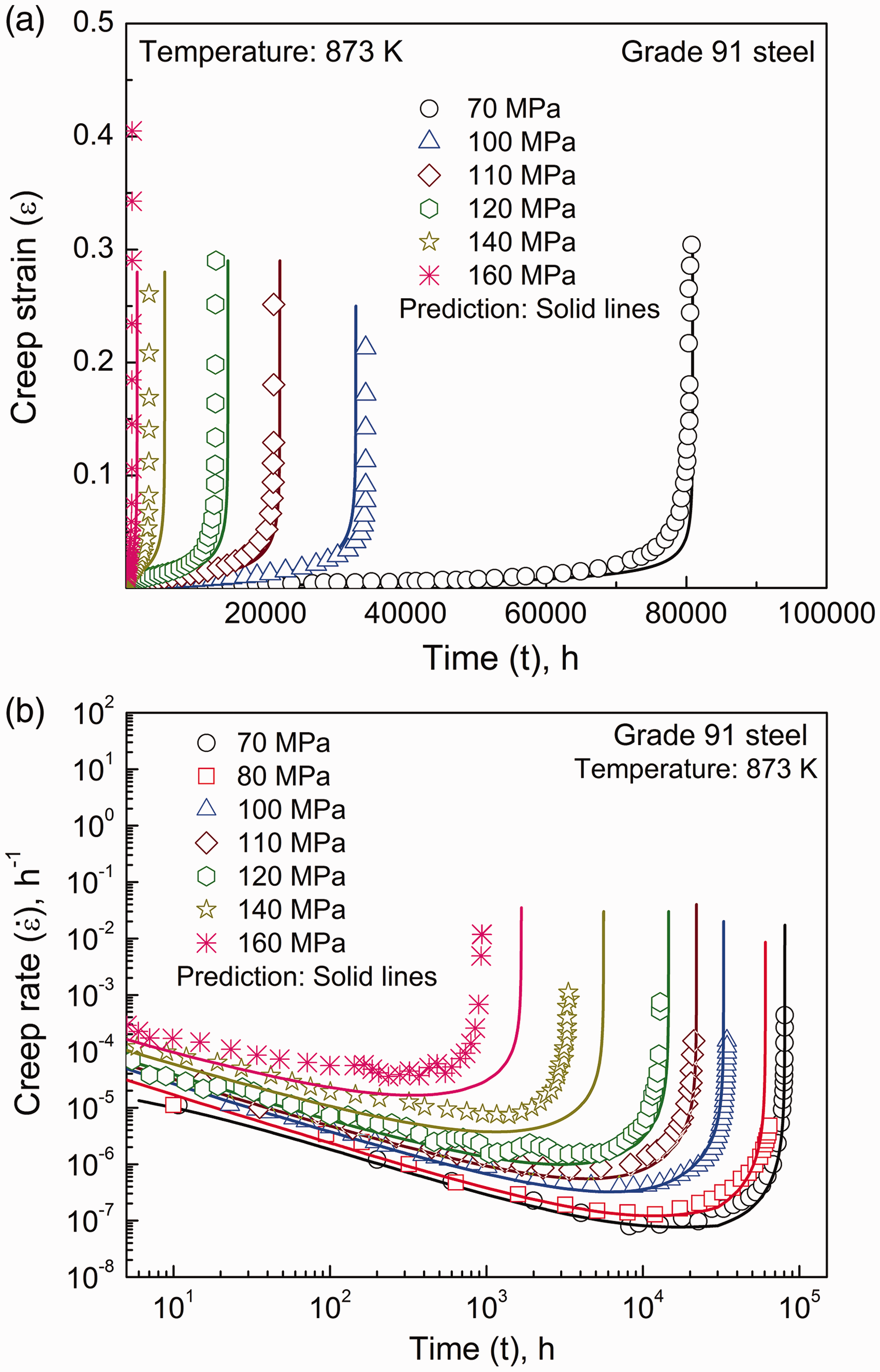
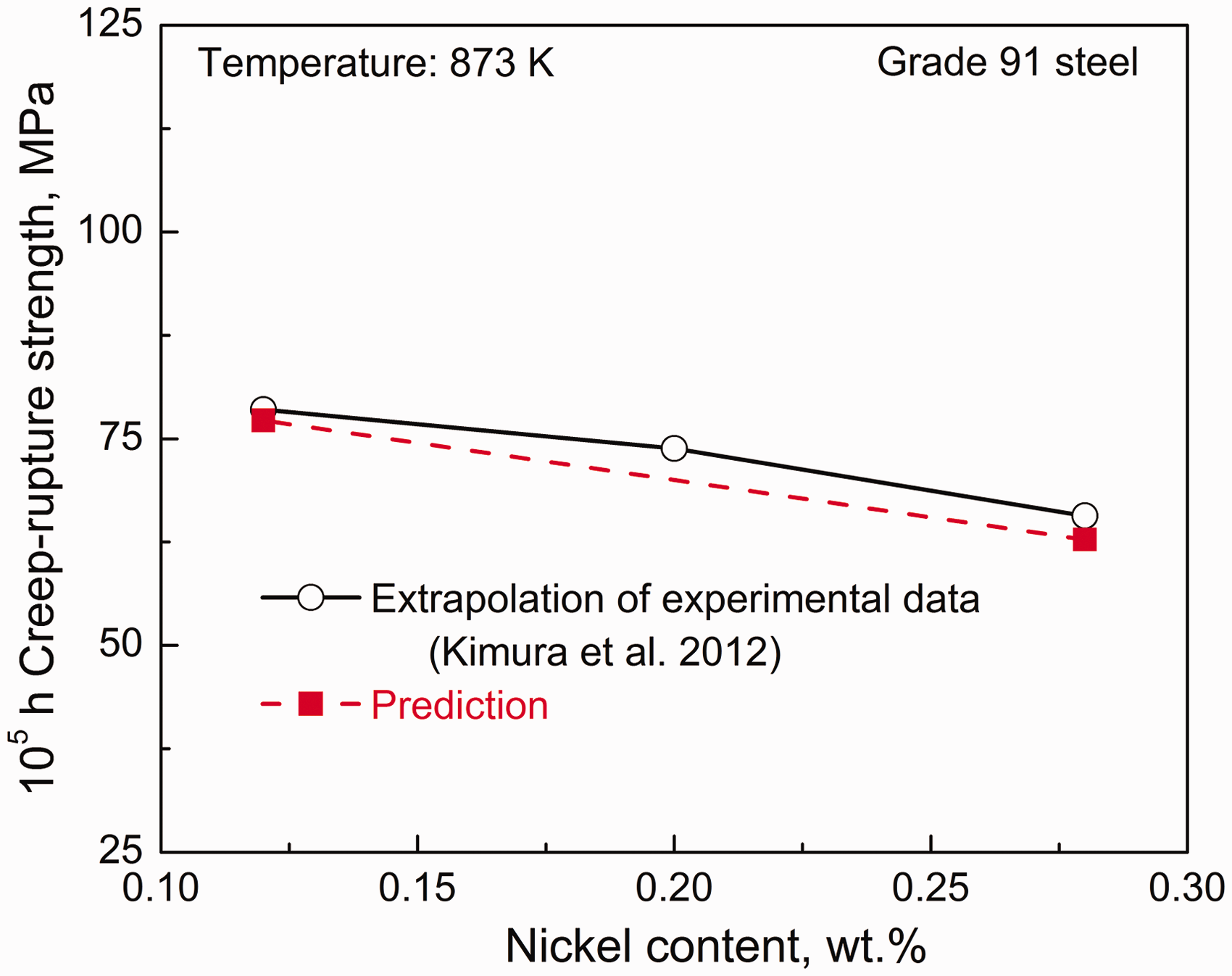
The numerical simulations have also been performed for conditions with constant initial number density of MX. These simulations indicate that MX precipitates do not undergo any conversion to Z-phase. The simulated creep rate–time data at 80 MPa for two different conditions with constant initial number density of MX and varying number density of MX have been shown in Figure 6 as full and broken lines, respectively. The decrease in number density of MX precipitates and formation and growth of Z-phase significantly affect tertiary creep behaviour of the steel. It has been reported that the increasing nickel content in the three heats, i.e. MGA (0.12% Ni), MGB (0.20% Ni) and MGC (0.28% Ni) greatly influences the long-term creep behaviour in terms of decrease in the creep-rupture strength of Grade 91 steel (Kimura et al., 2012). Since heat MGA (Kimura et al., 2012) containing 0.12% Ni with large number of MX precipitates and insignificant Z-phase was observed after creep exposure at 80 MPa, the creep rate vs. time for MGA heat has been used to represent the condition of constant number density of MX or the absence of conversion of MX to Z-phase in Figure 6. It can be seen that the simulated creep rate–time data (full line) for constant initial number density of MX closely follow the experimental data for MGA heat. In case of MGC heat with high Nickel exhibiting significant decrease in the number density of MX at longer durations, a decrease in time to onset of rapid increase in creep rate and reduced rupture life can be seen in Figure 6. Creep-rupture strength at 105 h at 873 K has been predicted with and without MX number density change using modified approach. Figure 7 shows a good agreement between the 105 h strength values predicted using modified approach and those obtained by extrapolation of experimental data for MGA, MGB and MGC heats with different Ni content in Grade 91 steel (Kimura et al., 2012). The above findings clearly indicate that the developed model can be successfully used for prediction of long-term creep lifetimes. The present investigation also suggests that the computer simulation of creep curves is possible for Grade 91 steel by coupling precipitation kinetics obtained from thermodynamic-kinetic data (Prasad et al., 2012) and Dyson–McLean approach.
Comparison between predicted and experimental creep rate–time data for 80 MPa at 873 K for MGA and MGC heats of Grade 91 steel containing 0.12 and 0.28% Ni (Kimura et al., 2012), respectively. Dash and dash-dotted lines represent predicted creep curves with constant number density of MX precipitate and significant decrease in the number density of MX precipitate, respectively. Comparison between predicted and extrapolated creep-rupture strength values for 105 h for the three heats MGA, MGB and MGC containing 0.12, 0.20 and 0.28% Ni (Kimura et al., 2012), respectively.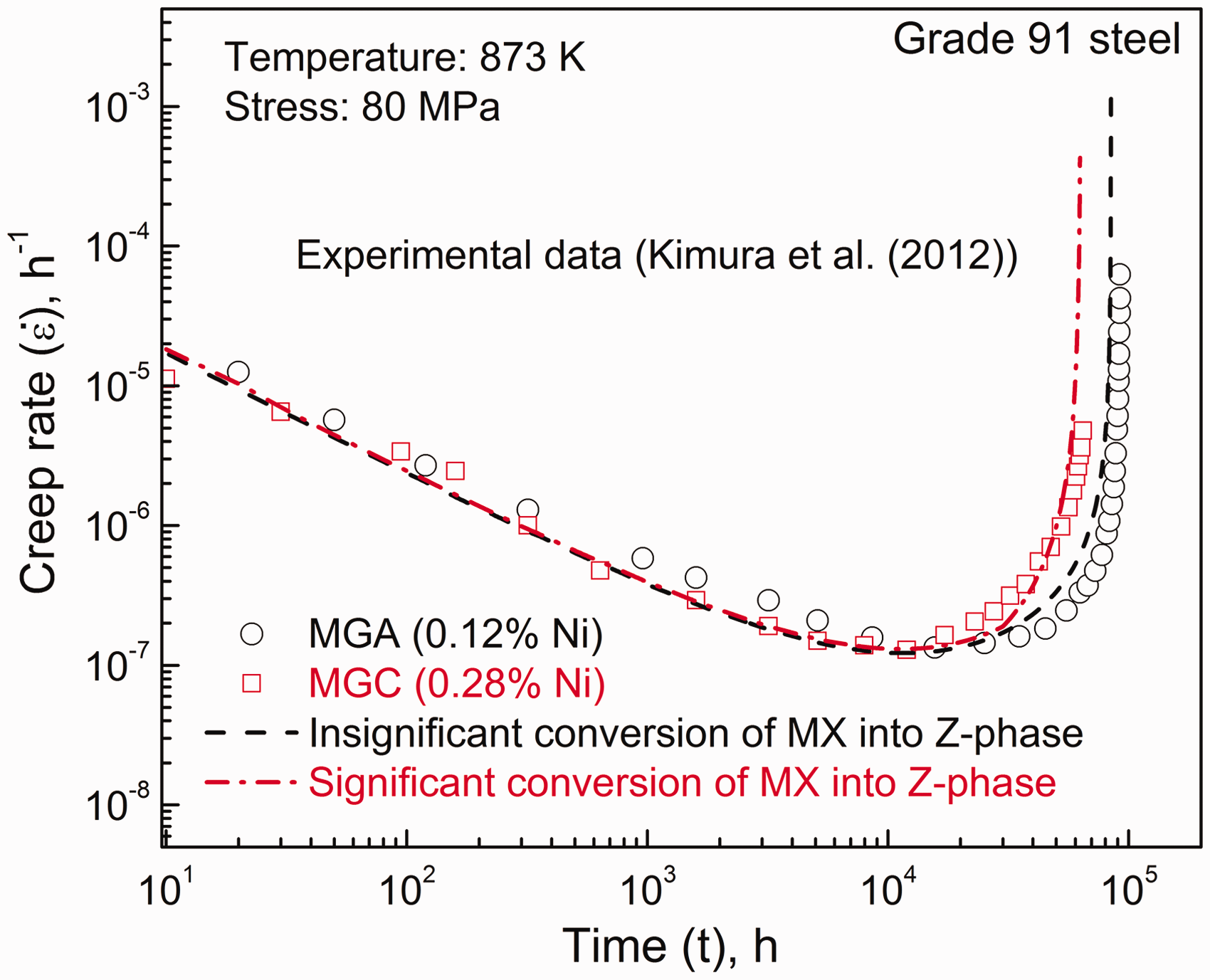
Conclusions
The long-term creep behaviour of Grade 91 steel has been successfully predicted following necessary modifications in the kinetic creep law in the framework of microstructure-based creep damage mechanics approach. The exponential rate relationship has been developed for accounting the evolution of number density of MX with time and it is successfully coupled with the kinetic creep law. The decrease in number density of MX precipitates and formation and growth of Z-phase greatly influence the tertiary creep behaviour of the steel. Good agreement was observed between the predicted and experimental creep data in long-term creep regime using the modified version of Dyson–McLean approach.
Footnotes
Declaration of conflicting interests
The author(s) declared no potential conflicts of interest with respect to the research, authorship, and/or publication of this article.
Funding
The author(s) received no financial support for the research, authorship, and/or publication of this article.