







Abstract
We analyze in this contribution the phase velocities of Rayleigh waves in periodic beam-lattices materials. The effective mechanical properties for the virgin and damaged structures are evaluated. The damaged lattice is modeled by removing beams within full networks made of repetitive unit cells. An evaluation of the phase velocities for the longitudinal and transverse versus the amount of damage is done for different relative densities evaluated versus the percentage of damaged beams for the square and triangular network. The effective mechanical properties of the overall network are evaluated as a function of the increasing damage based on a numerical procedure. Computations show that the square lattice has higher phase velocities in comparison with the triangular lattice. This work sets the basis of a methodology for evaluating the state of damage in network materials based on the changes in the wave propagation velocities.
Keywords
Introduction
Recent research activity has been devoted to the design and computation of the acoustic properties of artificial metamaterials having a periodic microstructure, especially periodic lattices. The dynamic response and wave propagation properties of periodic lattices and structures has motivated numerous studies especially in aeronautics, in the manufacturing of coatings, with the objective to reduce or absorb vibrations, shock and sound propagation in structural components and damage detection (Langley et al. 1997; Mead, 1996).
Architectured materials, and especially repetitive network materials consisting of structural elements like beams, constitute a wide class of structures having the capacity to filter waves in certain directions and frequency range. The computation of the dispersion relations and phase velocities for architectured periodic lattices having the attributes of metamaterials is a hot research topic raising the interest of researchers in the field of acoustics and wave propagation phenomena (Bacigalupo and Gambarotta, 2014; Brillouin, 1946; Chen and Fish, 2001; Gonella and Ruzzene, 2008a, 2008b; Phani et al., 2006; Reda et al., 2016a, 2016b). The mechanical response of such networks has fostered many research activities, but the evaluation of their dynamical and acoustic properties, especially in the high frequency domain, remains a scientific challenge (Guenneau et al., 2007; Goffaux et al., 2002; Liu et al., 2000; Pennec et al., 2008; Torrent and Sanchez-Dehesa, 2008; Wang et al., 2004; Wu et al., 2004). Most of the research works focus on the design of materials and structures having a periodic microstructure in order to get complete sound propagation in a certain frequency range, called the spectral band gap (Bacigalupo and Bellis, 2015; Merheb et al., 2009).
Many applications of the elastic wave propagation deal with bulk waves such as longitudinal and shear waves (Vinch and Ogden, 2004), but so far few works have dealt with the propagation of surface waves in anisotropic media (Wang and McDowell, 2003; Wu et al., 2004).
Surface waves propagates along the interface between two different media (Imberger, 2012). A common example is gravity waves along the surface of liquids, such as ocean waves (Melville, 2001). Elastic surface waves, such as Rayleigh or Love waves, can propagate along free surface or along the boundary between two dissimilar solid media. The canonical boundary-value problem of surface-wave propagation involves the planar interface of two half-spaces occupied by dissimilar materials which can be isotropic, anisotropic, or bi anisotropic. Either or both materials can be periodically non-homogeneous in the direction normal to the interface.
Rayleigh waves are formed when the particle motion is a combination of both longitudinal and transverse vibration giving rise to an elliptical retrograde motion in the vertical plane along the direction of travel, whereas Love waves are primarily surface waves having a horizontal motion that is shear or transverse to the direction of propagation (Haldar, 2018). Surface waves can be employed in non-destructive testing for detecting surface defects, like damage.
The Rayleigh waves have dispersive properties according to which the phase velocity is a frequency-dependent. Their advantages are related to the fact that a high percentage of the energy generated by a surface source is radiated in the form of Rayleigh waves, and the geometrical attenuation of this wave type is low because of the cylindrical shape of the wave front, rather than the higher geometrical attenuation caused by the spherical wave fronts of body waves (Al Wardany et al., 2004; Stokoe and Santamarina, 2007). Rayleigh waves with high frequencies propagate in top layers of material whereas lower frequency waves penetrate more deeply into the material. Affected by the mechanical properties of each layer, waves with different wavelength travel at different phase velocities. The variations of the phase velocity as a function of frequency or wavelength are presented in the dispersion curve to determine the variation of the stiffness profile with depth (Al Wardany et al., 2004).
The investigations of the fracture behavior and damage tolerance of lattice materials in presence of defects is a relatively recent topic, which emerged about 20 years ago in the literature, as underlined in the review paper (Quintana-Alonso and Fleck, 2010). Since then, the influence of different types of defects has been analyzed by means of numerical, analytical and experimental methods. Defects can be introduced ad hoc by randomly fracturing cell-walls(Albuquerque et al., 1999; Silva and Gibson, 1997) or removing cells within the network (Guo and Gibson, 1999). While the static aspects of the fracture behavior have been extensively studied in the literature, there have been very little analyses of the impact of damage or structural imperfections in lattice materials on their wave propagation features. It is the aim of the present contribution to analyze the effect of randomly fractured unit cell walls on the wave propagation characteristics of repetitive network materials. More specifically, the purpose is to attempt to correlate the velocity of surface waves to the amount of damage within lattice materials.
Novel aspects presented in this paper are the following:
An analytical method for characterizing surface Rayleigh wave propagation is developed for 2D damaged network materials; A methodology for the detection of the degree of damage within the structure is set up based on the computation of the phase velocity for surface Rayleigh waves propagation; The impact of network damage on surface wave propagation is assessed; The influence of the network geometrical parameters on surface wave propagation is analyzed.
The outline of this contribution is as follows: The next section provides the main steps for the computation of the Rayleigh waves propagating in orthotropic compressible elastic materials. The homogenization method used to identify the effective continuum behavior and to determine the effective properties of periodic 2 D structures is described in the Determination of the effective rigidity coefficients for periodic virgin networks by homogenized method section. Applications of this model to different 2 D structures are then successively presented (the Applications section). In the Damage detection by Rayleigh surface waves section, the effects of fractured cell walls on the in-plane effective elastic rigidity and yield strength of the studied lattices are investigated. A summary of the main results and a few perspectives for future work are summarized in section 4.
Regarding notations, vectors and tensors are denoted by boldface symbols.
Computation of Rayleigh wave propagation in orthotropic elastic materials
The analysis of surface waves in isotropic material has been lot studied in the literature (Wu et al., 2004). The case of anisotropic materials is more involved. Formulas for the phase velocity of Rayleigh waves in orthotropic elastic materials are obtained in explicit form by starting from the equilibrium equation, the boundary conditions and using the theory of cubic equations (Vinch and Ogden, 2004).
The subscripts 1, 2, 3 stand for the directions x, z and y respectively.
The plane motion in the

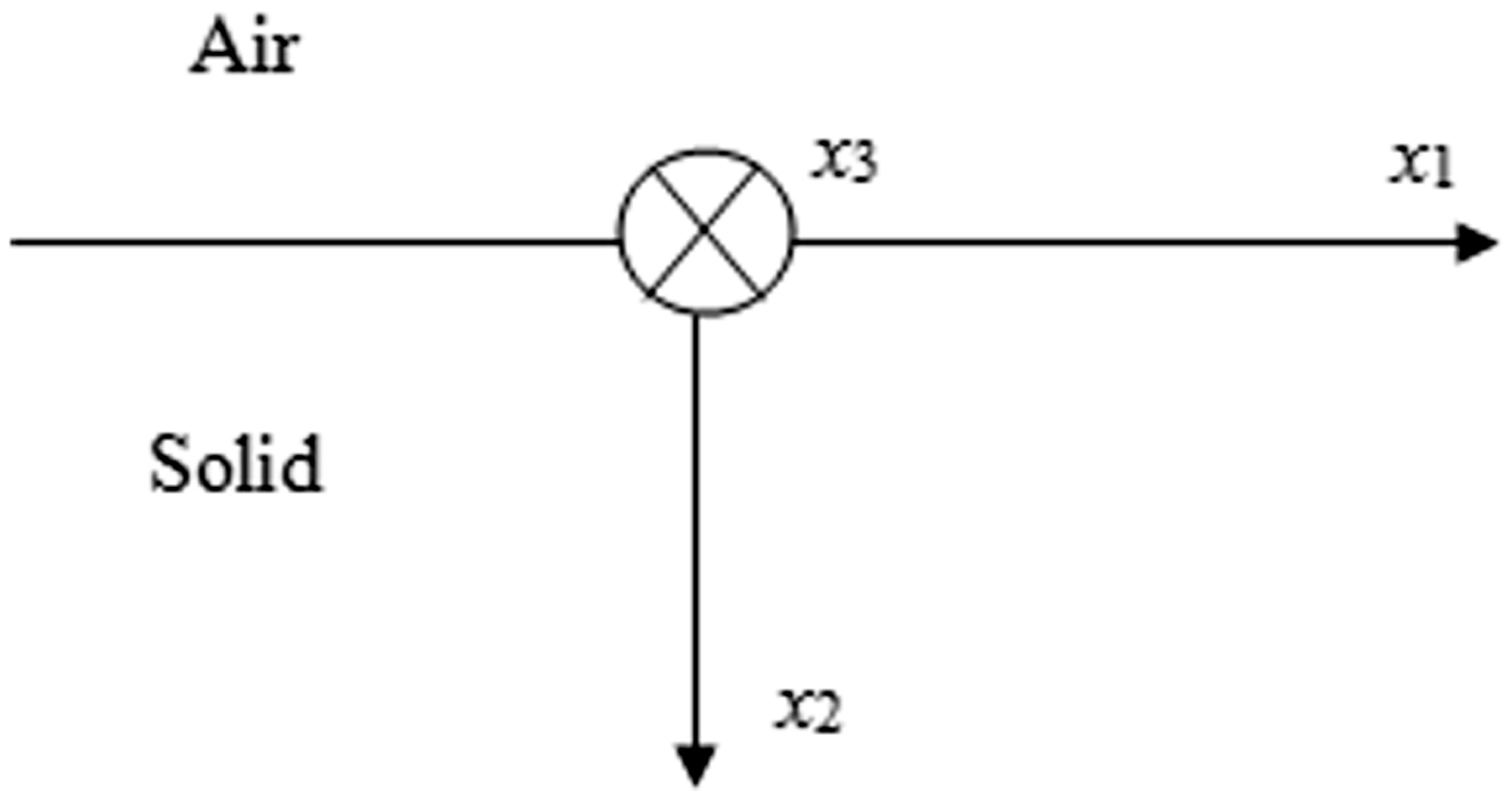
Semi-infinite solid limited by a free surface
Note that due to plane strain conditions and the existence of a symmetry plane, the usual nine orthotropic constants reduce to four. The equations of motion, expressed in terms of the displacement components

We now consider harmonic waves propagating in the x1 direction, so we consider the following Ansatz for the displacement:


Inserting equation (3) in the equilibrium equation (2) and taking into account the boundary conditions, we obtain a system of equation in terms of the amplitudes Ai, i = 1,3, as follows:

Inserting equation (3) in the boundary equation leads to the following conditions:

It is then easy to verify that the solution of (5) satisfying (6) is:


Having positive real parts, the coefficients αj (j = 1,2) in (7) are determined from relationship

The constants Bi, i = 1,2, are determined from equation (5). From equation (8), we have:

The product

Inequality (11) has two negative real roots; this contradicts the requirement that
Substitution of (7) in (5) leads to a homogeneous linear system of algebraic equations for the coefficients B1, B2. For non-trivial solutions, the determinant of this system must vanish; this condition yields the secular equation (4). After removing the factor (s1−s2) and using the equalities (10) and (11), the secular equation of the Rayleigh waves propagating in orthotropic compressible elastic materials is obtained:

The forthcoming subsection will expose in a synthetic manner the principal steps of the discrete homogenization technique, in order to determine the effective rigidity coefficients of network materials made of beams in their initial undamaged state.
Determination of the effective rigidity coefficients for periodic virgin networks by homogenized method
In order to determine the effective moduli of two-dimensional network materials made of beams, a discrete homogenization model has been developed in Dos Reis and Ganghoffer (2010) for periodical structures endowed with central symmetry and a dedicated code has been built with the Maple software. The method enables to treat any repetitive lattice with an arbitrary architecture, relying on an input file describing the geometrical and mechanical properties of the beam lattice.
We refer the reader to Reda et al. (2016) and Rahali et al. (2015)8,33 for more details related to the different steps of the discrete homogenization method leading to the expression of the stress tensor of the Cauchy effective continuum.
Regarding notations, vectors and tensors are denoted using boldface symbols.
In the sequel, one can note that the 2 D lattices are described as quasi 2 D periodic beam networks, which are fully defined by the node positions and their connectivity: we denote NR and BR the set of nodes and beams within the reference unit (base) cell respectively. We shall note that due to the assumption of periodicity, the infinite network structure is built from the repetition of a reference cell by a 2 D translation. As a consequence, the topology of the network is completely described by the identification of the reference unit cell and its topology in terms of its nodes and beams, and the two periodicity vectors in the case of 2 D periodic structures.
Homogenization steps of virgin networks
The discrete homogenization method requires the development of all geometrical variables (length, thickness, width) and kinematic variables (displacements) as Taylor series expansions versus a small parameter ε, defined as the ratio of unit cell size to a macroscopic length characteristic of the entire lattice; these expansions are thereafter inserted into the equilibrium equation of forces, expressed in weak form. After resolution of the unknown displacements in the localization problem posed over the identified reference unit cell, the stress tensor is constructed versus their conjugated kinematic variables, the deformation tensor, thereby defining the homogenized constitutive law; this allows identifying the effective moduli for the equivalent continuum.
For each beam b, write the expressions of the normal N and transverse T forces exerted on the beam extremities


with 2. Write the asymptotic expansion of geometrical and kinematic variables of each beam, in curvilinear coordinates denoted λ in the sequel:
- The beam length and width respectively
- The relative nodal displacement (see Rahali et al., 2015, 2017; Reda et al., 20168,33,34)
3. Passage of curvilinear to Cartesian coordinates (see Rahali et al., 2015). 4. Calculate the unknown’s displacement from the self-equilibrium equations (equilibrium at each node)


BR refer to the set of beams within the reference unit cell, 5. Expression of the stress vector 6. Calculation of the stress tensor

The scalar g stands for the determinant of the Jacobian defining the Curvilinear 7. Calculation of effective properties.
Applications
In this study, two lattices are selected for their desired interesting mechanical, acoustic and dynamical properties: the triangular lattice (denoted T) and the square lattice (denoted S), pictured in Figure 2. The mechanical parameters of the two studied lattices are given in Table 1.
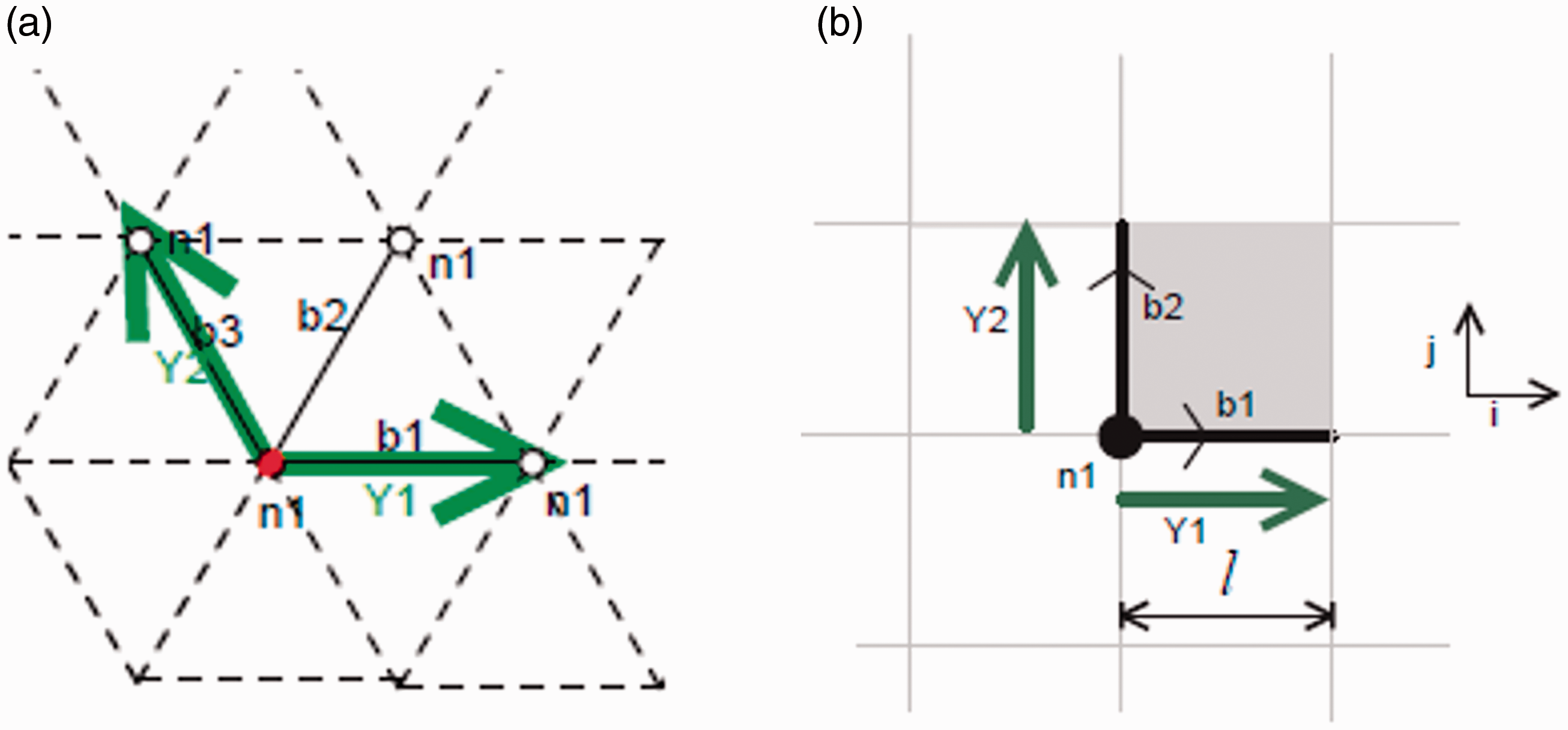
Representative unit cell of investigated lattices: (a) Triangular lattice, (b) Square lattice.
Mechanical properties of the two studied lattices.

Using the discrete homogenization method, one can compute the rigidity coefficients of the representative unit cell in the undamaged state as a basis for analyzing the propagation of Rayleigh surface waves (see Table 2). We note that the structure of the stiffness matrix for the triangular lattice is that of a transversely isotropic material.
Computed coefficients of the considered lattices.
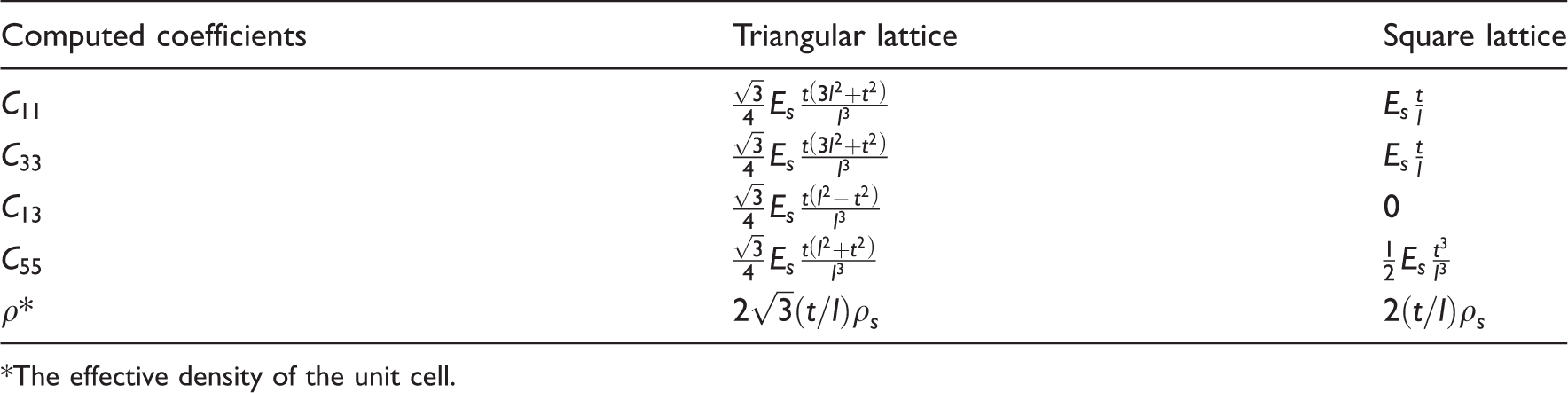
*The effective density of the unit cell.
The parameter Es stand for the Young’s modulus of the beam,
The computed coefficients given in Table 2, for virgin triangular lattice, have been compared with those from Liu and Liang (Liu and Liang, 2012). A satisfactory agreement is obtained between predictions of the two methods under conditions of slender beams as can be seen in Table 2, due to the approximations

In Figure 3, the variation of the dimensionless Rayleigh phase velocities, the rigidity coefficients and the effective density are shown for the triangular and square lattices, for different slenderness ratio
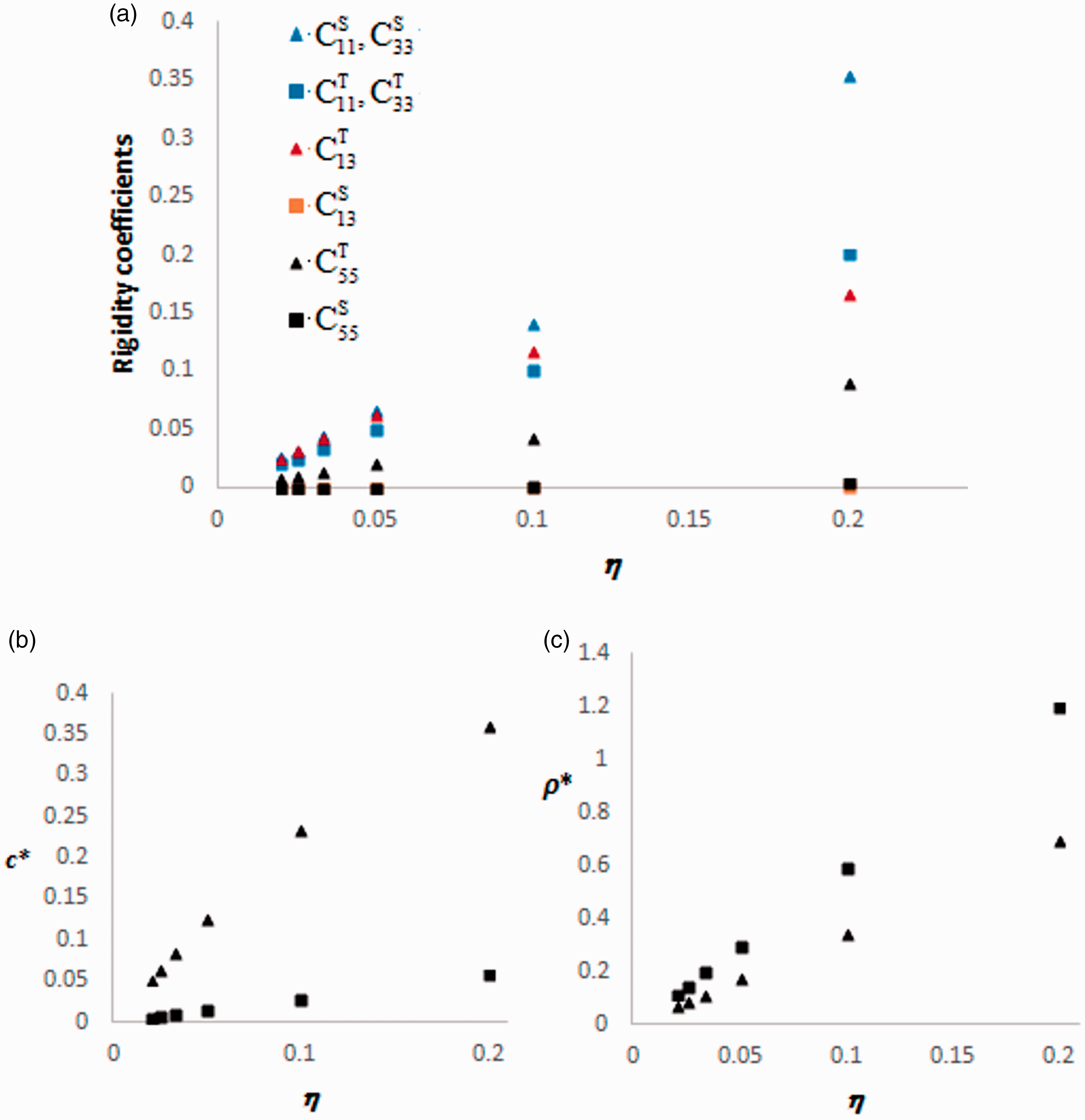
Dimensionless (a) Rigidity coefficients, (b) Surface Rayleigh phase velocities and (c) Effective density of the material versus the slenderness ratio of the investigated lattices. The acronyms S and T therein are abbreviations of the terms square and triangular. The square and triangular symbols on inserts (b) and (c) denote respectively the square and triangular networks.
Increasing the slenderness ratio leads to an increase in the effective mechanical properties of the undamaged structures, leading to an increase in the effective density (Figure 3(c)) and phase velocity (Figure 3(b)).
Damage detection by Rayleigh surface waves
In this section, we study the effects of the fractured cell walls (damage) on the in-plane effective elastic properties of the square and triangular unit cells; the effective damaged properties are obtained during ongoing damage by means of a finite element analysis, relying on the application of a set of elementary kinematic loadings over the lattices (see Appendix 1). The in-plane properties of the defect lattices can differ significantly from those of the virgin structure, due to the emergence of local heterogeneous deformation mode, depending on both the cell type and stress state. Firstly, the effect of the size of a statistical volume element of triangular and square cells with randomly removed cells is explored using different numbers of cells with 5% of their walls removed. Beams are successively removed within the entire network to reach the desired amounts of defects. Note that the thickness and length of the cell walls of the square are maintained at their original values. The minimum size of a representative volume of the unit cell element - it has to be small enough in comparison with the wavelength of propagating waves - is determined for each considered in-plane property. The effective properties of the investigated lattices are calculated as a function of the increasing density of the randomly removed cell walls, representing the percentage of global network damage.
To be more specific two initially periodic networks (depicted in Figure 2) are considered with a random distribution of introduced damage by randomly removing beams within the network. We will analyze in the sequel the effect of the degree of introduced damage on the effective stiffness of the lattice. The degree of damage is expressed in terms of the relative density, evaluated from an initial defect-free value defined as the ratio of the initial effective density to the density of the bulk material ρ*/ρѕ = 15%, due to the random removal of cell walls. The lattice consists of 32x32 cells, chosen large enough to avoid surface effects, and the considered densities of the cell walls with missing beams are, respectively, 1%, 2%, 4%, 8%, 16% and 32%, as pictured in Figure 4 for the square unit cell. The effective density is defined as the ratio of the area occupied by beams over the total lattice area. The upper bound of damage has been computed a posteriori from the onset of stiffness percolation threshold for which some of the effective stiffness coefficients tends towards zero.
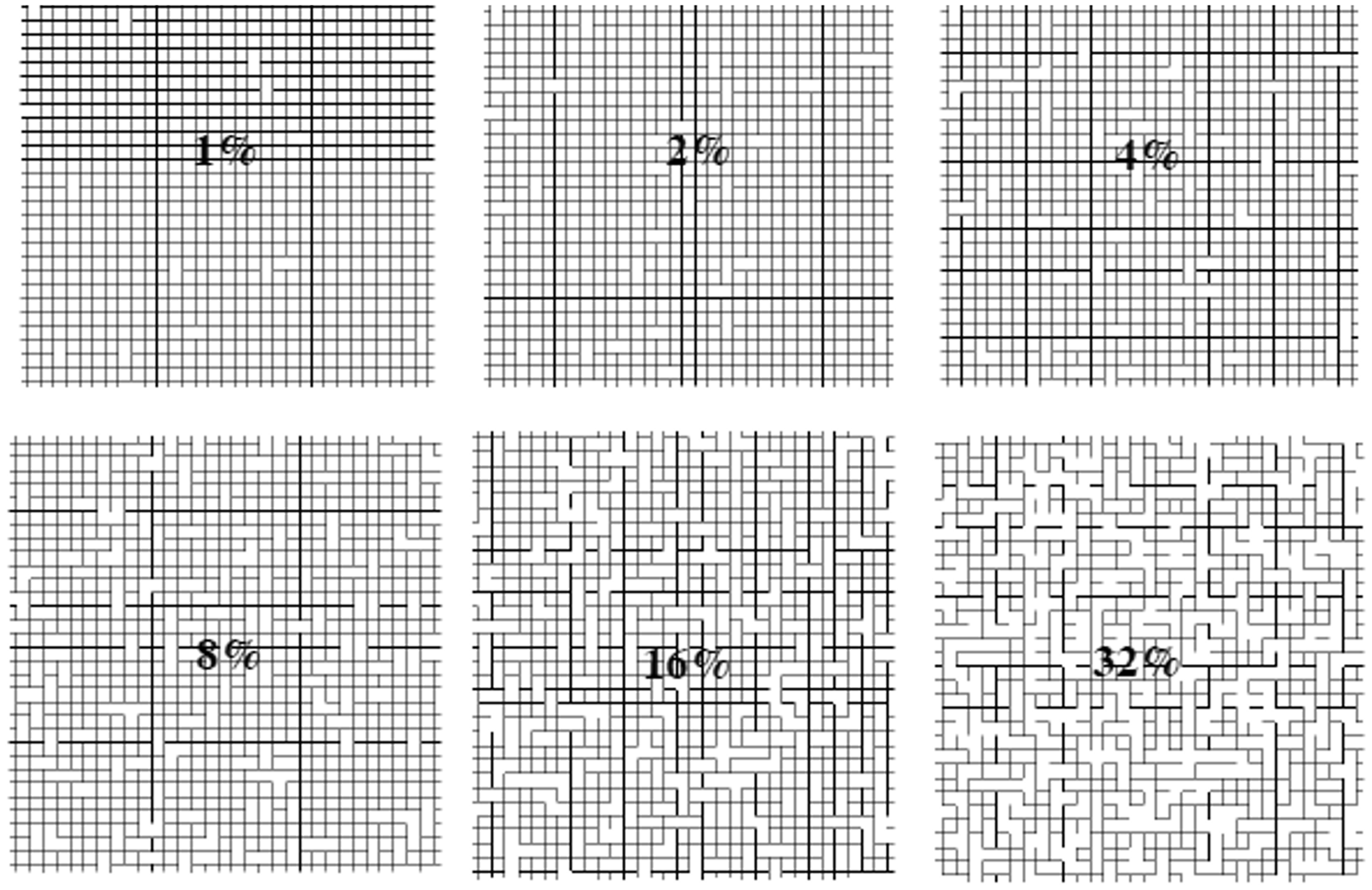
Randomly removed cell walls within square unit cells of lattice materials with increasing percentages of damage (Wang and McDowell, 2003).
Square periodic lattice
For the square lattice, the effective tensile modulus decreases when increasing the number of missing cell walls and it approaches zero when 32% of the cell walls are removed (Figure 5), which means that one has reached the percolation threshold for the corresponding rigidity. However, the effective shear modulus is still non-zero for this amount of damage, and it continues to decrease with the amount of damage together with the relative density.
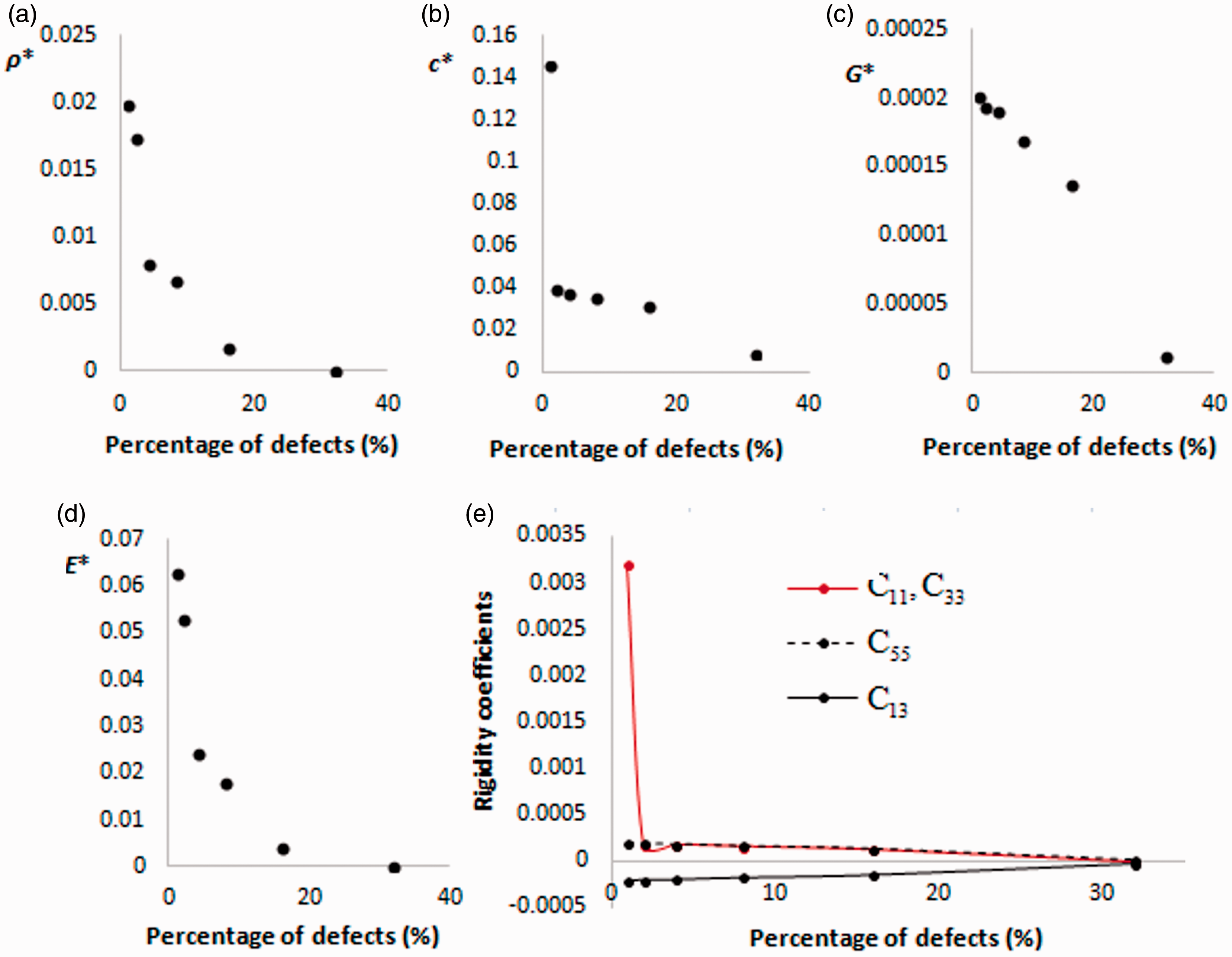
Dimensionless (a) Effective density of the material, (b) Surface Rayleigh phase velocities, (c) shear modulus, (d) Tensile modulus and (e) Effective rigidity coefficients of the square lattice versus the percentage of defects.
We could check numerically that the damaged lattice remains overall nearly orthotropic. As the fraction of missing cell walls increases, the damage starts propagating through the structure; the effective shear modulus tends to zero for degrees of damage corresponding to a range of defects of 30–40%.
Triangular periodic microstructure
Effects of randomly removed beams on the effective stiffness of periodic triangular unit cells networks are considered in this paragraph; the results presented here are based on the method for introducing damage exposed in Wang and McDowell (2003). The degree of damage is again expressed in terms of the reduction of the relative density with respect to an initial, defect-free value of 15% (the same initial effective density has been adopted for the two considered network materials), as for the square lattice in order to compare both lattice materials.
Defects within periodic FE models of the triangular lattice consisting of large arrays of cells are simulated by removing cell walls at random locations within the entire network. The representative volume element size is 32 × 64 cells, and the fraction of missing cell walls inserted randomly within the whole network are 1%, 2%, 4%, 8%, 16% and 32% respectively, as shown in Figure 6. We could check that the lattice remains overall orthotropic. One can observe on Figure 7 that the effective tensile rigidity of the triangular cell gradually decreases when reducing the relative density due to the missing cell walls. However, for a density of 32% there still exists some effective stiffness, unlike the square unit cell under a compressive loading. The effective initial rigidity under both compressive and shear loading decrease rapidly even when a few cell walls beams are removed; the reason for this behavior is that the adjacent cell walls to the missing cell walls fail in bending.
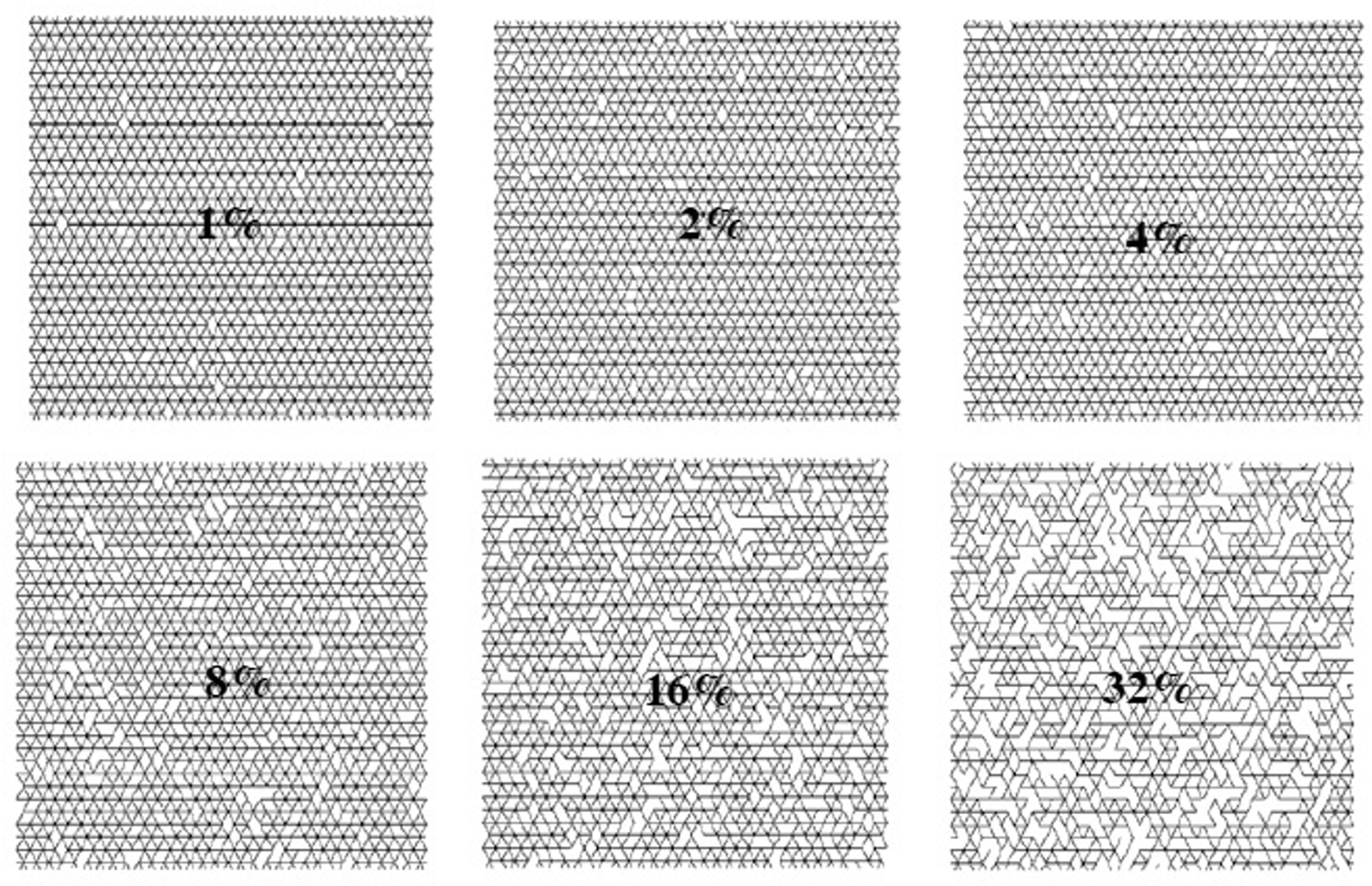
Randomly removed cell walls of the network of triangular unit cells with increasing percentages of damage.
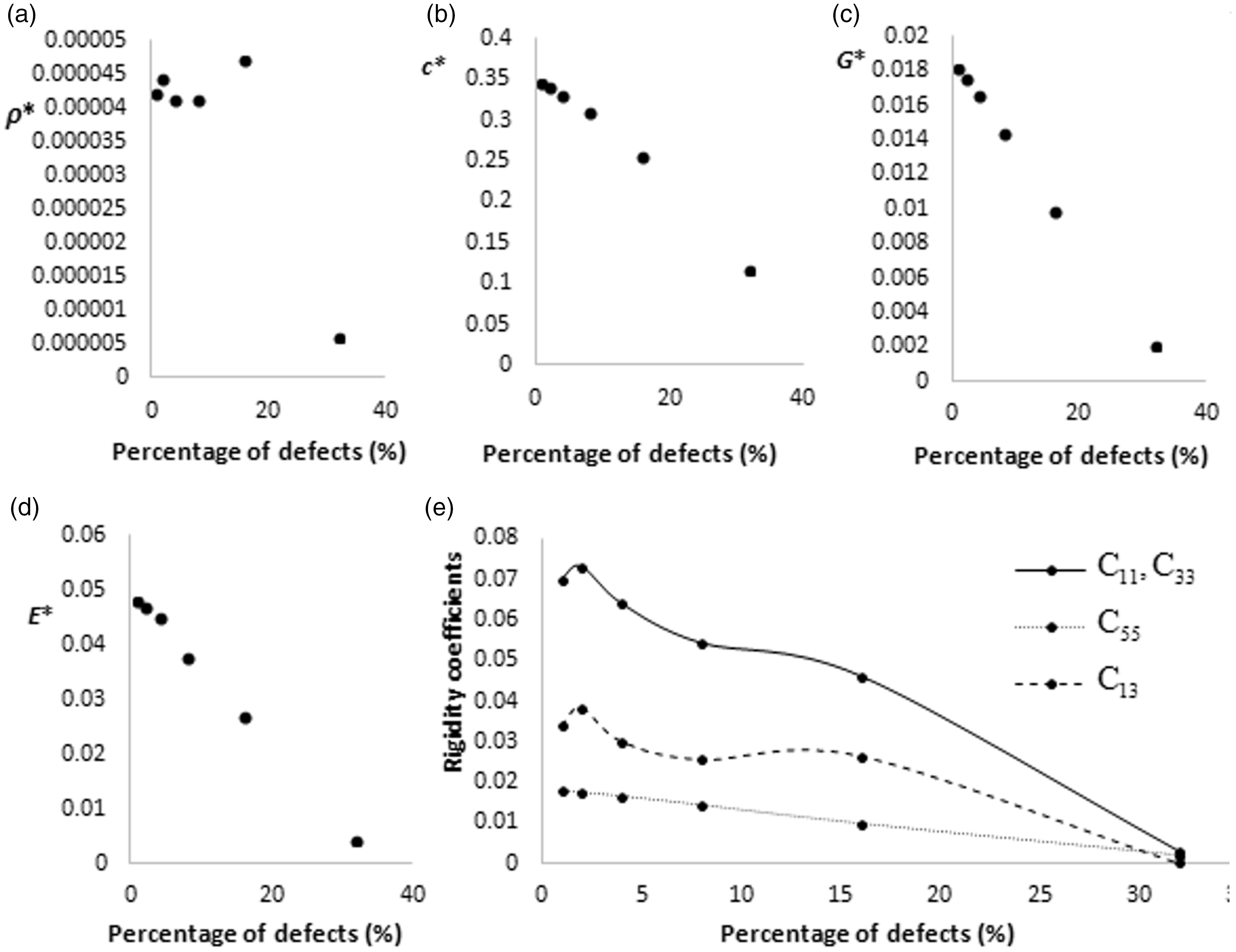
Dimensionless (a) Effective density of the material, (b) Surface Rayleigh phase velocities, (c) Shear modulus, (d) Young’s modulus and (e) Effective rigidity coefficients of the triangular lattice versus the percentage of defects.
Figures 5(b) and 7(b) show that the wave velocity for both square and triangular lattices decreases as the percentage of defect representing the overall amount of damage increases. In parallel, the effective Young modulus decreases as the percentage of defects (amount of damage) increases. This entails that as the phase velocity decreases within the structure, one can infer that the level of defect increases due to the decrease of the effective Young modulus. Therefore, the proposed work lays down the foundations for a methodology to quantify the amount of damage into structures prone to brittle or ductile failure depending on the nature of the material, since measurements of Rayleigh wave velocities enable the estimation of the degree of damage within such lattice materials.
Conclusion
We analyze in this contribution the phase velocities for Rayleigh waves in periodic planar lattices, which are modeled as beam-lattices. The effective mechanical properties for the virgin and damaged structures are computed by means of homogenization methods. The damaged lattice is modeled by removing beams randomly within the lattice. This results in a decrease of the in-plane mechanical properties with the percentage of damage and it leads to a decrease of the phase velocities of Rayleigh waves propagating within the network. We could check numerically that the state of anisotropy of the initial virgin network remains nearly unchanged when damage propagates, due to the random introduction of damage. The phase velocities of the damage and virgin structures have been evaluated numerically and compared for different relative densities corresponding to increasing percentages of the amount of global damage. Computations show that the square lattice has higher phase velocities in comparison with the triangular lattice. Rayleigh wave propagation can be used as a non-destructive test for the detection of surface damage. Measurements of the Rayleigh wave velocity may lead to an experimental methodology for estimating the degree of damage within such lattice materials. The propagation of damage within such lattice materials is prone to trigger strain localization (Dascalu, 2016), a topic that is worth investigating in future developments.
Supplemental Material
sj-pdf-1-ijd-10.1177_1056789520963207 - Supplemental material for Impact of damage on the propagation of Rayleigh waves in lattice materials
Supplemental material, sj-pdf-1-ijd-10.1177_1056789520963207 for Impact of damage on the propagation of Rayleigh waves in lattice materials by H Reda, Y Rahali, B Vieille, H Lakiss and JF Ganghoffer in International Journal of Damage Mechanics
Footnotes
Author note
Jean-François Ganghoffer is now affiliated to Metamaterials for Mechanical, Biomechanical and Multiphysical Applications Research Group, Ton Duc Thang University, Ho Chi Minh City, Vietnam and Faculty of Civil Engineering, Ton Duc Thang University, Ho Chi Minh City, Vietnam.
Declaration of conflicting interests
The author(s) declared no potential conflicts of interest with respect to the research, authorship, and/or publication of this article.
Funding
The author(s) received no financial support for the research, authorship, and/or publication of this article.

Appendix 1. Determination of the effective mechanical properties
In order to determine the components of the effective rigidity matrices for the damaged lattice materials, different boundary conditions are generated on the elementary cell, thereafter a numerical evaluation (by finite element) of the total energy of elastic deformation stored in the unit cell, denoted
Adopting the periodic boundary conditions imposed over a unit cell of domain Ω with boundary ∂Ω, the components of the stiffness tensor for the unit cell can be evaluated. We perform for this purpose the following four elementary tests for different states of damage.
Test 1: Uniaxial extension for C11: with a uniform strain
This yields
Test 2: Uniaxial extension for C33: with a uniform strain
This yields
Test 3: Biaxial extension for C13: with a uniform strain
This yields
Test 4: Shear deformation for C55: with a uniform strain
This yields
References
Supplementary Material
Please find the following supplemental material available below.
For Open Access articles published under a Creative Commons License, all supplemental material carries the same license as the article it is associated with.
For non-Open Access articles published, all supplemental material carries a non-exclusive license, and permission requests for re-use of supplemental material or any part of supplemental material shall be sent directly to the copyright owner as specified in the copyright notice associated with the article.
