







Abstract
The loading paths experienced by components during multi-pass forming processes often exhibit significant non-proportionality. However, traditional damage models are predominantly developed and validated under proportional loading conditions, which introduces limitations in their application, as they fail to characterise damage evolution accurately under non-proportional paths. Consequently, developing damage models capable of effectively accounting for non-proportional loading history is paramount. This paper systematically reviews recent advances in damage research under non-proportional loading paths. It encompasses the design of experimental methodologies for non-proportional loading, quantitative characterisation methods for damage, microscopic damage mechanisms and methods for damage modelling. Finally, building upon a summary of existing achievements, future research directions in this field are outlined.
Keywords
Introduction
Complex components often require multi-pass forming during manufacturing due to constraints in the original material's ductility and strength, which helps release residual stresses, mitigate work hardening and enhance formability (Li et al., 2024). During multi-pass forming processes, abrupt or non-proportional changes in the strain path frequently occur between passes (Wu et al., 2019). Damage evolution is a critical factor limiting the formability of components. Consequently, damage models are widely employed to predict and assess material behaviour and formability during metal forming processes (Qian et al., 2021).
Research on damage evolution remains inadequate for non-proportional loading paths with time-varying principal stress orientations/ratios (Wei et al., 2023). Non-proportional loading exhibits significant path dependence, meaning the loading history profoundly influences the damage evolution. Furthermore, path variations can induce competition and coupling among different damage mechanisms, resulting in a more complex relationship between microscopic damage and macroscopic mechanical response (Kong et al., 2023).
Existing models for damage prediction can be broadly categorised into uncoupled and coupled ones based on whether the damage variable is incorporated into the constitutive equations governing the material's stress–strain response. In existing uncoupled damage models, the damage variable is typically defined as a function of the accumulated equivalent plastic strain and stress state parameters (Basak and Panda, 2023; Zhu et al., 2025). Although these models can somewhat reflect the distribution of damage, they fail to account for its influence on elastic, plastic and hardening behaviours (Ma et al., 2023). Consequently, they struggle to accurately capture the additional damage induced by loading path changes. Furthermore, as the model parameters are calibrated experimentally for specific paths, their predictive capability is inadequate under complex loading conditions with frequent stress state variations (Gao et al., 2025). On the other hand, coupled damage models, established within the framework of voids evolution and continuum damage mechanics, demonstrate high predictive accuracy under typical stress states. However, their responsiveness to path-sensitive features, such as the rotation of principal stress axes, is insufficient, leading to significant limitations when addressing non-proportional paths involving frequent changes in combined stress states (Mcclintock 1968; Isik et al., 2018).
Given the prevalence of non-proportional loading paths in plastic forming and the critical importance of accurately predicting damage for optimised forming results, a systematic review of damage evolution under non-proportional loading is essential. The framework of this paper is illustrated in Figure 1: the ‘Non-proportional loading experimental design’ section outlines the specimen structure design and typical loading paths adopted to achieve non-proportional loading conditions. The ‘Quantification of damage’ section outlines established damage quantification methods. The ‘Damage mechanisms under non-proportional loading’ section synthesises microscopic damage mechanisms during non-proportional loading. The ‘Damage modelling method under non-proportional loading path’ section reviews damage modelling methods for non-proportional loading paths. Finally, the ‘Conclusion’ section summarises significant research advances and proposes future research directions.

Paper structure.
Non-proportional loading experimental design
Building upon conventional tensile tests, researchers have established reliable non-proportional loading systems through innovative specimen structure design and loading path control. Thin-walled tubular specimens (primarily used for tubes to generate three-dimensional stress states) (De Freitas et al., 2006) and biaxial notched tensile specimens (used mainly for sheets under representative plane stress states) (Gerke et al., 2017) constitute two predominant experimental configurations. Furthermore, based on path trajectory characteristics, non-proportional loading paths are categorised into three types: uniaxial step loading (Marian et al., 1985), multi-axis variable path loading (Rao et al., 2025) and multi-axis cyclic loading (Liang et al., 2025).
Specimen structure design
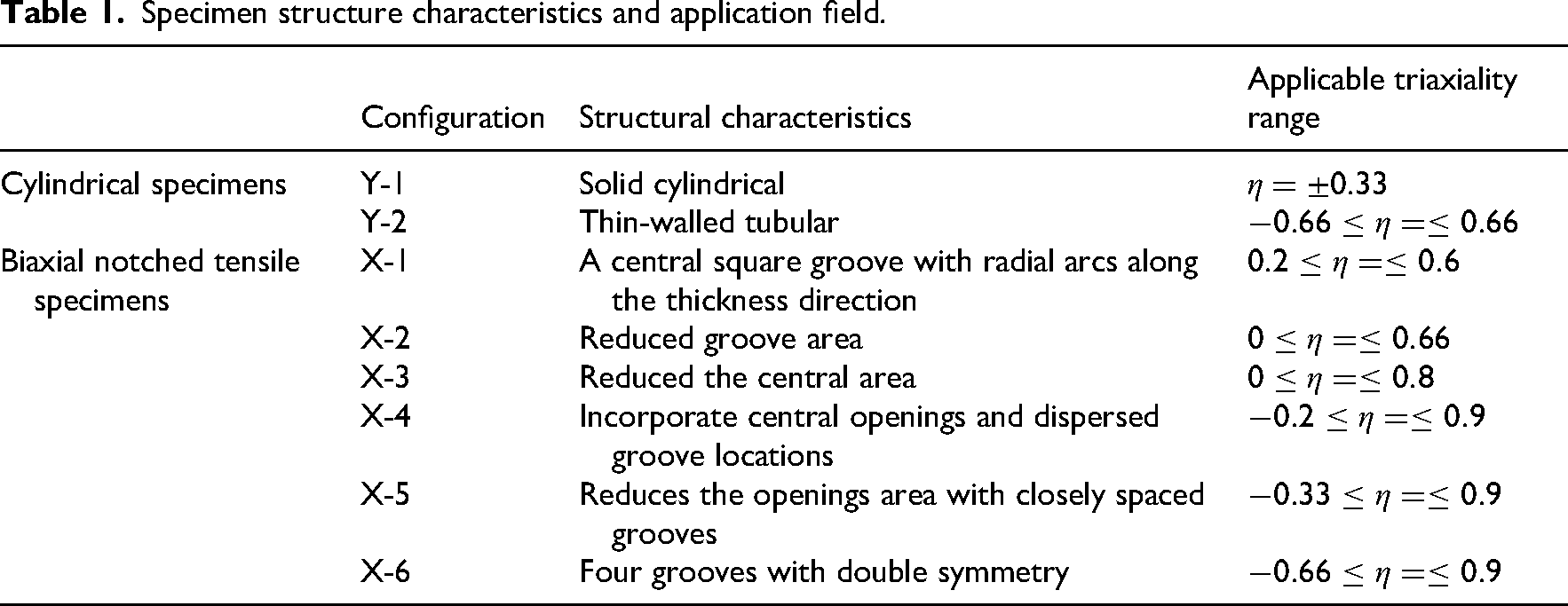
The structural characteristics and applicable field of cylindrical specimens and biaxial notched tensile specimens are summarised in Table 1. Solid cylindrical specimens exhibit uniform stress distribution across the section under axial load (Simão et al., 2025). However, under pure torsional loading, significant radial stress gradients develop (Yip and Jen, 1996), which compromise the accurate characterisation of material responses under homogeneous shear conditions. Thin-walled structures effectively mitigate stress gradient effects under torsional loading (Suntaxi et al., 2025). Numerical simulation techniques provide reliable methodologies for optimising the geometric configuration of thin-walled tubular specimens (Yao et al., 2025).
Specimen structure characteristics and application field.
Biaxial notched tensile specimens represent a standard configuration for investigating non-proportional loading paths under plane stress-dominated conditions. Six specimen variants in Figure 2(b) include: X-1 (Kuwabara, 2007; Makinde et al., 1992; Shiratori and Ikegami, 1968), X-2, X-3, X-4, X-5 (Wei et al., 2025) and X-6 (Wei et al., 2024). Specimen structural design focuses on several aspects: featuring geometric symmetry to prevent load distribution imbalances caused by deflection, minimising the area of central rigid zones to prevent buckling, and implementing groove structures to control deformation regions precisely.
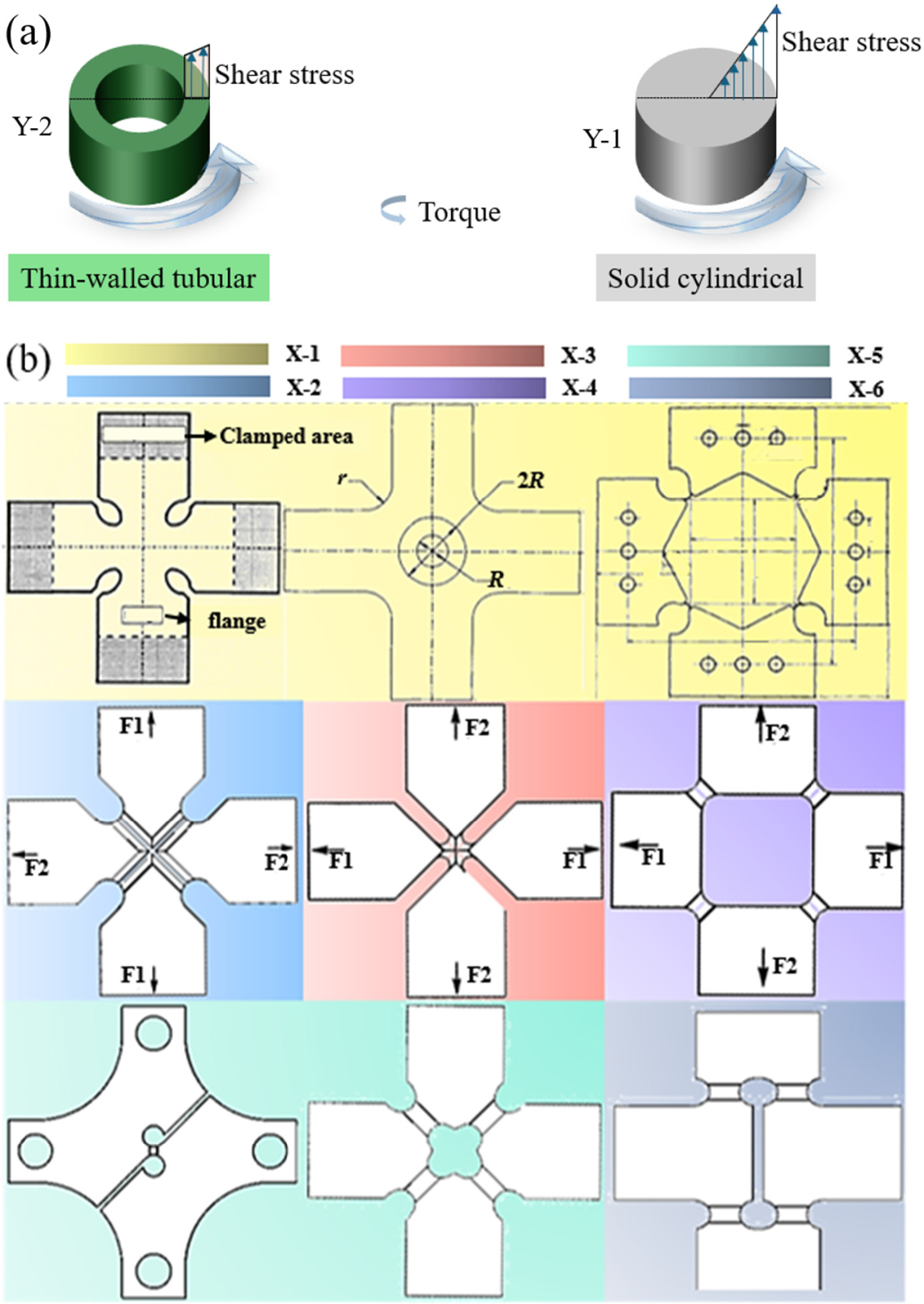
Specimen structure design: (a) cylindrical specimens, (b) biaxial notched tensile specimens.
Loading path design
This section systematically reviews six non-proportional loading path designs, which combine three typical loading paths with two specimen configurations: thin-walled tubular specimens and biaxial notched tensile specimens.
Uniaxial step loading
Uniaxial step loading involves applying discrete load increments or distinct load types at different loading stages, resulting in a non-continuous loading history (Maier et al., 2021). Significant abrupt variations in stress triaxiality arise from step loading in thin-walled tubular specimens. These changes are typically induced by instantaneous load-type switching (Kristoffersen et al., 2025) or geometric configuration mutations (Basu and Benzerga, 2015), as depicted in Figure 3. Throughout the loading stages, load transitions require a finite time Δt. When Δt is sufficiently small relative to the total duration, the rate of stress triaxiality change at transition points becomes excessively high, approximating a step change (Li, 1994). Similarly, geometric mutations during loading cause a stress triaxiality step. In the initial stages, specimens undergo pre-tension followed by machining of strain-concentrated regions to alter local geometry, thereby introducing controlled step changes in stress triaxiality (Bleck et al., 1998).
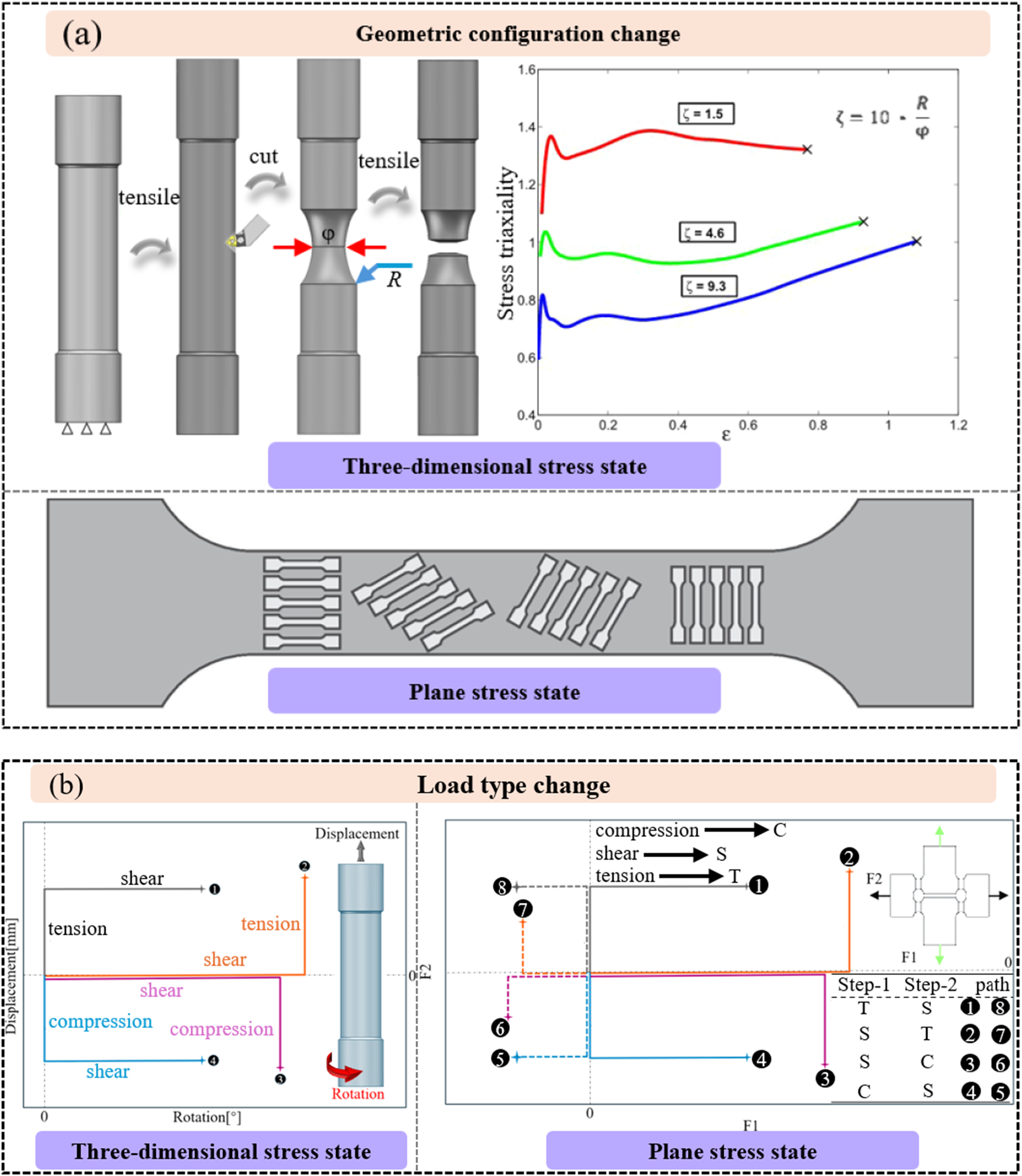
Uniaxial step loading: (a) geometric configuration change (Basu and Benzerga, 2015; Gerke et al., 2020), (b) load type change.
To characterise the effects of step loading path changes under plane stress, specimens are extracted from pre-deformed sheets along varying orientations. Step loading paths are constructed by altering the angle between secondary axial tension and pre-tension directions (Gerke et al., 2020). Alternatively, step loading is widely implemented by independently regulating the loading sequence along the X/Y axes of biaxial notched tensile specimens. Displacement control and force control constitute primary loading regulation methods (Zistl et al., 2024). Representative step loading paths include tension-shear, shear-tension, shear-compression and compression-shear (Brünig et al., 2019).
However, actual engineering loading histories predominantly exhibit continuously smooth variations. The inherent discreteness of step loading limits its ability to replicate continuous loading histories (Tarigopula et al., 2008), confining its applicability exclusively to relatively simple loading paths (Yang et al., 2023).
Multi-axis variable path loading
Complex components frequently undergo multi-axis variable path loading during plastic forming, experiencing complex multiaxial stress states (Papasidero et al., 2015). Axial-torsion loading applied to thin-walled tubular specimens enables coupling of axial and shear stresses, as illustrated in Figure 4(a). By regulating the load angle γ, multi-axis variable paths with arbitrary axial-shear coupling can be quantitatively designed (Scales et al., 2016). The load angle γ is defined as:
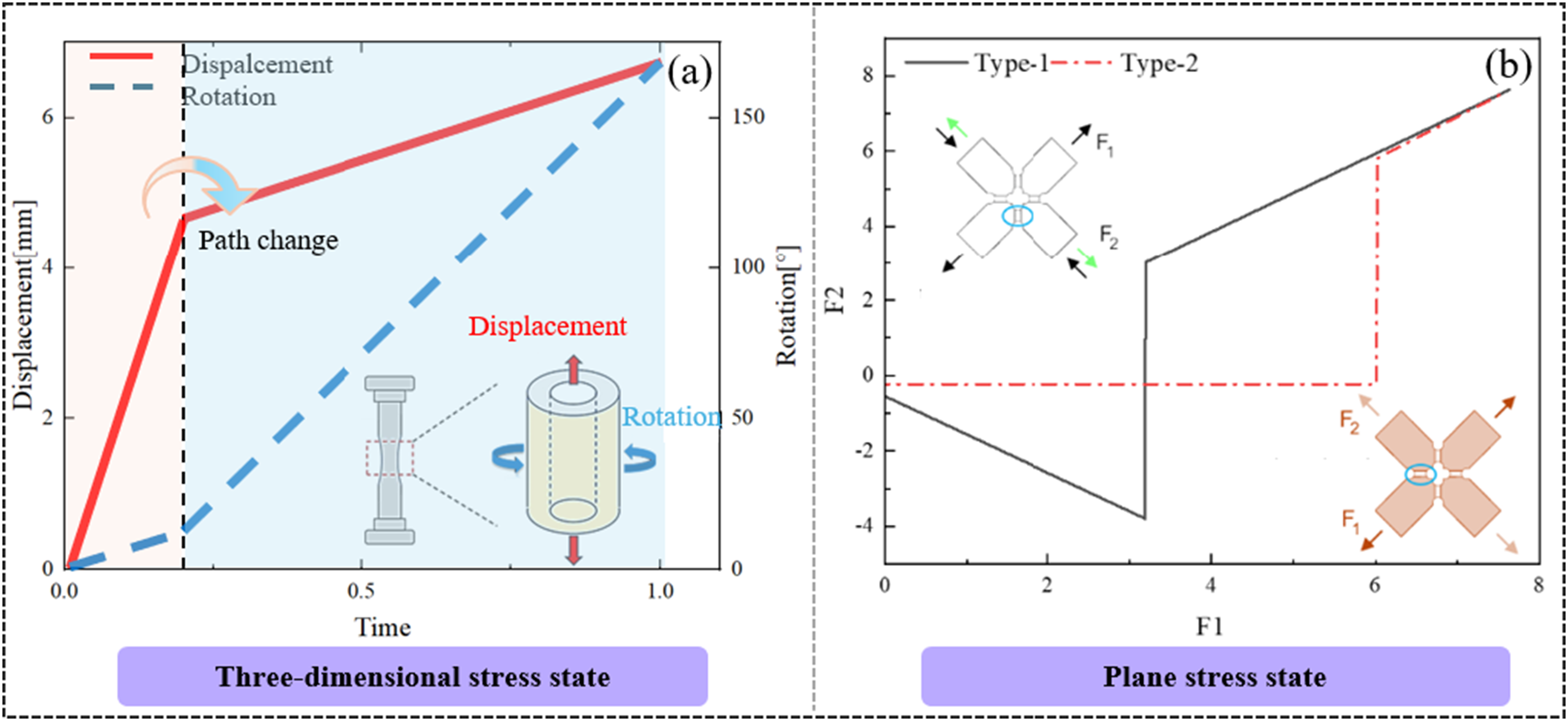
Multi-axis variable path loading: (a) thin-walled tubular specimen, (b) biaxial notched tensile specimen.
Multi-axis cyclic loading
Multi-axial cyclic loading is a fundamental subject in mechanics research. Given their practical relevance, investigations into such loading paths attract significant attention (Zhang et al., 2024a). Thin-walled tubular specimens are most commonly employed for multi-axis cyclic loading (Li et al., 2023a). Based on phase relationships between axial and shear strains and their trajectory shapes, loading paths are categorised into four types: Triangular, Sinusoidal, Trapezoidal and Step, as shown in Figure 5(a) (Bharti et al., 2025). Asynchronous variation in axial and shear strain components induces rotation of the principal strain direction, thus forming non-proportional loading paths. Arbitrary multi-axis cyclic loading paths can be constructed by varying the phase angle between axial and shear strains, peak strain, dwell time and other parameters (Ma et al., 2024). Research on multi-axial cyclic loading under plane stress-dominated conditions also warrants attention, as exemplified in Figure 5(b) (Shanyavskiy, 2011). Wei et al. (2023) investigated damage behaviour in aluminium alloy EN-AW6082-T6 under non-proportional biaxial reverse cyclic loading. Additionally, the same team examined ductile damage under cyclic biaxial shear loading for this material (Wei et al., 2025). Due to inherent geometric constraints, biaxial notched tensile specimens can only passively achieve limited path combinations without active regulation of path indicators, thus primarily serving for qualitative validation of simple loading paths.
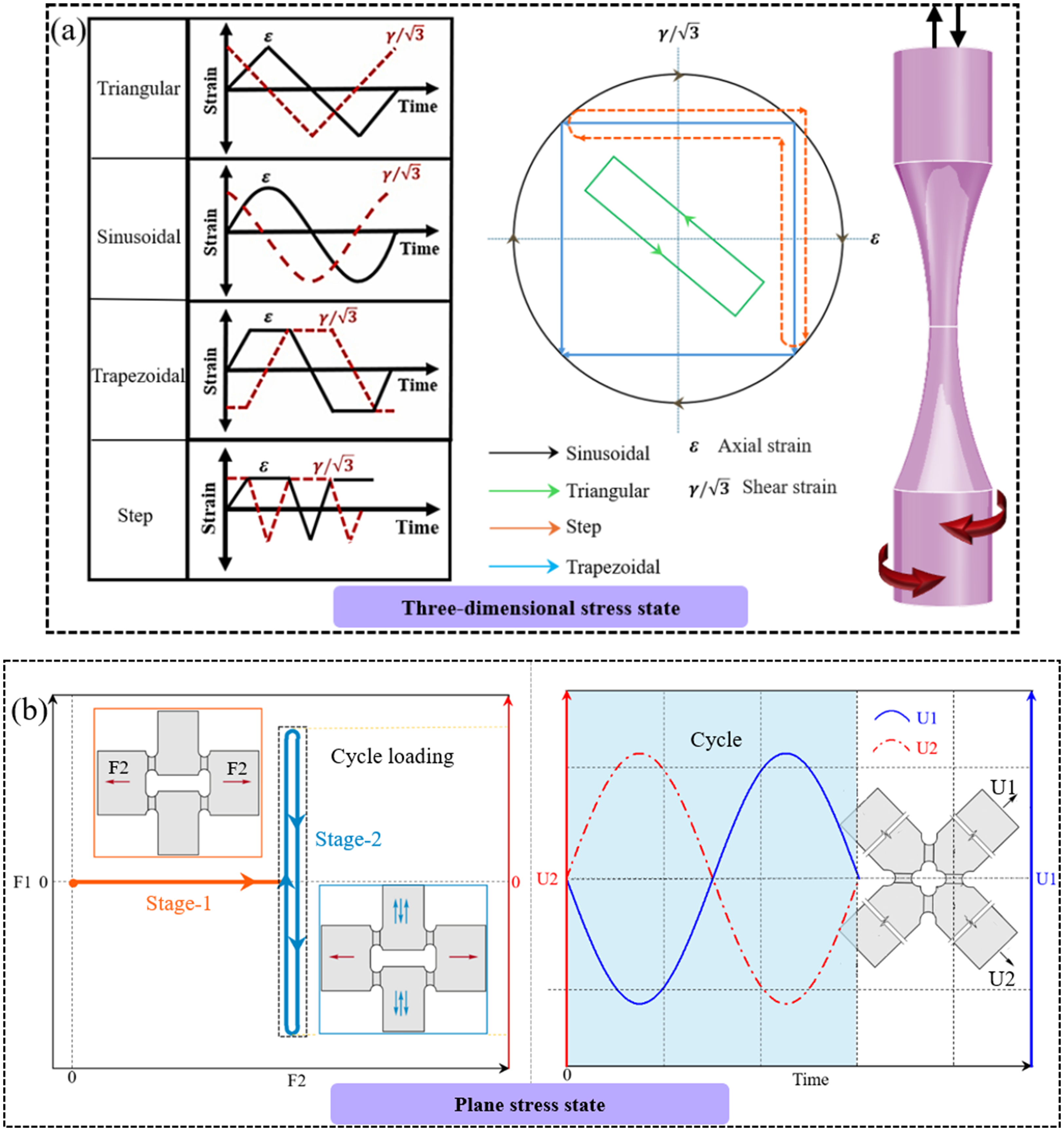
Multi-axis cyclic loading: (a) thin-walled tubular specimen (Bharti et al., 2025), (b) biaxial notched tensile specimen (Wei et al., 2023).
Quantification of damage
Breakthroughs in microscopic characterisation techniques have enabled high-resolution damage observation at micro/nanoscales, providing indispensable technical foundations for quantitative damage characterisation (Yue et al., 2024).
Analysis tools for damage
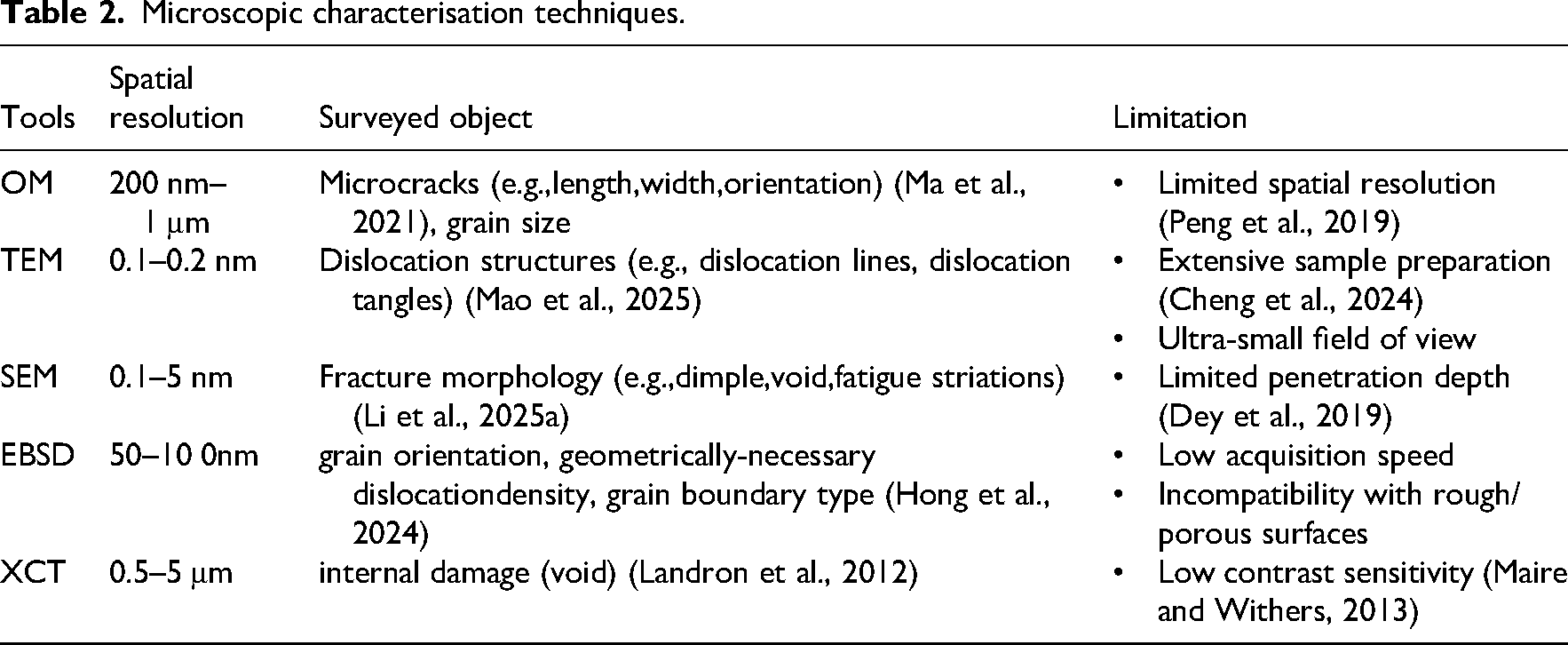
Current core analytical tools for microstructural characterisation primarily include optical microscopy (OM), transmission electron microscopy (TEM), scanning electron microscopy (SEM), electron backscatter diffraction (EBSD) and in-situ X-ray computed tomography (XCT). The selection of characterisation techniques hinges on three key parameters: spatial resolution, morphological features and structural information targets. To systematically guide technique selection, this paper comprehensively evaluates spatial resolution, observable features and limitations for these characterisation methods, with summarised results presented in the following Table 2.
Microscopic characterisation techniques.
Quantification methods for damage
The direct method determines the damage at different plastic strain levels by measuring the area or volume fraction of voids in the plastically deformed region via multi-scale characterisation techniques (Kumar and Dixit, 2014). The damage quantification process is illustrated in Figure 6. Interrupted tests are conducted on cylindrical or sheet specimens, which are unloaded at predetermined strain levels. A sample containing the minimum cross-section is then sectioned from the deformed region. Subsequently, the minimum cross-section is polished, and an observation area is selected on the polished surface. The distribution of voids within this observation area is examined using SEM, with subsequent image processing via MATLAB algorithms that identify voids. The damage value for the region is denoted as D (where 0 < D < 1).
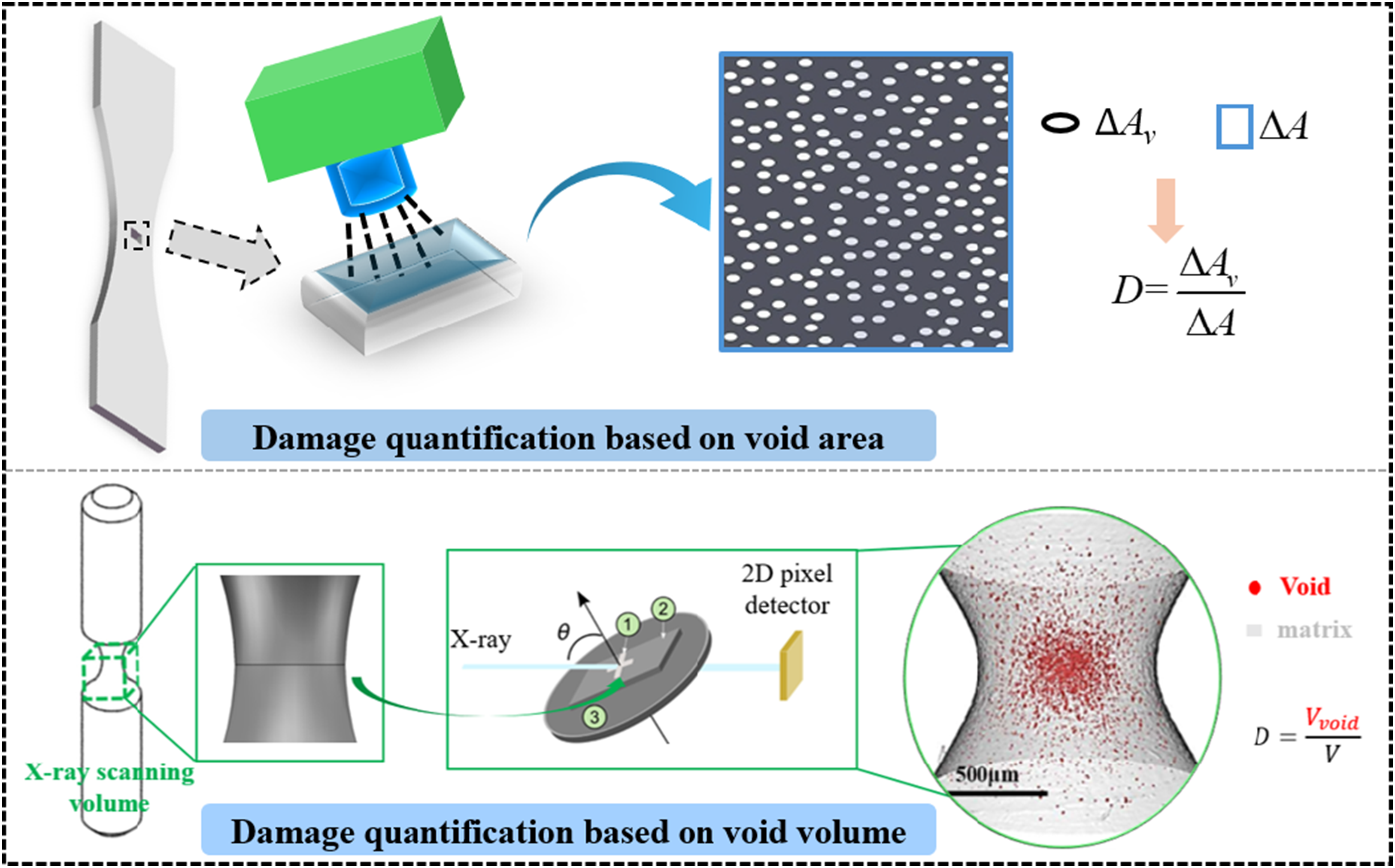
Methods for damage quantification illustrating direct measurement via void morphometry (Kong et al., 2022; Dang et al., 2022).
In addition, X-ray tomography quantifies damage by exploiting differential X-ray absorption between low-density voids and high-density metallic matrices. Multi-angle projection data are acquired and reconstructed into 3D microstructures via the filtered backprojection algorithm (Dang et al., 2022). The void volume fraction during deformation is determined using grey threshold segmentation, serving as a damage internal variable that exhibits positive correlation with damage state (Nouira et al., 2025).
In contrast to the direct method, the indirect method assesses damage by monitoring the degradation of the material's macroscopic mechanical properties (Sun et al., 2021). This method is grounded in the physical rationale that plastic deformation induces the evolution of voids and alterations in the microstructure, manifest macroscopically as changes in properties such as the elastic modulus and hardness. The core of the indirect method lies in establishing a quantitative relationship between macroscopic degradation and the damage state, as illustrated in Figure 7 (Sadeghi Nezhad and Aboutalebi Haji, 2022).
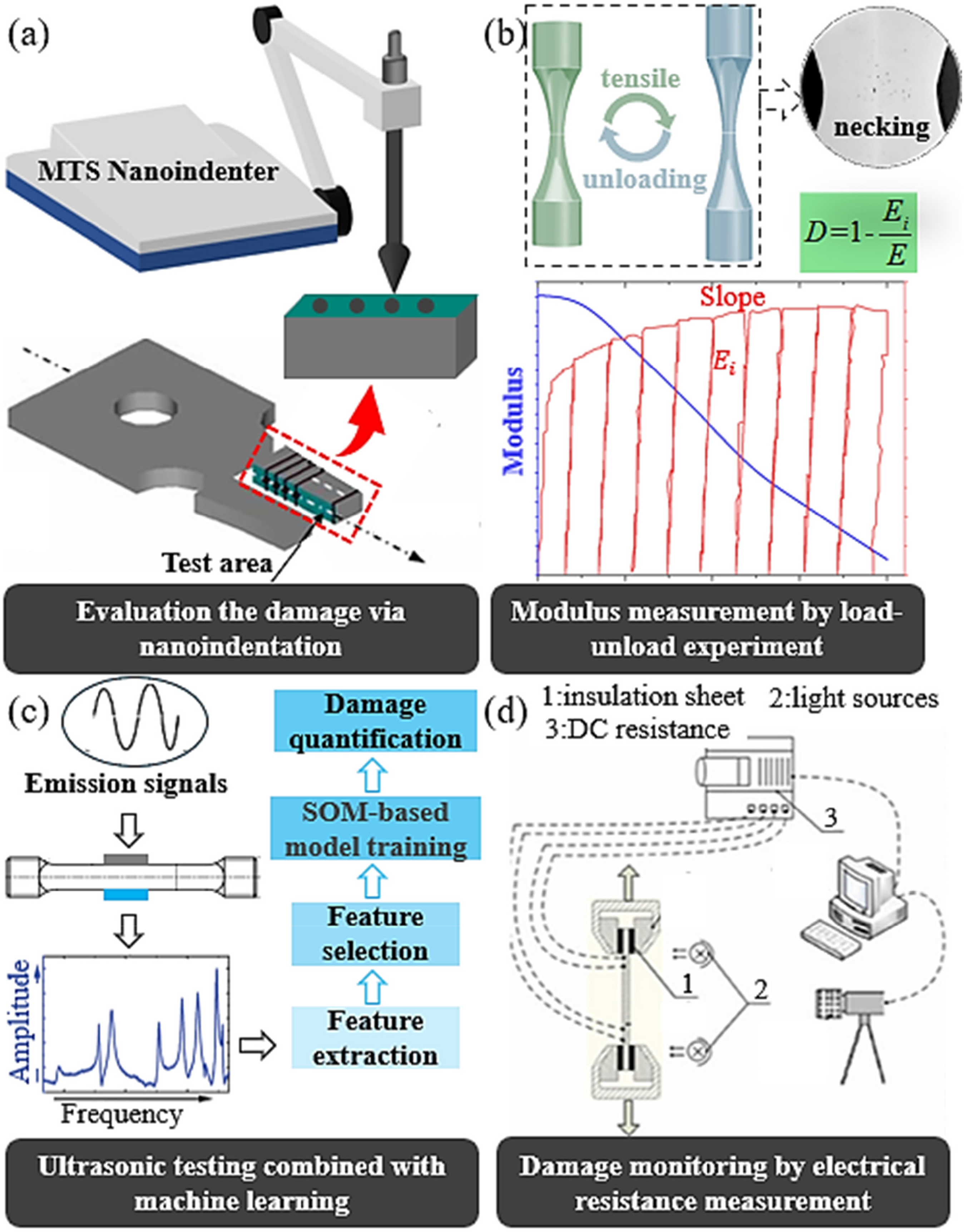
Indirect methods for damage quantification: (a) indentation method (Mkaddem et al., 2006), (b) cyclic load-unload method, (c) coupled ultrasonic guided wave and machine learning method, (d) electrical resistance method (Zhang et al., 2014b).
Measuring hardness via indentation tests on specimen cross-sections represents a straightforward and efficient method for damage quantification (Mkaddem et al., 2006). The procedure involves polishing the target surface and progressive indentation tests from lightly deformed to severely deformed regions using an MTS nanoindenter. However, other microstructural changes induced by plastic deformation, such as strain hardening, texture evolution and residual stress, may obscure the damage-induced reduction in hardness, thereby compromising the accuracy of the measurements (Tasan et al., 2010). Tasan et al. (2009) proposed a specific heat treatment procedure before indentation tests to overcome this limitation. This procedure is designed to eliminate other microstructural disturbances while preserving the damage, enabling the accurate identification of material softening behaviour attributable solely to damage.
Quantitative damage assessment based on changes in electrical resistance is a widely used non-destructive evaluation method (Zhang et al., 2014a). At room temperature, damage induced by plastic deformation leads to a change in electrical resistance. A standard formula for calculating the damage value is given by equation (3), where for metals, the constant K is typically taken as 2, and Rij represents the electrical resistance (Zhang et al., 2014b).
The quantification of the nonlinear degradation of Young's modulus during plastic deformation through cyclic load-unload tensile tests is recognised as a reliable indirect method for damage assessment (Tsiloufas and Plaut, 2012). In a typical experiment, a tensile load is applied to the specimen until it reaches 2% engineering strain, followed by complete unloading. This procedure is repeated iteratively until the onset of necking. The Young's modulus for each cycle, denoted as Ei, is determined from the slope of the elastic segment in the corresponding unload curve. By defining E as the initial Young's modulus, the damage variable D can be defined as:
With increasing cyclic number, Young's modulus demonstrates an exponential decay trend, consistent with theoretical expectations of mechanical property degradation induced by damage (Sebek et al., 2022). Additionally, some researchers utilise differences in propagation velocities between transverse and longitudinal ultrasonic waves within materials to measure Young's modulus during cyclic loading, enhancing computational accuracy (Wei et al., 2012).
However, transitioning to a complex triaxial stress state during necking invalidates the aforementioned methods. To address this limitation, Celentano and Chaboche (2007) proposed a method for calculating Young's modulus at necking by introducing a correction factor fE, based on the Bridgman approach, which converts the triaxial stress state to an equivalent uniaxial stress state.
Acoustic Emission (AE) technology is a passive non-destructive evaluation method that assesses damage status by detecting stress wave signals spontaneously generated during loading. In contrast to ultrasonic testing, which actively transmits sound waves, AE technology offers the potential for real-time monitoring of damage evolution (Jia, 2019). Furthermore, methods integrating ultrasonic guided waves with machine learning have been developed recently. For instance, Liu et al. (2022) proposed using a Self-Organising Map (SOM) algorithm to train on ultrasonic guided wave signals. This method extracts sensitive feature values from the signals to establish a mapping relationship with the damage, thereby achieving precise damage quantification.
However, the aforementioned damage quantification methods all exhibit limitations to varying degrees when tracking damage evolution under non-proportional loading paths, as summarised in Table 3.
Capabilities of different damage quantification methods in tracking damage evolution under non-proportional loading.
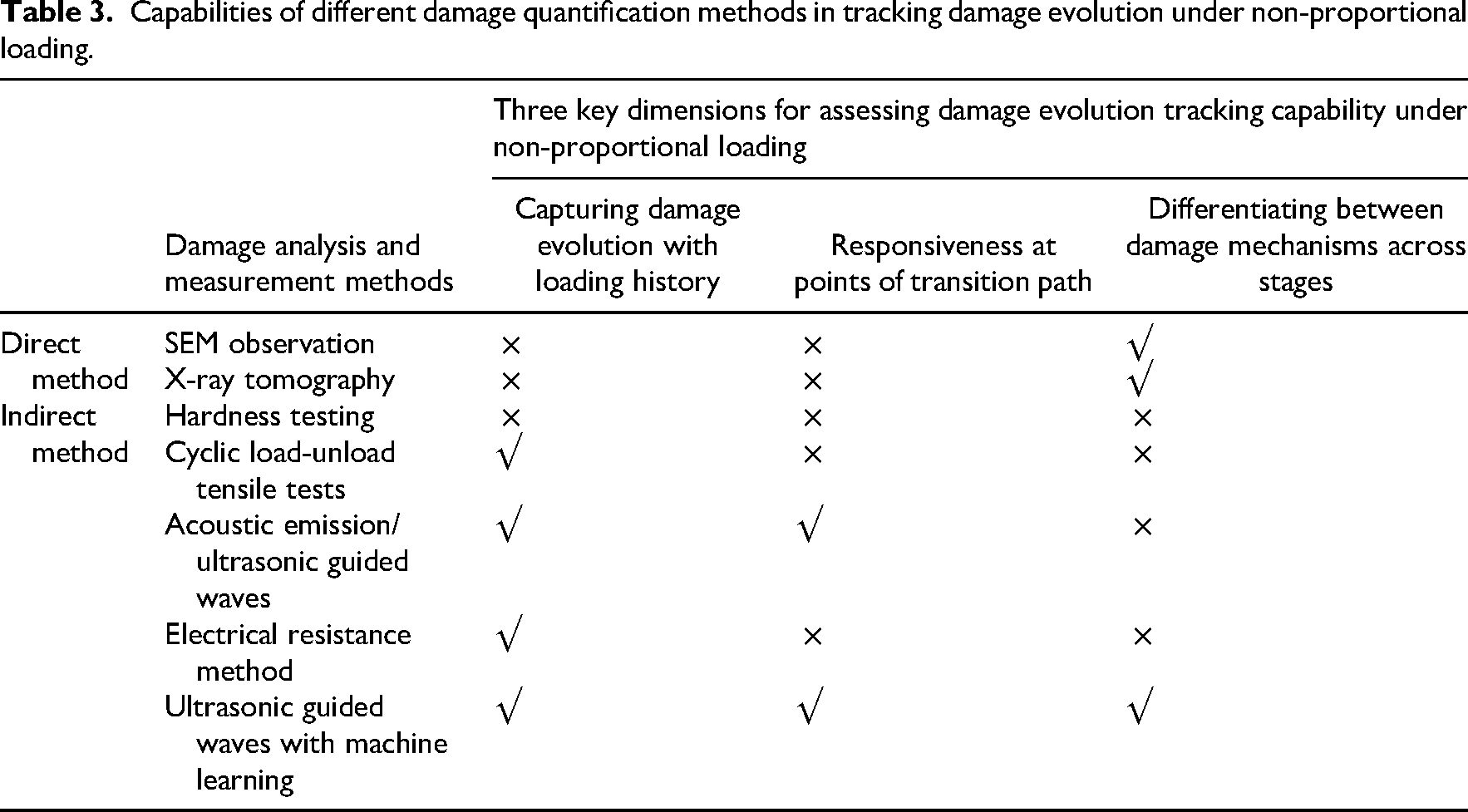
Regarding the ability to capture history-dependent damage evolution, SEM observation, X-ray tomography and hardness testing all require test interruption or a destructive specimen, providing damage states only at discrete strain points and thus not enabling continuous tracking (Wang et al., 2003). Although SEM and X-ray tomography can identify differences in damage mechanisms by analysing sequential cross-sections, their discrete nature makes it difficult to reconstruct the complete damage evolution process along the loading path (Wang et al., 2025). In terms of responsiveness to abrupt path changes, the cyclic load-unload tensile test and the electrical resistance method, despite enabling continuous monitoring, exhibit a response lag to sudden path transitions, making it challenging to capture damage evolution at the moment of abrupt change (Bonora et al., 2011; Sun, 2004). In contrast, acoustic emission and ultrasonic guided wave technologies offer the advantage of real-time monitoring and can capture damage signals during path transitions. However, they face the challenge of signal decoupling, as damage signals are highly intermixed with noise generated by mechanisms such as material internal friction and deformation, making it difficult to identify transitions in damage mechanisms accurately (Karev et al., 2019). Notably, methods integrating ultrasonic guided waves with machine learning provide a novel avenue for addressing these challenges (Lomazzi et al., 2023; Rautela and Gopalakrishnan, 2021a; Rautela et al., 2021b). By training models to learn signal-feature patterns corresponding to different damage mechanisms, this method enables real-time monitoring while simultaneously classifying and identifying damage mechanisms. This offers a feasible pathway for high-precision tracking of damage evolution under non-proportional loading (Zhang et al., 2024b).
Damage mechanisms under non-proportional loading
Quantitative characterisation of microstructures and observation analysis of damage evolution demonstrate that loading paths govern micro-scale damage behaviour by altering dislocation configurations, void growth patterns and microcrack initiation/propagation (Fillafer et al., 2014). A systematic summary of metallic damage mechanisms under uniaxial step loading, multi-axis variable path loading, and multi-axis cyclic loading is summarised in Figure 8.
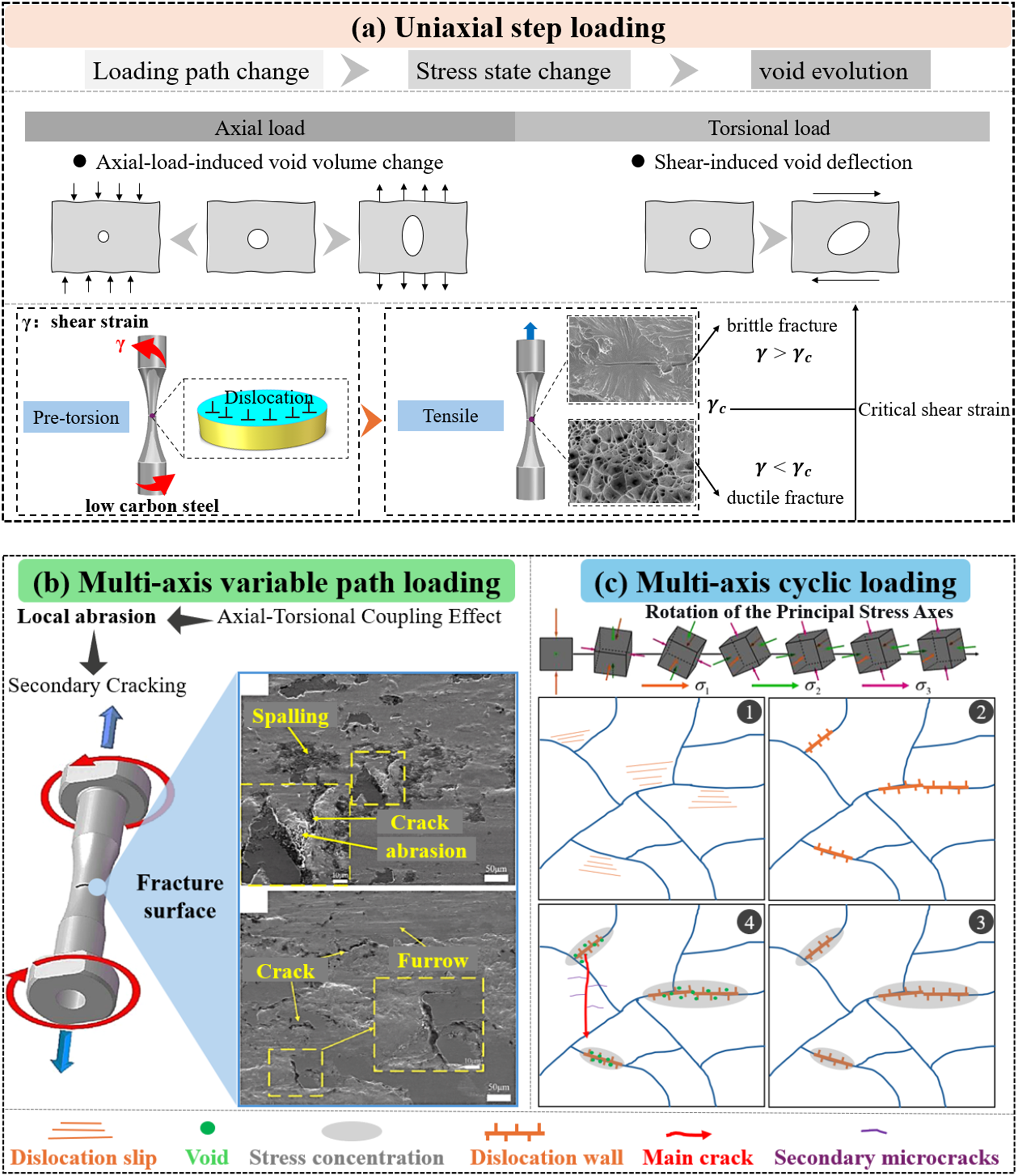
Damage mechanism under different loading paths: (a) uniaxial step loading, (b) multi-axis variable path loading (Zhou et al., 2022a), (c) multi-axis cyclic loading.
Uniaxial step loading experiments reveal that the type and proportion of strain in the loading path significantly influence the material's damage evolution process. When the axial strain component dominates, damage primarily manifests as volumetric changes in voids (Zhang et al., 2019). However, introducing a shear strain component markedly promotes dislocation slip, guiding the deflection and coalescence of voids along the direction of maximum shear stress, thereby forming shear dimples with distinct orientation (Volk et al., 2020). Consequently, the superposed effect of different load types is reflected in their influence on voids’ morphology, size and distribution. However, the applicability of the aforementioned damage mechanisms based on void evolution is highly dependent on the material's intrinsic microstructure. Studies have shown that in alloys with high initial void density or abundant intermetallic particles, such as AA2024-T3, shear-induced damage is predominantly governed by void-mediated failure (i.e., void nucleation-rotation-elongation). Conversely, in aluminium alloys with limited initial defects, such as AA2198-T8R, under combined shear-tension loading, the damage mechanism shifts to the nucleation and coalescence of grain-structure-related ‘flat cracks’, rather than being dominated by void evolution. These flat cracks typically nucleate during the shear loading and propagate under further tensile deformation (Kong et al., 2022).
Furthermore, for 20Cr low-carbon steel bars, the superposition of shear and tensile loads under specific conditions can induce a transition in the macroscopic damage mechanism. Research by Li (1994) indicates that while pre-torsion deformation introduces limited plastic damage, the resulting strengthening effect increases the material's yield strength, causing it to approach the ultimate tensile strength. This microstructural alteration suppresses subsequent plastic deformation capacity, leading to rapid instability and damage without significant plastic deformation during subsequent tensile loading. The damage mode transitions from ductile to quasi-cleavage brittle, with the extent of this transition exhibiting a positive correlation with the pre-torsion shear strain magnitude.
Under multi-axis variable path loading, the mechanisms of crack initiation and propagation in materials differ significantly from those under uniaxial step loading. A defining characteristic is that crack initiation and propagation are predominantly governed by shear stress, proceeding along slip planes. In contrast, the axial stress controls the crack growth rate by influencing the crack closure effect (Chen et al., 2025b). Furthermore, a critical distinction is that multi-axis variable path loading introduces abrasion. As evidenced by research on aluminium alloy 2024-T351 by Liu et al. (2024), the synergistic action of axial and shear stresses causes minimal contact areas between the two fracture surfaces to rub against each other, resulting in abrasion. The abrasion process induces mutually parallel secondary cracks. Observations indicate that these secondary cracks act as sources for subsequent micro-cracks, whose formation, in turn, accelerates the propagation of the primary crack. This interaction establishes a complex damage feedback mechanism that hastens material damage (Zhou et al., 2022a).
Damage evolution under multi-axis cyclic loading exhibits path-dependency and a significant non-proportional cyclic hardening (Li et al., 2018; Li et al., 2023b). During loading, the continuous rotation of the principal stress axes due to a non-zero phase difference alternately activates slip systems along different orientations within the material, thereby inducing intense dislocation interactions (Xu et al., 2023a; Zuo et al., 2024). Microscopically, this increases dislocation density and the formation of a stable dislocation barrier (Bharti et al., 2025; Feng et al., 2024; Mao et al., 2025). Macroscopically, it manifests as a cyclic hardening response distinct from that observed under proportional loading. This effect exacerbates local stress concentrations, generating high intergranular stresses particularly at grain boundaries (Wang et al., 2024). To accommodate plastic deformation, voids preferentially nucleate in these regions of dislocation accumulation. They subsequently coalesce and grow to form microcracks, often inducing intergranular fracture. However, the severity of this effect is markedly material-dependent, with high-strength steels, stainless steels and titanium alloys being particularly susceptible (Vormwald and Döring, 2009). Furthermore, the rotating stress axes promote the initiation of microcracks along the instantaneous direction of maximum shear stress, resulting in a multi-directional distribution pattern (Itoh et al., 2013). These cracks propagate and connect across different slip bands, eventually coalescing into a primary crack, accelerating damage.
Damage modelling method under non-proportional loading path
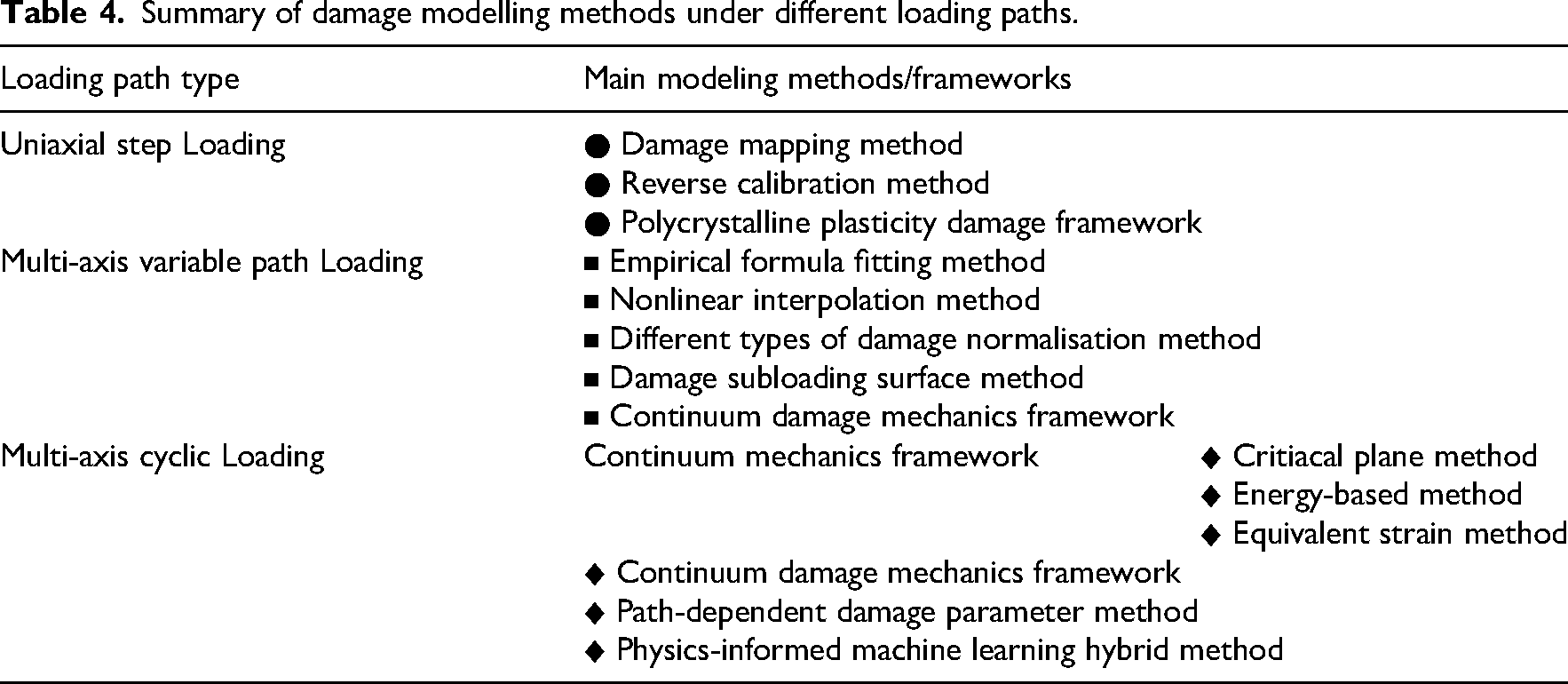
This chapter systematically reviews pertinent damage modelling methods for different non-proportional loading paths, as summarised in Table 4. It begins by analysing modelling methods for the relatively straightforward case of uniaxial step loading. Subsequently, multi-axis variable path loading methods, which account for the influence of combination stresses, are examined. Finally, modelling strategies for multi-axis cyclic loading, addressing effects such as non-proportionality and cyclic hardening, are summarised. This chapter aims to provide theoretical references and insights for establishing damage models applicable to various non-proportional loading scenarios.
Summary of damage modelling methods under different loading paths.
Damage modelling under uniaxial step loading
Based on the classification outlined in Chapter 2, uniaxial step loading can be categorised into two types: changes in geometric configuration and changes in load type. In loading processes with changing geometric configurations, staged loading is often employed, where the damage mapping relationship between successive stages is critical for predicting the final damage state. Damage generated in the preceding stage significantly influences subsequent deformation behaviour.
Currently, mapping algorithms are widely used to achieve damage mapping. These algorithms calculate the corresponding parameters for new mesh nodes via shape function interpolation, based on the coordinates and field variables of the old mesh nodes, as illustrated in Figure 9(a) (Zhang et al., 2025). However, during data transfer, this method suffers from information loss of field variables, such as damage and stress. In recent years, data-driven approaches have offered a novel solution to reduce mapping errors. This approach leverages high-fidelity numerical simulations or specifically designed experiments to generate extensive data on the inter-stage deformation process. These data are then used to train neural networks capable of perceiving historical dependencies. Such models take the field variables from the previous stage and the geometric information of the new mesh as input, and directly output the distributed field variables for the newly mapped mesh, effectively circumventing the information loss associated with traditional interpolation methods (Kurt et al., 1989).
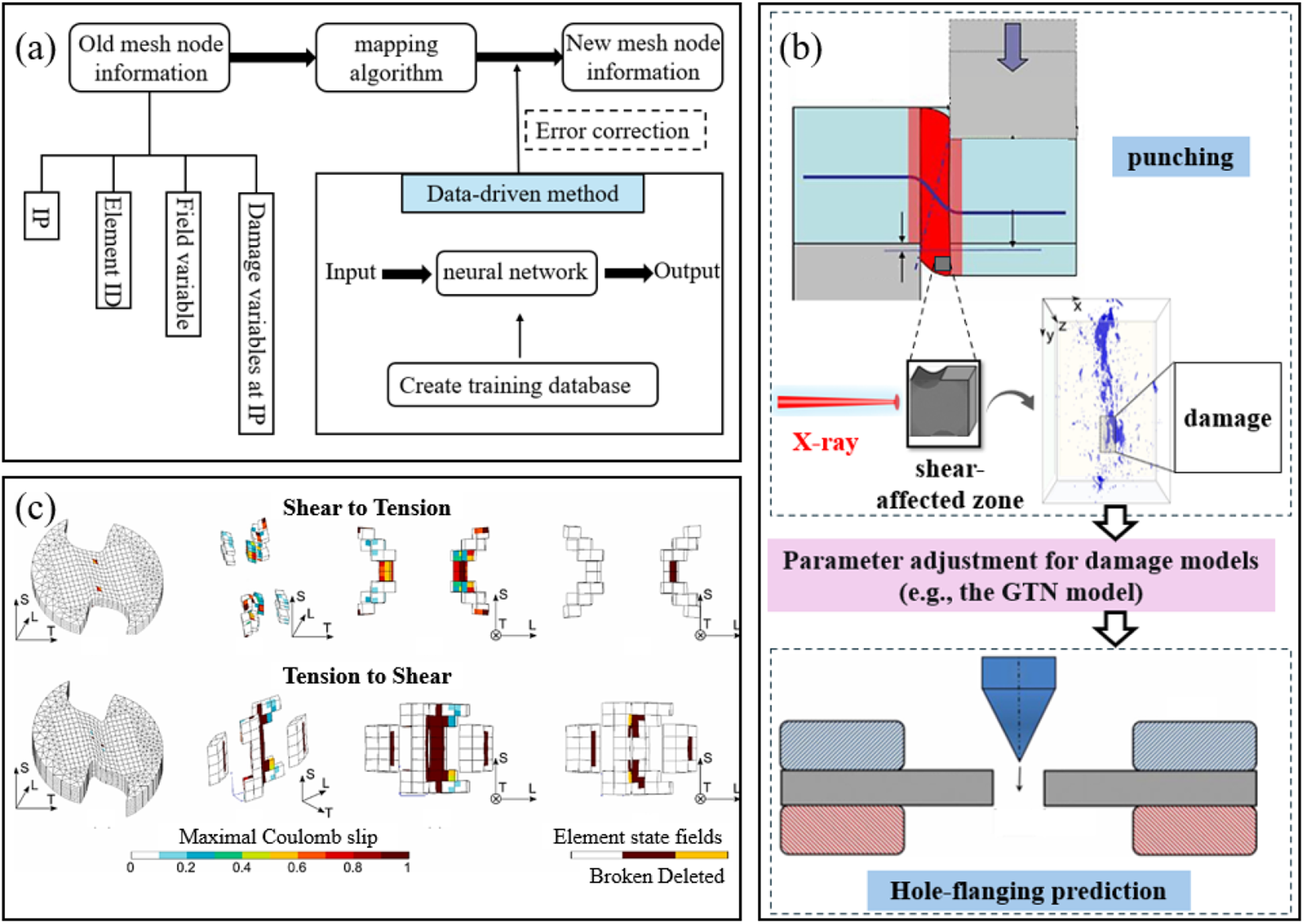
Damage modelling under uniaxial step loading: (a) flowchart for damage calculation via field mapping, (b) damage mapping method based on an equivalent thought (Butcher et al. 2013), (c) maximal Coulomb slip fields under different load paths (Kong et al., 2023).
On the other hand, the damage mapping method based on an equivalent thought also has relevant applications. This method accounts for the influence of damage from the preceding stage by equivalently adjusting parameters in the damage model used for the subsequent stage, thereby circumventing complex mapping procedures. Preliminary explorations have been conducted. For instance, Butcher et al. (2013) investigated the hole-flanging process by first assessing the damage condition along the sheared edge through scanning, and subsequently calibrating the parameters of the Gurson-Tvergaard-Needleman (GTN) model accordingly, as illustrated in Figure 9(b). The calibrated parameters effectively characterised the damage introduced during the punching stage. The updated model was then applied to simulate the hole-flanging process, achieving an indirect modelling of damage mapping. This methodology, which integrates experimental measurement with simulation, represents an inverse identification strategy and has demonstrated good engineering applicability.
For step loading paths involving changes in load type, the alteration in mechanical response is attributed to the change in the loading path. Corresponding damage models have been established in existing research based on microscopic mechanisms. Kong et al. (2023) proposed a polycrystalline plasticity damage framework for damage modelling by coupling porous plasticity with the Coulomb ductile fracture criterion, successfully predicting damage evolution under tension-to-shear paths, as illustrated in Figure 9(c). Their model represents the material using a polycrystalline aggregate, where individual grains possess random orientations. Plastic deformation is described by the shear motion on internal slip systems, and deformation compatibility and stress equilibrium from the grain scale to the macroscopic scale are achieved using a self-consistent scheme. Different slip systems are sequentially activated or deactivated when the load type changes. This micro-scale plastic deformation manifests macroscopically as plastic anisotropy and distortion of the yield surface.
Following a similar micro-mechanism-based modelling method, Chouksey and Keralavarma (2022) employed a unit cell model simulation to characterise damage evolution through the processes of void growth and coalescence. Their study explicitly incorporated step changes in stress triaxiality and the Lode parameter into the model. The arc-length method was utilised to track the real-time evolution of these stress state parameters dynamically. Furthermore, the equivalent plastic strain at the onset of void coalescence was defined as a path-dependent function, thereby emphasising the dependence of both the damage accumulation process and the critical damage value on the loading history.
Damage modelling under multi-axis variable paths loading
Compared to uniaxial step loading, the core challenges in damage modelling under multi-axis variable path loading primarily stem from two aspects. First, the multiaxial stress state within a loading stage significantly influences the damage evolution mechanism. Second, the switching of loading paths introduces strong path-dependency effects, which are typically accompanied by the rotation of the principal stress axes. This rotation activates different microscopic deformation mechanisms, markedly altering the damage evolution behaviour.
Several researchers have conducted studies on damage modelling under multi-axis variable path conditions. Cortese et al. (2016) introduced a specific function to describe the damage growth rate by drawing an analogy to fatigue damage models. This function is expressed as a nonlinear combination of the stress triaxiality and the Lode parameter, capturing the dependence of damage on the equivalent plastic strain during multi-axis variable path loading. Its general form is given as follows:
Model variants based on m and q parameters.
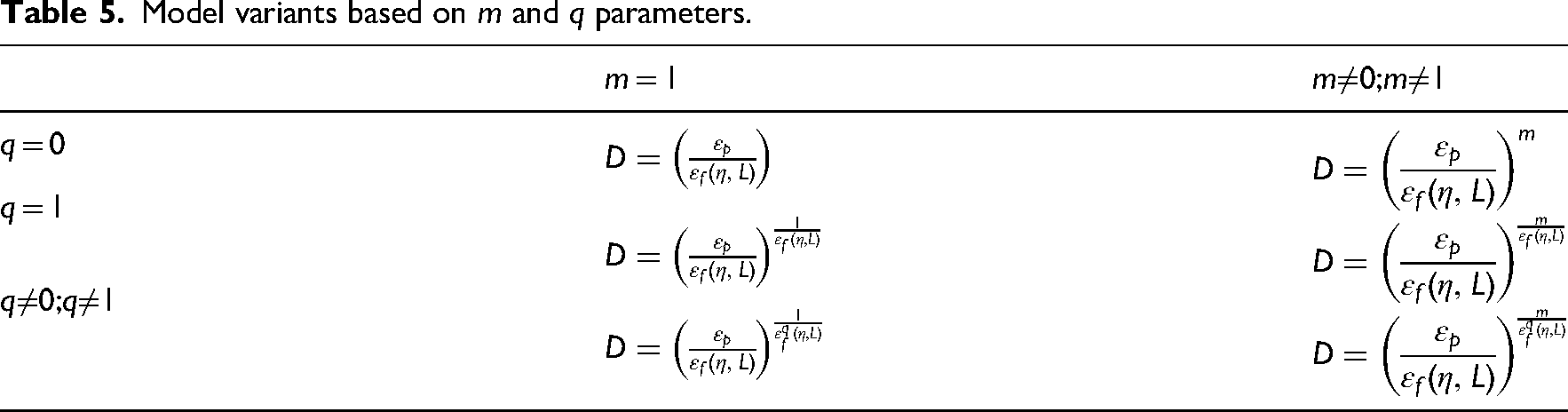
However, such models often lack a clear foundation in physical mechanisms, and the method relying on the fitting of macroscopic experimental data exhibits significant limitations in practical application.
Alternatively, some models aim to quantify the degree of individual stress components on damage evolution under combined stress states. Building upon the Modified Wöhler Curve Method (MWCM), Li et al. (2025b) proposed establishing an interpolation function between two typical stress states – pure shear and pure tension/compression – to assess damage under a combined stress state. The flowchart of the proposed model is illustrated in Figure 10. The study introduced the concept of the multiaxiality of stress ρ to quantify the deviation of the current stress state relative to either pure shear or pure tension/compression. The expression for ρ is given as follows:

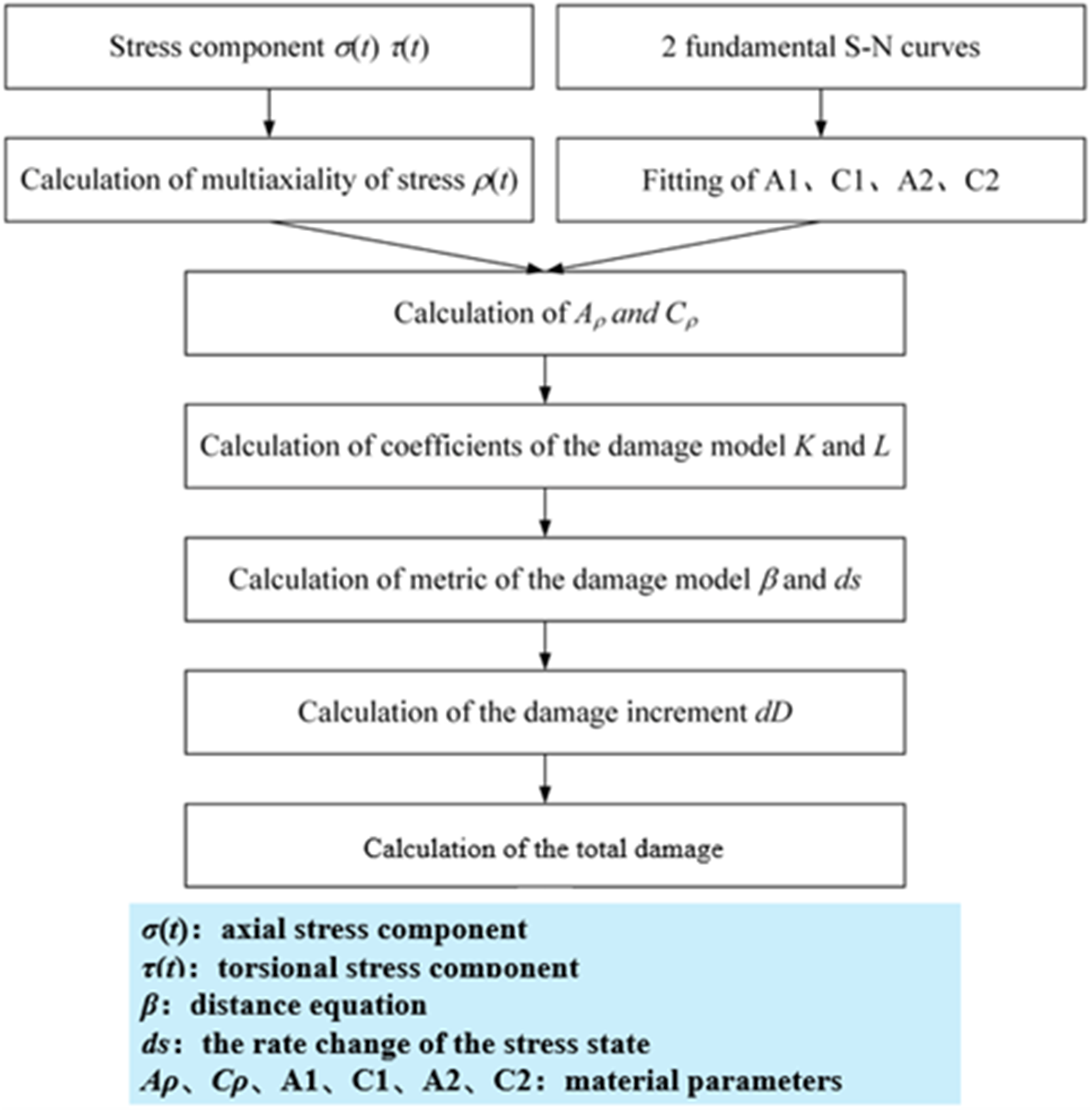
The flowchart framework of the model (Li et al., 2025b).
Malcher et al. (2014) addressed the coupling of tension and shear mechanisms by introducing an effective damage into the GTN model. The model still uses porosity to characterise damage induced by tension. In contrast, shear damage is represented by a function related to the equivalent plastic strain, Lode angle and stress triaxiality. These two independent damage parameters are normalised to construct a unified effective damage Def, whose expression is below.
In the equation, f represents the current void volume fraction, fc denotes the critical volume fraction, D is the shear damage variable and Dc signifies the critical shear damage. f/fc characterises the damage component as dominated by tensile stress, while D/Dc characterises the damage component dominated by shear stress. The term (1 + fc/Dc) is a damage acceleration factor accounting for the combined stress state. The effective damage is evaluated in the model as a post-processing measure and does not influence the evolution of the two independent scalar damage variables. This method achieves a normalised representation of different damage mechanisms by constructing a variable weighting function, thereby providing a more comprehensive reflection of the damage process and coupling effects under complex stress states.
A fundamental limitation inherent to existing models describing damage evolution under non-proportional loading often stems from adopting the associated flow rule. This rule assumes that the direction of the plastic strain rate depends solely on the current yield surface, thereby neglecting the inelastic contribution of the tangential component within the stress rate tensor (Algarni et al., 2017). In reality, the rotation of the principal directions of the stress tensor during non-proportional loading generates a non-negligible tangential component of the stress rate. Conventional theory typically presupposes that this component does not induce plastic deformation, leading to predictive inaccuracies. To address this, Fincato and Tsutsumi (2019) proposed a damage subloading surface (DSS) model, which incorporates the influence of this factor into the damage growth rate term. The corresponding expression is given as follows:
In the equation,
To address the limitations of the classical Lemaitre damage model under multiaxial stress states, some scholars have recently proposed extensions to the model within the thermodynamic framework (Hansen and Schreyer, 1994). According to thermodynamic principles, the damage growth rate can be derived from the derivative of the Helmholtz free energy φ, with respect to the damage strain energy release rate, Y.

To improve the predictive accuracy of the model under low stress triaxiality conditions, Cao et al. (2014) and Sadeghi Nezhad and Aboutalebi Haji (2024) introduced invariants of the deviatoric stress tensor and the Lode parameter, respectively, thereby constructing enhanced Lemaitre models that depend on the stress state. The model achieves effective prediction of ductile damage under various non-proportional loading paths.
To overcome the limitations of traditional models in describing anisotropic damage evolution, researchers have extended the methods for characterising anisotropic damage from different perspectives. Voyiadjis and Kattan (2012) introduced an anisotropy tensor term, replacing the effective stress in the Lemaitre model with a stress term that captures the material's anisotropic characteristics, thereby establishing an anisotropic damage model. Ali Modad et al. (2026) introduced a fourth-order damage effect tensor to describe anisotropic damage in the material's local coordinate system and defined damage as the degradation of elastic stiffness based on strain energy equivalence. This model further considers the coupling effect between damage evolution and plastic flow, enabling more accurate capture of the anisotropic damage evolution characteristics under non-proportional loading. Ma and Yuan (2015) investigated damage evolution in sintered iron under tension-torsion multiaxial loading and proposed a phenomenological constitutive model that accounts for damage differences along various directions. Based on a thermodynamic framework, this model defines the damage variable by monitoring the degradation of Young's modulus along the maximum principal strain direction. Furthermore, it distinguishes between stress-induced damage in the elastic state and plastic strain-induced damage in the plastic state, providing a modelling approach for predicting damage under multiaxial loading.
Although the Lemaitre model draws its physical foundation from thermodynamics, it still shows inherent limitations when describing complex damage behaviour. First, the thermodynamic framework requires that damage evolution be derived from a dissipation potential that satisfies convexity conditions. This restricts the form of the damage evolution equation, making it difficult to capture certain nonlinear evolution characteristics under non-proportional loading (Murakami and Kamiya, 1997). Second, the model treats damage as an internal variable decoupled from plasticity. This treatment ensures that the second law of thermodynamics is automatically satisfied. However, it is limited in its ability to capture the interaction between damage and plasticity, especially under loading paths characterised by strong coupling between these two phenomena (Basaran and Nie, 2004).
Damage modelling under multi-axis cyclic loading
Under multi-axis cyclic loading paths, the material is subjected to continuously varying multiaxial stress states with persistent rotation of the principal stress directions. In this process, the cyclic hardening and path-dependency effects are coupled, presenting a significant challenge for damage modelling.
Within the modelling framework based on continuum mechanics, a relatively mature method involves coupling a multiaxial cyclic plasticity model with a nonlinear damage model to predict damage under multi-axis cyclic loading conditions. The schematic of this framework is illustrated in Figure 11 (Araghi et al., 2018). These models typically employ the Chaboche kinematic hardening model as the plasticity constitutive. Introducing a backstress tensor to describe the translation of the yield surface in the stress space, the model can effectively simulate, at a macroscopic level, the material hardening behaviour induced by complex loading paths such as the rotation of the principal stress axes. The nonlinear nature of the dynamic recovery term causes the evolution of the backstress to automatically deviate from that under proportional loading when the loading path changes, thereby accurately predicting the additional hardening phenomenon (Wei et al., 2023). On this basis, the damage model performs an evolutionary integration based on the calculated real field variables to assess the degree of damage.
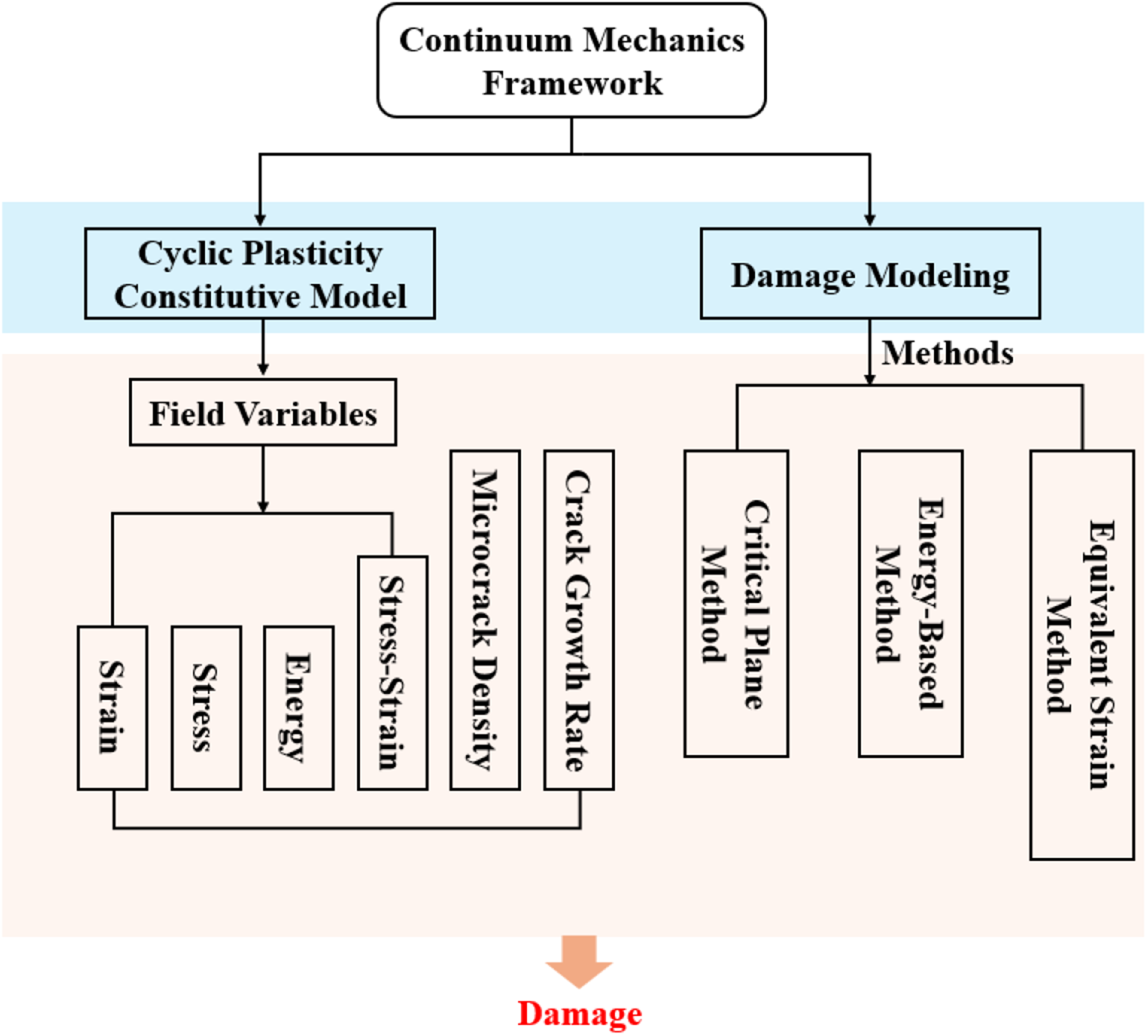
Framework-based damage modelling in continuum mechanics.
In damage modelling based on field variables, the widely adopted methodologies primarily include the critical plane method, energy-based method and equivalent strain method (Ge et al., 2025). Damage evolution under multiaxial loading exhibits significant direction sensitivity and localisation characteristics, typically manifested as crack initiation and propagation on specific micro-planes. The critical plane method is grounded in this physical mechanism, aiming to quantify damage by identifying the plane most susceptible to damage within the material and utilising the stress/strain history (Chiocca et al., 2025). The modelling process generally involves the following steps: First, candidate planes of all possible orientations are defined at the potential damage site. Second, a damage parameter is selected, and its historical response on each plane is calculated. Finally, by comparing the damage values across all candidate planes, the plane corresponding to the maximum damage value is identified as the critical plane. By tracking historical response on a fixed material orientation, this method effectively captures the additional damage generated by the rotation of the principal stress axes under non-proportional loading.
Within the critical plane method, damage assessment is typically based on six categories of parameters: strain, stress, energy, micro-crack density, crack growth rate and stress–strain parameters (Zhou et al., 2022b). The corresponding damage value is obtained by performing a path integral of these parameters over the critical plane (Chen and Chen, 2007). Stress–strain parameters are widely applied due to their ability to effectively reflect the material's constitutive behaviour.
From a microscopic mechanism perspective, damage under multiaxial loading often manifests as the initiation and growth of micro-cracks along slip systems, which generally align with the planes of maximum shear stress. Based on this physical reality, the maximum shear plane is frequently selected as the critical plane. To further account for the influence of vertical stress on crack behaviour, some studies have incorporated a vertical stress component into shear-dominated damage parameters (Mei and Dong, 2016). Additionally, to quantify the mechanical response characteristics specific to non-proportional loading, Itoh and Yang (2011) proposed the concept of a non-proportionality factor K*, defined by the following expression.
The factor comprises the additional non-proportional hardening coefficient lnp and the degree-of-non-proportionality coefficient fnp. lnp is closely related to the material's microstructure. For materials exhibiting low sensitivity to non-proportional loading, such as the 1050 N and 2024-T3 aluminium alloys, the additional hardening effect is weak, resulting in a small value for lnp. However, due to the non-proportional loading involving continuous rotation of the principal stress axes, fnp remains present. The value of fnp is typically quantified based on the phase difference or the geometric characteristics of the stress–strain trajectory, ranging from 0 to 1. It equals zero under uniaxial loading and reaches one under closed paths such as circular or elliptical ones (Ronchei et al., 2022).
Energy-based methods operate on the premise that energy dissipation remains the fundamental driving force for damage evolution, regardless of the complexity of the loading path. This method simplifies the multiaxial stress–strain state into a scalar measure of dissipated energy, which inherently neglects the directional dependence of damage and quantifies it from the perspective of energy accumulation (Deng et al., 2023). Cyclic loading typically induces an additional hardening effect, where the material exhibits a higher stress response at the same strain level. The combination of higher stress and plastic strain results in a significant increase in energy dissipation. Consequently, energy-based methods can capture the extra damage introduced by cyclic loading paths through increased accumulated energy value (Rokhgireh and Nayebi, 2019).
However, due to its neglect of the directional characteristics of damage, this method struggles to predict the orientation of crack initiation accurately. Some researchers have combined this limitation with the critical plane method to address this limitation. This hybrid method identifies the plane with the maximum shear strain energy density as the critical plane and calculates damage based on the energy parameters on this specific plane (Xu et al., 2018). This integration retains the macroscopic quantification capability of the energy-based method while introducing the necessary directional sensitivity. Furthermore, to achieve a more precise description of the effects of non-proportional loading, Xu et al. (2023b) introduced a non-proportionality factor into the calculation of the strain energy density, thereby enhancing the model's responsiveness to path characteristics.
The equivalent strain method is a widely used engineering simplification method. Its core principle lies in reducing a multiaxial loading state to an equivalent uniaxial state, enabling the application of well-established uniaxial damage models for prediction. The conventional practice involves converting the multiaxial strain tensor into the von Mises equivalent strain. However, this equivalent strain only reflects the deviatoric component and fails to account for the influence of the mean stress. Consequently, research often introduces parameters incorporating the mean stress for correction. Furthermore, as the von Mises equivalent strain is a scalar quantity, it cannot capture the non-proportional effects induced by the rotation of the principal stress axes, making it difficult to account for additional hardening and the associated damage. Some researchers have enhanced the method by introducing a non-proportionality factor to overcome this limitation. For instance, Fatemi and Shamsaei (2011) utilised this factor to amplify the equivalent strain value, effectively quantifying the influence of non-proportional loading paths on damage evolution.
Within the coupled framework of multiaxial cyclic plasticity models and nonlinear damage models, the accuracy of damage prediction heavily relies on the precision with which the plasticity model calculates the field variables, prompting researchers to explore other modelling methods with significant potential. Bhatti and Wahab (2018) established a damage model for non-proportional, multiaxial asynchronous cyclic loading based on the framework of continuum damage mechanics. This model accounts for the dynamic evolution of the stress triaxiality function, extending the damage evolution law accordingly. The -Y is adopted as the driving force for damage evolution, defined by the following expression:
Defining damage parameters directly linked to the geometric characteristics of the loading path presents another methodology for characterising damage under non-proportional loading. Ravi et al. (2022) proposed two geometric damage parameters: the Accumulated Path Length (PL) and the Accumulated Moment of Load Path (MLP), as illustrated in Figure 12. The PL is defined as the actual total length of a complete cyclic loading path in the stress space. In contrast, the MLP considers not only the path length but also accentuates the contribution of high-stress segments to damage, thereby reflecting the physical reality that high-stress fluctuations are more detrimental and likely to initiate damage compared to low-stress fluctuations. Ultimately, by combining either PL or MLP with a non-proportionality factor, a parameter capable of quantifying the damage extent under complex paths is constructed. This method transforms the intricate mechanical process, which is difficult to compute directly, into a problem of calculable geometric features and experimentally calibratable material constants, endowing it with significant engineering applicability and theoretical flexibility.
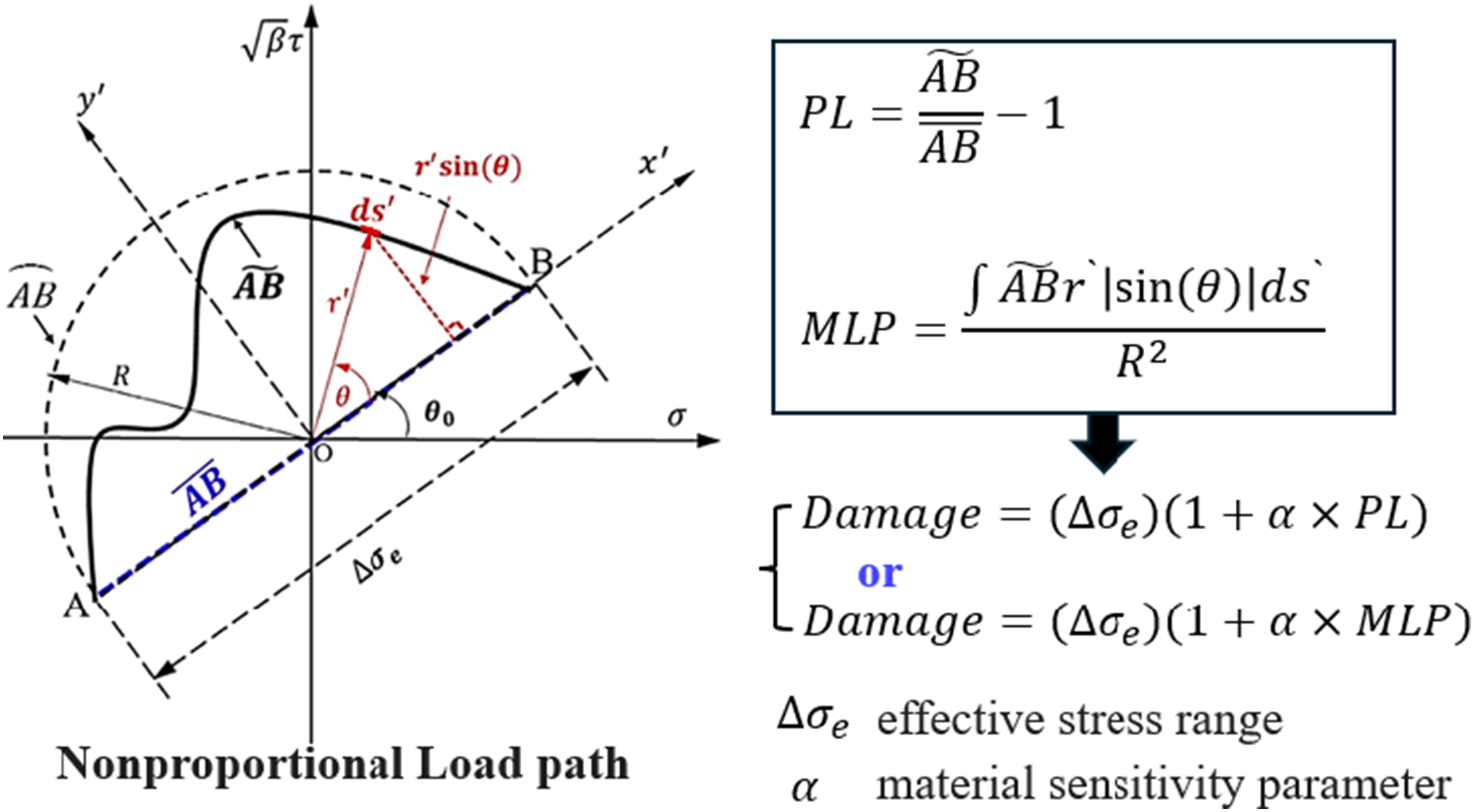
Schematic of the two geometric damage parameters (pl and MLP) (Mei and Dong, 2016).
Furthermore, with the advancement of machine learning technologies, the construction of physics-informed machine learning hybrid models has emerged as a significant method for predicting damage. Leveraging the powerful nonlinear data processing capabilities of machine learning algorithms, researchers have adopted various approaches to investigate this domain. Tasdemir et al. (2025) obtained high-fidelity data from non-monotonic loading experiments and constructed a feedforward neural network composed of classification and regression subnetworks. This approach extracts constitutive relationships directly from experimental data without relying on a predefined theoretical framework, offering a novel perspective for physics-informed damage modelling under complex stress states. In contrast, Gao et al. (2024) combined the Manson-Halford model with machine learning algorithms. They employed the physical model to describe the nonlinear damage accumulation process while utilising machine learning to learn from experimental data and calibrate the load interaction effects that traditional models struggle to capture. This hybrid approach achieved accurate prediction of damage evolution in nickel-based superalloy GH4169 under multilevel cyclic loading.
For modelling anisotropic damage behaviour under complex loading using machine learning, Lorenzo et al. (2026) and Yvonnet and He (2025) employed deep neural networks and spherical harmonic expansion, respectively, to learn anisotropic damage evolution laws from representative volume element (RVE) simulation data. By establishing a direct mapping from microstructure to macroscopic damage, their approaches effectively capture anisotropic damage behaviour under complex loading while ensuring computational efficiency.
To address the insufficient predictive accuracy of traditional multiaxial fatigue damage models under non-proportional cyclic loading, researchers have embedded physical information into machine learning models to enhance their predictive capabilities. The deep learning model proposed by Liu et al. (2026) integrates convolutional neural networks (CNNs), long short-term memory (LSTM) networks and fully connected neural networks (FCNNs), with a particular focus on capturing the sequential coupling effects under non-proportional loading. Karolczuk et al. (2022) combined Gaussian process regression with a physics-based modelling strategy, employing stress and strain invariants as input features to capture the material's physical damage mechanisms. Addressing the challenge of small sample sizes, Deng et al. (2024) proposed a physics-informed ensemble machine learning framework that leverages the respective advantages of purely data-driven and physical models, effectively improving predictive accuracy and generalisation capability.
Under extreme non-proportional loading conditions, such as impact, Huang et al. (2025) proposed a progressive damage model that integrates physical modelling with machine learning. In terms of damage modelling, they introduced a dynamic threshold based on the maximum equivalent displacement to replace the traditional constant threshold. By combining principal component analysis (PCA) with CNN, they achieved high-fidelity prediction of nonlinear responses under impact loading, offering new insights for damage assessment under abrupt path changes. Danoun et al. (2022) proposed a Thermodynamically Consistent Recurrent Neural Network (ThC-RNN) architecture, whose design explicitly accounts for the history dependence inherent in non-proportional loading paths. This model uses an RNN framework to capture loading history and complex nonlinear relationships. The core of this method lies in introducing thermodynamic constraints during the training process. By incorporating penalty terms into the loss function, the model is forced to obey the physical law of ‘non-negative energy dissipation’. The model automatically corrects predictions that violate fundamental thermodynamic principles during training by embedding physical rules, enhancing its predictive capability and accuracy.
Although the aforementioned studies demonstrate the promising application of physics-informed machine learning methods for damage modelling under non-proportional loading, several challenges remain. First, the model's generalisation capability for non-proportional loading paths lacks systematic validation methods, with most studies still confined to specific materials and loading conditions (Zhou et al., 2024). Second, a methodological consensus has yet to be reached on integrating physical information. From selecting physics-based features and imposing physical constraints in loss functions to designing network architectures that satisfy thermodynamic consistency, the pathways for integrating different physical mechanisms with machine learning still require further in-depth exploration (Wang et al., 2022).
Conclusion
This paper has systematically reviewed key components of the research chain concerning damage under non-proportional loading paths, encompassing experimental design, damage quantification, the revelation of microscopic mechanisms and damage modelling. It aims to provide a valuable reference for subsequent scholars to gain deeper insights into damage evolution under non-proportional loading conditions.
Regarding experimental design, complex non-proportional loading paths can be effectively replicated by optimising the geometries of specimens, coupled with precise control over the loading sequences of different load types. Furthermore, propelled by the rapid advancement of multi-scale characterisation techniques, damage quantification methodologies evolve from traditionally inefficient optical microscopy observations towards high-precision, real-time and non-destructive physical signal monitoring. Concurrently, these high-resolution characterisation techniques provide powerful support for capturing microscopic damage behaviours.
Beyond the aspects above, this paper reviews primary categories of damage modelling methods for non-proportional loading paths. For uniaxial step loading, the predominant strategy integrates machine learning with mapping algorithms, trains damage models based on experimental data, and enables the transfer of damage states across loading stages. In relatively simple loading paths, a practical approach within the polycrystalline plasticity damage framework involves constructing damage models at the slip system level, effectively balancing computational accuracy and efficiency. Under multi-axis variable path loading, damage evolution arises from the competition and coupling among different stress states. Although empirical formulas incorporating stress state parameters are commonly used in engineering applications, they often lack a physical foundation. As an alternative, interpolating damage evolution laws observed under representative stress states or establishing normalised damage variables can more effectively quantify the influence of multiaxial stress. For multi-axis cyclic loading, damage evolution becomes considerably more complex, often exhibiting characteristic responses such as non-proportional cyclic hardening. The introduction of a back stress tensor in kinematic hardening models provides an effective means to capture the non-proportional hardening induced by the rotation of principal stress axes. The evolution of internal state variables is path-dependent. By integrating their evolution equations throughout the loading history, the damage can be calculated. Furthermore, developing non-proportionality factors or path-dependent damage parameters that incorporate both loading path dependence and material attributes for quantitatively assessing the effects of non-proportional loading paths.
Although significant progress has been achieved in damage modelling under non-proportional loading paths, several promising directions warrant further exploration. The alteration of loading paths induces rapid evolution of the stress state and triggers complex interactive responses within the microstructure. Consequently, developing cross-scale damage models that effectively bridge microscopic physical mechanisms with macroscopic mechanical responses represents a crucial pathway toward accurate damage prediction. Secondly, the deep integration of data-driven methods with physical models demonstrates considerable potential. Leveraging machine learning techniques to process complex experimental data and embedding these insights into sound frameworks holds promise for developing damage models that maintain high accuracy while possessing robust extrapolation capabilities. Finally, further elucidating the inherent competitive and synergistic mechanisms of damage evolution under non-proportional paths – particularly under conditions involving thermo-mechanical coupling and extreme loading – is paramount for refining existing theoretical models and expanding the boundaries of their engineering applications.
Highlights
Reviewing non-proportional loading path experimental design
Systematically summarising microscopic damage mechanisms across diverse non-proportional loading paths
Comprehensively reviewing quantification methods for damage
A systematic review of damage modelling methods under non-proportional loading paths
Footnotes
Acknowledgements
The authors would like to express their sincere gratitude for the support provided by the Institute of Forming Technology & Equipment, Shanghai Jiao Tong University. The authors sincerely appreciate the constructive comments and valuable suggestions from the editor and reviewers, which have significantly improved the quality of this manuscript.

Authors’ contributions
Data availability statement
The data that support the findings of this study are available from the corresponding author upon reasonable request.
Funding
The authors disclosed receipt of the following financial support for the research, authorship, and/or publication of this article: This work was supported by the Science and Technology Cooperation Program of Shanghai Jiao Tong in Inner Mongolia Autonomous Region – Action Plan of Shanghai Jiao Tong University for "Revitalizing Inner Mongolia through Science and Technology” and the National Natural Science Foundation of China (Grant Number 52375352).
Declaration of conflicting interests
The authors declared no potential conflicts of interest with respect to the research, authorship, and/or publication of this article.