






Abstract
A total of 130 undergraduate and graduate music education and music therapy students watched a videotape of elementary children with cerebral palsy (CP) and typical peers preparing and performing in a musical production. The focus of the video was on preparation for inclusion, inclusive interactions, and the performance. Four questions addressing inclusion that required written responses from participants were posed. Responses were categorized for comparisons. Results indicated no significant difference due to training (music therapy majors, music education majors with and without class discussions on inclusion; p > .05). All groups focused on social more than academic benefits for all children. Participants noted the following: benefit of being in a musical play for the children with CP, that children without CP benefited from exposure to information about the disability, that children with CP gained from interacting with typical peers and from making a new friend, and many of the techniques teachers used to prepare students for successful inclusion. More than a third were concerned that their future students would not accept children with disabilities in the classroom or that children with disabilities would be incapable. There is an apparent inability to make the transfer of using the identified teaching techniques to enable their own future efforts at inclusion to be successful.
Success in the inclusive music classroom depends greatly on the perceptions and attitudes of both teachers and classroom peers. Researchers have examined the attitudes of inservice and preservice teachers and classroom peers, strategies to alter these attitudes, and the perceived benefits and challenges of mainstreaming in both the regular and music education settings.
Researchers in the field of special education have focused on the attitudes and potential impact of teachers’ attitudes toward students with special needs in the classroom (Cook, 2001; Jobe, Rust, & Brissie, 1996; Shippen, Crites, & Houchins, 2005). Somewhat less prevalent are researchers who intended to determine the attitude of children in inclusive settings (Dyson, 2005; Rimmerman, Hozmi, & Duvdevany, 2000). Complimentary research in music education and music therapy has examined the attitudes of teachers and students in the music setting (Colwell, 1998, 1999; Darrow & Johnson, 1994; Jellison, 1992; Johnson & Darrow, 1997; Wilson & McCrary, 1996).
Teachers’ views toward mainstreaming, and more specifically, students with special needs, can be affected by several factors. These factors include increased knowledge about the disability conditions, support from administration in the form of availability for consultation/ collaboration with those knowledgeable about inclusion, time for lesson adaptation, input on placement decisions, models of effective inclusive practices, perceptions of severity of students’ disabilities, type of disability (i.e., emotional or behavior disorders), prior experience, gender, and self-perception of teacher efficacy in mainstreamed settings (Avramidis, Bayliss, & Burden, 2000; Burke & Sutherland, 2004; Cook, 2001; Darrow, 1999; Jellison, Brooks, & Huck, 1984; Jobe et al., 1996; Sideridis & Chandler, 1995; Treder, Morse, & Ferron, 2000). Setting the stage for these factors may help promote positive attitudes among teachers and in turn facilitate successful programs.
A variety of strategies have been implemented to alter attitudes toward mainstreaming and inclusion and more specifically, toward students with special needs from the perspective of teachers (inservice or preservice) and classroom peers (Cassidy, 1987; Colwell, 1999; Colwell, Thompson, & Berke, 2001; VanWeelden & Whipple, 2005). Researchers have supported and examined the impact of increased knowledge about disabilities and curriculum adaptations on attitudes of teachers (Carroll, Forlin, & Joblin, 2003; Colwell, 1999). In a more interpersonal form of increased information, several researchers have advocated the use of academic and social interaction or experience with individuals with disabilities as a means to alter attitude (Jellison et al., 1984; VanWeelden & Whipple, 2005; Wall, 2002). Similarly, researchers have focused on increased information through both knowledge and experience as a functional strategy for altering the attitudes of children and adults (Cassidy, 1987; Cassidy & Sims, 1991; Colwell, 1998; Johnson & Darrow, 1997).
In music teacher education, preservice teachers often take a course in the Special Education Department providing basic information about children and youth with special needs. Only a few programs offer a more specific course within music education targeting working with students with disabilities in music settings (Colwell & Thompson, 2000; Salvador, 2010). Field experiences are a common component of teacher education programs in general and in music education specifically (Buck, 1992; Burke & Sutherland, 2004; Hourigan & Scheib, 2007; McDowell, 2007). The opportunity for preservice music teachers to complete a field experience working with children with special needs in a music setting guided by a music faculty member may be less available. Researchers have found that actual interactions with children with disabilities through field experiences can alter perceptions of music majors with regards to attitude, comfort, and perception of level of preparedness (Hourigan, 2007, 2009; Kaiser & Johnson, 2000; VanWeelden & Whipple, 2005).
Disability simulation is an additional strategy for altering the attitudes of teachers and students toward individuals with special needs. Simulations have been used in awareness training to promote empathy, awareness, and positive attitudes of adults (Behler, 1993; Grayson & Marini, 1996). In public schools, simulations have also been used to influence attitudes of students toward their peers with disabilities (Hallenback & McMaster, 1991). Although not as prevalent in the literature, disability simulations have been implemented in the music setting to alter the attitudes of music educators/therapists (Colwell, 2003, 2010) and public school music students (Colwell et al., 2001).
More researchers have described attitudes toward and concerns about mainstreaming and inclusive education than those who have described the perceived or actual benefits of such programs. Although an accepted practice within school districts across the country, debate continues over the benefits and challenges of partial or full inclusion of students with special needs (Copeland, Hughes, & Carter, 2004; Eisenberger, Bertrando, Conti-D’Antonio, 2000). The implied perception of the initial public laws was that the purpose of mainstreaming was for the social benefit of the students with disabilities yet the promotion of partial or full inclusion seems more all encompassing. Benefits of inclusive education may be both social and academic (Hunt & Goetz, 1997; Madden & Slavin, 1982) and can exist for the students with disabilities as well as for their typically developing peers (Peltier, 1997; Tapasak & Walther-Thomas, 1999).
Reported and proposed social and academic benefits of integration of students without disabilities and their peers with disabilities have been described in the literature (Halvorsen & Sailor, 1990; Hunt & Goetz, 1997). Benefits begin with the positive classroom issues of having regular and special educators working cooperatively within one setting and may include the immediate availability of support services, having more than one adult in the room, and instructional integration between teachers (Gieger & Drecktrah, 2001).
Academic benefits have been observed for both students with special needs and their typically developing peers with increased academic responding (McDonnell, Mathot-Buckner, Thorson, & Fister, 2001), improved language development (Klein, Geiss, Kushner, & Hill, 2003), and on-site availability of peer role models for students with special needs (Geiger & Drecktrah, 2001). Social benefits include improved self-concept, increased tolerance of other people, reduced fear of human difference, improved reaction toward peers with disabilities (Hammond, 1996; Shevlin & O’Moore, 2000), increased empathy for peers (Gieger & Drecktrah, 2001), reduced rates of competing social behaviors during learning (McDonnell et al., 2001), and friendship development among peers (Copeland et al., 2004).
The purpose of this study was to observe the impact of training on students’ perceptions of inclusive music education. Questions posed were the following: (a) Does training in inclusive education change one’s perception of the benefits of inclusion similarly for children with and without disabilities? (b) Can future educators and therapists identify strategies used by others to ensure success in the mainstreaming process? (c) Do participants project their use of these strategies in their own future professional work?
Method
Participants (N = 130) for this study included undergraduate and graduate students from two large, comprehensive music schools, one in the Midwest and one in the South. To look at the effects of training on perceptions of inclusion, three groups of participants were targeted. One group included music education students enrolled in a methods course (n = 48), who participated in this research study prior to any class discussion on values or techniques of inclusion. The second group included music education students enrolled in a course focused on inclusion in music education (n = 44). Data were collected approximately half way through the course. The third group was composed of students majoring in music therapy (n = 38).
To compare perceptions of the benefits of inclusion for children with disabilities and those without, participants watched a videotape of elementary children with cerebral palsy (CP) and typical peers preparing for and performing in a musical production. This professionally made 30-minute videotape, Something Magical (Gandolfini Dye, 1991), documents social and academic preparation of two groups of children for the performance of a musical. One group of children is educated in a self-contained school for children with CP and the other group is educated in a private school. The videotape consists of interviews with teachers and parents of both sets of children, the music therapist who coordinated the production, children from both schools, rehearsals in separate settings as well as inclusive settings, preparations for inclusion—which included presentations of various disabilities and a chance to participate in a disability simulation—and segments of the final production.
University students watched the videotape and were asked to answer four open-ended questions: (a) What do you think the children with cerebral palsy gained from this experience? (b) What do you think the children without cerebral palsy gained from this experience? (c) What did the teachers and staff do to prepare students so that the mainstreaming would be successful? (d) What do you think the challenges will be in your classroom when children with disabilities are included in music activities?
Participants’ responses to the first two questions were coded as academic benefits (learned about music, had the opportunity to be in a play/achieved something, learned about CP, other) or social benefits (interacted with students different from themselves, gained a friend, developed a better understanding/respect of others, had fun, developed self-confidence, other). Responses to the third question were recorded by teaching strategy and frequencies of responses were tallied. Responses to the fourth question were categorized as academic/students, social/students, and teacher challenges. Responses in each category were tabulated. Number of participants responding at least once in each category was recorded for each question. For reliability purposes, an independent rater coded one third of the response sheets (n = 45). Reliability across all comments, calculated as agreements divided by agreements plus disagreements, was r = .91.
Results
To look at differences in perceptions due to training, a two-way chi-square analysis compared the data gleaned from the first two questions: What were benefits of experience for children with CP? What were benefits of experience for children without CP? Numbers of responses (N = 562) of perceived academic and social benefits for the two groups of children were tallied across the three training groups. Data, converted to percentages for ease in comparison, are presented in Table 1. Results indicated that there was no significant difference in observed and expected frequencies between the inclusive and noninclusive classes across types of comments, χ2(6, N = 130) = 4.97, p > .05. It is clear that all groups focused on social benefits more than academic benefits regardless of participants’ training. This was most notable in the perceptions of benefits for children without CP. Patterns of responses in the subcategories were uncannily similar across the treatment groups for both questions; therefore data were collapsed for descriptive comparisons among subcategories.
Percentage of Responses by Group Across Category

Perceptions of social benefits for children with CP and those without CP fell into six categories: (a) provided a chance to interact with children different from oneself, (b) made a friend, (c) developed an understanding about/acceptance for children who are different from oneself, (d) had fun, (e) felt a sense of belonging/gained confidence and self-worth, and (f) other. Frequency of responses in each category is displayed in Figure 1. What is striking in the graph is the perception that children with CP gained much more from interacting with typical peers and from making a new friend than did the children without CP. Enjoyment, sense of camaraderie, and a boost in confidence are all usual reasons given in support of children participating in performing groups. Participants in this study, however, rarely recognized those benefits for the children without CP but more often listed it as an advantage for children with CP. As might be expected, participants listed “develop an understanding” and “develop respect” for others as a benefit for children without CP more frequently than for those with CP.

Participants’ perceptions of children’s social gain from inclusive setting
Perceptions of academic benefits for children with CP and those without CP fell into four categories: (a) opportunity to participate in a typical music activity (musical play), (b) learned something about music, (c) learned about CP, and (d) other. Frequency of responses in each category is displayed in Figure 2. Participants overwhelmingly noted the benefit of being in a musical play (engage in a typical activity) for the children with CP; however, that did not seem as important to the children without CP. As expected, participants’ perceptions were that children without CP benefited by exposure to information about the disability.

Participants’ perceptions of children’s academic gain from inclusive setting
In response to the third question, participants noticed many of the techniques teachers used to prepare students such that the endeavor was successful. Table 2 presents the techniques and the frequency of responses among participants. Three of the techniques reported were used in preparing the children without CP—learning about the disability, being confined to a wheelchair at a mall in a disability simulation, and communication and assistance strategies. One technique was specific to preparing the children with CP—adapting equipment and parts so that all children could participate. The other techniques applied to preparing all children—pairing students and careful structure of the initial meeting, music practice sessions that happened separately in home schools prior to combined rehearsals, validation of feelings of apprehension before the first meeting, and making the experience enjoyable. Unique to the particular setting portrayed in the video, a music therapist wrote the musical performed by the children. The plot of the play highlighted the “magic” that happens when friendships develop between people who initially appear to be different from one another. Many participants identified the appropriateness of the play in aiding the process of inclusion.
Perceived Strategies Used to Prepare for Success in Mainstreaming (Percentage of Participants Responding From Each Group)
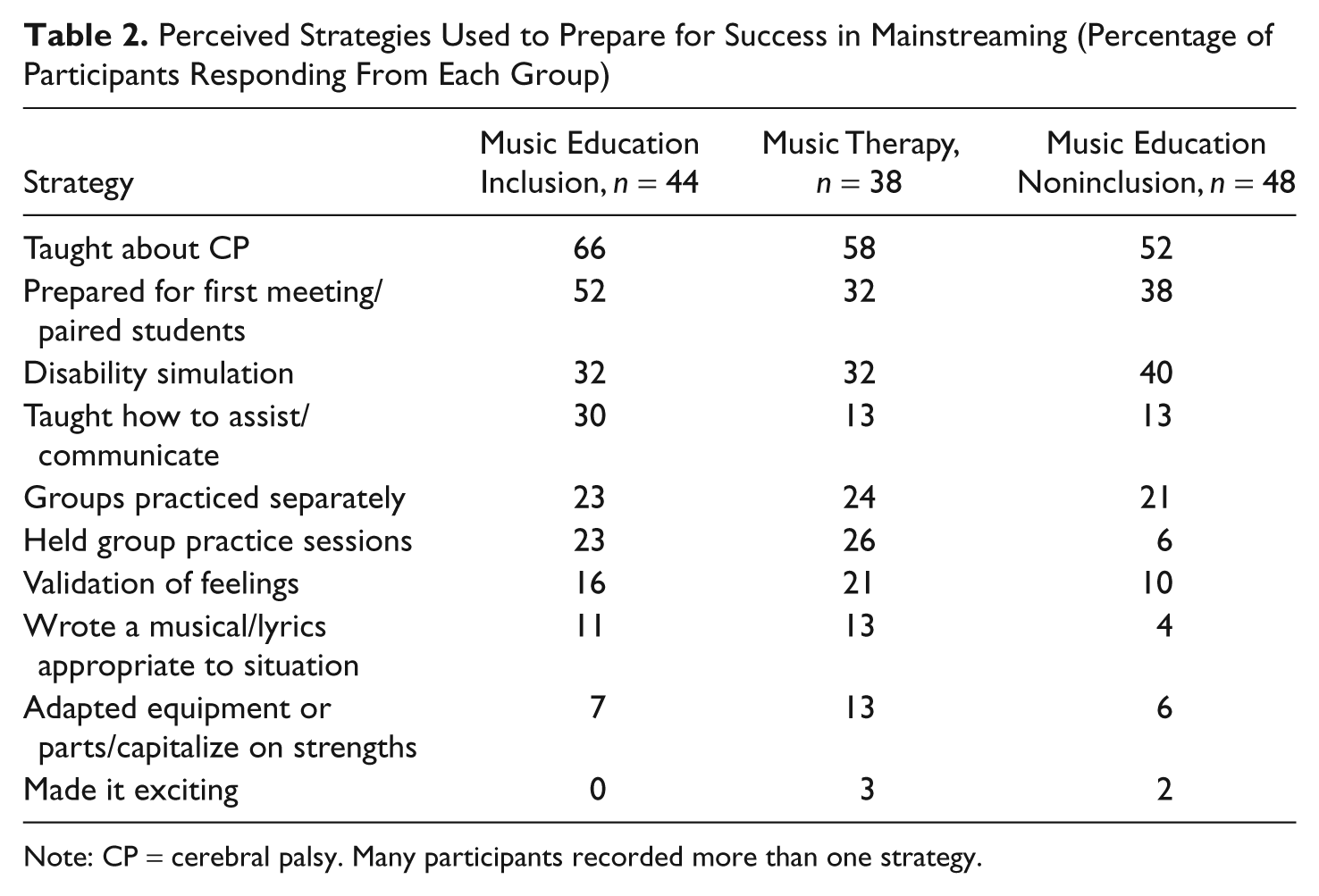
Note: CP = cerebral palsy. Many participants recorded more than one strategy.
In the fourth question, participants were asked what challenges they predict they will face in an inclusive classroom. Comments fell into two main categories—challenges the children will face and challenges the teacher will face. Responses were coded and recorded only once per subject in each sub category. There were 203 total recorded comments from the 130 participants, the majority of which (70%) dealt with teacher challenges. Percentages by group are reported in Table 3.
Perceived Challenges in an Inclusive Classroom (Percentage of Participants Responding From Each Group)
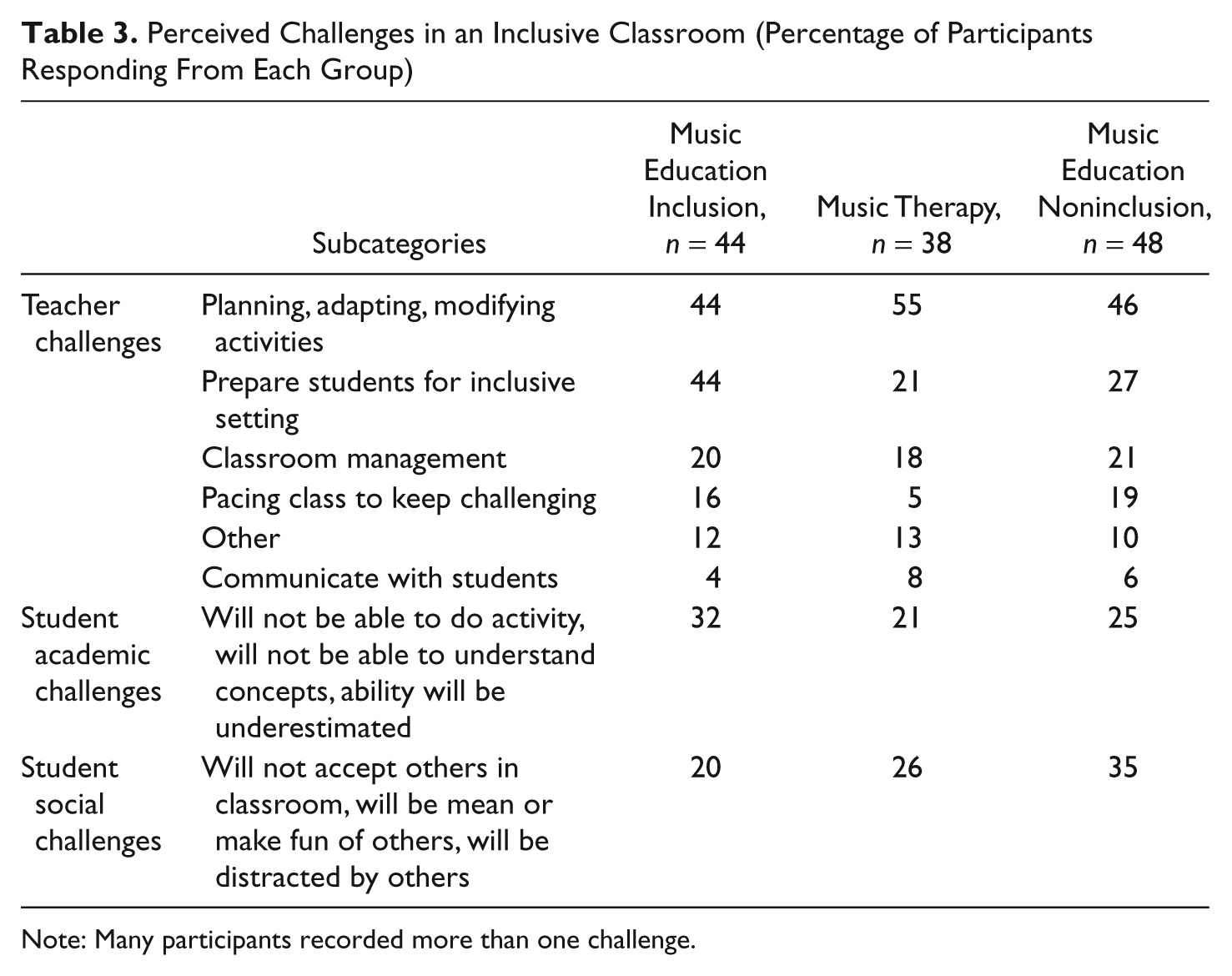
Note: Many participants recorded more than one challenge.
Teacher challenges were recorded in one of six subcategories: (a) planning, modifying, or adapting activities so that students of all levels can participate successfully; (b) pacing activities in class to keep them challenging and interesting for all children; (c) communicating with the children who are disabled; (d) preparing all children for accepting other children in the classroom, including teaching the children without disabilities appropriate interaction strategies; (e) classroom management when some children might need individual help and others will need to be patient; and (f) other unique comments. Three participants did not answer the question. As can be seen from the data in Table 3, participants most frequently (38% of teacher responses) articulated the challenge of planning lessons that allowed all children to participate in activities. This included responses about selecting appropriate activities, adapting instruments and the classroom, and simplifying parts. Music therapy majors identified this notably more often than did either music education group. Preparing the classroom for acceptance was another frequently cited category (22% of teacher responses), with this particularly concerning the participants who received inclusion instruction in their music education class. Participants acknowledged the need to structure classroom interactions by teaching appropriate interaction strategies, teaching information about disabilities, and setting expectations about mutual respect in the classroom.
Nearly one third of the responses (30%) to the fourth question defined challenges the students would face in the classroom. As presented in Table 3, these were fairly equally divided between comments related to academic and social behavior. Half of the comments described academic attributes of the children with disabilities—they would not be able to do the activities, would not be able to understand the concepts, or their abilities would be underestimated by the other children. The other half of the remarks dealt with social behavior of the children without disabilities—they will make fun of or be mean to, they will not be accepting of, or they will be distracted by the behaviors of the children with disabilities. Music education students in the inclusion class were more concerned about academic behaviors and music education students with no training were more concerned with social behavior than either of the other two groups.
Discussion
The participants in this study watched a video that was explicit in preparation techniques, showed students being musically successful at their own level, and promoted the positive effects of mainstreaming on all children. Therefore, it is not surprising to find no differences among training groups in the articulation of benefits for children in the video. The message implied in the video was clear and all participants seemed equally aware of this intended message.
Researchers have noted that there are social and academic benefits of inclusive education for both the children with disabilities and their typically developing peers (Halvorsen & Sailor, 1990; Hunt & Goetz, 1997; Madden & Slavin, 1982; Peltier, 1997; Tapasak & Walther-Thomas, 1999). What is a little disconcerting in this current study is the perceived differences in the benefits for the two groups of children. On one hand, children with CP were thought to have benefited from participating in a production with their typical peers, developing friendships, and feeling a sense of achievement and belonging. On the other hand, the children without CP were thought primarily to have gained understanding of and respect for others with disabilities. Although these are all positive observations, it is interesting that the perceived benefits were so strikingly different, when all children had the same level of interaction, the same opportunity to make new friends, participation in the play, and to be a part of a group. Obviously, learning about a disability and participating in simulations would be more beneficial to the typical peers.
Also interesting is the apparent ability of participants to identify strategies used by teachers to prepare for successful inclusion (including academic and social success), yet many comments indicated lack of awareness of how they would transfer this information into their own future classroom. Participants were able to specify nearly all the obvious and even more subtle preparations made by the instructional staffs at the two schools. Yet more than one third of the participants (37%) were concerned either that their future students would “make fun of” the children with disabilities and be judgmental and nonaccepting or that children with disabilities would be incapable of participation. The responsibility of the teacher to make this work was noticed but often not taken personally. It is important that teachers develop a repertoire of strategies to use in preparation for the inclusive process, so that whether “it will work” is not left to chance. The difficulty does lie in preparation for children with different levels of abilities.
A variety of teaching strategies have been used to alter the attitudes of preservice and inservice teachers toward the inclusion of children with special needs into the music setting. Increased knowledge (Carroll et al., 2003; Colwell, 1999), disability simulation (Colwell, 2003, 2010), and actual field experience (Hourigan, 2007, 2009; Kaiser & Johnson, 2000; VanWeelden & Whipple, 2005) have been indicated by researchers to have an impact on the attitudes of these teachers. Although music methods instructors can provide informational knowledge and teaching strategies, create disability simulations experiences, and design mock peer teaching modules focused on modifications and accommodations for children with special needs, the need for field experience seems warranted. Practicum experience for methods courses should include children with disabilities. Since there are not many courses specifically designed for working with children with special needs in a music setting in our music teacher education program (Colwell & Thompson, 2000; Salvador, 2010), these field experiences may need to occur within the music methods courses (general, choral, and instrumental).
Footnotes
The author(s) declared no potential conflicts of interest with respect to the research, authorship, and/or publication of this article.
The author(s) received no financial support for the research, authorship, and/or publication of this article.