







Abstract
The purpose of this study was to describe the essence of being a male elementary general music teacher (MEGMT). I sought answers for two research questions. First, what are the perceived uniquely male experiences in elementary general music teaching? Second, in what ways might gender be a consideration in the preparation of elementary general music teachers? I conducted semistructured interviews of ten current MEGMTs in one New England state. After three cycles of coding, I found four emergent themes: (a) perceived uniquely male issues in teaching, (b) the hiring process and early years, (c) workplace gender issues, and (d) urban teaching overall. These findings both corroborated and contradicted those of the limited studies about MEGMTs, yielding support to investigate MEGMTs’ multifaceted essence further.
Introduction
Since the 1990s, officials in media, government, and academia have discussed the small number of male teachers in Western elementary or primary schools, especially in the United Kingdom (e.g., Bailey, 2002; Biklen, 1995; Nelson, 2002; Weaver-Hightower, 2003, 2011). Commentators in this dialogue have referred to this state of affairs as the feminization of elementary school teaching and claimed it as a rationale for boys’ perceived poor academic achievement (Cushman, 2008). Researchers have rejected the feminization argument for a number of reasons, not least of which because it implies that female teachers cannot communicate with boys and male teachers can. Rather than focusing on a perceived deficit in any gender, researchers have turned to gender characteristics in teachers. In a thorough review of literature, Skelton (2012) argued that any stakeholders wishing to gender-diversify faculty would be wiser to focus of how masculinity and femininity work in elementary schooling.
Perhaps because of this recent gender debate, researchers have studied male teachers and sought their perspectives on teaching (e.g., Cooney & Bittner, 2001; Francis, 2007; Montecinos & Nielsen, 2004; Skelton, 2012; Smedley, 2007; Sumsion, 2000). They found that male teachers have conflicting views about their teaching experience. Some male teachers find themselves facing suspicion of their motives for working with children (Smedley, 2007), others pay attention to their gender only because their colleagues do (Skelton, 2012), and still others relish the opportunity to be a role model to students (Cooney & Bittner, 2001), especially to boys.
In music education, there is a growing body of literature on teacher gender (e.g., Gould, 1992; Kruse, Giebelhausen, Shouldice, & Ramsey, 2015; Sears, 2010). There are fewer inquiries into the perspectives of male elementary music teachers on their teaching, but that may be changing. Roulston and Mills (2000) analyzed two earlier multiple case studies and described Tony, who felt out of place at faculty meetings because of his gender. Another male music teacher participant, Andy, created camaraderie among the boys in his class with his sporting background and an air of hegemonic masculinity. According to Roulston and Mills (2000), both participants attempted to distance themselves from “unmanliness.” Later, and now in the United States, Roulston and Misawa (2011) examined music teachers’ constructions of gender in elementary education. The male participant, Brian, felt the need to assert that he was a married man with two children in order to combat inferences that he was possibly gay. Brian left elementary school teaching to pursue a middle school chorus position partly because of these perceived suspicions. More recently, in an instrumental case study, Shouldice (2013) studied one male undergraduate’s choice to become an elementary general music teacher. For Pete, critical experiences in his coursework and dissatisfaction with band culture were among the factors that led to his career shift. Pete commented that his gender influenced others’ reactions to hearing about his choice because a common perception is that women have a better temperament to teach younger students and that men are suited for older students. Pete dismissed this stereotype because he and women he knew were evidence for the opposite teaching ages.
In light of the limited amount of research on this facet of gender studies in music education, the purpose of this study was to describe the essence of being a male elementary general music teacher (MEGMT). I sought answers for two research questions:
By pursuing this line of research, I hope to raise awareness about any unique experiences that MEGMTs face in order to better prepare preservice MEGMTs. In a broader sense, I hope to bring a general awareness to all educational stakeholders, particularly MEGMTs’ colleagues and administrators, about MEGMTs’ unique and specific responsibilities.
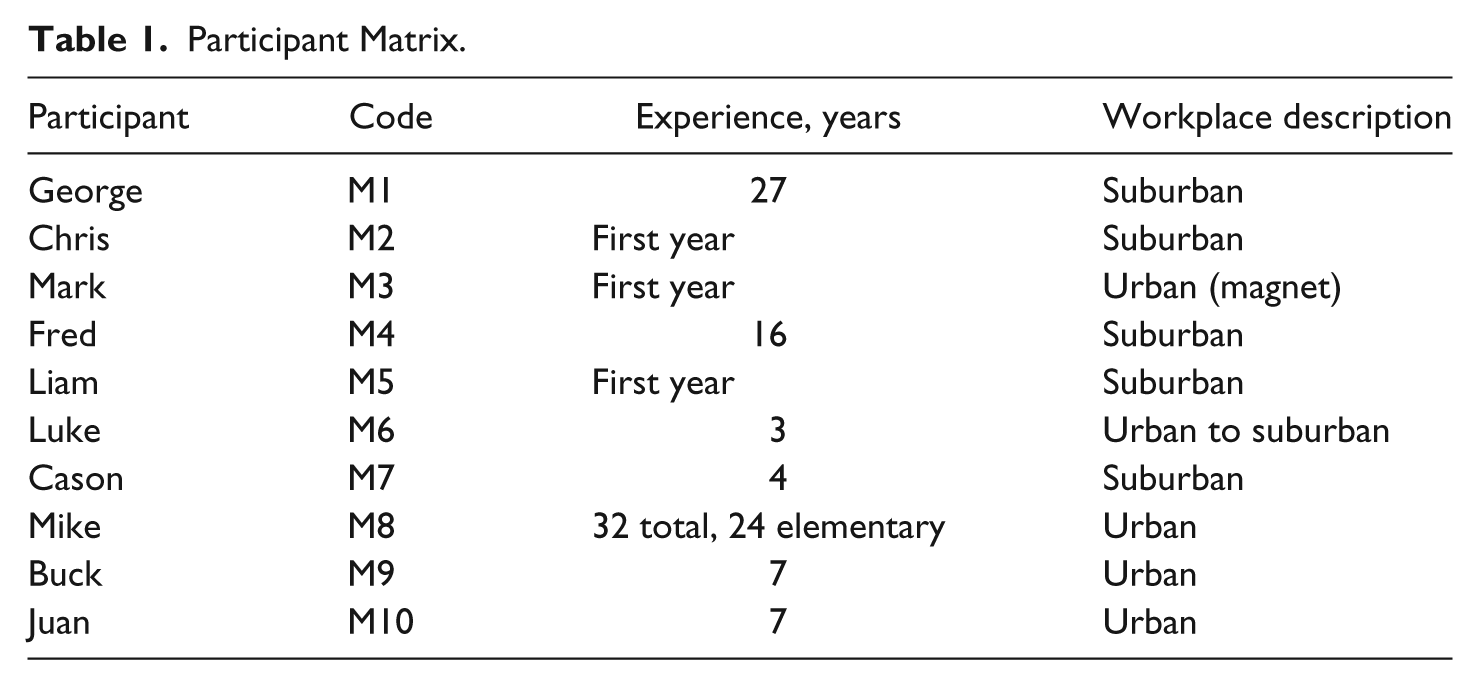
Participant Matrix.
Method
Phenomenology is the description of the common meaning for several individuals’ lived experiences (Creswell, 2007). A central purpose of phenomenology, according to Van Manen (1990), is to identify an object of human experience and reduce it to its very nature. Moustakas (1994) referred to this as what collected individuals experienced and how they experienced it. In this investigation, the object of human experience was being a MEGMT. I pursued this inquiry through phenomenology because I was most interested in commonalities among the participants’ experiences with the intention of better informing preservice or early-career MEGMTs about what they may encounter.
I completed the study within a 5-month period. In January through April of 2015, I recruited participants who met the criteria of being MEGMTs currently practicing in the public schools of one New England state. I found participants’ information through the websites of every public elementary school in the state and through snowball sampling. In keeping with Polkinghorne’s (1989) recommendations for phenomenological studies, I strived to recruit at least 10 participants. I emailed each MEGMT individually with a recruitment letter and a request for names of other MEGMTs in the state. I corresponded with dozens of potential participants, and of those willing to take part in semistructured, in-person interviews, I selected 12 participants for maximum variation (Miles, Huberman, & Saldaña, 2014) concerning years of teaching experience and socio-economic conditions of their districts. To refine my initial interview questions, I conducted two pilot interviews prior to gathering data from the remaining 10 participants.
Despite my efforts for maximum variation among participants, MEGMTs were mostly young people. Five of the participants were in their early career, four of whom were in their first year of teaching, three were closer to the middle of their career, and two were toward the end of their career. I selected five participants who taught in urban environments and five who taught in suburban environments. All but two participants conducted a chorus as part of their workload. All participants held full-time positions except for one who held a .9 position, and half of the participants reported working in two schools.
I conducted one semistructured interview with each participant at places and times of their choosing, and I collected and analyzed data simultaneously (Creswell, 2007). Due to time constraints, I had a choice to conduct multiple interviews with fewer participants or one interview with many participants and I chose the latter. The average interview lasted about 35 minutes. I recorded all interviews with an audio-recording application on my mobile phone. I wrote observations as personal asides during interviews and transcribed all interviews into separate Word documents. After de-identifying the data and assigning pseudonyms, I conducted member checks with all participants, asked if they had any additional input, and made minor changes as necessary. After preparing the data, I entered them into HyperRESEARCH software, read the data multiple times, and created lengthy analytical memos in the style of Emerson, Fretz, and Shaw (2011). The interview protocol for the semistructured interviews was as follows:
How long have you been a male elementary general music teacher?
How did you get to be a male elementary general music teacher?
If you came into a student teaching seminar, what advice would you give to young teachers about to enter the field?
Would your advice to the males in the room be different from the advice to the females?
If so, would you give this advice based on personal experience? If so, please describe.
Do you have anything you would like to share about being a male elementary general music teacher?
Before coding, I heeded Maxwell’s (2005) recommendations and spent time reflecting on coding categories, discussing them with two colleagues and a mentor. To code the data, I used three cycles of coding (Miles et al., 2014). In the first cycle, I used open coding, paying special attention to emic or in vivo codes (Creswell, 2007), of which there were several that were poignant in my view (e.g., parental role/fatherhood). In the second cycle of coding, I combined first cycle codes into pattern codes (Miles et al., 2014), and in the third cycle of coding, I combined the pattern codes into four themes with narrative descriptions.
As a practicing MEGMT at the time of this study, I made an effort to suspend my judgments about participants’ answers. At the time of the interviews, I had taught in public elementary schools for 9 years, the last 7 of which were teaching general music to students in prekindergarten to Grade 4. As a male, I noticed I was in the minority in my workplace and became curious about other MEGMTs’ experiences at work. Hence, this study is an extension of my experience as a practitioner, and I conducted many interviews within 1 hour of teaching my own students. It is possible that my background was helpful in eliciting candid and honest responses. It is also possible that my bias could have clouded my judgment in determining which lines of questioning to pursue further with participants. However, I was careful to increase trustworthiness by declaring my bias from the outset of the study and by conducting weekly debriefings with two colleagues and a mentor.
Findings
After analyzing the data in three cycles of coding, I found four emergent themes: (a) perceived uniquely male issues in teaching, (b) the hiring process and early years, (c) workplace gender issues, and (d) urban teaching overall. In this section, I will summarize each theme and seek the emic perspective by providing salient quotations.
Perceived Uniquely Male Issues in Teaching
This theme was a synthesis of data on participants’ advice to fellow males, fatherhood mentions or analogies, male role model discussions, and the perceived reactions to MEGMTs. The participants thought these issues were uniquely male. The first of these issues in many interviews was the use of falsetto. Each participant had an opinion on the singing voice to use with students, the strongest of which came from George, who cited vocal health among other reasons not to use falsetto singing exclusively: My first one and a half years I taught with falsetto. I would not be here if I tried to do an entire career singing falsetto, my voice would have been gone . . . Two decades ago it would have been absolutely shot and I would not have survived.
Two of the 10 participants used their falsetto singing exclusively. The other participants described ways in which they trained their students to sing with an octave displacement. These strategies included occasional falsetto use, playing an instrument (e.g., piano, ukulele, xylophone) in the students’ octave while singing an octave below, and praising student models.
All participants said they had been called a positive male role model before, but most participants were at a loss to explain what a male role model was specifically. When asked to define a male role model, many participants spoke about their impact as males in elementary schools. Mark stated it this way, “The boys are very . . . responsive to having that model around just simple as interactions in the hallway or just saying ‘hi’ to the kids in the morning.” George described it this way, “To see you there, in kindergarten, treating them kindly and treating them nicely, that means a great deal to them and it’s going to impact how they view males in the future.” All participants had a favorable or neutral reaction to the added responsibility of being a perceived male role model except for one. Juan, a MEGMT who taught in the most economically disadvantaged school district in this study, the same school district he grew up in, voiced a unique preference: Yeah I (exhale) like I don’t really, (pause) I guess when I think of myself, (pause) I don’t really think of myself as like a role model or anything like that, but, I would rather have them think of me as a good teacher before like, “Oh he’s such a good man,” I want them to know that, or at least feel that I know what I’m doing.
Other participants made mention that they filled a parental or fatherly role for their students. For Mike, the only participant with children of his own, being a male role model was something closely aligned with fatherhood: A lot of children call me their “in-school dad” you know, a lot of the kids that I teach at one of the schools, they don’t have fathers at home or their fathers are either, as several of them have shared with me, their fathers are in prison . . . I have at least a half a dozen kids at that school call me “dad.” . . . Like you know, “Can you be my in school dad?” they’ll ask me that . . . I think it is like that, it’s like a parent to child relationship . . . we’re their dads or moms during the day.
Several participants mentioned that very young students were scared to come to music class at first, possibly because of their gender or bigger physical presence, and they shared strategies to mitigate that fear. Mike shared that at the beginning of the year, he was always sitting on the floor with a physical barrier to the very young children such as a stuffed animal or guitar. Fred shared that he takes advantage of the first week of school in which students do not attend music class: I do try to go down to the kindergarten wing and kind of introduce myself, have a little conversation with the teacher that they developed a trust with this new person and therefore saying, “Oh this guy’s cool, he’s a friend of this new teacher that I trust” . . . so when they come down, it’s “Oh I remember that’s the nice guy that blah blah blah blah blah.” And through that association um already the seed is planted that hopefully we’re not intimidating in here and that you’re going to have hopefully positive (pause) musical experiences in here.
The Hiring Process and Early Years
This theme was a synthesis of data on participants’ early career experiences, career satisfaction, and general teaching advice. Data about early career difficulties and the hiring process were particularly relevant to this study. For Luke, who taught in a suburban school but started his career in an urban school in the same district, being a male was an advantage while interviewing: Here’s the real benefit to being male. Well, number one, male privilege is alive and well, and also, they will hire men because they don’t have any, they just want men. I’ve seen it happen, I had a colleague once who went on her first big interview and she was asked some really hard questions and she didn’t know the answers to, and it was a woman interviewing another woman, and she would ask things like “Are you a single mother?” which is completely unprofessional . . . Then she asked me like, “What’s your discipline policy?” and that was one question that I didn’t have a knockout punch answer to, but that was one that, “Uh, I guess I could do this, this, and this” and she like saved me, she like cut me off and just started talking about her experience . . . this woman saved me in the middle of an interview when she could have let me fall on my face. So that’s one benefit to being male and it’s (pause) that sounds pretty shitty right?
In another view, Chris sensed his gender might have been a disadvantage for his chances at a first position depending on the gender of the outgoing teacher. He described his disappointment in an interviewing process while still an undergraduate: And, so here I am, end of April thinking, “Well I could sign a contract by May for August,” and . . . it turned out that they hired a female. Which, for all I know, they were a better teacher . . . maybe they had experience under their belt . . . and even if maybe the situation were different if it were an outgoing female maybe they wanted they wanted to hire a male or…
Yet, once Chris started in his first position, he encountered difficulties, some of which may have stemmed from his gender: Like if a kid was upset most of the time . . . the parents would circumvent contacting me and go straight to the administration and say, “Oh well he is this and blah blah blah” and they and my administration flat out told me, they supported me one hundred percent, but they flat out told me it’s because you are a guy.
Many participants with fresh memories of the hiring process and the first teaching years believed gender was substantial in both. For most, being a male was an advantage to participants in the hiring process, but presented a separate set of challenges once hired. According to Cason, his building principal, who is female, sought males for the Art, Music, and PE teaching positions because she wanted a “male influence in the school.” However, once in the position, Cason thought his gender necessitated a different set of behaviors than his female colleagues, When a little kid comes up to you and wants a hug, I have to be like ‘I don’t like hugs’ like you have to keep it distant but still show that you have a personal interest in these kids.
During arguably one of their most vulnerable times, the hiring process and year thereafter, young MEGMTs believed that they were paying extra attention to their gender.
Workplace Gender Issues
There was a plethora of data on participants’ experiences with colleagues at work. For some participants, gender was not a more substantial factor in workplace identity than being the youngest person in the building or being a music teacher. Each of these attributes made them feel novel. For example, Chris was the youngest faculty member in the school and the same age as some of his colleagues’ children. He recalled humorous overreactions of colleagues who cooked soup for him after he missed a day of school for a minor illness. For Chris, being male did not contribute to his workplace identity as much as his age. For others, such as Buck, being male made him subject to harassment: I have the [pause], even like these old women at work, they’re kinda like grandma figures and stuff, they would say, you know, like, well, I started working out, losing weight, and they were like “Oh, you’re so skinny” and one of them actually made a comment about uh, my physical appearance, like pretty strongly. And if I did the same thing I would be fired. There’s been a lot of, there’s been a handful of incidents where if like I did the same thing that had the women had done to me, I would be canned and I have to take it.
Buck was the only participant to describe harassment toward him, but other participants described instances that some would consider a double standard. In most cases, these participants did not feel these instances were any more than a nuisance. Fred described a day in the lunchroom this way: Let’s say you know the teachers are talking about some sort of jewelry or did you read Fifty Shades of Gray or whatever . . . and you kind of feel like “woah, I’m just gonna eat my lunch . . .” But at that at that point, we’re kind of over here so much like a family . . . they’ll just say “okay Fred just block your ears we’re gonna talk about blah blah blah.” You know and I turn a little red . . . And then life goes on or whatever.
I found some commonalities among participants’ workplace identity, some regarding gender. Eight participants said that they valued having other males in the building such as a gym teacher, a fellow music teacher, or an administrator. Cason valued his band teacher colleague Brad: “That is HUGE. If I didn’t have that, this world would start feeling so small (laughs).” For Juan, it is an administrator: “I feel that um, at least with one of my administrators that I’ve had for a longer period of time he’s, he kind of confides to me in a way where it’s kind of like bro-talk almost.” Mark recognized this effect early on and requested a male cooperating teacher. I interpret these data as symptoms that gender is a substantial contributor to strengthening or creating bonds among male colleagues, substantial enough to overcome barriers such as those traditionally between teachers and administration or heighten student teaching.
Many participants thought that their gender helped to insulate them from female teachers who were mean-spirited to each other. Mark described it this way, “I think I’ve noticed that it’s like, as far as like when there’s a, a male dynamic in there, it’s like I’ve noticed more than once, the females just, they’ll just fight with each other (laughs).” Mike, who referred to one of his workplaces as a “henhouse,” described feelings of being on the outside: I’m an anomaly . . . you’re kind of on the outside, you’re a guy and so, there is that . . . and it tends to be like I said a henhouse. Especially in the teachers’ lounge which I will completely avoid at all costs because it tend[s] to be like yip yap about this and about that and I don’t really participate in it . . .
Urban Teaching Overall
Because 5 of the 10 participants taught in urban districts, I double coded much of the data on urban teaching overall with other material. Six participants speculated that MEGMTs might have more of an impact in urban environments than their female colleagues would; they reasoned that absentee fatherhood was a bigger problem in urban environments. However, of those participants that believed this, only some had urban teaching experience.
Of those with the experience, Luke said, “Like I said there’s only three of us in the building, you know, so we have to do as much as we can to be really cool and responsible and show them what a man has to look like.” Juan, arguably the participant with the most experience in urban schools, felt less of a gendered responsibility: “Grade three they’re still in that like innocent like ‘oh, you’re like the daddy that I never had’ kind of phase, and then when they get older, they realize ‘oh, all daddies are bad’ (laughs).” During a member check, I asked Juan to elaborate on this point. He said, “How can I put this, as they get older, because of their environments and experiences, they just don’t have as much respect for men as before. They get a little jaded.” For Juan, representing an entire gender to students was an insurmountable task because other males in the students’ lives were behaving poorly. “They still enjoy music but they don’t enjoy being told what to do by a male, especially the girls.” When asked what this meant for student–teacher interactions, Juan replied, “I haven’t cracked the girl code yet, but I try my best to be consistent with my management and consequences. I back off, evaluate how they’re feeling, then see if I can return to my usual teasing, joking self.”
Discussion
The essence of an MEGMT is interplay among novelty, impact, and gender representation. This interplay has different effects on an MEGMT at different times in his career. In early career, MEGMTs are an embodiment of novelty as one of the few males, arts area teachers, and youngest staff members in a school. With some exceptions, neither are early-career MEGMTs focused on their impact on students beyond their instructional time with them, nor are they thinking about representing their gender in the long term. For them, practical matters such as acclimating to one’s first teaching position are paramount.
Middle-career MEGMTs, having passed the initial demands of being a new teacher, are more confident in their ability and judgment, and they have a body of work on which to reflect. Particularly if they have stayed in the same school for several years, their novelty is less potent and they shift their attention to their impact on students. Middle-career MEGMTs begin to think about what should and should not be in education, and how their gender factors into their school community. In general, they feel a responsibility to be role models because they perceive their actions will have a greater impact on students, particularly boys, than will their female colleagues’.
Later career MEGMTs have decades of experience with which to form their opinions. In the current study, only two participants were toward the end of their career; this may be symptomatic of the average age of a MEGMT. Later career MEGMTs are convinced that they have a big impact on students, that gender magnifies this impact, and that this gendered impact has evolved into representing one’s entire gender for students. They are able to cite letters or testimony from former students explaining both this impact and gender representation. In all three stages, gender is prominent, whether it manifests chiefly as novelty in early career, impact in middle career, or gender representation in later career.
I sought answers to two research questions in this investigation: (a) What are the perceived uniquely male experiences in elementary general music teaching? and (b) In what ways might gender be a consideration in the preparation of elementary general music teachers? In answering the first research question, I found that to varying degrees, all participants believed there were uniquely male experiences in general music teaching. These perceived uniquely male experiences were feelings of novelty or isolation as part of being in the gender minority in the workplace, male music teaching considerations such as falsetto singing, and the added dimension of being a male role model. Participants also shared some unsettling experiences that concern legality. Buck’s experience was egregious as was Luke’s telling of the hiring process. Though atypical among the participants, no teacher should be subject to harassment or sexism.
From a phenomenological standpoint, the findings in this study corroborate and conflict with those in the limited amount of studies about MEGMTs. These findings are a synthesis of 10 participants’ perspectives from one New England state and thus may not be widely generalizable. Still, their similarities and differences to other populations add credence to the argument that the MEGMT experience is multifaceted. For example, contrary to Andy (see Roulston & Mills, 2000) and Brian (see Roulston & Misawa, 2011), the MEGMTs in the current study never spoke of their sexuality. However, Tony’s (Roulston & Mills, 2000) accounts of “hen parties” are almost identical to Mike’s accounts of one of his workplaces, even to the specific analogy. Similar to Pete (see Shouldice, 2013), all participants reported that they wanted to teach at the elementary level and that it was not a means to a secondary position.
In answering the second research question, analyzing the participants’ experiences may contribute to gender considerations across the 4 years of preservice MEGMTs’ training. From a pragmatic standpoint, teacher vocal modeling is the most obvious issue for preservice teachers and those who train them. There is literature concerning gendered vocal modeling (see Green, 1990), but there may be a gap in the literature in longitudinal studies about male falsetto modeling and its effects on vocal health. In any case, preservice MEGMTs should exit their undergraduate education with a variety of strategies to mitigate the octave displacement. An equally practical issue is the effects of teacher gender on interactions with very young students. Participants shared strategies they developed for helping students become unafraid of their music teacher, which included building a rapport with the classroom teacher, working with a stuffed animal, and sitting down during instruction. Finally, teaching in urban environments may pose different challenges for MEGMTs than their female counterparts. If, as Juan shared, there is greater resistance to male teachers in these cases, MEGMTs and their mentors may wish to solicit successful management strategies from practicing MEGMTs in their area before practicum or student teaching.
Implications for Practice and Future Research
There are unique and underresearched issues facing MEGMTs and those who prepare them. Many of the participants communicated that they valued working with a male cooperating teacher during student teaching or in workshops thereafter, and 8 of the 10 participants valued having a male colleague in the workplace. As an implication for practice, directors of student teaching programs may wish to consider placing preservice MEGMTs with male cooperating teachers. Practicing MEGMTs who have not hosted a student teacher may wish to consider doing so or seek other males in their building with whom to confer.
Based on these findings, student teaching seminars should include at least one session on gendered material. For any student teacher, it would be helpful to know how gender might affect student interactions, how students may be looking for a role model, and how to react to this occurrence. More critically and as learned from Buck, it is important for student teachers to know how to identify behavior in the staff lunchroom that is inappropriate and how to speak out in such cases. Similarly, as evidenced by Cason and Luke, it is important to know what practices are acceptable or not in the recruitment and job interview process and how to respond to them. Inviting MEGMTs to speak to groups of student teachers is one strategy to facilitate these important discussions.
As an implication for future research, one may wish to bound future studies further than I chose to in this study. The essence of MEGMTs is multifaceted and such narrowing may be necessary to reach a satisfactory depth in one facet of the MEGMT experience. A few of the many facets include MEGMTs in the hiring process, MEGMTs in urban environments, MEGMTs’ identity in the workplace, the vocal health of long-term falsetto singing, MEGMTs’ perceived impact on boys, MEGMTs’ job satisfaction, and colleagues’ perceptions of MEGMTs’ teacher effectiveness. In some ways, MEGMTs may share a kinship with female band directors (see Sears, 2010) because of their place in the gender minority.
As a final consideration for future research, if my experience is any indication, there may be great enthusiasm among practicing MEGMTs for investigation into this underresearched topic. In the current study, many participants inquired about other participants’ experiences once I concluded their interview and stopped the recording. “How many guys in the state are there? What did some of the other guys say?” they asked. As such, MEGMTs in other populations may be anxious to share their experiences with future researchers. Quantitative work may add to this body of research by revealing statistics on the number and location of current MEGMTs in the United States.
Conclusion
At the intersection of gender and workplace identity, there is an area worth researching. For males, one such intersection is being a MEGMT. Whether it is novelty, impact, gender representation, or as I argue, interplay among all three of these facets, their experience is complicated and underresearched. In this sense, the way forward is clear. This line of research necessitates more studies on specific aspects and impacts of the MEGMT experience, and based on the recruitment response and participants in this New England state, the time may be ripe to do so.
Footnotes
Declaration of Conflicting Interests
The author(s) declared no potential conflicts of interest with respect to the research, authorship, and/or publication of this article.
Funding
The author(s) received no financial support for the research, authorship, and/or publication of this article.