







Abstract
The purpose of this study was to examine undergraduate conductors’ personal approaches to conducting practice, practice time allocation, and beliefs about their conducting abilities. Participants (N = 126) were undergraduate conductors enrolled in basic conducting courses at 17 NASM (National Association of Schools of Music)–accredited institutions. Our findings indicated that “patterns” and “dynamics” were the most practiced conducting behaviors. “Sing or hum musical lines” and “silent conducting practice” were the most used practice strategies. Through responses to open-ended items, participants shared that hand independence was the most challenging conducting skill and wished that it was discussed more by their conducting instructor, while “conducting patterns” was the skill that came most naturally. Undergraduate conductors practiced an average of 48 minutes per week across 2 to 3 days, and during practice sessions they used a score almost three fourths of the time. Implications for conducting practice and curricula are discussed.
Conducting courses are a common feature of undergraduate curricula at music schools, and the National Association of Schools of Music (NASM) specifies that “rehearsal and conducting skills are required as appropriate to the particular music concentration” (NASM, 2018, p. 100). Through coursework, practice, and experience, undergraduate music majors develop nonverbal conducting behaviors that, when employed as part of ongoing rehearsal teaching responsibilities, presumably influence how their ensembles perform. These nonverbal behaviors also affect listeners’ perceptions of ensemble expressiveness (Silvey, 2011, 2013; Silvey & Koerner, 2016); ensembles led by conductors who use nonverbal behaviors and expressive gestures often are rated more highly than those led by conductors without such characteristics (Morrison, Price, Geiger, & Cornacchio, 2009; Morrison & Selvey, 2014; Napoles, 2013). Given the importance of these behaviors in guiding perceptions of conductor and ensemble effectiveness, conducting instructors must carefully consider how to develop and refine similar behaviors among undergraduate conductors.
To help amass these important skills, most undergraduate music majors receive 50 minutes of conducting instruction two to three times per week (Hart, 2019) over the course of two semesters (Harris, 2001; Manfredo, 2008). Instruction that is focused on basic physical and technical demands such as conducting patterns, hand independence, and cuing gestures is common in basic conducting courses (Juslin & Persson, 2002). Once students are proficient in these rudimentary skills, they typically develop advanced conducting and rehearsal skills such as error detection and correction (DeCarbo, 1982; Forsythe & Woods, 1983), facial expression (Orzolek, 2002), score study (Silvey, Montemayor, & Baumgartner, 2017), and expressive gesture (Johnson & Fredrickson, 1995) through careful instruction and practice.
Perhaps due to different philosophical approaches, the curricular content of undergraduate conducting courses can vary. Researchers have reported disagreements among conducting faculty about the sequence, scope, and content of basic conducting courses. Manfredo (2008) found that faculty who identified their teaching emphasis as “conducting” placed more importance on gesture and less emphasis on score study and pedagogy than did faculty whose teaching emphasized “music education.” Conducting instructors also had differing beliefs on the amount of instructional time that should be devoted to developing content knowledge as opposed to pedagogical content knowledge (Hart, 2019; Romines, 2003). The pedagogical approaches of conducting instructors would appear to influence students’ practice habits and strategies. In addition, how instructors choose to emphasize course topics and provide feedback may affect students’ perceptions of their conducting abilities.
Much information exists about instructors’ beliefs toward undergraduate conductors’ skill development (Boardman, 2000; Hart, 2019; Manfredo, 2008; Romines, 2003), but there is limited data about the practices and beliefs of undergraduate conducting students. Silvey (2011) examined undergraduate music majors’ perceptions of instrumental conducting curricula. When asked about their perceived level of conducting preparedness, participants reported that basic conducting skills (posture, baton grip, and eye contact) were taught and developed more fully than rehearsal skills (feedback, pacing, error detection, and correction).
One aspect of conductor preparation that should guide undergraduates’ gestural choices is score study. According to conducting pedagogues, a thorough knowledge of the score aids the conductor in making interpretive choices (Feldman, Contzuis, & Lutch, 2016) and provides a mental model of an ideal performance to which conductors may compare actual performances during rehearsal (Battisti & Garofalo, 1990). However, as noted by Silvey et al. (2017), “the solitary and idiosyncratic nature of score study makes it difficult for conducting teachers to gain a full understanding of what undergraduates do when they study an ensemble score” (p. 67). In his research study, Lane (2006) also noted that while conducting teachers can provide many strategies for score study, undergraduate conductors may not transfer these skills to their own practice, making them unhelpful in guiding undergraduates’ decision-making processes.
Few researchers have studied undergraduate conductor practice, but research about music performance practice may prove informative. Kim (2008) suggested the ideal music performance practice model might include a combination of goal setting, a variety of practice strategies, and self-evaluation. Allowing students to set their own learning goals can keep them more engaged in the learning process (Miksza, 2012). Still, focusing on the quality of practice, rather than the amount of practice time, is likely a more efficient path for improvement (Duke, Simmons, & Cash, 2009). Conducting textbooks authors (Green & Gibson, 2004; Hunsberger & Ernst, 1992; Labuta & Matthews, 2017) do recommend certain practice strategies, such as practicing with a mirror or singing musical lines. These suggestions are helpful for novices who are developing their conducting skills, but little is known about whether these specific behaviors are actually used by undergraduate conductors. Data concerning if, how, and when undergraduate conductors choose to practice may enhance instructors’ understanding of conductor development and could provide a basis for making recommendations about undergraduate conducting course content. The purpose of this study was to examine the practice behaviors of undergraduate conductors. We surveyed participants on their (a) personal approaches to conducting practice, (b) conducting practice time allocation, and (c) beliefs about their conducting abilities.
Method
We identified institutions throughout Missouri and its eight neighboring states that offered an undergraduate degree in music education by accessing the NASM online database (NASM, n.d.). Our sampling decision was based primarily on concerns about potential costs associated with printing and mailing paper questionnaires to individual institutions for in-class administration, as well as return postage. A regional sampling approach, in which participants are solicited from contiguous states, has been used in previous survey studies (Baumgartner, 2014; Boardman, 2000) and provides a reasonable scope for generalizability. We searched each institution’s website and identified the faculty member who served as the director of bands. (We identified a chair of music education if the director of bands was not specified on the institution’s website.) The 126 institutions, which constituted the target population for our study, represented a wide range of student enrollments, locations, and institution types (private vs. public).
In the spring of 2018, we emailed the director of bands or music education chair, requesting that they forward our survey invitation to the instructor who taught the basic conducting course at their institution (assuming that they were not the instructor). All 126 emails were delivered, but one individual who indicated that their institution was on a quarter system (rather than semesters) was excluded from participation because we wanted to keep the approximate number of instructional hours the same at the time we distributed the questionnaire (i.e., Week 12 of a 16-week semester). Other individuals responded that their institution did not offer a basic conducting course during the spring semester (n = 11). Because only 18 out of 114 basic conducting course instructors indicated that they were willing to distribute the questionnaire, we decided to send another invitation from the same list at the same point in time during the fall 2018 semester. Ten additional instructors indicated they would distribute our questionnaire, resulting in a total accessible population of undergraduate conducting students from 28 institutions. Of those, we received completed questionnaires from 17 institutions.
We developed an institutional review board–approved questionnaire by adopting and modifying items from previous examinations of undergraduates’ perceptions of conducting curricula (Silvey, 2011), university conducting faculty members’ recommended score study behaviors (Silvey, Springer, & Eubanks, 2016), and high school wind players’ practice behaviors (Miksza, 2007). We divided our 15-item questionnaire into three sections that were designed to collect information about undergraduate conducting students’ (a) approaches to practicing their conducting skills, (b) practice time allocation, and (c) beliefs about their conducting abilities. In Section 1, we incorporated two frequency scale items with response options ranging from 1 = never to 5 = always, one yes/no item, and a multiple-choice item. Section 2 included three multiple-choice items, whereas in Section 3 students were allowed to respond freely about their conducting beliefs using three open-ended items. In the final section, participants responded to five demographic items.
University basic conducting course instructors (N = 5) and undergraduate conducting students (N = 5) pilot tested the questionnaire so that we could establish content and face validity of the identified conducting behaviors, strategies, and open-response items. Comments from pilot participants helped to determine the clarity, content, ease of use, and approximate amount of time to complete the questionnaire. (Student pilot study participants and their respective schools were not invited to participate in the final survey.) Recommendations for questionnaire content included adding (a) “eye contact” to the list of practice behaviors, (b) “Laban gestures” to the list of practice strategies, and (c) open-response items asking participants to reflect on their conducting practice behaviors. Consistent with recent exploratory studies, we did not examine statistical indicators of survey reliability (Egger & Springer, 2019; Silvey et al., 2016; Sims & Cassidy, 2016).
The basic conducting course instructors who agreed to distribute our questionnaire also provided us with the number of potential participants in each of their basic conducting courses (N = 261). We then mailed the questionnaires to instructors so they could distribute them to their own students. We chose a paper survey method for ease in calculating our response rate (i.e., the number of returned questionnaires divided by the number of delivered questionnaires) and to hopefully increase the response rate and completion of open-ended questions by having our cooperating faculty members provide printed questionnaires to potential participants during class (Kaplowitz, Hadlock, & Levine, 2004). Included in the mailing was a slip of paper with instructions for directors, which stated the following: “Thank you for agreeing to distribute our survey to your students. Please notify students that the survey is double-sided. The total survey completion time is approximately 5 minutes.” Instructors had approximately 2 weeks to distribute the questionnaires after receiving them. We sent a reminder email to conducting instructors 1 week after the questionnaires were initially distributed. Instructors placed the completed questionnaires into a researcher-provided self-addressed package and mailed them back to the primary author. A total of 148 questionnaires were returned. Only responses from undergraduate participants indicating enrollment in a basic conducting course were accepted, resulting in the exclusion of 22 questionnaires. Our response rate was 48.28%.
Participants (N = 126) were undergraduate instrumental conductors from 17 universities who reported their age (M = 20.7 years, SD = 1.32), gender (male, n = 63; female, n = 59; nonbinary, n = 1; did not indicate, n = 3), year in school (freshmen, n = 1; sophomores, n = 39; juniors, n = 53; seniors, n = 33), and major (music education, n = 63; music performance, n = 43; music history, n = 1; music composition, n = 4; music education/music performance, n = 1; other, n = 14). All students indicated that they were instrumentalists currently enrolled in a basic conducting course at their institution. Because we wanted participants to answer the open-response items candidly, we did not ask for any identifying information about their school or location. Therefore, the school demographics of the participants were unknown.
Results
Approaches to Practicing Conducting Skills and Conducting Textbook Usage
We designed the first section of our questionnaire to collect information about participants’ approaches to practicing their conducting. For Item 1, undergraduate conductors were asked how frequently they practiced various conducting behaviors. Participants indicated that they practiced “patterns,” “dynamics,” and “cues” most often, whereas “facial expression” and “Laban movements” were practiced least often (see Table 1 for all item means and standard deviations).
Means and Standard Deviations of Undergraduate Conductor Practice Behaviors
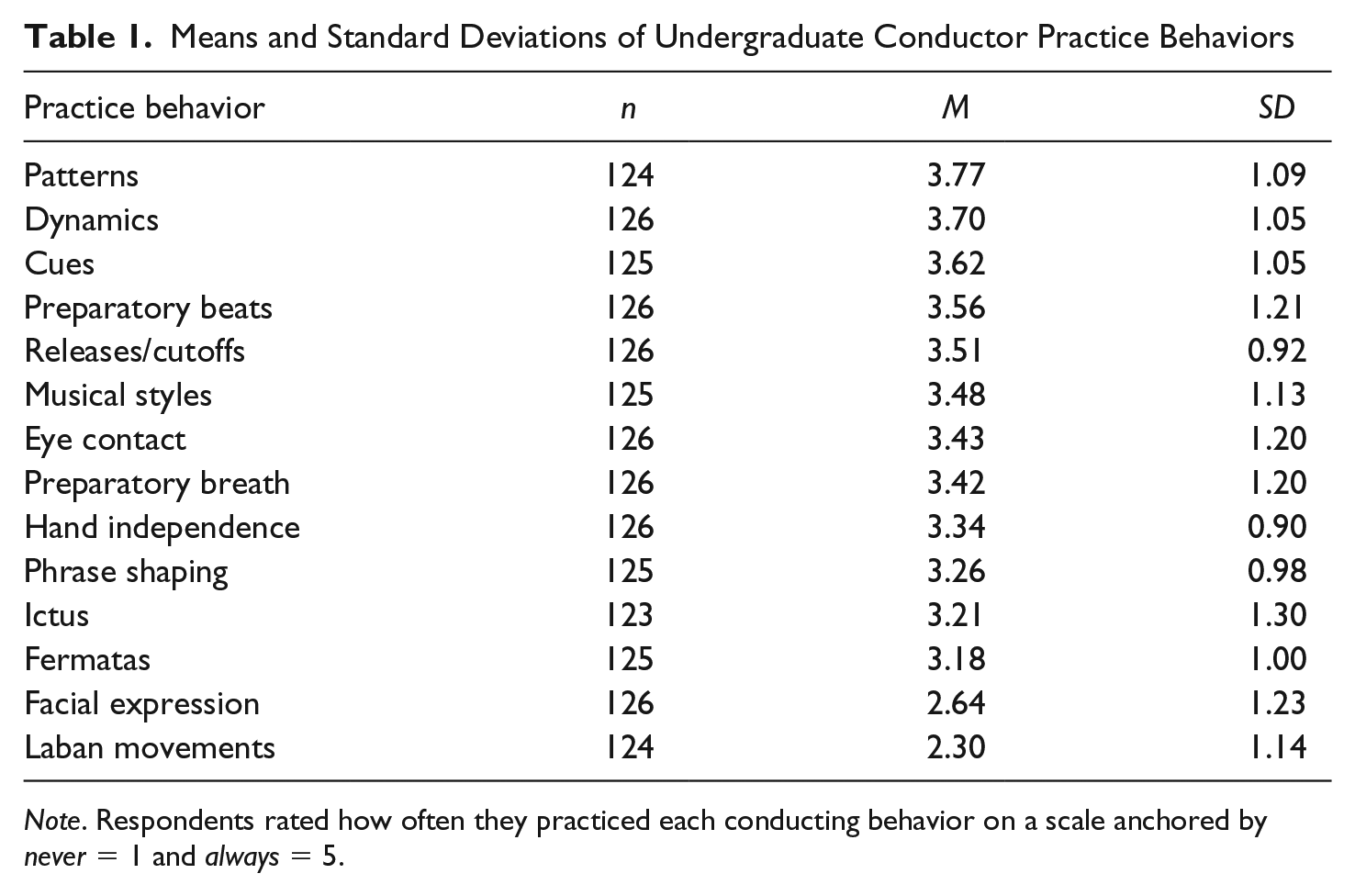
Note. Respondents rated how often they practiced each conducting behavior on a scale anchored by never = 1 and always = 5.
Using the same frequency scale, participants reported how often they used specific strategies when practicing their conducting alone. The most frequently reported strategies included “singing or humming musical lines,” spending time “silently conducting,” and “conducting in front of a mirror.” Conversely, “using a metronome,” “video-recording their conducting,” and “using video analysis software (e.g., SCRIBE or Coach’s Eye)” were the least commonly employed strategies. In Table 2, we display means and standard deviations for participants’ practice strategies. As a follow-up to the previous question, we asked participants “Has your instructor discussed the following conducting practice strategies in class?” The majority of participants indicated that their instructors had discussed “conducting in front of a mirror” (n = 118, 94.40%), “video recording your conducting” (n = 112, 88.89%), “singing or humming musical lines” (n = 114, 91.20%), “using a metronome” (n = 110, 87.30%), “silently conducting” (n = 109, 87.20%), and “conducting with a model recording” (n = 92, 73.01%). Only nine participants (7.14%) indicated that their instructors discussed using “video analysis software (e.g., SCRIBE or Coach’s Eye).”
Means and Standard Deviations of Undergraduate Conducting Practice Strategies
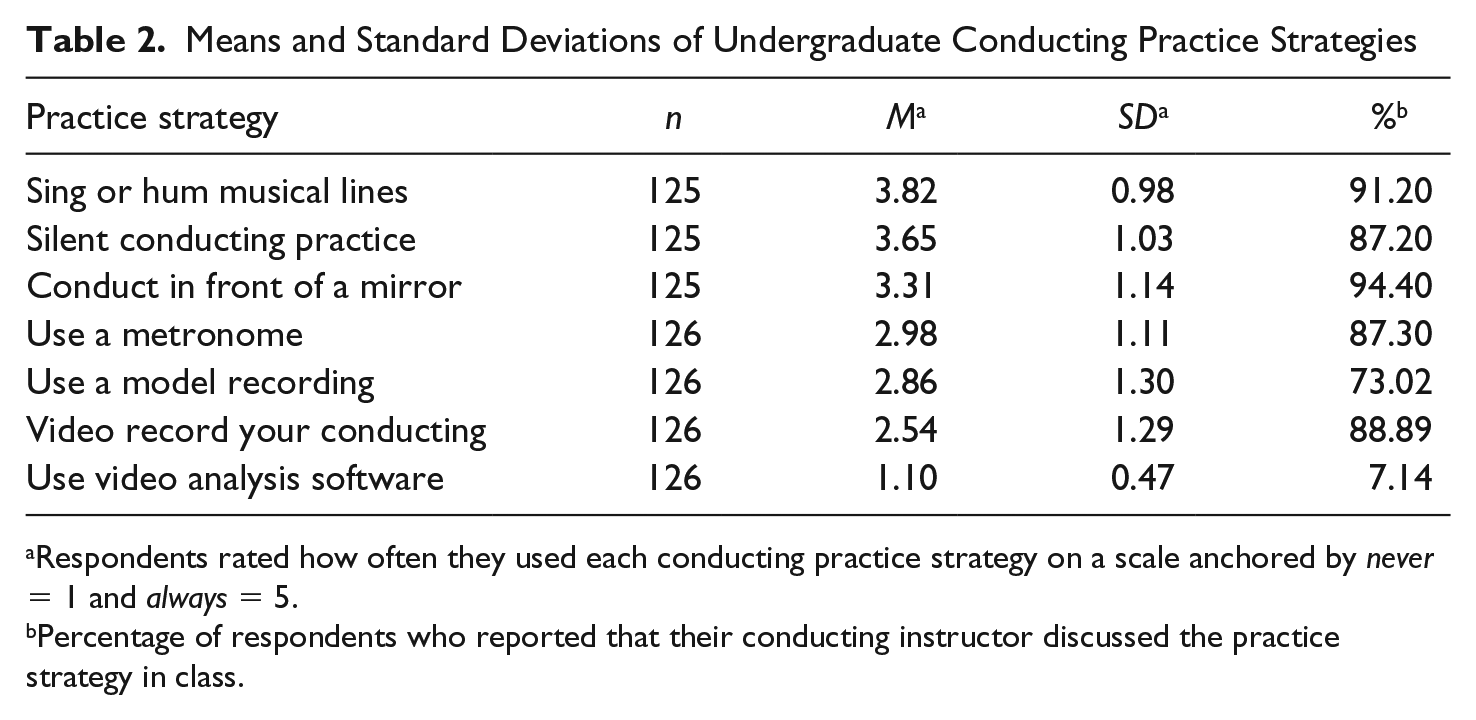
Respondents rated how often they used each conducting practice strategy on a scale anchored by never = 1 and always = 5.
Percentage of respondents who reported that their conducting instructor discussed the practice strategy in class.
We designed the final question of the first section to collect information about the conducting textbooks used in participants’ basic conducting classes. Participants responded to a list of seven texts, and an eighth category “other” from which to choose. “Basic Conducting Techniques” by Labuta and Matthews was the most frequently reported text (n = 44, 33.08%). This text was followed by “other” (n = 42, 31.58%)—which included Methods and Materials for Conducting by Stotter and instructor-provided materials—and The Art of Conducting by Hunsberger and Ernst (n = 27, 20.30%). Other texts included Conducting: A Hands-On Approach by Maiello and Bullock (n = 14, 10.52%), The Modern Conductor by Green and Gibson (n = 4, 3.01%) and Basic Techniques of Conducting by Phillips (n = 2, 1.50%).
Practice Time Allocation
In this section of the questionnaire, we examined how participants used their conducting practice time. We asked participants (Question 5) to provide the number of days per week they practiced conducting. Participants’ mean response was 2.77 days per week (n = 126, SD = 1.43). We also asked participants how many minutes per week they practiced conducting on average, using a scale from 0 (zero) to 120+ minutes with 15-minute intervals as options. The majority of participants indicated that they practiced 30 minutes (n = 49, 40.50%), 45 minutes (n = 25, 20.66%), or 60 minutes per week (n = 20, 16.53%). Roughly 20% of undergraduate conductors practiced 75 minutes or more per week. In the final question of this section, participants answered “What percentage of time do you spend practicing conducting with a score and without a score outside of class time?” The mean percentage for score use during practice was 71.65% (n = 119), whereas without a score was 27.75% (n = 120). For students who did not practice their conducting outside class, we included the option to select “I do not practice conducting.” Four students indicated that they did not practice conducting outside of class time.
Beliefs About Conducting Abilities
We designed Section 3 of our questionnaire to gain further insight into students’ conducting practice and perceived ability through open-ended questions. A three-part qualitative procedure was used to analyze participants’ answers by (a) assigning codes, (b) combining codes into themes, and (c) displaying the data (Creswell, 2007). We adopted preexisting conductor behavior codes (Silvey, 2011) while also allowing for additional codes to emerge. To establish reliability, the second author examined all of the participants’ comments and then the first author independently examined 20% of those comments. Reliability was calculated by dividing the number of agreements by agreements plus disagreements (multiplied by 100 to express it as a percentage), resulting in an acceptable interrater reliability of 90.30%. In response to “What aspect of conducting is most challenging for you?,” 32 participants (19.88%) wrote that “hand independence” was a primary challenge. Other frequently mentioned challenges included “expressivity” (n = 23, 14.29%), “cues” (n = 17, 10.56%), “conducting patterns” (n = 17, 10.56%), and “facial expression” (n = 13, 8.07%). See Table 3 in the online supplemental materials for a more complete summary of conducting challenge responses.
When asked, “What aspect of conducting do you think comes most naturally for you?,” participants indicated, in order of frequency, “conducting patterns” (n = 43, 29.45%), “expressivity” (n = 31, 21.23%), “keeping time” (n = 16, 10.96%), and “cues” (n = 12, 8.22%). Table 4 in the online supplemental material contains further conducting aspect responses. Finally, we asked, “What aspects of conducting do you wish were covered more frequently in your basic conducting class?” Participants provided a variety of responses including “expressivity” (n = 19, 17.43%), “other” (n = 15, 13.77%), and “hand independence” (n = 11, 10.09%). See Table 5 in the online supplemental material for a complete list of open-response codes.
Discussion
Participants indicated that the most practiced conducting behaviors were technical skills such as patterns, cues, and preparatory beats. Expressive conducting behaviors—which included facial expression, Laban movements, and phrase shaping—were among the least practiced. Results from open-response items indicated that practicing the technical demands of conducting came most naturally to participants, whereas hand independence and expressive elements were most challenging. These findings are congruent with research on nonverbal expressivity (Juslin & Persson, 2002; Silvey, 2011). Furthermore, participants’ responses about these conducting skills mirrored the content found in their basic conducting course texts (Green & Gibson, 2004; Hunsberger & Ernst, 1992; Labuta & Matthews, 2017).
It is interesting to note that participants reported practicing expressive behaviors less than technical ones, even though expressive conducting skills were identified as being the most challenging. Participants’ comments indicated that expressive and, to a lesser degree, more refined technical skills should be taught more regularly by conducting faculty. Based on our results, there appears to be an interest among novice undergraduate conductors in addressing expressive elements earlier in basic conducting courses; however, conducting faculty have expressed difficulty in teaching expressive conducting skills to novices (Juslin & Persson, 2002). Because experts demonstrate expressive gestures with more magnitude and regularity than do novices (Bergee, 2005; Byo & Austin, 1994), instructors should examine how they incorporate and teach expressive conducting behaviors to meet the interests and needs of students.
Our participants indicated that they practiced conducting 2.77 days per week on average, and they only did so for a total of 48 minutes per week (or approximately 18 minutes per practice session). Although this may not seem like much practice time for undergraduates who are learning, refining, and automatizing newer motor skills, the looming issue may still be that of curricula. Because there is disagreement about what should be learned in basic conducting courses (Boardman, 2000; Hart, 2019; Manfredo, 2008), more information is needed about students’ conducting practice behaviors and the weight that instructors place on various teaching philosophies (e.g., gestural competencies, score study, instrument pedagogy skills). Nonetheless, the fact that undergraduate conductors reported practicing on their own�a novel finding�should be considered encouraging for basic conducting instructors who may have wondered if students ever practiced these skills outside the classroom. Researchers should consider surveying conducting instructors and their students simultaneously (i.e., over the same semester or academic year) to analyze whether there is overlap between what skills conducting instructors tell their students to practice and what the students actually do.
Undergraduate conductors indicated practicing while singing or humming musical lines more often than practicing in silence. Written responses supported this finding, with participants indicating practicing with a score over 70% of the time. However, it appears that participants rarely used video-recordings to reflect on their behaviors or gestures, even though their instructors discussed using video-recordings as a practice strategy. Research findings have indicated that the use of video reflection as a practice strategy may help improve undergraduate conductors’ abilities to identify their own conducting habits or gestures (Powell, 2016). Observational studies of undergraduate conductors’ practice could confirm and expand on the initial findings of this study concerning conducting practice. In addition, qualitative analyses of conductors’ practice sessions would provide contextual understanding to students’ approaches and choices.
There are limitations to this study that should be noted. Conducting students’ practice behavior is likely affected by the relative emphasis and prioritization placed on course topics by the instructor, but we did not survey conducting instructors about their course content. Such content is also shaped by external factors that govern teacher preparation including NASM and state regulations. Furthermore, disseminating the questionnaire nationally would have given us a larger representative sample. However, we did try to make this uniform by selecting only the first conducting course offered by NASM-accredited institutions and not advanced conducting or rehearsal techniques courses. Although we gathered information from all students who were currently enrolled in basic conducting courses, approximately half of our participants were nonmusic education majors. It is likely that surveying a more homogenous group (i.e., only music education students or music performance majors) may have yielded more insightful conducting practice behavior data, as students’ impetus for practicing these skills probably varies based on their perceived immediate and long-term benefits. In addition, the perceptual data collected about participants’ coursework may have been different at the conclusion of the course versus the 12th week.
Implications and Recommendations
Based on the results of our study, we propose a number of recommendations for instructors of undergraduate conducting courses. Because conducting instructors appear to be successfully preparing students to attain basic technical skills, instructors might consider ways to incorporate more advanced skills like facial expression (Orzolek, 2002) or expressive gestures (Johnson & Fredrickson, 1995) earlier in the developmental process. Identifying and practicing short music excerpts that allow undergraduate conductors to demonstrate expressivity early in their preparation could promote incremental and sustained growth. Instructors should also consider modeling such nonverbal gestures as part of their pedagogy, as students’ practice behaviors often reflect strategies used by their instructors (Miksza, Prichard, & Sorbo, 2012). Conducting instructors could also invite other experts (e.g., mime and dance instructors) to present ideas on gesture and expressivity to their students.
With regard to students’ conducting practice behaviors, instructors can take time in class or during individual conferences to address students’ practice strategies that may improve their self-regulation, similar to approaches found in music performance (Miksza, 2012). By monitoring students’ practice, instructors could determine which strategies discussed in class are being used or need to be reinforced and broaden their contextual understanding of practice routines with regard to time and setting (Baughman, 2017). Furthermore, data gleaned from monitoring students’ practice could be valuable for instructors when determining how to sequence and pace course content.
This study raises several questions that could affect conducting instructors’ pedagogical approaches. To what extent do students’ practice behaviors change when they do or do not use a score? Which elements of a piece of music do students identify as needing gestural practice? How does the difficulty level of a piece of music change the practice behaviors of undergraduate conductors? Conducting instructors could use these research findings to (a) inform the content of their conducting courses, (b) recommend effective practice strategies to their students, or (c) adjust the duration or frequency with which certain skills are taught. Results from the current study inform our understanding of novice conductors’ practice behaviors and beliefs and suggest that additional guidance is needed for undergraduates who often mention the difficulty in developing their expressivity. Further investigation of the contextual factors that influence undergraduate conductors’ practice strategies and beliefs will aid instructors in course design and continue to improve pedagogical strategies and student outcomes.
Supplemental Material
Conductor_Practice_Survey_1 – Supplemental material for An Examination of Undergraduate Conductor Practice Behavior
Supplemental material, Conductor_Practice_Survey_1 for An Examination of Undergraduate Conductor Practice Behavior by Bradley J. Regier, Alec D. Scherer and Brian A. Silvey in Journal of Music Teacher Education
Supplemental Material
Online_Supplementary_Tables_1 – Supplemental material for An Examination of Undergraduate Conductor Practice Behavior
Supplemental material, Online_Supplementary_Tables_1 for An Examination of Undergraduate Conductor Practice Behavior by Bradley J. Regier, Alec D. Scherer and Brian A. Silvey in Journal of Music Teacher Education
Footnotes
Declaration of Conflicting Interests
The author(s) declared no potential conflicts of interest with respect to the research, authorship, and/or publication of this article.
Funding
The author(s) received no financial support for the research, authorship, and/or publication of this article.

Supplemental Material
Supplemental material for this article is available online.
References
Supplementary Material
Please find the following supplemental material available below.
For Open Access articles published under a Creative Commons License, all supplemental material carries the same license as the article it is associated with.
For non-Open Access articles published, all supplemental material carries a non-exclusive license, and permission requests for re-use of supplemental material or any part of supplemental material shall be sent directly to the copyright owner as specified in the copyright notice associated with the article.
