






Abstract
In this multiple case study, I examined experiences of former music education students of color who left their undergraduate programs to develop a more nuanced understanding of the pipeline into—or out of—the music teaching profession. Previous research in music education has examined both the collegiate experiences of students of color and student attrition generally; what is missing, however, are perspectives of students of color who left their programs and their reasons for no longer pursuing careers as music teachers. I interviewed seven former music education students of color from different universities. Guided by a theoretical framework of Museus’ (2014) Culturally Engaging Campus Environment (CECE), five themes emerged: (a) curriculum and coursework, (b) relationships with faculty, (d) relationships with peers, (d) financial burdens of music education, and (e) disillusionment with music and the teaching profession. Implications for music teacher educators include strategies for faculty engagement, curriculum reform, and targeted financial support.
Keywords
In 2023, the National Association for Music Education (NAfME) released A Blueprint for Strengthening the Music Teacher Profession (Confredo et al., 2023), outlining challenges and strategies for recruiting and retaining music teachers of color in U.S. public schools. However, in the years since its publication, shifts in federal policy have altered the national landscape regarding diversity, equity, and inclusion in higher education. Actions include the Supreme Court’s decision to end race-conscious college admission policies (Students for Fair Admissions, Inc. v. President and Fellows of Harvard College, 2023) and executive orders discontinuing grant funding for teacher preparation programs (U.S. Department of Education, 2025). These policies have reshaped the context in which institutions may work to recruit and support racially diverse students in these programs. Given the evolving policy landscape, gaining a more nuanced understanding of the collegiate pipeline into the music education profession is critical, as the vast majority of U.S. music teachers enter the field via an undergraduate degree in music education (Elpus, 2016). Although previous researchers have examined the collegiate experiences of students of color in music education, highlighting challenges and successes on their pathways to becoming music teachers (Bryant, 2022; DeLorenzo & Silverman, 2016; Draves & Vargas, 2022; Fitzpatrick et al., 2014; Kruse, 2013; Lechuga & Schmidt, 2018; Parker, 2023; Regus, 2025; Robinson & Hendricks, 2018), no previous work has centered on reasons students of color leave undergraduate programs and exit the pathway toward a career in music teaching.
Pre-College Experiences for Music Education Students of Color
Researchers have identified commonalities in the pre-college experiences of music teachers of color. Many students have reported that their decisions to pursue music education were due to positive high school music experiences highlighted by strong relationships with both peers and music teachers (Abramo & Bernard, 2020; DeLorenzo & Silverman, 2016; Fitzpatrick et al., 2014; Kruse, 2013; Palmer, 2011; Regus, 2025). However, students of color have also noted limited musical training and/or study outside their high school ensembles (Abramo & Bernard, 2020; DeLorenzo & Silverman, 2016; Fitzpatrick et al., 2014) and difficulty navigating the college admissions and audition process (Abramo & Bernard, 2020; DeLorenzo & Silverman, 2016; Fitzpatrick et al., 2014; Koza, 2008; Lechuga & Schmidt, 2018; Palmer, 2011; Regus et al., 2024; Robison et al., 2019).
Experiences of Music Education Students of Color at Predominantly White Universities
Across multiple studies, researchers have outlined how students of color in music education programs at Predominantly White Universities (PWIs) have encountered marginalization within programs in multiple ways. Academically, Black (Parker, 2023; Regus et al., 2024; Robinson & Hendricks, 2018), Latinx (Draves & Vargas, 2022), and Afro-Latinx (Regus, 2025) students indicated that their musical knowledge and backgrounds were devalued and under-appreciated within schools of music that have historically prioritized Western art music over other musical traditions, styles, and practices. Socially, students of color have reported feelings of culture shock, discomfort, isolation, and loneliness within their programs, as they were often one of the few students of color in almost exclusively White spaces (DeLorenzo & Silverman, 2016; Fitzpatrick et al., 2014; Parker, 2023; Regus, 2025; Regus et al., 2024; Robinson & Hendricks, 2018). In multiple studies, students noted climates of racial insensitivity where Black (Fiorentino, 2020; Parker, 2023), Latinx (Fiorentino, 2020), Afro-Latinx (Regus, 2025), and indigenous (Fiorentino, 2020) students combatted negative racial stereotypes, assumptions, and biases on their campuses. Negative interactions with White peers (Fiorentino, 2020; Parker, 2023) led students to feel like “the spokesperson for all Black people” (Regus et al., 2024, p. 11), question their sense of belonging (Parker, 2023; Regus et al., 2024), and try to “survive” until graduation (Parker, 2023). To ameliorate these issues, students sought out peers with similar identities (Fitzpatrick et al., 2014), enrolled in courses together (Draves & Vargas, 2022), and created support groups (Fiorentino, 2020; Regus et al., 2024).
Relationships with faculty have played a critical role in the experiences of students of color at PWIs (Robison et al., 2019). Negative interactions with White professors have resulted in distrust of faculty (Parker, 2023), feeling inferior to other students (Draves & Vargas, 2022; McCall, 2015), and being othered within classrooms (Kruse, 2013). However, students have also credited faculty members, especially those of color, who cultivated strong relationships with them as playing significant roles in their success and graduation (Draves & Vargas, 2022; Fitzpatrick et al., 2014; Jones & Bannerman, 2024; Kruse, 2013; Regus et al., 2024). In addition, faculty who presented racial experiences outside of a dominant White narrative have created academic spaces for students to feel validated in their identities (Fiorentino, 2020).
Experiences of Music Education Students of Color at Historically Black Colleges and Universities and Hispanic Serving Institutions
Historically Black Colleges and Universities (HBCUs) and Hispanic Serving Institutions (HSIs) play a large role in educating future music teachers of color. Approximately 30% of recent Black music education graduates attended HBCUs, and 25% of recent Latinx graduates attended HSIs (DeAngelis, 2022). HBCUs refer to “any historically black college or university that was established prior to 1964, whose principal mission was, and is, the education of Black Americans” (U.S. Department of Education, Institute of Education Sciences, National Center for Education Statistics, 2024). Students at HBCUs have highlighted the positives of their experiences in music education, expressing an appreciation for campus environments in which their identities and values were affirmed by peers, professors, curriculum, and organizations (McCall, 2015). Similar to students of color at PWIs, they have noted the importance of faculty mentoring and peer support in navigating the stressful demands of music education programs (Bryant, 2022). However, students have indicated that the HBCU experience was not universally positive, raising concerns regarding a curriculum overly focused on marching band, as well as issues related to faculty quality, funding, peer hazing, and colorism, a “practice of discrimination [within the African American community] based on skin color as well as hair texture, eye color, culture, education, and class” (McCall, 2015, p. 245). In contrast to HBCUs, HSIs receive this designation from the federal government once their Latinx enrollment surpasses 25% (Hispanic Association of Colleges and Universities, n.d.). Reflecting this difference, Latinx music education students at HSIs have reported feeling pressures to demonstrate higher levels of acculturation and assimilation into American culture to succeed (Weimer et al., 2019).
Previous researchers exploring collegiate experience for students of color in music education programs have mostly outlined successes despite significant obstacles and barriers (Bryant, 2022; Davis, 2021; Draves & Vargas, 2022; Fitzpatrick et al., 2014; Kruse, 2013; Lechuga & Schmidt, 2018; McCall, 2015; Parker, 2023; Regus et al., 2024); research regarding student attrition is limited. Regus (2025) profiled three Afro-Latinx music education students, one of whom left his collegiate music education program, stating, “I’m not sure if I see myself being able to teach what I want to teach and how I want to teach” (p. 136). Gavin (2012) did explore student attrition within one collegiate music education program; themes included struggles in studio lessons, loss of identity, change in attitude toward teaching, and personal life issues. However, racial identity was not considered as a part of the study design or analysis.
Purpose and Research Questions
In this study, I sought to build on previous research regarding the collegiate experiences of students of color as well as the limited research into student attrition in music education to develop a more nuanced understanding of the undergraduate college experience for music educators of color. In addition, recent shifts in federal policy, including the end of race‑conscious admissions and termination of funding for teacher‑preparation programs, have intensified long-standing challenges in recruiting and retaining teachers of color. Therefore, developing a deeper understanding of why students of color exit undergraduate music education programs may help guide university music teacher preparation programs in supporting students in an era when such practices are at risk. The following research question guided this inquiry: How do former music education students of color describe experiences that influenced decisions to exit their undergraduate programs?
Method
I explored the attrition of former music education students of color using a multiple case study design (Stake, 2006). In this approach, cases are “bound together . . .[as] a ‘quintain’ [which] is an object or phenomenon or condition to be studied” (p. 6). Focusing on a quintain shifts the emphasis from understanding each case in isolation to understanding what the cases collectively reveal about a central phenomenon. In this study, the quintain is the attrition of students of color from collegiate music education programs. To deepen understanding of this quintain, a multiple case study explores both similarities and differences across participants—students of color who share the experience of leaving music education programs.
Because college completion is often a complex and non-linear process, Bean and Metzner (1985) recommend that researchers investigating this topic “choose an operational definition of attrition that is appropriate for the research problem to be investigated” (p. 489). Extending the work of Tinto (2012) who used the terms “institutional” and “system” (p. 128) to distinguish between individuals who depart collegiate programs at their institution versus those who depart the higher educational system at large, for this study, I define attrition from a “programmatic” perspective: those who departed their originally intended collegiate program of study, in this case the music education major.
Participants
Because potential participants were former students who left the pathway toward the music teaching profession, they were unlikely to be active within current music teaching networks, organizations, forums, or online communities where participation in this study could be more directly solicited. Therefore, after receiving approval from my university’s Institutional Review Board, I recruited potential participants using a) criterion sampling (Patton, 2014) to find students of color who entered college as music education majors but left programs prior to graduation and b) intensity sampling (Patton, 2014) to seek participants whose experiences reflected a strong relationship to the quintain. I set a target of six to eight participants, consistent with previous case studies in music education research that have explored identity and marginalization in collegiate programs (e.g., Bryant, 2022; Fiorentino, 2020; Regus, 2025). I contacted music education faculty, high school music teachers, and others in my personal and professional networks, explaining the purpose of the study and eligibility criteria: students of color who entered college as music education majors but left programs prior to graduation. Colleagues who indicated that they had former students who fit the criteria then contacted these individuals to gauge their interest in the study.
I screened potential candidates according to the following: that each participant’s experiences would (a) be relevant to the research questions, (b) provide diversity across other participants, and (c) offer an opportunity to learn about their shared experience across different contexts (Stake, 2006). Ultimately, seven participants enrolled in the study, each of whom attended different undergraduate music education programs in seven different states in the Midwest, South, and Southwest.
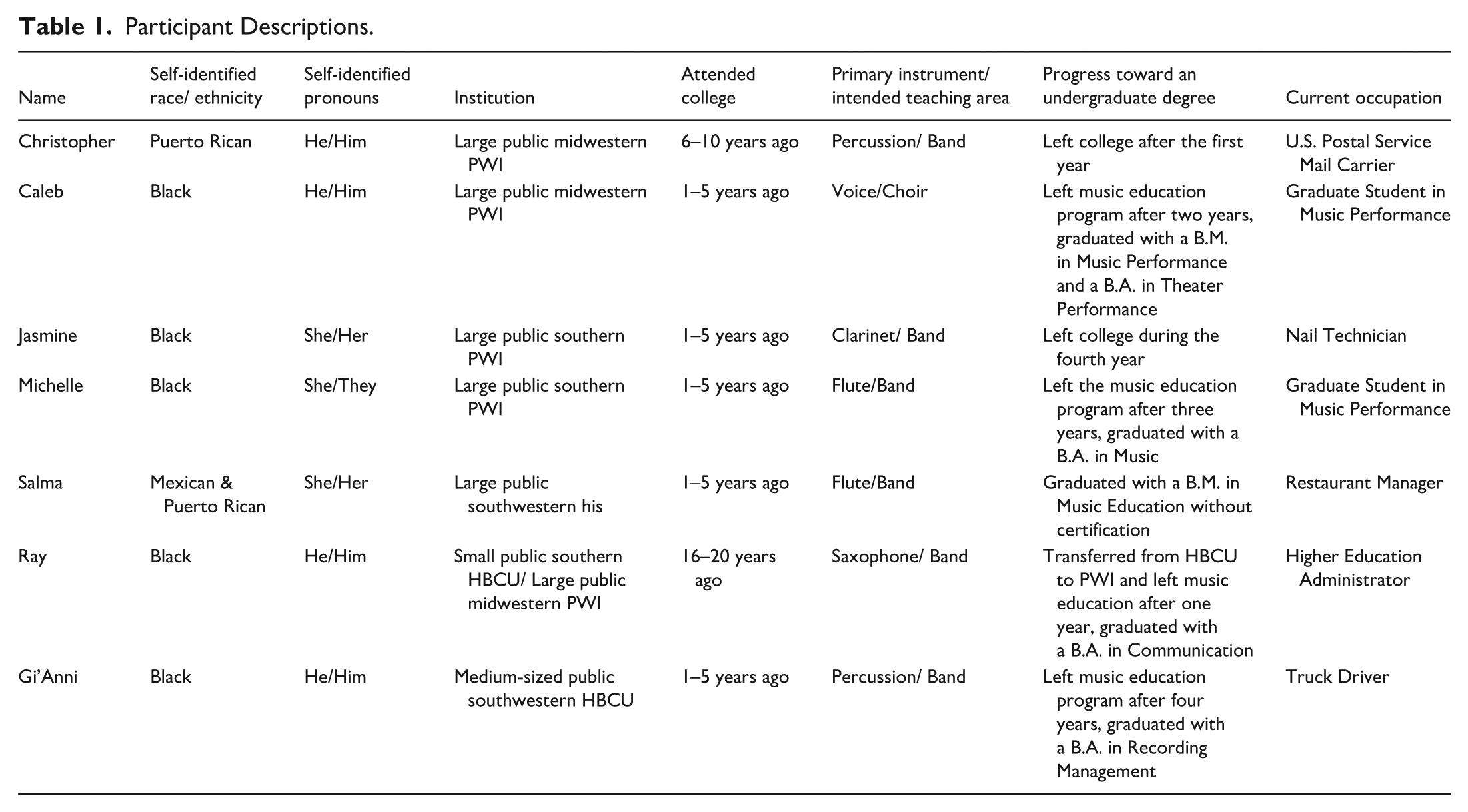
Each participant entered college with the intention of becoming a music teacher; six participants left their programs prior to graduation. One participant graduated with a degree in music education but opted against completing her teaching certification, the ultimate goal of the program, and therefore her experiences fell within my operational definition of programmatic attrition. For the other six participants, two dropped out of college, three graduated with other music degrees, and one graduated with a major outside of music. At the time of the study, no participants had any immediate plans to pursue a career as a music teacher. Two participants were graduate students in music performance, and the other five were employed in a variety of occupations. All participants attended public universities: four attended PWIs, one attended an HSI, one attended an HBCU, and one began at an HBCU before transferring to a PWI. Finally, although participants were specifically recruited for this study as former music education students of color, all participants self-identified as coming from low-income backgrounds, and all but one participant were first-generation college students. Table 1 provides a description of participants, all of whom chose pseudonyms.
Participant Descriptions.
Data Collection
I developed semi-structured interview protocols to guide two rounds of interviews with participants. The first consisted of open-ended questions to explore participants’ experiences in their programs, their reasons for both entering and leaving the major, and their reflections on coursework, identity, relationships, and support. In the second, I asked follow-up questions for clarification and elaboration and explored emergent topics with participants (see Supplementary Materials for protocols). When investigating a phenomenon of interest, Seidman (2013) recommends a three-interview series: (a) focused life history, (b) the details of experience, and (c) reflection. However, Seidman also acknowledged that conducting three interviews may not be feasible and encouraged researchers to adapt the structure as long as “participants [may] reconstruct and reflect upon their experience” (p. 25). Because the purpose of this study was to explore and reflect on details of a particular experience, I condensed the process into two interviews, focusing on life history and details in the first interview, and reflection in the second.
I conducted the initial round of interviews between March 2021 and December 2021, which ranged from 42 to 56 min. I then conducted follow-up interviews between June 2022 and February 2023, which ranged from 25 to 55 min. Interviews were primarily over Zoom, except for one in-person interview, which I recorded using an external audio recorder. After each interview, I uploaded audio files to Otter.ai (2024), where I listened back and edited interview transcripts until they accurately reflected the content of the interviews. In total, I conducted 602 min of interviews, yielding 190 pages of single-spaced transcripts.
Data Analysis
I uploaded each interview transcript to MaxQDA (2022) for analysis. For my initial within-case analysis, I began by in vivo coding to center the experiences of participants in their own words (Saldaña, 2014). Then, because this study focused on students’ reasons for leaving their programs, I engaged in process coding to capture “ongoing action/interaction/ emotion taken in response to situations, or problems, often with the purpose of reaching a goal or handling a problem” (Corbin & Strauss, 2008, pp. 96–97). Next, to begin the cross-case analysis, I used pattern coding (Saldaña, 2014) to develop themes related to causes and explanations, organizing codes into 14 categories. Finally, I examined these 14 categories using theoretical coding, which “integrates and synthesizes the categories derived from coding and analysis to now create a theory” (Saldaña, 2014, p. 224), sorting codes into five overarching themes.
Trustworthiness
As an initial trustworthiness measure (Stake, 2006), I conducted follow-up interviews with participants to discuss emerging themes, ask clarifying questions, and offer opportunities for feedback. Although triangulation from multiple perspectives is recommended for case study research (Stake, 2006), I decided against conducting interviews with participants’ teachers, professors, or advisors because I wanted to center the study solely on ways in which participants described their lived experiences within their programs. After both the second-stage pattern coding and theoretical coding, I sought out a peer-debriefer for an external audit of the coding process, at which point we discussed emergent themes, disconfirming evidence, and the theoretical framework. Finally, I engaged in member checking with participants, offering multiple opportunities to review interview transcripts, selected quotations, my interpretations, and emergent themes. All participants responded to both rounds of member checks, and two requested changes to their quotations.
Positionality
I share few, if any, of the marginalized identities that my participants brought to this work. I am a cisgender, middle-class, heterosexual White male who has benefited from the privileges that come with identifying with the dominant cultural norms of society. Although I cannot claim any shared knowledge of the lived experiences of my participants, I sought to use my position as a researcher to critically examine both myself and the structures of power in which I reside (Talbot, 2018). My goal throughout this process was to speak with participants rather than for them (Hess, 2018), engaging them as collaborators and emphasizing stories in their own words to “powerfully articulate their realities” (p. 583). To practice reflexivity through the process, I noted my evolving interpretations of participant experiences, especially those that were—and were not—related to aspects of their racial identity. In addition, I utilized peer debriefing conversations to ensure that interpretations were grounded in participants’ lived experiences before bringing emergent themes to participants for their feedback and collaboration.
Theoretical Framework
To guide my analysis, I used Museus’ (2014) Culturally Engaging Campus Environment (CECE) model of collegiate success (see Figure 1) as a theoretical framework. Although theoretical frameworks often guide both data collection and analysis in qualitative research, the CECE model emerged after the first round of interviews, when an initial framework did not adequately reflect the complexity of participants’ experiences. The CECE model emerged as a better fit because it takes a multifaceted approach to collegiate success that considers personal, external, and institutional factors. Diverging from previous work in student attrition, especially that of Tinto (1975, 1993, 2012), which had previously related success to student behaviors and individual factors, Museus (2014) instead focused this model on the role of the institution in creating a campus environment that fosters success for students of color.
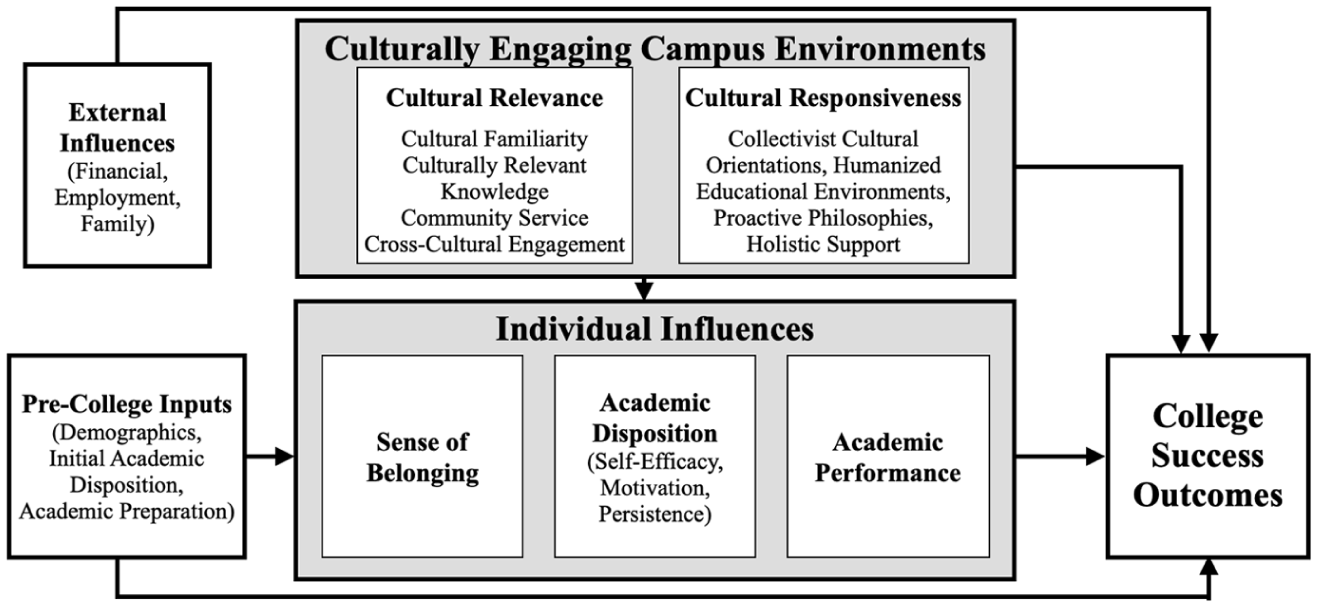
Culturally engaging campus environment (CECE) model of college success (Museus, 2014).
In the upper left corner of the CECE model are External Influences that impact college success, which include finances and family influences. These affect success outcomes directly and may be independent of the collegiate experience. Next, in the bottom left corner, are Pre-College Inputs that are associated with every student prior to entering college. These can be demographic factors, academic dispositions (such as self-efficacy), and academic preparation, which can influence both their collegiate experience as well as success outcomes. The center of the model highlights nine indicators of a culturally engaging campus, divided into two categories: Cultural Relevance (cultural familiarity, culturally relevant knowledge, community service, and cross-cultural engagement) and Cultural Responsiveness (collectivist cultural orientation, humanized educational environments, proactive philosophies, and holistic support). Specific examples of these indicators include cultivating academic environments where students “have opportunities to learn and share knowledge about the issues within and needs of their own communities” and “engage in positive and purposeful interactions with peers from disparate cultural origins” (p. 211). Each of these nine indicators can positively affect students’ sense of belonging, academic disposition, and academic performance, all of which have been linked to collegiate success outcomes for students of color.
Findings
Five main themes emerged from the cross-case analysis: (a) curriculum and coursework, (b) relationships to faculty, (c) relationships to peers, (d) financial burdens of music education, and (e) disillusionment with music and the teaching profession. For each of these five dimensions, they were either experienced as a connection that strengthened their collegiate experience or as a disconnection that weakened their experience. Although the collegiate experience has been characterized as a series of junctures and barriers as students move through time (Barefoot, 2010), what emerged in these interviews was indicative more of a dynamic web of connections that pulled and pushed against students throughout their time in college. Across participants, it was often an accumulation of specific disconnections, rather than a single event, that influenced decisions to exit their music education programs.
Curriculum and Coursework
Music Theory
Participants described contrasting experiences within the music education curriculum—the planned educational experience—as well as the coursework within specific classes. Specifically, students often singled out music theory courses for being particularly arcane. Caleb recounted his music theory experience, stating, “I cannot stand theory. I hate it . . . I don’t like to say that I’m not good at it. Because I’m probably decent at it . . . the only reason why I took five years to complete two degrees is because of one theory course.” Gi’Anni’s experience in music theory was not much different, as he left his music education program because he had trouble “grasping [theory] concepts, not understanding them, or them not necessarily being taught all the way in depth properly. I kind of caught myself always, like, calling the drum instructor that I had in high school [for help].” Christopher repeatedly referenced profoundly negative experiences in one theory class, identifying this course as the primary reason he left college after his first year. For some participants, difficulties and negative interactions in core music theory courses became pivotal moments that shaped their decisions to leave their music education programs.
However, other participants, such as Ray, found music theory less challenging. Ray was also the only participant who attended a performing arts high school, stating that “I think a lot of folks had a more difficult time in that class than I did because of the high school I went to . . . the introductory course was very easy for me, because I had already been doing this.” Salma was the only participant to highlight the positives of her music theory experience. Her professor made the material relevant to her other courses by emphasizing “why it’s important for us to learn what we’re learning . . . I saw how it connected with my private lessons . . .[and] I noticed that as I took aural skills, my intonation got better.” Notably, Salma was the only participant in this study to graduate with a music education degree, although she opted against completing her teaching credential.
Ensembles
Participants consistently emphasized the central role that ensembles played in shaping their collegiate music education experiences. For some, this was a positive. Jasmine persisted in her music education program for three years because of her strong experiences in her university’s concert band. She stated that, “being a Black woman, I felt like I was represented . . .[our director] went out of his way to find and incorporate women composers, composers of color . . . I felt very included.” Gi’Anni attended a high school with an HBCU-style marching band, so he specifically sought this type of ensemble in a collegiate music program. He took pride in being part of the band, stating, “We are the biggest student entity on campus.” However, others described mandatory ensembles in less glowing terms. Salma lamented long Saturdays through the fall devoted to marching band and football games, while Ray felt that the undue emphasis put on his HBCU marching band came at the expense of other musical activities. As a vocalist, although Caleb was not required to be in marching band, he found himself being pushed to participate in multiple choirs, stating that “You’re kind of told that . . . if you don’t take the time and do all these other things, then you’re not a part of the community.” Because their ensembles often demanded more time from students than the listed credit hours, they sometimes fostered feelings of discontent rather than the strong institutional connections they might have otherwise built. Added pressures and misalignments that these students felt from mandatory ensembles, compounded with other challenges, impacted their decisions to ultimately exit their programs.
Relationships With Faculty
For participants in this study, nothing was more complex than the constantly evolving relationships they maintained with faculty. In the best scenarios, students developed meaningful relationships with key professors who kept them engaged and were often credited with their successes. Relationships with faculty sometimes began prior to college as faculty members used the audition process to recruit, offer scholarships, and advocate for students in the admissions process. For Jasmine, she navigated the audition process entirely on her own, combing through YouTube to find appropriate repertoire. When it came time to audition, “I wasn’t used to . . . playing by myself alone, so I was fumbling . . . bumbling over the . . . fingerings, all that stuff.” However, her clarinet professor “saw something in me. He was like, ‘We’re gonna accept you’ [even though] there were a lot of things I needed to work on.”
Many students specifically highlighted the closeness they felt with music education faculty advisors to the point of not wanting to inform them of their decision to leave their music education programs. Gi’Anni stated about his advisor: “She cares. When she found out that I was switching [majors], I didn’t tell her, and she was upset. ‘I just hate that you didn’t inform me—I want to be there to help and support you.’” Michelle felt similarly about her music education advisor, reflecting that “I went to her for everything . . . I love her so much. She’s probably like my favorite person ever.” Salma remembered a particular moment from a music education class where the professor made time so “we could all just talk about our problems, like what we had going on in our lives . . . And it was a safe space to just let our emotions out because, I mean, we all really needed that.” Although Caleb left the music education program, his close relationship with his voice teacher influenced his decision to continue in the School of Music and pursue a degree in music performance. “He challenged me, but also, you know, got down to my level, with, with life just in general. He cares about how you are in the day and what’s going on . . . He’s not just a teacher.” In each case, faculty members went above and beyond to build sustained relationships with each student, offering strong connection points to the program.
Other students had markedly different experiences with faculty in their programs. For Christopher, repeated negative experiences with one professor in a remedial theory class played a significant role in his decision to leave his program after his first year. He recalled, “One kid was really excelling in the class. And our professor said something like, ‘Oh . . . you’re doing really well. You shouldn’t be in this class, unlike our friend over there’ [pointing to me].” When faculty interactions became strained or left students feeling discouraged, these moments often served as turning points that led participants away from the music education degree. However, these complex relationships sometimes evolved over time. For Michelle, a rather acrimonious relationship with her studio teacher was the main reason she left music education after her third year. But as she continued in her music B.A. program, her relationship with the same studio teacher improved dramatically, leading her to decide to pursue a graduate degree in performance.
Relationships With Peers
Participants who attended PWIs commonly described themselves as being one of the few students of color in predominantly White spaces. They were acutely aware of racial differences, especially when offering their perspectives and opinions in class. Michelle reflected that it “feels weird that I’m still in a room full of people who really don’t look like me.” To cope with these feelings, she often sought out solidarity from the other Black students in her program. “We would kind of have this, like, connection with other Black students, where we would definitely support each other more, just like, ‘yeah, you know, it’s hard for us, but we’re gonna get there.’” Caleb employed a similar strategy to develop camaraderie among other Black students in his classes. “We know the other Black people in the classroom, because we see each other immediately, right? Because it’s a white room, and then there’s one black dot . . . Gravitating towards . . . the other Black people in the classroom, this is what you did.” For students at HBCUs and HSIs, however, their experiences were markedly different. Although Salma was from a different background than many of her White peers, faculty efforts to validate her educational and cultural experiences helped bridge those differences. The two students who attended HBCUs, they both found themselves in racially affirming environments. Gi’Anni described his reasons for attending his HBCU: “I didn’t want to be a number; I wanted to be a name. So I naturally wanted to go somewhere I knew I could be comfortable . . . it almost felt like home.”
In addition to bringing attention to the racial dynamics of their relationships with peers, participants also reflected on their relative standing in their programs compared to others. Only Ray felt himself ahead of his classmates, as he rose to the top of ensemble seating assignments and tackled theory coursework with ease. In contrast, others felt much differently about their respective standing in their programs. For example, Christopher reflected on collaborating on homework assignments with classmates: “They were willing to help me, but at the same time, it was like ‘how don’t you know this kind of stuff?’” Among participants, feelings of being behind their peers stemmed from many sources, including enrolling in remedial courses, observing others in practice rooms and studio classes, noticing differences in resources and training, and being assigned to graduate students for private lessons rather than faculty. Over time, as patterns of isolation, comparison, and a limited sense of belonging built up alongside other challenges, these peer dynamics sometimes became part of the set of factors that led students out of their programs.
Financial Burdens of the Music Education Major
Participants discussed at length the financial burdens of the music education major. Financial struggles manifested in multiple ways, including unpaid student teaching, transportation challenges to observations/practicum, additional time commitments to ensembles beyond credited hours, outside work responsibilities, finding adequate time to practice, and maintaining instruments. Ray spent his first year in college at an HBCU in the south before deciding to transfer to a PWI closer to home in the Midwest. After his audition, the saxophone professor offered the following feedback: “Technically, this is great. This is on point, we’d love to have you . . . we want to have you in the studio, but you need a new instrument.” Ray’s response: “I can barely afford being here at school.” That conversation ended Ray’s pursuit of a music education degree as he chose a different major at his new university.
For other students, financial burdens appeared in more insidious ways. Jasmine, a clarinetist, needed to work a full-time job to help pay for school, which meant that she lost time toward practicing, leaving her feeling overwhelmed.
A lot of [other students] didn’t work. So they had a lot of free extra time to practice . . . I worked 3–12 and then I had 8 a.m. classes, so my only time to practice was literally at like 2:00, 3:00 in the morning, but they would still be there practicing.
Music education coursework, especially practicum and observations in area schools, also presented hidden costs to participants. Michelle recounted that her school assignments for music education coursework “weren’t in walking distance . . . And I’m like, ‘Well, I don’t have a car. I also don’t have money to pay gas money and catch Ubers.’” Finally, for Salma, grappling with the prospect of unpaid student teaching marked the moment she left the pathway toward music teaching: I chose not to graduate with the teaching certification because of the financial reasons . . . In order to get my certification, I have to student-teach, and that’s considered a class so I have to pay for it. And I’m basically a teacher’s aide. And I think anywhere else, this would be considered an internship where we would get paid for it, but we don’t.
Whether experienced as mounting pressures or sudden, non‑negotiable costs, financial burdens emerged as some of the most powerful disconnections in the web of students’ collegiate experiences, often making it no longer feasible to remain in their programs.
Disillusionment With Music and the Teaching Profession
Five of the seven participants in this study were enrolled in their programs during the spring of 2020, when the COVID-19 pandemic dramatically altered their collegiate experiences. Challenges such as online music courses, miscommunication regarding program deadlines, or the complexities of student-teaching online contributed to a growing disillusionment with the prospect of becoming teachers, and some participants used this time to reevaluate their career plans. Salma recalled that “I saw especially after the pandemic, how teachers were not being treated very well . . . So I thought, what if something like that happens again, do I really want to be kind of stuck doing that? But it also made me really sad, because I remember how passionate I was in the beginning.” For these five students, they also began to grasp what daily life might look like as a K–12 public school teacher. Jasmine remembered that after a semester of observations, “it was the background . . . that I kind of really didn’t want to be part of . . . the teacher work . . . [such as] reporting to faculty meetings.” However, this sense of disillusionment extended beyond participants enrolled in college during the pandemic. Looking back, Christopher recalled, “I went there for a reason. And that reason was music education . . . to grow as a musician and to learn more . . . Once I felt like that’s not what I was doing there, I definitely decided that, you know, I’m not going to waste my time or waste my money.” Similarly, Ray’s enthusiasm for pursuing a career in music teaching diminished after his saxophone teacher required him to purchase a new instrument to transfer to his studio. Across all participants, these experiences prompted them to reflect critically on whether music teaching remained a viable career path. As disillusionment intersected with other disconnections and students’ sense of a future in teaching diminished, continuing in the major no longer felt like a logical choice.
Discussion
In this study, I examined collegiate experiences that influenced students of color to leave their undergraduate music education programs. Each student had their own unique reasons for leaving their programs and not pursuing careers in music education; however, their commonalities may offer insights into how music education programs might better support students of color in their programs. Although the themes in this study align with findings from previous research, the CECE model may offer a valuable framework for more deeply interpreting these students’ experiences.
First, the CECE model identifies nine dimensions of a culturally engaging campus. Museus (2014) asserts that “the degree to which culturally engaging campus environments exist at a particular postsecondary institution is positively associated with more positive individual factors and ultimately greater college student success” (p. 207). The following three themes: (a) curriculum and coursework, (b) relationships with faculty, and (c) relationships with peers, are aligned within multiple dimensions of a culturally engaging campus, especially culturally relevant knowledge, humanized educational environments, and holistic support. Reinforcing previous studies that have examined the college experience for students of color (Bryant, 2022; DeLorenzo & Silverman, 2016; Draves & Vargas, 2022; Fitzpatrick et al., 2014; Kruse, 2013; Lechuga & Schmidt, 2018; Parker, 2023; Regus, 2025; Robinson & Hendricks, 2018), strong alignment, connection, and support in these three areas was associated with collegiate success for participants in this study. Students who found evidence of these dimensions in their music education program—through the curriculum, coursework, or relationships with faculty and peers—felt more connected to their programs and often persisted longer toward degree completion. Those who experienced little to no evidence of these practices tended to leave early, like in the case of Christopher, who left after his first year.
For the three students who graduated with different degrees than they originally intended, their time in college should still be considered a success. Among the participants in this study, those who received strong support from their studio teachers ultimately left their music education major but completed degrees in music performance. Their experiences both corroborate and complicate findings from Gavin (2012), in which he identified negative experiences in applied music studios as a key factor in student attrition. Although negative experiences with private teachers did play a role in some students’ decisions to leave their programs, results from this study suggest that faculty influence is not limited to studio teachers. Students often credited faculty, including music education advisors, studio teachers, and ensemble directors, who went above and beyond to support them, as key contributors to their success, even if it came outside of music education.
Second, the CECE model identifies finances as an External Influence that impacts success outcomes. In his discussion of finances, Museus (2014) highlighted both the challenges of collegiate tuition and the negative impact of outside employment on college persistence. Although income level was not considered during participant recruitment, all participants self-identified as coming from low-income backgrounds. Their intersectional identities, particularly regarding race and socioeconomic status, offered new insights into the financial burdens of music education programs. Participants made a few decisions without some thought to their financial ramifications. Costs associated with student loans, coursework expenses, instrument purchases and maintenance, and financial aid directly affected students’ success, which align with financial concerns also noted by first-generation music education students (Garrepy & Bernard, 2024; Jones & Bannerman, 2024; Vasil & McCall, 2018). These patterns mirror broader structural inequities in access to music education, where the “intersection of socioeconomic and systemic racism barriers produces deep disparities in who has the resources and support to pursue a career in music” (Yi, 2023, p. 15), continuing to shape beyond the K–12 level who is able to persist in music education programs.
Other financial challenges exerted a more indirect influence, particularly through time constraints, which has not been previously explored in either the CECE model or music education research. For students in this study, the most demanding part of their programs was often not the coursework itself, but limited time due to financial burdens. Because time and money were both finite resources in students’ lives, the time required by outside work responsibilities, one credit-ensembles such as marching band and choir, travel to off-campus practicum and observation sites, and unpaid student teaching all detracted from their ability to maintain a sustainable balance between school and necessary outside employment. While prior research has acknowledged the rigorous nature of the music education major (Bryant, 2022; Garrepy & Bernard, 2024; Gavin, 2012; Jones & Bannerman, 2024; Parker, 2023; Payne et al., 2020), reframing these challenges from a financial standpoint may elucidate how participants in this study experienced these pain points and may help music education programs recognize the role that financial pressures play in students’ persistence.
Finally, the theme of disillusionment with music and the teaching profession can be associated with the “Individual Influences” section of the CECE model, which includes concepts such as sense of belonging and self-efficacy. Once students no longer saw themselves as future K–12 music teachers, they may have had doubts about their place or their ability to thrive in the music teaching profession. Like students in Gavin (2012), who experienced a fundamental shift in their personal attitudes toward becoming music teachers during college, students in this study came to similar realizations about their career goals and views toward the teaching profession.
Limitations
Because recruitment occurred through my professional networks, this approach likely connected me with individuals who remained in contact with former faculty and felt comfortable responding to a study invitation. As a result, interviews reflected experiences of participants who remained connected to these networks and may not capture perspectives of students who severed these ties upon leaving their programs. In addition, recruiting participants through the same faculty members who taught them introduces complex power dynamics where students may have participated out of a sense of obligation to their former professors. Finally, for two participants, their time in college was more distant, as interviews happened between six and 20 years after their departure from their programs. Although these participants spoke in detail about their experiences, recall about some finer points, interactions, or other moments may have been limited.
Implications for Music Teacher Education
Gaining a deeper understanding of why students of color leave music education programs can shed light on the perhaps unseen mechanisms shaping collegiate experiences. First, faculty in music education programs need to critically assess multiple connection points students of color have with their institutions. Consistent with previous research (Regus, 2025; Regus et al., 2024), students in this study identified multiple disconnections with the curriculum, especially in music theory. Although prospects for curricular change may vary across institutions, relationships with key faculty as advisors, studio teachers, and ensemble directors are critical to success, especially for students of color. Previous research has highlighted the importance of faculty mentors of color (Fitzpatrick et al., 2014; McCall et al., 2023; Regus et al., 2024), but the responsibility for cultivating strong relationships should rest with all faculty to implement culturally responsive practices to build supportive and meaningful relationships with their students.
Second, music education departments need to recognize the strengths that students of color are bringing to these spaces, which may begin with high school student recruitment (Abramo & Bernard, 2020) and support through the college audition process (Fitzpatrick et al., 2014). This is especially important for students of color within music education programs at PWIs, as several participants described feeling like one of the few students of color in predominantly White spaces, echoing findings from previous research (DeLorenzo & Silverman, 2016; Fitzpatrick et al., 2014; Parker, 2023; Regus, 2025; Regus et al., 2024; Robinson & Hendricks, 2018). Rather than devaluing knowledge that falls outside of traditional Western art music (Draves & Vargas, 2022; Parker, 2023; Regus et al., 2024; Robinson & Hendricks, 2018), departments need to affirm these epistemologies and traditions, as these practices may likely prove valuable to music teachers in their future schools. In addition, in academic environments where self-comparison may be inevitable, affirming multiple ways of knowing and making music may empower students of color to resist internalizing deficit narratives or see themselves as “behind” their peers.
Third, however possible, music education departments need to identify ways to financially support students beyond standard institutional financial aid packages. For participants in this study, financial realities shaped how they navigated their time in college, as their experiences aligned with Jones and Bannerman’s (2024) observation that “institutional incentives” (p. 49) can meaningfully influence how students make decisions about their college experience. As Regus (2025) noted, “Although financial support alone cannot eliminate cultural isolation or the challenges . . . it can facilitate opportunities for these students to seek mentorship across campus or at other institutions” (p. 325). This perspective highlights why faculty and other support staff must be transparent about program costs with new students by taking a broad view of the financial commitment of being a music education major, especially time, as a finite resource for students. Whereas students in other programs might be done once they finish a problem set, reading, or assignment, there’s always more practicing to be done for musicians—how much time spent practicing do students need to be successful?
Some challenges identified in this study, particularly financial burdens and disillusionment with the teaching profession, are not unique to students of color. However, for participants in this study, these commonly noted pressures often intersected with other racialized or marginalized dimensions of their collegiate experiences, which amplified their impact. These intersections reflect patterns noted in previous research regarding students from marginalized backgrounds, particularly how race and socioeconomic status impacted their experiences in music education programs (Draves & Vargas, 2022; Fitzpatrick et al., 2014; Garrepy & Bernard, 2024; Jones & Bannerman, 2024; Regus, 2025; Vasil & McCall, 2018). Given the heightened scrutiny and rolling back of race-based initiatives at the federal level in higher education, music education programs must be especially intentional in their retention strategies. Exploring interventions designed especially to support low-income and first-generation students may also have a positive impact on the experiences of students of color; similarly, specific interventions might not be needed by all students of color but may be beneficial to other marginalized students across the department. Ultimately, leaning into individualized approaches such as faculty advising, mentoring, and community building can benefit all students in a program. In these ways, music teacher educators can continue working toward goals of racial equity while remaining responsive to the legal and political realities of the moment.
Although this study focused on a small group of individuals, their stories illuminate the institutional dynamics that shaped their experiences as they moved into and out of the pathway to music teaching. Because earning an undergraduate degree in music education remains the dominant pathway into the profession, removing barriers or other mechanisms that may be funneling out music teachers of color during college is a critical component of early career retention. If our profession hopes to build a more diverse music teacher workforce, exploring transferable elements from these narratives may help music teacher educators and other faculty and staff identify strategies to support students of color that are relevant to their specific institutions.
Supplemental Material
sj-docx-1-jmt-10.1177_10570837261457563 – Supplemental material for Attrition of Undergraduate Music Education Students of Color: A Multiple Case Study
Supplemental material, sj-docx-1-jmt-10.1177_10570837261457563 for Attrition of Undergraduate Music Education Students of Color: A Multiple Case Study by David R. DeAngelis in Journal of Music Teacher Education
Supplemental Material
sj-docx-2-jmt-10.1177_10570837261457563 – Supplemental material for Attrition of Undergraduate Music Education Students of Color: A Multiple Case Study
Supplemental material, sj-docx-2-jmt-10.1177_10570837261457563 for Attrition of Undergraduate Music Education Students of Color: A Multiple Case Study by David R. DeAngelis in Journal of Music Teacher Education
Footnotes

Funding
The author received no financial support for the research, authorship, and/or publication of this article.
Declaration of Conflicting Interests
The author declared no potential conflicts of interest with respect to the research, authorship, and/or publication of this article.
Supplemental Material
Supplemental material for this article is available online.
References
Supplementary Material
Please find the following supplemental material available below.
For Open Access articles published under a Creative Commons License, all supplemental material carries the same license as the article it is associated with.
For non-Open Access articles published, all supplemental material carries a non-exclusive license, and permission requests for re-use of supplemental material or any part of supplemental material shall be sent directly to the copyright owner as specified in the copyright notice associated with the article.
